An Assessment of Written Responses to
Conflict Imagery by Northern Ireland Art
and Non-Art Students
Martin Forker
*Abstract
This study examines the written responses of art and non-art students in Northern Ireland to a series of images related to conflict using Stavropoulos’ (1992) Diagnostic Profile (DP). Stavropoulos’ instrument is primarily designed to offer a more complex and nuanced insight into the analysis of art images using four dimensions: descriptive, formal, interpretative, and historical. It is evident that even though the art students achieve overall higher scores than the non-art students, it might have been expected that they would have shown greater evidence of more specific knowledge-based elements in their accounts. This finding might imply that the delivery of the art curriculum in Northern Ireland pays insufficient attention to the formal and historical aspects of the subject, but rather has encouraged the students to rely on more descriptive and interpretative judgments which are insufficiently rooted in the formal traditions of the subject. This study also uses an additional fifth social/psychological dimension, developed by the present researcher, to identify the social attributions and coping strategies used by children affected by the conflict in Northern Ireland. Specifically, this study scrutinizes the social attributions of 159 Protestant and Catholic art and non-art high school students living in real conflict zones of Belfast. The findings suggest that there is a proliferation of fear, harm and loss attributions in the children’s written responses. Related to this is the extent to which attributions reflecting outgroup/ingroup themes and issues related to religious/ideological support, stereotyping and social representation
categorizations are also present. It is also apparent that some children possess something that is akin to a “political” intelligence. The findings also imply that some children use coping strategies to live in what Rackstraw (2001) refers to as “idealized worlds”. It may be that the evidence of these themes is related to psychological needs arising from living in, or being close to, areas of political conflict.
Key words: social attributions, coping strategies, outgroup/ingroup, stereotyping, idealized worlds
An Assessment of Written Responses to
Conflict Imagery by Northern Ireland Art
and Non-Art Student
Martin Forker
Introduction
Rationale for the Study
I am a Northern Ireland art educator with many years experience teaching art to Northern Irish high-school art students. A-level Art and Design high-school students in Northern Ireland are required to complete an art dissertation as part of their contextual studies program.1 On examination of multiple art dissertations, I discovered that most art students in several schools did not demonstrate evidence of a strong knowledge base in art history. On one level, my sense was that art teaching underplayed the formal historical traditions of the subject and rather encouraged high-school art students to interpret art in descriptive, perhaps even shallow, ways. In the writing of such evaluations and dissertations, it was my opinion that that many art teachers promote art students to employ a language that is ornate and lacking in substance. This situation perpetuated the notion of art as existing in an ill-structured domain which appeared to run contrary to notions derived from multiple intelligence
theory in which art is regarded as a particular form of intelligence (Gardner, 1983).
Hence, one of the purposes of this study is to investigate the differences between the written responses to imagery between art and non-art students in several Northern Ireland schools in order to establish if art as an academic subject is situated in an ill-structured domain.
1 An “A-level” refers to Advanced Level which is a General Certificate of Education qualification in
the United Kingdom. A-levels are usually taken by students during the optional final two years of secondary school after they have completed the General Certificate of Secondary Education (GCSE) exams. British universities consider A-level results when deciding whether applicants should be offered places.
In addition, while there have been some specific attempts to use the visual arts to provide an alternative language for discussing and understanding the reasons for and consequences of political violence, such attempts have been atypical. Northern Ireland is a society where issues of conflict and division are normally maintained under a discrete silence - in such a society the visual arts provide at least the potential for an alternative medium for engagement that is freed from the normal constraints provided by language. This study also explores how art and non-art students may draw, at least in part, on their experience as young people in a conflicted society when they attempt to interpret and understand the ambiguous images that are often found in the visual arts. Thus, my experience suggested that the teaching and assessment of art could pay greater regard to the complexities in the task and the traditions of the subject.
All children who live in war zones are emotionally affected in some way even if they have not seen or witnessed someone die. The physical or psychological health of these children may seem to be undamaged but their sense of what the world is like has been profoundly affected. Often, children in these war zones perceive violence as being normal. Often, these children do not express their fears overtly and prefer to live in an “idealized world” (Rackstraw, 2001), or in the “silent” world of the classroom (Forker, p.362). How can we gain access to this “silent’ world? This study argues that by adding an extra social/psychological dimension to Stavropoulos’ (1992) four dimensions of her diagnostic profile of art understandings (DP), we can gain access to this “silent” world. My hypothesis is this. The extra dimension provides an accessible language and a safe containing space where feelings, which may not otherwise be named, can be explored, expressed and controlled safely. Hence, this study examines the social attributions and coping strategies evident in the written responses to conflict imagery by children living in real conflict zones of Belfast in Northern Ireland.
A Brief History of the Conflict
The conflict in Ireland has a protracted history. Since the 12th century, constant revolts challenged British rule in Ireland climaxing in the 1916 Easter Rebellion in Dublin. The rebellion sparked a chain of events leading to civil war and the partition of the island. In the south, 26 counties formed a separate state, while six counties in the north stayed within the UK. Over successive decades the Catholic minority in the north suffered discrimination over housing and jobs, which fuelled bitter resentment. In 1969, Catholic civil rights marches and counter-protests by Protestant Loyalists spiralled into violent unrest and British troops came into conflict with the Provisional IRA (Irish Republican Army). Loyalist paramilitary groups responded with a campaign of sectarian violence against the Catholic community. Northern Ireland’s parliament was suspended and direct rule was imposed from London. Throughout the 1970s, 1980s and early 1990s, the Provisional IRA carried out deadly bomb and gun attacks in Britain and Northern Ireland that targeted police, soldiers, politicians and civilians. Loyalist paramilitaries targeted Catholics in reprisal killings. In the early 1990s, negotiations took place between political parties and the British and Irish governments. After several years of talks, IRA and loyalist ceasefires held. In 1998, the “Good Friday” agreement was signed. It set up a power-sharing executive with ministerial posts distributed by party strength and elected assembly. The deal was backed by voters in referendums in Northern Ireland and the Republic which scrapped its constitutional claim to the north. Finally, on the 8th of May 2007, Northern Ireland’s main political parties agreed to start sharing power.
The Diagnostic Profile of Art Understandings and Misunderstandings
Stavropoulos’ (1992) diagnostic profile assesses the use of students’ knowledge-seeking strategies, and scores them within four dimensions. Thedescriptive dimension scores objects, and subject matter; the formal dimension
scores elements or principles of design, media and technique; the interpretative dimension scores meaning, emotion, feeling, and expression; whilst the historical dimension scores names, dates and information regarding the artist. Based on
cognitive conceptions of learning; the parameters of the diagnostic profile are reflective of lower-order understandings, higher-order understandings, and misunderstandings. The instrument provides a means to analytically and holistically assess written and verbal statements about works of art. It has been well-received by art teachers and other professionals. The diagnostic profile has been implemented in a number of studies (Cason, 1998; French, 1992; Stavropoulos, 1995/1996; Forker, 2002; Forker & Chang, 2007). It provides a means to analytically and holistically assess written and verbal statements about works of art. My main intention is to demonstrate that the usage of an additional fifth dimension psychological dimension to Stavropoulos’ (1992) four dimensions provides a technique for assessing the complex processes involved in Northern Ireland art and non-art students’ accounts of imagery; and most significantly, gives further insight into students’ accounts by allowing for the examination of conflict-related themes.
Exemplification of a Sample Scored Statement
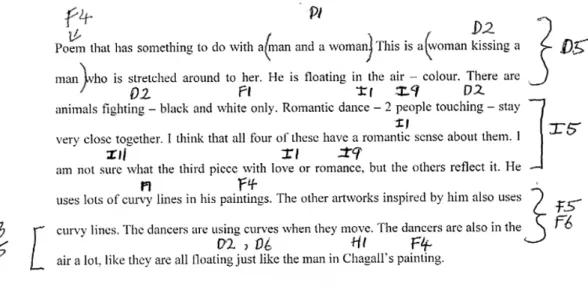
Significantly, it is not necessary for an art educator/assessor to use the four dimensions in any particular order as scoring units within each dimension is scored in each written response (See Figure 1).
Fifth Dimension of the Diagnostic Profile
Northern Ireland is a society where issues of conflict and division are normally maintained under a discrete silence. In such a society the visual arts provide at least the potential for an alternative medium for engagement that is freed from the normal constraints provided by language. An additional aim of this study is to identify if students possess something that is akin to a “political” intelligence. What we mean by this is the possibility that, in interpreting ambiguous or subjective phenomena, students may draw upon existing discursive resources that reflect political dimensions of their existing social world. On this basis, I proposed that an additional dimension to Stavropoulos’ (1992) diagnostic profile of art understandings might expand our ability to categorize students’ understandings of conflict related themes in their written responses to selected imagery. Consequently, I attempted to construct a fifth social/psychological dimension to analyze their social and psychological attributions. My point is this. If we can control the social attributions children make, then we can influence their future behaviour (Lepper et al., 1973, p. 129).
Attribution Theory
Attribution Theory (Heider, 1958) is a theory designed to explain how people
perceive, infer, or ascribe causes to their own and other people's behaviour. Basic research in this area has established that we tend to attribute another person’s behaviour to internal, dispositional causes rather than external, situational causes if the behaviour seems different from how other people would act in the same situation but characteristic of that person's behaviour in similar and dissimilar situations in the past; but if the behaviour seems similar to that of others in the same situation but uncharacteristic of that person’s past behaviour in similar and different situations, then we are likely to attribute it to external causes. For example, an external
attribution assigns causality to an outside agent or force. In short, something outside
motivates the event. Intergroup attribution is concerned with the causal explanations offered by people acting as social category members; research suggests that these phenomena might be affected by a variety of contextual factors (Oakes et al., 1994;
Islam & Hewstone, 1993). Hewstone (1990) suggests that the attributions made by social category members are group serving, in so far as they tend to favor members of the ingroup over the outgroup. Intergroup attributional biases might be interpreted as a reflection of the attempt to achieve and maintain a positive social identity (Tajfel & Turner, 1979). Outgroup derogation is characterized by individuals who remain neutral to their ingroup while acting in a highly derogatory manner to outgroups. Research on minimal groups demonstrates that arbitrarily creating two groups leads to the development of in-group favoritism. Experiments using the minimal group’s paradigm show how easily in-group biases can be created simply by categorizing others. Perdue et al.,(1990) conducted a study of ingroup bias by first administering to their subjects subliminal cues associated with either a chosen ingroup, using the words we or us in discussions with their subjects or with an outgroup, using the word
them in discussions with their subjects. They termed the bias to outgroups as outgroup derogation. Duncan (1976) examines the perception and explanation of
interracial violence by asking subjects to look at a videotaped interaction of an increasingly violent argument. When the videotape contained a black protagonist, over 70% of the subjects chose “violent behaviour” as the appropriate category; when the protagonist was white, only 13% of the subjects labeled the act in this manner. LeVine et al., (1972) emphasize that intergroup attributions are of an ethnocentric nature. Sherif (1966) saw the role of stereotypes in relation to blaming outgroup members and vindicating the ingroup, and noted that the assignment of blame is conducted almost entirely from the ingroup’s point of view. Patterson (2007) points out that an “ingroup” is a social group towards which an individual feels loyalty and respect, usually due to membership in the group. This loyalty often manifests itself as an ingroup bias. Commonly encountered ingroups include family members, people of the same race, culture or religion, and so on. Research demonstrates that people often privilege ingroup members over outgroup members even when the ingroup has no actual social standing; for instance, a group of people with the same color shirts, when the other group has another color of shirt.
Mural Imagery as Ideological Representations
Moscovici (1981) argues that ideologies define, maintain and sustain conflict. Any causal explanation must be viewed within the context of social representations and is determined thereby. The term “social representations” has its origins in Durkheim’s (1898) concept of representation collectives. Collective representations describe a whole range of intellectual forms that include science, religion and myth - a collective representation is not reducible to individual representations, it constitutes a social reality sui generis. Moscovici (1988) further underlines that social representations are concerned with the contents of everyday thinking and the stock of ideas that give coherence to our religious beliefs, political ideas and the mental connections we create. They make it possible for us to classify persons and objects; to compare and explain behaviours and to objectify them as parts of our social setting. Finn (1996) argues that Northern Ireland murals are a form of social representation and that they are garbled clichés of tribalism which seem to have taken on the form of icons generating different gods, malevolent nightmare images that fester and spread fear. As all of the participants in this study lived in or travelled through conflict areas that exhibited political and religious murals, it was expected that such negative imagery would be reflected in their written responses. My point is this. Propagandistic murals are a form of restricted code. Bernstein (1972) argues that the working-class use a restricted code. Within this restricted code, there is simplicity of verbal forms, a low proportion of subordinations and a restriction on the use of adjectives and adverbs. Douglas (1966) pollution theories involve reflection on the relation of order to disorder, being to non-being, and form to formlessness, and life to death. The construction of categories such as “clean” and “unclean”, like the distinctions between insiders and outsiders, are the products of cultural systems of classification that create social order.
International Studies on Children in Conflict
Lazarus & Folkman (1984), in their cognitive appraisal model of stress and coping methods, predicts that people’s expectations of potentially stressful situations
will mitigate their reactions to stress. According to this model, people engage in cognitive appraisal of their environment, which Lazarus & Folkman (1984: 31) describe as “the process of categorizing an encounter, and its various facts, with respect to its significance for well-being”. Cognitive appraisal occurs in two stages. First, during primary appraisal, a perceiver reflects on the nature and degree of risk inherent in a potentially hazardous situation. If risk is deemed to exist, the individual next makes a secondary appraisal to evaluate coping methods and resources for addressing the hazard. As a result of the primary and secondary appraisals, the person views the situation as either a challenge or a threat. Lazarus & Folkman’s (1984) notion of primary appraisal suggests that it is not the event itself that is significant in determining children’s reactions to political violence, but rather, children’s interpretation of the event. They posit that denial, distancing and habituation are best conceptualized as emotion-focused coping strategies, and that they manage the negative affect generated by a stressful encounter. Freud & Burlingham (1943) studied the development of pre-school English children during World War II, and suggested that destructive and aggressive impulses were easily aroused by the overt aggression in the world around them. Bandura (1973) finds that modeling is the tendency for individuals to acquire new and more complex forms of behaviour by observing this behaviour and its consequences, in real life or symbolic models. Bettelheim (1961) underscores that a strong ideological commitment has a conditional moderating influence on psychosocial well-being, and that it is children with the strongest ideological commitments that experience the most traumas. Kuttab (1988) argues that in situations of political violence, the distinction between victim and perpetrator often becomes indistinct. Garmezy (1993) observes that a minority of children manifested serious psychopathology - the majority of children who witnessed the violence associated with political conflict showed few, if any, signs of maladjustment. Resilience was contingent on factors or mechanisms which either protected psychological integrity or, factors or mechanisms that increased children’s risk of adverse outcomes. Successful coping did not imply that a sense of control
over one’s life situation had been achieved (Lazarus & Folkman, 1984). Weisenberg et al., (1993) observe that children who attempted to use problem-focused coping, such as checking gas masks and room seals, tended to have less favourable post-war outcomes. As children matured they tended to use emotion-focused strategies more often during scud missile attacks than the younger children, who in turn were more likely to employ problem-focused coping strategies. Punamaki (1996) studied the relationship between ideological commitment and the psychosocial well-being of Israeli children. Feelings of anxiety, insecurity, depression and failure related to war were found only in those children with a weak ideological commitment. Adolescence tends to be a time when there is a preoccupation with ideologies. In a situation of armed conflict where there is a need to justify the violent actions of one’s own group or the hardship endured at the hands of the out-group; often the development of ideology occurs prematurely, resulting in rigid and dogmatic thinking (Straker et al., 1995). Punamaki questions the coping role of activity, suggesting that it only serves to delay the outbreak of symptoms in children at best. Solomon (1990) found that children of holocaust survivors were less resilient to negative life events. Studies that examined the effects of children’s exposure to traumatic incidents such as shooting (Pynoos & Nader, 1989); disasters (Belter & Shannon, 1993) or the effects of the outbreak of a particular war, did not necessarily produce findings that were applicable to a situation of chronic civil and political unrest (Milgram & Milgram, 1976). McLachlan (1981) highlights that a teenager growing up in a deprived, violent and religiously segregated neighborhood accepted the received version of his own community’s situation. Liddell et al., (1994) propose that modeling and imitation probably play a major role in determining the amount of aggression shown by children. Modeling is a form of learning where individuals ascertain how to act or perform by observing another individual. Chimenti & Nasr (1989) points out that modeling explains an increased aggression among children exposed to political violence. Rackstraw’s (2001) notion of a false-self occupying an idealized world might explain some children’s avoidance of living with ethnic conflict. Many
children present an idealized world, taking great care to create aesthetically pleasing images or objects. Hence, they need to hold these idealized images/fantasies as a way of coping, while they internalize an appalling reality.
Northern Ireland Studies on Children in Conflict
Cairns (1987) explores how a child’s moral and political development is affected by conflict and how bitterness is transferred from generation to generation. Cairns (1996) concurs with Kuttab’s (1988) findings that in situations of political violence, the differences between victim and perpetrator are frequently indistinct. Cairns & Dawes (1996) argue that ideological commitment contributes to coping situations of extreme adversity based on observations in the Dachau concentration camp; those who had strong beliefs allowed them to ascribe meaning to the hardships they were forced to endure, and were more likely to retain their psychological integrity. Believing that actions are based on principles and ideology allows individuals to justify and rationalize their own violent actions. Ferguson & Cairns (1996) suggest that young people exposed to higher levels of political conflict manifested lower levels of moral maturity as measured by standardized tests. Harbinson (1983) claimed that young children did not show any evidence of attitudinal problems and generally achieved high educational attainment. Fraser (1971) hypothesizes that only a minority of children was vulnerable to short-term effects of the violence, and that there was optimism about the short-term effects of political violence, but he made more fatalistic predictions were made about the long-term consequences. Fraser (1974) notes that children from as young as eight years old have become aggressively involved in fighting. Moreover, Lyons (1979) and McWhirter & Trew (1982) envisaged an inevitable response to children’s exposure to political violence. Lyons (1979) noted that those arrested for minor offences such as “riotous” behaviour as well as those on more serious charges of terrorism generally showed no evidence of psychiatric disorder or psychopathy. Fraser (1974) suggests that children in normal situations deal with internal conflicts between “good” and “bad” generated from the superego and id respectively. One way
that children coped with the conflict was through projection into games - there must be goodies and baddies. In Northern Ireland, the “bogeyman” figure is real - the “bogeyman” to the Protestant child is a Catholic or a member of the IRA. For a Catholic child, the “bogeyman” figure may be a British soldier or a Loyalist paramilitary. Cairns (1996) stresses that the hostility, destructiveness and aggression of war become part of the child’s inner fantasy life and world of emotions. However according to Joseph et al., (1993), Northern Irish children appeared to display few psychological symptoms as a result of the conflict. Lorenc & Branthwaite (1986) claimed that Northern Irish children were more approving or tolerant of violence. Comparison of young people’s perceptions before and after the cease-fires suggested that young people had a less partial view of the cause of the conflict (McLernon et al., 1997). McWhirter & Gamble (1982) posit that most of the evidence demonstrated that children had some understanding of the denominational group; by the age of nine, 75% of children could correctly identify their own group identification.
Coping Strategies
Muldoon (2000) and Muldoon & Trew (1995) found that youths living in more violent areas might fail to habituate to everyday conflict-related events. Habituation is a coping strategy that is available to young people who experience a conflict from a relatively safe distance. A second strategy distancing refers to efforts made by young people to distance themselves cognitively from the political conflict (Cairns, 1987). McIvor (1983) maintains that coping attempts to make a stressful situation more tolerable, or minimizes the distress induced by the situation, sometimes children accept the reality of the situation and seek to deny the violence occurring in or near their locality. He underscores that children might seek to deny that violence is occurring in or near their own locality. Likewise, Cairns & Wilson (1989) reinforces this finding by research with adults in Northern Ireland - those who lived in a violence-prone area were more likely to use distancing as a coping mechanism than those living in a less violent area. Cairns & Wilson claim that it is possible that the majority of people in Northern Ireland deal effectively with stressgenerated by the
political violence, but do so by denying the existence ofthe violence around them. Muldoon & Cairns (1999) maintain that habituation might serve to increase young people’s tolerance of those who broke the cease-fires, and that distancing might result in viewing the problems of the region as being the responsibility of others. Muldoon (1996) identifies a number of children’s coping strategies which also proved useful in categorizing my participants’ responses to the selected conflict imagery. For example:
․Avoidance refers to both cognitive and behavioural efforts to avoid the stressful
event. This dimension covers a wide range of responses, including distraction techniques, denial, efforts to obtain detachment, and physical avoidance.
․Active Problem Solving refers to a child taking cognitive or behavioural steps to
find and use a solution to the problem faced. Such responses include behaviours like information-seeking and problem-solving.
․Benign/Irrelevant suggests the encounter or transaction has no significance for
well-being. In this case, the child does not see the encounter as negative.
․Catastrophising refers to a child’s unduly pessimistic response. The child’s own
fault in the occurrence of the event is overplayed or overly critical and/or the ramifications of the event are overplayed.
․Challenge refers to an opportunity for growth, mastery or gain. A child appraising
an event in this manner might refer to the positive aspects of the situation and what would be gained from the experience.
․Cognitive Reappraisal refers to cognitive efforts by the child to view the event in
a different manner than he/she did initially. Reappraisal might involve efforts to distance the child from the occurrence or efforts to assign blame for the event to someone other than the child.
function of this kind of coping is to manage somatic, subjective and affective components of the stressful transaction.
․Emotional Expression refers to a response to a situation essentially related to an
alteration in affect. These actions might be positive or negative such as crying, aggression and social withdrawal.
․Evaluation Anxiety refers to events where the child perceives an event as stressful
because of the likelihood of failure at school, or criticism from their parents or teachers. This dimension includes references to punishment as a result of what the child perceives as his/her inadequacies.
․Environment Coping is encoded as environment when the child’s behaviour is
directed at things or persons other than the self.
․Fear of the Unknown refers to events where the risk the child perceives is largely
related to the ambiguity of the situation and its outcome. Fears related to fear of the unknown are often fears negotiated with childhood and represent to some extent a child’s lack of understanding or capacity to cope with a situation.
․Fear of Danger/Death refers to events where the child perceives risk of physical
injury or death to himself or herself, or significant others.
․Fear of Rejection refers to a child’s fear or belief that he or she are unwanted or
abandoned by significant others, siblings, peers, or parents.
․Fear of Being Alone refers specifically to a child’s fear of being without company
or friendship. This companionship might relate to that provided either by family or friends. It is distinguished from rejection by the fact that the child is unworried about being rejected or unwanted.
․Harm/Loss refers to injury or damage already done, be it physical or
that the damage has already occurred, and it is as a result of the stressful encounter and the resultant harm. Loss might be physical, social or psychological.
․Problem Focused denotes a coping behaviour that is problem-focused and
instrumental in nature. It functions to change one’s own situation either by changing one’s own behaviour or action (focus on self), or by changing the damaging or threatening environment.
․Remorse refers to events that distress or upset a child because the child regrets his
or her behaviour or actions.
․Revenge refers to when a child seeks retribution against the person he/she views as
responsible for the stressful situation.
․Self is encoded when the child’s coping behaviour is directed at his/her own action
or subjective distress.
․Self-Controlling refers to efforts by the child to inhibit or reduce reactions to
negative events. This category includes efforts to endure or resign one-self to the situation.
․Separation Anxiety refers to events that the child perceives as threatening because
of potential or actual separation from significant others, usually a parent.
․Social Support refers to assistance other than information about the events or
problem. Support includes direct bids for materials, moral support or sympathy.
․Threat refers to the potential for harm or loss in a transaction. A child appraises an
event in this manner where the child is concerned about the consequences of a stressful encounter.
․Unfairness refers to events that upset or might upset a child because of the event
․Unfulfilled Expectations refers to events or situations which cause distress
because the child fails to obtain something they previously sought and believed they would obtain.
Methodology
The research design stemmed from the rare opportunity to obtain data from participants who lived in, or near, a conflict zone of Belfast. The fact that the research was conducted in real time when children were being exposed to political conflict was vital in attempting to learn from the children themselves what their stress reactions were and what helped them cope. Various social/psychological concepts identified in the literature review were used to categorize each student’s written responses which reflected attributions related to fear, harm and loss,
ingroup/outgroup religious/ideological, stereotyping, social representation etc. Art
students and non-art students from five Belfast schools participated in the study (N=159). In order to give the study a sense of balance, students were selected from grammar and comprehensive schools which reflected a Protestant and a Catholic ethos. Permission to undertake research was sought, and granted, by the school principal. Consent was also sought and given by parents for their children’s participation. As I had previously taught art in most of the schools, I had already established good rapport with most of the students and staff. In addition, members of staff were consulted on the nature of the research, and instructed in the procedures of the data collection. Each respondent was labeled “AS” and “NAS” for an art and non-art student, respectively. Participants were given several images which reflected the themes of war and political conflict. The images were labeled as A, B1, B2, B3, C,
D, E, R and S. Spengler’s two documentary photographs were labeled R and S to
distinguish them from fine art or graphic imagery. In order to elicit participants’ attributions, they were asked to write down their “understandings” of the selected imagery. It was anticipated that the usage of the selected imagery would elicit more conflict related themes in my participants’ written responses. Schools were colour coded.
Selected Imagery
Image A: Picasso’s Guernica (1937)
Images B1, B2, B3: The 12th of July 1998 (Triptych). Artist: Ray Duncan
Image C: Titanic postcard (1912)
Image E: Mother Ulster (1989) by Rita Duffy
Image R: Boy with Mask (1977) Photographer: Christine Spengler
Image S: Soldier beside Sandbags (1977) Photographer: Christine Spengler
Picasso’s Guernica (1937) was selected because it is the most famous anti-war image of the 20th century. Duncan’s The 12th of July 1998 (Triptych) was chosen because it depicted one of the most brutal sectarian murders of Catholic children by a Northern Ireland Loyalist. Richard, Mark and Jason Quinn died in a loyalist petrol bomb attack on their home at the height of the Drumcree crisis in July 1998. The Titanic postcard (1912) was selected because it reflected Protestant/Loyalist identity. Forker (2007) considers the iconic association of woman as container or vessel and the gendering of ships as women. Extending this symbolism, Forker suggests that the
ill-fated Titanic could be interpreted as a representation of a Northern Irish Loyalist female who symbolically embodies political, religious, and sectarian tensions and fissures, since the doomed Titanic was built in a Belfast shipyard by Protestant workers.
McCaughan (1998) points out that the Titanic was a “demon” image because the ship had enshrined anti-Catholic messages written on it. For example, the Titanic’s alleged ship number was 3909 ON, which was written on the side of the ship. This is a mirror image, possibly reflected in the water, of the sectarian slogan No Pope (Hayes, 1994). Catholics regarded the Titanic as a symbol of a workplace from which they themselves had been rejected. Donnelly’s A Wonderful Irish Painting No. 2 (1988) was chosen because it depicted lilies which are symbolic of Irish nationalism. Duffy’s depiction of Mother Ulster (1989) was chosen because it mirrored Loyalist motherhood and included references to the Loyalist Orange Order. Spengler’s images of Boy with Mask (1977) and Soldier beside Sandbags (1977) were chosen because they were photographic historical documentary images of children experiencing conflict in Northern Ireland.
Findings and Discussion
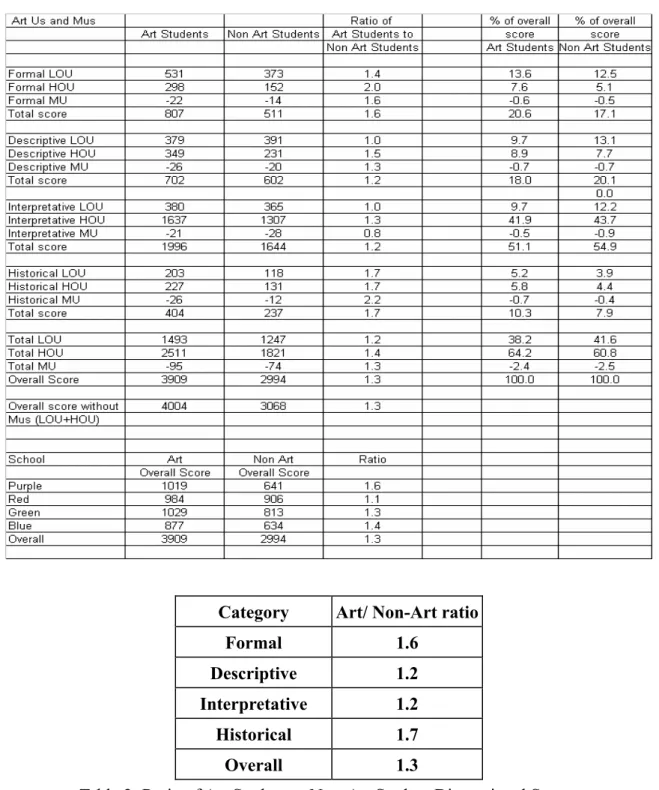
Table 1 outlines the overall pattern of results showing the scores for the art and non-art students across each of the dimensions. In addition, the table shows the ratio of art/non-art student scores as a basis for comparing the relative extent to which the students scored across the dimensions. We can see from Table 1 that the art students achieved higher scores across each of the dimensions and overall. This is summarized on Table 2.
Table 1: Total Number of Art Understandings and Misunderstandings of Art Students and Non-Art Students
Category Art/ Non-Art ratio
Formal 1.6 Descriptive 1.2 Interpretative 1.2
Historical 1.7 Overall 1.3
It is perhaps not surprising that the ratio is lowest for the descriptive and interpretative scores, as the formal and, more particularly the historical, dimensions depend more on prior knowledge. The formal and historical dimension relates more to the use of historical facts and corrects artistic terminology in students’ accounts of images. To that extent, then, these data point to the specific aspects that art students bring to these types of assessments. However, it is perhaps noteworthy that the scores of the art students on these two dimensions are quite low, in comparison with the use of descriptive and interpretative dimensions. An advantage of the diagnostic profile is that it allows us to examine the nature of the students’ response in more detail. Firstly, when we compare the ratio of lower-order, higher-order and misunderstandings between the art and non-art students (Table 1); we can see that the ratio was highest in the higher-order scores. Again, this outcome might be predictable as the high-order judgments are more likely to reflect attempts to judge the images on the basis of prior knowledge. When we consider the pattern of scores for misunderstandings, we can see that the art students had higher (that is, more negative) scores in the formal, descriptive and historical dimensions. In addition, the art students had a higher overall score on this dimension. Although this may appear counter-intuitive, it probably reflects the greater extent to which art students tried to offer judgments along these dimensions, but made errors in their accounts.
Table 3: Fear Attributions
Table 4: Outgroup/ Ingroup Attributions
Table 6: Social Support Attributions
Table 7: Social Representations Attributions
Table 8: Stereotyping Attributions
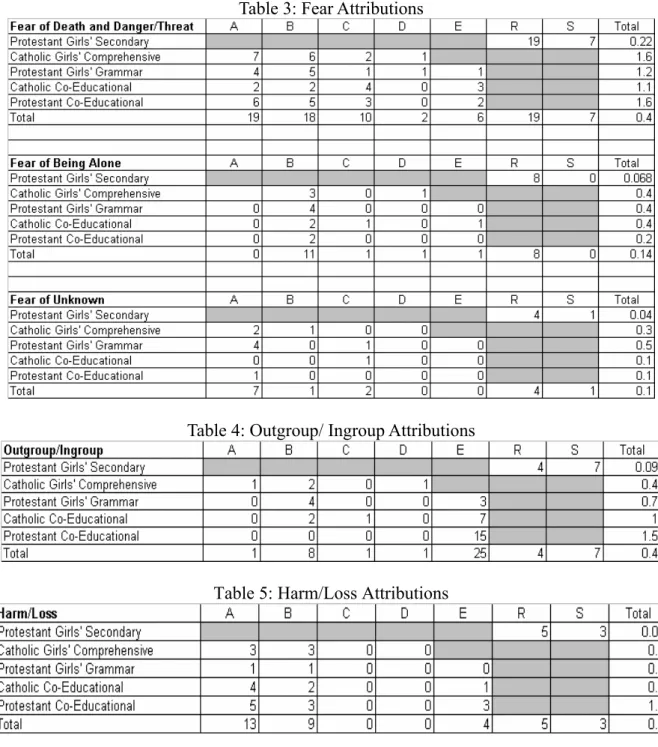
An important pattern that emerges is the proliferation of fear and harm and loss attributions made by Protestant and Catholic children. Attributions in the
ingroup/outgroup, religious/ideological support, stereotyping and social representation categorisations are also prevailing. Fear of death/danger/ threat
attributions are relatively high. Protestant students make more conflict-related attributions than their Catholic counterparts. In total, Fear of Being Alone attributions are made by 22 students. Protestant students make 14 attributions, Catholic students make 8 attributions. These scores deeply reflect the psychological fears of children living in a conflict zone. Clearly, such children seem to need the security of their families and friends. For instance:
A friend who the three boys have left behind (B3) NAS
A lonely bird on its own travelling through a stormy sea (B2) NAS
Large flowers…are quite lost or lonely (D) AS
Fear of the Unknown attributions is made by 15 students. Twice as many Protestant
students give responses in this area than Catholic students; Protestant students scoring 11 attributions to the Catholic students’ 4 attributions. For instance:
Dark colours also suggest something bad lurking (A) AS
Gives a sense of creepiness (A) NAS
A dungeon of a castle…it looks dark and gloomy (A) NAS
A similar pattern of fear is expressed in many attributions related to the Harm and
Loss category. Overall, 34 such attributions are made, Protestant students making 21
attributions, whilst Catholic students made 13 attributions. For instance:
Loss of identity and freedom (B1) AS
A sense of loss…everyone has been made sad (B3) AS
A boy with his face blown up by a bomb (R) NAS
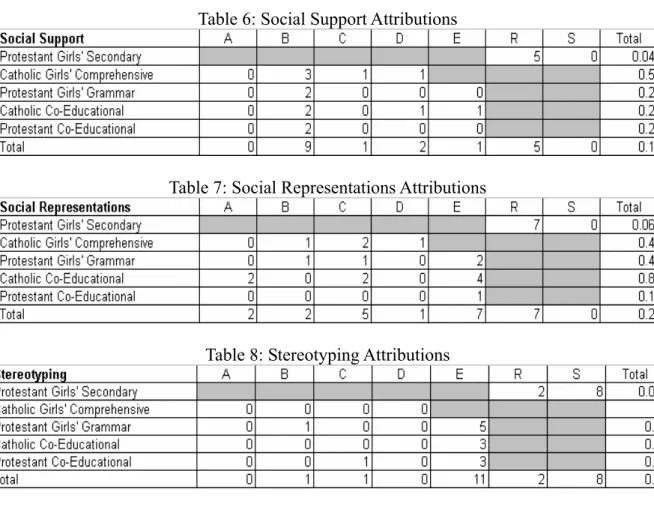
Since the students’ fear categorisations are so dominant, it is not unanticipated to find that these psychological fears are compensated by children’s psychological needs. Such attributions demonstrate a child’s need for social support systems, especially for children living in or near a conflict zone. For example:
All of the people… are trying to comfort him and offer support (B3) NAS
A sense of love…represented through the two blue flowers (D) NAS
Protestant and Catholic students make 12 attributions each in the social
sense of low-self esteem. For example, deprecating remarks about the district that they live in or near.
It looks as if it is on the Shankill Road (S) AS
It looks old-fashioned… somewhere on the Shankill Road (S) AS
The picture looks like a street on the Shankill Road (S) AS
Like a typical house down the Shankill - a two up two down (S) AS
Significantly, notions of Douglas’s (1966) pollution theories are reflected solely in Protestant social representation attributions. For instance, Mother Ulster is described by a Protestant grammar school student as being “sick and polluted”.
She also looks quite sick like she has been polluted (E) AS
The place looks dull and dirty like in the old days (R) AS
Looks really filthy…their clothes don’t look so clean either (R) AS
Some people are looking very dirty and scraggy (R) AS
The houses look old and the street looks dirty and falling to bits (R) AS
Looks dirty as if people were throwing glass bottles, rubbish and making holes in the ground (R) AS
Overall, there was a total of 23 stereotype attributions made. Protestant students making the vast majority of stereotyped attributions (20). Protestant grammar and secondary students make stereotyped attributions related to Belfast’s “working-classes’ and being “rich’. For example:
I see the stereotype coming through (B) NAS
The little girl looks like she is wearing rich clothes (S) AS
The main divergence in the responses given by the Protestant secondary students and their grammar/comprehensive counterparts can be exemplified by Bernstein’s (1972)
notion of elaborated and restricted codes. The students use a limited vocabulary and there is also evidence of repetition. For instance:
Wee boy is by himself (R) AS
Lots of black (R) AS
Looks like she is rich but the street looks old…looks like someone is telling her to come back…looks like they are on the road…looks like soldiers a lot… looks
interesting…looks like there is a hole. (S) AS
Moreover, if we deem that Picasso’s Guernica to be an overtly conflict image, then these data would seem to indicate that some Belfast art students’ and non-art students’ dramatic descriptions of war atrocities may indicate their resilience to living within a conflict zone (Garmezy, 1993). For example:
Their bodies are twisted and distorted…you can tell how some died as a chopped arm holds a broken sword, with severed yet live limbs lying about
it…everyone looks kind of insane (A) AS
The actual moment of the bombing…a dismembered body lies in the foreground
(A) AS
Some kind of murder or even a massacre (A) AS In the following response, the student demonstrates a political awareness. For example, “human rights”, “freedom”, “loss of identity” and “closed doors” are higher-order political concepts:
A loss of identity, as the boys in the image have no facial features…this must have something to do with closed doors and that these boys must be seen as ugly in their society’s eyes…the boys want freedom just like the bird… freedom and the beauty of freedom and human rights. (B1) AS
The Protestant student below displays ethnocentric fundamentalist interpretation of the Titanic image. The Catholic Church is selected as a suitable target of externalisation or as a bogeyman figure (Fraser, 1974).
The ridiculous Catholic Church shows the way world religion has gone down hill… too much emphasis on ceremony (C) AS Sarcastically, some Protestant students give irreverent responses to this ‘Protestant’ image:
Jesus is causing death… it may be used for propaganda purposes from the Church telling its followers that once you have died, it’s okay because you are now closer to God, “Nearer my God to Thee”…makes me feel angry and cheated (C) AS
Jesus looks distant…I think this is an unforgiving God, a merciless God…a white man in a robe with a beard and a crown of thorns. Who is to say Jesus is white? - maybe the truth about Jesus was covered up by all the years of racism. (C) AS The Catholic student’s interpretation below is an illogical finding. Although the work clearly depicts several flowers, the student makes a highly romanticised political attribution. However, this illogical allusion must be understood within an Ulster context. President and Hillary Clintons’ first visit to Northern Ireland had a political agenda; namely, to encourage a nascent peace-process. Consequently, the Clintons appear as charismatic figures to many young people in Northern Ireland:
This to me would represent a couple who have made a lot of differences in people’s lives. A couple who comes to mind is Bill and Hillary Clinton who have made a difference to the people living in Ireland and they did all of this when
they had personal problems in their lives. (D) NAS
Below, the Protestant student demonstrates outgroup derogation (Perdue et al., 1990), ethnocentrism and stereotyping. The Belfast working-class is chosen as a suitable target of externalisation. McIvor’s (1983) notions of habituation and distancing may be evident. For instance, “I really did not need to be reminded of all this”.
The mother is an ugly fat bored housewife, and the kids look like selfish brats it reminded me of the type of family, so often occurring in the working-class areas of Belfast, who breed self-centred, narrow-minded, pretentious people who grow into (bullies, thugs) due to lack of care, attention and family support when they were younger. I really did not need to be reminded of all this. (E) AS
The Protestant grammar school student demonstrates a higher-order political sympathy. Potential sectarian tension in the form of a painted kerbstone is observed. New meanings are constructed to create deeper political understandings. For example, the fact that a child is playing with a demolition ball may or may not be a sign of the in-built capacity for self-destruction in the youth of Northern Ireland.
A matriarchal figure at the centre of a Belfast tableau… slum-dwelling and traditional heavy industry…undertones of sectarian tension in the form of a painted kerbstone…the fact that one of the children is playing with a demolition ball may or may not be a sign of the in-built capacity for self-destruction in the
youth of Northern Ireland. (E) NAS An acute political intelligence is also displayed by the Catholic student:
The children’s faces seem a lot older than them - maybe this is because they
The Protestant grammar school student associates poverty with the conflict and links the concept of youth with the irrationality of sectarianism:
It reminds me of Belfast and how the Troubles are stupid as they are causing poverty…the schoolboy represents a sectarian person, and how immature they are. (E) AS Another pattern that emerges is how Protestant students actually “see” the security forces. Although, the British army and the Royal Ulster Constabulary (RUC) were constantly attacked by Protestant and Catholic rioters during the conflict, the Protestant students’ responses reflect a benign outlook towards the police and army. Interestingly, the Protestant secondary schoolchildren do not perceive British soldiers and Northern Ireland policeman as Fraser’s (1974) ‘bogeyman’ enemy image. Traditionally, the security forces are considered to be demonized figures by Catholics.
It looks like a man with a baton; maybe it is a soldier trying to beat off a crowd
(R) NAS
I don’t see any other soldiers there. (S) AS Since most children in Belfast conflict zones are exposed to propagandistic wall murals, it was anticipated that the participants’ written responses would reflect Finn’s (1996) notion that murals are garbled clichés of tribalism which generate different icons and malicious frightening images that spread fear. However, an unforeseen outcome is the avoidance of such iconography in the participants’ written responses. Evasion of such negative imagery may suggest coping strategies such as avoidance,
distancing and habituation (McIvor, 1983). Instead, students refer to non-conflict
imagery suggesting agreement with Rackstraw’s (2001) notion of children creating “idealized worlds”. Consequently, it is evident that many children prefer to avoid or
try to escape the negative propagandistic effects of sectarian murals. For example, they make attributions to Michelangelo’s Sistine Chapel, nursery rhymes such as “The Old Woman who Lived in a Shoe”, George Orwell’s “Animal Farm”, Finn McCool, a legendary mythological Irish giant, and Halloween masks.
Michelangelo’s Sistine Chapel (B) AS
Makes me think of the nursery rhyme; there was an Old Woman who Lived in a Shoe! (E) NAS
Animal Farm (A) NAS
The giant theme might come from Finn Mc Cool (E) NAS
It is a boy wearing a Halloween mask (R) AS
Conclusions
This study examined Northern Ireland art and non-art students’ written responses to a series of images. The students’ accounts were scored using the diagnostic profile, which allowed for an examination of a number of different dimensions of the students’ responses. Overall, the study shows that art students offer a larger number of responses in their accounts and, as might be expected, they are more likely to show evidence of using specific knowledge-based elements in their accounts. Ironically, the fact that the art students tend to have higher misunderstandings scores may also reflect their attempt to make greater use of specific knowledge-based elements in their accounts. At this relatively simple level then, the data seem to suggest that the diagnostic profile provides a useful basis for examining a range of aspects of students’ accounts.
However, two further issues are raised by the data collected during the study. While it is the case that the art students show greater use than non-art students of elements that are knowledge-based, it is also true that the relative extent to which
these themes are evident in their accounts is rather low. Thus, while the art students achieve higher scores overall, it might have been expected that they would have shown evidence of more specific knowledge-based elements in their accounts. This finding might suggest that the delivery of the art curriculum in Northern Ireland pays insufficient attention to the formal and historical aspects of the subject, but rather has encouraged the students to rely more on more descriptive and interpretative judgments which are insufficiently rooted in the formal traditions of the subject. Whether or not this is an accurate portrayal of problems within the teaching of art in Northern Ireland is probably an assessment that would need to be based on a larger study, but, for the present, the fact that these data indicate that this problem might exist is a further demonstration of the value of a diagnostic profile that attempts to go beneath the surface of student accounts and seeks to examine a range of different aspects of their understanding of images.
Stavropoulos’ (1992) usage of four dimensions in her diagnostic profile is primarily designed to provide a more complex and nuanced insight into analysis of art images. However, it seems that the use of an extra psychological dimension can play an important role in addressing the needs of children affected by the conflict in Northern Ireland as it provides an accessible language and a safe containing space where feelings, which may not otherwise be named, can be explored, expressed and contained safely. In short, it provides access to an otherwise silent world in the classroom.
Surprisingly, there is no evidence of Punamaki’s (1996) finding that adolescence tends to be a time when there is a preoccupation with ideologies. Furthermore, the students in the Protestant and the Catholic grammar and comprehensive schools tend to show more evidence of the use of an elaborated code in their responses, in comparison with the more restricted code used by the students in the Protestant secondary school. This may be due to differences between the school types or may be due to age differences.
When the actual comments are examined in more detail then it is striking that there is a proliferation of fear, and harm and loss attributions made by the students in their accounts. Related to this is the extent to which attributions reflecting outgroup/ingroup themes, issues related to religious/ideological support, and stereotyping and social representation categorizations are also present. There is also evidence of students making higher-order political attributions. Moreover, their attributions may indicate resilience to being exposed to continual political conflict.
It is also noteworthy that the Protestant students make more outgroup/ingroup associations in comparison with the Catholic students: some of the comments by Protestant grammar school students relate to class, rather than religious, categorizations. There is a sense also that the Protestant secondary school students’ responses show a little more evidence of lower self-esteem. One way this emerges is through deprecating remarks about the area in which they live in some of their comments.
Additionally, there is relatively little mention of mural iconography by the Catholic and Protestant students, despite the ubiquity of these images in the city. It may be, although this must remain speculative, that the absence of comment on this marks an avoidance of such imagery. That the students tend to refer to non-conflict imagery may link with Rackstraw’s (2001) notion of children creating “idealized worlds”. Some responses suggest a general negative portrayal of these young peoples’ sense of self and place. These comments may by indicative of the continuing conflict which grips Northern Ireland and which has a continuing resonance in Belfast and, more particularly, North Belfast, where many of these young people live and attend school. It may also further strengthen the claims of those who suggest that schools in Northern Ireland are not, and never have been oases of peace and calm where the conflict can be left outside.
References
Allport, G. W. (1954). The Nature of Prejudice. Beacon Press: New York.
Bandura, A. (1973). Aggression: A Social Learning Analysis. New Jersey: Prentice Hall.
Belter, R.W. & Shannon, M.P. (1993). Impact of Natural Disasters on Children and Families. In C.F. Saylor (Ed.), Children and Disasters (pp.85-104). New York: Plenum.
Bernstein, B. (1972).Class, Codes and Control, Volume l: Theoretical Studies toward
a Sociology of Language. London: Routledge & Kegan Paul.
Bettelheim, B. (1961). Informed Heart. New York: Free Press. Cairns, E. (1987). Caught in Crossfire. Appletree Press: Belfast.
Cairns, E. (1996). Children and Political Violence. Blackwell Press: Belfast. Cairns, E. & Wilson, R. (1984). “The Impact of Political Violence on Mild
Psychiatric Morbidity in Northern Ireland.” British Journal of Psychiatry, 145, 631–635.
Cairns, E. & Dawes, A. (1996). Children: Ethnic and Political Violence. Child
Development, 67 (1), 129-139.
Cason, N. (1998). Interactive Multimedia: An Alternative Context for Studying Works of Art, Studies in Art Education, 39(4), 336-349.
Chimenti, G. & Nasr, J. (1989). Children’s Reactions to War Related Stress-Affective Symptoms and Behaviour Problems. Social Psychiatry and Psychiatric
Douglas, M. (1966). Purity and Danger: An Analysis of Concepts of Pollution and
Taboo. Routledge & Kegan Paul: London.
Duncan, B.L. (1976). Differential Social Perception and Attribution of Intergroup Violence: Testing the Lower Limits of Stereotyping of Blacks. Journal of
Personality and Social Psychology, 34, 590-598.
Durkheim E. (1898). Individual Representations and Collective Representations.
Morale VI, 273-302.
Ferguson, N. & Cairns, E. (1996). Political Violence and Moral Maturity in Northern Ireland. Political Psychology, 17 (4) 713-725.
Finn, G.P.T. (1996). Visual Images as Social Representations of the Northern Irish Conflict. Paper presented to the XXVI International Congress of Psychology, Montreal.
Forker, M. (2002). A Diagnostic Profile of Art Understandings and Social
Attributions based on Written Responses to Conflict Imagery. Unpublished Ph.D.
thesis: Queen’s University of Belfast, Northern Ireland.
Forker, M. (2007). The Role of Motherhood Symbolization in the Conflict Imagery of Northern Ireland. Visual Culture & Gender Journal, Northern Illinois University: U.S.A., 2, 72-87. See: http://146.186.186.74/vcg/.
Forker, M. & Chang. M.J. (2007). The Use of a Diagnostic Profile of Art Understandings in the Assessment of Taiwanese Art Students’ Written Responses to Chagall’s ‘The Birthday. National Taiwan University of Arts
Journal, 81, 71-91.
Fraser, R. M. (1971). The Cost of the Commotion: An Analysis of the Psychiatric Sequelae of the 1969 Belfast Riots. British Journal of Psychiatry, 118, 257-264. Fraser, R. M. (1974). Children in Conflict. Pelican: England.
French, M. (1992). Effectiveness of a DBAE Program: Pre- and Post-Test SDP
Analysis of Written Statements from Three Elementary Classrooms. Unpublished
Master’s thesis, Ohio State University, U.S.A.
Freud, A. & Burlingham, D. (1943). Reactions to Evacuation: War and Children. International Universities Press.
Gardner, H. (1983). Frames of Mind: The Theory of Multiple Intelligences. Basic Books: New York.
Garmezy, N. (1993). Children in Poverty: Resilience despite Risk. Psychiatry, 56, 127-136.
Harbison, J. (Ed.) (1983). “Children in a Society in Turmoil.” Children of the
Troubles, Stranmillis College, Belfast.
Hayes, M. (1994). Sweet Killough, Let Go your Anchor. Belfast: Blackstaff Press. Heider, F. (1958). The Psychology of Interpersonal Relations. New York: John Wiley
& Sons.
Hewstone, M. (1990). The Ultimate Attribution Error? A Review of the Literature on Intergroup Causal Attribution. European Journal of Social Psychology, 20, 311-335.
Islam, M.R. & Hewstone, M. (1993). “Intergroup Attributions and Affective Consequences in Majority and Minority Groups.” Journal of Personality and
Social Psychology, 64, 936-950.
Joseph, S., Cairns, E. & McCollam, P. (1993). “Political Violence, Coping and Depressive Symptomatology in Northern Irish Children.” Personality and
Individual Differences, 15, 471-473.
Kuttab, D. (1988). A Profile of the Stone Throwers. Journal of Palestinian Studies,
Lazarus, R. S. & Folkman, S. (1984). Stress Appraisal and Coping. New York: Springer.
Lepper, M., Greene, D. & Nisbett, R. (1973). Undermining Children’s Intrinsic Interest with Extrinsic Reward: A Test of the Over-justification Hypothesis.
Journal of Personality and Social Psychology, 28 (1), 129-137.
LeVine, R.A. & Campbell, D.T. (1972). Ethnocentrism: Theories of Conflict, Ethnic
Attitudes and Group Behaviour. New York: Wiley.
Liddell, C., Kvalsvig, J., Qotyana, P. & Shabala, A. (1994). Community Violence and Young South African Children’s Involvement in Aggression. International
Journal of Behavioural Development, 17 (4), 613-628.
Lorenc, L. & Branthwaite, A. (1986). Evaluations of Political Violence by English and Northern Irish Schoolchildren. British Journal of Social Psychology, 25 (4), 349-352.
Lyons, H. (1979). Civil Violence: The Psychological Aspects. Journal of
Psychosomatic Research, 23, 373-393.
McCaughan, M. (1998). Titanic: Out of the Depths and into the Culture. In A. D. Buckley (Ed.), Symbols in Northern Ireland (pp.131-151), The Institute of Irish Studies, Queen’s University of Belfast.
McIvor, M.E. (1983). Societal Awareness in Belfast Children and Adolescents. Unpublished Ph.D., Queen’s University of Belfast, Northern Ireland. McLachlan, P. (1981). Teenage Experiences in a Violent Society. Journal of
Adolescence, 4, 285-294.
McLernon, F., Ferguson, N., & Cairns, E. (1997). Comparison of Northern Irish Children’s Attitudes to War and Peace before and after the Paramilitary Ceasefires. International Journal of Behavioural Development, 20, 715-730.
McWhirter, L. (1982). Northern Irish Children’s Conceptions of Violent Crime. The
Howard Journal, 21, 167-77.
McWhirter, L. & Gamble, R. (1982). Development of Ethnic Awareness in the Absence of Physical Cues. Irish Journal of Psychology, 5 (2), 109-127. Milgram, R.M. & Milgram, N.A. (1976). The Effect of the Yom Kippur War on
Anxiety Levels in Israeli Children. Journal of Psychology, 94, 107-113. Moscovici, S. (1981). On Social Representations. Social Cognition: Perspectives on
Everyday Understanding, Forgas, J.P., (Ed.), London: Academic Press, 181-209.
Moscovici, S. (1988). Notes towards a Description of Social Representations.
European Journal of Social Psychology, 18, 211-250.
Muldoon, O.T. (1996). Childhood Stress and Coping: A Psychosocial Approach. Unpublished doctoral thesis, Queen’s University of Belfast, Northern Ireland. Muldoon, O.T. (2000). Social Group Membership and Self-Perceptions in Northern
Irish Children: A Longitudinal Study. British Journal of Developmental
Psychology, 18, 65-80.
Muldoon, O.T. & Trew, K. (1995). Patterns of Stress Appraisal in a Conflict Environment: A Northern Irish Study. Children’s Environments, 12, 49-56. Muldoon, O. T. & Cairns, E. (1999). Children, Young People and War. In E.
Frydenburg (Ed.), Learning to Cope. Oxford, UK: Oxford University Press. Oakes, P.J., Haslam, S.A. & Turner, J.C. (1994). Stereotyping and Social Reality.
Oxford: Blackwell.
Patterson, M.M. (2007). Effects of Physical Atypicality on Children’s Social Identities and Intergroup Attitudes. International Journal of Behavioral
Perdue, C.W., Dovidio, J.F., Gurtman, M.B. & Tyler, R.B. (1990). Us and Them: Social Categorization and the Process of Intergroup Bias. Journal of Personality
and Social Psychology, 59, 475-486.
Punamaki, R.L. (1996). Can Ideological Commitment Protect Children’s
Psychosocial Well-Being in Situations of Political Violence? Child Development,
67, 55-69.
Pynoos, R.S. & Nader, K. (1989). Children’s Exposure to Violence and Traumatic Death. Psychiatric Annals, 20, 334-344.
Rackstraw, A. (2001). Have Basket will Travel: Art Therapy in Informal Settlements in South Africa. In M. Smyth & K. Thomson (Eds.), Working with Children and
Young People in Violently Divided (pp.156-162), Papers from South Africa and
Northern Ireland, Community Conflict Impact on Children; INCORE: The Initiative on Conflict Resolution and Ethnicity of the United Nations University and the University of Ulster.
Sherif, M. (1966). In Common Predicament: Social Psychology of Intergroup
Conflict and Cooperation. Boston: Houghton-Mifflin.
Solomon, Z. (1990). Does the War end when the Shooting Stops? The Psychological Toll of War. Journal of Applied Social Psychology, 20, 1733-1745.
Stavropoulos, C.S. (1992). A Diagnostic Profile of Art Understandings based on
Verbal Responses to Works of Art. Unpublished doctoral thesis, U.S.A.: Ohio
State University.
Stavropoulos, C.S. (1995). Assessing Student Learning in the Arts: Building a Bridge between Theory and Practice. Arts and Learning Research, 12 (1), 18-32.
Stavropoulos, C.S. (1996). Alternative Methodology for Diagnostic Assessment of Written and Verbal Responses to Works of Art. In J. Flood, S. B. Heath, & D. Lapp (Eds.), A Handbook for Literacy Educators: Research on Teaching the
Communicative and Visual Arts. New York: Macmillan.
Straker, G., Mendelsohn, M., Moosa, F. & Tudin, P. (1995). Violent Political Contexts and the Emotional Concerns of Township Youth. Child Development, 67, 46-54. Stringer, M. & Cairns, E. (1983). “Catholic and Protestant Young People’s Ratings of Stereotype Catholic and Protestant Faces.” British Journal of Social
Psychology, 1 (22), 241-246.
Tajfel, H. (1981). Human Groups and Social Categories. Cambridge University Press.
Tajfel, H. & Turner, J.C. (1979). An Integrative Theory of Intergroup Conflict. In W. G. Austin & S. Worchel (Eds.), The Social Psychology of Intergroup Relations. Monterey: Brooks Cole.
Weisenberg, M., Schwarzwald, J., Waysman, M., Solomon, Z. & Klingman, A. (1993). Coping of School Age Children in a Sealed Room during Scud Missile Bombardment and Post-war Stress Reactions. Journal of Consulting and