Acute Toxicity of Copper, Cadmium, and Mercury
to the Freshwater Fish Varicorhinus barbatus and
Zacco barbata
Wen-Jiunn Shyong*1,2and Hon-Cheng Chen1
1Department of Zoology, Nation Taiwan University, Taipei, Taiwan, R.O.C. 2Department of Aquaculture, National Chiayi Institute of Technology.
ABSTRACT
Acute toxicities of copper, cadmium, and mercury to the freshwater fish Varicorhinus
bar-batus and Zacco barbata found in clear upstream waters were studied as a basis for the
pro-tection of river water quality and the ease of aquaculture pond management. In all cases, the higher the concentration of metal used, the quicker the animals died. Twenty-four-hour LC50values of copper, cadmium, and mercury to V. barbatus were 0.305 mg/l Cu,
1.657 mg/l Cd, and 0.183 mg/l Hg; however 96-h LC50 values decreased to 0.246 mg/l Cu,
1.502 mg/l Cd, and 0.168 mg/l Hg,respectively. Similarly, 24-h LC50 values of copper,
cad-mium, and mercury to Z. barbata were 0.130 mg/l Cu, 2.598 mg/l Cd, and 0.201 mg/l Hg;96-h LC50 values were 0.079 mg/l Cu, 1.510 mg/l Cd,and 0.161 mg/l Hg,respectively.
The order of metal toxicity to V. barbatus is Hg > Cu > Cd, while to Z. barbata it is Cu > Hg > Cd. To protect aquatic organisms, biologically safe concentrations of copper and mercu-ry are suggested to be 7 µg/l and 1.5 µg/l,respectively. However more studies are needed to determine this level for cadmium.
Key words: Acute toxicity, Copper, Cadmium, Mercury, Varicorhinus barbatus, Zacco
barba-ta.
INTRODUCTION
The importance of experimental exposure of fish to industrial waste for predicting its potential damage to aquatic ecology has been advocated and demonstrated (Sprague, 1969). Information provided by various toxicity tests can be used in the management of water pollu-tion: (a) to estimate the environmental effects of a waste; (b) to compare different toxicants among tested animals; and (c) to regulate the amount of discharge of pollutants (Buikema et
al., 1982). Thus an acute toxicity test can easily
assess the effects of pollutants at high concen-trations and can compare the toxicity of differ-ent toxicants in a short time.
Heavy metals have long been considered to be serious pollutants inducing their toxic effects on aquatic fauna (De Mayo et al., 1979; USEPA, 1980; Mance, 1984). Copper, cadmi-um, and mercury are especially toxic (Arthur and Leonard, 1970; Reeder et al., 1979; Chen et
al., 1980; Nriagu, 1980; Ingersoll and Winner,
1982; Nebeker et al., 1984). Copper sulfate has been used to control protozoan diseases in fish and is used extensively in ponds as an algicide. However, copper is quite toxic to fish, includ-ing such cultured species as cyprinids and cat-fish, when concentrations are increased. Cadmium is not a biologically essential trace element for aquatic organisms. It is basically nonexistent in unpolluted water, and if abun-*Corresponding author:
dant in water it may induce the following changes in fish: alterations of steroid hormones (Sangalang et al., 1972), extension of skeletal muscle contractions and longitudinal body contractions, and vertebrae collapse due to ver-tebral overloading (Bengtsson et al., 1975).
Extensive evidence indicates that mercury affects ionic homeostasis. Water-borne mercu-ry inhibits the activity of gill Na+-K+ATPase (Renfro et al., 1974; Borquegneau, 1977), an enzyme responsible for active ion intake by gill epithelium. Lock et al. (1981) showed that dis-solved mercury altered the permeability char-acteristics of gills, increasing passive ionic effluxes. Additionally, mercury accumulating via the diet, a more environmentally realistic route of intake (Phillips and Buhler, 1978; Dallinger et al., 1987), also seems to disrupt ion regulation in fish and other organisms (Stagg et al., 1992; Wright and Welbourn, 1993).
There are about 60 species of primary divi-sion freshwater fishes in Taiwan. They are widely distributed in streams; the dominant species are Varicorhinus barbatus and Zacco
barbata. The former is found in upper reaches
of streams with high dissolved oxygen and water temperatures below 20°C. However, it can still be seen in lower reaches of rivers in eastern Taiwan at low elevations,due to rapid water currents and lower water temperatures (Tzeng, 1986). Z. barbata, an endemic fresh-water fish,is widely distributed in streams of western Taiwan (Shen et al., 1993). Due to the destruction of habitat by water pollution in rivers and high demand for human consump-tion in recent years, the cultured area of these two species of fish has increased. Altogether there are many studies on culturing, breeding, and nutrition of V. barbatus and Z. barbata (Tang et al., 1987; Peng et al., 1988, 1989, 1990; Huang et al., 1998; Shyong et al., 1998), research on the toxicity of heavy metals to freshwater fishes in rivers is very scarce in Taiwan (Chen et al., 1994). Accordingly, the present study investigates and compares the acute toxicities of three heavy metals: copper,
cadmium, and mercury to V. barbatus and Z.
barbata. In addition, it can also provide a
ref-erence for stipulating water quality criteria to protect aquatic life and for aquaculture pond management.
MATERIALS AND METHODS
Fr y of V. barbatus were bought from Chienshih Hsiang, Hsinchu Country, Taiwan, and Z. barbata were obtained from the hatch-ery in our laboratory. The fish were acclima-tized in a laboratory tank under experimental conditions for at least 1 week before use. Water was changed regularly and maintained at a temperature of 24-26°C, pH 8.1-8.5, dis-solved oxygen 6 mg/l, and total hardness 140-160 mg/l as CaCO3. Average total body length of the two species used for this study was in the range of 1.60 to 1.80 cm.
Stock solutions were prepared by dissolving 3.929 g CuSO·5H2O (Merck reagent grade), 2.031 g CdCl2·21/2H2O (Merck reagent grade), or 1.357 g HgCl2 (Merck reagent grade) in 1 liter of deionized water to make 1000 mg/l solutions of copper, cadmium, and mercury, respectively. Before commencing the experi-ments, the stock solutions were diluted to the desired concentrations with chlorine-free aer-ated tap water.
For acute toxicity tests, 20 randomly select-ed V. barbatus or Z. barbata were placselect-ed in 2-L beakers for each metal concentration, with replications done for each treatment and for untreated controls. Test beakers were kept in rooms with a constant temperature of 25°C. The acute toxicity tests utilized a static method without aeration or feeding (Buikema et al., 1982), test solutions were renewed daily. Concentrations of heavy metals tested by atomic absorption spectrum were checked and maintained between 85%and 100%before the next water renewal. In all test solutions, dis-solved oxygen of the water was maintained in a range of 5.2 to 6.7 mg/l, water temperature 25 ± 1°C, pH 7.5-8.3, and total hardness 150-160
mg/l as CaCO3.
The LC50(median lethal concentration) value and 95% confidence limits were calculat-ed using a microcomputer program following the method of Trevors and Lusty ( 1985 ). RESULTS AND DISCUSSION
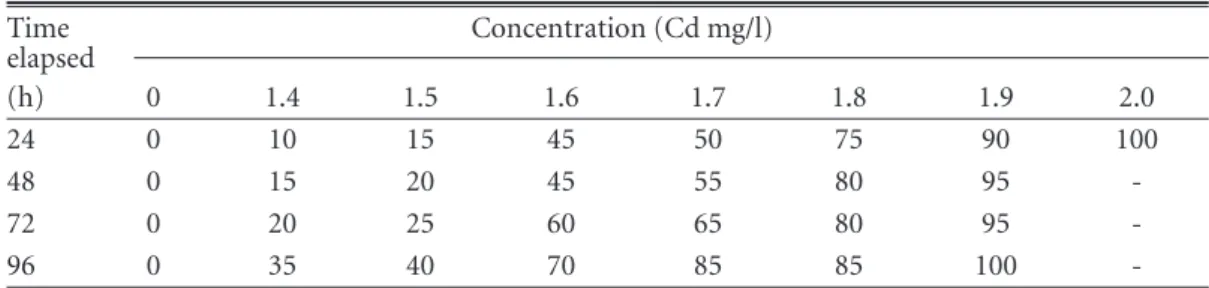
Percentage mortalities of V. barbatus exposed to three heavy metals (copper, cadmi-um, and mercury) for different times are shown in tables 1-3. It is clear that mercury caused higher mortality than the other metals.
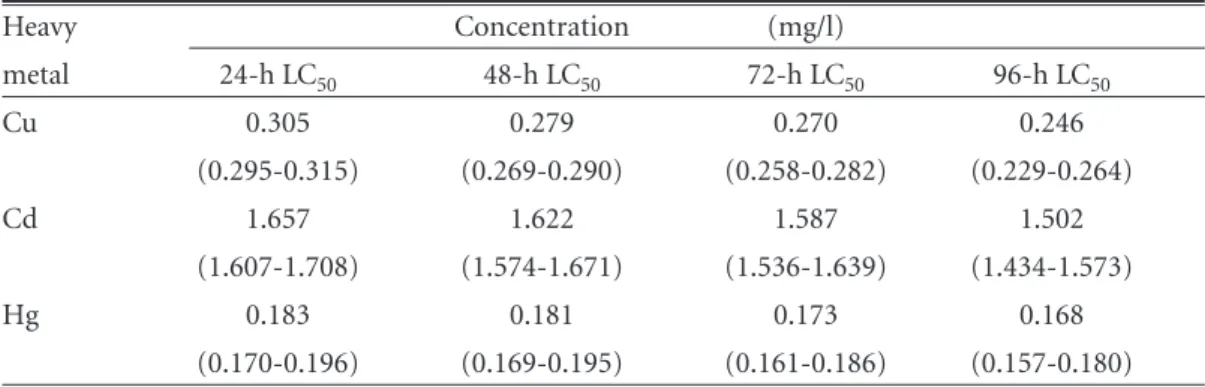
From these tables, the LC50 values and 95% confidence limits of heavy metals for V.
barba-tus were calculated and are shown in table 4. It
can be seen that the LC50 values and 95% confi-dence limits of the three heavy metals decrease with increasing time of exposure in hours. Generally speaking, the higher the concentra-tion of toxicants, the lower the LC50 values. However, the LC50 values were not remarkedly shortened in prolonged exposure, showing that these three metals are very toxic, even after 24 h. Comparing the toxicity of the three metals Table 1. Mortality rates (%) of Varicorhinus barbatus exposed to different concentrations of copper
for various time periods.
Time Concentration (Cu mg/l)
elapsed (h) 0 0.24 0.26 0.28 0.30 0.32 0.34 0.36 0.38 0.40 0.42 24 0 10 30 45 45 57.5 60 77.5 80 92.5 100 48 0 30 40 55 57.5 65 70 87.5 87.5 97.5 100 72 0 30 50 60 65 70 72.5 92.5 95 100 -96 0 40 60 75 80 82.5 82.5 92.5 95 100
-Table 2. Mortality rates (%) of Varicorhinus barbatus exposed to different concentrations of cadmi-um for various time periods.
Time Concentration (Cd mg/l) elapsed (h) 0 1.4 1.5 1.6 1.7 1.8 1.9 2.0 24 0 10 15 45 50 75 90 100 48 0 15 20 45 55 80 95 -72 0 20 25 60 65 80 95 -96 0 35 40 70 85 85 100
-Table 3. Mortality rates (%) of Varicorhinus barbatus exposed to different concentrations of mercu-ry for various time periods.
Time Concentration (Hg mg/l) elapsed (h) 0 0.12 0.14 0.16 0.18 0.20 0.22 0.24 24 0 10 10 30 35 70 80 100 48 0 10 15 30 35 70 80 -72 0 15 20 35 40 75 85 -96 0 15 25 40 45 80 85 -
Table 4. LC50values of copper, cadmium, and mercury, and 95% confidence limits for Varicorhinus
barbatus at different time periods (h).
Heavy Concentration (mg/l) metal 24-h LC50 48-h LC50 72-h LC50 96-h LC50 Cu 0.305 0.279 0.270 0.246 (0.295-0.315) (0.269-0.290) (0.258-0.282) (0.229-0.264) Cd 1.657 1.622 1.587 1.502 (1.607-1.708) (1.574-1.671) (1.536-1.639) (1.434-1.573) Hg 0.183 0.181 0.173 0.168 (0.170-0.196) (0.169-0.195) (0.161-0.186) (0.157-0.180)
Table 5. Mortality rates (%) of Zacco barbata exposed to different concentrations of copper for vari-ous time periods .
Time Concentration (Cu mg/l)
elapsed (h) 0 0.07 0.09 0.11 0.13 0.15 0.17 0.19 0.21 0.23 24 0 0 10 33.3 56.7 66.7 76.7 90 93.3 100 48 0 26.7 30 70 73.3 93.3 96.7 100 100 -72 0 30 56.7 80 83.3 100 100 - - -96 0 36.7 60 90 96.7 - - - -
-Table 6. Mortality rates (%) of Zacco barbata exposed to different concentrations of cadmium for various time periods .
Time Concentration (Cd mg/l) elapsed (h) 0 0.8 1.2 1.6 2.0 2.4 2.8 3.2 3.6 4.0 4.4 24 0 0 0 20 30 42.5 55 67.5 70 80 100 48 0 0 10 32.5 50 67.5 90 100 100 100 -72 0 0 12.5 40 60 75 95 - - - -96 0 12.5 22.5 40 65 87.5 97.5 - - -
-Table 7. Mortality rates (%) of Zacco barbata exposed to different concentrations of mercury for various time periods.
Time Concentrations (Hg mg/l) elapsed (h) 0 0.12 0.14 0.16 0.18 0.20 0.22 0.24 0.26 24 0 0 0 5 25 45 80 85 100 48 0 0 15 40 65 97.5 100 100 -72 0 2.5 20 50 75 100 - - -96 0 2.5 22.5 50 77.5 - - -
-to V. barbatus, it is obvious that mercury is the most toxic, followed by copper, with cadmium being the least toxic.
It is interesting to note that the order of tox-icity of heavy metals to Z. barbata has the fol-lowing sequence: Cu > Hg > Cd. This result indicates that the toxicity of copper to Z.
bar-bata is stronger than that of mercury, which is
an unusual case; but a similar result was also found in other fish (Yuan, 1994). From tables 4 and 8, it can be seen that toxicities of cadmi-um and mercury to V. barbatus and Z. barbata are more or less the same.
In addition, some related literature and important publications dealing with metal tox-icity in Taiwan after 1980 are summarized in table 9 for comparison. It is clear that
Acrosscheilus paradoxus is most sensitive to
copper (Chen et al., 1994), followed by V.
bar-batus, Z. barbata (present study), Plecoglossus altivelis (Lin et al., 1989), common carp (Wai et al., 1982), Misgurnus anguillicaudatus (Lin et al., 1989), and grass carp (Wai et al., 1984).
The most tolerant fish to copper is Anguilla
japonica (Tsay et al., 1981).
Similarly, different animals have various degrees of tolerance to cadmium. A. paradoxus (Chen et al., 1994)is still the most sensitive species to cadmium poisoning, followed by V.
barbatus, Z. barbata (present study), common
carp (Wai et al., 1982) and Aristichthys nobilis (Huang, 1987). The most insensitive species to
cadmium toxicity is tilapia (Tsay et al., 1981). As to the toxicity of mercury to freshwater fish, P. altivelis was found to be the most sensi-tive species (Lin et al., 1989), followed by V.
barbatus, Z. barbata (present study), grass carp
(Wai et al., 1984) and common carp (Wai et
al., 1982); Acrosscheilus paradoxus was not
test-ed. The most insensitive species to mercury is
M. anguillicaudatus (Lin et al., 1989).
Summarizing all the data, the order of toxi-city of these three heavy metals to most fresh-water fishes in Taiwan is mercury > copper > cadmium; these conclusions were reached from the fact that the LC50 values are the lowest and the differences of LC50 values among all fish are the least for mercury, then copper, and cadmi-um. However, the order of toxicity of copper > mercury > cadmium in the case for Z. barbata shows that this fish is most sensitive to copper poisoning. Determining the reason requires further studies. It has been mentioned that small fish or younger organisms are more sus-ceptible to metal poisoning than are larger or more mature fish. However, it can also be seen from Table 9 that fish inhabitating clear waters are less tolerant of metal toxicity than those found in eutrophic waters.
Other environmental factors including water temperature, hardness, and pH can also affect the acute toxicity and fish tolerance. Waiwood and Beamish (1978) reported that toxicity increases at lower levels of water hard-Table 8. LC50values of copper, cadmium, and mercury and 95% confidence limits for Zacco barbata
at different time periods (h).
Heavy Concentration (mg/l) metal 24-h LC50 48-h LC50 72-h LC50 96-h LC50 Cu 0.130 0.095 0.084 0.079 (0.121-0.138) (0.088-0.103) (0.076-0.094) (0.073-0.086) Cd 2.598 1.915 1.774 1.510 (2.387-2.829) (1.787-2.052) (1.660-1.897) (1.395-1.635) Hg 0.201 0.163 0.162 0.161 (0.195-0.207) (0.158-0.168) (0.157-0.167) (0.156-0.166)
Table 9. Toxicity of copper, cadmium, and mercury to other freshwater fishes in Taiwan.
Chemical Species Water quality LC50(mg/l ) Reference
CuSO4 Anguilla japonica 28 ± 1°C 24-h 149.00 Tsay et al.
8.61 cm pH 7.7-8.4 48-h 34.50 (1981)
0.65 g 72-h 23.20
96-h 23.20
Tilapia sp. 28 ± 1°C 24-h 38.575 Tsay et al.
2.13 cm pH 7.7-8.4 48-h 17.250 (1981)
0.26 g 72-h 14.686
96-h 10.647
CuSO4·5H2O Cyprinus carpio 23°C 24-h 0.31 Wai et al.
1.5-2.0 cm 210 mg/l CaCO3 48-h 0.29 (1982)
0.01-0.025 g pH 6-8
CuSO4·5H2O Ctenopharyngodon idellus 24-30°C 24-h 0.72 Wai et al.
3.5-4.0 cm 210 mg/l CaCO3 48-h 0.40 (1984)
1.2-1.5 g pH 6-8
CuSO4·5H2O Clarias fuscus 24-30°C 24-h 4.05 Wai et al.
1.0-1.5 cm 210 mg/l CaCO3 48-h 3.30 (1984)
pH 6-8
CuSO4 Aristichthys nobilis 23-28°C 24-h 1.13 Huang
5.4-6.3 cm 210 mg/l CaCO3 48-h 0.89 (1987)
0.16-1.72 g pH 6-8
CuSO4·5H2O Misgurnus anguillicaudatus 215 mg/l CaCO3 24-h 0.446 Lin et al.
4.0-5.5 cm pH 6-8 48-h 0.204 (1989)
Plecoglossus altivelis 215 mg/l CaCO3 24-h 0.136 Lin et al.
3.9-4.7 cm pH 6-8 48-h 0.102 (1989)
Acrosscheilus paradoxus 22°C 24-h 0.044 Chen et al.
1.50-1.80 cm 30-38 mg/l CaCO3 48-h 0.033 (1994)
pH 7.5-8.3 96-h 0.026
CuSO4·5H2O Varicorhinus barbatus 24-28°C 24-h 0.305 Present study
1.50-1.80cm 140-160 mg/l CaCO3 48-h 0.279 (2000)
pH 8.1-8.5 96-h 0.246
CuSO4·5H2O Zacco barbata 24-28°C 24-h 0.130 Present study
1.50-1.80cm 140-160 mg/l CaCO3 48-h 0.095 (2000)
Table 9. Toxicity of copper, cadmium, and mercury to other freshwater fishes in Taiwan. (Cont. 1)
Chemical Species Water quality LC50(mg/l ) Reference
CdCl2·21/2H2O Tilapia sp. 28 ± 1°C 24-h 140 Tsay et al.
2.13 cm pH 7.7-8.4 48-h 53.223 (1981)
0.26 g 72-h 38.571
96-h 4.053
C. carpio 23-27°C 24-h 2.40 Wai et al.
1.0-2.0 cm 210 mg/l CaCO3 48-h 2.15 (1982)
0.01-0.03 g pH 6-8
Poecilia reticulata 24 ±1°C 96-h 5.98 Lin et al.
1.5 ±0.5 cm (1983)
C. idellus 24-30°C 24-h 42.5 Wai et al.
3.5-4.0 cm 210 mg/l CaCO3 48-h (1984)
1.2-1.5 g pH 6-8 41.2
C. fuscus 24-30°C 24-h 46.3 Wai et al.
1.0-1.5 cm 210mg/l CaCO3 48-h 43.1 (1984)
pH 6-8
A. nobilis 23-28°C 24-h 8.38 Huang
4.5-6.3 cm 210 mg/l CaCO3 48-h 7.54 (1987)
0.61-1.72 g pH 6-8
Micropterus salmoides 23-28°C 24-h 74.64 Huang
2.5-2.8 cm 210 mg/l CaCO3 48-h 52.40 (1988)
pH 6-8
M. anguillicaudatus 215 mg/l CaCO3 24-h 76.118 Lin et al.
4.0-5.5 cm pH 6-8 48-h 71.297 (1989)
P. altivelis 215 mg/l CaCO3 24-h 16.031 Lin et al.
3.9-4.7 cm pH 6-8 48-h 13.943 (1989)
CdCl2·21/2H2O V. barbatus 24-28°C 24-h 0.305 Present study
1.50-1.80cm 140-160 mg/l CaCO3 48-h 0.279 (2000)
pH 8.1-8.5 96-h 0.246
CdCl2·21/2H2O Z. barbata 24-28°C 24-h 0.130 Present study
1.50-1.80cm 140-160 mg/l CaCO3 48-h 0.095 (2000)
Table 9. Toxicity of copper, cadmium, and mercury to other freshwater fishes in Taiwan. (Cont. 2)
Chemical Species Water quality LC50(mg/l ) Reference
HgCl2 A. paradoxus 22°C 24-h 0.555 Chen et al.
1.50-1.80 cm 30-38 mg/l CaCO3 48-h 0.371 (1994)
pH 7.5-8.3 96-h 0.292
HgCl2 A. japonica 28 ±1°C 24-h 0.476 Tsay et al.
8.61 cm pH 7.7-8.4 48-h 0.294 (1981)
0.65 g 72-h 0.250
96-h 0.154
C. carpio 23°C 24-h 0.24 Wai et al.
1.5-2.0 cm 210 mg/l CaCO3 48-h 0.21 (1982)
0.01-0.025 g pH 6-8
C. idellus 24-30°C 24-h 0.25 Wai et al.
3.5-4.0 cm 210 mg/l CaCO3 48-h 0.20 (1984)
1.2-1.5 g pH 6-8
C. fuscus 24-30°C 24-h 0.34 Wai et al.
1.0-1.5 cm 210 mg/l CaCO3 48-h 0.25 (1984) pH 6-8 A. nobilis 23-28°C 24-h 0.63 Huang 4.5-6.3 cm 213.6 mg/l CaCO3 48-h 0.55 (1987) DO>6 mg/l pH 6.0-8.9 M. salmoides 23-28°C 24-h 0.312 Huang 2.5-2.8 cm 210 mg/l CaCO3 48-h 0.312 (1988) pH 6-8
M. anguillicaudatus 215 mg/l CaCO3 24-h 0.997 Lin et al.
4.0-5.5 cm pH 6-8 48-h 0.813 (1989)
P. altivelis 215 mg/l CaCO3 24-h 0.185 Lin et al.
3.9-4.7 cm pH 6-8 48-h 0.148 (1989)
HgCl2 V. barbatus 24-28°C 24-h 0.305 Present study
1.50-1.80cm 140-160 mg/l CaCO3 48-h 0.279 (2000)
pH 8.1-8.5 96-h 0.246
HgCl2 Z. barbata 24-28°C 24-h 0.130 Present study
1.50-1.80cm 140-160 mg/l CaCO3 48-h 0.095 (2000)
ness. Since both high Ca+2and Mg+2 concen-trations significantly reduce the immediate effects of Cu+2 exposure(Bjerselius et al., 1993), Cu+2 is less toxic in hard water than in soft water (Andrew et al., 1977; Pagenkopf et al., 1974; Howarth and Sprague, 1978; Chakoumakos et al., 1979; Miller and Mackay, 1980). Similar results have been reported for cadmium ( Jones, 1938; Pickering and Henderson, 1966; Eaton, 1974).
Acute toxicity tests can detect the toxic damage of pollutants in a short period; they also make it easy to compare the degree of toxi-city among different pollutants and the relative sensitivities of animals to the same pollutant (Buikema et al., 1982). Accordingly, in the evaluation of environmental damage resulting from pollutants or the establishment of water quality criteria to protect aquatic life, we always use 96-h LC50values multipled by a fac-tor of 0.1-0.01 to arrive at a biologically safe concentration (Sprague, 1971). In compliance with such an evaluation, biologically safe con-centrations for V. barbatus are 0.024 mg/l Cu, 0.015mg/l Cd, and 0.0016 mg/l Hg. Similarly evaluated biologically safe concentrations for
Z. barbata are 0.007 mg/l Cu, 0.0151 mg/l Cd,
and 0.0016 mg/l Hg. Therefore in view of the need to protect most natural resources, a stricter criterion (0.007 mg/l Cu) should be adopted. This is in good agreement with USEPA criteria (1986). A similar result is also obtained for mercury. However, the biologi-cally safe concentration of cadmium obtained in the present study is much higher than those in the USA (USEPA, 1986; Meade, 1989), as well as water quality standards for aquaculture in Malaysia and Taiwan (Taiwan EPA, 1997) (Table 10). Thus, water quality criteria for cadmium have to be further investigated. REFERENCES
Andrew, R. W., K. E. Biesinger and G. E. Glass (1977) Effects of inorganic complexing on the toxicity of copper to Daphnia magna. Water. Res. 11: 309-315.
Arthur, J. W. and E. N. Leonard (1970)Effects of copper on Gammarus pseudolimnaeus,
Physa integra and Campeloma decisum in
soft water. J. Fish. Res. Bd. Can. 27: 1277-1283.
Parameter Water quality standards for aquaculture (Meade, 1989) Malaysia national water quality standards (Doe·UM, 1986) Taiwan water quality standards (Taiwan EPA, 1985) Safe concentration (96-h LC50x 0.1~0.01) (Varicorhinus barbatus) Safe concentration (96-h LC50x 0.1~0.01) (Zacco barbata) Cu (mg/l) Alkalinity < 100 mg/l 0.006 0.008 0.003 0.024 0.007 > 100 mg/l 0.03 Cd (mg/l) Alkalinity < 100 mg/l 0.0005 0.0007 0.01 0.0150 0.0151 > 100 mg/l 0.005 Hg (mg/l) < 0.02 0.0001 0.002 0.0016 0.0016
Table 10. Safe concentrations of three heavy metals for Varicorhinus barbatus and Zacco barbata and some foreign water quality standards.
Bengtsson, B. E.,C. H. Carlin, A. Larsson and O. Avanberg (1975).Vertebral damage in minnows, Phoxinus phoxinus L., exposed to cadmium. Ambio 4: 166-176.
Bjerselius, R., S. Winberg, Y. Winberg and K. Zeipel (1993) Ca+2protects olfactory recep-tor function against acute Cu(II) toxicity in Atlantic salmon. Aquat. Toxicol. 25:125-138. Borquegneau, J. M.(1977)ATPase activity in mercury- intoxicated eels. Experientia 33: 941-942.
Buikema A. L. Jr., R. R. Niedertehner and J. Cairns Jr. (1982)Biological monitoring Part IV-toxicity testing. Water Res. 16: 239-262. Chakoumakos, C., R. C. A. Russo and R. V.
Thurston (1979) Toxicity of copper to cut-throat trout (Salmo clarki) under different conditions of alkalinity,pH,and hardness. Environ. Sci. Technol. 13: 213-219.
Chen, H. C. (1996)Methods for measuring the acute toxicity of effluents and receiving waters to freshwater and marine organisms. Taiwan Environmental Protection Agency, EPA-85-E3S5-09-06-02, pp. 67.
Chen, H. C. and Y. K. Yuan (1994) Acute toxic-ity of copper, cadmium and zinc to freshwa-ter fish Acrosscheilus paradoxus. Acta Zool. Taiwanica 5(2):45-60.
Chuang, L. C. and Y. S. Lin (1995) Notes on the breeding behavior of Zacco barbata. Acta Zool. Taiwanica 6: 91-94.
Dallinger, R., F. Prosi, H. Segner and H. Back (1987) Contaminated food and uptake of heavy metals by fish: a review and proposal for further research. Oecologia 73: 91-98. De Mayo, A., M. C. Taylor and S. W. Reeder
(1979) Guidelines for surface water quality. Vol I. Inorganic substance: arsenic. Environment Canada, Ottawa.
DOE-UM (1986)Water quality criteria and standards for Malaysia. Vol.1-Executive Summary. Final Report. Department of
Environment, Ministr y of Science, Technology and Environment, Malaysia/Consultant Group on Water Quality, Institute of Advanced Studies, Univ. of Malaya, Kuala Lumpur, Malaysia, July 1986, pp. v-xii.
Eaton, J.G. (1974) Testimony in the matter of proposed toxic pollutant effluent standards for aldrin-dieldrin et al. Federal Water Pollution Control Act Amendments (307), Docket no. 1.
Howarth, R. S. and J. B. Sprague (1978) Copper lethality to rainbow trout in waters of various hardness and pH. Water Res. 12: 455-462.
Huang, C. H. and W. J. Shyong (1998)Effect of dietar y protein levels on growth of
Varicorhinus barbatulus. Chin. Biosci. 41(1):
1-10.
Huang, L. T. (1987) The study on acute toxici-ties of some heavy metals to Tilapia sp. and bighead carp (Aristichthys nobilis). Bull. Taiwan Fish. Res. Inst. 42: 205-209.
Huang, L. T. (1988) The study on acute toxici-ties of some heavy metals to Lateolabrax
japonicus and Micropterus salmoides. Bull.
Taiwan Fish. Res. Inst. 44: 116-118.
Ingersoll, C. G. and R. W. Winner (1982) Effect on Daphnia pulex (De Geer)of daily pulse exposures to copper or cadmium. Environ. Toxicol. Chem. 1(4): 321-327.
Jones, J. R. E. (1938) The relative toxicity of salts of lead, zinc and copper to the stickle-back (Gasterosteus acaleatus L.) and the effect of calcium on the toxicity of lead and zinc salts. J. Exp. Biol. 15: 394-407.
Lin, G. D., L. F. Chang and G. E. Wu (1983)The study on acute toxicities of some heavy met-als to guppies (Poecilia reticulata). Chin. Biosci. 21: 73-84.
Lin, T. S. and H. C. Tang (1989) Studies on acute toxicities of heavy metals, cyanide,
and fluoride to Misgurnus anguillicaudatus and Plecoglossus altivelis. Bull. Taiwan Fish. Res. Inst. 46: 127-138.
Mance, G., C. Musselwhite and V. M. Brown (1984) Proposed environmental quality standards for List II substances in water. Arsenic. Technical Report TR212, Marlow, Bucks, Water Research Centre, 51 pp. Meade, J. W. (1989) Aquaculture management.
Van Nostrand Reinhold, New York.
Miller, T. G. and W. C. Mackay (1980) The effects of hardness, alkalinity and pH of test water on the toxicity of copper to rainbow trout (Salmo gairdneri). Water Res. 14: 129-133.
Nebeker, A. V., M. A. Cairns and C. M. Wise (1984) Relative sensitivity of Chironomus
tentans life stages to copper. Environ.
Toxicol. Chem. 3(1): 151-158.
Nriagu, J. O. (1980) Cadmium in the environ-ment. Part I: Ecological cycling. J.Wiley, New York.
Pagenkopf, G. K., R. C. Russo and R. V. Thurston (1974) Effect of complexation on toxicity of copper to fishes. J. Fish Res. Bd. Can. 31: 462-465.
Peng, H. K. and H. C. Tang (1988) Egg devel-opment and larvae rearing of Varicorhinus
barbatus. Bull.Taiwan Fish. Res. Inst. 44:
85-90.
Peng, H. K. and H. C. Tang (1990) Feeding experiment on the fry of Varicorhinus
bar-batus. Bull. Taiwan Fish. Res. Inst. 48:
115-119.
Peng, H. K. and H. C. Tang (1989) Feeding experiment on Varicorhinus barbatus under culture. Bull. Taiwan Fish. Res. Inst. 46: 105-111.
Phillips, G. R. and D. R. Buhler (1978) The rel-ative contributions of methyl mercury from food or water to rainbow trout Salmo
gaird-neri in a controlled laboratory environment.
Trans. Am. Fish. Soc. 107: 853-861.
Pickering, Q. H. and C. Henderson(1966) The acute toxicity of some heavy metals to dif-ferent species of warmwater fishes. Intl J. Air Water Poll. 10: 453-463.
Reeder, S. W., A. DeMayo and M. C. Taylor(1979) Guidelines for surface water quality, Vol. I, Inorganic chemical sub-stance:cadmium. Environment Canada, Ottawa.
Renfro, J. L., B. Schmidt-Nielsen, D. Miller, D. Benos and J. Allen (1974) Methyl mercury and inorganic mercury: uptake, distribution and effect on osmoregulatory function in fishes. In Pollution and physiology of marine orgamisms. F. J. Vernberg and W. B. Vernberg, eds. Academic Press, New York, pp. 101-122.
Sangalang, G. B. and M. T. O'Halloran (1972) Cadmium-induced testicular injury alter-ations of androgen synthesis in brook trout. Nature. 240: 470-471.
Shen, S. C., S. C. Lee., K. T. Shao., C. H. Mok., C. C. Chen. and C. S. Tzeng (1993)Fishes of Taiwan. Department of Zoology, National Taiwan Univ. Taipei.
Shyong, W. J., C. H. Huang and H. C. Chen (1998)Effects of dietary protein concentra-tion on growth and muscle composiconcentra-tion of juvenile Zacco barbata. Aquaculture 167: 35-42.
Sprague, J. B. (1969) Measurement of pollutant toxicity to fish-I. Bioassay methods for acute toxicity. Water Res. 3: 793-821.
Sprague, J. B. (1971) Measurement of pollutant toxicity to fish-III. Sublethal effects and safe concentration. Water Res. 5: 245-266. Stagg, R. M., J. Rusin and F. Brown (1992) Na+,
K+-ATPase activity in the gills of the floun-der (Platichthys flesus) in relation to
mercu-ry contamination in the Firth of Forth. Mar. Environ. Res. 33: 255-266.
Taiwan EPA (1985) Water quality standards. Environmental Protection Agency, Taipei, Taiwan, no. 547327.
Tang, H. C. and H. K. Peng (1987) Artificial propagation of Varicorhinus barbatus-Induced spawning and egg stripping. Bull. Taiwan Fish. Res. Inst. 42: 171-176.
Trevors J. T. and C. W. Lusty (1985) A basic micro-computer program for calculating LD50 values. Water Air Soil Poll. 24: 431-442.
Tsay, T. T. and T. C. Yu (1981) Acute toxicity of some heavy metals to Tilapia sp. and eel (Anguilla japonica) and oyster (Crassostrea
gigas) Bull. Taiwan Fish. Res. Inst. 33:
581-586.
Tzeng, C. S. (1986) The freshwater fishes of Taiwan. Department of Education, Taiwan Provincal Government, ROC, 183 pp. (in Chinese)
USEPA (1980) Ambient water quality criteria for arsenic. EPA-440/5-80-021. US Environmental Protection Agency, Washington, DC.
Wai, C. Y. and C. K. Liu (1982) Toxicity of heavy metals and its sublethal effect on common carp and tilapia. Bull. Taiwan Fish. Res. Inst. 34: 207-217.
Wai, C. Y., J. S. Lin and C. K. Liu (1984) The toxicity study of heavy metals on sublethal effect of grass carp and catfish. Bull. Taiwan Fish. Res. Inst. 37: 169-171.
Waiwood, K. G. and F. W. H Beamish (1978) Effects of copper, pH and hardness on the critical swimming performance of rainbow trout (Salmo gairdneri Richardson). Water Res. 12: 611-619.
Wright, D. H. and P. M. Welbourn (1993) Effects of mercury exposure on ionic regu-lation in the crayfish Orconectes propinquus. Environ. Poll. 82: 139-142.
Yan, J. H., K. Y. Lue., Y. S. Chen and J. K. Jeng (1995) The study on the reproductive ecolo-gy of Zacco barbata in Ha-Pen creek. Biol. Bull. Nat. Taiwan Normal Univ. 30: 69-81. Yuan, Y. K. (1994) Studies on the use of
fresh-water fish Acrosscheilus paradoxus as bioindicator of water pollution. PhD Thesis. Zoology Dept. National Taiwan Univ., Taipei, Taiwan.
1 2 Varicorhinus barbatus Zacco barbata 24,48,72,96 LC50 0.305 0.279 0.270 0.246 mg/l CuSO4-Cu 0.130 0.095 0.084 0.079 mg/l CuSO4-Cu 24,48, 72,96 LC50 1.657 1.622 1.587 1.502 mg/l CdCl2-Cd 2.598 1.915 1.774 1.510 mg/l CdCl2-Cd 24,48,72,96 LC50 0.183, 0.181 0.173 0.168 mg/l HgCl2-Hg 0.201, 0.163 0.162 0.161 mg/l HgCl2-Hg 0.007 mg/l 0.0015 mg/l