The Relationships Among Cultural Intelligence, Cross-cultural
Adjustment, Psychological Capital, and Perceived Supervisor
Support: Philippine Labors Working in Taiwan
by
Wan-Yun Hsieh
A Thesis Submitted to the
Graduate Faculty in Partial Fulfillment of the Requirements for the Degree of
MASTER OF BUSINESS ADMINISTRATION
Major: International Human Resource Development
Advisor: Yi-Chun Lin, Ph. D.
National Taiwan Normal University Taipei, Taiwan
ACKNOWLEDGEMENT
It would not have been possible to finish the thesis without the help and support of the kind people around me, to only some of whom it is possible to give particular mention here.
Foremost, I would like to express my sincere gratitude to my advisor Dr. Yi-chun Lin for the continuous support of my master degree She is patient, enthusiastic, and have immense knowledge to guidance me all the time of research and writing of this thesis. In addition, I am deeply appreciated to Dr. Shin-yih Chen, who has the attitude and substance of a genius: she has a spirit of adventure regarding to research and an excitement to teaching. Without her guidance and persistent help to my statistic problem, the thesis would not have been materialized. Besides my advisor, I would like to thank my thesis committee: Professor Wei-Wen Chang for her encouragement, insightful comments, and hard questions.
I would like to offer my special thanks to Bert Hung for offering me the summer internship opportunities in the groups and leading me working on diverse exciting projects. I thank my classmates: Agnes Yen, Roy Hung, Alan Yu, and Ryan Wei for the stimulating discussions, for the sleepless nights we were working together before deadlines, and for all the fun we have had in the last two years. Special thanks to Yen-wei to share all the happiness and sadness, and to accompany me all the way to finish my master degree
Last but not the least; I would like to show my greatest appreciation to my family, especially, my parents for giving birth to me and supporting me spiritually throughout my life.
ABSTRACT
The rapid advancement of technology and transportation creates a global market that highlights the importance of individuals’ ability to manage and resolve conflict with clients and business partners all over the world. The internationalization of market not only leads to a significant incensement of cross-cultural interaction between people, but also enhances the use of diverse workforce in global villages. As the workforce moving globally, the issue of cross cultural adjustment has been draw attention for many years. The longer period of adaptation people take, the greater amounts of cost an organization spends on the overseas assignment. To increase the intercultural effectiveness to construct organization global competition advantages, many researchers have constantly examined the relationship between cultural intelligence (CQ) and cross-cultural adjustment during the past ten years; however, few researchers took individuals mental status as well as the outside factors into consideration while exploring antecedents affecting the intercultural effectiveness. The purpose of this study was to investigate the relationships among CQ, cross-cultural adjustment, psychological capital (PsyCap), and perceived supervisor support (PSS) through the paper-based questionnaires which collected from 538 Philippine labors in Taiwan. The statistic software of SPSS v18.0 and AMOS 18.0 were used to analyze by hierarchical regression and structural equation model (SEM). The result indicated that PsyCap plays as a partial mediating link between CQ and cross-cultural adjustment and PSS served as a moderator on the relationship between PsyCap and cross-cultural adjustment. The result of this study helps human resource practitioners understand the foreign laborers’ current situation and the HR practitioners can apply it as one of the selection criteria for successful overseas assignment. In other words, as recruiting employees with positive psychological status, organizations easily take competitive challenges and obtain more business opportunities in the global market.
Keywords: cultural intelligence, cross-cultural adjustment, psychological capital,
VII
TABLE OF CONTENTS
Abstract………...I Table of Contents………...II List of Tables………IV List of Figures………...VCHAPTER I INTRODUCTION ... 1
Background of the Study ... 1
Problem Statement ... 3
Study Purpose ... 5
Research Questions ... 6
Definitions of Key Terms ... 6
Research Procedure ... 7
CHAPTER II LITERATURE REVIEW ... 9
Cultural Intelligence ... 9
Cross-cultural Adjustment ... 10
CQ and Cross-cultural Adjustment ... 11
Psychological Capital ... 14
CQ and PsyCap ... 16
PsyCap and Cross-cultural Adjustment ... 18
The Mediating Effects of PsyCap ... 22
Perceived Supervisor Support ... 23
The Moderating Effects of PSS ... 24
CHAPTER III METHODOLOGY ... 27
Research Framework ... 27 Research Hypotheses ... 28 Research Design ... 29 Measurement ... 30 Questionnaire Design ... 34 Focus Group ... 35 Pilot Test ... 35 Data Analysis ... 39
CHAPTER IV FINDINGS AND DISCUSSIONS ... 45
Descriptive Statistics ... 45
Correlation Analysis ... 47
Confirmatory Factor Analysis (CFA) ... 49
Structure Equation Model (SEM) ... 51
VIII
CHAPTER V CONCLUSIONS AND SUGGESTIONS ... 65
Conclusions ... 65
Implications ... 70
Limitations ... 72
Further Research Suggestions ... 73
IX
LIST OF TABLES
Table 3.1 Population Description of Foreign Labors in Taiwan………...30
Table 3.2 Descriptive Statistics for Pilot Test………...37
Table 3.3 Mean, Standard Deviations, Correlations, and Reliability for Pilot Test..38
Table 3.4 Summary of Fit Indexes………41
Table 4.1 Descriptive Statistics……….46
Table 4.2 Mean, Standard Deviations, Correlations, and Reliability………48
Table 4.3 Results of Confirmatory Factor Analysis………..50
Table 4.4 Result of Regression Analysis of the Moderating Effect Between PsyCap and Cross-cultural Adjustment………...57
Table 4.5 Result of Regression Analysis of the Moderating Effect Between PsyCap and General Adjustment……….58
Table 4.6 Result of regression analysis of the moderating effect between PsyCap and interaction adjustment ……….59
Table 4.7 Result of Regression Analysis of the Moderating Effect Between PsyCap and Work Adjustment ………60
XI
LIST OF FIGURES
Figure 1.1 Research procedure………7
Figure 3.1 Research framework………27
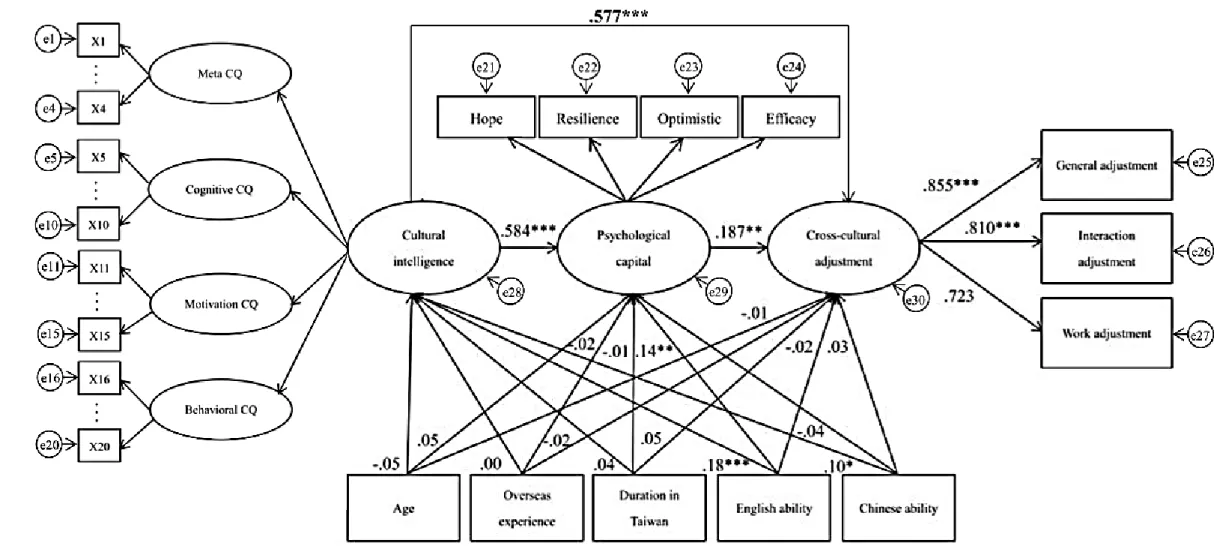
Figure 3.2 SEM conceptual model………42
Figure 4.1 SEM model with path coefficients………...53
Figure 4.2 SEM mediating model with path coefficients………..54
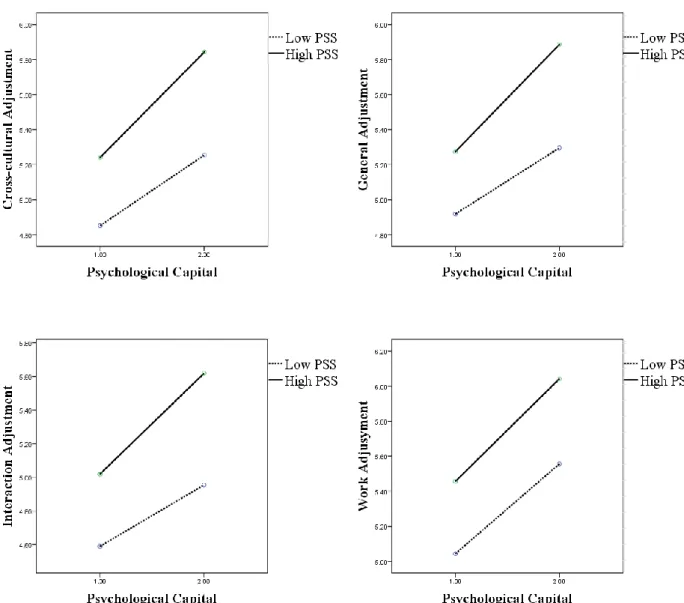
Figure 4.3 Interaction plots for the moderating effects of perceived supervisor support……….61
1
CHAPTER I INTRODUCTION
In this chapter, the background, problem statement, study purpose, research questions, significance, and research limitations of this study were introduced.
Background of the Study
The rapid advancement of technology and transportation creates a flat world and allow workforces to move beyond nation boundary. In a global workplace, people have more opportunities to collaborate and compete with others from different corners of the planet than ever (Friedman, 2005). It is important for both individuals and organizations to well-prepared competition in a wide range of cultural context. Budworth and DeGama (2012) asserted that individuals’ abilities to lead, manage, negotiate, and resolve conflict with clients, colleagues, and business partners all over the world, which are critical fundamentals that the organizations contest with other competitors in the global market.
Due to the internationalization in the world, the cross-cultural interactions are significantly increased between people. The use of diverse workforce in the global village has led to large number of labors living and working overseas, and having to adjust to new work environment as well as new living style (Black, Mendenhall, & Oddou, 1991). Black and Stephens (1989) found out that the longer the employees adjust to the new environment, the much more cost the organization spend. That is to say, the employees’ level of adaptation is one critical factor that determines organization’s success or failure in a global market. It is important to address the problem of how to facilitate individual’s adjustment as conducting overseas assignment in order to minimize the cost of failure adaptation and increase the organization global competition advantages (Harrison, Chadwick, & Scale, 1996).
2
be a key source of competitive advantage because it is difficult to copy individuals’ education, knowledge, experiences, skills, and intelligence to increase the organization’s competitiveness (Luthans, Luthans, & Luthans, 2004). For instance, cultural intelligence (CQ) is the vital capability for people to function effectively in intercultural settings and many researchers have been draw attention to this issue for many years due to its high relevance to globalization, international management, and workforce diversification (Van Dyne, Ang, Ng, Rockstuhl, Tan, & Koh, 2012). Aside from the intelligence, individuals’ mental resources such as confidence, hope, optimism, and resilience have been viewed as important factors to determine the competitive advantage in the workplace (Luthans, Avey, Clapp-Smith, & Li, 2008 a). Luthans et al. (2008) constructed the concept of psychological capital (PsyCap) with features of confidence, hope, optimism, and resilience and proposed that employees with higher PsyCap have great impact on the organization’s success. According to Luthans, Avolio, Avey, and Norman (2007), the increasing 10% of PsyCap leads organization to have 50% incensement of performance. PsyCap can be viewed as a factor that translates benefit of positive psychology movement into organizations and labors (Luthans, Norman, Avolio, & Avey, 2008). They believed that when organizations seek ways to help employees to overcome challenging work environment, it is more important to help them recognize the advantages and develop their strength rather than just fix the weakness (Avey, Luthans, Jensen, & Susan, 2009).
In the organization, the supervisors play important roles to give formal feedback about the job performance and to determine employees’ amount of payment. Supervisors’ support are more influential than other social supports to employees because supervisors act as agents in the organization to closely work together with employees every day, to help employees deal with problems, and also evaluate their
3
performance directly (Shanock & Eisenberger, 2006). Yoon and Thye (2000) suggested that perceived supervisor support (PSS) is an important determinant of organizational effectiveness and personal well-being. Above all, environmental characteristics, such as supervisor support, do play a critical role that affects individuals’ degree of adaptation as well as psychological status when employees encounter challenging situations.
Acknowledging the economic crisis and dynamic industry movement, not only expatriates are sent to overseas assignments but also many other labors move beyond their countries to seek more job opportunities. Take Taiwan as an example, owing to the economic development and the increasing amount of high educated citizens, the problem of labor shortage becomes seriously in recent years. Many foreign labors immigrate into Taiwan from the near countries to work for the dirty, dangerous, and difficult jobs. In May 2013, the total number of foreign labors in Taiwan was 454,171. Foreign laborers in Taiwan suffer many job-related problems, such as missing work time with no excuses, performing job in low quality and low pace, violating rules, and inhabiting low morality, which decreased the productivity and created conflicts within the organization (Chen, Lin, & Sawangpattanakul, 2011). In order to overcome these problems, more alternative ways should be found to enhance individual’s degree of adaptation.
Problem Statement
Cross-cultural adjustment is the degree of psychological comfort individuals feel during the adaptation process when living and working in a foreign culture (Black & Stephens, 1989). Prior researches have been identified factors that influence on individual’s cross-cultural adjustment. For example, language fluency (Bhaskar-Shrinivas, Harrison, Shaffer, & Luk, 2005; Kim & Slocum, 2008), social support (Adelman, 1988; Bhaskar et al., 2005; Caligiuri & Lazarova, 2002; Caligiuri,
4
Joshi, & Lazarova, 1999; Kraimer, Wayne, & Jaworski, 2001), previous international experiences (Bhaskar et al., 2005; Black, Morrison, & Gregersen, 1999; Kim & Slocum, 2008), pre-departure training (Black & Grefersen, 1991; Black, Mendenhall, & Oddou, 1991), and individual differences. The individual differences included personality (e.g., open-mindedness, emotional stability, extraversion), self-monitoring, self-efficacy (Harrison et al., 1996; Plathe, 2004; Parker & McEvoy, 1993; Peltokorpi & Froese, 2012; Shaffer, Harrison, Gregersen, Black, & Ferzandi, 2006), and cultural intelligence (CQ) (Ang, Van Dyne, Koh, & Ng, 2004; Ang, Van Dyne, Koh, Ng, Templer, Tay, & Chandrasekar, 2007; Lin, Chen, & Song, 2012; Ramalu, Uli, & Kumar, 2012; Ramalu, Raduan, Kumar, & Uli, 2010; Templer, Tay, & Chandrasekar, 2006).
Cultural intelligence (CQ) refers to individual’s capability to adapt effectively in culturally diverse settings (Earley & Ang, 2003). Researchers pointed out that individual in high CQ can adjust to the culture diverse environment by processing the related cognition, behavior, and interpersonal skill more effectively. On the other hand, some researchers regarded individual differences as critical antecedents of individuals’ cross-cultural adjustment. PsyCap, one type of individual differences, is different from other trait-like constructs such as personality and intelligence. PsyCap is a “state-like” construct of hope, resilience, optimism, and efficacy, which concerns about who you are and was defined as an individual’s positive psychological state of development (Luthans, Avolio, Avey, & Norman, 2007). PsyCap has been constantly studied as a predictor of employee behaviors, attitudes (e.g., satisfaction and commitment), and performance (Luthans, Avey, Avolio, & Peterson, 2010; Luthans et al., 2007a; Luthans, Avolio, Walumbwa, & Li, 2005; Luthans et al., 2008b; Rego, Marques, Leal, Sousa, & Pina, 2010; Sun, Zhao, Yang, & Fan, 2011). Although the relationship between CQ and cross-cultural adjustment has been constructed
5
constantly in the past ten years (Ang et al., 2004; Ang et al., 2007; Lin et al., 2012; Ramalu et al., 2012; Ramalu et al., 2010; Templer et al., 2006), few researches took the individual differences such as PsyCap into consideration when discussing the intercultural effectiveness.
Few studies focused on how PsyCap influences on individual’s adjustment in a cross-cultural setting. Avey, Wernsing, and Luthans (2008) asserted that individuals high in PsyCap usually hold optimistic outlook and make use of the positive mental resource to adapt to the new change. More empirical studies demonstrated that hope, resilience, optimism, and efficacy (four features of PsyCap) had influence on cross-cultural adjustment separately. For example, hope and optimism demonstrated higher possibilities of multicultural interaction success (Peltokorpi & Froese, 2012). Individuals high in efficacy and resilience were found more satisfaction with life and work, and tend to adjust to stressful life events (Harrison et al., 1996; Luthans et al., 2007a; Palthe, 2004; Tripathi, 2011).
In short, CQ and cross-cultural adjustment are two variables that being adopted to predict intercultural effectiveness frequently in many researches; however, the individual differences of mental status, which gain little attention as exploring cultural related issues. If the level of CQ is a predictor to know individual’s adjustment, and if the features of PsyCap such as hope, resilience, optimism, and efficacy have been shown to be critical for individual’s psychological adaptation comfort, then more should be known about the relationships among CQ, PsyCap, perceived supervisor support, and cross-cultural adjustment in the perception of cultural diversity.
Study Purpose
The purpose of the study was to investigate the relationships among cultural intelligence (CQ), cross-cultural adjustment, psychological capital (PsyCap), and perceived supervisor support (PSS) through the analysis of data collected from
6
foreign labors. The specific aims in this study were (a) to examine how CQ relates to PsyCap and PsyCap relates to cross-cultural adjustment, (b) to identify the mediating effect of PsyCap on the relationship between CQ and cross-cultural adjustment, and (c) to explore the moderating effect of PSS on CQ and cross-cultural adjustment.
Research Questions
To address the issues already outlined and to begin to fill the gaps in the previous research, the present study was designed to address the following research questions: 1. Does CQ have a positive effect on cross-cultural adjustment and its three
sub-dimensions?
2. Does CQ have a positive effect on PsyCap?
3. Dose PsyCap have a positive effect on cross-cultural adjustment and its three sub-dimensions?
4. Does PsyCap serve as a mediator between CQ and cross-cultural adjustment, CQ and its three sub-dimensions individually?
5. Does PSS positively moderate the relationship between PsyCap and cross-cultural adjustment and its three sub-dimensions individually?
Definitions of Key Terms
Cultural Intelligence (CQ)
CQ refers to an individual’s capability to adapt and perform effectively under the cultural diversity situations (Earley & Ang, 2003). Individuals with high CQ are able to come up with new solutions to novel tasks and interact with people from different cultures successfully (Earley & Ang, 2003; Lee & Templer, 2003).
Cross-cultural Adjustment
Cross-cultural adjustment is the degree of psychological comfort individual feels during the adaptation process of living and working in different cultures (Black & Stephens, 1989).
7
Psychological Capital (PsyCap)
Psychological capital concerns about whom you are and was defined as an individual’s positive psychological state of development and characterized by hope, resilience, optimism, and efficacy (Luthans et al., 2007b).
Perceived Supervisor Support (PSS)
Perceived supervisor support was defined as employees’ general beliefs concerning the extent to which supervisors value their contributions and care about their well-being (Kottke & Sharafinski, 1988).
Foreign Labors
This study defines foreign labors as blue collar labors being legally employed in Taiwan according to the Employment Services Act (http://law.moj.gov.tw).
Research Procedure
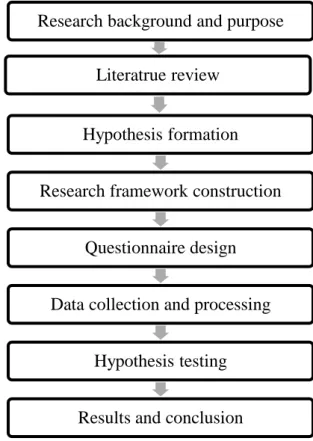
The procedure of this study is shown below. Please see Figure 1.1. Research background and purpose
Literatrue review
Hypothesis formation
Research framework construction
Questionnaire design
Data collection and processing
Hypothesis testing
Results and conclusion
9
CHAPTER II LITERATURE REVIEW
This chapter reviewed the literature regarding cultural intelligence (CQ), cross-cultural adjustment, psychological capital (PsyCap), and perceived supervisor support (PSS). Also, the research hypotheses were proposed based on theories and researches.
Cultural Intelligence
The concept of CQ, one predictor to explain intercultural effectiveness, was different from general intelligence (IQ) and it was first proposed in the book of Cultural
Intelligence: Individual Interactions across Cultures. CQ was defined as “an
individual’s capability to adapt effectively to situations of cultural diversity” (Earley & Ang, 2003, p.3). Individuals with high cultural intelligence were able to interact with people from different cultures successfully since they can interpret the message and make correct judgments in cultural diversity settings. Further, they were able to come up with new solutions to novel tasks (Earley & Ang, 2003; Lee & Templer, 2003). Earley and Ang (2003) presented that CQ was viewed as a multifactor structure which consists of mental ability (cognitive CQ and meta-cognitive CQ), motivational CQ, and behavioral CQ.
Cognitive CQ was referred to the knowledge and experience about norms,
practices, and conventions in different cultures which were stored in individual’s memory and was concern about the information processes of intelligence (Earley & Ang, 2003; Earley & Perterson, 2004). Meta-cognitive CQ was an understanding
process as individuals having interacting with people in different cultures. Individuals with a high meta-cognitive CQ had ‘cognitive strategies’ in the mind (Ang & Inkpen, 2008) and had better ability to put one specific culture pattern together into a coherent picture even when they did not fully understand the situation (Earley, 2002).
10
Motivational CQ was the mental capacity to direct attention and energy towards
intercultural experiences and to be motivated to learn more about cultural differences (Ang et al., 2007). Imai and Gelfand (2010) also pointed out that motivational CQ put emphasis on the intrinsic motivation and self-efficacy in adapting new cultures. Motivational CQ was regarded as a critical factor that leads to cultural adaptation; in other words, if individuals lack of motivational CQ, the adaptation never occurred (Earley & Perterson, 2004). Earley (2002) pointed out that the cultural adaptation not only had cognition of knowing what and how to do, but also had motivation to persist in performing proper response in cultural diversity situations. Behavioral CQ was the ability to express verbal and non-verbal action appropriately in intercultural situations. Individuals with a high behavioral CQ tend to have a comfortable and effective intercultural exchange under cultural diversity situation since they can quickly adapt to another’s gesture and message (Earley & Perterson, 2004).
Cross-cultural Adjustment
Cross-cultural adjustment was the degree of psychological comfort individuals feel when living and working in a foreign culture (Black & Stephens, 1989). Mendenhall and Oddou (1985) identified four important dimensions for individuals to utilize during their adaptation process. The first dimension was self-oriented. Individuals’ high in self-confidence will reach high level of psychological comfort during the adaptation process by involving in similar activities they had before in the home country, acquiring necessary skill to accomplish the assignments, and coping with stress successfully. The second one was others-oriented. Individuals who are willing to communicate and develop relationships with the host nationals had greater abilities to build a social network in the new environment to advance the adjustment. Third, perceptual dimension referred to the understanding of the host nationals’ behaviors. Individuals who had better understanding of the host nationals were able to predict the
11
host nationals’ behaviors and reduce the uncertainty. Forth, cultural-toughness dimension referred to the gap between the host country and the home country. The bigger the gap was, the more difficult individuals adapt to the new culture.
Black and Stephens (1989) proposed three facets of cross-cultural adjustment which had been widely adopted by many other studies related to cross-cultural context. First, general adjustment referred to the overall daily adaptation to living, housing condition, food, climate, and health facilitates. Second, interaction adjustmentwas identified as the most difficult facet to be achieved referred to achieving successful and comfortable interaction with host nationals in both work and non-work situations (Balck et al., 1999). Third, work adjustment referred to the adaptation to new work role, job task and work environment.
CQ and Cross-cultural Adjustment
Earley and Ang (2003) indicated that individuals with high cultural intelligence have greater motivation to understand new cultures and are able to interact with people from different cultures successfully. Recent studies also indicated the positive relationship between cultural intelligence and cross-cultural adjustment; briefly, the results implied that higher CQ leads to higher level of cross-cultural adjustment (Ang et al., 2004; Ang et al., 2007; Lin el al., 2012; Ramalu et al., 2012; Ramalu et al., 2010; Templer et al., 2006). Ramalu et al. (2012) empirically examined the relationships among CQ, cross-cultural adjustment, and performance with the sample of Malaysia expatriates. The result showed that cross-culture plays as a mediator between CQ and performance, which indicates the causal relationship between CQ and adjustment. When individuals were awarded the cultural knowledge and had confidence to socialize with locals, they had better ability to cope with stress associated with uncertainty and ambiguity in new cultural environment, hence resulting in a better adjustment. Lin et al. (2012) conducted a study among 295 international students in
12
Taiwan to test the moderating effect of emotional intelligence between CQ and adjustment in a cross-cultural context. The result showed that CQ positively related to cross-cultural adjustment. Specifically, individual who had higher meta-cognitive CQ can adjust to a culture diverse environment by processing the cultural related cognitive effectively. Based on the previous studies, this study hypothesized a positive relationship between CQ and cross-cultural adjustment; specifically, individuals with high CQ adapt to the new culture setting better than those with lower CQ.
Hypothesis 1. Cultural intelligence has a positive effect on cross-cultural adjustment.
CQ and General Adjustment
General adjustment involved factors such as living, housing, food and health facilitates that affect individual’s daily life adaptation. Individuals with high CQ tend to sense and understand the political, economic, and social systems similarities and differences across cultures; therefore, they had better capability for successful adaptation to new and unfamiliar cultural settings (Ang et al., 2007; Brislin, Worthley, & MacNab, 2006; Earley &Ang, 2003). Ramalu, Chuah, and Rose (2011) conducted a study among 339 expatriates working in Malaysia through online and e-mail surveys in order to confirm the effects of CQ on cross-cultural adjustment and job performance; the result showed that meta-cognitive CQ and motivational CQ were positively associated with general adjustment. Ang et al. (2007) found the similar result among technology consulting professionals in Singapore. The result showed that individuals with high motivational CQ and behavioral CQ performed higher level of general adjustment; in other words, individuals with high intrinsic interest in other cultures and had the capacity to perform appropriately in a cultural diversity situation was predicted to have higher general adjustment. Templer et al. (2006) noted that motivational CQ was regarded as a critical component that affected individual’s daily
13
live adjustment since they were more open to experience and try new thing. Based on the previous researches, this study assumed that individuals with high CQ predict higher level of general adjustment.
H 1-1. Cultural intelligence has a positive effect on general adjustment.
CQ and Interaction Adjustment
Interaction adjustment represented the degree of individual’s comfort to socialize with local people both in work and non-work situations. Individuals with high CQ enjoyed and had confidence on interacting with people from different or unfamiliar cultures. Ang et al. (2007) conducted a study among 593 undergraduate students in mid-western U.S.A and Singapore aimed to exam the relationship between CQ and cultural adaptation. The result showed that motivational CQ and behavioral CQ predicted interaction adjustment. Ramalu et al. (2011) also indicated that individuals with high meta-cognitive CQ, cognitive CQ, and motivational CQ performed higher level of interaction adjustment. Overall speaking, individuals who have higher CQ are more willing to make use of the cultural knowledge and change their verbal and non-verbal behavior in order to build friendly relationship with people from different cultures than those with lower CQ. Hence, this study proposed that CQ has a positive effect on interaction adjustment.
H 1-2. Cultural intelligence has a positive effect on interaction adjustment.
CQ and Work Adjustment
Job factors such as role novelty, role ambiguity, role conflict, and role overload inhabited in individual’s work adjustment (Black, 1988). Individuals who perform high work adjustment usually involved the adaptation to new job tasks, work roles, responsibilities, and the new work environment in a cultural diversity environment. Rose, Ramaly, Uli, and Kumar (2010) noted that “since expectations for performing
14
role prescribed behaviors often differ across cultures, CQ will facilitate individuals to perform in their job because of its more context or situation-specific nature characterized by cultural diversity” (p.79). Researchers indicated that individuals with high CQ were able to deal with cultural diversity by their efficacious belief of adaptive capabilities; furthermore, they were more open to new situation and tend to persist in adapting to both work and non-work situations in cultural diversity environment (Ang et al., 2004). Many other empirical researchers also found that there was a positive relationship between CQ and work adjustment, implying that the higher level of CQ predicted the greater level of work adjustment (Ang et al., 2007; Ramalu et al., 2010, 2011; Templer et al., 2006). Ang et al. (2007) conducted a study among 103 foreign professionals worked for an information technology consulting firm in Singapore through online survey. The results showed that motivational CQ and behavioral CQ predicted work adjustment. Ramalu et al. (2010, 2011) indicated that the four dimensions of CQ positively associated with work adjustment. Templer et al. (2006) also pointed out that motivational CQ was positively associated with work adjustment. Based on the theoretical and empirical literatures, this study proposed that there was a positive relationship between CQ and work adjustment. Individuals with high CQ usually sense the culture differences and take appropriate actions to meet the expectations across cultures. Hence, this study proposed that CQ has a positive effect on work adjustment.
H 1-3. Cultural intelligence has a positive effect on work adjustment.
Psychological Capital
Luthans (2008a) defined positive organization behavior (POB) as “the study and application of positively oriented human resource strengths and psychological capacities that can be measured, developed, and effectively managed for performance improvement in today's workplace” (p.59). PsyCap was derived from the POB
15
foundation and criteria (Luthans & Youssef, 2004; Luthans et al., 2004) and was first proposed by Luthans et al. (2004). It addressed the importance of ‘who you are’ beyond the concept of economic capital (what you have), human capital (what you know), and social (who you know). PsyCap was defined as “an individual’s positive psychological state of development” (Luthans et al., 2007b, p.542). Briefly, PsyCap reflects the condition of individual’s positive emotional status during the process of development and it helps individuals to recognize their role as well as sustains positive perception of well-being. PsyCap is characterized by four features which include hope, resilience, optimism, and efficacy.
Hope drew form the work of positive psychology and was defined as “a
positive motivational state that was based on an interactively derived sense of successful (a) agency (goal-oriented energy) and (b) pathways (planning to meet goals)” (Snyder, Irving, & Anderson, 1991, p.287). Luthans and Youssef (2004) defined resilience as “the capacity to bounce back from adversity, uncertainty, failure, or even positive but seemingly overwhelming changes” (p.152). Resilience was composed with three components, including a firm acceptance of reality, a deep belief, and the ability to adapt to significant change. With the three components, individuals are encouraged to face the difficulties and hold firm belief that they can deal with any difficulties in any situations. In short, people with high resilience capacity can not only bound back from the difficulties but also perform better and find meaningful value during the life process (Luthans & Youssef, 2004).
Optimism was another feature that is applied in the positive psychology
movement. Seligman (1998) drew the definition of optimism from attribution theory in terms of one’s explanatory style of good and bad events. The two critical dimensions that to do with time and apace are permanence and pervasiveness. Specifically, the optimisms interpreted bad events as being temporary, while the
16
pessimisms interpreted bad events as being permanent. Self-efficacy (or confidence) was defined as “one’s conviction (or confidence) about his or her abilities to mobilize the motivation, cognitive resources, and courses of action needed to successfully execute a specific task within a given context” (Stajkovic & Luthans, 1998, p. 66). People with high self-efficacy are willing to put more efforts on tasks and are likely to take challenging goals. Furthermore they usually persist to the end no matter how many obstacles they meet during the process of accomplishment (Luthans & Youssef, 2004).
CQ and PsyCap
Meta-cognitive CQ component associated with thinking about rational and related strategies (Earley & Peterson, 2004). MacNab and Worthley (2012) noted that within this component individuals reflect their own cultural background, stereotypes of thinking on the other culture. In other words, meta-cognitive CQ influenced individual’s perspective of thinking. Optimism referred to the style that individual explains positive or negative events. Individuals who were more optimistic tent to interpret good events as personal, and permanent, whereas negative events as external, temporary, and situation-specific (Seligman, 1998). Hope was composed with two components which were “will-power” (agency) and “way-power” (pathway). Agency provided the determination to achieve goals, whereas pathway promoted individuals’ creation to come up with alternative paths to replace the obstacles occurred in their process of pursuing goals (Youssef & Luthans, 2007). Owing to meta-cognitive CQ had been constructed by the original culture or international experience, meta-cognitive CQ affected on individual’s perspective of thinking. There was a great possibility that when individuals try to explain events happened around them or intend to come up with new pathway to pursue a certain goal, people will be either constrained or liberate by distinguishing the culture style. Therefore, meta-cognitive
17
CQ influences individual’s creative thinking as well as psychological status.
Motivational CQ component referred to perseverance and appropriate goal setting in the culture setting (Earley & Peterson, 2004). Resilience involved maintaining positive adjustment and bouncing back when individuals meet both positive and negative overwhelming changes. People with high resilience were recognized to hold staunch acceptance of reality and believe life as meaningful (Luthans et al., 2004). Motivation had been regarded as an important intrinsic energy to overcome obstacles and perform successfully. The component of perseverance in motivation affected individual’s willingness to maintain positive belief while facing setbacks. Hence, motivational CQ facilitated the positive energy to help individuals recover from difficulties. Applying to the cross-cultural setting, individuals with high motivational CQ have greater chances to bounce back when they face setback during the adaptation process or meet difficulties to communicate with the locals, because they have been set their goals to deeply involved in the host nation. On the other hand, self-efficacy, the other features of PsyCap, had been recognized to play an important role in CQ (Earley & Peterson, 2004; NacNab & Worthley, 2012). Earley and Peterson (2004) stated that people high in CQ had a strong sense of efficacy; on the contrary, people low in motivational CQ feel frustrated when encountering initial frustration of goal attainment and then decreasing efficacy as well as constructing negative self-images.
Based on the above literatures, both meta-cognitive CQ and motivational CQ had many theoretical and empirical studies to support the relationship between CQ and the four features of PsyCap (optimism, hope, resilience, and self-efficacy), this study proposes that CQ has a positive effect on PsyCap. Specifically, individuals with high CQ perform higher level of PsyCap in the cross-cultural setting than those low in CQ.
18
Hypothesis 2. Cultural intelligence has a positive effect on psychological capital.
PsyCap and Cross-cultural Adjustment
Luthans et al. (2004) first proposed the concept of PsyCap that go beyond human capital and social capital. PsyCap could be trained and invested to develop competitive advantages (Luthans et al., 2010). There were growing studies shown that PsyCap was significantly related to desired employee behaviors, attitudes (e.g., satisfaction and commitment), and performance (Luthans et al., 2007b); however, very few researches applied PsyCap under cross-cultural settings or even discussed the relationship between PsyCap and adjustment. In spite of this, Avey et al. (2008) conducted a study among 131 adults working in the US and found that employee with high PsyCap were easier to adjust the change of the organization. Avey et al. (2008) suggested that it was the employees’ responsibilities to adapt and behave in ways with new organization strategies and regulations. Under the circumstance of change, employee knew how to adjust to the new paths and strategies to meet the redefined goals of the organization. First of all, employee tended to keep the confidence (efficacy) to adapt to the organizational change as well as the resilience to recover from the setback occurred during the change process. Further, they had motivation and determination (hope) to come up with new pathways to encounter obstacles. Finally, they were positive (optimistic) to the attribution when things happened beyond expectations. These characteristic would be helpful for employees to survive in a new organization. In short, individuals who had the ability to utilize the characteristics of PsyCap advances the organization change process since they tend to adapt to the new organization easier than those who hold low level of PsyCap. Based on the study, individual with high PsyCap showed little resistance to unfamiliarity environment and tended to adapt to the new setting. Similarly, individuals with high level of PsyCap were supposed to experience higher level of psychological comfort
19 when living and working in a foreign culture.
Hypothesis 3. Psychological capital has a positive effect on cross-cultural adjustment.
Psychological Capital and General Adjustment
General adjustment referred to the degree of individuals’ psychological comfort to adjust to the overall daily life such as living conditions, transportation system, food, shopping, weather, and entertainment. Individuals took pleasures from the activities that happened in the daily life and satisfied with the life tend to perform high level of general adjustment. Avey, Reichard, Luthans, and Mhatre (2011) conducted a meta-analysis study by reviewing 51 researchers about PsyCap in order to clarify the relationship between PsyCap, desirable and undesirable attitude. The result showed that PsyCap was positively related to psychological well-being, while negatively related to stress and anxiety. In addition, Tripathi (2011) examined the relationship among PsyCap, life satisfaction, and well-being. The samples were 37 male employees working in the insurance sector from Raebareli. The result showed that well-being was positively correlated with PsyCap; particularly, self-efficacy and resilience were found as significant predictors of well-being, which help individuals to adjust to stressful life events better.
H 3-1. Psychological capital has a positive effect on general adjustment.
Psychological Capital and Interaction Adjustment
Interaction adjustment referred to the degree of individual’s comfort when socialize and communicate with host country nationals. Peltokorpi and Froese (2012) conducted an empirical study among 181 expatriates in Japan and found that individual’s personality trait was positively related to interaction adjustment. The result indicated that individuals who were more interest in the local people and took flexible views of right and wrong were more likely to adjust to work and non-work
20
overseas assignments. In other words, individuals who are comfortable when interacting with locals usually hold strong willpower (hope) to interact with locals and tend to value positive events more contributive than negative one (optimism). In addition, self-efficacy, one of the features of Psycap, was viewed as an important antecedent to interaction adjustment (Harrison et al., 1996; Palthe, 2004). Briefly, even though individuals confronted many unsuccessful outcomes when interacting with people from different cultural backgrounds, people with higher levels of self-efficacy tend to apply both verbal and non-verbal behaviors that being learned constantly than those with less self-efficacy. Moreover, resilience was defined as individual’s capacity to bounce back from setbacks or overwhelming changes. Individuals with resilience were characterized by holding firm acceptance of reality and had ability to adapt to significant change. Resilience did not limit in proactive recovery from setbacks but also included active learning and growth through difficult challenges (Luthans & Youssef, 2004). Through the trial process of interacting with different people from diverse culture, individual facilitated the degree of adjustment (Black et al., 1991). Above all, since both empirical and theoretical studies pointed out that the four features of Psycap were positive components to smooth the interaction adjustment progress, the study proposed that individuals with high PsyCap perform higher level of interaction adjustment.
H 3-2. Psychological capital has a positive effect on interaction adjustment.
Psychological Capital and Work Adjustment
Individuals with high level of PsyCap usually held optimistic outlook and made use of the positive mental resource (e.g., resilience, hope, self-efficacy) to adapt to the new change (Avey et al., 2008). On the other hand, individuals who felt more comfortable and less stressful when adapting to new job tasks, work roles,
21
responsibilities, and the new work environment leads to high work adjustment (Black & Stephens, 1989). PsyCap, featured by hope, resilience, optimistic, and self-efficacy, had been regarded as a significant predictor to employees’ satisfaction, commitment, and performance (Luthans et al., 2007b). Although the relationship between PsyCap and work adjustment did not demonstrated consistently in the past, prior research showed a direct relationship between PsyCap and other positive individual and organizational outcomes. Further, the relationship between self-efficacy and wok adjustment had been constructed directly in empirically studies (Luthans et al., 2008b; Avey et al., 2011; Luthans et al., 2007a; Harrison et al., 1996; Palthe, 2004).
Empirically, Luthans et al. (2008b) tested the relationship among supportive organizational climate, PsyCap, and desirable attitude with a total of 737 samples from different occupations. The result showed that PsyCap was positively related with job satisfaction. Besides, the meta-analysis conducted by Avey et al. (2011) found the same result that PsyCap had a positive effect on desire attitude (e.g., satisfaction, work happiness, commitment, and psychological well-being). Researchers suggested that individuals high in PsyCap report were more satisfied with job as well as experience work happiness since they expected good things to happen at work (optimism), hold strong belief that they created success on their own (hope and efficacy), and setback from difficulties easier than those who lower in PsyCap (Luthans et al. 2007a). Furthermore, Harrison et al. (1996) and Palthe (2004) found that expatriates with high self-efficacy (one of the features of PsyCap) had significantly great degree of work adjustment.
Above all, individuals with high PsyCap look forward to good things happening and they believed that they had the abilities to take over the challenges. Most importantly, they have better abilities to facilitate the positive mental resources to make them feel comfortable to adapt to the redefined goals of the new role,
22
responsibility, and tasks. Therefore, this study proposed that individuals with high PsyCap perform higher level of work adjustment, while, those who hold lower level of PsyCap can hardly accept the new performance standard or expectations and tend to face more difficulties to adjust to the new job responsibilities.
H 3-3. Psychological capital has a positive effect on work adjustment.
The Mediating Effects of PsyCap
PsyCap served as a mediator to predict performance, satisfaction, commitment, and engagement in many other researches (Luthans et al., 2008b; Vink, Ouweneel, & le Blance, 2011). According to Stajkvoic and Luthans (1998b), self-efficacy (on feature of PsyCap) was defined as “individual’s conviction about his or her abilities to mobilize the motivation, cognitive resources, and courses of action needed to successfully execute a specific task within a given context” (p.66).
Prior research found that people high in CQ had strong sense of efficacy even when encountering frustration and were less likely to construct negative self-images (Earley & Peterson, 2004). Precisely, motivational CQ facilitated the positive energy to help individual recover from difficulties, and meta-cognitive CQ influenced individual’s creative thinking as well as psychological status. On the other hand, researchers asserted that individuals with high level of PsyCap usually held optimistic outlook and made use of the positive mental resource (e.g., resilience, hope, self-efficacy) to adapt to the new change (Avey et al., 2008). Particularly, individuals high in PsyCap usually looked forward to good things to happen, deeply believe that they can create success on their own, and had strong confidence to setback form difficulties (Luthans et al., 2007a). As the pattern suggested in the prior literatures, CQ had effects on PsyCap and PsyCap had been regarded as antecedent of individual’s degree of cross-cultural adjustment.
23
The argument above suggested that individuals high in CQ lead to higher PsyCap and that PsyCap drives them to adjust better in a cross-cultural context. Applying PsyCap to the cross cultural setting, individuals high in PsyCap have ability to mobilize the motivation and cognitive CQ to overcome difficulties during the process of adaptation. In addition, they know the effective strategies as well as efficient path to adjust to redefined goal or new environment. Therefore, this study proposed that Psycap mediates the relationship between CQ and cross-cultural adjustment as well as the three sub dimensions.
Hypothesis 4. Psychological capital serves as a mediator between cultural intelligence and cross-cultural adjustment.
H 4-1. Psychological capital serves as a mediator between cultural intelligence and general adjustment.
H 4-2. Psychological capital serves as a mediator between cultural intelligence and interaction adjustment.
H 4-3. Psychological capital serves as a mediator between cultural intelligence and work adjustment.
Perceived Supervisor Support
Perceived supervisor support (PSS) was defined as employees’ general beliefs concerning the extent to which supervisors value their contributions and care about their well-being (Kottke, 1988). Supervisor support was one influential foci derived from the organizational commitment (Becker & Billing, 1993; Becker, Billing, Eveleth, & Gilbert, 1996; Gregersen, 1993). Unlike traditional studies discussed about employees’ identification of involvement in one organization, the new studies focused on how the employees’ commitment was affected by their sense of commitment from the organization such as the tangible (e.g., pay raise, promotion) or intangible (e.g., perceptiveness to employees’ needs) benefits. Employees usually formed a general
24
belief consistent with the organization’s commitment to them and showed the agreement pattern by whether the origination appreciated their contribution or treat them in either favorable or unfavorable ways (Eisenberger, Huntington, Hutchison, & Sowa, 1986). Individual who sensed high appreciation from the organization or supervisor means that they perceived high supervisor support.
The Moderating Effects of PSS
Perceived supervisor support (PSS), the extension of perceived organization support (POS), represented an employee’s overall assessment concerning how much supervisors valued their contributions and cared about their well-being. Rhoades and Eisenberger (2002) noted that PSS was one of the most important factors for employees to receive the commitment message from the organization since the supervisors were the front channel of the organization to reflect how organization view the employees’ contribution and well-being.
Researchers pointed out that PSS highly related to performance, job satisfaction, and adjustment (Galletta, Portoghese, Penna, Battistelli, & Saiani, 2011; Shanock & Eisenberger, 2006). Caligiuri et al. (1999) conducted structured phone interview among 42 female expatriates on global assignments. The result showed that organizational support was a significant predictor of cross-cultural adjustment. Specifically, women who perceived greater support from the organization performed higher level of cross-cultural adjustment than those who perceived less support. Therefore, this study proposed that supervisor support provides a positive emotion support for individuals to perform successfully in diverse cultures and facilitates individuals’ adaptation in new culture settings.
Hypothesis 5. Perceived supervisor supportpositively moderates the relationship between psychological capital and cross-cultural adjustment.
25
Emotional support, informational support, and instrumental support were three different types of social support, which may came from resources such as host nationals, colleagues, friends, and supervisors. Individuals usually suffered stress, disorientation and loneliness during the adjustment process; therefore, emotional support would be helpful for them to overcome negative feelings in the process of adaptation. The scope of information sharing included where to shop, eat, entertainment, and how to interpret host nationals’ behavior, which reduced individual’s’ uncertainty and confusion when trying to fit in the new environment. Finally, instrumental support referred to provide necessary resources for individuals to feel easy in a stressful situation. The instrumental support includes money, baby-sitting, and lessons related to any issue about host-country (Caligiuri & Lazarova, 2002). Above all, the variety supports provided by the supervisor would increase individuals’ degree of general adjustment comfort.
H 5-1. Perceived supervisor support positively moderates the relationship between psychological capital and general adjustment.
Kraimer et al. (2001) found that perceived organization support from the foreign facilities’ managers was positively related to expatriate’s interaction adjustment because expatriates worked with managers on a day-to day basis. The managers were viewed as an important channel for expatriates to gain information about the host countries. Similarly, interaction with supervisors was an important source of gaining knowledge about cultural difference. Supervisors who were willing to interact with expatriates enhance expatriates’’ degree of interaction adjustment.
H 5-2. Perceived supervisor support positively moderates the relationship between psychological capital and interaction adjustment.
26
Researchers pointed out that PSS had influence on employee’s performance (Dawley, Houghton, & Bucklew, 2010; DeConinck & Johnson, 2009) and work adjustment (Kraimer et al., 2001). For example, DeConinck and Johnson (2009) conducted a research on 384 salespersons and found that the sales manager played an important role not only in reducing salesperson turnover but also increase performance. Salespeople who received praise and well-being concerns from the managers reported to have lower turnover intention as well as have better performance. Both perceived organization support and PSS are one form of social supports in an organization context. Kraimer et al. (2001) conducted a study among expatriates from three U.S.-based Fortune 500 companies. The result showed that organization support was positively significant to employee’s work adjustment. In addition, researchers asserted that supervisor supports can reduce employees’ emotional exhaustion and stressful feeling arose from job demands (Willemse, Jonge, Smith, Depla, & Pot, 2012). In other words, individual who received aids such as rewards and affirmation from organization or supervisors would have better encouragement to take over the new responsibility in different settings.
H 5-3. Perceived supervisor support positively moderates the relationship between psychological capital and work adjustment.
27
CHAPTER III METHODOLOGY
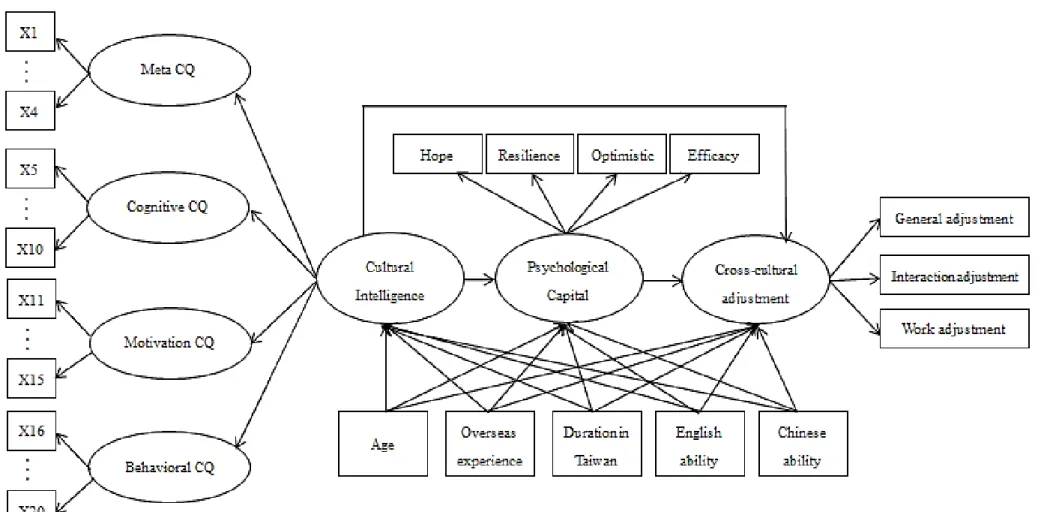
In this chapter, the research framework, hypothesis, research design, measurement, questionnaire design, and data analysis method were described. This research adopted quantitative research process to investigate the relationships among cultural intelligence (CQ), psychological capital (PsyCap) with four feathers, cross-cultural adjustment with three dimensions, and perceived supervisor support.
Research Framework
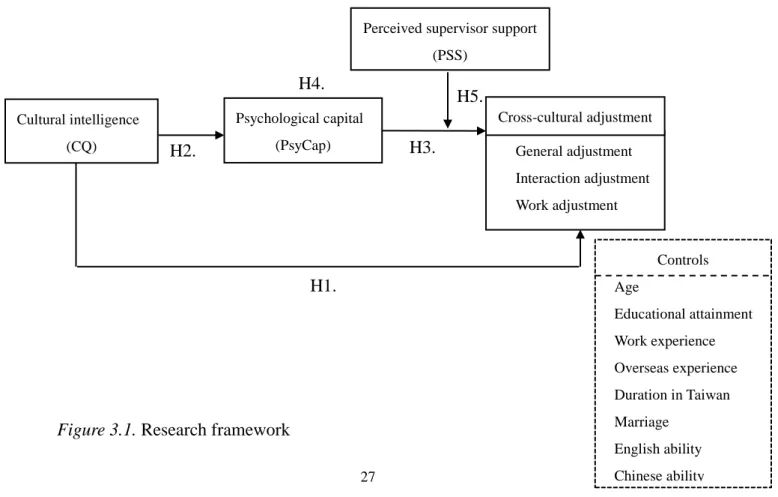
The independent variable was CQ. The dependent variable was cross-cultural adjustment which was consisted of three dimensions: general adjustment, interaction adjustment, and work adjustment. Psychological capital was the mediator to examine the relationship between CQ and cross-cultural adjustment. Perceived supervisor support served as the moderator to examine the relationship between PsyCap and cross-cultural adjustment with three dimensions. The research framework was shown below, see Figure 3.1.
Figure 3.1. Research framework
Controls Age Educational attainment Work experience Overseas experience Duration in Taiwan Marriage English ability Chinese ability H1. H2. H3. H4. H5. Cultural intelligence (CQ) Psychological capital
(PsyCap) General adjustment
Interaction adjustment Work adjustment Cross-cultural adjustment Perceived supervisor support
28
Research Hypotheses
Based on previous literatures, the research purpose, and research questions, the hypotheses were described as followed.
Hypothesis 1. Cultural intelligence has a positive effect on cross-cultural
adjustment.
H 1-1. Cultural intelligence has a positive effect on general adjustment.
H 1-2. Cultural intelligence has a positive effect on interaction adjustment.
H 1-3. Cultural intelligence has a positive effect on work adjustment are.
Hypothesis 2. Cultural intelligence has a positive effect on psychological capital. Hypothesis 3. Psychological capital has a positive effect on cross-cultural
adjustment.
H 3-1. Psychological capital has a positive effect on general adjustment.
H 3-2. Psychological capital has a positive effect on interaction adjustment.
H 3-3. Psychological capital has a positive effect on work adjustment.
Hypothesis 4. Psychological capital serves as a mediator between cultural intelligence and cross-cultural adjustment.
H 4-1. Psychological capital serves as a mediator between cultural intelligence and general adjustment.
H 4-2. Psychological capital serves as a mediator between cultural intelligence and interaction adjustment.
H 4-3. Psychological capital serves as a mediator between cultural intelligence and work adjustment.
Hypothesis 5. Perceived supervisor support positively moderates the relationship between psychological capital and cross-cultural adjustment.
29
H 5-1. Perceived supervisor support positively moderates the relationship between psychological capital and general adjustment.
H 5-2. Perceived supervisor support positively moderates the relationship between psychological capital and interaction adjustment.
H 5-3. Perceived supervisor support positively moderates the relationship between psychological capital and work adjustment.
Research Design
Samples
Foreign labors face lots of adjustment challenges when moving from the home country to work in other countries since they were hired by a company located in a host country. In this study, foreign labors were defined as “legal blue collar labors being employed in Taiwan without the host nationality according to the Employment Services Act” (http://law.moj.gov.tw). The blue collar labors referred to those who engaged in physical works such as mining, construction, and manufacturing.
The total number of foreign labors in Taiwan was 454,171 according to the statistic data provided by Bureau of Employment and Vocational Training in May, 2013. Foreign labors who work in industry and social welfare sectors in Taiwan came from Indonesia, Philippian, Thailand, Vietnam, Malaysia, and Mongolia. As dividing labors according to industry, there were 9,460 (2.08%) labors in agricultural, forestry, fishery, and husbandry industry; 233,530 (51.41%) labors in manufacturing industry; 2,630 (0.01%) labors in construction industry; 208,551 (45.91%) labors in nursing and housing industry. Above all, Indonesia and Vietnam labors were mainly engage in nursing and housing industry while Thailand and Philippian labors were mainly engage in manufacturing and construction industry. In addition, all the Philippine labors engaged in the high technology industry were female.
30 Table 3.1.
Population Description of Foreign Labors in Taiwan
Nationality
Sectors Total Indonesia Philippian Thailand Vietnam Malaysia Mongolia
Total 454,171 199,971 87,808 62,591 103,797 4 0 Industry 245,620 36,347 63,664 64,865 82,621 4 0 Primary industrial 9,460 7,968 1,346 9 137 0 0 Manufacturing 233,530 28,246 63,484 59,700 82,096 0 0 Construction 2,630 133 35 2.074 388 0 0 Welfare 208,551 163,624 22,942 808 21,176 0 0
Note. Adapted from Bureau of Employment and Vocational Training. Retrieved May
28, 2013.
This study conducted purposive sampling concerning the language boundary and sample accessibility toward foreign labors. The target participants were Philippine labors in technology manufacturing industries.
The sample criteria included: fluent in English, high educational attainment, and working in group with supervisors. First of all, high technology manufacturing industry in Taiwan prefer to hire female Philippine labors because they are fluent in English and they got at least college degree. Secondly, in order to answer questions related to perception of supervisor, the target participants must have high connection with the supervisors in a workplace. Hence, this study chose the Philippine labors as our target samples.
Measurement
This study adopted matured scales to measure all variables and the precision of measurements was confirmed through the reliability analyses. The degree of precision indicated by Cronbach alpha coefficient (Cronbachα) is to show the “stability” and
31
“consistency” of instrument. The higher value of Cronbachα means a higher consistency of each dimension. The acceptable value is higher than 0.7 (Nunally & Berstein, 1994).
Cultural Intelligence (CQ)
Cultural intelligence refers to an individual’s capability to adapt effectively to situations of cultural diversity (Earley, 2002). This research adopted the cultural intelligence scale (CQS) which developed by Ang et al. (2007). The scale contains 20 items in 4 dimensions: meta-cognitive CQ, cognitive CQ, motivational CQ, and behavioral CQ. Example items of each dimension were “I am aware of the cultural knowledge I use when interacting with people with different cultural backgrounds” (meta-cognitive CQ); “I know the legal and economics of other cultures” (cognitive CQ); “I enjoy interacting with people from different cultures” (motivational CQ); “I change my verbal behavior (e.g. accent, tone) when a cross-cultural interaction requires it” (behavioral CQ). Responses were designed on a 7-point Likert scale, ranging from 1(strongly disagree) to 7 (strongly agree). The high score indicated that the person can deal with cultural diversity well in a new environment. The Cronbach’s alpha reliability of the CQ in this study was 0.92 and the four dimensions of CQ were ranged from 0.84 to 0.90 (See Table 4.2).
Cross-cultural Adjustment
Cross-cultural adjustment refers to a person’s feeling of comfort in the new role and the degree of mastering the role requirement (Black, 1988). The scale was developed by Black and Stephens (1989). It contains 14 items divided into three dimensions: general adjustment with 7 items, interaction adjustment with 4 items, and work adjustment with 3 items. Example items of each dimension were “I am adjusted to the living condition in general” (general adjustment); “I am adjusted to socializing with Taiwanese” (interaction adjustment); “I am adjusted to my specific job responsibilities”
32
(work adjustment). Responses were designed on a 7-point Likert scale, ranging from 1(strongly disagree) to 7 (strongly agree). The high score indicated that the person can adjust to a new cultural environment. The Cronbach’s alpha reliability of the cross-cultural adjustment in this study was 0.94 and the three dimensions of cross-cultural adjustment were ranged from 0.89 to 0.91 (See Table 4.2).
Psychological Capital (PsyCap)
Psychological capital (Psycap) was a term derived from positive psychology that go beyond human and social capital. Individuals can gain competitive advantages through investing and developing of ‘who you are’. (Luthans, et al., 2004; Luthans & Youssef, 2004). Psychological capital was adopted from Psychological capital (PsyCap) questionnaire (PCQ) self-rater version by Harms and Luthans (2013). There are 24 items (includes three reverse items) divided into four dimensions which were
Hope, Resilience, Optimism, and Efficacy. Example item of hope was “If I should find
myself in a jam at work, I could think of many ways to get out of it.”; example item of
resilience was “I feel I can handle many things at a time at this job”, and the reverse
item was “When I have a setback at work, I have trouble recovering from it, moving on.”; example item of optimism was “If something can go wrong for me work-wise, it will”, and it included two reverse items; example item of efficacy was “I feel confident analyzing a long-term problem to find a solution.” Each dimension was in the form of statement and responses were designed to answer by a 5-point Likert scale, ranging from 1(strongly disagree) to 5 (strongly agree). The high score of scale indicated that people have higher level of psychological capital (PsyCap). The Cronbach’s alpha reliability of the PsyCap in this study was 0.87 (See Table 4.2).
Perceived Supervisor Support (PSS)
Perceived supervisor support (PSS) refers to the degree a person’s feeling of how the supervisor values his/her contribution and well-being. This study adopted PSS scale
33
developed by Cheng, Jiang, and Riley (2003), which consists of four items with 7-point Likert scale ranged from 1(strongly disagree) to 7 (strongly agree). Example item included: “My supervisor offers help when I am in a personal crisis.” The high score indicated that the person’s perception of supervisor support is high. The Cronbach’s alpha reliability of the PsyCap in this study was 0.84 (See Table 4.2).
Control Variables
Prior research on cross-cultural adjustment had established that individual-level factors, such as age, educational attainment, work and overseas experience, duration in Taiwan, marriage, and language ability had influence on individual’s cross-cultural adjustment. Therefore, these control variables were included in the final section of the questionnaire to clarify the relationships among dependent, independent, moderator and mediator variables.
Age.
Researchers suggested that age is one demographic factor that would affect a person’s adaptation. The older workers are generally had better adaptation to the other culture and were more satisfied with their job than younger workers (Parker & McEvoy, 1993; Sam, 1998). Therefore, the questionnaire included one blank for participants to fill in their age.
Educational attainment.
The highest education degree the participants had received was included in the personal information part in the questionnaire and it was measured by dummy variable. The coding was 1 (high school), 2 (vocational course), 3 (college).
Work and overseas experience.
Black and Gregersen (1991) and Black et al. (1991) pointed out that previous work-related experiences help individual to form accurate work expectations in mind; on the other hand, previous non-work experiences facilitated the formation of accurate