國
立
交
通
大
學
運 輸 科 技 與 管 理 學 系 碩 士 班
碩 士 論 文
共有或交換:偏好交易型式對人際喜好、互動品
質、以及服務接觸中互動的動態變化之影響
Communal or Exchange:Impacts of Desired Transaction
Type on Interpersonal Liking, Interaction Quality, and
Interaction Dynamics in Service Encounters
研 究 生:胡友維
指導教授:任維廉 博士
涂榮庭 博士
共有或交換:偏好交易型式對人際喜好、互動品
質、以及服務接觸中互動的動態變化之影響
Communal or Exchange:Impacts of Desired Transaction
Type on Interpersonal Liking, Interaction Quality, and
Interaction Dynamics in Service Encounters
研 究 生:胡友維
Student:Yu Wei Hu
指導教授:任維廉
Advisors:William Jen
涂榮庭
Rungting Tu
國立交通大學
運輸科技與管理學系
碩士論文
A Thesis Submitted to
Department of Transportation Technology and Management College of
Management
National Chiao Tung University
in Partial Fulfillment of the Requirement
for the Degree of
Master
in
Transportation Technology and Management
June 2009
Hsinchu, Taiwan, Republic of China
I
共有或交換:偏好交易型式對人際喜好、互動品質、以及服
務接觸中互動的動態變化之影響
研究生:胡友維
指導教授:任維廉
涂榮庭
國立交通大學運輸科技與管理學系碩士班
摘 要
服務接觸過去一直是服務行銷研究領域中的重點之一,而之前的研究也已探 討了許多影響服務接觸成敗的因素。然而,過去許多學者僅單從顧客角度或是服 務人員的角度來瞭解員工服務或顧客行為對服務接觸影響,而忽略服務接觸中顧 客與服務人員的互動本質以及雙方同時對彼此行為與心理反應所造成的影響。因 此,本篇研究引用平衡理論並探討服務接觸中四個重要的概念來研究服務參與者 的心理與行為互動變化,此四個概念即偏好交易型式(共有或交換)、人際喜好、 互動品質、互動的動態變化 (互助合作、合作、競爭、對抗)。而本研究在正式 施測之前先進行 40 份問卷調查作為前測,以確定本研究情境設計的操弄效果以 及問卷問項的信度與效度。在正式施測的實驗一與實驗二中,我們各收集 120 份問卷來檢驗本研究的理論模型與假設。結果顯示本研究問卷情境有很好的操弄 效果,而且問卷問項也有很好的信度與效度。此外,本研究的假設均獲得統計上 顯著支持。實驗一的結果說明當顧客與服務人員的偏好交易型式一致時,顧客比 較容易對員工產生人際上的喜好並且知覺到較好的互動品質。而實驗二說明當顧 客處於不平衡狀態時(合作或是競爭)並且想要轉變成平衡狀態時(互助合作或 是對抗),顧客比較傾向選擇改變與員工的關係,而非改變自己對偏好交易型式 的看法與態度。本研究為服務行銷領域提供了理論與實務上的貢獻,並讓服務業 者與顧客能夠更瞭解影響服務接觸成敗的原因。 關鍵字:平衡理論、服務接觸、交易型式、共有、交換、人際偏好、互動品質、 互動動態變化Communal or Exchange:Impacts of Desired Transaction
Type on Interpersonal Liking, Interaction Quality, and
Interaction Dynamics in Service Encounters
Student: Yu Wei Hu Advisor: William Jen
Rungting Tu
Department of Transportation Technology and Management
National Chiao Tung University
Abstract
Service encounter has been a focus of service marketing research, and previous literature has explored and examined factors contributing successful service encounters. However, researchers has largely placed one-sided attention on either employees’ performance or customers’ behaviors, neglecting to address the interactive nature of service encounters and service participants’ potential psychological responses. To fill up the void, the present research adapts balance theory and introduces four concepts to illustrate participants’ psychological and behavioral interaction characteristics in a service encounter: desired transaction types (communal based or exchange-based), interpersonal liking, interaction quality, and interaction dynamics (Collaboration, Cooperation, Competition, and Confrontation). In this research, to carefully design the questionnaire, we recruited 40 participants to conduct a pretest. Then, another 240 participants were recruited for two scenario-based experiments to examine our hypotheses. Results show successful manipulations and suggest good reliabilities and validities of items for all constructs. Furthermore, all hypotheses of two studies were significantly supported. Study 1 shows that a match of desired transaction type would lead to higher level of personal liking that the customer has for the contact employee and good quality of interaction between the customer and the contact employee. Study 2 shows that when a customer who is in an imbalanced condition (cooperation or competition) and seeks a balanced interaction condition (collaboration or confrontation), He/she is more likely to change the relationship with the contact employee than to modify one’s desired transaction type to side with another. Our investigation of this topic contributes to the marketing literature in numerous ways. Finally, the author also presents theoretical and practical implications and provides marketers and servers better understanding about factors leading to successful service encounters.
Key Words: balance theory, service encounter, transaction type, communal, exchange,
III
致 謝
光陰荏苒、韶光飛逝,碩士生涯轉眼將劃下句點。回顧這三年半的生活:從 大四下加入交大運管這個大家庭;碩一時認真學習也認真玩樂;碩二出國交換學 生拓展眼界;到碩三專心於論文研究與留學考詴。要感謝許多人陪伴我一同度過 這段精彩又難忘的時光。首先,我要感謝指導教授 任維廉老師,任老師不但在 研究上給了我許多寶貴的意見與幫助,也給了我很多機會磨練自己生活及工作態 度。老師總是全力支持我的決定,幫助我走出更寬廣、更有發展性的路。此外, 任老師也常常與學生分享許多富含人生哲理的小故事,讓我們能夠從中獲得許多 啟發。而最讓我佩服的是,任老師除了在學校是一位盡職負責的好老師之外,在 家也是個體貼溫柔的好丈夫、好爸爸,這讓我瞭解到學習在工作與家庭生活中取 得平衡點是很重要的事情。與任老師相處的時光是人生中非常美好的經驗,感謝 任老師的諄諄教誨,在此謹致上我對您最誠摯的敬意與感恩。 同時,我也要感謝共同指導教授 涂榮庭老師,涂老師是良師也是益友,帶 領我拓展了學術的視野,也對我的生活態度以及作人處事的看法有很大的啟發。 在北京大學與涂老師學習的時光,無疑是我人生中非常重要的轉捩點,這段期間 讓我深深體會到只有先放下包袱並虛心學習才能有收穫。雖然過程中經歷了不少 困難,但是現在回想起來,是非常值得的。而且也只有自己從挫折中努力站起來, 才能真正得到成長的機會。此外,在涂老師的引領之下,也讓我們有許多機會能 接觸到國內外傑出學者如 Voss、Bolton、Maxham、David、與張影等人,並得以 與這些知名學者分享研究經驗,更讓我體會到學術的有趣與奧妙。與涂老師相處 的時光是人生中非常幸運且寶貴的經驗,感謝涂老師對我的循循善誘,在此謹致 上我對您最誠摯的敬意與感恩。 在論文審查期間,感謝交通大學經營管理研究所唐瓔璋老師、交通運輸研究 所許鉅秉老師費心審閱,提供許多寶貴且具體的建議,讓本研究順利步上軌道。 而在論文口詴階段,也感謝交通大學經營管理研究所唐瓔璋老師及交通大學管理 科學系張家齊老師播冗細審,並惠予寶貴意見與殷勤指正,使本論文疏漏之處得 以改進。而在研究所修課與研究期間,也感謝系上所有老師的教誨與指正,在此 一併致謝。 此外,在學校生活中,我也要感謝陪我度過的每一個人。堂榮學長是實驗室 的大家長,帶領著學弟妹勇往直前,在我們遇到困難時給我們最即時的指導與幫 助。當我們迷失方向時,會幫我們看清楚未來的路,而當我們在研究過程出現瓶 頸時,也會適時給予我們很大的支持,感謝堂榮學長為我們所付出的心力與照 顧。而明頴學長則是實驗室未來的大支柱,也是我們與老師之間溝通的橋樑,明 頴學長很照顧學弟妹,幫助我們解決許多疑難雜症,讓我們在寫論文時沒有後顧 之憂。而凱傑學長、士弘學長、與毓娟學姊平時也會給予我們幫助與意見,在此 一併致謝。另外,我也要感謝一起畢業、而且具有深厚革命情感的佛諭、竹軒、維中、 與薈明,不論在北京還是台灣,我們彼此在學業及生活上互相照顧與打氣,你們 陪我度過了豐富又愉快的研究生涯,每當回顧這段充滿酸甜苦辣的打拼時光,我 只能說認識你們真好。此外,我也要感謝老友翊倫、苡萩、冠佑、維真、璨維、 偉翔、永慶、琬翎、偉義、欣宜、博彥、建元、晉霖、宜欣、仲安、弈成、孟正、 詵珺、玲雯的祝福與鼓勵。同時也要謝謝景堯、思琪 (T1 戰將)、幼芝、羿菁、 敏倫、禹瑄、愉雪、邵偉、嘉修、世名、威呈、韋志等學弟妹的關心與幫忙。 最重要的是,感謝我摯愛的家人與親戚,父親、母親、外婆、乾媽、二阿姨、 兩位姊姊、兩位姊夫、及女友佩怡。由於你們的支持鼓勵與照顧,讓我能無後顧 之憂的專心向學。爸爸與媽媽從小就教育我正確的人生態度與觀念,並提供給我 舒適的生活環境與良好的讀書環境。不論在我得意或失意的時候,您們永遠是最 溫暖的避風港,您們為這個家庭所付出心力與貢獻實在無法用言語形容,我覺得 很幸福也很感恩,也希望爸爸媽媽身體健康,每天平安快樂,我愛您們。此外, 也謝謝外婆、乾媽、與二阿姨無微不至地照顧我在新竹的生活,讓我能專心唸書 做研究。同時,也感謝兩位姊姊自小對我的照顧,我們姐弟之間的感情總是很好, 常常可以互相分享喜悅以及分擔悲傷。同時也感謝兩位姊夫給姊姊們的愛護與支 持。另外,我也要感謝女朋友佩怡,妳總是適時地給我鼓勵、給我力量,在我挫 折的時候給我安慰,在我開心的時候跟我一起慶祝,有妳的陪伴很幸福。未來, 也還有很長的路要走,我們手牽手一起努力一起成長。最後,唯一讓我感到遺憾 的事,就是來不及跟疼我的爺爺奶奶分享這份成就與喜悅,不過我相信爺爺奶奶 在天上一定也會感到安慰與開心的。 最後,要感謝的人太多,篇幅有限無法一一致意,所以我想感謝所有我認識 以及認識我的人,在我需要你們的時候都能給我適時的幫助,感恩的心!
胡 友 維
謹誌Daniel Hu
中華民國九十八年七月于風城交大V
Content
Chinese Abstract ... I English Abstract ... II Acknowledgements ... III Content ... V List of Figure... VI List of Table ... VI 1. Introduction ... 1 2. Literature Review... 4 2.1 Service Encounter ... 42.1.1 Interpersonal Liking in Service Encounters ... 7
2.1.2 Interaction Quality in Service Encounters ... 9
2.2 Comercial Transaction Type ... 10
2.3 Balance Theory ... 13
2.3.1 Application of Balance Theory to the Service Encounter ... 15
3. Conceptual Model and Hypotheses ... 19
3.1 Study 1 ... 19 3.1.1 Static Model ... 19 3.1.2 Hypotheses ... 20 3.2 Study 2 ... 24 3.2.1 Dynamic Model ... 24 3.2.2 Hypotheses. ... 30 4. Methodology ... 34 4.1 Design ... 34
4.2 Subject and Procedure ... 35
4.3 Measures ... 37
5. Results ... 39
5.1 Study 1 – Static Model ... 39
5.2 Study 2 – Dynamic Model ... 44
6. Discussion and Implication ... 48
6.1 General Discussion ... 48
6.2 Implication ... 50
6.3 Limitation and Future Research ... 53
Reference ... 54
Appendix A: Questionnaire of Study 1 ... 59
List of Figure
Figure 1 Heider’s Basic Model ... 13
Figure 2 Four Balanced Patterns ... 14
Figure 3 Four Imbalanced Patterns ... 14
Figure 4 Service Encounter Triad ... 17
Figure 5 Four Balanced Patterns ... 18
Figure 6 Four Imbalanced Patterns ... 18
Figure 7 Conceptual Model ... 23
Figure 8 Shift of the Imbalanced State 1 to a Balanced State ... 25
Figure 9 Shift of the Imbalanced State 2 to a Balanced State ... 25
Figure 10 Shift of the Imbalanced State 3 to a Balanced State ... 25
Figure 11 Shift of the Imbalanced State 4 to a Balanced State ... 26
Figure 12 Interaction Dynamics Matrix ... 29
Figure 13 Interaction Dynamics Matrix and Hypotheses ... 33
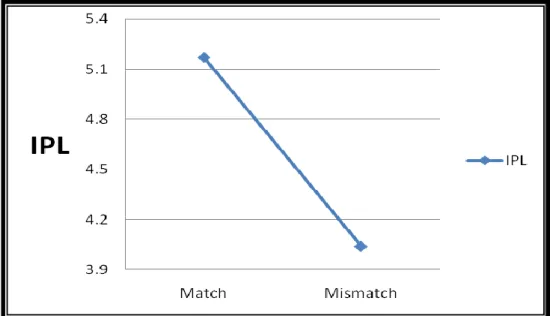
Figure 14 Interpersonal Liking ... 41
Figure 15 Interpersonal Liking ... 41
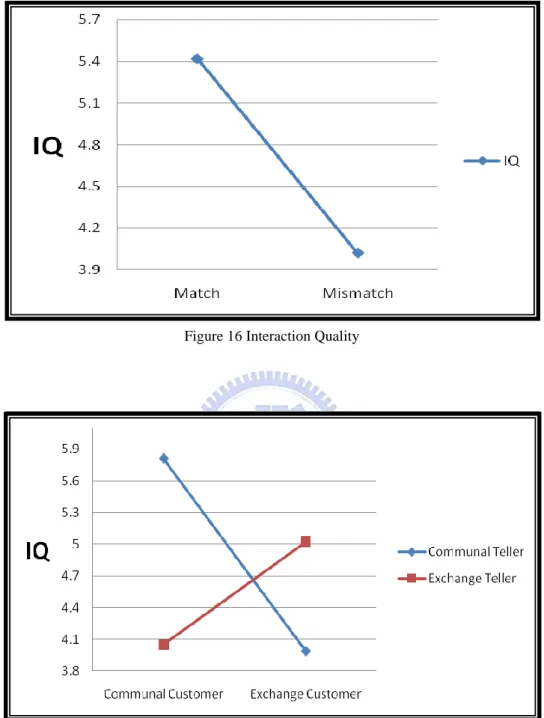
Figure 16 Interaction Quality ... 43
Figure 17 Interaction Quality ... 43
List of Table
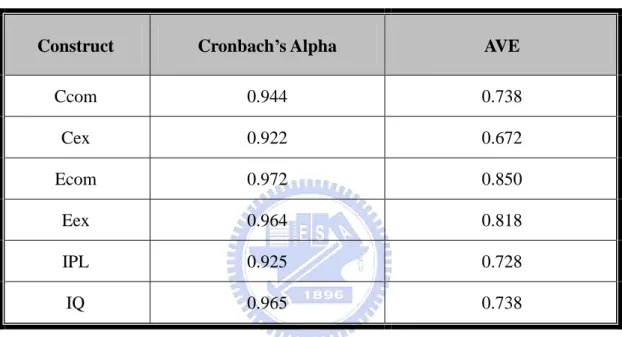
Table 1 Results of Cronbach’s Alpha and AVE... 401
1. Introduction
While previous research has provided insights into factors contributing to successful service encounters, researchers placed one-sided attentions on either employees’ performance or customers’ behaviors (Bitner et al. 1990, 1994; Hartline and Ferrell 1996; Hurley 1998). Given the interactive nature of service encounters, the present study focuses on effects of a match/mismatch of transaction type desired on interactions between customers and service providers and service participants’ potential psychological responses. Because both the customer and the contact employee often have their own preferences about good service delivery script and service styles, these preconceived desires not only influence relationships between them during service but also determine the valence of interaction quality evaluation and interaction dynamics. For example, in a service encounter, a contact employee diligently observing the needs of customers and constantly providing assistance may earn the appreciation of a customer seeking product recommendations; however, another customer who prefers to leisurely browse and make his/her own purchase decision may find such intense service interaction irritating and stressful.
Therefore, current research introduces three concepts to illustrate the service interaction characteristics of an encounter: desired transaction types (i.e., communal-based and exchange-based), interpersonal liking, and interaction quality. In addition, present research adapts Heider’s (1958) balance theory to explain how a match/mismatch of desired transaction types influences interpersonal liking in customer-contact employee relationship and quality of interaction between a customer and a contact employee. Balance theory helps providing critical explanations in our
study why customer seeks psychological and behavioral congruence to achieve balanced interactions, either by modifying one’s transaction type desired to side with another or by changing the relationship between the customer and the contact employee.
Furthermore, acknowledging the dynamic nature of interactions between the two parties involved in a service encounter, we adapt balance theory and propose a interaction dynamics matrix to examine the effects of match/mismatch of desired transaction type and interpersonal liking on interaction dynamics, uncovering the four imbalanced and balanced interaction conditions which are shiftable to each other: (1) ―Collaboration‖ in which both parties like each other and desire same transaction types (e.g., communal-communal and exchange-exchange), and actively put in efforts as partners to accomplish the service goal; (2) ―Cooperation‖ in which two parties dislike each other but have same desired transaction type. Yet, one party is willing to passively follow along and interact accordingly to achieve satisfactory results; (3) ―Competition‖ in which two parties like each other initially but have different desired transaction types (e.g., server communal-customer exchange, or server exchange-customer communal), tension interferes with service delivery, and the two parties actively compete to gain control over the other; and (4) ―Confrontation‖ in which two parties have different desired transaction types and dislike each other initially, disagreement surfaces, and the interaction becomes heated and disrupts service—a worst-case condition.
Finally, our investigation of this topic contributes to the marketing literature in numerous ways. In study 1, four scenario-based surveys conducted provide richer insight into how the match/mismatch could significantly influence interpersonal liking
3
and interaction quality in service encounters. Furthermore, in study 2, we conduct four scenario-based surveys to investigate service interaction dynamics and to look into possible ways of changing imbalanced state into balanced state, focusing on customer choice of psychological and behavioral changes in a service encounter. Finally, possible limitations and directions for future research will be discussed.
2. Literature Review
2.1 Service Encounter
Service encounter, defined as face-to-face, dyadic interactions between a customer and a contact employee in a service setting (Hurley 1998; Solomon 1985), plays an important role in service deliver process because it can influence customers’ and contact employees’ perceptions of the service (Bendapudi and Leone 2003; Bitner et al. 1990; Burroughs and Mick 2004; Hartline and Ferrell 1996; Homburg et al. 2005; Jayawardhena et al. 2007; Kelly et al. 1990; Schau et al. 2007; Svensson 2006; Taylor 1994; Wuyts and Geyskens 2005). Previous studies on service encounter have been based on the service receivers’ perspective. Parasuraman et al. (1988) develop the well-known SERVQUAL instrument which contains five dimensions of service quality in assessing the customer’s judgment of service quality. Bitner et al. (1990) identifies categories of events and behaviors that highlight critical service encounters form the customer’s point of view. Dabholkar et al. (1996) identified five dimensions in the retail industry.
Given the nature that contact employees are a critical source of information about customers, however, some studies in the field of service encounter ignores the service providers’ perspective, and there have been relatively few research that has attempted to explore the concept of the service encounter beyond the service receivers’ perspective. To fill up the void, Bitner et al. (1994) used critical incident technique (CIT) to explore the sources of satisfaction and dissatisfaction in service encounters from the contact employee’s point of view. They provided empirical
5
evidence that unsatisfactory service encounters may be due to inappropriate customer behaviors. Hence, jaycustomers, customers who misconsume in a manner similar to jaywalkers, can be the source of their own dissatisfaction through inappropriate behavior or being unreseasonably demanding.
Furthermore, some researchers suggests that because the interactive traits involved in service encounters are crucial for the outcome of service, research on service encounters should take into account the perspectives of both customers and service providers involved in human interaction and thus a bidirectional understanding of human interactions in the service setting will be achieved (Czepiel 1990; Raajpoot 2004; Solomon et al. 1985; Kelley et al. 1990). Therefore, Role and Script Theory (Solomon et al. 1985; Mills and Morris 1986) has been advanced and used to understand interactions between customers and contact employees in service encounters. According to Role and Script Theory, current research assumes that customers and contact employees in the service encounter have their own role expectations and service scripts. As described by Solomon et al. (1985), a role is the behavior associated with a socially defined position; the role expectations are the standards for role behavior, and script refers to sequences of role behaviors (Solomon et al. 1985).
Therefore, in many routine service encounters, particularly for experienced customers and contact employees, the roles are more likely to be well defined and both the customers and contact employs understand what to expect from each other (Bitner et al. 1994). However, many service encounters are not repeated frequently throughout a person’s life, resulting in weak, blurred, and unfamiliar scripts. Hence, differences in perspective may arise when roles of a customer or a contact employee
are less defined, a customer or a contact employee is unfamiliar with expected behaviors, or interferences require the use of complex or less routine subscript. When there is a mismatch of interaction expectations and consequently incongruently behaviors between the two parties, service encounters would not be as smooth and satisfactory as when the expectations are similar and complementary.
7
2.1.1 Interpersonal Liking in Service Encounters
The concept of interpersonal liking, from the social psychology literature, has been described as the attitudes we have toward another person (Hawke and Heffernan 2006; Nicholson et al. 2001). Some researchers define liking as an orientation toward or away from a person that may be described as having valence (positive, neutral, or negative). The orientation consists of cognitive structures of beliefs and knowledge about the person, affects felt and expressed toward him or her, and behavior tendencies to approach or avoid that person (Hendrick and Hendrick 1983). Furthermore, Nicholson et al. (2001) described interpersonal liking as the emotional bond developed between individuals. That is, ―the global affective attachment‖ an individual has for another individual. This emotional connection can be viewed as fondness or affection. Interpersonal liking has been shown to establish a personal attachment between individuals, therefore reinforcing bonds and acting as a potential driving force for the relationship.
However, interpersonal liking has received relatively scant attention in service encounter literature. More recently, Nicholson et al. (2001) indicate that liking was measured as the consumer’s general level of liking for the service provider. Furthermore, Hawke and Heffernan (2006) suggest that liking in a bank lender-business customer context can be defined as an ability to get on or be comfortable with the other party in a bank lender-business customer relationship; based on a positive attitude each person has for the other and the recognition of the existence of an affirmative emotional connection.
Interpersonal liking between the customer and the contact employee is based on first impressions and a serious of service encounters (Hawke and Heffernan 2006; Nicholson et al. 2001). A first impression may stimulate the perceiver to try to learn more about the person, influence his/her search for new information, and affect his interpretation of such information. Furthermore, first impressions are influenced not only by the other’s physical appearance, but also by other’s behaviors and responses. Some researchers further suggest that similarities of the behaviors or responses between individuals are affectively reinforcing because another’s similar responses support the perceiver’s sense of esteem or comfort (Nicholson et al. 2001). Therefore, interpersonal liking can be influential in motivating commercial relationship development and maintenance, positively influencing interaction success.
9
2.1.2 Interaction Quality in Service Encounters
Principally, interaction quality is the dimension of quality originating in interaction between the customer and service personnel (Brady and Cronin 2001). Chandon et al. (1996) point out that the concept of interaction quality should include not only the traditional subdimensions of service quality such as effectiveness, materiality, and accessibility, but also the subdimensions of interactivity, which encompasses the service relationships at work during the encounter, and rituality, which includes all the ceremonial and contextual aspects that shape the ―climate‖ of the interaction of the service encounter. In addition, Brady and Cronin (2001)’s work indicates that perceptions of service quality are determined by outcome quality, interaction quality, and physical environment quality. Furthermore, three distinct factors, attitude, behaviors, and/or expertise of the service provider, constitute customer perceptions of interaction quality. Furthermore, Some researchers also state that service encounters are human interactions (Solomon et al. 1985) and that the both sides (customer and contact employee) involved in the service interface will influence the perceived interaction quality (Monga and Zhu 2005). For example, when there is a mismatch of interaction expectations and consequent behaviors between the customer and contact employee, interaction quality would not be as good as when the expectations are similar and complementary. Moreover, since service have a lot of distinct features, including the following: service are intangible and heterogeneous; their production, distribution, and consumption are simultaneous processes; they are fundamentally activities or delivery processes. Therefore, these features reflect and highlight the essentially interactive nature of service encounters, making evaluation of interaction quality one of the most important parts of perceptions of service encounters.
2.2 Commercial Transaction Type
In current research, we introduce the concept of transaction type by borrowing from the concept of communal and exchange relationships. Previous research stream on communal and exchange relationships has been developed originally by researchers Clark and Mills (Clark and Mills 1979, 1993; Lemay and Clark 2008; Williamson and Clark 1992). Furthermore, Aggarwal (2004) used Clark and Mills's (1979) distinction between communal and exchange relationships to suggests that consumers frequently think about brands as entities associated with a set of human characteristics and that consumers can also have a communal/exchange relationship with a brand or company. The distinction between communal and exchange relationship is based on the rules or norms that govern the giving and receiving of benefits (Clark and Mills 1979, 1993).
In communal relationship, members of a communal relationship assume that each is concerned about the welfare of the other. They have a positive attitude toward benefiting the other when a need for the benefit exists (Clark and Mills 1993; Lemay and Clark 2008; Lemay et al. 2007; Price and Arnould 1999). For example, friendships, romantic relationships, and family relationships are relatively more communal in nature. Furthermore, Clark and Mills (1993) suggest that communal relationship can be either mutual or one-sided. In one-sided communal relationship, such as the relationship between a parent and an infant, individual gives benefits to another, he or she does not anticipate payback form the other. On the other hand, an essential feature of mutual communal relationships is that one’s partner cares about one’s welfare and will attend and respond to one’s desires, needs, and goal strivings.
11
On the other hand, an exchange relationship suggests that benefits are given with the expectation of receiving a comparable benefit in return or as prompt repayment for a benefit received previously. In such a relationship, until the benefit is repaid, individuals may experience a sense of inequity and distress. For example, people in business setting or strangers meeting for the first time are relatively more involved in exchange relationships. Clark and Mills (1993, 1994) also indicate that exchange-oriented people would prefer return requests made immediately afterward rather than those that are delayed in time. Furthermore, unlike communal relationship that is more likely to be preferred with an attractive people, an exchange relationship is more likely to be preferred with an unattractive other, and thus a benefit from such a person after he or she has been aided should lead to greater attraction (Clark and Mills 1993; Lemay and Clark 2008; Lemay et al. 2007).
For the application of the concept of communal and exchange relationships, current research suggests that commercial transaction types that individual likes in service encounter could vary along a continuum from ―exchange‖ to ―communal‖. Hence, in the present theorizing, we specify a distinction between two ends of transaction type in service encounter. The first one is ―commercial communal transaction‖ (hereafter CCT) which refers to a service encounter is liable to be more similar to a meeting between friends than merely economic transactions. During commercial communal transaction, individuals are more likely to view the other one in the service encounter dyad as a friend. For example, in a service encounter, a contact employee who desires commercial communal transaction is more willing to care about the wellbeing of the customer and to spend time and effort to share the true feeling. On the other hand, the second type of commercial transaction is labeled ―commercial exchange transaction‖ (hereafter CET) which refers to economic
exchange because in this kind of service encounter the benefits that customers or contact employees give and receive do involve only money or products/services. For example, in a service encounter, a contact employee who desires commercial exchange transaction does not think of the customer as a friend, furthermore, he or she does not like or expect any further interpersonal involvement in the service.
13
2.3 Balance Theory
Balance Theory was initially developed by Heider (1958). The tenets of balance theory also have been widely applied and verified in a variety of field of research, such as interpersonal attractions and relationships (Aderman 1969; Rodrigues 1967; Sussmann and Davis 1975), service quality (Carson et al. 1997), consumer buying decision and behavior (Woodside and Chebat 2001), cause-related marketing (Basil and Herr 2006).
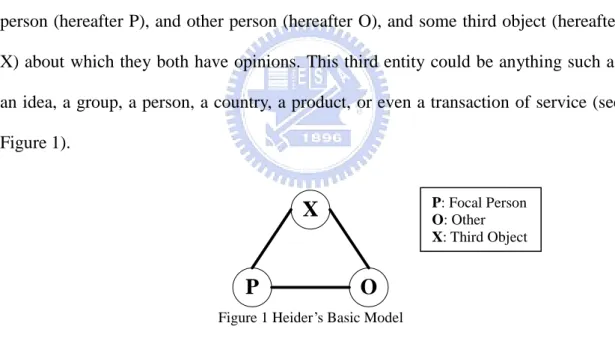
Heider (1958) proposes a basic social system model that is a triad of a focal person (hereafter P), and other person (hereafter O), and some third object (hereafter X) about which they both have opinions. This third entity could be anything such as an idea, a group, a person, a country, a product, or even a transaction of service (see Figure 1).
X
P
O
Figure 1 Heider’s Basic Model
In Heider’s basic model, each line represents a relationship, and those relationships can be either positive or negative. Heider uses a positive sign (+) to indicate a positive sentiment relation (likes, is in favor of, praises, etc.) and a negative sign () for a negative sentiment relation (dislikes, in against, criticizes, etc.) among three parties of a given interpersonal relation of the P-O-X type. Hence, there could be eight configurations that can exist among the focal person, the other person, and the third object based on the sign (+ or ) of these relationships. Furthermore, Heider
P: Focal Person O: Other X: Third Object
(1958) suggests that four of them are stable or ―balanced‖ (see Figure 2) and other four are unstable or ―imbalanced‖ (see Figure 3). More specifically, as illustrated by Heider, a triad is balanced when all three of the relations are positive or when two of the relations are negative and one is positive. In other words, a balanced triad when the resultant sign of the algebraic multiplication of the three signs of a given triads is positive. For example, the situation is balanced when P and O have the same attitude toward X where P likes O. On the other hand, a triad is imbalanced when all three of the relations are negative or when two of the relations are positive and one is negative. Namely, an imbalanced triad when the resultant sign of the algebraic multiplication of the three signs of a given triads is negative. For instance, the situation is imbalanced when P and O disagree regarding X where P likes O. Moreover, imbalanced patterns are fraught with tensions that made them unstable, particularly if the relationships are strong. Thus, if people feel themselves are out of balance, then they are motivated to restore a position of balance. There are three possible ways of changing imbalanced state into balanced state: changing the P-O relation, the P-X relation, or the O-X relation. X P O X P O X P O X P O
Figure 2 Four Balanced Patterns
X P O X P O X P O X P O
Figure 3 Four Imbalanced Patterns
+ + + + + + - - - - - - - - - - - - + + + + + +
15
2.3.1 Application of Balance Theory to Service Encounter Quality
The Three Parties in a Service Encounter Triad
Within the context of the current research, a customer is the purchaser and recipient of a service. In a service encounter, quality is partially defined by customer. Service quality perceptions stem from not only how effectively the service is delivered as compared to how effectively the customer expected the service to be delivered, but also whether the desired transaction type is fulfilled or not. Therefore, service quality, as perceived by customer, can be defined as the extent of the discrepancy between customers’ expectations or desires and their perceptions. If there is under fulfillment of customer expectation in the service performance, poor service encounter quality could be perceived by customers dissatisfied.
A customer-contact employee is the individual who provides services to the customer. The service delivery process is relatively interactive, requiring inputs from both customers and contact employees. Previous research suggests that there are some components of the service encounter for which customer holds the contact employee responsible. For example, customers may expect contact employees to be reliable, responsible, competent, courteous, credible, and attentive. Customers probably further hope that contact employees can exhibit proper demeanor, communicate effectively, and inspire confidence. However, more recently, research suggests that in a service encounter, quality is also partially defined by contact employee. Service quality perceptions stem from not only how customers behave as compared to how the contact employee expect, but also whether the desired transaction type is fulfilled or
not. Therefore, service encounter quality, as perceived by contact employee, can be defined as the extent of the discrepancy between contact employee’ expectations or desires and their perceptions. If there is under fulfillment of contact employee expectation in the service delivery process, poor service quality could be perceived by contact employees who are dissatisfied.
Current research suggests that commercial transaction types that individual likes in service encounter could vary along a continuum from ―exchange‖ to ―communal‖. Hence, we specify a distinction between two ends of transaction type in service encounter and assumer that either a customer or a contact employee would prefer one transaction type to the other during the service encounter. One of the transaction types is ―commercial communal transaction‖ which refers to a service encounter is liable to be more similar to a meeting between friends than merely economic transactions. During commercial communal transaction, individual are more likely to view the other one in the service encounter dyad as a friend. The other type of commercial transaction is labeled ―commercial exchange transaction‖ which refers to economic exchange because in this kind of service encounter the benefits that customers or contact employees give and receive do involve only money or products/services. Furthermore, customers or employees do not like or expect any further personal contacts beyond the transaction in the service.
17
C-E-T Relationships in the Service Encounter Context
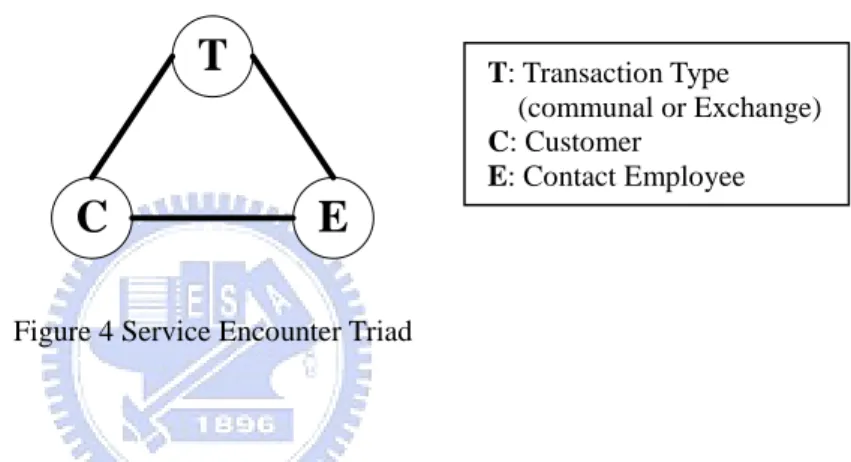
The relationships among the customer and the contact employee and their attitudes toward the certain transaction type in the service encounter can be explained through the application of balance theory. In present research, we examine a service encounter triad consisting of two people, customer (hereafter C) and contact employee (hereafter E), and a transaction type (hereafter T) about which they both have opinions (see Figure 4).
T
C
E
Figure 4 Service Encounter Triad
Furthermore, C-E bond denotes the interpersonal liking between customer and contact employee. We uses a positive sign (+) to indicate that the customer like the contact employee and a negative sign () for disliking for the contact employee. Second, C-T bond denotes the customer’s attitude toward the certain transaction type. We uses a positive sign (+) to indicate a customer’s preference and expectation of occurrence of commercial communal transaction and a negative sign () for a customer’s preference and expectation of occurrence of commercial exchange transaction. Third, E-T bond denotes the contact employee’s attitude toward the certain transaction type. We uses a positive sign (+) to indicate a contact employee’s preference and expectation of occurrence of commercial communal transaction and a negative sign () for a contact employee’s preference and expectation of occurrence of commercial exchange transaction.
T: Transaction Type
(communal or Exchange)
C: Customer
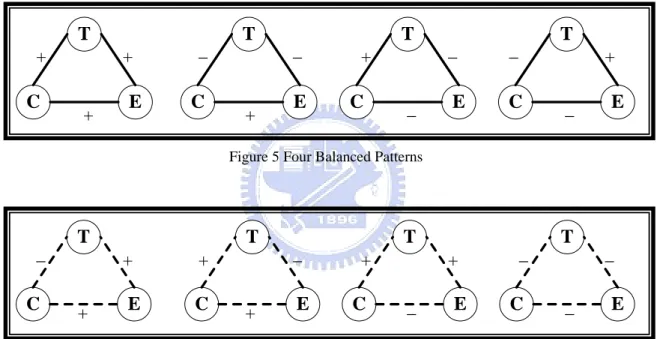
According to the balance theory, there could be eight configurations that can exist among the customer, the contact employee, and transaction type based on the sign (+ or ) of these relationships. Furthermore, current research proposes that four of them are balanced (see Figure 5) because in these patterns all three of the relations are positive or when two of the relations are negative and one is positive. Other four patterns are imbalanced (see Figure 6) because in these patterns all three of the relations are negative or when two of the relations are positive and one is negative.
T C E T C E T C E T C E
Figure 5 Four Balanced Patterns
T C E T C E T C E T C E
Figure 6 Four Imbalanced Patterns
Moreover, imbalanced patterns are fraught with tensions that made them unstable. Therefore, if the customer or the contact employee feels themselves are out of balance, then they are motivated to restore a position of balance. There are three possible ways of changing imbalanced state into balanced state: changing the C-E relation, the C-T relation, or the E-T relation.
+ + + + + + - - - - - - - - - - - - + + + + + +
19
3. Conceptual Model and Hypotheses
3.1 Study 1
3.1.1 Static Model
Previous academic research suggests that service encounter is a transaction in which customers and contact employees solicit cooperation by engaging in tacit bargaining processes, and such transaction will only continue if there is mutual expectation and benefit for both parties involved (Coye 2004; Mills 1990). Furthermore, both the customer and the contact employee in the service encounter have their own preconceived expectations about the how the service will proceed as their own desirability (Bitner et al. 1990; Solomon et al. 1985), and these expectations are about future events which, when compared with the perceived actual service delivered or with what other one involved want, are presumed to impact interactive relationship quality of each other the service encounter. Therefore, the purpose of this research is to propose a model that outlines the impacts of match/mismatch of the transaction type that the customers and the contact employee desire on personal liking and interaction quality at the point of service delivery process. The hypotheses are proposed in the next section.
3.1.2 Hypotheses
Previous research suggests that interpersonal liking between the customer and the contact employee is based on similarities of the behaviors or responses between individuals (Nicholson et al. 2001). Furthermore, according to balance theory, a balance pattern in which the C-E bond is positive exists only under the situation where both the C-T bond and the E-T bond are positive or negative (see Figure 5); otherwise the pattern would not be balanced (see Figure 6). Namely, only when the customer and contact employee have the same attitudes, positive or negative, toward the certain transaction type, there would be a stable state of C-E-T triad in which a positive personal liking and interaction quality between the customer and the contact employee exists (see Figure 7).
Therefore, according to role and script theory, we hypothesize that, for most service encounter, both customer and the contact employee play participatory role and often have their own preference about transaction type. When the customer wants a CET, he/she may view the transaction as merely economic transactions and require minimal interpersonal involvement. In this case, if the contact employee also desires a CET and regards the transaction as merely economic transactions, which require minimal interpersonal involvement, a match and similarity of the transaction type desired is more likely to lead to higher level of interpersonal liking in the customer-employee relationship. In another case, when the customer desires a CCT type, he/she may regard the transaction as mutually contributing experience between friends. Hence, if the contact employee also desires a CCT and regards the transaction as mutually contributing experience between friends, a match and similarity of the transaction type desired is more likely to lead to higher level of interpersonal liking in
21
the customer-employee relationship.
H1: The customer is more likely to have a personal liking for the contact
employee when there is a match of transaction type desired between them
than when there is a mismatch of transaction type desired between them.
H1a: If the customer desires a commercial communal transaction, the
customer is more likely to like the contact employee who desires a
commercial communal transaction than to like contact employee who
desires a commercial exchange transaction.
H1b: If the customer desires a commercial exchange transaction, the
customer is more likely to like the contact employee who desires a
commercial exchange transaction than to like contact employee who
desires a commercial communal transaction.
Kelley et al. (1990) define motivational effort as the amount of effort the customer/service employee exerts during the service encounter process, and motivational direction as the appropriateness of the behaviors of the customer/server. If there is a match between transaction types desired between both parties, the customer and the contact employee will make great efforts to conduct those appropriate activities to facilitate the service delivery in service encounters. Furthermore, Aggarwal (2004) also suggests that a match of norms will positively influence both parties’ attitudes and behaviors of the interaction. In other words, the less difference between customer expectations of desired transaction type and perceptions of transaction type that server performed, the better perceptions of
interaction quality that customers have.
Therefore, we hypothesize that, for most service encounter, both customer and the contact employee play participatory role and often have their own preference about transaction type. When the customer wants a CET, he/she may view the transaction as merely economic transactions and require minimal interpersonal involvement. In this case, if the contact employee also desires a CET and regards the transaction as merely economic transactions, which require minimal interpersonal involvement, match and similarity of the transaction type desired is more likely to lead to higher level of interaction quality in service encounters. In another case, when the customer desires a CCT type, he/she may regard the transaction as mutually contributing experience between friends. Hence, if the contact employee also desires a CCT type and regards the transaction as mutually contributing experience between friends, a match and similarity of the transaction type desired is more likely to lead to higher level of interaction quality in service encounter.
H2: The customer is more likely to have better perceptions of interaction quality
when there is a match of transaction type desired between the customer and
the contact employee than when there is a mismatch of transaction type
desired between them.
H2a: If the customer desires a commercial communal transaction,
interaction quality between the customer and the contact employee is
more likely to be better when the contact employee desires a
commercial communal transaction than when the contact employee
23
H2b: If the customer desires a commercial exchange transaction,
interaction quality between the customer and the contact employee is
more likely to be better when the contact employee desires a
commercial exchange transaction than when the contact employee
desires a commercial communal transaction.
Figure 7 Conceptual Model
Communal Communal Exchange Contact Employee Customer
H1: Higher Level of Personal Liking H2: Better Interaction Quality
3.2 Study 2
3.2.1 Dynamic Model
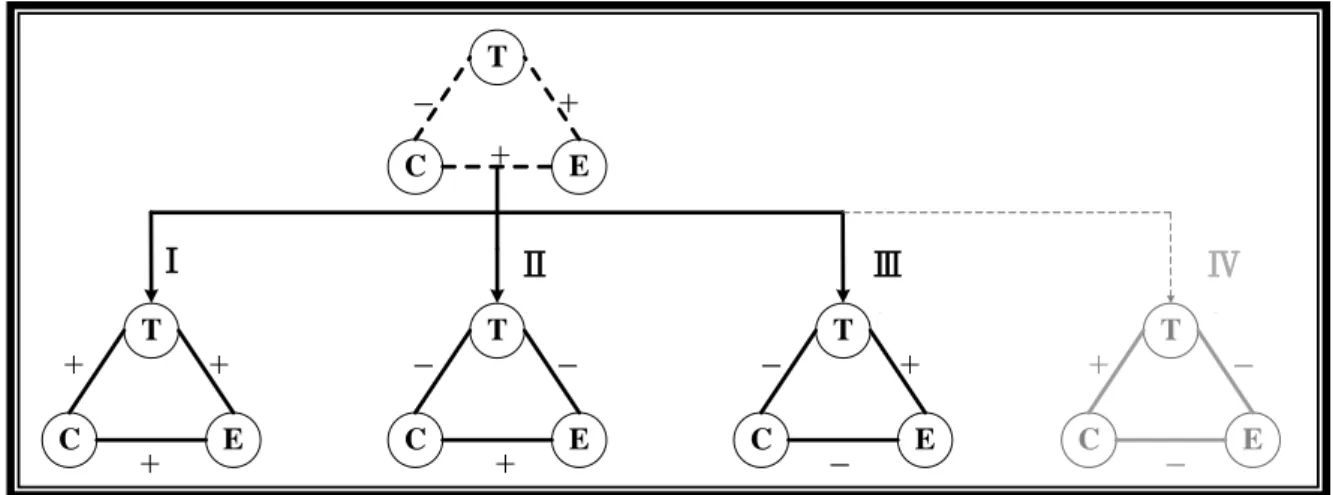
In present theorizing, there are four balanced states (see Figure 5) and four states are imbalanced (see Figure 6). According to balance theory, imbalanced states are fraught with tensions that made them unstable, particularly if the relationships are strong. Therefore, in service encounter context, if a customer or a contact employee feels himself/herself out of balance (in one of the imbalanced state), then he/she is more motivated to restore a position of balance (in one of the balanced state). That is, each imbalanced state could turn out to be one of balanced states (see Figure 8, 9, 10,11).
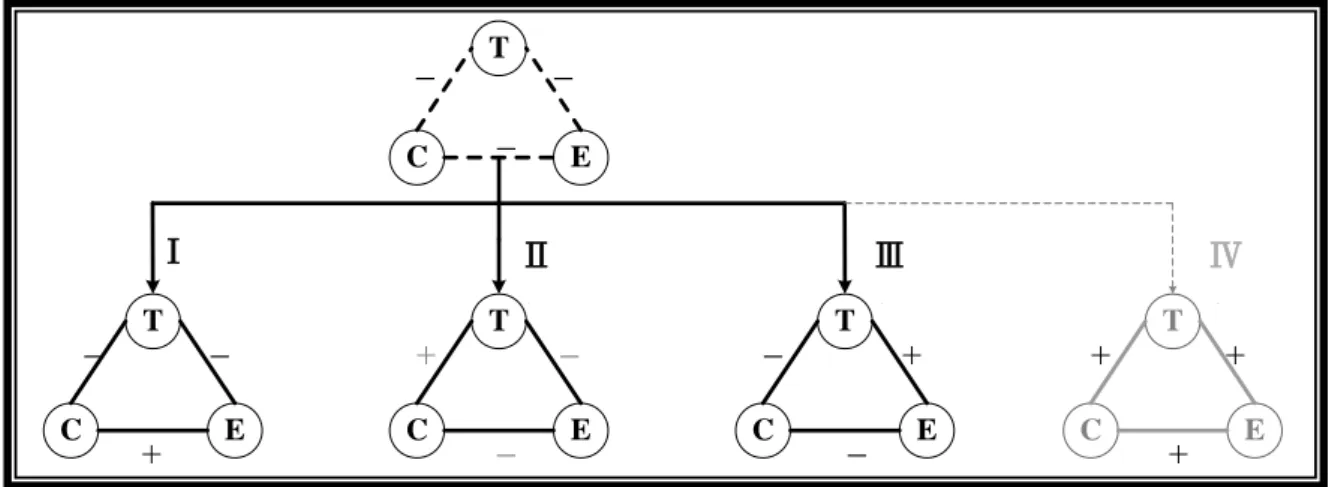
Furthermore, there are three possible ways of changing imbalanced state into balanced state: changing (1) the customer’s attitude toward the transaction type (C-T bond), (2) the contact employee’s attitude toward the transaction type (E-T bond), or (3) the interpersonal liking in customer-contact employee relationship (C-E bond). In order to more clearly and deeply discuss how a imbalanced state shift to a balanced, current research assumes there is one of three possible ways of changing imbalanced state into balanced state at a time. Furthermore, the purpose of study 2 is to investigate customer’s choice of possible ways of changing unbalanced state into balanced state, so contact employee’s conditions are given. In other words, for the customer, there are two possible ways to go: (1) changing his/her own attitude toward the transaction type (C-T bond) or (2) changing the level of personal liking that the customer has for the contact employee (C-E bond).
25 T C E T C E T C E T C E T C E
Figure 8 Shift of The Imbalanced State 1 to a Balanced State
T C E T C E T C E T C E T C E
Figure 9 Shift of The Imbalanced State 2 to a Balanced State
T C E T C E T C E T C E T C E
Figure 10 Shift of The Imbalanced State 3 to a Balanced State
- + - + - + - + - + - + - + - - - - - + - - - Ⅰ + - Ⅱ + - Ⅲ + - Ⅳ + - - + - + - + - + - + - + - + - - - - - + - - - Ⅰ + - Ⅱ + - Ⅲ + - Ⅳ + - - + - + - + - + - + - + - + - - - - - + - - - Ⅰ + - Ⅱ + - Ⅲ + - Ⅳ + -
T C E T C E T C E T C E T C E
Figure 11 Shift of The Imbalanced State 4 to a Balanced State
Furthermore, in order to further investigate how interactions between change in service encounters, current research proposes a customer-contact employee interaction matrix which contains four quadrants based on mis/match of the transaction type desired (vertical axle) and balance/imbalance condition (horizontal axle) (see Figure 12).
In the first quadrant, there is a match of transaction type that the customer and the contact employee desire, and service encounter triad is balanced because of interpersonal liking exists initially in their relationship. In this case, both the customer and the contact employee like each other initially, they hold the same attitudes about the transaction type desired and are willing to make motivational efforts to conduct those appropriate activities to facilitate the service delivery in service encounters. Ims and Jakobsen (2006) suggest that values and goals are more alike, more collaboration is possible, and greater harmony and partnership exist at some level, leading to a win-win situation. Hence, the customer and the contact employee may make greatest motivational efforts to conduct those appropriate activities with right motivational direction to facilitate the service delivery in service encounters (Kelley’s 1990).
Therefore, we specify that, in this case, the customer and the contact employee are - + - + - + - + - + - - - - - + - - - Ⅰ + - Ⅱ + - Ⅲ + - Ⅳ + - - -
27
more likely to adopt ―Collaboration,‖ which refers to a relatively stable interaction condition.
In the second quadrant, there is also a match of transaction type desired, but service encounter triad is imbalanced because of interpersonal disliking exists initially in their relationship. In this case, even though the customer and the contact employee do not have personal likings for each other initially, they still hold the same attitude about the transaction type desired and are willing to make motivational efforts to conduct those appropriate activities to facilitate the service delivery in service encounters. O’Donnell et al. (1993) suggest that when both parties hold similar beliefs and attitudes, more cooperation is possible though they do not like each other. Schmitt (1984) also suggest that cooperation typically leads to better performance. Therefore, present research specifies that, in this case, the customer and the contact employee are more likely to adopt ―Cooperation‖, which refers to a relatively unstable, positive interface, where both parties have the intention to smooth the interaction, but initial relationship between them is somewhat negative initially.
In the third quadrant, there is a mismatch of transaction type desired, and service encounter triad is imbalanced because interpersonal liking exists in customer-contact employee relationship. In this case, even though the customer and the contact employee have personal likings for each other initially, they still hold the different attitudes and expectation toward the transaction type desired. Ims and Jakobsen (2006) suggest that competition is based on the idea of conflicting interests or desires between the actors. When cooperation is replaced by competition as the main principle for interaction in the service encounter, both the customer and the contact employee make efforts to achieve his/her own goal and try to persuade others.
Therefore, current research defines that, in this case, the customers and the contact employee are more likely to be in ―Competition‖, which regarding a relatively unstable, negative interface, where customers disagree with the contact employee on transaction type and have more intention to hinder the service delivering.
In the fourth quadrant, there is a mismatch of transaction type desired, and service encounter triad is balanced because interpersonal disliking exists in customer-contact employee relationship. In this case, the customer does not agree with the contact employee on desired transaction type, and vice versa, and the initial relationship between them is also negative. Schmitt (1984) suggests that the more dissimilar ends and means exist, the more confrontation occurs, especially when both parties do not like each other. When competition is replaced by confrontation as the main principle for interaction in the service encounter, both the customer and the contact employee make efforts to achieve his/her own goal and try to dominate others. Therefore, they are under ―Confrontation‖, which represents a relatively stable, worst condition where customers are more likely to confront with the contact employee and hinder the accomplishment of the service.
This matrix illustrates the dynamic changes of interaction forms. According to balance theory, imbalanced patterns are fraught with tensions that made them unstable. If a customer/contact employee, who is in ―Cooperation‖ or ―Competition‖ condition, feels his/herself is out of balance, then he/she is motivated to restore a position of balance condition such as ―Collaboration‖ or ―Confrontation‖. By investigating possible ways of changing imbalanced state into balanced state, current research would provide richer insight into how match/mismatch and interpersonal liking could significantly influence interaction dynamics in service encounters.
29
3.2.2 Hypotheses
Shift from the Customer’s Point of View
In this section, we discuss how the customer who is in the imbalanced state will shift when the condition of the contact employee is given. More specifically, for the customer, there are two possible ways to go: (1) changing his/her own attitude toward the transaction type (C-T bond) or (2) changing the interactive relationship with the contact employee (C-E bond).
Previous research suggests that the consumer satisfaction originated from ―Expectation-Disconfirmation theory‖ referred to the discrepancy between consumers’ initial expectation and post-performance of a product/service (Oliver 1977) and one of the service quality gaps is the difference between consumer expectations and perceptions (Parasuraman et al. 1988). Furthermore, researcher characterizes customer expectation of the service as what customers think should happen in service encounters. These should expectation are often combined both customer wants and customer beliefs about what the contact employee is capable of providing (Coye 2004). Hence, customers of services have expectations about what they want and what they will receive from the service delivery process and often have needs and requests that require contact employee to fulfill them. Furthermore, nowadays common beliefs ―the customer is always right‖ and ―customer is the king‖ have been deeply rooted in customers’ mind. These beliefs make more customers take it for granted that ―paying the cost to be the boss.‖ So, customers rarely compromise themselves with contact employees on the service they expect.
31
Therefore, current research hypothesizes that customers are more likely to insist on their initial attitudes toward what they want such as desired transaction type, rather than to compromise with what they do not expect and want, even though such persistence would deteriorate the relationship between the customer and the contact employee. To sum up, form customer’s perspective, we hypothesize that, as shown in Figure 8, the imbalanced state will shift to the pattern Ⅲ; as shown in Fiure 9, the imbalanced state will shift to the pattern Ⅲ; as shown in Fiure 10, the imbalanced state will shift to the pattern Ⅰ; as shown in Fiure 11, the imbalanced state will shift to the pattern Ⅰ.
H3: In order to restore to the position of a balanced state, a customer is more
willing to change the relationship between the customer and the contact
employee than to change his/her attitude toward the transaction type
desired.
Interaction Dynamics in Service Encounters
According to our interaction dynamics matrix model (4 C’s: collaboration, cooperation, competition, and confrontation). We present a congruency matrix representing four service interaction dynamics: (1) ―Collaboration‖ in which both parties anticipate same types of transactions (e.g., communal-communal and exchange-exchange), and actively put in efforts as partners to accomplish the service goal; (2) ―Cooperation‖ in which two parties have the same expectations initially (e.g., server communal-customer exchange, or server exchange-customer communal), yet the relationship between them is not that good. Nevertheless, in this case one party is still willing to passively follow along and interact accordingly to achieve satisfactory
results; (3) ―Competition‖ in which two parties have different expectations initially, tension interferes with service delivery, and the two parties actively compete to gain control over the other; and (4) ―Confrontation‖ in which two parties have different expectations initially, disagreement surfaces, and the interaction becomes heated and disrupts service—a worst-case scenario. The interaction dynamic can move from one to the other depending on the actions and behaviors of the parties involved.
In addition, we adapt Heider’s (1958) balance theory to explain the various levels of service interaction equilibriums and illustrate the importance of balanced service encounters in customer satisfaction. The triad is anchored by the participating parties: (1) customer, (2) contact employee, and (3) the transaction type that actually occurs—either aligned with or opposite of one or both parties’ desired service interactions. Balance theory helps providing critical explanations in our study why customer/employee seeks congruence, either by modifying one’s own behavior to side with another or by persuading others to change. For example, imbalanced patterns are fraught with tensions that made them unstable. If a customer/contact employee, who is in ―Cooperation‖ or ―Competition‖ condition, feels his/herself is out of balance, then s/he is motivated to restore a position of balance condition such as ―Collaboration‖ or ―Confrontation‖.
Furthermore, because a customer is more willing to change the relationship between the customer and the contact employee than to change his attitude toward the desired transaction type, when in cooperation condition, a customer is more likely to choose to collaborate with the contact employee. Likewise, when a customer is being in the competition condition, a customer is more likely to choose to confront with the contact employee. (see Figure 13).
33
4. Methodology
4.1
Design
A pretest was administered to 40 pedestrians who are not part of the group involved in the experiments of study1 and study 2 to determine two scenario descriptions that represent communal transaction and exchange-based transaction separately from customers’ perspectives and to determine two scenario descriptions that represent communal transaction and exchange-based transaction separately from contact employees’ perspectives. We also interview and ask them to list adjectives that would capture the definitions of interpersonal liking in customer-server relationship and of interaction quality in service encounter.
In study 1, a 2 (customer communal vs. customer exchange) × 2 (employee communal vs. employee exchange) between subjects factorial design was used in this experiment to test the effects of match/mismatch of transaction type desired on interpersonal liking and interaction quality. In study 2, a 2(match of transaction type desired vs. mismatch of transaction type desired) × 2 (liking vs. disliking) within subjects factorial design was used in this experiment to investigate possible ways of changing imbalanced state into balanced state.
35
4.2
Subjects
and Procedure
In study 1, present study randomly chose 120 pedestrians such as students and wage earners as our subjects (30 participants per scenario). We ask them to fill out a questionnaire and offer them small gifts for their participation. The participants were randomly assigned to one of the four versions of the situation shown as appendix A. Participants are first exposed to a description of the transaction type a consumer desires in a hypothetical bank and are asked to project themselves into the role of the consumer. These descriptions are aimed at triggering either communal-based or exchange-based transaction type desired. Next, the scenario described a consumer who seeks help from teller A of the hypothetical bank to resolve a problem of the deferred parking payment which was paid by credit card of the hypothetical bank. In communal-based scenarios, Teller A desires CCT, which is based on concern for each other’s need, and regarded service transaction as mutually contributing experience between friends. In exchange-based scenarios, Teller A desires CET, which is based on quid pro quo, and views services as merely economic transactions and require minimal interpersonal involvement. Subsequently, participants are asked to complete a questionnaire containing items measuring communal orientation, exchange orientation, interpersonal liking, interaction quality, and also included demographic items. Finally, small gifts are offered to thank for their participation.
In study 2, current study randomly chose 120 pedestrians such as students or wage earners as our subjects (30 participants per scenario). We ask them to fill out a questionnaire and offer them small gifts for their participation. The participants were randomly assigned to one of the four versions of the situation shown as appendix B.
In the beginning, participants were informed that their participation would help the research evaluate service encounters in banking industry. Subsequently, participants viewed the stimulus material about imbalanced situations of a consumer and were asked to project themselves into the role of the consumer. One of four situations was randomly assigned. We ask subjects to complete a questionnaire containing items measuring initial communal orientation toward transactions, initial exchange orientation toward transactions, initial interpersonal liking, after communal orientation toward transactions, after exchange orientation toward transactions, after interpersonal liking, overall choice of after response, and also included demographic items.
37
4.3 Measures
In study 1, we use multi-item scales to measure the model constructs. Customer’s communal orientation toward transactions (hereafter Ccom) and exchange orientation toward transactions (hereafter Cex) were separately measured on a six-item, seven-point, semantic differential scale (Aggarwal 2004; Clark and Mills 1979, 1993; Lemay and Clark 2008; Lemay et al. 2007;Williamson and Clark 1992). Likewise, employee’s communal orientation toward transactions (hereafter Ecom) and exchange orientation toward transactions (hereafter Eex) were separately measured on a six-item, seven-point, semantic differential scale (Aggarwal 2004; Clark and Mills 1979, 1993; Lemay and Clark 2008; Lemay et al. 2007; Williamson and Clark 1992). Interpersonal liking (hereafter IPL) was measure on a five-item, seven-point, semantic differential scale (Nicholson et al. 2001). Interaction quality (hereafter IQ) was measured with a ten-item, seven-point, semantic differential scale (Brady and Cronin 2001; Chando et al. 1997).
In study 2, customer’s initial communal orientation toward transactions (hereafter Ccomb) and initial exchange orientation toward transactions (hereafter Cexb) were separately measured on a six-item, seven-point, semantic differential scale (Aggarwal 2004; Clark and Mills 1979, 1993; Lemay and Clark 2008; Lemay et al. 2007; Williamson and Clark 1992). Customer’s after communal orientation toward transactions (hereafter Ccoma) and after exchange orientation toward transactions (hereafter Cexa) were separately measured on a six-item, seven-point, semantic differential scale (Aggarwal 2004; Clark and Mills 1979, 1993; Lemay and Clark 2008; Lemay et al. 2007; Williamson and Clark 1992). Customer’s initial
interpersonal liking for the teller (hereafter IPLb) and customer’s after interpersonal liking for the teller (hereafter IPLa) were both measured on a five-item, seven-point, semantic differential scale (Nicholson et al. 2001).
39
5. Results
5.1 Study 1 – Static Model
From a total of 120 questionnaires of study 1, less than 10 of them contained unanswered questions. However, owing the limitation of the sample size, those unanswered questions are treated as missing data. Therefore, 120 questionnaires are usable consisting of 55 male and 65 female. Participants’ ages ranged from 19 years of age to 49 years of age, with 61% between ages 20 and 29. Furthermore, 82% of participants are students and 16% of them are wage earner. 49% of participants go to banks at least once per month.
We use SPSS 12.0 software to conduct manipulation check. Communal participant provided a significantly higher communal orientation score than exchange participants (Mcomm. = 5.39, Mexch. = 3.29; F(1, 119) = 108.825, P=0.000 ) and exchange participant provided a significantly lower Communality Score than communal participants (Mcomm. = 3.92, Mexch. = 5.38; F(1, 119) = 64.836, P=0.000 ). On the other hand, communal orientation score of communal teller scenario is significantly higher than that of exchange teller scenario (Mcomm. = 5.49, Mexch. = 2.64; F (1, 119) = 237.259, P=0.000) and communal orientation score of exchange teller scenario is significantly lower than that of communal teller scenario (Mcomm. = 3.35, Mexch. = 5.74; F (1, 119) = 169.633, P=0.000).