行政院國家科學委員會專題研究計畫 成果報告
未來建築辦公環境先期研究:以創新理論建構彈性工作場 所規劃之評估決策系統
研究成果報告(精簡版)
計 畫 類 別 : 個別型
計 畫 編 號 : NSC 99-2221-E-011-089-
執 行 期 間 : 99 年 08 月 01 日至 100 年 07 月 31 日 執 行 單 位 : 國立臺灣科技大學建築系
計 畫 主 持 人 : 阮怡凱
計畫參與人員: 碩士班研究生-兼任助理人員:林菁閔 博士班研究生-兼任助理人員:黃毓瑩
報 告 附 件 : 赴大陸地區研究心得報告
處 理 方 式 : 本計畫涉及專利或其他智慧財產權,1 年後可公開查詢
中 華 民 國 100 年 10 月 13 日
行政院國家科學委員會補助專題研究計畫 ■成果報告
□期中進度報告
未來建築辦公環境先期研究:
以創新理論建構彈性工作場所規劃之評估決策系統
計畫類別:■個別型計畫 □整合型計畫 計畫編號:NSC 99-2221-E-011-089
執行期間: 99 年 8 月 1 日至 100 年 7 月 31 日 執行機構及系所:
計畫主持人:阮怡凱 共同主持人:
計畫參與人員:黃毓瑩、林菁閔
成果報告類型(依經費核定清單規定繳交):■精簡報告 □完整報告
本計畫除繳交成果報告外,另須繳交以下出國心得報告:
□赴國外出差或研習心得報告
■赴大陸地區出差或研習心得報告
□出席國際學術會議心得報告
□國際合作研究計畫國外研究報告
處理方式:除列管計畫及下列情形者外,得立即公開查詢 ■涉及專利或其他智慧財產權,□一年■二年後可公開查詢
中 華 民 國 100 年 8 月 1 日
2
High-tech companies’ readiness assessment for alternative workplaces Accepted by African Journal of Business Management (SSCI) in 2010
ABSTRACT
Purpose - The aim of this paper is to provide an understanding of the assessment of the initial
readiness for AWA to assist the process of decision-making for AWA adoption from an organizational perspective.Design/methodology/approach – A set of readiness level assessment indicators (RLAI) with
three main categories of relative advantage, compatibility and complexity is developed to help decision makers assess the extent of an organization’s readiness for the adoption of an AWA.Using the RLAI, a total of 64 real adoption cases are collected from 19 large high-tech companies that had already adopted any of the six AWA types: hoteling, group address, shared office, home office, and virtual office.
Findings – RLAI proposed by this research has established a comprehensive and systematic
approach and provides decision makers with helpful guidelines for the AWA readiness assessment.Originality/value of paper – The results documented in this paper provide many other
organizations facing similar decision problems with insightful strategies and useful implications.Research limitations/implications– In exploring various types of AWA, this research is limited
to only primary place for work and full-time AWAs. Other types of AWAs such as mixed type, part-time AWAs, supplemental work-at-home and self-employed workers are not examined in this research.Keywords: Alternative Workplace Arrangements (AWA), Innovation attributes, Readiness
Level Assessment Index (RLAI), Rank correlation analysisPaper type: Research paper
1. Introduction
3
A growing body of evidence shows that globalization and advances in information and communication technology (ICT) have prompted a revolution in the way work is produced. One of the most notable changes is the establishment of the alternative workplace arrangement (AWA), in which workers have more freedom in their work hours and workplaces. As more and more businesses have begun to adopt AWAs, the number of employees who are working away from a permanently assigned office space and those who are geographically and virtually distributed has been increasing throughout the world (Venezia et al., 2007; AT&T, 2003). At the same time, real estate costs, air pollution, and traffic congestion resulting from mass commuting have worsened while companies seek to retain talented, knowledgeable workers in order to remain competitive (Roper and Kim, 2007). Thus, the trend of teleworking is likely to continue in the future, leading to greater reductions in the traditional ratio of workers to workspace, particularly in large companies. To successfully respond to the various demands of the competitive business environment (Martinez-Sanchez et. al., 2008) and to adapt to the growth of AWAs, such organizations are moving away from their physical headquarters and entering larger networks across cities and countries. All of these changes have forced them to reevaluate their goals and find solutions to the challenges they face by adopting AWA, ICTs, and other workplace practices (Roper and Kim, 2007).
AWA is a workplace arrangement aided by ICT and workers can choose to work at satellite office, telework center, home office, virtual office or any flexible location outside the traditional central office (Ndubisi and Kahraman, 2005). Many researchers use the term alternative workplace arrangements (AWA) loosely and interchangeably with other terms, however, alternative workplace arrangements(AWA), flexible workplace arrangements(FWA), distributed workplace arrangements (DWA), remote workplace arrangement(RWA), telecommuting arrangements and teleworking arrangements are all similar terms implying the arrangements of decentralized organizational structure where the core organization distributes a portion of its functions to a remote site (Venkatesh and Vitaliari, 1992). The workplace arrangements enabled by ICT allow employees to work from remote locations (Sullivan, 2003) and the workplace arrangement where employees do not have a permanent workspace on company premises becomes distributed and flexible (Belanger and Collins, 1998). Therefore, AWA is workplace arrangement designed to facilitate execution of distributed work by the entire organization and examples include working at home office, satellite office, hoteling and mobile work (Swan et al, 2004).
Much scholarly work has been done on the topics of AWA, especially on significant factors and characteristics to be considered for the AWA adoption. Venkatesh and Vitalari (1992) have provided three factors in a conceptual model for AWA study: organization/work, ICT, and household including worker’s characteristics. All three independent variables are related to a
4
fourth factor: supplemental work at home which is the dependent variable in their study.
Characteristics surrounding AWA are organizational, individual, work, household and technology characteristics (Belanger and Collins, 1998) and the AWA environments are separated into four components: social environment, technical environment, resource environment, and organizational structure environment (Swan et al., 2004). Numerous studies of AWA adoption have focused on organizational factors (Ruppel and Harrington, 1995), worker and task attributes (Kayworth and Leidner, 2002), and technological supports. Kowalski and Swanson (2005) provide a framework of critical success factors including support, communication and trust that are instrumental for organizations looking to develop an AWA program.
Much research has attempted to find solutions for AWA adoption issues. Fritz et. al., (1994) proposed a method for determining the suitability of an AWA implementation framework. (Bui et. al., 1996) have described various types of AWAs and discussed the suitability of each AWA type from the organizational perspective. Shin et al., (2000) have depicted a conceptual model of intra-organizational adoption of telework at four stages: initiation, adoption, implementation and institutionalization. Higa and Wijayanayake, (1998) have delineated the adoption patterns of different AWA types by different areas and the size of organizations in Japan. Higa and Shin, (2003) have examined and compared five successful AWA adoption cases and four not-so- successful adoption cases in terms of four AWA adoption phases: inception, testing, implementation and future planning. However, none of the decision models has shown clear evidence regarding its applicability to the AWA adoption decision process (Clark, 1998). A literature review reveals that there is little guidance about which organization, work types, workers and workspaces are compatible for AWA programs (Belanger and Collins, 1998), and no research about how the decision should be made to adopt a particular type of alternative workplace arrangement (Fritz et al., 1996). Today’s enterprises need assistance in assessing their readiness for AWA and developing a distributed workplace strategy (Harrison 2002). The problem is that decision makers have no established tools to assess their readiness for AWA or to select among the most appropriate AWA type considering their organizations’ business reasons of adoption and the current readiness conditions.
The purpose of this research is to provide an understanding of the assessment of the initial readiness for AWA to assist the process of decision-making for AWA adoption from an organizational perspective. The specific objective is to develop Readiness Level Assessment Indicators (RLAI) for assessing the extent of an organization’s readiness for the adoption of an AWA. RLAIs can be used as to predict the potential successfulness of AWA adoption from an organizational perspective. To achieve this, at the outset, with particular emphasis on Rogers’s innovation attributes (Rogers, 1995) and the Leavitt’s model of organizational subsystems
5
(Leavitt, 1965), surrounding factors and relevant attributes that can be used to assess the organizational readiness for AWA adoption are identified and selected, and based on these parameters, RLAI is developed. Using RLAI, a total of 64 AWA adoption cases are collected from high-tech companies for this research.
2. The trend and type of Alternative Workplace Arrangements (AWA)
A Telework Trendlines 2009 report notes an increase in the number of Americans who work at home or at workplaces other than the central office, including satellite offices and virtual offices, at least one day per month from 28.7 million in 2006 to 33.7 million in 2008 (Johnson, 2009).
Nemertes’ benchmark study 2007 discloses that 83% of the participating organizations consider their workplace structure as virtual where 91% of participating organizations’ employees work outside of headquarters and about 96% of them utilize some forms of real-time collaboration tools such as Web conferencing, instant messaging and video conferencing.
Flexibility is a key to the success of organizations due to its enormous impact on working conditions, productivity and performance (Origo and Pagani, 2008). The emergence of AWAs has altered the workplace and work time by altering how work is performed on a regular basis.
Responding to the needs of a rapidly changing business environment, companies have created and adopted many different forms of alternative workplaces: on-site workplaces, such as free addresses; hoteling and group addresses; and off-site workplaces, such as telecommuting, satellite offices and so on (Gilleard and Rees, 1998). Additionally there are more forms of AWAs, including the concept of supplemental workplaces where job-related tasks are also performed by full-time workers at home after regular work hours or on weekends (Venkatesh and Vitalari, 1992). Another form of AWA is the remote workplace, defined as those where workers are physically separated from managers (Staples, 2001).
In exploring various types of AWA, this research is limited to only primary places for work. If employees work in an alternative workplace only part of the time and still retain the permanently assigned workspace at the central office, organizations cannot expect to reduce their business cost because they have not actually implemented an AWA. Therefore, only primary place for work and full-time AWAs are considered in this research. Other types of AWA, such as mixed (e.g. hoteling and home office), part-time, and supplemental work-at-home AWAs are not examined in this research. In a literature review focusing on a primary place of work, AWAs are limited to six recurring types: on-site workplaces, such as hoteling; group addresses; shared offices; off-site workplaces, such as satellite offices; home offices, and virtual offices. Off-site types are selected based on the place of work. On-site types can be differently classified by their space configuration (e.g. group office) and usage (e.g. hoteling and shared office).
6
3. Assessment Metrics for RLAI
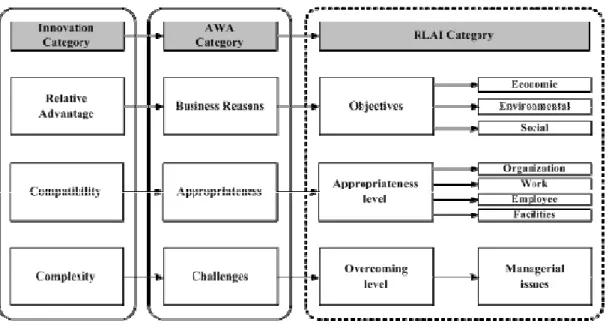
Organizational readiness assessment needs to be performed to provide decision makers with a reliable, quantifiable assessment of the organization’s potential readiness to successfully making the transition to alternative workplaces (Grantham et. al, 2007). Major business reasons, surrounding factors and relevant attributes are identified based on Rogers’s innovation attributes and Leavitt’s model of organizational subsystems as shown in Fig. 1.
Assessment indicators are finally determined by two different stages. First, significant factors, relevant attributes and assessment indicators are initially selected based on combined insights from the literature review and the discussions at the conferences. Next, the validity of the selected assessment indicators is additionally evaluated by the panel of experts formed for this research in order to build the readiness level assessment indicators (RLAI), which measure the initial readiness of high-tech companies for adopting an AWA.
3.1 Innovation Attributes
Many researchers describe innovation as a new idea, policy, process, product or program. An adoption of AWA as an alternative form of workplace arrangement would create some type of innovation in the organization. There are five perceived innovation attributes influencing adoption intention: relative advantage, compatibility, complexity, observability, and trialability in innovation diffusion theory (Rogers, 1995). The innovation theory can be served as a foundation for decision makers to start considering the adoption of AWA as an organizational innovation. Among these attributes speeding the adoption of organizational innovation, which is AWA in this study, relative advantage, compatibility and complexity are found more important in influencing adoption decision (Karnowski and White, 2002). Therefore, relative advantage, compatibility and complexity are used to investigate factors in each of the three AWA categories: business reasons, appropriateness and challenges.
From a readiness assessment standpoint, business reasons are represented as objectives and how clearly objectives of AWA adoption are identified and selected are assessed. Next, appropriateness is measured as appropriateness level and how appropriate in general the AWA adoption is with existing conditions is evaluated. Finally, challenges are measured as overcoming level. It measures whether or not managerial control practices exist, and if they do exist, evaluates how actively they are practiced. All the factors and attributes are extracted from each AWA category and readiness assessment areas to build up readiness level assessment indicators (RLAI) as shown in Fig. 1.
7
Fig. 1. Development Process for the Assessment Indicators
3.2 AWA Category
3.2.1 Business Reasons
Relative advantage can be described as the degree to which an organizational innovation is considered as being beneficial over the existing practice (Rogers, 1995). The business reasons, objectives or expected benefits of adopting AWA can be substituted for relative advantage in adopting AWA. Organizational objectives, for instance, could be focused on office space cost savings and improved productivity. Its objectives should match for the expected benefits of establishing AWA (Roper and Kim, 2007). Adopters of AWAs have reported clear benefits such as reduced operating costs by office space savings and requirement parking spaces, improved productivity, ease in staff recruitment and retention of skilled knowledge workers, reduced turnover and absenteeism, improved customer satisfaction, reduced traffic congestion and environmental impacts, improved employees’ work-life balance, provision of working opportunities for the elderly & handicapped (Belanger and Collins, 1998; Kurland and Bailey, 1999; Cascio, 2000; Higa and Shin 2003; Peters et al., 2004). Elkington (1998) coined the concept of the Triple Bottom Line (TBL), which he introduces to emphasize that a single dimension of economic value alone cannot fully explain various benefits. Thus, reporting on social and environmental performance is also necessary to explore its various benefits. The TBL concept provides with convincing approach to appreciate business reasons of AWA adoption from three aspects. Various business reasons for AWA adoption can fall into three categories as classified in the triple bottom line (TBL) as depicted in Table 1.
Table 1 Reasons for AWA Adoption in the TBL Concept
8
TBL category Adoption reasons Variables
Retention/attraction of skilled workers A1
Reduced office space costs A2
Improved productivity A3
Reduced turnover and absenteeism A4 Economic
Improved customer satisfaction A5 Environmental Reduced traffic congestion, better air quality A6 Social Employment opportunities for aging and handicapped
people, better employee work-life balance A7
3.2.2 Appropriateness
When the adoption of an AWA is seen as suitable given an organization’s existing conditions, it can be concluded that the organization is ready to adopt the AWA. The existing conditions can be represented as significant factors surrounding the AWA. Leavitt selected four elements for describing an organization: technology, structure, task and people (Leavitt, 1965), and management scholars added organizational culture to the four elements selected by Leavitt (Gordon and Olson, 1985). These elements gave an outline at the beginning to identify the important factors for AWA adoption when measuring appropriateness for a given organization.
As work patterns and structures evolve faster than workplaces are able to adapt, business patterns are also dramatically changing. AWAs can be attractive to large organizations due to their potential benefits, but organizations need to consider whether or not their goals, objectives, and surrounding conditions, as well as characteristics of their work, employees, and facilities, are appropriately suited for readiness assessment.
3.2.3 Challenges
At the organizational level, control, coordination and supervision of distributed workers are much harder than they are for workers on-site. Most challenges in adopting AWA are found in the area of managerial issues, including performance evaluation and coordination from the organizational perspective. It can be assumed that well-prepared managerial actions including a wide range of activities dealing with challenges in AWA settings can positively influence the success of AWA adoption. Areas in which AWA can lead to difficulties are performance evaluation, supervision, coordination, policy and guideline provision and learning opportunities for distributed workers (Fritz et. al., 1996; Fritz et. al., 1998; Apgar, 1998; Kurland and Bailey, 1999; Cascio, 2000; Roitz and Jackson, 2006).
9
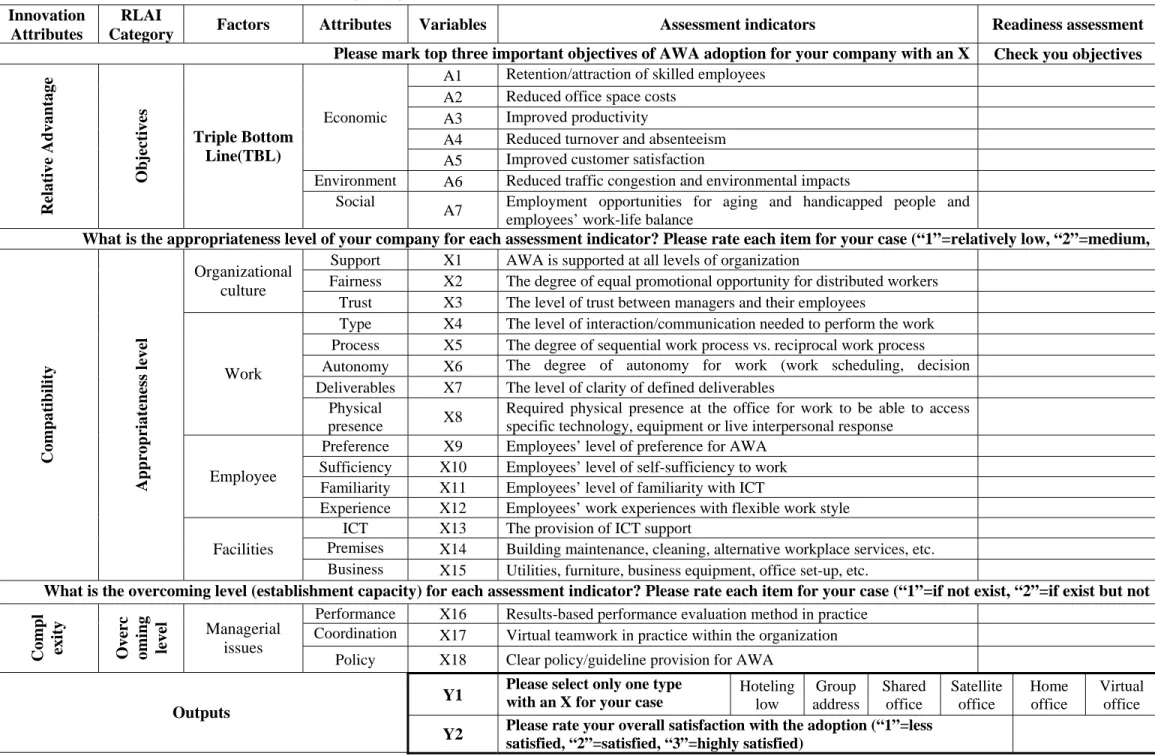
3.3 Readiness Level Assessment Indicators (RLAI)
In addition to the final selections of significant factors and attributes, assessment items for each attribute are added to complete the readiness level assessment indicators (RLAI). RLAI is developed to provide decision makers with an understanding of how to assess the initial organizational readiness AWA adoption. The survey questions are designed to get RLAI validated by experts. According to a three-point likert scale (“1”= not necessary, “2”=important but not essential, “3”=essential) each assessment item is carefully rated by the 15 experts and finally selected for this research using the content validity ratio (CVR) method to ensure the adequacy of indicators items. The CVR, which is an item statistic, is helpful in the retention or rejection of specific items (Lewis et al., 1995). According to the CVR table published by Lawshe, a CVR of 0.49 is minimally required for each item to prove its validity for AWA readiness assessment metrics when there are 15 people on the content evaluation panel. Among all items identified from the literature review and finalized through the analysis of the results on the first survey, items with CVR values higher than 0.49 are retained, and a list of 18 assessment items is finalized for RLAI as shown in Table 2.
Table 2 Readiness Level Assessment Indicators (RLAI) Table Innovation
Attributes
RLAI
Category Factors Attributes Variables Assessment indicators Readiness assessment
Please mark top three important objectives of AWA adoption for your company with an X Check you objectives A1 Retention/attraction of skilled employees
A2 Reduced office space costs A3 Improved productivity
A4 Reduced turnover and absenteeism Economic
A5 Improved customer satisfaction
Environment A6 Reduced traffic congestion and environmental impacts
Relative Advantage Objectives
Triple Bottom Line(TBL)
Social
A7 Employment opportunities for aging and handicapped people and employees’ work-life balance
What is the appropriateness level of your company for each assessment indicator? Please rate each item for your case (“1”=relatively low, “2”=medium, Support X1 AWA is supported at all levels of organization
Fairness X2 The degree of equal promotional opportunity for distributed workers Organizational
culture
Trust X3 The level of trust between managers and their employees
Type X4 The level of interaction/communication needed to perform the work Process X5 The degree of sequential work process vs. reciprocal work process
Autonomy X6 The degree of autonomy for work (work scheduling, decision Deliverables X7 The level of clarity of defined deliverables
Work
Physical
presence X8 Required physical presence at the office for work to be able to access specific technology, equipment or live interpersonal response
Preference X9 Employees’ level of preference for AWA Sufficiency X10 Employees’ level of self-sufficiency to work Familiarity X11 Employees’ level of familiarity with ICT Employee
Experience X12 Employees’ work experiences with flexible work style ICT X13 The provision of ICT support
Premises X14 Building maintenance, cleaning, alternative workplace services, etc.
Compatibility Appropriateness level
Facilities
Business X15 Utilities, furniture, business equipment, office set-up, etc.
What is the overcoming level (establishment capacity) for each assessment indicator? Please rate each item for your case (“1”=if not exist, “2”=if exist but not Performance X16 Results-based performance evaluation method in practice
Coordination
( k)
X17 Virtual teamwork in practice within the organization
Compl exity Overc oming level
Managerial issues
Policy X18 Clear policy/guideline provision for AWA Y1 Please select only one type
with an X for your case
Hoteling low
Group address
Shared office
Satellite office
Home office
Virtual office Outputs
Y2 Please rate your overall satisfaction with the adoption (“1”=less satisfied, “2”=satisfied, “3”=highly satisfied)
4. Data Collection & Analysis
4.1 Data Collection
Through telephone interviews, conference calls and email questionnaires, the RLAIs are used to collect a total of 64 real adoption cases from 19 large high-tech companies that had already adopted any of the six AWA types: hoteling, group address, shared office, satellite office, home office, and virtual office. Most of the companies provided more than one adoption cases since most of the cases are documented by different years. The number of cases documented in 2005 is three; in 2006, six; in 2007, eleven; and in 2008, 22. The number of ongoing cases is 22.
4.2 Case Description on Objective of AWA Adoption (A1-A7)
Major objectives of the actual adoption cases from high-tech companies are tabulated as shown in Table 1 and differences between responses from the experts without focusing on technology companies and the ones from the actual adoption cases from technology companies are identified. The most important objectives of AWA adoption from both experts (26.7%) and actual adoption cases from technology companies (25.5%) are “reduced office space costs”. The second most important objectives selected by the experts (22.2%) are
“retention/attraction of skilled employees,” whereas the second most important objectives selected by the actual cases (25.0%) are “improved productivity.”
Finally, the third most important objectives selected by the experts (17.8%) are “improved productivity,” whereas the third most important objectives selected by the actual cases (14.6%) are “retention/attraction of skilled employees”.
More than half of the technology companies feel that reduced office space costs and improved productivity are important. Therefore, it can be concluded that there is not much difference between selecting general objectives and specific objectives of high-tech companies for AWA adoption. Most technology companies feel that reduced turnover and absenteeism, improved customer satisfaction, reduced traffic congestion and environmental impacts, and employment opportunities for aging and handicapped people and employees’
work-life balance (A4-A7) are not important.
4.3 Case Description on Type Selection (Y1) and Satisfaction Level (Y2)
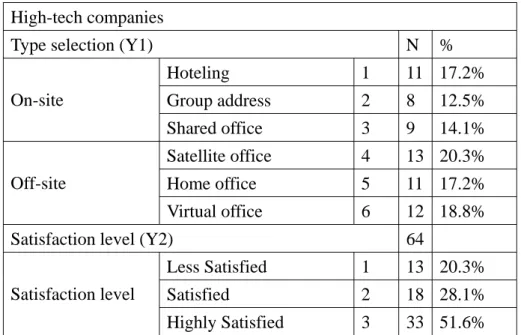
As shown in Table 3, among on-site types, hoteling is selected by eleven cases representing 17.2% followed by shared office (14.1%) and group address (12.5%). Among off-site types, satellite office is selected by thirteen cases representing 20.3%, followed by virtual (18.8%) and home office (17.2%). Over 55% of the technology companies allow off-site working situations. As suggested by respondents in the pre-testing stage, only 20.3% of the cases are categorized as “less satisfied,” and 28.1% of the cases are marked as “satisfied”. More than
12
half of all the cases are categorized as “highly satisfied”. About 80% of all the cases are marked as “satisfied” or above with their satisfaction level, which means that adoption cases collected by RLAI, which is expected to effectively capture the readiness level of the organizations, can represent best practices for AWA adoption.
Table 3 Outputs of AWA Adoption
High-tech companies
Type selection (Y1) N %
Hoteling 1 11 17.2%
Group address 2 8 12.5%
On-site
Shared office 3 9 14.1%
Satellite office 4 13 20.3%
Home office 5 11 17.2%
Off-site
Virtual office 6 12 18.8%
Satisfaction level (Y2) 64
Less Satisfied 1 13 20.3%
Satisfied 2 18 28.1%
Satisfaction level
Highly Satisfied 3 33 51.6%
4.4 Case Description on Readiness Level (X1-X18)
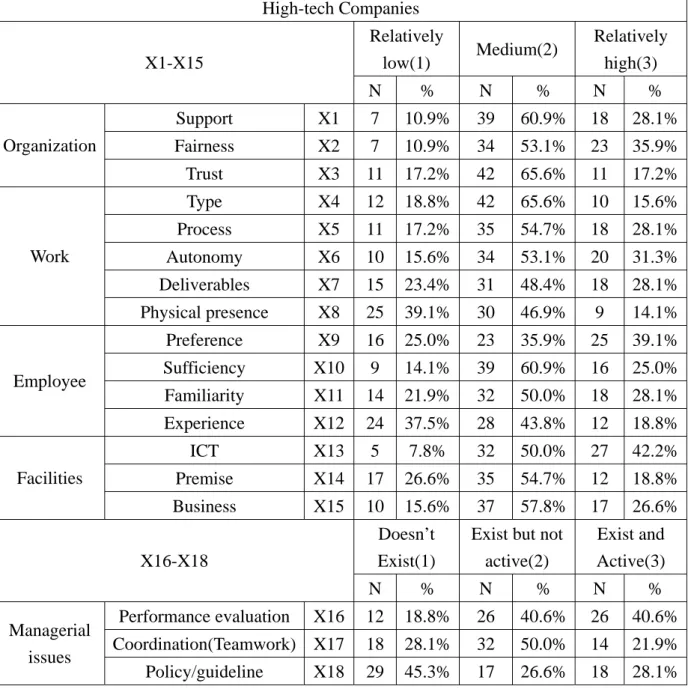
Most of the high-tech companies seem to have rated the readiness levels, named as X1-X15,
“medium.” However, a substantial number of companies rated X2, X6, X9, and X13
“relatively high,” as shown in Table 4. Among managerial issues measuring the establishment capacity of managerial practices, results-based performance evaluation methods and virtual teamwork in practice within the organization exist in most technology companies, but they are not actively in practice. However, most technology companies not only have a clear policy/guideline provision for AWA, but actively follow it. Among the 18 variables measuring the readiness level of each case, 16 variables are positively correlated with the satisfaction level of AWA adoption, and among the 16 readiness variables showing a positive rank correlation with Y2, 13 variables are significant at the .01 level (99% level) for a two- tailed prediction.
13
Table 4 Readiness Levels of Adoption Cases
High-tech Companies Relatively
low(1) Medium(2) Relatively high(3) X1-X15
N % N % N % Support X1 7 10.9% 39 60.9% 18 28.1%
Fairness X2 7 10.9% 34 53.1% 23 35.9%
Organization
Trust X3 11 17.2% 42 65.6% 11 17.2%
Type X4 12 18.8% 42 65.6% 10 15.6%
Process X5 11 17.2% 35 54.7% 18 28.1%
Autonomy X6 10 15.6% 34 53.1% 20 31.3%
Deliverables X7 15 23.4% 31 48.4% 18 28.1%
Work
Physical presence X8 25 39.1% 30 46.9% 9 14.1%
Preference X9 16 25.0% 23 35.9% 25 39.1%
Sufficiency X10 9 14.1% 39 60.9% 16 25.0%
Familiarity X11 14 21.9% 32 50.0% 18 28.1%
Employee
Experience X12 24 37.5% 28 43.8% 12 18.8%
ICT X13 5 7.8% 32 50.0% 27 42.2%
Premise X14 17 26.6% 35 54.7% 12 18.8%
Facilities
Business X15 10 15.6% 37 57.8% 17 26.6%
Doesn’t Exist(1)
Exist but not active(2)
Exist and Active(3) X16-X18
N % N % N % Performance evaluation X16 12 18.8% 26 40.6% 26 40.6%
Coordination(Teamwork) X17 18 28.1% 32 50.0% 14 21.9%
Managerial issues
Policy/guideline X18 29 45.3% 17 26.6% 18 28.1%
14
4.5 Discussion of Best Practice Cases
While describing AWA adoption cases collected from high-tech companies, some important features of successful AWA adoption cases are revealed. One is the relatively more important objectives by different AWA type, and the other feature is that there are different readiness levels expressed in appropriateness and overcoming levels as reported for on and off site types. First, relatively more successful cases are extracted from the case data. Only 33 cases with the satisfaction level “3”, highly satisfied with AWA adoption, are selected for more analysis to determine suggested objectives by different AWA types. For each AWA type, the main objectives of each case have been identified based on the higher frequency of selection from the respondents. According to the frequency of selection, the main objectives for adopting each AWA type are the following:
Hoteling: “reduced office space costs” and “improved productivity”
Group address: “improved productivity” and “reduced turnover and
absenteeism”
Shared office: “reduced office space costs” and “employee’s work-life
balance”
Satellite office: “improved productivity” and “improved customer
satisfaction”
Home office: “reduced office space costs” and “improved customer
satisfaction”
Virtual office: “reduced office space costs” and “improved customer
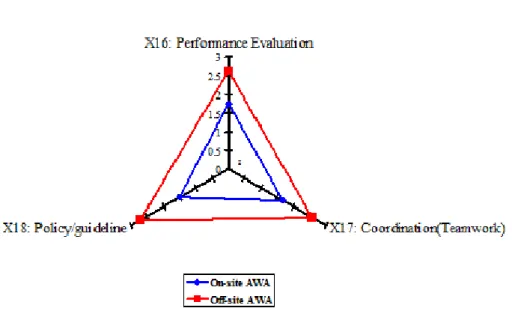
satisfaction”Next, the average overcoming levels are calculated from successful cases to compare differences in overcoming levels between on-site and off-site types. Among three overcoming measurement areas, levels of off-site types are higher than the ones of on-site types in all three areas. This confirms the previous research findings (Kurland and Bailey, 1999) that managerial challenges become greater as distributed workers are further from the central office in terms of physical distance so that higher overcoming levels are needed for successful AWA adoption.
15
Fig. 2. Overcoming Level Comparison between Different AWA Types
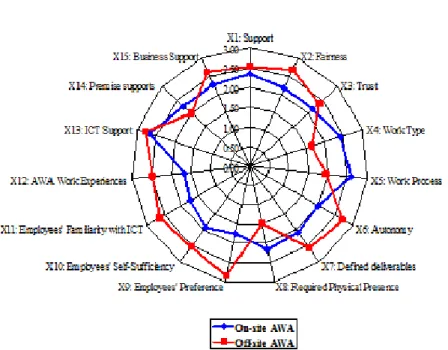
Finally, the average appropriateness levels are calculated from successful cases to compare differences in the levels between on-site and off-site types. Among the 15 appropriateness measurement areas, levels of off-site types indicate higher than the ones for on-site types in 11 areas. However, the appropriateness levels for on-site types found to be higher in four areas are as follows (see Fig. 3.):
The level of interaction/communication needed to perform the work
The degree of sequential work process vs. reciprocal process (The degree of transactional vs. open ended work process) “close to reciprocal process”: 1,
“close to sequential process”: 3, “middle or both”: 2
Required physical presence at the office for worker to be able to access specific technology, equipment or live interpersonal response (location dependency)
The level of premise supports
16
Fig. 3. Appropriateness Level Comparison between Different AWA Types
The areas in which obvious distinctions between on-site and off-site types are revealed are work types, process and physical presence. These attributes are all under “work” factor. This indicates that the level of interaction needed to perform the work and the level of required physical presence at the office are found to be lower in off-site types. Surprisingly, sequential work processes are found more in on-site types, whereas it is assumed that sequential work processes would be found more in off-site types. This indicates that work process is not a critical attribute in selecting an appropriate AWA type because work process itself doesn’t seem to be a significant issue anymore with the development of sophisticated ICT.
4.6 Rank Correlation Analysis Results
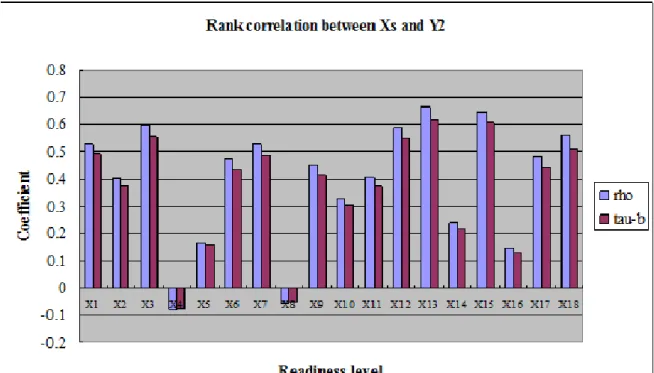
Rank correlation analysis is conducted to measure the association between two ordinal variables: the readiness level and the satisfaction level. Two rank correlations, Spearman’s and Kendall’s, show similar results. Among the 18 variables measuring the readiness level for each case, the 16 variables are positively correlated with the organization’s satisfaction level with AWA adoption as depicted in Fig. 4.
Among the 16 variables showing a positive correlation with Y2, 13 of them are significant at the .01 level (99% level) for a two-tailed prediction. Assuming that X4 and X8 are less significant variables measuring the readiness, it is concluded that a positive correlation exists between organizational readiness level for AWA adoption and organization’s satisfaction with AWA.
17
Fig. 4. Spearman and Kendall’s Correlation between Xs and Y2
5. Conclusion
This research results in the development of readiness level assessment indicators (RLAI) that decision makers can use when measuring their organization’s readiness for AWA adoption.
Secondly, three important features are revealed from analyzing only 33 best practice cases.
First, more important objectives are found in each of six AWA type adopted by participating high-tech companies. Another finding is that the average overcoming levels of off-site types are higher than those of on-site types in three measurement areas such as “results-based on performance evaluation method in practice”, “virtual team work in practice within the organization” and “clearly written policy, guideline and procedure provision for AWA”. The final feature is that among the 15 appropriateness measurements, the average appropriateness levels of off-site types indicate higher incidence than the ones of on-site types in 11 areas.
However, appropriateness levels for on-site types are higher in the four features of “the level of interaction/communication needed to perform the work”, “the degree of sequential work process vs. reciprocal process (The degree of transactional vs. open ended work process)”,
“required physical presence at the office for work to be able to access specific technology, equipment or live interpersonal response” and “the level of premise supports including building operation and maintenance and cleaning.
Finally, of special note, X1, X3, X7, X12, X13, X15 and X18 are highly correlated with the satisfaction level expressed in how much an adoption meets the initial objective of the AWA adoption(correlation is significant at the .01 level). Therefore, it is concluded that a positive
18
rank correlation exists between organizational readiness level for AWA adoption and organization’s satisfaction with AWA.
X1: The level of AWA supported at all levels of the organization X3: The level of trust between managers and their employees X7: The level of clarity of defined deliverables
X12: Employees' work experiences with flexible work style X13: The provision of ICT support
X15: The level of business support services X18: Clear policy/guideline provision for AWA
6. Future Research
The scope of this research is limited to only the initiation stage and adoption stage. In the future, it will be necessary to extend the scope to the next implementation stage, where a detailed feasibility study including cost estimation and risk analysis for the final adoption decision is conducted. In future research, based upon a larger sample of AWA adoption cases from other industries, more efforts could be researched to develop decision support systems which can provide even more accurate and solid predictions regarding AWA adoption decision issues as well as measure the performance of distributed workers.
Reference
Apgar, M. (1998), “The alternative workplace: changing where and how people work”,
Harvard Business Review, May-June, pp. 121-136.
AT&T (2003), “Remote working in the net-centric organization”, an AT&T survey and white paper in co-operation with the Economist Intelligence Unit, London, July.
Belanger, F. and Collins, R.W. (1998), “Distributed work arrangement: a research framework”, The Information Society, Vol. 14, pp. 137-152.
Bui, T., Higa, K., Sivakumar, V. and Yen, J. (1996), “Beyond Telecommuting: Organizational Suitability of Different Modes of Telework”, in System Science, Proceedings of the Twenty- Ninth Hawaii International Conference, IEEE.
Cascio, W.F. (2000), “Managing a virtual workplace”, Academy of Management Executive, Vol.14 No.3, pp. 81-90.
Clark II, S.D. (1998), “The Decision to Telework: A Synthesized Model”, in System Science,
19
Proceedings of the Thirty-First Hawaii International Conference, IEEE.
Elkington, J. (1998), Cannibals with Forks: The Triple Bottom Line of 21st
Century Business,
New Society Publishers, Jackson, TN.Fritz, M.B., Higa, K. and Narasimhan, S. (1994), “Telework: Exploring the Borderless Office”, in System Science, Proceedings of the Twenty-Seventh Hawaii International Conference, IEEE.
Fritz, M.B., Narasimhan, S. and Rhee, H. (1996), “Adoption of Remote Work Arrangements:
An Initial Analysis”, Proceedings of the Twenty-Ninth Hawaii International Conference, IEEE.
Fritz, M.B., Narasimhan, S. and Rhee, H. (1998), “Communication and coordination in the virtual office”, Journal of Management Information Systems, Vol. 14 No. 4, pp. 7-28.
Grantham, C.E., Ware, J.P. and Williamson, C. (2007), Corporate Agility, Amacom, New York, NY.
Gilleard, J.D. and Rees, D. (1998), “Alternative workplace strategies in Hong Kong”,
Facilities, Vol. 16 No. 5/6, pp. 133-137.
Gordon, B. D. and Olson, M.H. (1985), Management Information Systems: conceptual
foundations, structure and development, McGraw Hill Series in Management Information
Systems, (2nd Edition), New York, NY.Harrison, A. (2002), “Accommodating the new economy: the SANE space environment model”, Journal of Corporate Real Estate, Vol. 4 No. 3, pp. 248-265.
Higa, K. and Wijayanayake, J. (1998), “Telework in Japan: Perceptions and Implementation”, in System Science, Proceedings of the Thirty-First Hawaii International Conference, IEEE.
Higa, K. and Shin, B. (2003), “The telework Experience in Japan”, Communications of the
ACM, Vol. 46 No. 9, pp. 233-242.
Karnowski, A. and White, B.J. (2002), “The role of facility managers in the diffusion of organizational telecommuting, Environment and Behavior, Vol. 34, No. 3, pp. 322-334.
20
Kayworth, T.R. and Leidner, D.E. (2002), “Leadership effectiveness in global virtual teams”,
Journal of Management Information System, Vol. 18, No. 2, pp. 7-40.
Kowalski, K.B. and Swanson, J.A. (2005), “Critical success factors in developing teleworking programs”, Benchmarking, Vol. 12, No. 2, pp. 236-249.
Kurland, Nancy B. and Bailey E. Diane (1999). “Telecommuting: The Advantages and Challenges of Working Here, There, Anywhere, and Anytime,” Organizational Dynamics, New York, Autumn, Vol. 28, No. 2, pp. 53-68.
Lawshe, C.H. (1975), “A Quantitative Approach to Content Validity”, Personnel Psychology, Vol. 28, pp. 563-575.
Leavitt, H.J.(1965), "Applied Organisational Change in Industry: Structural, Technologocal and Humanistic Approaches" in J.G. March (ed.), Handbook of Organisations, Vol. 27, pp.
1144-1170, Rand McNally, Chicago.
Lewis, C.H., Snyder, C.A. and Rainer, K.R. (1995), “An empirical assessment of the information resource management construct”, Journal of Management Information Systems, Vol. 12 No. 1, pp. 199-223.
Martinez-Sanchez, A., Perez-Perez, M, Vela-Jimenez, M.J and de-Luis-Carnicer, P. (2008),
“Telework adoption, change management, and firm performance”, Journal of Organizational
Change Management, Vol. 21, No. 1, pp.7-31.
Nemertes Research. Nemertes benchmark: Building a successful virtual workplace, 2007.
Available at http://www.nemertes.com/networkingelecommunications/nemertes benchmark building a successful virtual workplace (accessed 15 March 2010).
Ndubisi, N.O. and Kahraman, C. (2005), “Teleworking adoption decision-making processes:
Multinational and Malaysian firms comparison”, The Journal of Enterprise Information
Management, Vol. 18 No. 2, pp.150-168.
Origo, F. and Pagani, L. (2008), “Workplace flexibility and job satisfaction: some evidence from Europe”, International Journal of Manpower, Vol. 29 No. 6, pp. 539-566.
Peters, P., Tijdens, K.G. and Wetzels, C. (2004), “Employees’ opportunities, preferences, and practices in telecommuting adoption, Information & Management, Vol. 41 No. 4, pp. 469-482.
21
Rogers, E. M. (1995), Diffusion of Innovations, Free Press, New York, NY.
Roitz, J. and Jackson, E. (2006), “AT&T adds business continuity to the long list of telework’s advantages”, Journal of Organizational Excellence, Spring, pp. 3-12.
Roper, K. and Kim, J. (2007), “Successful distributed work arrangements: a developmental approach”, Journal of Facilities Management, Vol. 5 No. 2, pp. 103-114.
Ruppel, C. and Harrington, S. (1995), “Telework: an innovation where nobody is getting on the bandwagon?”, ACM SIGMIS Database archive, Vol. 26 No. 2/3, pp. 87-104.
Shin, B., Sheng O.R. and Higa, K. (2000), “Telework: Existing Research and Future Directions”, Journal of Organizational Computing and Electronic Commerce, Vol. 10 No. 2, pp. 85-101.
Staples, D. S. (2001), “A Study of Remote Workers and Their Differences from Non-Remote Workers”, Journal of End User Computing, Vol. 13 No. 2, pp.6-14.
Sullivan, C. (2003), “What’s in a name? Definitions and conceptualization of teleworking and homeworking”, New Technology, Work and Employment, Vol. 18 No. 3, pp. 158-165.
Swan, B., Belanger, F. and Watson-Manheim, M. (2004), “Theoretical Foundations for Distributed Work: Multilevel, Incentive Theories to Address Current Dilemmas”, in System Science, Proceedings of the Thirty-Seventh Hawaii International Conference, IEEE.
Venezia, C., Allee, V. and Schwabe, O. (2007), “Designing productive spaces for mobile workers: Role insights from network analysis”, Information Knowledge Systems Management, Vol. 5, pp. 1-15.
Venkatesh, A. and Vitalari, N.P. (1992), “An emerging distributed work arrangement”,
Management Science, Vol. 38 No. 12, pp. 1687-706.
差旅摘要報告
此出差有主要兩大目的:(一)前往同濟大學進行學術交流與研討;(二)於
同濟大學經濟與管理學院進行公開演講。就此兩大目的分別說明如下:
學校交流與研討部分,共分為三天行程。第一天由本人介紹與主持,研討議 題主要包含企業與學術研究方法論。針對企業部分,介紹各種管理科學方法如何 應用以改善企業永續發展與競爭力,研討過程中亦介紹相關研究案例。與會人員 亦提出許多執行層面的問題,例如,如何把學術理論與實務結合以發揮最大功 效、企業如何發掘經營問題並提出改善方式等。研討過程中,發現大陸年輕學者,
普遍對於企業經營有濃厚的興趣,年輕的博士班學生也多數有在外面註冊公司、
創業並積極尋求合作的機會,此也顯示中國大陸市場仍具無窮的商機。
第二天研討行程,由經濟與管理學院副院長王廣濱教授主持。研討議題主要 為未來居住、生活與辦公模式之探討。居住與生活部分,分享了世博各場館對於 本次主題「Better City, Better Life」所採用的智慧化技術、智慧空間營造、未來 生活模式與情境模擬,透過影片、動畫與圖說,進行現場報告。辦公模式部分,
則由本人針對國科會計畫:「未來建築辦公環境先期研究:以創新理論建構彈性 工作場所規劃之評估決策系統」進行報告。報告中除介紹歐、美、日等先進國家 之執行經驗,並檢討此模式在亞洲地區發展中國家執行的可行性。與會專家學者 表示,中國大陸許多產業仍屬於勞力密集型產業,要蛻變成知識型產業以適用於 彈性工作場所規劃制度,仍有一段差距,但對於未來,仍具期待。台灣地區地狹 人稠,知識產業密集度高,在家工作者或自營工作者比例不低,相對來說,具發 展潛力。
第三天研討行程,由美國史丹福大學(Stanford University) 永續發展與全球競 爭力中心主任 Jie Wang 教授主持,主要探討議題為環境服務產業在大中華地區 面臨的挑戰與機會。王教授除了介紹美國的發展概況,也針對未來在中國大陸地 區的企業,如何營造永續發展與競爭力改善的演進過程提出建言。與會企業代表
也提出產業發展未來可持續努力改善的方向,例如,政府政策的管控、獎勵政策、
與外資合作談判等,並期望將來能有效達成與歐美接軌、合作的目標。
第四天研討行程,則參與同濟大學建築與城市規劃學院師生座談。討論主題 為綠色節能技術在建築設計規劃應用之可行性評估。座談中也分享了世博一些節 能展館,檢討其實踐性。然而,討論過程中發現,儘管中國大陸已致力於推行綠 色建築,但由其介紹的建築個案作品可發現,節能技術的應用與實踐,仍深具強 烈的需求。對於上海新開發地區的社區建設,業主普遍均已有對於環保、節能的 認知,但技術方面的硬體與民眾軟性的認知,仍有很大落差。未來可持續與該校 進行學術交流,針對環保、節能建築等領域進行更多的合作。
除了研討行程,此行也順道拜訪同濟大學經濟與管理學院,並進行一場公開 演講。該院已獲得 AMBA 國際權威認證,成為 EFMD 的正式會員。該院成立於
1984 年,1988 年與商學院合併成為「經濟與管理學院」,目前匯集了同濟大學經
濟類、管理類的主要學科,設有管理科學與工程系、建設管理與房地產系、工商 管理系、會計系、經濟與金融系、公共管理系。目前在校大學生超過 1,700 人,
碩士研究生(包括 MBA、NPA、工程碩士、EMBA)與博士研究生 6,000 人,二 十多年來,經管學院已培養出許多優秀專業人才,在國家經濟建設中發揮重要作 用。
本此演講主題主要包含:人工智慧與管理科學在建築管理的應用、創新設計 與管理。主要針對該院的教師與博士生進行報告,介紹過去相關的研究、與國外 合作開發的建築管理軟體進行解說示範。未來將持續針對其應用範圍與領域,進 行合作交流,並思考如何導入實務界。另外也提出一些建築產品設計規劃,與當 地的營建公司進行交流。
回顧本此出差心得,大陸地區的建築持續地發展,尤其是在城市硬體設施方 面。但對於軟性部分(人力素質、技術創新觀念)等,仍有很大的改善空間,這 也可成為未來兩岸可持續合作交流的目標。
國科會補助計畫衍生研發成果推廣資料表
日期:2011/10/13
國科會補助計畫
計畫名稱: 未來建築辦公環境先期研究:以創新理論建構彈性工作場所規劃之評估決策 系統
計畫主持人: 阮怡凱
計畫編號: 99-2221-E-011-089- 學門領域: 建築都巿
研發成果名稱
(中文) 移動式辦公屏風系統 (英文) Movable office screen system成果歸屬機構
國立臺灣科技大學發明人 (創作人)
阮怡凱,塗文郁
技術說明
(中文) 台灣人口已達二千三百萬。實際工作人口約佔一千萬。辦公室的作業型態為主要 的工作模式。傳統辦公室作業的情境與方式,並不是一種理想的工作環境。而區 隔辦公空間最主要的工具︰屏風,也由於設計不良、功能不佳、效用不大等問題,
只為滿足員工辦公私密與空間區隔,而造成辦公空間的壓迫。在邁向知識經濟時 代的社會,如何結合網路與資訊科技的優勢,並根據未來辦公的需求與特性,來 改善既有辦公屏風的缺點,是本技術產品極欲解決的目標。
本技術產品首先檢討計有產品缺失,檢討相關產品技術開發,並考量未來辦公需 求、現代科技發展、技術可行性、成本與永續性評估,最後提出四項核心設計功 能,亦即稱之為『FCIM模矩辦公系統』︰
Focalization︰基本核心,提供個人私密與專注辦公環境 Collaboration︰擴充核心,彈性提供可調式團隊合作討論環境
Individualization︰客製核心,提供個性化與風格化工作區域的彰顯。
Molilization︰整合核心,整合佈線、供電、可移動式的工作平風模組。
(英文) A movable office screen system. A main screen unit has a first end and a second end opposite thereto. A first roller blind screen is disposed in the main screen unit and selectively extends to the exterior thereof. At least one roller is connected to the first end of the main screen unit. The main screen unit is supported by the roller and is moved by rolling of the roller.
產業別
營造業;設計業技術/產品應用範圍
本技術產品之使用特性除可提供作為辦公作業單元之使用外,亦可作為室內活動隔間與 展示牆面之應用,係屬多元整合之室內傢俱產品。技術移轉可行性及 預期效益
本技術產品適用對象為「非住宅類」之辦公室、少部分商店、醫院、學校等建築使用。
根據行政院主計處與營建署統計,台灣地區房屋使用類型以住宅(42.6%)、商店(20.6%) 和工廠(12.9%)為大宗。辦公室、醫院、學校等具備辦公機能之類型佔將近12%。若再加 上少部分商店或商場亦具備辦公機能之用途(如百貨公司的行政後勤管理等辦公部門)的 比例,本技術產品在可供給的市場面需求預期至少涵蓋20%台灣房屋市場。
本技術產品,針對新建房屋,可以在新建之初結合室內裝潢等提供整體建置。針對既有 房屋,可以在房屋改裝、整修、維護時,進行設備管線與傢俱整合的契機,預期將可提 升老舊辦公室的辦公機能與環境改善。
註:本項研發成果若尚未申請專利,請勿揭露可申請專利之主要內容。
99 年度專題研究計畫研究成果彙整表
計畫主持人:阮怡凱 計畫編號:99-2221-E-011-089-
計畫名稱:未來建築辦公環境先期研究:以創新理論建構彈性工作場所規劃之評估決策系統 量化
成果項目 實際已達成
數(被接受 或已發表)
預期總達成 數(含實際已
達成數)
本計畫實 際貢獻百
分比
單位
備 註 ( 質 化 說 明:如 數 個 計 畫 共 同 成 果、成 果 列 為 該 期 刊 之 封 面 故 事 ...
等)
期刊論文 0 0 100%
研究報告/技術報告 0 0 100%
研討會論文 0 0 100%
論文著作 篇
專書 0 0 100%
申請中件數 1 1 100%
專利 已獲得件數 0 0 100% 件
件數 0 0 100% 件
技術移轉
權利金 0 0 100% 千元
碩士生 1 1 100%
博士生 1 1 100%
博士後研究員 0 0 100%
國內
參與計畫人力
(本國籍)
專任助理 0 0 100%
人次
期刊論文 1 1 100%
研究報告/技術報告 0 0 100%
研討會論文 0 0 100%
論文著作 篇
專書 0 0 100% 章/本
申請中件數 1 1 100%
專利 已獲得件數 0 0 100% 件
件數 0 0 100% 件
技術移轉
權利金 0 0 100% 千元
碩士生 0 0 100%
博士生 0 0 100%
博士後研究員 0 0 100%
國外
參與計畫人力
(外國籍)
專任助理 0 0 100%
人次
其他成果
(無法以量化表達之成
果如辦理學術活動、獲 得獎項、重要國際合 作、研究成果國際影響 力及其他協助產業技 術發展之具體效益事 項等,請以文字敘述填 列。)
1. 與美國喬治亞理工學院 Building Construction Program 教授合作,完成美 國 與 台 灣 案 例 調 查 , 研 究 成 果 已 發 表 在 「 African Journal of Business Management(SSCI)」
2. 根據本計畫所提出的移動式辦公室屏風系統設計,榮獲第四屆金頭腦創意競 賽 佳作,並已申請專利。
成果項目 量化 名稱或內容性質簡述
測驗工具(含質性與量性) 0
課程/模組 0
電腦及網路系統或工具 0
教材 0
舉辦之活動/競賽 0
研討會/工作坊 0
電子報、網站 0
科 教 處 計 畫 加 填 項
目 計畫成果推廣之參與(閱聽)人數 0
國科會補助專題研究計畫成果報告自評表
請就研究內容與原計畫相符程度、達成預期目標情況、研究成果之學術或應用價 值(簡要敘述成果所代表之意義、價值、影響或進一步發展之可能性)、是否適 合在學術期刊發表或申請專利、主要發現或其他有關價值等,作一綜合評估。
1. 請就研究內容與原計畫相符程度、達成預期目標情況作一綜合評估
■達成目標
□未達成目標(請說明,以 100 字為限)
□實驗失敗
□因故實驗中斷
□其他原因 說明:
2. 研究成果在學術期刊發表或申請專利等情形:
論文:■已發表 □未發表之文稿 □撰寫中 □無 專利:□已獲得 ■申請中 □無
技轉:□已技轉 □洽談中 ■無 其他:(以 100 字為限)
3. 請依學術成就、技術創新、社會影響等方面,評估研究成果之學術或應用價 值(簡要敘述成果所代表之意義、價值、影響或進一步發展之可能性)(以 500 字為限)
1. 環顧目前彈性工作規劃之學術研究甚少,本研究為未來辦公環境規劃之先期研究,率 先提出企業評估決策模式。確認組織變革目的後,對於後續辦公環境與物業管理規劃之研 究有正向幫助。
2. 因應國際潮流與趨勢,彈性工作規劃制度之研究,減少通勤與污染,對於交通運輸、
節能減碳、辦公空間利用率、工作者之家庭與生活平衡均有所幫助。
3.因應重大傳染疾病或意外災害,當實體辦公環境遭受破壞或工作者必須隔離人群時,彈 性工作規劃制度能使政府機關或企業,尚能維持正常運作。
4.因應彈性工作規劃之施行,將可因需求產生而增加更多商機,例如,通訊與電信業者、
行動辦公業者、衛星或遠距中心業者,達到政府推廣無線上網與 e 化目標。