國立臺灣大學法律學院科際整合法律學研究所 碩士論文
Graduate Institute of Interdisciplinary Legal Studies College of Law
National Taiwan University Master Thesis
兩岸投保協議下投資人與地主國間 爭端解決條款之評估及其運作之改進
Assessment of Investor-State Dispute Settlement Clause under Cross-Strait Bilateral Investment Agreement —
Possible Enhancement in Its Operation
孫 婷 Sun, Ting
指導教授:羅昌發 博士 Advisor: Lo, Chang-fa, S.J.D.
中華民國 102 年 2 月
February 2013
謝 辭
論文的完成很不真實,彷彿一場美夢,但我不用害怕夢醒,因為她是真實地 存在著,紀錄著自己在臺大的點滴。這一路走來,是滿滿的祝福與感恩。
最感謝的,就是我的指導教授─羅昌發老師。當想法流於天馬行空而開花,
或走到死胡同不知所措之際,老師的啟發及提點總能讓我對於論文的方向更加明 確;當進度停滯不前,覺得自己沒有辦法完成時,老師的鼓勵及每周的固定約會 督促著我一步步向前。在 WTO 中心擔任助理,讓我有很多磨練、成長的機會,
從老師身上學習待人處事之道,這是研究所最大的收穫。
我也要感謝口試委員林彩瑜老師、楊培侃老師的寶貴意見與指導。剛到德國 時挫折感很深,覺得自己甚麼都不上手,林彩瑜老師在信裡告訴我「放輕鬆看世
界,會有不同的快樂」;我第一次能代表老師們在國際研討會上發表時,楊培侃
老師坐在我旁邊給我鼓勵、肯定,上台前的「加油」讓我信心滿滿。往事歷歷在 目,老師們的勉勵與教導,學生謹記在心。
謝謝人生各階段中,與我同行的朋友,你們的關心與打氣是最溫暖的友情。
研究所期間,科法所及 WTO 中心有我許多回憶。謝謝一直陪伴著我的你們─科 法所的大家、一起熬夜工作的你們、半夜信件 MSN 的你們、陪伴著我生論文的 你們、還有每一個共事及打拼的你們。從踏進臺大到畢業,所有歡笑淚水都交織 成一幅幅美麗的圖畫印在心底,因為有你們陪伴左右,才能讓這旅程如此美好。
更謝謝來參加論文發表的你們,你們的提問讓我看到自己的盲點及不足。
在仲裁協會以及德國的實習,是讓我對於這個領域有所認識、對論文發想的 開始。感謝 Dr. Wilske 與 Dr. Markert 毫不藏私的帶著我學習成長,在論文撰寫期 間給我鼓勵。
謝謝我的家人,在台北因為有你們,我總是如此地開懷、無憂無慮;謝謝為 我代禱的牧師們,信仰對我來說是最重要的精神支柱,而上帝總透過你們告訴我 要有信心、學會交託。感謝我最親愛的爸爸、弟弟、恩恩,特別是媽媽,你們給 的支持及陪伴是最重要的力量來源,不管再沮喪、再疲憊,回家看到你們的笑容,
就是最開心的事情了。感謝天父上帝的帶領,讓我在寫論文中見證的神蹟,更深 刻體認祢是如此真實的存在,一切榮耀歸與上帝,阿們!
摘要
在簽訂雙邊投資協議的趨勢下,兩岸於民國 101 年 8 月簽訂了《兩岸投資保 障及促進協議》。本協議之特色之一,在於爭端解決機制之安排:除了現行雙邊 投資協議所包含的國與國間、投資人與地主國間之爭端解決條款外,本協議亦涵 蓋了私人間的投資商務糾紛。其中,投資人與地主國間爭端解決條款之研究為中 心。
本文首先就兩岸就對外投資及外來投資之政策變化與態度轉變、兩岸相互投 資歷史,及台商在大陸投資時所遇到的糾紛與困難加以闡述。接著介紹《兩岸投 資保障及促進協議》之簽訂過程與其內容、特色。
為對投資人與地主國間爭端解決規範有詳盡的瞭解,本文就現行雙邊投資協 議規範下所解決之爭端類型、所提供之解決爭端途徑及其架構等三方面進行分析。
在了解現行雙邊投資協議之相關規範後,提出大陸與台灣在與其他國家簽訂之雙 邊投資協議下此等規範。最後著墨於兩岸過往協議爭端解決之安排提出兩岸爭端 解決。
《兩岸投資保障及促進協議》第十三條係投資人地主國間爭端解決條款。就 第十三條,本文提出三個面向的討論及疑問:其一,那些爭端是在本條之涵蓋範 圍;其二,本條所提供之五種爭端解決機制,能否提供能拘束雙方之結果;其三,
五種爭端解決機制中,是否有公正第三人的加入。作者藉由與先前提出同類規範 之比較及單就本條文之解釋兩種方法,嘗試在現行架構下就前諸問題提出可能解 套。
此協議的簽訂是兩岸共同努力的成果,能有效適用協議中各規範是肯認協議 的最好方法。本文針對投資人地主國間爭端解決條款提出潛在問題與解決之道,
希冀能藉此對第十三條之運作有些許貢獻。
關鍵字:兩岸投資保障與促進協議、雙邊投資協議、投資人地主國爭端解決、
投資爭端、友好協商、當地救濟途徑、協處、調解
Abstract
In the trend of signing bilateral investment treaties, Cross-Strait Investment Protection and Promotion Agreement (the Agreement) entered into its signatory in August 2012. One of the special features of the Agreement is its dispute settlement regime. It includes not only State-State and Investor-State ones, but also includes Private-Private ones. In the thesis, the author emphasized on the disputes settlement clause between an investor of one Contracting Party and the other one.
In Chapter Two, focus is fixed on the bilateral investment both in terms of policy perspective and statistic point of view. Other issues raised under this Chapter are way of resolving disputes in the past, and problems or difficulties Taiwanese investors encountered. The last section in this Chapter is the introductory notes to the Agreement, both in its content and the highlights of this Agreement.
Turning to Chapter Three, Investor-State dispute settlement provisions in modern BITs are firstly introduced. Analysis conducted on these dispute settlement provisions are on three perspectives: subject matter, and that channels are provided to resolve investment disputes and the structure of such provisions. Attention is then shifted to the Investor-State dispute settlement provisions in cross-strait practices. Furthermore, agreements concluded between China and Taiwan are examined on the arrangements of dispute settlement mechanism.
In Chapter Four, analysis is conducted on Article 13 (Settlement of Disputes Between an Investor and the Host Party) of the Agreement. Three issues are discussed in this Chapter. The first one is the subject matter of this clause. The second issue is the non-binding force of five dispute settlement channels provided in Article 13. The last issue is in regard to the involvement of neutral third party. The next Chapter focuses on possible enhancement in Article 13’s operation responding to the issues brought about in Chapter Four. By means of interpreting Art. 13 and making comparison between Art. 13 and other Investor-State dispute settlement provisions, the author proposes possible ways to facilitate the function of Art. 13.
Riding on the train of signatory to BITs, the two sides across the strait have endeavor much effort from negotiation, drafting, until the born of the Agreement. And this is indeed a remarkable step for both China and Taiwan. The thesis puts forwards some potential issues and doubts, later on tries to response to these issues raised.
There is limitation to the thesis, but hopefully by proposing ideas in solving potential problems, there would be contribution to the actual function of Art. 13.
Keywords: Cross-Strait Bilateral Investment Protection and Promotion Agreement, bilateral investment treaties, BIT, investor-state dispute settlement, investment disputes, amicable settlement, local remedies, coordination, mediation
i
TABLE OF CONTENTS
TABLE OF CONTENTS ... i
LIST OF FIGURES AND TABLES ... iv
CHAPTER 1 INTRODUCTION... 1
CHAPTER 2 BACKGROUND OF CROSS-STRAIT INVESTMENT AND THE CONCLUSION OF CROSS-STRAIT BIA ... 6
2.1 Cross-Strait Economic and Investment Relations ... 7
2.1.1 The Positions of China and Taiwan on Foreign Direct Investment .. 8
2.1.1.1 China’s Changing Attitude Towards Foreign Investment ... 8
2.1.1.2 Taiwan’s Attitude Towards Foreign Direct Investment ... 11
2.1.2 Bilateral Investment Across the Taiwan Strait ... 14
2.1.2.1 Taiwan’s Investment in China ... 14
2.1.2.2 China’s Investment in Taiwan ... 17
2.2 Problems Encountered and Solutions to Disputes ... 20
2.2.1 Difficulties and Disputes Taiwanese Investors Faced ... 21
2.2.2 Type of Cross-Strait Investment Disputes ... 24
2.2.3 Channels for Resolving Investment Disputes ... 24
2.3 Introduction to Cross-Strait BIA ... 28
2.3.1 Background and Signatory of Cross-Strait BIA ... 29
2.3.2 Content and Features of Cross-Strait BIA ... 31
2.3.3 What Cross-Strait BIA Offers... 35
CHAPTER 3 INVESTOR-STATE DISPUTE SETTLEMENT PROVISIONS IN MODERN BITS AND CROSS-STRAIT PRACTICES ... 37
3.1 Typical Investor-State Dispute Settlement Provisions Contained in Modern BITs ... 39
3.1.1 “Cafeteria Style” ... 40
3.1.1.1 Energy Charter Treaty ... 40
3.1.1.2 Sri Lanka Model BIT ... 42
3.1.2 Offer to Arbitrate ... 43
3.1.2.1 German Model BIT 2008 ... 44
3.1.2.2 U.S. Model BIT 2012 ... 46
3.1.2.3 U.K. Model BIT 2005 (with 2006 Amendments) ... 49
3.1.2.4 The North American Free Trade Agreement... 52
3.1.3 Status Quo for Resolving Disputes in Modern BITs ... 53
ii
3.1.3.1 The Acceptance of Final and Binding Force ... 54
3.1.3.2 The Involvement of Neutral Third Party ... 56
3.1.3.3 Exhaustion of Local Remedies ... 57
3.2 Two Generations of China’s Investment Treaties and Their Dispute Resolution Clauses ... 59
3.2.1 “First Generation” of China’s Investment Treaties ... 60
3.2.2 “Second Generation” of China’s Investment Treaties ... 64
3.3 Taiwan as Signatory Party to BITs ... 70
3.3.1 Taiwan-India BIA ... 73
3.3.2 Taiwan-Japan BIA ... 75
3.4 Dispute Settlement Arrangements under Previous Cross-Strait Non-Investment Agreements ... 76
3.4.1 Pre-ECFA Era Agreements ... 77
3.4.2 ECFA and Post ECFA Agreements ... 81
3.4.2.1 Dispute Settlement Provision in ECFA ... 81
3.4.2.2 Dispute Settlement Clauses Contained in Post ECFA Agreements ... 83
CHAPTER 4 ANALYSIS ON ARTICLE 13 (SETTLEMENT OF DISPUTES BETWEEN AN INVESTOR AND THE HOST STATE) OF CROSS-STRAT BIA 85
4.1 Subject Matter of Investor-State Dispute Clause ... 86
4.1.1 “Suffered Losses” ... 88
4.1.2 A Breach by the “Institutions or Organizations” of the Other Party ..
... 924.2 Non-Binding Force of Dispute Resolution Options ... 94
4.2.1 Amicable Negotiation Between the Parties... 96
4.2.2 Coordination Through Coordination Mechanism at the Place of Investment or the Superior Authorities ... 97
4.2.3 Resolution through Investment Working Group of the ECC ... 98
4.2.4 Mediation Under Cross-Strait Investment Dispute Settlement Institution ... 99
4.2.5 Administrative Remedy or Judicial Proceedings of the Host Party100 4.3 Lack of Neutral Third Party ... 102
4.3.1 Amicable Negotiation Between the Parties ... 103
4.3.2 Coordination Through Coordination Mechanism at the Place of Investment or the Superior Authorities ... 104
4.3.3 Resolution through Investment Working Group of the ECC ... 105
4.3.4 Mediation Under Cross-Strait Investment Dispute Settlement
Institution ... 106
iii
4.3.5 Administrative Remedy or Judicial Proceedings of the Host Party .. 107
CHAPTER 5 POSSIBLE ENHANCEMENT OF ARTICLE 13 OPERATION .. ... 110
5.1 “Losses Suffered” as A Precondition or Losses as Claims? ... 111
5.2 Sequence Or Variety of Options?... 113
5.2.1 Structure of Investor-State Dispute Settlement Clause ... 113
5.2.1.1 Category I: Negotiation ... 116
5.2.1.2 Category II: Involvement of a Third Party ... 117
5.2.2 Relationship Between Art. 13.1.(5) (“Local Remedies”) and Others Channels ... 119
5.3 Making Dispute Resolution Binding and Imposing Impartiality to the Proceedings ... 121
5.3.1 Connotation and Coverage of Mediation in Art. 13.1.(4) ... 122
5.3.2 Empowering Binding Force to Mediation ... 124
5.3.2.1 Adopting Med-Arb Characteristic ... 125
5.3.2.2 Introducing Binding Mediation to Cross-Strait Circumstances ..
... 1265.3.2.3 “Good Faith” Requirement in Annex ... 129
5.3.3 Standard for Institution Candidates ... 130
5.3.4 Ensuring Due Process in Mediation Proceedings ... 132
5.3.4.1 Imposing Impartiality and Independence Factors to Third Party & Appointment of Mediators ... 134
5.3.4.2 Parties’ Choice Among Institution Candidates ... 136
5.3.4.3 Confidentiality ... 136
CHAPTER 6 CONCLUSION ... 138
REFERENCES ... 141
APPENDIX ... 153
iv
LIST OF FIGURES AND TABLES
Figures
Figure 1: Ways of resolving dispute in P.R.C. as provided under Chinese Law ... 27 Figure 2: Forms of Dispute Resolution and Parties’ Control ... 57 Figure 3: Forms of Dispute Resolution ... 105
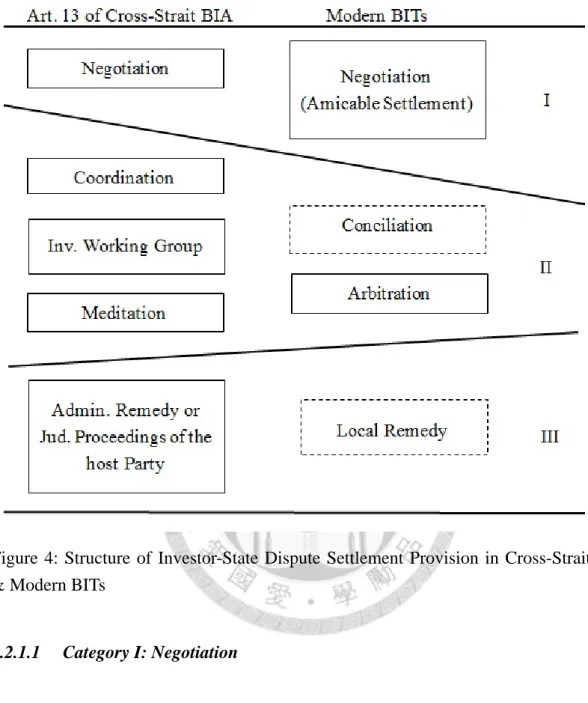
Figure 4: Structure of Investor-State Dispute Settlement Provision in
Cross-Strait BIA & Modern BITs ... 116
Tables
Table 1: Statistic on Taiwan Investment in China 2000-2010 ... 17 Table 2: Statistics on Approved Investment from China ... 20 Table 3: Taiwanese-Investors-Involved Disputes Resolved with the Assistance of the SEF ... 23 Table 4: BITs between China and other States in Alphabetical Order ... 70 Table 5: Information on Individual Chiang-Chen Talk ... 80
1
CHAPTER 1 INTRODUCTION
The roots of modern treaty rules on foreign investment can be traced back to 1778 when the United States and France concluded their first commercial treaty. The early treaties addressed trade issues and contained rules requiring compensation in case of expropriation.1 The United States negotiated a series of agreements on Friendship, Commerce, and Navigation [hereinafter FCN] after 1919.2 After 1945, trade matters were regulated in separate treaties, and FCN treaties deals with more detail on foreign investment.3 State welcomes foreign investment for a variety of reasons. Foreign investment has been regarded as an engine of economic growth, a source of foreign currency income, a stimulator of the local economy, and a source of foreign skills, information and know-how.4 The first-ever Bilateral Investment Treaty (BIT)5 was entered into between Germany and Pakistan in1959 and this is the start of modern investment treaties.6 BITs are drafted to address a specific circumstance: that of an investor of one state locating assets in the territory of another state.7
1 RUDOLF DOLZER &CHRISTOPH SCHREUER,PRINCIPLES OF INTERNATIONAL INVESTMENT LAW 17 (2008).
2 Id.
3 Id.
4 SURYA P.SUBEDI,INTERNATIONAL INVESTMENT LAW:RECONCILING POLICY AND PRINCIPLE 83 (2008).
5 The use of bilateral investment treaties (BIT) and bilateral investment agreements (BIA) are both seen throughout the content, but BIT and BIA are identical instruments that engage two parties in respect to bilateral investment. Reference to BIT or BIA is because of the title of the instrument, e.g. Cross-Strait Investment Protection and Promotion Agreement is referred to as” Cross-Strait BIA” in short.
6 See DOLZER &SCHREUER,supra note1, at 18.
7 KENNETH J.VANDEVELDE,BILATERAL INVESTMENT TREATIES:HISTORY,POLICY, AND INTERPRETATION
1 (2009).
2
An investment agreement may cover four aspects. These four aspects are protection of investment, such as provisions on compensation for expropriation;
liberalization of investment, such as granting foreign investors a right to establish investment; promotion on investment, such as provisions on investment insurance;
regulation on investment, such as prohibiting its corrupt payments by investors.8
As the number of BITs across the world keeps inclining, the matter of dispute settlement under these BITs arouses concern. Talking about disputes settlement under BITs, dispute resolution provisions deal with two kinds of disputes: State-State disputes and Investor-State ones. Investor-State disputes arising under international investment treaties are not ordinary commercial disputes. Treaty-based Investor-State disputes are special: first, such disputes are not a matter of simple contract claims governed by contract law; second, at the heart of many Investor-State conflicts is a public policy question; third, due to the involvement of public policy issues, Investor-State disputes are political in nature and often become highly politicized; fourth, underlying the dispute is an intended long-term investment relationship, and that is a complex connection; fifth, the amounts of money at stake in the dispute are large.9
Cross-Strait relationship has been an intense yet close one mainly due to political
8 Id. at 5.
9 See Jeswald W. Salacuse, Is there A Better Way? Alternative Methods of Treaty-Based, Investor-State Dispute Resolution, 31(1) FORDHAM INT’L L.J. 138,140 (2007).
3
concern. In August 2012, People’s Republic of China [hereinafter China] and Republic of China [hereinafter Taiwan] signed the Cross-Strait Bilateral Investment Protection and Promotion Agreement [hereinafter “Cross-Strait BIA” or “the Agreement”], and this is one of the fruitful result owing to years of negotiation. In order to effect negotiations with China on operational issues without compromising the government’s position on denying the other side’s legitimacy, the Taiwan government created the “Straits Exchange Foundation” (SEF), a nominally non-governmental institution directly led by China Affairs Council, an instrument of the Executive Yuan. The China responded to this initiative by setting up the “Association for Relations Across the Taiwan Straits”
(ARATS), directly led by the Taiwan Affairs Office of the State Council. The existence of SEF and ARATS allows both China and Taiwan to engage with each other on a semi-official basis without compromising their respective sovereignty policies.
Deregulated control over foreign exchange led to a rapid increase in outward investment by Taiwan’s enterprises. Problems engendered by increased contact necessitated a mechanism for regular negotiations.
Cross-Strait BIA is unique not only because the special characteristic embedded, but also the differences marked with other BITs. These special characteristic and differences include containing a personal safety clause, and regarding to disputes settlement mechanism, not only does the Agreement cover State-State dispute
4
settlement clause and Investor-State dispute settlement one, disputes between investors and juridical person or other institutions of the other Party (Investment-related Commercial Disputes) are also included.
The author focuses on the Investor-State dispute settlement clause under Cross-Strait BIA (Art. 13) and aims to enhance the operation. To achieve this goal, the author first draws attention on Investor-State dispute settlement provisions in modern BITs, as well as cross-strait practices, so as to have well-rounded idea on what shall be embedded in Investor-State dispute settlement provisions. The author finds that in comparison to Investor-State dispute settlement provisions contained in modern BITs, Art. 13 offers not a channel that involves a neutral third party and has binding effect, and this is also the part that does not meet the public’s expectation.
With knowledge to Investor-State disputes settlement provisions in modern BITs and cross-strait practices, the author makes analysis and interpretation on Art. 13, and furthermore pinpointing the possible obstacles and problems Parties may encounter in applying the clause. First of all, the current Investor-State dispute settlement clause the Agreement possesses five channels in resolving investment disputes but none of them has binding natures. Without binding effect, the possibility of not enforcing the decision is high if parties are not satisfied with the result. Second, unlike neutral-third-party involvement, there is no position for such a role in Art. 13. Lack of neutral third party
5
may thus give doubt to parties in the existence of bias. Third, there is ambiguity in Art.
13 wording. With the ambiguity, it leaves room for multiple interpretations and later on affects the application of this clause.
Bilateral investment has been ongoing for a long time. In drafting Cross-Strait BIA, past experiences are taken into account. Lessons from these experiences shall not be neglected, and whatever difficulties Taiwanese investors encountered prior to the signatory to the Agreement must be bear in mind and the author tries of find a way out via Art. 13. One limitation of the thesis is not due to the accessibility to information; the author is looking at this Investor-State dispute settlement clause from Taiwanese investor’s perspective. However, the ultimate goal is to achieve what the Preamble says,
. . . protect the rights and interests of investors across the Taiwan Straits,
promote mutual investments, create an impartial investment environment,
and enhance cross-strait economic prosperity . . .
6
CHAPTER 2 BACKGROUND OF CROSS-STRAIT
INVESTMENT AND THE CONCLUSION OF CROSS-STRAIT BIA
Foreign direct investment [hereinafter FDI], portfolio investment, and other in direct investment are the three forms of foreign investment in China.10 Amongst the three, FDI is main way of investment in China. Purchasing real estate, building factories, hiring employees and producing products through FDI can equipped the local with manufacturing techniques and managing skills. This can do good to local economic development and employment situation, and therefore FDI is welcomes by all countries.
In this Chapter, the author first puts forth situation on cross-strait bilateral investment in the past (2.1). Then, difficulties and disputes related to the foresaid investment and ways of resolving these disputes are highlighted (2.2). Resolving disputes remains a problematic issue despite the existence of current dispute settlement channels. A mechanism that works both way (Taiwanese investors with China or Chinese investors with Taiwan) to settle these disputes is called for. With the need for a systemic mechanism to settle investment disputes, also comprehensive provisions to regulate investment-related issues between the cross-strait, Cross-Strait BIA was born (2.3).
10 See Qing Chen, Introduction to China’s Investment Regulations [Da Lu Tou Zi Fa Ling Gai Yao], http://www.dkcpa.com.tw/data/030808.htm (last visited Feb. 6, 2013).
7
2.1 Cross-Strait Economic and Investment Relations
A reform and Open-Door policy was enacted in 1797 by Deng Xiaoping. As a result of this policy, China began to open its door to the world and changes have been made. In 1987, the Taiwan government lifted Martial Law and began to allow visits to China. Deregulated control over foreign exchange led to a rapid increase in outward investment by Taiwan’s enterprises.
After economic developments for over twenty years, China, including the Government of the Hong Kong Special Administrative Region of the China (Hong Kong), China has become11 not only the largest trade partner of Taiwan with the amount of US$127.55 billion in 2011 accounting for 21.6% of the total amount,12 but also the largest source of trade surplus of Taiwan where Taiwan enjoyed a US$40,36 billion trade surplus with China in 2011 (compared to US$26.81 billion with that of the world). Furthermore, China is also the largest export market of Taiwan, as in 2011exports to China amounted to US$83,95 billion equal to 27.2% of the total; second largest source of imports of Taiwan. In respect to investment, China is the largest Target country for investment. As accumulated to October 2012, Taiwan’s investment in China reached US$ 121,94 billion.
11 Bureau of Foreign Trade, R.O.C., Statistic on Import and Export of R.O.C., http://cus93.trade.gov.tw/fsci/ (last visited Feb. 3, 2013).
12 The total amount of trade in 2011 is US$589.68 billion.
8
China and Taiwan are closely related in terms of trade and geographical status.
Despite the intensive relationship owing to the political status, there is no doubt as to how close China and Taiwan are in all the other aspects as we can see in the above presented numbers.
2.1.1 The Positions of China and Taiwan on Foreign Direct Investment
As mentioned above, both China and Taiwan did not give an open-armed-welcome to foreign trade. With the rapid growth of global economy, breaking down the wall that avoided or prevented influence and impact from an international community and economic environment became a necessity.
2.1.1.1 China’s Changing Attitude Towards Foreign Investment
“China’s rise as an economic player is causing significant power shifts in the world economy.”13 Since the adoption of Open-Door policy in 1978, China has experienced decades of economic reform. Changing the domestic industrial structure and increasing the degree of integration of her economy businesses into the global economy are the goals for the reform.14 China has isolated herself from the international community, as
13 Axel Berger, The Politics of China’s Investment Treaty-Making Program, in THE POLITICS OF
INTERNATIONAL ECONOMIC LAW 162, 162 (Busch eds., 2011).
14 Hinrich Voss, Peter J. Buckley & Adam R. Cross, Thirty Years of Chinese Outward Foreign Direct Investment, at 1, presented at CEA (UK) Conference: Three Decades of Economic Reform (1978-2008) (Apr. 1-2, 2008).
9
well as global economic and political influence due to the protectionist attitude she held prior to 1979.15 Before the Open-Door policy, China’s foreign policy emphasized the sovereignty of States over natural resources and denied any substantial protection of foreign investment under law.16
In the first stage of China’s BIT Policy (1949-1981), China displayed a hostile approach towards foreign investors. 17 Characteristic of China’s policy was well-explained by “Five Principles of Peaceful Co-Existence,”18 of which is consisted of “mutual respect for each other’s sovereignties and territorial integrity, mutual non-aggression, non-interference in each other’s internal affairs, equality and mutual benefit, and peaceful coexistence.”19 The announcement of Open-Door policy was in line with China’s eagerness to “attract foreign investment in order to boost her economic, social and technological progress.”20 The “Five Principles of Peaceful Co-Existence” led to a policy that emphasized the sovereign right to control the entry of FDI, regulate foreign investors and nationalize foreign property without the obligation
15 See Stephan W. Schill, Tearing Down the Great Wall – The New Generation Investment Treaties of the People’s Republic of China, at 3 (bepress Legal Series, Working Paper 1928, Jan. 9, 2007), available at http://law.bepress.com/expresso/eps/1928 (last visited Feb. 3, 2013).
16 See Qingjuang Kong, Bilateral Investment Treaties: The Chinese Approach and Practice, 8ASIAN YB. INT’L L.105, 107 (1998/1999).
17 Axel Berger, China and the Global Governance of Foreign Direct Investment: The Emerging Liberal Bilateral Investment Treaty Approach (German Development Institute, Discussion Paper 10/2008) (2008), at 20, available at
http://www.die-gdi.de/CMS-Homepage/openwebcms3.nsf/(ynDK_contentByKey)/ANES-7FXHY6/$FIL E/DP%2010.2008.pdf (last visited Feb. 3, 2013).
18 Consulate-General of the People’s Republic of China in Houston, The Five Principles of Peaceful Co-existence (June 28, 2004), http://houston.china-consulate.org/eng/nv/t140964.htm (last visited Feb. 3, 2013).
19 Kong, supra note 16, at 109.
20 Schill, supra note 15, at 4.
10
to compensation.21 The first stage ended with signing the first BIT with Sweden in 1982.
With gradual opening up of the Chinese economy after 1979, the second stage of China’s BIT practice (1982-1998) sets in.22 China’s foreign policy was altered from the
“Five Principles of Peaceful Co-Existence” to “Three Guiding Principles”23 on international economic cooperation and exchange. The “Three Guiding Principles” was new to China. By adopting and making reference to international practice, it showed China’s willingness to engage herself with international economic community was set forth.24 The second stage was characterized by changing attitude towards international investment policy-making and support for a cautious legal protection of FDI.25 BITs signed by China up until 1998 have reservation towards substantive and procedural protection of foreign investment.26 One incident worth mentioned is that in this second state, China signed the Convention of the International Centre for Settlement of Investment Dispute [hereinafter ICSID Convention]
21 Berger, supra note 17, at 20.
22 Berger, supra note 17, at 21.
23 These three principles are principle of sovereignty, principle of equality and mutual benefit, and principle of reference to international practice. “Three Guiding Principles” was a copy of the “Five Principles of Peaceful Co-existence” in terms of context. The principle is of reference to international practice, where “international practice refers to:
(1) Widely accepted and workable practice with respect to the business activities of companies and the economic administration of the government,
(2) Generally recognized principles and rules governing inter-state relations” (quoted from Kong, supra note 16, at 110.).
24 Kong, supra note 16, at 10.
25 Berger, supra note 17, at 21.
26 See Berger, supra note 17, at 21.
11
BITs signed in the third stage are different from the ones signed in the second stage, and this will be discussed in detail in the next Chapter. In this stage, China is acting like a capital-exporting country and she tries to increase the protection on investors and investor within her territory.27 For decades, China has been receiving large inflows of foreign investment in export oriented industries, and therefore “been perceived as the workbench of the global economy.” Outward FDI glows started to grow in the first half of the 1900s.28 In 2010, China’s outward FDI reached US$68.81 billion, which stood a 21.7% increase compared to 2009.29
2.1.1.2 Taiwan’s Attitude Towards Foreign Direct Investment
As early as late 1950s, Taiwan made a shift in FDI policy.30 In 1960s, three major reforms were announced: the promulgation of the Statue for the Encouragement of Investment introduced FDI and encouraged domestic investment, the unification of the multiple exchange rate, and the amendment to the tariff rebate system initiated in 1955
27 Berger, supra note 17, at 21.
28 See Axel Berger, China’s New Bilateral Investment Treaty Programme: Substance, Rational and Implications for International Investment Law Making, presented at The Political of International Economic Law: The Nest Four Years, Washington, D.C. (Nov. 14-15, 2008), available at
www.asil.org/files/ielconferencepapers/berger.pdf (last visited Feb. 3, 2013).
29 2012 Statistical Bulletin of China’s Outward Foreign Direct Investment, at 1,
http://hzs.mofcom.gov.cn/accessory/201109/1316069658609.pdf (last visited Jan. 31, 2013).
30 Satoru Okuda, Taiwan’s Trade and FDI Policies and Their Effect on Productivity Growth, 32(4) DEV.
OF ECON. (INST. OF DEV.ECON.,JAPAN EXTERNAL TRADE ORG.) 423, 424 (1994), available at
http://ir.ide.go.jp/dspace/bitstream/2344/242/1/ARRIDE_DE_Vol32%284%29_1994.04.04_okuda.pdf (last visited Jan. 31, 2013).
12
for the purpose of further promote exports.31 Amending the Statute for the Encouragement of Investment was done in 1970; meanwhile, curtailed support for labor-intensive investment and instead promoted investment in export-oriented firms was the modified investment policy presented by the government.32
Running large and sustained trade surplus generated substantial foreign reserves, beginning in the early 1980s in Taiwan. Taiwan was under increasing external pressure to liberalize its economy, where restriction on inflows of FDI is particularly mentioned.
Apart from external pressure, the internal voice is increasingly calling for economic and political liberation. Removing previous restrictions on FDI in reserved sectors was one of the liberation processes. Taiwanese firms started to make substantial direct investment in Southeast Asian in 1980 and in China in 1991. These firms faced terrible conditions in domestic investment environment since the late 1980s.33
As engagement in the global economy and trade became deeper, policies on inflow and outward FDI change to a more-welcoming tendency. Started from mid 1990s, Taiwanese firms increased their foreign investment to exploit their assets, e.g. patents, other technological assets, skills in production, marketing, and advertising.34 Taiwan introduced a series of tax benefits for foreign investors and began to support export
31 Id.
32 Okuda, supra note 30, at 425.
33 Chen-Min Hsu & Wan-Chun Liu, The Role of Taiwanese Foreign Direct Investment in China:
Economic Integration or Hollowing-Out?, 5(2)J.KOR.ECON 207, 210 (2004), available at
http://homepage.ntu.edu.tw/~ntuperc/docs/publication/2004_11_Hsu.pdf (last visited Jan. 30, 2013).
34 Id. at 210.
13
processing zones, under these circumstances, inward FDI in Taiwan has risen steadily since the early 1950s.35 In terms of sectoral and industrial distribution, inward FDI in Taiwan has been concentrated in manufacturing and in finance and insurance.36
In July 2012, the UN Conference on Trade and Development (UNCTAD) issued the 2012 World Investment Report. The report revealed that FDI inflows into Taiwan amounted to US$1.96 billion in 2011. This figure was the worst among East and Southeast Asian countries, and put Taiwan in the second-lowest place worldwide, only ranking above Angola.37 From January to October, 2012, approved foreign direct investment in Taiwan totaled US$3.62 billion, which represented a 20.59% increase in comparison to the same period in 2010. The top three nations and territories to invest in Taiwan were the British Caribbean Territories,38 the U.S. and Singapore, which respectively injected US$872 million, US$555 million and US$425 million into the local economy.39 The three most popular investment targets, accounting for 58.32 percent of all FDI, were the financial and insurance industry, electronics parts manufacturers, and wholesale and retail suppliers, said Investment Commission,
35 Victor Zitian Chen, Ming-Sung Kao & Anthony Kuo, Inward FDI in Taiwan and Its Policy Context (2012), at 2, available at http://ssrn.com/abstract=2029168 (last visited Jan. 27, 2013).
36 Id. at 3.
37 Eric Chou, Editorial: Role of FDI Requires Examination, TAIPEI TIME (Aug. 4, 2012), available at http://www.taipeitimes.com/News/editorials/archives/2012/08/04/2003539384 (last visited Jan. 29, 2013).
38 Many multinational corporations are registered in the British Caribbean Territories because the countries within it tend to offer very competitive business tax rates.
39 Aaron Hsu, Foreign Direct Investment in Taiwan Climbs 20.59 Percent (Nov. 22, 2011), http://www.taiwantoday.tw/ct.asp?xItem=180877&ctNode=445 (last visited Jan. 31, 2013).
14
Ministry of Economy Affairs (MOEA), R.O.C.40
2.1.2 Bilateral Investment Across the Taiwan Strait
The type of investment are divided into four types, namely market expansion, technology acquirement, cost saving and others.41 While market expansion and technology acquirement are expansive investing elements, cost savings are classified as defensive investment elements.42
2.1.2.1 Taiwan’s Investment in China
The main type of investment in China is manufacturing investment, and these are conducted in southern China.43 This kind of investment forms a new pattern of FDI comparing to common ones. The new pattern is characterized by investors who are not vertically integrated giant transnational corporations. Instead, they are mostly small- and medium-sized, independent manufacturing firms.44
Investment in China appears to be attractive with her investment potential for foreign investors. “The obvious magnitude of the Chinese market has proven to be
40 Id.
41 Hsu & Liu, supra note 33, at 221.
42 Id.
43 Investment Commission, MOEA, Report on Analyzing the Effects on Cross-Strait Trade and Investment, http://www.moeaic.gov.tw/system_external/ctlr?PRO=DownloadFile&t=4&id=79 (last visited Jan. 30, 2013).
44 Hsu & Liu, supra note 33, at 210.
15
extremely enticing to foreign investors, who have vigorously pursued the potential for accessing China’s domestic market since the commencement of reform in 1979.”45
Outbound investment in Taiwan began in 1959. As early as the late 1980s, shift of Taiwanese manufacturing operations firms from Taiwan to Asia started.46 Foreign exchange controls on capital account transactions were lifted in 1987, but restriction on investment outflow to China still existed.47 As a result, investment from Taiwan to China was little; on the other hand, indirect Taiwanese investment in China grew bigger.
Reasons for Taiwanese investors to invest in China are common in language, culture affinity,48 geographical closeness, cost-effective labor, and cost of land. Preferential regulations49 are announced to encourage Taiwanese investors’ investment in China.
With the enforcement of “Act Governing Relations Between Peoples of the Taiwan
Area and China Area,”50 investment in China is legally permitted once firms are
45 See SHIZHONG DONG,DANIAN ZHANG &MILTON R.LARSON, Foreign Investment in China: Law and Practice, in TRADE AND INVESTMENT OPPORTUNITIES IN CHINA: THE CURRENT COMMERCIAL AND LEGAL
FRAMEWORK 147, 148 (1992).
46 See DANIAL H.ROSEN &ZHI WANG,China-Taiwan Economic Relations, in THE IMPLICATIONS OF
CHINA-TAIWAN ECONOMIC LIBERALIZATION 5,27(2011), available at
http://www.piie.com/publications/chapters_preview/5010/01iie5010.pdf (last visited Jan. 31, 2012).
47 Id.
48 Robert Read, Foreign Direct Investment & the Growth of Taiwan and Korea, presented at the IBRG FDI: Country Case Studies Conference (Sept. 13-14, 2002), at 10.
49 The only law enacted was Protection on Taiwan Compatriot Investment Law of P.R.C. in 1994. As for administrative regulations, they are announced by State Council of the People's Republic of China:
(1) Preferential Treatment Regulation on Taiwan Compatriot Investment in Special Economic Zone, 1983;
(2) Regulations on Encouraging Taiwan Compatriot’s Investment, 1988;
(3) Notification on Problems Concerning “Regulations on Encouraging Taiwan Compatriot’s Investment,” 1988;
(4) Decision on Further Development in Cross-Strait Economic Relations, 1999.
50 “Act Governing Relations Between Peoples of the Taiwan Area and China Area” was promulgated on July 31, 1992. Full text of this Act, available at
http://law.moj.gov.tw/Eng/LawClass/LawAll.aspx?PCode=Q0010001 (last visited Dec. 2, 2012).
16
registered and have obtained approval from the Ministry of Economic Affairs, R.O.C.
(MOEA). China has experienced grounding inflows of direct investment from Taiwan since late 1980s; however formal statistics on investment in China was not compiled until 1991. In 1991, Taiwan’s FDI in China was US$174 million. In 1993, the number jumped to almost US$3.2 billion, taking 66% of Taiwan’s total FDI in that year.51
Taiwanese investment in China mostly focuses on coastal area, such as Jiangsu Sheng, Jejiang Sheng, Fujian Sheng, Guangdung Sheng and Hebei Sheng.52,53 Amongst these provinces, investment in Jiangsu Sheng trumps all other for nine consecutive years.54 As of 2012, Taiwan’s investment in China for the first eight months totaled US$7.19 billion, a drop of 25% from the same period last year, according to statistics released by the Investment Commission, MOEA. The total cases approved for Taiwanese investment in China dropped by 28.7% for the same period to 291 cases.55
51 See Chen-Yuan Tung, The Impact on Taiwan, in THE GLOBALIZATION OF THE CHINESE ECONOMY 202, 203 (Shang-Jin Wei et al., 2004).
52 These are four of the provinces within the territory of China a d “Sheng” is province in Mandarin.
53 Overseas Chinese Affairs Council,R.O.C., Overview on Taiwan Investment in Foreign Countries [Tai Wan Hai Nei Wai Tou Zi Gai Kuang], http://www.ocac.gov.tw/dep3/profile/america_93/html/003_6.htm (last visited Jan. 29, 2013).
54 See Scale of Taiwanese Investment in Jiang-su-sheng Ranks First Among All the Provinces in China for Nine Years [Jiang Su Tai Shang Tou Zi Gui Mo Lian Xu Jiu Nian Wei Ju Da Lu Ge Sheng Shi Zhi Shou], CHINA NEWS, Nov. 26, 2012, http://www.chinanews.com/tw/2012/11-26/4359660.shtml (last visited Jan. 31, 2013).
55 See Taiwan-to-China Investment Drops 25% in First Eight Months of Year, WANT CHINA TIMES,Sept.
22, 2012, http://www.wantchinatimes.com/news-subclass-cnt.aspx?id=20120922000003&cid=1102 (last visited Jan. 29, 2013).
17
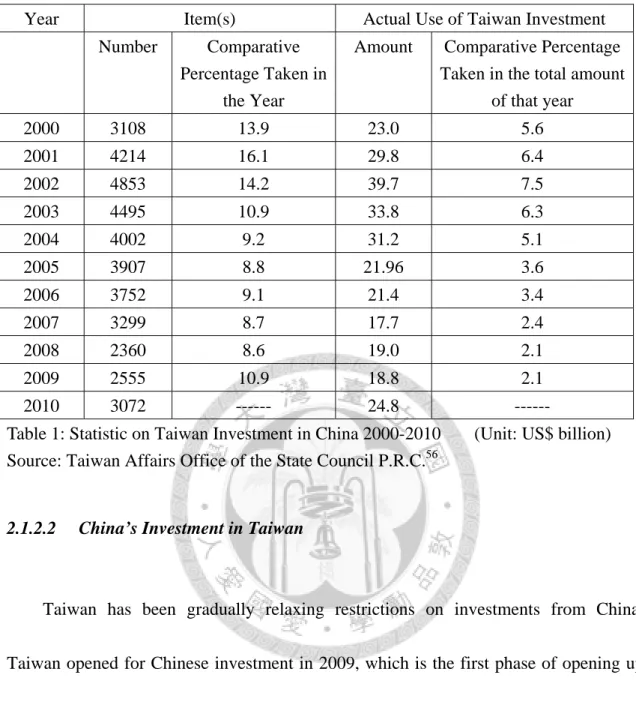
Year Item(s) Actual Use of Taiwan Investment
Number Comparative Percentage Taken in
the Year
Amount Comparative Percentage Taken in the total amount
of that year
2000 3108 13.9 23.0 5.6
2001 4214 16.1 29.8 6.4
2002 4853 14.2 39.7 7.5
2003 4495 10.9 33.8 6.3
2004 4002 9.2 31.2 5.1
2005 3907 8.8 21.96 3.6
2006 3752 9.1 21.4 3.4
2007 3299 8.7 17.7 2.4
2008 2360 8.6 19.0 2.1
2009 2555 10.9 18.8 2.1
2010 3072 --- 24.8 ---
Table 1: Statistic on Taiwan Investment in China 2000-2010 (Unit: US$ billion) Source: Taiwan Affairs Office of the State Council P.R.C.56
2.1.2.2 China’s Investment in Taiwan
Taiwan has been gradually relaxing restrictions on investments from China.
Taiwan opened for Chinese investment in 2009, which is the first phase of opening up to Chinese Investment and it amounted to 192 items.57 Not until June 30, 2009 was inflows FDI from China on business investment allowed by establishing subsidiary companies, branches or offices.58 On the same date, “Measures Governing the
56 Statistic on Taiwanese Investment in China (2000-2009),
http://www.chinataiwan.org/twzlk/twjj/gk/201005/t20100521_1382073.htm (last visited Dec. 29, 2012).
57 See Council for Econ. Plan. & Dev. (CEPD), Taiwan Opens 192 Items to Mainland Chinese Investment, TAIWAN NEW ECONOMY NEWSLETTER No. 103 (Aug. 13, 2009),
http://www.cepd.gov.tw/encontent/m1.aspx?sNo=0012159 (last visited Jan 5, 2013). Under this new policy, Taiwan opened 64 sectors in manufacturing, 117 in services and 11 in public construction
58 Jin-yu Tan, Suggestions on Expanding Inflow FDI From China Strategies [Kuo Da Lu Chi Lai Tai Tou Zi Zhi Ce Lue Jian Yi], http://www.npf.org.tw/post/2/8200 (last visited Dec. 29, 2012).
18
Permission of Investment by Nationals in Mainland Area” was implemented.59 As Taiwan has become more and more open-minded on investment from China, the accumulated approved investment cases from China and the amount are in a rise. And this can be shown by the gradual releasing restriction on in-bound investment from China on the end of China.
In opening up for investment from China, the MOEA points out that investment from China is being opened up under the precondition that it does not adversely affect domestic industries. The items that are opened to this investment have all undergone careful evaluation and are implemented step by step.60 After the 192 items opening-up, the second phase took place in March 2011. This time a total of another 42 items opened up to investment from China.61 The third phase set in in March 2012, where a total of 261 items were opened to China’s investment.62 As for the fourth phase, it is now under discussion and debate as to how wide and to what extend should investment in China be allowed. Minister of Economic Affairs announced the government’s
59 Full text is available at http://www.moeaic.gov.tw/system_external/ctlr?PRO=LawsLoad&id=64 (last visited Dec. 7, 2012) (in Chinese); translation in English is available at
http://61.60.74.130/system_external/ctlr?PRO=LawsLoad&lang=1&id=70 (last visited Dec. 2, 2012).
60 See Investment Commission, MOEA, Allowing Investment from China, Putting Bilateral Investment in Practice: Complementary and Mutual Benefit [Kai Fang Lu Zi Lai Tai, Shi Xian Liang An Shuang Xiang Tou Zi You Shi Hu Bu & Hu Li Shuang Ying],
http://www.moeaic.gov.tw/system_external/ctlr?PRO=NewsLoad&id=648 (last visited Jan. 4, 2013).
61 See Investment Commission, MOEA, News: Investment Items Opened in Second Phase [Di Er Jie Duan Kai Fang Lu Zi Lai Tai Tou Zi Ye Bie Xiang Mu] (Mar. 2, 2011),
http://www.moeaic.gov.tw/system_external/ctlr?PRO=NewsLoad&id=756 (last visited Jan. 7, 2013).
62 See Investment Commission, MOEA, News: Investment Items Opened in Third Phase [Di San Jie Duan Kai Fang Lu Zi Lai Tai Tou Zi Ye Bie Xiang Mu] (Mar. 20, 2012),
http://www.moeaic.gov.tw/system_external/ctlr?PRO=NewsLoad&id=853 (last visited Jan. 7, 2013).
19
intention to allow Chinese investors to participate in 161 kinds of businesses.63 However, one concern would be national security, thus the Taiwanese government will be looking into its core infrastructure to decide which areas to restrict Chinese investments after a top official from the National Security Bureau called for additional scrutiny on such deals.64
China invested US$38.28 million in Taiwan between January and October 2012, a 57% decline compared to 2010.65,66 The first eight months of 2012, Chinese investment cases in Taiwan worth a total of US$135.54 million were approved for the period, a jump of almost 331% from that of the previous year.67 Until September 2012, China has invested more than US$311 million in Taiwan. The significant increase in investment from China was due the Bank of China and the Bank of Communications upgrading into branches in January 2012. And this resulted in investment totaling US$91.5 million.68
63 Taiwan: More Mainland Chinese Investment to Be Permitted (Mar. 22, 2013),
http://www.loc.gov/lawweb/servlet/lloc_news?disp3_l205403044_text (last visited Jan. 7, 2013).
64 Rich Chang, Bar Chinese firms from Security Telecoms: NSB, TAIPEI TIMES (Oct. 23, 2013), http://www.taipeitimes.com/News/taiwan/archives/2012/10/23/2003545888 (last visited Jan. 7, 2013).
65 Hsu, supra note 39.
66 By contrast, Taiwanese companies invested a total of US$11.16 billion in China in the first ten months of the 2011, which is a 25.16% increase compared to the same period in 2010. In Jan. 2013, the fourth phase of opening-up is under furious debate.
67 Comparatively, as for Taiwan’s investment in foreign markets, a total of US$6.8 billion was approved for the period, a jump of 258% from the same period last year, according to the commission.
68 WANT CHINA TIMES, supra note 55.
20
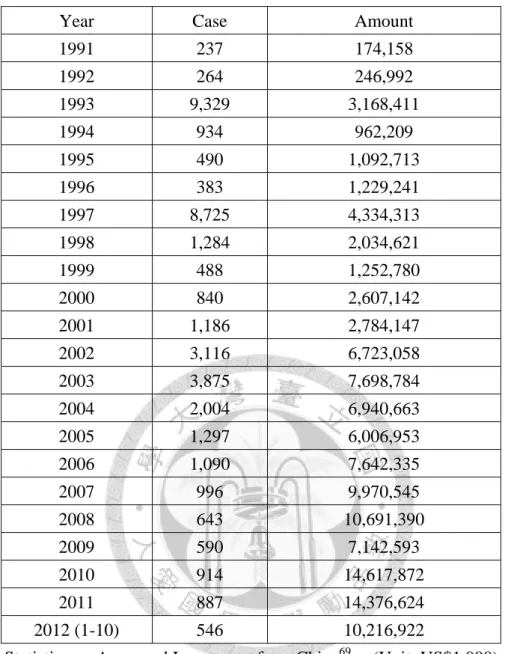
Year Case Amount
1991 237 174,158
1992 264 246,992
1993 9,329 3,168,411
1994 934 962,209
1995 490 1,092,713
1996 383 1,229,241
1997 8,725 4,334,313
1998 1,284 2,034,621
1999 488 1,252,780
2000 840 2,607,142
2001 1,186 2,784,147
2002 3,116 6,723,058
2003 3,875 7,698,784
2004 2,004 6,940,663
2005 1,297 6,006,953
2006 1,090 7,642,335
2007 996 9,970,545
2008 643 10,691,390
2009 590 7,142,593
2010 914 14,617,872
2011 887 14,376,624
2012 (1-10) 546 10,216,922
Table 2: Statistics on Approved Investment from China69 (Unit: US$1,000) Source: Investment Commission, MOEA
2.2 Problems Encountered and Solutions to Disputes
Before the conclusion of the Agreement, there are problems Taiwanese investors encountered. Reasons for the foresaid problems vary. In this Section, the author discusses what difficulties Taiwanese investors face, what kinds of disputes were
69 The statistic can be downloaded via
http://www.moeaic.gov.tw/system_external/ctlr?PRO=PublicationLoad&id=125 (last visited Dec. 2, 2012).
21
brought up between cross-strait investment (mainly the ones Taiwanese investors encountered), and what are the prior-to-the-Agreement solutions to these disputes.
2.2.1 Difficulties and Disputes Taiwanese Investors Faced
Investment dispute took place roughly every other day (as seen in Table 3 below), and the number does not include disputes that are settled without the assistance of the SEF. With the high profile of such investment disputes arising concerning Taiwanese investors, several problematic issues deserve more attention:70
First thing being Taiwanese investors do not find themselves familiar with China’s relevant economic and investment laws or regulations, and they lack of understanding toward China’s law in common.
Second issue is related to Taiwanese investors’ knowledge to China’s laws and regulation in settling investment disputes. Taiwanese investors have no efficient path of understanding China’s relevant economic and investment laws or regulations, and judicial remedies in China in advance. Even if they know going to courts is a way to settle disputes, Taiwanese investors don’t know how to resort to judicial remedies in China and they don’t have faith in the fairness of China’s judicial remedies. Once
70 Centre of Asian Studies, National Taipei University, Study on Disputes Concerning Taiwanese Investors and Their Way Out [Tai Shang Jiu Fen Yu Pai Chu Fang Shi Zhi Yan Jjiu] (authorized by the SEF) (Jan. 2011), available at http://www.ntpu.edu.tw/college/e10/files/research/20111230171303.pdf (last visited Jan. 7, 2012) [hereinafter Study by NTPU].
22
disputes aroused, Taiwanese investors turn to the SEF for assistance just to give it a try since unable to resolve the disputes would be the worst scenario. To them, it would be nice to settle disputes with the assistance of the SEF, but they don’t have the kind of determination to have the disputes settled, problems solved or to fight for their rights.
Another point is related to Taiwanese investors’ non-faith in China’s judicial system. That is current status of China’s laws and regulations are either not specific enough or not evolved as time goes by. Once they file before local courts, another problematic issue arises—Enforcement on laws in China is not effective enough. Also, with the prevailing of protectionism, rights of Taiwanese investors are not assured.
23
Types of Disputes Year
Personal Safety
Regarding Legal Interests on Property
Total Complaints by
Taiwanese Investors
Complaints by Chinese and Firms
1991 0 13 0 13
1992 2 23 0 25
1993 17 57 4 78
1994 30 40 4 74
1995 41 43 14 98
1996 36 25 9 70
1997 35 22 13 70
1998 64 48 15 127
1999 58 35 3 96
2000 51 31 1 83
2001 67 36 1 104
2002 91 43 1 135
2003 107 32 3 142
2004 124 27 3 154
2005 133 54 5 192
2006 197 85 8 290
2007 249 42 0 291
2008 312 221 9 542
2009 353 428 15 796
2010 328 368 5 701
2011 274 328 4 606
2012 267 419 14 700
Total 2836 2420 131 Sum
5387 Table 3: Taiwanese-Investors-Involved Disputes Resolved with the Assistance of the
SEF71
Source: Department of Economic Affairs, SEF
71 Statistic on Taiwanese-Investors-Involved Disputes Resolved with the Assistance of the SEF, http://www.sef.org.tw/lp.asp?CtNode=3728&CtUnit=2291&BaseDSD=7&mp=14 (last visited Feb. 6, 2013). The Statistic was conducted by Department of Economic Affairs, SEF on Jan. 2, 2013.
24
2.2.2 Type of Cross-Strait Investment Disputes
As seen in Table 3, types of disputes involving cross-strait investment include, but not limited to, disputes regarding personal safety and disputes regarding legal interests of property. In a study authorized by the SEF, investment disputes Taiwanese investors are categorized into six based on the causes and origins of these disputes.72 These disputes are of the six following concerns: contracts, intellectual property rights, labor-managements, taxation, land developments, and personal safety.
2.2.3 Channels for Resolving Investment Disputes
Despite the fact that Taiwanese investors are under the protection of P.R.C. laws and regulation,73 disputes arising from Taiwanese investors’ investment are not totally avoidable. Therefore, there is no key to the question of “how to resolve disputes of all kinds.” When looking at how such disputes are resolved, two provisions worth our attention. The author directs the individual provisions and also provides some information of the law and rule.
The first one would be Article 14 of “Law of the People’s Republic of China on the
72 Study by NTPU, supra note 70, 58-123. See also MOEA, 2010 Diagnosis on Management of Taiwanese Investors in China and Investment Disputes Cases [99 Nian Du Da Lu Tai Shang Jing Guan Jhen Duan Yu Tou Zih Jiou Fen An Li], at 96-181, available at
http://twbusiness.nat.gov.tw/files/201110/20111013-99.pdf (last visited Feb. 6, 2013).
73 Study by NTPU, supra note 70, at 24-48. How the current legal protections run is discussed in detail in Chapter Three.
25
Protection of Investment of Taiwan Compatriots.”74 By announcing and implementing
“Law of the People’s Republic of China on the Protection of Investment of Taiwan Compatriots,” China has level up the protection on Taiwanese Investors from order or regulation to the standard of law. However, this set of law has its deficiency on that protection on Taiwanese investors is not well-rounded and that the uncertainty in it resulted in local governments’ implementing their own laws.75 Dispute resolving channels mentioned under Art. 14 are consultation, mediation and arbitration, if provided in the contracts.
Second one is Article 28 of “Rules for Implementation of The Protection of Investments by Taiwan Compatriots.”76 This set of Rules contains more protections on
74 Law of the People’s Republic of China On the Protection of Investment of Taiwan Compatriots (adopted at the Sixth Meeting of the Standing Committee of the Eighth National People's Congress on Mar. 5, 1994, promulgated by Order No.20 of the President of the People's Republic of China the same date), full text available at http://www.pkykwong.com/eng/pdf/law_protection.pdf (last visited Dec. 8, 2012). Art. 14 states that
1. With respect to disputes over investment arising between investors who are Taiwan compatriots and companies, enterprises, other economic organizations or individuals in other provinces, autonomous regions or municipalities directly under the Central Government, the parties concerned may settle them through consultation or mediation.
2. Where the parties concerned are not willing to resort to consultation or mediation, or where consultation or mediation proves unsuccessful, they may, in accordance with the arbitration clause in the contract or the written arbitration agreement reached subsequently, submit the matter to an arbitration organ for arbitration.
3. Where there is no arbitration clause in the contract, and no written arbitration
agreement reached subsequently, the parties concerned may bring a suit to the people’s court.
75 Analysis on Cross-Strait BIA and Recommendations to Taiwanese Investors [Hai Xia Liang An Tou Zi Bao Zhang He Cu Jin Xie Yi Ping Xi Yu Dui Tai Shang De Jian Yi], http://www.npf.org.tw/post/2/11355 (last visited Feb. 5, 2013).
76 Rules for Implementation of The Protection of Investments by Taiwan Compatriots (promulgated on Dec. 5, 1999), full text available at http://www.asianlii.org/cn/legis/cen/laws/rfiotpoibtc825/ (last visited Dec. 8, 2012). Art. 28 sets out as followed,
Investors who are Taiwan compatriots, enterprises with investment by Taiwan compatriots, or associations of enterprises with investment by Taiwan compatriots, if believing that any specific administrative behavior of an administrative agency or work staff of an
administrative agency has infringed upon their lawful rights and interests, may apply for administrative reconsideration or institute administrative procedure in accordance with the
26
Taiwanese investors, such as broadening the scope of protection to indirect investment.
Though “Rules for Implementation of The Protection of Investments by Taiwan Compatriots” is meant to solve the problems in applying “Law of the People’s Republic of China on the Protection of Investment of Taiwan Compatriots,” provisions provide in this set of rules remain vague or unclear due to the absence of regulations concerning procedural matters.77 In regard to disputes arising concerning administrative behaviors, Art. 28 provides that investors may resort to administrative reconsideration or institute administrative procedure.
Options provided to Taiwanese investors, in accordance with the two foresaid provisions, are consultation, mediation, arbitration and civil litigation when it is disputes over investment between Taiwanese investors and other private sectors involved; when the dispute is between Taiwanese investors and administrative agencies, that’s when administrative reconsideration or institute administrative procedure apply.
provisions of relevant laws and administrative regulations of the State.
77 Analysis on Cross-Strait BIA and Recommendations to Taiwanese Investors, supra note 75.
27
Figure 1: Ways of resolving dispute in P.R.C. as provided under Chinese Law Source: Study on Disputes Concerning Taiwanese Investors and Their Way Out78
Through negation, which may take place either before or after parties’ resorting to judicial remedies or arbitration, parties to the dispute can exchange opinions directly. In practice, Taiwan affairs offices play the role as brokers.79 Similar with negotiation, the purpose of mediation is not seeking for absolute justice, but a resolution that is acceptable to both parties. To facilitate both negotiation and administrative mediation,80 China established the “Department of Complaints and Coordination” to deal with
crucial cases of Taiwanese investors’ complaints81 in July 2005.82 According to Article
78 Study by NTPU, supra note 70.
79 Id. at 50
80 Mediation, in the context of China, can be divided into five categories: mediation in court, mediation in arbitration, joint mediation, administrative mediation and civil mediation.
81 Office’s Structure of Taiwan Affairs Office of the State Council P.R.C.,
http://www.gwytb.gov.cn/en/Introduction/OfficesStructure/201103/t20110316_1789195.htm (last visited Feb. 6,2013).
28
14 of “Law of the People’s Republic of China on the Protection of Investment of Taiwan Compatriots,” arbitration and either consultation or mediation can applied solely or interchangeably. As to which arbitration institution to turn to, Taiwanese investors shall have the option to submit disputes to institutions outside China and Taiwan.83
As for judicial remedies,84 Taiwanese investors rarely resort to local courts in practice. And when it comes to circumstances that Taiwanese investors deem behaviors of administrative organs inappropriate and expropriation, Taiwanese investors often turn to local Taiwan affairs offices.85
2.3 Introduction to Cross-Strait BIA
Investment issue is of great concern for a long time to Taiwanese businessmen in China. Not having an agreement on investment has brought these businessmen difficulties in many aspects. Taiwan government has consistently advocated that the two sides should negotiate and sign such an agreement. With years of effort, the goal has finally been achieved on the Eighth Chiang-Chen Talk.
82 Study by NTPU, supra note 70, at 51.
83 There exists conflict on choices of arbitration institution in “Law of the People’s Republic of China on the Protection of Investment of Taiwan Compatriots” and “Rules for Implementation of The Protection of Investments by Taiwan Compatriots.” While the former states “arbitration organ,” the latter limits choices to that in China. However, given that the legal status of the former is higher than the latter, Taiwanese investors shall have to right to choose arbitration organs outside China. Id. 54.
84 Here, judicial remedies include court, administrative reconsideration and institute administrative procedure.
85 Study by NTPU, supra note 70, at 54-55.
29
2.3.1 Background and Signatory of Cross-Strait BIA
At as early as the first preparatory discussion for the Second Koo-Wang Talk in May 1995, Taiwan proposed that the two sides make this issue a priority for consultations; however, the handling of this matter was delayed. Institutionalized cross-strait negotiations resumed in June 2008. At the First Chiang-Chen Talk, Taiwan brought this issue back to the table and requested the initiating consultation on an investment protection agreement between the two sides. At the Fifth Chiang-Chen Talk.
The two sides agreed to prioritize Investment Protection Agreement among other follow-up agreements to the “Economic Cooperation Framework Agreement”
[hereinafter ECFA].86 The broad scope and complexity involved in the content of the Agreement has make the path to conclusion and signing of the Agreement harder, let alone the difficulties multiply with differences in terms of administrative systems. Due to these reasons, numerous rounds of discussion and talks have been held over the past years.
Joint Opinion of the SEF and the ARATS on Advancing Negotiations on the Cross-Strait Investment Protection Agreement was announced after the Seventh
86 In tradition, BIT is concluded between two States. Cross-Strait BIA is a follow-up agreement to ECFA, therefore different from BIT. However, for the convenience of discussion, the author deems Cross-Strait BIA as a separate agreement, instead of looking at the Agreement under a Free Trade Agreement (FTA).