
彌合或擴大鴻溝:亞歐會議在覺醒"認知區域主義"之角色(1996-2013) - 政大學術集成
334
0
0
全文
(2) Huong Le Thu. Doctoral Dissertation. TABLE OF CONTENT Title Page ……………………………………………………………………………………….1 Table of Content ………………………………………………………………………………..2 Acknowledgement ………………………………………………………………………………8 Abstract ………………………………………………………………………………………..11 PREFACE ………………………………………………………………………………………13 PART 1: RESEARCH DESIGN ……………………………………………………………….14 Chapter 1: INTRODUCTION …………………………………………………………………15 1.1. Summary of the research …………………………………………………………15. 政 治 大 1.1.2. Motivation of the study ……………………………………………….18 立. 1.1.1. Background of the problem and the research puzzle ………………….17 1.1.3. Contribution of the study ……………………………………………..21. ‧ 國. 學. 1.1.4. Organization of the dissertation ……………………………………..22 1.2. Literature Review ………………………………………………………………24. ‧. 1.2.1. Inter-regionalism …………………………………………………….24 1.2.2. The Five Functions of inter-regionalism from the mainstream International. y. Nat. sit. Relations approaches ……………………………………………………….26. al. er. io. 1.2.3. Old versus New: Typologies of inter-regionalism …………………..31. n. 1.2.4. Defining a region ……………………………………………………..34. Ch. i n U. v. 1.2.5. Issue of Actorness ………………………………………………………37. engchi. 1.2.6. ASEM as a manifestation of multilateralism ……………………………38 1.2.7. The socio-cultural dimension of the dialogue ……………………………40 1.2.8. Summary of existing literature ………………………………………….43 Chapter 2: Research Design ……………………………………………………………….. 47 2.1. Analytical Framework …………………………………………………………..47 2.1.1. Research Questions …………………………………………………….47 2.1.2. Working hypotheses ………………………………………………….49 2.2. Conceptual framework ……………………………………………………………53 2.2.1. Levels of analysis ………………………………………………………..53 Page 2 of 334.
(3) Huong Le Thu. Doctoral Dissertation. 2.2.2. Socializing as mimicking each other ………………………………55 2.2.3. Social environment of international organizations …………………59 2.2.4. Concepts of social constructivism …………………………………..61 2.2.5. Epistemic community as an effect of socializing …………………..63 2.2.6. Original contribution: The concept of “Cognitive regionalism”……66 2.3. Methodology …………………………………………………………………. 69 2.3.1. Methods applied ……………………………………………………..70 2.3.2. Organization of empirical data ……………………………………….72 2.3.3. Summary of interviewees profiles ……………………………………...77. 政 治 大 Chapter 3: HISTORICAL BACKGROUND OF THE PROCESS AND INSTITUTIONAL 立. PART TWO: DEVELOPMENT OF ASEM AND ASEAN…………………………………..81 ARRANGEMENT ……………………………………………………………………………82. ‧ 國. 學. 3.1. ASEAN then – contribution and expectations from ASEAN ………………….. 83 3.1.1. Intra-ASEAN development: ASEAN’s origin …………………………84. ‧. 3.1.2. Five phases of ASEAN evolution ………………………………………85 3.1.2.1. The formative phase ………………………………………….85. y. Nat. sit. 3.1.2.2. The second phase …………………………………………..87. al. er. io. 3.1.2.3. The third phase ……………………………………………. 88. n. 3.1.2.4. The fourth phase after the financial crisis …………………90. Ch. i n U. v. 3.1.2.5. The fifth period …………………………………………….92. engchi. 3.2. ASEAN-EU relations and the birth of Asia-Europe Meeting (ASEM) ………….93 3.2.1. ASEAN–EU relations before Karlsruhe Meeting (1970s and 1980s) ……93 3.2.2. Karlsruhe Meeting – the turning point of EU foreign policy towards Asia (1994-1996) ……………………………………………………………………97 3.2.3. The birth of ASEM (1996) ……………………………………………100 3.2.4. First phase of ASEM and its meaning to the ASEAN-EU relations …..104 3.2.5. Summary of Historical background …………………………………….107 3.3. Institutional design and working format of ASEAN ……………………………...109 3.3.1. Institutionalization of ASEAN ………………………………………...109 3.3.2. ASEAN norms and the ASEAN Way ………………………………..111 Page 3 of 334.
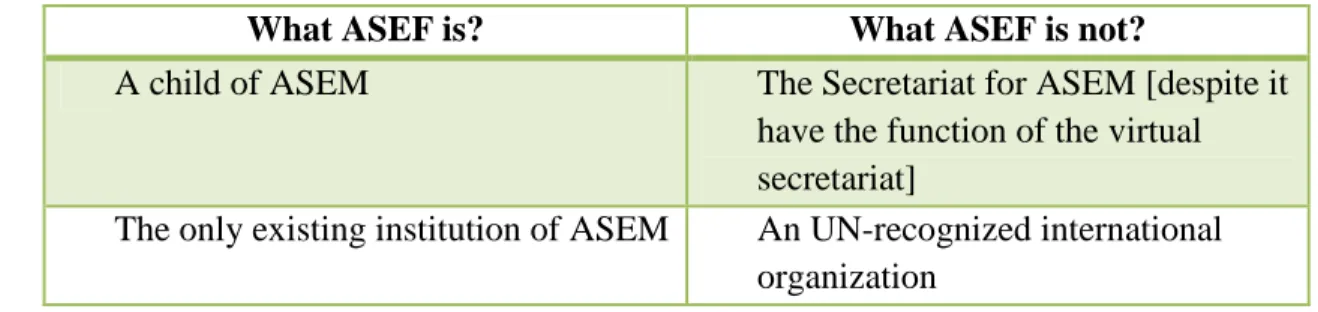
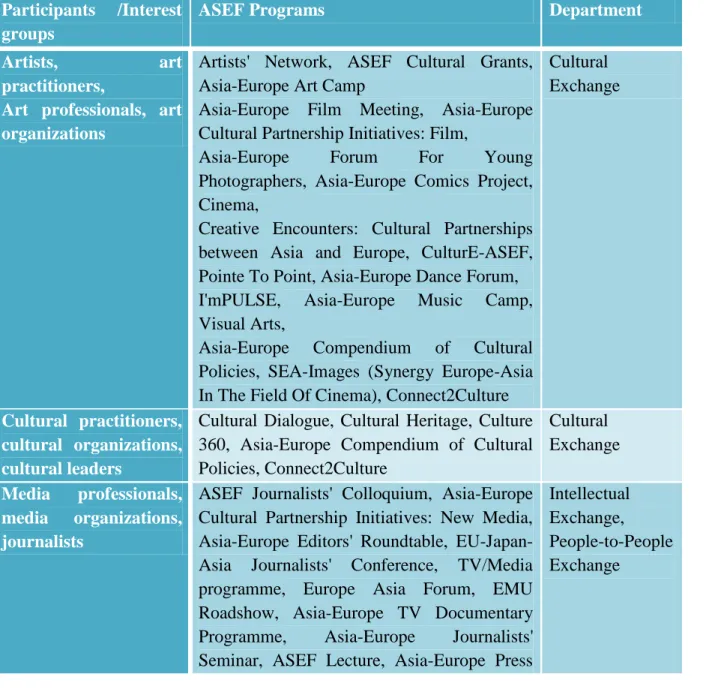
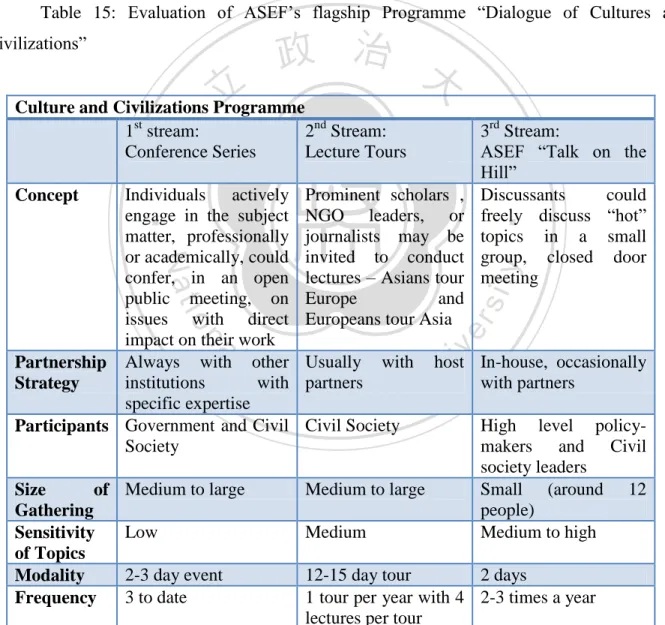
(4) Huong Le Thu. Doctoral Dissertation. 3.3.3. Meetings and format …………………………………………………….113 3.4. Institutional design and working format of ASEM ………………………………..116 3.4.1. Institutional arrangements of ASEM ……………………………………116 3.4.2. The three-pillar structure ……………………………………………….119 3.4.2.1. The Political Pillar …………………………………………….119 3.4.2.2. The Economic Pillar …………………………………………122 3.4.2.3. The Socio-Cultural Pillar ……………………………………123 3.3.3. Institutional management of ASEM …………………………………125 3.4. Summarizing the ASEAN and ASEM’s institutional characteristics ……………127. 政 治 大 4.1. Asia-Europe Meeting: the dialogue norms, values and modules of cooperation …131 立. Chapter 4: NORMS, VALUES AND IDENTITY- THE VALUE OF DIALOGUING ………130. 4.1.1. ASEAN Way versus European institutionalism ……………………….132. ‧ 國. 學. 4.1.2. Conflicting cooperation cultures ……………………………………135 4.1.3. Clashing over the human rights issues ……………………………..141. ‧. 4.1.4. Norms’ differences and the asymmetric relationship ………………146 4.1.5. East -West binary and the “Asian values” discourse ……………….147. y. Nat. sit. 4.2. Regions in the making – ASEM and regional identity formation …………….148. al. er. io. 4.2.1. Regionalism through inter-regionalism …………………………….151. n. 4.2.2. Collectiveness and its political meaning …………………………..154. Ch. i n U. v. 4.2.3. Identity as cultural representation …………………………………157. engchi. 4.2.4. Developing regional awareness through interaction ……………….161 4.2.5. Identity on the grassroots level ……………………………………165 4.2.6. Perceptions of “Asia” “Europe” …………………………………….167 4.3. Conclusion ……………………………………………………………………173. Chapter 5: THE VALUE -ADDED ASEM: THE ROLE OF THE ASIA -EUROPE FOUNDATION ………………………………………………………………………………..176 5.1. Cultural cooperation in the mandate of ASEM ………………………………...177 5.1.1. Policy tracing of cultural agenda in ASEM documents ………………..177 5.1.2. The Asia-Europe Foundation (ASEF) ………………………………….181 Page 4 of 334.
(5) Huong Le Thu. Doctoral Dissertation. 5.1.3. Phases of ASEF evolution …………………………………………184 5.1.4. ASEF’s ambiguous identity ……………………………………….187 5.2. The nebulous relationship between ASEM and ASEF ……………………….189 5.2.1. Contributions of ASEF to the ASEM process ………………………190 5.2.1.1. Pluralization of actors ……………………………………190 5.2.1.2. Inclusiveness of civil society …………………………….193 5.2.1.3. The value of cultural cooperation ………………………..196 5.2.1.4. Inter-regionalism through educational and intellectual exchanges ………………………………………………199 5.2.1.5. ASEF as an expert of Asia-Europe relations ……………….202. 政 治 大 5.2.2.1. Who needs whom more? …………………………………. 207 立. 5.2.2. ASEM recognition and endorsement of ASEF ……………………….205 5.3. Problems and limitations ………………………………………………………210. ‧ 國. 學. 5.3.1. Interests and funding: who cares, who doesn’t, and why? ……………211 5.3.2. Connecting but disconnected ………………………………………….214. ‧. 5.3.3. Visibility issues ………………………………………………………216 5.4. Conclusion ………………………………………………………………………...217. sit. y. Nat. al. er. io. PART THREE: CHANGING ASIA, CHANGING EUROPE …………………………….221. n. CHAPTER 6: CHANGE OF THE ACTORS, CHANGE OF THE BALANCE ……………222. Ch. i n U. v. 6. 1. The changing ASEAN …………………………………………………………223. engchi. 6.1.1. ASEAN and the 21st Century’s challenges …………………………..225 6.1.2. New agenda: The Charter, human rights and institutionalisation ……229 6.1.3. ASEAN and its “Way” as a socialization agent ………………………233 6.2. The changing ASEM ……………………………………………………………236 6.2.1. The issue of enlargement – ASEM’s identity crisis …………………..237 6.2.2. ASEM: a problem solving institution or a non-solving problematic institution? ………………………………………………………………………….242 6.2.3. Challenges for inter-regionalism ……………………………………...244 6.2.4. Change of interests: members’ commitments ………………………..248 6.2.5. Changes from “below” ……………………………………………….251 Page 5 of 334.
(6) Huong Le Thu. Doctoral Dissertation. 6.3. Change as an effect of socialization ………………………………………………253 6.3.1. The role of dialogue mechanism ………………………………………253 6.3.2. Functionality of ASEM process …………………………………….255 6.4. Conclusion ……………………………………………………………………259. CHAPTER 7: EVALUATNG THE ASEM PROCESS: EXPECTATIONS AND LIMITS OF THE ASEM NOW AND THEN ……………………………………………………………..261 7.1. Expectations ……………………………………………………………………..261 7.1.1. The rhetoric at inception …………………………………………….261 7.1.2. Expectations from Europe …………………………………………….262. 政 治 大 7.1.3. Expectations from ASEAN ……………………………………………..269 立. 7.1.2.1. ASEM as EU's external policy towards Asia …………………265. 7.1.3.1. ASEAN’s role in creating the ASEM …………………………269. ‧ 國. 學. 7.1.3.2. ASEAN’s duality towards ASEM …………………………….271. 7.2. Evaluation ……………………………………………………………………….272. ‧. 7.2.1. Utility of ASEM to the EU …………………………………………….272 7.2.2. What ASEM can offer to ASEAN? ……………………………………275. y. Nat. sit. 7.2.3. Convergence or divergence of expectations? …………………………277. al. er. io. 7.3. The values of ASEM process ……………………………………………………280. n. 7.3.1. The political values: Political symbolism …………………………….280. Ch. i n U. v. 7.3.2. The economic values: Tangible benefits ……………………………..282. engchi. 7.3.3. “Beyond hard reasoning: Where politics and economy do not reach …285 7.3.4. Contribution of the Asia-Europe Foundation ………………………….286 7.4. The remaining gap ………………………………………………………………288 7.4.1. Limits and their reasons ………………………………………………288 7.4.2. Diversity of perceptions ……………………………………………..292 7.4.3. The mismatching expectations ………………………………………294 7.4.4. Informality or indecision? …………………………………………….296 7.5. Conclusion ………………………………………………………………………299. Page 6 of 334.
(7) Huong Le Thu. Doctoral Dissertation. Chapter 8: CONCLUSIONS ……………………………………………………………….304 8.1. Tested hypotheses ………………………………………………………………304 8.2. Recommendations ……………………………………………………………….313 8.3. Summary …………………………………………………………………………315 BIBLIOGRAPHY …………………………………………………………………………….317 APENDIX …………………………………………………………………………………….329 LIST OF ABBREVIATIONS ……………………………………………………………… 330 LIST OF TABLES ……………………………………………………………………………332 LIST OF GRAPHS …………………………………………………………………………..333. 立. 政 治 大. ‧. ‧ 國. 學. n. er. io. sit. y. Nat. al. Ch. engchi. Page 7 of 334. i n U. v.
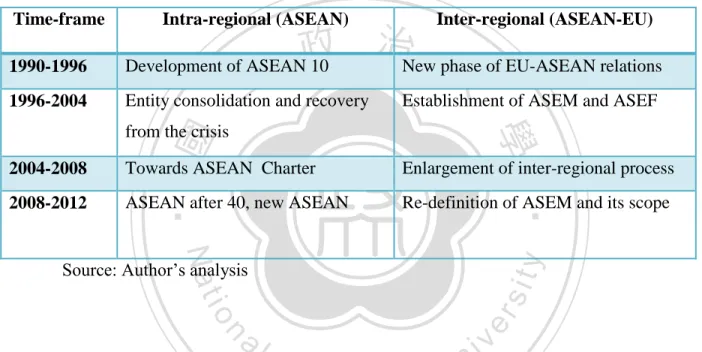
(8) Huong Le Thu. Doctoral Dissertation. ACKNOWLEDGMENT. First and foremost, I would like to thank Prof. Zhengjia Tsai for taking up the supervision of this dissertation, as well as for his advice and support over these years. I extend my thanks to my dissertation committee for their constructive suggestions and encouragement: Internal members from the Institute of International Relations (IIR) of the National Chengchi University (NCCU): Dr. Alan Yang Hao and Dr. Tsai-Wei Sun; and external committee members: Associate Prof. Eric Chiu from National ChungHsin University and Associate Prof. Shangmao Chen from FoGuang University.. 政 治 大. I am grateful to the Taiwan Ministry of Education and the National Science Council of. 立. Taiwan for awarding me the scholarship and fellowship that have allowed me to come to Taiwan. ‧ 國. 學. in the first place and embark on the pursuit for a PhD degree. I also thank the College of Social Science of National Chengchi University for awarding me travel grants for a number of international conferences.. ‧. I thank University of Malaya the Asia Europe Institute for hosting me for research. Nat. io. er. I find more rewarding than any scientific accomplishment.. sit. y. fellowship in 2011. During the time in Malaysia I met with warmth and hospitality of people that. al. n. iv n C College of Asia Pacific for providing me excellent research h e n g c h i U conditions during the visiting fellowship in 2012-2013. The rigid research environment at ANU was very inspiring and I feel. I am grateful to Australian National University the Centre for European Studies and the. lucky to receive mentorship from senior colleagues there. In the Eastern thoughts, learning is often associated with journey. I have travelled throughout of Asia, Europe and even Australia to gain some wisdom. Each of those journeys was a discovery. I have been particularly lucky in meeting kind and wise people who remain my inspiration, often even outside of academic sphere. My deep gratitude goes to the many professors and colleagues, whom I have encountered on the way, who have encouraged and guided me through this long journey of searching, exploring, and struggling through the doctoral. Page 8 of 334.
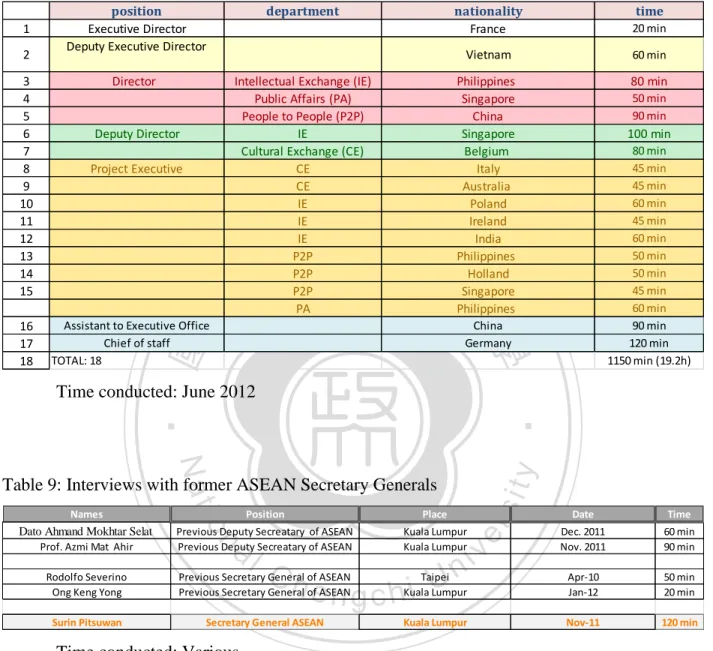
(9) Huong Le Thu. Doctoral Dissertation. process. I appreciate the thoughts and insights they shared with me, and even more so, the moral support they gave me. Special thanks go to my mentors from the National Australian University: . Prof. Anthony Milner , Basham Prof. of Asian History, College of Asia and the Pacific,. . Prof. Andrew Walker, ANU College of Asia and the Pacific.. As well as to senior authorities in the field who were patient enough to bear with my questions multiple times: . Dr. Yeo Lay Hwee, National University of Singapore. . Prof. Bart Gaens, University of Helsinki. Dr. Mathew Doigde, University of Canterbury. . Dr. Danny Wong, University of Malaya. . Prof. Azmi Mat Akhir, University of Malaya. 學. . ‧ 國. . 政 治 大 Prof. David Camroux, Science-Po, 立 Paris, France ‧. On the local ground, I have been blessed with warm encouragement from:. y. Nat. . Dr. Pinying Kuan at IDAS and IMAS, NCCU for believing in me;. . Prof. Adam Jelonek from Jagiellonian University who is now the Ambassador of Poland. er. sit. Dr. Linjun Wu from IIR, NCCU for constant encouragement;. io. . al. n. iv n C in Malaysia, Brunei and the Philippines. U the first ones to inspire me about h e n gHecwas h iamong the academic path, and who kindly assisted my field work in Malaysia.. I thank my interviewees, including diplomats, government officials and the previous Secretaries Generals of ASEAN, representatives of difference civil society groups and academics who kindly received my interviews, for their candid opinions. I send special appreciation to the Asia Europe Foundation (ASEF) and their staff for the assistance in my field work. It is ASEF that first ignited my interest to the topic. I thank many colleagues of ASEF who provided me with essential materials and for candid interviews over multiple sessions. I hope ASEF finds my research is beneficial to its development and visibility.. Page 9 of 334.
(10) Huong Le Thu. Doctoral Dissertation. I also would like to express thanks to the ASEAN Secretariat officials who assisted my field work and provided me with essential interviews. I am grateful to the Institute of Southeast Asian Studies (ISEAS) in Singapore to give me access to their impressive library and resources. My PhD endeavor has been a personal journey to reach intellectual stimuli. But most of all, it has been a personal struggle of overcoming own limits. And I have grown much since embarking on this journey, at which moment I had no idea what challenges and frustration were ahead of me. It has been a period of self-finding in a stimulating, challenging and also fulfilling way. There were lonely, discouraging moments and draining time. I have overcome them but. 政 治 大 helped me to bring this process to a successful ending. I thank each of my dear friends and 立 inspiring colleagues for accompanying me at various stages, different geographical spheres, as. needed courage and perseverance to do so. I owe my family and dear friends that strength that. ‧ 國. 學. well as throughout this PhD journey.. ‧. The deepest gratitude I address to my dear parents; without their love, support and faith, I would not be able to accomplish this endeavor.. y. Nat. sit. I dedicate this work to both of my grandmothers whom I lost during the course of. n. al. er. io. pursuing the doctoral degree.. Ch. engchi. Page 10 of 334. i n U. v.
(11) Huong Le Thu. Doctoral Dissertation. ABSTRACT. At the core of this study there lays a paradigm that existing explanation of regionalism and inter-regionalism process neglect the essential, and arguably the most advanced level of it – the cognitive level of regionalism. The theoretical contribution of this study is the concept of “cognitive”/ conscious regionalism”. This dissertation argues that without that element, regional and inter-regional cooperation cannot be advanced and they remain shallow processes. This study argues that the gap between Asia and Europe is a cognitive one, rather than. 政 治 大. physical. The Asia-Europe Meeting (ASEM) has been facing severe criticism because of the low effectiveness of its governance. This dissertation explains the reason behind the limits of ASEM. 立. in looking into the deeper levels that determine the inter-regional cooperation: level of cognition. ‧ 國. 學. of the actors involved.. The research not only explains the limits but also identifies the contributions of the. ‧. ASEM as a bridge between the regions and their peoples’. Creating the venue for interaction contributes to the realization and awakening of the perception of what is “Asia” and what is. Nat. sit. y. “Europe” in Asia-Europe Meeting. Incorporating cultural and intellectual agenda of cooperation. io. er. and including the civil society into the process not only creates the mutual understanding and acquisition of exchanged knowledge but also to pluralization of actors involved in the inter-. al. n. regional process.. Ch. engchi. i n U. v. Both in terms of actors and of cultural factors of cooperation, the Association of Southeast Asian Nations (ASEAN) plays the pivotal role in the ASEM process. The process of sustainable interaction shows institutional learning happening between ASEAN and ASEM that proves the idea of acquisition cognition through interaction also between institutions. This dissertation’s theoretical contribution is offering the concept of ‘cognitive regionalism’. Cognitive regionalism is explained and analyzed through ideas of awakening, acquisition and affiliation. The analysis is done on four levels of inter-regional, sub-regional, member government and civil society. The aspects included in these levels are: regional identity. Page 11 of 334.
(12) Huong Le Thu. Doctoral Dissertation. formation, institutional representation, member government’s commitment to ASEM process and civil society inclusiveness in “bottom-up” inter-regionalism. The empirical contribution of this research is in the richness of extensive interviews with various stakeholders including Track 1, 1½ , 2 and 3 representatives from both across Asia and Europe. Methodology is a combination of interpretative, policy-tracing of official documents, official press releases and an essential participatory observation and field work. The originality of this study is twofold: (1) the comprehensive explanation of the role of culture, and norms in the inter-regional cooperation focusing on the third pillar of ASEM particularly and (2) taking the ASEAN’s perspective in analysis.. 立. 政 治 大. ‧. ‧ 國. 學. n. er. io. sit. y. Nat. al. Ch. engchi. Page 12 of 334. i n U. v.
(13) Huong Le Thu. Doctoral Dissertation. PREFACE In December 2008 I attended the ASEM Seminar of Cultural Diversity: Sharing Experiences from Asia and Europe in Hanoi, Vietnam. The following year, I participated in the academic forum of ASEM Education Hub Conference on Comparative Regionalism in Singapore. In 2010 I served as conference rapporteur at the ASEM Workshop on Enhancing ASEM Visibility through Cultural Activities in Halong, Vietnam. The three activities, focusing on cultural, intellectual, and art and media contents of cooperation between Asian and European countries have ignited my interest for the issue of Asia-Europe cultural inter-regionalism. Although the diverse agenda of three meetings, all of them belong to the third pillar and. 政 治 大 from both European and Asian 立 members about the importance of the cultural agenda, there is a were coordinated by the Asia Europe Foundation. In spite of equally enthusiastic declarations. ‧ 國. 學. visible imbalance in terms of involvement and commitment. The very understanding and interpretation of culture as a value, and hence the approach to manage cultural issue also differs in many cases. I got intrigued since by the mechanism and motivations behind cultural. ‧. cooperation; hence, I set up a goal to explore the importance of culture and cultural cooperation. sit. y. Nat. in the inter-regional relations between ASEAN and EU within ASEM arrangements.. io. er. Asia-Europe inter-regionalism is a multi-dimensional framework overarching a wide range of participants from Europe and Asia. In this arrangement, the main principle for Asia-. n. al. Ch. i n U. v. Europe Meeting (ASEM) mechanism is equality among the member states.. engchi. Being a part of both Asian and European heritage this topic has special meaning to me. I am not only interested as a researcher, but I deeply care about the relations between Asia and Europe. My personal background gives me possibility to approach and gain trust of each side because of my language abilities as well as familiarity of cultures. I could utilize that in conducting research and interviews, reaching out for candid opinions. Having experience of living both in Asia and Europe I have witnessed prejudice, distorted perceptions, but also interest and curiosity that Asia treats Europe and vice versa. Therefore, I have committed to scientific understanding of the idea of ASEM as a bridge between the cultures. I hope my research can contribute a little more to the mutual understanding of the regions I care about.. Page 13 of 334.
(14) Huong Le Thu. Doctoral Dissertation. 政 治 大. PART 1: RESEARCH DESIGN. 立. ‧. ‧ 國. 學. n. er. io. sit. y. Nat. al. Ch. engchi. Page 14 of 334. i n U. v.
(15) Huong Le Thu. Doctoral Dissertation. CHAPTER ONE INTRODUCTION. This dissertation embarks on an ambitious purpose of understanding the meaning and the value of a multi-focused inter-regional cooperation of the Asia-Europe Meeting (ASEM). In evaluation of ASEM, this research takes up layered approach, taking primarily the cultural dimension of ASEM’s contribution to multilateral cooperation and the ASEAN’s perspective. The theoretical reasoning of this research combines institutionalist and constructivist approaches in multi-methods analysis.. 政 治 大 Meeting process. The analysis looks 立 at different levels of actors – on the inter-regional level of. The purpose of this study is to offer a first comprehensive analysis of the Asia-Europe. ‧ 國. 學. member states and the civil society engagement. In cultural agenda states are not the main actor. Instead people and civil society are the active participants and creators that are playing the central role. This study aims at understanding to what extend the non-state actors are relevant to. ‧. such a multilateral inter-governmental cooperation framework. In other words, the study. y. Nat. examines whether engaging multiple stakeholders into global politics has impact on the nature of. sit. international/ inter-regional dialogues. The study measures the effectiveness of multilateralism. n. al. er. io. exercised by a foundation attached to a politically-grounded international institution.. Ch. 1.1. Summary of the research. engchi. i n U. v. This study offers an evaluation of the Asia-Europe Meeting (ASEM). The Asia-Europe Meeting is seen as an exercise of a multilateral process in trans-regional settings. And as such, the nature of the process is a subject of change as the actors in the process change. The Asia Europe Meeting is much different now than 17 years before when it came into life. The conditions both within each region of Asia and Europe, as well as the nature of inter-regional relations have much changed.. Page 15 of 334.
(16) Huong Le Thu. Doctoral Dissertation. At the moment, as Asian regional processes intensify, the European integration is facing some serious challenges. The landscape is much different from the time the Asia-Europe interregionalism was developed. The definitions of involved regions have altered as seen from the enlargement of ASEM. The driving forces behind the inter-regional dialogue and the very nature of it have also changed. This research looks at ASEM by analysing the change of actors, particularly focusing on the ASEAN and its recent development. In evaluating ASEM, this research takes multi-level of analysis: (1) inter-regional level - regional identity formation;. 政 治 大 (3) government members' level - benefiting from public diplomacy tools that ASEM 立 and ASEF give; (2) sub-regional level - ASEAN collective representation;. ‧ 國. 學. (4) civil society level - engagement of various interest groups and actors;. ‧. A double theoretical approach is adopted, building a framework of institutional and constructivist theories.. y. Nat. sit. The analysis incorporates concepts of constructivist and institutionalist theories. Various. al. er. io. angels of ASEAN’s participation in ASEM are discussed, including concepts of socialization,. n. norm discussion, identity-building, as well as institutionalisation, functional cooperation, and. Ch. region-building through inter-regionalism.. engchi. i n U. v. ASEM as a platform engaging 51 members from Asia and Europe, involves the intergovernmental entities of European Commission and ASEAN Secretariat, enables an interaction in diverse and crosscutting areas. It is also the only multilateral forum that ASEAN appears as a single member, on top of membership of all its countries. The ASEM multi-sectoral cooperation is framed under three pillars structure. The economic and political pillars have been much anticipated by global community, because it was the first time that such framework of multilateral cooperation has been launched. But it is the socio-cultural agenda that is the unique feature of ASEM collaboration, distinguishing it from other regional and inter-regional institutions. Exploring various fields of engagement, this study argues that the soft power of. Page 16 of 334.
(17) Huong Le Thu. Doctoral Dissertation. ASEM is its value-added socio-cultural agenda. This under-examined issue is examined through the perception of ASEAN’s interests and benefits. The purpose of this study is to evaluate up-to-date, and outline the possible role that ASEAN have and can play in ASEM. As the arrangements where ASEAN can form a collective policy towards, ASEM offers the potentials that for ASEAN to act as a united entity in counterpart with Europe and other Asian countries.. 1.1.1. Background of the problem and the research puzzle. 政 治 大. When established in 1996 the Asia-Europe Meeting (ASEM) was anticipated to counter-. 立. balance the Asia-Pacific Economic Cooperation (APEC). It was envisioned to be of at least equal. ‧ 國. 學. weight as to balance out the U.S. influence. Where it is today? What has it missed out that it has become a forum of more of social-diplomatic venue, than of real political significance? At what moment it has given up the potential it has and become only thinly interesting fatigue?. ‧. At the moment of inception, ASEM was expected to contribute to the consolidation of. Nat. sit. y. Asian identity. ASEM was even expected to enhance so called “regionalism through inter-. io. er. regionalism”. Given the transformation of Asian regionalism as well as the balance of global politics a series of questions come to mind: Where is ASEM now in its identity politics? Does. n. al. i n U. v. Asia still need ASEM to builds its regional “Asian” identity? What is ASEM identity itself in. Ch. engchi. facing the enlargement of neither Asian nor European countries? Is it redefining itself? Has ASEM bridged the gap as it intended or has the gap kept widening? Why ASEM didn’t bridge the gap between Asia and Europe as it originally intended to? Does that mean that Europe does not want to re-discover Asia? Why Asia does not have interest in Europe and vice versa? These questions all lead to the main purpose of this research is to understand what are the de facto the contribution and the meaning of the Asia Europe Meeting. From a very highly anticipated forum that could have had great potential of global governance to an expanding organization beyond Asia and Europe, but with little impact. While horizontally it kept growing in size, vertically, its impact remains (or even become more) shallow. That might imply that combination of “ASEAN Way” (read: ‘Asian style’) with Page 17 of 334.
(18) Huong Le Thu. Doctoral Dissertation. European-pushed agenda, cannot produce any meaningful outcome; that there will not be a third way as a result of the “bridging”. Does that mean that on traditional, mainstream of International Relations, high politics cannot work? Only low politics (third pillar) can get benefits from such bridging? According to the argumentation of this research is that culture, values, norms and understanding in the politics – how perceptions, understanding (or misunderstanding) and values affect the interregional cooperation. ASEM is the only political cooperation mechanism (inter-regional) institution that culture factor is most heavy in. ASEM, originally intended to be the “Euro-Asian answer” to APEC, with a focus on. 政 治 大 have been especially important.立 ‘The dialogue among cultures and civilisations’ and ‘interfaith. economic issues. As it turned out, ‘political dialogue and cooperation on social/cultural issues”. ‧ 國. 學. dialogue’ have become the keywords. In a culturalist view there is a pre-supposition of distinct Asian and Western cultures have been at the root of ASEM’ inevitably promotes the idea of an ‘Asia’ community transcending the highly complex Asian region.1. ‧ y. Nat. er. io. sit. 1.1.2. Motivation of the study. The Asia-Europe cooperation has contributed immensely not only to the two regions’. n. al. Ch. i n U. v. development, but to global multilateralism as well. The leaders from both regions value the. engchi. occasion of exchange and collaboration towards mutual growth. ASEM represents new interregionalism that is comprehensive and multi-sectoral, basing on the three main pillars; trade and investment, politics and security as well as socio-cultural and environmental cooperation. Interregionalism has been explored by academia in terms of economic cooperation and investment (first pillar), political and security dialogue (second pillar), studies have been made over comparative regionalism as well as dialogue on human rights. However, little attention has been paid to the third pillar, surprisingly the most effective within ASEM capacity. Hence, this research as a pioneer topic, serves explorative and. 1. Bart Geans, Europe-Asia Interregional Relations: A Decade of ASEM (Aldershot: Ashgate, 2008). P. 95-99. Page 18 of 334.
(19) Huong Le Thu. Doctoral Dissertation. descriptive objectives to shed a light on the phenomena, nature and consequences of interregional peoples’ flow that has been intensified in the recent years. The reason for the interest on the subject is personal experience of participating in several Asia-Europe inter-regional dialogues: ASEM Seminar of Cultural Diversity: Sharing Experiences from Asia and Europe, December 2008, ASEM Education Hub Conference on Comparative Regionalism, December 2009, and ASEM Workshop on Enhancing ASEM Visibility through Cultural Activities, April 2010. These experiences gave me a closure to the essence of inter-regional dialogue, involving official levels of representation as well as people’s level of practitioners. Although the diverse agenda of three meetings, all of them belong to the. 治 政 character of exchange between the Europeans and Asians when 大it comes to the cultural agenda. 立. third pillar and were coordinated by the Asia Europe Foundation. I gained observation on the. ‧ 國. 學. In spite of equally enthusiastic declarations from both sides about the importance of the cultural agenda, there is a visible imbalance in terms of involvement and commitment. The very understanding and interpretation of culture as a value, and hence the approach to manage cultural. ‧. issue also differs in many cases. The seminar on Cultural Diversity was heavily UNESCO-driven,. y. Nat. where experience from Europe and Asia were shared over the practices of implementation the. sit. UNESCO Convention on Promoting and Protecting Diversity of Cultural Expressions from 2005.. er. io. Experience sharing between the, somehow more experienced in terms of dealing with legal. al. iv n C explicit cultural protection clauses, Asians had to be held sensitively. hengchi U n. aspects of culture, Europeans with, in many cases limited by economic conditions or with less. In the case of the Workshop on Enhancing ASEM Visibility through Cultural Activities was designed because of the relatively low level of visibility of the organization. The European representatives tended to strategize cultural cooperation as a multi-directional process involving multiple actors, whereas some Asian presenters offered a cultural diplomacy tactics, which is unidirectional and understands culture as a tool for political (and up to a certain degree economic) promotion. I got intrigued since by the mechanism and motivations behind cultural cooperation, and the questions why the Europeans in many cases advocate or even “push” their partners in terms of launching cultural projects? And how ASEAN can benefit from such experience of cultural Page 19 of 334.
(20) Huong Le Thu. Doctoral Dissertation. cooperation? Through those observations, a conclusion was reached that cultural issues within such dialogues exceed the scope of “dance and song”, but involve political, economic, social, legal, international and inter-regional relations. Hence, I set up a goal to explore the importance of culture and cultural cooperation in the inter-regional relations between ASEAN and EU within ASEM arrangements. It is a contribution to Knowledge, as the essence of the third pillar has barely been academically discussed. Moreover, this study takes up on ASEAN perspective, which with combination of culturalist angle, is an innovative research agenda. The second dimension of this study’s significance is the contribution to the understanding of evolving process of Southeast Asian community building. The Asia-Pacific region recently. 治 政 ASEAN economic integration and the political will to create 大“One Vision, One Identity, One 立 understanding of cultures that encompass the region. The Community”, there is still insufficient. has been eager to emerge in the process of regionalism and community building. Yet, with the. ‧ 國. 學. definition of community still needs further development. As the deadline for establishment of ASEAN Community in 2015 is approaching, the concerns are raised upon relatively slow. ‧. progress and low level of awareness of the process.. y. Nat. The contribution of this study is the analysis going beyond official declaration, but. sit. examination of the processes in reality and the level of participation of the peoples. Majority of. er. io. researches on Asian identity concentrate on collective action of states, regional institutions,. al. iv n C The trend of integration in Asia has been noticed and policy-makers and the supra-governmental hengchi U organizations favour accelerating this trend. Yet, very few studies have been completed over the n. organizations, ministries and associations that implement decisions about community-building.. socio-cultural implications. Neither a study has looked at inter-regional exchanges from intercultural relations’ perspective. In existing analyses, the European perspectives are dominant in the field. This study brings an innovative perspective of ASEAN’s role in the Asia-Europe framework, and addresses the un-explored question of ASEM’s “low politics” significance for ASEAN. Apart from contribution to academia, this research attempts to serve as a reference point for ASEAN in policy-creation for ASEAN Community. It is looking at the third pillar of exchanges and tries to contribute to conceptualizing the idea of “People-oriented ASEAN”,. Page 20 of 334.
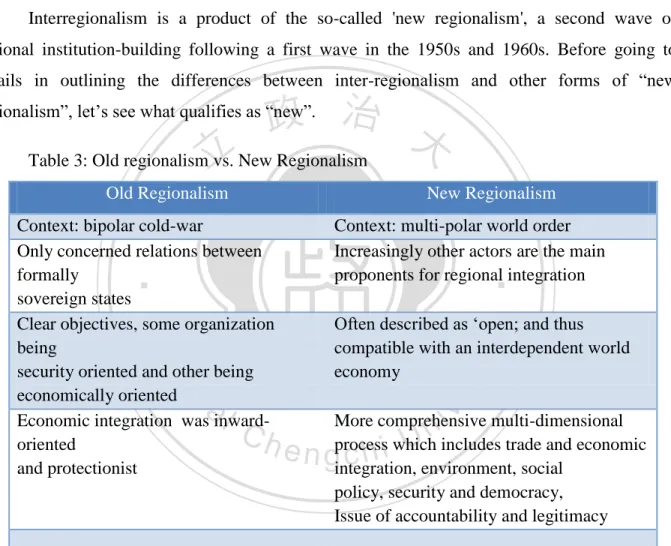
(21) Huong Le Thu. Doctoral Dissertation. participatory regionalism, and the build-up for the ASEAN Socio-Cultural Community. I also hope to contribute to ASEF and ASEM in terms of evaluation their program planning and evaluation, as well as to the European Union for a developing better understanding of cultural relations with Southeast Asia.. 1.1.3. Contribution of the study The motivation of this study is the dissatisfaction of the existing discourse about regionalism and inter-regionalism. The literature disregards the idealistic dimension of cognition. 政 治 大 is the last and most mature form of regionalism, and hence inter-regionalism. Hence, this study 立 embarks on the ambitious task of offering an interpretation of regionalism and inter-regionalism and perception. Both cognitive and perceptual factors are essential for building identity. Identity. ‧ 國. 學. analysis that would include the ideational consideration.. This research contributes to the literature on Southeast Asian regional and Asia-Europe. ‧. inter-regional institutions by providing a comprehensive understanding of ASEM based on. y. Nat. different dimensions: regional identity building, foreign policy advancement, and design of a. sit. regional institution. This thesis adds to the study of the impact of external forces, namely the EU,. n. al. er. io. on the development of regional awareness in Asia by exploring the cognitive experience and. i n U. v. inter-subjective understanding among participants in the ASEM process.. Ch. engchi. The original contributions of this study that differ it from other existing research on ASEM are on two levels. First it adopts ASEAN’s perspective of examining its original intentions, transformation of priorities and identifying the potential for ASEAN to explore. Secondly, it offers a first comprehensive study over the cultural aspects of cooperation. While most of the existing literature includes the third pillar in the evaluation, it is always treated as an addition, rather than the main focus. This thorough holistic evaluation argues that it is the third pillar of cultural cooperation that represents the most concrete outcomes of ASEM process. To explain its value, this study employs the multiple-theory approach to design a comprehensive framework for understanding the extensive and complex matter of ASEM process. Traditional International Relations theories are not accurate for interpreting ASEM. Page 21 of 334.
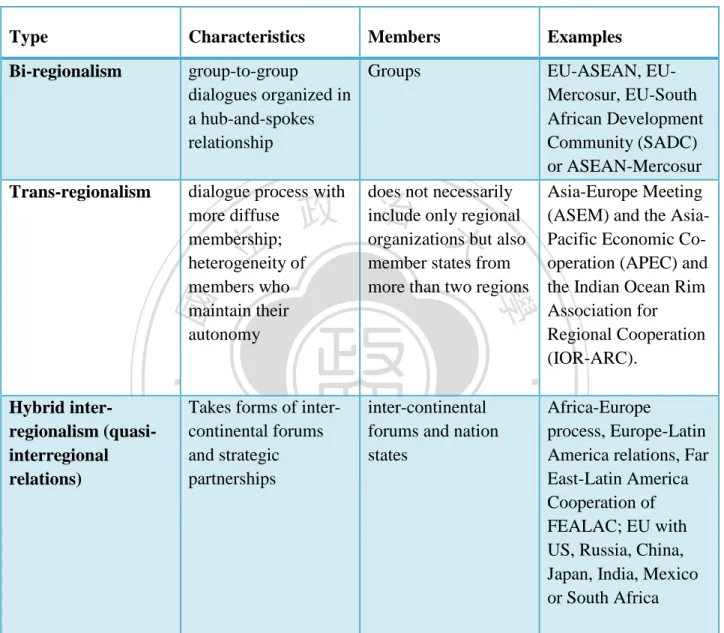
(22) Huong Le Thu. Doctoral Dissertation. The theoretical contribution of this study is the analysis of earlier not examined aspects of cultural cooperation and the ASEAN angle. The original contribution is the empirical data obtained from various field trips and numerous interviews with a variety of actors from Track 1, 1,5, 2 and 3.. 1.1.4. Organization of the dissertation This study is divided into three parts. The first part, composed of chapter one and two, is dedicated to the structural dimension of the research. Chapter one outlines the background of the. 政 治 大 contribution of this study. It then, offers a comprehensive literature review, recognizing the 立 existing studies and grouping them into theoretical and thematic clusters. The literature review problem and the research puzzle, explains the motivation of studying the issues and identifies the. ‧ 國. 學. serves the understanding of the phenomena studies but also to identify the gaps in the existing studies and pinpoints this dissertation’s innovative contribution. The second chapter presents the. ‧. research design. It offers a conceptualization of the examined cases, presenting a thorough explanation of multi-framework of analysis. Research questions, working hypotheses and. Nat. sit. io. er. of analysis.. y. methodology applied are explained next to the elaboration of the concepts adopted in the levels. al. n. iv n C explanation on the historical as well as the development h ecurrent i U of ASEM and ASEAN. This part h n c g serves as contextualization of the research, showcasing the changes that this research tracks. It. The second section, composed of chapters three, four and five, gives a thorough. combines literature review and policy tracing to understand the transformation of the institutions. Such analysis also allows me to analyze the objectives and motivations of actors involved. Chapter three offers historical background and the development leading to the establishment of the Asia-Europe Meeting. It explains external factors of world order affecting Asian and European regional processes separately and forming the inter-regional relations collectively. Chapter four continues on the nature of regional institutions, particularly focusing on the characteristics of ASEAN and the EU political norms. This chapter examines the institutional Page 22 of 334.
(23) Huong Le Thu. Doctoral Dissertation. differences leading to cooperation difficulties. Cooperation cultures and political identities are consequences of this discussion. The bottom line of this analysis is the function of interaction and socialization that allows not only better understanding of each other but also oneself. Hence, the argumentation about the identity formation based on the notion of cognitive learning that is predominant to this dissertation. While chapter four focuses on the leadership levels, the following chapter five discusses such interaction and socialization on the people’s levels.. By analyzing the Asia-Europe. Foundation (ASEF) which acts as a bridge between the ASEM governments and their peoples, this chapter explains what is done on the “bottom” level. Focusing on the examples of cultural. 治 政 regional process. This chapter has two level of analysis – at大 first one it looks at participatory of 立of the ASEM process, and hence also socialization of certain civil society and democratization. and educational exchanges, this chapter looks at the engagement of civil society in the inter-. ‧ 國. 學. norms between Asia and Europe. On the second level it looks at “democratization” of ASEM by examining its relations with ASEF. All of this discussion follows the paradigm of interaction and. ‧. communication of priorities, which are dictated by the norms.. y. Nat. The third part, composed of chapter six and seven, analyzes the changes that have. sit. occurred within Asia and in Asia-Europe relations. The purpose of this section is to evaluate the. er. io. Asia-Europe Meeting during its almost two decades of existence. Unlike the existing literature. al. iv n C research contributes an evaluation perspective of change. The h e n g c h i U changes also have taken place on the levels of members of ASEM, and this study argues that they affect significantly the ASEM as n. that focuses on the first phase of ASEM or on criticism after the Asian Financial Crisis, this. the organization as well. Chapter six looks at the transformation of ASEAN as the agent of change in ASEM process. It analyses the position and role of ASEAN from the establishment of ASEM until the recent change of balance due to the EU’s crisis. In this part, I analyze the context change putting emphasis on the ASEAN’s role, as well as the context of global balance of power arguing why the ASEM has lost its original legitimation of existence. Chapter seven offers a comprehensive evaluation of ASEM process in terms of political, economic and cultural values that it has brought to regional and inter-regional developments. Page 23 of 334.
(24) Huong Le Thu. Doctoral Dissertation. This chapter also looks at the enlargement of ASEM as posing challenges and redefining the purpose of the organization. It is a finalizing analysis chapter in which I evaluate the meaning of ASEM on two levels: 1) regional-governmental: ASEAN as an Asian regional entity, and 2) on the civil society level. The final chapter eight offers a conclusion of previous analyses bringing together different levels of analysis and offering an answer to the research questions posed and suggests several recommendations.. 1.2. Literature review. 立. 政 治 大. 1.2.1. Inter-regionalism. ‧ 國. 學. Traditional International Relations literature views regionalism and inter-regionalism in various perspectives that rarely included extensive explanation or even an inclusion of concepts. Alexander Wendt and Amitav Acharya, touched upon these notions.. Nat. sit. y. ‧. of perception, cognition and identity. Only a number of authors, including Peter Katzenstein,. The Asia-Europe relations is often analysed from inter-regionalism theory. Inter-. io. er. regionalism is a studies area within International Relations that underlines the interaction. al. n. iv n C institution-building, also called “new regionalism”. emerged “as a post-Cold h e n g cInter-regionalism hi U between regions. Inter-regionalism, developed after 1960s, is the second wave of regional. War product and entails the encounter of two regions as distinct and equal actors in a dialogue going beyond trade, economy and including political, security-related, and cultural issues”2. In the context of Asia-Europe inter-regionalism, the Asia-Europe Meeting (ASEM) is a profound representation of this form of group-to-group dialogue. ASEM is a unique forum for interregional dialogue, integrating the “Asian way” of informality and in the same time the European spirit of formalization and institutionalization. ASEM represents new inter-regionalism that is comprehensive and multi-sectoral, basing on the three main pillars; trade and investment, 2. Bart Geans, "Pitfalls and Potential of Region-to-Region Interaction in the Asia-Europe Meeting (ASEM)," in ISA Conference, EU’s Relations with Asia: Assessing Past Perspectives and Defining New Directions (New York2009).. Page 24 of 334.
(25) Huong Le Thu. Doctoral Dissertation. politics and security as well as socio-cultural and environmental cooperation. It is based on a low level of institutionalization, usually at the ministerial, ambassadorial and senior officials’ levels, supplemented by ad hoc experts’ working groups. Inter-regionalism refers to processes of cooperation between regions that are initiated by governments or the bureaucracies of regional organizations. The term “inter-regional” is generic covering a broad range of phenomena. Theoretically it has been distinguished the types of relationship within inter-regionalism as “bilateral inter-regionalism”, “bi-regionalism” or “pure inter-regionalism” which all basically describe a group-to-group relationship (Gilson 2002, Hanggi 2006, Ruland 2006, Ruland, Schubert, Schucher and Storz 2008, Robles 2008). 3. 政 治 大 to-group dialogues with more or立 less regular meetings centring around exchanges of information. Bilateral inter-regionalism, such as the ASEAN-EU relationship, can be defined as group-. ‧ 國. 學. and cooperation in specific policy fields. Inter-regionalism reflects that, in the view of increasing cross-border issues, regional organizations have begun to pool and share sovereignty and resources to establish direct communicative links to each other.. ‧. Inter-regionalism establishes a new layer of international relations, as it engages the non-. Nat. sit. y. state actors. Regional level of governance is gradually becoming preferred, or at least,. io. er. encouraged forum of dialogue and response to both traditional and non-traditional security issues. Moreover, inter-regionalism is concerned to be a new way for overcoming “discriminatory. n. al. i n U. v. power balance”, by increasing the chances for small and medium states to influence international decision making.. Ch. engchi. Alfredo Robles’ volume on theories of inter-regionalism provides a comprehensive international relations look at the development of inter-regionalism. The authors gave an overview from regionalism to inter-regionalism analysing other trans-regional grouping than. 3. Julie Gilson, "Concepts of Inter-regionalism," in Gilson Asia Meets Europe: Inter-regionalism and the Asia-Europe Meeting, ed. Julie Gilson (Northampton, MA, USA: Edward Elgar Publishing, Cheltenhan, 2002); Heiner Haggi, "Interregionalism: as a multifaceted phenomenon: in search for a typology," in Interregionalism and International Relations, ed. Ralf Roloff and Jurgen Ruland Heiner Hanggi (New York: Routledge, 2005); Jürgen Rüland, "Interregionalism: An Unfinished Agenda," in Interregionalism and International Relations , Asian-European relations : building blocks for global governance? , Routledge contemporary Asia series (London ; New York: Routledge, 2008); Alfredo C. Robles Jr., The Asia-Europe Meeting. The Theory and Practice of Interregionalism (New York: Routledge, 2008).. Page 25 of 334.
(26) Huong Le Thu. Doctoral Dissertation. ASEM in comparative perspective. The current state of inter-regionalism is summarized and categories in terms of the degree of institutionalization: hard and soft institutionalization, are distinguished. The mentioned literature provides a sound contribution in the theoretical categorization of functions that inter- and trans-regional forum exerts.. 1.2.2. The Five Functions of inter-regionalism from the mainstream International Relations approaches In the theoretical literature a number of scholars have listed five functions of inter-. 政 治 大 clearest classification. The five foci are as following: 立 (1) balancing (and bandwagoning) the political and economic disequilibria,. regionalism (Gilson 2002, Dent 2004, Roloff 2006, Ruland and Storz 2008).4 Robles offered the. ‧ 國. 學. (2) rationalizing,. (3) institution-building through formation of new coordination mechanisms,. (5) identity-building.. Nat. y. ‧. (4) agenda-setting for multilateral fora, and finally. sit. Institutional balancing is to address political and economic imbalances by readjusting. er. io. institutional influence and formation coordination mechanisms. Institution-building, rationalizing. al. n. iv n C to the claim that inter-regional forums contribute U multilayered system of global h e n g toc anh iemerging governance. Rationalizing and agenda-setting are regarded as requisites for the management of. and agenda-setting are function associate with liberal institutionalism. Institution-building refers. interdependence, a key function of global governance. Since they are mainly based on the consensus of preferences, making negotiation processes easier. Identity building in the context of inter-regionalism refers to a reflexive process of interaction, in which cognitive factors shape and sharpen regional identities, is a process of emerging the Self in the encounter with the Other.. 4. Julie Gilson, "Defining Inter-Regionalism: The Asia Europe Meeting (ASEM)," SEAS Electronic Working Papers 1, no. 1 (2002); Christopher M. Dent, "The Asia-Europe Meeting and Inter-Regionalism: Toward a Theory of Multilateral Utility," Asian Survey 44, no. 2 (2004); Ralf Roloff, "Interregionalism in theoretical perspective: State of the Art," in Interregionalism and International Relations, ed. Ralf Roloff and Jurgen Ruland Heiner Hanggi (New York: Routledge, 2006).. Page 26 of 334.
(27) Huong Le Thu. Doctoral Dissertation. Jürgen Rüland saw balancing as “soft balancing”. The function of balancing places greater emphasis on the global distribution of institutional power. “Soft balancing involves interregional forums in short-term coalition-building, the fluid nature of which entails few incentives for states and regional organizations to invest in the governance costs associated with building enduring and ‘deep’ institutions”.5 Table1: Inter-regionalism: functions, theory and foci. 立. 政 治 大. ‧. ‧ 國. 學. al. er. io. sit. y. Nat. Source: Quoted from Mathew Doidge “Joined at the Hip: Regionalism and Interregionalism”6. v. n. From the mainstream of international relations, inter-regionalism has been studied by. Ch. i n U. realists, liberal institutionalists and constructivists. The first group tends to see inter- and trans-. engchi. regional fora in category of coalitions or alliances of regional players to exercise power. Hence, they underline the balancing function of the region-to-region relations. For realists, ASEM is an inter-governmental forum in which cooperation takes place because there is coincidence in actors’ interests. Ruland (1996, 2000, 2002) 7 extensively argued that Asia and Europe were pushed. 5. Jürgen Rüland, "Balancers, Multilateral utilities or global identity builders? International Relations and the study of Interregionalism " Journal of European Public Policy 17, no. 8 (2010). P. 1280 6 Mathew Doidge, "Joined at the Hip: Regionalism and Interregionalism," European Integration 29, no. 2 (2007). P. 232 7 Jürgen Rüland, The Asia-Europe meeting (ASEM) : towards a new Euro-Asian relationship? , Rostocker Informationen zu Politik und Verwaltung, (Rostock: Universität Rostock, Institut für Politik- und Verwaltungswissenschaften, 1996).; Jürgen Rüland, Asia-Europe Coopeation - The ASEAM process: A European View, ed. Magnus Jerneck and Urlich Niemann, Asia and Europe: Regional Cooperation in a Globalizing World. Page 27 of 334.
(28) Huong Le Thu. Doctoral Dissertation. towards cooperation because of the US dominance. Particularly Europe feared isolation as the East Asian economies grew in importance. Preston and Gilson’s volume (Preston & Gilson 2001) 8 is concerned with interchange between the internal dynamics and regional inter-linkages of the EU and East Asia. They saw the core dynamics behind the establishing the ASEM as: the extension of European power in Asia, European domination and the demand of empire, European eclipse and the US hegemony, and Asia’s recovery and rise after the financial crisis, and Europe-Asia relations in the contemporary global system. Realism, by default not believing in cooperation, is not adequate for explaining the. 政 治 大 and ASEAN Secretariat are the立 members as well). The balancing component of ASEM versus cooperation of regions encompassed of multiple states and some regional institutions (the EC. ‧ 國. 學. APEC did not work, hence reaslism theory is no longer discussed in this dissertation. Institutionalists, on the other hand, regard cooperation as a key to mitigate the anarchical. ‧. character of international relations, to minimize the incidence of conflict and to enhance the welfare of peoples. Moreover, cooperation intensifies the flow of information between actors,. Nat. sit. y. builds trust and enhances the predictability of state behaviour. By this token, inter- and trans-. io. er. regional fora add another layer to the international system and thus enhance the institutional density. Such format creates an increasing demand for internal coordination as members or. n. al. Ch. i n U. v. regional organizations are advices to invent common positions prior to summits and meetings.. engchi. Furthermore, great powers while involved in the process, they also socialize into cooperative multilateralism.9 Institution-building refers to a process of progressive institutionalization of international relations and institutional differentiation. Unlike realist theory that focuses on competition and conflict, institutionalist, or more precisely neo-institutionalist theory rather tries to explain the nature and existence of cooperation in international institutions. In this particular case, it asks (Singapore: Asia Europe Foundation, 2000).; Jürgen Rüland, "Interregionalism in International Relations. Conference Summary," in Seminar für Wissenschaftliche Politik (Freiburg2002). 8 Peter W. Preston and Julie Gilson, The European Union and East Asia: Interregional Linkages in a Changing Global System (Northampton Edward Elgar, 2001). 9 Jürgen Rüland, "ASEAN and the European Union: A Bumpy Inter-regional Relationship," Discussion Paper c95(2001).. Page 28 of 334.
(29) Huong Le Thu. Doctoral Dissertation. question whether ASEM has contributed to evolution of norms and regimes in governing the cooperation between Asia and Europe. However, interregional fora face certain obstacles constraining institutional-building functions. So called “shallow institutionalization” (informality, non-legally binding decisions), create little or no enforcing compliance mechanisms. The pillared structure is criticized to cause dual problem of reducing efficiency and signifying democracy deficit. Interregional dialogues “suffer from the twin-deficit of ‘input’ and ‘output’ legitimacy”.10 Interregional dialogue fora can be considered as novel layers of governance which can be traced back in their origins to the early 1970s with the EU and ASEAN building up hub-and-. 政 治 大. spoke systems of bilateral and consecutively also multilateral forms of interregionalism.11. 立. Functions of interregionalism focus on the collective action, which relate to system of. ‧ 國. 學. global governance. “However, a closer look at these functions reveals that they are more theoretically deduced than empirically real”12. Ruland pointed out that, although there is a lack. ‧. of systematic empirical research testing the underlying assumptions, it seems that except for the balancing and bandwagoning functions, all other functions attached to ASEM are only weakly. Nat. sit. y. developed. Balancing and bandwagoning relate to the power dimension of international relations,. io. er. hence interregional fora such as ASEM play a role of an arena in triadic power contest (Hanggi 1999).13 ASEM in this perspective reflects a European strategy of bandwagoning in the face of. n. al. i n U. v. Asia’s unprecedented economic growth, and American’s dominance expressed in forming the APEC.14. Ch. engchi. Five functions of inter-regionalism reflect the recognition that international relations are characterized by a complex mix of policies and processes informed by an array of theoretical 10. Rüland, "Balancers, Multilateral utilities or global identity builders? International Relations and the study of Interregionalism ". P. 1276 11 Geoffey Edwards and Elfriede Regelsberger (eds), Europe's Global Links (Pinter Publishers, London, 1990); Christopher Piening, Global Europe: The European Union in World Affairs (Lynne Rienner, Boulder, 1997 12 Jürgen Rüland, "ASEM and the Emerging System of Global Governance," in Annual Meeting of the Association for Asian Studies (Washington2002). 13 Heiner Hanggi, "ASEM and the Construction of the New Triad," Journal of the Asia Pacific Economy 4, no. 1 (1999). 14 Rüland, "ASEM and the Emerging System of Global Governance.". Page 29 of 334.
(30) Huong Le Thu. Doctoral Dissertation. approaches, rather than by a single theoretical construct. Those functions see inter-regionalism as functioning in two directions: a. upward to the global multilateral level (external focus) and b. downward to regional level (internal focus)15 Graph 1: Directions of inter-regionalism. Global multilateral level (external focus). 立. 政 治 大 Interregionalism. ‧. ‧ 國. 學 Regional level. y er. io. sit. Nat. (Internal focus). Source: Author’s compilation based on theory proposed by Mathew Doidge’s “Joined at the Hip: Regionalism and Interregionalism”. n. al. Ch. engchi. i n U. v. Alfredo Robles disagreed on the functional perspective of interregionalism in the form of five above mentioned functions. His criticism came from a stand, in which he believed that interregional relations form a post-colonial dependencia perspective with the political economy of Asia-Europe relations at the centre. He saw EU’s interaction with Asia as far from ideal situation, and EU as a hardly qualified normative power, but rather an actor pursuing self-centred economic objectives at the expense of Asia’s developing countries.16 15. Doidge, "Joined at the Hip: Regionalism and Interregionalism." P. 232-233 Alfredo C. Robles, The Asia-Europe meeting : the theory and practice of interregionalism, Routledge contemporary Asia series (London ; New York: Routledge, 2008).. 16. Page 30 of 334.
數據

+7

Outline
Organization of the dissertation
Affiliation • Internalization
c. From ASEAN perspectives
ASEAN–EU relations before Karlsruhe Meeting (1970s and 1980s)
Asia-Europe Meeting as the dialogue between norms, values and modules of cooperation
Clashing over human rights issues
Her conclusion was that political interests and colonial memory were the core reasons why Asians felt barriers towards their European counterparts and therefore grouped into a closer
civil society level - engagement of various interest groups and actors
Community organizations
相關文件
• Using the remainder estimate for the Integral Test, answer this question (posed at the end of Group Exercise 2 in Section 12.2): If you had started adding up the harmonic series at
Project 1.3 Use parametric bootstrap and nonparametric bootstrap to approximate the dis- tribution of median based on a data with sam- ple size 20 from a standard normal
在 15~16 世紀中,義大利數學家帕西歐里(Luca Pacioli)、塔爾塔利亞 (Niccolo Tartaglia) 和 卡爾連奇 (Fillipo Carlandri)
學校意見 大專院校 公眾人士 傳媒 政黨立法會 、區 議會、 香港教 育城 、其他,例如專業團體、僱主、. z
在基礎教育階段,學生通過視覺藝術評賞、視覺藝 術創作和視覺藝術知識 三個學習範疇
(1) Formation of event organizational structure (2) Event management. (3) Event promotion (4) Event production
xchg ax,bx ; exchange 16-bit regs xchg ah,al ; exchange 8-bit regs xchg var1,bx ; exchange mem, reg xchg eax,ebx ; exchange 32-bit regs.. xchg var1,var2 ; error: two
Model checking: residuals can be obtained by 1-step ahead forecast errors at each time point, (observations minus the fitted value) Then if the model is adequate, residuals should
