CHAPTER V. CONCLUSIONS & RECOMMENDATIONS
In this chapter, 2 sections were included: conclusion of the thesis, recommendations for business and future research.
Conclusions
This study was aimed at understanding the factors that affect Taiwanese managers’
cross-cultural communication in the global corporation. Five of the factors were discussed in this thesis: awareness of national cultural differences, openness of corporate culture, multinational team structure, cross-cultural communication obstacles and company resources.
A few research methods were applied in this thesis. A case study approach on Trend Micro Inc. was employed to collect research data as primary data resource. Snowball strategy was applied to find the target interviewees, Taiwanese mid-level managers, and 8 of them accepted the interview. Secondary data were collected from published books and related websites/ magazines. Pre-interview questionnaire was applied as minor research method, in order to understand interviewees’ background information, current stage of global diversity integration of the case company, and type of Trend Micro’s corporate culture.
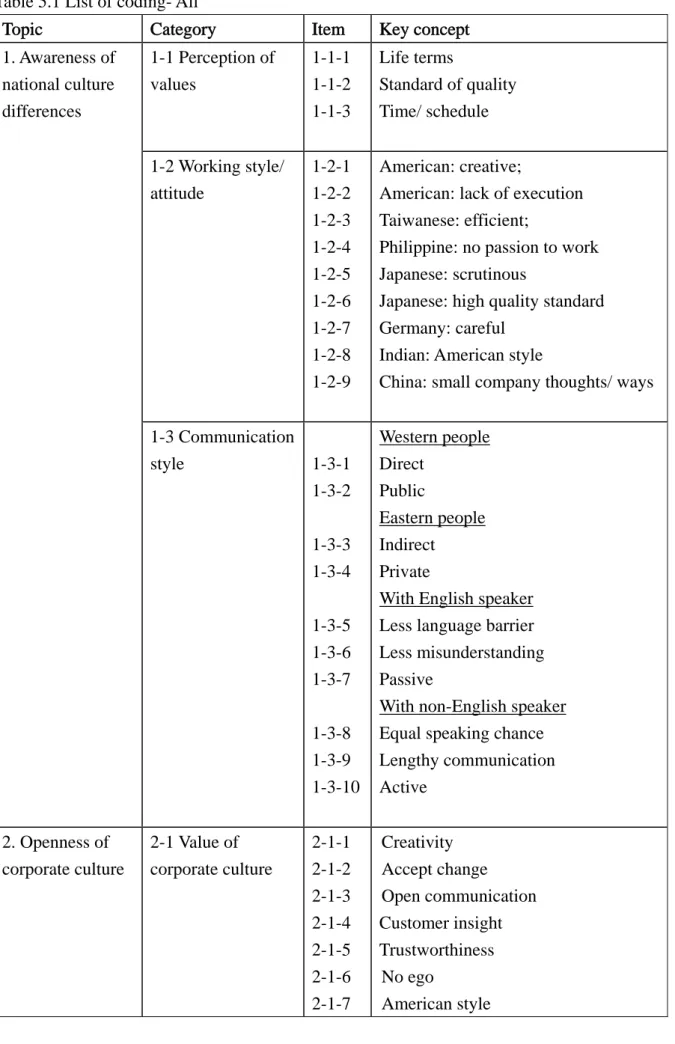
Contents of interview and pre-interview questionnaires were recorded and made as transcripts for data analysis. Through process of data collection and analysis in chapter 4, findings and discussions were deducted. Relationship of all findings was presented as Table 5.1.
Table 5.1 List of coding- All
Topic Category Item Key concept
1-1 Perception of values
1-1-1 1-1-2 1-1-3
Life terms
Standard of quality Time/ schedule
1-2 Working style/
attitude
1-2-1 1-2-2 1-2-3 1-2-4 1-2-5 1-2-6 1-2-7 1-2-8 1-2-9
American: creative;
American: lack of execution Taiwanese: efficient;
Philippine: no passion to work Japanese: scrutinous
Japanese: high quality standard Germany: careful
Indian: American style
China: small company thoughts/ ways 1. Awareness of
national culture differences
1-3 Communication
style 1-3-1
1-3-2
1-3-3 1-3-4
1-3-5 1-3-6 1-3-7
1-3-8 1-3-9 1-3-10
Western people Direct
Public
Eastern people Indirect Private
With English speaker Less language barrier Less misunderstanding Passive
With non-English speaker Equal speaking chance Lengthy communication Active
2. Openness of corporate culture
2-1 Value of corporate culture
2-1-1 2-1-2 2-1-3 2-1-4 2-1-5 2-1-6 2-1-7
Creativity Accept change
Open communication Customer insight Trustworthiness
No ego
American style
2-1-8 2-1-9 2-1-10
Connect to company strategy Freedom
Respect
2-2 Upward and downward communication
2-2-1 2-2-2 2-2-3 2-2-4
No hierarchical limitation Accept employees’ ideas To peer: direct
To upper management: indirect
2-3 Ways to enhance
corporate culture
2-3-1 2-3-2 2-3-4
Recruitment qualification CCO (Chief Culture Operation) Cultural competition
3-1 Features of organizational structure
3-1-1 3-1-2 3-1-3 3-1-4
Region/ geographical structure Corp (global) departments Customer-oriented segment Project-based structure (RD)
3-2 Strength of customer-oriented segments
3-2-1 3-2-2 3-2-3 3-2-4 3-2-5 3-2-6 3-2-7
Focused resources Clear goals
Small report line gap Small job scope
Customer need focused Relationship building Technology sharing
3-3 Weakness of customer-oriented segments
3-3-1 3-3-2
3-3-3
3-3-4
Interaction among segments Technology sharing among segments
Low communication efficiency among segments
Messy segment structures 3. Influence of
organizational structure on cross-cultural communication
3-4 Strength of Multinational project-based structure
3-4-1 3-4-2 3-4-3 3-4-4 3-4-5
World-class products Knowledge exchange Skills sharing
English improvement Global vision
3-4-6 Cross-functional interaction
3-5 Weakness of multinational project-based structure
3-5-1 3-5-2 3-5-3 3-5-4
Team forming efforts Knowledge management Miscommunication Communication overhead
4-1 Language proficiency
4-1-1 4-1-2 4-1-3
Expression accuracy Wording selection Accent
4-2 Cultural difference
4-2-1 4-2-2 4-2-3
Ways of work Stereotype
Perception of values 4. Cross-cultural
communication obstacles
4-3 Distance/ time difference
4-3-1 4-3-2 4-3-3
Communication efficiency Low interaction
Partnership building
5-1 Language proficiency
5-1-1 5-1-2 5-1-3 5-1-4 5-1-5 5-1-6
Speed adjustment Interpreter
Key words Drawing
Pre-meeting proposal Post-meeting confirmation
5-2 Cultural differences
5-2-1 5-2-2 5-2-3 5-2-4 5-2-5
Follow company goals
Consensus before cooperation Adjust in co-work process Unify language: English Escalate
5. Ways to overcome CCC obstacles
5-3 Distance/ time difference
5-3-1 5-3-2
Meeting at midnight Meet at third place
6. Company support on cross-cultural
6-1 Training courses
6-1-1 6-1-2 6-1-3
Language courses
Email writing skills training General communication skill
6-1-4 6-1-5 6-1-6 6-1-7
training
Presentation skill training On-the-job training Experience sharing Mentor
6-2 Activities 6-2-1 6-2-2 6-2-3
6-2-4
Team building Engineering camp
Quarterly: “High-communication meeting”
Annual: “Paramount”
6-3 Environment 6-3-1 6-3-2 6-3-3
Open internal environment Business trip
On-site visit
6-4 Equipment/
channel 6-4-1
6-4-2
6-4-3 6-4-4 6-4-5 6-4-6 6-4-7
Internal communication CEO blog
Intranet
External communication Phone
Webex system Email
MSN
Visual equipments communication
6-5 Top manager support
6-5-1 6-5-2
Role model
Frequent emphasis
Extensional findings about relationship among affecting factors: multinational team structure is typical structure in global companies which pushes global partners corporate with each other in high frequency. Due to frequent interaction, managers encountered cross-cultural communication obstacles such as language proficiency, time differences, perceptions of values, etc. These obstacles impacted efficiency of cross-cultural
communication in a team, and previous cooperation experience strengthened managers’
awareness to national cultural difference. Responses from interviewed managers proved this statement. Past trials and errors in cross-cultural communication stimulated them to be more aware of cultural differences and find out solutions for future cooperation. Managers realized their needs in facilitating cross-cultural communication--- framing open corporate culture--- to build up a communication platform for diverse workforce. Trend Micro provided a good example to frame open corporate culture, as well as showing supports and provide sufficient resources, ultimately achieved the goal to reduce impacts of communication obstacles.
To sum up, “environment” is the core influencing power to impact, on the other hand, to enhance managers’ cross-cultural communication as well in the global company. Because of the environment (multinational team structure), managers notice the importance of cross-cultural communication. And because of the environment (open corporate cultural and company support), manager may overcome most of the communication obstacles.
Environments directly influence efficiency of managers’ cross-cultural communication, which are considered much more powerful than trainings and stimulations. Enhancement of managers’ cross-cultural communication involved various approaches and fully execution, especially on climate setting in the global company (open corporate culture).
Recommendations for Business
Based on the purposes of the study, a few recommendations are provided for business:
1. Environment of global companies should be fully provided for cross-cultural communication/ interaction.
When concept of open communication is successfully installed in employees’ minds, providing direct-contact environment would be the following actions to take. From most interviewees’ feedback, they appreciated the environment and chances Trend Micro provided for direct cross-cultural communication. Experiences on direct contact and cooperation are more useful than other forms of training. “Learning by doing” will help managers adapt multicultural working environment as early as possible. Through process of coordination and communication, partnership with foreign colleagues will be built.
2. Corporate culture framing should be connected with open communication.
Many Taiwanese companies ignore the power of corporate culture framing, and the case study of Trend Micro provided a very positive example in climate setting for open communication. Continuous installations of culture values will strengthen morale, trust, power of teamwork among employees, and ultimately, become a unique competitive advantage of the company. If employees/ managers in the company are willing to communicate with one another, mistakes and conflicts will be prevented. Various activities such as cultural games and competitions are frequently used in Trend Micro so that employees are impressed and gradually influenced by Trend Micro’s corporate culture. Soft ways to promote corporate culture would be much better than forcing employees/ managers to follow. The most important is, managers need to be role models and lead employees to follow corporate culture.
3. Company structures should be considered tightly with global needs.
Company structures contain invisible power in building connection among diverse workforce, or, on the other hand, block the interaction of them. Thus, the arrangement of company/ organizational structures should be considered carefully to fit various global needs.
To facilitate managers’ cross-cultural communication, matrix organizational/ team structure may break the barrier among different departments and involvement of multinational workforce in team structures may continuously stimulate Taiwanese managers to enhance cultural awareness and cross-cultural communication skills.
Recommendations for future research
For future research of related topics, the researcher suggests to expand numbers of the interviewees and increase research methods such as field observation and focused group, so the results of primary data will be more reliable. More in-depth findings might be explored during the process of field observation or focused group. Internal document may also strengthen researcher’s viewpoint and discussion if available. Building good relationship with the case company will help the researcher to arranged interview easier. If people in the case company (such as Trend Micro) are open and willing to share their experiences to the researcher, process of data collection will be much smoother.
REFERENCES
Alder, N.J. (2001) International dimension of organizational behavior (4th ed.) Cincinnati, OH. USA: South-western.
Allert, J. & Innes-Brown, M. (2005). Building trust, communication and leadership for new globalization. Journal of Asia Pacific marketing. Parrington.
Avruch, K. & Black, P. (1993). Conflict Resolution in Intercultural Settings:
Problems and Prospects. Conflict Resolution Theory and Practice: Integration and Application. Sandole, D. & Merwe, H. V. D (ed.). NY: St. Martin's Press.
Beamer, L. & Varner, I. (2001) The effectiveness of intercultural business communication and business judgment. Intercultural communication in the global workplace. (2nd ed.) 335-336. McGraw-Hill Irwin
Berlo, D. (1960) The process of communication. McGraw-Hill Companies
Betsy, S. & Jim, H. (1996) Hotel managers' perceptions of upward and downward communication. International Journal of Contemporary Hospitality
Management. Bradford. 8 (1).
Daft, R. & Lengel, R. (1984)Information richness: a new approach to managerial and organizational design. Research in organizational behavior. Greenwich. CT:
JAI press
DuPraw, M. E. & Axner, M. (1997). Working on common cross-cultural communication challenges. Retrieved April 30th, 2007 from:
http://www.wwcd.org/action/ampu/crosscult.html#COMMUN
Global diversity integration (2003) Retrieved April 23rd, 2007 from:
http://www.itapintl.com/globaldiversity.htm
Hamm, S. (2003)It's Not Easy Going Stateless. Business Week. Retrieved June 19th, 2007 from: http://www.businessweek.com/magazine/content/03_38/b3850066_
mz063.htm?chan=search
Hofner Saphiere, D.M. (1996) Productive behaviors of global business teams.International journal of intercultural relations. 20(2): 227-59.
Hofstede, G. (1980) Culture's consequences: international differences in work-related values, Sage, Beverly Hills, CA.
Hofstede, G. & Bond, M. H. (1988) The Confucius connection: from cultural roots, economic connection, organizational dynamics. Beverly Hill: Sage Publications.
Katzenbach, J. & Smith, D. (1993). The wisdom of teams. Boston, MA: Harvard Business School Press.
Lantieri, L. & Patti, J. (1996). Waging Peace in Our School. US: Beacon press.
Lembke, S. & Wilson, M. G. (1998) Putting the “team” into teamwork: alternative theoretical contributions for contemporary management practice. Human Relations, 51 (7).
Matveev, A.V. & Miller, R. G. (2004) The value of intercultural competence for performance of multicultural teams. Team Performance anagement. Bradford.
10(5/6): 104.
Mowshowitz, A. (1997) Virtual Organization. Communication ACM. 40(9): 30-7.
Matveev, A. V. & Nelson, P. E. (2004) Cross Cultural Communication Competence and Multicultural Team Performance: Perceptions of American and Russian Managers. International Journal of Cross Cultural Management. London. 4 (2):
253
Marquardt, M. J. & Horvath, L. (2001). Global teams: how top multinationals span boundaries and cultures with high-speed teamwork. Davies-black publishing: CA.
Definition of cross-cultural communication (2007). Retrieved Jul. 7th, 2007 from:
http://www.mc-creation.com/Who_we_are/Cross_cultural_communication
Odenwald, S. B. (1993) Global training: how to design a program for the multinational corporation. USA: ASTD. 2-5
Orey, M. & Prisk, J. (2004) Communication skills training. 8-11. US: ASTD press
Paine, L.S. & Bettcher, K. (2003). “Trend Micro A” & “Trend Micro B”. Harvard Business School Cases. Retrieved on Jun. 19th, 2007 from:
www.dbusinessonline.hbsp.harvard.edu./b02/en/includes/search/search _results.jhtml?_requestid:60307
Ranney, J. & Deck, M. (1995) Making teams work: lessons from the leaders in new product development. Planning Review. 23 (4): 6-13.
Rhinesmith, S. H. (1996) A Manager's Guide to Globalization. Six Keys to Success in a Changing World. Alexandria, VA: ASTD
Schein, E. H. (1985) Organizational Culture and Leadership. San Francisco:
Jossey-Bass
Shokley-Zalaback, P. (2002) Protean places: teams across time and space. Journal of Applied Communication Research. 30 (3): 231-50.
Smith, A. G. (1966) Communication and culture. Beverly Hill: Sage Publications.
Schneider, S. C. & Barsoux, J. (1997). Managing Across Cultures. London: Prentice Hall, Inc.
Sohmen V. & Levin, G. (2001) Cross-Cultural Project Communications: Keys to Success. Retrieved May 12th, 2007 from ESI International:
http://www.esi-intl.com/public/publications/Horizonspdfs/horizons0801.pdf
Trend Micro website (2007) Retrieved June 10th , 2007, from : http://us.trendmicro.com/us/about/contact_us/index.html
Triandis, H.C. & Singelis, T.M. (1998) Training to Recognize Individual Differences in Collectivism and Individualism within Culture. International forum of
Intercultural Relations. 22(l): 35-47.
Trompenaars, F. & Hampden-Turner, C. (2004) Managing people across culture.
Capstone Publishing. England.
Wheelan, S.A., Buzalo, G. & Tsumura, E. (1998) Development Assessment Tools for Cross-cultural Research. Small Group Research. 29(3): 359-70.
Weaver, G. R. (2000). Culture, Communication and Conflict: Readings in Intercultural Relations (2nd ed.). Boston: Pearson Publishing.
Young, D. (1998) Global efficiency: team heat. CIO Magazine. Retrieved January 18th, 2007 from: www.cio.com/archive/090198_teamcontent.html
2006 Taiwan top 10 global brand (2006).Retrieved June 19th, 2007 from:
Http://www.ourfishbowl.com/images/press_releases/TWBA2006_Press_Release.pdf
張明正、陳怡蓁 (1999) @趨勢: 全球第一 Internet 防毒公司創業傳奇. 天下遠見
出版社. 台北市.
張明正、陳怡蓁 (2003) 擋不住的趨勢. 天下遠見出版公司. 台北市
李誠、周慧如 (2005) 趨勢科技: 企業國際化的典範. 天下文化出版社. 台北市
黃淑芳 (2006) 大紀元. 06/15/2007 摘自:
http://www.epochtimes.com/b5/6/9/27/n1469063.htm