Knowledge sharing in design studio: a Design Scope Model
synthesizing the concept of design problem solving and Game Theory
計畫編號:NSC 93-2211-E-011-033 執行期限:94 年 8 月 1 日至 95 年 7 月 31 日 主持人:施宣光副教授 國立台灣科技大學建築系 計畫參與人員:邱尚孝 國立台灣科技大學建築系博士班
陳清楠 國立台灣科技大學建築系博士班 張芳銘 國立台灣科技大學建築系碩士班
Abstract
A student is facing a knowledge sharing dilemma in the design studio. He can either share his knowledge for cooperative learning or hoard his knowledge to maintain a competitive advantage. The purpose of this is to understand why and how cooperation is initiated and sustained in the design studio. To attain this, a design scope model is developed to study the situation with co-existing cooperation and competition. The model is based upon design problem solving, and has integrated features of learning alliances and Game Theory. A
pedagogic case study is used to show how the design scope model can be used to interpret cooperative behavior. First of all, cooperation can be a beneficial strategy for improving individual performance, as well as a hedge strategy against the uncertainty of dynamic design processes. Secondly, frequently sharing knowledge to invite allies can be a necessary strategic move for sustaining the profit of cooperation. Finally, information technology which improves information transparency and reduces communication costs may act as a catalyst for initiating and sustaining cooperation.
Keywords: cooperation; design scope; design studio; Game Theory; knowledge sharing dilemma
1. Introduction
Design is a problem solving process that involves information-processing (Pahl and Beitz, 1996) and knowledge-intensive (Rodgers et al., 2001) activities. For example in an architectural project, architects employ knowledge to define design goals and design issues, based on the
information regarding clients’requirements and the features of a site, and propose spatial
solutions. In the process, knowledge is critical to the quality of the project. As Lee, Eastman, and Zimring (2003) figure out that knowledge plays an important role in reducing the chance of design errors and improving design quality.
The pedagogical design studio is considered to be a place of cooperative work and learning (Goldschmidt and Tatsa, 2005). Craig and Zimring (2000) argue that cooperation in the design studio is unstructured collaboration – collaboration without shared goals. In general, the exercises of a pedagogical design studio involve project-based learning. Collaboration without shared goals denotes that a student is requested to accomplish a project by himself.
Even though students must prove themselves, they can be inspired by sharing information and ideas with each other. Consequently, knowledge or information sharing has been shown to be a universal form of cooperation in the design studio.
Nevertheless, a design studio is also a place of performance competition. Students usually have insufficient incentive to share because of competing for grades (Craig and Zimring, 2000).
The situation in which cooperation and competition with others occurs synchronously puts students in the knowledge sharing
dilemma –whether to sharing knowledge for cooperative learning or hoarding knowledge for maintaining a competitive advantage. Kvan (2001a) contends that design education must emphasize cooperative learning but encourage egoism. Disastrously, the culture of the design studio seems to incline students toward working alone and competing rather than cooperating
(Anthony, 1991). Therefore, to promote cooperative culture in a design studio, it is necessary to understand why students share knowledge when they are confronted with the knowledge sharing dilemma.
Our review identified very few articles that discuss this issue. The purpose of this study is to provide a starting point for comprehending why and how cooperation is initiated and sustained in a design studio. We first introduce the concept of the learning dilemma in a learning alliance in the next section. Following that, a design scope model is developed to interpret the scenario of synchronous cooperation and
competition in the design studio. Next, a
pedagogical case is examined and followed by a discussion. The final section consists of
conclusions and suggestions for future research.
2. Cooperation and Competition in learning alliances
In this age of the knowledge economy, knowledge is a significant resource of
organizational competitive advantages (Drucker, 1992). To maintain advantages, knowledge acquisition and creation are core competences of an organization. As Powell (1998) regards that the competition among organizations as a learning race. In order to improve the
effectiveness and efficiency of organizational learning, organizations form strategic alliances, even with rivals, to exchange and develop new knowledge (Hamel et al., 1989). In strategic alliances, allies generally are in a situation in which two organizations cooperate in some activities and compete with each other in others activities simultaneously (Bengtsson and Kock, 2000). Cooperative activity between allies is knowledge sharing, and competitive behavior is that an organization attempts to outperform its partners through utilizing the new knowledge gained from such an alliance (Khanna et al., 1998).
Larsson et al. (1998) argue that a learning alliance is in an inter-organizational learning dilemma which erodes the foundation of cooperation. The dilemma derives from individualistic rationality that makes an organization pursue maximal private benefits from the alliance but optimizes the common
profits of the alliance. Because an organization’s cooperation strategy is the result of the costs and benefits of that strategy (Loebecke et al., 1999), Gulati et al. (1994) suggest that an
organization’s cooperative behavior in a strategic alliance can be analyzed by means of the concept of payoff structure derived from Game Theory, which studies the agents’
decision making practice during strategic interactions (Romp, 1997).
The utility of an organization’s strategy is affected by other organizations’strategies.
Payoff structure describes such relationships.
Khanna et al. (1998) proposed a payoff structure –including relative scope, private benefits, and common benefits (Figure 1) –to study the dynamics of learning alliances.
Relative scope involves two business
organizations’scopes of market which can be characterized by a set of products, customers, regional distribution, etc. When an alliance is established, relative scope refers to the intersection of one ally’s scope of market and that of another. Any member’s total benefits from the alliance include common and private benefits. Common benefits are acquired from cooperative operations in the relative scope of the alliance, while private benefits are acquired by utilizing the knowledge which is learned from the alliance within an unrelated part of a member’s market scope. The range of relative scope will shape the proportion of private benefits and common benefits relative to a member’s overall benefits. As a result, it will affect the cooperative behavior of an
organization. If common benefits are greater than expected, organizations will lean towards cooperation. Otherwise, organizations will lean towards to competition, resulting in the collapse of the alliance eventually.
Figure 1 Payoff structure of Relative Scope Model (Khanna, Gulati, and Nohria, 1998).
We contend that cooperative learning in the
Relative Scope
Private
&
Common Benefits
Cooperative
&
Competitive Behavior
design studio is a form of learning alliance.
Consequently, we develop a design scope model which is inspired by the relative scope model to interpret the learning dilemma that exists in the design studio.
3. A Design scope model
Design scope, common interests, and private interests
Design is a problem solving activity. Design scope is defined as a set of design issues included in a design proposal for a specific design project. Generally in a design studio, each student submits a design proposal for a same design program which is designated by instructors. However, students usually have different interests in the program. They choose different issues according to their interests for developing design solutions. Consequently, each student’s design scope of the design proposal is different. Figure 2 demonstrates the relationship between two design scopes. If any two students choose the same issues into their design scope, these same issues are their ‘common interests’, and the different issues are their own ‘private interests’. Interests in the same design issues (common interests) could serve as incentives to cooperate in terms of sharing information and knowledge with each other.
Common Interests Student B's Design Scope Student A's
Design Scope
Students B's Private Interests Students A's
Private Interests
Figure 2 Design scope, common interests, and private interests.
Payoff structure
Through the relationship between two design scopes, we developed a payoff function to symbolize a student’s payoff. Figure 3 depicts the payoff structure based upon a student’s design scope. The grade that a student receives for his design proposal derived from the
student’s design scope is the student’s payoff.
As common interests and private interests comprise a student’s design scope, the student’s Payoff in Design Scope (PDS) equals the sum of Payoff in Common Interests (PCI) and Payoff in Private Interests (PPI). A student’s costs are his investments (usually time) in his design scope.
Similar to total payoffs, total investments equal the sum of Investments in Common Interests (ICI) and Investments in Private Interests (IPI).
Thus, a student’s PDS is given by PDS = (PCI + PPI) –(ICI+ IPI).
Figure 3 Payoff structure of Design Scope Model.
Learning dilemma in the design studio The design scope model and its payoff structure represent two types of cooperative behavior that could exist in a design studio. The first is learning alliances. The payoff function shows that if students can work together on common interests, then every participant can acquire knowledge through information sharing;
moreover, they can redistribute their investments more efficiently.
The other is the temptation to be a free rider.
A free rider is someone who can benefit from cooperation without contributing. The free rider’s advantage is obvious. He can gain knowledge from others’efforts and save his investment. Furthermore, the savings can be utilized to acquire more new knowledge.
Consequently, a free rider can collect more knowledge than contributors. However, this advantage is dependent upon the existence of cooperators. If all students are free riders, then the profit from cooperation is zero. The result is a competitive and inefficient design studio.
Analysis of Evolutionary Stable Strategy In this subsection, we utilize the concept of Evolutionary Stable Strategy (ESS) (Maynard Smith and Price, 1973) to analyze what
strategies will be adopted by students. An ESS
Design Scope ( Private &
Common Interests )
Design Proposal
Grade ( Payoff )
is a strategy that adopted by all individuals in a group and cannot be invaded by a mutant strategy (Powell, 2003). If individuals with a mutant strategy can receive greater benefits than individuals adopting the old strategy, then there has been a successful invasion by the mutant strategy; otherwise, no one will adopt the mutant strategy and the old strategy is an ESS.
Assume there are n students in a design studio.
Each one has the same investment amount I.
Every student’s decision is his allocation of investment between common interests (CI) and private interests (PI). Xi represents Student i's investment on CI and 0 <= Xi <= I, then
Student i's investment on PI is I-Xi. Assume fc(x) is a function for calculating a student’s payoff from CI and fp(x) is a function for calculating a student’s payoff from PI, fc(x) and fp(x) are increasing functions. Thus, student i's payoff is given by
I Xi I fp Xj fc Pi
n
j
) ( ) (
1
where
n
j
Xj
1
is the sum of the investment in CI
by all n students. No matter what Xi is,
n
j
Xj
1
is the same for all students. That is, each student gains equally from CI.
Student i's strategy is his determination of Xi’s value. Assume all students, except Student i, adopt the same strategy X, 0 < X <= I. Student i adopts a mutant strategy Xi, Xi ≠X and 0 < Xi
<= I. Student i's payoff Pi is I Xi I fp Xj fc Pi
n
j
) ( ) (
1
, and the others’payoff P is I X I fp Xj fc P
n
j
) ( ) (
1
.
If Xi > X, then (I-Xi) < (I-X); as a result, Pi < P.
Consequently, students with strategy X have no incentive to change their strategy. In contrast, if Xi < X, then Pi > P. In this case, students with strategy X will change their strategy to Xi or Xj (Xj < Xi) to keep their advantage. The lowering process of X will continue until X=0. As a result, no one will invest in CI eventually.
The ESS analysis shows that all students will become free riders in the end. Nevertheless,
cooperation is not a rare phenomenon in the real world. In the next section, we will examine a pedagogical case to find out what actually happens in an architectural design studio.
4. A case study
The case
The pedagogical case studied here is a senior design studio at the Department of Architecture, National Taiwan University of Science and Technology. The studio included six students, one instructor, and assistants from graduate school. The design program was a Hakka culture center located at Taoyuan County, Taiwan. The studio was supported by a web forum
(http://140.118.29.4/design2003fall/index.asp) where students can share their knowledge with others. The design project lasted for eight weeks.
The instructor introduced the program to the students in the first week. Discussions on the forum started in the second week and ended in the sixth week. In the last two weeks, students prepared presentations for the design jury. On the jury day, a simple questionnaire was employed to survey students’design scopes.
There were 21 design issues posted on the forum and itemized in the questionnaire.
Students were asked to select issues which comprised their proposal. If the issues which were considered by students were not in the questionnaire, then students were asked to write them out. All 22 design issues are listed in Table 1 with an extra design issue identified by the questionnaire. The analytical data include records from the forum database and questionnaires.
Design scope analysis
This case study shows that cooperation among students happened and was sustained during the design period with no apparent free rider problem. We defined a free rider as a student who did not participate in any discussion threads of a particular design issue but his final design scope encompassed the issue. Table 1 demonstrates that all students played contributor and free rider simultaneously. Nevertheless, most of the students contributed more than trying to gain without giving. We also observed that the students’contributions were continuous
throughout the design period. Almost all of the students, and at least half of them, contributed knowledge from week three to week six. Finally, each student’s final proposal was the result of the joint efforts of all studio members (Table 1).
We observed two levels of design scope from this case: common design scope and individual design scope (錯誤! 找不到參照來源。). The common design scope was comprised of all the design issues posted on the web forum. An individual design scope was a set of all design issues which were considered in a student’s design proposal. Almost every student’s final design scope was a subset of the common design scope brainstormed out of the discussion forum. As a result, we argue that this case is a clear example of a cooperative design studio.
We treated the issues that appear in the forum without any response (#2, #19, #20) and the one issue written on the questionnaire (#22) as private interests, and we treated the rest as common interests. To a student, only the
knowledge regarding issues which were selected into his final design proposal could generate returns. Through comparing the issues that a student had involved with his design scope, we found that a student’s investments in his
interests may not yield any return, regardless of joint or individual effort. For example, issues #2,
#19, and #20 are private interests and they are not included in their contributors’design scope.
On the other hand, issues #1, #9, #15, #18, and
#21 are common interests that are not taken into account in any student’s design proposal.
Consequently, we argue that there are risks related to investments in design issues.
Both common and individual design scope fluctuated during the design. As time went on, more and more design issues were questioned and discussed, and the common design scope broadened. When new problems arose or old problems were redefined, students usually shifted their design scope. That is, the development of a student’s design scope is a dynamic process (Figure 4). A student collects knowledge based on his design scope, and then he reformulates his design scope by the
collected knowledge. Consequently, he search for new knowledge for his new design scope again.
A phenomenon of investment in this case is that more contributions result in more returns.
Table 2 shows that a student’s grade was positively correlated to his contributions. In fact, the student who contributed the most received the highest grade. Note that a student’s grade was not determined by his contributions but was awarded by the jury based upon the quality of his final design proposal.
Design Scope Knowledge search
define
Design Scope Knowledge search
define
Figure 4 Development of a design scope is a dynamic process
The analysis is summarized as follows. First, each student’s final proposal was the result of joint efforts of all studio members. The case is an instance of a cooperative design studio.
Secondly, the evolution of a design scope is dynamic, and the investments in design issues may not have yielded returns. There are risks associated with the design development. Finally, more contributions resulted in more returns.
This suggests that the contributors’payoff function and the free riders’payoff function may be different.
Comparison between the case and the ESS analysis
The ESS analysis (section 0) suggests that no one will share. If that was true, there should be few contributions in the forum. However, the case shows that cooperation among students happened and was sustained during the design period. We will compare the case and the ESS analysis to explore the factors affecting
knowledge sharing behavior.
Two presumptions are made about students’
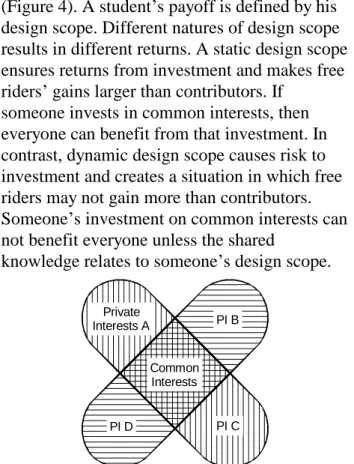
design scope in the ESS analysis: (1) no student’s design scope will change throughout the design process; and (2) only one set of common interests exists (Figure 5). However, we have observed in the pedagogical case that (1) the development of design scope is dynamic, and (2) there is a multi-set of common interests
(Figure 4). A student’s payoff is defined by his design scope. Different natures of design scope results in different returns. A static design scope ensures returns from investment and makes free riders’gains larger than contributors. If
someone invests in common interests, then everyone can benefit from that investment. In contrast, dynamic design scope causes risk to investment and creates a situation in which free riders may not gain more than contributors.
Someone’s investment on common interests can not benefit everyone unless the shared
knowledge relates to someone’s design scope.
Common Interests Private
Interests A PI B
PI D PI C
Figure 5 Static design scope in the analysis with ESS
The ESS analysis assumes three kinds of information are transparent. They are the students’design scopes, strategies, and returns.
Based on the information available, students can compare outcomes between various strategies, and then they can modify or maintain their strategy. Information transparency in this case was similar to the assumptions of the ESS analysis through the support of a web forum wherein students could observe others’interests and strategies. Outcomes of investments could be learned through the instructor’s review of the students’work every week. If a student’s proposal was appreciated by the instructor then he gained from his strategy. Note that the instructor asked for students to present their work to all when their work was reviewed.
Being a free rider is a better strategy, according to the ESS analysis, when design scope is static. In contrast, contributors are more successful in the case where design scope is dynamic. Both the analysis and the case exhibit good information transparency, which assists participants in adopting a strategy. Through design scope analysis and comparison, we conclude that cooperation is a better strategy when design scope is dynamic, and that
excellent information transparency can make dissemination of successful strategies easier.
5. Discussions
Knowledge sharing as the provision of public goods
Cabrera and Cabrera (2002) suggest that the knowledge sharing dilemma is similar to public good dilemmas. Public goods have two
characteristics –non-rival consumption and non-exclusion (Leuthold, 1987). If a good is consumed by one person and it can be used by other consumers, then the good is non-rival.
Non-exclusion means that a good’s provider is unable, or difficult, to select his consumers.
Examples of public goods are public defense, lighthouses, highways, broadcasts, and knowledge (Adler, 1989). If knowledge has been published in a book, then the book can be read by many different people even after one person has read it. If the book is available in a public library, it is almost impossible to exclude the specific readers. Non-exclusiveness is even more apparent when the knowledge is published on the Internet. Our case supported with a web forum exhibits the same circumstances.
Public goods dilemmas have two properties (Dawes, 1980). The first is that a defector (free rider) gains greater payoff than a cooperator (contributor). The second is that the payoff of all individuals’cooperation is better than the payoff of all individuals’defection. In our case study, the second property is predominant than the first.
We will discuss the implications in the next subsections.
Cooperation as a hedge strategy
The risk of design development is derived from the open-ended character of design problems that makes design a trial-and-error process. Therefore, the result of a design is difficult to predict, especially for novices with limited expertise and experience. Given this uncertainty, a fertile common design scope can reduce risk. A student might not benefit from his own efforts. Nevertheless, his efforts could be accumulated through the support of
information technology, and then help other students. In the same way, he can gain from
others’contributions. In our case, we have found that every student benefited from the common design scope. Knowledge sharing appeared to be a hedge strategy against the uncertainty of the dynamic design process.
Strategic moves for sustaining profit The effectiveness of knowledge sharing as a hedge strategy in a design studio relies on its implementation by the majority of all design studio members. We consider two main concerns that affect a student’s choice of strategy. The first is sustaining the profit resource –the common design scope. If the common design scope is more fertile, the profit will be greater for them. In contrast, knowledge hoarding will lead to a barren common design scope, resulting in a lower level of ‘common wealth’for all students. To sustain the profit resource, a student’s strategic moves must invite others to invest in the common design scope.
These moves are sharing knowledge and responding to others’contributions continuously.
The other concern is a more active strategic move designed to generate more profits via cooperation. We name this strategic move focus transfer strategy. Focus transfer strategy is an attempt to utilize collective efforts to achieve individual goals. A student can take action to direct discussions towards his private interests.
If the issues become the focus of discussion, then more information and knowledge of the issues will be accumulated. As a result, the student can work more efficiently and effectively.
Information technology in cooperation The circumstances of teaching, working, and learning are altered by introducing IT into the design studio. Two noticeable transformations are the extension of communication channels and the improvement in information
transparency.
The ubiquitous knowledge exchange channel in the design studio is the desk crit. A desk crit is an instructor who periodically reviews a student’s work at that student’s desk. The review is a conversation about the student’s analysis of design problems and his solutions
about the problems. Schon (1985) argues that a student learns how to design through the conversation. As a result, Kvan (2001b) suggests that an instructor should invite other students into the conversation, as they can learn by observing the review of a student’s work.
However, the conversation and observation are limited by time and space. Thus, a number of studies suggest ‘distant critics’with the support of IT to break the limitations (Brusasco et al., 2000; Zimring et al., 2001). There are several advantages of distant critics. First, students publish their works on the Internet periodically;
various stages of students’works can be stored.
Secondly, instructors can invite more experts to give advice on students’work. Finally, students’
works and theirs reviews can be accessed by all students at anytime and anywhere.
IT extends communication channels that alter communication patterns from ‘one-to-one’to
‘many-to-many’. The shift increases dialogue opportunities among instructors and students.
Furthermore, the costs of information exchange are decreased. Under ‘one-to-one’conditions, transmitting the same information to several individuals requires repeating the same procedure many times. In contrast, the
procedure can be performed just one time with the support of IT.
Information transparency “is defined as the degree of visibility and accessibility of
information (Zhu, 2002).”There are two categories of information which may affect cooperative behavior. The first is design
knowledge; the other is the information used to adopt a cooperative strategy. In an open
electrical forum, one can access others’
contributions easily almost without any costs.
This convenience may tempt a student to be a free rider. However, the information for decision-making is more critical in affecting cooperative behavior. Axelrod (1984) has suggested that increasing information about individuals’actions will facilitate cooperation and his argument is supported by Sell and Wilson’s experiment (1991). We believe that IT can improve students’abilities to process such information; as a result, cooperation is promoted.
In our model, a student’s interests (individual design scope) and his strategic moves are
important information that affects others’
cooperative strategies. A student can publish his interests on the forum, thereby inviting someone else to form a learning alliance. When a student participates in a discussion thread, he also sends a signal of cooperation to others. Consequently, other students can choose partners and strategic moves.
In our observation, improvement in information transparency did not appear to promote free riders. In contrast, this
improvement might provide greater potential for design development. Students had more
alternatives for synthesizing their unique solutions. The improvement of information transparency seems to have positive effects on initiating and sustaining cooperation in the design studio.
6. Conclusions
This study offers two contributions to understanding why and how cooperation is initiated and sustained in the design studio. First, we developed a design scope model which synthesizes the features of learning alliance and Game Theory upon the foundation of design problem solving. The model depicts that students face the dilemma between sharing and hoarding knowledge. Game Theoretical
approach is utilized to predict how students will act when confronted with such a dilemma. The concept of design scope is employed to interpret field data and analyze cooperative relationships between students.
Second, this study provides initial explanations regarding how cooperation is initiated and sustained in a design studio.
Cooperation may be a beneficial strategy for improving individual performance when the design scope is dynamic. Students’benefits come from taking on together the risk of open-ended problem solving. To sustain the benefits, sharing knowledge voluntarily and responding to others contributions continuously are necessary strategic moves for inviting contributors. Information technology may play an influential role in enhancing cooperation. IT extends participants’communication channels and makes information more transparent. These improvements can increase the efficiency of
knowledge sharing; therefore, a culture of cooperation may be promoted.
This research is a first step towards
understanding cooperation in the design studio.
Several future research directions are suggested.
First of all, the culture of cooperation or evolutionary stable strategies may be the result of long-term development. We cannot infer the long-term tendencies from a short-term case.
Thus, long-term and more large-scale studies across numerous design studios studies should be conducted. Second, the primary data
analyzed in this research comes from the
forum’s database. The data are just a segment of the record of interactions among students in the design studio. It is impossible that cooperation only happened on the Internet. Data from other sources and collection techniques should be explored in the future. Finally, modifications of the learning circumstances of the design studio – such as the introduction of IT –may lead to dramatic shifts in cooperative culture. The modifications and theirs influences should be studied thoroughly in future work.
References
[1] Adler, P.S. (1989). When knowledge is the critical resource, knowledge management is the critical task. IEEE Transactions on Engineering Management, 36(2), 87-94
[2] Anthony, K.H. (1991). Design Juries on Trial: The Renaissance of the design studio. New York: Van Nostrand Reinhold.
[3] Axelrod, R.M. (1984). The Evolution of Cooperation. New York: Basic Books.
[4] Bengtsson, M. & Kock, S. (2000 ). "Coopetition"
in Business Networks--to Cooperate and Compete Simultaneously. Industrial Marketing
Management , 29(5), 411-426
[5] Brusasco, P.L., Caneparo, L., Carrara, G., Fioravanti, A., Novembri, G., & Zorgno, A.M.
(2000). Computer supported design studio.
Automation in Construction, 9(4), 393-408 [6] Cabrera, A. & Cabrera, E.E. (2002).
Knowledge-sharing Dilemmas. Organization Studies, 23(5), 687-710
[7] Craig, D.L. & Zimring, C. (2000). Supporting collaborative design groups as design communities.
Design Studies, 21(2), 187-204
[8] Dawes, R.M. (1980). Social dilemmas. Annual Review of Psychology, 31, 169-193
[9] Drucker, P.F. (1992). The New Society of Organizations. Harvard Business Review, 70(5), 95-104
[10] Goldschmidt, G. & Tatsa, D. (2005). How good are good ideas? Correlates of design creativity. Design Studies, 26 (6), 593-611
[11] Gulati, R., Khanna, T., & Nohria, N. (1994).
Unilateral commitments and the importance of process in alliances. Sloan Management Review, 35(3), 61-70
[12] Hamel, G., Doz, Y.L., & Prahalad, C.K. (1989).
Collaborate with Your Competitors -- and Win.
Harvard Business Review, 67(1), 133-139 [13] Khanna, T., Gulati, R., & Nohria, N. (1998). The
dynamics of learning alliances: competition, cooperation, and relative scope. Strategic Management Journal, 19(3), 193-210 [14] Kvan, T. (2001a). The Problem in Studio
Teaching-Revisiting the Pedagogy of Studio Teaching. In M. Tan (ed.), Proceedings of the 1st ACAE Conference on Architectural Education (pp.
95-105). Centre for Advanced Studies in Architecture, National University of Singapore.
[15] Kvan, T. (2001b). The pedagogy of virtual design studios. Automation in Construction, 10(3), 345-353
[16] Larsson, R., Bengtsson, L., Henriksson, K., &
Sparks, J. (1998). The Interorganizational Learning Dilemma: Collective Knowledge Development in Strategic Alliances. Organization Science, 9(3), 285-305
[17] Lee, G., Eastman, C.M., & Zimring, C. (2003).
Avoiding design errors: a case study of redesigning an architectural studio. Design Studies, 24(5), 411-435
[18] Leuthold, J.H. (1987). A Public Goods Experiment for the Classroom. Journal of Economic Education, 18(1), 58-65
[19] Loebecke, C., Van Fenema, P.C., & Powell, P.
(1999). Co-opetition and knowledge transfer. The DATA BASE for Advances in Information Systems, 30(2), 14-25
[20] Maynard Smith, J. & Price, G. (1973). The logic of animal conflict. Nature, 246, 15-18
[21] Pahl, G., & Beitz, W. (1996). Engineering Design:
A Systematic Approach (2nd edition ed.). London:
Springer-Verlag.
[22] Powell, J.H. (2003). Game theory in strategy. In D.
Faulkner, & A. Campbell (Eds.), The Oxford Text Book of Strategic Management (Vol.2, pp.
383-415). Oxford: Oxford University Press.
[23] Powell, W.W. (1998). Learning From
Collaboration: Knowledge and Networks in the Biotechnology and Pharmaceutical Industries.
California Management Review, 40(3), 228-240
[24] Rodgers, P.A., Caldwell, N.H.M., Clarkson, P.J., &
Huxor, A.P. (2001). The management of concept design knowledge in modern product development organizations. International Journal of Computer Integrated Manufacturing, 14(1), 108-115 [25] Romp, G. (1997). Game Theory: Introduction and
Applications. Oxford: Oxford University Press.
[26] Schon, D.A. (1985). The Design Studio: An
exploration of its traditions and potentials. London:
RIBA Publications.
[27] Sell, J. & Wilson, R.K. (1991). Levels of Information and Contributions to Public Goods.
Social Forces, 70(1), 107-124
[28] Zhu, K. (2002). Information Transparency in Electronic Marketplaces: Why Data Transparency May Hinder the Adoption of B2B Exchanges.
Electronic Markets, 12(2), 92-99
[29] Zimring, C. , Khan, S., Craig, D.L., Haq, S., &
Guzdial, M. (2001). CoOL Studio: using simple tools to expand the discursive space of the design studio. Automation in Construction, 10(6), 675-685
Table 1 List of design issues
Student’s Contributions
# Design Issues A B C D E F
1 Long, thin site 2 1 1
2 Space requirement 2
3 The impact of the project on the neighborhoods
3* 1* * * 1* *
4 Green building * 1* 2* 1* 1* *
5 High-voltage power wire across the site
6 Spatial representation of Hakka culture * 1* * 1 *
7 Ecological system of the site 1 4* 2* 1* 2* 1
8 Buildings in the neighborhoods 1 1* 1* 1
9 Famous Hakka writer and musician 1 3
10 A ditch in the site 3*
11 Circulation of people and vehicles 2* 3* 2 1* * *
12 Sky bridge 1* 1*
13 Hierarchy of spaces 1* 2* * *
14 Potential of spaces 1 1* 1* *
15 Relationship between the village deity temple and the literature park on the site
1 1 1 1
16 Ecological wetland 1* * 2* 1*
17 Hakka court-house 3* 1* *
18 Landmark of entrance 2 2 1
19 Parking 1
20 Elements of Hakka architecture 1
21 Ventilation and lighting of basement 1 1
22 Street house (from questionnaire) * *
The number in a cell is the quantity of a student’s contributions for an issue. Issues that are selected into students’final proposals are marked by an asterisk (*). For example, student A’s final proposal includes issues #3, #4, #11, and #22.
Table 2 Statistics of students’contributions
Student
Total contributions
Participated issues
Issues selected in
final DS
Participated issues selected in
final DS Grade
A 10 6 4 2 70
B 23 15 11 10 80
C 11 12 10 8 65
D 9 7 8 5 70
E 10 8 6 4 70
F 5 5 5 0 55
Average 11 9 7 5 68