國立臺灣大學理學院心理學系 碩士論文
Graduate Institute of Psychology College of Science
National Taiwan University Master Thesis
身心互動途徑初探:以「身心中軸覺察訓練」對身體 感覺、工作記憶與注意力控制功能的提升效果為例
An Initial Inquiry about Body-Mind Interaction:
Examining the Training Effect of Body-Mind Axial Awareness Practice for Children on Bodily Senses and
Executive Functions
李少揚 Shao-Yang Li
指導教授:連韻文 博士 Advisor: Yunn-Wen Lien, Ph.D.
中華民國 106 年 1 月 January, 2017
致謝
這篇論文的完成,真的得感謝很多人,首先要感謝家人的支持,當初考上
研究所的時候,家人們給了我很大的鼓勵,我也終於跟上爸爸的腳步,從台大
的研究所畢業了。再來要感謝連韻文老師,在老師一步步地帶領下,讓一個原
本沒有什麼學術訓練的我最後可以寫出一篇完整的英文論文,也感謝老師很多
的耐心與包容;還有感謝陳顥齡老師的協助,謝謝老師放手讓我用那邊的器
材,也提供很多人手幫忙以及生理資訊相關的諮詢;也要感謝葉理豪老師對於
論文的建議與協助;也感謝陳玉秀老師的幫助,不僅是對於論文,還有對於營
隊課程以及生活的影響,真的是非常感謝;也感謝李宜芳老師在營隊期間非常
多的協助。
在研究進行中,整個營隊規劃下來參與的人真的很多,首先要感謝實驗室
的學長姐,玉正、善娟、宜諳以及營隊的夥伴憶如,對於營隊的協助還有對於
資料以及規畫的討論;感謝淳輔在資料分析上的幫助,即使在工作繁忙之餘還
不忘幫我改程式,還有思瑜協助指導施測以及後續分析的幫忙;也感謝幫忙施
測的職治系學弟妹,以及幫忙 coding 的心理系學弟妹,還有美工部分幫忙很多
的蕙如。也要感謝來參加營隊還有測驗的小朋友以及家長,希望那個暑假能夠
帶給你們或多或少正面的影響,即使是隱約記得有段快樂的時光,那也就非常
足夠了。
學習心理學至今也五年半,在台大的時間也八年半了,當初進來台大的我
一定沒想到會走了不同的方向並且一路就走到了研究所,最初的同學都一一畢
業,走上不一樣的道路,感覺在學校裡面的時間過的特別緩慢,而在外面卻已
變化萬千,現在這個剛要踏出學校的我會有怎樣的發展呢,雖然抱持著不安卻
又期待著下一步的方向。
最後,也要感謝橄欖球隊的教練還有隊友,在我碩一荒廢一年之後,碩二
還是有機會回去參與最後一次的大專盃,還有族語班的 Singsi 和 Kaput 們以及
藝術團的成員們,每個禮拜的族語課以及練歌舞的時間真的是很快樂又充實的
時光。還有北區認識的很多的朋友們,真的感謝各位的陪伴,讓我在煩惱和困
難的時候有人可以溝通。也感謝都蘭的朋友在我碩士生涯的陪伴;以及感謝靜
浦的 Idang 們,謝謝大家的接納,也希望可以身為 Selal 中的一份子一起走下
去。Nanay misarikec kami.
目錄
口試委員會審定書... i
致謝... ii
摘要... vi
Abstract ... viii
Introduction ... 1
Reasons for Using Children as Target Participants ... 4
The Effects of Mindfulness and MBCP Training for Children ... 5
Body-Mind Axial Awareness Program for Children (BMAA-C) ... 10
The Bodily Senses ... 13
The Executive and Attentional Control ... 19
Hypothesis ... 20
Method ... 24
Participant ... 24
Design and Procedure ... 25
Interventions ... 25
Tasks and Materials ... 30
Results of Pre-test Correlation ... 38
Discussion I ... 47
Results of Training Effect ... 52
Discussion II ... 59
General Discussion ... 64
圖表目錄
Table 1. The Definition, Examples and Modes of Assessment of Two Facets of Interoception and Proprioception ... 18 Table 2. The Components in Each Class Session of BMAA Program ... 27 Table 3. The Main BMAA Practices in Each Class Session for the BMAA Group .. 28 Table 4. Descriptive Statistics for Children’s Performance on Proprioception,
Interoception, Sustained Attention and Working Memory Capacity at T1 (N=58) ... 40 Table 5. Inter-correlation Matrix among the Scores on Proprioception, Interoception, Sustained Attention and Working Memory Capacity at T1 (N=58) ... 45 Table 6. T1 scores, T2 scores and Improvement Ratio on Proprioception,
Interoception, Sustained Attention and Working Memory Capacity for the BMAA Group (N = 27) and the Control Group (N = 21), respectively ... 55 Table 7. Multiple Regression Analyses Regarding the Effects of Proprioception at T1 on Sustained Attention and Working Memory, respectively ... 58 Figure 1. A conceptual diagram illustrating the possible relationship among bodily awareness and executive functions, and the possible training effect of BMAA-C .... 23 Figure 2. The procedures of operational span task ... 32 Figure 3. Two types of movement used in passive movement task... 36 Figure 4. The procedures of passive movement task ... 37 Figure 5. The scores of RTCV (reaction time coefficient of variability) for children with high/low interoceptive awareness (IAW) and high/low proprioceptive
awareness ... 46
摘要
在正念相關訓練的研究中,身體覺察的重要性總是不斷地被強調,但是身
體到底在這個部分扮演怎樣的角色仍是未知。在本論文中,此議題將會從三個
面向來檢驗:第一,是否孩童的身體覺察能力會和執行控制功能有關;第二,
是否訓練可以同時提升孩童的身(身體感覺)與心(認知功能);第三,是否孩
童原本的身體感覺條件會影響訓練的成效。我利用我們實驗室所發展的兒童版
的身心中軸覺察課程(Body-Mind Axial Awareness for Children, BMAA-C),來
檢驗這些問題。58 位小孩(平均年齡 9.52 歲,男性 51.7%)參與了身心相關性
研究(前測),而 48 位小孩進一步參與了訓練效果研究,他們被分配至訓練組
—BMAA 組(27 位,平均年齡:9.59 歲,男性 51.9%,女性 48.1%)以及參加
一般與正念無關營隊的對照組(21 位,平均年齡: 9.38 歲,男性 47.6%,女性
52.4%)。參與學童在訓練期前後兩週的時間內個別接受了本體覺的被動動作測
驗、內感覺的心跳偵測作業、持續性注意力反應作業以及工作記憶的操作廣度
作業。在前測的資料中發現學童的本體覺覺察度表現越好,他們的持續性注意
力的表現也就越好(較低的 RTCV 以及較高的 NOGO accuracy),而工作記憶跟
身體覺察度無關。此外,BMAA-C 課程較對照組更能提升孩童的工作記憶還有
持續性注意力(較低的 RTCV)。此外,在前測中,本體覺精準度高於中位數與
本體覺覺察度低於中位數的孩童相較於各自另一半的學童在持續性注意力的另
一個指標(NOGO accuracy)更能受惠於訓練,後續分析更發現在前測本體覺
覺察度低於中位數的孩童,其本體覺覺察度的提升跟 NOGO accuracy 的提升有
關聯性。這些結果首度提供 BMAA 訓練有助於孩童提升認知功能的證據,同時
也發現了身體覺察的重要性,也對於身心互動的關係提供一個初步的資料。
關鍵字:本體覺、工作記憶、持續性注意力、身心中軸訓練
Abstract
Recently, there is growing evidence that mindfulness trainings benefit children’s
cognition, during which the body awareness is emphasized. However, how body
awareness influences the mind via mindfulness trainings is still unknown. In this
thesis, I aimed to examine this issue from three aspects. First, whether children’s body
awareness correlates to their executive functions; Second, whether the training benefits children’s executive functions and body awareness at the same time; Third,
whether children’s initial states of their bodily senses would modulate the training
effects of Body-Mind Axial Awareness practices for children (BMAA-C), a kind of
movement-based contemplative practices (MBCPs) that emphasizes the body-mind
integration much, on executive functions. Fifty-eight children (mean age = 9.52; boy:
51.7%, girl: 48.3%) were recruited for the correlational study and forty-eight of them
were then participated the training effect study. They were assigned to either the
BMAA group (N = 27; mean age = 9.59 years old) or the control group (N = 21; mean
age = 9.38 years old). All the children completed tasks for proprioception,
interoception, sustained attention and working memory capacity before (T1) and after
(T2) the camp. With the T1 scores, I found that children’s performance on
proprioceptive awareness significantly correlated to their sustained attention, which
was further moderated by interoceptive awareness. However, working memory did
not correlate with bodily awareness. After training, the BMAA group improved more
than the control group on the scores of working memory capacities and RTCV, an
index of sustained attention. Furthermore, within the BMAA group, the training
benefits children with better proprioceptive accuracy at T1 more on sustained
attention, indicated by higher NOGO ACC, after training than those had poorer
proprioceptive accuracy. Children with poorer proprioceptive awareness at T1 also
improved more on NOGO ACC than those who had better proprioceptive awareness
and further analysis showed that there is a contingency between the improvement on
proprioceptive awareness and that on NOGO ACC in the children with poorer
proprioceptive awareness at T1. These findings provide an evidence of the
effectiveness of the BMAA-C practice for children on cognitive functions and
partially support the importance of bodily awareness to executive or attentional
control for children.
Keywords: Proprioception, Working memory, Sustained attention,
mindfulness, MBCP
Introduction
Recently, there is growing evidence showing that mindfulness practices have
positive effects on mental functions, such as reducing mind wandering (e.g., Mrazek,
Franklin, Phillips, Baird, & Schooler, 2013; Mrazek, Smallwood, & Schooler, 2012),
enhancing attention control (for a review, see Chiesa, Calati, & Serretti, 2011),
improving divergent creativity and cognitive flexibility (e.g., Colzato, Ozturk, &
Hommel, 2012; Ding, Tang, Deng, Tang, & Posner, 2014), as well as promoting
emotional regulation and the sense of well-being (e.g., Goleman, 2003; Ricard, 2006).
However, how mindfulness practices have these wide-ranging effects is still
controversial and unclear. Since mindfulness-based trainings or other types of
contemplative practices often emphasized the practice of being aware of one’s body
or inner feelings, some researchers argued that body awareness plays an important
role in mediating the effects found. For example, Hölzel et al. (2011) has stated that,
“The enhancement of body awareness might have relevance for affect regulation and
empathic processes and thus may be particularly relevant in the mindfulness-based treatment of patients with such deficits.”
Researchers pointed out the possible role that body awareness may play. For
example, somatic focus enhances top-down attentional control on mind-wandering
(Kerr, Sacchet, Lazar, Moore, & Jones, 2013). Specifically, the ability of top-down
control may be enhanced by repeatedly monitoring and redirecting attention to one’s
breath or inner feelings. As Flook et al. (2010) stated, “While in the mindfulness
practices, one has to focus on the breath, then watching the breath and noticing if the
attention runs out, and when the mind wanders redirect attention back to the breath.”
Other studies suggested strengthening one’s meta-awareness is crucial for executive
control or attention (e.g. Zeidan, Johnson, Diamond, David, & Goolkasian, 2010).
Other researchers also, suggested that the effect of mindfulness-based treatment may
be facilitated by improved meta-awareness (Hargus, Crane, Barnhofer, & Williams,
2010). While emphasizing on body awareness through mindfulness practices might, in the end, strengthen one’s meta-awareness.
Based on the claims above, it is reasonable to infer that body awareness could
be raised by mindfulness-related trainings, and influences the effects on attentional
control in some way. However, to my knowledge, previous studies about the effects of
mindfulness practices have never been focused on both body awareness and executive
or attentional control at the same time. The role that body awareness, or more
generally, the bodily senses, plays in the mechanism underlying the training effects of
mindfulness practice remains unknown.
In this thesis, I aim to examine the enhancing effects of a movement-based
contemplative practice (MBCP, will be explained later) on two aspects of bodily
senses, including the ability per se and the awareness of it, as well as executive or
attentional control for children. I am interested in exploring the following questions:
1) Whether children’s body awareness correlates to their executive functions; 2)
Whether the training benefits children’s executive functions and body awareness at
the same time; 3) Whether children’s initial states of their bodily senses would
modulate the training effects of MBCP, a practice that emphasizes the body-mind
integration much, on executive functions.
In this introduction, I will first explain the reasons I chose to use children as the
participants in my study. Next, I will review previous research about the training
effects mainly on cognitive functions, of mindfulness trainings and MBCPs for
children. This will be followed by an introduction of the MBCP I adopted in this
thesis, the Body-Mind Axial Awareness practice (BMAA for short). Two kinds of
bodily senses, interoception and proprioception, will be illustrated with objective
measures through the two aspects mentioned above. I will conclude the introduction
with an intervention study with pretest-posttest design and introduce my predictions.
Reasons for Using Children as Target Participants
I used children aged 8 to 11 as participants rather than adults in this thesis for
several reasons. First, compared to adults, there are still relatively few studies about
mindfulness training or MBCP for children (will be reviewed later). It is probably
because children cannot stay in a static mindful or contemplative state for long.
Nevertheless, it is important to conduct such research on children to learn whether children’s bodily senses are related to their executive functions in some way that
would in turn influence their behaviors. Impaired executive or attention control is
related to poor goal-directed behaviors, low school performance (e.g., Blair and
Razza, 2007) and would ultimately result in having a low socioeconomic status
(Moffitt et al., 2011). Therefore, developing a feasible mindfulness course that can improve children’s executive functions or attentional control is important and
desperately needed in Taiwan. As reported, number of children diagnosed as attention
deficit has increased. According to a report by Tzang, Wu and Liou. (2002), the
prevalence rate of attention deficit and hyperactivity disorder (ADHD) for children in
Taiwan was 8.4% compared to 5.29%, the worldwide-pooled prevalence (Polanczyk,
de Lima, Horta, Biederman, & Rohde, 2007).
Second, previous studies have shown potential correlations between children’s
bodily senses and their performance on attentional control. For instance, children with
developmental coordination deficiency (DCD) have long been known to be
proprioceptive deficit (Smyth & Mason, 1998; Mon‐Williams, Wann, & Pascal,
1999). Shum and Pang (2009) also found children who suffer from ADHD have
difficulty using signals from bodily senses to keep balance compared to normal
children. Furthermore, it has been reported that the occurrence of DCD is associated
with attention deficit. For example, Fliers et al. (2008) showed that one third of
children with ADHD also suffer from DCD, and vice versa, a large number of
inattentive children also showed coordination deficiency (Fliers et al., 2008; Piek,
Pitcher, & Hay, 1999). Based on these findings for these special groups of children, I
would like to know whether the same relation between bodily senses and attentional
control exist for normal children.
The Effects of Mindfulness and MBCP Training for Children
As mentioned, research about mindfulness trainings on children are limited
compared those conducted on adults, and evidence is mixed. For example, Napoli,
Krech and Holley (2005) conducted a 24-week mindfulness study (Attention
Academy Program) on 97 students where they attended two 45-minute sessions a
week. They found that after the program, the children’s selective attention, but not
sustained attention, improved compared to a control group without any treatment.
Similarly, Corbett (2011) also reported a null effect of 5-week mindfulness training on children’s sustained attention compared to the non-training group. However, Biegel
and Brown (2010) studies showed a 5-week (three times a week, 15 minutes each
time) mindfulness program at school improved children’s executive control which
tested by the attention network test, compared to themselves in the pretest. Felver,
Tipsord, Morris, Racer and Dishion (2014) found a similar result for children who
participated 8-week MBSR-C program compared to a wait-list control. Other positive
effects of mindfulness training for children include: improved psychological well-
being (Biegel, Brown, Shapiro, & Schubert, 2009; Burke, 2010; Flook et al., 2010;
Semple, Lee, Rosa, & Miller, 2010), reduced anxiety symptoms (Lee, Semple, Rosa,
& Miller, 2008; Semple, Reid, & Miller, 2005) and ADHD symptoms and attentional
problems (Crescentini, Capurso, Furlan, & Fabbro, 2016; Singh et al., 2010), as well
as enhanced children’s behavioral regulation, socio-emotional development, and
academic skills (Beauchemin, Hutchins, & Patterson, 2008; Flook et al., 2010).
Movement-based contemplative practices (MBCPs) typically involve specific
movement sequences, specialized use of breathing techniques, and modulation of
attention (Wayne and Kaptchuk, 2008) to achieve a state of body-mind integration.
Among them, yoga, Tai-chi, and other traditional mind-body exercises in Asia
societies are commonly mentioned. Similar to mindfulness-based trainings, body
awareness is also emphasized in MBCPs.
There is some evidence that although not much, proves MBCPs could benefit
both adult and child trainees’ cognitive performance. For example, positive effects for
adults include improving their working memory capacities (e.g. Gothe, Pontifex,
Hillman, & McAuley, 2013; Taylor-Piliae et al., 2010; Teng & Lien, 2016),
strengthening their cognitive inhibition (Bilderbeck, Farias, Brazil, Jakobowitz, &
Wikholm, 2013; Gothe et al., 2013), and increasing their scores on mindfulness trait
(e.g., Caldwell, Harrison, Adams, Quin, & Greeson, 2010; Teng & Lien, 2016).
Studies for children are even fewer. For example, practicing Yoga 75 minutes a day
for a week could increase 10 to 13-year-old female children’s planning abilities,
measured with tower of London test, more than a control group with physical training
at the same time (Manjunath & Telles, 2001). Rangan, Nagendra and Bhatt (2009)
also found that an academic-year of yoga training improved 11 to 13-year-old children’s sustained attention compared to an active control group which contains
physical exercises, mathematical puzzles, music and normal sports. In another study,
Slovacek, Tucker and Pantoja (2003) found that kindergarten to 8th grade students’
academic performance, positive attitudes about themselves, physical fitness levels,
and behaviors were improved after participating in a Yoga Ed program compared to
the control group without treatment. Moreover, receiving a yoga training for 10
weeks, two sessions a week and 45 minutes for each, helped teenagers reduce their
general tensions and stress symptoms such as headaches, compared to a control group
who read magazines during the training period (Kalayil, 1988). Children who
received a 10-day intensive yoga training also outperformed a control group who
carried out their usual routine at the same time on static motor performance (Telles,
Hanumanthaiah, Nagarathna, & Nagendra, 1993).
Studies on Tai-chi had also shown some positive effect. For example, ADHD adolescents’ anxiety, tendency to daydreaming, inappropriate expression of their
emotions, and hyperactivity could be reduced after a 5-week Tai-chi training (twice a
week and 30 minutes per class across 5 weeks) (Hernandez-Reif, Field, & Thimas,
2001). Asthmatic children who participated in a 12-week Tai- chi program also found
that their pulmonary function improved more than those who did not participate
(Chang, Yang, Chen, & Chiang, 2008). Moreover, it has been found that MBCPs can
enhance proprioception for particular groups of people. For example, practicing Tai-
chi improves proprioception for the elderly (Tsang & Hui-Chan, 2003; Xu, Hong, Li,
Chan, 2004) and yoga for the congenitally blind students (Mohanty, Pradhan, &
Nagathna, 2014).
As can be seen, no matter in the studies of mindfulness-based practices or
movement-based practices, most of the cases mentioned above examined the effects
on body and mind separately. To my knowledge, no study has discussed the effect of
mindfulness practices or MBCPs through the view of interaction between body and
mind. Moreover, most of sustained attention related studies mentioned above used
paper-sheet task. For example, studies of Corbett (2011); Napoli et al. (2005) and
Rangan et al. (2009) all targeted sustained attention as the possible benefit from
training. However, the former two found no benefit in sustained attention from
mindfulness-related training and the latter found benefits from yoga training. To solve
these problems, I used a MBCP to see its effect on both body and mind, and applied a
computerized sustained attention task as measurement. These would be introduced
later.
Body-Mind Axial Awareness program for Children (BMAA-C)
I chose one of the MBCPs rather than mindfulness-based practices for two
reasons. First, movements are concrete and may be easier to follow for children than a
kind of attitude usually emphasized in mindfulness-based training. In addition, with
movements, children may not get bored easily. Second, it has been reported that
children in Taiwan do not have enough exercise. According to Child Welfare League
Foundation (2012), among 1015 children in fourth and fifth grades sampled in
Taiwan, more than 70% of them exercised less than 2 hours a week. Instead, they
spent more than 14 hours on watching TV and 10 hours on the internet a week. In the
report of Li and Wu (2007), 25.6% of sampled children (11-12 years old) were
diagnosed having developmental coordination disorder. While the reported prevalence
rate for children (5–11) having developmental coordination disorder (DCD), has been
estimated to be around 6% (American Psychological Association, DSM-IV, 1994;
World Health Organization, ICD-10, 1992). Taiwanese children had shown a higher
prevalence rate of DCD compared with children around the world. Therefore,
conducting a program for children to move their bodies probably meets the needs of
Taiwanese children.
The program I chose to examine is a type of MBCPs based on the Li-Yue (禮樂)
tradition rooted in East Asian societies (Chen, 1994; Chen, 2011a, b; Teng & Lien,
2016). It was designed mainly on the principle of Body-Mind Axial Awareness (身心
中軸覺察) deconstructed by Chen (2011a) from the movements of Ya-Yue (雅樂),
which is ensemble of music (Yue) and movements (Li) used for heaven worshiping
three thousand years ago in ancient China, and later spread over to neighboring
countries including Korea and Japan (Chen, 1994; 2011b, Teng & Lien, 2016). The
BMAA principles are decoded as:
1. Keeping body in a way that a hypothetical axis, connecting the top center of
head to perineum is vertical to the ground.
2. Keeping one’s eyes looking inward and downward, while projecting the
attention to the hypothetical axis.
3. Moving one’s body through the force from the standing points of the body
(e.g., one’s feet while standing up, the ischium (or sit bones) while sitting, or head,
scapula, ilium and legs while lying down).
The first principle helps practitioners find their central body axis. The second
principle is a traditional way for practitioners to pacify their minds, dismiss
deliberative thinking, and volitional control over their bodies. The third principle
would help one move efficiently by keeping most of the major surface muscles not
involved relaxed. Through practices that follow these principles, a practitioner can
finally experience a sense of body-mind union.
In my personal experience, doing BMAA practices benefits both my physical and
mental state. Being constantly asked to pay attention to the central axis of my body
while doing BMAA movements enables me to notice some obstructions I have due to
physical or mental injuries buried deep in my body. The obstacles of maintaining the
body-mind axial state, were further resolved via practice. In addition, looking inward
and downward helped me reduce mind wandering and, moreover, void the mind.
After practicing, I felt calm and happiness and gradually, mindful and relaxingly.
Although BMAA and Tai-chi practices are from the same cultural tradition and
both emphasize body movements, BMAA is different from Tai-chi in various facets
(Teng & Lien, 2016). For example, while Tai-chi requires practitioners to carry out a
series of compound movement patterns (forms), BMAA instead practices
deconstructive movements according to the revealed principles. Moreover, Tai-chi
practices usually begin with standing position while BMAA starts practice in lying
position or semi-supine, which is easier for beginners to stay relaxed. So the latter
kind of practice may be more suitable for children.
The Bodily Senses
One’s ability to focus on their own body is associated with the so-called bodily
senses. In previous studies, the term “body awareness” was defined in a general way
which caused ambiguity. In this study, I selected two bodily senses that corresponds to the ability to focus on one’s body. They are the visceral senses (interoception) and the
musculo-skeletal senses (proprioception).
Interoception refers to visceral senses, which monitor the physiological state of
the body to maintain internal homeostasis, including respiratory, gastrointestinal, and
cardiovascular organs (for review, see Ritchie & Carruthers, 2015). In addition to
subjective self-report questionnaires (e.g., MAIA), the heartbeat detection task that
was first established by Schandry (1981), is widely used as an objective measure for
interoception. It requires participants to focus on their heartbeats and count them
without trying to control it. Koch and Pollatos (2014) modified this task for children
by decreasing the time of each trial to avoid the age-related problems mentioned by
Eley, Gregory, Clark and Ehlers (2007), who found children may be prone to make
errors by temporary distraction or miscount while doing this task.
Some studies showed meditation practices increase the activities in the brain
areas associated to interoception. For example, Kirk, Downar and Montague (2011)
indicated that the activities of interoception-related brain areas for long-term
meditators were significantly higher than non-meditators while doing Ultimatum
Game, and the former also demonstrated more rational decision-making behaviors
than the latter. In Farb, Segal and Anderson (2012), participants who had received
mindfulness training had different brain area activities to those who did not while
keeping their attention inward (interoceptive attention). For example, the meditators
showed greater brain activities in the anterior dysgranular insula regions and fewer
activities in the dorsomedial prefrontal cortex (DMPFC). The evidence above seems
to be in line with the claim that interoception is a likely mediator for the enhancement
of cognitive functions resulted from mindfulness trainings.
However, behavior studies show inconsistent results which indicate an
elaborated distinction between different facets of interoception might be necessary.
For example, Cebolla et al. (2016) found that experienced meditators could lessen
their rubber hand illusion which was associated with the heightened body awareness
measured by self-reported questionnaire (multidimensional assessment of
interoceptive awareness; MAIA). By contrast, Nielsen and Kaszniak (2006) and
Khalsa et al. (2008) found experienced meditators’ heartbeat perception did not differ
from that of non-meditators. Khalsa et al. (2008) further pointed out that experienced
meditators had better confidence in their heartbeat counting than the non-meditators
for the latter tended to underestimate their interoceptive ability. Garfinkel and
Critchley (2013) further suggested to distinguish a meta-cognitive aspect of
interoception from one regarding accuracy. In their later work, Garfinkel, Seth,
Barrett, Suzuki and Critchley (2015) defined interoceptive accuracy as a sense ability
referring to how close is one’s subjective feeling to one’s own inner sense (e.g., the
subjective count of one’s heartbeats); whereas the interoceptive awareness refers to
the congruency between one’s accuracy and confidence judgments. That is, how well
one can know how accurate his answer is. The researchers pointed out that it should
be careful about the different facets of interoception, and supposed these different
facets of interoception may solve the problem of inconsistent past findings.
Differing from interoception, proprioception, a musculo-skeletal sense, provides
afferent feedback during movement for guiding action in addition to visual
information (for review, see Ritchie & Carruthers, 2015). For example, one can move
his body through proprioceptive sense in darkness (Liutsko, 2013). In clinical
circumstances and laboratory studies, proprioception can be evaluated by the minimal
detection threshold for passive movements (e.g., Deshpande, Connelly, Culham, &
Costigan, 2003; Xu et al., 2004) or how well one can repeat the speed of joint
movements (e.g., Deshpande et al., 2003). On the other hand, some researchers chose
the passive movement task as the measure for proprioceptive ability (e.g. Deshpande
et al., 2003; Pincivero, Bachmeier, & Coelho, 2001; Schaap, Gonzales, Janssen, &
Brown, 2015; Smyth & Mason, 1998). In this task, participants had to actively move
their limbs to a certain angle which had been passively placed by the supervisors
without visual cues regardless of speed. Here I had also selected this task as our
measure for proprioceptive accuracy in the thesis.
Recently, Alloway and Alloway (2015) found participants increased their
working memory capacities after a two-hour proprioception-demanding training
course, compared to the control groups that received two-hour classroom-style lecture
or 1-hour yoga training. It is surprising that yoga training was not effective for
enhancing working memory since yoga also heavily relied on proprioception. The
possible reason for the ineffectiveness may be the relatively shorter dosage of yoga
training: the experiment group spent double the time on proprioception training than the yoga control group. Most importantly, they did not directly measure participants’
abilities of proprioception; therefore, whether the improvement on working memory
capacity can be attributed to it is still unknown.
To specify proprioception, I adapted the methodology Garfinkel et al. (2015)
used, where interoceptive accuracy and awareness are separately gauged. I proposed a
new index for proprioceptive awareness to measure proprioception on the meta-
cognitive level in addition to proprioceptive accuracy. Objective accuracy is about the location of one’s limb in the passive movement task. Proprioceptive awareness is the
meta-cognition to the proprioceptive accuracy: whether one knows their performance
in passive movement task is good or not. The definitions, task examples, and mode of
assessment for accuracy and awareness in proprioception and interoception are
illustrated in Table 1.
In this study, I aim to examine whether our training can enhance both bodily
awareness (proprioceptive or interoceptive) and executive control for children and the
role of bodily awareness played in this process.
Table 1
The Definition, Examples and Modes of Assessment of Two Facets of Interoception and Proprioception
Interoceptive Accuracy
Interoceptive Awareness
Proprioceptive Accuracy
Proprioceptive Awareness Definition Accuracy of
detecting self visceral signals.
Metacognition to the
interoceptive accuracy.
Accuracy of detecting self body location.
Metacognition to the
proprioceptive accuracy.
Example Can you
accurately count the number of your heartbeat?
Do you know your heartbeat- counting is correct or incorrect?
Can you accurately replace your leg to where the other one have put your leg to without seeing it?
Do you know your
replacement of your leg is identical to the right place or not?
Mode of Assessment
Assessed through
objective task of interoceptive accuracy Ex. Heartbeat Detection task.
Assessed through the congruency between interoceptive accuracy and confidence judgment.
Assessed through
objective task of proprioceptive accuracy Ex. Passive Movement task.
Assessed through the congruency between proprioceptive accuracy and confidence judgment.
The Executive and Attentional Control
In this thesis, two types of mental ability involving executive and attention
control were targeted. They are including working memory and sustained attention.
Working memory capacity, an aspect of executive control, is a constructed
cognitive system which reflects one’s capacity of manipulating and temporarily store
information simultaneously and consciously. In this study, it is measured by the
operational span task (OSPAN), one of the most widely used measurements for
working memory capacity (Turner & Engle, 1989). The task I adopted was revised
from Turner and Engle (1989). In this task, the participants were asked to remember
several two-character Chinese words (the primary task) while doing mental arithmetic
operations. The index for working memory capacity was the total number of words
recalled by the participant.
Sustained attention refers to the ability of keeping focus on a target, which
involves detecting one’s mind wandering and redirect their attention to the task at
hand. Sustained Attention Response Tasks (SART), derived from Robertson, Manly,
Andrade, Baddeley and Yiend (1997), has been widely used for measuring children’s
sustained attention (e.g., Johnson et al., 2007; Adamo et al., 2012; Chang, Hung,
Huang, Hatfield, & Hung, 2014; Vries, Prins, Schmand, & Geurts, 2015) and for indexing adults’ mind-wandering (Smallwood et al., 2004; Smallwood, Fishman, &
Schooler, 2007; Smallwood, McSpadden, & Schooler, 2008; McVay & Kane, 2009;
Cheyne, Solman, Carriere, & Smilek, 2009; Mrazek, Smallwood, & Schooler, 2012;
Morrison, Goolsarran, Rogers, & Jha, 2014). I thus also used it in my thesis as the
measure of sustained attention. The adopted task is a GO/NOGO response task, which
requires participants to respond to dominant stimuli (GO trials) continuously while
withdrawing their responses to specific few stimuli (NOGO trials). There are two
indices used to represent the quality of performance. The first one is Reaction Time
Coefficient of Variability of GO trials (RTCV for short), which is gauged by dividing the standard deviation around one’s reaction times of the correct GO trials by the
mean reaction time of these trials. Greater RTCV represents a less consistent speed of
responding, which are likely resulted from attentional lapses. The second index is the
accuracy rate for NOGO trials (NOGO ACC for short). High NOGO accuracy
indicates less distracting from the current task and better control of impulse.
Hypotheses
Based on previous review, I infer that 1) The BMAA training can enhance
children’s bodily awareness (including proprioception and interoception), sustained
attention, and working memory. Furthermore, if the suggestion from previous studies
about body awareness is true, then I also predict that 2) Better performances on bodily
awareness, either proprioception or interoception, are associated with better sustained
attention (lower RTCV and higher NOGO accuracy) or better working memory in our
pretest correlational study. 3) The improvement in sustained attention and working
memory may accompany the improvement of bodily awareness. Moreover, if
proprioception is important for the movement-based training, then 4) Children with
higher proprioceptive accuracy or awareness should benefit more from the training.
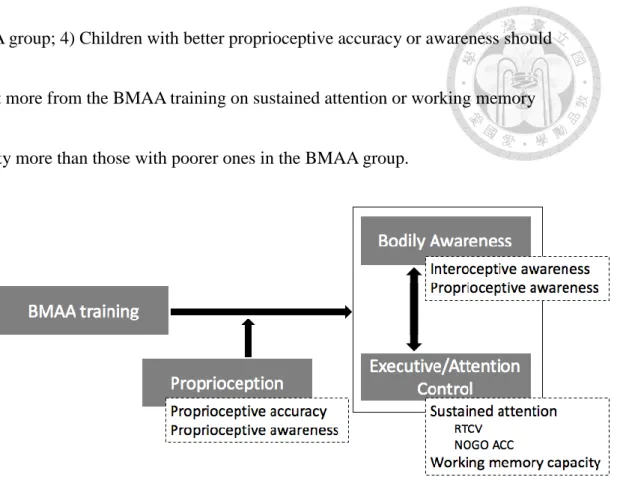
Figure 1 shows the schematic diagram about the relationships among BMAA training,
bodily awareness, and executive control mentioned in my hypotheses.
To test my hypothesis, a randomized control trial with pretest-posttest designed
was used. All children would complete SART, OSPAN, heartbeat detection task and
passive movement task before and after an intervention, BMAA program or a camp-
like course as an active control. Two kinds of active control group were organized.
Some of the participants in the control group received an active-control program
designed by my research team during the same period as the group that did the
BMAA practice. In this program, only BMAA practices were replaced with physical
and mental games (for details, see Method session). The other participants in the
control group were allowed to participate in summer camps or activities from other
sources available to them during the same time as the study was held. Themes of
these camps could be various kinds of sport games, science or language, handicraft,
cooking, outdoor activities or travelling. Some participants attended several. These
are typical activities that Taiwanese school children would do and enjoy during a
summer vacation. Therefore, it is appropriate to use it a baseline control. Note that
programs related to mindfulness-based training, martial arts or yoga was excluded.
My predictions are as follows: 1) Compared to the control group, the BMAA
group would improve more on proprioceptive awareness and interoceptive awareness,
working memory capacity, and sustained attention (i.e., higher NOGO ACC and lower
RTCV) after training. In other words, a group effect which compared with the
improvement ratio would be found; 2) Better proprioceptive awareness or
interoceptive capacity are associated with better sustained attention or better working
memory in the pretest; 3) Improvement on NOGO ACC, RTCV and working memory
capacity would be accompanied with the improvement of bodily awareness in the
BMAA group; 4) Children with better proprioceptive accuracy or awareness should
benefit more from the BMAA training on sustained attention or working memory
capacity more than those with poorer ones in the BMAA group.
Figure 1. A conceptual diagram illustrating the possible relationship among bodily awareness and executive functions, and the possible training effect of BMAA-C.
Method
Participants
Fifty-five normal children aged between 8 and 11 years old were recruited via
internet with the agreement of their parents. To increase the validity or correlational
study, nine children were further recruited here. None of them has taken any medicine
regularly or had the history of psychological diagnosis based on parents’ reports. Six
of them were excluded because of task incompletion or they showed too much
tiredness to focus on task in the pre-test. The analysis for correlational study were
thus based on fifty-eight children, 30 boys (M = 9.43 years old; SD = 0.86) and 28
girls (M = 9.61 years old; SD = 0.83), with average age 9.52 years (SD = 0.84).
As for the next study of the training effect, forty-nine participants (excluding the
later-recruited nine children) were randomly assigned to either BMAA-C program or
other program according to their available time. One children in the BMAA group
was further excluded for having an accuracy rate of zero in SART. Finally, the BMAA
group thus included 27 children (14 boys and 13 girls) with the mean age of 9.59 (SD
= 0.75) years old, and the control group consisted of 21 children (10 boys and 11
girls) with the mean age of 9.38 (SD = 0.74) years old. The participants of the BMAA
group and the control group were matched for age and gender. The study was
approved by Research Ethics Committee of National Taiwan University and the
informed consents were collected.
Design and procedures
A pretest-posttest control group design was used. Both BMAA training group
and the control group were tested with a set of tasks twice, within 2 weeks before
(time 1, T1) and after the intervention program (time 2, T2). All the participants were
tested individually in two separate days within two weeks at each test phase. In the
first day, they were tested with the passive movement task, a proprioception test, for
about 30 minutes and the sustained attention response task for about 20 minutes. The
order between these two tasks were counter-balanced, with a 10-minute break
between. In the second day, the participants completed a 15-minute heartbeat
detection task for interoception among other tasks not relevant to the current study.
Interventions
Body-Mind Axial Awareness practice for children (BMAA-C)
As mentioned previously, BMAA emphasizes practices that take practitioners’
attention back to the so-called body-mind axis to enhance self-awareness and be able
to move and attend efficiently but relaxingly (Chen, 2011a; Teng & Lien, 2016).
BMAA-C is lengthened and revised from the 12-hour adult version used in Teng &
Lien (2016) to be appropriate for children by the research team that I belong to.
BMAA-C course consists of 11 3-hour sessions, 3 in each week, across 3 and
half weeks. The course time was 33 hours in total. As can be seen in Table 2, each
class session consists of 1) a 30-minute welcoming and warm-up at the beginning,
during which children participants reported their arrivals, handed in home
assignments, and participated group activity as a warming-up and help to develop a
positive rapport with the trainers; 2) two separated parts of BMAA practice, an hour
for each; 3) a 15-minute snack time; and 4) a 15-minute end routine, during which
home assignment was delivered and the classroom was cleaned up by children. In
addition, BMAA practice II was replaced with a one-hour outing around NTU campus
once a week, 3 in total.
The main theme for BMAA practices in each class session is shown in Table 3,
including knowing and feeling the body, pacifying the mind and feeling the central
bodily axis, training the strength of one body part while keeping others relaxed, being
in the state of body-mind axial awareness ……etc. In particular, the program starts
with practicing the muscles involved in the five sense organs. Next, the practices of
using upper and the lower limbs, the scapula, and the spinal column was then taught.
All these practices were followed the principle of body-mind axial awareness.
Children were also taught how to apply the principle to the movements in daily life
such as walking, sitting, or even how to get up from a bed.
Table 2
The Components in Each Class Session of BMAA Program.
Minutes Components
30 Warm-up:
Welcoming.
Students report arrival and hand in home assignments.
Group activity.
60 BMAA practices I 15 Snack time
60 BMAA practices II 15 End Routine:
Instructors deliver the take-home assignment. Students clean up the classroom.
Table 3
The Main BMAA Practices in Each Class Session for the BMAA Group Session Main practices for each session
1 Knowing and feeling the body:
a. Introducing body parts, joints, and bones.
b. Introducing the concept of body-mind axis: A magic way to be the master of your body and mind.
c. Self-massaging five sense faculties and feeling their flexibility and softness.
d. Testing the nimbleness and strength of extremity endpoint.
2 Pacifying the mind and feeling the central bodily axis I:
a. Practices on increasing the flexibility of the five sense faculties.
b. Practices on keeping one’s eyes looking inwards and downwards relaxingly with the eyes closed or semi-closed in a sitting or lying position.
c. Stretching the five endpoints of one’s body (i.e. head, two hands and two feet) while keeping the eyes closed and looking inwards to
experience the central bodily axis.
d. Feeling one’s own breath and practice channeling the breath through abdominal movement.
3 Pacifying the mind and feeling the central bodily axis II:
a. Practices on increasing the flexibility of shoulder blades and thoracic b. Practicing uninostril breath while projecting one's attention inwards to the bodily central axis.
4 Training the strength of one body part while keeping others relaxed in a lying position I:
a. Practices on increasing the nimbleness and strength of fingers while keeping the shoulders, neck and head relaxed.
b. Practices on increasing the nimbleness and strength of toes while keeping the upper part of body relaxed.
5 Practices on keeping one’s back straight in accord with BMAA principles:
a. Practices on stabilizing the trunk by keeping coccyx forwards and contracting the levator ani.
(continued)
Table 3
The Main BMAA Practices in Each Class Session for the BMAA Group Session Main practices for each session
5 b. Feel the central bodily axis, a channel that connecting perineum and the top of head, when doing (a).
Channeling one’s attention towards the central bodily axis with the eyes closed while doing a movement
6 Practices on increasing the flexibility of spine with the principles:
a. Feel and move each bone of the spine.
Rolling one’s back.
7 Being in the state of body-mind axial awareness I: the lower limbs.
Meditative practices:
a. Eating rice mindfully.
b. Smelling and listening mindfully.
b. Practicing sitting meditation in accord with the BMAA principles.
8 Being in the state of body-mind axial awareness II:
c. Connecting each individual BMAA movement into a set of specific sequential movements and practicing it continuously for half an hour 9. Walking by the BMAA principles:
a. Practices on keeping the trunk moves as an integrated whole.
Practicing to mark time and walk in accord with the principle.
10 Being in the state of body-mind axial awareness III:
b. Practicing BMAA movements continuously and feeling the integration of mind and body.
11 Final review
Intervention for the control group
As previously mentioned, there were two types of control group. Nine out of 21
children participated summer camps or activities commonly offered during the
parents and were not related to mindfulness-based training, martial arts or yoga. The
remain participants (12 out of 21) in the control group were received an intervention,
which was also designed by the research team, during the same period as the BMAA
group. The procedure of this active-control program was almost the same as BMAA-
C in Table 2. Only the time for BMAA practice were replaced with physical and
mental games, such as group activities, drawing, ball playing, dancing, board games
and puzzle games.
Both BMAA course and the active-control program designed by us are taught
by the members of the research team mentioned above, most of them have had
practiced BMAA for more than 2 years. There are 4 to 7 members in each session.
The children participants never met with the trainers before the study.
Tasks and Materials
Sustained Attention Response Task (SART)
The task was programmed with PsychoPy (version 1.82; Peirce, 2009) and
played on a PC laptop. Each participant was seated in front of the laptop on a table,
with a distance that the participant felt comfortable, in a quiet room. SART consisted
of 250 trials, in each a digit between 0 to 9 was randomly presented on the screen.
Participants were asked to press the space key of a keyboard as fast as possible when
the number appeared except for number 3, the NOGO trial, during which the
participants should withhold key pressing.
In each trial, a number is shown for 250 ms and followed a 900 ms mask, during which a circled X is displayed. A following trial came immediately after participants’
pressing the key or the fixation time was over. Twenty-five trials (10%) were the
NOGO trials and the remaining 225 trials were GO trials (when the numbers other than “3” presented).
The reaction time coefficient of variability of correct GO trials (RTCV) and the
accuracy of NOGO trials (NOGO ACC) were computed for each individual as
previously mentioned, with higher NOGO accuracy and lower RTCV representing
fewer attentional lapse, thus better sustained attention.
The operational span task (OSPAN)
In each trial of this task, the participants were asked to a) read out loud an
equation involving single-digit addition and subtraction appeared on the screen of
computer, b) verify the correctness of the equation by saying yes or no and c) stated
and memorized a Chinese two-character word presented on the screen after the
verification. In each trial, the above procedure was repeated 2-6 times making the
number of words to be remembered ranged from 2 to 6. The Chinese two-character
words were selected from Report of Word Frequency for Elementary School Children
by Ministry of Education of Taiwan. Half of the equations was correct and the other
half was wrong. At the end of each trial, a recall instruction will appear, the
participants were then asked to recall the words appeared in the trial, in any order, as
many as possible. According to the number of words to be recalled, there were five
levels of trial difficulty, three trials at each level, making fifteen trials in total. The
working memory capacity for each participant was measured by the total number of
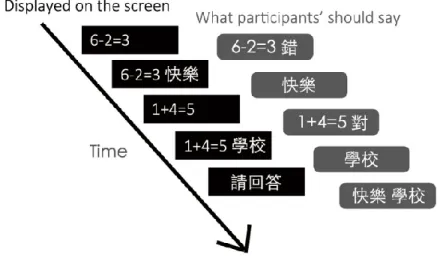
recalled words. The procedures of OSPAN is illustrated in Figure 2.
Figure 2. The procedures of operational span task.
Heartbeat Detection Task
Participants were seated restfully and instructed to concentrate on their
heartbeat signals and counted their heartbeats silently without trying to control of it.
Before the task, there was a 10-minute rest time for the participants to calm down and
to wear a sensor of electrocardiogram (ECG) on their point-finger to measure their
actual heartbeats. There were six trials with varied intervals, 13, 20, 25, 18, 23 and 15
seconds, respectively, and a 20-second break between each trial. The beginning and
the end of each trial was orally given by an instructor, and no other feedback was
given during or after the trial. Participants had to verbally report how much pulse they counted after they heard the “stop” instruction. In addition, they were asked to judge
how confident they were in their counts with a 7-point Likert scale, 1 represents no
confidence at all and 7 represents very confident.
Interoceptive accuracy (IAC) is indicated by the difference between the reported
heartbeats and the actual ones counted by ECG for each trial suggested by Schandry
(1981) as below:
IAC = 1
NIAC× Σ(1 −|recorded heartbeats − counted heartbeats|
recorded heartbeats )
NIAC = Number of IAC trials
The interoceptive awareness (IAW) is measured by a mean-square approach
proposed by Meessen et al. (2016), which is an average degree of congruency
between IAC and the confidence judgment for interoception (CJI) for each trial
according to the following formula. Note that he CJI was converted from 7-point
Likert scale to hundred-mark scale.
IAW =Σ[(IAC × 100 −100 7 CJI)2] NIAC
Passive Movement Task
In this task, how accurately a participant could sense the movement of his hip
joints was chosen to represent the proprioceptive sense. The movements of hip joints
was measured by twelve makers taped on relevant joints (including: trunk: xiphoid
notch, xiphoid process, left acromion and right acromion; pelvic: right anterior
superior iliac spine, left anterior superior iliac spine, right middle pelvic and left
middle pelvic; and the knee of dominant leg: medial epicondyle, lateral epicondyle,
thigh and greater trochanter), with which three-dimensional marker trajectories were
captured with a six-camera motion analysis system (VICON MX, Oxford Metrics Inc,
Oxford, UK). Although the angle of body limbs can be measured by protractor but the
motion analysis system was more sensitive to the difference of angles and the error is
also smaller than protractor.
After finishing marker taping, participants were told to lie down on a bed with
their hands put on their abdomen and eyes closed. At each trial, a participant’s
dominant leg was passively moved to a particular angle, either above 45 degrees or
under 45 degrees, and then moved back to the original position by an instructor. The
participants were then asked to actively move their leg to the position that had been
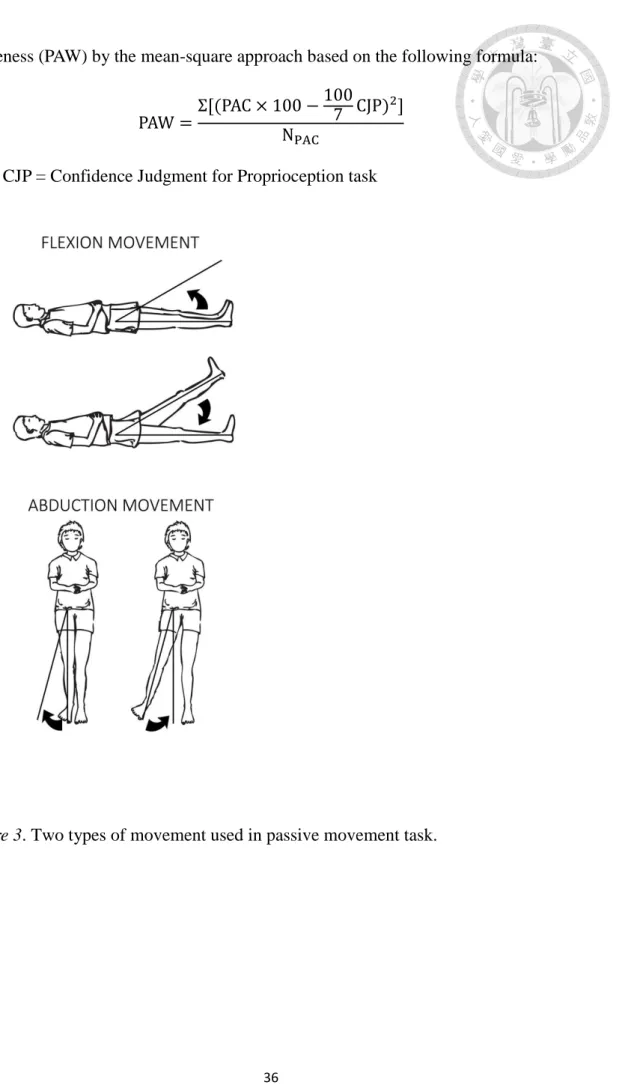
placed afterwards. Two types of movement of leg involving hip joints, abduction and
flexion, were measured in this task. For each type of movement, there were two trials
for each type of angle (i.e., above and under 45 degrees), constituting eight trials in
total. The types of movement are illustrated in the Figure 3.
After each trial, participants were also asked to make a confidence judgment on
how accurate their active placings were with a 7-point Likert scale, as 1 represents
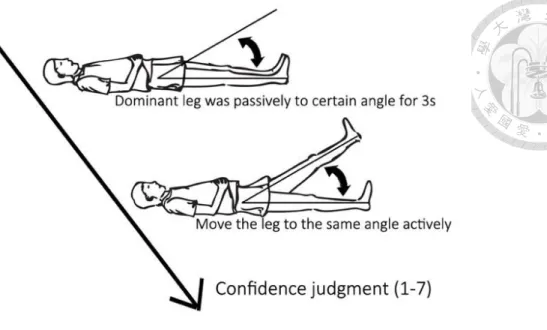
that they have no confidence at all and 7 very confident. The procedures of passive
movement task is illustrated in the Figure 4.
I define proprioceptive accuracy (PAC) by the degrees that the active placing
angels deviate from the passive placing ones, which is shown as follow:
PAC = 1
NPAC× Σ(1 −|angle of passive move − angle of active move|
angle of passive move ) NPAC = Number of PAC trials
Analogous to how interoceptive awareness is gauged, I define proprioceptive
awareness (PAW) by the mean-square approach based on the following formula:
PAW = Σ[(PAC × 100 −100 7 CJP)2] NPAC
CJP = Confidence Judgment for Proprioception task
Figure 3. Two types of movement used in passive movement task.
Figure 4. The procedures of passive movement task.
Results of Pre-test Correlation
Data Analysis
In order to examine if there is any relationship between body (bodily senses) and
mind (sustained attention and working memory), the correlational analysis was done
for the pre-test measures. The following statistics were calculated with SPSS version
21. Before examining the main concern about the correlations between each of the
bodily senses (interoception and proprioception) and cognitive performance (working memory, RTCV and NOGO ACC) will be examined, the participants’ performance on
each of the three tasks with respect to gender and their ages will be reported first, and
then the inter-domain correlations between the interoception and proprioception. All
results were considered significant at p < .05, two-tailed.
Children’s Performances of Interoception (Heartbeat Detection Task)
As shown in Table 4, the mean score of interoceptive accuracy for all the
participants is 0.68 (SD = 0.16) and that of interoceptive awareness is 729.66 (SD =
578.40). There is an unexpected significant correlation between interoceptive
accuracy and interoceptive awareness (r = .43, p < .01). Note that for the indices of
awareness used in this study, smaller numbers represent better awareness (i.e., less
incongruence between subjective confidence ratings and objective-measured
accuracy) than the larger ones. The above finding thus indicates children better at
counting heartbeat, nevertheless, do worse on judging how good their counts were.
No gender difference is found for either interceptive accuracy or awareness
(Accuracy: F(1,56) = .01, p = .91; Awareness: F(1,56) = 1.97, p = .17). In addition,
neither one is significantly associate to age (Accuracy: r = -.02, p = .89; Awareness: r
= .11, p = .41).
Children’s Performances of Proprioception (Passive Movement Task)
For all participants, the mean score is 0.81 (SD = 0.06) for proprioceptive
accuracy and 663.80 (SD = 431.49) for proprioceptive awareness. Unlike
interoception, there is no correlation between proprioceptive accuracy and awareness
(r = -.06, p = .66). For each of the index, neither gender difference (Accuracy: F(1,56)
= .68, p = .41; Awareness: F(1,56) = .06, p = .80), nor the correlation to age
(Accuracy: r = .11, p = .43; Awareness: r = .11, p = .42) was found.
Children’s Performance of Sustained Attention (SART)
For SART, the measurement of sustained attention, the mean accuracy of NOGO
trials (NOGO ACC) is 0.40 (SD = 0.20) and the mean Reaction Time Coefficient of
Variability of GO trials (RTCV) for GO trials is 0.39 (SD = 0.12). There was a
significant difference in RTCV between male (M = .43, SD = .12) and female (M
= .35, SD = .11), F(1,56) = 6.26, p < .05. Children’s RTCVs were also significantly
correlated with age, r = -.39, p < .01. As for NOGO ACC, neither a gender difference,
F(1,56) = 2.55, p = .11, nor a significant correlation with age, r = .19, p = .15, was
found.
Children’s Performance of Working Memory (OSPAN)
The working memory capacity was measured by the total number of OSPAN. The
mean score was 38.34 (SD = 6.40). There was no significant gender difference
F(1,56) = .63, p = .43 but it correlated with ages significantly, r = .29, p = .03.
Table 4
Descriptive Statistics for Children’s Performance on Proprioception, Interoception, Sustained Attention and Working Memory Capacity at T1 (N=58)
Indexes Mean SD Min Max
Proprioceptive Accuracy 0.81 0.06 0.66 0.92
Proprioceptive Awareness 663.80 431.49 63.60 1771.14
Interoceptive Accuracy 0.68 0.16 0.27 0.96
Interoceptive Awareness 729.66 578.40 36.29 2508.74
GO trial RTCV 0.39 0.12 0.17 0.71
NOGO trial ACC 0.40 0.20 0.04 0.96
Working memory capacity 38.34 6.40 21.00 49.00
Note: RTCV is short for reaction time coefficient of variability.
Correlation between Interoception and Proprioception
The inter-domain correlations between interoception and proprioception for
accuracy and awareness were also examined, respectively. There was a significant
positive correlation (r = .30, p < .05) between proprioceptive and interoceptive
awareness but no any relation was found in accuracy across domains (r = -.13, p
= .34)
Correlations between Bodily Senses and Sustained Attention
As predicted, children’s proprioceptive awareness is positively correlated with their performance on sustain attention. Specifically speaking, children’s scores of
proprioceptive awareness was positively correlated with RTCV (r = .30, p < .05) and
negatively correlated with NOGO accuracy (r = -.28, p < .05). In other words,
children who have better proprioception awareness tend to have higher accuracy and
respond in a more stable way in the sustain attention task, both of which indicating
fewer mind wandering and better sustained attention, than those have worse
awareness. In contrast, there is no significant correlation between interoceptive
awareness and measures of SART (RTCV: r = -.14, p = .29; NOGO ACC: r =.07, p
= .59).
In addition, it shows that proprioceptive accuracy has a significant correlation
with RTCV (r = -.37, p < .01) and a no-significant-trend in relating to NOGO ACC (r
= .24, p = .07). That is to say that children with higher proprioceptive accuracy
showed more consistent speed of responding, and thus have fewer mind wandering,
than those with lower accuracy. However, no such correlation was found between
interoceptive accuracy and sustained attention (Accuracy: r = .00, p = 1.00;
Awareness: r = .05, p = .71).
On the other hand, different from the results above about sustained attention, no
any indexes of bodily senses (interoception or proprioception) correlated with
working memory, neither awareness nor accuracy (ps > .10). All the above results are
shown in Table 5.
Did Interoceptive Awareness Play the Other Role than the Predictor for
Sustained Attention?
In the previous analysis, the direct relation between awareness and sustained
attention was found only in proprioception but not interoception. However,
interoceptive awareness associate with proprioceptive awareness significantly. It is
possible that interoceptive awareness may have effect on the relation between
proprioceptive awareness and sustained attention, so two separate moderation
analyses were carried out for RTCV and NOGO ACC. In all the regression analysis,
the proprioceptive awareness and interoceptive awareness were all mean centered (to
reduce the possibility of multicollinearity among the interaction terms and their
component predictors) and the interaction term between them were computed (Aiken
& West, 1991). The two predictors and the interaction term were simultaneously
entered into regression model. At first, RTCV was analyzed and it showed that the overall regression reached significance (𝑅2 = .16; 𝑅𝑎𝑑𝑗𝑢𝑠𝑡𝑒𝑑 = .11; F(3,54) = 3.34, p
= .03) and proprioceptive awareness (β = .35, p = .01) was significantly predictive for
RTCV which was in line with our relational results that mentioned above. In addition,
the interaction term had a trend toward significance (β = -.23, p = .09) while
interoceptive awareness was not significantly predictive for RTCV (β = -.08, p = .56).
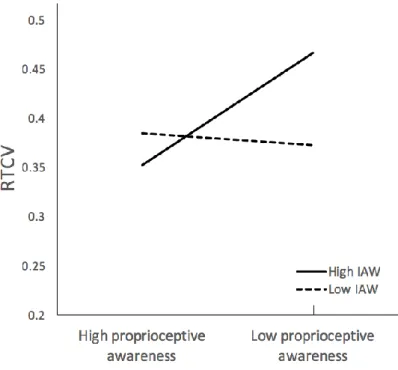
The slopes were illustrated in Figure 5.
In other words, we can see from Figure 5 that the relation between proprioceptive
awareness and RTCV was more obvious in the children who have better interoceptive
awareness. For the children who have lower interoceptive awareness, this kind of relation is not clear. That is, although interoceptive awareness didn’t directly associate
with RTCV, the role it played was the moderator for the effect of proprioceptive
awareness on RTCV.
As for the NOGO ACC, overall regression did not reach significance (𝑅2 = .10;
𝑅𝑎𝑑𝑗𝑢𝑠𝑡𝑒𝑑 = .05; F(3,54) = 2.01, p = .12). Identical with previous relational results,
only proprioceptive awareness was significantly predictive for NOGO ACC (β = -.30,
p = .03). Neither the predictiveness of interoceptive awareness nor the interaction
term was significant or has the trend toward significance. (interoceptive awareness: β
= -.02, p = 91; interaction: β = .15, p = .27)
Table 5
Inter-correlation Matrix among the Scores on Proprioception, Interoception, Sustained Attention and Working Memory Capacity at T1 (N=58) Proprioceptive
Accuracy
Proprioceptive Awareness
Interoceptive Accuracy
Interoceptive Awareness
GO trial RTCV
NOGO trial ACC
Working memory capacity
Proprioceptive Accuracy 1
Proprioceptive Awareness -.06 1
Interoceptive Accuracy -.13 -.03 1
Interoceptive Awareness -.07 .30* .43** 1
GO trial RTCV -.37** .30* .00 -.14 1
NOGO trial ACC .24∆ -.28* .05 .07 -.66** 1
Working memory capacity -.03 -.04 -.003 .14 -.20 .17 1
Note: RTCV is short for reaction time coefficient of variability.
∆ p<.10. * p<.05. ** p<.01.
Figure 5. The scores of RTCV (reaction time coefficient of variability) for children with high/low interoceptive awareness (IAW) and high/low proprioceptive awareness.
Discussion I
In summary, there are three main findings about the correlational analysis on the pretest scores. First, children’s abilities regarding proprioception are related to their
performance on sustained attention. Specifically speaking, children better at
proprioceptive awareness respond to GO trials with a more constant speed (i.e.,
smaller RTCVs) and have higher accuracy rates for NOGO trials (NOGO ACC) in
SART than those worse. In addition, children better at proprioceptive accuracy also
tend to be better at RTCV. Remind that high stability of reaction time for Go trials and
high accuracy rate for NOGO trials both represent better control of attention.
Although practicing body awareness or somatic attention has been thought to be
crucial for the positive training effect of mindfulness training on attention, my finding, for the first time, demonstrates that children’s body awareness, i.e.,
proprioceptive awareness, is associated to their attention control.
Second, although no correlation between sustained attention and interoception is
found, children’s interoceptive awareness is nevertheless significantly correlated with
proprioceptive awareness, and moderates the relation between proprioceptive
awareness and RTCV. That is, the positive correlation between proprioceptive