Tribe Dendrothripini
Antennal segments, except the terminal two, short and rounded. Metafurca large and obvious, forming a U shaped chitinized structure, the arms extending anteriorly to mesofurca.
Abdominal tergites with median pair setae closely situated, distance shorter than setae length.
Genus Dendrothrips Uzel
Dendrothrips Uzel, 1895: 159. Type species: Thrips ornata Jabl., 1894.
Head short and wider than long, vertex depressed between compound eyes. Antennae 8 or 9-segmented, segments III and IV with simple or forked sense cone, segments III-VI with microtrichia. Pronotum with transverse striae, without major setae. Forewing anterior margin curved downward to meet posterior margin, costal setae only on median portion, lacking on basal and apical ends, tip of apex with no seta. Laterals of abdominal tergites reticulated. Over 50 species in the world.
Key to species of Dendrothrips in Taiwan
1. Antennal segments III and IV each with a simple sense cone; forewing dark, with a median transparent band ... minowai -- Antennal segments III and IV each with a forked sense cone ... 2 2. Forewing with 4 brown bands; abdominal tergites without color spots ... maltimaculatus -- Forewing without obvious dark or transparent bands; abdominal tergites III-VI with
grayish spots ... guttatus
See footnote on p. 75.
-- Compound eyes normal; comb on abdominal tergite VIII complete ...
... Mycterothrips (part) 31. Two distal setae on upper vein of forewing situated in dark area; abdominal tergite VIII
with 3-4 rows of microtrichia near anteroangular ... Megalurothrips -- Distal setae of upper vein not in dark area; abdominal tergite VIII without rows of
microtrichia ... 32 32. Pronotum with 0-1 pair of posteroangular setae ... Dichromothrips -- Pronotum with 2 pairs of posteroangular setae ... Craspedothrips 33. Antennal segments III and IV with simple sense cone ... Bolacothrips -- Antennal segments III and IV with forked sense cone ... 34 34. Postocular region of head with transverse foldings to form raised sculpture; forewing with brownish markings ... Lefroyothrips -- Postocular region of head without transverse foldings; forewing may paler at base and
apex, but mainly with uniform color ... 35 35. Abdominal tergite VIII with several irregularly arranged micr-otrichia in front of spiracles ... Taeniothrips -- Abdominal tergite VIII with ctendia behind spiracles ... 36 36. Interocellar setae about same length as anteocellar setae; mesofurca with spinula ...
... Thrips (Thrips) -- Interocellar setae much longer than anteocellar setae; postocular setae long; mesofurca
without spinula ... Stenchaenothrips
hripidae
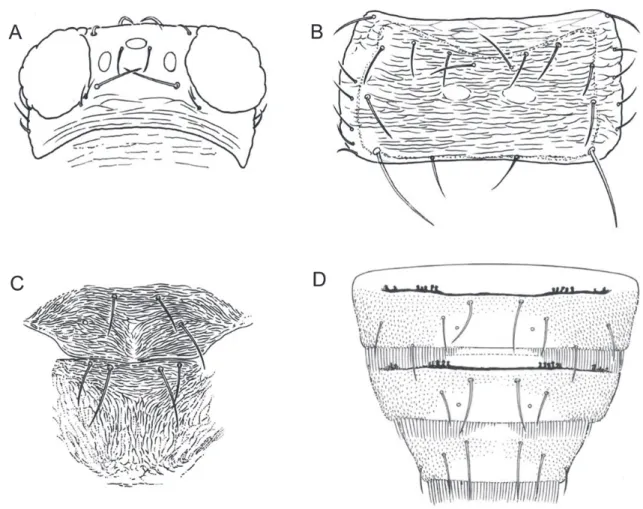
Fig. 26. Dendrothrips guttatus (♀) A. left antenna; B. head and pronotum; C. portion of forewing; D.
median of meso- and metanotum; E. median and right lateral of tergite II; F. median and right lateral of tergite V.
Dendrothrips guttatus Wang (Fig. 26) Dendrothrips guttatus Wang, 1993a: 254-256.
Female body length 0.9 mm on slide. Head and thorax yellowish brown, abdomen whitish yellow, laterals of abdominal tergites II, VII and VIII grayish yellow, 3 grayish spots on each side of tergites III-VI; antennae grayish yellow, distal end of segment V and segments VI-VIII brown. Fore and mid femora grayish brown, hind femora brown, paler on base; tibiae and tarsi whitish yellow, mid tibiae light brown. Forewings paler on median and subapical areas, basal portion transparent; major setae light brown.
Head wider than long, dorsum with irregular reticulations and inner dots. Ocellar setae short.
Maxillary palpi 2-segmented. Antennae 8-segmented, segments III and IV with forked sense cone, sense cone on inner side of VI reach base of VIII.
Pronotum broad, covered with reticulations and inner dots, no major setae. Mesonotum with dense transverse striae; metanotal triangle with dotted reticulations. Forewing without microtrichia, vein setae minute.
Median of abdominal tergites II-VIII smooth, laterals with reticulations; reticlulated sculpture obvious on tergites II, III, VII and VIII, dots inside reticulations; reticulations on tergites IV-VI weak; median pair setae on tergites II-VIII longer posteriorly, close to each other on tergite VI, posterior comb present on median of tergite VIII, lacking on laterals; tergite X complete.
Male unknown.
Distribution: Taiwan.
Habitat: Aleurites moluccana.
hripidae
Fig. 26. Dendrothrips guttatus (♀) A. left antenna; B. head and pronotum; C. portion of forewing; D.
median of meso- and metanotum; E. median and right lateral of tergite II; F. median and right lateral of tergite V.
Dendrothrips guttatus Wang (Fig. 26) Dendrothrips guttatus Wang, 1993a: 254-256.
Female body length 0.9 mm on slide. Head and thorax yellowish brown, abdomen whitish yellow, laterals of abdominal tergites II, VII and VIII grayish yellow, 3 grayish spots on each side of tergites III-VI; antennae grayish yellow, distal end of segment V and segments VI-VIII brown. Fore and mid femora grayish brown, hind femora brown, paler on base; tibiae and tarsi whitish yellow, mid tibiae light brown. Forewings paler on median and subapical areas, basal portion transparent; major setae light brown.
Head wider than long, dorsum with irregular reticulations and inner dots. Ocellar setae short.
Maxillary palpi 2-segmented. Antennae 8-segmented, segments III and IV with forked sense cone, sense cone on inner side of VI reach base of VIII.
Pronotum broad, covered with reticulations and inner dots, no major setae. Mesonotum with dense transverse striae; metanotal triangle with dotted reticulations. Forewing without microtrichia, vein setae minute.
Median of abdominal tergites II-VIII smooth, laterals with reticulations; reticlulated sculpture obvious on tergites II, III, VII and VIII, dots inside reticulations; reticulations on tergites IV-VI weak; median pair setae on tergites II-VIII longer posteriorly, close to each other on tergite VI, posterior comb present on median of tergite VIII, lacking on laterals; tergite X complete.
Male unknown.
Distribution: Taiwan.
Habitat: Aleurites moluccana.
hripidae
Fig. 27. Dendrothrips maltimaculatus (♀) A. head and pronotum; B. meso- and metanotum; C.
forewing; D. right antenna; E. tergite II; F. tergite VI. (Nonaka & Okajima, 1992)
Dendrothrips maltimaculatus Nonaka & Okajima (Fig. 27) Dendrothrips maltimaculatus Nonaka & Okajima, 1992: 110-113.
Female body length 1.1 mm on slide. Head, thorax, legs and tergite II brown, tergites III, VII-IX grayish brown, tergites IV-VI yellow, each tergite with 2 pairs of spots; forewing transparent, with 4 brown bands, basal band broadest; antennal segments II, VI-VIII brown, I and V grayish brown, III and IV yellowish brown.
Head wider than long, dorsum with irregular reticulations with inner dots. Ocellar setae short. Antennae 8-segmented, segments III and IV with forked sense cone, sense cone on inner side of VI reach apex of VIII.
Pronotum broad, covered with reticulations with dots inside, no major setae, 6 pairs of posterior marginal setae, all short. Mesonotum with transverse striae, with inner dots;
longitudinal striae on metanotum with dots. Forewing without microtrichia, upper vein with 19-23 setae, lower vein with 2-4 setae.
Abdominal tergite I smooth; laterals of tergite II clearly reticulated, with dots inside; laterals of tergites III-VI with weak reticulations; tergite VII with clear reticulations; posterior comb on tergite VIII present on median, lacking on laterals; tergite X no split.
Male body length 0.8 mm on slide. Color similar to female but paler, reticles weaker. Forewing with 3 brown bands.
Distribution: Taiwan, Japan.
Habitat: Quercus sp.
hripidae
Fig. 27. Dendrothrips maltimaculatus (♀) A. head and pronotum; B. meso- and metanotum; C.
forewing; D. right antenna; E. tergite II; F. tergite VI. (Nonaka & Okajima, 1992)
Dendrothrips maltimaculatus Nonaka & Okajima (Fig. 27) Dendrothrips maltimaculatus Nonaka & Okajima, 1992: 110-113.
Female body length 1.1 mm on slide. Head, thorax, legs and tergite II brown, tergites III, VII-IX grayish brown, tergites IV-VI yellow, each tergite with 2 pairs of spots; forewing transparent, with 4 brown bands, basal band broadest; antennal segments II, VI-VIII brown, I and V grayish brown, III and IV yellowish brown.
Head wider than long, dorsum with irregular reticulations with inner dots. Ocellar setae short. Antennae 8-segmented, segments III and IV with forked sense cone, sense cone on inner side of VI reach apex of VIII.
Pronotum broad, covered with reticulations with dots inside, no major setae, 6 pairs of posterior marginal setae, all short. Mesonotum with transverse striae, with inner dots;
longitudinal striae on metanotum with dots. Forewing without microtrichia, upper vein with 19-23 setae, lower vein with 2-4 setae.
Abdominal tergite I smooth; laterals of tergite II clearly reticulated, with dots inside; laterals of tergites III-VI with weak reticulations; tergite VII with clear reticulations; posterior comb on tergite VIII present on median, lacking on laterals; tergite X no split.
Male body length 0.8 mm on slide. Color similar to female but paler, reticles weaker. Forewing with 3 brown bands.
Distribution: Taiwan, Japan.
Habitat: Quercus sp.
hripidae
Fig. 28. Dendrothrips minowai (♀) A. head and pronotum; B. left antenna. (Chen, 1979)
Dendrothrips minowai Priesner (Fig. 28) Dendrothrips minowai Priesner, 1935b: 353.
Female body length 1.0 mm on slide. Grayish brown, compound eyes with red pigment, abdominal segments VIII-X paler; antennal segment I grayish yellow, II grayish brown, III-V whitish yellow but distal end of V darker, VI-VIII grayish brown; forewing dark gray, a transparent band near median; legs grayish brown, fore legs paler than mid and hind legs.
Head wider than long, dorsum with clear reticulated sculpture, posterior ocelli wide apart, ocellar setae each situated in front of posterior ocellus, out of triangular area; no occular setae.
Maxillary palpi 2-segmented. Antennae 8-segmented, segments III and IV with short simple sense cone, sense cone on inner lateral of VI reach or even exceed apex of VIII.
Pronotum broad, covered with reticulations, no major setae, anterior and posterior angle with a major seta, 3 pairs of posterior marginal setae, all short. Forewing vein setae minute, upper vein with 6-7 setae, 3 distal setae, about 38 costal setae.
Abdominal tergite I and laterals of tergites II-X reticulated; median pair of setae on tergite I minute and further apart, median setae on tergites II-VIII closer together; median setae on tergites II-IV short, length (on slide) not reach posterior margin of the segment; length of median setae on tergites V-VIII exceed posterior margin of the segment; posterior comb on tergite VIII present on median, lacking on laterals; tergite X complete. Sternites without discal setae.
Male unknown.
Distribution: Taiwan, China, Japan.
Habitat : Thea sinensis, Diospyros kaki.
hripidae
Fig. 28. Dendrothrips minowai (♀) A. head and pronotum; B. left antenna. (Chen, 1979)
Dendrothrips minowai Priesner (Fig. 28) Dendrothrips minowai Priesner, 1935b: 353.
Female body length 1.0 mm on slide. Grayish brown, compound eyes with red pigment, abdominal segments VIII-X paler; antennal segment I grayish yellow, II grayish brown, III-V whitish yellow but distal end of V darker, VI-VIII grayish brown; forewing dark gray, a transparent band near median; legs grayish brown, fore legs paler than mid and hind legs.
Head wider than long, dorsum with clear reticulated sculpture, posterior ocelli wide apart, ocellar setae each situated in front of posterior ocellus, out of triangular area; no occular setae.
Maxillary palpi 2-segmented. Antennae 8-segmented, segments III and IV with short simple sense cone, sense cone on inner lateral of VI reach or even exceed apex of VIII.
Pronotum broad, covered with reticulations, no major setae, anterior and posterior angle with a major seta, 3 pairs of posterior marginal setae, all short. Forewing vein setae minute, upper vein with 6-7 setae, 3 distal setae, about 38 costal setae.
Abdominal tergite I and laterals of tergites II-X reticulated; median pair of setae on tergite I minute and further apart, median setae on tergites II-VIII closer together; median setae on tergites II-IV short, length (on slide) not reach posterior margin of the segment; length of median setae on tergites V-VIII exceed posterior margin of the segment; posterior comb on tergite VIII present on median, lacking on laterals; tergite X complete. Sternites without discal setae.
Male unknown.
Distribution: Taiwan, China, Japan.
Habitat : Thea sinensis, Diospyros kaki.
hripidae
Head wider than long, median of dorsum with transverse striae, minute wrinkles between striae; 2 pairs of anteocellar setae. Mouth cone rounded, reach posterior margin of pronotum;
maxillary palpi 2-segmented. Antennae 9-segmented, segment I quadrate, II largest and rounded, II-VI with dorsum microtrichia, III and IV with forked sense cone.
Prothorax broad, pronotum with transverse striae and minute longitudinal striae; 2 pairs of major setae on posterior angles, outer pair longer, 2 pairs of posterior marginal setae.
Mesonotum covered with transverse striae, median pair setae situated near posterior margin;
metafurca large. Forewing costal setae 28, upper vein setae 7, well- developed. Hind tarsus quite long, longer than fore or mid tarsi, 2 spurs on distal end of hind tarsus.
Anterior median of abdominal tergite I, laterals of tergites II-VII, and anterior laterals of tergite VIII with transverse striae; striae on tergites II-VII densely arranged and with inner minute longitudinal wrinkles. Median pair setae on tergites II-VIII close to each other, and turned longer towards abdominal terminal. Rows of microtrichia on laterals and posterior median of tergite II-VII, laterals and posterior portion of tergite VIII, and posterior half of tergites IX and X. Tergite X complete. Sternites II-VI and laterals of sternite VII with transverse striae and microtrichia.
Male unknown. Distribution: Taiwan.
Habitat: Morus spp.
Genus Pseudodendrothrips Schmutz
Pseudodendrothrips Schmutz, 1913: 992, 998. Type species: Pseudodendrothrips ornatissima Schmutz, 1913.
Head short and broad, antennae 8 or 9-segmented, segments III and IV with forked sense cone. Pronotum with transverse striae, one major seta on each of posterior angle. Apical portion of anterior margin of forewing not curve downwards, costal setae complete from base to apex, tip of apex with a seta. Laterals of abdominal tergites with transverse striae and microtrichia.
About 20 species in the world.
Key species of Pseudodendrothrips in Taiwan
1. Pronotum reticulations with minute wrinkles ... fumosus -- Pronotum reticulations without wrinkles ... 2 2. Body grayish white; antennae 8-segmented ... mori -- Body brown; antennae 9-segmented ... lateralis
Pseudodendrothrips fumosus Chen (Fig. 29) Pseudodendrothrips fumosus Chen, 1980: 171, 172.
Female body length 0.95 mm on slide. Yellowish brown; antennal segments I and II brown, III yellowish brown, IV-VI grayish yellow and distal ends darker, VII-IX yellowish brown;
posterior 2/3 of mesonotum grayish yellow; abdominal laterals brown, median yellowish brown, antecostal ridge on tergites III-VIII brown; forewings gray, base and apical end paler; femora brown, tibiae grayish brown but yellow on both ends, tarsi yellow.
hripidae
Head wider than long, median of dorsum with transverse striae, minute wrinkles between striae; 2 pairs of anteocellar setae. Mouth cone rounded, reach posterior margin of pronotum;
maxillary palpi 2-segmented. Antennae 9-segmented, segment I quadrate, II largest and rounded, II-VI with dorsum microtrichia, III and IV with forked sense cone.
Prothorax broad, pronotum with transverse striae and minute longitudinal striae; 2 pairs of major setae on posterior angles, outer pair longer, 2 pairs of posterior marginal setae.
Mesonotum covered with transverse striae, median pair setae situated near posterior margin;
metafurca large. Forewing costal setae 28, upper vein setae 7, well- developed. Hind tarsus quite long, longer than fore or mid tarsi, 2 spurs on distal end of hind tarsus.
Anterior median of abdominal tergite I, laterals of tergites II-VII, and anterior laterals of tergite VIII with transverse striae; striae on tergites II-VII densely arranged and with inner minute longitudinal wrinkles. Median pair setae on tergites II-VIII close to each other, and turned longer towards abdominal terminal. Rows of microtrichia on laterals and posterior median of tergite II-VII, laterals and posterior portion of tergite VIII, and posterior half of tergites IX and X. Tergite X complete. Sternites II-VI and laterals of sternite VII with transverse striae and microtrichia.
Male unknown.
Distribution: Taiwan.
Habitat: Morus spp.
Genus Pseudodendrothrips Schmutz
Pseudodendrothrips Schmutz, 1913: 992, 998. Type species: Pseudodendrothrips ornatissima Schmutz, 1913.
Head short and broad, antennae 8 or 9-segmented, segments III and IV with forked sense cone. Pronotum with transverse striae, one major seta on each of posterior angle. Apical portion of anterior margin of forewing not curve downwards, costal setae complete from base to apex, tip of apex with a seta. Laterals of abdominal tergites with transverse striae and microtrichia.
About 20 species in the world.
Key species of Pseudodendrothrips in Taiwan
1. Pronotum reticulations with minute wrinkles ... fumosus -- Pronotum reticulations without wrinkles ... 2 2. Body grayish white; antennae 8-segmented ... mori -- Body brown; antennae 9-segmented ... lateralis
Pseudodendrothrips fumosus Chen (Fig. 29) Pseudodendrothrips fumosus Chen, 1980: 171, 172.
Female body length 0.95 mm on slide. Yellowish brown; antennal segments I and II brown, III yellowish brown, IV-VI grayish yellow and distal ends darker, VII-IX yellowish brown;
posterior 2/3 of mesonotum grayish yellow; abdominal laterals brown, median yellowish brown, antecostal ridge on tergites III-VIII brown; forewings gray, base and apical end paler; femora brown, tibiae grayish brown but yellow on both ends, tarsi yellow.
hripidae
Pseudodendrothrips lateralis Wang (Fig. 30) Pseudodendrothrips lateralis Wang, 1993a: 253, 254.
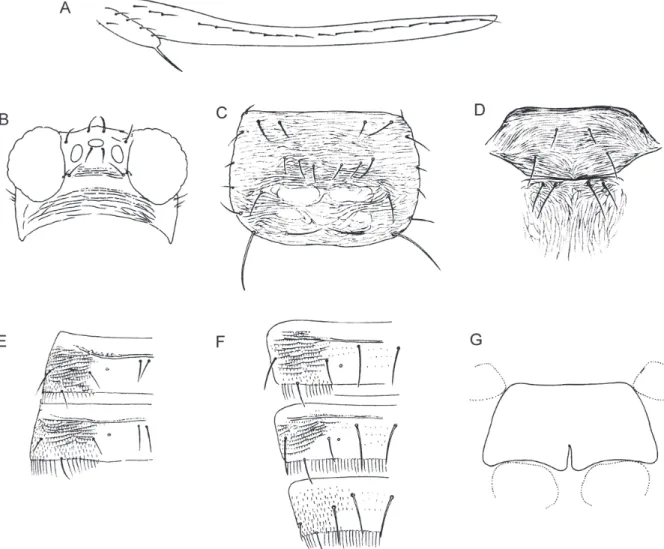
Female body length 0.7-0.95 mm on slide. Head and thorax reddish brown, abdomen yellow, lateral 2/3 of tergite II-VII grayish black and especially darker on posterior margin. Antennal segments I-III yellowish brown, IV-IX grayish brown, bases of IV-VI paler. All femora and tibiae mainly brown, both ends of tibiae yellowish, tarsi yellow. Forewings grayish, base and apical end paler.
Head wider than long, ocellar setae short, interocellar setae arising between anterior half of 2 posterior ocelli. median of dorsum with transverse striae. Maxillary palpi 2-segmented.
Antennae 9-segmented, segment I quadrate, segment II largest and rounded, segments II-VI with dorsum microtrichia, III and IV each with a forked sense cone, single sense cone each on inner base of VI and outer lateral of VIII, the latter exceed IX.
Prothorax broad, pronotum with transverse striae, one pairs of major setae on posterior angles, 3 pairs of posterior marginal setae. Forewing basal 1/4 and apical 1/9 without costal setae, median with 19-25 costal setae; upper vein with 6 setae, wide apart; lower vein without setae. Hind tarsus longer than fore or mid tarsus, distal end with 2 spurs.
Laterals of abdominal tergites II-VIII with rows of microtrichia, especially clear on tergite II and V-VII; median pair setae on tergites II-VIII close to each other, and longer towards abdominal terminal; reticles on median of tergites II-VII weak; posterior comb on tergite VIII complete; tergite X complete. Sternites without discal setae.
Male body length 0.67 mm on slide. Head, thorax and laterals of abdominal segments I and II reddish brown, the rest of abdomen yellowish white except laterals of segments VI-VIII grayish.
Distribution: Taiwan.
Fig. 29. Pseudodendrothrips fumosus (♀) A. left antenna; B. head and pronotum; C. tergites IX and X.
(Chen, 1980)
hripidae
Pseudodendrothrips lateralis Wang (Fig. 30) Pseudodendrothrips lateralis Wang, 1993a: 253, 254.
Female body length 0.7-0.95 mm on slide. Head and thorax reddish brown, abdomen yellow, lateral 2/3 of tergite II-VII grayish black and especially darker on posterior margin. Antennal segments I-III yellowish brown, IV-IX grayish brown, bases of IV-VI paler. All femora and tibiae mainly brown, both ends of tibiae yellowish, tarsi yellow. Forewings grayish, base and apical end paler.
Head wider than long, ocellar setae short, interocellar setae arising between anterior half of 2 posterior ocelli. median of dorsum with transverse striae. Maxillary palpi 2-segmented.
Antennae 9-segmented, segment I quadrate, segment II largest and rounded, segments II-VI with dorsum microtrichia, III and IV each with a forked sense cone, single sense cone each on inner base of VI and outer lateral of VIII, the latter exceed IX.
Prothorax broad, pronotum with transverse striae, one pairs of major setae on posterior angles, 3 pairs of posterior marginal setae. Forewing basal 1/4 and apical 1/9 without costal setae, median with 19-25 costal setae; upper vein with 6 setae, wide apart; lower vein without setae. Hind tarsus longer than fore or mid tarsus, distal end with 2 spurs.
Laterals of abdominal tergites II-VIII with rows of microtrichia, especially clear on tergite II and V-VII; median pair setae on tergites II-VIII close to each other, and longer towards abdominal terminal; reticles on median of tergites II-VII weak; posterior comb on tergite VIII complete; tergite X complete. Sternites without discal setae.
Male body length 0.67 mm on slide. Head, thorax and laterals of abdominal segments I and II reddish brown, the rest of abdomen yellowish white except laterals of segments VI-VIII grayish.
Distribution: Taiwan.
Fig. 29. Pseudodendrothrips fumosus (♀) A. left antenna; B. head and pronotum; C. tergites IX and X.
(Chen, 1980)
hripidae
Pseudodendrothrips mori (Niwa) (Fig. 31) Belothrips mori Niwa, 1908: 180.
Female body length 1 mm on slide. Body in very light color, almost transparent; Antennal segment I similar to body color, II light brown, the rest segments darker towards terminal; ocelli with red pigment; forewings whitish yellow or grayish yellow.
Head wider than long, median of dorsum with weak transverse striae. Maxillary palpi 2-segmented. Antennae 8-segmented, segment I quadrate, II largest and rounded, III and IV oval shaped and each with a forked sense cone, VII slender, some specimen with transverse suture (look like 9-segmented), VIII slender, about half length of VII.
Prothorax broad, pronotum with dense transverse striae, median laterals form a smooth area, 2 major setae on each of posterior angle, 2 pairs of posterior marginal setae. Mesofurca without spinula, metafurca large. Forewing with 24 costal setae, upper vein with 3 basal setae, one median seta, 2 distal setae. Legs slender, tarsi one-segmented, hind tarsus longest.
Laterals of abdominal tergites II-IX and posterior portion of tergite X with rows of microtrichia; median pair setae on tergites II-VIII close to each other, and longer towards abdominal terminal; posterior comb on tergite VIII complete; tergite X complete. Sternites without discal setae.
Male structure and color similar to female. Abdominal tergite IX without stout setae; sternites without glandular area.
Distribution: Taiwan, China, Japan, US.
Habitat: Morus spp.
Habitat: Morus spp., Acacia confusa.
Fig. 30. Pseudodendrothrips lateralis (♀) A. right antenna; B. head; C. forewing; D. enlarged portion of forewing; E. pronotum; F. median and left of tergites II and III; G. sternites VII and VIII.
hripidae
Pseudodendrothrips mori (Niwa) (Fig. 31) Belothrips mori Niwa, 1908: 180.
Female body length 1 mm on slide. Body in very light color, almost transparent; Antennal segment I similar to body color, II light brown, the rest segments darker towards terminal; ocelli with red pigment; forewings whitish yellow or grayish yellow.
Head wider than long, median of dorsum with weak transverse striae. Maxillary palpi 2-segmented. Antennae 8-segmented, segment I quadrate, II largest and rounded, III and IV oval shaped and each with a forked sense cone, VII slender, some specimen with transverse suture (look like 9-segmented), VIII slender, about half length of VII.
Prothorax broad, pronotum with dense transverse striae, median laterals form a smooth area, 2 major setae on each of posterior angle, 2 pairs of posterior marginal setae. Mesofurca without spinula, metafurca large. Forewing with 24 costal setae, upper vein with 3 basal setae, one median seta, 2 distal setae. Legs slender, tarsi one-segmented, hind tarsus longest.
Laterals of abdominal tergites II-IX and posterior portion of tergite X with rows of microtrichia; median pair setae on tergites II-VIII close to each other, and longer towards abdominal terminal; posterior comb on tergite VIII complete; tergite X complete. Sternites without discal setae.
Male structure and color similar to female. Abdominal tergite IX without stout setae; sternites without glandular area.
Distribution: Taiwan, China, Japan, US.
Habitat: Morus spp.
Habitat: Morus spp., Acacia confusa.
Fig. 30. Pseudodendrothrips lateralis (♀) A. right antenna; B. head; C. forewing; D. enlarged portion of forewing; E. pronotum; F. median and left of tergites II and III; G. sternites VII and VIII.
hripidae
Tribe Sericothripini
Head dorsum and occiput clearly separated by an occipital apodeme. Pronotum with blotch;
mesofurca with spinula, metafurca without spinula. Forewings with microtrichia, upper vein setae even and complete, lower vein with 0-2 setae. Abdominal tergites with dense microtrichia, laterals of antecostal ridge with protruded spots. Sternum of some species with microtrichia.
Legs never reticulated.
Key to genus of Sericothripini in Taiwan
1. Metasternum divided into 2 parts by a Y shaped furca ... Hydatothrips -- Mesosternum complete ... Neohydatothrips
Genus Hydatothrips Karny
Hydatothrips Karny, 1913b: 281.Type species: Hydatothrips adolfifriderici Karny, 1913.
Head wider than long. Antennae 8-segmented, segments III and IV with forked sense cone.
Pronotum with blotch; metasternum divided into 2 plates by a Y-shaped bone. Laterals of abdominal tergites I-VII with dense microtrichia; tergites II-VI with posterior comb, longer on laterals, short or lacking on median, posterior comb on tergite VIII complete. Median pair setae on tergites II-IV closely situated, those setae on tergites V-VIII longer, and further apart. About 40 species in the world.
See footnote on p. 75.
Fig. 31. Pseudodendrothrips mori (♀) A. head; B. pronotum; C. meso- and metanotum (Chen, 1980); D.
median and left of tergites II and III.
hripidae
Tribe Sericothripini
Head dorsum and occiput clearly separated by an occipital apodeme. Pronotum with blotch;
mesofurca with spinula, metafurca without spinula. Forewings with microtrichia, upper vein setae even and complete, lower vein with 0-2 setae. Abdominal tergites with dense microtrichia, laterals of antecostal ridge with protruded spots. Sternum of some species with microtrichia.
Legs never reticulated.
Key to genus of Sericothripini in Taiwan
1. Metasternum divided into 2 parts by a Y shaped furca ... Hydatothrips -- Mesosternum complete ... Neohydatothrips
Genus Hydatothrips Karny
Hydatothrips Karny, 1913b: 281.Type species: Hydatothrips adolfifriderici Karny, 1913.
Head wider than long. Antennae 8-segmented, segments III and IV with forked sense cone.
Pronotum with blotch; metasternum divided into 2 plates by a Y-shaped bone. Laterals of abdominal tergites I-VII with dense microtrichia; tergites II-VI with posterior comb, longer on laterals, short or lacking on median, posterior comb on tergite VIII complete. Median pair setae on tergites II-IV closely situated, those setae on tergites V-VIII longer, and further apart. About 40 species in the world.
See footnote on p. 75.
Fig. 31. Pseudodendrothrips mori (♀) A. head; B. pronotum; C. meso- and metanotum (Chen, 1980); D.
median and left of tergites II and III.
hripidae
anterior margin of mesosternum; maxillary palpi 3-segmented, slender. Antennae 8-segmented, segments III and IV with forked sense cone.
Pronotal blotch covered with dense transverse striae, 4 pairs of anterior marginal setae arranged on one row near margin, one seta on lateral margin, 3 pairs of posterior marginal setae;
pronotum outside of the blotch reticulated, anterior reticulations with inner dots; 2 pairs of pronotal anterior setae, distance between 2 median setae longer than length of setae.
Reticulations on mesonotum and metanotum with dotted wrinkles. Forewing upper vein setae complete, lower vein without setae. Tarsi 2-segmented.
Laterals of abdominal tergites I-VII with dense microtrichia; tergites I-VI with posterolateral comb; median pair setae on tergites I-IV close to each other, median pair setae on tergites V-VIII further apart, and setae longer; sublateral of antecostal ridge on tergites II-VII with forwardly protruded spots, more significant on tergite VII; posterior comb on tergite VIII even and complete. Sternites without discal setae.
Male color and shape similar to female but paler; median of abdominal tergites I-VII without dense microtrichia; sternites V-VII each with a transverse glandular area.
Distribution: Taiwan, Japan.
Habitat: Kummerovia striata, Dioscorea benthamii, Macaranga tanarius.
Key to species of Hydatothrips in Taiwan
1. Antennae 7-segmented; abdominal segment VI in lighter color; pronotal blotch with both anterior and posterior sides concaved greatly ... meriposa -- Antennae 8-segmented; abdominal segment VI not lighter; blotch concave only on anterior margin or not concaved ... 2 2. Body yellowish, abdominal segment IV in lighter color; 4 pairs of pronotal anterior
marginal setae, distance between 2 median setae shorter than length of seta ... flavidus -- Body brownish, abdominal segment IV and V, or V only, in lighter color; 2 pairs of
pronotal anterior marginal setae, distance between 2 median setae longer than length of seta ... 3 3. Pronotal reticulations with inner dots; abdominal segment V paler ... liquidambara -- Pronotal reticulations without inner dots; abdominal segment IV and V paler ... ekasi
Hydatothrips ekasi Kudo (Fig. 32) Hydatothrips ekasi Kudo, 1991: 520-523.
Female body length 1.2-1.3 mm on slide. Head and thorax dark brown, abdominal tergites I-III, VI, X brown, IV and V yellow, VII-IX dark brown, antecostal ridges of tergites II-VII dark brown. Antennal segments I, II, III except distal end, basal 1/4 of IV yellow, the rest brown.
Forewing brown, with a subbasal transparent area. Fore femora grayish brown, mid and hind femora darker, all tibiae and tarsi yellow.
Head short, dorsum with dense transverse striae. Occiput 3 times as long as rest of head, with reticulated sculpture on anterior portion, without inner wrinkles; interocellar setae arising near inner side of anterior margin of posterior ocelli. Mouth cone narrow and long, reach
hripidae
anterior margin of mesosternum; maxillary palpi 3-segmented, slender. Antennae 8-segmented, segments III and IV with forked sense cone.
Pronotal blotch covered with dense transverse striae, 4 pairs of anterior marginal setae arranged on one row near margin, one seta on lateral margin, 3 pairs of posterior marginal setae;
pronotum outside of the blotch reticulated, anterior reticulations with inner dots; 2 pairs of pronotal anterior setae, distance between 2 median setae longer than length of setae.
Reticulations on mesonotum and metanotum with dotted wrinkles. Forewing upper vein setae complete, lower vein without setae. Tarsi 2-segmented.
Laterals of abdominal tergites I-VII with dense microtrichia; tergites I-VI with posterolateral comb; median pair setae on tergites I-IV close to each other, median pair setae on tergites V-VIII further apart, and setae longer; sublateral of antecostal ridge on tergites II-VII with forwardly protruded spots, more significant on tergite VII; posterior comb on tergite VIII even and complete. Sternites without discal setae.
Male color and shape similar to female but paler; median of abdominal tergites I-VII without dense microtrichia; sternites V-VII each with a transverse glandular area.
Distribution: Taiwan, Japan.
Habitat: Kummerovia striata, Dioscorea benthamii, Macaranga tanarius.
Key to species of Hydatothrips in Taiwan
1. Antennae 7-segmented; abdominal segment VI in lighter color; pronotal blotch with both anterior and posterior sides concaved greatly ... meriposa -- Antennae 8-segmented; abdominal segment VI not lighter; blotch concave only on anterior margin or not concaved ... 2 2. Body yellowish, abdominal segment IV in lighter color; 4 pairs of pronotal anterior
marginal setae, distance between 2 median setae shorter than length of seta ... flavidus -- Body brownish, abdominal segment IV and V, or V only, in lighter color; 2 pairs of
pronotal anterior marginal setae, distance between 2 median setae longer than length of seta ... 3 3. Pronotal reticulations with inner dots; abdominal segment V paler ... liquidambara -- Pronotal reticulations without inner dots; abdominal segment IV and V paler ... ekasi
Hydatothrips ekasi Kudo (Fig. 32) Hydatothrips ekasi Kudo, 1991: 520-523.
Female body length 1.2-1.3 mm on slide. Head and thorax dark brown, abdominal tergites I-III, VI, X brown, IV and V yellow, VII-IX dark brown, antecostal ridges of tergites II-VII dark brown. Antennal segments I, II, III except distal end, basal 1/4 of IV yellow, the rest brown.
Forewing brown, with a subbasal transparent area. Fore femora grayish brown, mid and hind femora darker, all tibiae and tarsi yellow.
Head short, dorsum with dense transverse striae. Occiput 3 times as long as rest of head, with reticulated sculpture on anterior portion, without inner wrinkles; interocellar setae arising near inner side of anterior margin of posterior ocelli. Mouth cone narrow and long, reach
hripidae
Hydatothrips flavidus Wang (Fig. 33) Hydatothrips flavidus Wang, 2007: 53-54.
Female body length 1 mm on slide. Light yellow to brownish yellow, abdominal tergites II, III, V and VI grayish brown, IV whitish yellow, VII-X yellow, antecostal ridges on tergites II-VI dark brown, on tergite VII grayish brown; antennal segments I-III yellow, IV and base of V grayish brown, the rest segments brown; forewings brown with subbasal transparent area; legs yellow.
Head short, dorsum with dense transverse striae and wrinkles inside. Occiput large, anterior margin reach compound eyes, transverse striae on anterior portion, followed by reticulated sculpture, weak markings inside. Two pairs of anteocellar setae, interocellar setae situated in front of posterior ocelli. Mouth cone narrow and long, reach posterior margin of pronotum;
maxillary palpi 3-segmented, slender. Antennae 8-segmented, segments III and IV with forked sense cone.
Pronotal blotch covered with dense transverse striae, 3 pairs of anterior marginal setae, one pair of anterior submarginal setae, one seta each on lateral margin, 2 pairs of posterior marginal setae. Anterior reticulations on pronotum with sparse dots. Reticulations on mesonotum and metanotum with dotted wrinkles. Forewing upper vein setae complete, lower vein with 2 setae.
Tarsi 2-segmented.
Laterals of abdominal tergites I-VIII with dense microtrichia; tergites II-VII with posterior comb, none or very short in median; median pair setae on tergites I-IV close to each other, those on tergites V-VIII longer and further apart; sublateral of antecostal ridge on tergite II-VII with forwardly protruded spots, more significant on tergite VII; posterior comb on tergite VIII complete. Sternites without discal setae.
Male color and shape similar to female; body length 0.8 mm on slide; sternites VI and VII with transverse glandular area.
Fig. 32. Hydatothrips ekasi (♀) A. forewing; B. head; C. pronotum; D. meso- and metanotum; E. sternite VII; F. tergites III and IV; G. tergites VI-VIII.
hripidae
Hydatothrips flavidus Wang (Fig. 33) Hydatothrips flavidus Wang, 2007: 53-54.
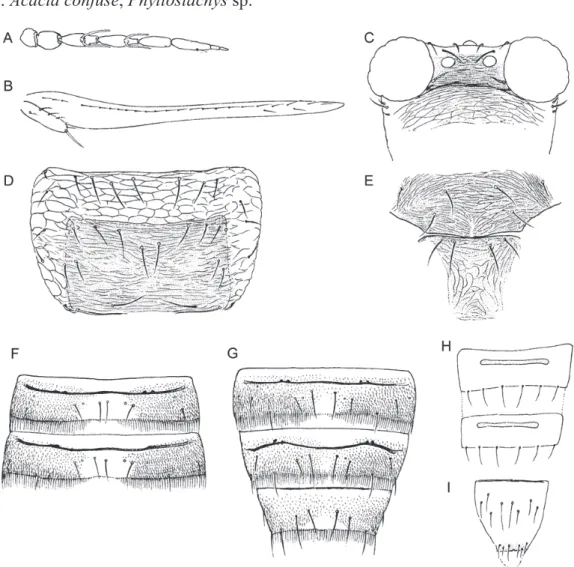
Female body length 1 mm on slide. Light yellow to brownish yellow, abdominal tergites II, III, V and VI grayish brown, IV whitish yellow, VII-X yellow, antecostal ridges on tergites II-VI dark brown, on tergite VII grayish brown; antennal segments I-III yellow, IV and base of V grayish brown, the rest segments brown; forewings brown with subbasal transparent area; legs yellow.
Head short, dorsum with dense transverse striae and wrinkles inside. Occiput large, anterior margin reach compound eyes, transverse striae on anterior portion, followed by reticulated sculpture, weak markings inside. Two pairs of anteocellar setae, interocellar setae situated in front of posterior ocelli. Mouth cone narrow and long, reach posterior margin of pronotum;
maxillary palpi 3-segmented, slender. Antennae 8-segmented, segments III and IV with forked sense cone.
Pronotal blotch covered with dense transverse striae, 3 pairs of anterior marginal setae, one pair of anterior submarginal setae, one seta each on lateral margin, 2 pairs of posterior marginal setae. Anterior reticulations on pronotum with sparse dots. Reticulations on mesonotum and metanotum with dotted wrinkles. Forewing upper vein setae complete, lower vein with 2 setae.
Tarsi 2-segmented.
Laterals of abdominal tergites I-VIII with dense microtrichia; tergites II-VII with posterior comb, none or very short in median; median pair setae on tergites I-IV close to each other, those on tergites V-VIII longer and further apart; sublateral of antecostal ridge on tergite II-VII with forwardly protruded spots, more significant on tergite VII; posterior comb on tergite VIII complete. Sternites without discal setae.
Male color and shape similar to female; body length 0.8 mm on slide; sternites VI and VII with transverse glandular area.
Fig. 32. Hydatothrips ekasi (♀) A. forewing; B. head; C. pronotum; D. meso- and metanotum; E. sternite VII; F. tergites III and IV; G. tergites VI-VIII.
hripidae
Hydatothrips liquidambara Chen (Fig. 34) Hydatothrips liquidambara Chen, 1977a: 145-147.
Female body length 1.2-1.4 mm on slide. Head and thorax brown, abdominal tergites I-IV and VI-IX grayish brown, tergite V yellow with median darker, tergite X grayish yellow, antecostal ridges on tergites II-VII dark brown. Antennal segments I and II yellow, III grayish brown, IV brown except basal 1/4 yellow, V-VIII brown. Forewings brown, with subbasal transparent area.
Fore femora yellow and brown in margins, mid and hind femora dark brown, all tibiae and tarsi yellow.
Head short, dorsum with dense transverse striae and clear wrinkles inside. Occiput large, longer than the rest of head, transverse striae on anterior portion, followed by reticulated sculpture, weak wrinkles inside, smooth near posterior margin. Two pairs of interocellar setae, interocellar setae situated near inner side of anterior margin of posterior ocelli. Mouth cone narrow and long, reach posterior margin of pronotum; maxillary palpi 3-segmented, slender.
Antennae 8-segmented, segments III and IV with forked sense cone.
Pronotal blotch covered with dense transverse striae, 3 pairs of anterior marginal setae, arranged on one row near margin; 2-3 setae each on lateral margin; 2 pairs of posterior marginal setae. Reticulations on pronotum out of blotch with inner dots; 2 pairs of pronotal anterior setae, distance between 2 median setae longer than length of setae. Pronotal reticulations on mesonotum and metanotum with dotted wrinkles. Forewing upper vein setae complete, lower vein with 0-2 setae. Tarsi 2-segmented.
Laterals of abdominal tergites I-VII with dense microtrichia; tergites II-VII with posterior comb, short in median; median pair setae on tergites I-IV close to each other, median pair setae on tergites V-VIII further apart, and setae longer; sublateral of antecostal ridge on tergite II-VII with forwardly protruded spots, more significant on tergite VII; posterior comb on tergite VIII even and complete. Sternites without discal setae.
Distribution: Taiwan.
Habitat: Acacia confuse, Phyllostachys sp.
Fig. 33. Hydatothrips flavidus (♀) A. antenna; B. forewing; C. head; D. pronotum; E. meso- and metanotum; F. tergites III and IV; G. tergites VI-VIII; (♂) H. sternites VI and VII; I. tergite X.
hripidae
Hydatothrips liquidambara Chen (Fig. 34) Hydatothrips liquidambara Chen, 1977a: 145-147.
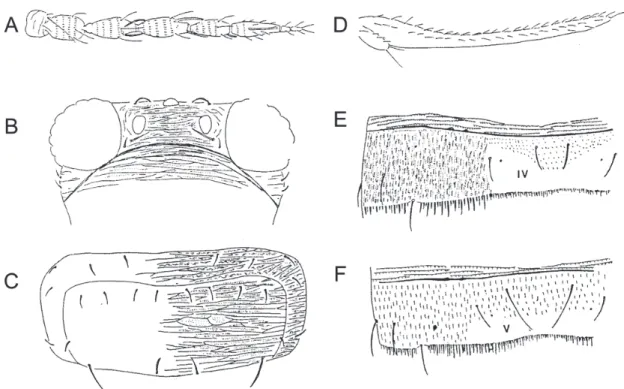
Female body length 1.2-1.4 mm on slide. Head and thorax brown, abdominal tergites I-IV and VI-IX grayish brown, tergite V yellow with median darker, tergite X grayish yellow, antecostal ridges on tergites II-VII dark brown. Antennal segments I and II yellow, III grayish brown, IV brown except basal 1/4 yellow, V-VIII brown. Forewings brown, with subbasal transparent area.
Fore femora yellow and brown in margins, mid and hind femora dark brown, all tibiae and tarsi yellow.
Head short, dorsum with dense transverse striae and clear wrinkles inside. Occiput large, longer than the rest of head, transverse striae on anterior portion, followed by reticulated sculpture, weak wrinkles inside, smooth near posterior margin. Two pairs of interocellar setae, interocellar setae situated near inner side of anterior margin of posterior ocelli. Mouth cone narrow and long, reach posterior margin of pronotum; maxillary palpi 3-segmented, slender.
Antennae 8-segmented, segments III and IV with forked sense cone.
Pronotal blotch covered with dense transverse striae, 3 pairs of anterior marginal setae, arranged on one row near margin; 2-3 setae each on lateral margin; 2 pairs of posterior marginal setae. Reticulations on pronotum out of blotch with inner dots; 2 pairs of pronotal anterior setae, distance between 2 median setae longer than length of setae. Pronotal reticulations on mesonotum and metanotum with dotted wrinkles. Forewing upper vein setae complete, lower vein with 0-2 setae. Tarsi 2-segmented.
Laterals of abdominal tergites I-VII with dense microtrichia; tergites II-VII with posterior comb, short in median; median pair setae on tergites I-IV close to each other, median pair setae on tergites V-VIII further apart, and setae longer; sublateral of antecostal ridge on tergite II-VII with forwardly protruded spots, more significant on tergite VII; posterior comb on tergite VIII even and complete. Sternites without discal setae.
Distribution: Taiwan.
Habitat: Acacia confuse, Phyllostachys sp.
Fig. 33. Hydatothrips flavidus (♀) A. antenna; B. forewing; C. head; D. pronotum; E. meso- and metanotum; F. tergites III and IV; G. tergites VI-VIII; (♂) H. sternites VI and VII; I. tergite X.
hripidae
Hydatothrips meriposa Wang (Fig. 35) Hydatothrips meriposa Wang, 2007: 56-57.
Female body length 0.8 mm on slide. Yellowish brown, abdominal tergites I-V grayish brown, VI whitish yellow, VII-X brown, antecostal ridges on tergites II-VII dark brown; antennal segments I and II whitish yellow, basal half of III-V whitish yellow and distal portion grayish brown, VI &VII grayish brown; forewings brown but lighter in color toward apex, with subbasal transparent area; legs yellow, mid femora brown in median, hind femora brown and paler on both ends.
Head short, dorsum with dense transverse striae and wrinkles inside. Compound eyes not touching anterior margin of occiput, distance between compound eyes and occiput larger than length of occiput. Occiput short, with dense transverse striae. Two pairs of anteocellar setae, interocellar setae situated in front of posterior ocelli. Mouth cone narrow and long, reach posterior margin of pronotum; maxillary palpi 3-segmented, slender. Antennae 7-segmented, segments III and IV with forked sense cone.
Pronotal blotch concave greatly on anterior and posterior sides, covered with dense transverse striae, 2 pairs of anterior marginal setae, median pair setae situated on margin, 2 pairs of anterior submarginal setae, 2 setae each on lateral margin, one pair posterior marginal setae.
Anterior reticulations on pronotum with inner dots, distance between 2 median setae 2-3 times longer than the setae. Reticulations on mesonotum and metanotum with dotted wrinkles.
Forewing upper vein setae complete, lower vein with 2 setae. Tarsi 2-segmented.
Laterals of abdominal tergites with dense microtrichia; tergites II-VI without posterior comb, short on tergite VII; median pair setae on tergites I-VIII further apart and longer toward anal segments, but difference between I-IV and V-VIII not very clear as the other 3 species of this genus; sublateral of antecostal ridge on tergites II-VII with forwardly protruded spots, more Male color and shape similar to female. Body length 0.9-1.1 mm on slide; sternites VI-VIII with
transverse glandular area.
Distribution: Taiwan.
Habitat: Morus australis, Piper betle, Cunnighamia sp., Phyllostachys sp., Manihot esculenta, Areca catechu, grasses.
Fig. 34. Hydatothrips liquidambara (♀) A. head; B. pronotum; C. meso- and metanotum; D. tergites IV-VI.
hripidae
Hydatothrips meriposa Wang (Fig. 35) Hydatothrips meriposa Wang, 2007: 56-57.
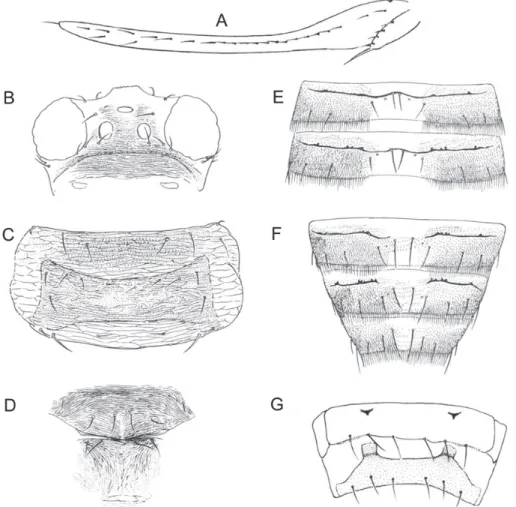
Female body length 0.8 mm on slide. Yellowish brown, abdominal tergites I-V grayish brown, VI whitish yellow, VII-X brown, antecostal ridges on tergites II-VII dark brown; antennal segments I and II whitish yellow, basal half of III-V whitish yellow and distal portion grayish brown, VI &VII grayish brown; forewings brown but lighter in color toward apex, with subbasal transparent area; legs yellow, mid femora brown in median, hind femora brown and paler on both ends.
Head short, dorsum with dense transverse striae and wrinkles inside. Compound eyes not touching anterior margin of occiput, distance between compound eyes and occiput larger than length of occiput. Occiput short, with dense transverse striae. Two pairs of anteocellar setae, interocellar setae situated in front of posterior ocelli. Mouth cone narrow and long, reach posterior margin of pronotum; maxillary palpi 3-segmented, slender. Antennae 7-segmented, segments III and IV with forked sense cone.
Pronotal blotch concave greatly on anterior and posterior sides, covered with dense transverse striae, 2 pairs of anterior marginal setae, median pair setae situated on margin, 2 pairs of anterior submarginal setae, 2 setae each on lateral margin, one pair posterior marginal setae.
Anterior reticulations on pronotum with inner dots, distance between 2 median setae 2-3 times longer than the setae. Reticulations on mesonotum and metanotum with dotted wrinkles.
Forewing upper vein setae complete, lower vein with 2 setae. Tarsi 2-segmented.
Laterals of abdominal tergites with dense microtrichia; tergites II-VI without posterior comb, short on tergite VII; median pair setae on tergites I-VIII further apart and longer toward anal segments, but difference between I-IV and V-VIII not very clear as the other 3 species of this genus; sublateral of antecostal ridge on tergites II-VII with forwardly protruded spots, more Male color and shape similar to female. Body length 0.9-1.1 mm on slide; sternites VI-VIII with
transverse glandular area.
Distribution: Taiwan.
Habitat: Morus australis, Piper betle, Cunnighamia sp., Phyllostachys sp., Manihot esculenta, Areca catechu, grasses.
Fig. 34. Hydatothrips liquidambara (♀) A. head; B. pronotum; C. meso- and metanotum; D. tergites IV-VI.
hripidae
Genus Neohydatothrips John
Neohydatothrips John, 1929: 33. Type species: Neohydatothrips latereostriatus John.
For convenient, Hydatothrips and Neohydatothrips are taken as genera as the old system.
Kudo (1997) take Hydatothrips, Neohydatothrips as well as Kazinothrips and Zonothrips as subgenus of Hydatothrips. This genus is separated from Hydatothrips by metasternum not divided into 2 parts. About 105 species in the world.
Key to species of Neohydatothrips in Taiwan
1. Antennae 7-segmented ... plynopygus -- Antennae 8-segmented ... 2 2. Forewing lower vein without seta ... 3 -- Forewing lower vein with 1-2 setae ... 4 3. Forewing brown with subbasal, median and apical transparent areas ... samayunkur -- Forewing brown, with basal transparent area ... 5 4. Abdominal tergites with IV and V yellow, tergites I-III and VI with brown semi-elliptical
areas clearly separated from median yellow areas ... tabulifer -- Abdomen yellow, tergites II-VI with lateral brown areas posterior to antecostal ridge ...
... gracilipes 5. Pronotal reticulations outside blotch strongly transverse with ratio of length/width >10,
abdominal tergites V and VI in light color ... medius -- Pronotal reticulations outside blotch transverse with ratio of length/width about 3-4,
abdominal tergites VI in light color ... surrufus significant on tergite VII; posterior comb on tergite VIII even and complete. Sternites without
discal setae.
Male unknown.
Distribution: Taiwan.
Habitat: Murraya paniculata.
Fig. 35. Hydatothrips meriposa (♀) A. antenna; B. forewing; C. head; D. pronotum; E. meso- and mtenotum; F. tergites III and IV; G. tergites VI-VIII.
hripidae
Genus Neohydatothrips John
Neohydatothrips John, 1929: 33. Type species: Neohydatothrips latereostriatus John.
For convenient, Hydatothrips and Neohydatothrips are taken as genera as the old system.
Kudo (1997) take Hydatothrips, Neohydatothrips as well as Kazinothrips and Zonothrips as subgenus of Hydatothrips. This genus is separated from Hydatothrips by metasternum not divided into 2 parts. About 105 species in the world.
Key to species of Neohydatothrips in Taiwan
1. Antennae 7-segmented ... plynopygus -- Antennae 8-segmented ... 2 2. Forewing lower vein without seta ... 3 -- Forewing lower vein with 1-2 setae ... 4 3. Forewing brown with subbasal, median and apical transparent areas ... samayunkur -- Forewing brown, with basal transparent area ... 5 4. Abdominal tergites with IV and V yellow, tergites I-III and VI with brown semi-elliptical
areas clearly separated from median yellow areas ... tabulifer -- Abdomen yellow, tergites II-VI with lateral brown areas posterior to antecostal ridge ...
... gracilipes 5. Pronotal reticulations outside blotch strongly transverse with ratio of length/width >10,
abdominal tergites V and VI in light color ... medius -- Pronotal reticulations outside blotch transverse with ratio of length/width about 3-4,
abdominal tergites VI in light color ... surrufus significant on tergite VII; posterior comb on tergite VIII even and complete. Sternites without
discal setae.
Male unknown.
Distribution: Taiwan.
Habitat: Murraya paniculata.
Fig. 35. Hydatothrips meriposa (♀) A. antenna; B. forewing; C. head; D. pronotum; E. meso- and mtenotum; F. tergites III and IV; G. tergites VI-VIII.
hripidae
Fig. 36. Hydatothrips gracilips (♀) A. forewing; B. head; C. pronotum; D. meso- and metanotum; E.
tergites II and III; F. tergites VI-VIII.; G. metasternum.
Neohydatothrips gracilips (Hood) (Fig. 36) Sericothrips gracilipes Hood, 1924: 149
Female body length 1.2-1.3 mm on slide. Body generally yellow, pronotal blotch with brown markings; abdominal tergites II–VII with dark brown antecostal ridge, also brown areas laterally on these segments behind antecostal ridges; antennal segments grayish brown, III and basal halves of IV and V paler; legs grayish yellow; forewing
grayish yellow with a subbasal pale band.
Head short, cheeks about same length as compound eyes; interocellar setae situated behind anterior ocellus, inside ocellar triangular area. Antennae 8-segmented, III and IV with forked sense cone, V and VI with linear sense area, segment VII about half the length of VIII.
Pronotal blotch weakly sclerotized without a clear margin, posteroangular pair of setae on blotch well-developed, about same length as blotch. Mesonotum and metanotum with dense transverse or longitudinal striae. Anterior margin of metasternum straight. Forewing upper vein setae complete, lower vein without setae.
Abdominal tergites II–VII with posteromarginal combs present laterally but not medially;
tergites VII and VIII with long and complete posteromarginal comb. Sternites I–VII with complete posteromarginal comb, without discal setae.
Male: unknown.
Distribution: Taiwan, Mexico, Costa Rica, Trinidad, Jamaica, Australia, Thailand, India.
Habitat: Malvaceae ( particularly species of Sida), many specimens were taken in Taiwan from cotton (Gossypium indicum), the plant from which this thrips was originally described.
hripidae
Fig. 36. Hydatothrips gracilips (♀) A. forewing; B. head; C. pronotum; D. meso- and metanotum; E.
tergites II and III; F. tergites VI-VIII.; G. metasternum.
Neohydatothrips gracilips (Hood) (Fig. 36) Sericothrips gracilipes Hood, 1924: 149
Female body length 1.2-1.3 mm on slide. Body generally yellow, pronotal blotch with brown markings; abdominal tergites II–VII with dark brown antecostal ridge, also brown areas laterally on these segments behind antecostal ridges; antennal segments grayish brown, III and basal halves of IV and V paler; legs grayish yellow; forewing
grayish yellow with a subbasal pale band.
Head short, cheeks about same length as compound eyes; interocellar setae situated behind anterior ocellus, inside ocellar triangular area. Antennae 8-segmented, III and IV with forked sense cone, V and VI with linear sense area, segment VII about half the length of VIII.
Pronotal blotch weakly sclerotized without a clear margin, posteroangular pair of setae on blotch well-developed, about same length as blotch. Mesonotum and metanotum with dense transverse or longitudinal striae. Anterior margin of metasternum straight. Forewing upper vein setae complete, lower vein without setae.
Abdominal tergites II–VII with posteromarginal combs present laterally but not medially;
tergites VII and VIII with long and complete posteromarginal comb. Sternites I–VII with complete posteromarginal comb, without discal setae.
Male: unknown.
Distribution: Taiwan, Mexico, Costa Rica, Trinidad, Jamaica, Australia, Thailand, India.
Habitat: Malvaceae ( particularly species of Sida), many specimens were taken in Taiwan from cotton (Gossypium indicum), the plant from which this thrips was originally described.
hripidae