行政院國家科學委員會專題研究計畫 成果報告
應用於假撚紗品質管理之智慧型生產資訊管理系統研究 研究成果報告(精簡版)
計 畫 類 別 : 個別型
計 畫 編 號 : NSC 95-2221-E-011-166-
執 行 期 間 : 95 年 08 月 01 日至 96 年 07 月 31 日 執 行 單 位 : 國立臺灣科技大學高分子工程系
計 畫 主 持 人 : 邱士軒 共 同 主 持 人 : 廖俊鑑
計畫參與人員: 博士班研究生-兼任助理:吳典錡
碩士班研究生-兼任助理:張哲誌、蔡青凌
處 理 方 式 : 本計畫可公開查詢
中 華 民 國 96 年 09 月 26 日
應用於假撚紗品質管理之智慧型生產資訊管理系統研究
NSC 95-2221-E-011-166
邱士軒*、廖俊鑑、吳典錡、張哲誌、蔡青凌 國立台灣科技大學高分子工程系
E-mail: [email protected]
1. 摘要
線上品質管理系統是一種監測假撚紗 品質的有效工具,而雜訊大都會影響異常 紗線張力圖形的分類結果。許多有效的訊 號濾波器被開發來降低雜訊,但並非所有 濾波器都完全有效地降低在紗線張力訊號 中的雜訊。然而在假撚紗張力訊號的雜訊 降低中,有少數致力於濾波器的比較與分 析。為了找出適當的濾波器,我們使用 Butterworth LPF、Gaussian LPF、Smoothing LPF、Wavelet LPF 四種低通濾波器來降低 張力訊號中的雜訊。在本研究中,在頻域 中分析三種雜訊:電氣雜訊、振動干擾、
質量變異,以訊號雜訊比與運算時間來估 測濾波器的效能。由實驗結果得知,特定 的雜訊種類需要以適當的訊號濾波器來降 低。
關鍵詞: 雜訊,濾波器,張力,紡織 2. ABSTRACT
The on-line quality control system is an efficient tool for monitoring the yarn quality on twister. The noises always influence the recognition results of the abnormal yarn tension pattern. Many efficient signal filters were developed to reduce the noises, but not all filters are exactly suitable for reducing the noise mixed in the yarn tension signal.
However, little attention has been devoted to the filters comparison and analysis in noise
reduction for the twist yarn tension signal. To find an adequate filter, four efficient low-pass filters including Butterworth LPF, Gaussian LPF, Smoothing LPF and Wavelet LPF are applied to reduce the noise in tension signal.
In this study, three noise types: electronic noise, vibration disturbance and mass variation are analyzed in frequency-domain.
The signal-to-noise ratio (SNR) and computation time are used to evaluate the filters’ performance. From the experimental results, it is shown that particular noise type needs adequate signal filter to reduce.
Keywords: Noise; Filters; Tension; Spinning 3. INTRODUCTION
The demand for Twist yarn has continuously grown in recent years. The analysis of yarn tension is very important for improving yarn quality on twister. The on-line quality control systems (e.g. Barmag, Murata, QAI, and FAG’s) on twister offer information of twist yarn to improve the yarn’s quality. Chiu and Lu1 developed an unusual tension type recognition system, which uses the wave appearance of the tension signal to recognize the abnormal yarn tension type. Unfortunately the random noises (e.g. electronics noise, machine vibration, or material variation) destroy the signal wave appearance, and badly affect the
recognized results. Although many efficient signal filters for noise reduction have been developed in recent years, little research devoted to this study. In practical applications, how to choose an adequate filter to do the noise reduction for the various noise types on twister is a difficult work. It is necessary to choose an adequate signal filter for the processing of the various noise types existed in yarn tension signal. To find an adequate filter, four efficient low-pass filters (LPF) including Butterworth LPF (BLPF), Gaussian LPF (GLPF), Smoothing LPF (SLPF), and Wavelet LPF (WLPF) are applied to compare the performance of noise reduction on various abnormal tension patterns. BLPF2,3 is a suitable choice in cases where tight control of the transition between low and high frequency. Different from that, GLPF4 allows much more high frequency signal to pass through. SLPF5 takes the average of the signal data contained in the moving window. Wavelet transform6-9 can efficiently extract both time and frequency information from a time-varying signal.
WLPF10 is a filter which bases upon the Wavelet transform. In this paper, we focus on the comparison and analysis of various low-pass filters for reducing noise on yarn tension signal. The signal-to-noise ratio (SNR) and computation time are used to evaluate the performance of various filters in experiments.
4. THEORIES OF THE LOW-PASS FILTERS
Butterworth Low-pass Filter (BLPF)
In BLPF, fast Fourier transform (FFT) is applied to transform the tension signal from
time-domain to frequency-domain. Let
( : time index) be the tension signal in time-domain, and ( : frequency index) be the tension signal in frequency-domain. The transfer function
of the BLPF of order is expressed as
) ( t x t
) (u
X u
) (u
H n
] ) D ( 1 [ ) 1
( 2 n
u u
H = +
D
2
(1)
where denotes the cutoff frequency. The cutoff frequency can be designed by a certain theoretical criterion.11 In Figure 1, BLPF ( n= ) with different D ( =5~20 ) is shown. The basic model for filtering is defined as
) ( ) ( )
ˆ (u X u H u
X = (2)
where is the de-noised signal in frequency-domain. By inverse Fourier transform, the tension signal with noise reduction can be obtained.
) ˆ u( X
Gaussian Low-pass Filter (GLPF)
Different from the BLPF, the transfer function of GLPF4 is expressed as
) 2 exp(
)
(u u2 q2
H = − (3)
where is the standard deviation of the Gaussian curve. GLPF provides spectral attenuation by tuning parameter q. Large value can retain more components of low frequency tension signal. Figure 2 shows the GLPF with different standard deviations (
q
q
q =15~35). By Eq. (2) and inverse Fourier transform, the de-noised tension signal is derived.
Smoothing Low-pass Filter (SLPF)
SLPF5 is also called the moving average method. The coefficients of SLPF are expressed as
⎭⎬
⎫
⎩⎨
⎧ ≤ ≤
= 0, Otherwise. B t 1 , 1 ) ( t
h (4)
where is the size of moving window. To compare with BLPF and GLPF, of SLPF with different window size ( ) is transferred into the frequency domain as (see Figure 3). Window size determines the main lobe size of frequency response. The larger is, the narrower the profile of is. SLPF is implemented by convolution computation as
B
) ( t h
B =5~20 ) (u H
B ) (u H
∑
=−
=
∗
=
B
m
m t h m x
t h t x t x
1
) ( ) B (
1
) ( ) ( ) ˆ(
(5)
where is the tension signal after noise reduction.
) ˆ t( x
Wavelet Low-pass Filter (WLPF)
Mallat’s herringbone algorithm7, 8, 12 with Haar-2 Wavelet are used to carry out Wavelet transform. Wavelet transform is constructed with basis functions as scaling function (φ t( )) and wavelet function (ψ t( )).
Scaling function and wavelet function can be expressed in terms of a weighted sum of shifted φ t(2 ) with and
(Haar-2 corresponding coefficients) as following equations.
) (n
hφ hψ(n)
) 2 ( 2 ) ( )
( =
∑
−n
n t n
h
t φ
φ φ ,
∑
−=
n
) 2 ( 2 ) ( )
( t h n φ t n
ψ ψ (6)
where
⎭⎬
⎫
⎩⎨
⎧ =
= 0, otherwise 0,1 ,
2 ) 1
( n
n
hφ ,
⎪⎭
⎪⎬
⎫
⎪⎩
⎪⎨
⎧
=
=
=
otherwise 1 0,
, 2 1 -
0 ,
2 1 )
( n
n n
hψ
In Wavelet transform, a signal is decomposed into many wavelet coefficients with the numbers ( , ) of available time scales by dyadic down-sampling.
Wavelet coefficients ( and ) are defined as
) (
log2 M M =512
Wφ Wψ
0 ,
| 2
) , 1 ( ) (
) , 1 ( ) 2 ( )
, (
≥
+ =
∗
−
=
+
−
=
∑
k k n m
n i W n h
m j W k m h k
j W
φ φ
φ φ
φ (7)
0 ,
| 2
) , 1 ( ) (
) , 1 ( ) 2 ( )
, (
≥
+ =
∗
−
=
+
−
=
∑
k k n m
n j W n h
m j W k m h k
j W
φ ψ
φ ψ
ψ (8)
where . The
tension signal is used as the scaling input.
The smaller coefficients are sieved out by a threshold (
1 2
~ 0 and 1
~
0 − = −
=
=n M k j
m
T ) in WLPF10 as
| ) , (
| , 0
| ) , (
| , ) , ) (
,
( ⎭⎬⎫
⎩⎨
⎧
<
= ≥
T k j W
T k j W k j k W
j W
φ φ φ
φ ,
| (9) ) , (
| , 0
| ) , (
| , ) , ) (
,
( ⎭⎬⎫
⎩⎨
⎧
<
= ≥
T k j W
T k j W k j k W
j W
ψ ψ ψ
ψ
where and are the
coefficients of the scale. The frequency responses of scaling function and wavelet function for WLPF are shown in Figure 4.
After removing some smaller coefficients which belong to the noise, all coefficients are
) , ( kj
Wφ Wψ( kj, ) th
j
reconstructed and resumed to the original scale. The analysis and synthesis of the wavelet transform are shown in Figure 5 and Figure 6.
5. EXPERIMENTAL RESULTS AND DISCUSSION
In the experiments, a personal computer with an Intel Pentium III / 1G Hz CPU is used to implement noise reduction. The tension and noise were collected from different twist yarn factory by a QAI yarn quality control system which was developed by YU HWA Co., Ltd.
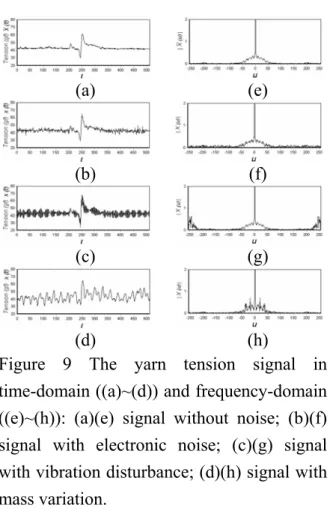
The sampling time of yarn tension signal acquisition is 0.01 sec. The tension sensors are frictional contact type as shown in Figure 7, which are installed on the twister. In Figure 8, four representative abnormal yarn tension patterns (“knot transfer”, “splice transfer”, “foreign matter” and “tail transfer”) are selected to test low-pass filters. It is assumed that the common noises include electronic noise, vibration disturbance, and mass variation. To demonstrate the features of the tension signal in the time-domain and frequency-domain, the tension pattern “tail transfer” with various noises is shown in Figure 9. Form the Figure 9(e), we find that the major part of frequency components concentrate on the lower band ( ). As the signal is mixed with three type noises (Figures 9(f) ~ 9(h)), they arise the different effect in the frequency response. The frequency components of electronic noise are averagely distributed on
50 50< <
− u
higher band (u>50 and , Figure 9(f)), the frequency components of mass variation are distributed on the lower band
(
−50
<
u
47 47< <
− u , Figure 9(g)), and the frequency components of vibration disturbance are distributed on the higher band (u>220 and u<−220, Figure 9(h)).
In the experiments, the SNR and the computation time are used to evaluate the performances of all filters. The tension signal with noise ( ) is assumed a linear mixture of the pure tension signal ( ) and the noise ( ). The SNR is defined as
) ( t x
)
~(t x )
( t n
⎥⎥
⎥⎥
⎦
⎤
⎢⎢
⎢⎢
⎣
⎡
−
= ∑
∑
=
= 512
1 t
2 512
1 t
2
10
t x t x
t x 10
) ) ˆ( )
~( (
)
~( log
SNR (10)
The numerator of Eq. (10) means the amplitude of the pure tension signal ( ), and the denominator of Eq. (10) means the difference between the pure tension signal ( ) and the de-noised signal ( ). It means that the large SNR value, the better performance of noise reduction is. The computation time is used to evaluate the possibility of system realization for real application.
)
~(t x
)
~( t
x xˆ t( )
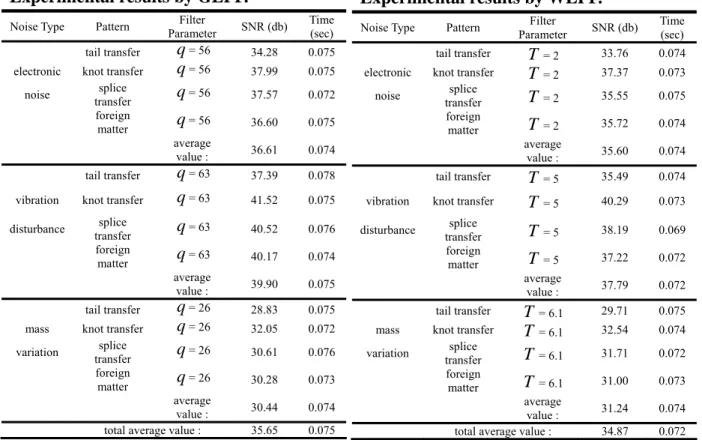
Figures 10 ~ 12 demonstrate the noise reduction by four low-pass filters. The SNR and computation time of all experiments are shown in Table I ~ IV. The frequency components of the electronic noise and vibration disturbance are distributed on the high band, and they can be easily reduced by four low-pass filters. These low-pass filters have good performance on high frequency components reducing. The mass variation occurs in the yarn spinning process while polymer material quality is unstable. Since the frequency components of mass variation distribute on the same band of the major
tension signal, it is difficult to reduce this noise by a traditional low-pass filter.
However, WLPF is a very potential method for reducing this noise. WLPF removes the smaller wavelet coefficients, but retains the larger wavelet coefficients in each time scales. Since WLPF is not an attenuation function, it can retain the main skeleton of the tension signal. For mass variation, WLPF has better performance than the others.
Overall, the computation time of four filters is all acceptable for real-time application.
6. CONCLUSION
In this paper, four various low-pass filters are applied to compare the noise reduction of the twist yarn tension signal on twister. The computation times of all filters are all acceptable on real applications. For two noise types: electronic noise and vibration disturbance, the average SNR value of all signal filters are greater than 35 db for all yarn tension patterns. It is said that all signal filters are effective in electronic noise and vibration disturbance reduction of yarn tensional signal. As the noise: mass variation, WLPF has the best performance, and it is a better choice than the others for this case.
From the experimental results, it is shown that particular noise type needs adequate signal filter to reduce.
7. References
1. Chiu, S. H.; Lu, C. P. International Journal of Advanced Manufacturing Technology 2005, to appear.
2. Southard, T. E.; Southard, K.A. IEEE Transactions on Biomedical Engineering 1995, 42, 13.
3. Gordon, D.; Robertson, E.; Dowling, J.
J. Journal of Electromyography and Kinesiology 2003, 13, 569.
4. Deng, G.; Cahill, L. W. IEEE Conference Record of Nuclear Science Symposium and Medical Imaging Conference 1993 (November), 3, 1615.
5. Chen, C. T. Digital Signal Processing:
spectral computation and filter design;
New York Oxford: Oxford University Press, 2001.
6. Mittermayr, C. R.; Nikolov, S. G.; Hutter, H.; Grasserbauer, M. Chemometrics and Intelligent Laboratory Systems 1996, 34(2), 187.
7. Mallat, S. G. IEEE Transactions Pattern Analysis Machine Intelligence PAMI-11:
1989a, 674.
8. Mallat, S. G. Transactions of the American Mathematical Society 1989b, 315, 69.
9. Burrus, C. S.; Gopinath, R. A.; Guo, H.
Introduction to Wavelet and Wavelet Transforms, Prentice-Hall, 1998.
10. Fang, H. T.; Huang D. S. Optics Communications 2004, 233(1), 67.
11. Huang, D. S. Intelligent Signal Processing Technique for High Resolution Radars, Publishing House of Machine Industry of China, 2001.
12. Gonzalez, R. C.; Woods, R. E. Digital Image Processing, Addison-Wesley, New York, 1992.
TABLE I
Experimental results by BLPF.
Noise Type Pattern Filter Parameter
SNR (db)
Time (sec) tail transfer D= 70 34.18 0.086 electronic knot
transfer D= 70 37.69 0.082 noise splice
transfer D= 70 37.33 0.085 foreign
matter D= 70 36.28 0.085 average
value :
36.37 0.084
tail transfer D= 63 35.69 0.081 vibration knot
transfer D= 63 39.34 0.083 disturbance splice
transfer D= 63 38.37 0.084 foreign
matter D= 63 37.77 0.087 average
value :
37.79 0.084
tail transfer D= 29 28.89 0.083 mass knot
transfer D= 29 32.28 0.081 variation splice
transfer D= 29 30.71 0.084 foreign
matter D= 29 30.25 0.081 average
value :
30.53 0.082 total
average value :
34.89 0.084
TABLE II
Experimental results by GLPF.
Noise Type Pattern Filter
Parameter SNR (db) Time (sec) tail transfer q= 56 34.28 0.075 electronic knot transfer q= 56 37.99 0.075
noise splice
transfer q= 56 37.57 0.072 foreign
matter q= 56 36.60 0.075 average
value : 36.61 0.074 tail transfer q= 63 37.39 0.078 vibration knot transfer q= 63 41.52 0.075 disturbance splice
transfer q= 63 40.52 0.076 foreign
matter q= 63 40.17 0.074 average
value : 39.90 0.075 tail transfer q= 26 28.83 0.075 mass knot transfer q= 26 32.05 0.072 variation splice
transfer q= 26 30.61 0.076 foreign
matter q= 26 30.28 0.073 average
value : 30.44 0.074 total average value : 35.65 0.075
TABLE III
Experimental results by SLPF.
Noise Type Pattern Filter
Parameter SNR (db) Time (sec) tail transfer B= 5 33.92 0.045 electronic knot transfer B= 5 37.21 0.045
noise splice
transfer B= 5 36.91 0.044 foreign
matter B= 5 36.02 0.046 average
value : 36.01 0.045 tail transfer B= 4 36.52 0.042
vibration knot transfer B= 4 41.16 0.043 disturbance splice
transfer B= 4 35.17 0.043 foreign
matter B= 4 38.93 0.044 average
value : 37.94 0.043 tail transfer B= 10 28.91 0.057
mass knot transfer B= 10 31.31 0.059 variation splice
transfer B= 10 30.44 0.058 foreign
matter B= 10 29.72 0.057 average
value : 30.09 0.058 total average value : 34.68 0.048
TABLE IV
Experimental results by WLPF.
Noise Type Pattern Filter
Parameter SNR (db) Time (sec) tail transfer T = 2 33.76 0.074 electronic knot transfer T = 2 37.37 0.073
noise splice
transfer T = 2 35.55 0.075 foreign
matter T = 2 35.72 0.074 average
value : 35.60 0.074 tail transfer T = 5 35.49 0.074 vibration knot transfer T = 5 40.29 0.073 disturbance splice
transfer T = 5 38.19 0.069 foreign
matter T = 5 37.22 0.072 average
value : 37.79 0.072 tail transfer T= 6.1 29.71 0.075 mass knot transfer T= 6.1 32.54 0.074 variation splice
transfer T= 6.1 31.71 0.072 foreign
matter T= 6.1 31.00 0.073 average
value : 31.24 0.074 total average value : 34.87 0.072
Figure 1 BLPF with four cutoff frequencies ( ), and
D =5~20 n =2.
Figure 2 GLPF with four standard deviations
( ).
q =15~35
Figure 3 SLPF with four window sizes
( ).
B =5~20
Figure 4 Scaling function and wavelet function in frequency-domain for WLPF.
Figure 5 An wavelet transform analysis bank12
Figure 6 The inverse wavelet transfer synthesis filter bank12
Figure 7 Tension sensors on yarn twister.
(a) (b)
(c) (d) Figure 8 The general abnormal yarn tension
patterns: (a) tail transfer; (b) knot transfer; (c) splice transfer; (d) foreign matter.
(a) (b)
(c) (d)
(e) (f)
(a) (e)
(b) (f)
(c) (g)
(d) (h)
Figure 11 Abnormal yarn tension pattern “tail transfer” with vibration disturbance: (a) signal without noise; (b) signal with noise;
noise reduction by (c) BLPF; (d) GLPF; (e) SLPF; (f) WLPF.
Figure 9 The yarn tension signal in time-domain ((a)~(d)) and frequency-domain ((e)~(h)): (a)(e) signal without noise; (b)(f) signal with electronic noise; (c)(g) signal with vibration disturbance; (d)(h) signal with mass variation.
(a) (b)
(c) (d)
(e) (f)
(a) (b)
(c) (d)
(e) (f) Figure 12 Abnormal yarn tension pattern “tail transfer” with mass variation: (a) signal without noise; (b) signal with noise; noise reduction by (c) BLPF; (d) GLPF; (e) SLPF;
(f) WLPF.
Figure 10 Abnormal yarn tension pattern “tail transfer” with electronic noise: (a) signal without noise; (b) signal with noise; noise reduction by (c) BLPF; (d) GLPF; (e) SLPF;
(f) WLPF.
行政院國家科學委員會專題研究計畫成果報告評估表
計畫主持人自我評估表 評審委員複評表
先生惠鑒:
隨函付上專題研究成果報告乙份,原計畫申請書及成果 報告評估表等資料,敬請撥冗惠予審查,並請於 月 日前 擲還本評估表及附件:本會各委員及職員均負不對外宣洩案 件內容之責任,亦請對外合密。非常感謝您的協助。
國科會 敬啟 年 月 日
※計畫主持人請於專題計畫結束時詳填本自評表,並隨同專題研究成果 報告一併送本會評審
計畫編號:NSC 95-2221-E-011-166
計畫名稱:應用於假撚紗品質管理之智慧型生產資訊管理系統研究
一、研究內容與原計畫相符程度說明( 如低於 50,請將不符處說明於後)
相符程度100%,研究內容與原計畫相符。
( )同意自評結果 ( )不同意 請說明:
二、本研究達成預期目標概要(請從報告中指出其最主要的項獻,複選) ( )創新之發現 ( )實驗原型或系統之建立 ( )理論之拴導或摸式建立 ( √ )人才培育
(√ )技術水準之提升 ( )其他(請說明)
( )新技術在國內之再現 ( )未獲具體結果,(請填下欄)
( )同意自評結果 ( )不同意 請說明:
三、本研究如未獲具體結果,其主要原因為何?(必要時請用另紙書寫) ( )同意自評結果 ( )不同意 請說明:
四、本研究成果之學術參考價值:
( )極高 ( √ )高 ( )中 ( )普通 ( ) 低 請列示應送參考機構名稱:
( )同意自評結果 ( )不同意 請說明:
五、本研究成果之應用推薦價值:
( )極高 ( √ )高 ( )中 ( )普通 ( ) 低 如可能。請建議送交那些單位或業者參考:
( )可立即推介 ( √ )尚需進一步研究 ( )不宜推介
( )同意自評結果 ( )不同意 請說明:
六、本研究成果可申請專利項目之說明:
可 ( )發明 ( )新型 ( )新式樣 不可,因計劃中內容已投稿,故無法申請專利。:
( )同意自評結果 ( )不同意 請說明:
七、本專題計畫應再進一步研究之需要性:
( )不需再研究
( √ )應再進一步研究,其研究之方向與目標:
計劃中為假撚紗異常張力訊號分析,可再進行智慧型異常張力圖形辨
識系統的建立,以及新式檢索系統的建立與系統E 化整合。
( )同意自評結果 ( )不同意 請說明:
八、本研究成果發表之建議:
( )否:( )機密性 ( )成果層次尚需再加強 ( √ )是,且刊載於何種刊制物為宜?
( )本會 Proceedings 季刊 ( )本會科學發展月刊 ( √ )可發表於其他國內外期刊
( )同意自評結果 ( )不同意 請說明:
九、綜評:
在計劃中應用了四種不同的低通濾波器,來比較假撚機台上假撚紗 張力訊號的雜訊降低,而這些濾波器的運算時間在實際的應用上是可接 受的。所有的訊號濾波器都有效地降阺了紗線張力訊號中的電氣雜訊與
振動干擾,而在質量變異上WLPF 具有最佳的性能,較其他濾波器適用。
由實驗的結果可知特定的雜訊種類需用適當的訊號濾波器來降低。
※ 對本研究成果報告自評等第:( )極佳 ( √ )佳( )中( )可( )劣
( )同意自評結果 ( )不同意 請說明:
※複評等第:( )極佳( )佳( )中( )可( )劣
計畫主持人簽名:邱士軒 96年08月20日 評審委員簽名: 年 月 日
可供推廣之研發成果資料表
□ 可申請專利 □ 可技術移轉 日期:96年08月20日
國科會補助計畫
計畫名稱:應用於假撚紗品質管理之智慧型生產資訊管理系統研究 計畫主持人:邱士軒
計畫編號:NSC95-2221-E-011-166 學門領域:生產自動化技術 技術/創作名稱 應用於假撚紗品質管理之智慧型生產資訊管理系統研究
發明人/創作人 邱士軒 中文:
線上品質管理系統是一種監測假撚紗品質的有效工具,而雜訊大 都會影響異常紗線張力圖形的分類結果。許多有效的訊號濾波器被開 發來降低雜訊,但並非所有濾波器都完全有效地降低在紗線張力訊號 中的雜訊。然而在假撚紗張力訊號的雜訊降低中,有少數致力於濾波
器的比較與分析。為了找出適當的濾波器,我們使用Butterworth LPF、
Gaussian LPF、Smoothing LPF、Wavelet LPF 四種低通濾波器來降低張 力訊號中的雜訊。在本研究中,在頻域中分析三種雜訊:電氣雜訊、
振動干擾、質量變異,以訊號雜訊比與運算時間來估測濾波器的效能。
由實驗結果得知,特定的雜訊種類需要以適當的訊號濾波器來降低。
技術說明
英文:
The on-line quality control system is an efficient tool for monitoring the yarn quality on twister. The noises always influence the recognition results of the abnormal yarn tension pattern. Many efficient signal filters were developed to reduce the noises, but not all filters are exactly suitable for reducing the noise mixed in the yarn tension signal.
However, little attention has been devoted to the filters comparison and analysis in noise reduction for the twist yarn tension signal. To find an adequate filter, four efficient low-pass filters including Butterworth LPF, Gaussian LPF, Smoothing LPF and Wavelet LPF are applied to reduce the noise in tension signal. In this study, three noise types:
electronic noise, vibration disturbance and mass variation are analyzed in frequency-domain. The signal-to-noise ratio (SNR) and computation time are used to evaluate the filters’ performance. From the experimental results, it is shown that particular noise type needs adequate signal filter to reduce.
可利用之產業 及 可開發之產品
假撚紗品質偵測、張力訊號或各類量測訊號的雜訊濾除
技術特點
推廣及運用的價值
假撚紗的需求在近十幾年來一直持續成長,在化纖產業上是一種相當 重要且量大的輸出產品,因此假撚紗的品質分級管理也隨之受到重 視。線上品質管理系統是假撚紗品質分級與張力異常偵測的重要工 具,進行假撚紗異常張力訊號分析,這是一個很基本且最重要的部份。