行政院國家科學委員會補助專題研究計畫
□ 成 果 報 告
■期中進度報告
應用生命週期觀點於技術評估平台之開發
– 以臺灣氫能源技術為例
第一年
計畫類別:
■
個別型計畫 □ 整合型計畫
計畫編號:NSC 97-2221-E-006-044-MY3
執行期間:97 年 8 月 1 日至 100 年 7 月 31 日
計畫主持人:福島康裕
計畫參與人員: 陳怡靜 黃筱婷 郭又鳴 陳煜希
成果報告類型(依經費核定清單規定繳交):
■
精簡報告 □完整報告
本成果報告包括以下應繳交之附件:
□赴國外出差或研習心得報告一份
□赴大陸地區出差或研習心得報告一份
□出席國際學術會議心得報告及發表之論文各一份
□國際合作研究計畫國外研究報告書一份
處理方式:除產學合作研究計畫、提升產業技術及人才培育研究計畫、
列管計畫及下列情形者外,得立即公開查詢
□涉及專利或其他智慧財產權,
■
一年□二年後可公開查詢
執行單位:國立成功大學環境工程學系
中 華 民 國 9 8 年 5 月 3 1 日
摘要
現今已存在許多針對減低因人類活動所造成的環境負載之技術開發,並逐步將整個社會推 向永續發展之標的。在眾多發展的技術當中,有些技術已能深入電力市場,然而也有部分 技術面臨發展瓶頸,正等待更新的技術突破。目前而言,環境層面的評估多被視為技術開 發的最後階段。但若環境層面的技術評估可以在早期的研發階段就被重視的話,將有助於 理解環境友善產品在減輕環境衝擊、可能遭遇之障礙,及技術底線上之特性;並且藉由增 進環境友善技術重要性之理解,在策略上對於研究發展 (R&D)資源的分配也將更具效率。 本計劃將針對氫能源相關之科技研發一重要技術發展平台。此平台將引進生命週期之觀點 於氫能源及其相關的科技(例如:燃料電池)以及勞務服務(例如:交通運輸)之應用,同時 考量氫能源生產及利用之技術。利用此一技術發展平台,將描繪出台灣氫能社會之主體樣 貌。本計劃將觸及的問題點如下所示: � 氫能源引進多寡為適?� 氫能源之技術應用為何? � 氫能源之技術突破將如何影響環境衝擊? � 氫能源之技術突破將如何影響未來氫能社會的發展? 為了協助解決以上的提問,此技術發展平台將提供氫能研究者關於研發中科技在整體氫能 社會中的角色及定位,及其相關競爭科技的關係、技術底限、可行的目標效率等。藉由這 樣的確認,將督促各研究部門著重於關鍵技術之突破,並帶動、強化氫能源科技之發展, 及縮短規模經濟化所需的時間。本計劃也將引進如「生態效益(eco-efficiency)」、內部環境 成本等的經濟觀點。藉由不同之目的進行氫能社會設計,如衝擊最小化、成本最小化、高 生態效益等,並促進政策討論,以體現尖端科技之知識。 關鍵詞:氫能社會,燃料電池,環境衝擊,技術開發平台,再生能源,複合式生命週期評估Abstract
There are many technologies being developed aiming at reducing environmental loads
generated from the human activities to realize a shift towards a more sustainable society. Some of those technologies have already started to penetrate in the power market, while other technologies are facing obstacles, and waiting for several more breakthroughs to happen. Conventionally, environmental assessment is treated as the final stage of such technologies. However, if environmental technology assessment can be carried out in earlier stages of technology development, it can contribute not only environmentally friendly technologies with the information on chances of environmental impact, possible barriers, and bottom-lines of the technologies, but also to allocate R&D resource in a strategic manner being aware of importance of such technologies.
In this project, a strategic technology development platform for hydrogen related technologies will be developed. The platform introduces life cycle perspectives on hydrogen and relevant goods (ex. fuel cell) and services (ex. transportation), and considers interaction among the hydrogen production and utilization technologies. Using the developed platform, possible hydrogen society in Taiwan will be illustrated. The example of questions addressed would be:
To what amount should we introduce hydrogen?
For which applications should hydrogen be used?
How does a technology breakthrough affect environmental impacts?
How does such breakthrough affect the size of the future hydrogen society? By making it possible to answer those questions, the platform will provide technology
researchers with a clear understanding of roles of their technology in the entire hydrogen society as well as the relationships with the competing technologies, bottom-line and favorable target efficiencies, etc. By doing so, some critical breakthroughs will be emphasized among others, which could catalyze the technology development and shorten the “time-to-market” of the new technologies. Economic aspects will be considered using eco-efficiency concept and internalized environmental cost. By designing hydrogen society with different objectives such as minimum impact, minimum cost, and highest eco-efficiency, this study could facilitate policy discussions incorporating details of cutting edge knowledge on technologies.
Keywords: Hydrogen Society, Fuel cells, Environmental Impact, Technology Assessment Platform, Renewable Energy, Composite Life Cycle Assessment
II
Table of Contents
Abstract (Chinese/English)
I
Table of Contents
II
Report
1
1. Introduction
1
2. Objective
3
3. Research review
3
4. Method
4
5. Results and Discussions
6
Reference
8
Self Evaluation
9
Report: 應用生命週期觀點於技術評估平台之開發 –以臺灣氫能源技術為例
1 Introduction
There are many technologies being developed aiming at reducing environmental loads generated from the human activities to realize a shift towards a more sustainable society. Some of those technologies (such as crystalline silicon based solar cells) have already started to penetrate in the market of some of the countries, while other technologies are facing obstacles, and waiting for several more breakthroughs to happen.
Development stages and Environmental Technology Assessment
Conventionally, technologies that are developed earlier and have reached low cost compared to existing technologies have been penetrated into the market. Environmental assessment of such technologies is treated as something that will be addressed after the technology is technically and economically ready. If such kind of “stand-by” products do not meet some environmental requirements, additional arrangements would be considered, but such assessment tends to be done only at the final stage of technology development. For example, Toyota Prius, the first hybrid vehicle to be introduced into the market, has been developed and marketed before they have some solution for recycling of such vehicles, believing that they could develop some way to deal with the end-of-life of such vehicles by the time there is a lot of Prius retiring from the market. Environmental considerations has been put less priorities in the various objectives, even for some technologies whose primary objective seems to be the “environmentally friendliness”.
Some researchers claimed on this situation, and have been pointed out that there could be clear advantage if environmental technology assessment can be carried out in earlier stages of technology development. For example, in chemical process design, Heizle and Hungerbuehler1 emphasize the need of incorporating life cycle analysis in the earlier stage of chemical process design, using Figure 1. Sharing the idea with them, Cano Ruiz2 have completed a methodology to incorporate LCA in the chemical process design
aggressively introducing Monte-Carlo simulation and applying polynomial caos expansion and collocation of probability distribution to deal with the uncertainty. Hoffmann3 has extended this approach into multi-objective decision making problem.
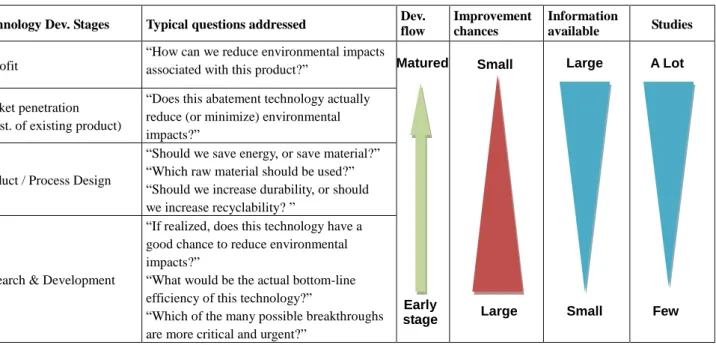
Table 1 summarizes the characteristics of environmental technology assessment in different stages of technology development. As can be seen, questions that are addressed will be quite different in different stages. In the earlier stages, questions could be directed to each of the technology that builds up to a final product and its lifecycle stages. The amount of information available for environmental technology assessment is less in the earlier stages, thus, studies in this part of matrix is few. However, as emphasized by the red colored figure, by overcoming the uncertainties and lack of information, there could be greater chance of improvement (environmental performance) if such environmental technology assessment could provide a feed-back to the development of the emerging technologies.
Because the information available at each of the stage increases as the technology becomes more developed, planning could incorporate more information. Especially, by extending the boundaries in the planning activities, chances to obtain a more favorable plan increases. For example, when a production process of a certain material is investigated, choices in processes will be less when the raw materials are fixed. However, when research and development in
- 2 -
such material is already matured, there will be a selection of promising raw materials, therefore, combinations of processes and raw materials can be explored, and the optimal combination of raw material and process could be chosen.
Table 1 Characteristics of environmental technology assessment in different stages of technology development.
More studies are done for already developed products, because more information on production is available. There is a greater chance of higher environmental performance in earlier stages, however, available information is less.
Technology Dev. Stages Typical questions addressed Dev.
flow Improvement chances Information available Studies Retrofit
“How can we reduce environmental impacts associated with this product?”
Market penetration (subst. of existing product)
“Does this abatement technology actually reduce (or minimize) environmental impacts?”
Product / Process Design
“Should we save energy, or save material?” “Which raw material should be used?” “Should we increase durability, or should we increase recyclability? ”
Research & Development
“If realized, does this technology have a good chance to reduce environmental impacts?”
“What would be the actual bottom-line efficiency of this technology?”
“Which of the many possible breakthroughs are more critical and urgent?”
However, such chances become less, if number of promising alternatives is already limited in the development process of raw materials. Screening of alternatives are currently based on instinct of researchers, and in the modern society, it is getting more and more difficult to incubate promising alternatives to allow a long-sighted planning of technology development, because the width of technology has been exploding in the last century and continues on exploding in this century as well. If screening is performed based on benefits on the short term, future competitiveness could be traded off. To summarize, it is crucial and urgent 1) to provide researchers of environmentally friendly technologies at the earlier stages, with the information on chances of environmental impact, possible barriers, and bottom-lines of the technologies, and 2) to allocate R&D resource in a strategic manner being aware of importance of such technologies.
Hydrogen technologies
Hydrogen is considered as an ideal media for storing, transporting, and generating power. A rich amount of research efforts are invested into the technologies to realize “Hydrogen Society”. Such technologies form a “cluster” as discussed in the previous sections.
The benefits of realizing Hydrogen Society could be raised as follows:
1. Breakaway from dependency on the fossil fuels4: This is necessary from two reasons. First, reproduction rate of fossil fuels is very slow, and if we use it as the main energy source, it will deplete. Second, Fossil fuel is unevenly distributed, and it has been a cause of political issues. Assuming we could produce hydrogen by sustainable means using evenly distributed resource, it will eliminate those problems.
2. Decentralized energy systems: The advantage of such an energy system is that it is less vulnerable to a disaster, and it could earn from the transmission loss. This advantage relies on the assumption that the distribution and storage of hydrogen is done in a safe and sustainable way.
3. Centralization of emissions of pollutants: Production of hydrogen would not be fully
Small Large Large Small A Lot Few Early stage Matured
covered with renewable energy such as wind, solar, and hydro power. Therefore, there will be emission of pollutants and CO2 at production of hydrogen. However, by using
hydrogen based technologies as power sources, we can avoid emission at the distributed demand sites. In other words, the emissions could be centralized at the hydrogen production sites, and it could be dealt with emission mitigation technologies that we already have in our hand5.
4. High energy conversion efficiency: Hydrogen could use fuel cells for production of power, as well as engines and turbines. Because fuel cell has very high energy conversion efficiency, the efficiency of resource utilization rises, assuming hydrogen could be produced in an efficient method.
Although studies on hydrogen society are actively carried out worldwide, a comprehensive and localized picture of hydrogen society has not been drawn in Taiwan. Therefore, the benefits and pitfalls of Hydrogen society have not yet been examined in the local context of Taiwanese society.
2 Objective
In this project, a strategic technology development platform for hydrogen related technologies will be developed. The platform introduces life cycle perspectives on hydrogen and relevant goods and services, and considers interaction among the hydrogen production technologies.
Using the developed platform, possible hydrogen society in Taiwan will be illustrated. The example of questions addressed would be:
To what amount should we introduce hydrogen?
For which applications should hydrogen be used?
How does a technology breakthrough affect environmental impacts?
How does such breakthrough affect the size of the future hydrogen society?
By making it possible to answer those questions, the platform could provide technology researchers with a clear understanding of roles of their technology in the entire hydrogen society as well as the relationships with the competing technologies, bottom-line and favorable target efficiencies, etc.
3 Research review
Hydrogen is the most common element in the universe, but on earth, it does not exist in significant quantities except for in combination with other elements: it is combined with water and with carbon in natural gas, oil, coal or biomass. Development of hydrogen energy from such sources is a cutting-edge research topic because hydrogen is often proposed as a potential energy carrier in the future.
Hydrogen as energy carrier exhibits both positive and negative aspects6. The main advantage of hydrogen as a fuel is the absence of CO2 emissions, as well as other pollutant
emissions (ex. thermal NOx) if it is employed in low temperature FCs in the transport sectors. In addition, hydrogen can be coupled with new and renewable energy sources of an intermittent character, in the current energy system7. Namely, we can apply a photovoltaic solar panel or a windmill lined to a fuel cell, which uses a part of the electricity to produce hydrogen8.
However, it does not mean that there are no environmental impacts when using hydrogen. Form life cycle point of view (from“cradle-to-grave”), there are still some emissions occurring when hydrogen is being produced. For instance, hydrogen production via natural gas steam reforming will emit overall 11,888g CO2-equivalent/kg H2 production9. The following
Table 2 contains a breakdown of the sources showing that the hydrogen plant itself accounts for 74.8% of the greenhouse gas emissions.
- 4 -
Table 2 Breakdown of sources of greenhouse gas emissions associated with hydrogen production8
Toward hydrogen society
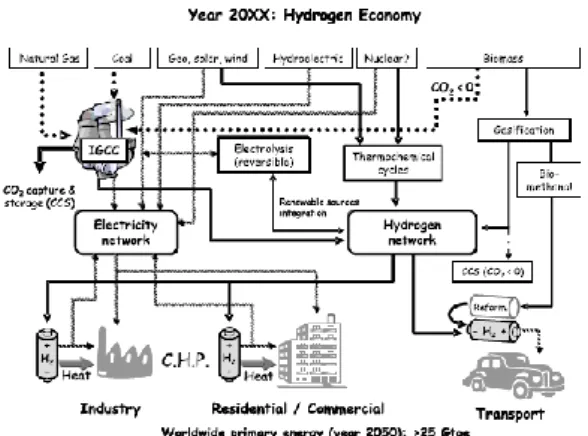
The “hydrogen economy” has the potential to provide a sustainable and secure energy system, and there is a wide and growing literature promoting and exploring different possible hydrogen futures. In Figure 3 illustrates the future society that applies hydrogen as the end-use in industry, residential/commercial, and transportation6.
Right now many countries are devoted to switch to hydrogen society. For example, as shown in Figure 3, UK sets out the six UKSHEC visions that are related to the role of hydrogen10. In terms of time scales, the intention is to imagine them far enough into the future that substantial infrastructural changes are conceivable, but not so far into the future that the technologies envisaged today will be obsolete, that is, around 2040-2050.
In Asian region, there are also many studies on hydrogen energy. Hong Kong, as a highly dependent city on imported fossil fuel, also sees hydrogen as clean renewable energy for long-term energy supply. According to the studies that have been done, the achievable hydrogen energy output would be as much as 40% of the total energy consumption in transportation in Hong Kong area11.
4 Method
A new methodology termed “Composite Life Cycle Assessment” is developed in this project. The assessment method allows decision-makers analyze environmental aspects of technology scenarios for hydrogen society in a strategic manner. Various collections of hydrogen technologies can be assessed with the LCA methodology for composite technologies developed in this study, termed composite LCA. A case study on assessment of Taiwanese hydrogen-based transportation system based on indigenous renewable energy is presented to demonstrate the methodology we propose.
Each hydrogen related technology falls into one of the four following categories: production, utilization, storage, and distribution. Among those technologies, in the proposed method,
Figure 2 Hydrogen society in the distant future. Renewable energies are intensified and fuel
cells-hydrogen binomial is employed to achieve higher efficiencies6.
production and utilization are primarily focused, because storage and distribution needs depend on the extent of utilization of hydrogen in the society, which is analyzed by production and utilization. The results from our methodology will make it possible to further assess storage and distribution in the successive steps, as introduced in the case study later.
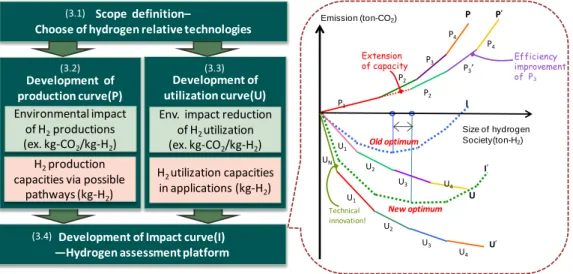
The composite LCA methodology designed for assessment of hydrogen society is summarized in Figure 4. Figure 4-a) presents the major building blocks of the methodology, which are related with the sections in case study. Figure 4-b) elaborates on the concepts of production and utilization curves, as well as the scheme of synthesis of impact curve in the methodology.
First, an initial collection of hydrogen production and utilization technologies is set based on specific criteria and constraints. Each technology is classified into either production or utilization technology.
Next, for the technologies classified in the production category, production curve (P curve) is developed. A cradle-to-gate LCA is conducted for hydrogen produced via each production technology to derive environmental impact associated with production of unit amount of hydrogen. At the same time, resources available for hydrogen production are evaluated. By combining those two results, a segment can be drawn in a coordinate with hydrogen production and environmental impact of primary interest in horizontal and vertical axes, respectively. The segments are linked to form a curve that start from the origin of the coordinate. For example, P in Figure 4-b depicts how a P curve would reveal. Each segment (P1, P2, P3, and P4) represents
different hydrogen production pathway.
For the technologies classified in the utilization category, utilization curve (U curve) is developed. A gate to grave LCA is conducted for hydrogen utilized via various hydrogen using technologies. Such analyses derive environmental impact reduction induced by utilization of unit amount of hydrogen in the respective technologies. At the same time, demands for functions delivered via respective utilization technologies are evaluated. By combining those two results, a segment can be drawn in a coordinate with hydrogen production and reduction in an environmental impact of primary interest in horizontal and vertical axes, respectively. The segments are linked to form a curve that start from the origin of the coordinate. For example, U in Figure 4-b depicts how a U curve would reveal. Each segment (U1, U2, U3, and U4) represents
different hydrogen utilization pathways.
If the segments are put in order by their gradients (P14, U14) the constructed curves are
convex downward. Such P and U curves show the minimum environmental impact and maximum environmental impact reduction over hydrogen production respectively. Conversely, if the segments were put in the reverse order (P41, U41), the P and U curves will be convex upward
and show the maximum environmental impact and minimum environmental impact reduction over hydrogen production using the same collection of production and utilization technologies. The P and U curves in reality would lie somewhere in between those two extremes, which intersects at the origin and at another end of the curves.
Combining the P and U curves, impact curve (I curve) can be synthesized to show the net changes in environmental impact over the extent of hydrogen use assuming a collection of technologies. For example, the lowest point on I curve shows the optimum extent of hydrogen utilization.
This framework is capable of evaluating consequences of technology breakthrough: for example, the extension capacity of P1 (dotted line in P’), efficiency improvement of P3 (P3’ of P’)
and technical innovation (UN of U’). So the change of hydrogen society can be seen here.
(dual-arrow in figure 1-b) Furthermore, this methodology can assess different impact categories together with a main impact category of interest, as demonstrated in the case study on renewable resources-based hydrogen for transportation in Taiwan.
- 6 - Emission (ton-CO2) Size of hydrogen Society(ton-H2) P1 P2 P3 P4 P2 P3’ P4 Extension
of capacity Efficiency improvement of P3 P P’ I I’ U U’ U1 U2 U3 U4 U4 U3 U2 U1 UN Old optimum New optimum Technical innovation! Development of production curve(P) H2production
capacities via possible pathways (kg-H2) Environmental impact of H2productions (ex. kg-CO2/kg-H2) (3.2) Development of utilization curve(U) H2 utilization capacities in applications (kg-H2)
Env. impact reduction of H2 utilization
(ex. kg-CO2/kg-H2)
(3.3)
Development of Impact curve(I) —Hydrogen assessment platform
(3.4)
Scope definition–
Choose of hydrogen relative technologies
(3.1)
Figure 4 The framework of Composite Life Cycle Assessment methodology explained in the context of evaluation of hydrogen technologies
5 Results and Discussions
In this case study, an assessment of Taiwanese hydrogen society is demonstrated by using the composite LCA methodology . The considered production pathways include wind, solar, and biomass (kitchen waste and rice straw). Greenhouse gasses emission was chosen as the environmental impact of focus. Data such as availability of resource (wind condition, solar irradiation, area, biomass availability, etc.) and energy consumptions of hydrogen production, emissions from fossil fuel combustions, and demand of different kinds of vehicles were used to construct the production and utilization curves.
The total hydrogen production potential from the selected renewable energy technologies available in Taiwan is 676 kton-H2/year, yet the demand of hydrogen in transportation sector is
1.13 Mton-H2/year. The current production capacity from renewable resource cannot fully satisfy
the demand if other technologies are not introduced. More assessment on hydrogen production development and resources acquirement should be derived for future hydrogen society.
Although the current hydrogen production capacity cannot provide sufficient supply for total transportation sector of Taiwan, the results present a variation in different area shown in Figure 6. It shows production capacities by area, which emphasizes the higher hydrogen production
potentials in the central and southern area of Taiwan. In eastern area, the low solar derived hydrogen production is due to less residential building in that area, so that there are less roof areas to be put PV panel to produce electricity.
12 42 38 124 0 20 40 60 80 100 120 140 0 50 100 150 200 250 300
North Central South East
kg-H2/person kton-H2 Wind Solar Biomass Available hydrogen per person
Figure 5 Preliminary P, U, and I curves in the case study Figure 6 Hydrogen production potential in the case study, by area
Figure 6 also shows the available hydrogen utilization amount per person in each area. Although the hydrogen production potential in eastern area is the lowest, it can provide people the largest amount of hydrogen due to less population in this area. And only eastern area can
-50 0 50 100 150 200 250 300 350 400 0 0.2 0.4 0.6 0.8 1 1.2 GHG Emission(Mton)
Size of Hydrogen Society(Mton-H2)
provide sufficient hydrogen for average personal demands (53.6kg-H2/year). More assessments
on hydrogen distribution should be considered in the future.
In addition, in the assessment platform presented in the case study, if we take other impact categories such as NOx and SOx into account, the optimum point for GHG emission doesn’t represent the optimum point for the other two emissions. The results shown in table 3 indicate that if we can provide more hydrogen for this society, the more pollutant emission can be reduced. So here comes a situation if more than one index is considered, how we can compare the results. If we are more focusing on GHG emission, then this society should only provide hydrogen until the optimum point of impact curve. However, if the other indexes occupy more importance, then this society should provide more hydrogen for usage.
Table 3 Emissions of GHG and pollutants (NOx and Sox) at different amount of hydrogen supply. Minimum GHG has more emission of other pollutants. By using all the defined resources for hydrogen production, GHG
emission increases while the other two decreases.
Minimum GHG Maximum H2 supply
GHG (Mton) -9.2 331.4
NOx (kton) -51.8 -82.5
SOx (kton) -7.51 -11.9
A composite life cycle assessment method is developed to allow decision-makers the strategic analyses on aware choice of hydrogen technologies. The presented case study demonstrates the use of methodology, and shows possibility of feedback on target efficiencies and consequential environmental benefits to the researchers developing the technologies assessed. Moreover, by collecting more data on wider variety of hydrogen related technologies, an assessment platform for hydrogen platform can be constructed. This project, in the following 2 years, attempts to clearly describe procedures to extend such a platform be constructed to make most of the technological assets generated as a result of research activities. As a result, the platform enables optimization of possible future hydrogen society using various criteria and constraints.
- 8 -
Reference
1. Heinzle, E. and Hungerbuehler, K., “Integrated Process Development: The key to Future Production of Chemicals. Chimia, 1997. 51:p.176-183
2. Alejandro Cano Ruiz, “Environmentally Conscious Chemical Process Design”, Massachusetts Institute of Technology, Ph.D. Dissertation (2000)
3. Volker H. Hoffmann, “Multi-objective decision making under uncertainty in chemical process design”, Swiss Federal Institute of Technology Zürich, Ph.D. Dissertation (2001)
4. J. POTHSTEIN, Hydrogen and fossil fuels, International Association for Hydrogen Energy, Int. J. Hydrogen Energy, Vol. 20, No. 4, pp. 283-286, 1995
5. Greg Brinkman, Economics and Environmental Effects of Hydrogen Production Methods, independent study, Fall 2003
6. Gregorio Marban, Teresa Valdes-Solis, Towards the hydrogen economy?, International Journal of Hydrogen Energy 32 (2007) 1625 – 1637
7. J.I. Levene, M.K. Mann, R. Margolis, and A. Milbrandt, An analysis of hydrogen production from renewable electricity sources, Conference Paper NREL/CP-560_37615, September 2005
8. B. Kroposki, J. Levene, and K. Harrison, P.K Sen, F. Novachek, Electrolysis: Information and Opportunities for Electric Power Utilities, Technical Report NREL/TP-581_40605, September 2006
9. Pamela L. Spath, Margaret K. Mann, Life cycle assessment of hydrogen production via natural gas steam reforming, National Renewable Energy Laboratory, NREL/TP-570-27637
10. William McDowall, Malcolm Eames, Towards a sustainable hydrogen economy: A multi-criteria sustainability appraisal of competing hydrogen futures, International Journal of Hydrogen Energy 32 (2007) 4611–4626
11. Meng Ni, Michael K.H. Leung, K. Sumathy, DennisY.C. Leung, Potential of renewable hydrogen production for energy supply in Hong Kong, International Journal of Hydrogen Energy 31 (2006) 1401 – 1412
Self Evaluation
Consistency between the ongoing research and the proposal (研究內容與原計畫相符程度): A Comment: The ongoing research is being conducted completely in line with the original proposal accepted by the National Science Council.
Actual progress compared to the expected (達成預期目標情況): A+
Comment: The expected achievement in the first year is actually achieved, and it will be the content of master thesis to be completed by I-Ching Chen in July, 2009. Preliminary results have been already presented at international and domestic conferences. A journal paper is in preparation. Part of items in the second year is already partly in progress.
Academic and practical values of the achievements (研究成果之學術或應用價值): B+ Comment: Because the paper is still not published from a journal, academic value of the study is not completely transferrable. When it is published, the value in both academic and practice is expected to be very high, because it can make R&D efforts more efficient, and serve as “map and compass” in the design of future energy systems.
Possibility of publication in academic periodicals (是否適合在學術期刊發表): A Comment: We consider it is highly possible to publish from academic periodicals, for example from International Journal of Life Cycle Assessment, and International Journal of Hydrogen Energy. A manuscript is in preparation in this line.
Overall evaluation (綜合評估): A
Publications, Presentations, Thesis
- Conference papers and Presentations
I-Ching Chen and Yasuhiro Fukushima, SETAC World Congress, 2008.8, Sydney, Australia
I-Ching Chen, xx, xx, Yasuhiro Fukushima, Annual Conference of the Chinese Institute of Environmental Engineers, 2009.11, Taipei, Taiwan
I-Ching Chen and Yasuhiro Fukushima, The fourth annual conference of the Institute of LCA Japan, 2009.3, Kokura, Japan
- Thesis
I-Ching Chen, Master thesis, National Cheng Kung University, Taiwan (2009) - Journal papers
I-Ching Chen and Yasuhiro Fukushima, “A Composite Life cycle Assessment of Hydrogen Society: A case study on hydrogen-based transportation using
renewable energy in Taiwan”, in preparation
Conference Participation Report is not attached, because the budget is not yet used. It will be used in June, 2009, before the 1st year ends.