Research Express@NCKU - Articles Digest
Research Express@NCKU Volume 3 Issue 1 - January 11, 2008 [ http://research.ncku.edu.tw/re/articles/e/20080111/1.html ]
Nanoscale mechanical characteristics of
vertical ZnO nanowires grown on ZnO:Ga/glass templates
Shoou-Jinn Chang * 、Sheng-Joue Young
Institute of Microelectronics & Department of Electrical Engineering
Nanotechnology, 18, 225603 (2007)
O ne-dimensional (1D) materials such as nanowires, nanobelts and nanorods have attracted considerable interest in recent years. They present the utmost challenge to semiconductor technology, making
fascinating novel devices possible. It has been demonstrated that these 1D materials exhibit superior electrical, optical, mechanical and thermal properties. It has also been shown that these materials are potential useful for nanoscale interconnects, active components of optical electronic devices and nanoelectromechanical systems (NEMS).
1D oxide systems such as SnO
2, tungsten oxide (W
18O
49), GeO
2, indium tin oxide (ITO), Al
2O
3and ZnO nanowires have also attracted much attention in recent years. Among them, ZnO is an n-type direct-gap semiconductor with a large exciton binding energy of 60 meV and wide bandgap energy of 3.37 eV at room temperature. Hence, ZnO is regarded as a promising photonic material. However, only few reports on the mechanical properties of ZnO nanowires can be found in the literature. In this work, we deposited vertically well-aligned ZnO nanowires on ZnO:Ga/glass templates and performed nanoindentation tests to study the buckling instabilities of these nanowires. However, no actual experimental measurements made to study the instabilities of the ZnO nanowires grown on ZnO:Ga/glass templates under uniaxial compression have been report. Based on Euler buckling model, we estimated Young’s modulus (elastic modulus) of the ZnO nanowires.
The synthesis of vertical ZnO NWs was performed by a modified self-catalyzed vapor-liquid-solid (VLS) method without any metal catalyst. During the growth of ZnO NWs, we placed the ZnO:Ga/glass template together with zinc vapor source on an alumina boat and inserted them into the quartz tube of furnace.
Constant streams of argon (i.e. 54.4 sccm) and variant oxygen flow rate (i.e. 0.8 and 0.2 sccm for sample A and sample B, respectively) gases were then introduced into the furnace.
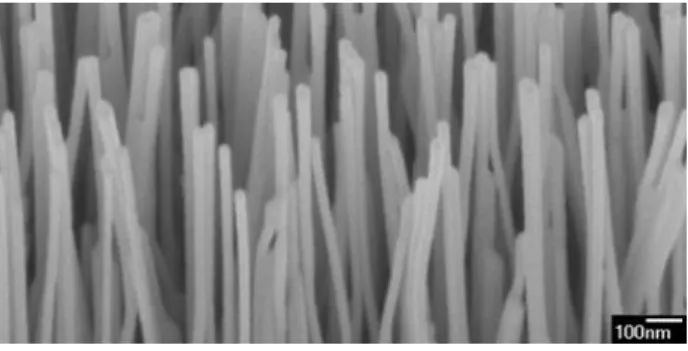
The FESEM images with 30˚ title angle of the as-grown ZnO NWs in samples A and B were shown in figure 1 (a) and (b). We found the typical diameter, length and density of the ZnO NWs in sample A were approximately 100 nm, 2000 nm and 8.2 × 10
9cm
-2while the ones of sample B were estimated to be 30 nm, 800 nm and 1.2 × 10
10cm
-2, respectively. Note that we can tune the oxygen flow rate during NW growth to obtain the different size of ZnO NWs. It was found that these ZnO NWs were distributed uniformly across the entire substrate and the tops of these NWs were hexagonal with the c-axis perpendicular to the substrate surface.
1 of 3
Research Express@NCKU - Articles Digest
Figure 1.FESEM images with 30
otitle angle of (a)
sample A with the 100 nm diameter ZnO NWs, Figure 1(b) sample B with the 30 nm diameter ones.
Figure 2 shows the measured XRD spectrum of the samples. The peak occurred at 2θ =34.3˚ in the spectrum was originated from the (002) plane of ZnO semiconductors. We also observed a ZnO (004) XRD peak at 2 θ =72.8˚. Such a result indicates that the ZnO NWs were preferentially grown in c-axis direction.
Figure 2.XRD spectra of the as-grown ZnO NWs (samples A and B) prepared on glass substrate.
Samples A and B with the vertical ZnO NWs of 100 and 30 nm diameters were used in the
nanoindentation tests. The investigation on the buckling behavior of the NWs were performed by means of a nanoindentation system (Hysitron Triboscope, Hysitron Inc., Minneapolis, MN).
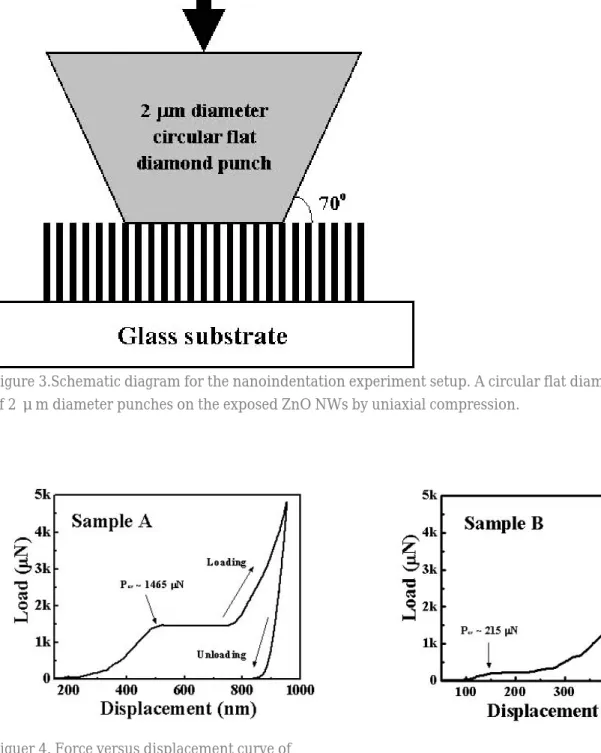
Uniaxial compression on the exposed NWs was accomplished with a diamond indenter of 2 •m diameter as shown in figure 3. The force-depth curves for the ZnO NW samples A and B are shown in figure 4 (a) and (b). The plot represents a loading- unloading cycle. The loading portion consists of three stages: an initial increase, followed by a sudden drop in the slop and the curve becoming flat, and a third stage comprising an increasing load. The collapse force is 1465 μN for sample A, whereas it is 215 μN for sample B. The critical buckling loads of the ZnO NWs are therefore found to be 1465 and 215 μN for samples A and B, respectively. Furthermore, the buckling energy was 3.62 × 10
-10and 3.69 × 10
-11J for samples A and B, respectively. Euler buckling model can be employed in evaluating the Young’s modulus (E) and the critical buckling strain ( ε
cr) of individual ZnO NWs. A size dependence of Young’s modulus in [0001] oriented ZnO NWs has been found in this work.
These results will facilitate the further application of ZnO NWs .
2 of 3
Research Express@NCKU - Articles Digest
Figure 3.Schematic diagram for the nanoindentation experiment setup. A circular flat diamond indenter of 2 μm diameter punches on the exposed ZnO NWs by uniaxial compression.
Figuer 4. Force versus displacement curve of sample A (a) and B (b)
3 of 3