Advancing U.S. Pre-service Teachers’ Mathematical Sophistication via Mathematical Tasks
Kien H. Lim
Department of Mathematical Sciences University of Texas at El Paso
This article is based on the seminar that the author presented for the Hong Kong Association for Mathematics Education at the Hong Kong Baptist University on May 22, 2008. In this article, the author differentiates (a) between institutionalized mathematics and school mathematics, (b) between ways of understanding and ways of thinking as two complementary subsets of mathematics that students should develop, (c) between sophisticated learners and passive learners, and (d) between knowledge dissemination and knowledge engagement as two modes of instructions. Harel’s (2007) pedagogical principles will be discussed in relation to the design of mathematical tasks and their use in classrooms. Examples are presented to illustrate how mathematical tasks can be designed to accomplish certain learning and teaching objectives, such as provoking the need for students to learn a particular concept, promoting desirable ways of thinking, deterring undesirable ways of thinking, and assessing students’ conceptual understanding.
In general, mathematicians, scientists, and engineers in their school days probably had less trouble understanding mathematical concepts that their classmates had to struggle with. Possible explanations, which are debatable, include they like math; they have the “math” gene; they were asked a lot of thinking questions in their childhood; they had a strong mathematical foundation; and they thought like a mathematician. Nevertheless, mathematics teachers can help students develop strong mathematical foundation and mathematical habits of mind. Unfortunately, the mathematics taught in most schools in the United States is school “mathematics”, which is fundamentally different from the mathematics practised by mathematicians.
Mathematics as a Discipline versus School Mathematics
Mathematics as a discipline is an interconnected web of concepts. In its transposition into the “mathematics” taught in schools, it is linearized and compartmentalized (Eisenberg & Dreyfus, 1991).
Academic knowledge is very intricate and contains many links and connections; these cannot be presented as a package since their presentation must be sequential. The elements of this knowledge must be taken apart and ordered sequentially. This process necessarily destroys many of the links and therefore considerable part of the unity of the knowledge. (p. 32)
Consequently, school mathematics becomes a collection of standalone topics.
The mathematics practised by mathematicians involves problem-solving, making connections, generalizing, symbolizing, structuring, representing, modelling, conjecturing, proving, seeking efficiency, and seeking elegance.
On the other hand, the focus in school mathematics tends to be on facts, procedures, definitions, theorems, and proofs. To emphasize the importance of mathematical processes, the National Council of Mathematics (NCTM) has included both content standards as well as process standards in its Principles and Standards for School Mathematics (2000). The five process standards are (a) problem solving, (b) reasoning and proof, (c) communication, (d) connections, and (e) representations.
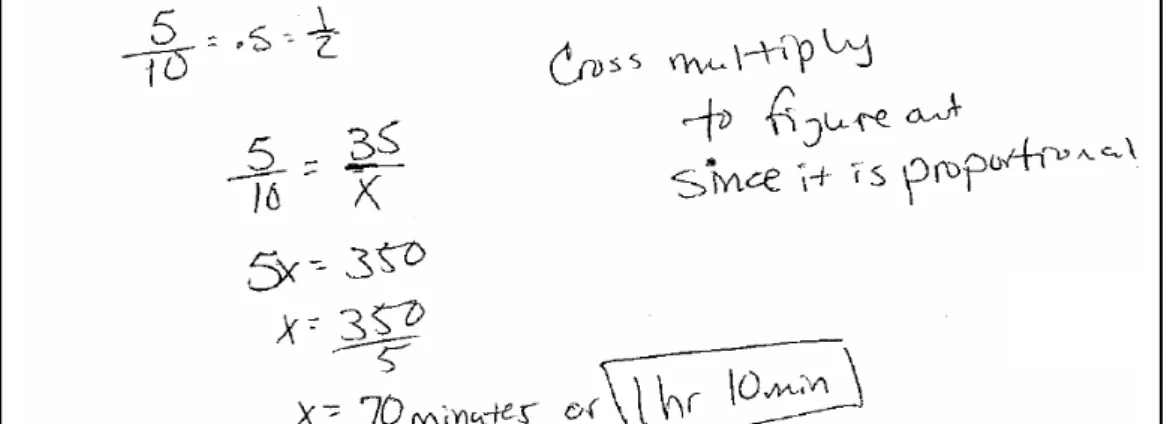
In response to the recent nationwide emphasis in the United States on testing and accountability under the No Child Left Behind mandate in President Bush’s educational policies, school teachers tend to teach to the test and disregard the process standards. Consequently, many prospective teachers in the teacher preparation program enter college with poor mathematical understanding. Some apply procedures without making sense of the problem situation. For example, the author found that only 47% of 64 prospective middle-school teachers correctly answered the following problem: “A group of
5 musicians plays a piece of music in 10 minutes. Another group of 35 musicians will play the same piece of music. How long will it take this group to play it?” 42% of them obtained 70 minutes. One such solution is depicted in Figure 1. Another 11% found other numbers because either the proportion was incorrectly set up or they made a computational mistake.
Figure 1. A prospective teacher’s solution using a proportion for an invariant problem
Seaman and Szydlik (2007) found the pre-service elementary teachers in their study “displayed a set of values and avenues for doing mathematics so different from that of the mathematical community, and so impoverished, that they found it difficult to create fundamental mathematical understandings” (p.
167). These pre-service teachers’ deficient ways of thinking prevented them from utilizing web-based resources effectively to solve problems. For example, there were nine pre-service teachers who could not find the greatest common factor of 60 and 105 at the beginning. After twenty minutes spent using online teacher resources (refer to http://www.math.com/school/subject1/
lessons/S1U3L2GL.html), only one of them succeeded in finding the greatest common factor of 60 and 105. These teachers “did not even attempt to make sense of the relevant definitions provided by a teacher resource” (p. 179).
Seaman and Szydlik describe these teachers as mathematically unsophisticated.
Ways of Understanding and Ways of Thinking
A mathematically sophisticated individual is someone who “has taken as her own the values and ways of knowing of the mathematical community”
(Seaman & Szydlik, 2007, p. 167). Although such an individual does not have the depth of mathematical knowledge of mathematicians, she should have habits of mind that resemble those of mathematicians. Figure 2 highlights two components of knowing and doing mathematics as a discipline.
Figure 2. Two components of mathematics as a discipline
Harel’s (in press) definition of mathematics accentuates the difference between these two aspects.
Mathematics consists of two complementary subsets. The first subset is a collection, or structure, of structures consisting of particular axioms, definitions, theorems, proofs, problems, and solutions. This subset consists of all the institutionalized ways of understanding (italics added) in mathematics throughout history. … The second subset consists of all the ways of thinking (italics added), which are characteristics of the mental acts whose products comprise the first set. (p. 8)
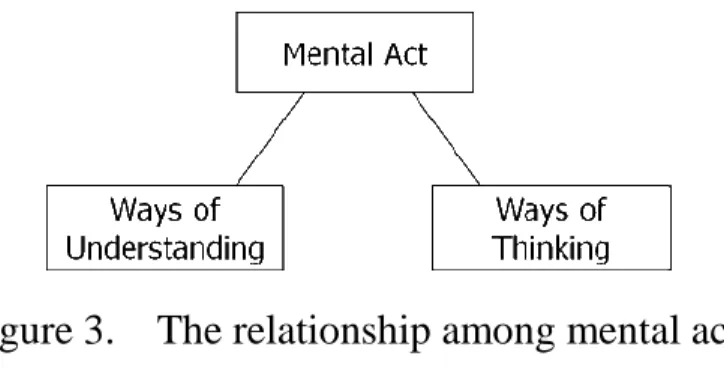
This definition highlights the triad—mental act, ways of understanding, and ways of thinking—as illustrated in Figure 3. According to Harel’s duality principle (2007), “Students develop ways of thinking only through the construction of ways of understanding, and the ways of understanding they produce are determined by the ways of thinking they possess” (p. 272). This principle asserts that ways of thinking cannot be changed without an appropriate change in ways of understanding, and vice versa. Hence, both ways of
understanding and ways of thinking must be incorporated as learning objectives for students. In the author’s paper on mathematical knowledge for pre-service teachers, Lim (2008a) describes the connection among ways of understanding, ways of thinking, and pedagogical content knowledge (Shulman, 1986).
Figure 3. The relationship among mental act, ways of understanding, and ways of thinking
In the context of mathematics, mental acts include interpreting, predicting, conjecturing, proving, symbolizing, structuring, computing, generalizing, formulating, transforming, searching, and classifying. A way of understanding refers to the cognitive product of a mental act whereas a way of thinking refers to the cognitive characteristic of the act (Harel, 2007, in press). Considering the mental act of ascertaining the truth of a proposition, Harel and Sowder (1998) suggest a theoretical construct called “proof scheme” which is a way of thinking associated with the act of proving—ascertaining for oneself or persuading others of the truth or falsity of a conjecture. In the case of ascertaining the truth of the proposition: the sum of two odd numbers is even, the justification a student gives, such as “the proposition is true because it is stated in the text book,” is considered the student’s way of understanding. The student’s way of thinking characterizing this justification is considered an authoritative proof scheme because the student gains conviction from an external source rather than from within mathematics. A justification based on a list of instances such as 1 + 3, 1 + 5, 7 + 9, and 13 + 25 is characterized as an empirical proof scheme. A justification that considers the generality aspect of the conjecture is characterized as a deductive proof scheme; for example, “odd plus odd is ‘even plus one’ plus ‘even plus one’; since the two extra one’s form a pair, there is no more odd one out; hence odd plus odd must be even.” A
taxonomy of proof schemes is found in Harel and Sowder’s (1998) article on Students’ Proof Schemes.
To elaborate Harel’s ways of thinking associated with the mental acts of anticipating (Lim, 2008b, 2006), consider an eleventh grader’s solution to this problem: “Is there a value of x that will make this statement true? (6x – 8 – 15x) + 12 > (6x – 8 – 15x) + 6” (Lim, 2008b, p. 42). The student predicted “of course there is” and commented “Let’s see, I was taught to combine like terms.
I was taught this (>) is actually an equal sign …”. After changing the inequality to an equation and simplifying, the student obtained 6 = 0, changed it back to 6 > 0, and guessed “may be there isn’t” a value for x that would make the statement true. The student’s prediction of “of course there is” seemed to be based on her association of her having a procedure for solving an inequality with the inequality having a solution. Furthermore, her prediction of “may be there isn’t” seemed to be based on her association between the disappearance of x and the inequality’s not having a solution. Both her predictions are characterized as association-based prediction, as opposed to coordination- based prediction. The student spontaneously thought of what she could do to the inequality rather than analyzing the inequality. Her anticipation of combining like terms is characterized as impulsive anticipation—
“spontaneously proceeds with an action that comes to mind without analyzing the problem situation and without considering the relevance of the anticipated action to the problem situation” (Lim, 2008b, p. 49). The student’s interpretation of the inequality as an equation is characterized as non-referential symbolic (Harel, 2007) because it is devoid of any referential meaning, as opposed to referential symbolic (e.g., interpreting an inequality as a comparison of two quantities, or as a proposition whose truth value depends on the value of x). Association-based prediction, impulsive anticipation, and non-referential symbolic interpretation are considered ways of thinking associated with the mental acts of predicting, anticipating, and interpreting respectively.
Mathematics teachers should aim to help students progress from undesirable ways of thinking to desirable ways of thinking, such as those depicted in Figure 4.
Figure 4. Progression from undesirable habits of mind to desirable habits of mind
The question is how to teach so that students can inculcate desirable ways of thinking. The way to teach will depend, to a certain extent, on the type of students we have.
Sophisticated Learners and Passive Learners
Two extreme types of learners are contrasted to accentuate their differences in terms of epistemological beliefs and learning habits. Schommer (1994) characterizes sophisticated learners as those who tend to believe that knowledge is mostly evolving whereas naïve learners as those who tend to believe that knowledge is mostly unchanging. The differences between sophisticated learners’ beliefs and naïve learners’ beliefs are summarized in the following table using Schommer’s (1994, p. 301) epistemological dimensions:
Epistemological Dimension Sophisticated Learners Naïve Learners
Certainty of knowledge Constantly evolving Absolute and unchanging Organization of knowledge Highly integrated Compartmentalized
Source of knowledge Reasoned out Handed by authority
Ability to learn Acquired through experience Genetically predetermined Speed of learning Learning is a gradual process Learning is quick
According to Schommer (1994), students’ epistemological beliefs affect their engagement with knowledge, such as active inquiry, integration of information, and persistence in coping with difficult tasks. In learning science, sophisticated learners tend to view science as dynamic and believe that learning scientific ideas involve understanding what they mean and how they are related;
passive learners on the contrary tend to view science as static and believe that scientific facts should be memorized (Songer & Linn, 1991). Characteristics of passive learners, who tend to hold epistemological beliefs of a naïve learner, are also described in mathematics education literature. Schoenfeld (1985, 1992) found students to hold beliefs such as a mathematics problem has only one right answer, a mathematics problem can be solved in just a few minutes, there is only one way to solve a mathematics problem, and mathematics students are expected to memorize and mechanically apply taught procedures.
For many students especially passive learners, “doing mathematics means following rules laid down by the teacher, knowing mathematics means remembering and applying the correct rule when the teacher asks a question, and mathematical truth is determined when the answer is ratified by the teacher”
(Lampert, 1990, p. 31).
Sophisticated learners tend to engage in active learning. In the context of mathematics learning, a sophisticated learner will substantiate the knowledge taught to them by instantiating with examples, seeking counter-examples, investigating the necessity and sufficiency of the conditions in a theorem, making connections with related concepts, and structuring and re-organizing information in a systematic manner that make most sense to them. A sophisticated learner realizes the ineffectiveness in memorizing without understanding and believes that learning new mathematical ideas is effortful.
Wang (2008) highlights that top Chinese students value the role of investigation and understanding in learning.
To understand mathematics knowledge, excellent Chinese students … attach great importance to research as opposed to rote memory. For complicated knowledge, before asking teachers or other students for help, they first try to find the answers themselves through independent investigation. (p. 100)
Passive learners, on the other hand, tend not to grapple with the knowledge taught to them. Consequently, they have superficial understanding and the knowledge learned in one topic may adversely affect their performance in
another. For example, after being taught concepts related to proportionality, the author found that pre-service elementary and middle-school teachers performed worse in items that does not involve a proportional situation.
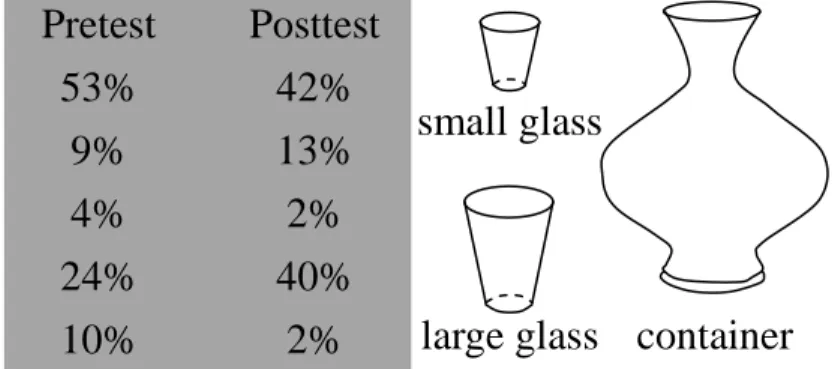
Figure 5 shows that (i) the number of students who chose the correct answer “b”
for the direct-variation item (ratios are equal) increased from 64% (out of 138 students) to 78% (out of 124 students), (ii) the number of students who chose the correct answer “a” for the inverse-variation item (products are equal), on the other hand, dropped from 53% to 42% , and (iii) the number of students who chose the incorrect proportional answer “d” increased from 24% to 40%.
Direct-Variation Item
The ratio of the amount of soda in the can to the amount of soda in the bottle is 4:3. There are 12 fluid ounces of soda in the can, how many fluid ounces of soda are in the bottle?
Pretest Posttest
(a) 8 fluid ounces 3% 6%
(b) 9 fluid ounces 64% 78%
(c) 15 fluid ounces 6% 3%
(d) 16 fluid ounces 27% 11%
(e) None of the above 1% 2%
Inverse-Variation Item
The ratio of the volume of a small glass to the volume of a large glass is 3:5. If it takes 15 small glasses to fill the container, how many large glasses does it take to fill the container?
Pretest Posttest
(a) 9 glasses 53% 42%
(b) 13 glasses 9% 13%
(c) 17 glasses 4% 2%
(d) 25 glasses 24% 40%
(e) None of the above 10% 2%
Figure 5. Pre- and post-test comparison for two items
can bottle
small glass
large glass container
Knowledge Dissemination Mode versus Knowledge Engagement Modes of Instruction
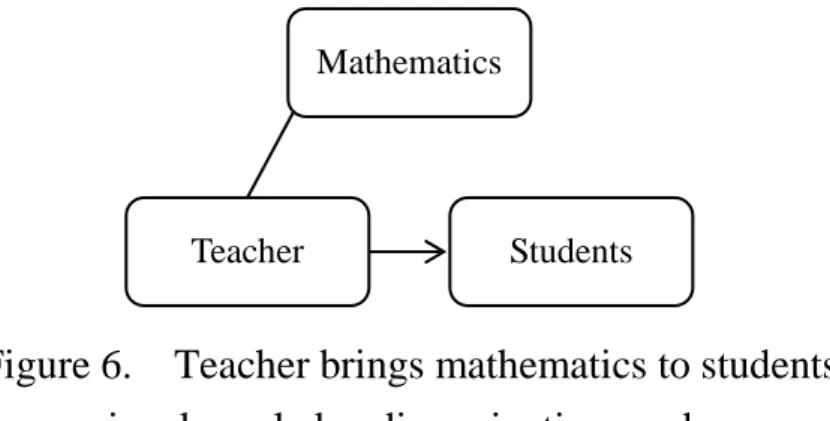
Knowledge dissemination mode of instruction usually takes the form of lectures. Mathematics classes have been traditionally taught in this mode, which is necessary for dissemination of a vast amount of knowledge in a limited amount of time. This mode of instruction can be effective if (a) the students are sophisticated learners; (b) the teacher helps students see the big picture by distinguishing critical ideas from supporting ideas, makes students think by posing intriguing questions, conveys enthusiasm, and constantly checks for student learning, and (c) the lectures are well organized around a few key points with connections among related ideas made explicit. In a knowledge dissemination mode, the teacher is considered a mediator between the mathematics and the students, as shown in Figure 6. Prior to delivering an effective lecture, the teacher typically engages with the mathematics, determines the key ideas, re-organizes the content around those ideas, and designs questions and mini-activities to engage students.
Figure 6. Teacher brings mathematics to students in a knowledge dissemination mode
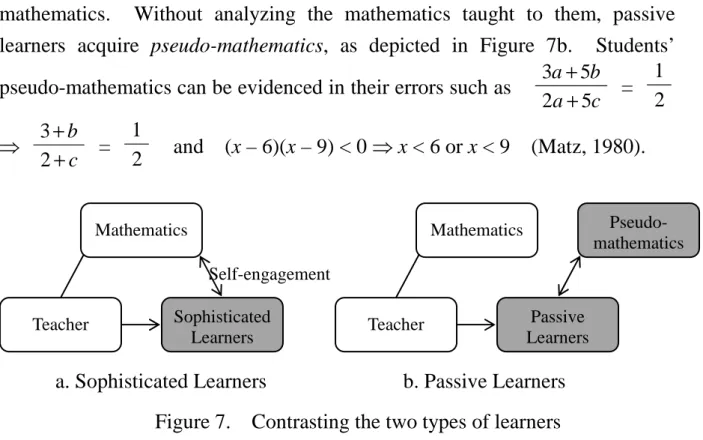
Knowledge dissemination mode favors sophisticated learners because sophisticated learners will investigate the mathematics on their own after lecturers, as illustrated in Figure 7a. Hence, their investigation will deepen their understanding of the lectured material. Leung and Lu (2008) contend that teacher-centered, content-oriented instruction works well in Chinese mainland universities because the students there tend to employ deep learning approaches. In the United States, many prospective teachers in liberal arts undergraduate program tend to be passive when it comes to learning
Mathematics
Teacher Students
mathematics. Without analyzing the mathematics taught to them, passive learners acquire pseudo-mathematics, as depicted in Figure 7b. Students’
pseudo-mathematics can be evidenced in their errors such as
c a
b a
5 2
5 3
+
+ = 2 1
⇒ c b + + 2
3 = 2
1 and (x – 6)(x – 9) < 0 ⇒x < 6 or x < 9 (Matz, 1980).
a. Sophisticated Learners b. Passive Learners Figure 7. Contrasting the two types of learners
in knowledge dissemination mode
For passive learners, knowledge engagement mode of instruction is necessary. In this mode of instruction, meaningful tasks can be used to engage students with mathematics during class. As shown in Figure 8, a mathematical task implemented as a classroom activity forces an ‘interaction’ among the students, the mathematics, and the teacher.
Figure 8. The centrality of mathematical tasks in knowledge engagement mode
“Tasks influence learners by directing their attention to particular aspects of content and by specifying ways of processing information” (Doyle, 1983, p.
161). According to Thompson, Carlson, and Silverman (2007), mathematical
Mathematics
Students Mathematical
Tasks Teacher
Passive Learners
Pseudo- mathematics Mathematics
Teacher Sophisticated
Learners Mathematics
Teacher
Self-engagement
knowledge, (b) to engage students in reflection and abstraction, and (c) to provide learners an opportunity to practise what they have learned. Hence, the use of well-designed mathematical tasks is a means to engage students in active learning.
Pedagogical Principles to Guide the Design and Use of Mathematical Tasks
A good mathematical task should, according to van de Walle (2003), have the following characteristics: (a) its primary focus should be the mathematics, (b) it should be challenging yet accessible to students, and (c) it should require students to explain and justify their answers. A good mathematical task can be designed and implemented with Harel’s (2007) pedagogical principles in mind.
The pedagogical principles are the duality principle, the necessity principle, and the repeated-reasoning principle. Collectively they constitute the DNR-based instruction.
The primary consideration in the design or selection of mathematical task for a lesson should be the learning objectives, but not the use of a particular type of technology or manipulatives. The learning objectives should include both ways of understanding and ways of thinking because teaching one without the other is ineffective as stipulated in Harel’s (2007) duality principle. Harel and Sowder (2005) observed that “teachers often focus on ways of understanding but overlook the goal of helping students abstract effective ways of thinking from these ways of understanding” (p. 29). For example, students may learn completing the square as a procedure for solving quadratic equations without recognizing that algebraic expressions are manipulated “with the purpose of arriving at a desired form and maintaining certain properties of the expression invariant” (Harel, in press). This way of thinking is necessary in many symbolic manipulations (e.g. the use of Gaussian elimination to determine the solution of a system of linear equations, the use of partial fraction for integrating certain rational functions, and the use of equivalent fractions with a common denominator in fraction addition). Hence, teachers should help students foster certain ways of thinking while developing mathematical
understandings such as the completing-the-square method and the Gaussian elimination algorithm.
The necessity principle stipulates that, “For students to learn what we intend to teach them, they must have a need for it, where by ‘need’ is meant intellectual need, not social or economic need” (Harel, 2007, p. 274).
Although economic needs (e.g., doing well in examinations in order to gain admission to a good university) may be a powerful motivator for some students to learn mathematics, they should not be the responsibility of teachers. On the other hand, teachers are responsible for engaging students with mathematics by posing intriguing problems for students to solve. When students understand and are intrigued by a problem posed to them, they are likely to experience an intellectual need. When students encounter a problematic situation because of the limitation of their existing knowledge, they are likely to experience an internal desire to resolve the situation; the resolution may lead to modification of their existing knowledge or construction of new knowledge.
The repeated-reasoning principle states that, “Students must practice reasoning in order to internalize, organize, and retain ways of understanding and ways of thinking” (Harel, 2007, p. 275). Students are unlikely to develop deep understanding or gain proficiency through a single experience.
Repeated-reasoning using varied mathematical tasks, not mere drill or routine practice, can help students reinforce the ways of understanding and ways of thinking that are supposed to be fostered through reasoning with those tasks.
For example, the concept of ratio as a measure can be experienced using various contextualized problems such as comparing “squareness” of rectangular lots (Simon & Blume, 1994), comparing steepness of ramps (Lobato &
Thanheiser, 2002), and comparing “oranginess” of orange juice drinks (Harel et at., 1994). By sharing their reasoning and justifying their explanations, students are more likely to internalize and retain the intended ways of understanding (e.g., a ratio of two values for two different attributes produces the measure of a third attribute) and ways of thinking (e.g., seeking different ways to quantify an attribute).
To help students improve their mathematical sophistication, tasks should be designed to help them progress from undesirable ways of thinking to desirable ways of thinking. Designing a mathematical task in accordance with Harel’s duality principle means that students’ existing ways of thinking and ways of understanding should be considered. Ideally, students should experience the limitation of their existing knowledge while working on the task, develop desirable ways of thinking and ways of understanding, and appreciate the contribution of these ways of thinking and ways of understanding in the construction of a solution. A task is said to have been designed and implemented in accordance with the necessity principle if students experience an intellectual need for a particular way of thinking or way of understanding.
Presented in the next section are some examples that highlight the connections between the tasks and the necessity principle or the duality principle.
Mathematical Tasks for Fostering and for Assessing Ways of Understanding and Ways of Thinking
Mathematical tasks can be designed to accomplish certain learning and teaching objectives, such as (a) provoking the need for students to develop a particular way of understanding, (b) fostering a desirable way of thinking, (c) deterring an undesirable way of thinking, and (d) assessing students’ conceptual understanding. Presented below are four tasks that were designed by the author and used in his classrooms. There are currently no empirical evidences to confirm the impact of these tasks on pre-service teachers’ mathematical sophistication. Nevertheless, these tasks are found to engage students in thinking.
Provoking the Need for Place Value. Although prospective teachers in the United States are familiar with arithmetic operations involving whole numbers, they may not have a solid understanding of place value. In her study, Ma (1999) found that 77% of the 23 U.S. teachers, as compared to 14% of the 72 Chinese teachers, displayed only procedural knowledge when asked to discuss questions involving subtraction with regrouping like 91 minus 79. The
understanding of the U.S. teachers was limited to superficial aspects of the subtraction algorithm.
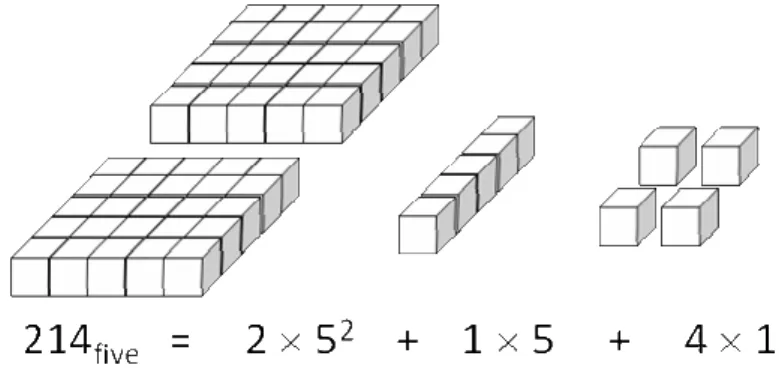
One way to draw students’ attention to the structure of place value is to use problems involving a different base. Tasks such as “draw multibase blocks to represent 214five and 1101two” may help students to see the structure of place value, as illustrated in Figure 9.
Figure 9. Use of multibase blocks to illustrate place value
These tasks, however, do not present a need for students to grapple with the concept of place value. The task depicted in Figure 10 was specifically designed for prospective elementary and middle school teachers to experience the intellectual need for place value.
Figure 10. A problem to provoke need for place value
This task requires the concept of place value to figure out how two hands of four fingers could represent 25 different values. Pre-service teachers generally find this problem intriguing because for them 10 human fingers can only represent 11 values, from 0 to 10. The solution involves assigning a value of five to each finger on one hand and a value of one to each finger on the other hand. This assignment reinforces the notion that in decimal notation digits on different positions represent different place values. Tasks that
provoke intellectual need for prime factorization and for lowest common multiple are described in another article (see Lim, in press).
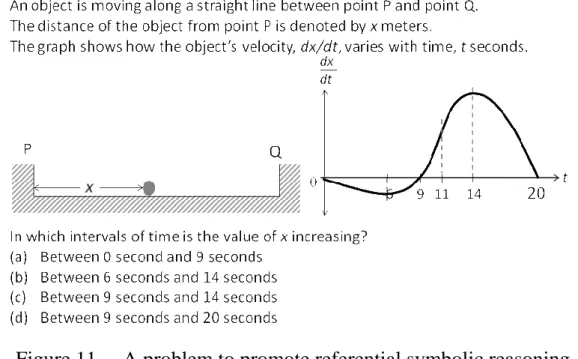
Promoting Referential Symbolic Reasoning. Unsophisticated students tend to solve mathematics problems without attending to the meaning of symbols. The following problem (Figure 11) was used to remind prospective teachers the importance of attending to the output quantity of a function represented graphically.
Figure 11. A problem to promote referential symbolic reasoning
This problem was used twice for two groups of prospective teachers in review sessions for state certification examination to teach high-school mathematics in Texas. Out of 12 students in the first group, 7 students chose
“b”, 3 students choose “c”, and only 2 students chose the correct answer “d”.
In the second group of 9 students, 4, 4 and 1 students chose “b”, “c” and “d”
respectively. Students who chose “b” and “c” focused on the characteristics of the graph without attending to the referent quantity, namely velocity, associated with the output of the function as represented by the given graph. By providing an opportunity for students to experience their tendency of not attending to meaning, this task has the potential of helping them progress from non-referential symbolic reasoning to referential symbolic reasoning, which is a foundational characteristic of mathematical sophistication.
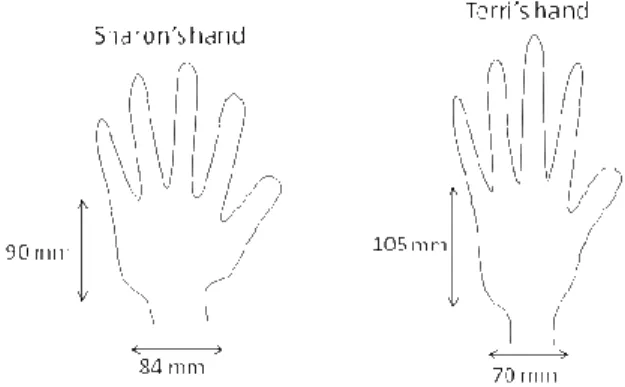
Deterring Impulsive Anticipation. Unsophisticated students tend to rush to a procedure without analyzing the problem situation. The problem in Figure 12 was designed to bring to their awareness their undesirable way of thinking, namely impulsive anticipation, and to help them progress towards analytic anticipation—a way of thinking in which one analyzes the problem situation and establishes a goal or a criterion to guide one’s actions (Lim, 2006, 2008b).
Figure 12. A problem to deter impulsive anticipation
This problem was posed after a series of problems was used to highlight the difference between additive comparison and multiplicative comparison, and to reinforce the notion of ratio as a measure (e.g. “squareness” of a rectangle, steepness of a line, and concentration level of a drink). For this problem involving comparison of palm-sizes, nine out of 22 students compared ratios (a student’s response is shown in Figure 13), three students compared differences, and only ten students compared areas as a means to determine whose palm is larger. This problem fosters the need for analyzing quantities in a problem and establishing the key idea for solving the problem; the key idea in this case is comparing products.
Since the goal of developing the habit of analyzing problem situation instead of diving into a procedure was established on the first day of class as a learning objective for the course, many students appreciate the opportunity to be aware of the need to analyze problem situation. For example, a student commented in her learning log after the lesson involving the palm-size comparison problem: “Dr. Lim had the great art of using awesome little tricks that would make us think you (should) use ratios, for example, when in fact it was multiplication! This was a great tactic, because often I would rush right into what I had just been taught, not even looking into the problem.” Listed below are a few comments written by other students in their end-of-course evaluations.
“The content was challenging at times, but required us to really think.”
“Everything we do is not hard, it just take thinking.”
“The way he makes us think is a good strategy we can use once we are teachers.”
These comments seem to suggest that pre-service teachers value the amount of thinking required in the course. Nevertheless, one semester of learning in a “thinking” environment is unlikely to change students’ belief about teaching and learning mathematics. Some students still have rely-on-teacher expectations as depicted in the following comments.
“He should give us what he expects from us in each exam. Give us a review to take home.”
“When students write their solutions on the board, he should tell us if the student was right or wrong.”
“I would like a bit more explaining before assignments.”
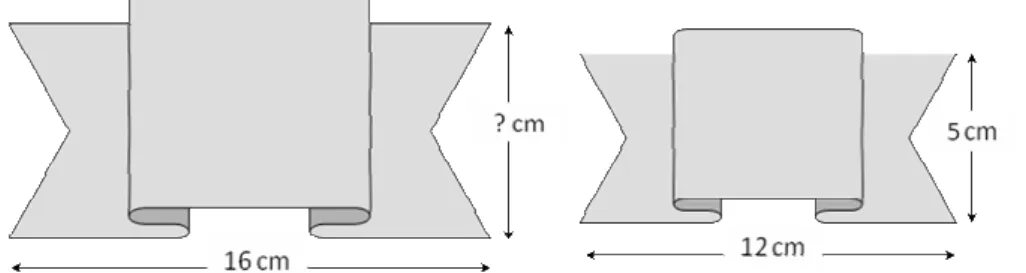
Assessing Students’ Understanding of Proportion. The problem in Figure 14 was designed to assess whether prospective middle-school teachers have understood that a proportion implies the equivalence of two ratios. When the
ribbon is scaled proportionally the ratio of its length to its width remains invariant. Many students could find the missing value without being aware of the invariance of the ratio 4 : 3.
Figure 14. A problem to assess students’ understanding of proportion Majority of the pre-service teachers constructed the proportion
12 16 =
5
x and correctly obtained 6 3
2 for the value of x . However, the ratio
6 3
2 : 5 was not among the choices. Consequently, 38% of 32 students
chose “b” and 28% chose “e”. 16% chose “d” probably because they reasoned additively. Only six students (19%) chose the correct ratio 4 : 3 and only two of them chose “a” without obtaining 6
3
2 . These two students probably
understood that the 16 : 12, or 4 : 3 , is the ratio that is used to determine the missing value. As a multiple choice item, this problem differentiates students who have a conceptual understanding of proportion from those who merely have a procedural understanding.
Designing mathematical tasks to accomplish certain teaching and learning objectives can be rather challenging. Fortunately, this skill can be developed;
one gets better with experience. In designing or selecting a mathematical task, a teacher should consider students’ current ways of understanding and ways of
thinking and tailor the task to a level of challenge that is appropriate for her or his students. In addition, a teacher should consider the relation of the task to past and future activities. For example, the palm-size comparison problem is posed after students have experienced comparing attributes such as squareness, steepness, and oranginess. In the implementation of a task, teachers should be sensitive to the norms and practices of the classroom. For example, in a classroom of passive learners who are inclined to wait for the teacher to present the solution to a problem, the teacher might have to allocate time to ensure that students are interpreting the problem as intended prior to asking them to work independently in small groups. When students have developed the habit of analyzing problem statements, the teacher can assign students to work on a problem without having to go over the problem statement as a class to ensure correct interpretation.
Summary
To recapitulate, the distinction between mathematics as a discipline and school mathematics highlights the “process” aspect of mathematics.
Corresponding to the content aspect and process aspect of mathematics are ways of understanding and ways of thinking respectively. Mathematics teachers should help students advance their ways of understanding as well as ways of thinking because the development of one depends on the development of the other.
Compared to passive learners, sophisticated learners are more likely to engage in active inquiry, integrate information, and resolve inconsistencies they encounter. Because they grapple with the mathematics on their own during and after class, sophisticated learners are able to develop desirable ways of understanding and ways of thinking in a knowledge dissemination mode of instruction. Passive learners on the other hand are unlikely to develop desirable ways of understanding and ways of thinking in a knowledge dissemination mode.
Knowledge engagement mode of instruction, where tasks and activities are designed to engage students with the mathematics they are supposed to learn, is
necessary for passive learners. Mathematical tasks can be designed and implemented, in accordance with Harel’s three pedagogical principles, to foster certain desirable ways of understanding and ways of thinking, as well as to assess students’ depth of understanding.
References
Doyle, W. (1983). Academic work. Review of Educational Research, 53, 159 – 199.
Eisenberg, T., & Dreyfus, T. (1991). On the reluctance to visualize in mathematics. In W.
Zimmermann & S. Cunningham (Eds.), Visualization in teaching and learning mathematics. MAA Notes No. 19, 25 – 37.
Harel, G. (2007). The DNR system as a conceptual framework for curriculum development and instruction. In R. Lesh, J. Kaput, E. Hamilton (Eds.), Foundations for the Future in Mathematics Education (pp. 263 – 280). Mahwah, NJ: Lawrence Erlbaum Associates.
Harel, G. (in press). What is mathematics? A pedagogical answer to a philosophical question. In R. B. Gold & R. Simons (Eds.), Current issues in the philosophy of mathematics from the perspective of mathematicians. Mathematical American Association.
Harel, G., Behr, M., Lesh, R., & Post, T. (1994). Invariance of ratio: The case of children's anticipatory scheme of constancy of taste. Journal for Research in Mathematics Education, 25(4), 324 – 345.
Harel, G., & Sowder, L. (1998). Students’ proof schemes: Results from exploratory studies.
In A. Schoenfeld, J. Kaput & E. Dubinsky (Eds.), Research in collegiate mathematics education III, Vol. 7 (pp. 234 – 282). Providence, RI: American Mathematical Society.
Harel, G., & Sowder, L. (2005). Advanced mathematical thinking: Its nature and its development. Mathematical Thinking and Learning, 7(1), 27 – 50.
Lampert, M. (1990). When the problem is not the question and the solution is not the answer: Mathematical knowing and teaching. American Educational Research Journal, 27, 29 – 63.
Lim, K. H. (2006). Characterizing students’ thinking: Algebraic inequalities and equations.
In S. Alatorre, J. L. Cortina, M. Sáiz & A. Méndez (Eds.), Proceedings of the 28th Annual Meeting of the North American Chapter of the Int. Group for the Psychology of Mathematics Education, (Vol. 2, pp. 102 – 109). Mérida, México.
Lim, K. H. (2008a). Mathematical knowledge for pre-service teachers. In L. D. Miller &
S. R. Saunders (Eds.), Proceedings of the US-Sino Workshop on Mathematics and
Science Education: Common Priorities that Promote Collaborative Research (pp. 92 – 98). Murfreesboro, Tennessee.
Lim, K. H. (2008b). Students' mental acts of anticipating: Foreseeing and predicting while solving problems involving algebraic inequalities and equations. Germany: VDM Verlag Dr. Müller.
Lim, K. H. (in press). Intellectual-need-provoking tasks. Mathematics Teaching in the Middle School.
Leung, M., & Lu, X. (2008). China’s learning curves: What works at mainland universities may not be as effective in Hong Kong. ASEE (American Society for Engineering Education) PRISM, 17 (8). Retrieved June 14, 2008 from http://www.prism-magazine.org/apr08/tt_03.cfm
Lobato, J., & Thanheiser, E. (2002). Developing understanding of ratio as measure as a foundation for slope. In B. Litwiller (Ed.), Making sense of fractions, ratios, and proportions: 2002 Yearbook (pp. 162 – 175). Reston, VA: National Council of Teachers of Mathematics.
Ma, L. (1999). Knowing and learning mathematics for teaching: Teachers’ understanding of fundamental mathematics in China and the United States. Mahwah, NJ: Lawrence Erlbaum Associates.
Matz, M. (1980). Towards a computational theory of algebraic competence. Journal of Mathematical Behavior, 3, 93 – 166.
National Council of Teachers of Mathematics (NCTM). (2000). Principles and standards for school mathematics. Reston, VA: NCTM.
Schoenfeld, A. (1985). Mathematical problem solving. New York, NY: Academic Press.
Schoenfeld, A. (1992). Learning to think mathematically: Problem solving, metacognition, and sense making in mathematics. In D. A. Grouws (Ed.), Handbook of research on mathematics teaching and learning (pp. 334 – 370). New York: Macmillan.
Schommer, M. (1994). Synthesizing epistemological belief research: Tentative understandings and provocative confusions. Educational Psychology Review, 6, 293 – 319.
Seaman, C. E., & Szydlik, J. E. (2007). Mathematical sophistication among preservice elementary teachers. Journal of Mathematics Teacher Education, 10, 167 – 182.
Shulman, L.S. (1986). Those who understand: Knowledge growth in teaching.
Educational Researcher, 15(2), 4 – 14.
Simon, M. A., & Blume, G. W. (1994). Mathematical modeling as a component of understanding ratio-as-measure: A study of prospective elementary teachers. Journal of Mathematical Behavior, 13, 183 – 197.
Songer, N. B., & Linn, M. C. (1991). How do students’ views of science influence knowledge integration? Journal of Research in Science Teaching, 28 (9), 761 – 784.
Thompson, P., Carlson, M. & Silverman, J. (2007). The Design of Tasks in Support of Teachers’ Development of Coherent Mathematical Meanings. Journal of Mathematics Teacher Education, 10, 415 – 432.
van de Walle, J. A. (2003). Designing and selecting problem-based tasks. In F. K. Lester & R.
I. Charles (Eds.), Teaching mathematics through problem solving: Prekindergarten – Grade 6 (pp. 67 – 80). Reston, VA: NCTM.
Wang, G. (2008). How Top Chinese Students Study Mathematics. In L. D. Miller & S. R.
Saunders (Eds.), Proceedings of the US-Sino Workshop on Mathematics and Science Education: Common Priorities that Promote Collaborative Research (pp. 99 – 104).
Murfreesboro, Tennessee.
Author’s e-mail: [email protected]