Houng-Yu Hsiao and Wen-Ta Tsaia)
Department of Materials Science and Engineering, National Cheng Kung University, Tainan, Taiwan 701, Republic of China
(Received 8 April 2005; accepted 6 July 2005)
The anodic films formed on AZ91D magnesium alloy after heat treatment were analyzed and their electrochemical properties were investigated. The results showed that the cooling rate had a significant influence on the microstructure evolution of the AZ91D magnesium alloy after solution heat treatment at 440 °C for 20 h in N2 atmosphere. A single-phase microstructure was observed when the alloy was quenched in water after solution heat treatment. However, a duplex structure consisting of both␣ and phases was found if the solution-annealed alloy was cooled in air. The
differences in microstructure of the heat treated AZ91D magnesium alloy gave rise to a significant change in the property of the anodic film formed in 3 M KOH + 0.21 M Na3PO4 + 0.6 M KF + 0.15 M Al(NO3)3electrolyte. During the early stage of
anodization, for the as-cast alloy, inhomogeneous anodic films were formed exhibiting relative rough surface appearances. A rather smooth anodic film was formed for the solution-annealed AZ91D magnesium alloy either followed by air cooling or water-quenched. The surface and cross section appearance was almost the same regardless of the prior heat treatment after anodizing for 20 min. The corrosion resistances of the various anodized AZ91D magnesium alloy were evaluated and compared by employing electrochemical impedance spectroscopy (EIS). The results demonstrate that the anodic film formed on the water-quenched AZ91D magnesium alloy had a slightly higher polarization resistance than that formed on the as-cast alloy. The highest polarization resistance of anodic film was found for that formed on annealed and air-cooled alloy. The presence of Al-rich phase on the surface gave rise to the formation of a more protective anodic film which consisted of a great amount of Al2O3.
I. INTRODUCTION
The dependence of corrosion resistance of magnesium alloys on microstructure has been of interest and studied extensively. For AZ91D magnesium alloy which exhibits duplex microstructure, Linder et al.1 reported that the intermetallic Mg17Al12precipitates ( phase) is in gen-eral more resistant to corrosion than the ␣ matrix. The high Al content in the intermetallic Mg17Al12is the main factor giving rise to the high corrosion resistance of  phase. However, depending on its volume fraction and distribution, phase can act as a corrosion barrier for the matrix or a galvanic cathode for the surrounding ␣ ma-trix.2,3 The casting method is also important in deter-mining the corrosion performance of AZ91D magnesium
alloy. Ambat et al.4 indicated that die-cast AZ91D had higher corrosion resistance and better passivation than ingot-cast AZ91D because the former had fine grain structure and  phase. Song and co-workers have re-ported that the skin of die-cast AZ91D exhibited better corrosion resistance than its interior.3
Clearly, the micro-structural aspects include composition, gain size, volume fraction, and distribution of  phase are important in affecting the corrosion behavior of AZ91D.
The microstructure of AZ91D can be significantly modified by heat treatment, which subsequently affects its corrosion behavior. Aung and Zhou5 found that ho-mogenization treatment of the AZ91D ingot at 420 °C for 24 h was beneficial in improving the corrosion resistance while aging treatment at 200 °C for 8–26 h had an ad-verse effect. In contrast, Song et al.6found that the cor-rosion rate of die-cast AZ91D decreased if it was aged at 160 °C for less than 45 h. For extended aging at 160 °C, however, the corrosion rate increased. Again, the a)
Address all correspondence to this author. e-mail: [email protected]
distributions of  phase and the associated chemical composition change in ␣ matrix are the most important factor in affecting the corrosion performance of AZ91D. For solution heat-treated magnesium alloys, the micro-structure may vary due to different cooling rate. Unfor-tunately, the study on the effect of cooling rate, after solution heat treatment, on the corrosion behavior of magnesium alloys is rather scarce.
To improve the corrosion resistance of magnesium al-loys, anodization7–12 is commonly used. The corrosion performance of the anodic film is strongly dependent on its composition and structure. Since the anodic film is formed resulting from oxidation of the substrate, its prop-erty is thus affected by the composition and microstruc-ture of the substrate, especially the amount and distribu-tion of phase. As mentioned above, heat treatment can have a significant influence on modifying the microstruc-ture of AZ91D magnesium alloy, its subsequent effect on the anodic film formation is of great concern. In this investigation, the effect of homonenization heat treat-ment on the anodization of AZ91D is explored. The role of cooling rate after solution heat treatment is empha-sized. The corrosion resistance of the anodized film was also evaluated.
II. EXPERIMENTAL
Die-cast AZ91D Mg alloy plate with a thickness of 2 mm was used. The plate was cut into square specimens each with a dimension of 1.5 × 1.5 cm2. The specimens were heat treated in an alumina tube furnace. During the whole heat treatment process, the furnace was constantly flushed with N2gas atmosphere. Solution heat treatment was conducted at 440 °C for 20 h. Two different cooling processes, namely air cooling and water quenching, were applied after solution annealing. These specimens were then ground with SiC papers to a grit of 1000 finish for subsequent uses.
For microstructure analysis, the specimen was further polished with Al2O3powders to 0.05m, then etched in 1 vol% HNO3+ 24 vol% H2O + 75 vol% ethylene glycol solution for 10–20 s (to reveal  phase) before being examined under an optical microscope (OM). The cross-section micrograph was also obtained using a scanning electron microscope (SEM). The phase change after so-lution annealing, with different cooling processes, was analyzed by x-ray diffraction (XRD).
Anodization was performed in an electrolyte at room temperature with the following composition: 3 M KOH + 0.21 M Na3PO4 + 0.6 M KF + 0.15 M Al(NO3)3. A stainless steel plate was used as the cathode while the AZ91D Mg alloy was kept as the anode. A two-stage process was used for anodization. In the first stage, a constant current density of 10 mA/cm2was applied until the potential reached a preset value of 90 V. It normally
took a few seconds to reach this present potential. Then, in the second stage, a constant voltage of 90 V was applied for 20 min. Because the preset voltage was higher than the breakdown potential of the anodic film, sparking occurred at this stage. For some specimens, the anodizing time was shortened to less than 20 min to examine the change of microstructure during anodiza-tion. The surface morphology of the anodized alloy was examined by SEM. Glance angle x-ray diffraction (GAXRD) was performed for crystal structure and phase identification of the anodic film. The incident angle of 0.5° was used and the detected angle was scanned from 10° to 70° at a speed of 4°/min. X-ray photoelectron spectroscopy (XPS) was used for surface chemical analy-sis. Monochromated Al K␣ (1486.6 eV) radiation was used as an x-ray source. The cross-section micrograph of the anodized AZ91D was also examined. Some of the specimens were etched to reveal the duplex microstruc-ture of the substrate.
The corrosion resistances of the various heat-treated AZ91D Mg alloys along with those anodized were evalu-ated by comparing the polarization resistances measured in 3.5 wt% NaCl solution at open circuit potential (OCP) using electrochemical impedance spectroscopy (EIS). Before EIS measurements, all specimens were pre-immersed in 3.5 wt% NaCl solution for 20 min. In this work, the frequency was ranged from 65535 to 0.1 Hz with a potential amplitude of 10 mV used in EIS meas-urement.
III. RESULTS AND DISCUSSIONS
A. Effect of heat treatment on the microstructure of AZ91D Mg alloy
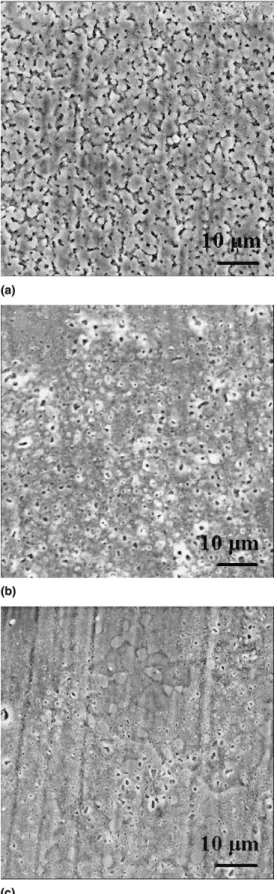
The optical micrograph revealing the surface micro-structure of as-cast AZ91D Mg alloy is shown in Fig. 1(a). As can be seen in this micrograph, the as-cast alloy consisted of two phases with the eutectic Al-rich phase distributing along the grain boundary of the pri-mary ␣ matrix phase. Similar observation has been re-ported by others.2–5,13 After solution heat treatment at 440 °C for 20 h followed by water quenching and air cooling, the optical micrographs showing the surface mi-crostructure AZ91D Mg alloy are given in Figs. 1(b) and 1(c), respectively. Homogenization by dissolving  phase into the␣ matrix was observed if water quenching was applied [Fig. 1(b)]. As shown in Fig. 1(c), however, a high density of fine phase was found distributed in ␣ matrix if air cooling was applied after solution heat treat-ment. The cross-section SEM image showing the precipi-tation of lamellar plates of phase in ␣ matrix near the surface, for the air-cooled alloy, is illustrated in Fig. 2(a). In the interior of this specimen, as shown in the optical micrograph of Fig. 2(b), discontinuous precipitation of phase initiated at the grain boundary of␣ phase was seen.
The discontinuous precipitation of phase has also been found in AZ91D if isothermally aged at 160 °C.6 The slow cooling rate in the air-cooled specimen as compared with that of the water-quenched was responsible for the formation of  phase after solution heat treatment. The difference in microstructure as revealed in Figs. 1(b) and 1(c) clearly indicated that homogenization of as-cast AZ91D Mg alloy could only be obtained by fast cooling after solution heat treatment.
X-ray diffraction patterns for the as-cast and those solution-annealed AZ91D Mg alloy are shown in Fig. 3. The results indicated that water quenching after solution annealing treatment could give rise to a single phase microstructure. For the solution-annealed and air-cooled alloy, however, the diffraction peaks of  phase still existed in the XRD pattern. These results were consistent with the metallographical analyses.
B. Effect of heat treatment on the anodic film formation on AZ91D
After anodization treatment, the XRD patterns of the as-cast and two heat treated AZ91D alloy are shown in Fig. 4. Regardless of the prior heat treatment, the XRD patterns revealed that the oxides formed on the surfaces of three different substrates after anodization were the same, namely MgO and MgAl2O4. Similar results have been reported for the anodic film formed in KOH– Al(OH)3 solution by others.
8,14
Fukushi and Takaya15 have further analyzed the anodic films formed on Mg alloys in basic solution at the breakdown potential by secondary ion mass spectrometer (SIMS). They indicated that the films were composed of MgO and MgAl2O4. The XRD results obtained in this investigation were in agree-ment with those reported in the literature. In fact, MgAl2O4 is a solid solution of MgO and Al2O3. The high peak in-tensity ratio of MgO/MgAl2O4(see Fig. 4) indicated that MgO was the main oxide formed in the anodic film. FIG. 1. Optical micrographs of AZ91D Mg alloy: (a) as-cast, and
solution-annealed at 440 °C/20 h followed by (b) water quench and (c) air cooling.
FIG. 2. (a) SEM micrograph of cross-section microstructure and (b) optical micrograph of discountinous precipitation of  phase of AZ91D Mg alloy after annealing followed by air cooling.
The mechanism of anodic film formation on Mg alloys has been elucidated by some researchers.8,16,17Previous investigations also indicated that the electrolyte compo-sition had a great effect on the properties of anodic film formed on Mg alloys.11,18 In this study, the effect of surface microstructure (resulting from different heat treatment) on the progress of anodic film formation in
3 M KOH + 0.21 M Na3PO4 + 0.6 M KF + 0.15 M Al(NO3)3electrolyte was explored. The transition of the surface morphology and cross section microstructure of the anodic film formed at different anodizing time was examined. Figure 5 shows the SEM micrographs of the surface morphologies of various AZ91D Mg alloys (sub-jected to different heat treatments) anodized in the above electrolyte for 1 min. For the as-cast alloy, the anodized surface exhibited a feature with a large number of con-cavities. By comparing with the optical micrograph shown in Fig. 1(a), it seemed that the concave sites shown in Fig. 5(a) corresponded to the phase-rich grain boundaries of primary ␣ phase, while the anodic films formed on ␣ phase were at the convex sites. The con-cave/convex surface appearance of the as-cast Mg alloy after anodization was mainly due to the difference in chemical composition between the two constituent phases. Since␣ phase has a higher concentration of Mg than  phase, the dissolution of Mg and its subsequent precipitation of Mg hydroxide is more likely to occur on ␣ phase surface as soon as the as-cast AZ91D Mg alloy is immersed in the anodizing electrolyte. The precipita-tion of Mg hydroxide may thus increase the impedance and reduce the spacing between the anode and the cath-ode locally. As a result, concentrated sparking occurs on ␣ phase at which a relatively higher film-growth rate is found. Thus, the selective sparking between ␣ and  phases was the main cause for the nonuniform surface appearance observed [Fig. 5(a)].
For the solution-annealed and water-quenched AZ91D Mg alloy, the surface morphology of the anodized speci-men was different from that of the as-cast. As shown in Fig. 5(b), the anodic film exhibited porous structure while the characteristic feature showing the preferential anodization of ␣ phase disappeared. The volcanic ap-pearance of the anodic film was commonly seen for the anodized aluminum and magnesium alloys, resulting from sparking due to electric breakdown and accompa-nied with gas evolution.7 As mentioned earlier, water quenching after solution annealing gave a homogeneous and single phase microstructure of the substrate. The ab-sence of phase made the surface chemical composition more uniform, which consequently led to the formation of a relatively continuous oxide film in anodization. For the air-cooled AZ91D Mg alloy (following the solution heat treatment), though a duplex microstructure was es-tablished on the surface, the anodic film was more uni-form than that shown in Fig. 5(a). The uniuni-form distribu-tion of fine phase as revealed in Fig. 1(c) was the main reason for the formation of a uniform anodic film. Since the anodizing time was very short (1 min), the oxide film formed was very thin such that the polishing scratches on the substrate could still be seen.
The SEM cross section micrographs of AZ91D Mg alloy after being anodized for 1 min are displayed in FIG. 3. Effect of heat treatment on x-ray diffraction patterns of
AZ91D Mg alloy: (a) as-cast, (b) solution-annealed at 440 °C/20 h followed by water quenching, and (c) solution-annealed at 440 °C/20 h followed by air cooling.
FIG. 4. X-ray diffractograms of anodized AZ91D Mg alloy with dif-ferent prior substrate heat treatment: (a) as-cast, (b) solution-annealed at 440 °C/20 h followed by water quenching, and (c) solution-annealed at 440 °C/20 h followed by air cooling.
Fig. 6. The specimens were slightly etched to reveal the dual phase microstructure before examining under SEM. As can be seen in Figs. 6(a) and 6(c), the anodic films formed on the as-cast and the air-cooled AZ91D Mg alloy were less uniform as compared with that on the water-quenched alloy [Fig. 6(b)]. The film thickness was about 1m in each case.
By increasing the anodizing time to 2 min, the film thickness increased to about 2m. The surface morphol-ogy and cross section micrograph for the as-cast and anodized AZ91D Mg alloy as depicted in Figs. 7(a) and 7(b) still revealed the nonuniform surface characteristics with delayed anodization on  phase. For the solution-annealed and air-cooled alloy, however, the surface ap-pearance was similar to that of the water-quenched speci-men. As shown in Fig. 7(c), the volcanic type of surface morphology was seen. The cross section micrograph de-picted in Fig. 7(d) showed that the anodic film was rather uniform, even though the substrate consisted of duplex
FIG. 5. SEM micrographs showing the effect of substrate heat treat-ment on the surface morphologies of anodized AZ91D Mg alloy: (a) as-cast, (b) solution-annealed at 440 °C/20 h followed by water quench, and (c) solution-annealed at 440 °C/20 h followed by air cooling; anodizing for 1 min.
FIG. 6. Cross-section SEM micrographs of AZ91D Mg alloy after anodizing for 1 min on the substrates with different heat treatment: (a) as-cast, (b) solution-annealed at 440 °C/20 h followed by water quenching, and (c) solution-annealed at 440 °C/20 h followed by air cooling.
microstructure. The finely dispersed  phase (with sub-micron spacing) in the matrix made the selective spark-ing became less important. Thus, the anodic film thick-ness was more uniform. As the anodizing time was in-creased, the concavities on the as-cast AZ91D Mg alloy gradually became indistinguishable. The film-growth rate on top of phase increased and the pores started to be filled with oxides.
After anodizing for 20 min, the surface appearance was almost the same regardless of the prior heat treat-ment. The continuous sparking and sintering made the surface of the anodic film smoother. Though some pores still remained on the surface, its density was substantially reduced for the as-cast and the heat treated AZ91D Mg alloy. Figure 8(a) gives an example showing the anod-ized surface SEM micrograph of the as-cast alloy. The cross-section micrograph shown in Fig. 8(b) indicated that the film was about 15–20m thick after anodizing for 20 min.
Based on the above observations, it was found that the substrate microstructure could affect the film formation at the early stage of anodization. The film-growth rate on the surface of␣ phase was higher than that of the Al-rich  phase at the beginning of the anodizing process. How-ever, the nonuniformity of the anodic film growth proc-ess could be diminished if phase was finely dispersed in the␣ phase matrix. If the spacing of  phase was less than the diameter of the spark, then the difference in
selective anodizing reaction between ␣ and  phases could be minimized. As found in this investigation, the spacing between the adjacent  phase plates was in the order of submicrons, probably less than the sparking size. Thus, the feature of concave/convex surface appearance was not found for the solution-annealed and air-cooled AZ91D Mg alloy.
C. Effect of heat treatment and anodization on the corrosion resistance of AZ91D Mg alloy
The corrosion resistance of the anodized AZ91D Mg alloy in 3.5 wt% NaCl solution was evaluated by per-forming EIS measurement. Figure 9 shows the Nyquist plots for the as-cast and two solution-annealed AZ91D Mg alloys. The polarization resistances obtained by per-forming non-linear least square (NLLS) fitting19
are listed in Table I. The impedance plot only revealed one semicircle for each case, indicating the simple dissolu-tion behavior in 3.5 wt% NaCl soludissolu-tion. However, the polarization resistance of the air-cooled alloy was higher, while the water cooled alloy was lower than that of the as-cast alloy. It has been elucidated by many research-ers1–4 that phase can act as a corrosion barrier if its volume ratio is high. As can be seen in Fig. 1, fine  phase was uniformly distributed within ␣ matrix of the solution-annealed and air-cooled AZ91D Mg alloy as compared with that of as-cast. In the latter case, phase FIG. 7. SEM micrographs showing (a) surface morphology and (b) cross-section microstructure of as-cast AZ91D Mg alloy; (c) surface morphology and (d) cross-section microstructure of AZ91D Mg alloy solution-annealed at 440 °C/20 h followed by air cooling. Anodized in 3 M KOH + 0.21 M Na3PO4+ 0.6 M KF + 0.15 M Al(NO3)3electrolyte for 2 min.
was mainly located in the grain boundary of␣ phase and widely separated. Such distribution of  phase would favor the galvanic corrosion of␣ phase which contained less amount of Al. For the homogenized (water-quenched) alloy, however, the polarization resistance was the lowest, in contrast to that reported by Aung and Zhou.5 For the homogenized alloy,  phase was dis-solved in the matrix and the barrier effect for corrosion was absent. In addition, the surface Al content of the homogenized AZ91D Mg alloy was lower than those containing  phase (e.g., the as-cast and the solution-annealed and air-cooled). The formation of Al2O3 pas-sive film was less feasible. Thus, the corrosion resistance of the water-quenched alloy was lower than those of the as-cast and the air-cooled alloys studied in this investi-gation.
The Nyquist plots for the anodized AZ91D Mg alloys, with three different prior thermal processes, are illus-trated in Fig. 10. The polarization resistances of the three anodized alloys determined in 3.5 wt% NaCl solution are also listed in Table I. Clearly, anodization treatment
could significantly improve the corrosion resistance, at least 20 times higher as demonstrated by the substantial increase of the polarization resistance shown in Table I. The highest polarization resistance (85,110 ⍀ cm2) was found for the alloy which had the highest volume fraction of phase on the surface (solution-annealed followed by air cooling). Previous investigation11
has indicated that an increase in the corrosion resistance of the anodized AZ91D Mg alloy could be obtained if the MgO anodic film was modified by Al2O3. For the alloy heat treated at 440 °C/20 h followed by air cooling, the finely dispersed  phase gave rise to a high Al content on the surface, which in turn favored the formation of an anodic film containing a relatively high amount of Al2O3.
The chemical composition of the anodic film was fur-ther analyzed by XPS. The results showed that anodic film consisted of MgO, Mg(OH)2, and MgF2, similar to that reported in the literature for some anodized Mg FIG. 8. SEM micrographs for (a) surface morphology, and (b)
cross-section microstructure of as-cast AZ91D Mg alloy after anodizing for 20 min.
FIG. 9. Nyquist plot showing the effect of heat treatment on the elec-trochemical behavior of AZ91D Mg alloy in 3.5 wt% NaCl solution.
TABLE I. Effect of heat treatment on the polarization resistances (in 3.5 wt% NaCl solution) of die-cast AZ91D Mg alloy, before and after anodizing in 3 M KOH + 0.21 M Na3PO4 + 0.6 M KF + 0.15 M Al(NO3)3electrolyte for 20 min.
Condition for heat treatment and anodization
Polarization resistance (⍀ cm2, R p)
As-cast 510
Solid solution treatment + water quenching 450 Solid solution treatment + air cooling 630 As-cast AZ91D Mg alloy + anodizing 10620 Solid solution treatment + water quenching + anodizing 16710 Solid solution treatment + air cooling + anodizing 85110
alloys.9,18
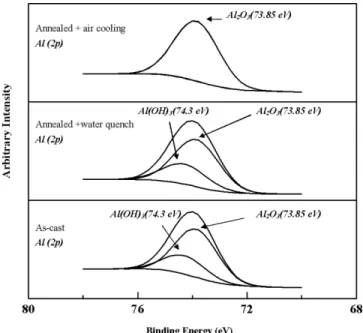
Heat treatment and/or cooling process did not exert any noticeable effect on the chemical state of Mg in the anodic film. The anodic film also contained Al2O3 and Al(OH)3. However, a significant effect of heat treat-ment on the relative amount of these two species was observed. Figure 11 demonstrates the XPS spectra for Al(2p) taken from the three different anodized AZ91D Mg alloys. Deconvolution analysis of the XPS spectra showed that the binding energy at 73.85 eV corresponded to Al2O3 while the peak at 74.3 eV to Al(OH)3. The
higher intensity for Al2O3 (comparing with that of Al(OH)3) implied that it was the main Al compound in the anodic film formed on both the as-cast AZ91D Mg alloy and that water-quenched after prior solution heat treatment at 440 °C for 20 h. For the air-cooled AZ91D Mg alloy, no peak corresponding to Al(OH)3was found, indicating that all Al(OH)3had been dehydrated to form Al2O3 during repeated sparking and sintering. The XPS spectra for O(1s) electron, for various heat treated specimens, were also analyzed. The results demonstrated in Fig. 12 indicated that MgO (530.0 eV), Mg(OH)2 (530.9 eV), Al(OH)3(531.5 eV), Al2O3(531.8 eV), and H2O (533.2 eV) were found in the anodic films formed on the as-cast and that water quenched (following solu-tion annealing) specimens. However, for the solusolu-tion an-nealed and air-cooled AZ91D Mg alloy, the peak for Al(OH)3 disappeared with only that of Al2O3 remained in the O(1s) spectra. The results of O(1s) spectra revealed in Fig. 12 were in good agreement with Al(2p) spectra shown in Fig. 11. The extreme high polarization resis-tance found for the solution-annealed and air-cooled AZ91D Mg alloy (as shown in Table I and Fig. 10) was probably attributed to the significant amount of Al2O3 present in the anodic film.
IV. CONCLUSIONS
Heat treatment at 440 °C for 20 h could lead to the dissolution of  phase (Mg17Al12) into the␣ matrix of AZ91D Mg alloy. The subsequent water quench could give rise to the formation of a single phase and homo-geneous␣ solid solution. However, air cooling following FIG. 10. Effect of substrate heat treatment on the EIS spectra of
anodized AZ91D Mg alloy in 3.5 wt% NaCl solution.
FIG. 11. Effect of substrate heat treatment on the XPS spectra for Al(2p) for AZ91D Mg alloy anodized in 3 M KOH + 0.21 M Na3PO4+ 0.6 M KF + 0.15 M Al(NO3)3electrolyte for 20 min.
FIG. 12. Effect of substrate heat treatment on the XPS spectra for O(1s) for AZ91D Mg alloy anodized in 3 M KOH + 0.21 M Na3PO4+ 0.6 M KF + 0.15 M Al(NO3)3electrolyte for 20 min.
the solution heat treatment could cause the precipitation of high density fine phase in the ␣ phase matrix.
A homogeneous and uniform anodic film could be formed on the AZ91D Mg alloy if it was heat treated at 440°C for 20 h. For the alloy contained dual phases, selective sparking occurred during anodization. In 3 M KOH + 0.21 M Na3PO4+ 0.6 M KF + 0.15 M Al(NO3)3 electrolyte, the anodic film growth rate on ␣ phase was higher than on phase at the early stage of anodization. The presence of  phase and its spacing had a great influence on the surface uniformity of the anodic film. After prolonged anodizing, the surface morphologies of the anodic films were almost the same, regardless of heat treatment.
X-ray diffraction analyses showed that MgO was the the major oxide with less amount of MgAl2O4in anodic films formed on all AZ91D Mg alloys with different thermal history. The results of XPS analyses indicated that only Al2O3was present in the anodic film if the alloy was air-cooled after solution heat treatment. In the as-cast and the homogenized AZ91D Mg alloys, not only Al2O3but also Al(OH)3was present in the anodic films. Homogenization treatment degraded the corrosion re-sistance of AZ91D Mg alloy due to the dissolution of phase. However, the precipitation of a high density and finely distributed  phase on the surface gave rise to a higher corrosion resistance than the as-cast AZ91D Mg alloy in 3.5 wt% NaCl solution.
The formation of anodic film on AZ91D Mg alloy could greatly improve its corrosion resistance. The high-est polarization resistance in 3.5 wt% NaCl solution could be obtained on the solution-annealed and air-cooled AZ91D Mg alloy. The high volume fraction of phase precipitated on the surface was responsible for the formation of a very resistant anodic film against corro-sion.
REFERENCES
1. O. Lunder, J.E. Lein, T.K. Aune, and K. Nisancioglu: The role of Mg17Al12phase in the corrosion of Mg alloy AZ91. Corrosion 45, 741 (1989).
2. G. Song, A. Atrens, X. Wu, and B. Zhang: Corrosion behavior of AZ21, AZ501 and AZ91 in sodium chloride. Corros. Sci. 40, 1769 (1998).
3. G. Song, A. Atrens, and M. Dargusch: Influence of microstructure on the corrosion of diecast AZ91D. Corros. Sci. 41, 249 (1999). 4. R. Ambat, N.N. Aung, and W. Zhou: Evaluation of microstruc-tural effects on corrosion behavior of AZ91D magnesium alloy.
Corros. Sci. 42, 1433 (2000).
5. N.N. Aung and W. Zhou: Effect of heat treatment on corrosion and electrochemical behavior of AZ91D magnesium alloy.
J. Appl. Electrochem. 32, 1397 (2002).
6. G. Song, A.L. Bowles, and D.H. St. John: Corrosion resistance of aged die cast magnesium alloy AZ91D. Mater. Sci. Eng. A 366, 74 (2004).
7. S. Ono, T. Osaka, K. Asami, and N. Masuko: Oxide films formed on magnesium and magnesium alloys by anodizing and chemical conversion coating. Corros. Rev. 16, 175 (1998).
8. O. Khaselev and J. Yahalon: Constant voltage anodizing of Mg–Al Alloys in KOH–Al(OH)3solutions. J. Electrochem. Soc. 145,190 (1998).
9. V. Birss, S. Xia, R. Yue, and R.G.R. Rateick, Jr.: Characterization of oxide films formed on Mg-based WE43 alloy using AC/DC anodization in silicate solutions. J. Electrochem. Soc. 151, B1 (2004).
10. S. Xia, R. Yue, R.G.R. Rateick, Jr., and V. Birss: Electrochemical study of AC/DC anodized Mg alloy in NaCl solution. J.
Electro-chem. Soc. 151, B179 (2004).
11. H.Y. Hsiao and W.T. Tsai: Characterization of anodic films formed on AZ91D magnesium alloy. Surf. Coat. Technol. 190, 299 (2005).
12. S. Ono, K. Asami, and N. Masuko: Mechanism of chemical con-version coating film growth on magnesium and magnesium alloys.
Mater. Trans. 42, 1225 (2001).
13. A. Bag and W. Zhou: Tensile and fatigue behavior of AZ91D magnesium alloy. J. Mater. Sci. Lett. 20, 457 (2001).
14. M. Takaya: Anodizing of magnesium alloys in KOH–Al(OH)3 solutions. Aluminum 65, 1244 (1989).
15. S. Fukushi and M. Takaya: Springer Series in Chemical Physics.
Secondary ion mass spectrometry: SIMS V: Proceedings of the 5th International Conference, Washington, D.C. 44, 400 (1985).
16. S. Ono, K. Asami, T. Osaka, and N. Masuko: Structure of anodic films on magnesium. J. Electrochem. Soc. 143, L62 (1996). 17. O. Khaselev, D. Weiss, and J. Yahalon: Anodizing of pure
mag-nesium in KOH-aluminate solutions under sparking. J.
Electro-chem. Soc. 146, 1757 (1999).
18. H.Y. Hsiao and W.T. Tsai: Anodization of AZ91D magnesium alloy insilicate-containing electrolytes. Surf. Coat. Tech. 199, 127 (2005).
19. B.A. Boukamp: A package for impedance/admittance data analy-sis. Solid State Ionics, 18 & 19, 136 (1986).