Research Express@NCKU - Articles Digest
1 of 4
Research Express@NCKU Volume 23 Issue 7 - March 22, 2013 [ http://research.ncku.edu.tw/re/articles/e/20130322/3.html ]
Heat Annealing Effect on the Performance of CdS/CdSe
Sensitized TiO
2
Photoelectrodes in Photochemical
Hydrogen Generation
Ching-Fa Chi, Shih-Yi Liau and Yuh-Lang Lee
*Department of Chemical Engineering, College of Engineering, National Cheng Kung University [email protected]
Nanotechnology, 21, 025202 (2010)
I
ntroduction
Since the innovative discovery by Fujishima and Honda in 1972,1 development of semiconductor photocatalyst for efficient water splitting application has been focused in many studies. Nevertheless, the wide band gap of TiO2 limits its photocatalytic properties
in the UV region. On the contract, low band gap semiconductor like CdS and CdSe, possess good light harvest property were applied in solar cell widely. In general, performance in energy conversion is not only determined by the light harvest range, but also by the charge transport rate in the sensitizer and at the TiO2/sensitizer interface. In this work, CdS and CdSe were coupled with TiO2 for extending the light harvest region, furthermore, heat annealing was utilized to eliminate structural defects present in an as-prepared material and enhance the performance of emiconductor-sensitized TiO2 photoelectrodes for photo-electrochemical hydrogen generation. This strategy was shown to be effective not only for CdS- and CdSe-sensitized electrodes, but also for CdS/CdSe co-sensitized electrode.
Result
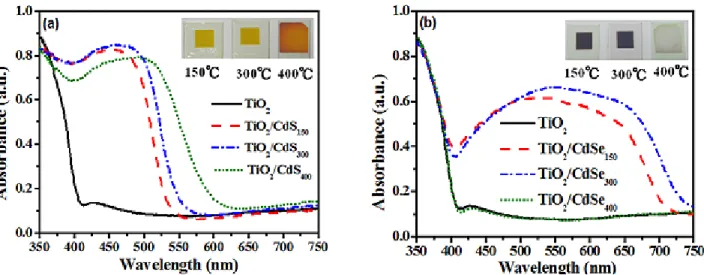
Heat annealing effect on the light absorption properties of the semiconductor-modified TiO2 (TiO2/CdS and TiO2/CdSe) electrodes as well as a bare TiO2 film, are evaluated by an UV-vis spectrometer. The absorption
spectra of these electrodes are shown in figure 1. The apparent colors of these electrodes were also shown in the inset of figure 1. The bare TiO2 film only absorb the UV light at the wavelength below 420 nm. For the TiO2/CdS and TiO2/CdSe electrodes, heat annealing triggers a red-shift of the absorption spectrum and the
wavelength of absorption edge increases with increasing the annealing temperature.
To study the performance of these photoelectrodes at various wavelengths, experiments were conducted to obtain the incident photon to current conversion efficiencies (IPCE). These measurements were performed in a photoelectrochemical cell at an applied voltage of 0.5 V and carried out from the photocurrents monitored at
Research Express@NCKU - Articles Digest
2 of 4
Figure 1. UV-vis absorption spectra of the TiO2/CdS (a) and TiO2/CdSe (b) electrodes by heat annealing at
various temperatures. The inset shows the photos of the relative TiO2 electrodes.
Figure 2. Incident photon to current conversion efficiencies (IPCE) for various electrodes measured at different excitation wavelengths. Heat annealing effect on TiO2/CdS and TiO2/CdSe electrodes(a). TiO2/CdS/CdSe
prepared with the different heat annealing process (b).
different excitation wavelengths. The result shown in figure 2(a) demonstrates that IPCE obtained for the 150 ℃ annealing CdS (TiO2/CdS150) and CdSe (TiO2/CdSe150) electrodes are about 52% and 21%, respectively. This result indicates that the electron-hole pairs excited in CdS can be separated and collected more efficiently than in CdSe, attributable to the higher conduction band edge of CdS with respect to that of CdSe. The TiO2/CdS electrode only responses to the light with wavelength smaller than about 550 nm, while the absorption region of TiO2/CdSe can be extended to about 700 nm. When the annealing temperature was increased to 300 ℃, IPCEs was increased to ca. 63 and 33%, respectively, for TiO2/CdS300 and TiO2/CdSe300 electrodes. This result indicates that the performances of both TiO2/CdS and TiO2/CdSe electrodes were improved by the heat annealing effect.
It had been shown that the performance of a QD-sensitized electrode can be greatly enhanced by the co-sensitization effect of CdS/CdSe.2 Since the heat annealing was proved to be effective for the single sensitizer systems, it was anticipated to be valid for the co-sensitized electrode. Various treating procedures were utilized to obtain an optimal one. For the first, electrodes with TiO2/CdS/CdSe cascade structure were prepared first and
Research Express@NCKU - Articles Digest
3 of 4
then subjected to a heat annealing at 150 or 300 ℃. These electrodes were termed as (TiO2/CdS/CdSe) 150 and (TiO2/CdS/CdSe) 300, respectively. For the second, a two-steps annealing process was utilized. CdSe was deposited on a 300 ℃ annealed TiO2/CdS electrode (TiO2/CdS300), followed by a second annealing at 150 or 300 ℃. These electrodes were denoted by TiO2/CdS300/CdSe150 and TiO2/CdS300/CdSe300, respectively. In general, the heat annealing effect on the absorption spectra of the co-sensitized electrodes is similar to that on the single-sensitizer systems (not shown here). Heat annealing triggers a slightly red-shift of the absorption spectrum and this effect is more significant for a higher annealing temperature.
Comparing TiO2/CdS/CdSe with the CdSe-sensitized electrode prepared at the optimal annealing condition (TiO2/CdSe300), similar light absorption ranges but much higher IPCEs were obtained for the co-sensitized CdS/CdSe electrodes﹙figure 2(b)﹚. In the long-wavelength region (>500 nm) where CdS cannot be photoexcited, the IPCE increment of the co-sensitized electrodes clearly indicates the superior ability of the cascade structure in charge transport. Furthermore, the heat annealing effect on the charge transport in the co-sensitized electrodes can be observed by comparing the IPCEs of TiO2/CdS300/CdSe150 and (TiO2/CdS/CdSe) 150 electrodes. By using the two-steps annealing process, the IPCE of the TiO2/CdS300/CdSe150 electrode can
be increased up to 80%, which also attributed to a higher crystallization state of the semiconductor sensitizers, as well as a better connections at the TiO2/sensitizer and sensitizer/sensitizer interfaces.
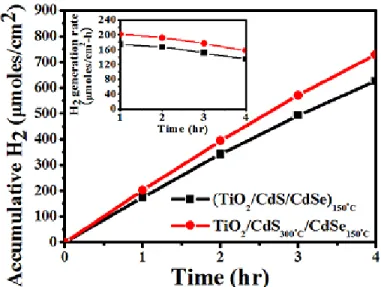
Since the co-sensitized electrodes appear to have superior performances than the electrodes sensitized by single material, these electrodes were utilized for hydrogen generation. These experiments were performed in an electrochemical cell and operated at the applied potential of 0.5V (vs. OCP). The hydrogen evolved from Pt cathode was collected and analyzed using a gas chromatograph. Figure 3 shows the evolution amount of hydrogen and the corresponding generation rate as a function of time for the TiO2/CdS300/CdSe150 and (TiO2/CdS/CdSe)150 electrodes. In the first hour, the hydrogen evolution rates for the TiO2/CdS300/CdSe150 electrode (201 μmol cm-2 h-1)
Figure 3. Hydrogen evolution in photoelectrochemical cells using TiO2/CdS/CdSe photoanodes annealing at various temperatures. The inset shows the hydrogen generation rates corresponding to the cumulative hydrogen
gas.
is higher than that of the (TiO2/CdS/CdSe)150 (174 μmol cm-2h-1), consistent with the IPCE measured result. Apparently, appropriate heat treatment has been proved to be an efficient process to increase the crystallinity of
Research Express@NCKU - Articles Digest
4 of 4
CdS and CdSe nanocrystallites deposited on mesoporous TiO2 films, improve the charge transport characteristics
of the semiconductor-sensitized TiO2 films, and increase the performance the photoelectrodes.
Reference
1. Fujishima et. al Nature 238 (1972) 37-38. 2. Lee et. al. Adv. Funct. Mater. 19 (2009) 604-9