短柱山茶母樹之果實採收期影響種子大小、
種子發芽與種仁油含量及成分
陳舜英1) 許俊凱1) 許原瑞1) 簡慶德2) 許富蘭3,4)
摘 要
山茶籽油被臺灣人民當作食用油之一,因為它有益於身體健康。本文旨在研究探討臺灣原生種短 柱山茶2地5株母樹,在不同的果實採收期對種子大小、發芽率和種仁油成分及含量之影響。結果顯示 6月底採收的果實,種子小,且含水率高80%以上,發芽率0~54%。7月下旬採收的果實,苗栗泰安3株 母樹的種子含水率下降至55~66%,發芽率90~99%,種子已經增大成熟,而桃園龍潭2株母樹延後6星 期至9月上旬,種子才成熟,此時含水率分別為48和66%,發芽率99和93%。5株母樹種子發芽率達到 50%之最短天數為52~70天。種子去殼後的種仁含油率,在9月以前5株母樹平均種仁含油率低於20%,
10月上旬採收的種子,平均種仁含油率提高至32%,其中苗栗泰安有1株母樹之種仁含油率42%,經過 2星期10月中旬採收的果實,平均種仁含油率35%,達到最高點。分析種仁內主要脂肪酸,包括棕櫚 酸、硬脂酸、油酸和亞麻油酸,5株母樹皆以油酸含量最高,9月後採收的種子,油酸含量70~82%,亞 麻油酸次之,含量9~16%,其他2種飽和脂肪酸-棕櫚酸和硬脂酸,含量低於10%。油脂內的微量活性 成分-角鯊烯和維生素E含量則隨著採收期有逐漸增加的趨勢,但角鯊烯含量於8~9月達到最高,其中桃 園龍潭1株母樹含量,每克種仁油可達800~900 μg,並於10月上旬達到1217.8 μg;維生素E以10月中旬 含量最高,其中有2株母樹每克種仁油分別含有1007.4和1057.5 μg維生素E。總結可知,短柱山茶種子 成熟期因栽植地點不同有幾星期的差異,但為生產最大量的種仁油、油酸、角鯊烯、維生素E等,以每 年9月下旬至10月採收果實為最佳的選擇。
關鍵詞:短柱山茶、採收期、種仁油、亞麻油酸、油酸、種子發芽率、角鯊烯、維生素E。
陳舜英、許俊凱、許原瑞、簡慶德、許富蘭。2019。短柱山茶母樹之果實採收期影響種子大小、種子 發芽與種仁油含量及成分。台灣林業科學34(4):263-73。
1) 林 業 試 驗 所 蓮 華 池 研 究 中 心 ,55543南投縣魚池鄉五城村華龍巷43號 Lienhuachih Research Center, 43 Hualong Lane, Yuchi Township, Nantou County 55543, Taiwan.
2) 林 業 試 驗 所 育 林 組 ,10066臺北市南海路53號 Division of Silviculture, Taiwan Forestry Research Institute, 53 Nanhai Rd., Taipei 10066, Taiwan.
3) 林 業 試 驗 所 森 林 化 學 組 ,10066臺北市南海路53號 Division of Forest Chemistry, Taiwan Forestry Research Institute, 53 Nanhai Rd., Taipei 10066, Taiwan.
4) 通訊作者 Corresponding author, e-mail:[email protected]
2019年6月送審 2019年8月通過 Received June 2019, Accepted August 2019.
Research paper
Effect of the Fruit Harvest Date of Camellia brevistyla Mother Trees on Seed Size, Seed Germination,
and Kernel Oil Content and Composition
Shun-Ying Chen,1) Chun-Kai Hsu,1) Yen-Ray Hsui,1) Ching-Te Chien,2) Fu-Lan Hsu3,4)
【Summary】
Camellia seed oil has long been used as an edible oil by Taiwanese people. The main purpose of this study was to determine the effects of various times of fruit harvesting on the seed size, seed germination, kernel oil content and composition from 2 sites with 5 mother trees of a native spe- cies of Camellia brevistyla. Results showed that fruits harvested from the 2 sites at the end of June had small seeds, and moisture contents and germination percentages were > 80% and 0~54%, respectively. Fruits harvested from Tai’an Township, Miaoli County in late July had matured, and moisture contents and germination percentages were 55~66% and 90~99%, respectively. However, fruits from 2 mother trees in Longtan Township, Taoyuan exhibited delayed maturation for 6 weeks until early September, and moisture contents were 48 and 66% and germination percentages were 99 and 93%. The shortest times to a 50% germination of seeds of the 5 mother trees were 52~70 d.
The mean kernel oil percentages from seeds of 5 mother trees harvested before September were <
20%, but the percentage increased to 32% in early October, and among them, 1 tree from Tai’an, Miaoli reached 42%. The maximum mean kernel oil percentage of seeds harvested in the middle of October was 35%. Fatty acid compositions of kernel oil from the 5 mother trees were investigated on different dates, and we found that after September, the highest content was of oleic acid (C18:1) at 70~82%, followed by linoleic acid (C18:2) at 9~16%, with palmitic acid (C16:0) with stearic acid (C18:0) contents of < 10%. Squalene and vitamin E of kernel oil were also analyzed, and both contents gradually increased with time of harvest. However, squalene contents reached a maximum in August and September, and among the 5 mother trees, 1 tree from Longtan, Taoyuan had maxi- mum squalene contents of 800~900 μg g
-1kernel oil, and it reached 1217.8 μg in early October. Vi- tamin E from all mother trees had maximum contents in the middle of October, and 2 mother trees had maximum vitamin E contents of 1007.4 and 1057.5 μg g
-1kernel oil. Site differences in seed maturation times from the 2 sites exhibited 6 weeks of variance. Further, to produce maximum seed oil, oleic acid, squalene, and vitamin E, we suggest that the best harvest date is from late Sep- tember to October.
Key words: Camellia brevistyla, harvest date, kernel oil, linoleic acid, oleic acid, seed germination percentage, squalene, vitamin E.
Chen SY, Hsu CK, Hsui YR, Chien CT, Hsu FL. 2019. Effect of the fruit harvest date of Camellia
brevistyla mother trees on seed size, seed germination, and kernel oil content and composi-
tion. Taiwan J For Sci 34(4):263-73.
緒 言
臺灣茶科(Theaceae)山茶屬(Camellia)植 物約有12種(Hsieh et al. 1996),其中本土種短 柱山茶(Camellia brevistyla (Hayata) Cohen.- Stuart),俗稱小果油茶,為具有經濟潛力的食 用油作物。山茶屬主要分布於熱帶和亞熱帶地 區,木本常綠植物,超過200種,其中一些品種 具有極大的經濟價值,果實內種子壓榨出來的 油品佳,統稱山茶籽油(camellia seed oil),可 當做食用植物油使用。
國人熟知的苦茶油除了可作為食用油外,
在民俗療法中常作為治療胃痛與燒傷用,並具 有抗菌、抗病毒、癒合皮膚、降低體內膽固醇 及抗氧化等活性(Siegel et al., 1987; Deng et al., 1993; Tripoli et al., 2005; Lee and Yen, 2006),
對 高 血 壓 、 心 臟 病 、 動 脈 粥 化 、 高 血 脂 等 心 血管疾病亦有保健效果(Su et al. 2014, Yang et al. 2018)。苦茶油以脂肪酸為主要成分,此外 亦有少量成分如生育醇(tocopherol)及固醇類 (sterols)、三 等。Wang and Lin (1990)分析細 葉山茶(C. tenuifolia)種子油之脂肪酸發現,以 油酸(oleic acid, C18:1)、亞麻油酸(linoleic acid, C18:2)等2種不飽和脂肪酸(unsaturated fatty acids; UFAs)及棕櫚酸(palmitic acid, C16:0)及 硬脂酸(stearic acid, C18:0)等2種飽和脂肪酸 (saturated fatty acids; SFAs)為主,其油酸、
亞 麻 油 酸 、 棕 櫚 酸 及 硬 脂 酸 含 量 分 別7 4 . 1 、 11.25、7.91、及2.06%。Yang等人(2016)研究 油茶(Camellia oleifera)栽培品系同樣發現油酸 含量最高(達75%以上),其次是亞麻油酸、棕櫚 酸,而硬脂酸含量較少。Yuan et al. (2012)研究 133種不同油茶結果亦發現四種主要脂肪酸(油 酸 、 亞 油 酸 、 棕 櫚 酸 及 硬 脂 酸)含量分別分布 在70.33~86.21%、3.25~17.18%、7.0~13.85%, 及1.35~5.49%。Wang and Lin (1990)分析小果 種苦茶油內生育醇及固醇類的含量,結果發現 生育醇以α-生育醇及γ-生育醇之含量最高,
植 物 固 醇 類 以 豆 固 醇(stigmasterol)、谷固醇 (sitoterol)及菜油固醇(campesterol)三種為主。
Wei等人(2016)探討細葉山茶種子油主要的營 養 和 保 健 活 性 , 分 離 鑑 定 並 確 認 為 香 樹 脂 醇
(β-amyrin)和β-谷固醇(β-sitosterol),具有抗 氧化活性。
山 茶 籽 油 品 質 好 壞 會 受 到 不 同 種 類 、 品 種 、 生 長 環 境 、 栽 培 管 理 、 果 實 成 熟 度 、 乾 燥 儲 存 及 製 油 條 件 等 因 子 影 響 , 其 中 果 實 採 收 時 間 對 種 子 大 小 、 含 油 率 及 油 品 組 成 分 有 極大的影響(Handbook of Camellia cultivation management and utilization 2013)。
中 國 大 陸 浙 江 省 研 究 油 茶 在 不 同 的 採 收 期 , 油 茶 籽 油 的 理 化 性 質 和 營 養 成 分 , 結 果 顯示種子內不飽和脂肪酸隨著油茶果實成熟度 逐漸增加,抗氧化物如維生素E (vitamin E)、
β-谷固醇及角鯊烯也隨著果實愈晚採收而增 加(Luo et al. 2012)。另外,中國大陸湖南省研 究油茶鮮籽含油率和種仁含油率,在10月下旬 最高,不宜提早採收,以免對產油量造成損失 (Chen et al. 2006)。
本研究從臺灣北部桃園及中部苗栗地區,
選樣5株產量多的短柱山茶種源母樹,於傳統採 收 期 前3個月開始採集果實,調查果實每公升 果實和種子大小粒數、種子含水率、種子發芽 率,及製備不同時期採收果實之種仁油,分析 種仁含油率、脂肪酸比例、維生素E和角鯊烯 等,以瞭解種仁油性質,除提供初步的基礎資 料,更可做為未來種源選擇及果實最適採收期 之參考資料。
材 料 與 方 法
一、 母樹選定、果實採集處理和種子含水率 測定
選擇不同地點之形態優良和產量多的短柱 山茶母樹5株,編號TA127、TA238、TA308、
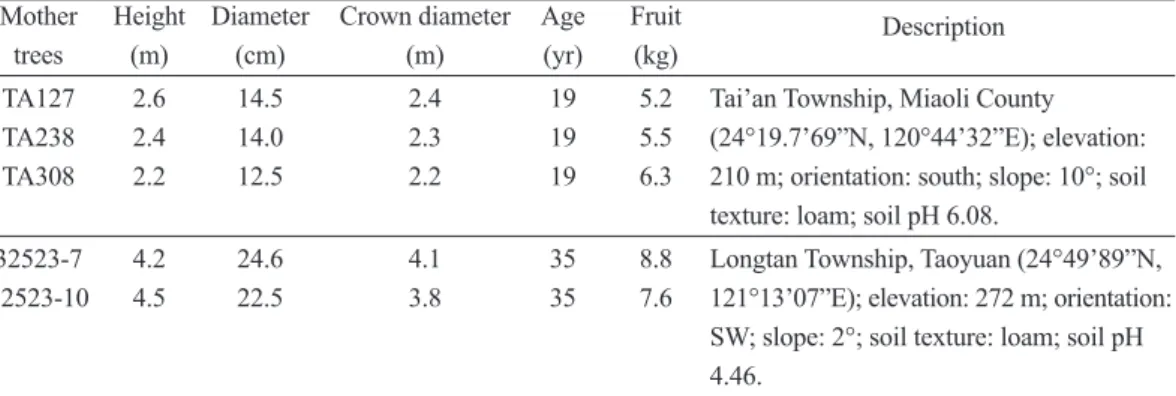
32523-7、32523-10,短柱山茶母樹樹高、地 徑、平均冠幅、樹齡、產量及生育環境等相關 資料見表1 (Table 1)。於2016年6月初調查結 實情形,接著從6月30日開始,大約每隔2週採 收果實一次,採收日期分別為6月30日、7月12 日、7月27日、8月12日、8月25日、9月8日、9 月22日、10月6日、10月20日和10月27日,共 計10次。母樹TA127於10月6日最後一批採收結
束,母樹TA238、TA308於10月20日最後一批採 收結束,僅剩下母樹32523-7和32523-10,於10 月27日採收結束。採收後的果實和種子皆暫存 5℃備用。
每批次果實運回實驗室,先量測果實每公 升(L)粒數,接著去除果皮,再量測種子每公 升(L)粒數。種子含水率測定是將種子置於烘 箱103℃下17小時,烘乾前先將種子切成4 mm 大小,每重複1粒,共4重複(International Seed Testing Association 2007)。
二、種子發芽試驗
短柱山茶每批次種子和濕水苔置於透明PE 封口袋,均勻混合並留有一半空間及空氣,封 口後置於變溫25/15℃發芽箱內發芽,24小時循 環一次,即在25℃溫度光照12小時,15℃溫度 無光照12小時;3重複,每重複20~25粒,若種 子量少,每重複減至10~15粒。每星期檢查紀錄 一次種子發芽粒數,並將發芽的種子挑出來。
種子平均發芽率(%)是根據胚根已突破種皮,長 度≥ 2mm之種子數量與發芽試驗總數量計算獲 得。利用Excel軟體取得發芽率平均值和標準誤 差,此平均發芽率是3重複的平均值。種子發芽 速度(seed germination speed)是以種子達到50%
發芽率所需的天數表示之(Soltani et al. 2015)。
三、 種仁含油率(kernel oil content)、脂肪酸 (fatty acid)、角鯊烯(squalene)和維生素 E(α-tocopherol)之定量分析
不同時期採收的果實秤重後置於70℃烘箱 3天,去除果殼和種殼,所獲得的種仁經粉碎機 打碎備用。
(一) 種仁含油率:以正己烷為溶劑(Wang and Lin 1990),利用索氏萃取法萃取種仁內 油 脂 , 然 後 經 減 壓 濃 縮 機 移 除 溶 劑 , 乾 燥 後 獲 得 油 重 量(g),並依油重量/種仁重
×100,以獲得含油率(%)。
(二) 脂肪酸含量:參考中華民國國家標準CNS 14759食用油脂檢驗法-脂肪酸甲酯測定之轉 酯化法及Chen等人(2011),以4 mL異辛烷 溶解60 mg種仁油樣本,加入0.2 mL氫氧化 鉀-甲醇溶液進行轉酯化作用;接著加入1 g 硫酸氫鈉中和氫氧化鉀,離心後取上層液 再以異辛烷稀釋,過濾定量後取1 μL注入氣 相層析質譜儀(GC-MS, Shimadzu Scientific Instruments, Japan),分析定量。層析管柱為 SP2380(內膜厚度0.25 μm,內徑0.25 mm×30 m),注射口溫度為250℃,層析管溫度:初 溫150℃,升溫速率為10℃ min-1;升至230℃
後,升溫速率為5℃ min-1,終溫為250℃,2 min後結束;檢出器溫度為250℃。移動相氣 體氦氣,流速為1 mL min-1,分流比為50:1。
結果以質譜圖峰面積(peak area)計算每個脂肪 酸之相對百分率(relative percentage),呈現脂 肪酸C16:0、C18:0、C18:1、C18:2及其他微 量脂肪酸。
Table 1. Information on the height, diameter, crown diameter, age, fruit, and location of 5 mother trees
Mother Height Diameter Crown diameter Age Fruit Description trees (m) (cm) (m) (yr) (kg)
TA127 2.6 14.5 2.4 19 5.2 Tai’an Township, Miaoli County TA238 2.4 14.0 2.3 19 5.5 (24°19.7’69”N, 120°44’32”E); elevation:
TA308 2.2 12.5 2.2 19 6.3 210 m; orientation: south; slope: 10°; soil texture: loam; soil pH 6.08.
32523-7 4.2 24.6 4.1 35 8.8 Longtan Township, Taoyuan (24°49’89”N, 32523-10 4.5 22.5 3.8 35 7.6 121°13’07”E); elevation: 272 m; orientation:
SW; slope: 2°; soil texture: loam; soil pH
4.46.
(三) 角鯊烯和維生素E含量:種仁油分別添加 不 同 濃 度 之 角 鯊 烯 及 維 生 素E標準品後,
再 以 氯 仿/正己烷(7:3)溶液稀釋,過濾後 以UPCC (Ultraperformance Convergence Chromatography, Waters, USA)分析角鯊烯 及維生素E含量,結果濃度以µg g-1種仁油 呈現(Tu et al. 2017)。
結 果
一、 母樹採收期與種子含水率、果實大小、
種子發芽率之關係
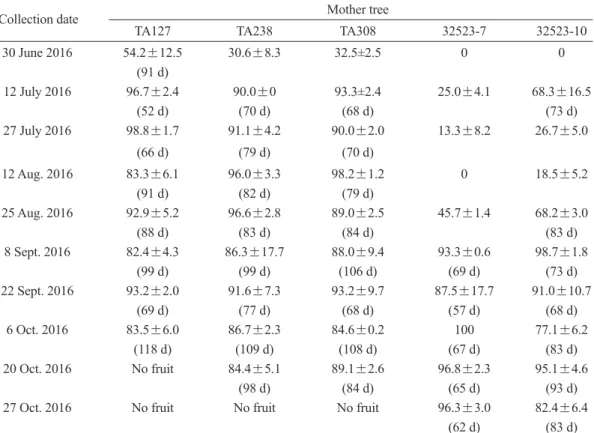
短柱山茶母樹於10月開花,隔年6月果實快 速增大。6月30日採收的5株母樹之種子含水率 皆高於80%,果實每公升179~1149粒,種子每公 升553~6229粒,種子發芽率0~54%,其中以母樹 TA127果實和種子最大,發芽率54%最高,而母 樹32523-7和32523-10之種子發芽率0% (Tables 2, 3)。7月12日採收的種子,除了TA127之種子含水 率下降至67%及發芽率97%外,其他4個母樹之 種子含水率也都在80%以上,發芽率25~93%;
果實和種子大小以TA127每公升分別為142粒和 536粒,粒數最少,果實最大,其他4株母樹之 果實每公升268~492粒間,種子每公升781~1705 粒間。自7月27日起採收的果實,母樹TA127、
TA238和TA308種子含水率逐漸下降至55~66%,
且發芽率都在90%以上,顯示種子已經成熟;母 樹32523-7和32523-10需延遲至9月8日,果實才成 熟,其種子含水率分別下降至66和48%,種子發 芽率93和99%。9月8日採收的種子含水率,除了 32523-7仍有66%外,其他母樹含水率都在50%以 下,而10月6日採收的全部5株母樹之種子含水率 都已經低於45% (Table 2)。總之,全部母樹之種 子發芽率皆可達到90%以上,且母樹間發芽率達 到50%天數最快範圍52~70天,唯32523二株母樹 果實成熟時間稍晚,然而種子含水率一旦下降,
發芽速度加快(Tables 2, 3)。
果實和種子平均大小,於9月8日之後採收 的資料顯示,以母樹32523-7最大,TA308最小 (Table 2)。母樹TA果實較早成熟,如TA127最 後一批採收是在10月6日,此時大部分果皮開 裂,種子裸露或脫粒,接著是TA238和TA308,
於10月20日為最後一批採收;32523-7和32523- 10果實較晚成熟,最後採收日期是在10月27 日,果實開裂數量少。
二、不同時期採收的種子之種仁含油率 短柱山茶母樹種子去殼後之種仁含油率隨著 果實增大而逐漸增加(Fig. 1)。6~7月份採收的5株 母樹種仁含油率2~15%,其中以母樹32523-7之種 仁含油率最低;8月至9月上旬(9月8日)採收的種 子,5株母樹平均種仁含油率20%以下,而母樹
Fig. 1. Kernel oil contents of Camellia brevistyla seeds harvested from 5 mother trees on
different dates in 2016. Seeds from TA127 on 20 October and from TA127, TA238, and
TA308 on 27 October were unavailable.
Table 2. Information on moisture content (mc; ), and fresh fruit and seeds per liter of
Camellia brevistyla collected from 5 mother trees with different harvest datesCollection date Mother tree
TA127 TA238 TA308 32523-7 32523-10 30 June 2016
Fruit (no. L-1) 179 298 360 1149 395
Seeds (no. L-1) 553 862 1347 6229 1491 % mc of seeds 80.3±6.3 82.3±1.0 84.4±0.2 82.9±0.9 87.0±0.2 12 July 2016
Fruit (no. L-1) 142 282 268 492 282 Seeds (no. L-1) 536 781 1207 1705 838 % mc of seeds 67.2±11.6 82.3±0.4 81.0±3.0 84.9±1.9 87.5±0.7 27 July 2016
Fruit (no. L-1) 153 246 325 266 204 Seeds (no. L-1) 392 633 974 687 532 % mc of seeds 55.4±4.9 66.7±13.0 54.5±0.2 80.9±2.8 79.0±2.1 12 Aug. 2016
Fruit (no. L-1) 110 176 218 135 181 Seeds (no. L-1) 390 568 806 295 464 % mc of seeds 47.6±7.1 51.1±4.4 43.8±1.7 79.4±3.7 64.9±1.9 25 Aug. 2016
Fruit (no. L-1) 121 212 276 134 155 Seeds (no. L-1) 372 584 850 263 500 % mc of seeds 38.2±4.0 48.9±5.1 44.9±1.5 77.4±6.3 60.6±6.3 8 Sept. 2016
Fruit (no. L-1) 121 221 237 129 212 Seeds (no. L-1) 440 572 1021 233 504 % mc of seeds 36.2±3.6 39.5±3.6 35.4±2.4 66.1±2.7 48.0±6.6 22 Sept. 2016
Fruit (no. L-1) 161 220 345 121 239 Seeds (no. L-1) 446 587 903 233 515 % mc of seeds 32.3±1.2 34.5±0.1 32.9±1.5 59.7±7.1 43.5±4.3 6 Oct. 2016
Fruit (no. L-1) 233 237 317 110 245 Seeds (no. L-1) 503 577 851 191 594 % mc of seeds 32.2±2.7 31.6±1.9 31.8±5.3 43.1±3.6 37.6±3.1 20 Oct. 2016
Fruit (no. L-1) No fruit 255 339 132 255 Seeds (no. L-1) 623 909 239 520 % mc of seeds 27.8±1.5 29.8±2.5 44.8±2.0 31.0±2.7 27 Oct. 2016
Fruit (no. L-1) No fruit No fruit No fruit 143 324
Seeds (no. L-1) 268 805
% mc of seeds 46.2±4.7 37.8±5.0
Table 3. Germination percentages ( ) at 25/15℃ incubation and days to reach 50
germination (in parentheses) of Camellia brevistyla seeds collected from 5 mother trees with different harvest dates
1)Collection date Mother tree
TA127 TA238 TA308 32523-7 32523-10 30 June 2016 54.2±12.5 30.6±8.3 32.5±2.5 0 0
(91 d)
12 July 2016 96.7±2.4 90.0±0 93.3±2.4 25.0±4.1 68.3±16.5 (52 d) (70 d) (68 d) (73 d) 27 July 2016 98.8±1.7 91.1±4.2 90.0±2.0 13.3±8.2 26.7±5.0
(66 d) (79 d) (70 d)
12 Aug. 2016 83.3±6.1 96.0±3.3 98.2±1.2 0 18.5±5.2 (91 d) (82 d) (79 d)
25 Aug. 2016 92.9±5.2 96.6±2.8 89.0±2.5 45.7±1.4 68.2±3.0 (88 d) (83 d) (84 d) (83 d) 8 Sept. 2016 82.4±4.3 86.3±17.7 88.0±9.4 93.3±0.6 98.7±1.8
(99 d) (99 d) (106 d) (69 d) (73 d) 22 Sept. 2016 93.2±2.0 91.6±7.3 93.2±9.7 87.5±17.7 91.0±10.7
(69 d) (77 d) (68 d) (57 d) (68 d) 6 Oct. 2016 83.5±6.0 86.7±2.3 84.6±0.2 100 77.1±6.2
(118 d) (109 d) (108 d) (67 d) (83 d) 20 Oct. 2016 No fruit 84.4±5.1 89.1±2.6 96.8±2.3 95.1±4.6
(98 d) (84 d) (65 d) (93 d) 27 Oct. 2016 No fruit No fruit No fruit 96.3±3.0 82.4±6.4
(62 d) (83 d)
1) Days to reach 50% germination are expressed as the seed germination speed.
32523-7和32523-10之種仁含油率低於16%;9月 下旬(9月22日)採收的種子,5株母樹平均種仁含 油率迅速增加至31%,以TA238母樹種仁含油率 37%最高。10月上旬(10月6日)採收的種子,5株 母樹平均種仁含油率32%,其中以母樹TA127之 種仁含油率42%最高;10月中旬(10月20日)採收 的種子,4株母樹平均種仁含油率35%最高,其 中以母樹TA238和TA308種仁含油率最高,分別 為43和41%。結果顯示10月以後採收的種子,種 仁含油率以母樹TA127、TA238和TA308高於平均 值,而32523-7和32523-10低於平均值。
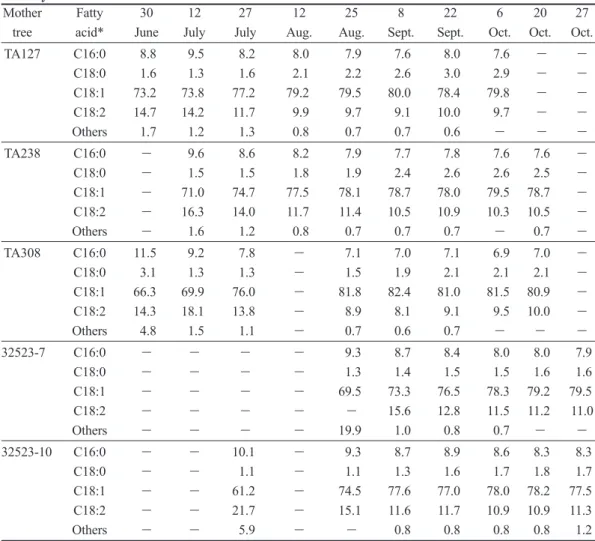
三、不同時期採收的種子之種仁內脂肪酸含量 分析5株母樹種仁內4種主要脂肪酸含量,包 括飽和脂肪酸(棕櫚酸和硬脂酸)和不飽和脂肪酸 (油酸和亞麻油酸),結果顯示所有母樹以油酸含
量最高,9月份以後採收的種子,油酸含量都在 70%以上,其中TA308油酸含量最高80%以上;其 次是亞麻油酸,9月份以後其含量在9~16%間,其 中以母樹32523-7最高,都維持在10%以上(Table 4)。其他2種棕櫚酸和硬脂酸,在含量方面皆低於 10%,以硬脂酸含量最低3%以下。5株母樹在不 同時期採收果實所製取之種仁油成分,皆隨採收 時期(6~10月)而有油酸變多和亞麻油酸變少,及 硬脂酸變多和棕櫚變少之趨勢。苦茶油因含高量 具多項生理調節功能(如抗氧化、調節血糖血脂、
促進傷口癒合、抑制腫瘤生長及護肝等)之油酸而 聞名,故過早採收對種仁油內油酸含量不利。
四、 不同時期採收的種子之種仁內角鯊烯和 維生素E含量
角鯊烯含量自8月份以後隨著採收期有逐
Table 4. Fatty acid compositions ( ) of kernel oil of seeds of 5 mother trees of Camellia
brevistyla with different harvest datesMother Fatty 30 12 27 12 25 8 22 6 20 27 tree acid* June July July Aug. Aug. Sept. Sept. Oct. Oct. Oct.
TA127 C16:0 8.8 9.5 8.2 8.0 7.9 7.6 8.0 7.6 - - C18:0 1.6 1.3 1.6 2.1 2.2 2.6 3.0 2.9 - - C18:1 73.2 73.8 77.2 79.2 79.5 80.0 78.4 79.8 - - C18:2 14.7 14.2 11.7 9.9 9.7 9.1 10.0 9.7 - - Others 1.7 1.2 1.3 0.8 0.7 0.7 0.6 - - - TA238 C16:0 - 9.6 8.6 8.2 7.9 7.7 7.8 7.6 7.6 - C18:0 - 1.5 1.5 1.8 1.9 2.4 2.6 2.6 2.5 - C18:1 - 71.0 74.7 77.5 78.1 78.7 78.0 79.5 78.7 - C18:2 - 16.3 14.0 11.7 11.4 10.5 10.9 10.3 10.5 - Others - 1.6 1.2 0.8 0.7 0.7 0.7 - 0.7 - TA308 C16:0 11.5 9.2 7.8 - 7.1 7.0 7.1 6.9 7.0 - C18:0 3.1 1.3 1.3 - 1.5 1.9 2.1 2.1 2.1 - C18:1 66.3 69.9 76.0 - 81.8 82.4 81.0 81.5 80.9 - C18:2 14.3 18.1 13.8 - 8.9 8.1 9.1 9.5 10.0 - Others 4.8 1.5 1.1 - 0.7 0.6 0.7 - - - 32523-7 C16:0 - - - - 9.3 8.7 8.4 8.0 8.0 7.9 C18:0 - - - - 1.3 1.4 1.5 1.5 1.6 1.6 C18:1 - - - - 69.5 73.3 76.5 78.3 79.2 79.5 C18:2 - - - - - 15.6 12.8 11.5 11.2 11.0 Others - - - - 19.9 1.0 0.8 0.7 - - 32523-10 C16:0 - - 10.1 - 9.3 8.7 8.9 8.6 8.3 8.3 C18:0 - - 1.1 - 1.1 1.3 1.6 1.7 1.8 1.7 C18:1 - - 61.2 - 74.5 77.6 77.0 78.0 78.2 77.5 C18:2 - - 21.7 - 15.1 11.6 11.7 10.9 10.9 11.3 Others - - 5.9 - - 0.8 0.8 0.8 0.8 1.2
-, not available due to a lack of seeds.
* palmitic acid (C16:0), stearic acid (C18:0), oleic acid (C18:1), linoleic acid (C18:2).
漸增加的趨勢,增至最高後再下降(Table 5)。
母樹32523-7角鯊烯是全部5株母樹中含量達最 高,如10月6日採收的種子,每克種仁油含有 1217.8μg角鯊烯;母樹32523-10每克種仁油含 有932.2 μg角鯊烯,但於10月後迅速降至低點;
其餘3株TA母樹每克種仁油僅含有220~560 µg 角鯊烯,以TA127濃度最低。維生素E含量於 採收初期極低,隨著採收月份含量有逐漸增加 的趨勢,約在10月中旬(10月20日)含量最高,
如母樹TA238和32523-10每克種仁油分別含有 1007.4和1057.5 μg維生素E,其次為TA308,每
克種仁油含有630.8 μg維生素E。
討 論
臺 灣 產 短 柱 山 茶 為 耐 陰 的 樹 種(Kuo and Yeh 2015),從開花至果實成熟需要一年的時 間。本研究栽種地點2處,果實從7月下旬開始 成熟,此時期採自苗栗縣泰安鄉TA母樹,種子 已經增大,種子含水率下降至60%,種子發芽 率90%以上,空粒率極低。然而,採自桃園市 龍潭鄉32523母樹,需延遲至9月下旬,果實才
會完全成熟。雖然母樹間種子成熟時間有2個月 的差異,但從種子產量和品質,顯示棲地環境 適合短柱山茶樹木生長。不同的種源母樹果實 及種子大小差異大,比較本研究5株母樹,母樹 32523-7成熟的種子最大,而母樹TA308成熟的 種子最小(Table 2)。
成熟採收後的果實水分逐漸蒸發,果殼開 裂,種子容易取出。研究發現6月至7月期間採 收的未成熟果,果殼與種子難以分離,部分種 仁成乾扁狀,種子於烘乾過程,會有咖啡色黏 液流出。短柱山茶成熟的種子,可以乾燥儲藏 在5℃至少6個月,且5℃低溫濕層積處理2~3個 月,能加速種子發芽(Chien et al. 2015)。
短柱山茶種子內種仁含油率隨著採收後期 果實逐漸增大而增加,於9月下旬至10月增加的 幅度最大(Fig. 1)。種仁油脂肪酸隨時間不飽和 脂肪酸之油酸變多和亞麻油酸變少,及飽和脂 肪酸之硬脂酸變多和棕櫚變少之趨勢。種仁油 內的角鯊烯與維生素E含量,呈現先升後降,太 晚採收可能會造成油茶果實內機能性成分的流 失。此外,角鯊烯及維生素E具有抗氧化等活 性,未來可考慮篩選高含量角鯊烯及維生素E優 良品系栽種(Handbook of Camellia cultivation management and utilization 2013)。本研究發現 角鯊烯與維生素E濃度在種源母樹之間差異大,
將來篩選母樹時,可於9月種子成熟後檢測。
由於母樹栽種地點及環境不同,種子成熟
期不一致,但考慮種仁含油率、脂肪酸及機能 性成分等含量,建議果實採收期應在9月下旬至 10月採收最佳。
結 論
研究臺灣產短柱山茶5株母樹,無論在種 子 大 小 、 種 子 內 種 仁 含 油 率 和 成 分 含 量 皆 有 差 異 。 根 據 年 產 量 的 資 料 , 種 子 大 小 以 母 樹 32523-7最大,種仁含油率以TA母樹3株皆高於 平均值,油酸含量以TA308油酸含量最高,亞 麻油酸以母樹32523-7最高,角鯊烯濃度以母樹 32523-7含量最高,維生素E濃度以母樹TA238 和32523-10最高。因此,篩選優良品系時,依 目標需求,利用無性扦插或嫁接繁殖苗木,然 後選定地點栽種。
謝 誌
本 研 究 承 蒙 行 政 院 農 業 委 員 會 林 業 試 驗 所經費補助科技計畫(編號:105農科-15.1.2- 森-G1和106農科-14.2.2-森-G1)與科技部科技計 畫(編號:MOST 104-2313-B-054-002-MY3),
特予致謝。感謝林業試驗所育林組王玉婷、張 益瑞、陳彥甫,森林化學組葛量正、楊甯喻及 蓮華池研究中心王德華、邱之偉、林志東、姚 曉蓓等在實驗工作上的協助。
Table 5. Squalene and vitamin E contents (μg g
-1kernel oil) from seeds of 5 mother trees of
Camellia brevistyla with different harvest datesMothet 30 12 27 12 25 8 22 6 20 27 tree June July July Aug. Aug. Sept. Sept. Oct. Oct. Oct.
Squalene TA127 48.8 28.8 36.9 14.2 28.8 215.9 227.8 160.0 - - TA238 - 47.5 38.1 21.2 41.7 566.6 233.4 469.4 445.7 - TA308 64.0 49.5 37.2 - 44.6 402.0 185.2 333.2 78.7 - 32523-7 - - - 72.9 373.1 905.6 800.8 1217.8 476.9 422.7 32523-10 - - 61.8 - 932.2 613.5 750.0 159.0 220.7 84.8 Vitamin E TA127 4.5 6.1 5.0 6.8 4.1 29.3 81.5 367.3 - - (α-tocopherol) TA238 - 6.3 6.6 9.1 7.6 146.5 349.5 629.5 1007.4 - TA308 5.5 7.8 10.6 - 10.8 214.2 385.3 431.8 630.8 -
32523-7 - - - 18.2 - 57.9 186.7 233.0 402.1 374.6
32523-10 - - 11.8 - 61.1 - 291.4 135.9 1057.5 435.6
引 用 文 獻