Fuzzy Controlled Fast Charging System for Lithium- Ion Batteries
Ming-Wang Cheng Applied Science and Eng.
Institute
Fu Jen Catholic University Taipei, Taiwan [email protected]
Shih-Ming Wang Dept. of Electronic Eng.
Fu Jen Catholic University Taipei, Taiwan [email protected]
w
Yuang-Shung Lee Dept. of Electronic Eng. &
ASE Inst.
Fu Jen Catholic University Taipei, Taiwan [email protected]
Sung-Hsin Hsiao Applied Science and Eng.
Institute
Fu Jen Catholic University Taipei, Taiwan [email protected]
w
Abstract—A DSP is adopted to construct a fuzzy controlledlithium-ion battery charging system. By using this intelligent charging system, the data collection, calculation and peripheral circuit control are performed for the battery charging status.
According to the lithium-ion battery charging specifications, two hours are required for battery charging. A fuzzy logic controller (FLC) is constructed by using the battery protection cell voltage and voltage difference among the batteries. They are used as the input variable to shorten the charging and equalizing time and assure that the battery will be operated within the safety voltage range.
Keywords - fuzzy controlled battery charger, lithium-ion battery strin
g,
battery equalizationI. I
NTRODUCTIONFossil fuel shortages have resulted in ever rising gas prices.
To solve the related economic and pollution problems, electric cars have emerged as the mode of transportation for the future.
Storage batteries are the principal power source for both immobile products (UPS continual electric system or automatic power failure lights) and mobile products (electric powered cars or electric powered motorcycled). With so many types of electrical equipment being operated by storage batteries, the need to more accurately measure the battery charging process grows every day. Ensure that the user of an electric product can check the power charging status at any time, and therefore reduce the time spent charging the battery is becoming a very important question.
The lithium-Ion battery has adapted to the requirements of modern products. However, the voltage in a single Lithium-Ion battery is inherently low. Therefore, a series of cells are usually employed for many practical applications. With a series connected battery string, imbalanced cell voltage will cause over charging or deep-discharging and decrease the total battery storage capacity and lifecycle. Safe operation during lithium-ion battery string charging and discharging is more complex than with other batteries. Therefore, a series connected battery string module that controls and monitors usage efficiency and battery lifecycle extension has become a necessary battery engineering technique.
The battery string charging time can be reduced using a fast-charging system. There are many ways to charge a battery,
with the most simple being CC_CV battery charging. If you want to shorten the time it takes to charge a battery you must use a stronger current, but the drawback is that this will cause the battery temperature to increase dramatically and shorten its life. On the other hand if the current is smaller, it will take longer to charge the battery. The charging method has a large effect on battery life. Overcharging causes damage to the battery and shortens its’ life. An explanation of battery charging methods is described below [1-4]. Most battery charging devices use the constant voltage (CV) charging method because the battery charger circuit is simple and easy to control. The drawback is that at the beginning stages of charging the voltage is too low, usually resulting in the current being too high, causing the battery temperature to dramatically increase. This in turn causes damage to the battery and shortens of its life. A battery charging process that transforms constant current into constant voltage can be divided into two stages.
The first stage uses constant current to charge the battery, thus shorting the time it takes to charge the battery. After the battery voltage reaches a set level, the system switches to using constant voltage to charge the battery. During this stage the battery charging current will gradually become smaller as time goes by, shortening the time it takes to charge the battery.
Currently most lithium-ion batteries on the market use this battery charging method [5].
From the energy conservation and environmental protection point of view, electric cars are undoubtedly the future trend for transportation. Therefore, developing corresponding battery control systems is very important. A DSP based fuzzy controlled battery charging system is developed for a series connected lithium-ion battery string with the individual cell equalization schemes (ICEs) proposed in this paper. We use the fuzzy control method to adjust the charger output current. The proposed charging system can shorten the charging time within a specified charging profile and assure that the each cell in the battery string will be operated within the safe voltage range.
II. T
HEC
HARACTERISTICO
FS
ERIESC
ONNECTEDL
ITHIUM-I
ONB
ATTERYThe strong points of lithium-ion batteries are its no memory effect, high working voltage, no pollution, low discharge rate, high volume energy density, and high weight energy density characteristics, making it a focal point of new power supply
1498
research in recent years. Lithium ion batteries are pollutant-free green environment friendly secondary batteries that fit the green energy development needs of the international community. These batteries can also be applied to the high energy power environment of hybrid electric cars (HEV) and electric vehicles (EV). The power batteries used in electric bicycles, electric cars and other electric tools, require several batteries working together to achieve a higher capacity and higher power.
A series battery module, usually a single electric power source, is used for the battery series charging process.
However, the electrochemical properties and resistance of individual batteries and non-linear behaviors are not all the same. Therefore when in operation, differences in environmental conditions will produce differences in battery performance. Taking this into account, even if the current that enters the batteries is all the same, the amount of power charged by each individual battery will not necessarily be the same. If the power stored by each batter is different, then there will be an even bigger difference in the terminal voltage displayed by each battery. Most charging circuits are only able to detect the terminal voltage of the entire battery module, using this to determine when to stop charging the batteries. For this reason, when the battery stops charging it is possible that other batteries within the module have already reached an over- charged state, while other batteries are still not fully charged [6-8].
Over-charging or deep-discharging a lithium-ion battery results in undesirable chemical and electrochemical reactions.
A lithium-ion battery protection circuit and the management system are very important for series connected battery string. It important to measure the power in a battery judge the operating standards to prevent battery aging and preserve battery life span. When the battery management system in electric powered or hybrid electric cars into consideration, it is necessary to constantly monitor and balance the voltage in a series of 100 batteries working together. Fig. 1 shows the battery charging properties for the Panasonic CGR18650HG lithium-ion battery [9]. To improve the battery charging efficiency, we tried to add control methods. Because it was difficult to establish a mathematical model for the battery during the control process we used a fuzzy control method to control the charge in the batteries.
Fig 1. The charged profiles of lithium-ion battery
III. F
UZZYL
OGICC
ONTROLLEDC
HARGINGS
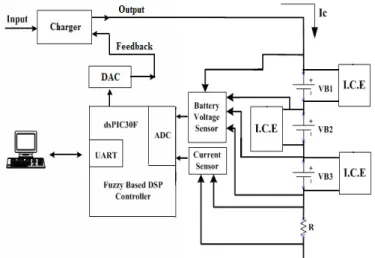
YSTEMBecause the lithium-ion battery is a complex nonlinear element and the fuzzy logic controller does not need an exact mathematical model for control, an adaptive way to control the cells was developed. To enhance the charging efficiency we added a fuzzy logic controller to change the charge current in the CC-CV section. Fig. 2 demonstrates the intelligent charging system configuration for a series connected battery with individual cell equalizers (I.C.E). The I.C.E scheme modified from dissipative cell level voltage management for a battery balancing system. The proposed intelligent charging system can shorten the charging time based on the fuzzy control law and assure that the each cell in the battery string will be operated within the safe voltage range [10].
The fuzzy logic controller can be classified into four parts.
Fuzzifier: The fuzzifier uses the membership function to convert the system true value into linguistic fuzzy sets. Fuzzy rule base: According to professional experience and the system control operating, method a fuzzy rule base is designed. Fuzzy inference engine: Fuzzy inference engine is an operating method that transforms the fuzzy rule base into fuzzy linguistic output, any rules can compound one fuzzy inference engine.
Defuzzifier: The way in which the linguistic fuzzy sets are converted into true values.
The charging current is controlled by the fuzzy logic controller output according to the cell voltage (VB) and differences in voltage (Vd) among individual cells. The membership function is described using five linguistic variables, i.e. VL (very large), L (large), M (medium), S (small), and VS (very small) in triangular form [11]. The rule base collects the control rules that describe the knowledge and experience of the battery equalization control in the fuzzy set [12]. The decision rule Table I for the linguistic variables for the fuzzy logic controller is two-dimensional (5x5) and constructed in the rule-based memory system of the control scheme. The linguistic inference results are converted into numerical output Io by the defuzzifier. The fuzzy controlled output current Io is the desired battery charging current of the proposed cell charge scheme shown in Fig. 3.
Fig 2. Charging system block diagram
1499
TABLE I. FUZZY CONTROL RULL BASE
Fig 3. The 3-D characteristic curve of the fuzzy logic controller output
IV. D
ISSIPATIVE INDIVIDUAL CELLE
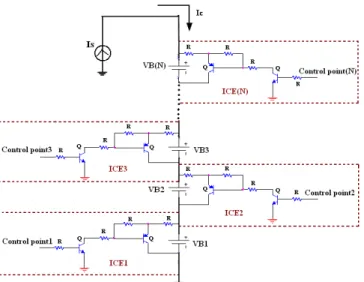
QUALIZATION UNITFig. 4 shows the proposed dissipative individual cell equalization unit (ICE) for the series connected battery strings.
The different equalize circuit structure was used in different battery capacity, charging method, battery category and environment. In this strategy of battery equalization, the voltages of individual cells are monitored and the voltage of individual cells is managed by passing current around a cell through a dissipative element (e.g., a resistor) during charge.
This strategy insures that all of the cells remain within the specified voltage limits and that all cells are charged to the same voltage level. Of course, the capacity of the battery is still limited by the first cell of the battery string to reach the minimum voltage during discharge.
Fig 4.
The dissipative individual cell equalization unit
The dissipative method is the simplest, cheapest, and least complex cell balancing technique. The circuit is shown in
Fig. 4.It detects the highest voltage and uses the resistor to remove charge from the highest cell until they match the charge of the lowest cells. However, large resistors can cause power dissipation and high energy losses. Thus, the large resistor could result in design with costly thermal management requirements. Therefore, if we use small charge currents, the efficiency can be increased and would be more suited for operating the system.
V. E
XPERIMENTALP
LATFORMDSPIC30F4011 was used to complete the proposed charging system structure for the intelligent lithium-ion battery shown as Fig. 2. It adopts a differential amplifier constructed using OP amplifiers to read the voltage on each battery, charging amount of battery-cascade current during the charging process. The acquired parameters will be provided for DSP calculation to adjust the charger output current to determine the voltage and current required for battery charging and equalization. The current sensor is also used to monitor whether over-current exists during the battery-cascade charging process to protect the battery-cascade. The battery management system could pass the system status information over to a computer for processing using the UART communication interface.
Fig. 6 shows the flow chart for the battery charging control program. First initialize the system variables. Next use the analog multi-tool to change the reading of the initial voltage level for each battery in the battery string using the ADC of the inner MCU from analogue signal to digital signal. After knowing the battery voltage and comparing and identifying the single battery with the highest voltage; start the battery charging control process. Read the current sensor to see if the battery charging current is correct or not and then pass the cell voltage information to the computer for processing using the UART communication interface. Fig. 5 is a flow chart for the battery equalization control program.
Fig 5. Flow chart for the battery equalizing control program
1500
Fig 6. Flow chart for the battery charging control program
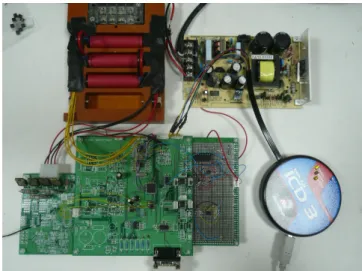
Fig 7. Experimental platform of fuzzy controlled lithium-ion charging system
VI. E
XPERIMENTALR
ESULTTThe dsPIC30F was adopted as the battery control chip with charger in this experimental platform shown as Fig. 7. Three series connected lithium-ion battery strings were used in the battery charging experiment. The battery type is SANYO UR18650W, the battery initial voltage is following below:
V
B1=2.8(V), V
B2=2.8(V), and V
B3=2.8(V).
During the battery charging process, we adopted a fuzzy control device to control the feedback current for the battery charger and adjust the size of the output current to shorten the time of charging to 1 hour and 15 minutes. Fig. 8 is a voltage chart for the fuzzy control added to the battery series during the experiment. If we adjust the membership function of Io with
the fuzzy control, when the battery voltage increases and the difference in voltage becomes small, the battery charging current will be comparatively higher. The charging time is around 1 hour and 3 minutes, shorter by 12 minutes using the unadjusted process. Fig. 9 displays the membership function of the fuzzy control after adjustment. Fig. 10 is the battery charge characteristic after membership function adjustment. If we adjust the battery charging current range to 4 (A), after the membership function is adjusted, the battery charging current as a whole will increase and the time needed to charge the battery will shorten to within 1 hour. Fig. 11 is the resulting charge characteristic after membership function adjustment and the changed current range to 4 (A).
Fig 8. The charge characteristic of add fuzzy control on lithium-ion battery
Fig 9. The membership function of the fuzzy controller after adjustment
Fig 10. The charge characteristic of the battery after the adjustment of the membership function
1501
Fig 11. The charge characteristic of adjusting the membership functions and the changing current range to 4A
The proposed battery charger with the fuzzy controlled charging algorithm for series connected battery as the structure shows as Fig. 2. The experiment verified that this system can indeed shorten the charging time. Comparing the battery charging voltage after adding the fuzzy controller and a normal 1C charge, it can be seen that the battery charging time decreased after adding the fuzzy control. The battery voltage was also maintained at a safe level. Fig. 12 shows that a normal 1C battery charge takes about one hour and a half with a charge capacity of 1446 mAh. After adding the fuzzy control, the time was shortened by about 15 minutes. After adjusting the membership function, the charging time was shortened by 25 minutes. If the charging current is adjusted to 4 (A), the charging time can be shortened again by 35 minutes, greatly increasing the battery charging efficiency. When comparing the results from the 3 different kinds of fully charged battery systems after adding the fuzzy controller and the capacity of a 1C charge, it can be seen that after adding the fuzzy controller the charging capacity was 2% higher than that for the 1C charge. After adjusting the membership function, the charging capacity was 99% of the 1C charge. After adjusting the current to 4 (A), the charging capacity was higher than 1C about 7mAh, displaying much more efficient battery charging. Fig.
13 is a comparison chart of the discharging capacities.
The battery equalization initial conditions of batteries are V
B1=3.4 (V), V
B2=3.6 (V), V
B3=3.8 (V), Fig. 14 shows the experimental results of the battery equalization without charging. The equalization result for the proposed charging circuit with ICEs is shown in Fig. 15.
Fig 12. The comparison chart with battery charging voltage
Fig 13. The comparison chart of battery discharging capacity
Fig 14. The experimental result of battery equalization without charging
Fig 15. The experimental result of battery equalization with charging
VII. C
ONCLUSIONThis paper applied fuzzy theory to a DSP fuzzy controlled lithium-ion charging system. The proposed method reduces the charging time and circuit space. Cell balancing control was significant in extending the battery life and charging safety of the battery stack and improving the battery charging efficiency.
In comparison with the 1C charge, it was possible to shorten the charging time by 15 minutes. If the membership function was adjusted and the current range increased, the charging time was reduced by 35%. The charging capacity was larger than that in the 1C charge. The proposed charging system can shorten the charging time and assure that the each cell in the battery string will be operated within the safe voltage range. In our future research, the fuzzy control method will be applied to battery equalization and add functions for estimating the battery residual capacitance, monitoring and controlling the each single battery status. The proposed method will battery
1502
operation more safe and develop a set of complete battery charging-discharging management systems.
A
CKNOWLEDGMENTThis research work was supported by Fu Jen Catholic University and Chung-Shan Institute of Science and Technology Electronic System Research Division, under 6301- 03 and CSIST 804-V101 (98), respectively.
R
EFERENCES[1] W.F. Bentlv and D.K. Heacock, “Battery Management Consideration for Multichemisty System,” IEEE Aerospace and Electronic System Magazine, vol. 11, no. 11, 1996, pp. 23-26.
[2] V.L. Teofilo, V.L. Mermitt and R. P. Hollandsworth, “Advanced Lithium Ion Battery Charge,” Battery Conference on Applications and Advances, vol. 12, no. 11, pp. 227-231, 1997.
[3] W.F. Bentley, “Cell Balancing Considerations for Lithium Ion Battery System,” Battery Conference on Applications and Advances, pp. 223- 226, 1997.
[4] J.A. Martin, M. Gonzalez, M.A. Perez, F.J. Ferrero and J. Diaz, “A Microcontroller-Based Intelligent Fast Charge for Ni-Cd and Ni-MH Batteries in Portable Appliction,” IEEE Industrial Electronic Conference (IECON’98), vol. 3, pp. 1638-1643, 1998.
[5] Y. Podrazhansky and P.W. Popp, “Rapid Battery Charger/Discharger and
Conditioner,” U.S. Patent 4, 829, 225, May 1989
[6] M.J. Isaacson, R.P. Hollandsworth, P.J. Giampaoli, F.A. Linkowsky, A.
Salim, and V.L. Teofilo, “Advanced Lithium Ion Battery Charger,” The Fifteenth Annual Battery Conference on Applications and Advances, pp.
193-198, 2000.
[7] M. Maskey, M. Parten, D. Vines, and T. Maxwell, “An Intelligent Battery Management System for Electric and Hybrid Electric Vehicles,”
IEEE Vehicular Technology Conference, vol. 2, pp. 1389-1391, 16-20 May 1999.
[8] J. Chatzakis, K. Falaitzakis, N.C. Voulgaris, and S.N. Manias
“Designing a New Generalized Battery Management System,” IEEE Transactions on Industrial Electronics, vol. 50, no. 5, October 2003, pp.
990-999.
[9] Panasonic Batteries Handbook 2000.
[10] G.C. Hsieh, L.R. Chen, and K.S. Huang, “Fuzzy Controlled Li-Ion Battery Charge System with Active State-of-charge Controller, “IEEE Transactions on Industrial Electronics, vol. 48, no..3, June 2001, pp.
585-593.
[11] Y.S. Lee, S.H. Chen, and Y.P. Ko, “Micro-Controller Unit Application in Fuzzy Battery Equalization for Battery String,” IEEE International Conference on Systems, Man, and Cybernetics, pp. 2110-2115, October 2006.
[12] Y.S. Lee, and M.W. Cheng, “Fuzzy Logic Controlled Battery Equalizer for Series Controlled Lithium-Ion Battery Strings,” The 19th International Battery Hybrid and Fuel Cell Electric Vehicle Symposium EVS19, Busan Korea, pp.1891-1901, October 2002.