Chapter Two Literature Review
This chapter presents literature reviews, following by the development of writing instruction from 1960s to current writing approaches, the implement of social cognitive theory in the writing classroom, and the development of writing test of Scholastic Aptitude English Test (SAET) as well as The General English Intermediate Writing Proficiency Test of The Language Training and Testing Center (LTTC) in our country.
2.1 Second Language Teaching and Learning
For much of this century, there has been a heated debate between the view that education is a matter of making meaning for learners and the view that the function of education is to facilitate the process whereby learners make their own meaning. This ongoing debate within the wider context of education has had a profound effect on language education.
Underlying experimental learning are the notions that learners are at the center of
that learning process, and learning that is a process of self-discovery. Kohonen
(1992) pointed out experiential learning had diverse origins. It was derived from
John Dewey’s progressive philosophy of education, from Lewin’s social psychology,
from Piaget’s model of developmental psychology, from Kelley’s cognitive theory
education, and from the work of Abraham Maslow and Carl Rogers in the field of
humanistic psychology. Kohonen saw education as simultaneously looking inward
and operating outward, and that any attempts to resolve the myth of what motivates
behavior must necessarily capture link between the individual and the group.
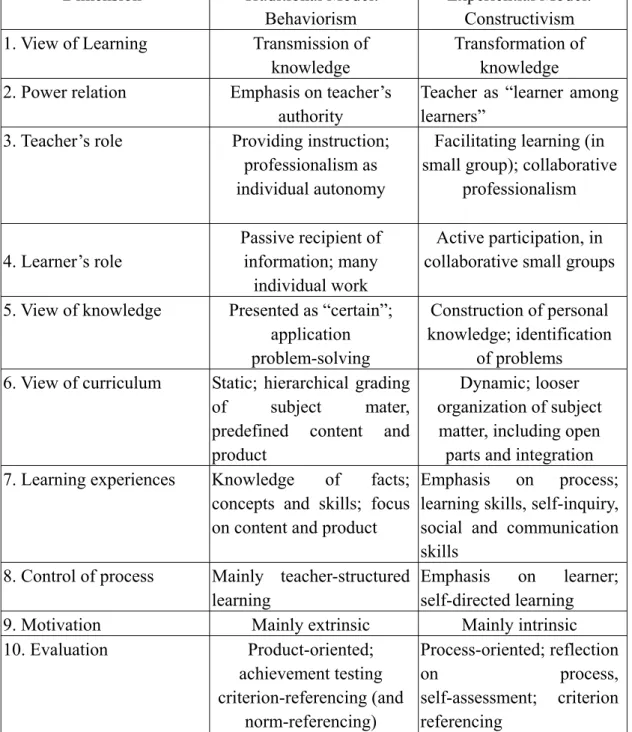
Similarly, he provided contrasts between traditional and experiential models of education in ten dimensions. (See Table 2.1)
Table 2.1 Traditional and Experiential Education Models Compared (Cited from David Nunan, 2000)
Dimension Traditional Model:
Behaviorism
Experiential Model:
Constructivism 1. View of Learning Transmission of
knowledge
Transformation of knowledge 2. Power relation Emphasis on teacher’s
authority
Teacher as “learner among learners”
3. Teacher’s role Providing instruction;
professionalism as individual autonomy
Facilitating learning (in small group); collaborative
professionalism
4. Learner’s role
Passive recipient of information; many
individual work
Active participation, in collaborative small groups 5. View of knowledge Presented as “certain”;
application problem-solving
Construction of personal knowledge; identification
of problems 6. View of curriculum Static; hierarchical grading
of subject mater, predefined content and product
Dynamic; looser organization of subject matter, including open parts and integration 7. Learning experiences Knowledge of facts;
concepts and skills; focus on content and product
Emphasis on process;
learning skills, self-inquiry, social and communication skills
8. Control of process Mainly teacher-structured learning
Emphasis on learner;
self-directed learning
9. Motivation Mainly extrinsic Mainly intrinsic
10. Evaluation Product-oriented;
achievement testing criterion-referencing (and
norm-referencing)
Process-oriented; reflection
on process, self-assessment; criterion
referencing
2.2 The Trend of Teaching Writing in Second Language Acquisition (SLA)
In the beginning of the 20
thcentury, the conceptual model for teaching writing emphasized the composed product rather than the composing process. The teaching of writing focused on analyzing discourse into word level, sentence level, and paragraph level. It also classified discourse into description, narration, exposition, and argument.
Moreover, a lot of emphasis was placed on style and usage.
2.2.1 An Overview in Composition Research
In 1963, the National Council of Teachers of English (NCTE) published its first survey of composition research, Research in Writing Composition, to encourage research in the young field of composition. For over three decades, composition research evolved from error counts and comparative studies of teaching methods to writing process research, from classroom-based research to content-based research.
In 1984, in the New Directions in Composition Research, Beach and Birdwell defined composition research as the investigation of writing behaviors, cognitive processes during composing, and the ways in which these behaviors and cognitive processes interacted with written products and their contexts.
Composition research has been a flourishing and active field in English education.
We can chronologically divide the development of writing paradigms into several branches: Controlled Composition, Contrastive Rhetoric Approach, The Process Approach, Classroom Process Research, Content-based Approach and Interactive Task-based Approach.
2.2.1.1 Controlled Composition
In the earlier years of the century, the pedagogy for second language composition
was controlled composition. The approach was derived from the then popular
stimulus-response theory of Behaviorism. According to the Behaviorism, we can divide a subject into certain definable skills and learning can take place in a step-by-step fashion, supported by negative or positive reinforcement (Bloomfield, 1933). This approach focuses writing on accuracy and correctness in writing.
Learning to write in a second language is seen as an exercise in habit formation—writing takes the form of sentences drills such as fills-in, substitutions, transformations, and completions. The writer is simply a manipulator of previously learned language structures; the instructor is concerned with formal linguistic features;
the content is provided by the text and by the teacher (Raimes, 1991). In other words, this approach fundamentally emphasizes three features: grammar, syntax, and mechanics, focusing on accuracy instead of fluency or originality. This method involves practicing the language without a social context. It is plagued by its lack of spontaneity in both the teaching materials and activities.
2.2.1.2 Contrastive Rhetoric Approach
However, in the mid-sixties, controlled composition was thought to be inadequate.
And the contrastive rhetoric approach arose. Pieces of connected discourse began to be used as instructional materials. The ESL writers employed rhetoric and a sequence of thought which violated the expectations of the native reader—first language gave a great impact on the organization of the text in the second language writing. The text produced by second language speakers differed from those produced by native speaker in the ways the writers organized what they were writing. Learners’ first language was thought to interfere with English writing beyond the sentence level;
more drills at the rhetorical level rather than the syntactical level were considered
necessary needed in writing instruction. This means writing instruction must
emphasize not only the grammatical form, but also the rhetorical form in order for
learners to recognize, to use topic sentence to employ examples as well as illustrations for body development, and to give a conclusion with personal opinion or by summarizing the whole ideas (Raimes, 1991).
2.2.1.3 The Process Approach
In the late sixties and early seventies, the conventional paradigm was challenged and composition researchers began to question their assumptions that had not been tested against the actual composing processes of writers. As a result, the dramatic shift came--the process approach--when researchers began analyzing what writers really do when they write instead of what they ought to do (Beach & Bridwell, 1984).
And researchers cited below began to explore writing behaviors and the process of composing. Emig (1971) initiated the research on the composing process in her case study of “The Composing Processes of Twelfth Grades”. Likewise, Stallard (1974) did a similar study. Both of them found their students used time to contemplate their writing before revising them and this was a recognizable process that students could learn and that using it they could improve their writing. Britton (1978) discussed the composing processes and functions of writing by proposing three principal categories:
transactional, expressive, and poetic, which marked out two spectra. The spectrum the system from expressive to transactional covered language in the role of participant, and it is the spectrum from expressive to poetic that covered language in the role of spectator. Murray (1978) found internal revision as a process of using language to discover and believed that the most accurate definition of writing was that it was the process of using language to discover meaning in experience and to communicate it.
In addition, the process could be described, understood, and learned.
Moreover, in Flower & Hayes’ study (1981a; Perl, 1980), they used a protocol
analysis to examine the writing process as a cognitive development and problem
solving. They asked both expert and novice writers to compose aloud. Consequently, they observed the order of the linear model--prewriting, drafting, revising, and editing—gave way to “recursive” model. Writing is nonlinear. In other words, writing actually is a set of processes involved moving back and forth within the four stages above, making changes in what had been created. Writers discovered what they wanted to say (Hudelson, 1988); good writers planned more (Pianko, 1979; Stallard, 1974; Wall & Petrovsky, 1981); good writers reread and rescanned more (Bridwell, 1980; Stallard, 1974; Wall & Petrovsky, 1981). Perl (1980) observed the composing process of college freshman writers and found that recursiveness occurred in writing, but the parts that recurred seemed to vary from writer to writer and from topic to topic.
Remedial writers confused revision with editing, and focus on spelling and mechanics.
Unskilled writers edited more locally whereas experienced ones scoped the text as mutable and fluid and would like to recycle. Experienced writers exhibited a more sophisticated repertoire of revision strategies by using revision for invention, finding new ideas (Faigley & Witte, 1981; Sommers 1981). In a word, writing was viewed as a recursive and reflective process of generating ideas, creating meaning, and problem-solving, for it engaged writers with moving back and forth in drafting.
2.2.1.4 Classroom Process Research
Process studies provided insight into the complexity of composing and they
revealed a close relationship between instruction and writing. However, from surveys
of writing instruction and writing, we found it did not indicate that teachers had
learned from the process research and writing continued to be taught according to
traditional models because the problematic nature of incorporating change still occurs
in the classroom and process studies have not typically investigated writing in the
naturalistic settings where it is held (Zamel, 1987).
Researchers have therefore undertaken classroom-based investigation. The goals of such research have been both to specify what is common to second language instruction and to identify the factors that cause classroom activities to vary from one setting to another. The research, stressing on ethnographic nature, was in an effort to understand better the connections between writing behavior and writing paradigm.
The paradigm gave teachers insight into the behaviors, strategies, and difficulties of writers.
For instance, Grave’s (1983) and Calkins’s ethnographic studies of writing classrooms provided us perceptions not only in how children develop as writers, but also showed how their classroom environment and situational factors impinge upon their development.
Kantor (1984) in his study further demonstrated how contextual classroom features interacted with writing experiences. He found that non-directive and encouraging stance of the teacher and the supportive and comfortable community-writing classroom helped learners built up a trusting relationship with their instructor. And then this in turn inspired them to take risks for the development of writing. Their study made them more confident about their intuitions about writing.
Likewise, the work of Dunn, Florio-Ruanne, and Clark (1985) pointed out that while the teacher motivated, encouraged, and coached in an effort to open interaction among the classroom participants, the students were given responsibility in their role as writers and were provided numerous opportunities to write for a range of purposes and a variety of audiences. In a word, the authority that the teacher gave to his students became the primary elements for their developing authorship.
In 1984, Newkirk explored the writing experiences of college freshman writers,
with special focus on the development of one particular student. He described the
teacher’s attitude toward the student as instrumental in improving the students’
writing, allowing the student to make the amazing “breakthrough”.
Edelsky’s (1982) study of the development of writing in a bilingual program left a great mark in L2 writing research. It examined how context and writing interacted.
Edelsky’s analysis of children’s writing in L1 and L2 indicated that the literacy of the children in both languages was promoted in a program that involved purposeful writing for a variety of audiences, that children wrote a great deal, and that children are allowed them to write on the topics of their own choice.
Subsequently, the work of S. Diaz, Moll, and Mehan (1986) investigated the growth and change in students in her own process-oriented classroom. The classroom was characterized by free writing, daily journal entries, writing groups that provided instructive feedback, rehearsal and invention strategies, teacher conferences, drafting and redrafting, writing with purpose and audience, content-based compositions, and attention to error during the final stages of composing. She observed a concern with process, a nonpunitive, student-oriented environment, and extensive opportunities to write meaningfully. Specifically, she found that opportunities not only had promoted more and better writing, but also had helped these students feel more confident about their abilities both to write and make a success in other L2 activities. For them, as writing was seen as producing anxiety, school-imposed activity became important and writing was as an approach to acquire more language, as a way of learning and knowing.
With two compared groups, one focusing on product and mechanical correctness
and the other emphasizing the critical nature of writing, much similar to the classroom
described by D. Diaz—meaningful for a real purpose and audience—Hildenbrand
(1985) observed that the classroom helped build in the student an awareness of
oneself as a writer, enabled the student to take risks as one attempted to articulate
one’s thoughts and ideas in writing. Moreover, the classroom gave learners a sense of
confidence and self-worth that served to counteract the negative influence of other schooling experiences. This nontraditional classroom did not assign topics or expository papers but rather engaged students in self-generated topics and experiential, expressive writing. Hildenbrand suggested this approach was particularly effective in preparing students for the demands of academic writing because it fostered an appreciation for writing as a means to explore and elaborate meaning.
As a matter of fact, classroom process research rejects as simplistic any unvariated classification of the second language instructional experience. Instead, it does not lead directly to empirically validated application. It is directed more at clarifying those factors, which must ultimately be taken into account in attempt to examine the effects of particular classroom treatments. By and large, the classroom process research seeks to inform our understanding of how teachers and learners accomplish classroom lesson (Gaies, 1983).
2.2.1.5 Content-based Approach
In content academic writing instruction, writing is connected to study of specific academic subject matter and is viewed as a means of promoting understanding of this content.
Content-based approach differs from other approaches to teaching academic writing in at least four major ways (May Shih, 1986).
First, writing from personal experience and observation of immediate surroundings
is de-emphasized; instead, the core of the instruction falls on writing from a variety of
sources—readings, lectures, discussions and so forth and on synthesis and
interpretation of information currently being studied in depth. Writing has more
connections with ongoing study of a specific subject matter in one or more academic
disciplines and is viewed as a means to stimulate students to think and to learn.
(Beach & Bridwell, 1984; Emig, 1977; Fulwiler, 1982; Newell, 1984)
Second, the instructor who guides and responds to writing has to know the subject matter well enough to explain it, field questions, and respond to content and reasoning in papers. At the same time, the instructor follows the writer’s need to give the treatment of the matters of form such as organization, grammar, and mechanics.
Third, contrary to the traditional belief—students should only write in a writing course-- students listen, discuss and read about a topic before they begin to write.
Last, the instructor leads students to the study of a topic to before they proceed to write, so that there is active control of ideas and extensive processing of new information (Anthony, 1985, p.4) before students begin to write. In the content-based writing program, a longer incubation period is permitted. It is also characterized by more input from external sources, unlike the situation in traditional composition classes in which students depend solely or primarily on self-generated ideas and write on a new topic for each composition. Furthermore writing assignments can build on one another with “situational sequencing” (Schuster, 1984).
2.2.2 Summary
This section has presented an overview of the evolution of L1 and L2 composition research, and pedagogical applications in L1 and L2 writing instruction. Obviously, composition research in the early ‘60s was conducted from the linguistic perspective, in which the instruction emphasized correctness and clarity and the research focused on written texts, analyzing the form on word, sentence, and paragraph levels. In the early of ’70s, however, the focus of the research shifted to the cognitive domain.
Writing, then, was seen as essentially problem solving and discovery of meaning. In
consequence, journal writing, collaborative workshop, peer view and so on were
used as instructional techniques. Toward the end of 1970s, writing came to be
regarded not only as a cognitive process but also as a social and cultural development.
Put on the macro level, writing was viewed in a global way and researchers adopted new research methods to collect data—classroom-based paradigms by using an ethnographic approach or observing classroom activities. The research valued social and contextual interactions and, therefore, it was a time in which research focusing on social and contextual interactions began to play a role in composition research.
In the present study, the researcher transfers the merits among the process approach, content-based approach, and classroom approach with student-centered activities into constructivists’ interactive task-based approach.
2.3 Current Writing Teaching in EFL
A great deal of the recent controversy about the teaching of writing has centered not only on the topics students write about but also around the dichotomy of writing as a process or as a product. In a writing class, students need to be taught both how to use the process to their advantage as language learners and writers, and how to produce an acceptable product upon the demand. High school students—the subject researched in the thesis certainly need to learn how to pass exams, but they need to perceive writing as a tool for learning as well. Writing should be a tool that can be useful to them throughout their personal development and to their advanced learning in the future.
With a variety of approaches available for teaching writing, teachers are trying to figure out what approach to adopt in writing classroom, yet they sometimes confront a false trail that seems to promise a quick way out of multitude of obstacles in teaching.
In practice, we, as writing teachers, should be aware of the great diversity that exists
in teaching EFL in general because there is no such thing as a generalized EFL
student. Therefore, we should fully recognized that the complexity of composing, of
student diversity, of learners’ processes, and of the value of practice as well as the
competitiing theories. When teaching writing, we also have to balance the elements—the form, the writer, the content, and the reader.
The “complexity” means that a variety of theories need to be developed to support and inform diverse approaches (Silva, 1990). Thus, a fuller recognition of the complexity of writing is necessary for principled model building
.With respect to the diversity of students, we must realize that not all approaches and procedures might apply equally to all EFL students. Instead, we should present a governing philosophy and pay attention to all four elements involved in writing. The combination of complexity and diversity makes teaching writing imperative for us not to seek universal prescription, but instead to strive to validate other, local forms of knowledge about language and teaching (Pennycook, 1989). Furthermore, as Raimes points out (1991): “Writers are readers as they read their own texts. Readers are writers as they make responses on written text. Content and subject matter do not exist without language. The form of text is determined by the interaction of writer, reader, and content. Language inevitably reflects subject matter, the writer, and the writer’s view of the reader’s background knowledge and expectations.” In writing classroom, the balance of the four elements is very essential in writing instruction.
Nunan (1989a, 1989b) mentioned that a notion of process underlined a great deal of current communicative, task-based, and collaborative instruction and curriculum development. While there is a controversy about what a process approach to teaching writing actually comprises and to what extent it can take academic demands into account. Teachers need to know about the process of how learners learn a language and how writers produce a written product.
2.3.1 Writing as a Process vs. Writing as a Product
In the field of composition teaching, there are two main branches—the
Product-oriented approach vs. the Process-oriented approach. In essence, the
process-oriented approach sees writing as a continuing process to improve writing.
This approach encourages students to constantly engage in reading, writing, and revising. On the other hand, the product-oriented approach focuses on the finished product. Weeding out the errors in words, sentences, and structure is the focus of this approach. Since researchers and writing teachers have realized the focus on product does not take into account the act of writing itself, therefore, they are paying more attention to investigate the process of composing.
Methodologically, the process approach focuses on quantity rather than quality.
Beginning writers are encouraged to get their ideas on paper in any shape or form without worrying too much about formal correctness. This approach also encourages collaborative group work between learners as a way of enhancing motivation and developing positive attitudes towards writing. However, it has come under attack from critics, saying that thus approach confines learners largely to narrative forms and this sets a serious limitation on learners’ mastery text types such as reports, expositions and arguments, which are essential for academic success at school and beyond (Nunan, 2000).
According to Zamel, the writing class should take into account the learner’s purposes for writing, which transcend that of producing texts for teachers’ evaluation.
She thinks writing skills could develop rapidly when students’ concerns and interests
are acknowledged, when they are given numerous opportunities to write, and when
they are encouraged to become participants in a community of writers. She also
suggests that teachers should themselves become action researchers in their
classrooms. By engaging in the types of inquiry and investigation, teachers can apply
insights from what they have learned in the most profound way. Through real
investigation of their own practices on their students, teachers are able to find an
excellent way of bridging the gap between theory and practice.
As classroom-based research and action research has been increasingly recommended to decrease teacher’s reliance on theorist and researchers (Richard &
Nunan, 1990).
The researcher has conducted this classroom-based action research to identify the complex nature of the composing process.
2.3.2 Skilled vs. Unskilled Writers
There have been several important findings from previous research on writing. First, writing was affected by the mode of discourse. More specifically, students write more and with more fluency when their writing involves them personally, while they write with less facility when their writing is more objectified. Second, when inexperienced writers pay much attention to the form, the on-going process of discovery is constantly interrupted. Third, in the process of discovering meaning, experienced writers change whole chunks of discourse, and each of changes represents a recording of the whole.
Vivian Zameal (1982) found that an important dimension of the writing process
involved the period before the actual writing. In her survey, students all talked about
how important and helpful the classroom discussion was in delineating the ideas
related to a particular topic. Besides, students indicated that writing about what they
experienced was important when they were beginning writers. In her cases study, she
quoted many students’ comments that showed that writing provided a means for
discovering, creating, and forming to one’s thoughts and ideas. Students pointed out
that through rereading; writing helped them assess the clarity of their ideas. When
they had new ideas, they tried to write them down as soon as possible because this
was a way of checking if their ideas were clear or confused. Then, when they went
back to their writing, they often found that the order of ideas that they originally
planned was reversed. Interestingly, there were some students expressing dissatisfaction with more personal-oriented writing assignments after they were promoted more advanced writing classes. For solving the problem, she suggested keeping personal journals was as an effective way to help students to realize that writing was indeed a way to explore one’s feeling and thoughts.
To sum up, writing should be thought of as a process of discovery and revision should be the main focus of the writing course. Furthermore, the teacher, assumed the role of feedback providers, should carefully guide students through the process. As a result, the interaction between teachers and students, students and students as well as individual conference help develop in students the crucial ability of re-viewing their writing with the eyes of another.
In the senior high school of Taiwan, writing is the most difficult skill for most of students. Based on the researcher’s experience and observation, the skilled students are quick to put on the key points of their ideas and pay much attention to the coherence of their writing; whiles the unskilled ones scatter their ideas on paragraphs and is less efficient in self-correction. Therefore, discussion of various genres and peer evaluation as well reflection among readers play an important impact on the EFL writing course.
2.3.3. Current Perspectives on the EFL Writing Tasks
In 2001, Alister Cumming designed a research study hoping it might uncover the differences, across certain types of educational contexts, in practices for curriculum organization, instruction and student assessment.
In his article, the issues of student assessment in writing are in specific purposes or
general-purpose courses. He conducted 48 interviews
2of 1 to 1.5 hour duration over a period of 8 months in 1999: 31 interviews were in situations where English is the majority language and 17 were in situations where English an international language.
In the end of the paper, Alister Cumming gave his comments about the distinctions between specific-purpose and general-purpose writing classes. What he found was with Widdowson who argued in 1983, specific-purpose definitions of learning tend to be restricted, limiting the conceptualization of learning opportunities in a manner akin to training rather than education. In contrast, general-purpose orientations to EL/EFL writing instruction were associated with variable methods of assessment and criteria for achievement, focused on individual learners and their personal development, conceptualized in multi-faceted ways.
Viewing writing in the EFF situation from theoretical perspectives, Maria Palmira Massi (2001) states writing is a tool for the creations of ideas and the consolidation of the linguistic system by using it for communicative objectives in an interactive way whether writing is for general purpose or an academic purpose. Thus, writing, from her citation from Bouhey C. (1997), implies the successful transmission of ideas from an addresser to an addressee via a text and this exchange of information surely becomes a powerful means to motivate and encourage the development of language skills. In her literacy review, all the authors (T. Hedge 1988, R. White and V. Arndt 1991, A. Raimes 1993) favor a process approach to teaching the writing skill from the
2 He posed each interviewee three open-ended questions: How is the curriculum for ESL or EFL writing organized in your school?
1. Could you describe a typical syllabus for an ESL or EFL writing course at your intuition? Please select one course that you usually teach.
2. How students are typically assessed in their ESL or EFL writing?
3. In addition, during the first interview, he devised additional follow-up question, inquiring about the achievements the instructors perceived their students making in ESL or EFL writing. For the present analysis, he posed two research questions to guide his analyses:
4. Under what conditions do instructors say they tend to adopt a specific-purpose orientation or a general-purpose orientation to ESL/EFL writing instruction?
outset since its social orientation is visible and highlights the writer-text-reader interaction. By generating and encouraging interactive writing, writing is not just texts per se to be read and graded by the teacher, students will gain self-confidence, fluency and they will be stimulated their authentic voices in the process of text production.
Maria offers teachers some suggestions (adapted from L. Hamplyons and B.
Heasley 1992) as follows:
Group-brainstorming on a given topic Collaborative writing
Peer-editing
Also, the tasks the paper suggests and outlines below refer to the activities in the real world that learners typically do in their everyday lives and reflect some canonical homely genres in particular discourse format—formal and informal letters, opinion pieces and stories—which serve a truly communicative goal.
A Letter to the English Teacher Sending a Letter abroad
Writing a Letter to the Author of a Story E-mail Writing
Films
Reviews, Stories and Opinions Articles Providing an Alterative Ending
An Introduction to an Anthology of Short Stories Journal Writing
A Personal Anthology The Writing Portfolio
In conclusion, the real world writing pays less attention to accuracy though it is
certainly true that without a solid basis of the formal linguistic system and the
students cannot hope to develop into effective writers. The paper confirms that her experience agrees with the findings of many research studies--(R. White and V. Arndt 1991, C. Tribble 1966) which conclude that once students are writing fluently and confidently, they will be more inclined and more able to write accurately.
2.3.4 Learning Strategies and Writing Process
In the present study of this paper attempts to investigate the correction and learning interface longitudinally based on theoretical framework of developed by Lev S.
Vygotsky and his colleagues as well as followers that has come to be known as socio-cultural theory of mind. As to the conception of ZPD, Vygotsky views the ontogenesis of mental functions as something captured in the genetic law of cultural development: every function in the child’s cultural development appear twice. First, the social level that happens between people that is inter-psychological. Later, individual level happens inside the child that is intra-psychological. It is the process of internalization, or more properly for socio-cultural theory, appropriation. The appropriation process is not only observable during ontogenesis of children into adults, but also during microgenesis, in which processes undergo change “right before one’s eyes.” Therefore, when assessing development and guide educational intervention, Vygotsky insisted that two developmental levels of the individual must be taken into account: (1) Actual developmental level- established as a result of certain already completed development cycles. (2) Potential developmental level- the individual functions with assistance from more experienced members of society.
Aljaafreh, A. & Lantolf, J. P. (1994) make use of Mechanisms of Effective Help within ZPD and evaluates the process of implicit to explicit by a scale with 12 levels.
The shortcomings of this paper are that the data was collected exclusively in audio
format, which eliminated from analysis potentially important source of nonverbal
information and the tutorial format is just one of the ways for co-constructing the ZPD.
For getting rid of the demerits, collaborative interaction between learners engaged in problem-posing tasks, use of portfolios, dialogue journal is among the other avenues through which a ZPD can be constructed and learning emerges.
No matter in European or in American, using portfolio
3as education assessment is popular now. Evidently many practitioners would agree about the links but bemoan the lack of training and opportunity that their students have had to develop skills. The author here shares his own teaching experiences in Japan, New Zealand, Central Europe; all facts show the light of that the instructor regarded using portfolio assessment in process writing as unworkable. Thus, Rea Simon (2001), to build a bridge to the gap, he gave a concrete idea to show how portfolios and reflection can be integrated into a process-writing course.
Based on the on-line experiment, portfolio assessment indicates both strengths and
3 The practice is done in a university-level process-writing course called Text Production.
Following is the description regarding the practice about Portfolios and Process Writing:
The TP course consists of 21 contact hours that are divided into 14 blocks of 1 1/2 hours and is taught on a weekly basis. The final teaching block comprises interviews. The students are generally in the third semesters of their studies and there can be up to 30 students in each class. As part of the course requirements the students are expected to produce a typewritten report about eight A4 pages (excluding bibliography and notes). The final grade is based on this dossier, homework grades, participation in class work, a writing journal and a portfolio, which the students themselves select and discuss with the instructor in a final interview discussion. Students in this course are familiarized with insights of the genre approach and given practice in producing different academic and professional genres. In common with much process writing instruction, the course also emphasizes writing as a process. In the TP course, these include practice in and direct teaching about generating and planning techniques such as brainstorming and concept mapping. Besides, students are also given an article and short content-based inputs these theoretical inputs are linked to listening-- the tape of a think-aloud protocol of a short text being written which the students listen to and then to speaking-- talking about.
Revision is used to encourage students to look at their own writing critically. In the first stage, the students work on set texts, including introductions and conclusions of dossiers from previous days.
Students are asked to read them after they are corrected for surface level errors and then to rewrite them.
They do this first as individuals and then discuss the results as a whole group. Following this, the students read and rewrite different sections of each other's texts, using the insights they have gained from the class discussions. Afterwards, they go on to re-formulate their own work based on the insights of their colleagues (and the instructors) rather than just correct it for grammar and spelling mistakes.
From the observation from the author, reformulation obviously helps students to become aware of external readers and this is reinforced with video and text-based input.
weaknesses. The study shows that this causes “portfolio fatigue”
4and “plea bargaining”
5, yet reflects on learning as a process and can help learners to integrate portfolio into a process-writing course
Agreeing with the benefits of the portfolio assessment mentioned above but different in practice, the researcher in the study only asked students to collect their writing together as a learning portfolio after they finished the writing program. At the same time, they are given a written think aloud as self-reflection of their learning.
2.4 Constructivists’ Social Cognitive Theory
Constructivism emerged as a prevailing paradigm only in the late part of the twentieth century. It is a psychological and philosophical paradigm contending that individuals form or construct much of what they learn and understand (Bruning, Schraw, & Ronning, 1995). Constructivism contrasts with behavioral views of learning which stress the influence of the environment on the person, and also with cognitive accounts, focusing on information process, which places the locus of learning within the mind with little attention to the context in which occurs. It might also be described as an emphasis on active processes of construction of meaning and and attention to texts as a means of gaining insights into those processes. Besides, it is an interest of knowledge and its variation, including the nature of knowledge associated with membership in a particular group. (Spivey 1997)
4 The amount of time for the activity needed with between 15 minutes per student and a short break between each one. This can lead to a certain "portfolio fatigue" on the instructor's part, generally after the first six or seven interviews. In turn this may lead to the instructor dominating the discussion and not allowing the students to express themselves in their own way. For some students any such interview situation can be stressful and this may affect their performance. However, the portfolio-based personal interview between students and the instructor can transform writing into a consciously self-analytical deuteron-learning cycle, which helps a lot in the interaction between teaching and learning (Rea Simon.
2001).
5 Some students make use of the interview as an opportunity for bargaining about their grades while others may try to be sycophantic in the hope that this will improve their grades.
2.4.1 Piagetian Constructivism
Piaget (1972) stressed the importance of individual cognitive social context development as a relatively solitary act. Biological timetables and stages of development were basic; social interaction was claimed only to trigger development at the right moment.
Piagetian theory emphasizes that solving a conflict will benefit students (Murray, 1994). In Piaget’s view, the practice using a dyad works in promoting cognitive growth well. A dyad is a condition that refers to placing a pair of students within a group who hold opposing viewpoints about the solution to a problem. When there is a disagreement about the answer or solution to a problem, conflict then may arise.
Through negotiating and discussion the solution with each other, students are capable of clarifying what is vague or unclear to themselves. As Olsen & Kagan (1992) points out students’ being able to solve conflicts within groups not only increases their comprehension but also accelerate their intellectual growth.
2.4.2 Vygotsky’s Sociocultural Theory
In comparison with Piagetian Constructivism, in 1924, at the Second Psychoneuro-logical Congress in Leningard, Vygotsky contended that human beings are unlike animals. Humans have the capacity to change the environment for their own purpose. He opposed the dominant views and spoke on the relation of conditioned reflexes to human consciousness and behaviour.
One of Vygotsky’s central contributions in learning was his emphasis on socially
meaningful activity as an important influence on human consciousness. He considered
the social environment critical for learning and thought that learning was produce as
the integration of social and personal factors produce learning. Social activity is a
phenomenon that helps explain changes in consciousness and establishes a
psychological theory that unifies behavior and mind.
Vygotsky (1962) is described as a social constructivist because he maintained that social interaction was foundational in cognitive development and rejected the notion of predetermined stages. He claimed that social relationships were distinctively related to human mental functions and accomplishments. He viewed language and learning as a process of making sense and a social activity. Collaboration among a community of learners was regarded as essential for expanding and extending language competence and cognitive growth. With the same view, Connelly and Clandinin (1990) advocated that the best occasion on which to foster collaboration so as to facilitate this was in schooling. In addition, Forman and Cazden (1985) showed that growth in individual problem-solving was also enhanced when students collaborated to solve problems in their research about language competence and cognitive growth.
An important concept in Vygotsy’s theory is the Zone of Proximal Development, defined as
The distance between the actual developmental levels is determined by independent problem solving and the level of potential development is determined through problem solving under adult guidance or in collaboration with more capable peers. (p.86)
The ZPD represents the amount of learning possible by a student given a proper
instructional condition. In ZPD, a teacher and learner work together on tasks that the
learner could not perform independently because of the difficulty level. The ZPD
captures the Marxist idea of collective activity, in which those who know more or are
more skilled share that knowledge and skill with those who know less to accomplish a
task (Bruner, 1984). Learners bring their own understandings to social interactions
and construct meanings by integrating those understandings with their experiences in
the context. The learning often is sudden, in the Gestalt sense of insight, rather than
reflecting a gradual accretion of knowledge. (Wertsch, 1984).
Vygotsky’s ideas lend themselves to many educational applications. They are: (1) self-regulation, (2) reciprocal teaching, (3) peer collaboration, and (4) apprenticeships.
Social cognitive theory views self-regulation as comprising three processes:
self-observation (or self-monitoring), self- judgment, and self-reaction.
Based on different researches (Bandura & Kupers 1964; Davison & Smith 1982) having students self-monitor their performance tringe and evaluate their capabilities or progress in learning makes it clear that they have become more competent, and this perception strengthens self-efficacy and enhances self-regulated learning efforts.
In their study, Bandura & Kuper exposed children to a peer or adult demonstrating stringent or lenient standards while playing a bowling game. They found children exposed to a high standard model were more likely to reward themselves for high scores and less likely to rewards them for lower scores compared with subjects assigned to the low-standard condition. In the same way, adult models produced stronger effects than peers. Davidson and Smith had children observe a superior adult, equal peer, or inferior younger child set stringent or lenient standards while performing tasks. Children who observed a lenient model rewarded themselves more often for lower scores than those who observed a stringent model.
Certainly, students may not normally be in the habit of evaluating their skills or learning progress; thus, they may need to learn how to do so and regular evaluative periods may be necessary. It is evident, however, that developing self-evaluation strategies helps students gain control over their learning. This, in turn, allows then they focus more effort on studying in areas where they need more time, practice, and so forth.
The term “instructional scaffolding”, it refers to the process of controlling task
elements that are beyond the learner’s capacities. In the learning situation, the teacher provides support to guide learners through various stages of skill acquisition, and gradually reduces aid as the learner develops the skill. For example, if a teacher were working with students on organizing sentences in a paragraph to express ideas in a local order, the teacher might assist the students by initially giving them the sentences with word meanings and spellings so these would not interfere with their primary task.
As they become more competent in sequencing ideas, the teacher might have students compose their own paragraphs while still assisting with word meanings and spellings.
Therefore, the learners can focus and master those features of the tasks that they can catch quickly. Eventually students will assume responsibility for these functions.
What is reciprocal teaching? It involves an interactive dialogue between a teacher and students. Initially the teacher models the activities, after which teacher and students take turns being the teacher. Thus, if students are learning to ask questions during reading comprehension, the instructional sequence might include the teacher modeling a question-asking strategy to include checking their level of understanding.
From a Vygotskian perspective, reciprocal teaching stresses social interaction and scaffolding as students gradually develops skills.
Peer collaboration, another important application, reflects the notion of collective
activity. Research shows that cooperative groups are most effective when students each have assigned responsibilities and all must attain competence before anyone are allowed to progress.
Finally, an application relevant to Vygotsky’s theory—apprenticeships, this means
novices who work closely with experts in joint work-related activities. Apprentices
operate within a ZPD since they often work on tasks beyond their capabilities. By
working with experts, novices develop a shared understanding of important processes
and integrate this with their present understandings (Schunk Dale H. 1996).
2.5 Writing Proficiency Test in Taiwan
In this section, we provide background information regarding the development of the test of written English in the Joint College Entrance Exam (JCEE) since 1974 and Graded English Writing Proficiency Test, which was administrated in full scale in 2001. Moreover, the section also provides the grading scale adopted for the Intermediated-level Proficiency Test (MGEPT) developed and administered by The Language Training & Testing Center (LTTC). This grading scale also serves as the major instrument for evaluating students’ compositions in this study.
2.5.1 The Development of Writing Tasks in the JCEE
Tracing back to the writing tasks in the JCEE since 1974, the researcher finds the major types are classified into error identification, sentence making/combining—in the multiple choice format in the 70s, free composition in the early 80s, guided and situational composition in the 90s, and eventually to reader response in recent years.
Below are the examples of the writing tests:
(1) Error identification in 1974
1. The money being stolen and we had no chance of getting it, so I explained (A) (B) (C)
to her that there was no use crying over spilt milk.
(D) (E)
2. I’d like to get all the information you have on a man named who used to (A) (B) (C) (D)
work in your office.
3. Since we don’t want to run short of food in the trip, we are carrying extra (A) (B) (C) (D)
rations in our knapsacks.
(E)
(2) Sentence Making in 1974
1. They got over that difficulty _______ of different approaches.
(A) in order to (B) by trying (C) have tried (D) try (E) a number 2. Under no circumstances _______ to stay up late, since you are in poor
health.
(A) doctor (B) should (C) has order (D) you (E) be allowed
3. A person _______ pleases nobody.
(A) who (B) is used to (C) tries to (D) please (E) everybody (3) Sentence Combining in 1978 Test
1. The rain is over. You must not stay any longer ________ the rain is over.
(A) when (B) that (C) now that (D) as for
2. One of the women left. A little later, she came back, crying a chair. She put it down before me. One of the women left and then returned with a chair _______ she put down before.
(A) that which (B) which (C) with which (D) of that
3. I am going to tell you just that. Nothing more. As things stand now, you’d better know no more than that. At the moment, you need to know_________.
(A) nothing about the truth
(B) less than what you already know
(C) no more than what you have already been told (D) more than what’s good for you
(4) Composition with a Topic Sentence and a Set of Vocabulary (JCEE, 1981) Starting with the topic sentence provided, write an English composition of
60 to 80 words, exclusive of the nine words in the topic sentence. Use at least 10 of the following 12 vocabulary items in any order and tense and underline them in your composition. Two points will be deducted from your score if you see only nine of them, four points if only eight of them, and so on. The total score is 20 points.
Topic sentence: I have long hoped to become a college student.
Vocabulary: 1. make up my mind 2. as early as 3. specialize 4. on the one hand 5. on the other 6. enable
7. after all 8. moreover
9. do my best 10. lose heart
11. certainty 12. success
(5) Situational Composition in the test of 1985
Write briefly in English about a leisure activity (for example, traveling, physical exercise or sport, going to the movies, listening to music, or reading books you love, etc.) which you always wanted to do during high school years but for some reason(s) couldn’t and hope to do eagerly after being admitted college. Divide your article into two paragraphs, the first explaining why you couldn’t do it and the second stating hoe you plan to do. The length of your composition should be about 80 words.
(6) Composition with Two-Paragraph Format Since 1986 Test
Write briefly in English a shopping experience of yours. Divide your article into two paragraphs, the first explaining the reason why you wanted to buy the item, stating the location of the store and how you get there, and so forth, and the second describing the process of bargaining or buying it, if you were satisfied with what you bought, and so forth. The length of your article should be around 80 words that of the first paragraph around 30 words and that of the second around 50 words. The total score for the composition is 20 points.
(7) Composition with Two Topic Sentences Since 1992 Test
Write an English composition about 100 words on the topic “Time.” Divide your composition into two paragraphs, stating the first with the topic sentence “Lost time is never found again,” and the second with the topic sentence “Now I have a new plan for using my time wisely.”
Note: The topic sentences should be written in your composition. If one of
them is not written, two points will be taken from your scores; if both, four
points.
Scoring criterion: Content, 4 points; organization, 4 points; Grammar, 4 points; Diction, 4 points, Spelling, Capitalization and Punctuation, 4 points.
(8) Writing Tasks in the Scholastic Achievement Test Since 1997
The writing task of 1997 Test is rather unique in that testees were required to write (supposedly in two paragraphs) their responses to two specified questions, which related to possible plans in the future, with about 60 words in each paragraph, as the rubric below indicates:
Answer the following two questions with relate to your future plans. You should write approximately 60 words as answer to each question. Mark your answer in accordance with each question.
1. Why do you want to go to college?
2. What else would you do if you should fail to enter college?
(9) Writing Tasks in the Scholastic Achievement Test Since 1998
Writing tasks in the SAT exam typically require testees to produce writing that is closely related to daily life. Necessary stimulus and information are also provided for testees to express their personal views on the assigned topic.
April Rain Song Written by Langston Hughes
Let the rain kiss you.
Let the rain beat upon your head with silver liquid drops.
Let the rain sing you a lullaby.
The rain makes still pools on the sidewalk.
The rain makes a running pool in the gutter.
The rain plays a little sleep-song on our roof at night—
And I love the rain.
The testees were required to forts answer five questions based on the poem and then to write an English composition 120 words. The questions and the rubric for the writing task are as follows:
1. Which season of the year serves the setting of the poem?
2. Which word in the poem is closest I meaning to sleep-song?
3. What do the phrase silver liquid drops refer to?
4. Which word in the poem is opposite in meaning to running?
5. Which of the following words best describes the rain in this poem:
boring, harsh, depressing, heavy, hopeful, or musical?
The rubric:
Everyone feels definitely about the rain under different circumstance. First describe an event you actually experienced or a scene you actually saw on a rainy day. Then, write on how you feel about the rain based on the event or the scene.
As the examples illustrated above, the writing test of JCEE is actually not a real writing proficiency test in the very beginning. These items in errors identification are in fact designed to evaluate testees’ knowledge of grammar and structure. Items designed in the multiple-choice format apparently cannot elicit genuine writing samples from the testees. Sentence Making appeared in the test of the JECC in 1975;
also the items do not require testees to generate ideas and then organize the ideas on paper. They fail to measure writing ability, either. As to sentence combining, it focuses on the use of a clause connector and a relative pronoun. It examines testees’
knowledge of vocabulary and grammar, respectively. It should belong to the domain
of reading comprehension. In 1981, Composition with a Topic Sentence and a set of
vocabulary, this writing task in essence is a type of guided composition. The
shortcoming is testees were required to use at least 10 of the 12 vocabulary items
provided; their performance must have been severely hindered by the restrictions imposed. Unlike the writing task of the 1981 test, no restriction was imposed on testees’ composition—except for the length (i.e., approximately 80 words) from 1982 to 1984. This time, the English writing test on JCEE really got its name. The testees were able to generate their own ideas based on the assigned topics and organize their ideas in any way they considered coherent. Situational Composition writing task required tesetees to write an English composition of about 80 words in the test of 1985, yet this time an explicit instruction was also provided in Chinese to guide the testees in writing the composition. Afterwards, in the 1986 test two-paragraph format writing task was followed, which imposed a more stringent requirement on the number of words in each paragraph—the first paragraph is around 30 words and the second around 50 words.
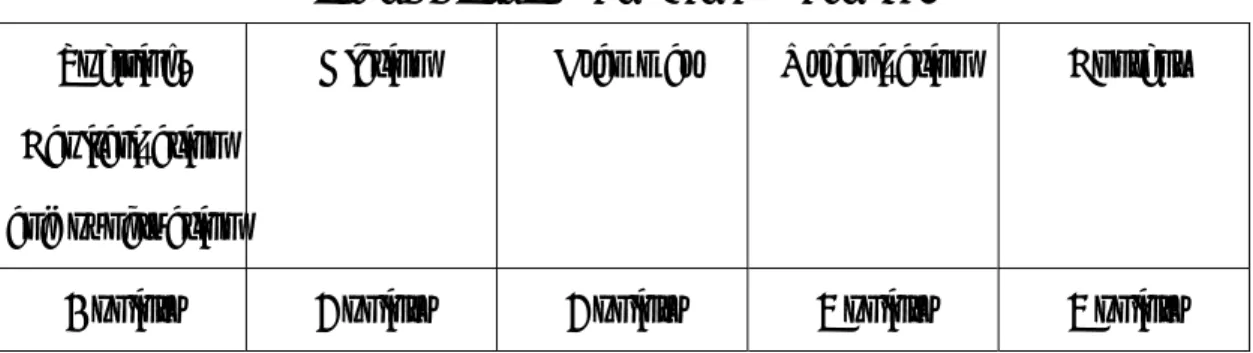
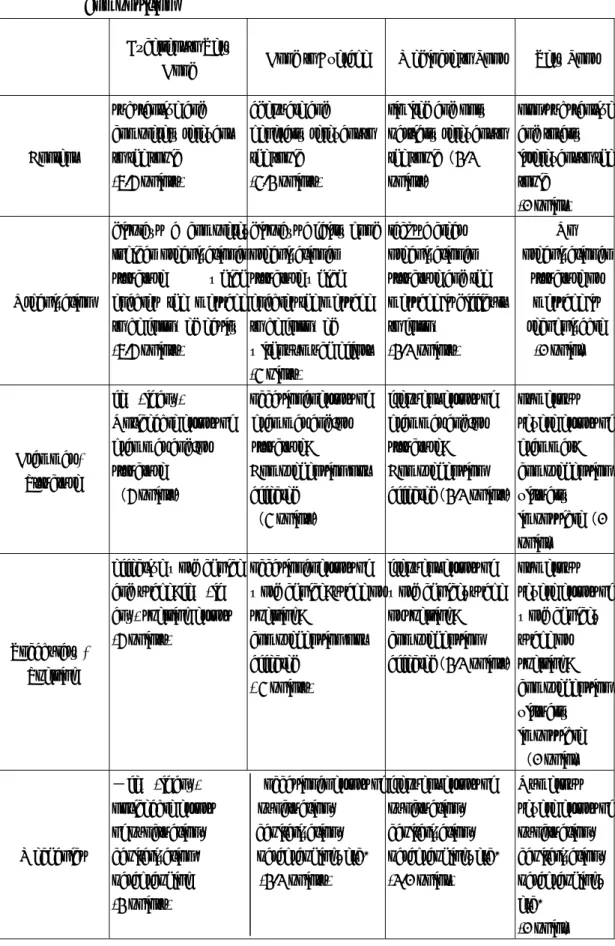
The most outstanding feature of the 1986 test was that the scoring criterion was for the first time explicitly given as part of the rubric and was adopted in the following years until its modification in 1993. This scoring criterion provided markers with general guidelines in scoring testees’ compositions, which helped to maintain consistent scoring standards and to ensure greater inter-grader (see Appendix I).
Table 2.2 The Scoring Criterion since 1993 Spelling,
Capitalization and punctuation
Diction Grammar Organization Content
2 points 4 points 4 points 5 points 5 points
Table 2.3 The Scoring Criterion in 2000: scoring guide for marking testee’s composition
Excellent to Very
Good Good to Average Mediocre to Poor Very Poor
Content
substantive and completely relevant to the topic
(5-4 points)
adequate and generally relevant to the topic
(3-2 points)
limited and only partially relevant to the topic(2-1 points)
non-substantive and totally irrelevant to the topic
(0 point)
Organization
displays a complete, logical organizational structure which enables the message to be followed easily (5-4 points)
displays a fairly good organizational structure which enables the message to be followed without much effort (3 pints)
lacks a clear organizational structure and the message is difficult to follow
(2-1 points)
No organizational
structure or message is recognizable
(0 point)
Grammar &
Structure
few (if any) Noticeable errors of grammar and/or structure
(4 points)
occasional errors of grammar and/or structure;
Comprehension not affected
(3 points)
frequent errors of grammar and/or structure;
Comprehension affected(2-1 points)
numerous severe errors of grammar;
comprehension virtually impossible(0 point)
Vocabulary &
Spelling
effective word choice and usage; few (if any) spelling errors (4 points)
occasional errors of word choice; usage or spelling;
comprehension not affected
( 3 points)
frequent errors of word choice, usage or spelling;
comprehension affected(2-1 points)
numerous severe errors of word choice, usage or spelling;
comprehension virtually impossible
(0 point)
Mechanics
-few (if any) occasional errors of noticeable errors punctuation, of punctuation, capitalization, capitalization. paragraphing, etc.
paragraphing (2-1 points) (2 points)
frequent errors of punctuation, capitalization, paragraphing, etc.
(1-0 point)
Numerous severe errors of punctuation, capitalization, paragraphing, etc.
(0 point)
Scoring Criterion
Excellent to Very Good
19-20 points
Good to Average
15-18 points Average 10-14 points
Mediocre to Poor
5-9 points
Very Poor
0-4 points
2.5.2 GEPT Intermediate Writing Proficiency Test of LTTC
The GEPT Intermediate writing test has two parts, Chinese-English Translation and Guided Writing. For each part, a separate rating scale is employed, consisting of bands numbered from 0 (lowest) to 5 (highest). An examinee’s Translation and Guided Writing are scored separately, and the two band scores are converted to one composite percentile score in which translation is given a weight of 40 % and Guided writing, 60%. To pass the writing test, an examinee must achieve a composite score 80 or above.
In the present study, the researcher adopted the score criterion form (GEPT) because LTTC train senior high schools as graders and the Cronbach Alpha inter-grader reliability on GEPT is over 0.9, whereas SAET do not accept senior high school teachers as grader and the Cronbach Alpha inter-grader reliability on GEPT have not been tested. The Scoring guide for marking candidates’ essays on guided writing is listed on Table 2.4
Table 2.4 Scoring Guide of the GEPT Intermediate English Writing Proficiency Test
Level Standard 5
Communicates meaning completely and effectively; qualified intelligibility in certainspecial purpose areas. Can generally be understood without any difficulty.