Soochow University
Global Business Program, School of Business Thesis
When Masstige Brand Meets Designers Brand: Better Impact?
Student:Yang Ning
Advisor::Dr. Ku, Hsuan-Hsuan January 2016
When Masstige Brand Meets Designers Brand: Better Impact?
A Thesis Submitted to Soochow University
in partial Fulfillment of the Requirements for the Degree of
Master of Business Administration
In
Global Business Program
By
Yang Ning
Global Business Program, School of Business, Soochow University
January, 2016
i
Abstract
The idea behind this research is that nowadays co-branding is a common way to increase sales of a product but we also want to obtain the results if it was brand collaborating with designers. In order to analyze we target three masstige brand clerks as our interviewee which can be seen as a good way to collect basic level customer response. Further on the research will also analyze the marketing strategy companies use to promote the collaboration event. In order to obtain a more accurate result the interview will include five questions in different dimensions.
The results based on the customer response in the interview showed that collaborating with a designer will mainly have positive effects for selling the product.
Key Words: co-branding, masstige, brands, customer’s response.
ii
Acknowledge
I would love to give my heartfelt thanks to my Advisor Dr Hsuan Hsuan Ku (顧萱萱) and the committee members Dr Yang-Chu Lin(林陽助) and Dr Huei-Fang Chen(陳惠芳) for the continuous guidance and support. This would not have been completed without Dr Hsuan Hsuan Ku’s advice, constructive criticism and time in reviewing my thesis.
I would also thank the three interviewees and their cooperation, without them this research would not have been possible.
Lastly I extend my thanks to my family and friends who gave me constant support and motivation during my years at Soochow University.
i
Table of Content
Abstract ... i
Acknowledge ... ii
Table of Content ... i
List of Tables ... iii
List of Figures ... iv
Chapter 1 Introduction ... 1
1.1 Research Background and Motivation ... 1
1.2 Research Objective and Purpose ... 5
Chapter 2 Literature Review ... 7
2.1 Masstige brands ... 7
2.2 Fast fashion brands ... 11
2.3 Designer brands ... 13
2.4 Co-branding ... 15
Chapter 3 Research design and methodology ... 18
3.1 Research Introduction ... 18
3.2 Research Design... 20
Chapter 4 Results and Findings ... 22
4.1 The collaboration’s effect ... 22
4.2 Marketing strategy analysis ... 25
Chapter 5 Conclusion and Discussion ... 27
ii
5.1 Research and Marketing Implications ... 27 5.2 Limitations and Future Recommendations ... 29 Reference ... 31
iii
List of Tables
Table 1 Top collaborations ... 1 Table 2 Interview result... 24 Table 3 Interview result... 26
iv
List of Figures
Figure 1 Research Framework ... 19
1
Chapter 1 Introduction
1.1 Research Background and Motivation
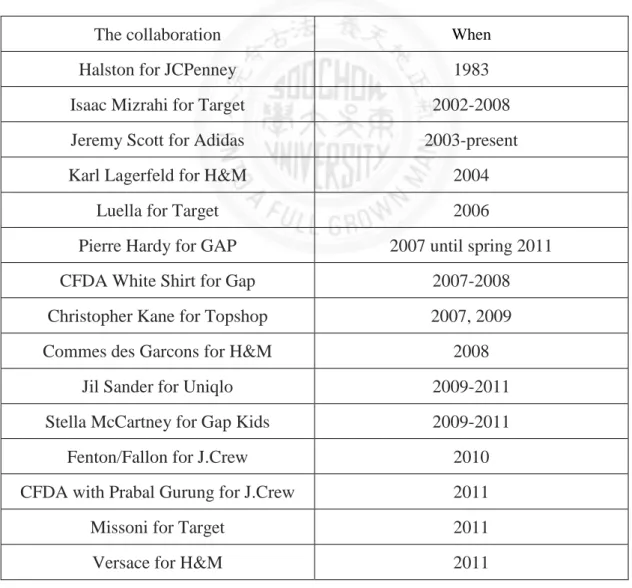
Designer-brand Collaborations have been a big success and publicity magnet since a decade ago. First we will show a table of 15 past examples of famous designer collaborations that made a huge impact to the market according to Fashionista: The Top designer collaborations (Leah Chernikoff 2012):
Table 1 Top collaborations
The collaboration When
Halston for JCPenney 1983
Isaac Mizrahi for Target 2002-2008
Jeremy Scott for Adidas 2003-present
Karl Lagerfeld for H&M 2004
Luella for Target 2006
Pierre Hardy for GAP 2007 until spring 2011
CFDA White Shirt for Gap 2007-2008
Christopher Kane for Topshop 2007, 2009
Commes des Garcons for H&M 2008
Jil Sander for Uniqlo 2009-2011
Stella McCartney for Gap Kids 2009-2011
Fenton/Fallon for J.Crew 2010
CFDA with Prabal Gurung for J.Crew 2011
Missoni for Target 2011
Versace for H&M 2011
2
Jil Sander collaborated with Japanese retailer Uniqlo starting in 2009 on a line simply called +J. Fashion lovers went absolutely bonkers for the line, especially its outerwear.
+J shuttered in 2011, leaving many of us to wonder where our winter coats will come from. On the other hand Versace for H&M was the most-hyped, most anticipated, and most debated H&M collaboration ever. Staying true to Versace's glam party-girl roots, Donatella threw one hell of a soiree before the line launched, featuring Nicki Minaj and most of the fashion people who live in New York City. Fans were rabid to get their hands on Donatella's offerings, camping on the sidewalk two days before the launch and crashing the website multiple times.
There were also examples of designer’s negative response of collaborating with
fast fashion brands: Though clearly ahead of his time as far as business models go, disco designer Halston got in on the mainstream collaboration thing about thirty years too early. After launching the affordable Halston III line at the way-affordable JCPenney, more exclusive stores like Bergdorf Goodman got snobby and stopped selling his higher priced line. At a New York Times Talk in 2009, Marc Jacobs revealed that his hesitancy towards doing collaborations is based on Halston's career. Another case is Karl Lagerfeld for H&M, Before he directed ice cream commercials and had his likeness emblazoned on soda cans, Karl Lagerfeld made a 30-piece collection (including a fragrance called "Liquid Karl...") for H&M--the Swedish mega-retailer's first high-end collaboration ever. Despite the success of his collaboration (which sold out in just hours), Lagerfeld told German magazine Stern (via Vogue UK) that he would never again work
3
with H&M, accusing the high street giant of "snobbery" and producing his designs in larger sizes than he had envisioned.
These kind of phenomenon transformed the fashion industry and the high-end market proving that fast-fashion retailers could accomplish to offer high quality and design to an affordable price. Becoming more acceptable throughout the years attracting celebrities, new customers and various designers the trend may now be facing its peak and is a constant element in the cheap brand branding and design strategy. The collections, as well as the designers chosen, have had a broad variety. It is from now on a bigger challenge surprising and attracting the customer since designer strategy has to continue to trigger them to come back for more.
I couldn’t find any after searching for past thesis about the collaboration between designer and brands (research gap), so I decided to search for thesis about co-branding and discuss what they focus on. Here are some examples:
The Research of Co-branding Strategy (Zhang 2006) the thesis is mainly about how to put co-branding into its own strategy, choose the suitable co-branding pattern, grasp the correct operation strategies in a co-branding course and control the venture of co-branding.
Brand portfolio strategy in the wood products industry: Consideration of brand associations in a co-branding environment (Elizabeth 2008) The research presented in this dissertation focuses on two specific areas of branding in the forest products industry.
4
The first part of this dissertation centers on corporate (producer) and product co-branding. The subsequent part of this dissertation examines another type of co-branding, i.e., the use of specific product characteristics applied as co-brands. The wood product characteristics used as co-brands are: product structure (i.e. solid or engineered), species identification, country of origin identification, and certification status. The product brand associations measured as part of this research are quality, technology, and environmental stewardship.
Co-branding strategy for imported children's programming in the United States market (Youn 2005) study confirms that "branding" appears to be a critical consideration in the development of marketing strategies for children's programming;
"co-branding" potentially links multiple international organizations into profitable ventures. The purpose of this study is to contribute to the development and business of children's programming, particularly focusing on informing creators and marketers of the most advantageous practice for the U.S. and global markets.
After reviewing the above co-branding thesis, I had the passion to do a research similar to The Research of Co-branding Strategy (Zhang 2006) also focusing on strategy and response but in a different dimension, it will be targeted on collaborations between designer and brand but not the brand-brand, as I said there is not much thesis related to the designer-brand relationship topic.
5
1.2 Research Objective and Purpose
This research will first describe the definition of masstige brand, fast fashion brand, designer brand and co-branding. Further on, it will discuss successful brands experiences and place an interview with three masstige brand company workers about the marketing plan and customer response and questions of how the collaborations might have continuously affected the market and the reasons why these kind of collaboration make good results, Based on the interview and customer response, a strategy advice plan is set up with crucial matters should be considered when adopting the strategy in the future. To conclude, possible effects will be analyzed.
The purpose of this study has been to research the past and future development within masstige fashion brands and designer collaborations, Co-branding has become a common strategy within the fashion industry but does the collaboration always make positive effects?
The purpose of this study are illustrated as follows:
1. Does the collaboration always make positive effects? (brand’s point of view and designer’s point of view)
This question will be concluded in two dimensions, the designer’s view and the brand’s view, and we will also divide the response into two areas, sales and brand image,
6
according to the customer’s response we will analyze the possible effect the collaboration will make to the designer and the brand.
2. Marketing strategy analysis
According to past examples, we believe that a successful collaboration does not rely solely on the designer, marketing strategy is another key factor which we want to discuss. We focus mainly on the marketing plan companies adopt and the correspondence with the target market, and throughout the customer response we can make a further improvement to the strategy plan.
7
Chapter 2 Literature Review
In this chapter, we will describe the three brand types on a literature base, and then the explanation of co-branding and the discussion of successful examples. After reviewing these literatures we will have a framework about how to set the research design.
2.1 Masstige brands
The emergence of this new type of brand resolved the traditional dichotomy between luxury and non-luxury brands. The term "masstige brands’" easily conveys their basic idea: offering prestige to the masses (some authors also use "new luxury" or
"mass luxury" (Kapferer and Bastien 2009). Typical masstige brands include Coach, Godiva, Starbucks and Victoria`s Secret (Silverstein and Fiske 2003). Although these brands are not luxury brands, they still rate higher than middle-market brands on the major dimensions of luxury products. Masstige brands concentrate especially on creating symbolic benefits and prestige; they care very much about shine and therefore also about design. Zara exemplifies the idea of selling taste and style to the masses, which is accomplished by imitating the design of luxury brands for their clothing, stores and advertising. However, they are forced to cut back on the other major characteristics.
A mass-prestige-business in the mass/middle-class market reduces the level of rarity and can only be achieved with reasonable prices, which, in turn, requires a compromise on quality, extraordinariness and aesthetics (see also Keller 2009). The study carried out by
8
Truong et al. (2009) demonstrates that masstige brands successfully differentiate themselves from middle-range brands by their prestige and from luxury brands mainly by their reasonable pricing. The authors found out that products from luxury fashion brands are about three times more expensive than masstige products, which, in turn, are about twice as expensive as middle-range products. While there is only a relatively small difference in prestige between luxury and masstige brands, the latter were indeed perceived as being much more prestigious than middle-range brands.
The masstige strategy is also applied by many luxury brands. They are trading-down by extending their product range with masstige products that are more accessible to middle-class consumers (Kapferer and Bastien 2009; Truong et al. 2009).
This kind of price differentiation marks one of the major growth strategies for luxury brands. The challenge that comes with this strategy is one of preserving an image of exclusivity (Keller 2009). This problem has been solved by Ferrari with line extensions in product categories that do not compete with the brand’s core identity: while Ferrari cars remain very expensive and exclusive, the value of the brand is exploited by offering products in categories as diverse as apparel to computers (Berthon et al. 2009).
Both the trading-up strategy of masstige brands and the trading-down strategy of luxury brands make luxury-like products accessible for middle-class consumers. This development is referred to as the "democratization of luxury". According to the economic relativity of luxury, democratic luxury products are characterized by Kapferer
9
and Bastien (2009) as ordinary items for extraordinary people, which are at the same time extraordinary items for ordinary people.
Masstige is a marketing term meaning downward brand extension. The word is a portmanteau of the words mass and prestige and has been described as "prestige for the masses."
The term was popularized by Michael Silverstein and Neil Fiske in their book Trading Up and Harvard Business Review article "Luxury for the Masses." Masstige
products are defined as "premium but attainable," and there are two key tenets: They are considered luxury or premium products and They have price points that fill the gap between mid-market and super premium. Silverstein and Fiske cite several examples:
Bath & Body Lotion that sells for $1.13 per ounce versus $0.30 per ounce. Pottery Barn housewares that are considered premium but are widely available at attainable price points well below super premium brands. Kendall-Jackson Wines that entered the market at $5 per bottle versus the standard $2 per bottle.
Changes in contemporary consumer behavior in societies have led to the emergence of a new meaning and perception of luxury. 'New luxury' has been defined as 'products and services that possess greater level of taste, quality and aspiration than other things in the category, but are not so exclusive as to be out of reach'. Within a broader context, observers have pointed to the trend of middle-market consumers trading up for products that meet their aspiration needs, referred to as the 'luxurification of society'.
10
Masstige is a marketing cliche coined in the U.S. by Boston Consulting Group executives, referring to mass prestige associated with ownership of certain brand name products. It is a marketing trend in which products offer consumers some of the prestige that comes with brand-name luxury goods, but at a fraction of the cost.
11
2.2 Fast fashion brands
Fast fashion is a contemporary term used by fashion retailers to express that designs that move from catwalk quickly in order to capture current fashion trends (Hines, Tony, and Bruce. 2001). Fast fashion clothing collections are based on the most recent fashion trends presented at Fashion Week in both the spring and the autumn of every year. Emphasis is on optimizing certain aspects of the supply chain in order for these trends to be designed and manufactured quickly and inexpensively to allow the mainstream consumer to buy current clothing styles at a lower price. This philosophy of quick manufacturing at an affordable price is used in large retailers such as H&M, Zara, Peacocks, GAP, and Topshop. It particularly came to the fore during the vogue for
"boho chic" in the mid-2000s.
This has developed from a product-driven concept based on a manufacturing model referred to as "quick response" developed in the U.S. in the 1980s (Lowson, King, and Hunter. 1999) and moved to a market-based model of "fast fashion" in the late 1990s and first part of the 21st century. Zara has been at the forefront of this fashion retail revolution and their brand has almost become synonymous with the term, but there were other retailers who worked with the concept before the label was applied, such as Benetton (Hines 2001). Fast fashion has also become associated with disposable fashion because it has delivered designer product to a mass market at relatively low prices (Hines 2007). The slow fashion movement has arisen in opposition to fast fashion, blaming it for pollution (both in the production of clothes and in the decay of synthetic
12
fabrics), shoddy workmanship, and emphasizing very brief trends over classic style (Cline, Elizabeth 2012). Fast fashion has also come under criticism for contributing to poor working conditions in developing countries (Ian. Taplin 2014).
13
2.3 Designer brands
The term designer brands refers to clothing, luxury automobile manufacturers and other personal accessory items sold under an often prestigious marque which is commonly named after a designer, founder or location where the company was founded (Shukla 2010) such as BMW. The term is most often applied to luxury goods. While members of the upper middle class, or the mass affluent, are perhaps the most commonly targeted customers of these designer labels, some marquees—such as Cartier, Rolex, Montblanc and the haute couture — tend to a wealthier customer base. But almost every designer brand has merchandise that middle-class wouldn't normally be able to afford such as exotic skins, furs and hides, limited edition pieces, or things simply priced higher. Designer Label companies use their smaller and cheaper merchandise, aimed at the middle class, such as wallets, fashion jewellery, key-rings and small accessories, to make the majority of their income, whilst the more expensive pieces such as haute couture, high jewellery, hand-bags, shoes and even furnishings are usually reserved for the wealthier upper-class clientele.
Many department stores themselves may be considered designer labels, such as Neiman Marcus, Harrods, David Jones and Daimaru.
Designer labels are not only restricted to the fashion design industry. Many car and motorcycle companies such as Rolls Royce, Harley Davidson and Mercedes Benz are regarded as designer labels. These companies make their vehicles to a higher
14
standard than the average manufacturers and many other attributes such leather used in the upholstery, woodwork and paneling, high levels of technology, extra safety and speed are employed to make for a better product. These vehicles are also in high demand all over the world, and waiting lists may be applied to some models such as the Rolls Royce Phantom and the Bugatti Veyron. Many people consider designer labels to be a status symbol.The relationship between consumer products and social status is highly debated (Ehrenreich, Barbara 1989).
15
2.4 Co-branding
Co-branding refers to several different marketing arrangements:
Co-branding, also called brand partnership, is when two companies form an alliance to work together, creating marketing synergy. As described in Co-Branding:
The Science of Alliance (Blackett, Boad, 1999):
"the term 'co-branding' is relatively new to the business vocabulary and is used to encompass a wide range of marketing activities involving the use of two (and sometimes more) brands. Thus co-branding could be considered to include sponsorships, where Marlboro lends it name to Ferrari or accountants Ernst and Young support the Monet exhibition.
Co-branding is an arrangement that associates a single product or service with more than one brand name, or otherwise associates a product with someone other than the principal producer. The typical co-branding agreement involves two or more companies acting in cooperation to associate any of various logos, color schemes, or brand identifiers to a specific product that is contractually designed for this purpose. The object for this is to combine the strength of two brands, in order to increase the premium consumers are willing to pay, make the product or service more resistant to copying by private label manufacturers, or to combine the different perceived properties associated with these brands with a single product.
16
According to Chang, from the Journal of American Academy of Business, Cambridge, there are three levels of co-branding: market share, brand extension, and global branding. Level 1 includes joining with another company to penetrate the market, Level 2 is working to extend the brand based on the company's current market share, Level 3 tries to achieve a global strategy by combining the two brands.
There are many different sub-sections of co-branding. Companies can work with other companies to combine resources and leverage individual core competencies, or they can use current resources within one company to promote multiple products at once.
The forms of co-branding include: ingredient co-branding, same-company co-branding, national to local co-branding, joint venture co-branding, and multiple sponsor co-branding (Chang. 2009). No matter which form a company chooses to use, the purpose is to respond to the changing marketplace, build one’s own core competencies, and work to increase product revenues.
Ingredient co-branding involves creating brand equity for materials, components or parts that are contained within other products (Wei, Liyuan. 2006). Examples are like Betty Crocker’s brownie mix includes Hershey’s chocolate syrup, Pillsbury Brownies with Nestle Chocolate, Dell Computers with Intel Processors, Kellogg Pop-tarts with Smucker’s fruit.
Same company co-branding is when a company with more than one product promotes their own brands together simultaneously like Kraft Lunchables and Oscar Mayer meats (Chang. 2009).
17
National to local co-branding occurs when a local small business teams up with a national brand or network to target local audiences and interests (Chang. 2009). For example Visa co-branding credit cards with local retailers and Auto manufacturers with local dealerships.
Joint venture co-branding is another form of co-branding defined as two or more companies going for a strategic alliance to present a product to the target audience (Chang. 2009). For Example: British Airways and Citibank formed a partnership offering a credit card where the card owner will automatically become a member of the British Airways Executive club. Finally, there is multiple sponsor co-branding. This form of co-branding involves two or more companies working together to form a strategic alliance in technology, promotions, sales, etc. For example, Citibank/American Airlines/Visa credit card partnership.
18
Chapter 3 Research design and methodology
3.1 Research Introduction
We wonder why some of the cooperation between brands and designers can smash such significant impact while it seems like some of them are not able to.
We assume that different results is because of different strategies companies use to cooperate with designers, including the designer selection, target market they aim for, What kind of marketing plan they use to promote the product-designer cooperation event, and the results will be reflected on the amount of sales and the customer’s response to this designer-product cooperation event, so we set up an interview with five questions, four questions aiming for marketing strategy and another customer response question to help us analyze the product-designer cooperation event feedback.
The Figure below indicates that the influence of the three Marketing strategies (Target market, Marketing plan and Designer selection) will be reflected on the Customer’s response and the Effectiveness of limited products, which means by the feedback of Customer’s response and the Effectiveness of limited products, we will have a further understanding of how to adjust the marketing strategies to make better results.
19 Research design questions
Figure 1 Research Framework
Target market Marketing plan Designer selection
Customer’s response
Effectiveness of limited products
20
3.2 Research Design
In this study we will set up an interview with masstige brand co-workers (Uniqlo PT, 8 months of service)( H&M PT, 1.5years of service)and (GAP PT, 1.2 years of service)(PT: Part time)about the designer collaboration(Uniqlo with Ines)(GAP with the GQ team)(H&M with Balmain)with five main questions: target customers(marketing strategy), marketing plan(marketing strategy),designer selection(marketing strategy), customer’s response(overall feedback) and the effectiveness of limited products(marketing strategy),the reason why we choose part time co-workers is because the majority clerks in these stores which we can contact are part time workers, they represent the clerks that face the customers most of the time. The reason of choosing these three brands is because they are three well known and popular masstige brands in Taiwan. The research aim to find out the possible effects that might happen to the designer and the masstige brands using the information we acquire in the interview, we will also discuss what kind of marketing strategy can make remarkable results.
The interview design will include the following questions:
1. What is the Target market the designer cooperation aim for? And why do you think this kind of customer section will fit?
2. What kind of marketing plan did you use to promote the products cooperation with the designer?
21
3. What is the customer’s response to this designer-product cooperation event? Did the customers maintain the same as the target market?
4. Do you think collaborating with famous (well known in the industry) designers will make better sales revenue than normal designers?
5. Do you think customers tend to have more purchasing desire on limited products?
22
Chapter 4 Results and Findings
4.1 The collaboration’s effect
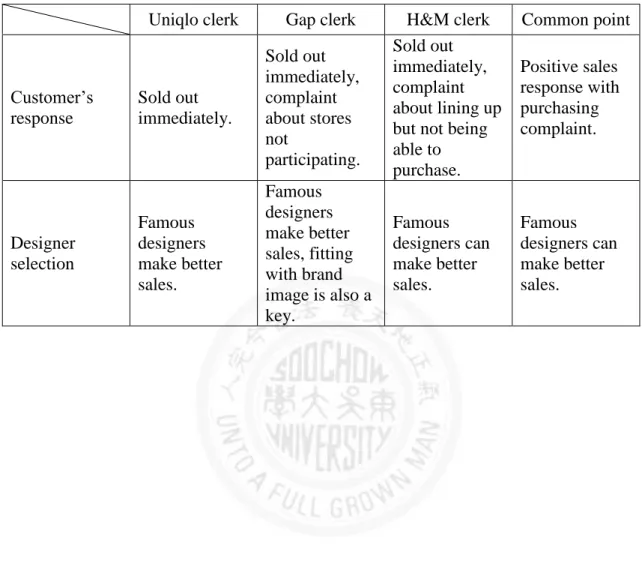
According to the interview’s answer for question no.3 (What is the customer’s response to this designer-product cooperation event?), Uniqlo clerk mentioned that: The customer’s response was crazy, they were fighting for ines product like people who don’t have clothes. Yes the main target market maintained the same but there were also a lot of customers aged above our target range who came because of the price. Gap clerk mentioned that: The products were sold out immediately and there was also a lot of complaint from branch stores in other areas of Taiwan for not participating in selling the collaboration product, and yes the target market remained the same. H&M clerk mentioned that: The target market was basically the same but we didn't limit the amount of people that could line up and it ended up that the stock was not enough and only 10%
of the people in the line would be able to buy them, so we received several complaint about not making the rules clear and wasting customers time, I think that this will lower the brand image. Despite the fact that H&M clerk indicated that there were some complaints about not being able to buy the product because of the product limitation, but all three brand clerks showed that the collaboration product was sold out in a short period of time which means the effect of collaborating with a designer is positive, this is also proved by the answers for question no.4 (Do you think collaborating with famous designers will make better sales revenue than normal designers?) Uniqlo clerk: With the experience of ines collaboration and the response, Yes. I think that collaborating with a
23
well-known and popular designer will definitely make better revenue because you can draw more customer attention. Gap clerk: Gap collaborated with GQ designers for four times, and I think that famous designers is definitely one key factor to impact good customer response but fitting with the image of the brand and how they promote the event also plays an important role, I don’t think the GQ designers will have an advantage collaborating with sports brand like Nike compared to pro-athletes. H&M clerk: Yes, collaborating with famous designers is like collaboration with famous brands, if you collaborate with a designer that is popular and well known in the target market group it will definitely create better chances, actually I don't think the collaboration products look really good this time but the response was still good, I feel like customers nowadays care about the brand more than the real thing, I also think collaborating with fast fashion brands will lower the image of a designer if the products weren’t as good as it should be.
All three answers for question no.4 proved that the clerks think collaborating with a suitable designers can create better chances and have a positive effect for selling the product.
24
Table 2 Interview result
Uniqlo clerk Gap clerk H&M clerk Common point
Customer’s response
Sold out immediately.
Sold out immediately, complaint about stores not
participating.
Sold out immediately, complaint about lining up but not being able to purchase.
Positive sales response with purchasing complaint.
Designer selection
Famous designers make better sales.
Famous designers make better sales, fitting with brand image is also a key.
Famous designers can make better sales.
Famous designers can make better sales.
25
4.2 Marketing strategy analysis
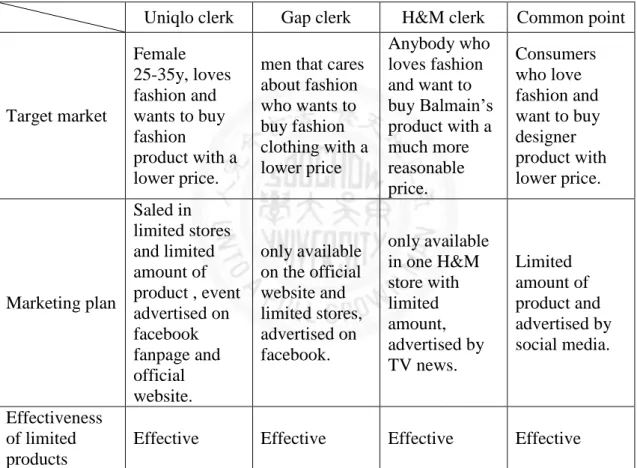
According to the results of question no.1 (target market) Uniqlo clerk: Female around 25-35years old that are interested in fashion, because this range of age tends to buy fashion designed products with an affordable price, and the ines collaboration products are much more cheaper than the standard ines designed product. Gap clerk: The designer crew this time are all men so the target market is also on men that loves and cares about fashion, which also wants to buy fashion clothing with an affordable price.
H&M clerk: Anybody who loves fashion and loves Balmain’s design, who wants to buy Balmain’s product with a much more reasonable price. We can see that the target market is basically the same, people who care about fashion and want to buy designer level products with a lower price, making the customers feel like they are buying an expensive designer brand product with a low price is the key to attract massive buyers, the actual quality, in comparison, becomes less important.
According to the result of question no.2 (the marketing plan) Uniqlo clerk mentioned that: Saled in limited stores and limited amount of product available is the main way we promote the event, we also advertise the event on facebook fanpage and our official website . Gap clerk mentioned that: products are only available on the official website and limited stores , we also use facebook fanpage to let more customers notice this event. H&M clerk mentioned that: Products were only available in one H&M store with limited amount, so customers who were interested had to line up early, we also had several TV news report a month before the event started to draw everybody’s
26
attention. The answers showed that the main way brands use to promote the event is by social media and news, and another effective marketing strategy is to limit the product amount to increase the product rareness and decrease the consumer’s thinking time before buying, and in question no.5 it showed that limit products is proved as an effective way to represent the product.
Table 3 Interview result
Uniqlo clerk Gap clerk H&M clerk Common point
Target market
Female 25-35y, loves fashion and wants to buy fashion
product with a lower price.
men that cares about fashion who wants to buy fashion clothing with a lower price
Anybody who loves fashion and want to buy Balmain’s product with a much more reasonable price.
Consumers who love fashion and want to buy designer product with lower price.
Marketing plan
Saled in limited stores and limited amount of product , event advertised on facebook fanpage and official website.
only available on the official website and limited stores, advertised on facebook.
only available in one H&M store with limited amount, advertised by TV news.
Limited amount of product and advertised by social media.
Effectiveness of limited products
Effective Effective Effective Effective
27
Chapter 5 Conclusion and Discussion
5.1 Research and Marketing Implications
This research shows that collaborating with designers can overall make positive effect to product sales, the image of the designer also has to fit the brand so they can collaborate gracefully, famous and popular is also a key, because the more customer attention you draw the better chances. Companies nowadays tend to make the customer feel like they are buying luxury designer brand products with a normal price and use limited product as there prior marketing strategy to promote, it is an efficient way and the cost is also low. On the other hand it might have negative effects on the brand and designer’s brand image if the message to consumer and product quality is not properly controlled, but we sort these kind of negative effect as company’s strategy problems, so the overall rating of collaboration with designer is a plus, but brands and designers still have to carefully find a balance in between.
In the past we can find a lot of thesis about co-branding but the different part we researched is the effect of brands collaboration with designers but not the stereo type brand-brand relationship, the collaboration type is different so it might face different types of difficulties and choices throughout the program and it shows that collaboration between designer and brands needs a well-planned marketing strategy to burst its efficiency to the highest. Another important contribution of this research is that it makes
28
us rethink that what next we can collaborate with to make better effect because nowadays collaboration are not limited in only the brand-brand area.
29
5.2 Limitations and Future Recommendations
This research was done solely on basic level employees; therefore the response of this research is limited to a smaller point of view, we might not be able to get the actual sales number due to the limits of the interviewee, only one sort of dimension is used in this research to analyze the collaboration event, and we get our information mainly based on the customer’s response the clerks provide us, which also limited the width of this research. After the whole interview, I totally realized that Setting up the questions is another point I have to improve, some of the answers provided by the three clerks were too similar which limited the answer’s diversity, an interview with a larger question base in different dimensions will solve this problem, and questions with more subtitles can make us dig the answers deeper.
Therefore for future recommendation, interviews on manager level employees and another interview about customers thoughts would widen the response diversity, if able, shopping at the store when the event is going and experience the whole process to gain further knowledge about the event is a recommended way to make us have the inspiration of setting the interview question in a much completed angle.
Another task we want to complete in the future is to conclude with the numbers of sales and cost by getting the information from manager level and use the cost benefit analysis to make further plans for the brand on how to invest the designer
30
collaboration and set up an advice procedure for future companies to consult, this will also make the research more accurate based on numbers.
31
Reference
Berthon, P. et al., 2009. Aesthetics and Ephemerality: Observing and Preserving the Luxury Brand. California Management Review, 52(1), pp.45–66.
Black, Sandy (2013). The Sustainable Fashion Handbook. New York: Thames and Hudson. ISBN 0500290563.
Brand Management Vol. 16, 5/6, 375-582, New luxury brand positioning and the
Breyer, Melissa (September 4, 2014). "10 awesome innovations changing the future of fashion". Treehugger. Narrative Content Group. Retrieved October 24, 2015.
Bruce, Margaret, and Lucy Daly. "Buyer behaviour for fast fashion." Journal of Fashion Marketing and Management 10 (2006): 329-44.
Carr, D. J., Gotlieb, M. R., Lee, N., & Shah, D. V (2012). "Examining overconsumption, competitive consumption, and conscious consumption from 1994 to 2004: Disentangling cohort and period effects". The ANNALS of the American Academy of Political and Social Science.
Casabona, Liza. "Retailer Forever 21 Facing A Slew of Design Lawsuits." WWD:
Women's Wear Daily 194.15 (23 July 2007): 12-12. Textile Technology Index. EBSCO.
Mary Couts Burnett Library, Fort Worth, Texas. 13 Nov. 2008
Cline, Elizabeth (18 July, 2014). "Where Does Discarded Clothing Go?". The Atlantic.
The Atlantic Monthly Group. Retrieved October 24, 2015.
Cline, Elizabeth L. (2012) Overdressed: The Shockingly High Cost of Cheap Fashion.
Penguin Group. New York.
32
Competing for Customers and Capital. Southwest Airlines: Put a Little LUV in Your Logo!. customersandcapital.com.
Council for Textile Recycling. www.weardonaterecycle.org. Retrieved 2015-11-08.
DSN Retailing Today. 42.15 (Aug. 4, 2003): p22.
DuFault, Amy. "Can 'upcycling' give Haiti's fashion industry a boost?". the Guardian.
Retrieved 2015-11-08.
Ehrenreich, Barbara (1989). Fear of Falling, The Inner Life of the Middle Class. New York, NY: Harper Collins. ISBN 0-06-097333-1.
Emergence of Masstige brands, Yann Truong, Rod McColl, Phillipp J. Kitchen, 2008,
Emergence of Masstige Brands. Journal of Brand Management, 16(5-6), pp.375–382.
Fast Fashion and the Environment | Ian Somerhalder Foundation. www.isfoundation.com.
Retrieved 2015-11-08.
Fast Fashion Is the Second Dirtiest Industry in the World, Next to Big Oil » Page 2 of 3.
EcoWatch. Retrieved 2015-11-08.
Gee, Tim. "Fast fashion." Engineer (00137758) 293.7742 (25 Feb. 2008): 16-16.
Business Source Complete. EBSCO. [Mary Couts Burnett Library, Fort Worth, Texas.
13 Nov. 2008
Gwilt, A., & Rissanen, T. (2011). Shaping sustainable fashion: Changing the way we make and use clothes. Washington DC, London: Earthcan. p. 143.
Hines, T. 2001. "From analogue to digital supply chains: Implications for fashion marketing " In Fashion marketing: Contemporary issues. Eds. T. Hines and M. Bruce.
Oxford: Butterworth Heinemann, 26-47
33
Hines, T. 2001. "From analogue to digital supply chains: Implications for fashion marketing " In Fashion marketing: Contemporary issues. Eds. T. Hines and M. Bruce.
Oxford: Butterworth Heinemann, 26-47.
Hines, T. 2004. Supply chain strategies: Customer driven and customer focused. Oxford:
Elsevier.
Hines, T. 2010. "Trends in textile global supply chains." Textiles 37 (2): 18-20.
Hines, T, and M. Bruce. 2001. Fashion marketing - Contemporary issues. Oxford:
Butterworth-Heinemann.
Hines, T. 2001. "Globalization: An introduction to fashion markets and fashion marketing." In Fashion marketing: Contemporary issues. Eds. T. Hines and M. Bruce.
Oxford: Butterworth Heinemann, 1-24.
Hines, T. (2004), Supply Chain Strategies: Customer Driven and Customer Focused, Oxford: Elsevier
Hines, T. (2007) Globalization: Global markets and global supplies, in Hines, T. and M.Bruce. Eds. Fashion Marketing Contemporary Issues 2nd Edn. Oxford, Elsevier
Hines,T. (2007) Supply Chain Strategies, Structures and Relationships, in Hines, T. and M.Bruce. Eds. Fashion Marketing Contemporary Issues 2nd Edn. Oxford, Elsevier
Hunter, A., King, R., and Lowson, B., Alan, Russell, and Bo (1999). Quick Response - Managing the Supply Chain to Meet Consumer Demand. Wiley.
Hunter, .A. 1990. Quick Response in Apparel Manufacturing. Manchester The Textile Institute.
34
Ian M. Taplin,(2014) "Who is to blame?: A re-examination of fast fashion after the 2013 factory disaster in Bangladesh", critical perspectives on international business, Vol. 10 Iss: 1/2, pp.72 - 83 Emerald Group Publishing
Kapferer, Jean-Noel and Bastien, V., 2009. The Specificity of Luxury Management:
Turning Marketing Upside Down. Journal of Brand Management, 16(5/6), pp.311–322.
Keller, K.L., 2009. Managing the Growth Tradeoff: Challenges and Opportunities in Luxury Branding. Journal of Brand Management, 16(4), pp.290–301.
Leah Chernikoff,(June 2012),The Top twenty designer collaborations:A Timeline,Fashionista.
Lowson, B., R. King, and A. Hunter. 1999. Quick Response - Managing the Supply Chain to Meet Consumer Demand. Chichester: Wiley.
Muran, Lisa (2007). Profile of H&M: A Pioneer of Fast Fashion. Fort Woth, Texas:
Textile Outlook International. pp. 11–13.
Paurav Shukla. "What is luxury?". 2010-05-14. Retrieved 2010-08-09.
Pfeifer, Margarida O. "Fast and Furious." Latin Trade (English) 15.9 (Sep. 2007): 14-14.
Business Source Complete. EBSCO. Mary Couts Burnett Library, Fort Worth, Texas. 13 Nov. 2008
Sheridan, Mandy, Christopher Moore, and Karinna Nobbs. "Fast fashion requires fast marketing: The role of category management in fast fashion positioning." Journal of Fashion Marketing and Management 10 (2006): 301-15.
Muran, Lisa. "Profile of H&M: A Pioneer of Fast Fashion." Textile Outlook International (July 2007): 11-36. Textile Technology Index. EBSCO. Mary Couts Burnett Library, Fort Worth, Texas. 13 Nov. 2008
35
"Planned obsolescence". The Economist. ISSN 0013-0613. Retrieved 2015-11-08.
Baker, Rosie. "Following fast fashion." In-Store (June 2008): 37-39. Business Source Complete. EBSCO. Mary Couts Burnett Library, Fort Worth, Texas. 13 Nov. 2008
Silverstein, M.J. & Fiske, N., 2003. Luxury for the Masses. Harvard Business Review, 81(4), pp.48–57.
The McWhopper proposal, a co-branding between Burger King and McDonald’s.
Fameable.
Truong, Y., McColl, R. & Kitchen, P.J., 2009. New Luxury Brand Positioning and the United States. Cong. House. Committee on the Judiciary. 109th Cong., 2nd sess. HR 5055. By Goodlatte, Delahunt, Coble and Wexler. 30 Mar. 2006. 13 Nov. 2008
Tom Blackett, Bob Boad, 1999. Co-Branding: The Science of Alliance, Palgrave Macmillan.
United States. Cong. House. Committee on the Judiciary. 110th Cong., 1st sess. HR 2033. By Delahunt, Goodlatte, Maloney and Bono. 25 Apr. 2007. 13 Nov. 2008
Wei, Liyuan. Essays on ingredient branding. University of Toronto (Canada), ProQuest Dissertations Publishing, 2006
Wei-Lun Chang, “Roadmap of Co-branding Positions and Strategies,” Journal of American Academy of Business, Cambridge (JAABC), Vol. 15, September, pp. 77-84, 2009.
Where Does Discarded Clothing Go? . The Atlantic (in en-US).
https://plus.google.com/109258622984321091629. Retrieved 2015-11-08.
36
Woyke, Elizabeth. "FASHION'S BID TO KNOCK OUT KNOCKOFFS." Business Week (10 Apr. 2006): 16-16. Business Source Complete. EBSCO. Mary Couts Burnett.
13 Nov. 2008
37
Interview with Uniqlo clerk(who participated the ines designer collaboration event) :
1. What is the Target market the designer cooperation aim for? And why do you think this kind of customer section will fit?
A: Female around 25-35years old that are interested in fashion, because this range of age tends to buy fashion designed products with an affordable price, and the ines collaboration products are much more cheaper than the standard ines designed product.
2. What kind of marketing plan did you use to promote the products cooperation with the designer?
A: Saled in limited stores and limited amount of product available is the main way we promote the event, we also advertise the event on facebook fanpage and our official website .
3.What is the customer’s response to this designer-product cooperation event? Did the customers maintain the same as the target market?
A: The customer’s response was crazy, they were fighting for ines product like people who don’t have clothes. Yes the main target market maintained the same but there were also a lot of customers aged above our target range who came because of the price.
4. Do you think collaborating with famous designers will make better sales revenue than normal designers?
38
A: With the experience of ines collaboration and the response, Yes. I think that collaborating with a well-known and popular designer will definitely make better revenue because you can draw more customer attention.
5. Do you think customers tend to have more purchasing desire on limited products?
A: As a shopper myself, yes limited products can definitely create the purchasing desire and most importantly make consumers want to buy the product now because they will think that they might not have the second chance.
39
Interview with GAP clerk (who participated with NSF, STAMPD, The hillside and David Hart designer collaboration):
1. What is the Target market the designer cooperation aim for? And why do you think this kind of customer section will fit?
A: The designer crew this time are all men so the target market is also on men that loves and cares about fashion, which also wants to buy fashion clothing with an affordable price.
2. What kind of marketing plan did you use to promote the products cooperation with the designer?
A: products are only available on the official website and limited stores , we also use facebook fanpage to let more customers notice this event.
3. What is the customer’s response to this designer-product cooperation event? Did the customers maintain the same as the target market?
A: The products were sold out immediately and there was also a lot of complaint from branch stores in other areas of Taiwan for not participating in selling the collaboration product, and yes the target market remained the same.
4. Do you think collaborating with famous designers will make better sales revenue than normal designers?
A: Gap collaborated with GQ designers for four times, and I think that famous designers is definitely one key factor to impact good customer response but fitting with the image
40
of the brand and how they promote the event also plays an important role, I don’t think the GQ designers will have an advantage collaborating with sports brand like Nike compared to pro-athletes.
5. Do you think customers tend to have more purchasing desire on limited products?
A: Definitely, everyone wants to be unique and doesn't want to wear clothes that other people are also wearing.
41
Interview with H&M clerk (who participated with the Balmain designer collaboration event ):
1. What is the Target market the designer cooperation aim for? And why do you think this kind of customer section will fit?
A: Anybody who loves fashion and loves Balmain’s design, who wants to buy Balmain’s product with a much more reasonable price.
2. What kind of marketing plan did you use to promote the products cooperation with the designer?
A: Products were only available in one H&M store with limited amount, so customers who were interested had to line up early, we also had several TV news report a month before the event started to draw everybody’s attention.
3.What is the customer’s response to this designer-product cooperation event? Did the customers maintain the same as the target market?
A: The target market was basically the same but we didn't limit the amount of people that could line up and it ended up that the stock was not enough and only 10% of the people in the line would be able to buy them, so we received several complaint about not making the rules clear and wasting customers time, I think that this will lower the brand image.
4. Do you think collaborating with famous designers will make better sales revenue than normal designers?
42
A: Yes, collaborating with famous designers is like collaboration with famous brands, if you collaborate with a designer that is popular and well known in the target market group it will definitely create better chances, actually I don't think the collaboration products look really good this time but the response was still good, I feel like customers nowadays care about the brand more than the real thing, I also think collaborating with fast fashion brands will lower the image of a designer if the products weren’t as good as it should be.
5. Do you think customers tend to have more purchasing desire on limited products?
A: This is a strategy often used in fashion brand clothing industry because limited product is never a minus.
43
訪談 Uniqlo 店面員工(參與了 Ines 設計師的合作活動)
1. 這次設計師合作活動目標客群是?為何認為這樣的客群符合目標?
A:主要是年紀 25-35 歲對時尚有興趣的女性,因為在這個範圍的女性會想要以較 可負擔的價格購買時尚產品,這次和 Ines 合作的產品也比一般 Ines 的產品價格低 的許多。
2. 本次的設計師合作活動是用哪種行銷計畫來推動的?
A:限定店鋪以及限量銷售是主要的手法,另外活動的廣告是以 Facebook 還有官 方網站來宣傳的。
3.對於這次設計師合作活動顧客回應方面是?目標客群和原定的相符嗎?
A:顧客的回應非常瘋狂,像是沒衣服穿的人一樣把Ines的產品一掃而空。目標客群 和原訂的大致相同不過也有不少年紀比較大的客人因為覺得便宜而來購買。
4.你認為和知名的設計師合作帶來的銷售額會比一般設計師來得高嗎?
A:經過這次和Ines合作的顧客回應,我認為會。和一個受歡迎且知名的設計師合 作推出產品絕對會有更好的銷售因為能吸引更多顧客的關注。
5.你認為消費者對於限量的商品有更大的購買慾望嗎?
A:我本身也喜歡購物,而我也認為限量產品的確能提升消費者的購買慾望而且最 重要的是讓消費者有種現在不把握可能就沒有機會的感覺。
44
訪談 GAP 店面員工(參與了NSF,STAMPD,The hillside, David Hart 設計 師的合作活動)
1. 這次設計師合作活動目標客群是?為何認為這樣的客群符合目標?
A:這次的設計師團隊都是男性,目標客群也鎖定在喜愛時尚並且想要以較低價格 購買時尚服飾的男性。
2. 本次的設計師合作活動是用哪種行銷計畫來推動的?
A:主要為商品限定只有在官方網站還有限定店舖販售,另外也有以社群網頁做宣 傳。
3. 對於這次設計師合作活動顧客回應方面是?目標客群和原定的相符嗎?
A:活動開始後商品迅速售完,也有許多消費者抱怨為何所在地區的GAP店鋪沒 有參與這次活動,另外目標客群和鎖定的也是大致相同。
4. 你認為和知名的設計師合作帶來的銷售額會比一般設計師來得高嗎?
A:GAP和GQ的設計團隊合作了四次,我認為和知名設計師合作絕對是造成顧 客迴響的一個關鍵,不過設計師和品牌的適合度以及如何包裝這個活動也扮演著重 要的角色,舉例來說我不認為NIKE和GQ的設計團隊合作會帶來比和知名運動 員合作更高的效益。
5. 你認為消費者對於限量的商品有更大的購買慾望嗎?
A:當然,大家都希望自己能有獨特的穿著也不希望時常與他人撞衫吧。
45
訪談 H&M 店面員工(參與了 Balmain 設計師的合作活動)
1. 這次設計師合作活動目標客群是?為何認為這樣的客群符合目標?
A:任何喜愛時尚且喜愛 Balmain 設計感,且想要以較低價格購買有設計感產品的 人。
2. 本次的設計師合作活動是用哪種行銷計畫來推動的?
A:商品是限量的且台灣只有一間H&M店鋪有販售,所以有興趣的消費者必須提早 來排隊,除此之外我們在活動的一個月前也在電視新聞上做了不少宣傳。
3. 對於這次設計師合作活動顧客回應方面是?目標客群和原定的相符嗎?
A:目標客群基本上和原訂的相同,不過由於我們沒有限制排隊的人數加上庫存不 足的關係,最終只有 10%排隊隊伍中的人能購買這次商品,所以也收到了許多消費 者關於這次活動庫存消息不夠明確導致消費者希望落空以及浪費消費者時間的抱 怨,這對品牌形象來說是有損害的。
4. 你認為和知名的設計師合作帶來的銷售額會比一般設計師來得高嗎?
A:是的,和知名設計師合作就像是和知名品牌合作一樣,和一個知名且受目標客 群歡迎的設計師合作能製造更多機會,事實上我不認為這次合作活動的商品非常的 完美不過消費者一樣買單,也許是因為價格低且崇尚設計師品牌吧。另外我認為和 平價品牌合作的產品若品質沒有監控好對設計師的形象是會有負面的效果。
5. 你認為消費者對於限量的商品有更大的購買慾望嗎?
46
A:限量是一個最常使用的手段尤其是在服飾業因為限量永遠不會對商品的質感度 上有減分的效果。