Maganda ka ba? From Sex Object to Powerful Women: A Look at Posing in Lad Magazines
Rosalinda N. Erpelo
Submitted in partial fulfillment of the requirements for the degree of Master of Arts
in Cultural Studies
Prof. Allen Chun Supervisor
Institute of Social Research and Cultural Studies Department of Humanities and Social Science
at
National Chiao Tung University
Hsin-chu, Taiwan June 16, 2008
TABLE O F CONTE NTS
Abstract iv Acknowledgment v List of Tables and Figures x Glossary of Filipino Terms x
CHAPTER ONE: LITERATURE REVIEW / 1
1. Introduction / 1
2. Theoretical Perspectives on Gender and Feminist Studies / 7
3. The rise of the 4th State: The Corporate Media and the New Morality— The Power of the Media to Insist and the Power of the Person to Resist / 18
4. Lad Magazines in the Context of Gender, Power and Morality / 22
5. Female ‗Celebrity‘ Model in Men‘s Magazines: A New and Powerful Breed of Worker Within the Sex Industry / 32
6. Celebrity Culture: Cashing on Celebrity Complex / 35 7. Research Methods / 37
CHAPTER TWO: CULTURAL AND POWER DIMENSIONS OF GENDER IN THE CONTEMPORARY PHILIPPINES / 40
1. ‗Si Malakas at Si Maganda‘: A Look at Filipino Indigenous Legend / 40 2. The Gendering Concept of Maganda and Malakas in the Context of Philippine Sex
Trade: Prostitution / 44
3. Influence of the Catholic Church in the Changing Context of Gender and Sex Trade / 47 4. Poverty and Smut Culture: From FHM to Pinoy Playboy Mansion? / 49
CHAPTER THREE: SEXUAL IMAGES AND SELLING SEXUALITY / 51
1. Sexuality in the Media and the Arts (Television and Film): Stereotypes, Sex, and the Decency Issue / 51
2. Graphic Images: Pornography and the Public‘s Response to ‗Selling Sexuality‘/ 52 a. Defining Obscenity / 52
b. The Movement against the Sexualization of the Visual Media / 55 c. Female Celebrity Models in Lad Magazines and Selling Sexuality / 57
CHAPTER FOUR: BEYOND STRUCTURALISM AND EXPLOITATION/CHOICE / 61
1. The Exploitation/Choice Dichotomy / 61 2. The Gendering Power of Sexual Discourse / 67
CHAPTER FIVE: FEMALE CELEBRITY MODEL'S SUBJECTIVE ACCOUNTS OF POWER / 73
1. Female Celebrity Models in Lad Magazines: Strategy and Tactics / 73 a. Female Celebrity Models in Lad Magazines: Conceptualization of power and
positionalities in the sex industry / 75
b. Female Celebrity Models in Lad Magazines: Subjective accounts of power / 82 c. Female Celebrity Models in Lad Magazines: Demands for basic rights and other social and
civil considerations / 91
d. Female Celebrity Models in Lad Magazines: Understanding about feminism and/or access to feminist programs /92
CHAPTER SIX: POLITICS OF SUBJEC TIVE POSITIONALITIES / 93
1. The Maganda/Pangit Construction of Female Celebrity Model‘s Decision-Making Agency / 93
a. External Impediments to Empowerment / 94 1. The Powerful World of Showbiz / 94 a. The Coercive/Adoring Power of the Public / 95
b. The Power of the Network/Producer / 97 c. The Power of the ‗Gossip/Infotainment‘ Press / 98 d. The Power of the Celebrity‘s Manager /Talent Agency / 101
2. Culture in Power / 103
3. International Structures of Political Economy / 109 b. Women's Internal Impediments to Empowerment / 111
CHAPTER SEVEN: CONCLUSION 115
Implications for Further Research / 119
Abstract
Where are women located in the struggle for freedom to express and have control of what can or cannot be said and done in the media? Female sexuality becomes a site for contestation not only on relational levels such as social, moral, religious, economic and political but also on the personal level. This thesis discusses the significance of subjective accounts of power in which female ‗celebrity‘ models in the Philippines exercise decision-making power to pose ‗sexy‘ in lad magazines. The politics of these women's positionalities can be examined in the complexity of competing and hegemonic structural power struggles involving global capital, the Philippine state, the Catholic Church, the media, and the sex industry, as well as in power relationships between, and/or among female celebrity models and their managers, publishers, editors, magazine consuming customers and the general viewing public.
Different perspectives of Filipino feminism explain women's decision-making agency. They generally see power inequality surrounding women in the sex industry as fundamental impediments to the exercise of women's decision-making power. Structuralist feminists argue that women's abilities to exercise choice are absent because of poverty and patriarchy; it is the ‗sexploitative‘ system of the international political economy that forces women to enter the sex trade to serve as commodities for male sexual gratification and financial profits. Structuralist feminists call for elimination of all forms of sex trade, the prostitution business especially, where poor women's choices are reduced to being male sex objects. On the other hand, liberal and neo-liberal feminists argue that women, regardless of their socio-economic background, exercise choice by entering the sex industry, which needs to be recognized as a legitimate form of work performed by workers in the sex industry. Liberal and neo-liberal feminists both endeavor to oppose the abusive and exploitative operations of the sex industry, where women's choices and rights are unrecognized especially those engage in prostitution.
One can regard women in the Philippine sex industry as oppressed or marginalized in the power discourse of sexual morality. Being disempowered at the bottom of the malakas
power structures of the sex industry, such women are „mahina‟, the weak in society. But
this is not the whole story. While I recognize the realities of these women's oppression and exploitation, my focus is not to replicate structuralist accounts of the sex industry in the form of prostitution and pornographic activities, which further victimize the already vulnerable lives of women in the sex trade. Instead, my point of departure poses the question of women's agency in order to look not only at their unequal positionalities in the power dynamics of the sex industry but also the subjectivities constructed through those positionalities, in essence by offering female celebrity models as an example where women can work in the sex industry and still preserve and/or restore the social adequacy of being maganda (‗beautiful‘), disente (decent) and „malakas‟na babae‟ (strong and powerful woman) in the power dynamics of the Philippine sex industry. By transcending the exploitation/choice dualism in a (neo-)liberal prostitution debate, I hope to offer new post-structuralist interpretations of women's decision-making agency that examine the subjectivities of female celebrity models in lad magazines within the Philippine sex industry, which create instead a space for such women to challenge existing rules of conduct yet emerge victorious, by gaining celebrity status that affords them more space and power to exercise their will to attain personal goals they set for themselves. In other words, I argue that there should be some space for women's subjective accounts of power in a feminist theory of the sex industry—not limited exclusively to prostitution and/or pornographic acting and includes all forms of work within the sex industry that do not require actual sex acts—that are not predicated on women "choosing" to enter the sex industry in the face of patriarchy and/or political economy. It is therefore crucial to listen to female celebrity models voices in order to understand the extent to which women's self-disciplining impact on
their decision-making agency within the power dynamics of the Philippine sex industry.
Acknowledgment
When I decided to go to Taiwan and study in National Chiao Tung University Institute of Social Research and Cultural Studies (ISRCS) I never reckon that I will have the hardest but the most rewarding academic journey of my life. My experiences in and outside NCTU afforded me to evaluate my own biases, fears and limitations first as a student, a woman and a person of value. I have learned that voices from within are more powerful than voices from outside of our own. We are only good as what we think. And what we think is what we will become.
Writing this thesis is not just an academic journey for me, it is emotional, spiritual even. Thank you very much if only for these.
I owe so many people for the help and support while I am writing this thesis throughout to its completion.
I am most grateful to my thesis supervisor Prof. Allen Chun (NCTU ISRCS and Academia Sinica) for making impossible things possible for me. I am still totally in awe of him. I must be the most fortunate advisee in the whole NCTU if not the whole world. Even after all things were done and over with I still couldn‘t find the words to express the importance of his intellectual advice and support.
Prof. Allen is methodical and totally obsessed with logic and consistency. My writing style (journalistic and impassioned) is totally anachronistic to his. He is about keeping all my arguments clear-cut and clean but still making room for the possibilities of contending arguments. He is always supportive of my intellectual needs especially for developing my understandings on difficult writings of Foucault, Adorno, Frankfurt School, theories of power, empowerment in gender and development discourse, and the whole business of culture industry.
I am also most grateful to Prof. Hsin-yi Lu (NCTU College of Hakka Studies) and Prof. Teri Silvio (Academia Sinica) who served as my external readers. Their valuable inputs especially during my proposal oral defense redirected some of my arguments and strengthened my theoretical framework. Their comments gave me a great deal of useful textual and empirical information in understanding women positionalities and subjective accounts of power. Their vocal thoughts helped supplement and develop my understanding of culture industry beyond the existing literature.
I made lots of amazing friends both from local and international students. And they were most helpful during the lowest point of my graduate life. It was totally unthinkable, and (unacceptable for me) not to graduate and earned a degree within the specified period prescribed by my program especially so if it was not my own doings, but because the system (in my Institute) does not allow for it to happen—just because it is not the way things are done there--you have to spend at least two years to actually be able to have a proposal oral defense and another year to have a final oral defense for master and longer in PhD. And yet it is normal for graduate and doctoral (Taiwanese) students in my Institute to earn a degree in three or five years or longer respectively. Now, I can understand and relate to some students
writing their frustrations on the walls of our study room in Chinese: “是學生要畢業,不是老
師要畢業再給你們延二年也寫不出來啊!!!”(“It is the students who must graduate and not
the professors who must graduate. Even if they give you an extension of two years still you won‟t be able to write!”--This is the literal translation in English). This is really a sad if
not tragic state of affairs in our Institute. And for a non-Chinese-speaking student like me this extension problem could be avoided if only a formal orientation was conducted before my two-year program begins or a follow-up reminder at least. I could have prepared and made provisions for it not to happen or to make the impact less severe at least. For a Filipino, the psychological impact of not finishing within the prescribed 2-year scholarship program is more serious than the monetary considerations. Back in my country, an extension could only mean one thing: that I failed, or that I am not up to the standard set by the Institute or simply put, I did something wrong and it‘s my fault.
The Institute is supposed to be an international teacher-training and research institution and yet we don‘t feel the love (at least I don‘t)—it doesn‘t matter whether you live or die, if you want to live you have to „survive on your own‟ because the professors there are not in the business of helping the students to succeed but „only to teach‟ (in Chinese— emphasis supplied). In almost all my Chinese-conducted classes (all required subjects) I was made to feel that I am such a nuisance, a bother and yet I was treated as if I was virtually non-existent--they did not even try to discuss in English long enough for me to understand those difficult abstract cultural concepts that even my Taiwanese classmates found too difficult and too complicated to understand even in Chinese, forgetting that if I had a choice not to take them I won‘t. It was worse than wasting time, it was a nightmare—I was treated as if I was a non-entity inside the class! It was a total anomaly, a sham—a farcical cultural studies. But survived I did—by sitting and smiling! But I still cannot get over the shock of learning that my original program—International Graduate Program in Taiwan Studies—is in fact a non-existent program in practice—is just an imposition from the Taiwanese government as part of the on-going internationalization program. In fairness, I must admit without exception, the professors in my Institute are really intellectual giants in their fields. It was really very unfortunate and a shame for me that I was not able to learn more from them only because I do not speak Chinese.
And yet looking back, especially that hellish fourth semester is more like a blessing than a tragedy. And an extension of four months after that seemed nothing compared to meeting and working with the most brilliant of minds and understanding of hearts—Prof. Allen, Prof. Hsin-yi and Prof. Teri. I cannot begin to express my deepest gratitude and appreciation to my adviser for making everything possible for me, considering he was on
official leave of absence and was staying in Singapore at the time of my thesis writing— from the Fall Semester 2007 to Spring Semester 2008. Although our communications were
all done through e-mails, Prof. Allen was with me all the way—from start to finish. I couldn‘t have done any of these without him.
And how can I forget Prof. Hsin-yi? She was instrumental for Prof. Allen to finally agree to take me as his thesis advisee even as late as January 2, 2008. She was the only one who did something all the time I was having troubles (and crying my hearts out) with the whole business of thesis writing and she is not even connected to my Institute. Without Prof. Hsin-yi, I won‘t be able to ask Prof. Allen to be my thesis adviser by myself.
Aside from Prof. Allen Chun, Prof. Hsin-yi Lu and Teri Silvio, I also had the biggest luck and the best opportunity to meet and learn from four brightest minds in the humanities, social sciences and cultural studies in the whole world: the perfect tandem of Prof. Shaw-Herng Huang and Prof. Shu-Chen Chiang (Introduction to Taiwan Studies), Prof. Mei-Lin Pan (Taiwan‘s Economical Development) and Prof. Erik Ringmar (Transgression and the Oriental Sublime). Attending their classes was never more fun and more interesting for me. I was at my happiest, on top of my elements and most productive self whenever I am in their classes. As Prof. Ringmar would say: ―It is transgressive and yet totally sublime. You really rock!
I also would like to express my deepest gratitude to all my NCTU friends and family I made along the way. They made my life in Taiwan more fun, interestingly sweet and memorable:
First, I am most grateful to the International Service Center (ISC) headed by Mr. Hwa-cheng An, Ms. Sue Wang and Lily Chen. They took care of my over-all well-being in Taiwan. Your unqualified kindness and support extended beyond just a performance of duty or just doing your job. I won‘t forget how you took care of me when I had a vehicular accident and had to be confined in a hospital for three days. For such a big baby like me who never stayed in a hospital more than the necessary check-ups or a shot of vaccine much less being in a hospital without any family member, the experience could be more painful if not traumatic for me, but whenever I opened my eyes you were always there making my conditions better. Your constant presence stayed away my tears otherwise I will disrupt the whole hospital with all my crying. I won‘t also forget those field trips in different scenic and historical locations all over Taiwan. They were wonderful because you took time and consideration to plan for it—crazy fun but safe as Mr. An would like it to be.
My special thanks go to Ms. Sue Wang for being such a wonderful person. To me you are the perfect embodiment and fine example of what is good inTaiwan. My stay in Taiwan would never be as sweet if you were not there. I really love you.
Second, thank you to NCTU Foreign Students Association (FSA). For an international student this club along with ISC and Student Ambassador Association (SAA) is the closest you can call home and family away from home.
Third, I am also most grateful to my NCTU Indonesian family—my very supportive brothers Irfan, Bono, Wono, Dedy and Agus, and my beautiful sisters Vilya, Donna, Linda and Amei. I am proud to declare that I am half-Indonesian by ‗friendship‘. With my NCTU Indonesian family I found home. I love you guys.
My special thanks go to my dear friend Irfan. You were always there for me especially those crucial and most frustrating moments of my life like losing all my thesis files because suddenly my vista office went crazy on me with only a day before my proposal oral defense. I was totally in trouble back then but you worked on my notebook till 1:00 AM so patiently and encouraging me at the same time that I did not have the heart to panic and go ballistic with frustration. Needless to say you saved all my files and unselfishly saved them in your notebook just in case something happened again to mine. You even went shopping with me to prepare for my final oral defense even stayed the whole time even though you were busy preparing for your final exams. I think you must be my guardian angel in disguise. You just knew when I needed you most and just saved me. Thank you Bro.
To my dear friend Bono, thank you for the supports and the prayers. Whether as FSA President or just being a friend, I knew I have somebody who will be there for me to cheer me up. Your secret lessons about „Player 101‟ will always be remembered.
To Josh (Malaysia) for being so sweet and understanding especially those times I was jokingly calling you the „original mean guy‟ after the very first meeting (but actually you were so mean at the time) and teasing you about all those Taiwanese girls in your lab. But knowing you as a person, as a friend and as Buddhist practitioner, the first impression I had of you doesn‘t hold true anymore, for you now have my utmost respect and trust in you. And how can I forget the time you saved me from one creepy „I-guy‟. Thank you.
To Yuen-yee (Malaysia), you were always there with from the very beginning with Chen-Chen (Thailand) and Newlin (India). How can I forget my very first birthday celebration in Taiwan—44th, right? I was asking for four individual birthday candles for the four of us to blow them while making wishes for me, and yet you came back with two numbered four candles. I won‘t forget how you rushed-out to replace the wrong candles with the right ones seeing my disappointed expression. Fortunately, the cake shop was just across the corner the Japanese restaurant we were celebrating. And the ‗44th‘ birthday candles incident made the evening more crazy fun.
My special thanks also to my roommate and friend Barnali (India) who let me taste and experience the best of India—the delicious hot and spicy chicken curry and the beautiful sari. I must agree with you that everybody looks beautiful in sari.
It‘s really true that friendship is about addition and multiplication of connections, of relationships. To dear Martin (Slovakia), your friendship with my Bro. Irfan is not limited only to him but also extends to me. I really appreciate your thoughtfulness especially during my pre-and post-final thesis oral defense. You were both so busy preparing for your final exams and yet you took time to help and celebrate with me.
To my beautiful and sweet Indonesian sister Amei along with my equally beautiful and sweet sisters from Xian, China, Yi and Lilian, thank you for listening to all my frustrations about my Institute. Your presence alone helped me forget how alone I was in Taiwan and made me realize the essential things in life like friends and counting my blessings instead of disasters. In the final analysis, these terrible things though avoidable were necessary for me to see the finer and most wonderful things in my life in NCTU and in Taiwan for indeed there were more thankful moments.
To Yamei, my very first Taiwanese friend, you were so busy writing your final thesis and yet you made time for me. Thank you for driving and showing me all the places I can shop and buy what I needed. Thank you for accompanying me to the optical shop when I needed my prescription eye glasses.
To Claire you are not just my language-exchange partner but a friend. You made me understand Taiwanese culture and cuisine in vivid colors. I really appreciate you taking me to watch the traditional Taiwanese Opera and explaining the whole plot, characters and even the costumes to me. For a very young person of 21, the breadth and scope of your interest and understanding of Chinese and Taiwanese history were so amazing. I especially like it when you were telling me stories about traditions and culture of Taiwan in animated expressions and singing those traditional songs, not to mention the beef jerky you would bring me from your hometown Keelung and the soft tofu with barley or green beans from Tsing Hua night market because you knew I love them.
To sweet Jasmine, you are not just a classmate in Contemporary Taiwanese Culture under Prof. Hsin-yi Lu but a friend, your thoughtfulness and care simply render me speechless.
To all my Taiwanese friends and classmates in the lab (study room): Jason, Ya-shun, Yen, Stanley, Natasha, Ralph, Austin, Nancy and Terry (overseas Chinese from Malaysia), thank you for making my life at the Institute worth staying for. You made me feel welcome and helped me ignore unfortunate experiences with „bigoted and unkind people‟ in the Institute.
My special thanks to Stanley for showing me the whole Hsin-chu, introducing me to some of his wonderful friends who owned a specialty art shop, letting me try ‗unusual but totally delicious food‘ and bringing me to his beautiful alma mater, Tunghai University in Taichung.
To dear Natasha, you are so sweet. I am so fortunate to have known you and your beautiful mom.
To totally artistic Yen, thank you. Your creative mind especially about your special topic ‗nymphomaniac‘ never ceased to amaze me. Thank you for the many invites to stay and do crazy things in Taipei with you and your interesting and talented friends. You are so totally crazy fun to be with. And you are a gift to the performing arts.
And of course to my lab mates for the last two semesters especially Jason, Ya-shun, Viki, Fox (Hu Li-wen), Yu-shan, Lucy and Terry, I won‘t forget those crazy times we were just being silly and crazy which were almost every day. And thank you very much for listening and offering encouragement when I was at my lowest point.
To dear Jason--the youngest but the sweetest and funniest guy in the lab--thank you. You really made me want to smile just by being who you are. I really love watching Taiwanese drama (in Hakka) with you. Despite your easy demeanor, you are one of the most intelligent persons I know in the Institute. My special thanks also go to your mother. I won‘t forget her thoughtfulness. She was so sweet just like you.
Sweet Ya-shun thank you for letting me ‗harassed‘ you.
Dear Fox thank you for always sharing ‗girl talks‘and fruits with me. Your bedimpled smiles and warm expressions always made me happy.
And to dear Terry—the God of Computer at my Institute--I won‘t forget the thoughtfulness and all the help you gave me especially about my lab computer problems, keeping me updated about the latest episodes in Criminal Minds, NCIS and CSIs—(Las Vegas, New York and Miami) and sharing with me any program—films and documentaries-- you think I will enjoy. Thank you also for all the encouragement and keeping me informed about Prof. Hsin-yi‘s schedule. Without you, I won‘t be able to do any of these.
Indeed, except my Institute everything about Taiwan is great!
My special thanks to Taiwan government and to National Chiao Tung University for the chance to study and live in Taiwan. Looking back this is one of the best decisions I made in my life.
My special thanks also go to the Philippine government especially the Quezon City Division Office and Quezon City Science High School for allowing me to come to Taiwan.
To you My Love, thank you for making me realize that love must be approached with strength and dignity tempered with respect to be truly enduring. Without you constantly reminding me of what I can do and cannot do, I won‘t be able to do what I have to do and let go.
Finally, my greatest thank you and love go to my family. I could not have completed this thesis without their emotional and financial supports.
I dedicate this thesis to my Tatay, Nanay, brothers, sisters, Neneng, Betong Pagong, Bing, Adrei and to My Love.
List of Tables and Figures
Figure 1: Definitions of power and empowerment in practice…p.15
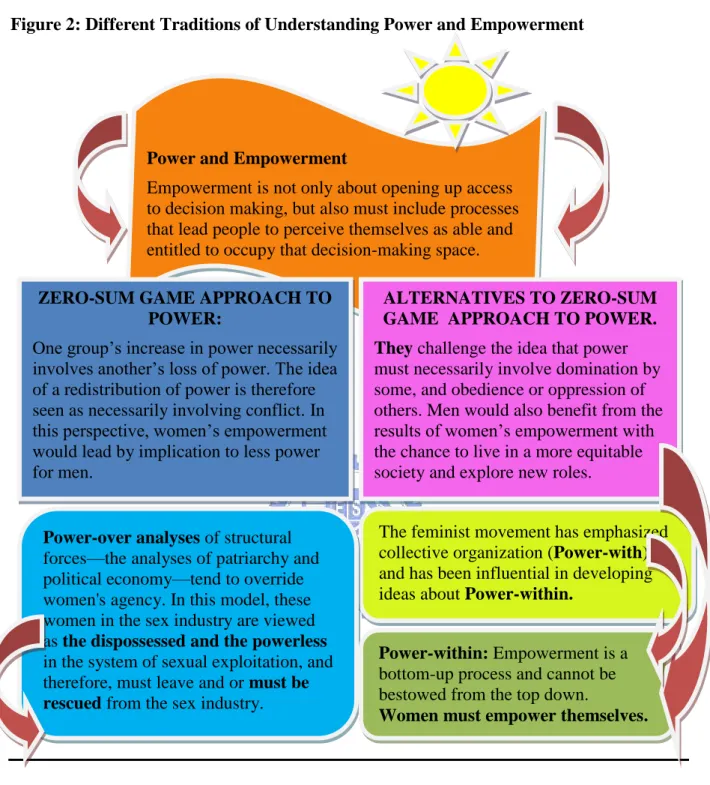
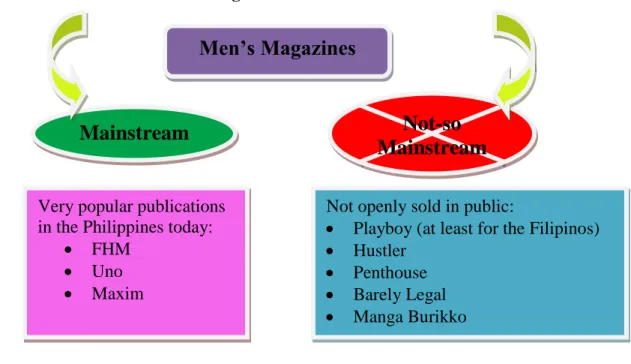
Figure 2: Different Traditions of Understanding Power and Empowerment…p.18 Figure 3: Classification of Men‘s Magazines…p.24
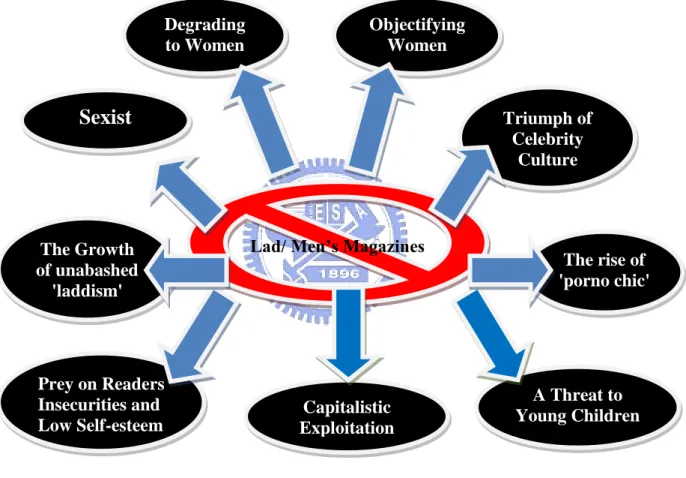
Figure 4: Issues against Lad/ Men‘s Magazines…p.26
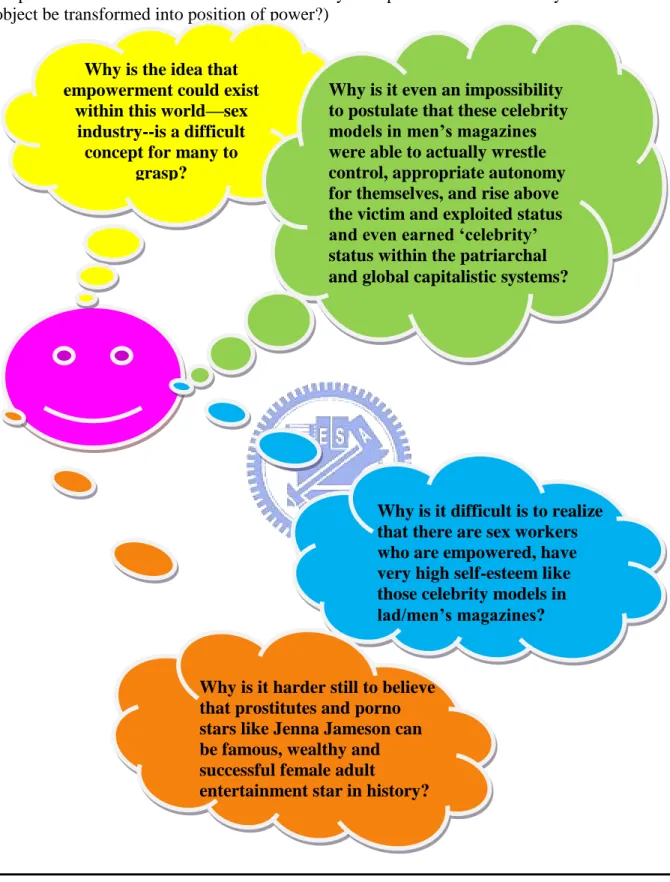
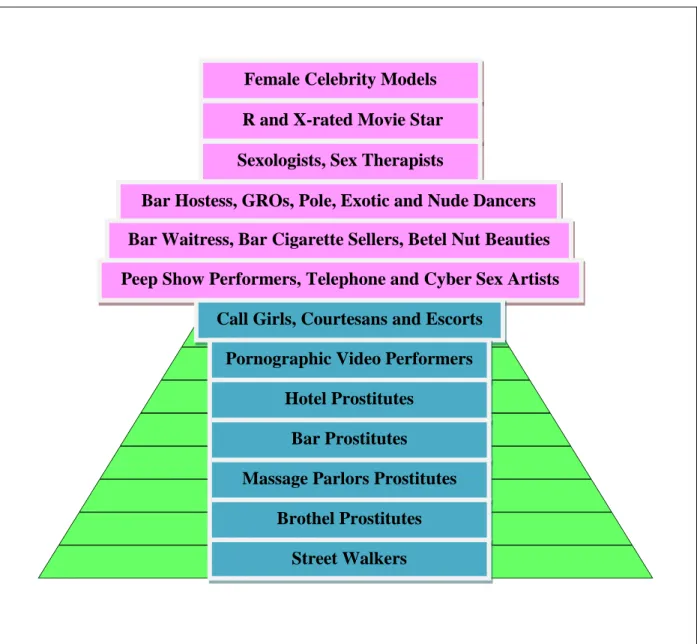
Figure 5: Can women empowerment possible in the Sex Industry?…p.30 Figure 6: Hierarchy of Workers within the Sex Industry…p.31
Figure 7: Traditional Views of Sex Workers…p.33
Figure 8: The Power of Internalized Self-Image Imposed by Others: Cultural Norms versus
Celebrity Culture…p.35
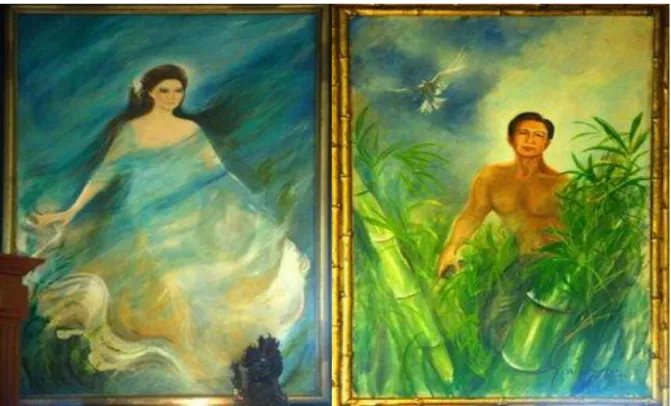
Figure 9: Painting of Malakas at Maganda…p.38
Figure 10: Imelda and Ferdinand Marcos‘ self-image and version of Maganda at
Malakas…p.39
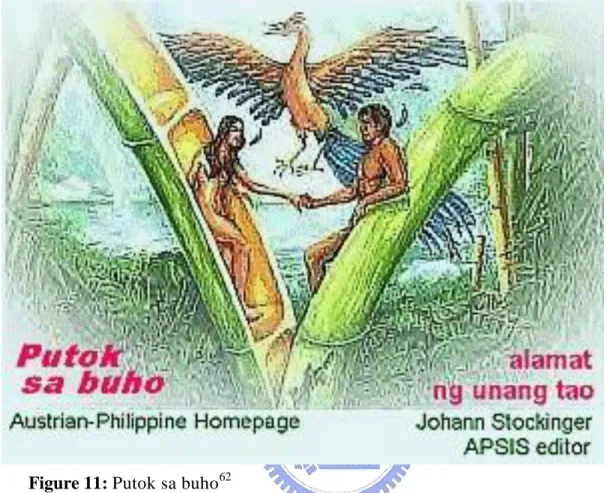
Figure 11: Putok sa buho…p.41
Figure 12: Erotic Art versus Pornography: A Matter of Personal Taste and Perception…p.51 Figure 13: Filipino Feminism: The Exploitation/Choice Dichotomy…p.65
Figure 14: The Gendering Construction of Filipino Subjectivities: Maganda/Malakas and
Pangit/Mahina Dichotomy…p.67
Figure 15: Maganda/Malakas METER…p.67
Figure 16: The Gendering Construction of Filipina Subjectivities within the Malakas Power
Structures: Si Maria Clara at si Malakas (Maria Clara and Malakas)…p.68
Figure 17: Star Meter: Celebrity‘s Star Power…p.71
Figure 18: Categories of Filipino Entertainment Stars…p.72 Figure 19: External Impediments to Empowerment…p.92
Figure 20: External Impediments to Empowerment: The Powerful World of Showbiz…p.93 Figure 21: Internal Impediments to Empowerment: Personally Internalized Mixture of
Indigenous Gender Concepts and Hispanic Catholicism…p.111
Bawal—forbidden, taboo
Crush ng Bayan—Nation‘s Crush. It is usually attributed to people who are considered the
most desirable in and outside showbiz
Kagandahan— beauty, allure
Lola—literally it means grandmother. It usually pertains to old ladies. Sometimes it could
mean conservative or old-fashioned. (Same is true with Lolo or grandfather).
Maawain—merciful Mabuti—good, kind Mabait—good, kind
Maganda—literally it means beautiful. It is synonymous to mabuti. It is usually associated
with a woman and also with female physical beauty. It also means anything and everything good and beautiful
Magandang Tingnan—literally it means to look good. As a moral gaze, it means socially
acceptable.
Mahalay—earthly
Mahina—literally it means weak, powerless or lacking in power or strength. The exact
opposite of what is malakas. Synonymous to: May sakit (sick or in poor health)
Maka-Diyos—godly, religious Makatao--humane
Malakas--usually associated with a man, and also male virility, sexual prowess, and physical
strength. It literally means strong and powerful. It is synonymous to: Makapangyarihan (Influential or people in power). Authority or power itself. The exact opposite of what is mahina
Malaswa—lewd
Malinis—clean, pure—virginity, honest
Marangal—honorable, dignified, morally upright
Maria Clara— is portrayed as the epitome of modesty and devotion of the Filipina. Maria
Clara lived a sheltered life—stuck in the convent, or living in her family home, the opulent house of the Delos Santos family (Capitan Tiago). The "ideal" image, promoted by no less than Jose Rizal, is that of Maria Clara, a demure, self-effacing beauty whose place was on the pedestal of male honor. Rizal describes this "ideal" of the Philippine woman with words such as these: "an Oriental decoration," "her eyes...always downcast," "a pure soul." (Chapter 5, Noli Me Tangere)
Masama—bad, evil Masunurin—obedient
Pangit—literally it means ugly usually pertaining to physical appearance. It also means
anything and everything ugly, bad and evil
Pangit tingnan—literally it means to look bad. As a moral gaze, it means socially
unacceptable
Chapter One: Literature Review 1. Introduction
Our world is increasingly driven by a combination of information and entertainment values, and these are both promoted by the explosion of different means of communication, especially electronic communication such as satellite TV and the Internet. Most people, even in many developing countries, have access now to many information sources in their homes and offices, including TV, radio, and internet. The audience is overloaded with options that make the process of choice, selection and even decision-making more informed yet harder.
On the other hand, competition has become increasingly keen in the area of the mass media as they keep fighting for the attention of the readers, listeners, and TV-viewers. The life and death of each newspaper and TV station is at stake when the income from advertising and sponsoring is proportional to the number of readers or viewers. In order to survive, they increasingly turn to other strategies such as entertainment, titillation, scandal mongering, spreading fear and spending fewer resources on serious researching of news.
In most countries, particularly in America and Europe, news is the most important channel for propagation of culture, ideas, and opinions. But this is not true in the Philippines. The entertainment media has been more influential than the news media in the dissemination of culture, ideas and opinions. Religious and educational institutions have been losing their influence on the people, while political institutions already lost its relevance on the people, as people gave up on the government a long time ago. Filipinos rely more on television than on newspaper or internet. Access to television programs is easy and free, whereas one must pay to read a newspaper or access the internet, not to mention the cost of appropriate hardware.
The failure of the Philippines government and to some extent the ‗serious‘ media to provide authoritative information to the public is the main cause of an impoverished political culture and an inadequate public policy. Today, news is treated more like entertainment. The Filipinos have become so weary that even serious news propagated by politicians from both the administration and the opposition is not seen as credible. Most Filipinos expect more to be entertained rather than informed by the news. The entertainment function of media serves in turn to pacify and excite the viewer, which in the long run reproduces the low literary level of the media culture as a whole. The dominance of music videos, saturated by the seductions of sound and sense impressions, has become a ―culture industry‖ in Adorno‘s terms.1 Most opinion formation takes place while people watch news and debates on television. However,
1
millions of lazy viewers, not only in the Philippines but all over the world, sit comfortably, oblivious to the significant cultural and political transformations taking place in their country. In the Philippines, the attention of the whole country seems fixed on three things: telenovelas, i.e. television dramas, both imported and locally produced; entertainment gossips, particularly of the sensationalist tabloid kind; and, the House of Representatives‘ and Senate‘s corruption and even impeachment hearings, hoping to usher in people power revolution to topple down a widely perceived corrupt and illegitimate Arroyo government. However, it seems that the third, people power, is on the decline. If not, the House‘s and Senate‘s corruption hearings, however, will create another crisis…this time ‗lad magazines‘ featuring celebrities, who are considered the ‗pantasya ng bayan‘ (national dream girl), the ultimate ‗it girl!‘
‗Lad magazines‘ like FHM, Maxim and Uno are a successful phenomenon in the Philippines. Their meteoric success is not surprising, considering the aggressive and huge media resources and mileage that they are given. To date, about 300,000 copies of ‗Lad magazines‘ are in circulation per month, with FHM publishing 105,000-135,000, followed by Maxim and UNO, with 100,000 copies each. According to surveys, 70% of their readers are male, 30% are female. More surprising is the relative ease with which such ‗lad magazines‘ were able to penetrate the market, penetrating the Filipino consciousness on a national scale. Two decades ago, this was unthinkable and unacceptable to a general public and would have drawn condemnations from publishers, the Catholic Church, and the government. Religion, ideology, politics, morals, and norms played a conservative role in the Philippines in the past, thus making a study of change in rules of conduct and philosophies of life seminal.
Compared to Western countries, lad magazines are new to the Philippines. However, the avid interest it has generated has now become unprecedented, as many Filipinos eagerly wait for each issue. It has now reached such a level of national popularity that people from all walks of life, of every gender and sexual orientation and preference appear to have opinions about it. To some extent, determining the sexiest and the most beautiful Filipina of the year, much like the Miss Universe beauty contests, has become a national past time. Landing in the list, particularly at the top, has become the most contested, and thus the most coveted, prize for their featured celebrities and movie icons. ‗Lad magazines‘ and the ensuing controversies regarding their popularity are not uncommon either in the Philippines or elsewhere. Simply put, ‗lad magazines‘ are accused of pornography, that these publications are degrading to women, that they pose a threat to children and that they prey on readers' insecurities and low self esteem. However, for all intents and purposes, one must also point out that lad magazines wittingly or unwittingly create a space for these women to challenge existing rules of conduct
and perhaps emerge victorious by gaining celebrity status that in turn affords them even more space and power to exercise their will to attain personal goals that they set for themselves.
The construction of female ‗celebrity‘ models‘ decision-making agency stands in the midst of this zero-sum game of empowerment: the struggle to maintain and/ or gain maganda power in order not to become mahina, i.e. the ―weak‖ in the malakas, male dominated power structure using one‘s ‗kagandahan‘ (beauty, youth, sexiness and allure). Central to this is the question of „propriedad‟ (propriety), through the use of women‘s personal ‗kagandahan‘ as a bargaining tool, which is a way to gain or maintain power and control of one‘s personhood, in this instance, womanhood in a man‘s world. Propriety, after all, with all intents and purposes, has much more to do with gendered, culturally specific and explicit rules of moral conduct. It has little to do with how one views the world, but with how others think you should live your life. Most of the time, it is counterproductive, limiting and to some extent unhealthy. Simply put, there is a ‗sub-rosa rule‘ about the way things are openly expressed in the Philippines. Does one really want to be mired in the unproductive and unfair, if not illogical ‗givens‘ of a hypocritical ‗principalia-led generation‘ of the Spanish colonial past? Are we bound to the feeling that old ways are what make things hang together, that if they are no longer followed, morals will disintegrate? To put it succinctly, why do one‘s taste, preference and desire have to conform to the others? It is often difficult to discern which of the sub-rosa rules to keep and which to discard. Moreover, there is something in each of us
that will shock the rest of us. In the end, it is how one views oneself that counts. As to the
question of maganda ka ba, the answer cannot be too obvious: ‗it is who you think you are!‘ I realize that commonalities in women's subordination everywhere are constructed in the context of class, race, and gender relations, thus should have different consequences for different groups of men and women.
I am also aware that the women in the Philippine sex industry can be viewed as being oppressed and marginalized in the power discourse of sexual morality. Disempowered at the bottom of the malakas power structures of the sex industry, the women are „mahina‟, i.e. the weak in society. But this is not the whole story. While I recognize the realities of oppression and exploitation in women's lives, my focus is not to replicate such structuralist accounts of sex trade within the sex industry in the form of prostitution and performing in pornography that further victimize the already vulnerable lives of women in the sex trade. Instead, my point of departure poses the question of women's agency, to examine not only their unequal positionalities in the power dynamics of the sex industry but also the subjectivities constructed through those positionalities, in this case by viewing female celebrity models as
an example in which women can work and be part of the sex industry and still preserve and/or restore the social adequacy of being maganda (‗beautiful‘), disente (‗decent‘) and
malakas‟na babae (‗strong and powerful woman‘) within the power dynamics of the
Philippine sex trade in particular and sex industry in general. By transcending the exploitation/choice dichotomy in the liberal/neo-liberal prostitution debate, I offer a post-structuralist approach to women's decision-making agency by examining the subjectivities of the female celebrity models in lad magazines within the Philippine sex trade that creates a space for these women to challenge existing rules of conduct and yet emerge victorious by gaining celebrity status, which affords them space and power to exercise their will to attain personal goals. In other words, I argue that there should be space for women's subjective accounts of power in a feminist theory of sex work—not simply that of prostitution and/or pornographic activities alone but all forms of sex-oriented activities within the sex industry— that are not predicated on women "choosing" to enter sex work in the face of patriarchy and/or political economy. It becomes crucial thus to listen to female celebrity models‘ voices in order to see how and the extent to which women's self-disciplining impacts on their decision-making agency within the power dynamics of the Philippine sex trade. Specifically, the thesis seeks to explain the following:
1. How is the female celebrity model's decision-making agency constructed within the power dynamics of the Philippine sex trade and Philippine show business industry? 2. How are culturally created gender specific labels, such as „maganda‟ o „pangit‟
(beautiful/ugly) and „malakas‟ o „mahina‟ (strong/weak), shaped and mold Filipino women‘s perceptions and beliefs, not only as a collective group but more importantly as a ‗woman‘ person regardless of achievements, success and even celebrity status? 3. Why is the idea that empowerment can exist in this world—sex industry—a difficult
concept for many to grasp? Why is it even impossible to postulate that these celebrity models in such men‘s magazines were able to actually wrestle control, appropriate autonomy for them, then rise above the victim and their exploited status and even earn ‗celebrity‘ status within the patriarchal and global capitalistic systems?
4. Why it is difficult to realize that there are sex workers who are empowered, have very high self-esteem, like those celebrity models in lad magazines? Why is it even more difficult to believe that prostitutes and movie porn stars, like Jenna Jameson, can be famous, wealthy and successful female adult entertainment stars in history?
5. How do female celebrity models in lad magazines contend with and negotiate within a limited confluence of a tripartite power represented by the ideological spaces of local power and structures of the global political economy in order to succumb to the pangit inferiority complex and to continue to maintain the internalized maganda ideals? 6. Why are internal impediments a more crucial factor than external structural forces to
female celebrity model‘s empowerment?
exploited status, somehow rise above these positionalities, and still attain that much prized honor of being labeled not only as ‗maganda‘ but also as ‗malakas na babae‘ (beautiful and strong woman), but most importantly as an individual ‗woman‘ person? 8. How do lad magazines in the Philippine sex trade create a space for female celebrity models to challenge existing rules of conduct, yet emerge victorious to gain celebrity status, allowing them more space/power to exercise their will to attain personal goals? 9. How can women's decision-making agency be integrated into a feminist theory of
commoditization of the female body in ways that move beyond these "exploitation" dilemmas? Or how does a traditionally held position of weakness by women as sex object transformed into a position of power?
The key to understanding women's agency is thus to investigate not only their unequal positionalities in the power dynamics of the sex trade but also their subjectivities constructed through those positionalities. The articulation of female celebrity model subjectivity depicts their decision-making agency in ways that can further elaborate a feminist understanding of
why and how these women "choose" by their own accord to enter the sex industry. This
is different from understanding women's decision-making agency as being driven into sex
work and/or being forced to enter the sex industry, like posing ‗sexy‘ for men‘s magazine
and other socially stigmatized sex work, such as prostitution and pornography, because of socio-economic conditions and patriarchal systems.
This principle of from „power-within‟ to „power-to‟ („bottom-up instead of
top-down‟ approach to empowerment) is consistent with the main objective of my thesis study:
to investigate the significance of subjective accounts of power by female „celebrity‟ models as they exercise decision-making power to pose ‟sexy‟ in lad magazines in the Philippines. How can women's decision-making agency be integrated into a feminist theory in ways that move beyond the "exploitation" dilemmas? How can a traditionally held position of weakness by women as sex object be transformed into positions of power? The subjectivities of women within these gendered spaces of politics, economy, religion, class, race and sexuality center on the configuration of power, which construct these women's discourses in various ways in which women can serve as sex worker yet still preserve and/or restore the social adequacy of being maganda (beautiful) and ‗proper‘ women. The maganda power is about conformity to what is seen as socially acceptable behavior for Filipino women: to be beautiful, ‗proper‘ and moral. Should they lose their state of maganda, Filipino women would become ‗lowly
pangit‘, whose role is one of only entertaining malakas, strong and powerful men of virility.
I also propose to analyze lad magazines in detail at three levels:
First, beyond the cover and the choice of model, it is important to focus on the worth and merit of the contents. Specifically, what do these ―lad magazines‖ represent?
Second, the ensuing circulation wars between lad magazines soon led to more daring covers and sleazier articles. The question remains, although one can ask where the fault lies. Do ―lad magazines‖ set the pace or are they merely the reflection of a changing society?
This final point is particularly interesting, because it can clarify the debate regarding the power of the media to insist and the power of the people to resist. Mass media analysts have often discussed how much influence the media wields in people's opinions. People tend to selectively read what they already agree with and to rationalize their preformed opinions in the face of contrary arguments. Experimental evidence seems to indicate that the mass media has little power to change people's opinions on issues for which they already have formed a strong opinion, but they have a profound influence, when it comes to setting the agenda and priming people on new issues. The way an issue is framed determines how it is discussed, which social problems it causes, and which possible remedies are applicable to it. It is easy to manipulate people, not because they are stupid but because they are given a wide range of options or choices, thus choosing is difficult. But with the evolving power of the mass media in a market system, the people‘s will is prone to new trends, norms and social values. Here lies the power of the media, hyping what the people need and to a larger extent brokering what the people need and want even if these choices are not really what they need or want.
In short, there is a need to reevaluate women‘s sexuality and empowerment through discourses of morality insofar as they are linked at the same time to media industry practices. The construction of women‘s identity and gender relations in contemporary Philippine media representations occur in the midst of hegemonizing and homogenizing forces: globalization, rapid changes in media technologies, extraordinary contradictions in the transformations of regulatory cultural, religious, economic and political frameworks, and theoretical approaches used to make sense of gender constructions and representations. These changes will require us to rethink about the kinds of theoretical concepts and cultural politics that might be needed to engage with these changes. In sum, constructions of women‘s identity and gender relations in contemporary Philippine media representations can be categorized as follows:
1. Theoretical Perspectives on Gender and Feminist Studies
2. The rise of the 4th State: The Corporate Media and the New Morality—The Power of the Media to insist and the Power of the Person to Resist
3. Lad Magazines in the Context of Gender, Power and Morality
4. Female ‗Celebrity‘ Model in Men‘s Magazines: A New and Powerful Breed of Worker Within the Sex Industry
2. Theoretical Perspectives on Gender and Feminist Studies
Advocates of Filipino feminism although united in their common goal of elevating women concerns to the level of highest priority have seen women's decision-making agency in two different ways. I will categorize these seemingly opposing feminist groups as
„structuralist‟ on one hand, and „liberal or neo-liberal‟ on the other. Structuralist feminists argue that women's abilities to exercise choice are absent because of poverty and
patriarchy; it is the ‗sexploitative‘ system of the international political economy that forces women to enter the sex trade to serve as commodities for male sexual gratification and financial profits. Structuralist feminists call for elimination of all forms of sex trade, the prostitution business especially, where poor women's choices are reduced to being male sex objects. On the other hand, liberal and neo-liberal feminists argue that women, regardless of their socio-economic background, exercise choice by entering the sex industry, which must be recognized as a legitimate form of work performed by workers in the sex industry. Liberal and neo-liberal feminists endeavor to oppose the abusive and exploitative operations of the sex industry, where women's choices and rights are unrecognized, especially where they are engaged in prostitution and pornography.
In my opinion, the Coalition against Trafficking in Women (CATW or Coalition) exemplifies the structuralist feminist perspective, while Nelia Sancho of the Asian Women's Human Rights Council (AWHRC) echoes the liberal and neo-liberal feminists‘ line. Coalition against Trafficking in Women (CATW or Coalition) argues that women's abilities to exercise choice are absent because of poverty and patriarchy, that is, the ‗sexploitative‘ system within the global political economy forces women to go into sex trade, only to become commodities for male sexual gratification and financial profit.2 Structuralist feminists have called for the elimination of all forms of sex trade, specifically prostitution, where poor women are reduced to being male sex objects. Such arguments highlight the existence of a structural environment in which women in the Philippine sex trade are situated. In fact, it is commonly understood that women in sex work are trapped within systematic forms of power inequality that engulf operators, procurers and buyers of the sex industry, state‘s police apparatus and institutions of
2 The Coalition against Trafficking in Women (CATW) is an international feminist NGO that has Category II
consultative status with the United Nations Economic and Social Council. Its umbrella organization, Coalition-Asia Pacific (CATW-AP), is located in the Philippines, and their member organizations provide direct services to women in various areas such as legal assistance, skills, educational programs, material and medical support. The Coalition assists programs of member organizations dealing with women who were previously involved in prostitution. Coalition feminists argue that, for women in poverty and with limited job opportunities, there is no such thing as voluntary prostitution, as they are forced to become prostitutes in order to survive economically.
the global political economy. One should also note the anonymous, centralized, and pervasive forms of power that regulate social behavior rooted in the collusion of native gender concepts and Hispanic Catholicism—institutionally unbound forms of power that can be ‗voluntary‘. On the other hand, liberal or neo-liberal feminists, such as Nelia Sancho of Asian Women's Human Rights Council (AWHRC), argue that women, regardless of their socio-economic background, make choices to enter the sex trade that must be respected as a recognized form of labor performed by workers of the sex industry.3 Liberal/neo-liberal feminists oppose the exploitative operations of the sex trade within this industry, where women's choices and rights are unrecognized, especially where they are engaged in prostitution. The prevailing feminist literature in this regard also tends to limit itself largely to the themes of prostitution, of commoditized, objectified and pornographic representations of the female body, femininity and female sexuality that accent forms of patriarchal structural power that in turn allow little, if any, agency to women. Such arguments perpetuate male domination or sexual gratification above women‘s needs in addition to continued encouragement of female sexual passivity.
For the purpose of this study, the term sex industry includes but is not limited to
prostitution and pornography. I wish to point out that while a majority of such women earn
all or part of their living as prostitutes, which in my opinion accounts for the relation of sex work to prostitution, this has led to misconceptions about the nature of their work. Moreover, some of these women earn an income in other areas of the sex industry, including exotic and nude dancing, poll dancing, telephone sex, cyber sex, acting in R and/or X rated movies, peep shows, escort service, massage parlors, bar hostess and GROs, sex therapy (practitioners who provide one-on-one, hands-on and real time sex therapy to rehabilitate those who are sexually dysfunctional), selling betel nuts (like the betel nut beauties found in Taiwan), and modeling for men‘s magazines mainstream (like lad magazines). Moreover, the ―terms 'sex work' and 'sex worker' have been coined by sex workers themselves to redefine commercial sex, not just as the social or psychological characteristic of a class of women but as an
3 Nelia Sancho is the coordinator of Asian Women's Human Rights Council (AWHRC), Manila, an Asia-based
feminist human rights NGO with UN observer status. For AWHRC, what constitutes human rights violation is not the act of prostitution per se, but the abuse and exploitation behind the operation of the prostitution business. Thus, AWHRC seeks to protect the rights of women prostitutes to consensual, voluntary sexual service. Sancho and her AWHRC colleagues led various other women's NGOs to establish the Task Force on Filipino Comfort Women (TFFCW) in 1992 and later helped to organize LILA Pilipina Lolas, an advocacy group of the Filipino comfort women survivors and women's human rights advocates. The testimonies of Filipino comfort women appeared in a book edited by Sancho, entitled War Crimes on Asian Women: The Case of the Filipino Women, Book II (Manila: AWHRC, 1999). She is also an active organizer and participant in many international forums on prostitution and trafficking, having collaborated with other Asian AWHRC counterparts and feminist NGOs, such as the Global Alliance against Trafficking in Women (GAATW) of Thailand.
income-generating activity or form of employment for women and men. It can thus be
considered simply as a form of economic activity. An employment or labor perspective is a necessary, if not sufficient, condition for making sex work an integral part of the ongoing debate on human, women‘s and workers‘ rights at the local, national and international level.‖4 This is precisely because those who engage in sex work are generally viewed by society in a discriminatory way. For many, it may serve as the only employment or survival option. While some may freely choose sex work as their occupation, many more young girls, boys and women are coerced through violence, trafficking, debt-bondage or the influence of more powerful adults. In some instances, sex work is simply a temporary informal activity. Women and men who have occasional commercial sexual transactions, where sex is exchanged for food, shelter or protection (survival sex), would not consider themselves to be linked with formal sex work. Occasional sex work takes place where sex is exchanged for basic, short-term economic needs, and this is less likely to be a formal, full-time occupation.
What is noteworthy about the exploitation/choice dichotomy is the manner in which it differentiates the act of sex trade per se from the abuse and exploitation in the labor condition of sex workers, thereby distinguishing the work from the person. Feminist perspectives view patriarchy and global capitalism as inherent obstacles to the exercise of women's decision-making power. They focus less on the influences of these women's unequal positionalities on their subjectivity constructions. In my opinion, women's obstacles to exercise an empowering choice do not reside just in the context of structural power forces but can be attributed also to women themselves, through their submission, voluntary or involuntary, to the "gendering" power discourse of sexual morality, propriety and beauty. This raises several cultural notions of morality, e.g. „magandang tingnan‟ (socially acceptable) and „pangit tingnan‟ (socially unacceptable), reverent and irreverent, moral and immoral, and similar notions dichotomizing art and pornography, sex work and prostitution. Notions of maganda/pangit (beautiful/ugly) and malakas/mahina (strong/weak) engender in the Philippines a power structure vertically or horizontally linking men and women in and outside sex work (in society at large).
Sandra Bartky has developed a theory about the construction of femininity,5 drawing
4
Jo Bindman. Redefining Prostitution as Sex Work on the International Agenda.
Jo Bindman is connected with Anti-Slavery International with the participation of Jo Doezema of Network of Sex Work Projects, 1997. Available online at http://www.walnet.org/csis/papers/redefining.html#8
5
See Sandra Bartky, ―Foucault, Femininity, and the Modernization of Patriarchal Power,‖ in Diana Tietjens Meyers, ed., Feminist Social Thought: A Reader (London, New York: Routledge, 1997).
on Michel Foucault's earlier account of the disciplinary power paradigm.6 In a similar way, the construction of gendered sexuality and the impact of gender power relations upon sexual morality and behavior in Philippines society have theoretical linkages with Foucault's subtle forms of power that penetrate into the body and mind. The disciplinary practices Foucault cites in Discipline and Punish are based on Jeremy Bentham's model of the Panopticon:
―At the periphery of the Panopticon, a circular structure at the center, a tower with wide windows that opens into the inner side of the ring. The structure on the periphery is divided into cells, each with two windows, one facing the windows of the tower, the other facing the outside, allowing an effect of backlighting to make any figure visible within the cell. …Each inmate is alone, shut off from effective communication with his fellows but constantly visible from the tower.‖7
The structure of the Panopticon imposes on the inmate ―a state of conscious and permanent visibility that assures the automatic functioning of power.‖8 In the perpetual self-surveillance of the inmate, ―the tight, disciplinary control of the body has gotten a hold on the mind.‖9
The effects of Foucault's Panopticon model resonate within the walls of discourse on the double standard of morality and its impacts on sexual behavior in Philippines society. Gender practices in the Philippines impose on women, through institutions of family, church, and school, core Catholic values of ―dutiful daughters, virginal girlfriends, devoted wives
and sacrificing mothers.‖10 Indeed, the moral value placed on female virginity is so strong
that "women's sexuality is generally accepted only within the confines of marriage, and most Filipino men would only marry women without a sexual past."11 Thus, women are expected to preserve pre-marital virginity and be faithful to their husbands after marriage. The practice
6 See Monique Deveaux, ―Feminism and Empowerment: A Critical Reading of Foucault,‖ in Susan Hekman, ed.,
Feminist Interpretations of Michel Foucault (Philadelphia: University of Pennsylvania Press, 1996). Foucault's earlier modern power framework, in his Discipline and Punish, is comprised of two disciplinary regimes: ‗docile bodies/Panopticonism‘ and ‗bio-power‘. The first refers to the transition in state power from the authoritarian forms of sovereignty to more subtle, disciplinary forms of modem power, which construct the self-surveillant (panoptic) discourse of what human bodies should be in order to remain ‗docile (obedient)‘ within a modern state power. The latter refers to a transformation in the state's interests from the juridical authority over the life and death of the population to medical intervention in population control and management, such as reproductive capacities, health, birth; and mortality: the ―bio-politics of the population,‖ or simply ―bio-power‖ (p.2 13-20).
7
Bartky, 1997, 94-95.
8 Bartky, 1997, 95. See also Michel Foucault. Discipline and Punish: The Birth of Prison, Alan Sheridan, trans..
(New York: Vintage, 1979), 201.
9 Ibid. 10
Rene E. Ofreneo and Rosalinda Pineda Ofreneo, "Prostitution in the Philippines," in Lin L. Lim, ed., The Sex Sector: The Economic and Social Bases of Prostitution in Southeast Asia (Geneva: International Labour Office, 1998), 104.
11
Eric Ratliff, "Women As 'Sex Workers,' Men As 'Boyfriends': Shifting Identities in Philippine Go-Go Bars and Their Significance in STD/AIDS Control," in Anthropology and Medicine, Vo1.6, No. 1, 87.
of such Catholic chastity in the Philippines, however, does not apply to men. Men's sexual freedom is generally considered as a separate category of Catholic sexual morality, although it supposedly imposes on both men and women the same demands of being free from ‗sinful‘ sexual desire. Many Filipino men commit adultery with women, before marriage and outside the marital relationship, and they do not normally have any moral guilt about their infidelity. Former President Joseph Estrada, for example, has more than ten children from extra-marital relationships with other women. A TV personality, Martin Nievera, justifies in the same way an affair that caused his wife, Pops Fernandez, to file for annulment of their marriage by claiming that there is no such a thing as eternal love. Furthermore, the different grounds for legal separation on the basis of sexual infidelity also reflect such sexual double standards.12
The double standard of morality underpins the aforementioned gender stereotypes attached to Filipino cultural notions of malakas, maganda, and pangit, which has two distinct implications for prostitution. One is that the purchase of women by men is widely accepted through the malakas concept of ‗aggressive male with virility‘ and the pangit concept of women as ‗objects of male sexual gratification‘. This is consistent with the fact that ―there is such a strong local demand from men of all social classes for prostitutes.‖13 The other is that sexual double standards also divide women into two types: maganda woman as „moral
guardian‘ and pangit woman as ‗evil whore.‘ In this light, it is not surprising that even a
woman in the sex industry, insofar as she is a 'cherry girl,'14 comments that going out with her clients (implies having an intimate relationship with a client) is what loose women do. ‗Decent‘ women outside the sex industry differentiate themselves even more strongly from 'fallen' women. Local women avoid wearing any 'revealing' clothes such as a sleeveless shirt, tight mini skirt or even short pants, which are usually seen as things that only prostitutes wear to attract clients. The way the discourse of sexual double standards infiltrates into a person's
12
See Dominador D. Buhain. The Revised Penal Code of the Philippines, 1992 revised ed. (Manila: Rex Book Store, 1992). See also Sylvia Chant and Cathy McIlwaine, Women of a Lesser Cost: Female Labour, Foreign Exchange and Philippine Development (London and East Haven, 1995), 14. There are two separate articles on "crimes against chastity" in the Philippine Revised Code: adultery and concubinage, one pertaining to women, the other to men, respectively. Article 333 states that "adultery is committed by any married women who shall have intercourse with a man not her husband and by the man who has carnal knowledge of her knowing her to be married, even if the marriage be subsequently declared void," whereas Article 334 states that concubinage is committed by "any husband who shall keep a mistress in the conjugal dwelling, or shall have sexual intercourse under scandalous circumstances, with a woman who is not his wife, or shall cohabit with her in any other place.. .If the husband has carnal knowledge with his paramour in hotels even on different occasions, he is not guilty of concubinage for this is not one of three ways by which concubinage is committed" (p. 125).
13
Ofreneo and Ofreneo, 1998, 105.
14
mind and sexual behavior reminds us of the image of the Panopticon: ―knowing that he may be observed from the tower at any time, the inmate takes over the job of policing himself.‖15
The ‗moral gaze,‘ which is inscribed in the sexual relations of the Philippine society, appears to be internalized by Filipinos and is perpetually oriented toward the disciplinary practices of self-policing subjects. The exercise of disciplinary power, according to Foucault, is unique in a sense that it "seeks to transform the minds of those individuals who might be tempted to resist" in anonymous forms of psychological power.16 This contrasts with the authoritarian forms of physical control that are directly exercised on citizens by the state.
When the Spanish first came to the Philippines in the sixteenth century, colonial authorities imposed Catholicism, ―a patriarchal culture where women had to subordinate themselves to father, husband and priest.‖17
Women's mobility was confined to the domestic sphere and the church, and their sexuality was controlled through the notion of Virgin Mary and other aspects of a strict moral code that emphasized modesty and chastity. Tragically and ironically enough, prostitution began to evolve and function as the outlets of Spanish men's sexual desire, which was suppressed under the moral authorities; the rape of native women by the Spanish "created a reserve of 'fallen' women who became available to service not only the homesick Spanish troops and dignitaries, but also the friars.‖18
In contemporary Philippine
society, colonial Catholic institutions no longer shelter young girls from 'sinful' behaviors and 'lewd' or 'worthless' women in separate quarters. Instead, the virgin cult inscribed at school, family and church—individualized forms of "faceless, centralized, and pervasive"19 power rooted in the combination of indigenous gender concepts and Hispanic Catholicism—seeks to place the sense of unworthiness on the "docile bodies" of those who have lost their virginity.
Thus, Foucault's modern disciplinary power is useful for examining sexual discourses of power and their impacts on sex trade, especially prostitution in the Philippines. Foucault's poststructuralist theory offers alternative approaches the structuralist arguments by Coalition feminists, where prostitution is viewed as a global creation of patriarchal political economy. Foucault's notion of power departs from structuralist analyses of power that over-determine
power subjects to an alternative notion of micro-power, which "brings into play relations
15
Bartky, 1997, 106.
16 Ibid.
17 Ofreneo and Ofreneo, 1998,100. 18
Ibid.
19