
國際貿易下之非信用狀交易實務與風險規避:從台灣出口廠商之角度探討 - 政大學術集成
70
0
0
全文
(2) 國際貿易下之非信用狀交易實務與風險規避: 從台灣出口廠商之角度探討 International Trade Practice and Risk Aversion of Non-LC Trading From the Perspective of Taiwanese Exporters. 研究生:王威凱. Student: Kevin Wang. 指導教授:吳文傑. 立. Advisor: Professor Jack Wu 政 治 大. ‧ 國. 學. 國立政治大學. 商學院國際經營管理英語碩士學位學程. Nat. A Thesis. er. io. sit. y. ‧. 碩士論文. Submitted to International MBA Program. n. al. iv. National C Chengchi University Un. hengchi. in partial fulfillment of the Requirements for the degree of Master in Business Administration. 中華民國一百年六月 June 2011 i.
(3) Abstract International Trade Practice and Risk Aversion of Non-LC Trading From the Perspective of Taiwanese Exporters By Kevin Wang. Taiwan, an island with outstanding economic miracle, has deeply depended on international trades to increase economic growth and national wealth. There are many successful. 政 治 大 Made-in-Taiwan products all over the world through international trade and commerce. 立. companies, including listed enterprises and SME, manufacturing and marketing. ‧ 國. 學. Therefore, undoubtedly the power international trade is one of our strength and plays a key role on stimulating economy as well as elevating the living standard of people. .. ‧. Nat. sit. y. To compete with other international exporters, Taiwanese exporters must provide not only. n. al. er. io. products with good quality and reasonable price, but also offer competitive payment terms to. i Un. v. further strive for new clients and strengthen individual competitiveness. This is a recent trend. Ch. engchi. of International Trade. From the risk-free payment term, such as- T/T Advance to O/A 90 days after shipment, Taiwanese exporters suffered both political risk and credit risk. Not to mention cash flow risk and exchange rate risk that normally appears during transaction.. Remembered financial crisis in 2007, market failed and malfunctioned at that time. As for corporate side, individual companies faced difficulties of continuously operation. Some even seriously went bankruptcy during that time. In this circumstance, Taiwanese exporters, even successfully won the orders, could not receive the payment on time from foreign buyers. Some of them may even suffered huge loss because of intentional disputes or buyer’s. ii.
(4) closedown. Therefore, it goes without saying that risk aversion is becoming an important issue for Taiwanese companies to survive.. There would be three major financial tools being introduced for risk aversion with three case studies. Each of them has its special features and functions by different needs. How and why does Taiwanese exporter choose and leverage for risk aversion will be explained and discussed. The purpose of this paper is to find out the solutions for Taiwanese exporters to reduce risk of international trade as well as increase competitiveness in the foreign trade and grow the economy as contribution in the long run.. 立. 政 治 大. ‧. ‧ 國. 學. n. er. io. sit. y. Nat. al. Ch. engchi. iii. i Un. v.
(5) Acknowledgements. First, I must acknowledge my gratitude to my bank, the Export-Import Bank of the Republic of China. Without its generous support and understanding, I would not have had the opportunity to study in IMBA and further elevate my knowledge level as well as strengthen English and social ability.. Moreover, I would like to express sincere appreciation to my advisor, Professor Jack Wu,. 政 治 大 the reviewers and committee of my thesis. 立. who guided me with thoughtful suggestions in a clear direction. My appreciation also goes to. ‧ 國. 學. Third, I want to thank my colleagues and friends for their contributions and encouragements.. ‧. Special thanks to the S.V.P of my bank, Jack Huang, who gave me valuable instructions and. Nat. sit. y. shared experiences with me. The other gratitude goes to my former manager, Frank Hsieh,. n. al. er. io. who always reminds me the important concepts of international trade. Without his help, I could not finish the thesis smoothly.. Ch. engchi. i Un. v. Besides, I would like to express appreciation to the IMBA office staff who would always be my best consultants with providence of prompt assistance and to all my classmates who share a great learning experience with me in the past two years.. I dedicate this thesis to my parents with greatest gratitude and appreciation. They support me in all dimensions of my life, not only as I work to finish my degree, but also console while I was frustrated and directed me out of difficulties. Without their love and sacrifice, my life. iv.
(6) could not even approach to this milestone. Sincere thanks with my higher respects to Father and Mother for completing my life with endless support and love.. 立. 政 治 大. ‧. ‧ 國. 學. n. er. io. sit. y. Nat. al. Ch. engchi. v. i Un. v.
(7) TABLE OF CONTENTS. Abstract ......................................................................................................................................ii Acknowledgements ................................................................................................................... iv TABLE OF CONTENTS .......................................................................................................... vi List of Figures and Tables...................................................................................................... viii 1.. Introduction ........................................................................................................................ 1. 2.. Recent Trend and Modes of Non-LC Payment Terms ...................................................... 7 2.1. 2.2.. Modes of Non-LC Payment Terms-D/A.............................................................. 15. 2.4.. Modes of Non-LC Payment Terms-O/A.............................................................. 17. 2.5.. Major Risks Involved in International Trade ....................................................... 20. ‧. ‧ 國. 學. 2.3.. Nat. Trading Risk............................................................................................. 21. 2.5.2.. Cash Flow Risk ........................................................................................ 22. 2.5.3.. Exchange Rate Risk ................................................................................. 23. n. al. er. sit. y. 2.5.1.. io. 3.. 政 治 大 Modes of Non-LC Payment Terms-D/P .............................................................. 11 立 Recent Trend of International Trade ...................................................................... 7. Ch. engchi. i Un. v. Financial Tools for Risk Aversion ................................................................................... 24 3.1.. Export Insurance .................................................................................................. 24 3.1.1.. 3.2.. 3.3.. Export Credit............................................................................................ 28. International Factoring Service ............................................................................ 30 3.2.1.. The Function of International Factoring .................................................. 31. 3.2.2.. The Operation of International Factoring for O/A Term ......................... 32. Stand-by Letter of Credit ..................................................................................... 35 3.3.1.. Four Major Features of Stand-by LC ....................................................... 35. 3.3.2.. The Major Types of Stand-by LC ............................................................ 37. vi.
(8) 3.3.3. 3.4. 4.. The Attitude of Issuing Banks for Stand-by LC ...................................... 38. The Comparison among Financial Tools ............................................................. 39. Case Study: How Does These Financial Tools Benefit Taiwanese Exporters?............... 45 4.1.. 4.2.. Case Study 1: TronicPower Technology Corporation ......................................... 45 4.1.1.. The Application of Payment Term & Export Insurance .......................... 47. 4.1.2.. What does Export Insurance Benefits TronicPower? .............................. 48. Case Study 2: Taiwan Calcom Graphic Co. Ltd. ................................................. 49 4.2.1.. The Application of Payment Term & International Factoring Services .. 51. 4.2.2.. What does International Factoring Services Benefits TCGC? ................ 52. 4.3.2.. What does Stand-by LC Benefits MMC? ................................................ 56. 治 政 4.3. Case Study 3: Miracle Medicare Corporation 大 ..................................................... 53 立 4.3.1. The Application of Payment Term & Stand-by LC ................................. 55 ‧ 國. 學. Conclusion ....................................................................................................................... 58. ‧. 5.. n. al. er. io. sit. y. Nat. Bibliography ............................................................................................................................ 61. Ch. engchi. vii. i Un. v.
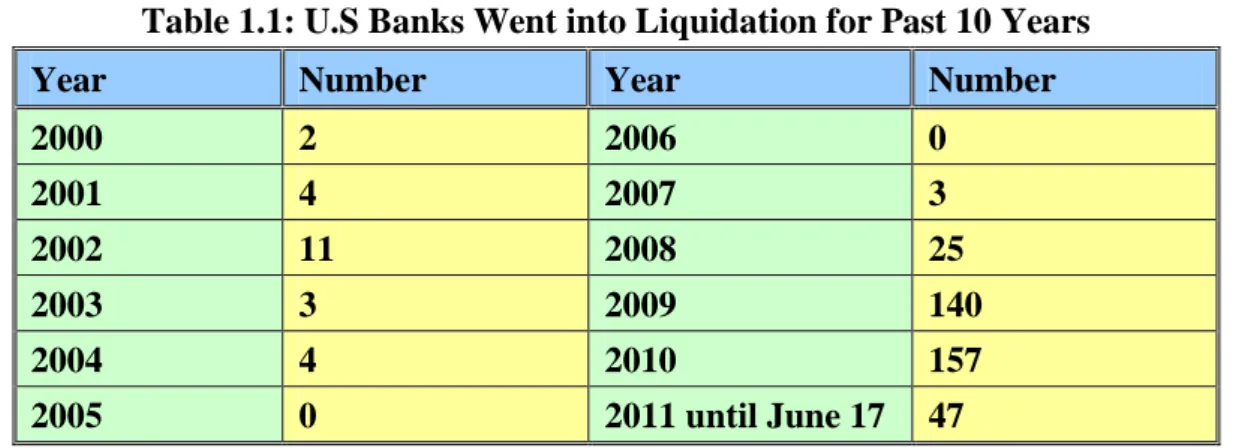
(9) List of Figures and Tables. Table 1.1: U.S Banks Went into Liquidation for Past 10 Years ................................................ 3 Table 2.1: Recent 12 Years of Taiwan Exports in US$ Million ................................................ 9 Table 2.2: Recent 20 Years of Taiwan Exports (%) ................................................................ 10 Figure 2.1: Recent Trend of International Trading for Past 20 Years ..................................... 11 Figure 2.2: Operating Practice of D/P Procedure .................................................................... 13 Figure 2.3: Operating Practice of D/A Procedure .................................................................... 16. 政 治 大 Figure 3.1: Procedure of Export Insurance .............................................................................. 25 立 Figure 2.4: Operating Practice of O/A Procedure .................................................................... 19. ‧ 國. 學. Table 3.1: Credit Rate Sheet by Country ................................................................................. 26 Figure 3.2: Operating Procedure of Export Credit................................................................... 29. ‧. Figure 3.3: Figure of International Factoring for O/A Term ................................................... 33. Nat. sit. y. Figure 3.4: Relationship among Applicant, Beneficiary, and Issuer ....................................... 37. n. al. er. io. Figure 3.5: Relationship of Stand-by LC ................................................................................. 38. i Un. v. Table 3.2: Comparison of Financial Tools .............................................................................. 40. Ch. engchi. Figure 4.1: Operating Procedure of TronicPower.................................................................... 47 Table 4.1: Calculation of Risk Coverage and Protection ......................................................... 48 Table 4.2: Risk Exposure and Benefits of TronicPower.......................................................... 49 Figure 4.2: Operating Procedure of Taiwan Calcom Graphic Company................................. 52 Table 4.3: Risk Exposure and Benefits of TCGC .................................................................... 53 Table 4.4: Possible Solutions for MMC .................................................................................. 57 Table 5.1: Recommendations under Different Conditions ...................................................... 59. viii.
(10) 1. Introduction. With more than 590,000 companies and 760,000 business houses1 registered at Ministry of 2. Economic Affairs on June 2011 , Taiwan has been described as “The Island of International Trade” in the past few decades. The mainly reason is that Taiwan does not own extensive territory and abundant natural resources, such as iron, coal, or crude oil as other countries do. Besides, the location of Taiwan is right on the center of East Asia Island chain surrounded by the Pacific Ocean and the Taiwan Strait. Therefore, subject to scarce resources and small. 政 治 大 market to the world. Based on global perspectives and adventure business culture, not only 立 local market, companies in Taiwan have to seek opportunities oversea and try to expand. ‧ 國. 學. the famous multi-national Taiwanese companies, such as Acer, Delta, Mediatek, and HTC, who have been playing important roles on IT industries and marketing their products all over. ‧. the world, but also many successful small and medium enterprises (SME) who have also been. Nat. n. al. er. io. sit. y. successfully dealing business with their global clients by different industries.. i Un. v. According to the statistics of Central Bank of the Republic of China (Taiwan), the foreign. Ch. engchi. reserve of Taiwan until May 2011 has already attained to US$ 398.68 Billion.3 Taiwan so far ranks the 5th of US foreign reserve in the world, only after China (US$ 2,622,000 Billion), Japan (US$ 1,135,549 Billion), Russia (US$ 502,460 Billion), and Saudi Arabia (US$ 456,200 Billion).4 The amazing foreign reserve is accumulated by Taiwanese businessmen who grab every single and tiny opportunity to sell products and services with hard-working 1. The major difference between a company and a business house is the regulated law. A company shall obey Company Law while a business house shall follow Business Registration Law. http://www.ntpc.gov.tw/web/FAQ?command=showDetail&postId=178108&groupId=12347 2 According to the statistics of Commerce Industrial Service Portal, Ministry of Economic Affairs , R.O.C. http://gcis.nat.gov.tw/pub/simple/alive.jsp 3 The statistics of foreign reserve until May 2011 is US$ 398.68 billion. http://www.cbc.gov.tw/lp.asp?CtNode=644&CtUnit=307&BaseDSD=32&mp=1 4 The ranking list of global US foreign reserve is referred to the website of Stock Q.org. http://www.stockq.org/economy/reserve.php. 1.
(11) attitude and economical personality. The footprints of Taiwanese businessmen have been remained and noticed all corners of the world, including Asia, Middle East, Europe, North America, Middle and South America, Africa, and Oceania. Until 2010 in these trading areas, there are total US$ 526 billion trading amount of Taiwan and Asia ranks No.1 with trading amount of US$ 328 billion, followed by US$ 73 billion of North, Middle, and South America. The third trading area is Europe with US$ 56 billion trading amount.5 The huge trading figure is step-by-step accumulated by every single international transaction of Taiwanese exporters. Therefore, we could not deny that international trade plays a very important role of creating Taiwan economic miracle, not to mention that international trade has huge and. 治 政 positive influence on the change of Taiwanese industrial 大structures from original farming 立 industry to profitable of IT and service industries. ‧ 國. 學 ‧. It goes without saying that profits usually come with risk. Although Taiwan businessmen. sit. y. Nat. performed well in the past few decades, they still faced a lot of risk. Not to mention when the. io. er. time goes bad, many companies go bankruptcy without an advance sign. Back to the financial. al. crisis happened on December, 2007, the economy seriously damaged all over the world,. n. iv n C including United States, Europe, Japan,hand China. Almost e n g c h i U every one of us influenced by the crisis more or less. Some people lost their job and were laid off by their employers. The other. people even faced the closedown of the company they worked and lose their job. To settle down the social unrest and economic problem, every government tried hard by offering special policy to solve the liquidity problem, including QE 1, QE2, or even QE3 from U.S government, bailout policies from European Central Bank, and other rescue programs offered by IMF as well as regional cross-border organizations, such as EBRD, ADB, Export Credit Agencies, and governments in different countries. There is no doubt that the liquidity. 5. The trading figure of different areas is referred to the website of Bureau of Foreign Trade. http://cus93.trade.gov.tw/FSCI/. 2.
(12) problem was a big issue at that time so that FED would pour money into the financial system and force market back to the track. As for government, there is no trust among banks and other financial institutions. Therefore, government had to regulate banks to keep supporting credits to their clients in this very special disastrous moment. However, banks were still become more and more prudent, or even strict, to any clients by tightening the credit line as well as forcing some clients to repay their loans right away. Some insurance companies even decided to get out of loan and credit market because of the huge loss from insurance claims. In this situation, not only exporters but also importers were deeply influenced by the strict credit policy of banks. In the view of macro-economy, market demand had already shrunk to. 治 政 a certain extent. Plus, companies could not get the financial 大 support from banking industry. 立 No wonder the total trading amount decreased in a fast speed since 2008. From the ‧ 國. 學. perspectives of companies, they needed the credit more than before. However, the reaction of. ‧. financial institutions was cruel and brittle and put all enterprises in a huge dangerous situation. sit. y. Nat. of financial pressure as well as suffered cash flow risk during this time. Now has been. io. er. already 3 years after the financial crisis, each economy seemed to be on the track of recovery. al. with the help of bailouts or government policies. The international trading amount also. n. iv n C increased by a certain degree. However, really become better? The answer is hdid e nthegeconomy chi U maybe or maybe not. Here is an interesting statistics about bankruptcy of U.S financial institutions for the past 10 years as the following table. Table 1.1: U.S Banks Went into Liquidation for Past 10 Years Year. Number. Year. Number. 2000. 2. 2006. 0. 2001. 4. 2007. 3. 2002. 11. 2008. 25. 2003. 3. 2009. 140. 2004. 4. 2010. 157. 2005. 0. 2011 until June 17. 47. The resource is from Federal Deposit Insurance Corporation http://www.fdic.gov/bank/individual/failed/banklist.html. 3.
(13) As referred to Table 1.1, we originally assumed that financial crisis would damage the banking system with the worst situation at 2008. However, the truth is U.S banks kept falling down by 140 banks closing down at 2009 to 157 banks failure at 2010. Generally speaking, banks would go to liquidation because of clients’ defaults or bad loans. If the economy really becomes better, banks would have fewer and fewer bad loans with higher chance to make profits and to survive in the end. Nonetheless, facts could speak. The possible explanation of the recovery is the abstract sense of economy or maybe some part of economy has bounced back, instead a real and complete economic recovery. Therefore, this figure could conclude. 治 政 that there is still systematic risk as well as general trade-related 大 risk existing in the market. If 立 the economic situation still suffers, the business and operating situation of individual ‧ 國. 學. companies could be worse, especially for those companies dealing with the business of. er. io. sit. y. Nat. situation.. ‧. International Trade. They still need time to recover and carefully observe the market. al. Following the above logic, risk exists all the time. Companies shall be more prudent in recent. n. iv n C years, not only paying attention to international h e n g c hpolitics i U and economy but also patiently searching better partners and working on the fair contract to protect the right themselves. In the practical world, every competitor has similar ability to compete each other in terms of R&D and marketing strategy. Except the quality and price, trading mode and payment term have become another important issue and the trend of trading competitiveness. Apparently the trend of payment term goes to Non-LC transactions with the majority of O/A payment term. Therefore, once the convenience between seller and buyer becomes more and more important, the extent of risk exposure becomes bigger and bigger. Once companies suffer some unexpected event, such as defaults from major buyer or market failure, they would be seriously damaged and further destroyed in terms of finance structure and general operation. 4.
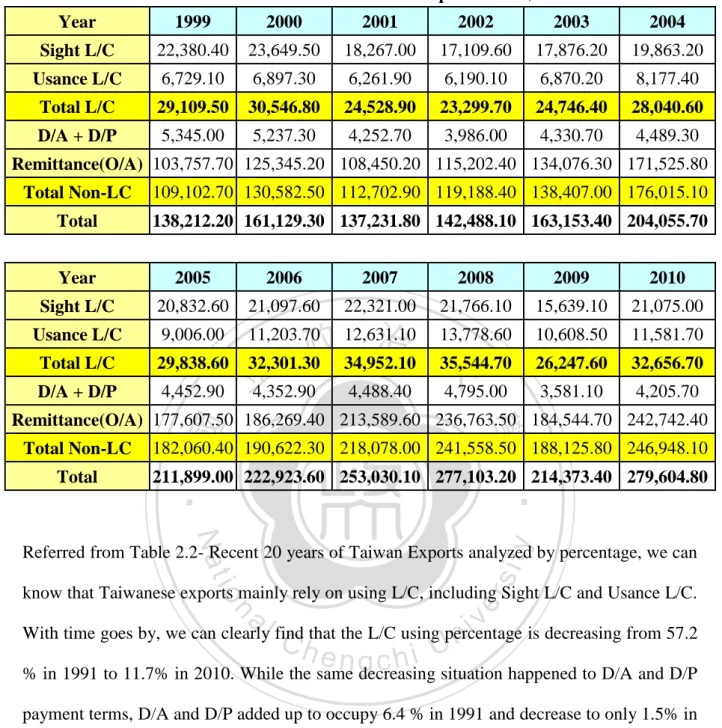
(14) In order not to get out of market in one-time and operate continuously, the best way for companies is taking action on risk aversion. Companies have to know the real-time situation of outside environment, including Macro-economy, trading country and market and match with their specialty and condition to completely understand what kind of risk they are facing now. By doing so, they would know how to make good use of financial tools, such as Export Insurance, Export Credit, International Factoring Services, and Stand-by LC, to cover trading risk, funding gap, and exchange rate risk. Through the financial tools of international trade, companies undoubtedly can lower down. 治 政 the operating risk as well as strengthen financial structure 大 and cash flow control. 立 Furthermore, applying well of these financial tools can upgrade the power of individual ‧ 國. 學. enterprises and finally increase the competitiveness of Taiwan in the field of International. Nat. sit. y. ‧. Trade, which match the final purpose of this paper.. io. er. The topic is related to the payment terms of international trade, especially focus on exports of. al. Taiwan. This does not mean that imports of Taiwan is not important for research, but because. n. iv n C Taiwan exports are more directly related growth in the past and still occupy h eton economic gchi U irreplaceable position of government policy and economic target. Therefore, I would like to strengthen for Taiwan exports and try to study deeper to see the improvement or solutions which may benefit Taiwanese exporters and local economy as well.. Historically speaking, Taiwanese exporters did very well in the field of International Trade. However, they have been facing a lot of risk while doing business with foreign buyers, such as trading risk, cash flow risk, and exchange rate risk. If exporters could not manage the risk well, they might suffer huge loss not just the delivered goods, but also the advanced. 5.
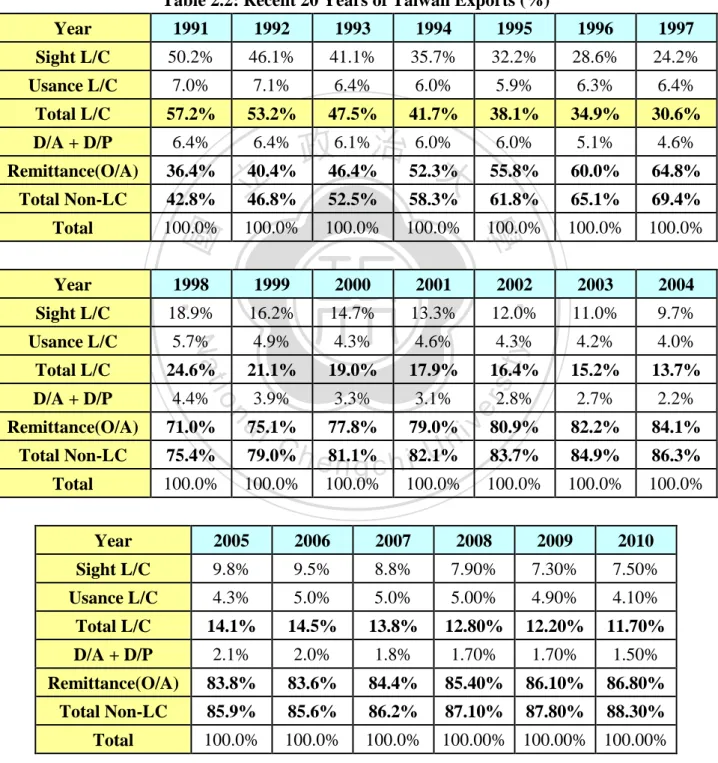
(15) investment-suck cost6 for the preparation of materials and products. Therefore, how to deal with the trading-related risk has been an unavailable and important issue for Taiwanese exporters. In section 2, the recent trend of International Trade will be introduced and analyzed. Also, the most common and useful payment terms in the real world will be introduced and explained, with focus on the most popular payment terms: Document against Payment, Document against Acceptance, and Open Account. Finally, the three major risks will be addressed with detailed explanation.. The remainder of the paper is organized as follows: Section 3 discusses the literature review. 治 政 beginning with an overview of political and credit risk. 大 In addition, relevant studies 立 pertaining to different solutions in the risk aversion, such as Factoring and Export Insurance ‧ 國. 學. will be examined and discussed. Regarding the solution for risk aversion, which will be. ‧. discussed in Section 5 will depend on the based knowledge of real practice. Last but not least,. sit. y. Nat. Section 6 presents the difficulty for Taiwanese Exporters when dealing with international. io. n. al. er. trade with conclusion and recommendation of the study.. Ch. engchi. 6. i Un. v. Sunk costs are retrospective costs that have already been incurred and cannot be recovered. http://en.wikipedia.org/wiki/Sunk_costs. 6.
(16) 2. Recent Trend and Modes of Non-LC Payment Terms. 2.1. Recent Trend of International Trade Each company has its own capital funded by its shareholders. No matter how large a company could be, its capital is still limited to some amount. Therefore, a company shall leverage its limited resources, including funding and human resources, to the maxima utility. Regarding funding need for general operations, most companies would borrow money from banks or other financial institution so that they could handle business over the limited capital. 政 治 大 credit policy or culture. Some companies keep their trading policy conservative, simply 立 capacity. As for foreign trades, companies would have different policies depending on their. ‧ 國. 學. taking the order with payment term of T/T7 100% in advance before delivery. However, in addition to price competition, most companies take action on non-price competition, such as. ‧. providing longer payment terms with loose limitation. There are four major types of payment. Nat. sit. y. terms ordered from the lowest risk (L/C) to the highest risk (O/A): Letter of Credit (L/C),. n. al. i Un. (O/A). Each payment term will be detailed discussed later.. Ch. engchi. er. io. Document against Payment (D/P), Document against Acceptance (D/A), and Open Account. v. Since most companies have their own credit control to secure their capital and assets, it is difficult for them to trust unknown buyers and do business through international trade. Except the first try out order paying by cash, most companies would step-by step follow the secure procedure to do business with foreign buyers. The securest and the most popular financial tools for Taiwanese exporters are to require foreign buyers to issue Letter of Credit (L/C) with the beneficiary of Taiwanese exporters. However, banks will charge foreign buyers for. 7. Telegraphic Transfer or Telex Transfer, often abbreviated to TT, is an electronic means of transferring funds overseas. A transfer charge is collected while sending money. http://en.wikipedia.org/wiki/Telegraphic_transfer. 7.
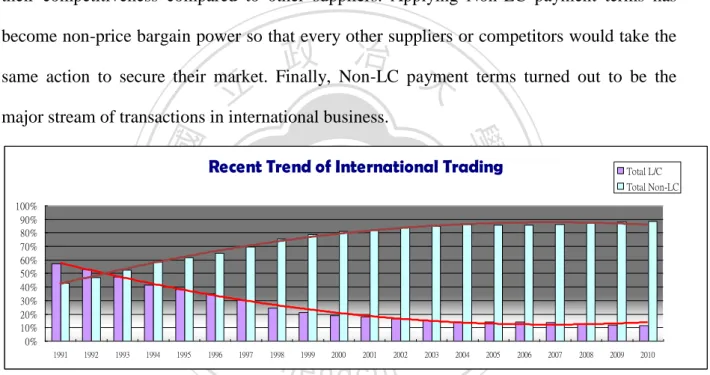
(17) service fees by issuing L/C. Furthermore, depending on different buyers, banks may ask for fixed deposits or real estates as the collateral before issuing L/C to foreign buyers. It seems inconvenient and costly for foreign buyers to issue L/C from banks. Therefore, with market goes more and more competitive, Taiwanese exporters have to start leveraging Non-L/C payment terms, such as D/A, D/P, and O/A, to attract potential buyers and boost volume of sales as well as increase their competitiveness.. Based on the yearly exports announcement of the Central Bank of Republic of China, the recent trend of International Trade by the payment term category- Sight L/C8, Usance L/C9, D/A + D/P, and Remittance(O/A). 立. 10. 治 政 are all listed as the 大 following Table 2.1 and Table 2.2.. From 1999 to 2010, it is clear that the total trading amount grew by 102.3% (From US$. ‧ 國. 學. 22,380.4 to US$ 279,604.8 million). This huge growth in exports double confirms Taiwanese. ‧. economic miracles depending on every single industry with widespread product lines. n. al. er. io. sit. y. Nat. marketing all over the world.. Ch. engchi. 8. i Un. v. Sight L/C: A letter of credit made payable to a beneficiary upon presentation to the opener of conforming documents. http://financial-dictionary.thefreedictionary.com/Sight+Letter+of+Credit 9 Usance L/C: A letter of credit payable at a determined future date after presentation of conforming documents. http://financial-dictionary.thefreedictionary.com/Usance+Letter+of+Credit 10 Remittance (O/A) refers to the Advance Payment before delivery and Open Account after delivery. In practice, except few irreplaceable hot-selling products using the Advance Payment terms, most trades rely on Open Account payment terms.. 8.
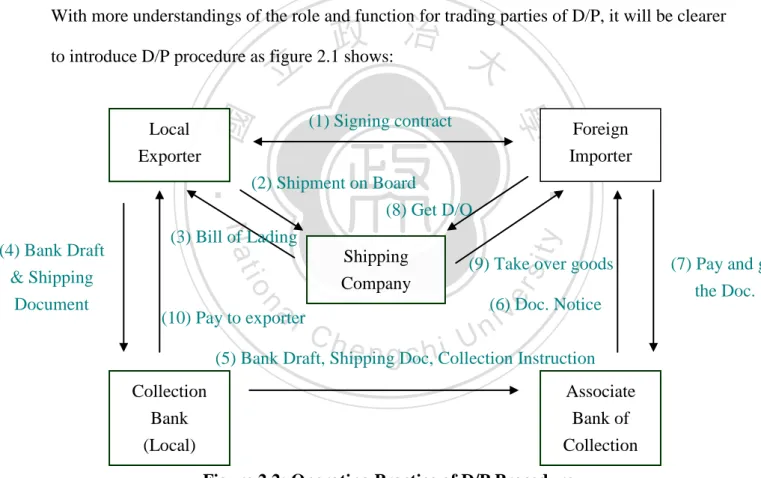
(18) Table 2.1: Recent 12 Years of Taiwan Exports in US$ Million Year. 1999. 2000. 2001. 2002. 2003. 2004. Sight L/C. 22,380.40. 23,649.50. 18,267.00. 17,109.60. 17,876.20. 19,863.20. Usance L/C. 6,729.10. 6,897.30. 6,261.90. 6,190.10. 6,870.20. 8,177.40. Total L/C. 29,109.50. 30,546.80. 24,528.90. 23,299.70. 24,746.40. 28,040.60. D/A + D/P. 5,345.00. 5,237.30. 4,252.70. 3,986.00. 4,330.70. 4,489.30. Remittance(O/A) 103,757.70 125,345.20 108,450.20 115,202.40 134,076.30 171,525.80 Total Non-LC. 109,102.70 130,582.50 112,702.90 119,188.40 138,407.00 176,015.10. Total. 138,212.20 161,129.30 137,231.80 142,488.10 163,153.40 204,055.70. Year. 2005. 2006. 2007. 2008. 2009. 2010. Sight L/C. 20,832.60. 21,097.60. 22,321.00. 21,766.10. 15,639.10. 21,075.00. Usance L/C. 9,006.00. 10,608.50. 11,581.70. Total L/C. 29,838.60. 26,247.60. 32,656.70. D/A + D/P. 4,452.90. 3,581.10. 4,205.70. 12,631.10 治 13,778.60 政 32,301.30 34,952.10 35,544.70 大 立 4,352.90 4,488.40 4,795.00 11,203.70. ‧ 國. 學. Remittance(O/A) 177,607.50 186,269.40 213,589.60 236,763.50 184,544.70 242,742.40 182,060.40 190,622.30 218,078.00 241,558.50 188,125.80 246,948.10. Total. 211,899.00 222,923.60 253,030.10 277,103.20 214,373.40 279,604.80. ‧. Total Non-LC. y. Nat. io. sit. Referred from Table 2.2- Recent 20 years of Taiwan Exports analyzed by percentage, we can. n. al. er. know that Taiwanese exports mainly rely on using L/C, including Sight L/C and Usance L/C.. Ch. i Un. v. With time goes by, we can clearly find that the L/C using percentage is decreasing from 57.2. engchi. % in 1991 to 11.7% in 2010. While the same decreasing situation happened to D/A and D/P payment terms, D/A and D/P added up to occupy 6.4 % in 1991 and decrease to only 1.5% in 2010. However, the only trend that increases is the payment terms of Open Accounts. As referred to the chart, Non-LC Trading increased from 42.8% in 1991, to 88.3% of total exports in 2010. Therefore, we can conclude that the payment term of Non-LC, mostly Open Account deals, has become the major stream of International Trade not simply in the recent years, but also in the future. The reason that O/A term become the most popular trading term is mainly due to the advantages of convenience and cost-efficiency. Nevertheless, using more convenient and economical way of payment terms, such as using D/A term or O/A term 9.
(19) would facilitate the trading activities at the same time face higher risk of insolvency. It goes without saying that companies shall be more prudent with higher attention for those Non-L/C trading deals. Therefore, the paper will focus on Non-LC payment terms to match the developing trend of International Trades.. Table 2.2: Recent 20 Years of Taiwan Exports (%) Year. 1991. 1992. 1993. 1994. 1995. 1996. 1997. Sight L/C. 50.2%. 46.1%. 41.1%. 35.7%. 32.2%. 28.6%. 24.2%. Usance L/C. 7.0%. 7.1%. 6.4%. 6.0%. 5.9%. 6.3%. 6.4%. Total L/C. 57.2%. 53.2%. 47.5%. 41.7%. 34.9%. 30.6%. D/A + D/P. 6.4%. 6.0%. 5.1%. 4.6%. Remittance(O/A). 36.4%. 55.8%. 60.0%. 64.8%. Total Non-LC. 42.8%. 6.1%治 6.0% 政 大 40.4% 46.4% 52.3% 立 46.8% 52.5% 58.3%. 38.1%. 61.8%. 65.1%. 69.4%. Total. 100.0%. 100.0%. 100.0%. 100.0%. 100.0%. 100.0%. Year. 1998. 1999. 2000. 2001. 2002. 2003. 2004. 16.2%. 14.7%. 13.3%. 12.0%. ‧. 11.0%. 9.7%. Usance L/C. 5.7%. 4.9%. 4.3%. 4.6%. 4.3%. 4.2%. 4.0%. Total L/C. 24.6%. 21.1%. 19.0%. 17.9%. 16.4%. 15.2%. 13.7%. D/A + D/P. 4.4%. 3.9%. 3.3%. 3.1%. 2.8%. 2.7%. 2.2%. Remittance(O/A). 71.0%. 82.2%. 84.1%. Total Non-LC. 75.4%. 84.9%. 86.3%. Total. 100.0%. 100.0%. 100.0%. er. io. sit. y. 學. 18.9%. Nat. 100.0%. Sight L/C. ‧ 國. 6.4%. n. a75.1% l C 77.8% 79.0%n i v 80.9% 79.0%h e81.1% i U 83.7% n g c h 82.1% 100.0%. 100.0%. 100.0%. 100.0%. Year. 2005. 2006. 2007. 2008. 2009. 2010. Sight L/C. 9.8%. 9.5%. 8.8%. 7.90%. 7.30%. 7.50%. Usance L/C. 4.3%. 5.0%. 5.0%. 5.00%. 4.90%. 4.10%. Total L/C. 14.1%. 14.5%. 13.8%. 12.80%. 12.20%. 11.70%. D/A + D/P. 2.1%. 2.0%. 1.8%. 1.70%. 1.70%. 1.50%. Remittance(O/A). 83.8%. 83.6%. 84.4%. 85.40%. 86.10%. 86.80%. Total Non-LC. 85.9%. 85.6%. 86.2%. 87.10%. 87.80%. 88.30%. Total. 100.0%. 100.0%. 100.0%. 100.00% 100.00% 100.00%. 10.
(20) Below figure clearly shows the recent trend of international trading classified by LC and Non-LC payment terms for past 20 years. The development trend is clear that LC deals decrease quickly from year 1991 to year 2004 and steadily on 15% from year 2004 to year 2010. However, Non LC deals increase sharply from year1991 to year 2004 and keep the level over 85% of the whole exports from 2004 until now. The turning point is around year1992 to year 1993, which Non-LC trading terms first surpass LC term. In other words, since year1992, exporters are more willing to apply more risky payment terms to increase their competitiveness compared to other suppliers. Applying Non-LC payment terms has become non-price bargain power so that every other suppliers or competitors would take the. Recent Trend of International Trading. ‧ y. sit. n. al. er. io. 1991. 1992. 1993. 1994. 1995. Total L/C Total Non-LC. Nat. 100% 90% 80% 70% 60% 50% 40% 30% 20% 10% 0%. 學. ‧ 國. 治 政 same action to secure their market. Finally, Non-LC payment 大 terms turned out to be the 立 major stream of transactions in international business.. 1996. 1997. Ch 1998. 1999. 2000. 2001. 2002. engchi. i Un 2003. v. 2004. 2005. 2006. 2007. 2008. 2009. 2010. Figure 2.1: Recent Trend of International Trading for Past 20 Years. 2.2. Modes of Non-LC Payment Terms-D/P Among the major types of trading terms, L/C is undoubted the lowest risk of payment term with the pay-back guarantee and credibility of issuing bank. However, issuing L/C would unavoidably increase financial costs for foreign buyers as well as make the trading procedures more complicated and time wasting due to banks regulations. As the 2010 figures showed above, only 11.7% of trades leveraged L/C to facilitate the payment procedure. The trend is clear that Taiwanese exporters need a tool with simplified operating procedure and 11.
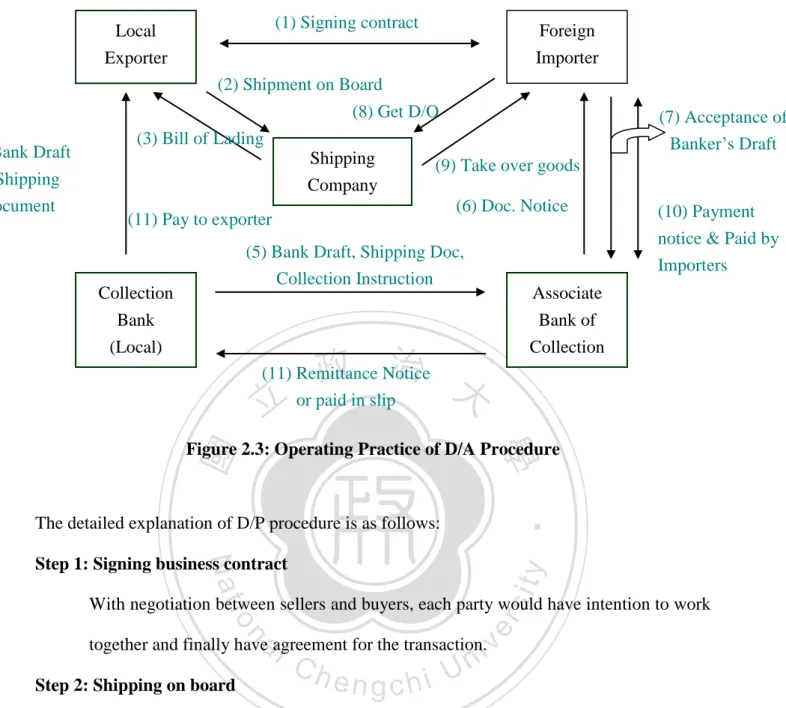
(21) financial cost reduction. Thus, the risk concern shall be transferred from issuing banks to foreign buyers and undoubtedly the operation of Non-LC deals have become more and more important at the past few years.. The second payment term with comparatively lower risk is Document against Payment (D/P). Generally speaking, D/P is an arrangement under which an exporter instructs the presenting bank to hand over shipping and title documents to the importer only if the importer fully pays the accompanying bill of exchange or draft. D/P is also called cash against documents.. 治 政 There are at least 5 parties involved in the D/P transaction, 大 such as Taiwanese Exporter, 立 Foreign Importer, Shipping Company, Collection Bank, and Associate Bank of Collection. ‧ 國. 學. Each party is very important and has its irreplaceable role to facilitate the trading deal at. ‧. different stages of D/P procedure. Before going through the trading procedure, I would. er. io. sit. y. Nat. explain function of each party as the based knowledge as the following:. al. (1) Local Exporter & Foreign Importer. n. iv n C The function of trading is to bridgehthe difference andUcommunicate different products or engchi prices all over the world. As long as the difference exists, the trading tractions between exporters and importers will continue to suit each other’s need. Therefore, Local Exporters and Foreign Importers are the very first and important parties to start and bridge the transaction.. (2) Collection Bank D/P is the second lower risk for trading payment term because of Collection Bank. In real practice, exporters shall prepare many documents, including commercial invoice, packing list, banker’s bill, etc., before delivery. Collection Bank will be the one responsible for. 12.
(22) the document accuracy as well as preparing the collection notice to Associate Bank of Collection with all shipping documents by mail. (3) Associate Bank of Collection Based on foreign country, the role of Associate Bank of Collection is to review the collection notice from Collection Bank. If the notice meet the shipping documents, Associate Bank of Collection will notify a foreign importer to pay. After making the payment, foreign importers will receive Bill of document for them to take the cargo.. With more understandings of the role and function for trading parties of D/P, it will be clearer. (1) Signing contract. Local Exporter. ‧. y. sit. n. al. er. io. & Shipping Document. Foreign Importer. (2) Shipment on Board (8) Get D/O (3) Bill of Lading Shipping (9) Take over goods Company (6) Doc. Notice (10) Pay to exporter. Nat. (4) Bank Draft. 學. ‧ 國. 治 政 to introduce D/P procedure as figure 2.1 shows: 大 立. Ch. engchi. i Un. v. (7) Pay and get the Doc.. (5) Bank Draft, Shipping Doc, Collection Instruction Collection Bank (Local). Associate Bank of Collection. Figure 2.2: Operating Practice of D/P Procedure. The detailed explanation of D/P procedure is as follows: Step 1: Signing business contract With negotiation between sellers and buyers, each party would have intention to work together and finally have agreement for the transaction.. 13.
(23) Step 2: Shipping on board Following the contract, exporters have to prepare the shipment on board. Step 3: Taking B/L After shipment on board, the shipping boat will issue “Mate’s Receipt”, which exporters can use to exchange for Bill of Lading (B/L) from the shipping company. Step 4: Preparing shipping documents to Collection Bank With all the documents, including banker’s bill, B/L, Invoice, Packing list, and other shipping document, at hand, exporter shall prepare the complete shipping documents to Collection Bank.. 治 政 大 documents to Associate Step 5: Preparing collection order and mail all the shipping 立 Bank of Collection ‧ 國. 學. After receiving shipping documents from exporters, the collection bank will follow. ‧. the instruction of exporter to type the collection order and mail all the documents to. sit. y. Nat. foreign Associate Bank of Collection.. io. al. er. Step 6: Notifying importers that the arrival of shipping documents. n. Verifying the accuracy of collection order with shipment documents and notifying importers.. Ch. engchi. i Un. v. Step 7: Making the payment and taking the documents If importers accept the notice from Associate Bank of Collection, then importers will pay for the shipment and take the documents away for cargo. Step 8 & 9: Using bill of document to exchange D/O11 After paying for the documents, importers can use bill of documents to exchange D/O for taking over goods. Step 10: Transferring payment to Exporters. 11. D/O is the abbreviation of Delivery Order, which is the certificate for importers to take over shipments. http://article.bridgat.com/big5/guide/process/200804/205.html. 14.
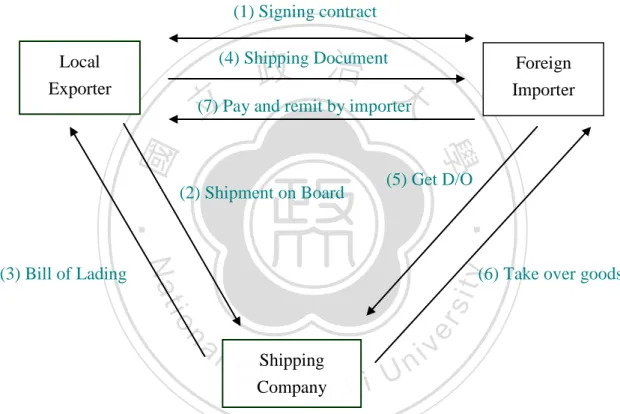
(24) Once received the payment from importers, Associate Bank of Collection will give credit advice to Collection Bank. Then, Collection Bank will transfer the payment to local exporters.. 2.3. Modes of Non-LC Payment Terms-D/A Document against Acceptance (D/A) is another payment term through banks. However, the major difference between D/A and D/P is that importers do not need to pay cash immediately for shipping documents, instead simply accept the banker’s draft and commit to pay in 30, 45, 60, or 90 days later depending on different payment conditions. In the case, importers would. 治 政 have more room for selling the products they imported with 大less funding pressure. 立 Furthermore, if Taiwanese exporters want to be more competitive than other foreign ‧ 國. 學. exporters in the same condition, except price and quality, Taiwanese exporters should go for. ‧. D/A terms to be more elastic of payment terms so that foreign importers would prefer to do. al. er. io. sit. y. Nat. business with Taiwanese exporters.. n. Figure 2.2 is the practice of D/A procedure.. Ch. engchi. 15. i Un. v.
(25) (1) Signing contract. Local. Foreign Importer. Exporter (2) Shipment on Board (8) Get D/O (4) Bank Draft & Shipping Document. (7) Acceptance of Banker’s Draft. (3) Bill of Lading Shipping Company. (9) Take over goods (6) Doc. Notice. (11) Pay to exporter. (5) Bank Draft, Shipping Doc, Collection Instruction. Collection Bank (Local). (10) Payment notice & Paid by Importers. Associate Bank of Collection. 政 治 大. (11) Remittance Notice or paid in slip. 立. ‧. ‧ 國. 學. Figure 2.3: Operating Practice of D/A Procedure. The detailed explanation of D/P procedure is as follows:. Nat. sit. y. Step 1: Signing business contract. n. al. er. io. With negotiation between sellers and buyers, each party would have intention to work. i Un. together and finally have agreement for the transaction. Step 2: Shipping on board. Ch. engchi. v. Following the contract, exporters have to prepare the shipment on board. Step 3: Taking B/L After shipment on board, the shipping boat will issue “Mate’s Receipt”, which exporters can use to exchange for Bill of Lading (B/L) from the shipping company. Step 4: Preparing shipping documents to Collection Bank With all the documents, including banker’s bill, B/L, Invoice, Packing list, and other shipping document, at hand, exporter shall prepare the complete shipping documents to Collection Bank.. 16.
(26) Step 5: Preparing collection order and mail all the shipping documents to Associate Bank of Collection After receiving shipping documents from exporters, the collection bank will follow the instruction of exporter to type the collection order and mail all the documents to foreign Associate Bank of Collection. Step 6: Notifying importers that the arrival of shipping documents Verifying the accuracy of collection order with shipment documents and notifying importers. Step 7: Acceptance of banker’s draft. 治 政 This step is different from D/P term, because what 大importers need to do is to accept 立 the banker’s draft and guarantee to pay in the future. Taking D/A 30 as an example, ‧ 國. 學. which is 30 days after acceptance (D/A 30 days), importers can take the shipping. ‧. document first and pay for the imported products 30 days later. Therefore, importers. sit. y. Nat. have more room in terms of time and funding to deal with the products.. io. al. er. Step 8 & 9: Using bill of document to exchange D/O. n. After paying for the documents, importers can use bill of documents to exchange D/O for taking over goods.. Ch. engchi. i Un. v. Step 10: Payment notice & Paid by Importers When the appointed payment date is due, Associate Bank of Collection will notify importers again and ask importers to perform the acceptance and make the payment. Step 11: The payment transfer to exporters Once received the payment from importers, Associate Bank of Collection will give credit advice to Collection Bank. Then, Collection Bank will transfer the payment to local exporters.. 2.4. Modes of Non-LC Payment Terms-O/A 17.
(27) As referred to Table 2.2, the percentage of O/A terms has reached to 86.8% of the whole trading amount and become the most popular payment term of credit sale.. Before addressing the operation of O/A term, here are some must-know features of this payment term as the following three points:. (1) Saving time The reason that exporters and importers are willing to take this term is strong trust and belief within each other. Exporters will directly send out all the shipping documents to. 治 政 foreign importers after delivery without any condition.大 In the case, banks involve little, 立 only except the remittance transfer through the banking system. Therefore, both exporters ‧ 國. 學. and importers will save time of the operation for the review of shipping documents as. sit. y. Nat. (2) Lowering costs. ‧. well as the delivery of documents.. io. er. If banks can be skipped for the O/A trading process, there is no doubt that charges from. al. banks will be saved. The saving cost might not be that huge. In the case of fee charging. n. iv n C for Taiwanese banks, banks will normally 0.05 % of the trading amount for h e n charge gchi U. service fees. Not to mention another charge from Associate bank of collection. In Chinese old sayings: “A penny saved is a penny earned”, both exporters and importers will try their best to save money especially in this challenging market with little profits. (3) Higher risk Although the way of doing transaction without the involvement of banks can save time and lower cost of both exporters and importers, the elastic and open room sometimes will put both parties into the danger of insolvency or commercial disputes. Except the agreement of business contract signed by exporters and importers, there are no other effective rules to regulate the behavior of trading parities. In other words, some bad 18.
(28) trading parties would leverage the elasticity of O/A trading term to cheat and default on purpose for the interests of themselves. Therefore, when taking O/A as the payment term, exporters or importers shall be more prudent and pay attention to every detail so that they would not lose the whole cargo or products simple due to a little bit saving of costs.. After knowing the features of Open Account, we can articulate the easier figure for the transaction as Figure 2.3. (1) Signing contract. 政 治 大 (7) 立Pay and remit by importer (4) Shipping Document. (2) Shipment on Board. (5) Get D/O. ‧ y. Nat. io. sit. (6) Take over goods. n. al. er. (3) Bill of Lading. Foreign Importer. 學. ‧ 國. Local Exporter. ni C hShipping U engchi Company. v. Figure 2.4: Operating Practice of O/A Procedure. The detailed explanation of O/A operation is as follows: Step 1: Signing business contract During O/A transaction, the business contract is extremely important, because this is almost the only guideline and principle for both parties to follow and obey. Therefore, the very important first step is to sign a fair contract without disputes or vague articles so that each party can perform contract clearly and legitimately. Step 2: Shipping on board 19.
(29) As the D/P and D/A transaction, exporters will prepare the shipment on board. Step 3: Taking B/L After shipment on board, the shipping boat will issue “Mate’s Receipt”, which exporters can use to exchange for Bill of Lading (B/L) from the shipping company. Step 4: Directly transfer shipping documents to foreign importers Since documents do not need to go through at least two banks (Bank of Collection & Associate Bank of Collection), what exporters need to do is to transfer the shipping documents to foreign importers. Step 5 & 6: Using bill of document to exchange D/O. Step 7 Importers pays and directly remit to exporters. 學. ‧ 國. 治 政 After paying for the documents, importers can use 大 bill of documents to exchange D/O 立 for taking over goods. ‧. When the appointed payment date is due, importers have to make the payment. 2.5. Major Risks Involvedain International Trade. er. io. sit. y. Nat. directly to exporters.. n. iv l C n Before discussing the risk trading parties face, one thing needs to be emphasized is that h emay ngchi U no matter how high or low the risk it is, exporters and importers have to be selective to the counter party. If they find the right companies to cooperate with, there shall be less and less problems or defaults generated during international trades. However, from the real practices of D/P, D/A, and O/A payment terms, there will be unavoidably three major risk being generated and may cause trading barriers of International Trade.. From the perspectives of Taiwanese exporters, they will face risks explained as the following three categories:. 20.
(30) 2.5.1. Trading Risk In the transactions of Non-LC deals, all the transactions mainly rely on the credit of foreign buyers. Taiwanese exporters should be selective for the trading party and pay attention to the its ability of making money in terms of revenues and profits as well as its financial structures, including current ratio, quick ratio, debt to equity ratio, and so on. Besides, the prospects of industry are also very important. If foreign buyers were in sun-setting industry, Taiwanese exporters would better do the business with more concern of safety, such as asking for guarantee or collateral as the protection. Therefore, foreign buyers could default the payment by their inability of making the payment as the below reasons: 12. (1) Bankruptcy or insolvency (2) Restructuring13. ‧ 國. 學. (3) Takeover14. 立. 政 治 大. ‧. (4) Financial problems of an individual importer. sit. y. Nat. io. er. Another possible reason for foreign buyers default is the lack of willingness to pay. In the. al. case, foreign buyers still have ability to make the payment. However, they may not have. n. iv n C profits in the transaction due to markethchange and falling e n g c h i U price. Sometimes, buyers will try to find some reasons to refuse the payment and finally cause commercial disputes.. Last but not least for trading risk is the political risk and economic risk in importing country. The most possible reasons for the political risk are as follows: 12. 13. 14. Bankruptcy or insolvency is a legal status of a person or an organization that cannot repay the debts it owes to its creditors. http://en.wikipedia.org/wiki/Bankruptcy Restructuring is the corporate management term for the act of reorganizing the legal, ownership, operational, or other structures of a company for the purpose of making it more profitable, or better organized for its present needs. http://en.wikipedia.org/wiki/Restructuring In business, a takeover is the purchase of one company (the target) by another (the acquirer, or bidder). In the UK, the term refers to the acquisition of a public company whose shares are listed on a stock exchange, in contrast to the acquisition of a private company. http://en.wikipedia.org/wiki/Takeover. 21.
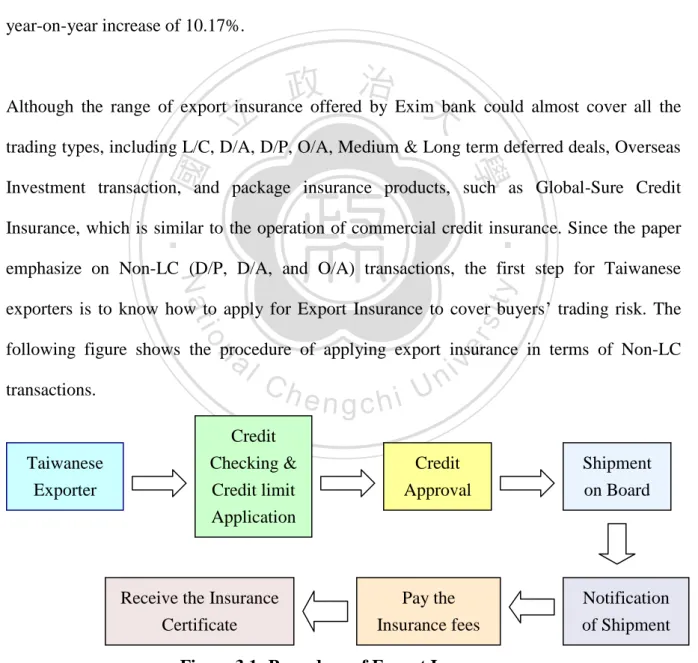
(31) (1) War (2) Internal Disorder (3) Foreign Aggression (4) Revolution (5) Foreign Exchange Control. This risk of the above-mentioned events could be treated as local systematic risk. Nobody can foresee the timing or serious situation before it really happened. Therefore, for Taiwanese exporters, it is better to trade with developed or developing countries with comparatively. 治 政 stable political system or democracy to reduce the political大 risk. 立 ‧ 國. 學. 2.5.2. Cash Flow Risk. ‧. To attract more orders from foreign buyers, most Taiwanese exporters tend to offer D/A or. sit. y. Nat. O/A terms, which could be treated as a way of deferred payment as a favor to foreign buyers.. io. er. However, in general, exporters would prepare materials and manufacture from materials to. al. n. products for sale. Therefore, exporters have to invest partial amounts for material preparation. ni Ch and manufacturing costs to their suppliers. U engchi. v. If the payment date being deferred for a long time, such as D/A 180 days which applied a lot in the fertilizing industry, exporters shall better ask the similar term as opposed to their suppliers to balance the cash flow. When the situation goes bad, or exporters have less bargain power against foreign importers than suppliers, sometimes exporters may suffer a situation of illiquidity or bankruptcy with profits in income statement. To prevent the situation, exporters shall keep the concept in mind “Cash is King” for some risky deals. To be more precise, Taiwanese exporters can follow the below equation and keep their eyes on the number as the following formula: 22.
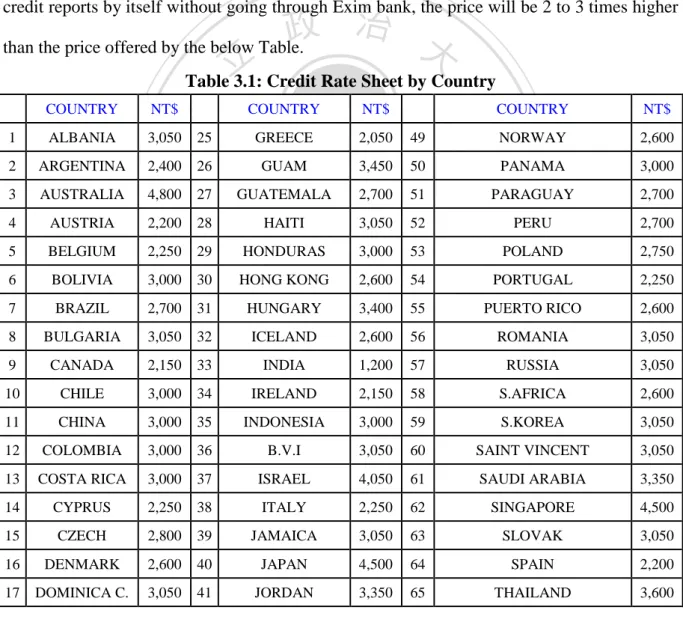
(32) Financing Gap = Net Cash Flow = Cash Flow Out – Cash Flow In If Financing Gap > 0, companies need cash for general purpose. If Financing Gap < 0, companies need to make good use of their money as investment.. Therefore, no matter how healthy the financial structures exporters or importers are, they have to keep the financing gap negative so that the money generated from sales could. 政 治 大. actually turn into cash for general purpose of the operation.. 2.5.3. Exchange Rate Risk. 立. ‧ 國. 學. Exchange rate risk, as per discussion, is another unavoidable risk when doing trades. As long. ‧. as the time difference exists, there will be Exchange rate risk involved in the transaction.. sit. y. Nat. However, the longer the time lasts, the bigger the risk exporters will expose. For example, if. io. er. an exporter signed a contract of US$ 100,000 (= NT$ 3,000,000) with a foreign importer at. al. the exchange rate 1US equals to NT 30. Both parties agreed the payment term of O/A 120. n. iv n C days after shipment. The exporter shall days after shipment for the payment from h wait e n 120 gchi U the importer. However, when the payment date is due, the Exchange rate has changed to 1US equals to NT 28. Then, the exporter still received the payment of US$ 100,000, but when the exporter exchange the payment from USD to TWD, the company would only get NT$ 2,800,000, which cause the exporter to loss NT$ 200,000 because of the appreciation of TWD. The 6.67% loss may not be a huge amount of money compared to the whole shipment. However, in the real world, it is difficult for exporters to sacrifice 6.67% profits in the extremely challenging market simple because of the Exchange rate risk. In the latter section, there will be some financial tools helping for avoiding the above-mentioned risk.. 23.
(33) 3. Financial Tools for Risk Aversion. About the three major risks mentioned in the early section, none of them could be 100% natural hedged by special arrangements of transactions. Although Trading Risk, Cash Flow Risk, and Exchange Rate Risk are all important for exporters, the most concern for exporters will still be the Trading Risk. The most difficult part to have a successful deal is to know that who is the right partner to cooperate with and who will keep promise, instead of playing games while trading. Therefore, this section will focus on dealing with the Trading Risk by. 政 治 大. introducing three solutions, such as Export Insurance, International Factoring Service, and. 立. Stand-by Letter of Credit.. ‧ 國. 學. 3.1. Export Insurance. ‧. In order to have comprehensive understanding of export insurance, a trading specialized bank,. Nat. sit. y. The Export-Import Bank of the Republic of China (Exim bank), shall be introduced as the. n. al. er. io. base knowledge of the financial service- Export Insurance.. Ch. engchi. i Un. v. Exim bank was established on January 11, 1979, under the Export-Import Bank of the Republic of China Act. It is a state-owned bank supervised by the Ministry of Finance. Its mission is to promote export trade and develop the economy, while its vision is to strengthen trade finance and assist external trade. Exim bank’s main objective is to support government economic and trade policies by providing financing, guarantees and export credit insurance to help enterprises expand external trade and overseas investments. It also increases international cooperation to ensure the steady and continuous development of Taiwan's economy.. 24.
(34) The export credit insurance offered by Exim bank includes Comprehensive Export Credit Insurance for document against payment (D/P) and document against acceptance (D/A) transactions, Comprehensive Export Credit Insurance for open account (O/A) transactions, Export Credit Insurance for Small and Medium Enterprises, Export Credit Insurance for letter of credit (L/C) transactions, Medium- and Long-term Deferred Payment Insurance, Overseas Investment Insurance, and Global-Sure Credit Insurance. According to the internal information, Export credit insurance coverage of 2010 totaled NT$63,957 million, with a year-on-year increase of 10.17%.. 治 政 Although the range of export insurance offered by Exim 大bank could almost cover all the 立 trading types, including L/C, D/A, D/P, O/A, Medium & Long term deferred deals, Overseas ‧ 國. 學. Investment transaction, and package insurance products, such as Global-Sure Credit. ‧. Insurance, which is similar to the operation of commercial credit insurance. Since the paper. sit. y. Nat. emphasize on Non-LC (D/P, D/A, and O/A) transactions, the first step for Taiwanese. io. al. er. exporters is to know how to apply for Export Insurance to cover buyers’ trading risk. The. n. following figure shows the procedure of applying export insurance in terms of Non-LC transactions.. Taiwanese Exporter. Ch. engchi. Credit Checking & Credit limit Application. i Un. v. Credit Approval. Receive the Insurance Certificate. Pay the Insurance fees. Shipment on Board. Notification of Shipment. Figure 3.1: Procedure of Export Insurance. Owning to the reason that Exim bank is a 100% stated-owned bank with specialized focus 25.
(35) and mission of government policy, Exim bank is not allowed to support foreign enterprises or OBU registered companies. Therefore, Taiwanese exporters are the only focus and target for Exim bank to serve. As the figure shows, Taiwanese exporters have to provide credit reports to Exim bank so that the credit limit could be underwritten by Exim bank. If exporters have no clue or channel to provide credit report, they could rely on the credit service through Exim bank by its group deal with cheaper price of credit reports. Table 3.115 is the Credit Reports Fees by Exim bank’s offer. No matter what countries the applicant like to inquire, the price range is generally from NT$ 1,200 to NT$ 4,800. However, if an applicant wants to inquire credit reports by itself without going through Exim bank, the price will be 2 to 3 times higher. 3,050. 25. GREECE. 2,050. 49. 2. ARGENTINA. 2,400. 26. GUAM. 3,450. 50. 3. AUSTRALIA. 4,800. 27. GUATEMALA. 2,700. 51. 4. AUSTRIA. 2,200. 28. HAITI. 3,050. 52. 5. BELGIUM. 2,250. 29. HONDURAS. 3,000. 53. 6. BOLIVIA. 3,000. HONG KONG. 2,600. 54. 7. BRAZIL. 2,700. 31. 8. BULGARIA. 3,050. 32. 9. CANADA. 2,150. 33. 10. CHILE. 3,000. 11. CHINA. 12. 30. NORWAY. 2,600. PANAMA. 3,000. PARAGUAY. 2,700. y. ALBANIA. NT$. PERU. 2,700. sit. 1. COUNTRY. POLAND. 2,750. PORTUGAL. 2,250. PUERTO RICO. 2,600. ROMANIA. 3,050. er. NT$. ‧. NT$. 學. COUNTRY. Nat. COUNTRY. io. ‧ 國. 治 政 than the price offered by the below Table. 大 立 Table 3.1: Credit Rate Sheet by Country. n. a lHUNGARY 3,400 55 i v n Ch ICELAND e n g c2,600 h i 56U INDIA. 1,200. 57. RUSSIA. 3,050. 34. IRELAND. 2,150. 58. S.AFRICA. 2,600. 3,000. 35. INDONESIA. 3,000. 59. S.KOREA. 3,050. COLOMBIA. 3,000. 36. B.V.I. 3,050. 60. SAINT VINCENT. 3,050. 13. COSTA RICA. 3,000. 37. ISRAEL. 4,050. 61. SAUDI ARABIA. 3,350. 14. CYPRUS. 2,250. 38. ITALY. 2,250. 62. SINGAPORE. 4,500. 15. CZECH. 2,800. 39. JAMAICA. 3,050. 63. SLOVAK. 3,050. 16. DENMARK. 2,600. 40. JAPAN. 4,500. 64. SPAIN. 2,200. 17. DOMINICA C.. 3,050. 41. JORDAN. 3,350. 65. THAILAND. 3,600. 15. The credit checking fees is referred from the website of The Export-Import Bank of R.O.C. www.eximbank.com.tw. 26.
(36) 18. DOMINICAN. 3,000. 42. KUWAIT. 3,350. 66. TRINIDAD & TOBAGO. 3,050. 19. ECUADOR. 3,000. 43. LUXEMBOURG. 3,000. 67. TURKEY. 1,800. 20. EGYPT. 3,350. 44. MALAYSIA. 3,150. 68. U.S.A.. 2,850. 21. FIJI. 3,200. 45. MEXICO. 3,050. 69. UNITED ARAB EMIRATES. 3,350. 22. FINLAND. 3,100. 46. MOROCCO. 2,800. 70. UNITED KINGDOM. 2,500. 23. FRANCE. 2,150. 47. NETHERLANDS. 2,250. 71. URUGUAY. 2,700. 24. GERMANY. 1,700. 48. NEW ZEALAND. 4,800. 72. VENEZUELA. 3,000. After applying the report, foreign credit agency will be mandated for making the latest report for Exim bank to decide whether the buyer is qualified enough to offer the risk credit. Once got the notification from Exim bank, exporters could insure the shipment after the on board. 政 治 大. date. Finally, Exim bank will issue Insurance Certificate and insurance receipt once exporters. 立. pay the premium. To sum up, Exim bank try to make the procedure as simple as it could be. ‧ 國. 學. so that each Taiwanese enterprises, no matter listed companies or SME, could enjoy the. er. io. sit. y. Nat. business.. ‧. government policy to benefit themselves from avoiding trading risk in the international. Last but not least, Export Insurance provides IDEAL services as the following:. n. al. (1) Inquire. Ch. engchi. i Un. v. Exporters can make good use of credit checking services to have deeper understandings of foreign buyers by cheaper price offered by Exim bank. Besides, if the insured amount of foreign buyer exceed to certain amount, now is NT$ three million, Exim bank will pay for the credit checking fees as a feedback of premium. (2) Diagnose Buyers’ credit will be verified by the Exim bank underwriters with no charge. Sometimes this is a good way to test whether the foreign buyer is a good one to cooperate with or a cheater or a fake company. The underwriting process is the best way for exporters to diagnose their buyers’ credits without actually knowing each other. 27.
(37) (3) Exposure Exporters will acquire the credit of buyers from Exim bank. The approved credit could be taken as a standard for internal control. If exporters sell goods below the credit limit, all of their shipment will be protected mostly (80% -90%) by the export insurance. (4) Administrate It is easy for a company to manage 10 or 20 buyers at the same time. However, it will become extremely difficult to manage over 50 buyers with different countries and culture backgrounds. The best way for companies to manage the buyers’ risk is to take Export Insurance as one of the must in Standard Operating Procedure. In that case, companies do. 治 政 not need to pay too much attention to the selection of buyer. 大 Instead, companies will have 立 more energy to develop their business. ‧ 國. 學. (5) Loss Indemnity. ‧. The most important of Export Insurance is the loss indemnity once buyers default. Exim. sit. y. Nat. bank is not a profit-oriented company, instead more willing to help Taiwanese companies.. io. er. Once suffered the situation of default, the problematic case will be discussed in Export. al. Insurance Committee, which is a fair and open committee, to decide the result of the. n. iv n C claim. In other words, loss indemnity is the most concern of Exim bank rather h efornclients gchi U than profits concern of commercial insurance company.. 3.1.1. Export Credit As for Cash Flow Risk and Exchange Rate Risk, Exim bank undoubtedly provides financial services, Export Credit, to reduce both Cash Flow Risk and Exchange Rate Risk. To keep it simple and easy, Taiwanese exporters do not need to provide any fixed deposits or collateral as payment protection, instead only provide Exim bank with Insurance Certificate and receipt, which are also issued by Exim bank. Then, exporters can drawdown the credit for funding right after shipment to avoid Cash Flow Risk and Exchange Rate Risk as well. Figure 3.2 28.
(38) shows the operating procedure of Export Credit for Taiwanese Exporters. Applying Credit of both Insurance & Loan. Providing Order or Contract. Get the residual (15-20%) once Importers paid. Funding for 80-85% of the shipment. Credit Approval. Shipment on Board. Drawdown Notice and application. Get Insurance Certificate & Receipt. Figure 3.2: Operating Procedure of Export Credit. 政 治 大 Based on the cover from Export 立Insurance, Taiwanese Exporters can apply Export Credit. ‧ 國. 學. without providing any other collateral. Furthermore, they are allowed to use their original banking account. This is a very different way compared to other commercial banks. In. ‧. general, banks is very much like to receive deposits as their low interest funding resources. Nat. sit. y. and lend the deposits out as banking loans to make profits. Therefore, it is very convenient to. n. al. er. io. apply Export Credit without going through troublesome account-opening procedures.. Ch. engchi. i Un. v. After signing contracts or getting the order from foreign buyers, exporters can apply both Insurance credit and loan credit. This doings can save time for standard banking procedure. Once got approval from both, exporters can deliver goods to foreign buyers and drawdown loan credit after shipment on board. Thereafter, Exim bank would provide 80 to 85% of total shipment, which are all covered by the credit line of Export Insurance. At the stage, exporters have already got the most part of future payments and naturally avoided Cash Flow Risk and Exchange Rate Risk at this moment.. For example, if the payment term is D/A 90 days after shipment, exporters will get the. 29.
(39) payment after 90 days from importers. Even with Export Insurance covered the political risk and credit risk of foreign buyers, Taiwanese exporters will still suffer Cash Flow Risk and Exchange Rate Risk in the coming 3 months. Therefore, if exporters could get the most part of payment (80-85 %) from Export Credit after shipment, it is convenient for them to avoid both risks simply by one action. After 90 days, importers will make the payment through the channel of Exim bank and corresponding bank. Finally, Exim bank will calculate the interests and procedure fees and remit the residual payment to exporters.. 3.2. International Factoring Service. 治 政 Like the function of export insurance, international factoring 大 provides the protection for 立 exporters. In general, factoring is defined as the purchase of account receivable on a ‧ 國. 學. non-recourse notification basis. The factor assumes to the client’s risk on credit-approved. ‧. sales and client’s customers are notified to pay the factor directly. The other definition is that. sit. y. Nat. the purchase of credit-approved account receivable from a seller without recourse and with. io. er. notification to the buyer.. al. n. iv n C factoring rely on credit sale h e mostly ngchi U. Following the definitions,. basis to sell products or. services. There are at least three participants for the service of factoring, such as Factors, exporter, and importer. Factors include import factor and export factor, mainly dealing with risk-taking and purchase business of account receivables. According to the location of factors, they could be classified export factor or import factor. An export factor is responsible for finding business and offer funding for local exporters; an import factor is responsible for receiving the payment and burden the financial risk of importers.. So far, there are three major organizations of international factoring. They are Factors Chain International (FCI), International Factors Group (IF Group), and Heller Group. FCI, held on 30.
(40) 1968, is currently the biggest organization with the exposure of more than 53 countries. General Rules for International Factoring16, the regulations of FCI, has already become the must-know guidelines in the field of international factoring.. 3.2.1. The Function of International Factoring There are four major function of factoring explained as follows: (1) Taking over the Credit Risk of Foreign Buyers Exporters could leverage factoring services to transfer 100% of buyer’s risk from exporters to factors. Except business disputes happened in the transaction, factors shall be. 治 政 responsible for the future payment once foreign importers 大 fail to make the repayment. 立 Therefore, covering risk of importers is the first function for factoring services. ‧ 國. 學. (2) Funding Purpose. ‧. Assignment of credit is the way to do factoring. Most factors provide exporters with. y. Nat. funding services. Besides, some exporters apply credit line of commercial banks by using. er. io. sit. their AR17 with factoring. Since all the AR is more or less guaranteed and strengthen the. al. payment ability by factors, banks are more willing to offer their credits without a doubt.. n. iv n C Therefore, using factoring is a goodhway to get the funding e n g c h i U not only from factors, but also from commercial banks. (3) Account Management and Collection Services. If a company involves in the field of international business for a certain period, it is natural for a company to steadily build up its clients’ pool. However, with the growing number of clients, it will turn out to be very difficult to manage all the clients by shipment. The client management and shipping information will all be taken care by factoring services. Moreover, factoring services also include troublesome AR collection work. In 16. FCI General Rules For International Factoring retrieved from http://bbs.sinotf.com/thread-2344-1-1.html 17 AR is the abbreviation of Account Receivables.. 31.
(41) every single deal, every factor will prepare Monthly Management Account Report for exporters so that exporters will understand the updated payment situation of each client and have ability to evaluate the credit adjustment of each client. (4) Providing Consulting Services of the Global Market Most factors are affiliates or associated companies of commercial banks. Besides, they all join one of the three factoring organizations with global connection. Therefore, exporters could make good use of international factors to not just take care of risk, but also get the business information of the importing countries. Therefore, consulting services and information sharing is another unique service of international factoring services.. 立. 政 治 大. 3.2.2. The Operation of International Factoring for O/A Term. ‧ 國. 學. For the international factoring service, there will be 2 payment terms, such as D/A term and. ‧. O/A term, suitable for the service. The operation of international factoring and steps of. n. al. er. io. sit. y. Nat. practices are explained as the following figure:. Ch. engchi. 32. i Un. v.
(42) (5) Signing Contract Local Exporter. (6) Goods & Shipping Documents. Foreign Importer. (7) Copy of Shipping Doc & NTR. (1) Credit Request & Copy of Shipping Doc. (9) Payment Reminders. (8) Advanced Funding. (4) Signing FA. (10) Final Payment (2) Credit Evaluation. (10)Final Payment (1) Credit Request. (3) Credit. (3) Credit Decision. Export Factor. 政 治 大 立(7) Copy of Shipping Doc & NTR (4) Transaction Details. Import Factor. 學. (10) Final Payment & Records. ‧ 國. Decision. Figure 3.3: Figure of International Factoring for O/A Term. ‧. The explanation of international factoring for O/A term. y. Nat. er. io. sit. Step 1: Credit Request. The first move of applying international factoring service is to fill out the application. n. al. Ch. i Un. v. and prepare copy of shipping documents to export factor. Then, export factor will. engchi. pass the credit request to import factor for further review. Step 2: Credit Evaluation After receiving the request from export factor, import factor will leverage it resources to check the credit of importers to see if import factor could give any credit for the application. Step 3: Credit Decision Once import factor take the risk of foreign importers, import factor will approve a credit line and notify export factor.. 33.
(43) Step 4: Signing FA18 A factoring Agreement (FA) is an important contract signed by exporters and export factor, which regulate rights and obligation of both sides. Step 5: Signing contract After confirming the applied credit of foreign importers, local exporters have less risk exposure because of the protection from export factor and import factor. Therefore, exporters have no doubt of the transactions with unfamiliar buyers and will dare to take new orders. Step 6: Goods & Shipping Documents. Step 7: Copy of Shipping Documents & NTR19. 學. ‧ 國. 治 政 Following the business contract, exporters have 大 to deliver their goods on board to 立 importers with related shipping documents. ‧. After goods on board, exporters must prepare Notification & Transfer of Receivables. sit. y. Nat. (NTR) and copies of shipping documents for the information of export factor.. io. er. Step 8: Advanced Funding. al. The most important for companies to leverage the services of international factoring is. n. iv n C to get the funding, normally 80% of the shipment, from export factor as well h eton90% gchi U. as to avoid the risk of exchange rate and cash flow risk. Although exporters can only ask for the payment protection, mostly they will also apply the credit from export factor based on the assignment of AR. Step 9: Payment Reminders. 18. A factoring agreement is entered into by a factoring firm and a business that wants to sell their accounts receivable at a discount for an immediate cash advance. The customer is also part of the agreement but is not involved in the process because their terms do not change except that they now owe the money to another company. The rate of these agreements will depend not on your business’ credit record like loans but on the credit records of your customers. http://www.interstatecapital.com/factoring-agreement 19 NTR is the abbreviation of “Notification & Transfer of Receivables”.. 34.
(44) Just like other credit terms, import factor will take the responsibility of notifying importers to make the payment on time. This is also important both for export factor and local exporters. The reason is that if factor does not receive the payment, factor would suffer loss in the factoring services. As for exporters, they may not get back the remaining amount of money, or even may face the situation of giving back the advance funding once involved in the commercial disputes. Step 10: Final Payment & Records The final payment is treated as the payment for very last remaining part of goods, normally 15% to 20% of the whole shipment. Of course, both export factor and. 治 政 import factor would make a record of this transaction 大for reference of future business. 立 ‧ 國. 學. 3.3. Stand-by Letter of Credit. ‧. Referred from Farlex Financial Dictionary, Stand-by LC is a statement issued by a bank to. sit. y. Nat. the buyer of a good, stating that the seller will receive payment on time and in the correct. io. er. amount. For example, if the buyer fails to make payment, the bank will do so on his/her behalf. To elaborate further, the issuing bank is at “Stand-by” position – the role to support. al. n. iv n C applicants. Therefore, the essence of Stand-by similar transaction of O/A term with h e n gLCcishstill i U. guarantees by issuing bank. Undoubtedly, Stand-by LC is another trading way of Non-LC payment terms.. 3.3.1. Four Major Features of Stand-by LC According to ISP 9820, Stand-by LC, once issued, is an independent, irrevocable and binding commitment followed by documents. Therefore, there are 4 characteristics of Stand-by LC as the following points:. 20. The 89 Rules in International Standby Practices (ISP98) offer a precise and detailed framework for practitioners dealing with standby letters of credit. Developed by the Institute of International. 35.
(45) (1) Irrevocable Feature In general, Stand-by LC is not allowed to cancel or modify. (2) Independence Following the underlying contract, an applicant will sign the Reimbursement Agreement to commit his/her responsibility to issuing banks. The effectiveness of Stand-by LC is independent from the original business contract and Reimbursement Agreement. (3) Connection to Documents Issuing banks shall follow the notification and instructions of shipping documents and verify those documents on their face to see whether Stand-by LC and shipping documents suit for each other.. 立. (4) Binding Commitment. 政 治 大. ‧ 國. 學. Once Stand-by LC being issued, it has binding power to issuing bank. No matter the. ‧. issuing fees has been paid or not, issuing banks shall perform and execute the Stand-by. er. io. sit. y. Nat. LC by the request of beneficiary.. al. Because Stand-by LC could be used for risk protection, the very important feature of. n. iv n C Stand-by LC is independence. Below figure the relationship and stands out h e nwillgshow chi U independence of Stand-by LC. Each party, including applicant, beneficiary, and issuer, is independent from each other and being regulated by different agreements.. Banking Law and Practice, endorsed and published by the International Chamber of Commerce (ICC), ISP98 is the standardized text for the use of standbys worldwide.. 36.
數據
+7
相關文件
For example, as a user of deep learning, you probably need to roughly know how it worksX. Otherwise you might now know what you are doing and what kinds of results you
園區內廠商 科技部科學工業園區管理局 加工出口區內廠商 經濟部加工出口區管理處 課稅區所有出口人 經濟部國際貿易局...
Seals, if any, essential for sealing the pressure sensing element, and in direct contact with the process medium, made of or protected by aluminum, aluminum alloy, aluminum
應標示中華民國製造或中華民國台灣製造,...但輸往美國以外之無邦交國 家或地區者,得標示台灣製造或同義之外文」規定,廠商出口本國產製之貨品
第八條 前一年出進口實績前五百名之績優廠商,得由貿
經濟部國際貿易局 貿易服務組
The value of total merchandise export for January 2011 amounted to MOP656 million, up by 5.8% year- on-year, of which value of domestic exports increased by 17.0% to MOP249 million,
為順利完成民間參與營運「台北世界貿易中心展覽大樓暨台北 國際會議中心」目標,借重專業服務廠商規劃能力,爰依據「政 府採購法」第 22 條第 1 項第 9
