
國立交通大學
資訊科學與工程研究所
碩
士
論
文
在 IEEE 802.16e 下一個節省能源的
增進型睡眠模式運作方式
Enhanced Sleep Mode Operation for Energy Saving
in IEEE 802.16e
研 究 生:鄭思賢
指導教授:王國禎 教授
在 IEEE 802.16e 下一個節省能源的
增進型睡眠模式運作方式
Enhanced Sleep Mode Operation for Energy Saving
in IEEE 802.16e
研 究 生:鄭思賢 Student:Sixian Zheng
指導教授:王國禎 Advisor:Kuochen Wang
國 立 交 通 大 學
資 訊 科 學 與 工 程 研 究 所
碩 士 論 文
A ThesisSubmitted to Institute of Computer Science and Engineering College of Computer Science
National Chiao Tung University in Partial Fulfillment of the Requirements
for the Degree of Master
in
Computer Science
June 2007
Hsinchu, Taiwan, Republic of China
i
在IEEE 802.16e下一個節省能源的
增進型睡眠模式運作方式
學生:鄭思賢 指導教授:王國禎 博士
國立交通大學資訊科學與工程研究所
摘 要
近年來,無線寬頻網路(如 IEEE 802.16e)已經有愈來愈受歡迎的趨勢。
對於在無線寬頻網路的的行動用戶來說,所有的運作都依賴著有限的電池
能源,該如何節省能源是一個重要的問題。行動用戶被允許可以進入睡眠
模式,以達到節省電源消耗的目的。在 IEEE 802.16e 中,它將所有的連線
服務依照省電的運作方式,分成三種不同的省電類型(I, II 及 III)。一
般而言,在基地台和行動用戶之間,可能存在著一條以上的連線服務。為
了更有效率的省電,我們必須同時考慮所有的連線服務。在本論文中,我
們只考慮單一播送的連線服務。我們去除了在省電類型 I 中的聆聽視窗,
同時考慮在延遲限制下,聚集數個省電類型 II 的封包並延遲在同一個訊框
中傳送,這樣可以減少類型 II 的聆聽視窗個數。而在類型 II 的聆聽視窗
中,行動用戶可以收到所有連線服務的 MOB_TRF-IND 訊息。藉由減少聆聽
視窗的個數,行動用戶可以在所有的連線服務中,得到更多的共同空閒時
間,因此可以停留在睡眠模式下更久。如果有愈長的睡眠時間,則行動用
戶就可以達到更好的省電效果。模擬結果顯示,關於能源消耗方面,我們
提出的方法(E-LCFT)比 IEEE 802.16e 的方法,可以提高 33%到 68%的省電
效果,但是相對地有比較長的封包延遲時間。即使如此,我們的方法依然
滿足了類型 II 的 QoS(延遲)需求。我們所提出的方法和原有的 IEEE 802.16e
標準依然相容,因為我們的方法只需要調整基地台的類型 I 和類型 II 之睡
眠視窗參數,並沒有更改到其它的協定。
iii
Enhanced Sleep Mode Operation for Energy
Saving in IEEE 802.16e
Student: Sixian Zheng Advisor: Dr. Kuochen Wang
Institute of Computer Science and Engineering National Chiao Tung University
Abstract
The broadband wireless access (BWA) network, such as IEEE 802.16e, becomes more and
more popular in recent years. The power saving for mobile subscriber stations (MSSs) in this
network is a very important issue, because all MSSs operate on the limited battery power. The
MSSs are allowed to switch to the sleep mode to reduce their power consumption. In the
IEEE 802.16e, it classifies service connections into different types of power saving classes,
types I, II and III, for power saving operation. In general, there may be more than one service
connection between a base station (BS) and an MSS. For efficient power saving, we have to
consider all service connections as a whole. In this thesis, we focus on unicast service
connections only (types I and II). We eliminate the listening windows of the power saving
classes of type I. We also group several type II packets into a single frame for transmitting
later while meeting its delay constraint. This is to reduce the number of listening windows of
the power saving classes of type II. During the listening windows of type II, the MSS will
can have more common free time among service connections in order to stay in sleep mode
longer. The longer the sleep periods is the more power saving the MSS can achieve.
Simulation results have shown that our proposed E-LCFT (enhanced longer common free
time) performs 33% to 68% better than the IEEE 802.16e Standard in terms of percentage of
sleep periods, which reflects power consumption. The overhead of the proposed E-LCFT is
that it has longer average packet delay than the IEEE 802.16e Standard. However, the QoS
requirements of type II connections are still guaranteed. The proposed E-LCFT scheme is still
compatible to the IEEE 802.16e Standard, because our schemes only need to adjust the sleep
windows of types I and II.
Keywords: energy consumption, energy efficiency, IEEE 802.16e, power saving class, sleep
v
Acknowledgements
Many people have helped me with this thesis. I deeply appreciate my thesis advisor, Dr.
Kuochen Wang, for his intensive advice and instruction. I would like to thank all the
classmates in Mobile Computing and Broadband Networking Laboratory for their invaluable
assistance and suggestions. The support by the NCTU EECS-MediaTek Research Center
under Grant Q583 is also grateful acknowledged.
Contents
Abstract (in Chinese) i
Abstract (in English) iii
Acknowledgements ... v
Contents...vi
List of Figures ...viii
List of Tables ...ix
Chapter 1 Introduction ... 1
1.1 Sleep Mode Operation in IEEE 802.16e ... 2
1.2 Power Saving Classes in IEEE 802.16e... 3
1.2.1 Power Saving Classes of Type I... 4
1.2.2 Power Saving Classes of Type II ... 5
1.2.3 Power Saving Classes of Type III... 5
Chapter 2 Problem Statement ... 7
vii
Chapter 4 Proposed Energy Saving Schemes... 12
Chapter 5 Simulation Results and Discussion... 17
5.1 Simulation Environment ... 17
5.2 Simulation Results and Discussion... 19
Chapter 6 Conclusions and Future Work... 26
6.1 Conclusions ... 26
6.2 Future Work... 27
Bibliography... 28
List of Figures
Fig. 1. Operation of power saving classes of type I... 4
Fig. 2. Operation of power saving classes of type II. ... 5
Fig. 3. Operation of power saving classes of type III. ... 6
Fig. 4. Example sleep mode operation with two power saving classes. ... 8
Fig. 5. Periodic on-off scheme (PS) [10] ... 10
Fig. 6. Original scheme of power saving classes ... 13
Fig. 7. Proposed method of power saving classes ... 14
Fig. 8. Percentage of sleep periods under the loose delay constraint (100ms) .... 23
Fig. 9. Average packet delay under the loose delay constraint (100ms)... 23
Fig. 10. Percentage of sleep periods under the tight delay constraint (30ms)... 24
Fig. 11. Average packet delay under the tight delay constraint (30ms)... 24
Fig. 12. The effect of packet sizes on percentage of sleep periods ... 25
ix
List of Tables
Table 1. Common parameters for power saving classes... 3
Table 2. Qualitative comparison of existing IEEE 802.16e power saving schemes .
. ... 11
Table 3. Parameters of type I connections ... 18
Chapter 1
Introduction
The original IEEE 802.16 standard [1] only supports fixed broadband wireless access
(BWA) in which all subscriber stations (SSs) are in fixed locations. The emerging IEEE
802.16e standard [2] enhances the mobility on the original standard so that mobile subscriber
stations (MSSs) can maintain its operation during their moving. The energy saving of mobile
devices is a very important issue, because the operation of mobile devices depends on limited
battery power.
In the IEEE 802.16e, there is always a base station (BS) to be a control center for many
MSSs in its radio range. Multiple MSSs may share an uplink channel via TDD to transmit
data, voice, and so on. For all MSSs, there are two operation modes: normal mode (or called
active mode) and sleep mode. The normal mode is the state that the MSSs transmit/receive
data with the BS. The sleep mode is a state in which an MSS conducts pre-negotiated periods
of absence from the serving BS air interface. These periods are characterized by the
unavailability of the MSS, as observed from the serving BS [2]. Every time MSSs want to
enter the sleep mode, they have to negotiate with the BS. The MSS stays at normal mode until
2 2
operation is intended to minimize the power usage of MSSs and to prolong the life time of
MSSs.
1.1 Sleep Mode Operation in IEEE 802.16e
When a connection is established, in order to reduce the power consumption, an MSS
can switch to the sleep mode if there is no packet to transmit.
The specification defines the sleep mode operation. In the sleep mode operation, the time
is divided into fixed sizes, called frames. A frame is the basic unit of time to send, receive and
listen. Before entering the sleep mode, the MSS has to send a sleep request frame to the BS. If
the MSS gains the approval from the BS, then it will enter the sleep mode. When an MSS
enters the sleep mode, it sleeps during the sleep window and wakes up at the listening
window to receive the MOB_TRF-IND (mobile traffic indication) message. If there is no
buffered packet for itself, it sleeps again until the next listening window. The actions of
sleeping and listening with updated size of sleep window are repeated until there is buffered
data for the MSS to transmit. The MSS also wakes up from the sleep mode when the MSS has
1.2 Power Saving Classes in IEEE 802.16e
The IEEE 802.16e defines three power saving classes for different applications which
have different properties. Power saving class is a group of connections that have common
demand properties [2]. For different connections between the BS and the MS, there are
different QoS requirements. So we group different connections into different power saving
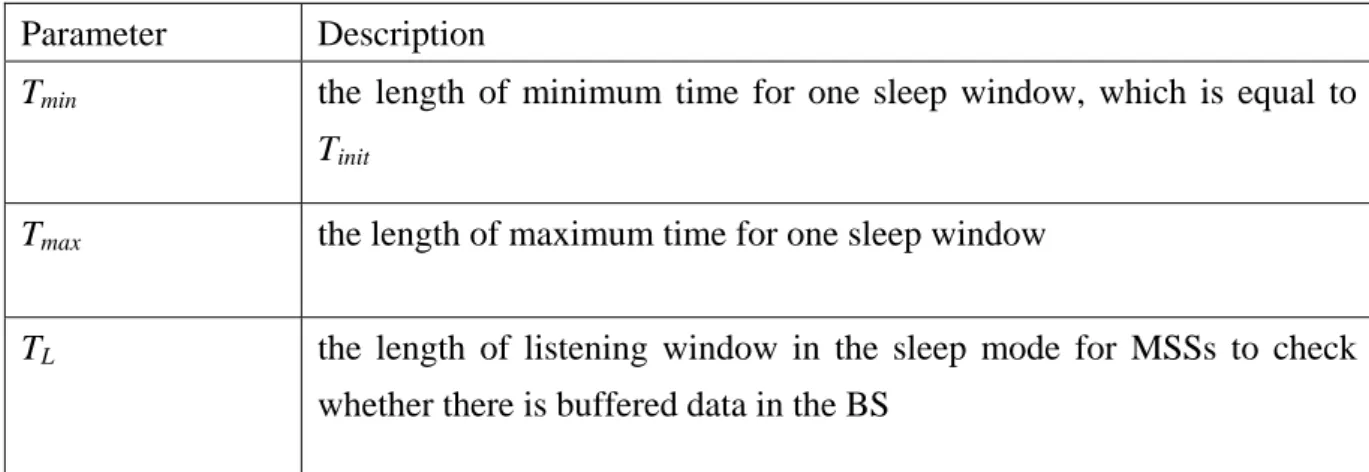
classes to match their QoS requirements. We first describe some common parameters in the
power saving classes as shown in Table 1
Table 1. Common parameters for power saving classes
Parameter Description
Tmin the length of minimum time for one sleep window, which is equal to Tinit
Tmax the length of maximum time for one sleep window
TL the length of listening window in the sleep mode for MSSs to check
whether there is buffered data in the BS
4 4
1.2.1
Power Saving Classes of Type I
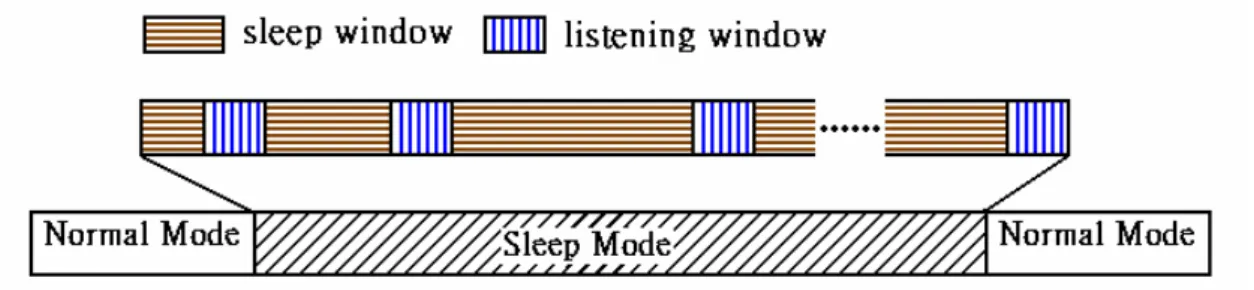
It is recommended for connections of BE (best-effort) or NRT-VR (non-real
time-variable rate) service. The nth sleep window, called Tn, is a variable. In the beginning of
the sleep mode, there is an initial sleep window Tmin. If it enters a continuous sleep period, the
sleep window will become a double of the previous one, until the length of sleep window
equals to the Tmax. The sleep window will stop increasing and become a fixed value. Equation
(1) presents the variation of Tn.
⎩ ⎨ ⎧ = > = − 1 , 1 ), , 2 min( min max min 1 n T n T T T n n (1)
During the power saving classes of type I, the MSS is not expected to send or to receive
any MAC SDUs (service data unit). Fig. 1 shows the operation of power saving classes of
type I.
1.2.2
Power Saving Classes of Type II
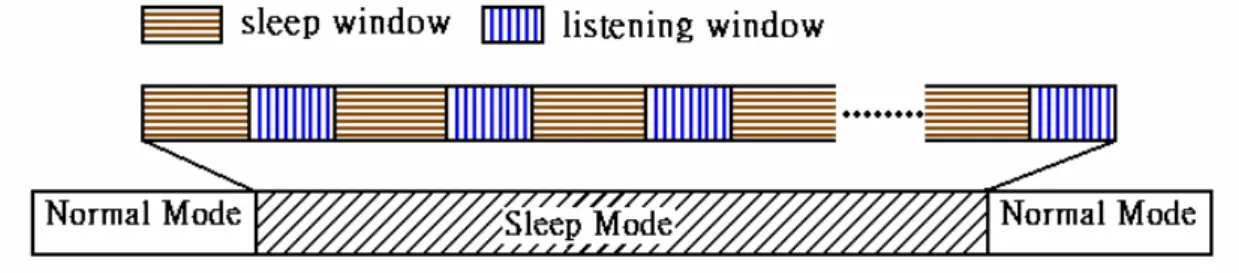
It is recommended for connections of UGS (unsolicited grant service) or RT-VR service.
The nth sleep window, Tn is a constant. It will not change during the sleep mode operation.
Each sleep window has the same size as Tinit. Equation (2) presents the value of Tn.
init
n
T
T
=
(2)During the listening windows of power saving classes of type II the MSS may send or
receive any MAC SDUs. Fig. 2 shows the operation of power saving classes of type II.
Fig. 2. Operation of power saving classes of type II.
1.2.3
Power Saving Classes of Type III
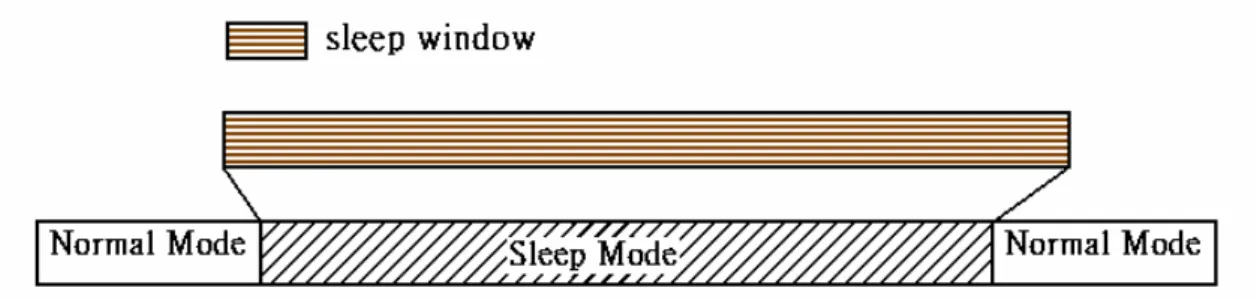
It is recommended for multicast connections or management operations All the MSSs
that entered the sleep mode use a pre-negotiated sleep window. After this period all MSs will
awake again to do their job. Equation (3) presents the value of sleep window T.
init
T
6 6
Chapter 2
Problem Statement
In general, there is usually more than one connection between the BS and the MSS at
one time. There are also different connection types among them. If we want to consider the
power saving efficiency, we have to consider all service connections as a whole. We define
free time as the total periods of sleep windows in the sleep mode for one connection and
common free time as the common periods of free time among several connections.
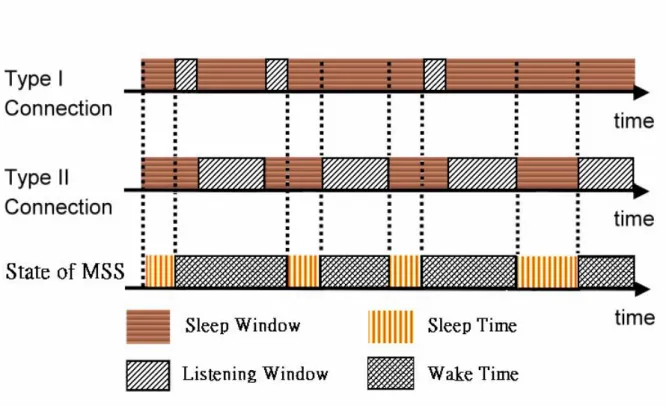
Fig. 4 is an example of sleep mode operation with two power saving classes (type I and
type II). Each connection has its own free time indicated by sleep windows. In the state of the
MSS, the periods which are marked as “Sleep Time” is the common free time between the
two connections. The periods of sleep time is the actual time duration for the MSS to enter the
sleep mode to save power. Note that in Fig. 4, each connection has more free time in its own
sleep mode operation. However, the common free time that the MSS can enter the sleep mode
is much less than the free time of each connection. This is because the listening windows are
not at the same time periods between two connections.
To enhance power saving, the MSS needs a longer periods of common free time among
8 8
listening windows, and send them in one single listening window while meeting the delay
constraints of different connections so as to lighten the effect of dispersive listening windows.
Chapter 3
Related Work
In recent years, several researches focused on the performance analysis of sleep mode
operation in the IEEE 802.16e. However most of them only concentrated on the performance
analysis of power saving classes of type I. In [3][4][5], the authors proposed a model for
performance analysis of the sleep-mode operation for energy saving considering both
incoming and outgoing frames of MSSs. In [6], it examined the sleep mode operation in IEEE
802.16e in terms of the dropping probability and the mean waiting time of packets in the
queue buffer of BS. In [7], it adaptively configures different parameters (Tmin, Tmax, and power
saving threshold size) to adapt for different traffic types to achieve better power saving. Two
examples of FTP and CBR traffic were used to show its idea.
In [8], the authors proposed an MILI (multiple increase and linear increase) scheme to
adjust the sleep window dynamically based on different traffic patterns to save power and
reduce delay for the power saving classes of type I. They thought the doubling method is not
good for some traffic environments. Under light traffic, the sleep period should be larger. That
is, a longer sleep window should be used. On the other hand, if the traffic is heavy, a longer
10 10
I and II. They showed that in order to achieve an optimal efficiency of energy saving, the
MSS should pre-negotiate with the BS to do the adaptive switching between power saving
classes of types I and II according to the measured traffic intensity. In [10], they proposed two
scheduling algorithms (PS and AS) for power saving classes of type II connections. The
schemes minimize the power consumption of an MSS and also guarantee the requirement of
QoS. They group packets into the same frame to reduce the number of listening windows. Fig.
5 gives an example that applies the PS. It groups two type II packets into a single frame. The
number of listening windows is reduced and the sleep periods increase. As a result, there is
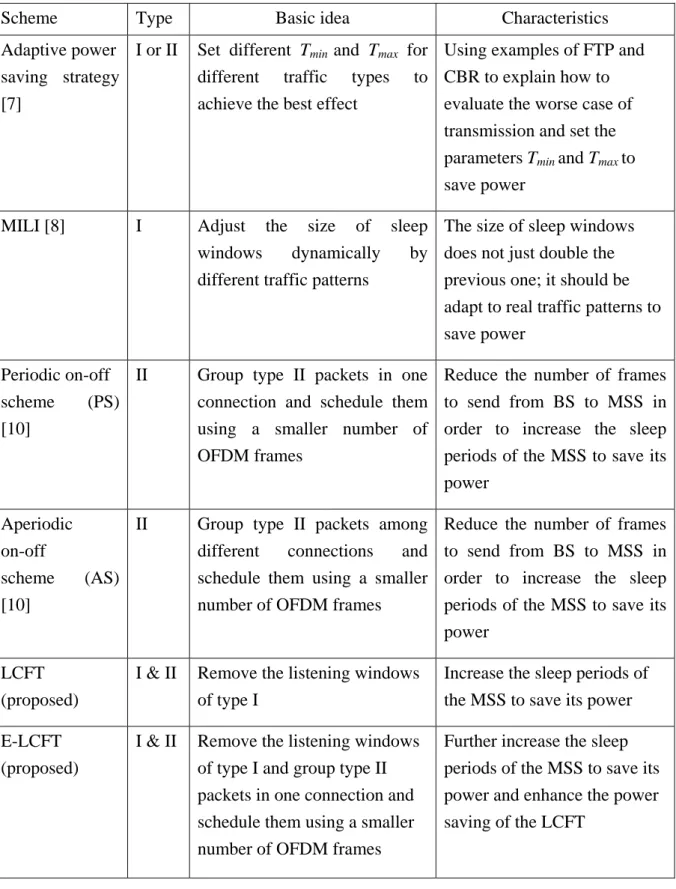
more free time for the MSS to enter the sleep mode and save more power. Table 2 summaries
the basic idea and characteristics of just mentioned existing approaches [7][8][10] and our two
proposed schemes (LCFT and E-LCFT).
Table 2. Qualitative comparison of existing IEEE 802.16e power saving schemes. Scheme Type Basic idea Characteristics Adaptive power
saving strategy [7]
I or II Set different Tmin and Tmax for
different traffic types to achieve the best effect
Using examples of FTP and CBR to explain how to evaluate the worse case of transmission and set the parameters Tmin and Tmax to
save power MILI [8] I Adjust the size of sleep
windows dynamically by different traffic patterns
The size of sleep windows does not just double the previous one; it should be adapt to real traffic patterns to save power
Periodic on-off scheme (PS) [10]
II Group type II packets in one connection and schedule them using a smaller number of OFDM frames
Reduce the number of frames to send from BS to MSS in order to increase the sleep periods of the MSS to save its power
Aperiodic on-off
scheme (AS) [10]
II Group type II packets among different connections and schedule them using a smaller number of OFDM frames
Reduce the number of frames to send from BS to MSS in order to increase the sleep periods of the MSS to save its power
LCFT (proposed)
I & II Remove the listening windows of type I
Increase the sleep periods of the MSS to save its power E-LCFT
(proposed)
I & II Remove the listening windows of type I and group type II packets in one connection and schedule them using a smaller number of OFDM frames
Further increase the sleep periods of the MSS to save its power and enhance the power saving of the LCFT
12 12
Chapter 4
Proposed Energy Saving Schemes
Because there are usually more than one service connection between a BS and an MSS,
we have to consider these connections as a whole. From Fig. 4, we know that if there is more
than one connection, the total common free time will decrease, because the total common free
time is the common periods of free time among all connections. If we can reduce the number
of listening windows in any connection, we can have more common free time among
connections, thus have more sleep time to save power. In this thesis, we propose two energy
saving schemes to increase the length of common free time and to enhance the energy saving
of sleep mode operation. Our schemes were designed for an environment that has both power
saving classes of type I and type II connections. In our schemes, we didn’t consider the power
saving classes of type III, which is for multicast connections, since we focused on the unicast
connections only.
The first proposed scheme is called Longer Common Free Time (LCFT). Because the
power saving classes of type II (for UGS, RT-VR) is time-sensitive, we only modify the
operation of the power saving classes of type I to have more common free time. For type I
connections, the MSS wakes up to listen the traffic indication message at each listening
basic idea of our LCFT scheme to removes the listening windows from the power saving
classes of type I connections and the traffic indication messages of power saving classes of
type I will be handled during the listening windows of power saving classes of type II
connections. The reason to do so is because the power saving classes of type I is for
connections of BE and NRT-VR, which are time-insensitive.
14 14
Fig. 7. Proposed method of power saving classes
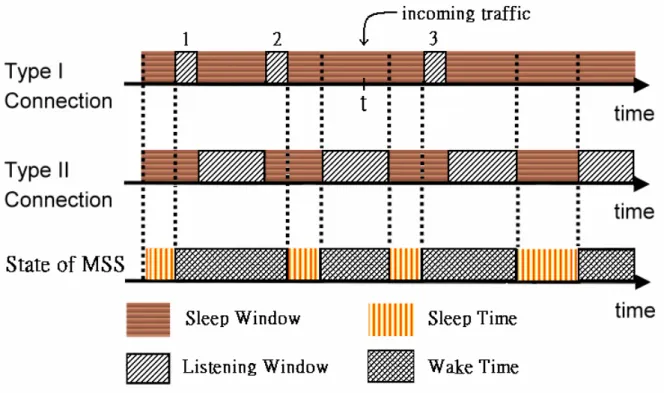
In Fig. 6, there are three listening windows in the type I connection. The MSS has to
wake three times to listen the traffic indication message. If there is only one data coming at
time t, in the first and second listening windows, the MSS beeds to wake up and then return to
sleep right away. We can have longer common free time if we can keep sleeping at these two
listening windows.
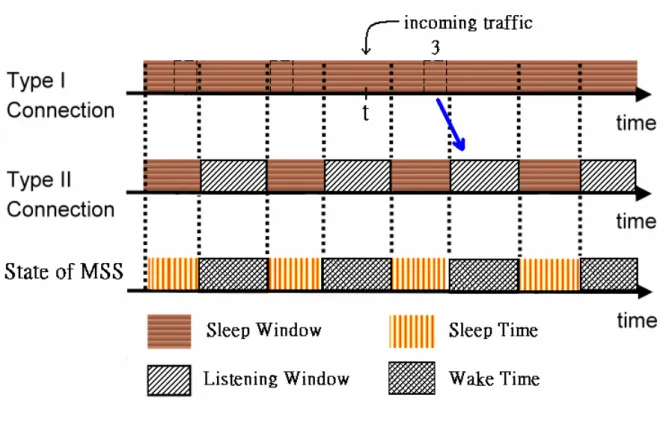
In Fig. 7, the proposed LCFT method removes the listening windows from the power
saving classes of type 1 connection and the traffic indication message transmitted by the BS
will be handled during the listening windows of type II connection. For example, in Fig. 7, the
connection. The advantage of our LCFT scheme is that for type I connections, the MSS
doesn’t need to wake up at all to listen the traffic indication messages from the BS. This
method reduces the effect of type I connections on common free time, and the MSS shall have
longer free time to enter the sleep mode. On the other hand, the method uses the periodic
characteristic of type II connections to read type I traffic indication messages if any. Note that
the type II connection wakes up in a fixed period, so the delay of type I connections can be
bounded. In summary, this method eliminates of the listening windows of type I connections
to save more power while type I connections have bounded delays.
Besides the LCFT, we combine the idea of [10] to enhance the LCFT scheme. We called
it enhanced LCFT (E-LCFT). This E-LCFT scheme groups several type II packets in one
connection into a single frame for transmission to reduce the number of frames that need to
transmit packets from BS to MSS. In this way, the sleep periods of this connection can be
increased. As a result, the MSS can have more common free time among different
connections to enter the sleep mode and save more power. The proposed two schemes, LCFT
and E-LCFT are compatible with the original IEEE 802.16e standard in terms of no change of
MSSs and no change of the communication mechanism between BS and MSS. The only
requirement is that the BS needs to be aware of LCFT and E-LCFT in order to set appropriate
values of Tmin and Tmax. For the LCFT, assume a type I connection of the MSS sends a request
16 16
parameter Tinit to a very large number. For this type I connection, the MSS will not wake up
periodically to listen to the traffic indication message. If there are buffered packets for the
type I connections in the BS, the BS can transmit the packets to the MSS via the frames of
type II connections. If the data size of power saving classes of type I is small enough, we can
use the unused frame space of a type II connection to transmit. Otherwise, the BS will
transmit the data to the MSS in the next frame and the MSS will stay awake to receive the
data. For the E-LCFT, the BS may group several type II packets that are to be sent in separate
frames, into a single frame for transmitting later. In this situation, the BS only needs to adjust
Tmin to allow the MSS to sleep longer. Again, for E-LCFT to work, the only requirement is the
BS needs to be aware of E-LCFT. No other changes are necessary in the MSS or the
communications between BS and MSS.
Our schemes are designed for an environment with both power saving classes of type I
and type II connections. If there are many connections of type I and less connections of type
II, our schemes may not achieve a good performance. Because if too many buffered data have
to be transmitted with type II frames, the average packet delay of type I connections will be
extended and the advantage of using unused frame space of type II connections will not work
Chapter 5
Simulation Results and Discussion
5.1 Simulation Environment
We used Visual C++ to simulate and evaluate the performance of LCFT, E-LCFT and
the sleep mode operation in the IEEE 802.16e in terms of the percentage of sleep periods and
average packet delay. The percentage of sleep periods, which reflects the power consumption
of an MSS, is defined as (number of sleep frames) / (number of sleep frames + number of
listening frames + number of awake frames). The average packet delay is the average elapsed
time from the time that a packet enters the BS to the time that the packet completes its
transmission to the MSS. The simulation environment is similar to that in [10]. The duration
of an OFDM frame is assumed 5 ms, and the maximal data rate that a BS can offer an MSS is
assumed 1600 kbps. That is, the frame length is 1000 bytes. Eight different traffic connections
were defined and the parameters of them are described in Table 3 and Table 4. Some
parameters were referred from [4] and [10] and we modified part of them to demonstrate the
energy efficiency of our proposed schemes in every respect.
Connections A, B, C and D are power saving classes of type I, and connections E, F, G
18 18
performance under different traffic loads. The values of packet size and interval of packet
arrival for each packet in type I connections were randomly generated from the ranges
specified in Table 3.
Table 3. Parameters of type I connections
Connection A B C D
Type I I I I
Packet size (Bytes) 1~1000 1~1000 1000~2000 1000~2000 Sleep Period (ms) [5, 320] [5, 160] [5, 320] [5, 160]
Interval of packet arrival (ms)
1~350 1~180 1~350 1~180
Table 4. Parameters of type II connections [10]
Connection E F G G
Type II II II II
Packet size (Bytes) 160 160 800 800 Interval of packet
arrival (ms)
20 30 20 30
5.2 Simulation Results and Discussion
In Fig. 8, it shows the percentages of sleep periods using the three different schemes
(802.16e, LCFT and E-LCFT). The higher percentage of the sleep period is, the longer
common free time that an MSS can enter the sleep mode and save more power. The notation
A+E means that there are only two connections, A and E. It is a simple traffic environment.
By increasing the number of connections, the traffic environment becomes more complex. We
found that if the traffic environment becomes more complex, the percentage of sleep periods
will become smaller in all the three schemes. In all cases, both the proposed two schemes
performed better than the IEEE 802.16e. In Fig. 8, it shows that the percentages of sleep
periods of LCFT and E-LCFT are 14% to 50% and 33% to 68% more than IEEE 802.16e,
respectively.
The overhead of the proposed schemes (LCFT, E-LCFT) is that they have longer average
delay than the scheme of IEEE 802.16e. The reason is that we delay the listening windows
and reduce the number of listening windows. The buffered data in the BS are sent only after
the listening windows of type II connections. However, we bounded the delay. The listening
windows were postponed by the evaluation with delay constraint of type II connections. For
connections of power saving classes of type II, we also guarantee their QoS. For the
20 20
Fig. 9 shows the average packet delay in different traffic environments. For type I (T1)
connections, the LCFT has 6% to 31% longer average packet delay than the IEEE 802.16e
scheme and the E-LCFT has 71% to 77% longer average packet delay than the IEEE 802.16e
scheme. For type II (T2) connections, the LCFT has the same average packet delay as the
IEEE 802.16e scheme since the LCFT did not modify the sleep mode operation of type II
connections. The E-LCFT has 84% to 88% longer average packet delay than the IEEE
802.16e scheme. The IEEE 802.16e scheme achieves the lowest packet delay, because its
MSS wakes up more frequently to transmit packets. Nevertheless, the simulation results
indicate that all schemes, no matter type I or type II connections all satisfied the QoS
requirement in terms of delay constraints specified in Table 4.
Since we can bound the average packet delay under the delay constraint of type II
connections in our schemes, here we present another simulation results of the percentage of
sleep periods and average packet delay with a tight delay constraint in Fig. 10 and Fig. 11,
respectively. The parameters of connections E’, F’, G’, and H’ are the same with connections
E, F, G and H respectively, except the delay constraint. We changed from the loose delay
constraint of 100 ms to a tight delay constraint of 30 ms. The simulation results still show that
the LCFT is 14% to 50% better than IEEE 802.16e and the E-LCFT is 26% to 57% better than
IEEE 802.16e in terms of the percentage of sleep periods. The average packet delay of the
E-LCFT decreases obviously. This is because the value of delay constraint affects the length
of sleep interval in type II connections. For type I connections, the E-LCFT has 38% to 44%
longer average packet delay than the IEEE 802.16e scheme. For type II connections, the
E-LCFT has 33% to 67% longer average packet delay than the IEEE 802.16e scheme. If the
delay constraint is set smaller, the average packet delay in the E-LCFT will become smaller.
This is because we use the delay constraint to calculate the number of packets that can be
grouped into a single frame for transmitting and thus to guarantee the QoS.
The listening windows of type II connections can transmit the MAC SDUs (service data
units). If the size of a type II packet is smaller, the unused space in the listening window will
be larger. In this situation, we can have higher probability to transmit type I packets within the
type II listening window. Then the MSS will have more frames to enter the sleep mode. In Fig.
12, it shows the effect of packet size on the percentage of sleep periods. The A+E and C+E
have more sleep periods than the A+G and C+G, respectively, because the packet size in
connection E is smaller than that in connection G. The A+E also has a higher percentage of
sleep periods than the C+E, because the packet size of A is smaller than that of C.
Note that the proposed two schemes were designed to piggyback the type I connection’s
traffic indication message at the type II connection’s traffic indication message. If the number
of type II connections is much less than type I connections, the percentage of sleep windows
22 22
following, we will evaluate this situation. In Fig. 13, there is only one type II connection E in
the following cases: A+E, A+B+E and A+B+C+D+E. The average packet delay increases
when the number of type I connections increases. This is because the total size of buffered
packets is larger than the unused space that a listening window of type II can provide. The BS
then has to transmit the unsent packets with another frame(s) and the packet delay becomes
longer. In the case of A+B+C+D+E+F, there are two type II connections of equal packet size.
Comparing between A+B+C+D+E and A+B+C+D+E+F, the average packet delay of the latter
is smaller than the former, since the latter has more type II connections of equal packet size.
Therefore, the proposed two schemes are suited to environments that allow type II
0.0% 10.0% 20.0% 30.0% 40.0% 50.0% 60.0% 70.0% 80.0% 90.0% 100.0%
A+E A+B+E+F A+B+C+D+E+F+G+H
Traffic Conncetions
Percenta
ge of sleep periods
802.16e LCFT E-LCFT
Fig. 8. Percentage of sleep periods under the loose delay constraint (100ms)
0 10 20 30 40 50 60
A+E A+B+E+F A+B+C+D+E+F+G+H Traffic Connections
Ave
rage Packet Delay
(ms)
802.16e T1 802.16e T2 LCFT T1 LCFT T2 E-LCFT T1 E-LCFT T2
24 24 0.0% 10.0% 20.0% 30.0% 40.0% 50.0% 60.0% 70.0% 80.0% 90.0% A+E ' A+B +E'+ F' A+B +C+D +E'+ F'+G '+H '
Tra ffi c C onne c t i ons
P e rcen ta g e o f sl eep p er io d s 8 0 2 .1 6 e LCFT E-LCFT
Fig. 10. Percentage of sleep periods under the tight delay constraint (30ms)
0 10 20 30 40 50 60 A+E ' A+B +E'+ F' A+B +C+D +E'+F '+G '+H '
Tra ffi c C onne t i ons
A v er ag e P ack et D el ay ( m s) 802.16e T1 802.16e T2 LCFT T1 LCFT T2 E-LCFT T1 E-LCFT T2
0.0% 10.0% 20.0% 30.0% 40.0% 50.0% 60.0% 70.0% 80.0% 90.0% 100.0%
A+E A+G C+E C+G
Traffic Connections
Percentage o
f sleep period
s
802.16e LCFT E-LCFT
Fig. 12. The effect of packet sizes on percentage of sleep periods
0 10 20 30 40 50 60
A+E A+B+E A+B+C+D+E A+B+C+D+E+F Traffic Connections
Average Pac
ket Delay (ms)
802.16e T1 802.16e T2 LCFT T1 LCFT T2 E-LCFT T1 E-LCFT T2
26 26
Chapter 6
Conclusions and Future Work
6.1 Conclusions
We have presented two efficient energy saving schemes for the sleep mode operation in
IEEE 802.16e. We remove the listening windows of power saving classes of type I and group
several type II packets into a single frame for later transmitting. The main idea of our
proposed schemes is to reduce the number of listening window in all service connections, so
that there is more common free time for the MSSs to enter the sleep mode and save more
power. From simulation results, the LCFT and E-LCFT performed 14% to 50 % and 33% to
68% better than the IEEE 802.16e scheme, respectively, in terms of percentage of sleep
periods. However, the overhead of our proposed schemes is higher average packet delay. The
LCFT and E-LCFT have 6% to 77% and 84% to 88% longer average packet delay than the
IEEE 802.16e scheme, respectively. Nevertheless, the delay of each type II connection still
met its delay constraint. That is, the QoS requirements of type II connections in our proposed
two schemes are still guaranteed. The proposed schemes are compatible with the original
IEEE 802.16e standard, because we only need to adjust the parameter values of sleep mode
6.2 Future Work
In this work, we did not consider the buffer size in the BS and we created the type I and
II connection traffic for possible cases. In the future, we may consider a limited buffer size in
the BS to address possible packet loss and use real traffic patterns of different types of
28 28
Bibliography
[1] IEEE 802.16-2004, Part 16: Air Interface for Fixed Broadband Wireless Access Systems,
Standard for Local and Metropolitan Area Networks, October 2004.
[2] IEEE 802.16e-2006, Part 16: Air Interface for Fixed and Mobile Broadband Wireless Access Systems - Amendment for Physical and Medium Access Control Layers for Combined Fixed and Mobile Operation in Licensed Bands, February 2006.
[3] Xiao, Y.; “Energy saving mechanism in the IEEE 802.16e wireless MAN”, IEEE
Communication Letters, Vol.9, no.7, pp. 595–597, July 2005.
[4] Xiao, Y.; “Performance analysis of an energy saving mechanism in the IEEE 802.16e wireless MAN”, Proceeding of IEEE CCNC 2006, Vol.1, no.8-10, pp. 406–410, Jan. 2006.
[5] Zhang, Y.; Fujise, M.; “Energy management in the IEEE 802.16e MAC” IEEE
Communications Letters, Vol. 10, Issue 4, pp. 311 – 313, Apr 2006.
[6] Seo, J.B.; Lee, S.Q.; Park, N.H.; Lee, H.W.; Cho, C.H.; “Performance analysis of sleep mode operation in IEEE 802.16e,” in Proc. VTC2004-Fall, Vol. 2, pp. 1169 - 1173, Sept. 2004.
[7] Jang, J.; Han, K.; Choi, S.; ”Adaptive Power Saving Strategies for IEEE 802.16e Mobile Broadband Wireless Access” in Proc. Asia-Pacific Conference on Communications, Aug. 2006.
[8] Lee, N.H.; B, S.; “MAC sleep mode control considering downlink traffic pattern and mobility,” in Proc. VTC 2005-Spring, Vol. 3, pp. 2076 - 2080, 30 May-1 June 2005.
[9] Kong, L.; Tsang, D.H.K.; “Performance Study of Power Saving Classes of Type I and Type II in IEEE 802.16e,” Proceedings 2006 31st IEEE Conference, pp.20 – 27, Nov.
2006.
[10] Chen, Y.L.; Tsao, S.L.; “Energy-Efficient Sleep-Mode Operations for Broadband Wireless Access Systems,” in Proc. VTC 2006-Fall, pp.1 – 5, Sept. 2006.
![Fig. 5. Periodic on-off scheme (PS) [10]](https://thumb-ap.123doks.com/thumbv2/9libinfo/8377600.178020/26.892.133.785.718.977/fig-periodic-scheme-ps.webp)
![Table 4. Parameters of type II connections [10]](https://thumb-ap.123doks.com/thumbv2/9libinfo/8377600.178020/34.892.117.812.729.965/table-parameters-type-ii-connections.webp)
