行政院國家科學委員會專題研究計畫 成果報告
如何建立/重建抱怨顧客的信任與忠誠度?探討負面評論,賣
家回應,與社會臨場感的影響
研究成果報告(精簡版)
計 畫 類 別 : 個別型 計 畫 編 號 : NSC 99-2410-H-151-015- 執 行 期 間 : 99 年 08 月 01 日至 100 年 07 月 31 日 執 行 單 位 : 國立高雄應用科技大學資訊管理系 計 畫 主 持 人 : 傅振瑞 報 告 附 件 : 出席國際會議研究心得報告及發表論文 處 理 方 式 : 本計畫涉及專利或其他智慧財產權,2 年後可公開查詢中 華 民 國 100 年 10 月 30 日
行政院國家科學委員會補助專題研究計畫
■ 成 果 報 告
□期中進度報告
如何建立/重建抱怨顧客的信任與忠誠度?探討負面評論,賣家回應,
與社會臨場感的影響
計畫類別:■個別型計畫 □整合型計畫
計畫編號:NSC 99 – 2410 – H - 151 – 015 -
執行期間: 99 年 8 月 1 日 至 100 年 7 月 31 日
執行機構及系所:國立高雄應用科技大學資訊管理系
計畫主持人:傅振瑞
計畫參與人員:郭愷瀚、林昭雯
成果報告類型(依經費核定清單規定繳交):□精簡報告 □完整報告
本計畫除繳交成果報告外,另須繳交以下出國心得報告:
□赴國外出差或研習心得報告
□赴大陸地區出差或研習心得報告
■出席國際學術會議心得報告
□國際合作研究計畫國外研究報告
處理方式:
除列管計畫及下列情形者外,得立即公開查詢
□涉及專利或其他智慧財產權,□一年■二年後可公開查詢
中 華 民 國 100 年 10 月 28 日
如何建立/重建抱怨顧客的信任與忠誠度?
探討負面評論,賣家回應,與社會臨場感的影響
傅振瑞 國立高雄應用科技大學資訊管理系 [email protected]摘要
在競爭激烈的電子商務環境中,贏得顧客的 信任與忠誠對於營運績效有關鍵的影響。然而, 過去研究甚少著墨。本研究以 Yahoo!拍賣為例, 從顧客與商家的互動歷程與網站的設計特性出 發,探討影響顧客信任、社會臨場感,以及顧客 忠誠度的重要因素。在網路拍賣的評價機制中, 線上顧客與商家互動的歷程被完整紀錄,此歷程 形成了一種新的口碑效果,影響潛在顧客對於商 家的態度,因此促進或阻礙了顧客信任的建立, 以及後續的再購意願。本研究深入探討賣家的顧 客抱怨處理回應方式,對於重建顧客信任的影 響。除此之外,本研究也分析網站的媒體豐富度 與回應的即時性對於顧客社會臨場的感受,以及 後續對於信任與忠誠度的影響。 本研究以台灣的 Yahoo!奇摩拍賣為資料蒐集 來源,並選定女裝與服飾類別,先隨機抽樣 1000 個網路商店,挑選其最近成功交易的消費者,一 共發放 2000 份問卷進行施測;再透過內容分析 法,分析拍賣網站賣家提供之資訊,分別給予評 分,並剔除無效問卷後,以 PLS 分析工具,檢定 研究變數的整體與中介效果,進而分析出本研究 模型中,影響顧客忠誠度之因素。 本研究可提供拍賣網站賣家在經營策略上的 建議,提升消費者的信任程度與社會臨場感,與 消費者之間有更良好的互動與溝通,進而產生顧 客忠誠度,以提升賣家在拍賣網站的競爭力。 關鍵詞:抱怨處理, 負面評論, 抱怨顧客忠誠度, 信任,社會臨場感1. 緒論
1.1 研究背景與動機 Yahoo!奇摩拍賣已成為台灣網拍交易最熱絡 平台,在創市際(ARO)網路調查發現 Yahoo!奇摩 拍賣榮登網友最喜愛的購物網站第一名。ARO 網 路調查,網友到訪 Yahoo!奇摩拍賣網站達 62%, 不重複使用人數約 633 萬人次;顯示了在拍賣網 站上購物人數呈現快速成長的現象,此拍賣模式 已漸漸成為台灣地區網友的購物趨勢。 值得注意的是,網路拍賣經營型態漸漸從 C2C 轉為 B2C 模式。根據統計,目前在拍賣網站 上 B2C 商家數已超過 C2C 達到 60%。網拍已轉 為一種新型態的網路銷售通路。對於商家而言, 了解消費者如何在眾多網拍商家中選擇與決策的 過程,以及消費者如何與賣家發展出信任與互動 的關係,進而產生顧客忠誠度,是一個重要且有 趣的研究議題。Noone & Griffin (1997)透過調查,發現公司的 長期利潤會因為顧客忠誠度而有顯著影響。Lee, Kim et al.(2000)認為忠誠顧客是決定拍賣網站價 值的主要因素,主要是由於舊顧客取得成本低、 有溢價的優勢、口碑推薦等特性。CRM 相關的研 究也指出忠誠顧客終身價值通常是新顧客的 5 至 10 倍。如何透過彼此的信任關係,將舊顧客轉變 成忠誠顧客,更是網拍商店帶來長期利潤的關鍵。 過去研究發現,將社會線索,如表情、肢體 動作及社會地位,應用於介面的互動設計,呈現 社會臨場感,可以讓使用者感受拍賣網站的人性 化特質(Picard, Wexelblat et al. 2002)。舉例而言, 許多自創品牌的「Y!ashion 雅選師」以照片呈現 獨特的穿搭技巧,帶領女裝流行風潮,創造了許 多固定的忠誠顧客,而買家回購率達 80%(Yahoo! 拍賣新聞 2007.12)。顯示清晰的圖像式說明及風 潮引領,有助於使買家了解最新的穿衣風格。若 搭配親切的態度回覆買家的疑問,便能夠打動消 費者的芳心,產生人際互動社會臨場感與信任, 進而提高顧客再次購買意願,為賣家帶來長期的 營業績效。 1.2 研究問題 過去研究多以買家對整體拍賣網站環境、機 制的滿意度,進而提昇忠誠度為研究目的,以創 造企業長期的利潤。較少研究針對買家對特定賣 家的忠誠度進行分析,在Yahoo!拍賣網站中,發 現賣家在拍賣網頁上皆會呈現不同的文字或圖像 說明其拍賣商品,消費者是否會因為呈現不同的 文字或圖像,而產生良好印象、流行風潮,進而 產生對此賣家的顧客忠誠度;此外,是否會因賣 家提供付款方式的不同、互動良好與否等因素,
因而減低買家認知風險,產生對賣家的信任,較 少學者研究此面向問題。以網拍的商品來分析, 女裝與服飾配件為2006年最熱門競標類別第一 名,由此可知女性的消費潛力不容小覷。故本研 究選定女裝與服飾配件商家為研究對象,並探討 女裝與服飾消費者對於此賣家所呈現之頁面資 訊,是否影響其社會臨場感程度與信任程度,與 忠誠度。根據上述動機,本研究主要問題如下: 1. 探究不同程度的社會臨場感與信任程度 是否顯著影響顧客忠誠度。 2. 了解拍賣網站賣家呈現不同意見回覆態 度與網路評價是否影響買家信任程度。 3. 探究拍賣網站賣家網路評價高低對買家 信任程度,是否會因過去的交易經驗而 有顯著的影響。 4. 探究買家的社會臨場感是否影響對賣家 的信任程度。
2. 文獻探討與研究假說
2.1 社會臨場感 (一) 社會臨場感之意義 社會臨場感(social presence),係指個體於人 際 關 係 的 互 動 過 程 中 對 他 人 的 感 知 程 度 (Tu 2002)。在電子商務領域的探討,則是關注於網友 透過互動介面,在網路世界中與其他網友連結的 感覺、察知,與反應的程度。從社會臨場感理論 來分析,Short, Williams et al.(1976)指出網路溝通 與傳統面對面溝通環境有許多差異,透過媒體能 讓溝通雙方在心理上感受到彼此存在的程度。 人類的溝通包含各種語言與非語言的訊息, 其中傳達許多非語言及社會線索的溝通媒體,如 面對面接觸,可感受到較高的社會臨場感;相反 的,電腦中介傳播(CMC)或手寫文字等,傳達非 語言人際線索的能力較弱,感受的社會臨場感也 較低。Rice(1993)則根據社會臨場理論解讀各種傳 播方式,發現社會臨場感較低的媒介,在溝通上 較不具友善、情緒、親切感、人性化,而較傾向 於嚴肅及任務導向。 (二) 媒體豐富度Daft & Lengel(1984)首先提出資訊豐富度的 概念(information richness theory)。資訊豐富度是指 該資訊的內容能使人理解的能力,若雙方溝通的 資訊能適時解釋模糊的事件或議題,而讓接收資 訊的人能立即理解,則此資訊會被視為是豐富 的;若是需要較長的時間才能理解,則該資訊的
豐富度較低(Daft & Lengel & Trevino 1984, 1986, 1987)。資訊豐富與媒體的關連性在於媒體具有傳 輸豐富資訊的能力,因而有所謂媒體豐富理論 (Media Rcihness)的產生。 網拍賣場其頁面資訊內容所帶來的影響,會 因為資訊呈現的情境而產生差異;消費者在瀏覽 商品時,若商品頁面呈現愈多豐富度,比如說完 整的商品描述、商品照片、圖片或多媒體影片等, 則會使消費者有身歷其境的感受,相對於沒有這 些圖片、影片的其他商家,會讓買家好像真的走 進賣場一樣,可降低消費者的不確定感。Daft & Lengel(1984)認為當人們面對的溝通訊息是不確 定的時候,可利用資訊或是較具高豐富性的媒介 來幫助降低事情的模糊性(equivocality)及不確定 性(uncertainty)。因此推論,若拍賣商品頁面資訊 較豐富,則有助於降低消費者面對非真實商品隔 閡感,提高消費者的社會臨場感。 H1拍賣商品頁面呈現的媒體豐富度對商品 社會臨場感有顯著影響 2.2 信任程度 (一) 信任程度之定義 信任(trust)為對交易對象誠實履行承諾的期 望,即選擇相信對方不會有投機行為且會實現其 承諾的信念(Rotter 1971; Luhmann 1979)。從關係 行銷角度,Doney & Cannon (1997)將信任定義為 信任者對信任對象認知的可信度及善意,行銷人 員的專業能力、好感度及與顧客的相似度,對於 建立信任、強化顧客與供應商之關係扮演重要的 角色。 為確定此賣家為值得信任的商家,消費者會 觀察賣場的某些資訊,以建立買家的信任感。賣 家對於購買者提出之意見,若其回覆態度良好, 會使消費者感覺賣家是有誠意的,且對於自己所 拍賣之商品具責任感,相較於態度不好的賣家而 言,消費者感覺與意見回覆態度良好的賣家交 易,其過程若有任何問題都可商量,認為此種賣 家較為可靠、有保障,而會增加買家信任程度。 Gefen & Straub (2003)也提出,在電子商務的線上 拍賣環境,由於買家無法透過有限的網站資訊掌 握賣家的個人身份及產品品質,易造成買家對產 品品質認知的不確定性。此外,買家也擔心賣家 訂定不合理的定價、侵犯隱私權、傳遞錯誤資訊 及盜用信用卡等投機行為,正因為線上拍賣充滿 種種不確定性,因此買家會透過信任來降低不確
定性及複雜度(Gefen 2000)。因此,本研究推論假 說如下:
H2拍賣網站賣家意見回覆的態度對買家信 任程度有顯著影響
(二) 網路評價
Pavlou & Dimoka(2006)發現正面評價、負面 評價、過去經驗、個人信任傾向都是影響買家認 知賣家善意程度與可靠度的因素。從過去研究中 發現,對於網路賣家的信任將會影響到消費者的 認知風險(Featherman 2001; Pavlou 2001)。Dowling & Staelin(1994)認知風險是消費者主觀認知可能 發生不利情況的程度,當買家愈信任賣家時,在 拍賣購物的認知風險也愈低。愈有經驗或正向評 價愈高的賣家代表的是可信度較高,因賣家的商 品資訊豐富、價格低廉、售後服務周到、商品品 質良好、送貨快速和良好的商品使用狀況等交易 因素,讓買賣雙方在交易過程中產生好感,因而 給予賣家正向的評價與意見;其他買家也會因為 高正面評價的吸引因而將此賣家列入選購的參考 對象。 因此,本研究推論,由於網路拍賣的評價數 是累積的,若賣家有不好的情況,則消費者便不 會給予正面評價,故若賣家的正面評價數愈多, 顯示其過去有很多消費者與此賣家交易並得到良 好的交易經驗,而累積的正面交易經驗,便可取 得後續消費者對此賣家的信任感,而提高買家的 信任程度。 H3買家透過賣家的總評價數對買家信任程 度有顯著影響 (三) 個人信任傾向 信任會因為不同的人格特質,包含個人過去 的經驗與所處環境的其他人是否實現其承諾,而 產生與他人互動時不同程度的信任感,根據人格 心理學研究顯示當遇到新的狀況時,具有高度信 任傾向的人會較容易信任他人。消費者本身若具 高度的信任傾向,比起不易相信人的買家來說, 皆會信任賣家,會認為賣家是誠懇在經營商店且 值得信任的。
Kini & Choobineh(1998)認為信任是根深蒂固 於個人的個性裡,是否信任的決策就會因個人的 人格特質而定,程度也會因人而異,此種人格特 質稱為個人信任傾向(the individual Tendency To Trust)。容易信任他人的人,也較容易相信網拍網 頁所呈現之資訊,因此個人信任傾向因素,也是 影響電子商務信任的重要因素之一。買家過去之 消費經驗愈正面,其會更相信在此賣場交易是安 全的;若過去有不好的消費經驗,則會影響消費 者的信任程度,其會處處小心以防再次發生,因 此變成了信任傾向較低之消費者,在此情況下, 也不容易去相信賣方,亦對賣家的信任程度較 低。故本研究推論: H9買家的交易經驗對個人信任傾向有顯著 影響 H10買家個人信任傾向因素對賣家的信任程 度有顯著影響 2.3 社會臨場感、信任程度與顧客滿意度的關係 顧客滿意表現在顧客消費體驗後產生的態度 上,並以喜歡與不喜歡的程度來呈現(Woodside, Frey et al. 1989),Oliver(1981)認為顧客滿意是一 種立即的情緒反應,它在特定的產品或服務情境 下,透過使用的產品或服務而產生的價值程度。 擁有社會臨場感的網拍商家,此種情境也會 讓買家察覺到賣家在意顧客的感受,相較其他缺 乏社會臨場感的網拍商家,更能體會此賣家的用 心與維持顧客關係的誠意,而提升買家顧客滿意 度。Szymanski and Hise(2000)將網路上的顧客滿 意度定義為顧客在其所選擇的網站,進行購物的 整 體 經 驗 感 受 , 透 過 焦 點 群 體 法 (focus-group interview),進而發現便利性、網站設計與財務安 全性對顧客滿意度有顯著的正向影響。因此推論 假說: H5買家在拍賣網站感受的社會臨場感對買 家顧客滿意度有顯著影響 消費者若對賣家有一定的信任程度,表示網 拍賣家的產品或是網站其他方面,有達到一定的 品質與水準,因此不管是在整體購物經驗感受 上,或是最後取得的商品情況,消費者都會有一 較正面的態度,進而增加買家的滿意度,故本研 究推論: H6拍賣網站買家的信任程度對買家顧客滿 意度有顯著影響 而體驗是顧客滿意與品牌忠誠度的關鍵決定 因素(Schmitt 1999)。相對於其他帶給消費者較少 社會臨場感的賣家,若買家感受到的社會臨場感 愈多,其身歷其境的情況,就像買家在真實商店 購買東西一樣,會因為在此網拍商店購物,但卻 好像商品就在手中一樣真實,而感到已經可以了
解欲購買商品的實體規格與資訊等,故越不會有 虛無飄渺的感覺,進而使買家對商品產生信心及 減少不安感,並對賣家產生較高的信任。Short, Williams et al.(1976)則表示,人感受的社會臨場感 是主觀的心理層面,當人們透過媒介感受社交的 親密性或立即性,會讓人們與媒體的互動過程, 感受到夥伴的存在,衍生社會層面的情感。故推 論假說如下: H4買家在拍賣網站感受的社會臨場感對買 家信任程度有顯著影響 2.4 顧客忠誠度 顧客忠誠度定義為顧客對特定的人、產品或 服務的依戀或好感,並認為顧客忠誠是顧客對某 特 定 產 品 或 服 務 在 未 來 的 再 購 買 意 願 (Jones, Sasser et al. 1995)。Griffin(1995)顧客忠誠度的形 成包括重覆購買與對特定產品與服務態度上的偏 好。 Bhote(1996)認為顧客忠誠度是顧客滿意公司 的商品或服務,使得買家願意傳播並製造正面口 碑效果於他人身上。若消費者對賣家有良好的滿 意度,表示其購買此賣家商品之態度是正向的, 包含過去購買過程的感受及對該商品的滿意度 等。相較於其他從無購買經驗的賣家來說,由於 曾經購買過,故對於該商家的品質及購物過程較 為信任,且之前的購物經驗又是正向的,所以消 費者會傾向於對此種賣家購物。因此顧客滿意度 提升會增加顧客再次購買的意願Cardozo(1965)。 而Lee(1999)也認為顧客是否願意再次購買,重要 的 決 定 性 因 素 在 於 其 購 物 的 滿 意 程 度 。 並 且 Kane(1999)也指出,39%的買家會向他們已經知道 或過去曾經有良好購物經驗的網路賣家購買東 西。Lee,Kim et al.(2000)也認為拍賣網站的價值即 忠誠顧客的多寡。在Singh & Sirdeshmukh (2000) 的研究中,並認為信任是購買前與購買後之間的 一項關鍵中介變數,它能夠導引出顧客的長期忠 誠,並將交易雙方的關係緊密連結。因此本研究 提出推論假說如下: H7買家的滿意度對顧客忠誠度有顯著影響
3. 研究方法
3.1 研究架構 本研究發展出的架構圖1所示,並加入交易經 驗為干擾變數。主要包含社會臨場感、信任程度、 顧客忠誠度三個構面。 圖 1 本研究架構圖 3.2 研究變數 表一:研究變數 變數 變數定義 資料蒐集方式 社會臨場感 消費者在拍賣網頁上,面對商品時所感受到的親切感、敏感度、溫馨度、 社交力及真實性 網路問卷 媒體豐富度 賣場頁面資訊中提供之文字與圖像,包含較多主觀的資訊,來吸引消費者 在心理上產生正面的感覺。以下說明其內容: 文字方面:透過商品感官描述,使買家產生對商品之情感與整體感 圖像方面:展示商品之圖像表現出不同的情感程度 內容分析 信任程度 消費者在其購買之拍賣網頁上,對此賣家的可靠度與誠實有信心且對網頁 裡呈現的文字及圖像具信任感 網路問卷 意見回覆 賣家面對消費者負面意見時,其回覆態度是否良好 內容分析&網路問卷 網路評價 賣家目前總評價之記錄 內容分析&網路問卷交易經驗 消費者過去所有在拍賣網站上購物不好的交易經驗 網路問卷 個人信任傾向 消費者是否容易相信,網路拍賣網頁所傳達的資訊之人格特質 網路問卷 顧客滿意度 消費者在某個時間點或期間,對於產品取得與消費經驗等層面,感受到情 感不同程度的反應 網路問卷 顧客忠誠度 消費者向此賣家完成交易後,所產生的忠誠程度 網路問卷 3.3 問卷設計 問卷採用Liker五點尺度測量。填答者在填寫 問卷最前面,會要求填寫人口統計變數,以利後 續剔除不適當問卷之用。問卷共分為四個部分, 分述如下: 1. 社會臨場感部分,衡量買家對於拍賣網站 呈 現 之 社 會 臨 場 感 程 度 , 本 研 究 擬 採 用 Short, Williams et al.(1976)量表,依照溝通媒介所傳達之 親切感、敏感度、溫馨度及社交力等構面,並使 用語意差別法來衡量。加上(Short, Williams et al. 1976; Keil and Johnson 2002; Sia, Tan et al. 2002) 提出之真實感構面,例如,”透過其他買家的拍賣 頁面,讓我感覺與商品之間是有距離的-親近 的”。 2. 信任程度部分,衡量買家對於拍賣網站賣 家的信任程度,擬採用Mayer et al.(1995)定義之被 信任方三項構面,分別是能力(competence)、善意 (benevolence)、正直(integrity)來衡量信任程度,並 加入交易經驗、個人信任傾向問項來測量,舉例 而言 “這次拍賣購物經驗,我認為此賣家是關心 顧客的”。 3. 顧客滿意度部分,衡量買家此次購物經驗 對 於 賣 家 的 滿 意 程 度 , 擬 採 用 Zeithaml and Westwood(2000) 之 網 路 滿 意 度 量 表 , 舉 例 而 言 “根據這次的交易經驗,這位賣家的服務讓我很滿 意”。 4. 顧客忠誠度部分,衡量買家此次購物經驗 對於賣家的忠誠度,擬採用(改為四人組)Dick & Basu (1994)量表,分成態度與行為兩項構面,態 度包含再次購買或購買該拍賣網站其他產品的意 圖、向他人推薦意願及面對競爭者免疫力;行為 則包括重複購買、交叉購買(購買該公司其他產品) 及向他人推薦行為。舉例而言 “我會鼓勵親朋好 友向這位賣家買東西”。 3.4 資料收集 本研究以Yahoo!奇摩拍賣為資料收集來源, 選定商品類型為女裝與服飾配件類別。透過兩種 方式蒐集資料。首先,隨機抽樣1000個網路商店, 透過問卷調查方式,挑選其最近成功交易3位消費 者,透過各種連絡媒介,挑選校內外合適填答之 學生,一共寄送3589份網路問卷;調查買家對於 此次購物經驗之社會臨場感、信任程度與顧客忠 誠度。回收問卷為94份,扣除重覆填答等因素之 無效問卷,共有90份有效問卷;並運用內容分析 法,針對90個有效問卷買家購物網頁進行評分, 評分的內容有:拍賣網站文字與圖像訊息、賣家 提供之意見回覆速度與態度、賣家之拍賣評價。 最後,為了提高買家填答意願,並感謝其填 卷之辛勞,本研究將舉辦抽獎活動,對於幸運的 買家提供100元至2000元不等的禮品。 3.5 分析方法-PLS 路徑分析 在確定各衡量構面達到可接受的信度與效度 要求後,由於本研究模型中包含了中介變數,為 了能檢定研究變數的中介效果,本研究以PLS (Partial Least Square)路徑分析工具來進行變數間 關係的檢測。在顯著性檢定方面,本研究採用 BootStrap方法以估計路徑係數的t值(Bollen and Stine 1992),經由資料的重新抽樣(Re-sampling)來 進行估計。
4. 資料分析
4.1 問卷前測 為了在正式發放問卷前,先了解整體問卷設 計之問項用詞,題意是否能清楚的傳達,並讓買 家順利填寫,本研究以高雄應用科技大學資訊管 理系之5位學生,進行問卷前測,並且詢問前測填 答者對此份問卷的疑問與建議,對於一些詞意容 易混淆填答者的題項,加以修改,避免因為誤解 題意而影響問卷檢測的準確性。 4.2 一般敘述統計 本研究調查問卷共回收90份有效樣本,首先 進行因素分析與信度分析,檢測問卷之將問卷之 基本資料與拍賣使用經驗,使用一般敘述統計分 析,做為後續分析的基礎資料。 本研是以 Yahoo!奇摩拍賣的女裝服飾類別, 為主要問卷發放對象,男女生的比例約為 2 比 8。 在年齡方面,樣本主要集中在 18~24 歲,佔總樣 本的 72.2%,25~30 歲為次要族群,佔 14.4%。在 婚 姻 狀 況 方 面 , 顯 示 大 多 數 樣 本 為 未 婚 , 佔86.7%。教育程度方面,大學程度佔 68.9%為最 多,高中職佔 14.4%次之,顯示較高的學歷,也 較容易接受網路購物之模式。職業方面,學生樣 本數最多,佔 55.6%,服務業佔 13.3%,此兩種職 業佔樣本大部份比例。每月平均所得方面,在「2 萬元以下」的樣本佔 65.6%,此數據顯示多數拍 賣使用者的所得分配。在使用 Yahoo!拍賣之經 驗,有 45.6%的買家已使用拍賣之機制,達四年 以上的時間,可見相當多的買家,對於拍賣環境 應該是相當的熟悉。 4.3 因素分析 透過直交轉軸之最大變異法,得到KMO取樣 適切性檢定之結果,其KMO值為0.89(接近1),表 示變項間有共同因素存在,故問卷之變項適合進 行因素分析;此外,Bartlett球面性檢定中,其卡 方值為1755.825,且達到顯著水準,故適合進行 因素分析。 表4為因素分析之最終結果,並按照因素負荷 量高低來排列,其中在第一次因素分析時,尤於 「網路評價_2」其值過小(為0.38,<0.5)故將此題 予以刪除,並進行第二次因素分析,其中「社會 臨場感_b2、滿意度_2、忠誠度_1、忠誠度_4」, 皆被分到另一個不相同的構念中,所以也將此四 題問項予以刪除,故下表呈現的是,將所有不符 合之問項剔除後的轉軸後因素矩陣,如此各問項 均可被同一個構念所解釋,即相同問項皆可收斂 到相對應的構念,因此具有一定程度上的收斂效 度。 在相關分析部份,當同時排除顧客忠誠度變 項後,對賣家社會臨場感與對商品社會臨場感的 複相關係數為.415(p=.000)、對賣家社會臨場感與 信任程度淨相關係數為.269(p=.011)、對商品社會 臨場感與信任程度淨相關係數為.331(p=.002)、信 任程度與顧客滿意度淨相關係數為.484(p=.000), 均達顯著水準。 4.4 信度分析 本 研 究 之 信 度 分 析 , 採 用 一 般 常 用 之 Cronbach’s α值來衡量,分析結果如表6所示,所 有α值除了對賣家社會臨場感的信度稍低之外, 其餘七個構念之α值皆在0.7以上,顯示此量表的 信度頗佳。 4.5 研究假說檢定 本研究模型經過PLS路徑分析檢定,其結果顯 示如圖4。 4.5.1社會臨場感假說檢定 在社會臨場感方面,本研究將其分為商品社 會臨場感與賣家社會臨場感,其中商品社會臨場 感,對應到賣家商品資訊中的文字與圖像。經過 PLS路徑分析檢定,媒體豐富度對商品社會臨場感 有顯著的關係(t>1.96***),表示不同程度的媒體 照片與資訊文字等,會使得買家產生不同程度的 商品社會臨場感。 4.5.2信任程度假說檢定 在信任程度構念部份,本研究在研究方法 上,採用網路問卷與內容分析法兩種方式來進行 檢定。在網路問卷之檢定結果如圖2所示,顯示意 見回覆對信任程度有顯著的影響(t>1.96***),表 示買家感受到賣家意見回覆的速度與態度,對於 信任程度,具有顯著的解釋能力。此外,在網路 評 價 對 信 任 程 度 上 並 不 具 有 顯 著 的 影 響 能 力 (t<1.645),故賣家網路評價的高低對於顧客的信 任感並不沒有顯著的不同。 交易經驗此干擾變數透過網路評價對信任程 度,並沒有顯著的影響(t<1.645),表示過去不愉 快的交易經驗,並不會顯著的影響其對於網路評 價的信任程度;在交易經驗影響個人信任傾向方 面,有顯著的解釋能力(t>1.645),顯示過去在拍 賣網站上交易的不愉快次數,會顯著影響個人信 任傾向之人格特質;在個人信任傾向影響信任程 度沒有顯著的解釋能力(t<1.645),這表示個人信 任傾向與否之人格特質,並不會顯著的影響其對 於賣家的信任程度。 圖 2 信任程度之假說檢定(問卷) 在內容分析之檢定結果如圖3所示,在意見回 覆對信任程度之解釋能力上,賣家回覆態度差、 普通、無回應對信任有顯著的影響(t值皆>1.96), 說明賣家對負評的處理態度,如果其態度不好,
會使得買家對於其信任程度會有相當顯著的差 異;若是態度普通且理性處理,買家所感受到的 信任程度也有所不同;若棄顧客負面評價於不 顧,買家所感受的信任程度也有明顯的差異。 圖 3 信任程度之假說檢定(內容分析) 4.5.3構念間假說檢定 整體構念間假說之檢定結果如圖4所示,社會 臨場感對信任程度的影響關係,其中商品社會臨 場感對信任有相當顯著的影響能力(t>1.96***), 表示賣場頁面提供與商品相關資訊的多寡,會讓 買家對於其信任感有顯著的不同;但是賣家社會 臨 場 感 對 信 任 程 度 並 沒 有 顯 著 的 解 釋 能 力 (t<1.645),故買家對於賣家帶給他們的社會臨場 感,在產生信任程度上並沒有明顯的差異。 在賣家社會臨場感對顧客滿意度有顯著的差 異(t>1.96),說明了不同程度賣家社會臨場感,在 顧客滿意度的表現上有非常顯著程度的差異;商 品社會臨場感對顧客滿意度是沒有顯著影響能力 的(t<1.645),表示商品社會臨場感高低對顧客滿 意度並無明顯的不同。 在信任程度對顧客滿意度之解釋能力,具有 相當顯著的差異(t>1.96***),說明了買家不同程 度信任感對於顧客滿意度的表現上,有高度的差 異性。顧客滿意度對顧客忠誠度也有相當顯著的 影響能力(t>1.96***),表示不同滿意度的買家, 對其交易的賣家會有不同程度的顧客忠誠度。 圖 4 假說檢定圖 5. 結論 5.1 研究結果 根據本研究的結果發現,商品社會臨場感對信任 程度具有的顯著正向影響,並且透過信任程度的中介 效果,而對顧客滿意度有正向的影響力;在賣家社會 臨場感對顧客滿意度有直接的正向影響,並且產生顧 客滿意度,以上說明之商品社會臨場感與賣家社會臨 場感,皆直接或接間的透過顧客滿意度,影響買家對 賣家的顧客忠誠度。 (一) 社會臨場感 在商品社會臨場感中,本研究發現其對信任程度 有顯著的正向影響,其影響來源是賣家在拍賣網站中 所提供商品相關的情感性照片,對於照片中人物的生 動表情與動作、情境背景與專業呈現度,都是影響買 家信任程度顯著差異的重要來源,若是賣家能在此方 面加強且呈現,就能大大的提升買家對其信任感。 另外研究發現,顧客對賣家社會臨場感會顯著的
正向影響顧客滿意度,表示顧客從網頁中某些賣家資 訊,也許是賣家自己的資訊揭露或一些實體商店照片 等,而對賣家產生之社會臨場感,對其顧客滿意度是 有顯著影響力的。 (二) 信任程度 透過假說驗證發現,信任程度對顧客滿意度有正 面的顯著影響,其影響來源包括賣家對於負評的回覆 態度,若是其態度差、普通或是對意見不做回應,態 度差意指把疏失歸咎於買家、不採納顧客意見等,普 通意指賣家以其經營角度來處理顧客抱怨,大多是較 為制式化的回應,不做回應指的是賣家對於抱怨意見 不予理會,以上三種都會造成買家在信任程度上有正 向的顯著差異。 另一方面,本研究發現買家過去的交易經驗,對 於其個人信任傾向之人格特質,有顯著的正向影響, 這表示只要買家過去曾有過不愉快的交易,對於其自 身信任他人的人格特質會有顯著的不同。 (三) 顧客滿意度與顧客忠誠度 在不同程度的顧客滿意度對顧客忠誠度有顯著的 影響,其原因來自於買家對商品的社會臨場感,有了 社會臨場感為交易基礎,進而對賣家提升信任程度, 在顧客購買商品感到滿意後,買家推荐他人或是再購 的意願將會明顯的提高;此外顧客對賣家的社會臨場 感,也會直接的對顧客滿意度有顯著的影響,可能是 買賣雙方在進行溝通時,賣家對商品與問題的處理態 度,有助於買家在完成交易後,因為滿意進而提升其 顧客忠誠度。 6. 研究限制與建議 在信度考驗中,發現對賣家社會臨場感,信度為 0.589,低於由於研究期間較為短暫,故建議後續研究 除了可對題項內容詞句修飾外,並可增刪題項,再挑 選新的受試者預試一次,提升此面向之信度。此外, 由於環境因素的影響,造成問卷樣本數較為不足,若 可找尋更多有網拍交易經驗之買家,並增加其填答意 願的方式與管道,可能會在統計分析上,帶來更具有 說服力的答案。本研究只探討國內Yahoo!拍賣女裝服 飾類別,故往後之研究可以探討露天拍賣或是國外 eBay等不同的拍賣環境中,嚐試透過社會臨場感與信 任程度上,對顧客滿意度與顧客忠誠度,是否會有更 多有趣的結果。 本研究中有些假說為部份顯著,故期望後續學者 可以深入探討,並從中找到更多合適的影響變項,探 討賣家如何透過有限的資訊呈現,來營造消費者對拍 賣賣家的信任感與社會臨場感。並幫助賣家了解信任 與社會臨場感的形成過程,以及其對顧客忠誠度的影 響。使得賣家可以透過網頁內容呈現方式的改變,來 提升顧客的信任與社會臨場感,並與消費者建立更長 遠的顧客關係,進而提升賣家核心競爭力。 在社會臨場感方面,拍賣賣家”關於我”的頁面 中,對於自我描述的部份皆是由文字程現,因此媒體 豐富度較低,可能是造成買家對於賣家的社會臨場感 較低之因素;相反的,女裝服飾賣場頁面中,揭露產 品相關的資訊相對較多(例如:生動的商品照片、商品 細部拍攝、商品穿著的感官刺激等),使得瀏覽網頁的 買家,相對提升其對商品的社會臨場感。 參考文獻
1. Bhote, K. R. (1996). Beyond customer satisfaction to customer loyalty: the key to greater profitability, American Management Association.
2. Bollen, K. A. and R. A. Stine (1992). “Bootstrapping Goodness-of-Fit Measures in Structural Equation Models.” Sociological Methods & Research 21(2): 205.
3. Cardozo, R. N. (1965). “An Experimental Study of Customer Effort, Expectation, and Satisfaction.” Journal of Marketing Research: 244-249
4. Dick, A. S. and K. Basu (1994). “Customer Loyalty: Toward an Integrated Conceptual Framework.” Journal of the Academy of Marketing Science 22(2): 99.
5. Doney, P. M. and J. P. Cannon (1997). “An Examination of the Nature of Trust in Buyer-Seller Relationships.” Journal of Marketing 61(2): 35-51. 6. Dowling, G. R. and R. Staelin (1994). “A Model of
Perceived Risk and Intended Risk-Handling Activity.” The Journal of Consumer Research 21(1): 119-134.
7. Featherman, M. S. (2001). “Extending the Technology Acceptance Model by Inclusion of Perceived Risk.” American Conference on Information Systems, Boston.
8. Gefen, D. (2000). “E-commerce: the role of familiarity and trust.” Omega 28(6): 725-737.
9. Gefen, D. and D. Straub (2003). “Managing User Trust in B2C e-Services.” e-Service Journal 2(2):
7-24.
10. Griffin, J. (1995). Customer loyalty, Jossey-Bass San Francisco.
11. Holbrook, M. B. and W. L. Moore (1981). “Feature Interactions in Consumer Judgments of Verbal versus Pictorial Presentations.” The Journal of Consumer Research 8(1): 103-113.
12. Johar, J. S. and J. M. Sirgy (1991). “ Value Expressive Versus Utilitarian Advertising Appeals: When and Why to Use Which Appeal.” Journal of Advertising 20: 23-34.
13. Jones, T. O., W. Sasser, et al. (1995). “Why Satisfied Customers Defect.” Harvard Business Review 73(11-12): 88-99.
14. Kane, M. (1999). “Online shoppers trust offline brands.” ZDNet News, December 7: 2100-11. 15. Keil, M. and R. D. Johnson (2002). “Feedback
Channels: Using Social Presence Theory to Compare Voice Mail to E-mail.” JOURNAL OF INFORMATION SYSTEMS EDUCATION 13(4): 295-302.
16. Kini, A. and J. Choobineh (1998). “Trust in Electronic Commerce: Definition and Theoretical Considerations.” Proceedings of the 31 Annual Hawaii Conference on System Sciences 4.
17. Lawson, C. L. (2002). “Product Quality in Electronic Commerce: An Old Problem Recast.” Mid-American Journal of Business 17(1): 23–31. 18. Lea, M., T. O'Shea, et al. (1992). “Flaming in
computer-mediated communication: Observations, explanations, implications.” Contexts of computer-mediated communication: 89-112.
19. Lee, M. K. O. (1999). “A Comprehensive Model of Internet Consumer Satisfaction.” Unpublished Working Paper.
20. Lee, J., J. Kim, et al. (2000). “What makes Internet users visit cyber stores again? key design factors for customer loyalty.” Proceedings of the SIGCHI conference on Human factors in computing systems: 305-312.
21. Liebermann, Y. and A. Flint-Goor (1996). “Message strategy by product-class type: A matching model.” International Journal of Research in Marketing 13(3): 237-249.
22. Luhmann, N. (1979). Trust and Power, Wiley New York.
23. Mandel, N. and E. J. Johnson. (1999). “Constructing Preferences Online: Can Web Pages Change What You Want?” from <http://ecom.wharton.upenn.edu/public/Constructin g_Preferences.PDF>.
24. Mayer, R. C., J. H. Davis, et al. (1995). “An Integrative Model of Organizational Trust.” The Academy of Management Review 20(3): 709-734. 25. Melnik, M. I. and J. Alm (2002). “Does a Sellers
eCommerce Reputation Matter? Evidence from eBay Auctions.” Journal of Industrial Economics 50(3): 337-349.
26. Noone, B. and P. Griffin (1997). “Enhancing yield management with customer profitability analysis.” International Journal of Contemporary Hospitality Management 9(2): 75-79.
27. Oliver, R. L. (1981). “Measurement and evaluation of satisfaction processes in retail settings.” Journal of Retailing 57(3): 25-48.
28. Pavlou, P. A. (2001). “Integrating Trust in Electronic Commerce with the Technology Acceptance Model: Model Development and Validation.” Proceedings of the Seventh Americas Conference on Information Systems: 816-822. 29. Pavlou, P. A. and A. Dimoka (2006). “The Nature
and Role of Feedback Text Comments in Online Marketplaces: Implications for Trust Building, Price Premiums, and Seller Differentiation.” Information Systems Research 17(4): 392-414.
30. Picard, R., A. Wexelblat, et al. (2002). Future interfaces: social and emotional. Minneapolis, Minnesota, USA.
31. Rice, R. E. (1993). “Media Appropriateness: Using Social Presence Theory to Compare Traditional and New Organizational Media.” Human Communication Research 19(4): 458-484.
32. Rice, R. E. and G. Love (1987). “Electronic Emotion: Socioemotional Content in a Computer-mediated Communication Network.” Communication Research 14(1): 85-108.
33. Rotter, J. B. (1971). “Generalized expectancies for interpersonal trust.” American Psychologist 26(5):
443-452.
34. Schindler, P. L. and C. C. Thomas (1993). “The structure of interpersonal trust in the workplace.” Psychological reports 73(2): 563-573.
35. Schmitt, B. H. (1999). “Experiential Marketing: How to get customers to sense, feel, think, act,relate to your company and brands.” NY:Free Press( ). 36. Short, J., E. Williams, et al. (1976). “The social
psychology of telecommunications.”
37. Sia, C., B. Tan, et al. (2002). “Group Polarization and Computer-Mediated Communication: Effects of Communication Cues, Social Presence, and Anonymity.” Information Systems Research 13(1): 70.
38. Singh, J. and D. Sirdeshmukh (2000). “Agency and Trust Mechanisms in Consumer Satisfaction and Loyalty Judgments.” Journal of the Academy of Marketing Science 28(1): 150-167.
39. Singh, S. N. and N. P. Dalal (1999). “Web home pages as advertisements.” Communications of the ACM 42(8): 91-98.
40. Szymanski, D. M. and R. T. Hise (2000). “E-satisfaction: an initial examination.” Journal of Retailing 76(3): 309-322.
41. Thompsen, P. A. (1996). “What’s fueling the flames in cyberspace? A social influence model.” Communication and cyberspace: Social interaction in an electronic environment: 293–311.
42. Tu, C. H. a. M., M. S. (2002). “An examination of social presence to increase interaction in online classes.” American Journal of Distance Education 16(2): 131-150.
43. Woodside, A. G., L. L. Frey, et al. (1989). “Linking
service quality, customer satisfaction, and behavioral intention.” J Health Care Mark 9(4): 5-17.
44. Zeithaml, V. A., A. Parasuraman, et al. (2000). A conceptual framework for understanding e-service quality: implications for future research and managerial practice, Marketing Science Institute 45. Zeitlin, D. M. and R. A. Westwood (1986).
“Measuring emotional response.” Journal of Advertising Research 26(5): 34-44.
46. Daft, R. L. & Lengel, IL, H. (1986). “Organizational information requirements: Media richness and structural design.” Management Science, 32, 554-571.
47. Daft, R., & Lengel, R. (1984). “Information richness: A new approach to managerial behavior and organizational design.” In B. Staw & L. L. Cummings (Eds.), Research in organizational behavior. Greenwich, CT: 1AI. Vol. 6, 191-233. 48. Daft, R., & Lengel, R., & Trevino, L. K. (1986).
“Message equivocality, media selection, and manager performance: Implications for information systems.” Management Information Systems Quarterly, II, 355-366. 49. ARO 創市際網路調查. (2006.11). “『購物/拍賣』 網 站 品 牌 印 象 調 查 “, from http://www.insightxplorer.com/news/news_11_13_0 6.html. 50. Yahoo!拍賣新聞. (2007.12). “「Y!ashion 雅選風 潮」獨熱,女性精品類寒冬中創下 20%銷售成長.” from http://tw.mb.yahoo.com/auction/board.php?action=a &bname=9_announce. 計畫成果自評 本計劃成果與預期目標大致相符,適合在學術期刊上發表。研究成果經過整理與撰寫後,預計將投稿至國 際期刊,如 IJEC(International journal of electronic commerce),I&M (information & management),或電子商務相 關的期刊。
Jen-Ruei Fu
International Conference on Innovation and Management, Kuala Lumpur, Malaysia, July 12-15, 2011.
The Impact of Seller Expertise and a Refund Guarantee on Auction
Outcome: Evidence from an Online Field Experiment of Camera Lens
Market
Jen-Ruei Fu
Department of Information Management,
National Kaohsiung University of Applied Sciences, Taiwan [email protected]
Corresponding Author: [email protected]
Abstract
The purpose of this study is to determine if an auction with high seller expertise and a refund guarantee can have a significant impact on consumers’ willing to transact with as well as the actual price premiums received by an online auction business in the context of a thin market. A controlled field experiment was conducted to examine bidders’ behaviors in the four online auction businesses over the course of one year. Fifteen used camera lenses were selected as the product sold in the auctions. The finding suggested that higher seller expertise leads to higher price premiums and higher willingness to participate in the bidding process. And providing a refund guarantee has a positive effect on price premiums, but its effect on willingness to transact is not significant. Finally, contrary to our expectations, results indicates that auctions with no refund guarantee attracted more unique bidders and bids than auctions providing a refund guarantee for the two high seller expertise groups. And bidders adopted entirely different bidding strategies in the two groups.
Keywords: Seller expertise, refund guarantee, online auction, bidding strategies, signaling
Jen-Ruei Fu
International Conference on Innovation and Management, Kuala Lumpur, Malaysia, July 12-15, 2011.
1. Introduction
Internet marketing has emerged as a major component of the world’s economy. One area that has exploded in sales and customer interest is online auctions. Compared with customers’ decision making task in bricks-and-mortar retail stores, buyers must make decisions under more severe uncertainty (Dewally & Ederington, 2006). Since it can be somewhat challenging for buyers to assess product quality before bidding, buyers bear risks for items not delivered or those misrepresented by sellers. The more difficult it is for the consumers to assess quality prior to purchase and the less they know about the business selling the product, the more likely they are to rely on signals to form expectations about quality (Spence, 2002). Given large numbers of buyers and sellers, with access to a wide variety of information, economic theory suggests that online auction markets should provide an efficient mechanism for establishing equilibrium prices (Wilson, 1980). However, research has found that auction prices are heavily influenced by participants’ selling strategies; i.e., that certain selling strategies can lead to higher selling prices (Suter & Hardesty, 2005), and that some buying strategies can lead to lower prices (Roth & Ockenfels, 2002). Thus, a key research question in the online auction is how a seller should select their auction settings in order to increase their expected profits. Researchers studying online environments have found that the context in which a product was being sold is statistically a better predictor of customer attitude than the actual product being sold (Lu & Lin, 2002). It has been confirmed that information content, design, security, and privacy are useful in discriminating between low and high purchase intention of shoppers (Ranganathan & Ganapathy, 2002). Similarly, some studies have found that differences in seller and buyer characteristics (such as experience, expertise or reputation) may result in similar items selling at vastly different prices (Ba & Pavlou, 2002).
Hou & Blodgett (2010) illustrated that the underlying structure of online auctions can be characterized along a continuum, from “thick” to “thin”. A thick market is one in which relatively homogeneous items are auctioned on regular basis, and in which there are multiple sellers and bidders. In a thick market, it is relatively easy for buyers to identify a fair market price because of the availability of information about what others have recently paid for similar or identical items. A prototypical item would be laptop computers. A thin market, in contrast, is one in which a particular type of item appears for auction less frequently, and in which there are fewer sellers and buyers. A thin market involves items that are more heterogeneous across key attributes and are of varying quality levels; some examples are used furniture and rare antiques. Hou & Blodgett (2010) found that the vast majority of empirical studies in the online auction have been conducted in thick markets. Furthermore, Hou & Blodgett (2010) conducted a comprehensive literature review and concluded that no studies have examined seller expertise in the context of a thin market.
Existing auction research in marketing and economic literature centers on modeling bidders’ specific behaviors. So far there has been little empirical evidence as to whether seller
Jen-Ruei Fu
International Conference on Innovation and Management, Kuala Lumpur, Malaysia, July 12-15, 2011.
expertise and a refund guarantee actually create desirable outcomes such as increased bidding or higher final prices in the thin market. Drawing on economic and sociological theories, we attempt to answer the following questions:
1. Do seller expertise and the refund guarantee promote price premiums and induce more bidders and bids?
2. Are there moderating effects of seller expertise on the relationship between the refund guarantee and auction outcomes (e.g., price premiums, number of bids/bidders)?
We used an online field experiment to characterize how bidders’ behaviors differ in the four auction formats. We posit that seller expertise and refund guarantee may play an important role in understanding the heterogeneity of real-world bidders’ behaviors and strategies. Following the work of Gregg & Walczak (2008), this study adds to the literature stream by using a real-world experiment in which consumers are charged for the items they purchase in the context of a thin market. The real-world experiment will validate previous research, extend previous research to examine the influence of seller expertise and refund guarantee on price premiums.
2. Theoretical Background
2.1 Signaling Theory
In situations where there is information asymmetry, a signal is an action of the seller that credibly relays information about unobservable product quality to the consumer (M. Spence, 2002). That is, sellers are more likely to be able to influence auction prices via various signals. And selling prices can vary considerably across seemingly identical items.
Spence (1974) stated that sellers engage in signaling to distinguish themselves from other sellers by revealing characteristics that are not easily mimicked. A signal can only provide the basis for making inferences about the product’s true features. It cannot tell buyers the absolute truth about those intrinsic features. It provides information beyond the product itself and reveals insight into the unobservable. Seller expertise and refund guarantee are examples of the means e-commerce sellers have of signaling quality to consumers.
Economists have identified and analyzed a number of strategies that sellers of high quality goods or services might utilized to distinguish their products from those of lower quality. The first strategy is to invest resources in developing a good reputation (Houser & Wooders, 2006). A second possible strategy is to offer a warranty or “money-back” guarantee (Kirmani & Rao, 2000). Third, the seller may provide information to the potential purchaser, for example, seller expertise, detail specifications of product, and test results of the product.
While each of these strategies has received considerable theoretical attention as a solution for information asymmetry in the online auction, empirical studies in the auction context of a thin market have been limited. Therefore, our research attempts to fill this gap by investigating the effect of seller expertise and the warranty on auction outcomes using a field
Jen-Ruei Fu
International Conference on Innovation and Management, Kuala Lumpur, Malaysia, July 12-15, 2011.
experiment in the online auction setting of a thin market. In doing so, we also shed light on the evaluation of auction designs.
2.2 Trust and Seller Expertise
Both academic and practitioner literature have recognized how important initiating, building, and maintaining trust between sellers and buyers is to the successful e-commerce transactions (Grabner-Krauter & Kaluscha, 2003). Studies of persuasion processes underscore the importance of source characteristics in the success or failure of attempts to influence the beliefs and behaviors of others (McGuire, Lindzey, & Aronson, 1985). Although there has been considerable debate about why source credibility affects persuasion attempts (Petty & Cacioppo, 1986), the general finding is that source credibility (either based on expertise or trustworthiness) affects the believability and trust of sellers’ messages. And highly credible sources often have resulted in more behavioral compliance (Sternthal, Phillips, & Dholakia, 1978).
Newell and Goldsmith (2001) found a strong and positive correlation between trust and expertise; thus, one may posit that a buyer’s favorable perception of a seller’s expertise helps reduce uncertainty. As stated earlier in this paper, seller expertise helps to build trust by increasing the buyer’s confidence that a salesperson can deliver on promises made (Doney & Cannon, 1997). In addition, Busch and Wilson (1976) found that buyers view salespeople with higher levels of perceived expert power as more trustworthy.
3. Research Hypotheses
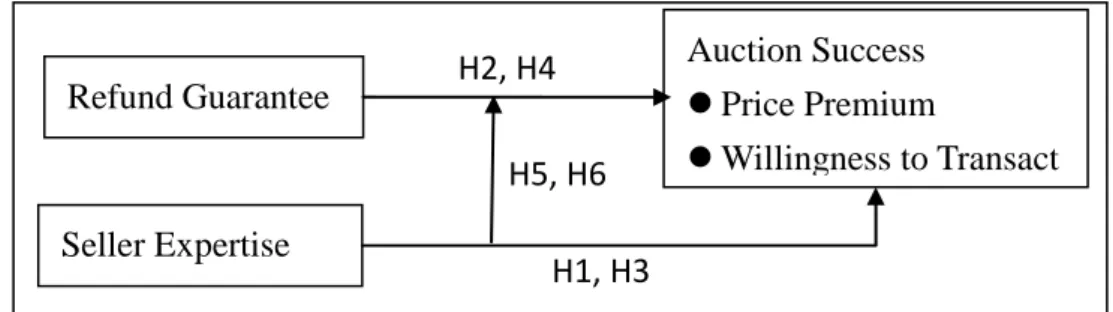
In a thin market it is more difficult to identify a fair market price because less information is available, and because seemingly similar items can vary considerably in terms of their underlying attributes and quality (Hou & Blodgett, 2010). Whereas prices of similar items in a thick market are likely to converge, prices of similar items in a thin market tent do exhibit greater variation. This study is concerned with assessing the impact of choices made by online auction sellers with respect to seller expertise and refund policy on price premiums and on consumers’ willingness to transact – holding all other auction factors constant in the context of a thin market.
Refund Guarantee Seller Expertise Auction Success Price Premium Willingness to Transact H1, H3 H2, H4 H5, H6
Jen-Ruei Fu
International Conference on Innovation and Management, Kuala Lumpur, Malaysia, July 12-15, 2011.
3.1 Price Premium
Seller expertise plays an important role in forming and developing buyer’s trust toward sellers. A seller’s expertise can bolster the buyer's confidence in predicting the product quality and sellers’ future behavior (Kim & Ahn, 2005). Seller expertise can be seen as a representative’s perceived level of knowledge that is relevant to the buyer–seller exchange relationship (Sharma, 1990). It may serve as cues that subtly affect auction prices.
Because a thin market is characterized by fewer sellers, high quality uncertainty and greater value variation of the product, bidders are apt to be more cautious. In this situation seller expertise can serve as an indicator of trustworthiness. By demonstrating expertise, a seller can help overcome the uncertainties that customers are likely to experience during the purchase encounter (Andaleeb & Anwar, 1996). On the contrary, buyers will penalize sellers of low expertise with price discount if they have to assume above average transaction-specific risks. According, it is expected that higher levels of seller expertise will have a greater impact on price premium.
H1. There is a positive relationship between seller expertise and price premium. An auction with high seller expertise has higher price premium than an auction with low seller expertise.
Warranties, or money-back guarantees, are cost-risking default-contingent signals (Kirmani & Rao, 2000) which do not involve monetary expenditure at the time it is offered. It credibly conveys information that false claims (e.g., product breakdown) would involve a direct cost to the firm. A guarantee would help create a positive and reasoned expectation on the part of the customers (Craighead, Karwan, & Miller, 2004). The premise underlying the warranty signal is that firms selling low-quality products will face higher repair costs for the same level of warranty than will high-quality firms, because low-quality firms’ products are likely to incur more frequent repair. As a result, a low-quality seller will reasonably self-select a strategy that offers relatively poor or no warranties. Thus, rational consumers can infer unobservable quality from the level of warranty coverage. We may expect that a bidder is likely to compensate sellers with price premiums and to transact with sellers who provide a high level of warranty claims, such as providing a refund guarantee.
H2. Provision of a refund guarantee will have a positive effect on price premium. An auction with a refund guarantee has higher price premium than an auction with no refund guarantee.
3.2 Willingness to Transact
Price premiums and amount of bids/bidders represent an important element to the survival and success of online auction marketplaces (Dimoka & Pavlou, 2006). A higher number of bids/bidders may indicate that the seller has more potential buyers who have expressed their intention to buy. This provides sellers with the chance to sell their products at a higher price.
Jen-Ruei Fu
International Conference on Innovation and Management, Kuala Lumpur, Malaysia, July 12-15, 2011.
A sense of seller expertise would raise the degree of trust by the customers and help reduce uncertainty, which would therefore enhance their willingness to transact and encourage them to participate in the auction. Gregg and Walczak (2008) found that the website quality, defined by professionalism of user identity and website quality, significantly impact the purchase intentions of consumers. Therefore, we expect that seller expertise encourages consumers to participate in auctions.
H3. There is a positive relationship between seller expertise and willingness to transact.
Because bidders in a thin market perceived high degree of risk, consumers may develop risk reduction strategies. Money-back guarantee represents a category of risk-reduction strategies and can play a significant role in attenuating consumer uncertainty (d'Astous & Guevremont, 2008). Product warranties essentially focus on reducing the uncertainty surrounding product quality because they guarantee that customer's money refunded if it does not perform as it should. Researchers have examined the effect of manufacturer warranties on risk perception. Unsurprisingly, studies have generally found that manufacturer warranties contribute to diminish perceived risk (d'Astous & Guevremont, 2008).
Given the a priori higher level of risk associated with the thin market contexts as opposed to the thick market with which risk is lower, a money-back guarantee can be an important signal in reducing perceived risks. Dowling & Staelin (1994) confirmed that consumers explicitly take into account a refund guarantee when they want to reduce risk. If consumers are allowed to return a product which they are unsatisfied, they are likely to respond favorably and submit more bids to the auction. A seller can attract more buyers by convincing them that the seller provides a refund guarantee.
H4. Provision of a refund guarantee will have a positive effect on willingness to transact.
3.3 Interaction between Seller Expertise and Refund Guarantee
Buyers in online marketplaces are vulnerable to additional risks because of potentially incomplete or distorted information provided by sellers (Lee, 1998). Due to the virtual nature of the online auction, seller expertise provides cues about the nature and abilities of the seller. The seller has high expertise in the product can assure the buyers and help reduce the high level of perceived risk that is inherent in buying situations where the buyers cannot personally inspect the item being sold or the person selling the item. With the help of seller expertise, the effect of information asymmetry is attenuated and thus the bidders know more clearly what they will get beforehand. In this situation, a refund guarantee is less important. However, when seller expertise is unavailable, a money-back guarantee can be an important signal in reducing perceived risks after bidding.
High seller expertise reduces information asymmetry, which may make bidders to depend less on the refund guarantee and encourage them to participate in the auction. For sellers, a money-back guarantee reveals information about the seller’s confidence in the product quality (Li, Srinivasan, & Sun, 2009). The guarantee should virtually eliminate
Jen-Ruei Fu
International Conference on Innovation and Management, Kuala Lumpur, Malaysia, July 12-15, 2011.
consumer risk. Therefore, a refund guarantee may have more impact on consumers when risk is high. We predict that in low seller expertise situations, i.e., when bidders believe that the seller has low level of perceived expert, providing a refund guarantee contributes to reduce consumer uncertainty and leads to higher perceptions of trust and higher willingness to transact, which effect is stronger than in high seller expertise situations.
H5. A refund guarantee has a stronger effect on price premium for an auction with low seller expertise than for an auction with high seller expertise.
H6. A refund guarantee has a stronger effect on willingness to transact for an auction with low seller expertise than for an auction with high seller expertise.
4. Method
This study used a controlled field experiment that measures the impact on actual purchases behavior. Online auction businesses were chosen for this experiment because they represent a large and growing sector of the online economy (Schonfeld, 2005). Four online auction business using different seller expertise (professional vs. one non-professional seller) and refund guarantees (a refund guarantee and no refund guarantee) were established and run for the period of one year. Auction business are relatively easy to establish; auction sites like eBay and Yahoo!Auction provide a built-in customer base for newly established businesses, and online auctions can easily be set up such that real customers are exposed to the listings for different experimental conditions in a real-world setting.
Used camera lenses were selected as the product sold in the auctions because used camera lenses are expensive and buyers of used camera lenses need expert knowledge of cameras, lenses and related equipments. In addition, used camera lenses appeared less frequently in the auction markets. And there are fewer sellers and buyers in the market. Thus, an auction for used camera lenses represents a good example of a thin market. The four businesses were new auction businesses with reputation scores less than 15 and 100% positive comments. All attributes of the businesses and of the auctions were kept identical over the course of the experiment except for the variables manipulated. This includes the starting price of the auction, the duration of the auctions (9 days), and the reservation prices. The time interval of the auctions for the identical product was kept apart at least 2 months. The four businesses had reputation scores that started at 0 and increased to 15 by the end of the experiment. There was some slight variation in the user reputation scores for the four businesses during the study.
One consequence of using actual transaction data is that it makes it impossible to directly measure the consumers’ “intention to transact” as had been done in prior survey-based studies (e.g., Ranganathan & Ganapathy, 2002). Instead, online auction data was examined to determine if buyers demonstrated an increased willingness to transact based on their bidding behavior. Willingness to transact was inferred based on the time from the
Jen-Ruei Fu
International Conference on Innovation and Management, Kuala Lumpur, Malaysia, July 12-15, 2011.
beginning of the auction to the receipt of the first bid, the total number of bidders participating in an auction, and the total number of bids received. The timing of the first bid shows increased willingness to transact since at this time the four auctions have identical auction characteristics (except for the seller expertise and refund guarantee). The number of bidders and bids provide an indication of how many bidders chose to transact with a business and how motivated they are to buy from them, also indicating they intend to transact.
Price premium have been measured as the difference between the price received by an individual seller and the average price received by multiple businesses for a matching product (Ba and Pavlous 2002). For the purpose of this research, price premiums are the difference between the monetary amount a business received and the average price of an identical product the four sellers received. Finally, since existing literature indicated that the final price was negatively related to the duration of the auction (Ariely & Simonson, 2003), we control the duration of the auction to be constant across the four groups of the camera lenses.
5. Data Analysis and Results
A repeated-measures analysis of variance was used to determine if there were significant differences between the dependent measures across the four different online auction scenarios. The repeated-measures ANOVA was appropriate because this research involves a matched sample measured across four conditions. In a repeated-measure ANOVA for a matched sample, measurements across treatment conditions are treated like repeated measures. Roy’s largest root statistic was calculated to estimate the effects of seller expertise, refund guarantee, and the interaction between them on price premiums, first bid time, number of bidders, and number of bids.
All analyses were based on a full-factorial ANOVA model, and p-values reflect two-tailed significant tests. First, the test statistic shows significant main effects for seller expertise (p < 0.001) and for the refund guarantee (p < 0.001). Thus, H1 and H2 are supported. However, H5 is not supported because the interaction of seller expertise and refund guarantee on price premium is not significant.
Second, seller expertise had a significant main effect on timing of the first bid (p < 0.001) with professional sellers receiving their first bid 5.69 days sooner than non-professional sellers (on average). Seller expertise also had a significant impact on the number of bidders bidding at the auctions, with 6.3 (on average) more bidders bidding at the professional sellers’ auctions than at the non-professional sellers’ auctions (p < 0.001). An auction with a professional seller received 17.2 (on average) more bids than the auction with a non-professional seller (p < 0.001). Overall, these evidences indicate that bidders have an increased willingness to transact with auctions with professional sellers, supporting H3.
Third, the refund guarantee was not significant with respect to the number of bidders (p =0.175), number of bids (p =0.138), timing of the first bid (p =0.596). Thus, H4 is not
Jen-Ruei Fu
International Conference on Innovation and Management, Kuala Lumpur, Malaysia, July 12-15, 2011.
supported. Fourth, the interaction between seller expertise and refund guarantee was significant with respect to the number of bidders (p<0.001), number of bids (p<0.001). However, no significant interaction effect was found between seller expertise and refund guarantee with respect to the timing of the first bid (p=0.380). Thus, H6 is partially supported.
Table 1. Descriptive Statistics of the four Auction Stores
Professional Seller Nonprofessional Seller
Refund guarantee No Refund guarantee Refund guarantee No Refund guarantee Closed price $11230 (4868.65) $9069 (3576.07) $3076 (1662.40) $1052 (151.67) Price Premium $5123.18 (2700.89) $2961.98(1510.41) -$3030.48(1429.40) -$5054.68 (2336.76) bidders 11.8 bidders (1.70) 15.4 bidders (2.97) 8.4 bidders (1.24) 6.2 bidders (0.56) bids 25.8 bids (8.15) 41.8 bids (11.48) 21.4 bids (12.36) 11.8 bids (2.83) Timing of the First Bid 23.21 hr. (37.74) 29.28 hr. (26.01) 171.45 hr. (42.60) 154.21 hr. (59.67)
Table 2. Results of Repeated-Measure ANOVA (Roy’s Largest Root)
Independent Variable Dependent variable Value F Sig Observed Power Seller expert Price premium 5.642 78.742 .000 1.000
Number of bidders 15.11 211.546 .000 1.000 Number of bids 3.733 52.255 .000 1.000 Timing of the First Bid 9.01 126.080 .000 1.000 Refund guarantee Price premium 1.736 24.299 .000 0.995 Number of bidders 0.146 2.04 .175 0.265
Number of bids 0.177 2.475 .138 0.311
Timing of the First Bid 0.021 0.294 .596 0.080
Seller expert x Refund guarantee Price premium 0.003 0.037 .851 0.054
Number of bidders 2.310 32.346 .000 1.000 Number of bids 1.636 22.909 .000 0.993 Timing of the First Bid 0.059 0.821 .380 0.135
6. Discussion and Conclusion
The goal of this study is to better understand the impact of seller expertise and refund guarantee on auction outcomes. First, consistent with signaling theory, the results indicate that seller expertise has a significant impact on price premium. This has implications for businesses in the online environment of a thin market, which must demonstrate their professional knowledge and capabilities. This is in line with and findings of Gregg & Walczak (2008). In addition, providing refund guarantee also results in higher price premium. Thus, it suggested that bidders tend to compensate sellers with higher price premium and to transact with sellers who provide a refund guarantee.
Second, the results also confirm that seller expertise has a positive effect on willingness to transact. However, the influence of a refund guarantee is not significant. Thus it seems that seller expertise has stronger effect in influencing bidders’ interest in participate in the auction processes.
Third, one of the most interesting findings of this study is the moderating effects of seller expertise. Contrary to our expectations, results indicates that auctions with no refund
Jen-Ruei Fu
International Conference on Innovation and Management, Kuala Lumpur, Malaysia, July 12-15, 2011.
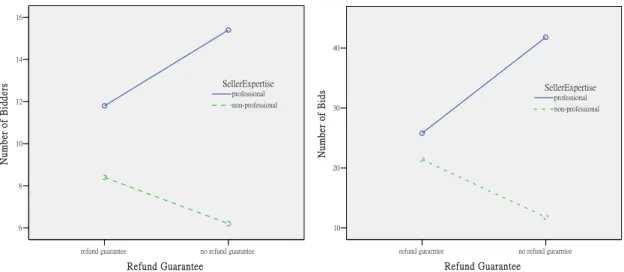
guarantee attracted more unique bidders and bids than auctions providing a refund guarantee for the two high seller expertise groups, as was shown in figure 2. Inspecting the raw data reveals that bidders adopted entirely different bidding strategies in the two groups. In the no refund guarantee and high seller expertise situations, bidders consistently submitted a low bid, then to wait and see if other bidders entered and submitted a bid, and possibly to revise the initial low bid later in response to later bidders entering the auction. These processes seemed to attract a lot of bidders and bids to participate.
no refund guarantee refund guarantee Refund Guarantee 16 14 12 10 8 6 Nu mber o f Bid d er s non-professional professional SellerExpertise no refund gurarntee refund gurarntee Refund Guarantee 40 30 20 10 Nu mbe r o f B id s non-professional professional SellerExpertise
Figure 2. The interaction Effect of Refund Guarantee and Seller Expertise on Auction Outcome
On the other hand, with high seller expertise and the refund guarantee to assure safe transactions, bidders bid early and bid their own valuation. Especially, bidders use the jump bidding strategies to signal their valuations to potential other bidders in the auction. Research has demonstrated “jump bidding” is akin to bluffing in poker (Avery, 1998). The occurrence of jump bidding discourages potential bidders from competition. Only those who with higher types respond with jump bids. We observed that several bidders seemed to immediately quit. Thus, in comparison with auctions providing no refund guarantee, the actual number of bidders and bids are significantly fewer for an auction providing a refund guarantee.
Finally, considering that online bidding involves multiple decision-making process (Ariely & Simonson, 2003); such as how much to bid and how to bid, and where and when to enter an auction; additional research is needed to integrate various behavioral constructs into online auction studies. In many instances, online bidders are often uncertain about their own valuation of the item, and thus research is needed to better understand what strategies online bidders would choose under different auction context and value assessment.
Acknowledgement
The author thanks Chun-Chih Liu for providing camera lenses and expert opinion about the formats and styles of the auction sites. This study was supported in part by a grant from the National Science Council in Taiwan, R.O.C. (Grant Number: NSC 99-2410-H-151-015)