噶瑪蘭語語法與認知整合型計畫(Ⅲ)--噶瑪蘭語言談與認
知研究
研究成果報告(精簡版)
計 畫 類 別 : 整合型 計 畫 編 號 : NSC 95-2411-H-002-051- 執 行 期 間 : 95 年 08 月 01 日至 96 年 07 月 31 日 執 行 單 位 : 國立臺灣大學語言學研究所 計 畫 主 持 人 : 黃宣範 計畫參與人員: 博士班研究生-兼任助理:黃惠如、葉郁婷、洪媽益 處 理 方 式 : 本計畫可公開查詢中 華 民 國 96 年 10 月 31 日
Table of Contents
Chapter 1 Phonology . . . 1
Chapter 2 Word Order . . . 18
Chapter 3 Morphology . . . 36
Chapter 4 Case Marking System . . . 57
Chapter 5 Nominalization and Relativization . . . 77
Chapter 6 Numeral and Kinship Terms . . . 103
Chapter 7 Quantifiers . . . 111
Chapter 8 Deixis . . . 131
Chapter 9 Reflexives . . . 140
Chapter 10 Reciprocals . . . 160
Chapter 11 Tense and Aspect . . . 181
Chapter 12 Adverbials . . . 195
Chapter 13 Existential Sentences . . . 229
Chapter 14 Negation . . . 259
Chapter 15 Causatives . . . 292
Chapter 16 Cleft Sentences . . . 306
Chapter 17 Imperatives . . . 319
Chapter 18 Interrogative Constructions . . . 333
Chapter 19 Ditransitive Constructions . . . 351
Chapter 20 Comparative Constructions . . . 364
Chapter 21 Complementation . . . 381
Chapter 22 Serial Verb Constructions . . . 413
Chapter 23 Subordination / Coordination . . . 435
Chapter 24 Spatial Expressions . . . 455
Chapter 25 Emotion . . . 475
Chapter 26 Cognition Verbs . . . 498
Chapter 27 Resultatives . . . 528
References . . . 536
Appendix: Glossary . . . 546
Chapter One
Phonology
噶瑪蘭語重音的語音表現 ─ 以雙音節單字為例
一、 引言 本研究著重於噶瑪蘭語單字層次的重音 (accent) 表現,以詳細的各種聲學 特質 (acoustic properties) 來檢視其雙音節單字層次,重音與非重音節的差異。 根據過去文獻對噶瑪蘭語的音韻描述,此語言的重音規律地落在最後一個音節 (張 2000:46),這樣的重音特徵和其他部分台灣南島語是一樣的 (例如賽夏語)。 然而,過去對於台灣南島語的重音研究都只侷限在音韻的描述,並無進一步做更 詳細的語音分析,因此即便知道每種語言的重音落在何方,但對於這些重音如何 表現仍是一無所知。過去我們已對賽夏語的重音做過詳細的語音分析,在噶瑪蘭 語的研究中將承襲之前的分析模式,以七種聲學參數 (acoustic parameters) 的角 度 來 檢 視 此 語 言 雙 音 節 單 字 層 次 重 音的 表 現 , 包 括 基 礎 頻 率 (fundamental frequency,簡稱 F0) 在不同點的值、基礎頻率的平均值 (mean F0)、音調變動範 圍 (pitch range)、斜率 (slope)、基礎頻率最高點的排列 (F0 peak alignment)、音 長 (duration) 以及強度 (intensity)。而由於鄰近子音對於音調或多或少會造成影 響,因此在這個初步的研究中將有兩個實驗階段的結果呈現:第一個階段以「無 子音結尾」的音節為主,探討其重音以及因應母音前子音 (pre-vocalic consonant) 不同而產生的細微變化。第二個階段則是以「子音結尾」的重音節為主,1 探討 重音表現和母音後子音 (post-vocalic consonant) 對重音的影響。實驗結果顯示, 噶瑪蘭語的重音呈現十分倚賴音調的變化,也就是重音節的F0 平均值較高、且 F0 peak 多落在音節後半部;至於音長及強度對於重音的呈現並不顯著,且易受 1 在這裡只有重音節是以子音結尾,因為非重音節多半沒有子音結尾。到鄰近子音的影響而有所變化。而在雙音節單字層次重音的研究之後,未來我們 將進一步探討句子層面重音的表現,以及句子的語調變化。 二、 研究方法 (一) 受訪者 本研究的受訪者為潘秀蘭女士,她年約四十歲。 (二) 語料 本研究分為兩個階段實驗,皆以雙音節結構的單字為語料。語料的來源為張 (2000) 的參考語法以及我們的田野調查。實驗一的部分測量 CVCV 的音節結 構,收集的單字依照母音前子音的有聲或無聲 (pre-vocalic consonant voicing) 分為四組,分別是: [+voice]CV‧[+voice]CV Æ 以 +CV+CV 表示 [+voice]CV‧[-voice]CV Æ 以 +CV-CV 表示 [-voice]CV‧[+voice]CV Æ 以 -CV+CV 表示 [-voice]CV‧[-voice]CV Æ 以 -CV-CV 表示 (+與-表示子音的有聲或無聲) 共採集到32 個 CVCV 結構的單字:
+CV+CV: bari, biRi, bura, damu, nengi, ningu, rima, zena, zuma +CV-CV: baqi, batu, mata, muti, Rasa
-CV+CV: kubu, pamu, pani, paRo, penu, puri, saRo, tama, tebu, teRi, tina -CV-CV: qaqa, qoto, saku, siku, sisu, siti, tasu
實驗二的部分則是測量CVCVC 的音節結構,收集的 65 個單字依照母音前
以響音 (sonorant) 結尾的 43 個單字:babar, bangun, banur, buran, labang,
lazing, lezun, lidam, mamin, maRong, muRing, nangan, ranem, razan, razum, ribeng, rubung, ruren, zanum, boqan, dasam, metong, mipir, mutun, Rotong, zapan, paRin, pineng, qadan, qeman, qemar, sezang, tamun, tangan, tedem, tiRan, tubir, pising, pukun, takan, taqan, tisan, tisin
以塞音 (stop) 結尾的 22 個單字:badaq, maded, mineb, niniq, razat, ruzit,
zinaq, busoq, lizap, qiReb, sabaq, saReq, siRop, sudad, temaq, tened, tumuq, tuzuq, kaput, kitut, taqoq, toqeb
在語料的設計上,母音並不做特別的篩選,這是因為母音本身對於音調的影 響遠比子音來得小 (Matisoff 1970),但是不會選擇雙母音 (/aw/, /ay/, /iw/和 /uy/),因其含有滑音,且時間值本身就會較長。另外在子音的選擇上不考慮滑音 (glide),避免在音譜圖上不容易與母音區辨,造成測量上的困難。
(三) 錄音
本 研 究 使 用 的 錄 音 地 點 及 器 材 是 位 於 台 大 語 言 所 語 音 實 驗 室 的 Computerized Speech Lab Model 4400,sampling rate 設為 22050 Hz。在與受訪者 確認語料的正確性之後,我們請她將語料上的單字以自然的說話速度各唸三次, 中間間隔約一秒。為了保持錄音品質及音量的固定,錄音時麥克風距離發音人有
固定的距離,約為20 公分左右。
(四) 分析與測量
錄音之後的語料以語音分析軟體Praat 做測量,sampling rate 亦為 22050 Hz。
統計軟體則採用SPSS 11.0 來做數據統計及分析。在測量方面去掉母音之前的子
音 (onset),只量 rime 的部分,避免有些無聲子音無法測量其音調,造成統計上 一個預期外的變數。
三、 結果
這裡我們將呈現兩個階段的實驗結果,每個實驗都包含七個參數,每個參數 的計算方式描述如下:
1. 四個點 (begin, end, peak valley) 的基礎頻率值 (F0,單位:Hz):
測量在每個rime 當中,開始和結束的 F0 值,以及 F0 最高點及最低點。
因此這四個點分別量得其F0 的值以及對應的時間點 (單位:ms)。
2. 基礎頻率的平均值 (mean F0,單位:Hz) 測量每個rime 的 F0 平均值。
3. 音調變動範圍 (pitch range,單位:Hz)
以F0 最高點 (peak) 減掉最低點 (valley),得到音調變動的範圍 (F0peak – F0valley)。
4. 斜率 (slope)
在F0 最高點及最低點之間,求得其一毫秒 (ms) 內音調上升或下降多少
Herz。計算方法為 F0 最高點減掉最低點,再除以此兩點的時間差 ((F0peak – F0valley)/(t peak – t begin))。得出來的值若是正數,表示音調的走向 是上升;相反地若是負數,音調的走向則是下降。
5. 基礎頻率最高點的排列 (F0 peak alignment,單位:%)
計算F0 最高點出現在 rime 的何處。計算方法為 F0 最高點的時間值減掉
開始的時間值,除以整個rime 的長度,再乘以一百 ((t peak – t begin)/( t end – t begin)*100)。
6. 音長 (duration,單位:ms)
每個rime 的結束減掉開始的時間值 (t end – t begin)。 7. 強度 (intensity,單位:dB)
測量每個rime 的強度平均值。
(一) 實驗一
1. 四個點 (begin, end, peak valley) 的基礎頻率值 (F0)
表一
F0 value (Hz): Mean (SD) Syllable Accent
begin end peak valley pre-Acc 171.34 (12.21) 148.99 (8.87) 175.49 (9.53) 146.98 (9.50) +CV+CV Acc 191.97 (17.45) 266.06 (55.22) 273.63 (51.03) 188.96 (17.11) pre-Acc 170.76 (18.63) 145.17 (9.56) 171.74 (18.62) 138.36 (10.99) +CV-CV Acc 211.15 (19.61) 217.05 (31.83) 227.65 (23.79) 199.17 (16.41) pre-Acc 190.48 (10.26) 149.86 (9.68) 191.28 (10.32) 149.02 (10.05) -CV+CV Acc 185.88 (17.08) 278.79 (26.08) 283.71 (27.44) 182.04 (13.71) pre-Acc 190.68 (14.77) 153.53 (8.50) 191.18 (14.52) 149.46 (12.6) -CV-CV Acc 231.16 (20.93) 227.72 (24.01) 237.19 (23.93) 212.13 (17.43) 從表中可知,和非重音節比起來,重音節的pitch 較高,且變異性也較大。
另外begin, end, peak, valley 這四個點 F0 的比較,在非重音節部分是有顯著差異 的 (F(3, 124) = 76.197, p < .01),事後檢定顯示,peak 和 begin 的 F0 大於 end 和 valley。至於在重音節,子音的 voicing 對於四點的比較有不一樣的結果。在有聲 子音開頭的重音節 rime,這四點的 F0 是有顯著差異的 (F(3, 76) = 57.095, p < .01),事後檢定顯示 peak 和 end 的 F0 大於 begin 和 valley。但以無聲子音開頭
的重音節,四個點的F0 反而是沒有顯著差異的。
而子音的voicing 對 rime 的影響,在重音節和非重音節有相同的表現,也有
不同的表現。共同點在於,在無聲子音之後,F0 的值會提高 (比較 begin 的 F0)。
而不同的地方是,非重音節在begin 和 peak 這兩個點,以無聲子音開頭的 F0 值
都較高 (begin: t(30) = 4.247, p < .01; peak: t(30) = 3.922, p < .01),end 和 valley 則無
顯著差異;但在重音節部分,以有聲子音開頭的F0 表現出較大的差異性:begin
和valley 的 F0 較低,但 end 的 pitch 較高,peak 的 F0 也是高於無聲子音開頭的 peak。
這也許可以解釋成,除了 begin 的 pitch 可能是受到子音的影響之外,其後
的音調高低應該是「重音」這個因素所造成的,也就是重音節的音調變化要比非
重音節來得大。不過有趣的是,有聲子音對重音節而言似乎不只影響begin 的音
2. 基礎頻率的平均值 (mean F0) 圖一為每種音節結構中,非重音與重音節的F0 平均值及標準差。 pre-Acc Acc Accent +CV+CV +CV-CV -CV+CV -CV-CV Syllable 50.00 100.00 150.00 200.00 250.00 300.00 M e a n F 0 ( H z ) 156.93 221.68 148.90 212.84 164.23 223.29 165.07 222.44 圖一 從圖可知,以F0 的平均值來看,重音節的確要比非重音節來得高。統計結 果如下: Category t-test +CV+CV t(16) = 6.971, p < .01 +CV-CV t(8) = 7.429, p < .01 -CV+CV t(20) = 8.271, p < .01 -CV-CV t(12) = 6.441, p< .01 而在子音的影響方面,非重音節依舊是無聲子音開頭的 pitch 較高 (t(30) = 2.990, p < .01),但在重音節部分,有聲子音開頭的 pitch 反而稍微高了一點 (根
據之前的結果,有可能是end 較高的 pitch 造成的),但整體而言,重音節不同 onset
3. 音調變動範圍 (pitch range) 圖二是每種音節結構中,非重音與重音節的音調變動範圍。 pre-Acc Acc Accent +CV+CV +CV-CV -CV+CV -CV-CV Syllable 0.00 50.00 100.00 150.00 200.00 P i t c h r a n g e ( H z ) 28.51 84.67 33.39 28.48 42.25 101.67 41.72 25.06 圖二 從圖中可知,pitch range 受到子音的影響也相當大:以有聲子音開頭的重音 節,pitch range 會比非重音節大得多 (+CV+CV: t(16) = 4.046, p < .01; -CV+CV: t(20) = 6.597, p < .01);但如果是無聲子音開頭,重音節的音調反而會比非重音節稍小 (+CV-CV 與-CV-CV),但在統計上無顯著差異。 4. 斜率 (slope) 圖三為每個非重音與重音節的rime 當中,音調變化的斜率。
pre-Acc Acc Accent +CV+CV +CV-CV -CV+CV -CV-CV Syllable -0.80 -0.40 0.00 0.40 S l o p e 0.57 0.62 -0.20 -0.24 -0.16 -0.44 -0.34 -0.17 圖三 重音節的斜率依舊受到子音的影響:以有聲子音開頭的重音節音調呈現大幅 度的上升 (0.57 和 0.62),藉此與非重音節區分 (+CV+CV: t(16) = 10.074, p < .01; -CV+CV: t(20) = 12.846, p < .01);以無聲子音開頭的反而是微微下降 (-0.16 和 -0.17),但與非重音節的斜率並無顯著差異。至於非重音節部分,不管有聲或無 聲子音開頭,音調都是下降的,只是無聲子音開頭的斜率較陡 (-0.44 和-0.34), 甚至比重音節還陡。 5. 基礎頻率最高點的排列 (F0 peak alignment) 圖四為非重音與重音節中,F0 最高點在整個 rime 當中的相對位置。
pre-Acc Acc Accent +CV+CV +CV-CV -CV+CV -CV-CV Syllable 0.00 25.00 50.00 75.00 100.00 F 0 p e a k a l i g n m e n t ( % ) 5.17 96.78 4.94 69.44 1.79 95.67 2.40 39.84 圖四 在這個參數當中,重音的影響似乎大於子音,因為重音節的F0 peak 多比非
重音節呈現更明顯的延遲現象 (peak delay),非重音節的 F0 peak 都是在 rime 的 開頭就出現,這也成為重音節和非重音節一個很大的不同點。唯一例外是-CV-CV 結構,重音節的F0 peak 出現在 rime 的前半段 (39.84%),雖然大於非重音節的 2.4%,但在統計上沒有顯著差異。詳細統計數據如下:
Category
t-test +CV+CV t(16) = 32.185, p < .01 +CV-CV t(8) = 3.674, p < .01 -CV+CV t(20) = 50.904, p < .01 -CV-CV t(12) = 1.991, p = .07 在子音的影響上,在重音節中以有聲子音開頭的rime,它的 F0 最高點會有 比較明顯的延遲現象 (t(30) = 4.291, p < .01),而在非重音節裡則無顯著差異。6. 音長 (duration) 圖五為非重音與重音節音長的表現。 pre-Acc Acc Accent +CV+CV +CV-CV -CV+CV -CV-CV Syllable 0 100 200 300 D u r a t i o n ( m s ) 185 158 174 138 134 180 147 129 圖五 由圖可得知,噶瑪蘭語單字的重音節,長度不一定會比非重音節長。只有在 -CV+CV 的結構中,重音節 (180 ms) 才比非重音節 (134 ms) 長,其他的音節結 構,非重音節反而都比重音節長。但在統計上面,無論何種結構,重音節和非重 音節的長度都是沒有顯著差異的。而子音的影響是,在重音節中,以有聲子音開 頭的rime 比較長 (t(30) = 3.623, p < .01);而在非重音節裡則無顯著差異。 7. 強度 (intensity) 圖六為非重音節與重音節強度的比較。
A pre-Acc B Acc Accent +CV+CV +CV-CV -CV+CV -CV-CV Syllable 10.00 20.00 30.00 40.00 50.00 M e a n i n t e n s i t y ( d B ) 46.84 46.80 42.65 48.69 49.10 48.58 45.05 48.66 圖六 重音節和非重音節的強度似乎不會相差太多,只有在重音節是以無聲子音開 頭時 (+CV-CV 與-CV-CV),強度才會稍稍高於非重音節,但在統計上,重音節 和非重音節的intensity 沒有顯著差異。此外子音也不會對強度造成統計上的顯著 差異。
綜合以上結果,噶瑪蘭語單字的重音主要以 mean F0 和 F0 peak alignment
這兩個參數來呈現,重音節的F0 平均值較高,且有明顯的 F0 peak delay 現象。
比起賽夏語,噶瑪蘭語似乎更依賴與音調相關的參數來表示其重音,因為duration
和intensity 這兩個參數在分辨噶瑪蘭語的重音上似乎無太大貢獻。而其他參數則
會受到子音的影響,不一定可以區辨重音和非重音節。
另外母音前的子音對於重音也有一定程度影響,例如以有聲子音開頭的重音
節,其pitch range 就會明顯變大且 slope 會是大幅上升,更利於分辨重音節與非
重音節;但如果是無聲子音開頭則會減弱重音和非重音節在這兩個參數上的差 異。
(二) 實驗二
在這個階段的實驗,我們要看重音節在以「子音結尾」的時候,這七個參數 的表現如何,以及會不會因為結尾子音的不同 (響音和塞音) 而產生變化。
1. 四個點 (begin, end, peak valley) 的基礎頻率值 (F0) 表二為結尾子音是響音 (sonorant) 和 塞音 (stop) 的時候,四個點的基礎頻 率值。 表二 F0 value (Hz): Mean (SD) Coda Accent
begin end peak valley pre-Acc 181.09 (10.37) 157.96 (7.87) 181.63 (10.32) 156.42 (7.68) Sonorant Acc 187.44 (14.53) 207.92 (7.87) 210.90 (11.44) 181.66 (21.42) pre-Acc 186.93 (17.97) 160.08 (22.67) 187.98 (19.45) 157.11 (19.56) Stop Acc 190.72 (11.23) 203.85 (12.90) 208.56 (11.88) 186.20 (10.12) 在這個參數方面,無論是何種音節,以及何種子音結尾,這四個點的F0 值
都是有顯著差異的,在非重音節中,begin 和 peak 的 F0 都大於 end 和 valley;而 在重音節裡面end 和 peak 的 F0 則大於 begin 和 valley 的 F0 值。詳細統計如下:
Category One-way ANOVA Post hoc test Sonorant pre-Acc F (3, 168) = 100.191, p < .01 peak, begin > end, valley
Acc F (3, 168) = 56.538, p < .01 peak, end > begin, valley Stop pre-Acc F (3, 84) = 15.385, p < .01 peak, begin > end, valley Acc F (3, 84) = 18.388, p < .01 peak, end > begin, valley
因此無論是響音或塞音結尾的單字,非重音節和重音節F0 的高低分佈是很
不同的,也就是這個參數受到重音的影響較大,受到結尾子音的影響較小。
2. 基礎頻率的平均值 (mean F0)
Sonorant Stop pre-Acc Acc Accent 50.00 100.00 150.00 200.00 250.00 300.00 M e a n F 0 ( H z ) 167.32 197.84 pre-Acc Acc Accent 168.13 197.03 圖七 從圖中可發現,無論是何種子音結尾,重音節的F0 平均值都是比較高的 (響 音:t(84) = 14.509, p < .01;塞音:t(42) = 6.294, p < .01)。至於結尾子音則不會對這 個參數產生影響,造成F0 平均值的顯著差異。 3. 音調變動範圍 (pitch range) 圖八為兩種子音結尾的單字中,F0 在非重音以及重音節的變動範圍。 Sonorant Stop pre-Acc Acc Accent 25.00 50.00 75.00 100.00 125.00 P i t c h r a n g e ( H z ) 25.22 29.23 pre-Acc Acc Accent 30.87 22.36 圖八 從圖中可知,這個參數在非重音與重音節的差異並不大,以塞音結尾的單 字,重音節的F0 變動範圍甚至比非重音節小。而在統計上,無論是重音或者結 尾子音都不會造成統計上的顯著差異。
4. 斜率 (slope) 圖九顯示兩種不同子音結尾的單字,其非重音與重音節中斜率的比較。 Sonorant Stop pre-Acc Acc Accent -0.80 -0.40 0.00 0.40 0.80 S l o p e 0.12 -0.36 pre-Acc Acc Accent 0.05 -0.23 圖九 這裡的結果配合之前四個點的F0 值來看,可知 F0 的走向在非重音節中都是 下降,在重音節中都是上升的。而除了以響音結尾的單字,兩個音節的斜率有顯 著差異外 (t(84) = 5.229, p < .01) ,在以塞音結尾的單字中,則是無顯著差異。 5. 基礎頻率最高點的排列 (F0 peak alignment) 圖十為兩種不同子音結尾的單字,其非重音與重音節中F0 最高點所在相對 位置的比較。 Sonorant Stop pre-Acc Acc Accent 0.00 25.00 50.00 75.00 100.00 F 0 p e a k a l i g n m e n t ( % ) 2.93 83.70 pre-Acc Acc Accent 7.56 62.05 圖十 很明顯地,在重音節中 F0 最高點位於 rime 的後半部,比起非重音節中 F0 最高點皆在rime 一開始就出現有很顯著的相對延遲現象 (Sonorant: t(84) = 22.307,
p < .01; Stop: t(42) = 5.647, p < .01)。同時也可以觀察到,跟以響音結尾的單字重音 節比起來,以塞音結尾的單字重音節,其F0 最高點會較早出現 (t(63) = 2.780, p < .01)。 6. 音長 (duration) 圖十一為兩種不同子音結尾的單字,其非重音節與重音節扣掉開頭子音之後 的音長,也就是rime 的長度。 Sonorant Stop pre-Acc Acc Accent 50 100 150 200 250 300 D u r a t i o n ( m s ) 123 292 pre-Acc Acc Accent 173 122 圖十一 由於重音節比非重音節多了一個子音,因此可預期前者的音長會比後者大。 在以響音結尾的單字中,重音節的確比非重音節長得多 (t(84) = 21.065, p < .01), 然而在以塞音結尾的單字中,非重音節反而比重音節長 (t(42) = 3.594, p < .01)。 至於結尾的子音也會對音長造成影響,也就是以響音結尾的重音節比以塞音結尾 的重音節來得長 (t(63) = 25.345, p < .01)。 7. 強度 (intensity) 在最後一個參數中,圖十二為兩種不同子音結尾的單字,其非重音節與重音 節rime 的強度比較。
Sonorant Stop pre-Acc Acc Accent 10.00 20.00 30.00 40.00 50.00 I n t e n s i t y ( d B ) 47.56 46.92 pre-Acc Acc Accent 46.76 48.73 圖十二 無論是何種子音結尾,非重音節與重音節的強度都非常相近,而統計顯示, 重音與否並不造成強度的顯著差異,只有在重音節中,以塞音結尾的會比以響音 結尾的有顯著的強度 (t(63) = 3.358, p < .01)。 在實驗二的情況中,主要是比較這七個參數是否受到重音及結尾子音不同而 產生差異。結果顯示,重音對於各個參數的影響比結尾子音來得大。噶瑪蘭語重 音的表現依舊以音調為主,也就是重音節的基礎頻率平均值較高、F0最高點有明 顯的相對延遲現象。而從四個點的F0值和諧率來看,重音與非重音節的不同也表 現在F0的走向上:非重音節的F0往下,而重音節的F0往上。 至於音長的情況就比較複雜。當結尾子音是響音時,重音節長度明顯比非重 音節長;但當結尾子音是塞音時,非重音節的長度反而比重音節長。另一個非音 調的參數,強度,在兩個實驗中都沒辦法用來區分重音及非重音節。 四、 結論 綜合以上結果,噶瑪蘭語的重音表現的確是非常依賴音調的變化,尤其是F0 平均值 (重音節大於非重音節) 以及F0最高點的位置 (重音節有相對延遲現 象),而F0最高點位置的差異也與重音、非重音節的F0走向息息相關。不過其他 與音調相關的參數則不是那麼規律地呈現重音非重音的區分,像是F0的變動範圍
以及斜率多少都會受到相鄰子音的影響。
另一方面,噶瑪蘭語並不用音長和強度來呈現重音。尤其音長的表現明顯受 到結尾子音的影響:以響音結尾的重音節最長,以塞音結尾的重音節最短 (甚至 比非重音節短),沒有結尾子音的重音節長度則介於之間。
Chapter Two
Word Order
2.0 Introduction
Kavalan is a predicate-initial language with predicate-argument order like most other Formosan languages. The predicates in this language come from a variety of syntactic categories such as verbs, nouns, existential markers, different kinds of interrogative words, and negators. Verbs are the typical predicates.
In this chapter, based on discourse-based data of the NTU Corpus, our main goal is to investigate the ordering of verbs in relation to their arguments. Word order is generally realized in terms of valency roles A, S, and O. A and O refer to the typical agent and patient of a transitive verb, and S to the only one argument of an intransitive verb. However, we will also take into account the “extended intransitive” constructions (EIC) (Payne, 1994; Ross, 2002; and Reid and Liao, 2004) and the role E, which also bears on the word order in Kavalan. E, coded by the oblique case, is a non-core argument in a semantically-transitive but syntactically-intransitive clause, namely the EIC. The presence or absence of E in the Kavalan corpus data is crucial to the core/oblique distinction in the language and is expected to exhibit other significant features in the syntax of Kavalan.
2.1 Methodology and Data
Before embarking on our discussion, it is necessary to demarcate our methodology more clearly.
First, a basic unit of our analysis is a clause, which contains a predicate and its optional arguments. Second, only main clauses are counted in our statistical analysis. Third, adverb-like predicates are excluded at this stage; if it co-occurs with other
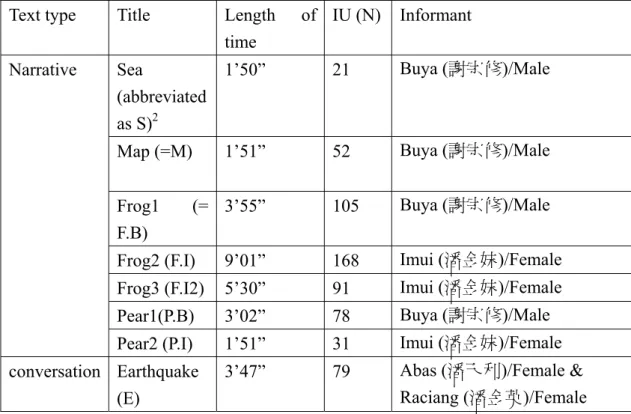
verbs, we only count the verbs. Fourth, our statistics on clausal focus and transitivity below also exclude from other constructions like the MA-verb constructions, negations, existential constructions, quotation constructions, and equational sentences. Our corpus data consist of eight texts, which run to 30 minutes and 47 seconds, for a total of 625 IUs. The table below offers a detailed description of our data.
Table 1. Database used in this study on word order Text type Title Length of
time IU (N) Informant Sea (abbreviated as S)2 1’50” 21 Buya (謝宗修)/Male
Map (=M) 1’51” 52 Buya (謝宗修)/Male
Frog1 (= F.B)
3’55” 105 Buya (謝宗修)/Male
Frog2 (F.I) 9’01” 168 Imui (潘金妹)/Female Frog3 (F.I2) 5’30” 91 Imui (潘金妹)/Female Pear1(P.B) 3’02” 78 Buya (謝宗修)/Male Narrative
Pear2 (P.I) 1’51” 31 Imui (潘金妹)/Female conversation Earthquake
(E)
3’47” 79 Abas (潘天利)/Female & Raciang (潘金英)/Female
2.2 Patterns & Distributions
In this section, we would like to discuss patterns of word order in the eight texts; we will tabulate the distribution of each pattern. Let’s first start with AF intransitive clauses.
2.2.1 Patterns & Distributions of AF Intransitive Clauses
To discuss the relative order of the verb and its sole argument (S) in an AF
intransitive clause, we picked AF intransitive clauses from our data and identified the various clausal patterns. Table 2 below presents the distribution patterns.
Table 2. Distribution of the word order patterns in AF intransitive clauses
Text AF: Vi Total Main Type (=M.T) Subtype (=S.T)
F.B F.I F.I2 P.B P.I S M E
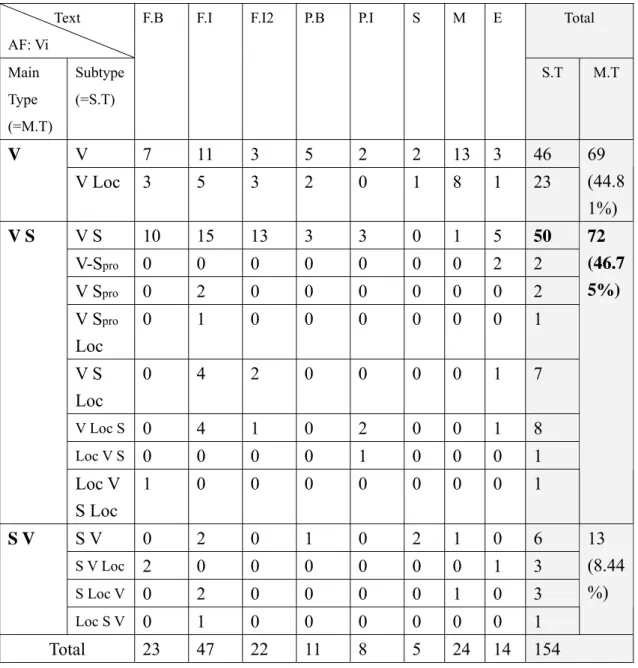
S.T M.T V 7 11 3 5 2 2 13 3 46 V V Loc 3 5 3 2 0 1 8 1 23 69 (44.8 1%) V S 10 15 13 3 3 0 1 5 50 V-Spro 0 0 0 0 0 0 0 2 2 V Spro 0 2 0 0 0 0 0 0 2 V Spro Loc 0 1 0 0 0 0 0 0 1 V S Loc 0 4 2 0 0 0 0 1 7 V Loc S 0 4 1 0 2 0 0 1 8 Loc V S 0 0 0 0 1 0 0 0 1 V S Loc V S Loc 1 0 0 0 0 0 0 0 1 72 (46.7 5%) S V 0 2 0 1 0 2 1 0 6 S V Loc 2 0 0 0 0 0 0 1 3 S Loc V 0 2 0 0 0 0 1 0 3 S V Loc S V 0 1 0 0 0 0 0 0 1 13 (8.44 %) Total 23 47 22 11 8 5 24 14 154
The sole verb, the VS order, and the SV order constitute the three main word order patterns in Kavalan AF intransitive clauses. We can see from Table 2 that Kavalan AF intransitive clauses tend to exhibit VS order (46.75%). The one with the second highest ratio is the sole V pattern; making up 44.81%, about 2 percent less than that of the VS order. The SV order constitutes only 8.44% of the AF intransitive
clauses in this language.
If we exclude the sole V pattern from consideration, the ratio of the VS order to the SV order is almost 6 to 1. It means that Kavalan is a V-initial language in the AF intransitive clauses.
We have examples for each pattern as follows.
(1) AF: V
nakuni t<em>ibuk=ti nani. (Frog_buya: 23) how <AF>fall=PFV DM
“… and somehow it falls.”
(2) AF: V Loc
t<em>eqez ta-repaw-an ni utay tu sa-ruki-an,_ <AF>stop.by LOC-house-LOC GEN PN TU SA-clock-AN
“(He) stopped over at Utay’s house for one hour.” (Map: 23)
(3) AF: V S
Ramneng sunis ‘nay atu wasu-na nani. (Frog_buya: 12) wake child that and dog-3SG.GEN DM
“The child and his dog wake up.”
(4) AF: V-SPro
masang m-susupa=ita nani. (Earthquake: 66) past AF-poor=1IPL.NOM DM
“We were poor in the past.”
(5) AF: V SPro
wiya=ti qaniawu tangi,\ (Frog_imui: 113)
leave=PFV 3PI.NOM now
“They left,”
(6) AF: V SPro Loc
tangi m-zaqis qaniawu ta==-iza-an u ta now AF-climb.up 3PI.NOM LOC-somewhere-LOC or LOC
babaw na paRin,/ (Frog_imui: 153)
above GEN tree
(7) AF: V S Loc
siquling=ti sunis ‘nay nayzi ta== babaw na paRin.\ roll=PFV child that from LOC above GEN tree
“The child rolled down from the tree.” (Frog_imui: 74)
(8) AF: V Loc S
tangi nani ..suRaw=ti ta-bataz-an na razan .. ‘nay sunis today DM fall=PFV LOC-halfway-LOC GEN road that child a yawu.\
LNK that
“Then the child stumbled in the middle of the road.” (Pear_imui: 15)
(9) AF: Loc V S
ta tibuR sayza s<em>aqay ‘nay kintulu ay sunis LOC south maybe <AF>walk that three.human REL child a yawu. \
LNK that
“Those three children came over, perhaps toward the south. “ (Pear_imiu: 27)
(10) AF: Loc V S Loc
ta- nani ta==zian ta==-pa-paRin-an mazmun ..muaza paRin FS DM here LOC-RED-tree-LOC FS many tree tayan nani.\
there DM
“There are lots of trees in the forest.” (Pear_imui: 32)
(11) AF: SV
Ronanai m-Rengnem… (Sea: 7)
man AF-go.into.the.water “The men go down into the water,…”
(12) AF: S V Loc
wasu ‘nay …t<em>uqaz ta-tengat-an. (Frog_buya : 22) dog that <AF>go.up LOC-window-LOC
(13) AF: S Loc V
ci buya .. nizi ta-repaw-an-na.. me-zukat,_ NCM PN from LOC-house-LOC-3SG.GEN AF-move.out “Buay came out from his house.” (Map: 1)
(14) AF: Loc S V
ta-tuRUz-an na siRemuq ‘nay wasu ‘nay t<em>alup=ti,/ LOC-head-LOC GEN deer that dog that <AF>hide=PFV “The dog hid behind the deer.” (Frog_imui: 102)
2.2.2 Patterns & Distributions of Extended AF Clauses
Patterns and distribution of AF transitive clauses are tabulated in Table 3.
Table 3. Distribution of the word order patterns in extended AF clauses
Text AF: Vt
Total Type
F.B F.I F.I2 P.B P.I S M E
Type V E 4 8 6 6 3 1 9 0 37 (66.07%) V S E 0 5 0 0 0 0 0 0 5 (8.93%) V E S 0 1 3 0 1 1 0 0 6 (10.71%) S V E 2 1 3 1 1 0 0 0 8 (14.29%) Total 6 15 12 7 5 2 9 0 56
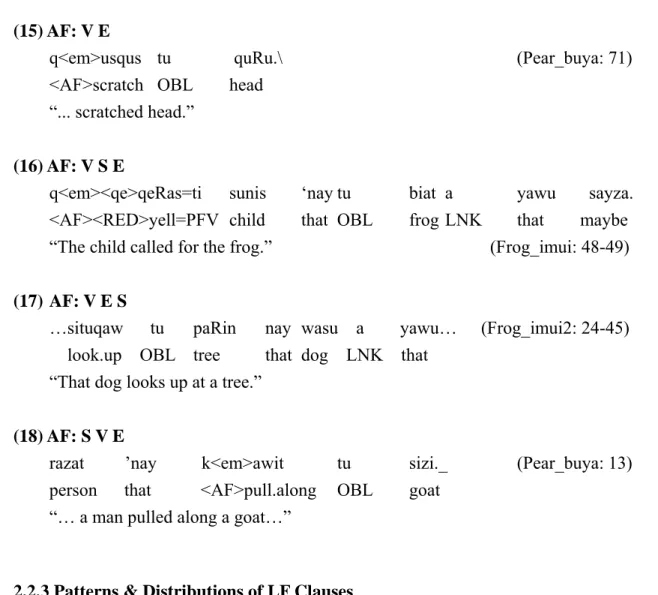
Table 3 shows a variety of patterns for the ordering of the verb in relation to its two arguments in extended AF clauses. The most frequent pattern is the VE pattern, followed by a bunch of other minor patterns SVE, VES and VSE.
(15) AF: V E
q<em>usqus tu quRu.\ (Pear_buya: 71) <AF>scratch OBL head
“... scratched head.”
(16) AF: V S E
q<em><qe>qeRas=ti sunis ‘nay tu biat a yawu sayza. <AF><RED>yell=PFV child that OBL frog LNK that maybe “The child called for the frog.” (Frog_imui: 48-49)
(17) AF: V E S
…situqaw tu paRin nay wasu a yawu… (Frog_imui2: 24-45) look.up OBL tree that dog LNK that
“That dog looks up at a tree.”
(18) AF: S V E
razat ’nay k<em>awit tu sizi._ (Pear_buya: 13) person that <AF>pull.along OBL goat
“… a man pulled along a goat…”
2.2.3 Patterns & Distributions of LF Clauses
Table 4 displays the distribution of valency role orders of LF clauses in Kavalan texts.
Table 4. Distribution of word order patterns in LF clauses Text LF Total M.T S.T F.B F.I F.I2 P.B P. I S M E S.T M.T V V 2 1 0 0 0 0 0 0 3 3 (3.19 %) VO VO 1 0 0 0 0 0 0 0 1 1 (1.06%) V A 0 1 0 0 0 0 0 0 1 V Apro 0 2 1 1 0 0 0 0 4 V A Loc 0 1 0 0 0 0 0 0 1 V-Apro 6 3 3 8 5 0 6 0 31 V-AproA 1 2 0 0 1 0 0 0 4 VA V-Apro Comp 2 2 5 5 0 0 1 0 15 56 (59.57 %) V-Apro O 4 1 1 6 3 0 3 2 20 V-AproA O 0 7 4 1 0 0 0 0 12 VAO
V-AproA Loc O 0 0 1 0 0 0 0 0 1
33 (35.11 %) AVO A V O 0 1 0 0 0 0 0 0 1 1 (1.06%) Total 16 21 15 21 9 0 10 2 94
As can be seen in Table 4, the highest percentage is 59.57 for the VA order. Compared with the extremely low percentage (1.06%) of the VO order, we find that verbs in LF clauses tend to select A over O as its sole and priority argument, suggesting the high topicality of A.
The second highest figure is 35.11% for the VAO order. If we add the two figures (i.e., 59.57% for the VA order and 35.11% for the VAO order) together, the percentage of the V-initial order in Kavalan LF constructions is nearly 95%.
The third highest frequent clause type is the V-only clauses (3.23%).
The remaining clause types like the VO and AVO order have no more than two tokens each in our database and show little significance for the word order of the language.
By convention, we exemplify each pattern as follows.
(19) LF: V
ri==zaq-an nani.\ happy-LF DM
“(The child) is happy.” (Frog_buya: 97)
(20) LF: V O
sinunu==ng-an penay ‘nay,_ (Frog_buya: 36)
along-LF bee that
“(They) follow the bees.”
(21) LF: V A
tang-an na sunis ‘nay yau tita tantanganan,\ (Frog_imui: 37) open-LF GEN child that EXIST see hallway
“The child opened the door and saw (the frog) in the hallway…”
(22) LF: V APro
nani tita-an na .. qanyawu tu ... taRbabi, / (Forg_imui2: 6) DM see-LF GEN 3Pl.NOM TU1 morning
“Then they saw in the morning.”
(23) LF: V A Loc
qaysuR-an na wasu a yawu a peRasku ‘nay,/
enter-LF GEN dog LNK that INT bottle that “The dog entered the bottle.” (Frog_imui: 40-41)
(24) LF: V-Apro
pipi==t-an-na nani.\ (Pear_buya: 5) pluck-LF-3SG.GEN DM
“(He) kept plucking.”
(25) LF: V-Apro A
isis-an-na=ti na wasu ’nay, / (Frog_imui: 39) lift-LF-3SG.PEN=PFV GEN dog that
(26) LF: V-Apro Comp
tita-an-na me-suRaw sa- sunis ‘nay.\ (Pear_buya: 38) see-LF-3SG.GEN AF-fall FS child that
“The three children saw the child fell.”
(27) LF: V-Apro O
kyara-an-na=ti ... ’nay byabas a yawu,/ (Pear_imui: 7) pick.up-LF-3SG.GEN=PFV that guava LNK that
“He picked up that guava.”
(28) LF: V-Apro A O
tanuz==-an-na=ti na==turiq a yawuya== .. wasu ‘nay.\ chase-LF-3SG.GEN=PFV GENwasp LNK that NOM dog that “The dog was chased by the wasps.” (Frog_imui2: 47-48)
(29) LF: V-Apro A Loc O
pa=qaysuR-an-na=ti na, CAU=enter-LF-3SG.GEN=PFV GEN
wasu a yawu .. ta-peRasku-an .. ‘nay quRu-na .. tu.\ dog LNK that LOC-bottle-LOC that head-3SG.GEN DM “The dog stuffed his head into the bottle.” (Frog_imui2: 10-11)
(30) LF: A V O
na sunis ‘nay zaqis-an-na quRu-na na GEN child that climb-LF-3SG.GEN head-3SG.GEN GEN siRemuq a yawu.\ (Frog_imui: 107)
deer LNK that
“The child climbed up to the deer’s head.”
2.3 A Comparison between Transitive Clauses and Intransitive Clauses in Different Focus Types
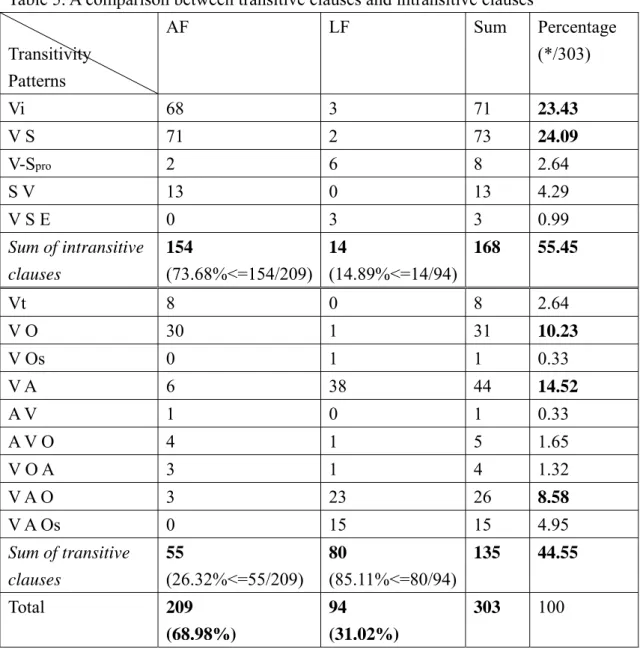
In this section, we will make a comparison between transitive and intransitive clauses in Kavalan AF/LF constructions. The basis comes from the results from Table 2 to Table 4. After counting the frequency of each pattern, we obtain Table 4 below, which displays the distinction between transitive clauses and intransitive clauses.
Table 5. A comparison between transitive clauses and intransitive clauses3 Transitivity Patterns AF LF Sum Percentage (*/303) Vi 68 3 71 23.43 V S 71 2 73 24.09 V-Spro 2 6 8 2.64 S V 13 0 13 4.29 V S E 0 3 3 0.99 Sum of intransitive clauses 154 (73.68%<=154/209) 14 (14.89%<=14/94) 168 55.45 Vt 8 0 8 2.64 V O 30 1 31 10.23 V Os 0 1 1 0.33 V A 6 38 44 14.52 A V 1 0 1 0.33 A V O 4 1 5 1.65 V O A 3 1 4 1.32 V A O 3 23 26 8.58 V A Os 0 15 15 4.95 Sum of transitive clauses 55 (26.32%<=55/209) 80 (85.11%<=80/94) 135 44.55 Total 209 (68.98%) 94 (31.02%) 303 100
Table 5 shows not only a comparison between transitive clauses and intransitive clauses but also reveals other significant issues like a comparison between AF clauses and NAF clauses or on the frequency for each different pattern of constructions. Points worth mentioning include: (1) more than half (168/303= 55.45%) of all the clauses are intransitive; (2) the ratio of the AF clauses to the NAF clauses is 6.9 to 3.1. Interestingly, there is one text in which no single LF clause was found in the whole
3 For ease of distinction, regardless of the AF-LF distinction, we use S and E for arguments in
intransitive constructions to distinguish from A and O for in transitive constructions. That is to say that argument-labeling in Table 5 is distinct from that in Table 2, Table 3, and Table 4.
narrative4; (3) Kavalan expresses transitive clauses primarily with LF constructions (80/94=85.11%), while intransitive clauses are expressed with AF constructions (154/209=73.68%); (4) among all patterns for the word order, the VS pattern occurs most frequently (with 24.09%), the next highest is the sole intransitive verb construction (with 23.43%), the third-ranked is the VA pattern (with 14.52%) and the fourth-ranked is the VO pattern (with 10.23%); (5) based on discourse evidence, we find that Kavalan is strongly V-initial (about 93.73%=284/303).
2.4 Other patterns
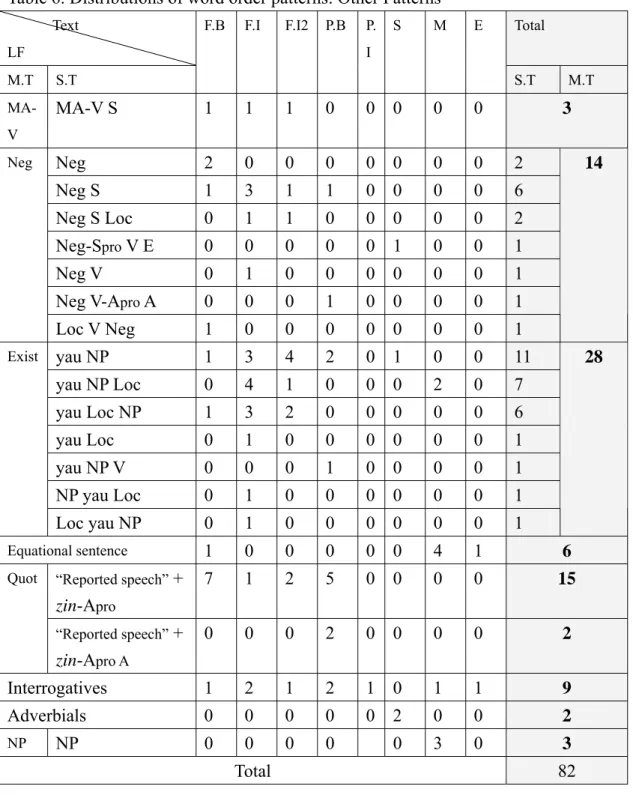
Except for the AF, extended intransitive and LF clauses, other constructions also display a variety of patterns in Kavalan texts. So, we enumerate all other constructions including the MA-verb constructions, negations, existential constructions, equational constructions and quotative constructions, interrogative constructions, adverbial clauses and noun phases. Table 6 shows the patterns and distribution of these constructions. Following Table 6 are their corresponding examples.
4 The text is Sea.
Table 6. Distributions of word order patterns: Other Patterns Text LF Total M.T S.T F.B F.I F.I2 P.B P. I S M E S.T M.T MA-V MA-V S 1 1 1 0 0 0 0 0 3 Neg 2 0 0 0 0 0 0 0 2 Neg S 1 3 1 1 0 0 0 0 6 Neg S Loc 0 1 1 0 0 0 0 0 2 Neg-SproV E 0 0 0 0 0 1 0 0 1 Neg V 0 1 0 0 0 0 0 0 1
Neg V-AproA 0 0 0 1 0 0 0 0 1
Neg Loc V Neg 1 0 0 0 0 0 0 0 1 14 yau NP 1 3 4 2 0 1 0 0 11 yau NP Loc 0 4 1 0 0 0 2 0 7 yau Loc NP 1 3 2 0 0 0 0 0 6 yau Loc 0 1 0 0 0 0 0 0 1 yau NP V 0 0 0 1 0 0 0 0 1 NP yau Loc 0 1 0 0 0 0 0 0 1 Exist Loc yau NP 0 1 0 0 0 0 0 0 1 28 Equational sentence 1 0 0 0 0 0 4 1 6 “Reported speech” + zin-Apro 7 1 2 5 0 0 0 0 15 Quot “Reported speech” + zin-Apro A 0 0 0 2 0 0 0 0 2 Interrogatives 1 2 1 2 1 0 1 1 9 Adverbials 0 0 0 0 0 2 0 0 2 NP NP 0 0 0 0 0 3 0 3 Total 82
(31) MA-V construction: MA-V S
… nani … ma-bedung=ti ya .. peRasku ‘nay … nani.\ DM MA-break=PFV NOM bottle that DM
“Then that bottle was broken.” (Frog_imui2: 16)
(32) Negation: Neg
…ma==i.\ (Frog_buya: 42)
“Nothing is there.”
(33) Negation: Neg S
… mai=ti … ‘nay== biat a yau, / (Frog_imui2: 8)
NEG=PFV that frog LNK that
“That frog wasn’t there.”
(34) Negation: Neg S Loc
… mai=ti ya== biat a yau (Frog_imui2: 9)
NEG=PFV NOM frog LNK that
ta- .. peRasku-an nani.\
LOC- bottle-LOC DM
“The frog wasn’t in the bottle. Then,”
(35) Negation: Neg-Spro V E
… mai=ita m-azas tu … ninu ay NEG=1IPL.NOM AF-bring OBL what REL
“We don’t take food (from home to the sea).” (Sea: 20)
(36) Negation: Neg V
… mai pama sya-qazqaz, _ (Frog_imui2: 170) NEG yet SYA-shore
“They haven’t arrived the shore.”
(37) Negation: Neg V-Apro A
.. mai ma tita-an-na baqi-an ‘nay sayza nani.\
NEG DM see-an-3SG.GEN elder.male-AN that this.way DM
“The old man was not paying attention.” (Pear_buya: 23)
(38) Negation: Loc V Neg
…(2.0) tanian ki-kirim-an-na mai.\ (Frog_buya: 16)
WHERE RED-FIND-LF-3SG.GEN NEG
“They cannot find it anywhere.”
(39) Existential Construction: yau NP
.. ma=sang nani yau usiq sunis ‘nay,_ (Frog_buya: 1-2) before DM EXIST one child that
atu wasu-na, / and dog-3SG.GEN
(40) Existential Construction: yau NP Loc
… yau wasu ‘nay ta-tuRuz-an-na na==, \
EXIST dog that LOC-backside-LOC-3SG.GEN GEN
… iza ‘nay na==(0.6) siRemuq a yau.\ something that GEN deer LNK that
“The dog is behind something… the deer.” (Forg_imui2: 59-60)
(41) Existential Construction: yau Loc NP
yau ta-kinir-an-na yau [X‘nay ‘nayX] tangan EXIST LOC-side-LOC-3SG.GEN EXIST FS FS hole ‘nay nani. \
that DM
“There is a hole near the beehive,…” (Frog_buya: 1-2)
(42) Existential Construction: yau Loc
yau ta babaw na, / (Frog_imui: 124-135) EXIST LOC above GEN
quRu-na… head-3SG.GEN
“(The child) was on the head (of the deer).”
(43) Existential Construction: yau NP V
... yau=ti sunis ’nay qa-zitinsya._ (Pear_buya: 16)
EXIST=PFV child that QA-bicycle
“There was a child riding a bicycle.”
(44) Existential Construction: NP yau Loc
.. na sunis a yau yau ta-waki-an-na tangi, _
GEN child LNK that EXIST LOC-horn-LOC-3SG.GEN now
… siRemuq ’nay. \ deer that
“The child was on the deer’s horn now.” (Frog_imui: 114-115)
(45) Existential Construction: Loc yau NP …(0.8) tazian yau usiq… mutun. \ here EXIST one mouse
“There was a mouse here.” (Frog_imui: 63) (46) Equational Construction
...ta-kawili-an.. [ra]za[n]-na.. repaw ni utay.\ LOC-left-LOC road-3SG.GEN house GEN PN
(47) Quotation: “Reported speech” zin-na
t<em>uqaz=pa=iku ‘nay k<em>i-kirim zin-na nani,_ <AF>go.up=FUT=1SG.NOM that <AF><Red>find say-3SG.GEN DM
“He said, “I will climb up to look for the frog.”” (Frog_buya: 60) (48) Quotation: “Reported speech” zin-na A
...(0.84) nakuni smani ni-kasyanem-an-na ne-.__ how not.know NI-think-AN-3SG.GEN FS
… mai-ti ...pasani=ti ‘nay.\
NEG-PFV toward=PFV that
sinsuli-ku.\ plum-1SG.GEN
... zin-na sayza-an-na baqi-an ‘nay.\ say-3SG.GEN maybe-LF-3SG.GEN grandfather-AN that
““Where did my plums go?” The old man said.” (Pear_buya: 72-75)
(49) Interrogative construction
utulun pasani semani._ (Pear_buya: 69)
three.nonhuman toward where “Where run (the three)?”
(50) Adverbial clauses
aimi kebalan, (Sea: 1-3)
1EPLUR.NOM Kavalan
…(2.0) azu ngil qatiw sa lazin nani if want go to sea DM “If we Kavalan people want to go to the sea,”
…(1.0) kawman q<em>ilim tu qaput definitely <AF>look.for OBL friend “(we) will definitely look for friends (to come with us).”
(51) NP
..n-- usiq babuy ta==(0.4)-- (Map: 11-12)
FS one pig FS
..babuy na nawung.\
pig GEN mountain
“a boar”
2.5 Summary
findings can be summarized as follows.
a. In AF intransitive constructions, the ranking of the frequency of the various patterns is, in descending order: VS pattern, the sole V pattern, and the SV pattern. The ratio of VS to SV is 6 to 1, showing that Kavalan is a V-initial language in the AF intransitive constructions.
b. The extended AF constructions tend to exhibit VE order, as expected. The order of the frequency is SVE > VES > VSE. The ratio 6:1 for V-initial pattern vs. non-V-initial pattern again means that Kavalan is a V-initial language.
c. In LF constructions, the most frequent patterns are the VA pattern and the VAO pattern, which together account for 95 percent of the LF clauses, which shows once again that the V-initial syntax operates in Kavalan.
d. Around 55.45 percent of all of the clause types in Kavalan are intransitive clauses. Kavalan expresses transitive clauses primarily with LF constructions (85.11 percent), while intransitive clauses are expressed as AF constructions (73.68 percent).
e. The order of the most frequent patterns found in our data is the VS pattern > the sole intransitive V pattern> the VA pattern > the VO pattern > the VAO pattern.
Findings found thus far are reliable since this study is based on discourse data. However, if the data are examined more cautiously, there remain some controversial issues. For example, why is there a large disparity between the AF constructions and the NAF constructions (ratio: 7 to 3)? And, what does the three-fifths ratio for intransitive clauses mean in this language and even to the comparison with other Formosan languages? We have no good explanation on these two kinds of disparity as of now. Is there any bias in the selection of constructions? Since we have not counted
other types of constructions like negations, existential constructions, quotative construction, and equational sentences in our statistical analysis, these constructions possibly exhibit differences in the alignment of verbs and arguments. Further study on these patterns is expected to help us learn more about this language.
Chapter Three
Morphology
3.0 Introduction
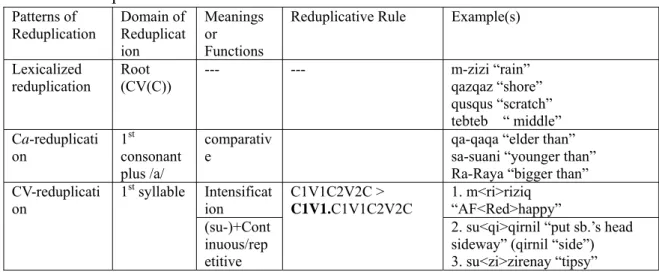
This chapter discusses word structures in Kavalan. It is organized as follows: Section 3.1 investigates verbal morphology. Section 3.2 is a discussion on nominal morphology. In Section 3.3, we turn our morphology discussion to a more specific morphological strategy, i.e., reduplication. Our summary will be provided in Section 3.4.
3.1 Verbal Morphology
The verbal morphology of Kavalan is primarily affixal in nature, and can be divided into inflection and derivation. The inflectional affixation is used to mark tense/aspect and mood. The derivational affixation involves the change of the grammatical category of the root or stem. Affixes for focus and causatives and those for the change of grammatical category constitute derivation of Kavalan. Compared with inflection, derivation is more complex in this language. Below we will first take up the inflectional morphology and then the derivational morphology.
3.1.1 Inflection
Let’s first deal with the case on tense affixes.
3.1.1.1 Tense
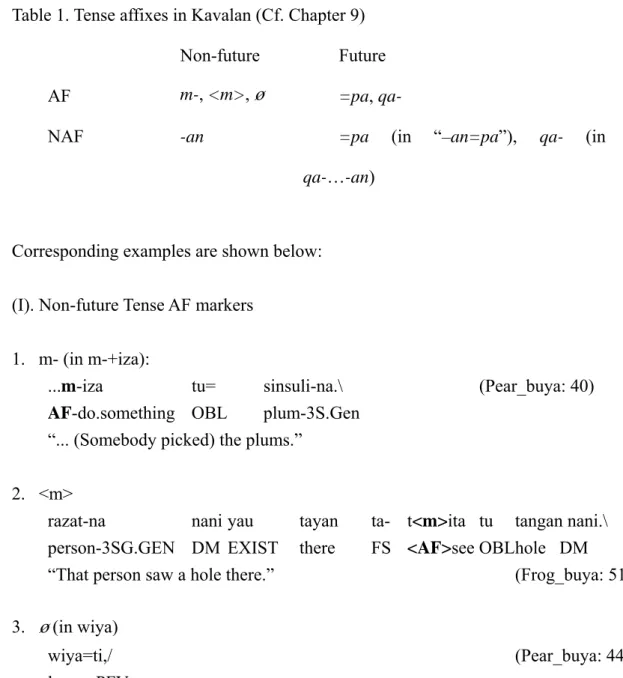
Table 1. Tense affixes in Kavalan (Cf. Chapter 9)
Non-future Future
AF m-, <m>, O =pa, qa-
NAF -an =pa (in “–an=pa”), qa- (in
qa-…-an)
Corresponding examples are shown below:
(I). Non-future Tense AF markers
1. m- (in m-+iza):
...m-iza tu= sinsuli-na.\ (Pear_buya: 40) AF-do.something OBL plum-3S.Gen
“... (Somebody picked) the plums.”
2. <m>
razat-na nani yau tayan ta- t<m>ita tu tangan nani.\ person-3SG.GEN DM EXIST there FS <AF>see OBLhole DM
“That person saw a hole there.” (Frog_buya: 51)
3. O (in wiya)
wiya=ti,/ (Pear_buya: 44)
leave=PFV “...went away.”
(II). Non-future tense LF markers
4. –an (in kyala-+ -an):
kyala-an-na=ti sinsuli-na._ (Pear_buya: 4) pick.up-LF-3SG.GEN=PFV plum-3SG.GEN
“He plucked his plums.”
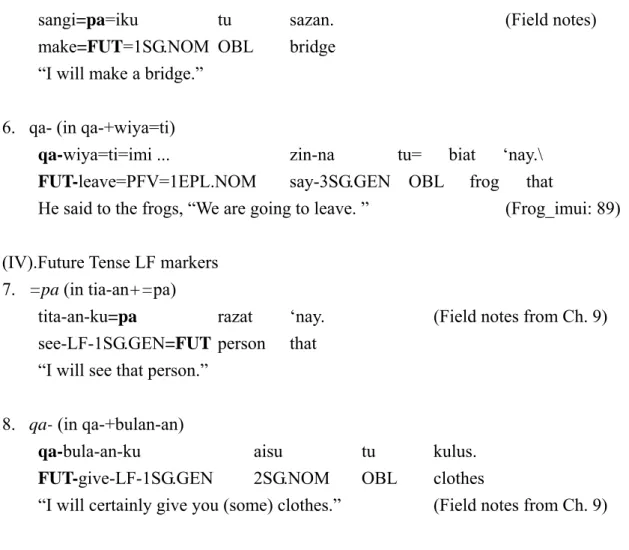
(III). Future tense AF markers
sangi=pa=iku tu sazan. (Field notes) make=FUT=1SG.NOM OBL bridge
“I will make a bridge.”
6. qa- (in qa-+wiya=ti)
qa-wiya=ti=imi ... zin-na tu= biat ‘nay.\ FUT-leave=PFV=1EPL.NOM say-3SG.GEN OBL frog that
He said to the frogs, “We are going to leave. ” (Frog_imui: 89)
(IV).Future Tense LF markers 7. =pa (in tia-an+=pa)
tita-an-ku=pa razat ‘nay. (Field notes from Ch. 9) see-LF-1SG.GEN=FUT person that
“I will see that person.”
8. qa- (in qa-+bulan-an)
qa-bula-an-ku aisu tu kulus. FUT-give-LF-1SG.GEN 2SG.NOM OBL clothes
“I will certainly give you (some) clothes.” (Field notes from Ch. 9)
Non-future affixes on tense are in the same form of focus markers in this language. The distinction between the non-future AF affixes and the non-future LF affixes is on whether the LF marker –an co-occur in the same word or not.
3.1.1.2 Aspect
The morphemes used to exhibit the aspect of Kavalan can be sorted into the following table.
Table 2. Aspect affixes in Kavalan (cf. Chapter 9)
Affix Perfective =ti
Progressive --- (CV reduplication)
Recent perfective
Ro-
Each aspect affix can be exemplified as follows:
9. =ti
t<em>ibuq=ti ya sunis ‘nay atu wasu a yawu,_ <AF>fall=PFV Nom child that and dog Link that
“The child and the dog fell down.” (Frog_imui2: 71)
10. =pama
nani yaw=pama aimi ta-tebaRung-an. (Earthquake: 16) DM EXIST=still 1EPL.NOM LOC-PN-LOC
“Well, (that happened) when we still lived in the tebaRung.”
11. CV-reduplication
wasu ‘nay nani.\ (Frog_buya: 43-45)
dog that DM
nakuni s<em>angi nani u-utuz-an-na=ti iza... how <AF>do DM Red-shake-LF-3SG.GEN=PFV something
“Somehow, the dog is stung by the bees.”
12. Ro-
Ro-qan ci-api. (Field notes from Ch. 9) REC.PAST-eat NCM-PN
“Api has just eaten.”
3.1.1.3 Mood
We now move on to the mood aspect of Kavalan. Thus far, we found two affixes exclusive to the imperatives. –ka is the imperative affix for the AF constructions, and –ika for the LF constructions, e.g. (15) & (16):
13. -ka
“qarim-ka” zin-na tu=,_ (Frog_imui2 : 79) quiet-IMP say-3SG.GEN OBL
“…said to his dog, “Be quiet!””
14. -ika
“tita-ika ya sunis ‘nay!” (Filed notes) see-IMP NOM child that
“(Go to) see the child.”
3.1.2 Derivation
The word formation via derivation though is common, is more complex. Focus and causatives also undergo the morphological process. We would like to elaborate on the affixation of focus and causatives in order and then, to go through all derivational affixations found in our corpus.5
3.1.2.1 Focus6
Focus markers are highly related to the verbal morphology in Kavalan as well as in most Formosan languages. Found in our corpus are two types of focus making: the agent focus marking (AF) and the locative focus marking (LF), as illustrated below:7
15. Focus affixes in Kavalan
5 Our database can be shown in the table below(Cf. Chapter 1).
Text type Title Length of time Iu No. Informant
Sea (abbreviated as S)5 1’50” 21 Buya (謝宗修)/Male Map (=M) 1’51” 52 Buya (謝宗修)/Male Frog1 (= F.B) 3’55” 105 Buya (謝宗修)/Male Frog2 (F.I) 9’01” 168 Imui (潘金妹)/Female Frog3 (F.I2) 5’30” 91 Imui (潘金妹)/Female Pear1(P.B) 3’02” 78 Buya (謝宗修)/Male Narrative
Pear2 (P.I) 1’51” 31 Imui (潘金妹)/Female
conversation Earthquake (E) 3’47” 79 Abas (潘天利)/Female & Raciang (潘金 英)/Female
6 In later chapter, there will be a profound discussion on focus system of Kavalan. We, at this stage,
mainly focus on how focus markers contribute to the formation of verbs.
7 Chang (1997) proposes another one type for focus marking, namely, the beneficiary or instrumental
focus marking, named as B/IV. That is, three types of focus marking system in Chang’s (1997) version are (1) AF: -um-, me-, and O, (2) PF: -an and (3)BV/IV: te-.
AF: m- me-, <em>, <m>, O LF: -an
Examples marked by markers in (17) are also illustrated respectively below:
16. a. m-:
sa waki ‘nay.. m-imet paRin ‘nay ta babaw in-na
LOC horn that AF-take tree that LOC above say-3Sg.Gen
sayza nani.\ (Forg_buya: 62)
maybe DM
“He thinks the thing above (the stone) is a tree, so he grasps it.”
b. me-:
..nani me-zukat qanyawu sa tati.\ (Frog_buya: 31) DM AF-go.out 3Pl.NOM Loc outside
“Then they go outside.”
c. <em>:
pameng=ti k<em>i<ki>kirim qanyawu,_ (Frog_buya: 14) no.other.choice=PFV <AF><Red>find 3PL.NOM
“They had no choice but kept looking for (the frog).”
d (=Ex. 2). <m>:
razat-na nani yau tayan ta- t<m>ita tu tangan nani.\ person-3SG.GEN DM EXIST there FS <AF>see OBLhole DM
“That person sees a hole there.” (Frog_buya: 51)
e (=Ex. 3). O:
wiya=ti,/ (Pear_buya: 44)
leave=PFV “...went away.”
f. –an:
tita-an-na pasa kawan-an yau usiq kitut ay razan see-LF-3SG.GEN toward right-LOC EXIST one small REL road
Except for AF and LF, there remains another marker related to the focus system; it is ma-, an undergoer marker (Huang & Sung, 2005). According to Huang & Sung (2005), the semantic function of ma- is very much like NAF but its grammatical behavior is similar to agent focus. We have no means to explore the functions and grammatical status of ma-, but treat it as an indispensable marker on verb formation in Kavalan, as the example below indicates.
18. yau ma-ziut ta-babaw-an na paRin a EXIST MA-hang LOC-above-LOC GEN tree LNK
“There was something hung on the tree.” (Frog_imui: 52)
3.1.2.2 Causatives
The affix pa- which prefix to the root or stem may contribute to the formation of causatives in Kavalan. Please see in (19).
19. pa-qaysuR-an-na=ti na,\ CAU-enter-LF-3SG.GEN=PFV Gen
wasu a yawu .. ta-peRasku-an .. ‘nay quRu-na .. tu.\ dog LNK that Loc-bottle-Loc that head-3SG.GEN DM
“The dog stuffed his head into the bottle.” (Frog_imui2: 10-11)
3.1.3 Other affixations on verbal morphology
In this section, we would like to discuss other affixes involving verbal morphology. The rest of the affixes can be divided into two groups: Group 1 is tantamount to inflectional affixes which lead to the change of meaning of the root or stem and Group 2 parallels derivational affixes. Affixes in the two groups will be discussed in order below.
Affixes found in our corpus have two: sa- “pretend to” and the reciprocal marker
sim-. These two affixes will be illustrated in order.
(A). sa-
Prefix sa- means “pretend to” and it is prefixed to a verbal root or stem, like
muRing “cry”. Its morphological rule and related examples are illustrated below:
Morphological rule: sa-+V> V.
a. sa-muRing “SA-cry; pretend to cry” a’. sa<ma>muRing “SA<RED>cry; pretend to cry” b. sa-maynep “SA-sleep; pretend to sleep” b’. sa<ma>maynep “SA<RED>sleep; pretend to sleep”
It also involves reduplication as shown in (a’) and (b’). (B). sim-
sim- is a verbal reciprocal marker.8 Again, the following are its structuring rule
and examples.
Morphological rule: sim-+V> V
a. sim-qatapung “sim-meet; meet each other” b. sim-paRu “sim-hug; hug each other”
c. sim-kawit “sim-hold hand; hold hand mutually”
3.1.3.1 Other derivational affixes for verbs
Derivational affixes for verbal morphology are in a large amount in Kavalan. (A). i-
i- prefixing to a root is to describe the height of an object. Let’s see below.
Morphological rule: i- + N> V
a. i-babaw “i-top; tall” b. i-ribeng “i-low; short”
20. i-ribeng sunis nay. (Field notes) I-low child that
“The child is short.”
As can be seen above, some kind of semantic extension exists between the stemmed verb and its nominal root. That is, both are the vertical spatial dimension.
(B). qa-
qa- means “take (a conveyance)”. Word formation and examples are as in
Morphological rule: qa- + N> V
a. qa-zitinsya “qa-bicycle; ride bicycle” b. qa-bawa “qa-boat; take a boat”
(C). qay-
qay- means “pick” or “catch”.
Morphological rule: qay- + N> V
a. qay-baut “qay-fish; catch fish (in the river)” b. qay-byabas “qay-guava; catch guava”
c. qay-paRin “qay-wood; catch wood" d. qay-tiRu “qay-egg; catch egg”
The incorporate objects of qay- are specific to those on the land. The restriction is motivated by a contrast with Ray- which is used to describe objects in the sea. We will elaborate this part later.
qi- attaching to a noun also means “pick” or “catch”. Based on the historical
change of phonology, qi- is an old form for qay-. So, it seems no need to give unnecessary details here.
(E). Ray-
Ray- also means “pick” or “catch”. As what we have mentioned, Ray- is opposed
to qay-. Examples below may highlight the contrast.
Morphological rule: Ray- + N> V
a. Ray-baut “qay-fish; catch fish (in the sea)” b. Ray-tunus “qay-puffer fish; catch puffer fish”
According to our informant, tunus “puffer fish” is not in the river but in the sea.
(F). rim-/rin-
rin-/ rim- means “half”.
Morphological rule: rim-/rin- + Numerals (=N)> V a. rim-zusa “rim-two; cut into two halves”
b. rin-turu “rin-three; cut into three halves”
(G). sa1-
sa1- expresses the production of an object. Let’s see below.
Morphological rule: sa- + N> V sa-mulay: “sa-bud; to bud”
sa-nunay: “sa-sprout; to sprout/to put forth” sa-sii: “sa-fruit; to fruit”
sa-sunis: “sa-child; to childbirth” sa-semawu: “sa-flower; to blossom”
21. sa-sunis=ti=iku tuRu nanay. (Field notes) SA-child=PFV=1SG.NOM baby.boy
“I gave birth to a baby boy.”
22. sa-sii=ti ya sinsuli ‘nay. (Field notes) SA-fruit NOM pear that
“That pear tree fruited.”
23. sa-nunay=ti ya tenayang. (Field notes) SA-shoot=PFV NOM bamboo
“The bamboo shot.”
(H). sa2-
sa2- has a sense on movement, tantamount to “go”. Let’s see below.
Morphological rule: sa-+ location (=N)> V a. sa-qazqaz(-an) “sa-shore; go to the shore”
(I). sa3-
sa3- is used to express a state that an container is full of objects. The container
can be a sack or a truck, as in:
Morphological rule: sa-+ container (=N)> V a. sa-kuiti: “sa- + sack; a sackfull of” b. sa-ketun: “sa- + truck; truckload”
24. sa-ketun tu beRas ketun=ku. (Field notes) SA-truck OBL unhusked.rice truck=1SG.GEn
“There is a truckload of unhusked rice in my truck.”
(J). sya-
Morphological rule: sya-+N > V
a. sya-qazqaz “sya-shore; go to the shore”
The motivation of employing two different morphemes, i.e., sya- and sa2-, to describe the action of pulling in to shore is to distinguish boats from humans. That is,
sa-qazqaz is exclusive to humans and sya-qazqaz to boats. Excluding the distinction
in question, both expressions, sa-qazqaz and sya-qazqaz can apply to other entities, such as wood, trash, and so on.
(K). si1-
si1- means “wear”. Its incorporated root or stem is subsumed under the category
of costume and accessories. Words like this are derived in terms of the following rule; there are also examples below.
Morphological rule: si-1+ N> V
a. si-kuzu “si-shoe; wear shoes” b. si-qubu “si-hat; wear a hat” c. si-buya “si-sock; wear socks” d. si-kulus “si-clothes; wear clothes” e. si-itus “si-necklace; wear a necklace” f. si-ruki “si-watch; wear a watch”
(L). si2-
si2- means “to possess”. Related morphological rule and examples are illustrated
in:
Morphological rule: si-2+ N > V
a. si-napawan “si-couple; have a couple; get married”
b. si-repaw “si-house; divide up family property or to have a family” c. si-kyokay “si-church; own a church”
d. si-razat “si-person; treat someone a meal”
e. si-kalabu “si-daughter-in-law; have a daughter-in-law” d. si-pataqsian “si-student; have a student”
(pa-taqsi-an “student”; taqsi “to study”)
25. si-napawan=ti=isu? (Field notes) SI-couple=PFV=1SG.NOM
“Are you got married?”
3.2 Nominal Morphology
In this section, we turn to our discussion on the nominal morphology of Kavalan. Three aspects will be discussed. One is the pronominal system; another is inflectional morphology; and the other is the derivational morphology. Let’s first take up the pronominal system.
3.2.1 The pronominal system in Kavalan9
Like other Formosan languages, pronominal forms in Kavalan can be divided into free/bound (Cf. Li, 1996). The pronominal system of Kavalan is tabulated below.
Table3. The Personal Pronominal System in Kavalan (cf. Chang, 2000: 84 )
Bound Free Form
Number
Nom Gen Nom Acc Loc Poss
1st =iku -ku aiku timaiku timaiukuan
tamaiku
zaku
2nd =isu -su aisu timaisu timaisuan
tamaisu
zasu
3rd
Singular
--- -na aizipna timaizipna tamaizipana zana 1st
Incl.
=ita -ta aita timaita timaitaan tamiata zaita 1st Excl. Plural =imi -niq -iaq
aimi timaimi timainian tamaimi
zaimi
2nd =imu -numi aimu timaimu timaimuan tamaimu
zaimu
3rd --- -na qaniau qaniau qaniauan zana
Only bound forms in Table 3 match our discussion in this chapter. That is, the nominative bound pronouns which are clitics and the genitive bound pronouns which are identified as agreement affixes are our foci in this section. With regard to its word structuring, we list examples for each type of bound pronouns as in (26) and (27) respectively.
(26). tita=pa-iku tu qubu-ku zin-na... see=FUT-1SG.NOM OBL hat-1SG.GEN say-3SG.GEN
“I am going to see my hat.” he said. (Pear_buya: 32)
(27a). kuriku==z-an-na razan ‘nay nani,_ (Map: 33) follow-LF-3SG.GEN road that DM
“He followed that road.”
(27b). ni-saqay-an-na (Map: 32)
NI-walk-AN-3SG.GEN “(the road) he had walked on”
(26a) and (27a) are clauses. (27b) is a nominal phrase; that is, only the genitive bound pronouns but not the nominative ones employ in phrasal constructions.
3.2.1 Inflectional Morphology of Nouns Let’s begin with the suffix –an.
(A). –an1
-an1 is used to denote the notion of spatiality.
a. kawan-an “right-an; right side” b. qazqaz-an “shore-an: shore”
(B). sa-…-an2
sa-…-an2 is used to denote a period of time.
Morphological rule: sa-+ temporal terms (=N)+ -an > N
a. sa-ruki-an: “sa-clock-an; one hour”
d. sa-seqawaru-an: “sa-summer-an; a whole summer” c. sa-lezun-an: “sa-winter-an; a whole winter” d. sa-tasaw-an: “sa-year-an; a whole year” e. sa-buran-an: “sa-month-an; a whole month” f. sa-Rabi-an: “sa-night-an; a whole night”
(28). t<em>eqez-iku ta-repaw-an ni utay tu sa-ruki-an.
<AF>stop.by-1SG.NOM LOC-house-LOC GENPN TU SA-clock-AN “I stopped over at Utay’s house for one hour.” (Field notes)
(C). ta-…-an1
One word formation involving both the nominalization and the notion of location through the affixation of ta-...-an to a nominal root or stem spreads far and wide in our corpus. According to the meanings, roots here can be divided into three parts. Firstly, roots which undergo the word formation essentially involve one particular spatial spot such as those denoted by place names like shores, midways or pakteRung (which is a village in Hua-lien County); second, roots in question may also involve objects like windows, bottles, or bicycles; and the last is that roots convey the sense of personal names. These three parts can be separately illustrated by three sets of examples, i.e., (a)~(c), (d)~(f), and (g) respectively. However, conventionally preceding the examples is the morphological rule in question.
a. ta-qazqaz-an “ta-shore-an; on the shore” b. ta-bataz-an “ta-midway-an; on the midway”
c. ta-pakteRung-an “ta-place.name-an; in (the village of) pakteRung” d. ta-tengat-an “ta-window-an; at the widnow”
e. ta-peRasku-an “ta-bottle-an; in the bottle” f. ta-zitinsya-an “ta-bicycle-an; on (a) bicycle”
g. ta-utay-an “ta-personal.name-an; at Utay’s place (like house)”
In general, syntactically, expressions on examples are tantamount to the oblique. Moreover, ta-…in ta-…-an is quite alike the preposition “at” in English.
3.2.3 Derivational Morphology of Nouns
Derivation involves the change of grammatical category of the root or stem. Such a morphological strategy is quite productive in Kavalan. Derivational affixes for nouns found in our corpus are listed below:
(A). –an as a nominalizer and its related morphological processes (A1). –an2
Firstly, -an is a well-known nominalizer in most Formosan languages (Zeitoun, 2002). Similarly, -an is an affix which participates in nominalizing the action predicates such as “study”, “bedroom”, and “step” in Kavalan. We show the morphological rule of nominalization below, also with examples following it.
Morphological rule: V + -an > N
a. taqsi-an “study-an; school” b. qaynep-an “sleep-an; bedroom” c. zaqis-an “step.on-an; ladder”
As can be seen in the derivational rule, i.e., V + -an > N, it employs an affix –an suffixing to a action verb root and then a derived noun occurs. The derived nouns have a reading on location.