Effect of Lateral Substituents on the Mesomorphic
Properties of Side-Chain Liquid Crystalline Polysiloxanes
Containing 4-[(
S
)-2-Methyl-1-butoxy]phenyl
4-(Alkenyloxy)benzoate Side Groups
CHAIN-SHU HSU, PEI-HWEI CHU, HUEY-LING CHANG, TONG-HONG HSIEH
Department of Applied Chemistry, National Chiao Tung University, Hsinchu, Taiwan 30050, Republic of China
Received 7 November 1996; accepted 27 February 1997
ABSTRACT: The synthesis of side-chain liquid crystalline polysiloxanes containing ei-ther 4- [ ( S ) -2-methyl-1-butoxy ] phenyl 4- ( alkenyloxy ) benzoate or laterally fluoro-, chloro-, bromo-, and methoxy-substituted 4- [ ( S ) -2-methyl-1-butoxy ] phenyl 4- ( alkenyl-oxy ) benzoate mesogenic side groups is presented. The mesomorphic properties of the synthesized polymers have been characterized by optical polarizing microscopy, differ-ential scanning calorimetry, and X-ray diffraction measurements. The effects of spacer length and lateral substituent on the mesomorphic properties of the obtained polymers are examined. The five polymers which contain three methylene units in the spacers show no mesophase, while the five polymers which contain eleven methylene units in the spacer display smectic mesomorphism. Among the other fifteen polymers which contain respectively four, five, or six methylene units in the spacers, those with small fluoro and chloro substituents reveal respectively an SAphase, while those with bulky bromo and methoxy substituents show no liquid crystalline behavior. The experimental results demonstrate that introducing a bulky lateral substituent into the mesogenic core of a polymer depresses the tendency to form a mesophase. Furthermore, the tech-nique of thermally stimulated current has been used to study the dipolar relaxation mechanisms in a side-chain liquid crystalline polysiloxane.q 1997 John Wiley & Sons, Inc. J Polym Sci A: Polym Chem 35: 2793 – 2800, 1997
Keywords: polysiloxanes; liquid crystalline polymers; lateral substitution effect; thermal stimulated current
INTRODUCTION
perature mixtures have so far been prepared for fast electrooptical applications. Besides low molar mass liquid crystals, a number of side-chain liquid In 1975, Mayer1presented theoretically and thencrystalline polymers ( LCPs ) exhibiting an S *C proved experimentally that the chiral smectic C
mesophase have been successfully prepared dur-( S *C) mesophase was ferroelectric. A bistable, fast
ing the past few years.3 – 14
switching, electrooptical device which uses the
The effect of molecular structure on the occur-ferroelectric liquid crystals ( FLCs ) was
demon-rence of tilted smectic C phases is very different strated a few years later by Clark and Lagerwell.2
from that on the nematic or orthogonal smectic An increasing interest in the synthesis of low
mo-phases. The molecules should possess some degree lar mass S *Cliquid crystals has since then
devel-of steric asymmetry so that the molecules can ar-oped. Numerous FLC compounds and
room-tem-range themselves in a tilted layer when they are packed together. Some reports15– 17
on low molar
Correspondence to: C.-S. Hsu mass liquid crystals in the literature also showed
Grant sponsor: National Science Council of ROC; grant that introduction of a suitable lateral substituent, number: NSC-83-0511-E009-001
e.g., a fluoro group, into the mesogenic core of a
Journal of Polymer Science: Part A: Polymer Chemistry, Vol. 35, 2793 – 2800 ( 1997 )
q 1997 John Wiley & Sons, Inc. CCC 0887-624X/97 / 132793-08 molecule can enhance the possibility to form a chiral
droxybenzoic acid, 3-chloro-4-hydroxybenzoic acid ( from Janssen Inc.) , and all other reagents ( from Aldrich ) were used as received. Dichloromethane used in the esterification was refluxed over cal-cium hydride and then distilled under nitrogen. Toluene used in the hydrosilation reaction was first refluxed over sodium and then distilled under nitrogen. 4- [ ( S ) -2-Methyl-1-butoxy ] phenol, 10-Figure 1. Molecular structure of the side-chain LC
undecen-1-yl tosylate, and
3-fluoro-4-hydroxyben-polysiloxanes.
zoic acid were synthesized according to literature procedures.11,28
smectic C phase. The goal of this paper is to present
the synthesis and characterization of several series Techniques of side-chain liquid crystalline polymers containing
1
H-NMR spectra ( 400 MHz ) were recorded on a laterally substituted mesogens. The particular
ex-Varian VXR-300 spectrometer. FT-IR spectra amples described here refer to polysiloxanes
con-were measured on a Nicolet 520 FT-IR spectrome-taining 4-[(S)-2-methyl-1-butoxy]phenyl
4-(alken-ter. Thermal transitions and thermodynamic pa-yloxy)benzoate, 4-[(S)-2-methyl-1-butoxy]phenyl
rameters were determined by using a Seiko SSC / 3-fluoro-4-(alkenyloxy)benzoate,
4-[(S)-2-methyl-5200 differential scanning calorimeter equipped 1-butoxy]phenyl 3-chloro-4-(alkenyloxy)benzoate,
with a liquid-nitrogen cooling accessory. Heating 4- [ ( S ) -2-methyl-1-butoxy ] phenyl 3-bromo-4- (
al-and cooling rates were 107C/min. Thermal transi-kenyloxy)benzoate, and
4-[(S)-2-methyl-1-butoxy]-tions reported were collected during the second phenyl 3-methoxy-4- ( alkenyloxy ) benzoate side
heating and cooling scans. A Carl-Ziess Axiophot groups ( Fig. 1 ) .
optical polarized microscope equipped with a Met-The effects of lateral fluoro, chloro, bromo, and
tler FP 82 hot stage and a FP 80 central processor methoxy substituents on the mesomorphic
prop-was used to observe the thermal transitions and erties of the obtained polysiloxanes are discussed.
to analyze the anisotropic textures. Preparative The molecular dynamics behavior of side-chain
gel permeation chromatography ( GPC ) was run LCPs has been extensively studied by dielectric
on a Waters 510 LC instrument equipped with a 410 relaxation spectroscopy,18 – 21
but the correlation
differential refractometer and a preparative GPC of the motions of the main chain with those of the
column (22.5 mm 1 60 cm) supplied by American pendant mesogenic units is not clearly understood
Polymer Standard Co. X-ray diffraction measure-yet. The thermally stimulated current ( TSC )
ments were performed with nickel-filtered Cu Ka
technique is another very suitable method for
radiation with a Rigaku powder diffractometer. study of the molecular dynamics behavior of
side-TSC experiments were carried out with a side-TSC/ chain LCPs. The first TSC study of a side-chain
RMA spectrometer (Solomat Instruments, Stam-LCP was published by Simon22
in 1989, and since
ford, CT) covering the range 0170 to 2007C. In each then several works have also been reported on this
experiment, the sample was polarized for several subject.23– 27 In this study, we report some TSC
re-minutes by a polarization voltage Vpat a tempera-sults on a polysiloxane showing liquid crystalline
ture Tpand the polarization was frozen-in by cooling behavior. The dielectric relaxation mechanisms of
to a temperature To ! Tp in the presence of the the side-chain LC polysiloxane are discussed.
electric field. With the field off the depolarization current was then measured as the sample was heated at a constant rate to Tf(Tfú Tp).
EXPERIMENTAL
Materials Synthesis of Monomers and Polymers
Poly(methylhydrogensiloxane) (MnÅ 4500–5000) The synthetic routes used to prepare the fol-and divinyltetramethyldisiloxane – platinum cat- lowing olefinic monomers 1M – 25M and poly-alyst were obtained from Petrarch Systems Inc. mers 1P – 25P are outlined in Schemes 1 and 2: ( Bristol, PA ) and used as received. ( S ) - ( – ) -2- 4- ( alkenyloxy ) benzoic acid ( 1 – 5 ) ; 3-fluoro-4-( alkenyloxy ) benzoic acid 3-fluoro-4-( 6 – 10 ) ; 3-chloro-4-Methyl-1-butanol, [a]25
D Å 06.57 (from Merck),
3-bromo-4-( alkenyloxy ) benzoic acid 3-bromo-4-( 16 – 20 ) ; 3-methoxy-4- ( alkenyloxy ) benzoic acid ( 21 – 25 ) .
The compounds 1 – 25 were prepared by the etherification of alkenyl bromides or undecenyl tosylate with 4-hydroxybenzoic acid, 3-fluoro-4-hydroxybenzoic acid, 3-chloro-4-3-fluoro-4-hydroxybenzoic acid, bromo-4-hydroxybenzoic acid, and 3-methoxy-4-hydroxybenzoic acid, respectively. The synthesis of 3-methoxy-4- ( allyloxy ) benzoic acid ( 21 ) is described below.
3-Methoxy-4-hydroxybenzoic acid (4.00 g, 0.024 mol ) was added to a solution of KOH ( 2.98 g, 0.052 mol ) and KI ( 0.5 g ) in 95 wt % ethanol ( 150 mL ) . The solution was refluxed for 1 h, and allyl bro-mide ( 5.07 g, 0.048 mol ) was added dropwise. The resulting solution was refluxed for 20 h and cooled to room temperature, and 100 mL of water was added. The solution was acidified with dilute hy-drochloric acid. The precipitate was filtered out and recrystallized from MeOH / H2O (
1
2 v / v ) to
yield 3.69 g ( 74.5% ) of white crystals. 1
H-NMR ( CDCl3, TMS, ppm) :d3.94 ( s, 3H, {OCH3) , 4.69
( d, 2H, {CH2O{) , 5.34 ( m, 2H {CH|CH2) ,
6.04 ( m, 1H, {CH| ) , 6.90 – 7.74 ( m, 3 aromatic protons ) .
Scheme 1. Synthesis of monomers 1M – 25M .
Synthesis of Monomers 1M–25M Synthesis of Polysiloxanes 1P–25P
The olefinic derivative, 0.8 g ( 10 mol % excess All olefinic monomers ( 1M – 25M ) were prepared
versus the Si{H groups present in polysiloxane ) , by a same method. The synthesis of monomer
was dissolved in 80 mL of dry, freshly distilled 21M is described below. 3Methoxy4 ( allyloxy )
-toluene together with the proper amount of poly-benzoic acid ( 2.62 g, 0.011 mol ) was reacted at
( methylhydrogensiloxane ) . The reaction mixture room temperature with excess thionyl chloride ( 6
was heated to 1107C under nitrogen, and 100mg mL ) containing a few drops of dimethylformamide
of divinyltetramethyldisiloxane – platinum cata-in methylene chloride ( 7 mL ) for 2 h. The solvent
lyst was then injected with a syringe as a solution and excess thionyl chloride were removed under
in toluene ( 1 mg /mL ) . The reaction mixture was reduced pressure to give the corresponding acid
refluxed ( 1107C) under nitrogen for 24 h. After chloride. The product was dissolved in 20 mL of
this reaction time, both the 1
H-NMR and FT-IR methylene chloride and slowly added to a cold
so-analyses showed that the hydrosilation reaction lution of 4- [ ( S ) -2-methyl-1-butoxy ] phenol ( 1.80
was almost complete. The polymers were sepa-g, 0.01 mol ) and triethylamine ( 3 mL ) in 100 mL
rated and purified by several reprecipitations of methylene chloride. The solution was stirred at
from tetrahydrofuran solution into methanol, fur-room temperature. The solvent was then distilled.
ther purified by preparative GPC, and then dried The obtained crude product was dissolved in
under vacuum. methylene chloride and passed through silica gel.
The solvent was removed in a rotary evaporater. The crude product was recrystallized from
eth-RESULTS AND DISCUSSION
anol to yield 3.47 g ( 87.0% ) of white crystals.1
H-NMR ( CDCl3, TMS ppm) : d 0.92 – 1.80 [ m, 9H,
Effects of Lateral Substituent on the Mesomorphic CH ( CH3) ( C2H5) ] , 3.70 ( d, 2H, {O{CH2{) ,
Properties of Polysiloxanes 3.88 ( s, 3H, {OCH3) , 4.64 ( d, 2H, |CH{CH2
{O{) , 5.33 ( m, 2H, CH2|) , 4.64 ( m, 1H, The synthetic route used for the preparation of monomers 1M – 25M is outlined in Scheme 1. The |CH{) , 6.86 – 7.74 ( m, 7 aromatic protons ) .
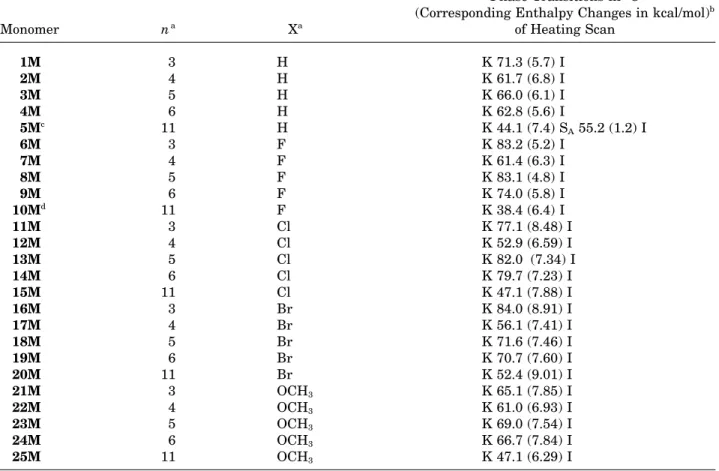
Table I. Phase Transitions and Phase Transition Enthalpies for Monomers 1M – 25M
Phase Transitions in7C
(Corresponding Enthalpy Changes in kcal/mol)b
Monomer na Xa of Heating Scan
1M 3 H K 71.3 (5.7) I 2M 4 H K 61.7 (6.8) I 3M 5 H K 66.0 (6.1) I 4M 6 H K 62.8 (5.6) I 5Mc 11 H K 44.1 (7.4) S A55.2 (1.2) I 6M 3 F K 83.2 (5.2) I 7M 4 F K 61.4 (6.3) I 8M 5 F K 83.1 (4.8) I 9M 6 F K 74.0 (5.8) I 10Md 11 F K 38.4 (6.4) I 11M 3 Cl K 77.1 (8.48) I 12M 4 Cl K 52.9 (6.59) I 13M 5 Cl K 82.0 (7.34) I 14M 6 Cl K 79.7 (7.23) I 15M 11 Cl K 47.1 (7.88) I 16M 3 Br K 84.0 (8.91) I 17M 4 Br K 56.1 (7.41) I 18M 5 Br K 71.6 (7.46) I 19M 6 Br K 70.7 (7.60) I 20M 11 Br K 52.4 (9.01) I 21M 3 OCH3 K 65.1 (7.85) I 22M 4 OCH3 K 61.0 (6.93) I 23M 5 OCH3 K 69.0 (7.54) I 24M 6 OCH3 K 66.7 (7.84) I 25M 11 OCH3 K 47.1 (6.29) I
an and X according to Scheme I. bK Å crystalline, I Å isotropic, S
AÅ smectic A, SC* Å chiral smectic C. cMonomer 5M shows S
A, SB, and SC* phases on DSC cooling scan: I 52.67C, SA25.47C, SC* 17.67C, SB6.97C K. dMonomer 10M shows S
Aand SBphases on cooling scan: I 37.67C, SA187C, SB11.17C K.
chiral end group was inserted into these meso- Sc * and SBphases, while monomer 10M reveals only two monotropic SAand SBphases. The exper-genic compounds starting with the commercially
available ( S ) - ( – ) -2-methyl-1-butanol. This was imental results demonstrate that introducing a more bulky lateral substituent into the mesogenic done by a sequence of reactions which avoided its
racemization. All monomers were characterized core of a monomer dramatically decreases the ten-dency to form a mesophase.
by differential scanning calorimetry and optical
polarizing microscopy. The phase transitions and The synthesis of polysiloxanes 1P – 25P is de-scribed in Scheme 2. An excess amount of olefinic corresponding enthalpy changes of monomers
1M – 25M are summarized in Table I. As can be monomers was usually used to carry the hydrosi-lation reaction to completion. The unreacted seen from Table I, all monomers with short spacer
length ( i.e., n Å 3 – 6 ) display no mesomorphic monomers were removed by several reprecipita-tions from tetrahydrofuran solution into metha-behavior. Among five monomers containing
eleven methylene units in the spacers, monomer nol and by preparative GPC. Therefore, the poly-mers were isolated with high purity. The obtained 5M without a lateral substituent and monomer
10M with a small fluoro substituent are the only polymers were characterized by differential scan-ning calorimetry and optical polarizing micros-two showing mesomorphic behavior while the
other three monomers which contain respectively copy. Table II summarized the phase transitions and corresponding enthalpy changes of the ob-a chloro, bromo, or methoxy substituent displob-ay
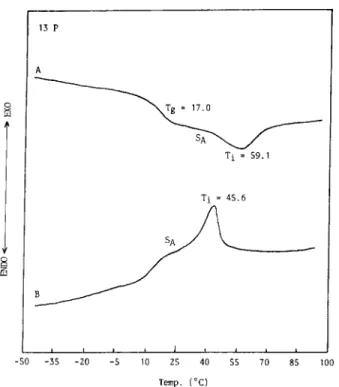
no liquid crystalline phase. Monomer 5M reveals tained polysiloxanes 1P – 25P . Representative DSC traces of polymer 13P are presented in Fig-an enFig-antiotropic SA phase and two monotropic
Curve A presents a diffuse reflection at about 4.5 A˚ , which corresponds to the lateral spacing of two mesogenic side groups, a sharp first-order reflec-tion at 21.3 A˚ , and a second-order reflection at 10.4 A˚ , which correspond to the d spacing of smec-tic layers. When the measuring temperature has been lowered from 50 to 40 and 307C, the d spac-ings of the first-order reflection are basically kept at about the same value ( curves B and C ) . The result indicates the formation of a smectic A phase. This result is also in agreement with the optical microscopic observation which reveals a typical smectic A texture ( Fig. 4 ) .
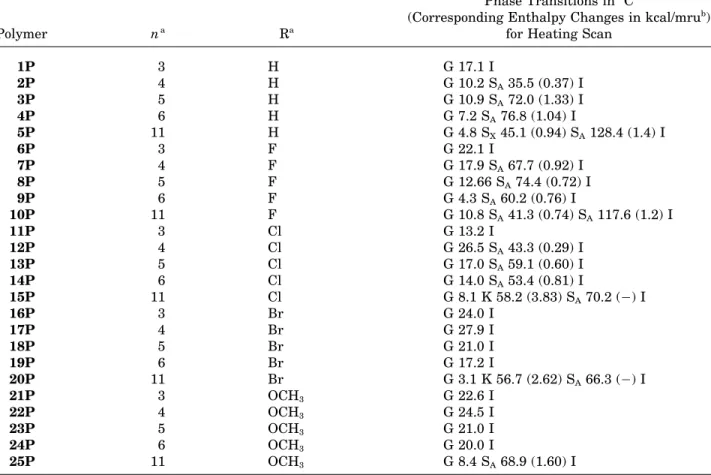
The thermal transitions and corresponding en-thalpy changes of the obtained polymers 1P – 25P are summarized in Table II. Among polymers 1P – 5P containing no lateral substituent, polymer 1P displays no mesophase, polymers 2P – 4P show re-spectively an enantiotropic SAphase, while poly-mer 5P reveals two enantiotropic SA and SB phases. As can be seen from the data listed in Table II, the spacer length has a profound effect Scheme 2. Synthesis of polysiloxanes 1P – 25P .
on the mesomorphic behavior of the obtained poly-mers. As the spacer length increases, the glass transition temperature ( Tg) decreases while the ure 2. On the heating scan ( curve A ) , it shows a
glass transition temperature ( Tg) at 17.07C fol- isotropization temperature increases. This result suggests that a longer spacer tends to stabilize lowed by a smectic A to isotropic phase transition
at 59.17C. The cooling scan (curve B) looks almost the mesophase more than a shorter one since a longer spacer always gives higher degree of decou-identical to the heating scan except that a small
amount of supercooling is observed for the exo- pling between the mesogenic side groups and the main chains. Polymers 5P – 10P and 11P – 15P , thermic transition. The phase assignment was
conducted by optical polarizing microscopic obser- which contain respectively a lateral fluoro or chloro substituent, display mesomorphic behavior vations and X-ray diffraction measurements. The
structures of side-chain liquid crystalline poly- very similar to that of their corresponding poly-mers 1P – 5P . However, among polypoly-mers 16P – mers have been extensively studied by X-ray
dif-fraction measurements.29,30
Structure models of 20P and 21P – 25P which contain respectively a lateral bromo or methoxy substituent, 20P and side-chain LC polymers in the smectic phase are
mostly derived from the ideas of Liebert and 25P containing 11 methylene units in the spacers are the only two polymers showing liquid crystal-Strzelecki.31 They picture the mesogenic side
chains with positional order along a director line behavior. The experimental results demon-strate that introducing a bulky lateral substituent packed in a lamellae type of arrangement. The
polymer backbone to which the mesogenic side into the mesogenic core of a polymer dramatically depresses the tendency to form a mesophase. Fur-chains are attached is placed between the
lamel-lae and is able to form a two-dimensional sheaf- thermore, according to the data listed in Table II, all polymers show no S *Cphase. The reason could like or coillike structure. The sheaflike structure
is very much supported by packing consideration. be due to the short mesogenic core. For this kind of phenyl benzoate mesogen, incorporation of a In these models the main chain is considered to
be of minor importance. Figure 3 presents the lateral substituent in the mesogen does not en-hance the tendency to form a S *Cphase.
temperature-dependent X-ray diffraction dia-grams obtained from powder samples of 13P at
TSC Study of the Molecular Dynamics Behavior of 50, 40, and 307C. A broad reflection at wide angles
a Side-Chain LC Polysiloxane ( associated with the lateral packings ) and a sharp
reflection at low angles ( associated with the smec- The side-chain liquid crystalline polymers consti-tute a major class of LCPs in which the mesogenic tic layers ) are respectively shown by all curves.
Table II. Phase Transitions and Phase Transition Enthalpies for Polymers 1P – 25P
Phase Transitions in7C
(Corresponding Enthalpy Changes in kcal/mrub)
Polymer na Ra for Heating Scan
1P 3 H G 17.1 I 2P 4 H G 10.2 SA35.5 (0.37) I 3P 5 H G 10.9 SA72.0 (1.33) I 4P 6 H G 7.2 SA76.8 (1.04) I 5P 11 H G 4.8 SX45.1 (0.94) SA128.4 (1.4) I 6P 3 F G 22.1 I 7P 4 F G 17.9 SA67.7 (0.92) I 8P 5 F G 12.66 SA74.4 (0.72) I 9P 6 F G 4.3 SA60.2 (0.76) I 10P 11 F G 10.8 SA41.3 (0.74) SA117.6 (1.2) I 11P 3 Cl G 13.2 I 12P 4 Cl G 26.5 SA43.3 (0.29) I 13P 5 Cl G 17.0 SA59.1 (0.60) I 14P 6 Cl G 14.0 SA53.4 (0.81) I 15P 11 Cl G 8.1 K 58.2 (3.83) SA70.2 (0) I 16P 3 Br G 24.0 I 17P 4 Br G 27.9 I 18P 5 Br G 21.0 I 19P 6 Br G 17.2 I 20P 11 Br G 3.1 K 56.7 (2.62) SA66.3 (0) I 21P 3 OCH3 G 22.6 I 22P 4 OCH3 G 24.5 I 23P 5 OCH3 G 21.0 I 24P 6 OCH3 G 20.0 I 25P 11 OCH3 G 8.4 SA68.9 (1.60) I
an and X according to Scheme II.
bmru Å mole repeating unit; G Å glassy; K Å crystalline; S
AÅ smectic A; I Å isotropic.
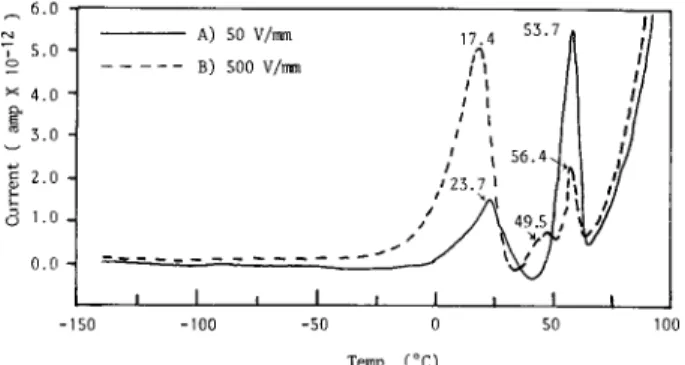
units are attached laterally to the main chain via 53.47C on the DSC scans. Figure 5 shows the TSC global spectra of polymer 14P . Two depolarization a flexible spacer. According to those reports22 – 27
in the literature, TSC spectra of side-chain LCPs peaks are observed for curve A ( polarization volt-age VPÅ 50 V /mm) : one whose maximum occurs generally show three different discharges: a lower
temperature one in the vitreous state, a discharge at 23.77C (near Tg) and the other whose maximum is at ca. 53.77C. In comparison with the DSC re-peak which appears near Tg, and a relaxation
above Tg. It seems that the lower temperature sults, it seems that the first peak at 23.77C corre-sponds to the glass transition relaxation and the relaxation arises from localized noncooperative
motions in the side group. The Tgpeak seems to second peak at 53.77C corresponds to the SA to isotropic phase transition. Curve A did not show arises from the microbrownian motions of the
di-pole moment rigidly attached to the main chain the relaxation motions of the longitudinal compo-nent of the dipole moment of the mesogenic side and / or from the motions of the mesogenic side
groups induced by the movements of the back- group.25
However, when the polarization voltage is increased to 500 V /mm, three depolarization bone. The relaxation above Tgcorresponds to the
motions of the longitudinal component of the di- peaks are observed for the TSC thermogram ( curve B ) : a high-intensity peak with tempera-pole moment of the mesogenic side group.27
In this work, polymer 14P , which contains six ture of maximum at 17.47C and two low-intensity peaks with temperatures of maxima at 49.5 and methylene units in the spacer and a lateral chloro
substituent, was chosen for TSC measurement. 56.57C. It seems that the peak at 17.47C is attrib-uted to the motions of the glass transition relax-Polymer 14P reveals a glass transition
Figure 2. DSC thermograms ( 207C/min) for polymer 13P : ( A ) Second heating scan; ( B ) cooling scan.
Figure 3. Temperature-dependent X-ray measure-ments for polymer 13P at ( A ) 507C, (B) 407C, and
SAto isotropic phase transition. Besides the glass ( C ) 307C. transition and the SAto isotropic phase transition
peaks, a depolarization peak at 49.57C is also pre-sented in curve B. It is thus reasonable to believe
polysiloxane have also been studied by the TSC the peak at 49.57C arises from rotations of the
technique. A glass transition relaxation and two longitudinal component of the dipole moment of
higher temperature relaxations are observed. the mesogenic side group.27
Comparison of the DSC and TSC results seems to confirm that the TSC technique as a more power-ful tool to resolve the dipolar relaxation
mecha-CONCLUSIONS
nisms of a side-chain LCP. Five series of side-chain liquid crystalline
polysi-loxanes containing either 4- [ ( S ) -2-methyl-1-bu-toxy ] phenyl 4- ( alkenyloxy ) benzoate or laterally substituted [ ( S ) -2-methyl-1-butoxy ] phenyl 4-( alkenyloxy ) benzoate mesogenic side groups are prepared. Both lateral substituent and spacer length have profound effects on the thermal sta-bility of mesophases formed. The bulky lateral bromo and methoxy substituents dramatically de-press the tendency to form a mesophase, while the small lateral fluoro and chloro substituents do not. Due to the short phenyl benzoate meso-genic core, all synthesized polymers display no
S *C phase. Incorporation of a lateral substituent
in this kind of mesogenic core does not enhance Figure 4. Optical polarizing micrographs ( magnifi-the possibility to form a S *C phase, either. The cation 3201 ) displayed by polymer 13P : SAtexture
ob-tained at 457C.
10. H. Kapitza and R. Zentel, Makromol. Chem., 192, 1859 ( 1991 ) .
11. C. S. Hsu, J. H. Lin, L. R. Chou, and G. H. Hsiue, Macromolecules, 25, 7126 ( 1992 ) .
12. C. S. Hsu, L. J. Shih, and G. H. Hsiue, Macromole-cules, 26, 3161 ( 1993 ) .
13. G. H. Hsiue, P. J. Hsieh, S. L. Wu, and C. S. Hsu, Polym. Bull., 33, 159 ( 1994 ) .
14. P. LeBarny and J. C. Dubois, in Side Chain Liquid Crystal Polymers, C. B. McArdle, Ed., Blackie, Glasgow, and London, 1989, p. 130.
15. J. P. Le Pesant, J. N. Perbert, B. Mourey, M. Har-eng, G. Decobert, and J. C. Dubois, Mol. Cryst. Liq.
Figure 5. TSC global thermograms of polymer 14P
Cryst., 129, 61 ( 1985 ) . obtained at ( A ) VP Å 50 V /mm and ( B ) VP Å 500
16. D. Cotes, Liq. Cryst., 2, 423 ( 1987 ) . V /mm. The experimental conditions were as follows:
17. S. M. Kelly, Liq. Cryst., 5, 171 ( 1989 ) . TPÅ 1007C; To Å 01407C; TfÅ 1007C; heating rate
18. G. S. Attard, K. Araki, J. J. Moura Ramos, and G. Å 77C/min.
Williams, Liq. Cryst., 3, 861 ( 1988 ) .
19. J. P. Parniex, R. Njeumo, C. Legrand, P. Le Barny, and J. C. Dubois, Liq. Cryst., 2, 167 ( 1987 ) . The authors are grateful to the National Science
Coun-20. F. J. Bormuth, W. Haase, and R. Zentel, Mol. Cryst. cil of the Republic of China for financial support of this
Liq. Cryst., 148, 1 ( 1987 ) . work ( Grant NSC-83-0511-E009-001 ) .
21. C. M. Haws, M. G. Clark, and G. S. Attard, in Side Chain Liquid Crystal Polymers, C. B. McArdle, Ed., Blackie, Glasgow and London, 1989, Chapter 7, p.
REFERENCES AND NOTES
196.22. G. P. Simon, Polymer, 30, 2227 ( 1989 ) .
1. N. A. Clark and S. T. Lagerwall, Appl. Phys. Lett., 23. F. Faubert, J. M. Gilli, P. Sixou, J. Dandurant, and
36, 899 ( 1980 ) . C. Lacabanne, Mol. Cryst. Liq. Cryst., 178, 133
2. S. T. Lagerwall and I. Dahl, Mol. Cryst. Liq. Cryst., ( 1990 ) .
114, 151 ( 1984 ) . 24. W. Kohler, D. R. Robello, P. T. Dao, and C. S.
Wil-3. V. P. Shibaev, M. V. Kozlovsky, L. A. Beresnev, land, J. Chem. Phys., 93, 9157 ( 1990 ) .
L. M. Blinov, and N. A. Plate, Polym. Bull., 12, 299 25. J. F. Mano, N. T. Correia, and J. J. Moura Ramos,
( 1984 ) . Polymer, 35, 3561 ( 1994 ) .
4. G. Decobert, F. Soyer, and J. C. Dubois, Polym. 26. J. F. Mano, J. J. Moura Ramos, A. C. Fernandes, Bull., 14, 179 ( 1985 ) . and G. Willams, Polymer, 35, 5170 ( 1994 ) . 5. R. Zentel, G. Rekert, and B. Reck, Liq. Cryst., 2, 27. J. F. Mano, N. T. Correia, J. J. Monra Ramos, and
83 ( 1987 ) . A. C. Fernandes, J. Polym. Sci., Polym. Phys., 33, 6. H. Kapitza and R. Zentel, Makromol. Chem., 189, 269 ( 1995 ) .
1793 ( 1988 ) . 28. M. F. Nabor, H. T. Nguyen, C. Destrade, and J. P. 7. S. U. Vallerien, R. Zentel, F. Kremer, H. Kapitza, Marcerou, Liq. Cryst., 10, 785 ( 1991 ) .
and E. W. Fischer, Makromol. Chem. Rapid Com- 29. P. Davidson and A. M. Levelut, Liq. Cryst., 11, 469
mun., 10, 33 ( 1989 ) . ( 1992 ) .
8. M. Dumon, H. T. Nguyen, M. Mauzac, C. Destrade, 30. J. H. Wendorf, in Liquid Crystalline Order in Poly-M. F. Achard, and H. Gasparou, Macromolecules, mers, A. Blumstein, Ed., Academic Press, New
23, 355 ( 1990 ) . York, 1978, p. 35.
9. S. U. Vallerien, F. Kremer, and E. W. Fischer, Mak- 31. L. Strzelecki and L. Liebert, Bull. Soc. Chim. Fr.,
2, 597 ( 1973 ) . romol. Chem. Rapid Commun., 11, 593 ( 1989 ) .