國立交通大學
音樂研究所 音樂科技組
碩士論文
以演算法作曲為基礎的華文詩詞與書法之
可聽化研究
A Study of Algorithmic Composition-Based
Sonification on Chinese Classical Poetry and
Chinese Calligraphy Painting
研究生: 任珍妮
指導教授: 黃志方
以演算法作曲為基礎的華文詩詞與書法之可聽化研究
A Study of Algorithmic Composition-Based Sonification on
Chinese Classical Poetry and Chinese Calligraphy Painting
研究生:任珍妮 Student: Jenny Ren
指導教授:黃志方 Advisor: Chih-Fang Huang
國立交通大學
音樂研究所 音樂科技組
碩士論文
A Thesis Submitted to the Institute of Music
College of Humanities and Social Sciences National Chiao Tung University
in Partial Fulfillment of the Requirements for the Degree of
Master of Art (Music Technology)
Hsinchu, Taiwan
June 2009
以演算法作曲為基礎的華文詩詞與書法之
可聽化研究
研究生:任珍妮 指導教授:黃志方博士 國立交通大學音樂研究所摘要
自古至今,中華文字在藝術上的精緻表現以詩詞與書法著稱。然而,對於視 覺障礙或不熟悉華文的人們來說,體驗中華文字之美卻總是困難重重。本研究分 別針對五言絕句與草書提出兩種可聽化的方法,目的在於萃取出詩詞字裡行間的 韻律之美以及書法揮毫紙上的線條之美,將其映射為數字化資料,並以演算法作 曲化數字為旋律。 本論文在詩詞可聽化的過程中,一方面透過文字平仄的格律分析,依據馬可 夫鍊判斷節奏的連接、控制音符音量大小與音程變化的範圍;另一方面藉由語音 聲韻的共振峰分析,以歐基里得距離挑選出最佳五音調式,並運用篩選理論篩選 出符合最佳調式的音高。在書法可聽化的過程中,運用影像分析將二維空間領域 的影像資訊轉換成時間領域與頻率領域的聲音資訊。 透過詩詞與書法的可聽化研究,除了提供視覺障礙或不熟悉華文的人們另一 種途徑來欣賞中華文字的藝術表現之外,也使得詩詞與書法在文字與圖像上可以 透過聲音的輔助讓鑑賞者能更即時地感知其中的意境,甚至建立出一套沉浸式華 文詩詞與書法學習環境。 關鍵字:演算法作曲、華文詩詞與書法、可聽化、馬可夫鍊、共振峰A Study of Algorithmic Composition-Based
Sonification on Chinese Classical Poetry
and Chinese Calligraphy Painting
Student: Jenny Ren Advisor: Dr. Chih-Fang Huang
Institute of Music
National Chiao Tung University
Abstract
Chinese characters are remarkable for their two forms of art — the classical
poetry and the calligraphy painting. However, it is difficult for the visually impaired
and people who are unfamiliar with Chinese to experience the beauty of the Chinese
characters. In this study, two Sonification schemes, Tx2Ms and Im2Ms, are proposed
to extract the melody between the lines, i.e., both the lines in verses and the lines in
strokes.
In Tx2Ms, the movement of multi-dimensional musical elements such as
durations, dynamics and interval relations are modeled by Markov Chain for
stochastic algorithmic composition based on the poesy analysis. In addition, the best
pentatonic mode for a specific poem is recommended according to the formants
analysis. In Im2Ms, the two-dimensional spatial image information is transformed into
the temporal music acoustics domain based on artistic conception and human
perception among space, color and sound.
Painting not only provide a free access for the visually impaired and people who are
unfamiliar with Chinese to appreciation but also enrich the state of mind and imagery
in the delivery process. Thus, an immersive learning environment of Chinese
Classical Poetry and Calligraphy Painting can be further developed.
Keywords: Algorithmic Composition, Sonification, Chinese Classical Poetry and
Acknowledgements
This thesis is dedicated to Dr. Phil Winsor, father of Computer Music in my life, who
inspires and encourages me in the beautiful wonderland of Computer Music. I would
like to acknowledge the contribution of my advisor, Dr. Chih-Fang Huang, for his
continued advisement and kindly guidance during the past three years. Thank you for
supporting my work and dreams! Without them, this work would not have been
possible. I would also like to thank members of my committee: Dr. Shian-Shyong
Tseng and Dr. Ming-Sian Bai for their useful feedback on this research.
Special thanks go to James Ma, Dr. Chao-Ming Tung, and Dr. Yu-Chung Tseng, from
whom I have learned diverse and invaluable lessons about Electro-Acoustic Music
Composition. Thanks also go to Dr. Lap-Kwan Kam, from whom I have learned the
way of thinking. I am thankful to my friends in Music Technology, Eddie, Dennis,
Karol, Gaspard, Vivian, John, Jose, and Hsing-Ji, who usually provid me with
stimulus for better work.
Finally, I am deeply grateful to my wonderful family for their love, patience, and
support: especially my beloved Daddy Douglas, Sister Anny, Aunt Lillian, and
Table of Contents
Abstract (in Chinese) ...i
Abstract ...ii
Acknowledgements...iv
Table of Contents ...v
List of Tables...vi
List of Figures ...vii
Chapter 1 Introduction...1
1.1 Motivation and Objectives...1
1.2 Scenarios and Contributions ...2
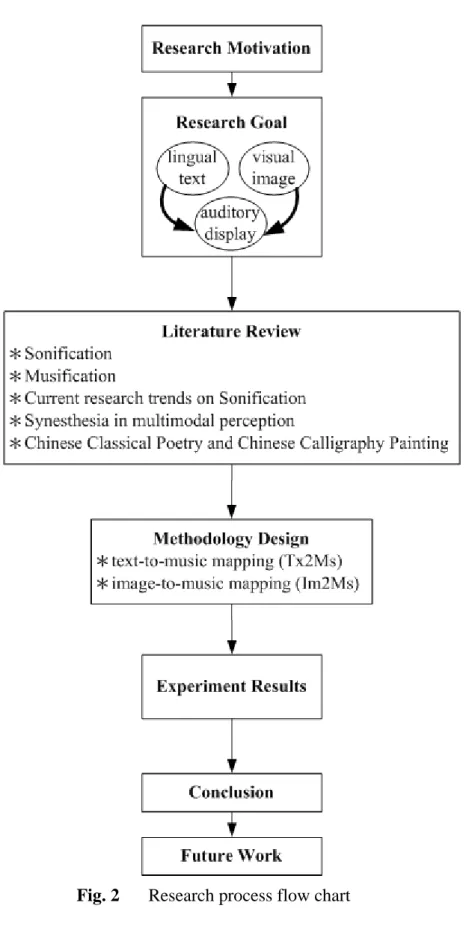
1.3 Thesis Organization and Research Process...3
Chapter 2 Related Works ...5
2.1 Sonification ...6
2.2 Musification ...9
2.3 Current Research Trends in Sonification ...10
2.3.1 Sonification in a diversity of usages ...10
2.3.2 Text-to-Sound Sonification ... 11
2.3.3 Image-to-Sound Sonification ... 11
2.4 Synesthesia in Multimodal Perception...13
2.5 Chinese Classical Poetry and Chinese Calligraphy Painting...14
Chapter 3 Methodology ...18
3.1 Tx2Ms (text-to-music mapping of Chinese Classical Poetry) ...19
3.1.1 Mapping Recipe of Tx2Ms ...20
3.1.2 Preliminaries of Tx2Ms ...21
3.1.3 System Architecture ...34
3.2 Im2Ms (image-to-music mapping of Chinese Calligraphy Painting)...38
3.2.1 Mapping Recipe of Im2Ms ...38
3.2.2 Preliminaries of Im2Ms ...40
3.2.3 System Architecture ...44
Chapter 4 Experiment Results ...47
4.1 Tx2Ms (text-to-music mapping of Chinese Classical Poetry) ...48
4.2 Im2Ms (image-to-music mapping of Chinese Calligraphy Painting)...51
Chapter 5 Conclusion and Future Work ...53
References...56
Appendix I ...58
List of Tables
Table 1 Framework of literature reviews...5
Table 2 Learning with audio-visual media and methodology...14
Table 3 The relation between memory maintenance and media usage...14
Table 4 Four basic types of tonal patterns of Five-Character Quatrain ...16
Table 5 Evolution of four primary styles of Chinese Calligraphy...17
Table 6 Features of classical Chinese intonation system...20
Table 7 Parameters classification and mapping of Chinese Classical Poetry...20
Table 8 Mappings from poetry information to musical parameters...21
Table 9 Transition Matrix ...23
Table 10 Three pentatonic modes used in Tx2Ms ...26
Table 11 Significant phonetic segments extraction in “Love Seed”...29
Table 12 Significant formants in “Love Seed” ...30
Table 13 Significant phonetic segments extraction in “Quiet Night Thoughts”...31
Table 14 Significant formants in “Quiet Night Thoughts” ...32
Table 15 Mappings from image information to musical parameters ...39
Table 16 Two structural descriptors of a Chinese character ...43
List of Figures
Fig. 1 Three display modalities of cross-disciplinary arts in this study...2
Fig. 2 Research process flow chart...4
Fig. 3 Three types of existing Sonification techniques ...7
Fig. 4 Elements hierarchy of a Sonification display ...8
Fig. 5 Schematic of an Auditory Display System ...8
Fig. 6 How to make an effective Sonification? ...9
Fig. 7 Comparison of proportions of the previous works on Image-to-Music and Text-to-Music mappings ...12
Fig. 8 General paradigm of Sonification...19
Fig. 9 Directed Graph...23
Fig. 10 The Markov Model is developed for stochastic algorithmic composition ...24
Fig. 11 An example of computing the rhythmic transition table from intonation ....25
Fig. 12 The notation of the three typical pentatonic modes ...26
Fig. 13 Pitch Class of modulo 12 ...27
Fig. 14 The harmonic series over the fundamental frequency C1 (32.703 Hz) ...33
Fig. 15 System flow chart of Tx2Ms...35
Fig. 16 System architecture of Tx2Ms ...36
Fig. 17 The Musification Phase in Tx2Ms ...37
Fig. 18 Typical process in image analysis...38
Fig. 19 Image analysis of a Chinese character ...39
Fig. 20 End Point detection by examining the 8-connected chain code elements ....43
Fig. 21 System flow chart of Im2Ms ...45
Fig. 22 System architecture of Im2Ms ...46
Fig. 23 Max/MSP implementation of Tx2Ms ...48
Fig. 24 Transition Matrix — four basic types of rhythm for the Five-Character-Quatrain in Classical Chinese Poetry ...50
Fig. 25 Ping/Ze score of the poem “Love Seed” in Fig. 11 ...51
Fig. 26 Waveform and spectrogram of output in Fig. 22 by horizontal scanning...51
Fig. 27 Waveform and spectrogram of output in Fig. 22 by vertical scanning ...51
Fig. 28 Pitch Distribution of output in Fig. 22 by horizontal scanning ...52
Fig. 29 Pitch Distribution of output in Fig. 22 by vertical scanning...52
Chapter 1 Introduction
1.1 Motivation and Objectives
The birth of this study is driven by the idea: “Is there any mechanism for assisting
the visually impaired, and people who are unfamiliar with Chinese in experiencing the art in forms of Chinese characters (i.e., poetry and calligraphy) through an alternative modality, hearing?” Fortunately, we found that text, image and sound, all these mediums
can evoke emotional responses. Since each modality has its certain strengths and each
combination of modalities may produce different synergistic results, sound can provide an
additional and complementary perceptual channel. Besides, sound can be used to augment
the visualization by permitting a user to visually concentrate on one field, while listening
to the other. Consequently, the aim of this study is to explore and utilize the auditory
display to strengthen the synesthesia and to supplement the visual interpretation of data
based on the artistic interrelationship. In other words, the digital data in three different
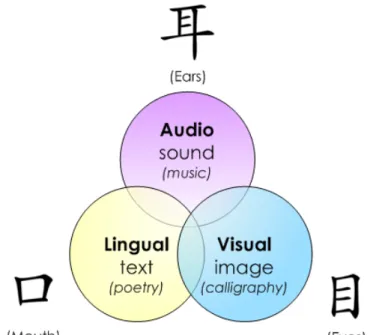
kinds of medium (text, images and sounds) are being manipulated. Fig. 1 depicts the
Fig. 1 Three display modalities of cross-disciplinary arts in this study
1.2 Scenarios and Contributions
The following are the two basic scenarios in this study: the former maps from text
onto sound, or, language to music; the latter maps from image onto sound, or space to time.
1. Learning the Chinese Classical Poetry, taking the example of the
“Five-Character Quatrain”.
2. Appreciating the Chinese Calligraphy Painting, taking the example of the
“Cursive Script”.
Although there has been research on mapping from text or image to sound, none of
them is dedicated to Chinese characters. The contributions of this study are as follows:
Firstly, either text or images, is analytically transformed from lingual or graphic data view
into abstract sonic space. Secondly, data is mapped to sound in a musical way. The visual
data representation is algorithmically compiled into audio data representation with
than arbitrarily or directly converted—a step forward from Sonification to Musification.
Thirdly, an immersive learning environment with audio-visual aids is built since it supports
concentration, provides engagement, increases perceived quality, and enhances learning
creativity during the appreciation process.
1.3 Thesis Organization and Research Process
The remainder of this paper is organized as follows: Chapter 2 presents a profound
survey on Sonification studies and existing tools for both text-to-audio and image-to-audio
transformations. To understand the role of Chinese characters in classical poetry and
calligraphy painting, this chapter also gives a brief sketch of the imagery and state of mind
inside the Chinese characters. Next, we propose our approach of both text-to-music
(Tx2Ms) and image-to-music (Im2Ms) mappings from structural music-level aspect rather
than from direct audio-level aspect (Chapter 3). A prototype implementation and
experimental results are presented in Chapter 4. Finally, we summarize the results of our
Chapter 2 Related Works
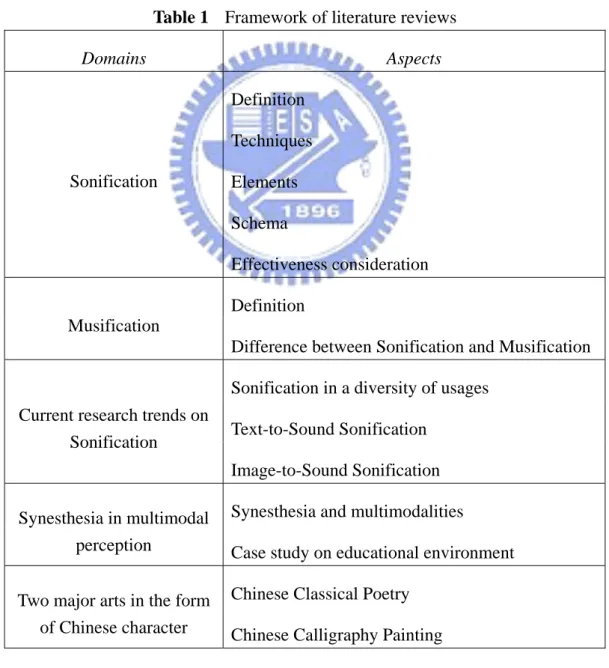
As shown in Table 1, the framework of literature reviews in this study is based on the
motivation and background knowledge, which is mainly focused on Sonification,
Musification, current research trends on Sonification, and Synesthesia in audio-visual
perception.
Table 1 Framework of literature reviews
Domains Aspects Definition Techniques Elements Schema Sonification Effectiveness consideration Definition Musification
Difference between Sonification and Musification
Sonification in a diversity of usages
Text-to-Sound Sonification Current research trends on
Sonification
Image-to-Sound Sonification
Synesthesia and multimodalities Synesthesia in multimodal
perception Case study on educational environment
Chinese Classical Poetry Two major arts in the form
2.1 Sonification
The word “Sonification” comprises the two Latin syllabus “sonus”, meaning sound,
and the ending “fication”, forming nouns from verbs which are ending with ‘-fy’.
Therefore, to “sonify” means to convey the information via sound. A Geiger detector can
be seen as the very basic scientific example for Sonification, which conveys (i.e., sonifies)
information about the level of radiation. A clock is even more basically an example for
Sonification, which conveys the current time.
The word “Sonification” has already been defined in a majority of researches.
“Sonification is to communicate information through nonspeech sounds" [6] (Ballas
1994, 79); “Sonification is the use of data to control a sound generator for the purpose of
monitoring and analysis of the data" [17] (Kramer 1994b, 187); “Sonification is the transformation of data relations into perceived relations in an acoustic signal for the purpose of facilitating communication or interpretation" [18] (Kramer et al. 1999);
“Sonification is a mapping of numerically represented relations in some domain under
study to relations in an acoustic domain for the purpose of interpreting, understanding, or communicating relations in the domain under study" [24] (Scaletti 1994, 224).
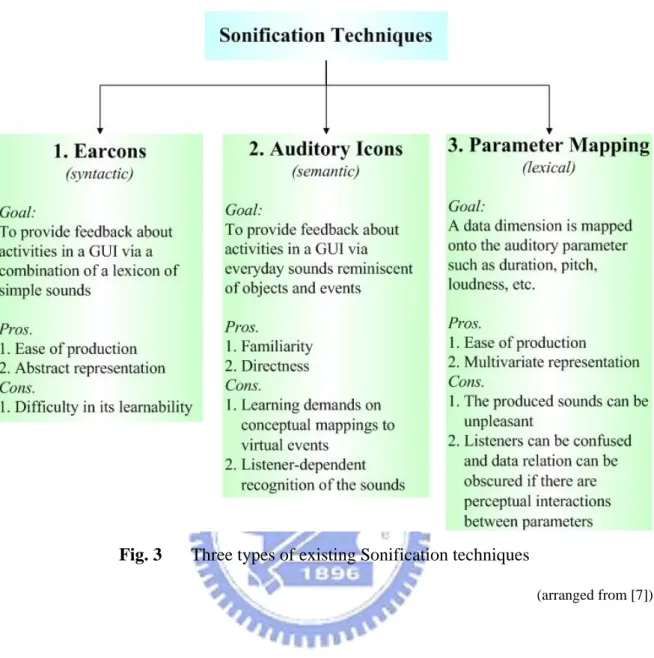
Fig. 3 illustrates the existing Sonification techniques, which are already categorized
into three types according to the mapping approach adopted: syntactic, semantic or lexical
Fig. 3 Three types of existing Sonification techniques
(arranged from [7])
Besides, the fundamental elements of a Sonification are suggested in Fig. 4 from both
data-centric and human-centric points of view, including the functionality to be identified,
Fig. 4 Elements hierarchy of a Sonification display
(rewritten from [23])
Moreover, Fig. 5 illustrates the fundamental procedure about how to design a
Sonification system, where the Communicative Medium is the core of Sonification [16].
Fig. 5 Schematic of an Auditory Display System
(rewritten from [16])
However, the essential goal of Sonification is to yield an auditory display that will be
orderly and intuitively maximal in meaning (i.e., coherence) to the observer. Inevitably, the
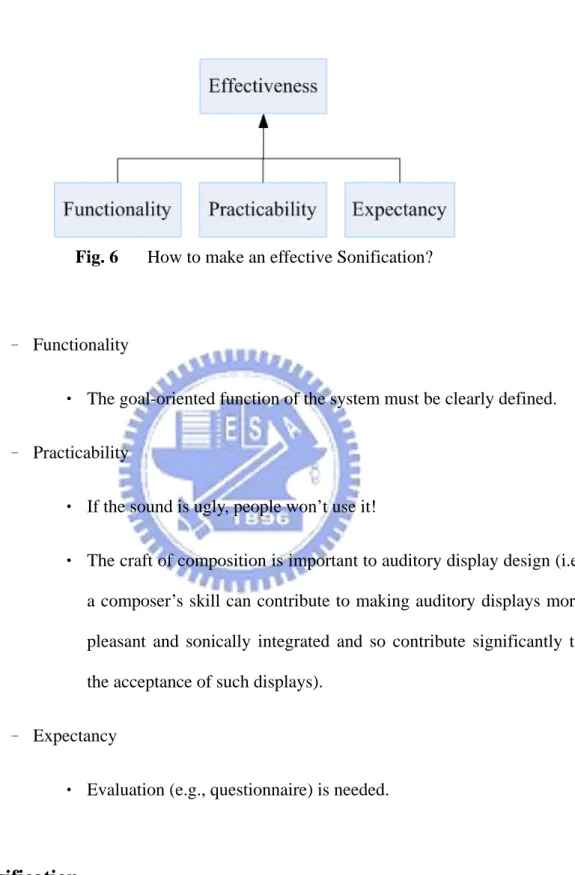
6).
Fig. 6 How to make an effective Sonification?
– Functionality
‧ The goal-oriented function of the system must be clearly defined.
– Practicability
‧ If the sound is ugly, people won’t use it!
‧ The craft of composition is important to auditory display design (i.e.,
a composer’s skill can contribute to making auditory displays more
pleasant and sonically integrated and so contribute significantly to
the acceptance of such displays).
– Expectancy
‧ Evaluation (e.g., questionnaire) is needed.
2.2 Musification
data can be musified by means of music as well. “ Musification is the musical
representation of data " [10] (Edlund 2004). However, the difference between
Sonification and Musification lies in the fact — Music is “organized sounds” (coined by
French composer, Edgard Varèse). Specifically speaking, data is no longer directly mapped
onto audio signal level, but algorithmically complied onto musical structure level, which
means, to follow some musical grammars or based on musical acoustics.
2.3 Current Research Trends in Sonification
This section reviews relevant research trends in Sonification from three aspects: a
diversity of usages, text-to-sound, and image-to-sound.
2.3.1 Sonification in a diversity of usages
Sonification has been put into practice in a variety of areas, inclusive of medical usages,
assistive technologies, or even data mining and information visualization. The idea of
using Sonification in medical usage is to use sounds to diagnose illness; the idea of
carrying out Sonification in assistive technologies is to make maps, diagrams and texts
more accessible to the visually impaired through multimedia computer programs; the idea
of applying a direct playback technique, called “Audification”, in data mining and
information visualization is to assist in overviewing large data sets, event recognition,
signal detection, model matching and education [7]. Besides, the method for rendering the
complex scientific data into sounds via additive sound synthesis and further visualizing the
sounds in Virtual-Reality environment has been proposed in [15], which is aimed to help
2.3.2 Text-to-Sound Sonification
The program “Poem Generator” in Phil Winsor’s book, “Automated Music
Composition,” has already illustrated the conversion from the constituent letters to the
pitch domain by mapping their individual ASCII values onto the pitch values in MIDI. The
mapping mechanism is basically derived from the idea that each character has an inherent
ASCII values as its digital information in every computer. The output results convey the
structure of the letters in a phrase, where rests are allocated for blank spaces and pitches
are assigned for different ASCII values of the letter [25].
2.3.3 Image-to-Sound Sonification
Kandinsky produced many paintings, which borrows motifs from traditional European
music, based on the correspondence between the timbres of musical instruments and colors
of visual image [14]. Contrary to Kandinsky’s attempt to “see the music”, there are
researchers and artists who have been trying to “hear the image”.
Iannis Xenakis’ UPIC (Unité Polyagogique Informatique du CEMAMu) system may be
one of the first digital graphics-to-sound schemes. Composers are allowed to draw lines,
curves, and points as a time-frequency score on a large-size and high-resolution graphics
tablet for input [19]. Later on, many of the ideas that drive image-to-sound software are
inspired from Xenakis’ research.
Unlike UPIC as a graphical metaphor of score, Coagula is an image synthesizer which
uses pixel-based conversion, where x and y coordinates of an image are regarded as time
and frequency axis, with a particular set of color-to-sound mappings. Red and Green
The vOICe (read the capitalized letters aloud individually to get “Oh, I see!”), or,
“Seeing with Sounds”, is a system that makes inverted spectrograms in order to translate
visual images into sounds, where the two-dimensional spatial brightness map of a visual
image is 1-to-1 scanned and transformed into a two-dimensional map of oscillation
amplitude as a function of frequency and time [20]. The mapping translates, for each pixel,
vertical position into frequency, horizontal position into time-after-click, and brightness
into oscillation amplitude — the more elevated position the pixel, the higher frequency the
associated oscillator; the brighter the pixel, the louder the associated oscillator. The
oscillator signals for a single column are then superimposed.
In Wang’s research, the image is converted from RGB to HSI system and then be
mapped from Hue (0-360 degree) to pitch (MIDI: 0-127), from Intensity (0-1) to playback
tempo (0-255), respectively [1]. In the research of Osmanovic, the image is mapped from
its electromagnetic spectrum to tone frequency and from intensity to volume based on
color properties and sound properties. The frequency of the tone is redoubled 40 times to
compute the frequency of the color: tone × 240 = color [22].
After all, a vast majority of the previous works focus on Image-to-Sound, or even
Image-to-Music mechanisms rather than Text-to-Music mechanisms (as shown in Fig. 7).
Fig. 7 Comparison of proportions of the previous works on Image-to-Music and Text-to-Music mappings
2.4 Synesthesia in Multimodal Perception
Synesthesia: from the Greek syn, meaning together, and aisthesis, meaning sensation,
literally means experiencing together. The human perception or cognition is a
multimodality process, combined of several sensations such as auditory modality, visual
modality, and so forth. Take the three different modalities in Fig. 1 for example.
z Between lingual text and non-lingual audio sound:
Rhythm plays a significant role in reading. Besides, the linguistic tone of voices
makes the words expressed with the implications of pitch, loudness, and speed/tempo.
For instance, a sentence at loud volume might convey the feel of anger, while a
sentence at fast tempo might imply the feel of urgency.
z Between visual image and non-lingual audio sound:
The spatial shaping constituents of a painting made up of dots, lines, shapes and colors
can bring about temporal musical features. Prof. Pei-sui Ma, a watercolor painter, once
mentioned that the length, width, position, slope, thickness, and density of lines can
produce the correspondence to pitch contour, loudness, and tempo.
The experiment conducted by Chen [3] shows the benefits how audio-visual
multimedia and its methods facilitate learning. The result proves that audio-visual aids in
educational environment assist the students in learning more, learning faster, and
Table 2 Learning with audio-visual media and methodology
Audio-Visual Media and Methods To Use Not To Use
A degree of understanding in a limited time 94 6
B time to spend until complete understanding 1 12
(rewritten from [3])
Table 3 The relation between memory maintenance and media usage
Memory Maintenance Usage Methods
3 hours later 3 days later
Hearing Only (oral teaching) 70% 10%
Vision Only (observation method) 72% 20%
Both Hearing and Vision (audio-visual method) 85% 65%
(rewritten from [3])
2.5 Chinese Classical Poetry and Chinese Calligraphy Painting
Chinese characters have been classified into six categories by etymology: pictogram,
ideogram, phonetic compounding, meaning aggregation, mixed word creation, and
transliteration. Strictly speaking, the Chinese character is a logogram, primarily comprising
pictograph and semasiograph, different from the phonogram, which represents phonemes
(speech sounds) or combinations of phonemes. From the old days, the Chinese character is
not only a kind of symbol to record the language but also a kind of art. The two most
well-known artistic creations based on the Chinese characters are Chinese Classical Poetry
and Chinese Calligraphy Painting. The former uses characters for syntactic expression and
for semantic narration to deliver the beauty of speech, while the latter uses characters for
Jintishi, or, “modern-form poetry”, is one set of the popular poetic forms among
Chinese Classical Poetry. In these form, each couplet comprises a series of set tonal
patterns using the four tones of the mid-ancient Chinese pronunciation. There are basically
the level, rising, falling and entering tones in the classical Chinese intonation system.
Furthermore, the key to the composition of Jintishi hinges on the intonation score of
Ping/Ze opposition in traditional Chinese verse, where level tone belongs to Ping and the
others belong to Ze. Overall, Jintishi is a specific form of Chinese Classical Poetry which
carries consistent and well-defined rules for not only its prosody (i.e., regular meter,
rhythm and intonation) but also the rhyming scheme.
Jintishi could be further categorized into three major forms based on the number of
lines in each poem [2]. (All forms of Jintishi could be written in five or seven character
lines.)
z Quatrain (with four lines in each poem): Some tonal patterns are followed.
z Regulated Verse (with eight lines in each poem): In addition to the tonal constraints, this form requires parallelism between the lines in the second (third
and fourth lines) and third (fifth and sixth lines) couplets. The lines in these
couplets have contrasting content, while the characters in each line are in the same
grammatical relationship.
z Long poem in Regulated Verse (with over eight lines in each poem): This form extends the Regulated Verse to unlimited length by repeating the tonal pattern.
The parallelism is required in each couplet except the first and last couplets.
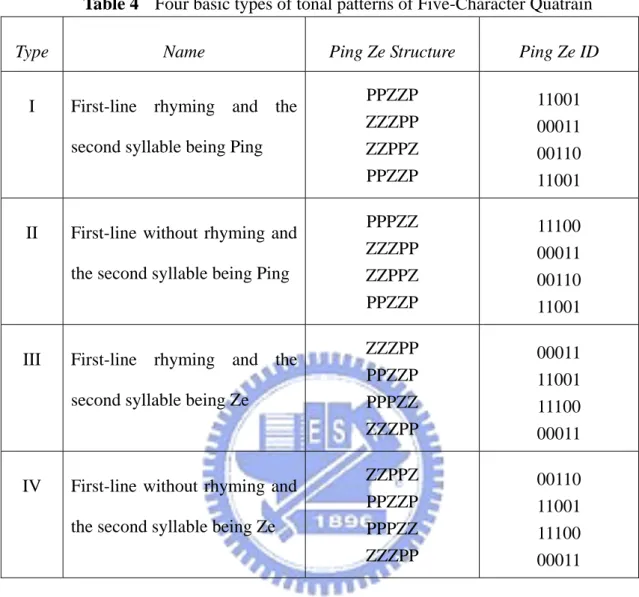
However, the tonal rules received greater emphasis than parallelism. According to the tonal
rules [2] [4] [5], we can infer four basic types of tonal patterns of the Five-Character
Table 4 Four basic types of tonal patterns of Five-Character Quatrain
Type Name Ping Ze Structure Ping Ze ID
I First-line rhyming and the
second syllable being Ping
PPZZP ZZZPP ZZPPZ PPZZP 11001 00011 00110 11001
II First-line without rhyming and
the second syllable being Ping
PPPZZ ZZZPP ZZPPZ PPZZP 11100 00011 00110 11001
III First-line rhyming and the
second syllable being Ze
ZZZPP PPZZP PPPZZ ZZZPP 00011 11001 11100 00011
IV First-line without rhyming and
the second syllable being Ze
ZZPPZ PPZZP PPPZZ ZZZPP 00110 11001 11100 00011
Chinese Calligraphy Painting is highly ranked as an important art form in East Asia,
referring to the beautiful handwriting of Chinese characters. Seal Script, Clerical Script,
Cursive Script and Regular Script are the primary styles in the evolution of Chinese
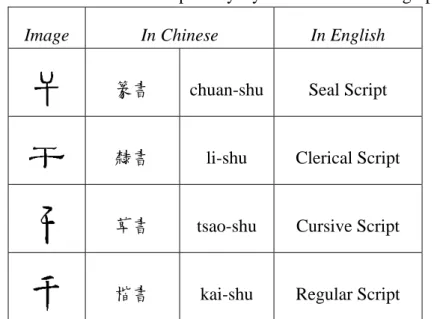
Calligraphy. Table 5 displays the same Chinese character, which means “thousand” in
Chinese, in four different styles. Among all, Cursive Script is the most expressive and
individual style, which draws the musical rhythm and speed in two dimensional space on
Table 5 Evolution of four primary styles of Chinese Calligraphy
Image In Chinese In English
篆書 chuan-shu Seal Script
隸書 li-shu Clerical Script
草書 tsao-shu Cursive Script
楷書 kai-shu Regular Script
These two artistic creations of Chinese characters are rich in poetic and pictorial
splendor, and deep in implicit imagery. The so-called state of mind of an artistic work is
composed of subjectively emotional feeling and objectively existential image in harmony
and unity. The state of mind is the territory of imagery expansion and the land with flows
of emotions. On the one hand, the refined verses with phonemic orderliness give birth to
the pleasant sounds of the recitation, making the poetry easy to read and to remember,
which might have been lingering in the audience’s heads for days. On the other hand, the
thickness, length, strength, speed and shape of the characters with the transition (stop and
change) of the brush strokes convey the disposition of the calligrapher and enchantment of
Chapter 3 Methodology
“The mapping problem” has been regarded as the essential issue of Sonification. In two
representative artistic creations which stem from Chinese character, we found that the
poets are interested in the patterns of prosody while the calligraphers signify their
personality through the strokes and modeling of a character.
In this study, the Sonification mechanisms of transforming Chinese Classical Poetry
(text) and Chinese Calligraphy Painting (image) into music are explored respectively. First
of all, the aesthetic features are extracted from Chinese Classical Poetry and Chinese
Calligraphy Painting. Afterwards, the rules are applied to individual parameter-mapping
mechanisms. The conversion of text-to-music mapping is based on the pronunciation
properties and the syntax characteristics in Chinese Classical Poetry. The conversion of
image-to-music mapping is based on a relationship that exists among space, color and
sound in human perception. Fig. 8 illustrates a general paradigm of our Sonification in this
study.
A limited number of features and corresponding sonic attributes are taken into account
so as to keep the resultant sounds as simple as possible and easy to decode because the
listeners always wish to hear what the data is doing. However, the sound will be still rich in
Fig. 8 General paradigm of Sonification
3.1 Tx2Ms (text-to-music mapping of Chinese Classical Poetry)
Throughout this section, a mechanism of mapping poetry data onto appropriate sound
3.1.1 Mapping Recipe of Tx2Ms
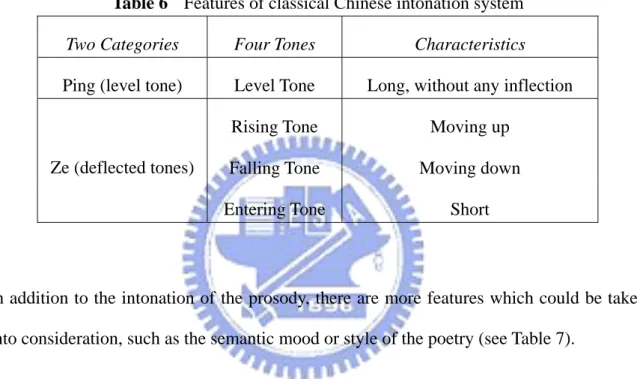
The four tones in mid-ancient Chinese pronunciation are dichotomized into the only
two categories in the classical Chinese intonation with the following characteristics (as
shown in Table 6).
Table 6 Features of classical Chinese intonation system
Two Categories Four Tones Characteristics
Ping (level tone) Level Tone Long, without any inflection
Rising Tone Moving up
Falling Tone Moving down
Ze (deflected tones)
Entering Tone Short
In addition to the intonation of the prosody, there are more features which could be taken
into consideration, such as the semantic mood or style of the poetry (see Table 7).
Table 7 Parameters classification and mapping of Chinese Classical Poetry
Music Parameters Classification
between two domains
Rhythm Interval
Size Sonority Dynamics Tempo Mode Prosody
Intonation O O O O X O
Poetry
Poetic Mood X X X O O X
classified and mapped to multiple parameters in music domain, where interval size refers
to horizontal adjacent pitches and sonority refers vertical simultaneous pitches,
respectively. Table 8 shows the mapping between poetic attributes and music parameters.
(The characters “C”, “J”, and “B” represent Chinese Pentatonic Mode, Japanese Hirajoshi
Five-Tone Mode, and Balinese Gamelan Five-Tone Pelog Mode respectively.)
Table 8 Mappings from poetry information to musical parameters
Music Parameters Mapping
Rhythm Interval
Size Sonority Dynamics Tempo Mode Ping Sparse small harmonic soft
Ze Dense large inharmonic loud
NULL
Prosody Intonation
Tone NULL C/J/B
brightness loud fast
darkness soft slow
Poetic Mood neutrality or exoticism NULL free free N U L L
3.1.2 Preliminaries of Tx2Ms
a.
Use Markov Chain in transition table constructionThere are several divisions of techniques in algorithmic composition, inclusive of
stochastic, rule-based flow control, grammar, chaotic and artificial intelligence. Markov
Chain is one of the stochastic processes in probability theory. The Markov models have
been widespread used in many other fields, like Wireless Communication and
Most of all, the principle of Markov Property is to memorize the current state. Thus,
the conditional probability of future states of the process depends only on the current state,
i.e. it is conditionally independent of the past states, and the path of the process, given the
present state. For instance, the probability of the (N+1)th state only correlates to the current
Nth state, having nothing to do with other previous states. Accordingly, the following
shows the Markov Property, also known as Markovian.
(
, , , ,)
Pr(
)
(1)Pr Sn+1Sn Sn−1 K S1 S0 = Sn+1Sn
Further, the Markov Chain is described as a sequence of random variables S1, S2, S3…,
Sn, with Markov Process, where each Si is one of the possible values from a state space S.
Take two lower level musical elements for example. The state space of Pitch Class is {0, 1,
2, 3, 4, 5, 6, 7, 8, 9, 10, 11} while the state space of Rhythm could be {1/1, 1/2, 1/4, 1/8,
1/16, 1/32}. The following illustrates the process with Markov Property in Markov Chain.
( )
t0 →S( )
t1 →S( )
t2 → →S( )
tn →S( )
tn+1 (2)S L
A Markov Chain could be represented either by a Directed Graph or a Transition
Matrix. A Directed Graph consists of a set of states and a set of transitions with associated
probabilities. A Transition Matrix of an N+1-dimensional probability table represents an
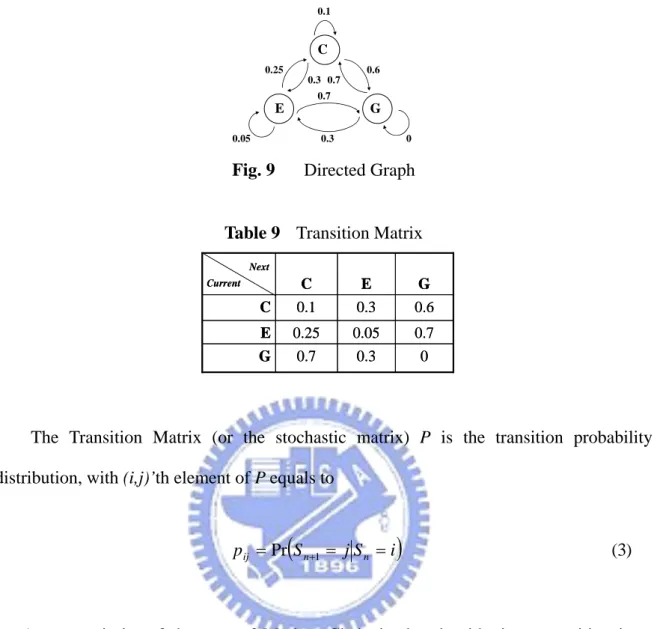
Nth-order Markov Chain, which tells us the likelihood of an event’s occurrence, given the
previous N states [21] [25]. Fig. 9 and Table 9 show the 1st-order Markov Chain in terms of Directed Graph as well as Transition Matrix where C, E and G refer to the name of the
C E G 0.1 0 0.05 0.6 0.3 0.25 0.3 0.7 0.7
Fig. 9 Directed Graph
Table 9 Transition Matrix
0 0.3 0.7 G 0.7 0.05 0.25 E 0.6 0.3 0.1 C G E C Next Current 0 0.3 0.7 G 0.7 0.05 0.25 E 0.6 0.3 0.1 C G E C Next Current
The Transition Matrix (or the stochastic matrix) P is the transition probability
distribution, with (i,j)’th element of P equals to
(
)
(3)Pr S 1 jS i
pij = n+ = n =
A vast majority of the uses of Markov Chain in the algorithmic composition is to
analyze and model the existing compositions. For example, some researches have already
analyzed the improvisation and chord progression by means of Markov Model [9] [12]
[13]. The Markov Models used in these studies are mainly regarded as an analyzer or a
model. In this study, we suppose the Markov Model contribute to the stochastic
algorithmic composition (see Fig. 10). The function of Markov Model is to facilitate
meaningful mapping between poesy data and musical elements. With the advent of
highly-relevant music, the emotional perception could be greatly improved during Chinese
Existing compositions Markov Chain Stochastic Algorithmic Composition
Fig. 10 The Markov Model is developed for stochastic algorithmic composition
In the Preprocessing Phase I of Tx2Ms, the interchanging Ping/Ze in each phrase is
decomposed and aggregated for further recomposing of the rhythm sequence of original
complete poem. Based on the rhythm sequence, a rhythmic transition table of 1st-order Markov Chain is computed for further algorithmic composition design. Fig. 11 takes the
b.
Apply Sieve Theory in pentatonic mode generationThe pentatonic or five note mode occurs in most of the ancient folk music in Asia.
The prevalence of pentatonic modes in Chinese, Japanese, and Javanese music makes
pentatonic modes have an Asian character for a long time. In particular, the pentatonic
mode typifies the Chinese-style music since the traditional Chinese music is primitively
based on pentatonic mode. Besides, A Pentatonic Mode, or, a Five Tone Mode, is a mode
with five notes per octave. Table 10 and Fig. 12 present three typical pentatonic modes in
the Tx2Ms.
Table 10 Three pentatonic modes used in Tx2Ms
Pentatonic Mode Name Pitch Name Pitch Class (PC)
Chinese Pentatonic (C, D, E, G, A) PCC: (0, 2, 4, 7, 9)
Japanese Hirajoshi Five-Tone (C, D, E♭, G, A♭) PCJ: (0, 2, 3, 7, 8)
Balinese Gamelan Five-Tone Pelog (C, D♭, E♭, G, A♭) PCB: (0, 1, 3, 7, 8)
Sieve Theory is utilized here to generate pitches within a specific mode once the
mode is recommended by Tx2Ms. Pitch Class uses “modulo 12”. By using “mod 12”, any
integer number above 12 should be reduced to a number from 0 to 11. This modulo
operator can be visualized using a clock face (Fig. 13):
Fig. 13 Pitch Class of modulo 12
The function is described as below, where RP means Random Pitch (i.e., a random number
integer) and 0 <= RP <= 127; RC refers to Residue Class (i.e., the set of integers filtered),
and is specified RC = {a,…, b}, where a is the minimum, and b is the maximum.
) 4 ( 12 mod RP RC =
z RC set of Chinese Pentatonic Mode (RCC): RP (mod 12) == {0, 2, 4, 7, 9}
z RC set of Japanese Hirajoshi Mode (RCJ): RP (mod 12) == {0, 2, 3, 7, 8}
z RC set of Balinese Pelog Mode (RCB): RP (mod 12) == {0, 1, 3, 7, 8}
For simplification, RCC, RCJ, and RCB are all named Pitch Class (PC) in ascending order
of individual modes as PCC, PCJ, and PCB, respectively.
The formants of the top-5 significant and reliable phonetic segments are extracted to
estimate the maximum likelihood of Pitch Class among the three predefined pentatonic
modes. Firstly, the two rhyming words and other three longest sounds are selected from all
phonetic segments of the poem recitation. Secondly, formants in the vowels of the five
words are analyzed with Praat, a free software for acoustic analysis (by Paul Boersma and
David Weenink, Institute of Phonetic Sciences, University of Amsterdam). Then, each
formant is converted into its approximate pitch based on the following equation to map a
pitch’s fundamental frequency f (measured in hertz) to a real number p
(
/440)
(5)log 12
69 2 f
p= +
Afterwards, the Pitch Class of the real number p is further derived with modulo of 12
) 6 ( 12 mod p PC =
The five derived Pitch Class are arranged in ascending order. Thirdly, Pitch
Class,PC
(
p1,p2,K,pn)
, is transformed to Interval Class, IC(
i1,i2,K,in)
, where(
p 1 p 12)
mod12; if k 1 n then p 1 p1. (7)ik = k+ − k + + > k+ =
The dissimilarities (distance) between the Interval Class of the poem and the Interval Class
of the three predefined pentatonic modes are compared by Euclidean Distance.
The Euclidean Distance between points P=
(
p1,p2,K,pn)
and Q=(
q1,q2,K,qn)
, in Euclidean n-space, is defined as:
(
) (
)
(
)
(
)
(8) 1 2 2 2 2 2 2 1 1∑
= − = − + + − + − n i i i n n q p q p q p q p LFinally, the Pitch Class with minimum Euclidean Distance is then selected as the best
suitable mode for the particular poem. See the following two examples.
1st Example: “Love Seed” by Wang Wei
step1. Select the top-5 phonetic segments
Table 11 Significant phonetic segments extraction in “Love Seed”
Phonetic Segments of the Poem “Love Seed” in Waveform1 Display
Text Pronunciation2 Length (s) Significance
紅 hong5 0.32
豆 tou7 0.47 long sound
生 seng 0.45 long sound
南 lam5 0.27 國 kok 0.23 春 chhun 0.27 來 lai5 0.38 發 hoat 0.28 幾 ki2 0.25 枝 ki 0.47 rhyming word 願 goan7 0.34 1
The digital speech file comes from National Digital Archives Program, TAIWAN (recited by 洪澤南);
URL: http://dlm.ntu.edu.tw/Education/94Web/7/index.html
2
The pronunciation, most recited in “Southern Min” by the Roman Pinyin, derives from 羅鳳珠-中華典籍 網路資料中心-唐詩三百首; URL: http://cls.admin.yzu.edu.tw/300/Home.htm
君 Kun 0.50 long sound 多 To 0.27 采 chhai2 0.33 擷 Khiat 0.30 此 chhu2 0.33 物 but8 0.27 最 choe3 0.36 相 Siong 0.42 思 Su 0.55 rhyming word
step2. Convert formants of vowels into Pitch Class
Table 12 Significant formants in “Love Seed”
Text Pronunciation F1 F2 F3 Approximate Pitch PC
豆 tou7 581 705 2955 D 2
生 sin 364 2101 2825 F# 6
枝 chi 437 2479 3196 A 9
君 kun 396 947 2777 G 7
思 su 295 2211 3139 D 2
step3. Calculate the Interval Class dissimilarity
Transform Pitch Classes PCX (2, 2, 6, 7, 9), PCC (0, 2, 4, 7, 9), PCJ (0, 2, 3, 7, 8) and
PCB (0, 1, 3, 7, 8) to Interval Classes ICX (0, 4, 1, 2, 5), ICC (2, 2, 3, 2, 3), ICJ (2, 1, 4, 1, 4)
and ICB (1, 2, 4, 1, 4). Compute the Euclidean Distance between ICX (0, 4, 1, 2, 5) and ICC
(2, 2, 3, 2, 3), ICJ (2, 1, 4, 1, 4), and ICB (1, 2, 4, 1, 4) as EC, EJ, and EB, respectively.
4 ) 3 5 ( ) 2 2 ( ) 3 1 ( ) 2 4 ( ) 2 0 ( − 2 + − 2 + − 2 + − 2 + − 2 = = C E 6 2 ) 4 5 ( ) 1 2 ( ) 4 1 ( ) 1 4 ( ) 2 0 ( − 2 + − 2 + − 2 + − 2 + − 2 = = J E 4 ) 4 5 ( ) 1 2 ( ) 4 1 ( ) 2 4 ( ) 1 0 ( − 2 + − 2 + − 2 + − 2 + − 2 = = B E
The similarity result is: Chinese Pentatonic ≈ Balinese Pelog > Japanese Hirajoshi. Thus, both PCC and PCB are recommended for the poem “Love Seed”.
2nd Example: “Quiet Night Thoughts” by Li Po
step1. Select the top-5 phonetic segments
Table 13 Significant phonetic segments extraction in “Quiet Night Thoughts”
Phonetic Segments of the Poem “Quiet Night Thoughts” in Waveform Display
Text Pronunciation Length (s) Significance
床 chhong5 0.33
前 chian5 0.57
明 beng5 0.47
月 goat8 0.24
光 kong 0.58 rhyming word
疑 gi5 0.32
是 si7 0.60 long sound
地 ti7 0.43
上 siong7 0.34
霜 song 0.51 rhyming word
舉 ku2 0.22 頭 thou5 0.52 望 bong7 0.47 明 beng5 0.40 月 goat8 0.40 低 te 0.28
思 su 0.56
故 kou3 0.34
鄉 hiong 0.60 rhyming word
step2. Convert formants of vowels into Pitch Class
Table 14 Significant formants in “Quiet Night Thoughts”
Text Pronunciation F1 F2 F3 Approximate Pitch PC
光 kong 622 1781 2593 D# 3
是 si7 437 1034 2665 A 9
霜 song 541 825 3025 C# 1
頭 thou5 347 879 2707 F 5
鄉 hiong 489 1181 2429 B 11
step3. Calculate the Pitch Class dissimilarity
Transform Pitch Classes PCX (1, 3, 5, 9, 11), PCC (0, 2, 4, 7, 9), PCJ (0, 2, 3, 7, 8) and
PCB (0, 1, 3, 7, 8) to Interval Classes ICX (2, 2, 4, 2, 2), ICC (2, 2, 3, 2, 3), ICJ (2, 1, 4, 1, 4)
and ICB (1, 2, 4, 1, 4). Compute the Euclidean Distance between ICX (0, 4, 1, 2, 5) and ICC
(2, 2, 3, 2, 3), ICJ (2, 1, 4, 1, 4), and ICB (1, 2, 4, 1, 4) as EC, EJ, and EB, respectively.
2 ) 3 2 ( ) 2 2 ( ) 3 4 ( ) 2 2 ( ) 2 2 ( − 2 + − 2 + − 2 + − 2 + − 2 = = C E 6 ) 4 2 ( ) 1 2 ( ) 4 4 ( ) 1 2 ( ) 2 2 ( − 2 + − 2 + − 2 + − 2 + − 2 = = J E 6 ) 4 2 ( ) 1 2 ( ) 4 4 ( ) 2 2 ( ) 1 2 ( − 2 + − 2 + − 2 + − 2 + − 2 = = B E
The similarity result is: Chinese Pentatonic > Japanese Hirajoshi ≈ Balinese Pelog. Thus, PCC is best recommended for the poem “Quiet Night Thoughts”.
Sonority is the resultant of two or more musical sounds combined simultaneously,
different from melody, which comprises of two or more successive pitches as a temporal
sequence. The harmonic series is utilized as a reference for sonority construction because
even an untrained user can intuitively and conveniently detect by ear whether the sonority
sounds harmonic or inharmonic. Taking the frequency of C1 (32.703 Hz) as an arbitrary
fundamental frequency, frequencies of tones sharing the same relationships as harmonics in
this harmonic series over the fundamental is calculated in a true overtone series as shown
in Fig. 14. The indications added to individual notes imply each tone’s deviation in cents
based on 1200 cents per octave standard.
Fig. 14 The harmonic series over the fundamental frequency C1 (32.703 Hz)
The higher up the harmonic series, the more dissonant the sonority becomes. If the
prosody intonation equals Ping then the sonority consists of intervals between lower
prosody intonation equals Ze then the sonority consists of intervals between higher
successive harmonic series such as the M3, and m3 (i.e., Major, and minor 3rd).
3.1.3 System Architecture
Fig. 15 and Fig. 16 illustrate the system flow chart and the system architecture of
In Phase II, the best suitable pentatonic mode is recommended according to the
formants of prosody intonation. The mapping rules in the Musification procedure are as
shown in Fig. 17.
3.2 Im2Ms (image-to-music mapping of Chinese Calligraphy Painting)
Throughout this section, we provide a mechanism of mapping calligraphy data onto
appropriate sound features along with an overview of the system architecture.
3.2.1 Mapping Recipe of Im2Ms
In most practical applications, a raw data image is hardly observed any useful
information. However, the preprocessing of an image contributes to features extraction in
image analysis (as shown in Fig. 18).
Fig. 18 Typical process in image analysis
Since a Chinese character is regarded as an image in this study, we are supposed to explore
the abstract elements which comprise a picture from a Chinese character. Every image has
its external frame and internal content, where the former means the explicit shape
characteristics (i.e., contour information, gesture of lines) and the later means the implicit
Basically we convert a Chinese character to sound according to its shaping frame of
pixels. Furthermore, the sound is characterized by its structural component of content
implied in the Chinese character (as shown in Fig. 19).
Fig. 19 Image analysis of a Chinese character
From the micro perspective, the smallest unit of an image in computer vision has
information about its RGB (true-color), intensity (gray-level), position (X-Y), etc.
According to the traditional spectrograph display of sounds, the two-dimensional axes are
one for frequency and the other for time. Besides, concerning the human behavioral habits
of writing a Chinese character (where most strokes are basically from top left towards
bottom right corner), two-way scanning methods (i.e., from left to right & from top to
bottom) are both adopted. Moreover, from the top-to-down perspective, each image as a
whole can be analyzed by its contour, shape, etc. Table 15 shows the mapping between
image and music parameters.
Table 15 Mappings from image information to musical parameters
Music Parameters Mapping
Pitch Dynamics Tempo Timbre
Left, Bottom Low Dark Loud Edge Intensity Bright NULL Soft NULL More Slower End Point Less NULL Faster NULL
Non Positive Smooth
Image
Structure Euler
Number Positive NULL Sharp
3.2.2 Preliminaries of Im2Ms
a. SegmentationHuman vision is very good at edge detection so that edge detection is one of the most
essential tasks in image analysis. Edge detection is extensively used in image segmentation
since edges characterize object boundaries. Representing an image by its edges has the
advantage that the amount of original image data is significantly reduced and useless
information is filtered out, while preserving most of the important structural properties in
an image. In typical image, edges are places with strong intensity contrast. An edge is a
jump in intensity from one pixel to the next, where drastic change occurs in gray level over
a small spatial distance (e.g. surface color or illumination discontinuity). Hence, edges
correspond to high spatial frequency components in the image signal. The majority of
different methods to perform edge detection can be grouped into two categories, gradient
and Laplacian. The gradient-based method detects the edges by looking for the maximum
and minimum in the first derivative of the image. The Laplacian-based method finds the
edges by searching for zero crossings in the second derivative of the image.
The gradient vector represents: (1) the direction in the n-D space along which the
function increases most rapidly, and (2) the rate of the increment. Here we only consider
2D field: ) 9 ( j y i x r r ∂ ∂ + ∂ ∂ ≅ ∇
where i and j are unit vectors in the x and y directions respectively. The generalization of a
2-D function f(x, y) is the gradient
) 10 ( ) , ( ) , ( ) , ( j f x y f i f j y i x y x f y x g x y r r r r r = + ⎟⎟ ⎠ ⎞ ⎜⎜ ⎝ ⎛ ∂ ∂ + ∂ ∂ = ∇ ≅
The magnitude of g(x, y) is first computed, and is then compared to a threshold to find
candidate edge points.
) 11 ( ) , ( ) , ( ) , ( 2 2 ⎟⎟ ⎠ ⎞ ⎜⎜ ⎝ ⎛ ∂ ∂ + ⎟ ⎠ ⎞ ⎜ ⎝ ⎛ ∂ ∂ = ∇ y y x f x y x f y x f
z Laplacian-based Edge Detection Methods:
The Laplace operator is defined as the dot product (inner product) of two gradient vector
) 12 ( 2 2 2 2 2 y x j y i x j y i x ∂ ∂ + ∂ ∂ = ⎟⎟ ⎠ ⎞ ⎜⎜ ⎝ ⎛ ∂ ∂ + ∂ ∂ ⋅ ⎟⎟ ⎠ ⎞ ⎜⎜ ⎝ ⎛ ∂ ∂ + ∂ ∂ = ∇ ⋅ ∇ ≅ ∇ ≅ Δ r r r r
The generalization of a 2-D function f(x, y) is the gradient
) 13 ( ) , ( 2 2 2 2 y f x f y x f ∂ ∂ + ∂ ∂ = Δ b. Features Extraction
Based on the topologically and morphologically structural attributes of a Chinese
character, two descriptors (as shown in Table 16) are utilized to produce the mapping rules
of implicit structural content along with the mapping criteria of explicit frame of pixels.
One is the morphological attribute — End Point, where each End Point EP(x, y) must
satisfy the following two conditions within the eight-connected chain code (Fig. 20):
( )
, 1 (14) . 1 EP x y =(
)
(
)
(
)
(
)
(
)
(
1, 1)
(
, 1)
(
1, 1)
1 (15) , 1 1 , 1 1 , 1 , 1 , 1 . 2 = − + + − + − − + − + + − + + + + + + + y x EP y x EP y x EP y x EP y x EP y x EP y x EP y x EPFig. 20 End Point detection by examining the 8-connected chain code elements
The other is the topological attribute — Euler Number, which means the total number of
objects in the image (i.e., C) minus the total number of holes in those objects (i.e., H),
defined as: ) 16 ( H C E = −
Table 16 Two structural descriptors of a Chinese character
Structural Features Illustration Metaphor
End Point
End Point = 7
Since the number of End Points
implies the number of strokes of a
Chinese character, the more the end
points, the more complicated and
higher fragmentation degree a
points, the smoother a Chinese character. Loop and Euler Number Loop = 3 Euler Number = -2 Loop = 2 Euler Number = -1 Loop = 1 Euler Number = 0
Since the number of Euler Number
implies the number of closed regions
in a Chinese character, the more the
Euler Number, the higher closed
degree a Chinese character.
Moreover, the more End Points plus
the Euler Number, the more changes
of breaths during the writing and
thus the slower tempo to accomplish
a Chinese character.
3.2.3 System Architecture
Fig. 21 and Fig. 22 illustrate the system flow chart and the system architecture of
Im2Ms, namely the image-to-music conversion of Chinese Calligraphy Painting, where Fig.
Chapter 4 Experiment Results
The Sonification schemes are implemented two ways for rapid prototyping and
exploration: Tx2Ms in Max/MSP, a graphical development environment for interactive
computer music and multimedia, originally written by Miller Puckette and currently
developed and maintained by Cyling’74, and Im2Ms in MATLAB, an environment with
4.1 Tx2Ms (text-to-music mapping of Chinese Classical Poetry)
Fig. 23 Max/MSP implementation of Tx2Ms
The implementation details of Tx2Ms are shown in Fig. 23, demonstrating different
user-controlled level modules:
z Mode Module: To select the recommended or user-preferred Pentatonic Mode, with Tonic and volume range selection.
z Markovian Rhythm Module: To select Ping-Ze based Rhythmic Transition Table templates for specific poem.
z Rhythm-Controlled Interval Module: the interval size is controlled by the transitional state result from Markovian Rhythm Module.
z Sonority Module: the sonority components are also controlled by the transitional state result from Markovian Rhythm Module.
z Ornament Module: user-controlled parameters for Random Process
Since Table 4 has illustrated the general Ping Ze for Five-Character Quatrain, Table
17 shows the Rhythm Sequence of each type of Five-Character Quatrain for building up
the Transition Matrix.
Table 17 Rhythm sequences of four Five-Character-Quatrain types
TYPE Ping Ze ID Ping Ze Aggregation Rhythm Sequence
TYPE I 11001 00011 00110 11001 201 02 020 201 20102020201 TYPE II 11100 00011 00110 11001 30 02 020 201 302020201 TYPE III 00011 11001 11100 00011 02 201 30 02 040402 TYPE IV 00110 11001 020 201 02020402
11100 00011
30 02
Furthermore, Fig. 24 displays four basic templates for rhythmic matrices transferred from
Ping Ze. Each message box has three numeric values, where the first and the second mean
the current state and the next state, and the last value is the weighting of transition from
current state to next state.
Fig. 24 Transition Matrix — four basic types of rhythm for the Five-Character-Quatrain in Classical Chinese Poetry
Fig. 25 demonstrates a Ping/Ze score of part of the state sequence output (1, 3, 1, 3, 2, 1, 2,
1, 3, 1, 2, 1, 3, 1, 1, 3, 1, 3, 1, 3, 1, 3, 1, 1, 3, 2, 1, 3, 2, 1, 3) from Rhythmic Transition
Fig. 25 Ping/Ze score of the poem “Love Seed” in Fig. 11
4.2 Im2Ms (image-to-music mapping of Chinese Calligraphy Painting)
Fig. 26 and Fig. 27 illustrate the output of Im2Ms in both waveform and spectrogram
displays of the exemplified cursive script (shown in Fig. 22) by horizontal and vertical
scanning method respectively.
Fig. 26 Waveform and spectrogram of output in Fig. 22 by horizontal scanning
Fig. 27 Waveform and spectrogram of output in Fig. 22 by vertical scanning
As shown in Fig. 28 and Fig. 29, Im2Ms achieve its responsiveness during the
Musification process by observing pitch distributions from two-way scanning mechanism.
It does meet the goal in expectancy of an effective Sonification as mentioned before in
Fig. 28 Pitch Distribution of output in Fig. 22 by horizontal scanning
Chapter 5 Conclusion and Future Work
Currently, the adaptive Musification prototypes designed for Chinese Classical Poetry
and Chinese Calligraphy Painting are proposed. General conclusion is that the sounds
produced in each experiment convey the information about the imagery state of mind and
the qualitative nature of the data.
For Text-to-Music conversion:
z Not only the arrangement of text but also the pronunciation properties and the syntactic characteristics of the poem are conveyed in the music output.
For Image-to-Music conversion:
z The position-to-pitch mapping is more intuitively responsive to original visual data and easy for gestalt formation than color-to-pitch applied in the two related
works. However, color could be mapped into timbre instead.
z Notwithstanding the two parameters are taken into account (i.e., position and intensity), the two-way scanning results in an extra musical effect — the
sonority. To sum up, the texture of the image in both horizontally and vertically
sequential scanning reflects on the sonority of the music.
Many interesting applications could be realized based on this study, such as an Audible
Platform. Nevertheless, the actual resolution obtainable with human perception of these
sound representations remains to be evaluated, and the algorithmic composition throughout
the Musification process need more improvements. The involvement of expertise in poetry
composition (Chinese Classical Poetry Analysis), image processing (Chinese character
Recognition), music composition, and even psychology is critical for its success.
Although this study has systematically investigated the logical and reasonable
mappings from the degrees of freedom in the data to the parameters controlling the
algorithmic composition or sound synthesis process, there are still few limitations of this
study. The most obvious one is the lack of strokes sequential information in the Im2Ms.
The sequential strokes of a Chinese character play a significant role in this kind of specific
image as an important feature itself. Consequently, there might be an alternative demand
for a real-time and interactive Musification for Chinese Calligraphy Painting. Mouse, write
pad, or other related input devices could be used to obtain more image information, such as
the sequence of the character, instead of simply horizontal and vertical scanning. Take the
following idea for example. Since the writing sequence is based on the “arrow”, the writing
segments are then retrieved for sections of music, with “rest” based on the timing between
the end of the last segment and the beginning of the next segment. Simply speaking, the
scanning sequence is no longer the pure left-to-right or top-to-bottom, but the real-time
writing strokes recorded sequentially. In this way, the image content could be mapped into
music, where the vertical axis variance determines the pitch in Pentatonic Scale up or
References
[1] 王威欽。2005。運用影像分析實現電腦音樂創作之研究。台北市:國立台北藝術大學科技藝術研 究所碩士論文。 [2] 許清雲。1997。《近體詩創作理論》。台北市:洪葉文化。 [3] 陳淑英。1987。《視聽教育與教育工學》。台北市:文景。 [4] 陳新雄。2004。《詩詞作法入門》。台北市:五南。 [5] 楊哲青。2004。詩作風格知識庫之研究-以蘇軾近體詩為例。新竹市:國立交通大學理學院專班 網路學習組碩士論文。[6] Ballas, J. A. 1994. Delivery of Information Through Sound. In Auditory Display: Sonification,
Audification and Auditory Interfaces, ed. Gregory Kramer, 79–94. Reading, MA: Addison-Wesley.
[7] Barrass, S., and Kramer, G. 1999. Using sonification. Multimedia Systems 7, no. 1 (January), http://www.springerlink.com/content/xd19ftjpfe3pb30l/fulltext.pdf (accessed May 9, 2009). [8] Blattner, M. M., Papp III, A. L., and Glinert, E. P. 1994. Sonic Enhancement of Two-Dimensional
Graphics Displays. In Auditory Display: Sonification, Audification and Auditory Interfaces, ed. Gregory Kramer, 447–470. Reading, MA: Addison-Wesley.
[9] Clement, B. J. 1998. Learning Harmonic Progression Using Markov Models.
http://www-lrn.cs.umass.edu/lab-lunch/papers/clement98learning.pdf (accessed May 10, 2009). [10] Edlund, J. 2004. The Virtues of the Musifier: A Matter of View. InterAmus Music Systems.
http://www.interamus.com/techTalk/musificationAndView.html (accessed May 9, 2009). [11] Ekman, R. 2003. Coagula – Industrial Strength Color–Note Organ.
http://hem.passagen.se/rasmuse/Coagula.htm (accessed May 9, 2009).
[12] Farbood, M., and Schoner, B. 2001. Analysis and Synthesis of Palestrina-Style Counterpoint Using Markov Chains. Paper presented at the International Computer Music Conference, September 18-22, in Havana, Cuba.
[13] Franz, D. M. 1998. Markov Chains as Tools for Jazz Improvisation Analysis. Master thesis, Virginia Polytechnic Institute and State University.
[14] Kandinsky, W. 1977. Concerning the Spiritual in Art. Trans. M.T.H. Sadler. New York: Dover Publications.
[15] Kaper, H. G., Wiebel, E., and Tipei, S. 1999. Data Sonification and Sound Visualization. Computing in
Science and Engineering 1, no. 4 (July/August),
http://ieeexplore.ieee.org/stamp/stamp.jsp?tp=&arnumber=774840&isnumber=16814 (accessed May 9, 2009).
[16] Kramer, G. 1994a. An Introduction to Auditory Display. In Auditory Display: Sonification, Audification
and Auditory Interfaces, ed. Gregory Kramer, 1–77. Reading, MA: Addison-Wesley.
[17] Kramer, G. 1994b. Some Organizing Principles for Representing Data with Sound. In Auditory Display:
Addison-Wesley.
[18] Kramer, G. et al. 1999. Sonification Report: Status of the Field and Research Agenda. Report prepared for the National Science Foundation by members of the International Community for Auditory Display. http://www.icad.org/websiteV2.0/References/nsf.html (accessed May 9, 2009).
[19] Marino, G., Serra, M.-H., and Raczinski, J.-M. 1993. The UPIC System: Origins and Innovations.
Perspectives of New Music 31, no. 1 (Winter), http://www.jstor.org/pss/833053 (accessed May 10,
2009).
[20] Meijer, P. B. L. 1992. An Experimental System for Auditory Image Representations. IEEE
Transactions on Biomedical Engineering 39, no. 2 (February),
http://ieeexplore.ieee.org/stamp/stamp.jsp?tp=&arnumber=121642&isnumber=3463 (accessed May 9, 2009).
[21] Moore, F. R. 1990. Chapter Five: Composing. In Elements of Computer Music. Englewood Cliffs, NJ: Prentice-Hall.
[22] Osmanovic, N., Hrustemovic, N., and Myler, H. R. 2003. A Testbed for Auralization of Graphic Art. Paper presented at the IEEE Region V 2003 Annual Technical Conference, April 11, in New Orleans, Louisiana.
[23] Saue, S. 2000. A Model for Interaction in Exploratory Sonification Displays. Paper presented at the International Conference on Auditory Display, April 2-5, in Atlanta, Georgia.
[24] Scaletti, C. 1994. Sound Synthesis Algorithms for Auditory Data Representations. In Auditory Display:
Sonification, Audification and Auditory Interfaces, ed. Gregory Kramer, 223–251. Reading, MA:
Addison-Wesley.
Appendix I
The following are translations of the two poems (Five-Character Quatrain) exemplified in
this paper, excerpted from the book “中英對照讀唐詩宋詞”, written by 施穎洲.
相思 Poem: Love Seed
王維 (唐) Poet: Wang Wei (Tang Dynasty) 紅豆生南國,
Red beans grow in the southern land. 春來發幾枝?
How many shoots are there in spring? 願君多采擷,
Pray gather them till full your hand. 此物最相思。
Recalling love best is this thing.
靜夜思
Poem: Quiet Night Thoughts
李白 (唐) Poet: Li Po (Tang) Dynasty 床前明月光,
Before my bed a moonlight land, 疑是地上霜。
I thought frost had come on the sand. 舉頭望明月,
Head raised, I gaze at the bright moon; 低頭思故鄉。