行政院國家科學委員會專題研究計畫 成果報告
在模糊拓樸空間內水準(λ,ρ)的區間值模糊集合的收歛問
題及其應用
研究成果報告(精簡版)
計 畫 類 別 : 個別型 計 畫 編 號 : NSC 95-2118-M-002-005- 執 行 期 間 : 95 年 08 月 01 日至 96 年 07 月 31 日 執 行 單 位 : 國立臺灣大學數學系暨研究所 計 畫 主 持 人 : 吳貴美 計畫參與人員: 博士班研究生-兼任助理:林俊良 處 理 方 式 : 本計畫可公開查詢中 華 民 國 96 年 12 月 12 日
Limit Theorem on a Family of Level
( ,λ ρ)Interval-Valued Fuzzy Sets
with
1. Limit theorem on a family of level ( , )λ ρ interval-valued fuzzy sets with fuzzy topological space.
1.1 A family of level ( , )λ ρ interval-valued fuzzy sets.
Def.1. For ,a b∈R a, <b, 0≤ ≤ , we called the fuzzy set [ , ; ]α 1 a bα is a level α closed fuzzy
interval if its membership function is
[ , ; ] , ( ) 0, a b a x b x otherwise α α μ = ⎨⎧ ≤ ≤ ⎩ (1.1) Def.2. For a b, ∈R a, <b, 0≤ ≤ if α 1 ( , ; ) , ( ) 0, a b a x b x otherwise α α μ = ⎨⎧ < < ⎩ (1.2) Then we called the fuzzy set , a level α open fuzzy interval.
And if [ , ; )( ) , 0, a b a x b x otherwise α α μ = ⎨⎧ ≤ < ⎩ (1.3)
We called the fuzzy set , a level α right hand open fuzzy interval. Again, if ( , ; ]( ) , 0, a b a x b x otherwise α α μ = ⎨⎧ < ≤ ⎩ (1.4) Then we called the fuzzy set , a level α left hand open fuzzy interval.
All the fuzzy sets defined above in these forms, [ , ; ],a bα ( , ; ),a bα [ , ; ),a bα ( , ; ],a bα
are called level α fuzzy interval.
Def.3. We say, a level α triangular fuzzy number, if its membership function is
( ) , ( ) ( ) , 0, D x p p x q q p r x x q x r r q otherwise λ λ μ − ⎧ ≤ ≤ ⎪ − ⎪ ⎪ − =⎨ − ≤ ≤ ⎪ ⎪ ⎪⎩
And denoted by D=( , , ; ).p q r λ When λ =1, we say D is a triangular fuzzy number, and denoted by ( , , )p q r or . ( , , ;1)p q r .
Let {( , , ;1) |FN = a b c ∀a b c, , ,∈R a, < < denote the family of all triangular fuzzy numbers. b c} Def.4. (Gorzalezang [4]) We call E , an interval-valued fuzzy set, if the membership grade at
( )
x ∈R of the fuzzy set E , on R belongs to the interval [μEL( ),x μEU( )]x ,
0≤μEL( )x ≤μEU( )x ≤ . And denoted by 1 μE( )x =[μEL( ),x μEU( )]x or [ , ]
L U
When ( , , ; )EL= a b c λ , ( , , ; )EU = p b q ρ ; 0< ≤ ≤ , and p a b c qλ ρ 1 < < < < . [ ,E= EL EU]is called a level ( , )λ ρ interval-valued fuzzy number.
Let FIVFN( , )λ ρ =
{
[( , , ; ), ( , , ; )] | , , , ,a b c λ p b q ρ a b c p q R p∈ , < < < <a b c q} be the family of all interval-valued fuzzy number.Fig 3 level ( , )λ ρ interval-valued fuzzy set
d a x′ b x c e x 1 ρ λ 2 ( ) u x g 2 ( ) L x g 1 ( ) u x g ′ 1 ( ) L x g ′
Fig. 2 Level( , )λ ρ interval-valued fuzzy number
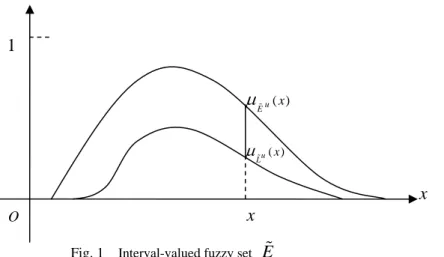
p a b c q 1
ρ λ
x
Fig. 1 Interval-valued fuzzy set E ( ) Eu x μ ( ) Lu x μ 1 O x x
Def.5. For d< < < <a b c e ∈ and functions R gLj( ),x gUj( ),x j=1, 2 . If g1L( ),x g1U( )x are
strictly increasing functions for x∈[ , ], [ , ]a b d b respectively, and g1L( )a =0, g1U( )d =0 ;
1 ( ) , 1 ( )
L U
g b =λ g b =ρ . Also g2L ( ),x g2U( )x are strictly decreasing functions for x∈[ , ], [ , ]b c b e
respectively, and g c2L( )=g2U( )e =0 , g b2L( )=λ,gU2( )b =ρ . Besides, for each
1, 2, 0 Lj( ) Uj ( ) ( , )
j= ≤g x ≤g x ∀x d e .
And g1L( )x =0, x≤a; g2L( )x =0, x≥ . c g1U( )x =0, x≤d; gU2( )x =0, x≥ e
Then we call G=[GL,GU], a level ( ,λ ρ) interval-valued fuzzy set; where the fuzzy sets ,
L U
G G each has respectively the following membership function:
1 2 ( ), ( ) ( ), 0, L L G g x a x b x g x b x c otherwise μ ⎧ ≤ ≤ ⎪ =⎨ ≤ ≤ ⎪ ⎩ (1) 1 2 ( ), ( ) ( ), 0, U U G g x d x b x g x b x e otherwise μ ⎧ ≤ ≤ ⎪ =⎨ ≤ ≤ ⎪ ⎩ (2)
And hence the level ( ,λ ρ) interval-valued fuzzy set is G=[GL,GU].
Let ( , )FIV λ ρ be the family of all such level ( , )λ ρ , 0< ≤ ≤ interval-valued fuzzy sets λ ρ 1 [ L, U] G= G G (3) When g1L( )x (x a), g2L( )x (c x) b a c b λ − λ − = = − − ; 1 2 ( ) ( ) ( ) , ( ) U x d U e x g x g x b d e b ρ − ρ − = = − − then [G= GL,GU]∈FIVFN( , )λ ρ ⊂FIV( ,λ ρ).
From Kaufmann and Gupta [5], we can have the following operation rules: For , , , ,a b c d e∈ , R [ , ] [ , ]a b + c d =[a+c b, +d] (4) [ , ], 0 [ , ] [ , ], 0 ea eb if e e a b eb ea if e > ⎧ = ⎨ < ⎩ (5) If 0≤ <a b and 0≤ <c d, then [[ , ] [ , ]a b × c d =[ac bd, ] (6) If a< ≤b 0 and c< ≤d 0, then [[ , ] [ , ]a b × c d =[ad bc, ] (7)
In general,
[[ , ] [ , ]a b × c d =[MIN MAX, ], where MIN =min(ac ad, , ) MAX =max(bc bd, ) (8)
The α -cut of G=[GL,GU]∈FIV( , )λ ρ is defined as follows:
From Fig. 4, g1U( )x = → =α x (g1U) ( )−1 α , g1L( )x = → =α x (g1L) ( )−1 α g2L( )x = → =α x (g2L) ( )−1 α , gU2 ( )x = → =α x (g2U) ( )−1 α Let GlU( )α =(g1U) ( )−1 α , GlL( )α =(g1L) ( )−1 α ; GrL( )α =(g2L) ( )−1 α , GUr ( )α =(g2U) ( )−1 α (9) When 0≤ <α λ, define the α - level set of G be
{ |x μGU( )x ≥α} { |− x μGL( )x ≥α} =
1 1 1 1
1 1 2 2
[(gU) ( ), (− α gL) ( )]− α ∪[(gL) ( ), (− α gU) ( )]− α
= [GlU( ),α GlL( )]α ∪[GrL( ),α GrU( )]α ( see Fig.4 ) (10) When λ α ρ≤ ≤ , the α - level set of G is
1 1 1 2 { | U( ) } [( ) ( ), ( ) ( )] U U G x μ x ≥α = g − α g − α =[GlU( ),α GrU( )]α (see Fig.4) (11) For each α∈[0,1], the function maps the real interval [ , ]a b to the level α fuzzy interval
[ , ; ]a b α is one-to-one onto. (12) By Def.1, (9) ~ (12), Fig.4 and the Decomposition theorem, we may express the level ( , )λ ρ interval-valued fuzzy set G=[G GL, U] as
0 ([ lU( ), lL( ); ] [ rL( ), Ur ( ); ]) ( [ lU( ), rU( ); ]) G G G G G G G α λ λ α ρ α α α α α α α α α ≤ < ≤ ≤ =
∪
∪ ∪∪
(13)Fig.4 α -cut of level ( , )λ ρ interval-valued fuzzy set
(g1u)−1( )α (g1L)−1( )α (g2L)−1( )α (g2u)−1( )α =Glu( )α =GlL( )α =GrL( )α =Gru( )α x 1 ρ λ 2 u g 2 L g 1 u g 1 L g α
Def.6. For F =[FL,FU],G=[G GL, U]∈FIV( , ), 0λ ρ < ≤ ≤ and e Rλ ρ 1 ∈ , define the following operations: ( ) [ L( ) L, U( ) U] F + G= F + G F + G [ L, U] eF = eF eF ( ) [ L( ) L, U( ) U] F × G= F × G F × G
From (4) ~ (12), and Def. 6, we have
(1 ) The α -cut (0≤ ≤ of α 1) FL( )+ GL is [ L( ), L( )] [ L( ), L( )] [ L( ) L( ), L( ) L( )] l r l r l l r r F α F α + G α G α = F α +G α F α +G α by (4) Thus ( L( ) L) ( ) L( ) L( ) l l l F + G α =F α +G α and ( L( ) L) ( ) L( ) L( ) r r r F + G α =F α +G α ; 0≤ ≤α λ Similarly, ( U( ) U) ( ) U( ) U( ) l l l F + G α =F α +G α and ( U( ) U) ( ) U( ) U( ) r r r F + G α =F α +G α ; 0≤ ≤ (14) α ρ (2 ) The α -cut (0≤ ≤ of α 1) P eF is [ P( ), P( )] l r eF α eF α , if e>0; and is [ P( ), P( )] r l eF α eF α , if e<0; by (5), where P=L U, Then, if e>0, ( L) ( ) L( ) l l eF α =eF α , ( L) ( ) L( ) r r eF α =eF α ; 0≤ ≤α λ ( U) ( ) U( ) l l eF α =eF α , ( U) ( ) U( ) r r eF α =eF α ; 0≤ ≤ α ρ And if e<0, ( L) ( ) L( ) l r eF α =eF α , ( L) ( ) L( ) r l eF α =eF α ; 0≤ ≤α λ ( U) ( ) U( ) l r eF α =eF α , ( U) ( ) U( ) r l eF α =eF α ; 0≤ ≤ (15) α ρ (3 ) The α -cut (0≤ ≤ ( )α 1) L L F ×G is [ L( ), L( )] [ L( ), L( )] l r l r F α F α × G α G α .
From (6), (7), we have the following
(3 .1) When 0 L( ) L( ) l r F α F α ≤ < , and 0 L( ) L( ) l r G α G α ≤ < ∀ ∈α [0, ]λ ( L( ) L) ( ) L( ) L( ) l l l F × G α =F α G α , ( L( ) L) ( ) L( ) L( ) r r r F × G α =F α G α ; 0≤ ≤α λ Similarly, when 0 U( ) U( ) l r F α F α ≤ < , and 0 U( ) U( ) l r G α G α ≤ < ∀ ∈α [0, ]ρ ( U( ) U) ( ) U( ) U( ) l l l F × G α =F α G α , ( U( ) U) ( ) U( ) U( ) r r r F × G α =F α G α ; 0≤ ≤ (16) α ρ
(3 .2) When FlL( )α <FrL( )α ≤ , and 0 GlL( )α <GrL( )α ≤0 ∀ ∈α [0, ]λ
(FL( )× GL) ( )l α =FrL( )α GrL( )α , (FL( )× GL) ( )r α =FlL( )α GlL( )α ; 0≤ ≤α λ
When ( )FlU α <FrU( )α ≤ and 0 GlU( )α <GrU( )α ≤0∀ ∈α [0, ]ρ
(FU( )× GU) ( )l α =FrU( )α GUr ( )α , (FU( )× GU) ( )r α =FlU( )α GlU( )α ; 0≤ ≤ (17) α ρ
1.2 Fuzzy topological space for level ( , )λ ρ interval-valued fuzzy sets
Def.7 (Chang [3] Def. 2.2) A fuzzy topology T on fuzzy sets in X satisfying the following conditions:
(a) , XΦ ∈ T
(b) If ,A B T∈ , then A B T∩ ∈
(©) If A Ti∈ ∀ ∈ , where I is any index set , then , i I i
i I
A T ∈
∈
∪
T is called a fuzzy topology for X and the pair ( , )X T is a fuzzy topological space (FTS )
Def. 8. (Chang [3], Def. 2.3) A fuzzy set U in a FTS X T is a neighborhood of a fuzzy set A ( , ) iff there exists a fuzzy set O∈ such that A O UT ⊂ ⊂ .
Def. 9. (Chang [3], Def.3.1) A sequence of fuzzy sets, say {A nn, =1, 2, } is eventually contained
in a fuzzy set A iff there exists a natural number m such that whenever n≥ , m An ⊂ . If A
{A nn, =1, 2, } is a sequence in FTS X T , then we say that this sequence converges to a fuzzy ( , ) set A iff it is eventually contained in each neighborhood of A . (i.e. if B is any neighborhood of
A , there is a positive integer m such that whenever n≥ , m An ⊂ ). B
Let OF ={( , ; ) |a bα ∀a b R a, ∈ , < and b α∈[0,1]}, then O is the family of all level F
α (α∈[0,1]) open fuzzy intervals ( fuzzy sets in R , see Def.2).
Let T be the family of all sets which is any union of elements in F O and contain F Φ such , R that for any element O O∈ F . Define O∩ Φ = Φ,O∪ Φ =O O, ∩ =R O O, ∪ =R R and
( )x 0, R( )x 1 x R
μΦ = μ = ∀ ∈ . Thus, we have
( , ; ) ( , ; )a bα c dβ ( )x ( , ; )a bα ( )x ( , ; )c dβ ( )x
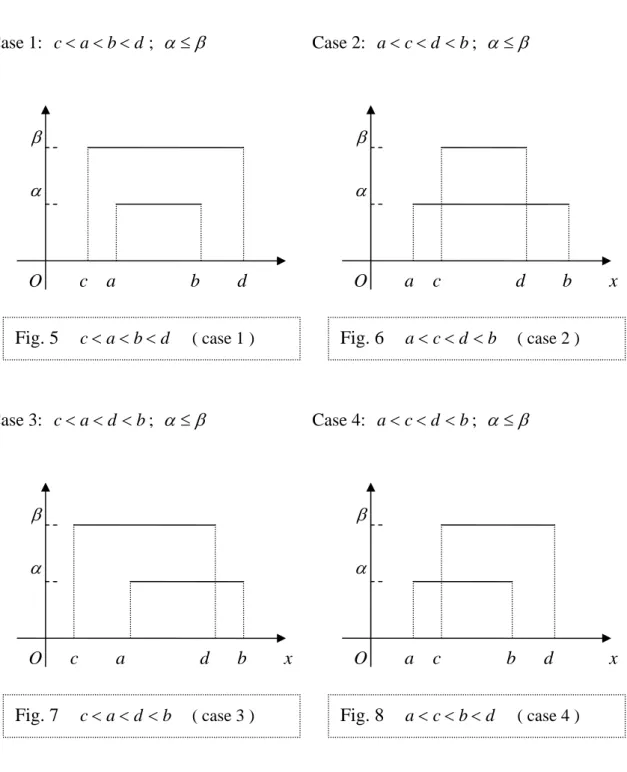
Case 1: c< < <a b d; α β≤ Case 2: a< < <c d b; α β≤
Case 3: c< < <a d b; α β≤ Case 4: a< < <c d b; α β≤
Case 5: c< ≤ <d a b or a< ≤ <b c d
We conclude the above results and have the following Table 1.
Table 1 case 1 2 3 4 5 ( , ; )a bα ∩( , ; )c d β ( , ; )a bα ( , ; )c d α ( , ; )a d α ( , ; )c b α φ β α O c a d b x Fig. 7 c< < < ( case 3 ) a d b O a c b d x β α Fig. 8 a< < < ( case 4 ) c b d β α O c a b d Fig. 5 c< < < ( case 1 ) a b d O a c d b x β α Fig. 6 a< < < ( case 2 ) c d b
Proposition 1. Let T =TF,X = in Def. 7. Then R T is a fuzzy topology for R , and ( ,F R TF) is a FTS.
Proof. (a) By the definition of T , ,F Φ ∈ . Definition 7(a) is satisfied. R TF
(b) For any element B in i T , it can be written as F i i, { }
i I
B O I i
∈
=
∪
= . Hence the element ofF
T has the form Φ, ,R or i i
i I
B O
∈
=
∪
with Oi∈OF ∀ ∈i I, an index set. Therefore, the intersection of any two elements in T , they are F Φ ∩ = Φ ∈R TF or ( i) Fi I O T ∈ Φ ∩
∪
= Φ ∈ or ( i) i F i I i I R O O T ∈ ∈ ∩∪
=∪
∈ , or for Qj∈OF ∀ ∈ , j J ( i) ( j) ( i j) i I j J i I j J O Q O Q ∈ ∈ ∈ ∈ ∩ = ∩∪
∪
∪ ∪
,where Oi∩Qj∈OF or equals to Φ . ( see Table 1 ) i.e. ( i) ( j) F
i I i j O Q T ∈ ∈ ∩ ∈
∪
∪
. 7(b) is satisfied.(c) As stated in (b), any element of T , is F Φ, ,R or
i i ij j J B O ∈ =
∪
, i I∈ , Oij∈OF ∀ ∈i I j, ∈J , Then i i ij F i I i I j J B O T ∈ ∈ ∈ = ∈∪
∪ ∪
, ( i) i I B ∈ Φ ∪∪
= i F i I B T ∈ ∈∪
, ( i ) F i I R B R T ∈ ∪∪
= ∈ . 7(c) is satisfied.By Def. 7, T is a topology on R , and ( ,F R TF) is a FTS.
1.3 Limit theorem on FIV( , )λ ρ
Def.10. A level α fuzzy point on R at b, denoted by Fpα of b if its membership function
is ( ) , 0, Fp of b x b x otherwise α α μ = ⎨⎧ = ⎩
Fig. 9 Level α fuzzy point Fpα of b
O b
α
x
From (13) [ L, U] n n n A = A A 0 {[( ) ( ), ( ) ( ); ] [( ) ( ), ( ) ( ); ]) [( ) ( ), ( ) ( ); ]) ( , ), 1, 2, 0 1 (18) U L L U n l n l n r n r U U n l n r IV A A A A A A F n α λ λ α ρ α α α α α α α α α λ ρ λ ρ ≤ < ≤ ≤ = ∪ ∪ ∈ = < ≤ ≤
∪
∪
Similarly, as in Fig.(4), we can have the α -cut of A as follows: n
From Fig.10, when 0≤ <α λ, we have the end points of the α -cut are ( ) ( )AnU l α , (AnL) ( )l α ,
(AnL) ( )r α , (AnU) ( )r α ∈ . So we have the level R α fuzzy points Fpα of (AnU) ( )l α , and Fpα
of (AnL) ( )l α , Fpα of (AnL) ( )r α , Fpα of (AUn ) ( )r α . And when λ α ρ≤ ≤ , we have the level α fuzzy points Fpα of (AnU) ( )l α , Fpα of (AUn ) ( )r α .
Def.11 For An =[AnL, AnU] (in (18)),
[ nL, Un ] A = A A = 0 [ U( ), L( ); ] [ L( ), U( ); ] [ U( ), U( ); ] ( , ) l l r r l r IV A A A A A A F α λ λ α ρ α α α α α α α α α λ ρ ≤ < ≤ ≤ ∪ ∈
∪
∪
For any arbitrary ε >0, there exists a positive integer N which is independent of α( [0, ])∈ ρ such that whenever n≥ , the following hold: N
1 1 ( ) (an u)− α 1 1 ( ) ( L) n a − α 1 2 ( ) ( L) n a − α 1 2 ( ) (an u)− α ( ) (Anu)l α = ( L) ( ) n l A α = ( L) ( ) n r A α = ( u) ( ) n r A α = Fig. 10 α-cut of [ L, u] n n n A A A = x 2 ( ) u n x a 2 ( ) L n x a β λ α
For each α( [0, ])∈ λ , Fpα of (AUn ) ( )l α ⊂(AlU( )α −ε,AlU( )α +ε α; ) (∈TF),
Fpα of (AnL) ( )l α ⊂(AlL( )α −ε,AlL( )α +ε α; ) (∈TF),
Fpα of (AnL) ( )r α ⊂(ArL( )α −ε,ArL( )α +ε α; ) (∈TF),
Fpα of (AnU) ( )r α ⊂(ArU( )α −ε,ArU( )α +ε α; ) (∈TF).
And for each α( [ , ])∈ λ ρ , Fpα of (AnU) ( )l α ⊂(AlU( )α −ε,AlU( )α +ε α; ) (∈TF),
Fpα of (AnU) ( )r α ⊂(ArU( )α −ε,ArU( )α +ε α; ) (∈TF). Then define lim n
n→∞ A = . A
NB.1 The meaning of Definition 11 is:
For each α∈[0,1], the following hold.
Fpα of b ↔ b(∈R) is an one-to-one onto mapping (19). Corresponds to the conditions of Definition 11 on R , we can have
For each α∈[0, )λ , (AnU) ( )l α ∈(AlU( )α −ε,AlU( )α +ε), (AnL) ( )l α ∈(AlL( )α −ε,AlL( )α + , ε) (AnL) ( )r α ∈(ArL( )α −ε,ArL( )α + , ε) (AnU) ( )r α ∈(ArU( )α −ε,AUr ( )α + . (20) ε) For each α∈[ , ]λ ρ , (AnU) ( )l α ∈(AlU( )α −ε,AlU( )α +ε), (AnU) ( )r α ∈(ArU( )α −ε,AUr ( )α + . (21) ε) From Definition 11, (20), and (21) we have. For each ε >0, there exists a positive integer N ,
independent of α, ( [0, ])∈ ρ such that whenever n≥ , the following hold: N
For each α∈[0, )λ , [(AUn ) ( ), (l α AnL) ( )]l α ⊂(AlU( )α −ε,AlL( )α +ε), [(AnL) ( ), (r α AnU) ( )]r α ⊂(ArL( )α −ε,ArU( )α + . ε) And lim( Un )l Ul ( ) n→∞ A = A α , lim( ) ( ) L L n l l n→∞ A = A α , lim( ) ( ) L L n r r n→∞ A = A α , lim( ) ( ) U U n r r n→∞ A = A α .
For each α∈[ , ]λ ρ , [(AUn ) ( ), (l α AnU) ( )]r α ⊂(AlU( )α −ε,ArU( )α +ε) . And lim( Un )l Ul ( ) n→∞ A = A α , lim( ) ( ) U U n r r n→∞ A =A α . Thus, when n→ ∞ , if [0, )α∈ λ , [(AnU) ( ), (l α AnL) ( )]l α →(AlU( ),α AlL( )]α , and [(AnL) ( ), (r α AUn ) ( )]r α →[ArL( ),α ArU( )]α . if [ , ]α∈ λ ρ , [(AnU) ( ), (l α AUn ) ( )]r α →(AlU( ),α ArU( )]α . Hence by (19), if [0, )α∈ λ , [(AnU) ( ), (l α AnL) ( ); ]l α α →(AlU( ),α AlL( ); ]α α , and [(AnL) ( ), (r α AUn ) ( ); ]r α α →[ArL( ),α ArU( ); ]α α . if [ , ]α∈ λ ρ , [(AnU) ( ), (l α AnU) ( ); ]r α α →(AlU( ),α ArU( ); ]α α .
1.3 Limit theorem on a family of interval valued fuzzy sets
Thm 1. An =[AnL,AnU], [A = AL,AU] ( , ),∈FIV λ ρ (0< ≤ ≤ . If lim( ) ( )λ ρ 1) nL l lL( )
n→∞ A α = A α ,
and lim( nL) ( )r rL( )
n→∞ A α = A α are uniformly convergent for 0≤ <α λ. And if lim( ) ( ) ( )
U U
n l l
n→∞ A α = A α ,
and lim( Un ) ( )r rU( )
n→∞ A α = A α are uniformly convergent for 0≤ ≤ , α ρ
Then lim n
n→∞A = . A
Proof. By the definition of uniformly convergent, we have, for any ε >0, there exists a natural number N , which is independent of α( [0, ])∈ ρ such that for all n≥ , the following hold. N
For each α∈[0, ]λ , ( )AlL α − <ε (AnL) ( )l α < AlL( )α + , ε
and ArL( )α − <ε (AnL) ( )r α <ArL( )α + . ε
and ArU( )α − <ε (AnU) ( )r α < ArU( )α + . (22) ε
By Definition 10, for each α∈[0, ]λ , the membership function of Fpα of (AUn ) ( )l α is
( ) ( ) , ( ) ( ) ( ) 0, U n l U n l Fp of A if x A x otherwise α α α α μ = ⎨⎧ = ⎩ (23) Bt Definition 2, for each α∈[0, ]λ , the membership function of (AlU( )α −ε,AlU( )α +ε α; ) is
( ( ) , ( ) ; ) , ( ) ( ) ( ) 0, U U l l U U l l A A if A x A x otherwise α ε α ε α α α ε α ε μ − + = ⎨⎧ − < < + ⎩ (24)
Since λ ρ≤ , and the third formula in (22), by (23), (24) we have ( U) ( )( ) ( U( ) , U( ) ; )( ) n l l l Fp ofα A α x A α εA α ε α x μ ≤μ − + ∀ ∈ and x R α∈[0, ]λ . Hence Fpα of (AUn l) ( )α ⊂(AlU( )α −ε,AlU( )α +ε α; ) [0, ]∀ ∈α λ . Similarly, Fpα of (An lL) ( )α ⊂(AlL( )α −ε,AlL( )α +ε α; ), Fpα of (ALn r) ( )α ⊂(ArL( )α −ε,ArL( )α +ε α; ), Fpα of (AUn r) ( )α ⊂(AUr ( )α −ε,AUr ( )α +ε α; ) .
Also, for each α∈[ , ]λ ρ , Fpα of (AUn l) ( )α ⊂(AlU( )α −ε,AlU( )α +ε α; ), Fpα of (AUn r) ( )α ⊂(AUr ( )α −ε,AUr ( )α +ε α; ).
Thus the conditions of Definition 11 are fulfilled, and hence by Definition 11, lim n
n→∞A = . A
Thm 2. Ajn =[ALjn, AUjn], Aj =[ALj, AUj ]∈FIV( , ),λ ρ j=1, 2;n=1, 2, For each j=1, 2; if lim( Ljn l) ( ) ( Lj) ( )l
n→∞ A α = A α , lim( ) ( ) ( ) ( )
L L
jn r j r
n→∞ A α = A α are uniformly
convergent for 0≤ ≤α λ; and if lim( Ujn l) ( ) ( Uj ) ( )l
n→∞ A α = A α , lim( ) ( ) ( ) ( )
U U
jn r j r
n→∞ A α = A α are
uniformly convergent for 0≤ ≤ , Then α ρ lim(A ( )+ A )=A( )+ A .
Proof. From Def. 6, we have A1n( )+ A2n =[A1Ln( )+ A2Ln, A1Un( )+ A2Un] , and
1( ) 2 [ 1( ) 2, 1 ( ) 2 ]
L L U U
A + A = A + A A + A . By the assumption of Thm. 2, and the theorem of uniform
convergence (unions) and (14), we have
1 2 lim( Ln( ) Ln l) ( ) n→∞ A + A α =lim( 1 ) ( ) lim( 2 ) ( ) L L n l n l n→∞ A α +n→∞ A α =( 1) ( ) ( 2) ( ) L L l l A α + A α =(A1L( )+ A2Ll l) ( )α is uniformly convergent for 0≤ ≤α λ.
Similarly, lim( 1Ln( ) 2Ln r) ( )
n→∞ A + A α =( 1( ) 2 ) ( )
L L
l r
A + A α is uniformly convergent for 0≤ ≤α λ.
Also, lim( 1Un( ) 2Un l) ( ) n→∞ A + A α =( 1 ( ) 2 ) ( ) U U l A + A α , and lim( 1Un( ) 2Un r) ( ) n→∞ A + A α =( 1 ( ) 2 ) ( ) U U r A + A α are all
uniformly convergent for 0≤ ≤ . α ρ
Nor replace A by n A1n( )+ A2n, A by A1( )+ A2 in Thm 1, we thus have
1 2 1 2 lim( n( ) n) ( ) n→∞ A + A =A + A . Thm. 3. An =[AnL,AUn ], [A= AL,AU] ( , ),∈FIV λ ρ 1, 2,n= ;e R∈ . If lim( nL) ( )l lL( ) n→∞ A α = A α , lim( ) ( ) ( ) L L n r r
n→∞ A α = A α , are uniformly convergent for 0≤ ≤α λ. And
If lim( Un ) ( )l Ul ( )
n→∞ A α =A α , lim( ) ( ) ( )
U U
n r r
n→∞ A α = A α are uniformly convergent for 0≤ ≤ , α ρ
Then lim n
n→∞eA =eA.
Proof. By Def. 6, eAn =[eA eAnL, Un ], . Similar to the proof of Thm. 2, by the assumptions of Thm. 3, the theorem of uniform convergence (scalar product) and (15), we have ,
for e>0, lim( nL) ( )l n→∞ eA α = lim ( ) ( ) L n l n→∞e A α = ( ) L l eA α = (eAL) ( )l α , lim( nL) ( )r n→∞ eA α = ( ) ( ) L r eA α are
uniformly convergent for 0≤ ≤α λ. And lim( nU) ( )l n→∞ eA α = ( ) ( ) U l eA α , lim( Un ) ( )r n→∞ eA α = ( ) ( ) U r
eA α are uniformly convergent for 0≤ ≤ . α ρ
Now, replace A by n eA , A by n eA in Thm. 1, we have lim n
n→∞eA =eA.
Thm. 4. Ajn =[ALjn, AUjn], Aj =[ALj, AUj ]∈FIV( , ),λ ρ n=1, 2, satisfy the two conditions in Thm. 2, and also satisfy either case 1 or case 2 of the followings:
Case 1: 0≤(ALjn l) ( )α <(ALjn r) ( )α ∀ ∈α [0, ],λ j=1, 2 and 0≤(AUjn l) ( )α <(AUjn r) ( )α ∀ ∈α [0, ],ρ j=1, 2. Case 2: (Ajn lL) ( )α <(ALjn r) ( )α ≤0, ∀ ∈α [0, ],λ j=1, 2 and (AUjn l) ( )α <(AUjn r) ( )α ≤0, ∀ ∈α [0, ],ρ j=1, 2, Then, lim( 1n( ) 2n) 1( ) 2 n→∞ A × A =A × A .
Proof. (a) Ajn, Aj satisfy the conditions of Thm. 2 and Case 1 above, by Def. 6,
1 2 1 2 1 2
(An( )× An)=[ALn( )× ALn, AUn( )× AUn], (A1( )× A2)=[A1L( )× A2L, A1U( )× AU2 ]. Then, 0≤(ALj) ( )l α <(ALj) ( )r α ∀ ∈α [0, ],λ j=1, 2 and
0≤(AUj ) ( )l α <(AUj ) ( )r α ∀ ∈α [0, ],ρ j=1, 2.
Hence, by the condition of (a), theorem of uniform convergence (product), and (16), we have
1 2 1 2 lim( Ln( ) Ln l) ( ) lim( Ln l) ( )( Ln l) ( ) n→∞ A × A α =n→∞ A α A α =( 1) ( )( 2) ( ) L L l l A α A α =(A1L( )× A2L) ( )l α is uniformly convergent for 0≤ ≤α λ. Similarly, lim( 1Ln( ) 2Ln r) ( ) n→∞ A × A α =( 1 ( ) 2) ( ) L L r
A × A α is uniformly convergent for 0≤ ≤α λ.
Also lim( 1Un( ) 2Un l) ( ) n→∞ A × A α =( 1 ( ) 2 ) ( ) U U l A × A α , lim( 1Un( ) 2Un r) ( ) n→∞ A × A α =( 1 ( ) 2 ) ( ) U U r A × A α for 0≤ ≤ . α ρ
Now, replace A by n (A1n( )× A2n), A byA1( )× A2 in Thm. 1, we have lim( 1n( ) 2n) 1( ) 2
n→∞ A × A =A × A .
(b) Ajn, Aj satisfy the conditions of Thm. 2 and Case 2 above, we have
(ALj) ( )l α <(ALj) ( )r α ≤0 ∀ ∈α [0, ],λ j=1, 2 and (AU) ( )α <(AU) ( )α ≤0 ∀ ∈α [0, ],ρ j=1, 2.
By (17), we have lim( 1n( ) 2n) 1( ) 2
n→∞ A × A = A × A .
Now we consider the set G=[GL,GU] ( in (1), (2)) ∈FIV( , )λ ρ , ( )V x is a real function
satisfies either Case 1 or Case 2 of the following. Then find out the level ( , )λ ρ interval-valued fuzzy set V F and both left, right point of its ( ) α -cut.
Case 1: V x is a strictly decreasing continuous function on R . From (1), (2) and Extension ( ) Principle, let z=V x( ), we have
1 ( ) ( ) ( ) sup ( ( )) L L V G G z V x z V z μ μ − = = = 1 2 1 1 ( ( )), ( ) ( ) ( ( )), ( ) ( ) 0, L L g V z V c z V b g V z V b z V a elsewhere − − ⎧ ≤ ≤ ⎪ ≤ ≤ ⎨ ⎪ ⎩ (25) ( U)( ) V G z μ = 1 2 1 1 ( ( )), ( ) ( ) ( ( )), ( ) ( ) 0, U U g V z V e z V b g V z V b z V d elsewhere − − ⎧ ≤ ≤ ⎪ ≤ ≤ ⎨ ⎪ ⎩ (26) 2 ( L) ( ) ( ) 0 L V G V c g c μ = = , ( L) ( ) 2( ) L V G V b g b μ = = , λ μV G( L)V a( )= ; 0 ( U) ( ) ( U) ( ) 0 V G V e V G V d μ =μ = , μV G( L)V b( )= , ρ 0≤μV G( L)( )z ≤μV G( U) ≤ 1 ∀ z
By (25), (26), we have the level ( , )λ ρ interval-valued fuzzy set V G( )=[ (V GL), (V GU)] (27) From (25), g V2L( −1( ))z = → =α z ((g2L) ( ))−1 α the left point ( (V GL)) ( )l α of the α -cut of
( (V GL)), the right point ( (V GL)) ( )r α of the α -cut of V G( L) respectively are
1 2
( (V GL) )( )l α =V((gL) ( ))− α =V G( rL( ))α , ( (V GL) )( )r α =V((g1L) ( ))−1 α =V G( lL( ))α ; 0≤ ≤α λ (28) by second formula of (1). And the α -cut of (V GU) are
1 2
( (V GU) )( )l α =V((gU) ( ))− α =V G( Ur ( ))α , ( (V GU) )( )r α =V((g1U) ( ))−1 α =V G( Ul ( ))α ; 0≤ ≤ α ρ
(29) by second formula of (2).
( L)( ) V G z μ = 1 1 1 2 ( ( )), ( ) ( ) ( ( )), ( ) ( ) 0, L L g V z V a z V b g V z V b z V c elsewhere − − ⎧ ≤ ≤ ⎪ ≤ ≤ ⎨ ⎪ ⎩ (30) ( U)( ) V G z μ = 1 1 1 2 ( ( )), ( ) ( ) ( ( )), ( ) ( ) 0, U U g V z V d z V b g V z V b z V e elsewhere − − ⎧ ≤ ≤ ⎪ ≤ ≤ ⎨ ⎪ ⎩ (31)
From (30), (31), we have the level ( , )λ ρ interval-valued fuzzy set V G( )=[ (V GL), (V GU)] (32) Similar to (28), (29), we can get
1 1 ( (V GL) )( )l α =V((gL) ( ))− α =V G( lL( ))α ,( (V GL) )( )r α =V((g1L) ( ))−1 α =V G( lL( ))α ; 0≤ ≤α λ (33) 1 2 ( (V GU) )( )l α =V((gU) ( ))− α =V G( Ur ( ))α ,( (V GU) )( )r α =V((g1U) ( ))−1 α =V G( Ul ( ))α ; 0≤ ≤ α ρ (34) Thm. 5. Gn =[GnL,GUn ], G=[GL,GU] ( in (1), (2)) ∈FIV( , ),λ ρ n=1, 2, . ( )V x defined on R ( or R+ =(0, )∞ , if d >0 in Fig. 3) is a strictly decreasing continuous function or a strictly increasing continuous function.
If lim( nL) ( )l lL( )
n→∞ G α =G α , lim( ) ( ) ( )
L L
n r r
n→∞ G α =G α are uniformly convergent in 0≤ ≤α λ
And lim( nU) ( )l lU( )
n→∞ G α =G α , lim( ) ( ) ( )
U U
n r r
n→∞ G α =G α are uniformly convergent in 0≤ ≤ . α ρ
Then lim ( n) ( )
n→∞V G =V G , where for each n=1, 2,
, 1 2 ( ), ( ) ( ), 0, U n U n U n G g x a x b x g x b x e elsewhere μ ⎧ ≤ ≤ ⎪ =⎨ ≤ ≤ ⎪ ⎩ 1 ( ), 1 ( ) L U n n
g x g x are strictly increasing continuous function in [ , ], [ , ]a b d b respectively.
2 ( ), 2 ( )
L U
n n
g x g x are strictly decreasing continuous function in [ , ], [ , ]b c b e respectively.
And gL( )a =gL ( )c = 0, gL( )b =gL ( )b = ; λ gU( )d =gU( )e = 0, gU( )b =gU( )b = ρ 1 2 ( ), ( ) ( ), 0, L n L n L n G g x a x b x g x b x c elsewhere μ ⎧ ≤ ≤ ⎪ =⎨ ≤ ≤ ⎪ ⎩
And 0 L( ) U( ) 1 , n n G x G x x n μ μ ≤ < ≤ ∀ . (V Gn)=[ (V GnL), (V GUn )] and V G( )=[ ( ), ( )]V G V G ( , ) IV F λ ρ ∈ .
Proof. (a) If V x defined on R is a strictly decreasing continuous function, by the assumption ( ) of Thm.4, theorem of uniform convergent, and (28), (29), we have
( (V GnL)) ( )l α =V G( nL)) ( )r α , ( (V GL)) ( )l α =V G( L)) ( )r α .
By the assumption of Thm.5, theorem of uniform convergent, we have lim( ( nL)) ( )l lim (( nL) ( ))r (( L) ( ))r ( ( L)) ( )l n→∞V G α =n→∞V G α =V G α = V G α is uniformly convergent in 0≤ ≤α λ. Similarly, lim( ( nL)) ( )r ( ( L)) ( )r n→∞V G α = V G α is uniformly convergent in 0≤ ≤α λ. By (29), we have lim( ( Un )) ( )l ( ( U)) ( )l n→∞V G α = V G α , lim( ( )) ( ) ( ( )) ( ) U U n r r n→∞ V G α = V G α are uniformly convergent in 0≤ ≤ . α ρ Replace A by (n V G , A by ( )n) V G , by Thm.1, lim ( n) ( ) n→∞V G =V G .
(b) ( )V x defined on R , is a strictly increasing continuous function, by (33), (34) and the same
argument above, we have lim ( n) ( )
n→∞V G =V G .
1.4 Limit theorem on a family of level ζ fuzzy sets.
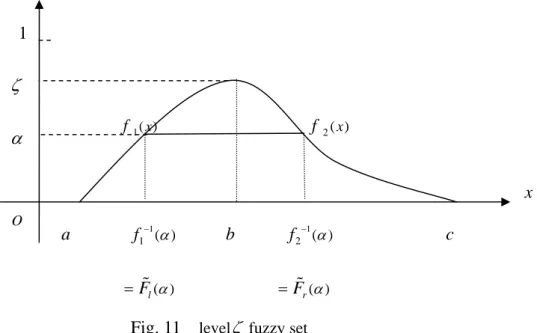
a 1 1 ( ) f− α b 1 2 ( ) f − α c ( ) l F α = =Fr( )α
Fig. 11 levelζ fuzzy set
1 ζ α x O 2( )x f 1( )x f
There exist a< < ∈ and functions b c R f x 1( ), f x satisfy the following set is called a level 2( ) ζ fuzzy set F , 0< ≤ , where ζ 1 f x is a strictly increasing continuous function and 1( )
1( ) 0
f x = ∀ ≤ . x a f x is a strictly decreasing continuous function and 2( ) f x2( )=0 ∀ ≥ x c
and f b1( )= f b2( )= . ζ
Let the membership function of the level ζ fuzzy set F be
1 2 ( ), ( ) ( ), 0, F f x a x b x f x b x c elsewhere μ ≤ ≤ ⎧ ⎪ =⎨ ≤ ≤ ⎪⎩ 1 1 ( ) ( ) l
F x = f− α , F xr( )= f2−1( )α ( see Fig.11 ) are the left, right end points of the α-cut of F respectively.
Let ( )FS ζ be the family of all such level ζ fuzzy sets. In Fig. 3, let a=d c, = and e λ=0. Then the level ( ,λ ρ) interval-valued fuzzy set G=[GL,GU] will turn to be a level ρ fuzzy set U G ∈FS( )ρ . It is trivial that U G ∈FS( )λ and 0 [( ) ( ), ( ) ( ); ] ( ) n n l n r S F F F F α ζ α α α ζ ≤ ≤ =
∪
∈ , 1, 2, n= .Then Def. 10 becomes
Def. 10′. For F Fn, ∈FS( ),ζ n=1, 2, , 0< ≤ . For each ζ 1 ε >0, there exists N , a natural
number which is independent of α, ( [0, ])∈ ζ such that ∀ ≥n N, the following holds:
For each α∈[0, ]ζ , [(Fn l) ( ), (α Fn r) ( ); )α α ⊂( ( )Fl α −ε, (Fn l) ( )α +ε α; ) (∈TF), Then define lim n
n→∞F = . Thus Thm. 1 ~ Thm. 5 will become Thm. 6 ~ Thm 8 as follows: F
Thm. 6. For Fn ,F∈FS( ),ζ 1, 2,n= ; 0< ≤ . ζ 1 If lim( n l) ( ) l( ), lim( n r) ( ) r( )
n→∞ F α =F α n→∞ F α =F α are uniformly convergent in 0≤ ≤ , α ζ
Then (a) lim n
n→∞F = , (b) limF n→∞eFn =eF, (c) lim (n→∞V Fn)=V F( ).
Thm 7. For Fjn,Fj ∈ FS( )ζ , j=1, 2 and n=1, 2, (0< ≤ ; if ζ 1) lim ( jn l) ( ) ( j l) ( )
Then lim ( 1n( ) 2n) 1( ) 2
n→∞ F + F =F + F
Thm 8. If Fjn,Fj ∈ FS( )ζ , satisfy either the following condition of Case 1 or Case 2 beside the condition of Thm. 7, Case 1: 0<(Fjn) ( )l α <(Fjn r) ( )α ∀ =j 1, 2 and n=1, 2 Case 2: (Fjn) ( )l α <(Fjn r) ( )α ≤0 ∀ =j 1, 2 and n=1, 2 Then lim ( 1n( ) 2n) 1( ) 2 n→∞ F × F =F × F Thm. 9 An =[A AnL, nU], A=[A AL, U], ( , )∈FIV λ ρ . If lim ( nL) ( )l lL( ) n→∞ A α = A α and lim ( nL) ( )r rL( )
n→∞ A α = A α are uniformly convergent for 0≤ ≤α λ; and lim ( ) ( ) ( )
U U
n l l
n→∞ A α = A α ,
lim ( Un ) ( )r rU( )
n→∞ A α = A α for λ α ρ≤ ≤ , then limn→∞An = , limA
L L n n→∞A = A , lim U U n n→∞A =A .
Proof. By Thm. 1, we have lim n
n→∞A = . Since A , ( ),
L L
n S
A A ∈F λ 1, 2,n= , by the first condition
of Thm. 9 and Thm. 6, lim nL L
n→∞A =A . Similarly, since , ( ),
U U
n S
A A ∈F ρ 1, 2,n= , by the
second condition of Thm.9 and Thm. 6, lim nU U
n→∞A = A . Now, since 1 1 [ , ; ) ( , ) n a b a b n α ∞ =
=
∩
− , and for each α∈[0,1], [ , )a b ↔[ , ; )a bα ,1 1
(a , )b (a , ; )b
n n α
− ↔ − are one-to-one mapping, therefore
1 1 [ , ; ) ( , ; ) F n a b a b T n α ∞ α = =
∩
− ∈ foreach [0,1]α∈ . It is obvious that for any arbitrary unions of all these fuzzy intervals [ , ; )a bα
(∀ < and a b α∈[0,1]) ∈ . Similarly TF 1 1 ( , ; ] ( , ; ) n a b a b n α ∞ α =
=
∩
+ ∈ for each TF α∈[0,1]. Andany arbitrary unions of these fuzzy interval ( , ; ]a bα (∀ < and a b α∈[0,1]) ∈ . Also, TF
1 1 1 [ , ; ] ( , ; ) n a b a b n n α ∞ α =
=
∩
− + ∈ for each TF α∈[0,1]. Hence. Any arbitrary unions of these fuzzy interval [ , ; ), ( , ; ],[ , ; ]a bα a bα a bα (∀ < and a b α∈[0,1]) and any arbitrary unions of elements in O are all F ∈ . TFFor any G=[G GL, U]∈FIV( , )λ ρ . By (13), for each α∈[0, )λ , [GlU( ),α GlL( ); ]α α ,
[GrL( ),α GUr ( ); ]α α ∈TF and for each α∈[ , ]λ ρ , [GlU( ),α GUr ( ); ]α α ∈TF. Hence
0 ([ U( ), L( ); ] [ L( ), U( ); ] [ U( ), U( ); ] l l r r l r G G G G G G G α λ λ α ρ α α α α α α α α α ≤ < ≤ ≤ =
∪
∪∪
∈TF.i.e. ( , )FIV λ ρ ⊂TF ∀λ ρ, ; 0< ≤ ≤ . Similarly, level λ ρ 1 ρ fuzzy set
0 [ ( ),l r( ); ] F F F α ρ α α α ≤ ≤ =
∪
in (35) ∈TF . Hence FS( )ρ ⊂TF ∀ < ≤ . 0 ρ 1 Def. 12. Gn =[GnL,GUn ], G=[G GL, U], [E = EL,EU] ( , )∈FIV λ ρ , 1, 2,n= (a) lim L( ) L( ) n G Gn→∞μ x =μ x and limn→∞μGUn( )x =μGU( )x ∀ ∈ ⇔ x R nlim→∞μGL( )x =μG( )x ∀ ∈ . x R
(b) 1 L L n n G G ∞ = =
∪
and 1 U U n n G G ∞ = =∪
⇔ 1 n n G G ∞ = =∪
. (c) EL⊂GL and EU ⊂GU ⇔ E G⊂ . Note 3. By Def. 4, ( ) [ ( ), ( )] L U G x G x G x μ = μ μ , x R∈ Thm. 10 Gn =[GnL,GnU], G=[G GL, U]∈FIV( , )λ ρ (⊂TF), 1, 2,n= If G1⊂G2⊂ ⊂Gn ⊂ G and lim ( ) ( ) n G G n→∞μ x =μ x ∀ ∈ , then x R 1 n n G G ∞ = =∪
Case 1: If G1L⊂G2L⊂ ⊂GnL⊂ GL ( in FS( )λ ⊂TF) and lim L( ) L( )
n G G n→∞μ x =μ x ∀ ∈ , x R then 1 L L n n G G ∞ = =
∪
. Case 2: If GU1⊂GU2⊂ ⊂GnU⊂ GU( in FS( )ρ ⊂TF )∀ ∈ , then x R 1 U U n n G G ∞ = =∪
.By Def.12, we shall prove for each case 1, 2, theorem holds.
Proof. Case 1: Let A(∈FS( ))λ be any neighborhood of G . By Def. 7, there exists a fuzzy set L
( F)
O ∈T such that GL⊂ ⊂ . By condition of Case 1, we have O A GnL⊂GL⊂ , 1,2,A ∀ =n .
Hence from Def. 8, we have , the sequence {GnL;n=1, 2, } converges to G . And also since L
L L k n G ⊂G 1, 2,∀ =k ,n; we have 1 kL( ) nL( ) n G G
theorem, 1 1 1 ( ) lim ( ) lim ( ) ( ) ( ) L L L L n k k L k k n G n G n G G G k k x x x x x μ μ μ μ μ∞ = ∞ →∞ →∞ = = = =
∨
=∨
= ∪ . Thus 1 L L k k G G ∞ = =∪
.By the same argument as in Case 1, Case 2 holds too. Hence Thm 10 holds. 2. Example
In Brigham [2] and Shappe etc. [7], there was a formula for present value of expected future dividend at time 0 with zero growth:
* 0 2 1 lim 1 (1 ) (1 ) n j n j D D D D P k k →∞ = k k = + + = = + +
∑
+ (36) Where D : dividends, the stockholder expects to receive at the end of every year.k: required rate of return at every year.
P : the intrinsic, expected present value at time 0 of an infinite stream of dividends. 0*
If the preferred red stock (preferred shares) can earn the dividends D . By (35), he can get
* 0
P . But it is difficult to earn the fixed dividend D for the common stock. If the management of
the company is stable, we can consider the dividend each year will be in the interval
1 2
[D− Δ ,D+ Δ , ] 0< Δ <1 D, 0< Δ (37) 2 Since (37) is an interval in stead of a single value, hence the decision maker needs to evaluate a certain value as the estimates dividend for each year. Should the decision maker choose a value D , Just exact the same as the original D , as it has zero error. Through the point of view in fuzzy
concept, by using confidence level to express this. The zero error means it has the maximum confidence level 1. that is, the farther the chosen value from D , the larger of the error in
1
[D− Δ ,D) or ( ,D D+ Δ will be. If the chosen value is 2] D− Δ or 1 D+ Δ , then the 2
confidence level reaches its least value 0. Therefore, relative to the interval (37), let the triangular fuzzy number D be U DU =(D− Δ1,D D, + Δ2; 1) (38)
From fFig.12, we can see that D has membership grade 1 at D . And become smaller as it apart from D and finally reaches 0 as it goes to D− Δ or 1 D+ Δ . Therefore the membership grade 2
has the same property as the confidence level. Therefore it is reasonable to define the confidence level to be the membership grade. Thus, it is also reasonable to define the triangular fuzzy number
D (38) for the interval (37). However , since the length of time is infinite, it is too idealistic
always to have membership grade 1 at D . So we set the membership grade at D belongs to the interval [ ,1]λ , 0< <λ 1. And let the level λ triangular fuzzy number D be L
3 4
( , , ; )
L
D = D− Δ D D+ Δ λ (40) The decision maker should suitably choose Δ , 1,2,3,4j j= satisfy
3 1
0< Δ < Δ < and D 0< Δ < Δ (41) 4 2
From (38), (40), we have level ( , 1)λ interval-valued fuzzy number D ,
[ L, U] D= D D (42) 1 D− Δ D− Δ3 D D+ Δ4 D+ Δ2 x 1 O
Fig.13 Level ( ,1)λ interval-valued fuzzy number D
1
D− Δ D D+ Δ2
x
1
O
Using (42), fuzzify 1 1 1 [1 ( ) ] (1 ) 1 n n j j D D k k k = = − + +
∑
in (36), we have the following Q . nLet 1[1 ( 1 ) ] 1 L n L n Q D k k = − + 3 4 1 1 1 1 1 1 ( [1 ( ) ]( ), [1 ( ) ] , [1 ( ) ] ; ) 1 1 1 n n n D D D k k k k k k λ = − − Δ − − + Δ + + + 1 1 [1 ( ) ] 1 U n U n Q D k k = − + 1 2 1 1 1 1 1 1 ( [1 ( ) ]( ), [1 ( ) ] , [1 ( ) ] ; 1) 1 1 1 n n n D D D k k k k k k = − − Δ − − + Δ + + + [ L, U] n n n Q = Q Q , 1, 2,n= .
The four α -cut of QnL,Q are nU
3 1 1 ( ) ( ) [1 ( ) ][ (1 ) ] 1 L n n l Q D k k α α λ = − − − Δ + 4 1 1 ( ) ( ) [1 ( ) ][ (1 ) ] 1 L n n r Q D k k α α λ = − + − Δ + 1 1 1 ( ) ( ) [1 ( ) ][ (1 ) ] 1 U n n l Q D k k α = − − −α Δ + 2 1 1 ( ) ( ) [1 ( ) ][ (1 ) ] 1 U n n r Q D k k α = − + −α Δ + , 0≤ ≤α 1 Let QlL( ) 1[D (1 ) 3] k α α λ = − − Δ , QrL( ) 1[D (1 ) 4] k α α λ = + − Δ , QlU( ) 1[D (1 ) 1] k α = + −α Δ , QrU( ) 1[D (1 ) 2] k α = + −α Δ , 0≤ ≤α 1 (43) Then lim( nL) ( )l lL( ) n→∞ Q α =Q α .
Since for each α∈[0,1], (QnL) ( )l α is an increasing function in n, and also a continuous function for [0,1]α∈ . Similarly, QlL( )α is also a continuous function of α . By the theorem of DINI in Brand [1], we have lim( nL) ( )l lL( )
n→∞ Q α =Q α is uniformly convergent in 0≤ ≤α 1.
By the same argument, lim( nL) ( )r rL( )
n→∞ Q α =Q α , lim( ) ( ) ( ) U U n l l n→∞ Q α =Q α , and lim( ) ( ) ( ) U U n r r n→∞ Q α =Q α
Are all uniformly convergent in 0≤ ≤α 1. So by Thm. 1,
lim n n→∞Q = , where Q [ , ] L U Q= Q Q , and by (42), 3 4 1 1 1 ( ( ), , ( ); ) L Q D D D k k k λ = − Δ + Δ , QU ( (1 D 1),1D,1(D 2); 1) k k k = − Δ + Δ
2 2 2 2 2 2 2 2 * 2 1 4 3 2 1 4 3 0 0 2 1 3 4 2 1 3 4 ( ) ( ) 3 [ ( )] 3 [ ( )] D P P k k k λ λ λ λ Δ − Δ + Δ − Δ Δ − Δ + Δ − Δ = + = + Δ + Δ + Δ + Δ Δ + Δ + Δ + Δ by (36).
From (41), we can show that P0 > , and 0 P is an expected present value at time 0 of an infinite 0
stream of dividends. When Δ = Δ , and 1 2 Δ = Δ , 3 4 P0 =P0*. i.e. the crisp case equals to the fuzzy case, or say, the crisp case is a special case of fuzzy case. If Δ < Δ and 1 2 Δ < Δ , then 3 4 P0 >P0*. If Δ < Δ , 2 1 Δ < Δ , then 4 3 P0<P0*.
3. Discussion
Def. 13. (Pu and Liu [6]), b R∈ if the membership function of the fuzzy set , b is as follows, then we call b, a fuzzy point.
1, ( ) { 0, b x b x x b μ = = ≠
Let F be the family of all fuzzy points on R , (p b ∈R)↔b(∈Fp) is an one-to-one mapping
from R to F . For p A=( , , ;1)p b q ∈FN(⊂FS(1)), let p= = , then A becomes ( , , ;1)q b b b b = , b
is a fuzzy point. From Fig. 14, the left, right point of the α -cut of b are bl(1)=br(1)=b,
( ) ( ) 0
l r
b α =b α = for all α∈[0,1). Then we have
0 1 [ ( ), ( ); 1]l r [ , ;1] b b b b b α α α ≤ ≤ =
∪
= . Hence Def. 11 becomes p b q x 1 OFig.15 Triangular fuzzy number ( , , ;1)p b q
Fig. 14 Fuzzy point b
O b
1
x
Def. 14. For any ε >0, there exists a natural number N such that ∀ ≥n N, the following holds. If [ ,b bn n;1]⊂(b−ε,b+ε;1), i.e. if bn ⊂(b−ε,b+ε;1), then lim n
n→∞b =b
It is easy to prove that for a b F, ∈ , ( )p a + =b c c, = + ; ( )a b a × =b d d, =ab
Thm 6 ~ Thm 8 become Thm. 11 For b bn, ∈ , 1,2,Fp n= ; if lim n n→∞b = , then b (a) lim n n→∞b =b (b) lim n , n→∞qb =qb q∈R (c) lim ( )n ( ) n→∞V b =V b
Thm.12 For bjn,bj∈ , 1,2Fp j= and n=1, 2, ; if lim jn j
n→∞b = then b (a) lim( 1n( ) 2n) 1( ) 2 n→∞ b + b =b + b (b) lim( 1n( ) 2n) 1( ) 2 n→∞ b × b =b × b . Appendix
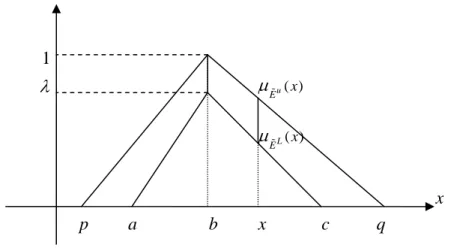
From Fig. 16, level ( ,1)λ interval-valued fuzzy number E =[EL,EU]=[( , , ; ), ( . . ;1)]a b c λ p b q
( ) , ( ) ( ) , 0 L E x a a x b b a c x x b x c c b otherwise λ λ μ − ⎧ ≤ ≤ ⎪ − ⎪ − ⎪ =⎨ ≤ ≤ − ⎪ ⎪ ⎪⎩ , ( ) , 0 U E x p p x b b p q x x b x q q b otherwise μ − ⎧ ≤ ≤ ⎪ − ⎪ − ⎪ =⎨ − ≤ ≤ ⎪ ⎪ ⎪ ⎩
Let f x( )=μEU( )x −μEL( )x , −∞ < < ∞x (see Fig.16), then the centroid of f x is ( ) ( ) ( )( ) ( )( ) ( ( )) 3[( ) ( )] ( ) xf x dx q p p b q c a a b c c f x q p c a f x dx λ λ ∞ −∞ ∞ −∞ − + + + − + + = = − + −
∫
∫
(A.1)From Fig. 15, when a= p c, =q,λ= , E becomes a triangular fuzzy number ( , , ;1)0 p b q =EU. In (A.1), let a= p c, =q,λ= , then the centroid of 0 E is U ( ( )) 1( )
3
c f x = p+ +b q , which is a
special case of (A.1). So we can use (A.1) to defuzzify E .
Fig. 16 Level( , )λ ρ interval-valued fuzzy number E p a b x c q 1 λ x ( ) u E x μ ( ) L E x μ
Reference
1. L. Brand: Advanced Calculus, an introduction to classical analysis, New York 1955
2. E. F. Brigham: Fundamentals of Financial Management, the Dryden Press, New York, 1992
3. C. L. Chang: Fuzzy topological space, J. Math. Anal. Appl. 41 (1968) 182-190
4. M. B. Gorzalezang: A method of inference in approximate reasoning based on interval-valued fuzzy sets. Fuzzy Sets and Systems 21 (1987) 1-17
5. A. Kaufmann and M. M. Gupta: Introduction to fuzzy arithmetic theory and applications. Van Nostrand Reinhold, New York 1991
6. P. M. Pu and Y. M. Liu: Fuzzy topology 1, Neighborhood structure of a fuzzy point and Moore-Smith convergence. J. Math. Anal. Appl. 76 (1980) 571-599