行政院國家科學委員會補助專題研究計畫
■ 成 果 報 告
□期中進度報告
中藥黃酮多酚及其代謝產物之組織分佈、代謝物之製備及其
與
carbamezepine 之交互作用與機制探討
計畫類別:□ 個別型計畫 ■ 整合型計畫
計畫編號:NSC 95-2320-B-039-025-MY2
執行期間: 九十六 年 八 月 一 日 至 九十七 年 七 月 卅一 日
計畫主持人:溫國慶
共同主持人:徐素蘭、李珮端
計畫參與人員: 姬盈璋、王孟珠
成果報告類型(依經費核定清單規定繳交):□精簡報告 ■完整報告
本成果報告包括以下應繳交之附件:
□赴國外出差或研習心得報告一份
□赴大陸地區出差或研習心得報告一份
□出席國際學術會議心得報告及發表之論文各一份
□國際合作研究計畫國外研究報告書一份
處理方式:除產學合作研究計畫、提升產業技術及人才培育研究計畫、
列管計畫及下列情形者外,得立即公開查詢
□ 涉及專利或其他智慧財產權,□一年□二年後可公開查詢
執行單位:中國醫藥大學
中 華 民 國 九十七 年 十 月 卅 日
中文摘要 化橘紅、槐花水煎劑富含柚皮苷與芸香苷等黃酮多酚,目前多酚之體外活性研究多 針對黃酮多酚之非醣體。多酚口服後,主要代謝成 sulfates、glucuronides 等,此等代謝物 之動力學或藥理活性尙鮮少報導。 Carbamazepine 為臨床常用之抗癲癇藥,治療指數狹窄其代謝與運輸排除與 CYPs、 P-gp 及 MRP2 有關。近來許多研究顯示,黃酮多酚對 Pgp、CYP3A4 具調控作用,而且內 源性或外源性的葡萄糖醛酸與硫酸代謝物於體內之轉運、外排與MRPs 有關,因此吾人臆 測併服黃酮多酚時,carbamazepine 之吸收與代謝可能受其影響,而且黃酮多酚所衍生之葡 萄糖醛酸與硫酸等代謝物可能會與carbamazepine 競搶 MRP2。 本計畫第二年以大鼠探討口服芸香科植物化橘紅及其成分柚皮苷、豆科植物槐花與 其成分芸香苷對於口服 carbamazepine 之代謝動力學影響,利用 HPLC 定量血清中 Carbamazepine 及活性代謝物 Carbamazepine-10, 11-epoxide 之濃度。結果顯示,併服柚皮苷 後 Carbamazepine 之血峰濃度(Cmax)顯著增加,而血藥曲線下面積(AUC0-t)及平均滯留時間 (MRT)均未有顯著差異,Carbamazepine-10, 11-epoxide 之 Cmax、AUC0-t及MRT 均無顯著差 異,僅血峰時間(Tmax)降低。併服化橘紅後 Carbamazepine 及 Carbamazepine-10, 11-epoxide 之Cmax、AUC0-t及MRT 均無顯著差異,顯見其於大鼠體內暴露並無顯著影響。
大鼠併服單劑量槐花、柚皮苷、芸香苷,對口服 Carbamazepine 之血藥面積及血峰 濃度皆顯著增加。因此為確保用藥安全,服用 Carbamazepine 的病患須避免併服芸香苷、 柚皮苷及含此成分之中草藥。
英文摘要
Huajuhung (Citrus grandis) and Huaihua (Sophora japonica L.) contain naringin and rutin as their major constituents, respectively. Recent in vitro screenings for bioactivities of these flavonoid polyphenols almost focused on the aglycones. However, our previous studies on the biological fates of polyphenols indicated that sulfates and glucuronides were the major forms in circulation after oral intake.
Carbamezepine is an anti-epileptic with narrow therapeutic window. CBZ was known as substrates for Pgp, CYP3A4 and MRPs. Recent biochemical studies indicated that flavonoids may modulate Pgp and CYP3A4, and the transport of endogenous and xenobiotic sulfates and glucuronides were associated with MRP2. Therefore, we hypothesize that the intake of flavonoid may alter the absorption and disposition of carbamazepine, moreover, the sulfates and glucuronides of flavonoids may compete for MRP2 with carbamazepine. The 2nd year of this project investigated the interactions between the above-mentioned flavonoids and herbal decoctions with carbamazepine. HPLC method will be used for the assay of carbamazepine and carbamazepine-epoxide in blood. Statistical comparison will be used to analyze the difference between treatments. The results showed that naringin and Huajuhung exerted no conspicuous alteration on systemic exposure of carbamazepine and the active metabolite carbamazepine-10, 11-exposide. Only naringin significantly increased the Cmax of carbamazepine. In addition, coadministration of Huaihua and rutin with carbamazepine, the Cmax and AUC of carbamazepine and carbamazepine-10, 11-exposide would increase. The systemic exposure of carbamazepine was markedly enhanced by coadministrations of Huajuhung, Huaihua, naringin and rutin.
It is anticipated to provide important drug safety information, moreover, to develop a cocktail therapy using nontoxic herb to enhance the efficacy of CBZ. Therefore, patients treated with carbamazepine should avoid concurrent use naringin, rutin or Chinese herbs containing naringin, rutin in order to ensure the safety.
目錄 中文摘要………..I 英文摘要………..II 附圖目錄……….V 附表目錄………VI 前言………1 材料與方法………3 結果與討論………5 結論………8 誌謝………8 參考文獻………18
附圖目錄
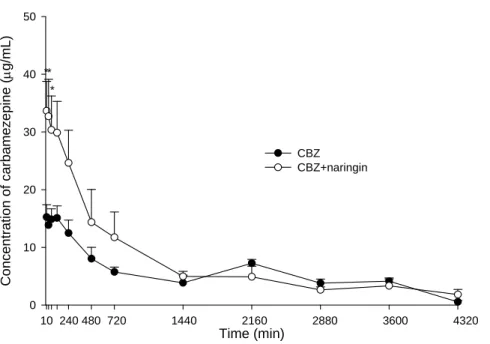
Figure 1. Serum concentration-time profiles of CBZ (mean±S.E.) after oral administration of CBZ alone (400 mg/kg) (●) and coadministrations with 213 mg/kg naringin (○)….9 Figure 2. Serum concentration-time profiles of CBZ epoxide (mean±S.E.) after oral
administration of CBZ alone (400 mg/kg) (●) and coadministrations with 213 mg/kg naringin (○)………9 Figure 3. Serum concentration-time profiles of CBZ (mean±S.E.) after oral administration of
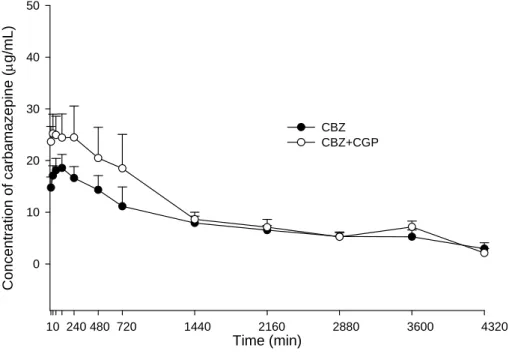
CBZ alone (400 mg/kg) (●) and coadministrations with 2 g/kg CGP (○)…………10 Figure 4. Serum concentration-time profiles of CBZ epoxide (mean±S.E.) after oral
administration of CBZ alone (400 mg/kg) (●) and coadministrations with 2 g/kg CGP (○)………10 Figure 5. Mean (±S.E.) serum concentration-time profiles of CBZ (a) and CBZ epoxide (b) after
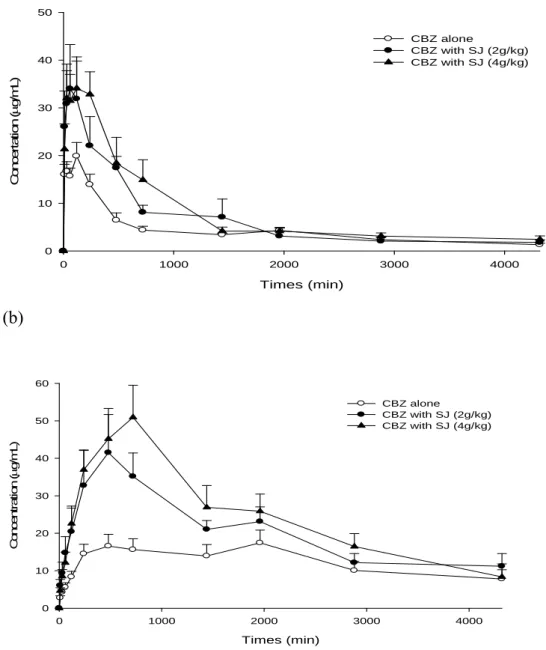
oral administration of CBZ alone (400 mg/kg) (○), coadministration with 2 g/kg (●) and 4 g/kg (▲) of SJ decoction in seven rats………11 Figure 6. Mean (±S.E.) serum concentration-time profiles of CBZ (a) and CBZ epoxide (b) after
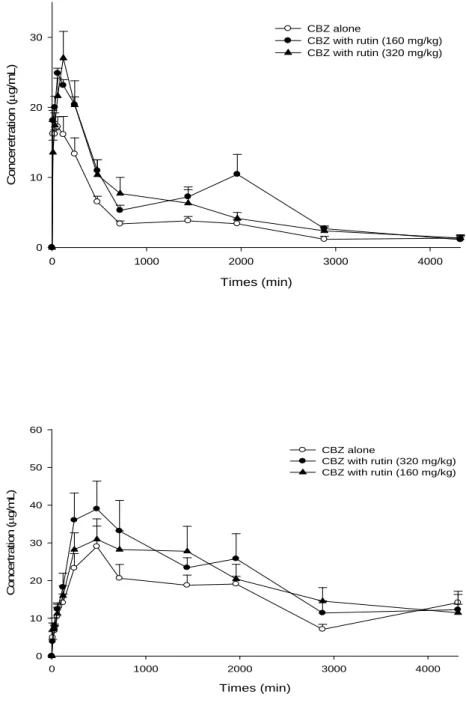
oral administration of CBZ alone (400 mg/kg) (○), coadministration with 160 mg/kg (●) and 320 mg/kg (▲) of SJ decoction in seven rats………..12
附表目錄
Table 1. Intraday and interday analytical precision and accuracy of CBZ in serum by HPLC analysis………..13 Table 2. Intraday and interday analytical precision and accuracy of CBZ epoxide in serum by
HPLC analysis………13 Table 3. Recovery (%) of CBZ from rat serum (n=3) ………14 Table 4. Recovery (%) of CBZ epoxide from rat serum (n=3) ………14 Table 5. Individual pharmacokinetic parameters of CBZ after oral administration of 400 mg/kg
CBZ alone to six rats………..14 Table 6. Individual pharmacokinetic parameters of CBZ epoxide after oral administration of 400
mg/kg CBZ alone to six rats………...14 Table 7. Individual pharmacokinetic parameters of CBZ after oral coadministration of 400 mg/kg
CBZ with naringin (213 mg/kg) to six rats………15 Table 8. Individual pharmacokinetic parameters of CBZ epoxide after oral coadministration of 400
mg/kg CBZ with naringin (213 mg/kg) to six rats………15 Table 9. Individual pharmacokinetic parameters of CBZ after oral coadministration of 400 mg/kg
CBZ with GCP (2 g/kg) to six rats………15 Table 10. Individual pharmacokinetic parameters of CBZ epoxide after oral coadministration of
400 mg/kg CBZ with GCP (2 g/kg) to six rats………..16 Table 11. Comparison of pharmacokinetic parameters of CBZ in 6 rats given CBZ alone (400
mg/kg) and coadministered with 2 g/kg CGP (CBZ+CGP) decoction……….16 Table 12. Comparison of pharmacokinetic parameters of CBZ epoxide in 6 rats given CBZ alone
(400 mg/kg) and coadministered with 2 g/kg CGP (CBZ+CGP) decoction……….16 Table 13. Pharmacokinetic parameters of CBZ and CBZ epoxide (CBZE) in seven rats receiving
oral CBZ (400 mg/kg) alone and coadministration with SJ decoction (2, 4 g/kg)…………17 Table 14. Pharmacokinetic parameters of CBZ and CBZ epoxide in seven rats receiving oral CBZ (400 mg/kg) alone and coadministration with rutin (160, 320 mg/kg)………...17
前言
天然多酚之化學結構依碳骨架可分為 flavonoid、anthraquinone、lignan、isoflavone 及 aromatic acid 等類,主要以配醣體之形式廣泛存在於植物界,如植物、水果和蔬菜中。流 行病學研究顯示,對於心血管系统、内分泌系统及癌症具有預防保護之良好效果(Anekonda &Reddy, 2004; Christofidou-Solomidou&Muzykantov; 2006; Doraiswamy, 2002; Dryden et al., 2006; Duarte et al., 2002; Fugh-Berman&Cott, 1999; Pan et al., 2003; Thelen et al., 2005; Van Meeteren et al., 2005)。現代藥理研究顯示,該類化學物質具有諸多生物活性例如抗氧化、 抗發炎、抗過敏、抗病毒、抑制血小板凝集、抗腫瘤等 (Aherne&O'Brien, 1999; Bilto&Abdalla, 1998; Cushnie&Lamb, 2005; Goniotaki et al., 2004; Gryglewski et al., 1987; Jeong et al., 2005; Lindahl&Tagesson, 1997; Middleton&Drzewiecki, 1984; Pearce et al., 1984)。
有關黃酮多酚的吸收、代謝、組織分佈等體內動力學真相,直到近幾年來才逐漸揭露, 大鼠或人攝食後,黃酮配醣體於腸道中必須受腸內酵素或腸道細菌水解成較低極性的非醣 體,方能被腸細胞吸收(Victor and Winter 1987; Mackey et al., 2002; Wilkinson et al., 2003; Bokkenheuser et al., 1987; )。然而,此些非醣體旋又受到腸及肝細胞之代謝,轉化成 sulfates、 glucuronides 等結合態代謝物而循環於血中;此些代謝物部分從尿中排出,另有部分從膽汁 排除後,旋而進入腸肝循環,重覆進入體中利用(Walle, 1997; Hanasaki et al., 1994; Li et al., 1997; Ratty and Das, 1988),許多 sulfates 及 glucuronides 等結合態代謝物在體內之轉運、 排泄與多藥物抗藥性蛋白如MRP1、MRP2、MRP3 及負離子轉運蛋白如 OAT 等相關(Cui et al., 1999; Hirohashi et al., 1999; Kawabe et al., 1999; O'Leary et al., 2003; van Aubel et al., 1998; Grim et al., 2003; Emoyo et al., 2002) 。
中藥槐花為豆科植物槐 Sophora japonica L. 的乾燥花及花蕾,為中醫常用的收斂止血 劑。其主成分為黃酮類成分 (rutin、quercetin、kaempferol、isorhamnetin、genistein、sophorin A);皂苷及其苷元 (betulin、sophoradiol、soyasaponin、kaikasaponin);其它成分 (tannin、 vitamine 等)。槐花含有豐富具生物活性之黃酮類配醣體-芸香苷。芸香苷口服後經腸內菌 水解成其苷元-槲皮素,隨即再代謝成硫酸及葡萄糖醛酸結合態代謝物,循環於全身。芸 香苷能保持毛細血管正常的抵抗力,減少血管通透性,可使因脆性增加而出血的毛細血管 恢復正常的彈性 (董艷芬與李堅,2001)。抗炎作用及抑菌(江蘇新醫學院,1997;黃敏,2000) 抗病毒、真菌作用(Wacker and Eilmers, 1978)對心血管系統則產生刺激心臟擴張血管及抑制 血小板凝集(Hitoshi et al., 1987)。
化橘紅為芸香科(Rutaceae)植物化州柚 Citrus grandis (L.) Osbeck var. tomentosa 或柚
Citrus grandis (L.) Osbeck 之成熟或未成熟乾燥果皮,其味苦辛性溫。現代藥理作用研究指
出其具抑制豚鼠支氣管平滑肌收縮、降血脂(Gorinstein et al., 2004)及抗高血壓之作用(Reshef et al., 2005) 。 其 主 成 分 為 黃 酮 類 成 分 (naringin, narigenin, neohesperidin, poncirin, furanocoumarins) 、 揮 發 油 (citral, geraniol, limalool, limomene, cadinene, dipenten 及 methlanthranilate 等),以及其他成分如 stachydrine, cis-3-hexenol, aurapten 等(Pallati et al., 2004; Mokbel and Suganuma, 2006)。Naringin 為 flavanones 主要存在於柑橘屬植物,如葡 萄柚的果皮及果肉,中藥枳實、枳殼及化橘紅。其具抗氧化、降低膽固醇、預防癌症、抗 菌、抗過敏等作用。柚皮苷具有清除自由基、抑制xanthine oxidase 活性、抗脂質過氧化、 保護DNA 免於裂解、抗氧化作用、提高血漿高密度脂蛋白、抑制 HMG-CoA reductase 活性、 降低血漿及肝臟膽固醇、抗潰瘍、預防肺癌、腸胃道解痙及抑制反應性抗體(reagenic antibody)產生的被動皮膚過敏反應等作用。此外,柚皮苷對酵母菌與真菌有抑制作用,對
H H H O OH HO O O O CH2 O OH OH O O OH O O CH3 OH OH 細菌有抗突變作用。另外,投予500 mg naringin 於人體無不良反應,服用單劑量 2 g 後, 亦無毒性反應。 Carbamazepine 為抗癲癇藥物、用於大發作、精神運動型癲癇與混合行發作及治療三叉 神經痛藥物,具有抗膽鹼激素、抗利尿、肌肉鬆弛及心律不整等活性(Brodie and Dichter, 1996; Tibballs, 1992)。常見副作用以鎮靜暈眩疲勞等中樞神經系統問題,噁心嘔吐等腸胃道問題, 視覺模糊及震顫等勢力問題為主,另有皮膚及Stevens-Johnson symdrome 等 (Tibballs, 1992; Keating and Blahunka, 1995)。於體內吸收完全口服生可用率達 85%,4-8 小時達血中最高濃 度(Bertilsson and Tomson et al., 1986; Levy and Kerr, 1988)。蛋白質結合率 76%,可通過胎盤 蓄 積 胎 兒 體 內(Rane et al., 1975) 。 於 肝 臟 受 CYP3A4 之 代 謝 , 形 成 具 藥 理 活 性 之 Carbamazepine-10, 11-epoxide 及其 N-或 O-glucuronides,多以代謝物排除僅少量原形(3%), Carbamazepine-10, 11-epoxide 血中蛋白質結合率為 50-60%,主要由尿液(72%)及糞便(28%) 排除(Bertilsson and Tomson et al., 1986; Levy and Kerr, 1988)。其於體內之轉運與 MRPs 有關。
Rutin Naringin
藥物動力學研究指出,這些富含黃酮類成分之中藥及其成分,於大鼠體內主要以其硫 酸及葡萄糖醛酸結合態代謝物之型態存再於血液循環中。更有報告指出硫酸及葡萄糖醛酸 結合態代謝物之轉運及外排與 MRP2 及 OATs 等有關(van Aubel et al., 1998; Grim et al., 2003; Emoyo et al., 2002 ; Gibbs et al., 2004 ; Kruh and Belinsky, 2003)。因而,吾人推論含柚 皮苷 (narigin)及芸香苷 (rutin) 之藥物,可能競爭該等運送蛋白而與 carbamazepine 產生交 互作用,預期將會提升西藥之血中濃度而增加療效或毒性。
本研究以大鼠探討柚皮苷與化橘紅水煎劑、芸香苷與槐花水煎劑對 carbamazepine 動力 學之影響,研究皆以平行設計進行,分別予以單獨口服 carbamazepine 及併服柚皮苷與化 橘紅水煎劑、芸香苷與槐花水煎劑。給藥後特定時間點心臟採血,以HPLC 分析法測定血 清中Carbamazepine 及 Carbamazepine-10, 11-epoxide 濃度。
O OH OH O O O O CH3 CH2OH OH OH OH OH OH O
材料與方法 一、中藥水煎劑、黃酮多酚溶液之製備 1. 化橘紅及槐花水煎劑 精確稱取化橘紅及槐花各 250 g,加入 5 L 一次水靜置半小時,於瓦斯爐上加熱 至沸騰,沸騰後轉為小火繼續加熱至體積減至 2.5 L 以下,以紗布趁熱過濾取濾液後, 將藥渣濾除,濾液以小火繼續煎煮至體積低於500 mL,加水定容至 500 mL,混合均勻 後分裝於50 mL 離心管,置於-30℃冰存備用。 上述水煎劑並分別以 HPLC 定量所含黃酮多酚含量,化橘紅所定支指標成分為 narigin 及 narigenin;而槐花則為 rutin 與 quercetin。
2. 柚皮苷與芸香苷溶液 (1) 精確稱取芸香苷,加熱水定容後以超音波震盪,配製 50 mg/mL 的柚皮苷溶液。 (2) 使用前新鮮製備。精確稱取 400 mg 之芸香苷,加熱水定容至 10.0 mL,超音波震盪,得 40 mg/mL 的芸香苷溶液。 二、口服中藥黃酮多酚對 carbamazepine 動力學之影響 1. 血清標準溶液之製備及定量前處理
分別精確稱取carbamazepine 與 carbamazepine epoxide,以甲醇溶解並稀釋定容,製 備介於 4.0 ~ 1000.0 g/mL 間九種濃度標準溶液,各取 100 µL 標準溶液,加入 900 µL 空白血清,得濃度分別為 0.4、0.8、1.6、3.1、6.3、12.5、25.0、50.0 及 100.0 µg/mL 之 血清標準溶液。 2. 檢量線之繪製 取 100 µL 血清標準溶液,加 100 µL含內標準 (2.0 µg/mL 5,7-dimethoxycoumarin) 之乙酸乙酯萃取,用試管振盪器振盪 20 秒後高速離心 (9860 g) 15 分鐘,取乙酸乙酯 層,用氮氣吹乾後,以 50 µL 氰甲烷溶解,取 20 µL 供 HPLC 分析。 3. 給藥與採血 (1) 口服化橘紅與柚皮苷對 carbamazepine 動力學之影響 實驗前禁食12 小時,給藥設計採交叉試驗模式。將大白鼠隨機分成三組,第一組以 胃管投予carbamazepine (400 mg/kg),第二、三組分別投予柚皮苷溶液 213.2 mg/kg (367 µmol/kg),或化橘紅水煎劑 2 g/kg 後併服 carbamazepine。單服 carbamazepine 組則併服等 體積的水。 口服投藥後於10、30、60、120、240、480、720、1440、2160、2880、3600 和 4320 分鐘,以心臟穿刺採血。每次採血量為0.4 mL,將血液檢品置於微量離心管,高速離心 (9860 g) 15 分鐘,貯存於 -30 ℃,俟 後分析。 (2) 口服化橘紅與柚皮苷對 carbamazepine 動力學之影響 實驗前禁食12小時,給藥設計採交叉試驗模式。將大白鼠隨機標記每組六隻以上, 第一組槐花水煎劑組,分成對照組單服carbamazepine 400 mg/kg與carbamazepine並服槐
花水煎劑2 g/kg組、4 g/kg組,第二組芸香苷組,分成對照組單服carbamazepine 400 mg/kg 與CBZ並服芸香苷160 mg/kg組、320 mg/kg組,每次給藥至少間隔兩週之wash out後。單 服carbamazepine時則併服等體積的水。 口服投藥後於10、30、60、120、240、480、720、1440、2160、2880和4320分鐘, 以心臟穿刺採血。每次採血量為0.5 mL,將血液檢品置於微量離心管,高速離心 (10000 g) 15 分鐘,貯存於 -30 ℃,俟後分析。 4. 血清檢品之前處理及定量 血清中 carbamazepine及其 epoxide 之定量係取 100 µL 血清檢品,加100 µL 含內標 準 ( 2.0 g/mL 5,7 -dimethoxycoumarin ) 之乙酸乙酯萃取,用試管振盪器振盪 20 秒後高速 離心 ( 9860 g ) 15 分鐘,取乙酸乙酯層,用氮氣吹乾後,以 50 µL 氰甲烷溶解,取 20 µL 供 HPLC 分析。 5. 高效液相層析分析條件 層析管:Apollo ® C18, 5 μm ( 150 × 4.6 mm ) 流速:1.0 mL/min 檢測波長:214 nm 移動相:氰甲烷:0.1 % 磷酸 ( 45:55, v/v ) 之混合液 6. 分析系統及方法之確效 (1). 精密度 (precision) 將各濃度之血清標準溶液,分別於同日內早、午、晚及連續三日之異日間各進行 一次層析,並以獲得之檢量線方程式求得每次實驗濃度。以三次同日內及三次異日間實 驗 濃 度 分 別 求 其 平 均 值 (mean) 、 標 準 偏 差 (standard deviation, S.D.) 及 變 異 係 數 (coefficient of variation, C.V.)。 (2). 準確度 (accuracy) 同日內三次及異日間三次實驗濃度平均值與理論濃度間之相對誤差( relative error ) 表示之。 (3). 靈敏度 (sensitivity) 將 naringenin 血清標準溶液一再稀釋,直到其波峰為雜訊三倍之濃度為偵測極限。 (4). 回收率 (recovery) 將 CBZ、CBZ epoxide 標準溶液 (溶於甲醇),分別加入空白血清及水中,製備 100.0, 6.3 及 0.4 µg/mL 等三種濃度之血清及水標準溶液各三份,所測得之血清標準溶液之波 峰面積比值除以各對應濃度之水標準溶液之波峰面積比值,即為回收率。 7. 數據分析
結果與討論
本 研 究 探 討 口 服 併 用 化 橘 紅 與 其 主 成 分 柚 皮 苷 、 槐 花 及 其 主 成 分 芸 香 苷 對
Carbamazepine 動力學之影響。
一、carbamazepine 與 Carbamazepine -10, 11-epoxide 分析方法
本研究利用 HPLC 定量 carbamazepine 與 Carbamazepine-10, 11-epoxide 之經時變
化,所採用之高效液相層析條件係以乙腈:0.1 %磷酸溶液(45:55, v/v)混液為移動相,
流速為1.0 mL/min,檢測波長 214 nm。以 5, 7-dimethoxycoumarin 為內部標準品。結果
顯示定量carbamazepine 與 Carbamazepine-10, 11-epoxide之方法在同日內及異日間皆有
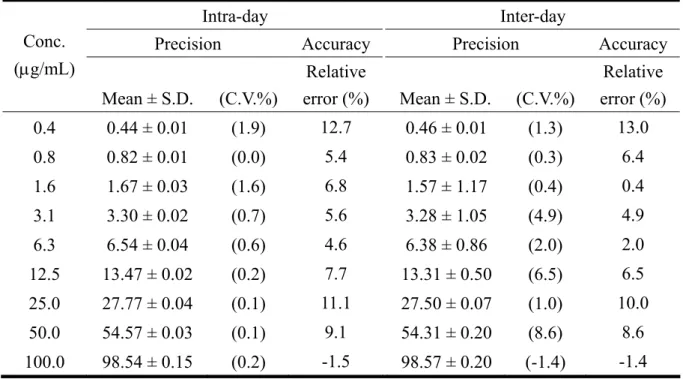
良好之精確度,其變異係數 ( C.V. ) 值均小於 10 %,相對誤差(relative error)均小於 14 % (Table 1 與 Table 2)。Carbamazepine 與 Carbamazepine-10, 11-epoxide之回收率(recovery) 分別為94.5~98.3 %、92.7~97.8 %、101.4~105.1 %、96.5~104.7 %如 Table 3~4 所示。確 效結果顯示本分析系統之精密度、準確度及回收率皆良好。
二、口服化橘紅、柚皮苷對 carbamazepine 動力學之影響
化橘紅水煎劑naringin 含量為 1739.1 μg/g 及 naringenin 含量為 20.5 μg/g。
單服 Carbamazepine 約 2.5 小時達血峰濃度,其活性代謝物 Carbamazepine-10, 11-epoxide 則約 48 小時達血峰濃度(Table 5 與 Table 6)。
大鼠併服naringin (213 mg/kg)後,其Carbamazepine 之 Carbamazepine 之血峰濃度
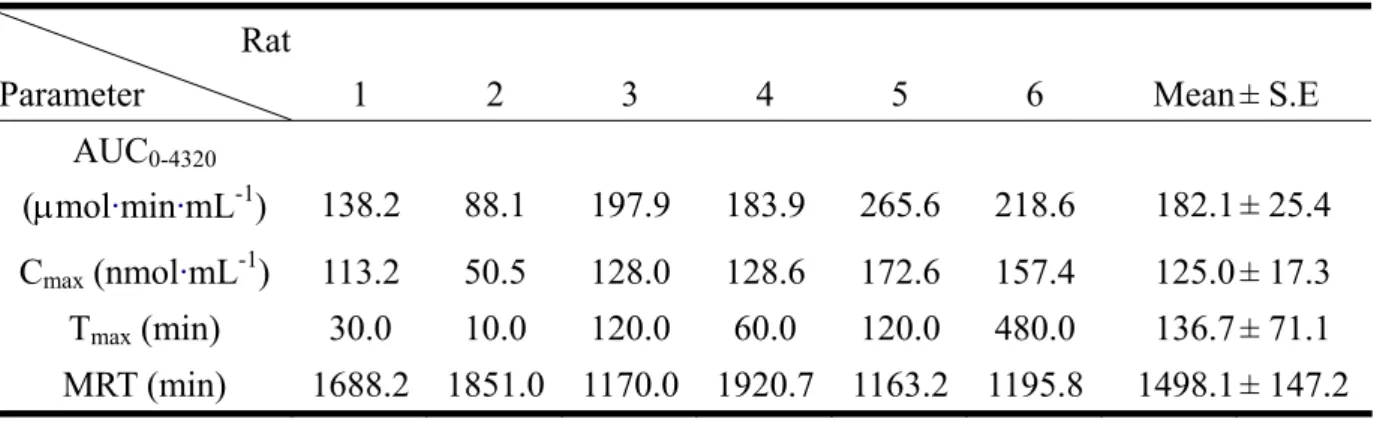
(Cmax)顯著增加,而血藥曲線下面積(AUC0-t)及平均滯留時間(MRT)均未有顯著差異, Carbamazepine -10, 11-epoxide 之 Cmax、AUC0-t及MRT 均無顯著差異,僅血峰時間(Tmax) 降低。Carbamazepine 及 Carbamazepine-10, 11-epoxide 之 Cmax、AUC0-t及MRT 均無顯著 差異,顯見其於大鼠體內暴露並無顯著影響(Figure 1 與 2;Table 7 與 Table 8)。併服化 橘紅後Carbamazepine 及 Carbamazepine-10, 11-epoxide 之 Cmax、AUC0-t及MRT 均無顯 著差異(Figure 1 與 2;Table 9 與 Table 10),顯見其於大鼠體內暴露並無顯著影響(Table 11 與 Table 12)。
文獻報導Carbamazepine 於為中之吸收率受劑型、物化性質、在胃中之溶離及胃排 空率之影響(Morselli et al., 1975; Levy et al., 1975),因而與naringin 併用時因而增加其吸
收速率加快藥效作用,因而其併用之安全性應進一步評估。Carbamazepine 多於肝臟代 謝僅約3%以原形排除(Petit et al., 1991; Lertrananangkoon and Horning, 1982),其於體內 主要轉化為Carbamazepine-10, 11-epoxide (Kerr et al., 1991),再由 microsomal epoxide hydrolase 水解成 trans-dihydrodiol,而 Carbamazepine-10, 11-epoxide 為具活性之代謝產 物(Bertilsson et al., 1986)。化橘紅水煎劑含大量naringin 及苷元 naringenin 可競爭外排運
輸蛋白,另化橘紅含 furannocoumarins 可抑制腸中 CYP3A4 活性,因此臆測應可增加
Carbamazepine 之暴露,但本實驗結果未達顯著差異。
三、口服槐花及芸香苷對 carbamazepine 動力學之影響
併服槐花後,高劑量組(4 g/kg)對於大鼠之 Carbamazepine 及 Carbamazepine -10, 11-epoxide 之 Cmax及AUC0-t顯著增加,另低劑量組(2 g/kg)之 Cmax亦顯著升高,而MRT 均無顯著差異,顯見槐花可增加大鼠體內之暴露(Figure 5 and Table 13)。
大鼠併服rutin後,高劑量組(320 mg/kg)之Carbamazepine 之 Cmax及AUC0-t顯著增 加,而低劑量組(160 mg/kg)之Carbamazepine 及 Carbamazepine -10, 11-epoxide 之 AUC0-t 均顯著增加,至於MRT 無論槐花高低劑量,無論於 Carbamazepine 及 Carbamazepine -10, 11-epoxide 均未有顯著差異(Figure 6 and Table 14)。
Carbamazepine 為 CYP3A4、P-gp 及 MRP2 之受質,口服芸香苷配醣體後會於體內 代謝成負離子之 sulfates 與 glucuronide,在體內與 Carbamazepine 競爭排除,使 Carbamazepine 滯留於體內的時間延長。有報告指出 sulfates、glucuronides 與 MRP2 有 關(Chu et al., 2004; Phillip et al., 2004; Akiko et al., 2000),因而推測口服後之結合態代謝 物對 Carbamazepine 產生抑制排除作用可能與 MRP2 有關。另外芸香苷於體內會水解 形成其苷元槲 皮 素 , ,並以槲皮素結合態代謝物及極少量的槲皮素苷元之形式存在於 血中,槲 皮 素 會 抑 制 P-gp 及 CYP3A 的 活 性 (Sarkar, 1997) 槲 皮 素 亦 有 誘 導 P-gp
白有關,使Carbamazepine 及其代謝物滯留腦中失量增加以致大鼠昏睡。此一機轉應再 進一步研究及討論。 Carbamazepine 為中樞抑制劑,治療癲癇大發作及運動型癲癇以及三叉神經痛,可 穿 透 BBB,其副作用為口乾、頭暈、嗜睡、運動失調等,較嚴重之副作用包含 Stevens-Johnson syndrome、骨髓抑制、心臟傳導異常等,為 2003 年台灣地區申請藥害 救濟第一位(高與戴,2003),因此其與中藥之交互作用不容小覷。
結論
1. 大鼠併服narigin後Carbamazepine之血峰濃度顯著增加,Carbamazepine及Carbamazepine -10, 11-epoxide 之 暴 露 則 無 顯 著 影 響 。 併服化 橘 紅 後Carbamazepine 及 Carbamazepine -10, 11-epoxide之血峰濃度、暴露均無顯著影響。 2. 大鼠併服槐花後,Carbamazepine及Carbamazepine -10, 11-epoxide之血峰濃度、曲線下面積 均顯著增加。併服rutin後Carbamazepine及Carbamazepine -10, 11-epoxide之血峰濃度與曲線 下面積亦顯著增加,平均滯留時間俱未受影響。併服槐花與rutin對大鼠之Carbamazepine暴 露均顯著增加。 3. 為確保用藥安全,服用 Carbamazepine 的病患須避免併服芸香苷、柚皮苷及含此成分之 中草藥。 誌謝 本計畫案由本計畫總主持人李珮端教授實驗室完成及提供結果,謹此致謝。
Figure 1. Serum concentration-time profiles of CBZ (mean±S.E.) after oral administration of CBZ alone (400 mg/kg) (●) and coadministrations with 213 mg/kg naringin (○).
Figure 2. Serum concentration-time profiles of CBZ epoxide (mean±S.E.) after oral administration of CBZ alone (400 mg/kg) (●) and coadministrations with 213 mg/kg naringin (○). Time (min) Co ncentratio n of carba m eze p ine ( μg/mL) 0 10 20 30 40 50 CBZ CBZ+naringin ** * 10 240 480 720 1440 2160 2880 3600 4320 Time (min) C o ncent rat ion o f carba m ezepin e epox id e (μ g/ mL) 0 10 20 30 40 50 CBZ CBZ+naringin *** 10 240 480 720 1440 2160 2880 3600 4320
Figure 3. Serum concentration-time profiles of CBZ (mean±S.E.) after oral administration of CBZ alone (400 mg/kg) (●) and coadministrations with 2 g/kg CGP (○).
Time (min) Concentration of c a rbamazepine (μ g/mL) 0 10 20 30 40 50 CBZ CBZ+CGP 10 240 480 720 1440 2160 2880 3600 4320 Time (min) Concentration of c a rbamazepine epox ide (μ g/mL) 0 10 20 30 40 50 CBZ CBZ+CGP 10 240 480 720 1440 2160 2880 3600 4320
(a) Times (min) 0 1000 2000 3000 4000 C o n c er ta ti on ( μg/ m L ) 0 10 20 30 40 50 CBZ alone CBZ with SJ (2g/kg) CBZ with SJ (4g/kg) (b) Times (min) 0 1000 2000 3000 4000 C o nc e n tr at io n ( μg/ m L ) 0 10 20 30 40 50 60 CBZ alone CBZ with SJ (2g/kg) CBZ with SJ (4g/kg)
Figure 5. Mean (±S.E.) serum concentration-time profiles of CBZ (a) and CBZ epoxide (b) after oral administration of CBZ alone (400 mg/kg) (○), coadministration with 2 g/kg (●) and 4 g/kg (▲) of SJ decoction in seven rats.
Times (min) 0 1000 2000 3000 4000 C o ncer e tr a ti o n ( μg/ m L ) 0 10 20
30 CBZ aloneCBZ with rutin (160 mg/kg) CBZ with rutin (320 mg/kg) Times (min) 0 1000 2000 3000 4000 C onc er tr at ion ( μg/ m L ) 0 10 20 30 40 50 60 CBZ alone CBZ with rutin (320 mg/kg) CBZ with rutin (160 mg/kg)
Figure 6. Mean (±S.E.) serum concentration-time profiles of CBZ (a) and CBZ epoxide (b) after oral administration of CBZ alone (400 mg/kg) (○), coadministration with 160 mg/kg (●) and 320 mg/kg (▲) of SJ decoction in seven rats.
Table 1. Intraday and interday analytical precision and accuracy of CBZ in serum by HPLC analysis
Intra-day Inter-day Precision Accuracy Precision Accuracy
Conc. (μg/mL) Mean ± S.D. (C.V.%) Relative error (%) Mean ± S.D. (C.V.%) Relative error (%) 0.4 0.44 ± 0.01 (1.9) 12.7 0.46 ± 0.01 (1.3) 13.0 0.8 0.82 ± 0.01 (0.0) 5.4 0.83 ± 0.02 (0.3) 6.4 1.6 1.67 ± 0.03 (1.6) 6.8 1.57 ± 1.17 (0.4) 0.4 3.1 3.30 ± 0.02 (0.7) 5.6 3.28 ± 1.05 (4.9) 4.9 6.3 6.54 ± 0.04 (0.6) 4.6 6.38 ± 0.86 (2.0) 2.0 12.5 13.47 ± 0.02 (0.2) 7.7 13.31 ± 0.50 (6.5) 6.5 25.0 27.77 ± 0.04 (0.1) 11.1 27.50 ± 0.07 (1.0) 10.0 50.0 54.57 ± 0.03 (0.1) 9.1 54.31 ± 0.20 (8.6) 8.6 100.0 98.54 ± 0.15 (0.2) -1.5 98.57 ± 0.20 (-1.4) -1.4
Table 2. Intraday and interday analytical precision and accuracy of CBZ epoxide in serum by HPLC analysis
Intra-day Inter-day Precision Accuracy Precision Accuracy
Conc. (μg/mL) Mean ± S.D. (C.V.%) Relative error (%) Mean ± S.D. (C.V.%) Relative error (%) 0.4 0.34 ± 0.01 1.86 -12.0 0.33 ± 0.01 3.59 -13.4 0.8 0.71 ± 0.01 0.44 -9.5 0.67 ± 0.03 4.50 -13.7 1.6 1.50 ± 0.02 1.40 -4.2 1.46 ± 0.01 0.70 -6.5 3.1 3.36 ± 0.01 0.34 7.6 3.17 ± 0.05 1.72 1.4 6.3 6.04 ± 0.06 1.03 -3.4 6.15 ± 0.02 0.39 -1.6 12.5 12.66 ± 0.12 0.98 1.2 12.85 ± 0.11 0.83 2.8 25.0 24.82 ± 0.27 1.11 -0.7 25.29 ± 0.25 0.98 1.2 50.0 50.30 ± 0.06 0.12 0.6 49.72 ± 0.58 1.17 -0.6 100.0 99.88 ± 0.80 0.80 -0.1 100.03 ± 0.30 0.30 0.0
Table 3. Recovery (%) of CBZ from rat serum (n=3)
Conc. (μg/mL) 1 2 3 Mean± S.D.
0.4 95.5 92.5 98.2 95.4± 2.8 6.3 94.5 97.3 96.9 96.3± 1.5 100.0 95.5 96.4 98.3 96.7± 1.4
Table 4. Recovery (%) of CBZ epoxide from rat serum (n=3)
Conc. (μg/mL) 1 2 3 Mean± S.D.
0.4 93.6 92.7 93.3 93.2± 0.5 6.3 94.2 97.8 96.4 96.2± 1.8 100.0 96.3 97.5 97.2 97.0± 0.6
Table 5. Individual pharmacokinetic parameters of CBZ after oral administration of 400 mg/kg CBZ alone to six rats
Rat
Parameter 1 2 3 4 5 6 Mean ± S.E AUC0-4320
(μmol·min·mL-1) 161.8 125.9 145.3 217.7 89.9 122.5 143.8 ± 17.8 Cmax (nmol·mL-1) 114.3 111.5 95.0 94.7 45.5 86.5 91.2 ± 10.1
Tmax (min) 720.0 60.0 120.0 480.0 10.0 60.0 241.7 ± 118.3 MRT (min) 1289.6 1409.3 1488.3 1751.8 1722.8 1917.1 1596.5 ± 97.3
Table 6. Individual pharmacokinetic parameters of CBZ epoxide after oral administration of 400 mg/kg CBZ alone to six rats
Rat
Parameter 1 2 3 4 5 6 Mean ± S.E AUC0-4320
Table 7. Individual pharmacokinetic parameters of CBZ after oral coadministration of 400 mg/kg CBZ with naringin (213 mg/kg) to six rats
Rat
Parameter 1 2 3 4 5 6 Mean ± S.E
AUC0-4320
(μmol·min·mL-1) 138.2 88.1 197.9 183.9 265.6 218.6 182.1 ± 25.4 Cmax (nmol·mL-1) 113.2 50.5 128.0 128.6 172.6 157.4 125.0 ± 17.3 Tmax(min) 30.0 10.0 120.0 60.0 120.0 480.0 136.7 ± 71.1 MRT (min) 1688.2 1851.0 1170.0 1920.7 1163.2 1195.8 1498.1 ± 147.2
Table 8. Individual pharmacokinetic parameters of CBZ epoxide after oral coadministration of 400 mg/kg CBZ with naringin (213 mg/kg) to six rats
Rat
Parameter 1 2 3 4 5 6 Mean ± S.E AUC0-4320
(μmol·min·mL-1) 240.8 242.2 187.9 213.8 266.8 151.6 217.2 ± 17.1 Cmax (nmol·mL-1) 86.3 80.6 87.5 61.3 124.2 43.5 80.6 ± 11.2
Tmax (min) 2880.0 3600.0 720.0 480.0 720.0 480.0 1480.0 ± 566.0 MRT (min) 2015.8 2315.5 1631.8 2216.2 1631.0 2216.3 2004.4 ± 124.5
Table 9. Individual pharmacokinetic parameters of CBZ after oral coadministration of 400 mg/kg CBZ with GCP (2 g/kg) to six rats
Rat
Parameter 1 2 3 4 5 6 Mean ± S.E AUC0-4320
(μmol·min·mL-1) 217.5 300.0 227.5 199.7 151.9 195.8 215.4 ± 20.0 Cmax (nmol·mL-1) 133.9 130.2 152.1 164.8 102.4 249.0 155.4 ± 20.6 Tmax(min) 120.0 120.0 120.0 120.0 120.0 120.0 120.0 ± 0.0 MRT (min) 1770.6 2033.5 1708.5 1715.6 1703.1 1184.1 1685.9 ± 112.8
Table 10. Individual pharmacokinetic parameters of CBZ epoxide after oral coadministration of 400 mg/kg CBZ with GCP (2 g/kg) to six rats
Rat
Parameter 1 2 3 4 5 6 Mean ± S.E AUC0-4320
(μmol·min·mL-1) 69.4 152.9 356.0 327.6 252.6 118.0 212.8 ± 47.8 Cmax (nmol·mL-1) 46.2 65.6 109.1 106.1 77.5 54.7 76.5 ± 10.7
Tmax (min) 60.0 120.0 2160.0 720.0 2160.0 480.0 950.0 ± 395.1 MRT (min) 1526.3 1821.4 2086.6 2048.5 2087.1 1568.7 1856.4 ± 105.9 GCP: Huajuhung; peel of Citrus grandis
Table 11. Comparison of pharmacokinetic parameters of CBZ in 6 rats given CBZ alone (400 mg/kg) and coadministered with 2 g/kg CGP (CBZ+CGP) decoction
Treatment Parameter CBZ CBZ + CGP Difference (%) AUC0-4320 (μmol·min·mL-1) 143.8± 17.8 182.1± 25.4 26.6 Cmax (nmol·mL-1) 91.2± 10.1 125.0± 17.3 37.1 Tmax (min) 241.7± 118.3 136.7± 71.1 -43.4 MRT (min) 1596.5± 97.3 1498.1± 147.2 -6.2
Table 12. Comparison of pharmacokinetic parameters of CBZ epoxide in 6 rats given CBZ alone (400 mg/kg) and coadministered with 2 g/kg CGP (CBZ+CGP) decoction
Treatment
Parameter CBZ CBZ + CGP Difference (%) AUC0-4320
Table 13. Pharmacokinetic parameters of CBZ and CBZ epoxide (CBZE) in seven rats receiving oral CBZ (400 mg/kg) alone and coadministration with SJ decoction (2, 4 g/kg)
CBZ alone CBZ + SJ (2 g/kg) Difference (%) CBZ + SJ (4 g/kg) Difference(%) Parameters Cmax (CBZ) 93.8 ±7.2 a 167.5 ±32.5 b 81.2±42.3 173.3 ±14.1 b 82.1±19.5 AUC0-t (CBZ) 79.2 ±8.5a 118.5 ±11.4 b 81.1±24.2 144.3 ±15.7 b 138.5±58.5 MRT0-t (CBZ) 1419.9 ±62.7 1073.7 ±131.5 -22.8±11.2 1131.1 ±119.1 20.3±7.7 Cmax (CBZE) 75.6 ±13.0 a 192.4 ±32.5 b 197.1±44.9 214.3 ±29.5 b 246.8±69.5 AUC0-t(CBZE) 218.7 ±32.1a 333.4 ±43.9 a 75.2±12.5 418.4 ±63.1 b 120.5±27.2 MRT0-t(CBZE) 1966.3 ±51.8 a 1700.9 ±119.6 a -13.0±6.6 1577.0 ±49.2 b -19.3±3.9
Table 14. Pharmacokinetic parameters of CBZ and CBZ epoxide in seven rats receiving oral CBZ (400 mg/kg) alone and coadministration with rutin (160, 320 mg/kg)
CBZ alone CBZ + rutin (160 mg/kg) Difference (%) CBZ + rutin (320 mg/kg) Difference (%) Parameters Cmax 82.3 ±29.1 a 106.4 ±40.2 a 31.1±11.7 115.8 ±43.8 b 45.3±17.1 AUC0-t 67.5 ±23.9 a 122.5 ±46.3 b 81.8±30.9 103.9 ±39.3 b 56.3±21.3 MRT0-t 1208.4 ±427.2 1298.3 ±490.7 16.6±6.3 1145.4 ±432.9 -1.0±0.4 Cmax -E 121.7 ±19.5 161.5 ±20.2 83.9±15.7 179.6 ±18.5 73.2±49.4 AUC0-t-E 267.1 ±27.2a 379.4 ±33.0 b 63.8±13.6 355.6 ±40.4 a 56.4±49.0 MRT0-t -E 1890.2 ±111.9 1707.6 ±101.1 -5.9±10.8 1789.2 ±60.5 -3.1±6.6
參考文獻
江蘇新醫學院.中藥大詞典.上海﹕上海人民出版社,2434, 1977.
高純琇、戴瓊芳。藥害救濟案例分析-Carbamazepine,藥物安全簡訊,6: 16-20, 2003. 黃敏. 複方槐花口服液的藥理作用研究. 廣西中醫藥, 25(3): 51-3, 2000.
董艷芬. 李堅. 槐花的現代研究与臨床應用. 中醫藥信息. 18(6):21-23, 2001.
Aherne SA, O'Brien NM. Protection by the flavonoids myricetin, quercetin, and rutin against hydrogen peroxide-induced DNA damage in Caco-2 and Hep G2 cells. Nutr Cancer. 34(2):160-6, 1999.
Akiko Morikawa, Yasumasa Goto, Hiroshi Suzuki, Tomoko Hirohashi and Yuichi Sugiyama. Biliary Excretion of 17b-Estradiol 17b-d-Glucuronide Is Predominantly Mediated by cMOAT/MRP2. 17(5), 546-552, 2000.
Anekonda Thimmappa S, Reddy P. Hemachandra Neuronal protection by sirtuins in Alzheimer's disease. Journal of Neurochemistry. 96(2):305-313, 2006.
Bilto YY, Abdalla SS. Effects of selected flavonoids on deformability, osmotic fragility and aggregation of human erythrocytes. Clin Hemorheol Microcirc. 18(2-3):165-73, 1998.
Bokkenheuser VD, Shackleton CH, Winter LJ. Hydrolysis of dietary flavonoid glycosides by strains of intestinal bacteroides from humans. Biochem J. 248: 953-956, 1987.
Christofidou-Solomidou Melpo; Muzykantov Vladimir R. Antioxidant Strategies in Respiratory Medicine. Treatments in Respiratory Medicine. 5(1):47-78, 2006.
Chu Xiao-Yan, Huskey Su-E. W., Matthew P. Braun, Balazs Sarkadi, David C. Evans, and Raymond Evers. Transport of Ethinylestradiol Glucuronide and Ethinylestradiol Sulfate by the Multidrug Resistance Proteins MRP1, MRP2, and MRP3. Journal of Pharmacology And Experimental Therapeutics Fast Forward. 309:156-164, 2004.
Critchfiels JW, Welsh CJ, Phang JM and Yeh CG, Modulation of adriamycin accumulation and efflux by flavonoids in HCT-15 colon cells. Biochemical Pharmacology. 48: 1437-1445, 1994.
Cui Y, Konig J, Buchholz JK, Spring H, Leier I, Keppler D. Drug resistance and ATP-dependent conjugate transport mediated by the apical multidrug resistance protein, MRP2, permanently expressed in human and canine cells. Mol Pharmacol. 55: 929-937, 1999.
Cushnie TP. Lamb AJ. Antimicrobial activity of flavonoids. Int J Antimicrob Agents. 26(5): 343-56, 2005.
Doraiswamy P. Murali. Non-Cholinergic Strategies for Treating and Preventing Alzheimer's Disease. CNS Drugs. 16(12):811-824, 2002.
Dryden Gerald W, Song Ming, McClain Craig. Polyphenols and gastrointestinal diseases. Current Opinion in Gastroenterology. 22(2):165-170, 2006.
cell line BeWo. Am J Physiol Cell Physiol. 282: C1064-C1075, 2002.
Fugh-Berman Adriane, Cott Jerry M. Dietary Supplements and Natural Products as Psychotherapeutic Agents. Psychosomatic Medicine. 61(5):712, 1999.
Gibbs JP. Adeyeye MC. Yang Z. Shen DD. Valproic acid uptake by bovine brain microvessel endothelial cells: role of active efflux transport. Epilepsy Res. 58 :53-66, 2004.
Goniotaki M, Hatziantoniou S, Dimas K, Wagner M, Demetzos C. Encapsulation of naturally occurring flavonoids into liposomes: physicochemical properties and biological activity against human cancer cell lines. J Pharm Pharmacol. 56(10):1217-24, 2004.
Gorinstein S, Caspi A, libman I, Katrich E, Lerner HT, Trakhtenberg S. Preventive effects of dietd supplemented with sweetie fruits in hypercholesterolemic patients suffering from coronary artery disease. Prev Med. 38: 841-847,2004.
Grim J. Chladek J. Martinkova J. Pharmacokinetics and pharmacodynamics of methotrexate in non-neoplastic diseases. Clin Pharmacok. 42: 139-151, 2003.
Gryglewski RJ, Korbut R, Robak J, Swies J. On the mechanism of antithrombotic action of flavonoids. Biochemical Pharmacology. 36: 317-22, 1987.
Hanasaki Y, Ogawa S, Fukui S. The correlation between active oxygens scavenging and antioxidative effects of flavonoids. Free Radical Biol Med. 16: 845-850,1994.
Hirohashi T, Suzuki H, Sugiyama Y. Characterization of the transport properties of cloned rat multidrug resistance-associated protein 3 (MRP3). J Biol Chem. 274: 15181-15185, 1999. Jeong YJ, Choi YJ, Kwon HM, Kang SW, Park HS, Lee M, Kang YH. Differential inhibition of
oxidized LDL-induced apoptosis in human endothelial cells treated with different flavonoids. Br J Nutr. 93(5):581-91, 2005.
Kawabe T, Chen ZS, Wada M, Uchiumi T, Ono M, Akiyama S, Kuwano M. Enhanced transport of anticancer agents and leukotriene C4 by the human canalicular multispecific organic anion transporter (cMOAT/MRP2). FEBS Lett. 456: 327-331, 1999.
Kruh GD, Belinsky MG. The MRP family of drug efflux pumps. Oncogene. 2003, 22: 7537-7552. Levy RH, Pitlick WH, Troupin AS, Green JR, Neal JM. Pharmacokinetics of carbamazepine in
normal man. Clin Pharmacol Ther. 17: 657-668, 1975.
Li BQ, Fu T, Yan YD, Baylor NW, Ruscetti FW, Kung HF. Inhibition of HIV by baicalin. Cellular Molecular Biological Research. 39: 119-124, 1997.
Lindahl M, Tagesson C. Flavonoids as phospholipase A2 inhibitors: importance of their structure for selective inhibition of group II phospholipase A2. Inflammation. 21(3):347-56, 1997.
Mackey AD, Henderson GN, Gregory JF. Enzymatic hydrolysis of pyridoxine-5'-beta-D-glucoside is catalyzed by intestinal lactase-phlorizin hydrolase. J Biol Chem. 277: 26858–26864, 2002.
Middleton E Jr, Drzewiecki G. Flavonoid inhibition of human basophil histamine release stimulated by various agents. Biochem Pharmacol. 1;33(21):3333-8, 1984.
Mokbel MS, Suganuma T.Antioxidant and antimicrobial activities of the methanol extracts from pummelo (Citrus grandis Osbeck) fruit albedo tissues. Eur Food Res Technol. 224: 39-47, 2006.
preparations during chronic administration to epileptic patients. Epilepsia. 16: 759-764, 1975. O'Leary KA, Day AJ, Needs PW, Mellon FA, O'Brien NM, Williamson G. Metabolism of
quercetin-7- and quercetin-3-glucuronides by an in vitro hepatic model: the role of human beta-glucuronidase, sulfotransferase, catechol-O-methyltransferase and multi-resistant protein 2 (MRP2) in flavonoid metabolism. Biochem Pharmacol. 65: 479-491, 2003.
Pallati F, Benvenuti S, Melegari M. High-performance liquid chromatography methods for the analysis of adrenergic amines and flavanones in Citrus aurantium L. var. amara. Phytochem Anal 15: 220-225, 2004.
Pan Tianhong; Jankovic Joseph; Le Weidong. Potential Therapeutic Properties of Green Tea Polyphenols in Parkinson's Disease. Drugs & Aging. 20(10):711-721, 2003.
Pearce FL, Befus AD, Bienenstock J. Mucosal mast cells. III. Effect of quercetin and other flavonoids on antigen-induced histamine secretion from rat intestinal mast cells. J Allergy Clin Immunol. 73(6):819-23, 1984.
Phillip M. Gerk, Wei Li, and Mary Vore. Estradion 3-glucuronide is transported by the multidrug resistance-associated protein 2 but does not activate the allosteric site bound by estradio 17-glucuronide. Drug Metab. Dispos. 32(10): 1139 – 1145, 2004.
Ratty AK, Das NP. Effects of flavonoids on nonenzymic lipid peroxidation: Structue activity relationship. Biochem Med Metabol Biol. 39: 69-79, 1988
Reshef N, Hayari Y, Goren C, Boaz M, Madar Z, Knobler H. Antihypertensive effects of sqeeties fruit in patients with stage I hypertension. Am J Hypertens. 18: 1360-1363, 2005.
Sarkar MA, Quercetin not only inhibits P-glycoprotein efflux activity but also inhibits CYP3A isozymes. Cancer Chemotherapeutic Pharmacology. 250 (1): 130-137, 1997.
Thelen Paul, Scharf Jens-Gerd, Burfeind Peter, Hemmerlein Bernhard, Wuttke Wolfgang, Spengler, Barbara, Christoffel Volke, Ringert Rolf-Hermann, Seidlova-Wuttke Dana. Tectorigenin and other phytochemicals extracted from leopard lily Belamcanda chinensis affect new and established targets for therapies in prostate cancer. Carcinogenesis. 26(8):1360-1367, 2005.
van Aubel RA, van Kuijck MA, Koenderink JB, Deen PM, van Os CH, Russel FG. Adenosine triphosphate-dependent transport of anionic conjugates by the rabbit multidrug resistance-associated protein Mrp2 expressed in insect cells. Mol Pharmacol. 53: 1062-1067, 1998.
van Meeteren M E, Teunissen C E, Dijkstra C D, van Tol E AF. Antioxidants and polyunsaturated fatty acids in multiple sclerosis. European Journal of Clinical Nutrition. 59(12):1347-1361, 2005.