Identifying Core Medical Electronic Resources for
Consortium Negotiation: A Survey in Taiwan
Tzu-Heng Chiu
Associate Professor, Center of General Education
Associate Director of Library
Taipei Medical University
E-mail: [email protected]
【Abstract】
In 2010, the author was appointed by the Medical Library Committee of the Library Association of Republic of China (MLCLAR) to conduct a research project on all medical libraries in Taiwan. The project was to investigate the willingness of supporting the MLC consortium purchase as well as to identify core medical e-resources for purchase. The author first selected mostly subscribed e-resources; then, questionnaires were sent out to 335 medical libraries in Taiwan in June 2010 and 180 copies returned in August. With 153 valid ones, the return ratio is 45.67%. 66.68% of the respondents agree to support the MLC consortium purchase. ANOVA analysis shows significant differences among different categories of libraries. The core medical e-resources are also identified. From September 2010, the MLC has emailed requests to e-resource vendors and has received feedbacks by October. Cochrane Library, MicroMedex, CINAHL, and EndNote assented to offer special discounts for small- and medium-sized libraries. In December, the LAROC officially announced these new offers to all medical libraries. The author suggests that the MLC utilize the economical benefit and wide-ranging variety of resources provided via consortium, while carrying on more price negotiations on e-resources. In this way, abundant resources may be provided with better offers for medical libraries in Taiwan.
Keyword
Medical e-resources;Medical library consortia;Consortium negotiation;Taiwan
圖書與資訊學刊 4:1=80(May ’12)1-12 ISSN 1023-2125
Research Background & Objectives
Recently, the electronic resources have become the primary collections of medical libraries. However, due to difficulties in the library operation, the budgets for e-resources can hardly meet the price increases. Since 2000, many medical library consortia have formed up in Taiwan and received the best discount than ever before. Hence, more reasonable offers would be negotiable with vendors if all of the medical libraries in Taiwan are forming an alliance, we can negotiate with vendors. In 2007, the Medical Library Committee (MLC) of Library Association of Republic of China came to a solution of conducting consortium purchasing, the MLC represent all medical libraries in Taiwan to deal with the price negotiations. In September 2007, in the MLC annual meeting, Micromedex and LWW sales representatives were invited to introduce their global pricing and marketing plans toward Taiwan market. Micromedex agreed to raise only 5% from the last year price, the first time in history for Micromedex to yield, surrendering extra 10% increase it normally required. LWW also offered a consortium special discount to all medical libraries in Taiwan. Such accomplishment not only brings medical libraries the benefits of lower the procurement expenses but fastens procurement processes. However, the consortium purchasing was a one-time activity and was not able to continue running due to the leadership rotation of the MLC.
In 2010, the MLC Committee Board rotated again. In March 2010, the committee delegated the author to conduct a 5-month research project to identify the core medical e-resources as well as to
survey all medical libraries for their willingness of supporting MLC to form a consortium. Therefore, the objectives of this research are:
1.To identify core medical electronic resources for medical libraries in Taiwan
2.To investigate the willingness of supporting MLC consortium purchasing among different categories of medical libraries
3.To conduct price negotiation with electronic resources vendors for 2011
Medical Library Consortia in Taiwan
For decades, libraries in hospitals of Taiwan have been facing budget insufficiency while the costs of medical journals are increasing year by year. Recently, the rise and widespread use of electronic journals have facilitated hospital libraries of building up digital library consortia. At the same time, libraries expect to incorporate everyone’s power to purchase more electronic resources at reasonable prices. Generally speaking, there are 3 main reasons for the development of digital library consortia: (a) to share resources in each library by a virtual union catalog or interlibrary loan services; (b) to acquire better prices than with single purchasing by negotiating between consortia and suppliers to save funds of libraries; and (c) to alter suppliers’ pricing policies, licensing agreement, and annual price increase range by consortium’s power (Pan, 2005). American OhioLINK is the best example. For years of its operational history, the consortium has considerably upgraded the purchasing capacity of its member libraries and allowed them to use more research and teaching information resources.
Identifying Core Medical Electronic Resources for Consortium Negotiation: A Survey in Taiwan
in Taiwan (CONCERT) was established in September 1998. It can be regarded as the largest consortium of libraries in Taiwan. However, its service targets are mainly academic libraries which, to some degree, contribute to the purchasing of digital resources of libraries of medical schools. However, since hospital libraries are not academic libraries, they are not qualified for participating in CONCERT. As a result, no purchasing assistance can be requested from CONCERT. Hence, it has become essential to establish digital library consortia exclusively for medical libraries.
Medical library consortia in the US and Canada are mostly based on the cooperation among libraries in the same area. At the beginning of their establishment, they focused on sharing original library resources and human resources. Over time, they gradually turned into consortium purchasing of digital resources. The initial establishment of a medical library consortium in Taiwan was at the end of 2001 when electronic resources were widely accepted by libraries. Thus, in the beginning, the target was the consortium negotiation and purchasing of digital resources. The following briefly introduces the 7 largest medical library consortia in Taiwan in the order of creation.
Starting from 2001, while electronic resources being widely accepted by libraries in Taiwan, medical library consortia have been established ever since. Their targets were to unite libraries to negotiate and purchase e-resources. There were 7 largest medical library consortia in Taiwan, including: 1. Consortium for Medical Electronic Resources in Taiwan (MERIT), established in 2001 by National Taiwan University Medical Library (NTUML; 2001);
2. Electronic Library of the Department of Health (DoH), Executive Yuan, established in 2003 by DoH (Chang & Lin, 2004); 3. TMU DiLib consortium, established in 2003 by Taipei Medical University (Chiu, 2005); 4. Digital Medical Resource Cooperative Network of Veterans Hospitals, established in October 2004 by Taipei Veterans General Hospital (Cho, n.d.); 5. Project of consortium purchasing of core biomedical journals and databases, established in 2004 by National Taiwan University Medical College (2005); 6.Armed Forces Hospital Digital Library Consortium, established in 2005 by National Defense Medical Center Library (n.d.); 7. United Purchasing Consortium of Electronic Resources in Central and Southern Taiwan, established 2005 by National Cheng Kung University Medical Library (n.d.).
To sum up, the executive or host institutions of medical library consortia in Taiwan are the libraries of medical centers (most of which are national institutions with sufficient resources and manpower). Consortium 1, 2, and 5 are executed by the NTUML, the largest medical library in Taiwan; consortium 4 is implemented by Taipei Veterans General Hospital; consortium 6 is executed by National Defense Medical Center Library; the host of consortium 7 is National Cheng Kung University Medical Library; and only the host of consortium 3 is a private institution: Taipei Medical University Library. As to the source of funding, consortium 1, 3, 7 are supported by the member libraries of the consortia. Consortium 2, 4, 6 are respectively provided by their higher authority institutes, the DoH, Veterans Affairs Commission, and Medical Affairs Bureau. As to the properties of these consortia, consortium 2, 4, 6 are
cooperative organizations under the same medical system. Members of the consortium 3 refer to medium- and small-sized regional and local hospitals. The consortium 7 stresses on the regional concept of central and southern Taiwan.
However, from year 2010, only four of the aforementioned consortia still exist, including consortium 2, 3, 4, and 6. In earlier research, Chiu (2008) had discovered issues regarding to too many consortia while each of which served only small groups of libraries. Chiu proposed five suggestions on the perspectives of the practicality and sustainability of the consortium. They are once again listed below:
1. Introducing diverse types of resources, so that physicians and other medical staff under the service could use more-diverse electronic resources.
2. Expanding the cooperative levels, so that human resources and professional knowledge among members could be in a more-efficient way.
3. Strengthening the cooperation with consortia of medical societies, and established mechanisms to acquire human, social science, science, engineering, and agricultural resources.
4. Establishing communication channels among consortia, to offer inter-consortium cooperative opportunities.
5. Pursuing sustainable development of consortium operation – each consortium actively look for stable funding sources, arrange full-time staff, and sign long-term
contracts with the resource suppliers for sustainable development.
In 2010, the author was appointed the chairperson of MLC of Library Association of Republic of China. The urge of interlibrary collaboration from MLC members drove the researcher to devote efforts to consortium purchasing project. With supports from the MLC board, the author conducted this 5-month research project.
Methodology
From April to May 2010, the author collected e-resources listed from the library websites of Taiwan’s medical schools and centers in order to select mostly subscribed e-resources; afterwards, a list of medical e-resource candidates was developed. Next step was to send out questionnaires to the medical libraries. In Taiwan, medical libraries can be generalized into 7 groups from three categories, including category 1. research library, category; 2. academic library, which can be further divided into 2 groups: university library and junior college library, and category; 3. hospital library in medical institutions, which can also be further grouped into three levels: medical center library, regional hospital library, and local hospital library. Some small government and private institutions are grouped into the others. According to the directory (http://www.lac.org.tw/committee/med/members.htm) provided by the MLC, Library Association of the Republic of China (LARMLC), there are a total of 335 medical libraries in Taiwan as of September, 2010. The numbers of research libraries, university libraries, junior college libraries, medical center libraries, regional hospital libraries, local libraries
Identifying Core Medical Electronic Resources for Consortium Negotiation: A Survey in Taiwan
and others are 5 (1%), 29 (9%), 14 (4%), 22(7%), 88(26%), 167(50%) and 10 (3%) accordingly.
The questionnaire was comprised with three major sections. The first section was information about the library. The second section was library’s experience and attitude toward consortia. The third section allowed libraries to select their core e-resources. From June to August 2010, research assistants sent out questionnaires to all 335 medical libraries in Taiwan. In August 2010, after two reminders, 180 copies returned. With 153 valid copies, the return ratio is 45.67%. Among the 153 valid returned questionnaires, by difference
categories, the most recovered one is from university library (86.2%), next is from medical center library (72.72%). Owing to the shortage of funds for collections and the limited budget for consortia purchase, the lowest recovered one is from local hospital libraries (23.95%) (see Table 1). Therefore, those libraries indicated the questionnaire unanswerable under such circumstance while research assistant conducting second reminder by phone. This situation may affect the comparisons between different types of libraries, and could be the limitation of this research.
Table 1
Questionnaire Returned Ratio – by Category
Category Quantity Percentage
Returned Total
Research Library 3 5 60.00%
Academic Library University Library 25 29 86.20%
Junior College Library 9 14 64.28%
Hospital Library
Medical Center Library 16 22 72.72%
Regional Hospital Library 57 88 64.77%
Local Hospital Library 40 167 23.95%
Others 3 10 30.00%
Total 153 335 45.67%
Research Findings
The Core Medical E-Resources in Taiwan
From the questionnaire, each library is able to review the canceled (used-to-have), currently owned (have), and the plan-to-cancel e-resources from the
list; at the same time, the willingness of delegating MLC to perform price negotiation was queried. Table 2 shows the lists of e-resources and the recovered data. The table was sorted by demanding of the requests, shown on the very right column, from high to low. This finding was later discussed on the MLC Board for final decision.
Table 2
E-Resource List and the Recovered Responses from Participants
E-Resources Used to have Currently have Plan to Cancel Delegate MLC consortium Negotiation Databases UpToDate 7 75 0 27 MD Consult 9 72 1 22 Cochrane Library 4 75 0 16 MicroMedex 8 69 2 18 CINAHL 6 41 0 14 Medline (Ovid-SP) 14 61 0 14 Nursing Collection 5 6 0 10
EBSCO host Academic 5 24 0 9 ICD-10 Online 0 2 0 7 PsycInfo 3 9 1 6 E-Journals CEPS 0 116 0 21 BMJ 5 32 0 16 LWW 5 45 0 15
Oxford Journals Online 1 21 0 14
Wiley InterScience 3 45 1 13 SpringerLink 8 31 0 13 CNKI 2 36 0 12 Cell Press 1 17 0 12 AMA 2 31 0 8 E-Books Access Medicine 4 14 0 14 Books@OVID 3 21 2 9 Stat!Ref! 5 20 1 9
Bibliographic Management Tools
EndNote 9 48 2 22
The Willingness of Supporting MLC
Consortium
All libraries were questioned the willingness to have the MLC form a consortium. After analyzing from recovered data, from scale 1 to 5 (5 meaning strongly agree), among 153 valid returned data, 45.34% of the participants selected agree and 21.34% of the participants selected strongly agree. These two figures came up to 66.68% of the participants whose attitude toward supporting the MLC to form a consortium are positive.
The author next ran one way ANOVA analysis to verify if there is significant difference among different categories of libraries, followed by Scheffe method and LSD method for post hoc pair-wise
comparison between each category. The finding results show that there is significant difference between different categories of libraries; research library, university library and medical center library all show significant difference from junior college Library, regional hospital library and local hospital library pair-wise. The following states the details.
The author first look up ANOVA to check if there is significant difference among six different categories of libraries. Table 3 shows the result of the ANOVA analysis between / within six groups. The F= 4.278 (p =.001<.05), indicating that the degree of supporting the MLC to form a consortium for price negotiation shows a significant difference among different categories of libraries.
Table 3
Degree of Agreement between / within Groups
Sum of Squares df Mean Square F Sig.
Between Groups 17.437 5 3.487 4.278 .001
Within Groups 117.396 144 .815
Total 134.833 149
Next, the author verifies the above finding via descriptive statistic result. Table 4 shows that among the six categories, the value of the total average (3.77) does not fall into the shade of the 95% interval of the
mean score of the university library (3.90-4.42) and the medical center library (4.05-4.70). Once again, this finding approves that there are significant differences among different categories of libraries. Identifying Core Medical Electronic Resources for Consortium Negotiation: A Survey in Taiwan
Table 4
Descriptive Statistics of Degree of Agreement
N Mean S.D. S.E.
95% Confidence Interval for Mean
Min. Max. Between- Component Variance Lower Bound Upper Bound Research Library 3 4.67 .577 .333 3.23 6.10 4 5 University Library 25 4.16 .624 .125 3.90 4.42 3 5
Junior College Library 9 3.33 1.000 .333 2.56 4.10 2 5 Medical Center Lib. 16 4.38 .619 .155 4.05 4.70 3 5 Regional Hospital Lib. 57 3.60 1.083 .143 3.31 3.88 0 5 Local Hospital Lib. 40 3.55 .846 .134 3.28 3.82 1 5
Total 150 3.77 .951 .078 3.61 3.92 0 5
Model Fixed Effects .903 .074 3.62 3.91
Random Effects .191 3.28 4.26 .120
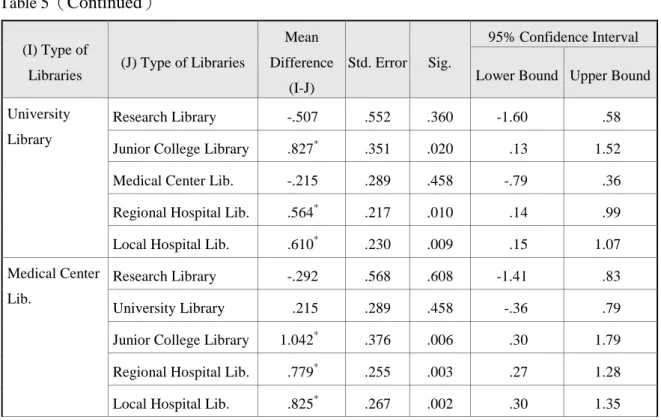
However, by using Scheffe method, the ANOVA analysis does not reflect a significant difference among different types of libraries. The author then uses LSD method, and the significant differences between categories are obvious. The statistical analysis shows that there are significant differences
between research library and junior college library, regional hospital library and local hospital library pair-wise. Same findings are shown on university and medical center libraries, each individually comparing with Junior college Library, Regional hospital library, and Local hospital library (see Table 5).
Table 5
Degree of Agreement Multiple Comparison (LSD Method)
(I) Type of
Libraries (J) Type of Libraries
Mean Difference
(I-J)
Std. Error Sig.
95% Confidence Interval
Lower Bound Upper Bound
Research Library
University Library .507 .552 .360 -.58 1.60
Junior College Library 1.333* .602 .028 .14 2.52
Medical Center Lib. .292 .568 .608 -.83 1.41
Regional Hospital Lib. 1.070* .535 .047 .01 2.13
Local Hospital Lib. 1.117* .540 .041 .05 2.18
Identifying Core Medical Electronic Resources for Consortium Negotiation: A Survey in Taiwan
Table 5
(Continued)
(I) Type of
Libraries (J) Type of Libraries
Mean Difference
(I-J)
Std. Error Sig.
95% Confidence Interval
Lower Bound Upper Bound
University Library
Research Library -.507 .552 .360 -1.60 .58
Junior College Library .827* .351 .020 .13 1.52
Medical Center Lib. -.215 .289 .458 -.79 .36
Regional Hospital Lib. .564* .217 .010 .14 .99
Local Hospital Lib. .610* .230 .009 .15 1.07
Medical Center Lib.
Research Library -.292 .568 .608 -1.41 .83
University Library .215 .289 .458 -.36 .79
Junior College Library 1.042* .376 .006 .30 1.79
Regional Hospital Lib. .779* .255 .003 .27 1.28
Local Hospital Lib. .825* .267 .002 .30 1.35
Note. The mean difference is significant at the 0.05 level. *p<.05
Price Negotiation of Core E-Resources for
2011
In September 2010, the author reported the research findings to the MLC Board. With 66.68% of positive feedbacks, the committee board decided to launch the MLC consortium and came out a final list of high demanding core medical e-resources based on recovered questionnaire to initiate price negotiation. The list includes 10 databases, 9 e-journals, 1 e-book and 1 bibliography management tool. Sorted by the order of the demand, the final list of core medical e-resources is as follows:
Databases
(a)UpToDate, (b)MD Consult, (c)Cochrane Library, (d)MicroMedex, (e)CINAHL, (f) Medline (Ovid-SP), (g)Nursing Collection (Ovid-SP), (h)EBSCOhost Academic Search Premier (ASP, ASC), (i)ICD-10 Online, (j)PsycInfo.
E-Journals
(a)CEPS, (b)BMJ, (c)LWW, (d)Oxford Journals Online, (e)Wiley InterScience, (f) CNKI, (g)Cell Press, (h)SpringerLink, (i) AMA.
E-Books.
Harrison Online.
Bibliographic management tool.
Endnote
In October, the MLC started emailing requests to e-resource vendors and received feedbacks shortly afterward. Due to time limit, vendors like UpToDate, MD Consult, BMJ, Wiley InterScience and SpringerLink could not provide proposals for 2011;
Cochrane Library, MicroMedex, CINAHL, and EndNote each provided a special offer for the small and medium-sized libraries. Table 6 listed the core medical e-resources that the MLC received better offers for the year 2011. In December, the LAROC issued an official announcement to all medical libraries; as a result, each medical library can purchase the below-listed e-resources with these offers.
Table 6
Core Medical E-resources MLC Accomplished Negotiation in 2011
No. E-resources List
1 AMA
2 CINAHL, CINAHL Plus 3 The Cochrane Library
4 EBSCOhost Academic Search—Premier EBSCOhost Academic Search—Complete 5 EndNote
6 Micromedex
7 OvidSP Nursing Collection, Ovid Nursing Full Text Plus
Conclusion
The 335 medical libraries in Taiwan are mostly mid-, small-sized libraries with budget concern to meet increased price yet each library is struggling on inquiring more e-resources for better services. Since 2001,seven consortia from different institutions have not only scattered resources, but also have lacked of consortia sustainability. The meeting with
MicroMedex and LWW sales representatives in the year of 2007 was a success; however, the change of MLC leadership clogged it from going. Thanks to leadership rotation again in 2010, the author conducted this research. With supports from 2/3 of responded libraries, the MLC consortium was launched. In addition, the core medical e-resources for medical libraries in Taiwan are identified. However, the benefit and budget saved still require
Identifying Core Medical Electronic Resources for Consortium Negotiation: A Survey in Taiwan
further assessment in the following year.
To review this research, there are still two issues needed to be concerned. First, almost all of the new price policies are restricted to small or mid-sized libraries. The MLC consortium needs to continue on providing benefits to wider range of libraries. Second, the agreement term is limited to access right only rather than ownership of the e-resources. In the future, the MLC consortium needs to focus on better agreement term. Going forward, the author expects the MLC consortium to strive to bring on more benefits for all medical libraries consistently, and perform price negotiation on a regular basis instead
of one-time shopping.
The researcher believes that, before conducting consortia price negotiation, the first priority is to survey the needed core resources among all the medical libraries. This research discovered core medial electronic resources in Taiwan. Due to the constraint of time and manpower, this research was not able to collect similar research results from other countries and to compare the differences and the reason of them. This topic is worth further studying.
(Received on 28 June 2011)
Acknowledgment
This article is a research project delegated by the Medical Library Committee of the Library Association of Republic of China from April to September, 2011. Portion of this study was accepted and presented in poster section on May 19, 2011 of MLA annual conference of 2011. The author would like to thank the generosity of MLCLAR for the funding, research assistants for data collecting, and all of the respondents from various medical libraries in Taiwan for answering the questionnaire. All have been a great help to complete this project.
References
Armed Forces Hospital Digital Library Consortium. (n.d.). Project history. Retrieved May 30, 2011, from http://210.60.119.10/mlibs/plan.htm. [Text in Chinese].
Chang, H. C. & Lin, Y. S. (2004). Reflection on establishment of electronic library of department of Health, Executive Yuan. In The Thesis for the Celebration of the Eightieth Birthday of Professor Chen-ku Wang(pp. 235-244). Taipei: Taiwan Student Bookstore. [Text in Chinese].
Chiu, T. H. (2005). Current situation of TMU DiLib consortium and the introduction of 2006 projects [Internal documents of TMUL]. [Text in Chinese].
Chiu, T. H. (2008). The development of medical library consortia in Taiwan. Poster session presented at the annual meeting of Medical Library Association, Chicago, IL, USA.
Cho, Y .C. (n.d). Digital medical resource cooperative network of Veterans Hospitals. Retrieved May 30, 2011, from http://vhnet.vghtpe.gov.tw/er/4/intro.ppt [Text in Chinese]
Introduction to United Purchasing Consortium of Electronic Resources in Central and Southern Taiwan.(n.d.) [Internal documents] [Text in Chinese].
National Taiwan University Medical College (2005). Project of consortium purchasing of core biomedical science journals and database. 2004 Technical Report of the Department of Health, Executive Yuan.(Project no.: DOH93-TD-T-007).[Text in Chinese].
Pan, S. H. (2005). Comparison of the consortium of electronic resources between Mainland China and Taiwan. Bulletin of Library and Information Science, 52, 42-57. [Text in Chinese].