行政院國家科學委員會專題研究計畫 成果報告
魚油(Fish oil)對全胃切除老鼠腸道及全身性免疫之影響
計畫類別: 個別型計畫 計畫編號: NSC93-2314-B-002-256- 執行期間: 93 年 08 月 01 日至 94 年 07 月 31 日 執行單位: 國立臺灣大學醫學院一般醫學科 計畫主持人: 林明燦 共同主持人: 陳維昭,李伯皇 計畫參與人員: 葉松鈴,郭明良 報告類型: 精簡報告 處理方式: 本計畫可公開查詢中 華 民 國 94 年 10 月 27 日
附件一
行政院國家科學委員會補助專題研究計畫
▓ 成 果 報 告
□期中進度報告
(計畫名稱)
魚油(Fish Oil)對全胃切除老鼠腸道及全身性免疫之影響
計畫類別:▓ 個別型計畫 □ 整合型計畫
計畫編號:NSC93-2314-B002-256
執行期間: 93 年 08 月 01 日至 94 年 07 月 31 日
計畫主持人:林明燦
共同主持人:陳維昭,李伯皇
計畫參與人員:葉松鈴,郭明良
成果報告類型(依經費核定清單規定繳交):▓精簡報告 □完整報告
本成果報告包括以下應繳交之附件:
□赴國外出差或研習心得報告一份
□赴大陸地區出差或研習心得報告一份
□出席國際學術會議心得報告及發表之論文各一份
□國際合作研究計畫國外研究報告書一份
處理方式:除產學合作研究計畫、提升產業技術及人才培育研究計畫、
列管計畫及下列情形者外,得立即公開查詢
□涉及專利或其他智慧財產權,□一年□二年後可公開查詢
執行單位:台大醫學院 一般醫學科
中 華 民 國 94 年 10 月 24 日
(二)中英文摘要及關鍵字(Keyword)
I、中文摘要關鍵詞:魚油 (Fish Oil, FO),全靜脈營養(Total Parenteral Nutrition, TPN),全胃手術(Total Gastrectomy) , 免 疫 (Immunity) , 腸 道 免 疫 (Intestine Immunity) , 腸 相 關 淋 巴 組 織 (Gut Associated Lymphoid Tissue, GALT) , 抗 氧 化 作 用 (Antioxidant) , 細 胞 免 疫 (Cellular Immunity),細胞激素(Cytokine),接著分子(Adhesion Molecules)
全靜脈營養(Total Parenteral Nutrition,TPN)是外科對整個醫學的一項劃時代重大貢 獻。只有在良好的營養醫療及支持(Nutrition therapy and nutrition support)之下,才能讓外科 醫師積極進行重大手術,達成治療目標,挽救病人性命,並且減少手術的併發症發生,甚 至有機會能減少癌症的再發。然而,傳統型的全靜脈營養(Conventional Standard TPN, SO-TPN)添加的脂肪(Fat emulsion)通常只含 Soy bean oil (SO,主要為 w-6 fatty acid),缺乏 重要營養素w-3 fatty acids 如魚油(Fish Oil,FO)。因此,在邁入 21 世紀之初,傳統型的全 靜脈營養必需加以改良,讓全靜脈營養更趨完善。然而,FO-TPN 對生物體(Biology)及病人 (Patient)手術的影響機制所知有限,特別是 FO-TPN 對全身(Systemic)及腸黏膜免疫(GALT) 方面影響的瞭解更是幾乎沒有。
添加魚油全靜脈營養(Fish Oil-supplemented TPN,FO-TPN)是最近發展的改良型全 靜脈營養法之一。Fish Oil 是免疫細胞重要的營養素。目前魚油應用於大手術的研究仍然相 當有限,因此值得深入研究探討。Schauder P 等人發現魚油可調節大腸手術的 IL-2,IFN-γ, TNF 反應,但對淋巴球的分類(Subset)無影響。Heller AR 等人研究發現腹部大手術病人給 予並不影響其凝血及血小板機能。Linseisen J 等人研究顯示病人腹部手術病人使用魚油並 無法改善血中脂肪的過氧化產物。然而Furukawa k 等人即發現進行食道切除大手術的病人 接受經口或經腸道魚油者可有效減輕IL-6 等發炎反應。因此,添加魚油對手術反應影響仍 不完全明暸。 隨著手術技術與周術期的照料(Perioperative care)的日益進步,愈來愈多的病人接受胃 癌手術的治療。手術是目前唯一可以有效治療胃癌的治療方式。因此,現代的外科醫師, 一方面要精進積極(Aggressive)與廓清性(Radical)的手術技術。也應該瞭解高壓力(High stress) 大手術(Major operation) 例如全胃切除術(Total Gastrectomy)對病人所產生的生理變化,更要 明瞭週術期營養醫療對胃切除病人的調節作用(Modulation)。
最近吾人等針對敗血症動物研究顯示,FO 可能會增進免疫細胞機能,甚至可能抑制癌 細胞。然而,以前關於FO 靜脈營養投與,幾乎沒有針對大手術時全身的免疫反應如抗氧 化,細胞激素,及接著分子影響作研究。添加FO 靜脈營養,如何影響全胃切除老鼠手術 術後的全身及腸道免疫,細胞激素,抗氧化作用,目前並不十分清楚。腸道淋巴組織(gut associated lymphoid tissue, GALT)是腸道及腸外組織重要的防禦系統,腸道內 70-80%的免疫 球蛋白由腸黏膜淋巴組織產生以抵禦侵入腸道之致病原。有些報告顯示,手術可能會讓腸 道會受到黏膜萎縮的影響,因此在全胃切除大手術引致腸黏膜反應之實驗模式中,若FO 添加可增加全胃切動物之存活率,是否有可能因增強了腸道及全身性免疫反應而致。故本 實驗擬將老鼠以全胃切除,這是一種被認為最接近臨床上全胃切手術的動物模式,並在讓 老鼠胃切前以由口進食,胃切除後以全靜脈營養之輸入方式給與FO,並與 SO 組及 NO 組 (完全不含 fat)比較來研究 FO 對胃切的影響,這將是第一個完整探討 FO 對全胃切除時腸道 及全身性免疫反應之實驗。 由於本實驗所探討的免疫機制項目繁多,且動物實驗全胃切除手術之技術及執行困難 度高,要探討GALT、脾臟、血液中 T 及 B 淋巴細胞之分佈比例,腹腔中巨噬細胞及全血 中白血球之吞噬能力等。並進一步分析血中營養素變化、腹水中cytokine 濃度、腸道中 sIgA 之濃度、巨噬細胞及腸道、脾臟收集之淋巴細胞以體外刺激後之免疫反應。本計劃之研究 結果可瞭解FO 添加對全胃切除老鼠在術後最嚴重時期,腸道及全身性免疫反應之影響。 期望將來能對臨床胃切除手術高危險群病人有所助益,兼具基礎及臨床應用之雙重意義。 本研究可能發現與貢獻: c確定 FO-TPN 如何影響胃切手術後全身及腸道免疫力,以及如何調節細胞激素,接著分 子,及抗氧化反應。 d將來展望:FO-TPN 可能對胃切手術的老鼠有調節全身及腸道免疫細胞激素及抗氧化作 用 。 因 此 ,FO-TPN 可能應用於臨床讓病人安全的渡過手術期,含魚油的免疫營養 (Immunoutrition)應是將來外科領域的研究發展重點。 II 英文摘要
Keywords:Fish oil (FO),Total Parenteral Nutrition (TPN),Total Gastrectomy,Immunity, Intestine Immunity,Gut Associated Lymphoid Tissue (GALT),Antioxidant,Cellular Immunity,
Cytokine,Adhesion Molecules。
Total parenteral nutrition (TPN) is a milestone contribution to the surgical field since 1968 successfully tested in human. TPN is a life-saving modality and has improved the perioperative mortality and morbidity for patients with malnutrition undergoing surgery, espically in paitents with gastric cancer. Surgeons are encouraged to undertake aggressive radical surgery for gastric cancer only with good nutritional support. However, conventional TPN usually contains soy bean oil (SO), lacks many important nutrients, including fish oil (FO). Fish oil is the important nutrient for immune cells, and may suppress cancer cell. FO was reported to have some immunomodulation effect in septic subjects. FO supplemented TPN may enhance patient immunity, and may be the advancement of TPN in 21st century. However, the detailed mechanisms of FO-TPN effects on major surgery are unknown.
Our previous studies investigated the influences of fish oil on the lipid metabolism in septic rats. However, it is unclear whether FO-TPN influences cytokine adhesion molecules production in rats after gastric surgery. One portion of this study is designed to investigate whether FO-TPN will influence antioxidant response, cellular immunity and cytokine production in rats following total gastrectomy. Rats are randomly divided into three group, standard total parenteral nutrition without fat (NO-TPN group, n=12), TPN with soy bean oil (SO-TPN group, n=12) or TPN with fish oil (FO-TPN group, n=12) after the gastrectomy. The nutrition fluid to each group is isocaloric (30 kcal/kg/D) and isonitrogenic (1.5 gN/kg/D) and fat in 30% of total calorie in the SO-TPN and FO-TPN groups. FO-TPN group receive 30% FO in total fat. Samples of blood are collected on preoperative day (Pre), post-operative day 3 (POD3). Systemic cytokine, adhesion molecules, antoxidant (SOD, GSH) and CD4, CD8, total lymphocyte in blood are determined.
As surgical skill and perioperative care progress, surgeons are more aggressive in doing surgery for gastric cancers to obtain good treatment result. Radical aggressive surgery, eg total gastrectomy, may cause the more stressful insult to the patients, as compared with conventional conservative surgery. However, physiological responses of subjects to such stressful operation are not well understood. Recent studies revealed that cytokines, eicosanoids, and oxidative mediatorsare deeply involved in response to surgical stress. However, characteristics of systemic response influenced by FO-TPN undergoing total gastrectomy during perioperative period are not clarified.
Small intestinal gut-associated lymphoid tissue (GALT) is a major contributor to primary immunologic protection at all mucosal sites. Approximately three fourths of the body’s immunoglobulin-secreting tissue locates on the gastrointestinal tract. In the model of total gastrectomy, gut is the main site of injury. Gut atrophy is frequently associated with many surgical insults, including sepsis, operation, etc. If FO has beneficial effect on improving mortality rate in sepsis as our previous reports stated, would FO enhances the systemic and mucosal immunity after gastrectomy? Another aim of this proposal is to investigate the effects of FO supplementation on intestinal and systemic immune response in rats with total gastrectomy. Total gastrectomy is considered to be a technique demanding, clinical relevant model of patients with gastric cancer. Because the mortality rate is high and sample collection is difficult in this animal model, this study is designed to be carried out cautiougly. FO will be administered by total parenteral nutrition after gastrectomy, to investigate the possible role of FO on gastrectomy. Animals are sacrificed 3 days after gastrectomy, a time point with severe inflammation in post-operative period, to investigate T cell and B cell population in GALT, spleen and blood. Besides, the ability of phagocytosis in peritoneal macrophage and blood leukocyte will also be evaluated. Plasma nutrient alteration, peritoneal NO concentrations, in vivo and in vitro cytokine secretion, intestinal sIgA production and cytokine mRNA expression in splenocyte will be analyzed. This study will be the first one to investigate the mechanisms of FO on GALT and systemic immunity in gastrectomy subjects. The results should be useful for understanding the effect of FO supplementation on modulating immune responses, and may have favorable effects for the patients undergoing major surgery.
(三)結果
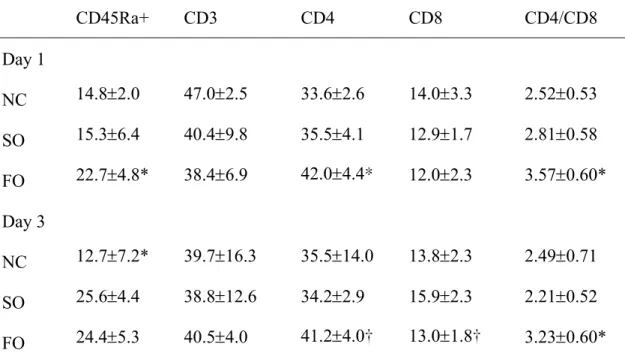
surgery. The CD8+ proportion in the SO group was higher than that of the FO group 3 d after surgery. The FO group had a higher CD4+ proportion and CD4+/CD8+ ratio than those of the SO and NC groups postoperatively. The CD45Ra+ proportion increased 3 d after surgery, regardless of whether the FO or SO emulsion was infused. The FO group had a higher CD45Ra+ proportion than the NC and SO groups at postoperative day 1 (Table 2).
Compared with the NC group, the intracellular IFN-γ distribution increased in the experimental groups after the gastrectomy. Lymphocyte IFN-γ expression in the FO group was even higher than that of the SO group on postoperative days. Although the FO group tended to have lower lymphocyte IL-4 levels after surgery, there was no significant difference in IL-4 levels among the 3 groups postoperatively (Table 3).
Plasma concentrations of ICAM-1 in the SO group were higher than the NC and the FO groups on postoperative day 1. There were no differences in plasma ICAM-1 levels among the 3 groups 3 d after surgery (Table 4). Leukocyte CD11a/CD18 expressions in the SO group were higher than the NC group, whereas there were no difference in CD11a/CD18 between the FO and NC groups after surgery. The expressions of CD11b/CD18 were higher in the experimental groups after the operation. Leukocyte CD11a/CD18 and CD11b/CD18 expressions in the FO group were significantly lower than those in the SO group on postoperative day 3 (Table 4).
Peritoneal macrophage phagocytic activities were significantly higher in the FO group than in the NC group, whereas there were no differences among the SO and NC groups on postoperative day 3. There were no differences in the phagocytic activities of blood PMNs among all groups (Fig 1A, 1B).
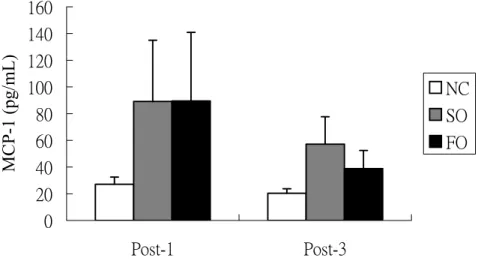
MCP-1 levels in PLF were higher in the experimental groups than the NC group after gastrectomy. There were no differences in MCP-1 between the SO and FO groups 1 d after surgery, however, MCP-1 levels were significantly lower in the FO group than in the SO group 3 d after surgery (Fig. 2).
(四)討論
This investigation showed that administration of TPN containing FO had a few effects on aspects of immune response which were not observed with the SO-based TPN. Previous studies showed that a significant decrease in T lymphocyte and CD4 cell numbers (22,23) and a shift from a Th1- to a Th2-type response occurs during surgical stress (2-4). In order to understand the effects of n-3 FA on the changes of systemic lymphocyte subpopulation in a surgical condition, total B cells (CD45Ra+), total T cells (CD3+), CD4+, and CD8+ cells were evaluated. The current work demonstrated that TPN with FO resulted in a higher CD4 proportion and CD4/CD8 ratio than those in the SO and NC groups after surgery. This result may indicate that TPN with FO did not result in immunosuppression during major abdominal surgery. Our results are comparable to those of a report by Furukawa et al. (24), who also found that parenterally infused n-3 FA reduced rather than increased stress-induced immunosuppression in surgical patients.
In this study, we directly measured intracellular IFN-γ and IL-4 productions to investigate the effect of FO on the Th1/Th2-type response during surgery. IFN-γ and IL-2 are produced by Th1 lymphocytes. Th1 cytokines enhance cell-mediated immunity. IL-4 and IL-10 are Th2 cytokines that enhance humoral immunity. The effects of Th1 and Th2 lymphocytes are counter-regulatory (25,26). Since rats in the NC group also received a laparotomy, we did not observe a significant difference in IL-4 distributions between the NC group and the groups which underwent a gastrectomy. However, higher lymphocyte IFN-γ expression in the FO group was seen than that of the SO group on postoperative days. This finding may indicate that FO administration resulted in susceptibility to a Th1 response after surgery and may have benefits on enhancing cellular immunity. This result is consistent with a report by Schauder et al. (23), who found that Th1 cytokine IL-2 production by lymphocytes was significantly augmented following infusion of FO-containing TPN after surgery. Lanza-Jacoby et al. (27) also reported that administering a FO parenteral diet prevented the sepsis-induced suppression of Th1 cytokine release.
A report by Cukier et al. (28) found that lipid TPN supplemented with fish oil emulsion increased liver and lung macrophage markers and phagocytosis. An animal study also showed
that parenteral nutrition providing n-3 FA improved bacterial clearance in rabbits injected with
Escherichia coli (29). In this study, we found that compared with the NC group, the phagocytic
activity of peritoneal macrophages was higher in the FO group 3 d after surgery, whereas no differences in the phagocytic activities of blood PMN among the 3 groups were found on postoperative days. This finding indicated that FO administration enhances macrophage phagocytic activity at the site of injury. The effect of FO on phagocytic cells in the systemic circulation was not obvious. PMN are potent inflammatory cells, and the total number of circulating PMN can be induced by acute infection and endotoxin (30). Since the operation of gastrectomy was performed in an aseptic condition, it is possible that the operation was successful and the rats were free of infection in this experiment that causes a systemic phagocytosis.
Trauma and surgical injury result in inflammatory reaction and stimulate the production of a variety of endogenous mediators. In this study, we did not measure the pro-inflammatory cytokines, because previous report by our laboratory had shown that these cytokines in plasma were not detectable after gastrectomy (31). Adhesive interactions between leukocytes and cellular or extracellular components of tissue are involved in inflammatory or immunological response mechanisms. Members of the immunoglobulin family of adhesion molecules such as ICAM-1 and its ligands (CD11a/CD18 and CD11b/CD18) are important mediators of host defense localized in the earliest lesions of inflammation (17,18). CD11a and CD11b are members of the leukocyte adhesion molecules β2 integrin and are thought to play central roles in
mediating the firm adhesion of leukocytes to endothelial cells. Excessive expression of these intergins may induce an inflammatory response and tissue injury (17,18). In vitro studies showed that endothelial cells with n-3 FAs inhibited cytokine-induced expression of adhesion molecules (10). In this study, we observed that plasma concentrations of soluble ICAM-1 were significantly higher in the SO group than in the NC and FO groups 1 day after surgery. Leukocyte CD11a/CD18 and CD11b/CD18 expressions in the FO group were lower than the SO group on postoperative day 3. The findings indicate that CAM-mediated cell interactions may be attenuated when FO is administered in a surgical condition.
MCP-1 is a chemotactic and activating factor for mononuclear phagocytes. MCP-1 is involved in the recruitment of peripheral blood leukocytes to the peritoneal cavity (32,33). A previous study showed that serum MCP-1 levels are raised in septic patients and are even higher in those with severe sepsis (19). In this study, we observed that MCP-1 levels in PLF were higher in both groups after the gastrectomy than in the NC group, and the peritoneal macrophage MCP-1 production was lower in the FO group than in the SO group 3 d after surgery. This finding may indicate that monocytes were recruited to the site of injury after surgery, and FO administration attenuated the inflammatory response induced by surgery. An in vitro study by Li et al. (34) found that both EPA and DHA decreased lipopolysaccharide-induced NF-κB activation and MCP-1 expression in a human tubular cell line. NF-κB is a nuclear transcription factor responsible for many inflammatory mediator expressions (35). Determining whether fish oil infusion downregulates NF-κB and thus ameliorates the inflammatory reaction and modulates the immune response is under investigation in our laboratory.
In summary, this study showed that parenterally infused fish oil did not result in immunosuppression. In addition, n-3 FA supplementation promotes lymphocyte Th1 cytokine production, enhances peritoneal macrophage phagocytic activity and reduced leukocyte adhesion molecule expressions in rats with total gastrectomy. Parenteral n-3 fatty acids may be of benefits for subjects undergoing major abdominal surgery.
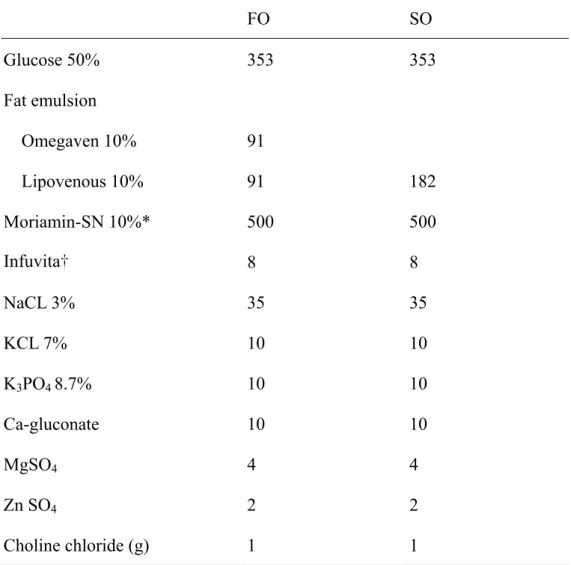
Table 1. Composition of the TPN solution (mL/L) FO SO Glucose 50% 353 353 Fat emulsion Omegaven 10% 91 Lipovenous 10% 91 182 Moriamin-SN 10%* 500 500 Infuvita 8 8 NaCL 3% KCL 7% K3PO4 8.7% Ca-gluconate MgSO4 Zn SO4 35 10 10 10 4 2 35 10 10 10 4 2 Choline chloride (g) 1 1 * From Chinese Pharmaceuticals, Taipei, Taiwan.
Contents (mg/dL): Leu 1250, Ile 560, Lys acetate 1240, Met 350, Phe 935, Thr 650, Trp 130, Val 450, Ala 620, Arg 790, Asp 380, Cys 100, Glu 650, His 600, Pro 330, Ser 220, Tyr 35, and aminoacetic acid (Gly) 1570.
From Yu-Liang Pharmaceuticals, Taoyuan, Taiwan.
Contents per milliliter: ascorbic acid 20 mg, vitamin A 660 IU, ergocalciferol 40 IU, thiamine HCl 0.6 mg, riboflavin 0.72 mg, niacinamide 8 mg, pyridoxine HCl 0.8 mg, D-panthenol 3 mg, dl-α-tocopheryl acetate 2 mg, biotin 12 ug, folic acid 80 ug, and cyanocobalamin 1 ug.
Table 2. Distribution of blood CD45Ra+, CD3, CD4, and CD8 lymphocytes (%) among the normal control (NC) and experimental groups 1 and 3 d after the operation
CD45Ra+ CD3 CD4 CD8 CD4/CD8 Day 1 NC 14.8±2.0 47.0±2.5 33.6±2.6 14.0±3.3 2.52±0.53 SO 15.3±6.4 40.4±9.8 35.5±4.1 12.9±1.7 2.81±0.58 FO 22.7±4.8* 38.4±6.9 42.0±4.4* 12.0±2.3 3.57±0.60* Day 3 NC 12.7±7.2* 39.7±16.3 35.5±14.0 13.8±2.3 2.49±0.71 SO 25.6±4.4 38.8±12.6 34.2±2.9 15.9±2.3 2.21±0.52 FO 24.4±5.3 40.5±4.0 41.2±4.0 13.0±1.8 3.23±0.60* *Significantly different from the other 2 groups at the same postoperative day. Significantly different from the SO group at the same postoperative day.
Table 3. Distributions of intracellular IFN-γ and IL-4 expressions (%) among the normal control (NC) and experimental groups 1 and 3 d after the surgery IFN-γ IL-4 Day 1 NC 19.8±5.6* 1.63±1.18 SO 24.5±5.2 1.50±0.43 FO 31.9±4.1 1.04±0.21 Day 3 NC 19.3±2.0* 1.01±0.90 SO 24.7±3.7 1.07±0.24 FO 38.1±3.2 0.87±0.05
*Significantly different from the SO and FO groups at the same postoperative day.
Table 4. Plasma intracellular adhesion molecule (ICAM)-1 concentrations and leukocyte CD11a/CD18 and CD11b/CD18 expressions among the normal control (NC) and experimental groups 1 and 3 days after gastrectomy
ICAM-1 CD11a CD11b ng/ml % Day 1 NC 637.3±95.7 9.66±4.03 2.06±1.58* SO 1009.2±194.4* 17.01±5.18 24.55±13.99 FO 751.9±48.7 12.7±2.12 23.81±3.91 Day 3 NC 1029.2±298.5 8.35±1.06 6.60±0.71* SO 1115.0±147.3 17.90±5.28* 18.12±3.56 FO 1144.3±280.1 11.01±1.47 12.44±2.48 *Significantly different from the other 2 groups at the same postoperative day. Significantly different from the SO group at the same postoperative day.
A) 0 2000 4000 6000 8000 10000 12000 14000 16000 18000 20000 Post-1 Post-3 F lu or es cei n ( E x=485 nm , E m =535 nm ) NC SO FO * B) 0 20 40 60 80 100 Post-1 Post-3 P ercent (%) NC SO FO
Fig. 1. Phagocytic activity of peritoneal macrophages and blood neutrophils 1 and 3 d after a sham operation or gastrectomy. A) phagocytic activity of peritoneal macrophages measured by phagocytosis assay and read in the fluorescence plate reader using 480 nm for excitation and 520 nm for emission. * p < 0.05 vs. NC group at post-operative day 3. B) phagocytic activity of blood neutrophils measured by flow cytometry.
0 20 40 60 80 100 120 140 160 Post-1 Post-3 MCP-1 (pg/mL) NC SO FO
Fig. 2. Monocyte chemotactic protein (MCP)-1 levels in peritoneal lavage fluid 1 and 3 d after a sham operation or gastrectomy. *Significant difference from the SO and FO groups at the same postoperative day. Significant difference from the FO group at postoperative day 3.
(四)計畫成果自評部分
本計畫均遵照當初之實驗設計進行,且結果已被Shock 雜誌接受。
REFERENCES
1. Braga M, Gianotti L, Andrea V, Andrea C, Pietro B, Valerio DC: Artificial nutrition after major abdominal surgery: impact of route of administration and composition of the diet. Crit
Care Med 26:24-30, 1998.
2. Slade MS, Simmons RL, Yunis E, Greenberg LJ: Immunosuppression after major surgery in normal patients. Surgery 78:363-372, 1975.
3. Walton B: Effects of anaesthesia and surgery on immune status. J Anesth 51:37-43, 1979. 4. Decker D, Schondorf M, Bildlingmaier F, Hirner A, von Ruecker AA: Surgical stress
induces a shift in the type-1/type-2 T-helper cell balance, suggesting down-regulation of cell-mediated and up-regulation of antibody-mediated immunity commensurate to the trauma. Surgery 119:316-325, 1996.
5. Grbic JT, Mannick JA, Gough DB, Rodrick ML: The role of prostaglandin E2 in immune
suppression following injury. Ann Surg 214:253-262, 1991.
6. Choudhry MA, Ahmad S, Sayeed MM: Role of Ca2+ in prostaglandin E2-induced T
lymphocyte proliferative suppression in sepsis. Infect Immun 63:3101-3105, 1995.
7. Harris WS: Fish oils and plasma lipid and lipoprotein metabolism in humans: a critical review. J Lipid Res 30:785-807, 1989.
8. Grimm H, Mayer K, Mayser P, Eigenbordt E: regulatory potential of n-3 fatty acids in immunological and inflammatory process. Br J Nutr 87:S59-67, 2002.
9. McCann ME, Moore JN, Carrick JB, Barton MH: Effect of intravenous infusion of omega-3 and omega-6 lipid emulsions on equine monocyte fatty acid composition and inflammatory mediator production in vitro. Shock 14:222-228, 2000.
Lipids 31:557-563, 1996.
11. Ertel W, Keel M, Steckholzer U, Ungethum U, Trentz O: Interleukin-10 attenuates the release of proinflammatory cytokines but depresses splenocyte functions in murine endotoxemia. Arch Surg 131:51-56, 1996.
12. Chandrasekar B, Fernandes G: Decreased proinflammatory cytokines and increased antioxidant enzyme gene expression by n-3 fatty acids in murine lupus nephritis. Biochem
Biophys Res Commun 200:893-898, 1994.
13. Xi S, Cohen D, Chen L: Effects of fish oil on cytokines and immune functions of mice with murine AIDS. J Lipid Res 39:1677-1687, 1998.
14. Ertel W, Morrison MH, Ayala A, Chaudry IH: Modulation of macrophage membrane phospholipids by n-3 polyunsaturated fatty acids increases interleukin-1 release and prevents suppression of cellular immunity following hemmorragic shock. Arch Surg 128:15-20, 1993. 15. Virella G, Fourspring K, Hyman B, Haskill-Stroud R, Long L, Virella I, La Via M, Gross AJ, Lopes-Virella M: Immunosuppressive effects of fish oil in normal human volunteers: correlation with in vitro effects of eicosapentaenoic acid in human lymphocytes. Clin
Immunol Immunopathol 61:161-176, 1991.
16. Endres S, Meydani SN, Ghorbani R, Schindler R, Dinarello CA: Dietary supplementation with n-3 fatty acids suppresses interleukin-2 production and mononuclear cell proliferatin. J
Leukoc Biol 54:599-603, 1993.
17. Henderson RB, Lim LHK, Tessier PA, Gavins FNE, Mathies M, Perretti M, Hogg N: The use of lymphocyte function-associated antigen (LFA)-1-deficient mice to determine the role of LFA-1, Mac-1 and α4 integrin in the inflammatory response of neutrophils. J Exp Med 194:219-226, 2001.
18. Albelda SM, Smith CW, Ward PA: Adhesion molecules and inflammatory injury. FASEB J 8:504-512, 1994.
19. Bossink AW, Paemen L, Jansen PM, Hack CE, Thijs LG, Van Damme J: Plasma levels of the chemokines monocyte chemotactic proteins-1 and –2 are elevated in human sepsis. Blood 86:3841-3847, 1995.
20. Ohta A, Motohashi Y, Sakai K, Hirayama M, Adachi T, Sakuma K: Dietary fructooligosaccharides increase calcium absorption and levels of mucosal calbindin-D9k in the large intestine of gastrectomized rats. Scand J Gastroenterol 33:1062-1068, 1998.
21. Böhmer RH, Trinkle LS, Staneck JL: Dose effects of LPS on neutrophils in a whole blood flow cytometric assay of phagocytosis and oxidative burst. Cytometry 13:525-531, 1992. 22. Lennard TWJ, Shenton BK, Borozotta A, Donnelly PK, White M, Gerrit LM, Proud G,
Taylor RMR: The influence of surgical operations on components of the human immune system. Br J Surg 72:771-776, 1985.
23. Schauder P, Rohn U, Schafer G, Korff G, Schenk HD: Impact of fish oil-enriched total parenteral nutrition on DNA synthesis, cytokine release and receptor expression by lymphocytes in the postoperative period. Br J Nutr 87:S103-110, 2002.
24. Furukawa K, Tashiro T, Yamamori H, Tagaki K, Morishima Y, Sugiura T, Otsubo Y, Hayashi N, Itabashi T, Sano W, Toyoda Y, Heymsfield S, Nitta H, Nakajma N: Effects of soybean oil emulsion and eicosapentaenoic acid on stress response and immune function after severely stressful operation. Ann Surg 229:255-261, 1999.
25. DiPiro JT: Cytokine networks with infection: mycobacterial infections, leishmaniasis, human immunodeficiency virus infection, and sepsis. Pharmacotherapy 17:205-223, 1997. 26. Parronchi P, DeCarli M, Manetti R, Simonelli C, Sampognaro S, Piccinni MP, Macchia D,
Maggi E, Del Prete G, Romagnani S: IL-4 and IFN (alpha and gamma) exert opposite regulatory effects on the development of cytolytic potential of Th1 or Th2 human T cell clones. J Immunol 149:2977-2983, 1992.
27. Lanza-Jacoby S, Flynn JT, Miller S: parenteral supplementation with a fish oil emulsion prolongs survival and improves rat lymphocyte function during sepsis. Nutrition 17:112-116, 2001.
28. Cukier C, Waitzberg DL, Logullo AF, Bacchi CE, Trabassos VH, Torrinhas RS, Soares SR, Saldiva PH, Oliveira TS, Heymsfield S: Lipid and lipid-free total parenteral nutrition: differential effects on macrophage phagocytosis in rats. Nutrition 15:885-889, 1999.
29. Kelbel I, Koch T, Prechtl A, Heller A, Schlotzer E, Schiefer HG, Neuhof H: Effects of parenteral application of fish oil versus soy oil emulsions on bacterial clearance functions.
Infus Ther Transfus 26:226-232, 1999.
30. Ringer TV, Zimmermann JJ: Inflammatory host responses in sepsis. Crit Care Clin 8:163-189, 1992.
31. Yeh CL, Lee CH, Chen SC, Hou YC, Yeh SL: Effects of arginine-containing total parenteral nutrition on nitrogen balance and phagocytic activity in rats undergoing a partial gastrectomy. Br J Nutr 93:267-272, 2005.
32. Ajuebor MN, Flower RJ, Hannon R, Christie M, Bowers K, Verity A, Perretti M: Endogenous monocyte chemoattractant protein-1 recruits monocytes in the zymosan peritonitis model. J Leukoc Biol 63:108-116, 1998.
33. Matsukawa A, Hogaboam CM, Lukacs NW, Lincoln PM, Strieter RM, Kunkel SL: Endogenous monocyte chemoattractant protein-1 protect mice in a model of acute septic peritonitis: cross-talk between MCP-1 and leukotriene B4. J Immunol 163:6148-6154, 1999. 34. Li H, Ruan XZ, Powis SH, Fernando R, Mon WY, Wheeler DC, Moorhead JF, Varghese Z:
EPA and DHA reduce LPS-induced inflammation responses in HK-2 cells: evidence for a PPAR-gamma-dependent mechanism. Kidney Int 67:867-874, 2005.
35. Blackwell TS, Christman JW: The role of nuclear factor κB in cytokine gene regulation. Am