SHRIMP ZIRCON AGE CONSTRAINTS FROM THE LARSEMANN HILLS REGION, PRYDZ BAY, FOR A LATE MESOPROTEROZOIC TO
EARLY NEOPROTEROZOIC TECTONO-THERMAL EVENT IN EAST ANTARCTICA
YANBIN WANG*†, DUNYI LIU*, SUN-LIN CHUNG**, LAIXI TONG***,
and LIUDONG REN*
ABSTRACT. This paper reports a geochronological study of granulite-facies rocks
from the Larsemann Hills of Prydz Bay, East Antarctica. SHRIMP zircon ages were obtained for a total of 14 samples that cover various rock types including felsic gneiss, mafic gneiss, paragneiss, enderbite, granitic gneiss and leucogneiss. These age results, combined with zircon geochemical data and cathodoluminescence images, enable us to explore the morphological complexity in zircons that record polytectonic events. Features of multiple age zoning, for example, were observed in zircon separates from three felsic gneiss samples studied, which contain magmatic cores of ca. 1.13 Ga and metamorphic mantles and rims of ca. 1.0 and 0.53 Ga, respectively. This suggests a period of magmatism and crust formation in the late Mesoproterozoic and two subsequent phases of high-grade metamorphism during the early Neoproterozoic and early Paleozoic, respectively. Similar phenomena of zircon overgrowth were also observed in other rock types. Although early Paleozoic tectonic activity has been considered as most significant in Antarctic crustal evolution, our study provides the first convincing age evidence for the existence of a Prydz Bay late Mesoproterozoic mobile belt. The ca. 1.0 Ga metamorphic record preserved in diverse rocks from the study area furthermore supports the proposal of a continuous circum East Antarctica late Mesoproterozoic (Grenville-age) orogenic belt. Within this framework, the Prydz Bay orogen is proposed to have been located in the central part of the Rodinia assembly that brought the Eastern Ghats of India together with Antarctica at ca. 1.0 Ga.
introduction
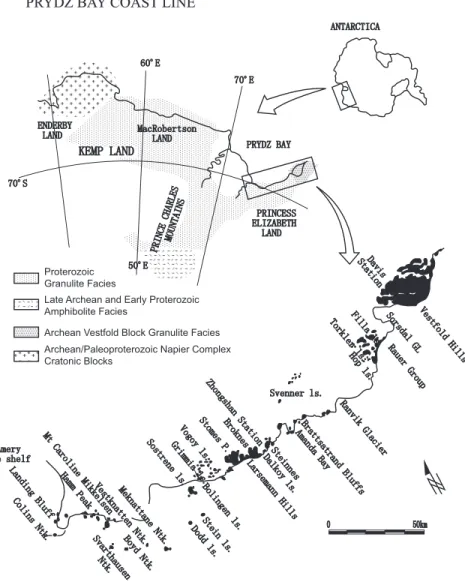
Granulite-facies rocks in the Larsemann Hills, Prydz Bay (fig. 1), represent an important suite for investigating the development of high-grade metamorphic terrains in East Antarctica. The tectono-thermal event that produced these granulite-facies rocks has long been considered to be of late Mesoproterozoic age (Tingey, 1981, 1982, 1991; Black and others, 1987; Stu¨ we and others, 1989), based essentially on a Rb-Sr whole-rock isochron age of 1050⫾ 109 Ma (Tingey, 1981), obtained on felsic gneisses in the Rauer Group of Filla Island, Prydz Bay (fig. 1). This event was henceforth termed the 1100 Ma event, and the idea of a so-called “Prydz Bay Grenville-age mobile belt” proposed (see Fitzsimons, 2000, for review). These, combined with the widespread occurrence of ca. 1.1 to 1.0 Ga records over East Antarctica, eventually led to the inference of a “Circum-East Antarctic mobile zone” that may be linked with metamor-phic belts of similar age in southern India, part of East Africa, Sri Lanka, and Australia to form the main suture in a Rodinia configuration. (for example, Moores, 1991; Dalziel, 1991; Hoffman, 1991; Powell and others, 1993; Torsvik, 2003). However, more recent studies cast serious doubt on the earlier interpretations by showing time constraints that suggest the region to have experienced Pan-African granulite-facies metamorphism in the early Paleozoic (ca. 500 Ma) (Zhao and others, 1992, 1995, 1997, 2003; Hensen and Zhou, 1995, 1997; Carson and others, 1996; Fitzsimons and others,
*Beijing SHRIMP Center, Institute of Geology, Chinese Academy of Geological Sciences, 26 Baiwan-zhuang Road, Beijing, 100037, China
**Department of Geosciences, National Taiwan University, Taipei 10699, Taiwan ***Institute of Earth Sciences, Academia Sinica, Taipei 115, Taiwan
†Corresponding author: [email protected]
1997), and led to the widely accepted view that the Pan-African event played a significant role in the tectonic evolution of the East Antarctic Shield. Given the fact that the paucity of precise age data hinders geologic correlations and understanding of the tectonic evolution, we conducted a detailed zircon U-Pb age study of metamorphic rocks from the Larsemann Hills and adjacent area by using the sensitive high-resolution ion microprobe (SHRIMP) method. In this paper, we present and discuss SHRIMP zircon ages from fourteen samples collected from the Larsemann Hills and adjacent areas. These include three samples of felsic gneiss (samples 9926-5, 9921-14 and K217-3), four mafic gneiss samples (samples 93122-15, F129-1, K217-4 and V218-5,), three Grt-Sill-Br-gneiss samples (samples 981227-1, S226-4 and V218-4), and an enderbite (sample 981221-2), two grantic gneiss (samples F127-4 and S204-1), and one leucogneiss (sample 981230-1).
LOCATION MAP OF THE PRYDZ BAY COAST LINE LOCATION MAP OF THE PRYDZ BAY COAST LINE
Proterozoic Granulite Facies
Late Archean and Early Proterozoic Amphibolite Facies
Archean Vestfold Block Granulite Facies Archean/Paleoproterozoic Napier Complex Cratonic Blocks
Fig. 1. Location and regional geological setting of the Larsemann Hills, East Antarctica (modified from Stu¨ we and others, 1989).
Our results constrain the ages of protolith formation as well as subsequent metamorphism and allow us to refine the temporal framework of magmatic and metamorphic processes in the region. Along with reporting precise zircon ages supportive of the notion of widespread early Neoproterozoic tectono-thermal event, broader implications for the tectonic evolution of East Antarctica are also discussed in this paper.
regional geology and previous studies
The Larsemann Hills and adjacent areas, from the Vo¨goy Island, northern Bolingen Islands to the Steinnes Peninsula (figs. 1 and 2), consist of upper amphibole- to granulite-facies metamorphic rocks. These areas are dominated by two major lithologi-cal associations, (1) composite mafic to felsic orthogneiss complexes, and (2) metasedi-mentary sequences comprising metapelite, semipelite, psammite, felsic paragneiss and metaquartzite. The rocks are extensively migmatized and/or intruded by magmatic rocks including granitic gneiss, leucogneiss, enderbite, granite and pegmatite (Fitzsi-mons and Harley, 1991; Dirks and Hand, 1995; Carson and others, 1995; Fitzsi(Fitzsi-mons and others, 1997).
Peak metamorphism in the region has been estimated at 7 kbar and 800 to 850 °C (Wang and others, 1994; Carson and others, 1995), with the post-peak evolution characterized by decompression. In some garnet-bearing mafic granulites from Søstrene Island, two-stage decompression phenomena were observed so that two phases of high-grade metamorphism are inferred and the earlier one’s P-T condition were estimated to be ⬃10 kbar and 980 °C (Thost and others, 1991). Such high P-T conditions were also reported by: (1) Ren and others (1992) for gneiss from the Larsemann Hills (9 kbar and 850 °C), (2) Dirks and Hand (1995) for the possible presence of sillimantite pseudomorphs after kyanite in metapelite from north Bollingen Islands (⬎10 kbar and 980 °C), and (3) Tong and Liu (1997) for mafic granulite from Larsemann Hills (9.5 kbar and 870 °C).
Sheraton and others (1984) reported Rb-Sr and Sm-Nd whole-rock isotopic data for various rock samples from the Prydz Bay area which include: (1) Rb-Sr whole-rock isochrons of 1600⫹800/-340 Ma for orthopyroxene gneisses from the Rauer Group,
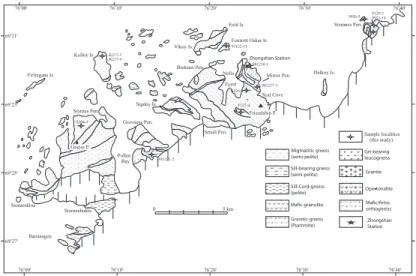
Fig. 2. Simplified geologic map of the Larsemann Hills and sample localities (modified from Stu¨ we and others, 1989; Carson and others, 1995).
1360 ⫹330/⫺190 Ma for garnet gneisses, 560 ⫾ 70 Ma for metapelites, and (2) a Sm-Nd whole-rock isochron of 1470⫾ 600 Ma for six metapelites. More recently, Zhao and others (1995) reported Nd TDMmodel ages of 2200 to 700 Ma for seven samples of
gneisses and granitoids from Larsemann Hills. Carson and others (1995, 1997) argued that the mafic-felsic composite orthogneiss from Larsemann Hills and adjacent areas may represent an Archean/Paleoproterozoic basement complex, based on its lithologi-cal similarity with mafic-fesic orthogneisses from the southeastern Rauer Group and the Berrneset Peninsula, dated to be of Archean and Paleoproterozoic ages, respec-tively (Sheraton and others, 1984). Zircon dating from the western and northern Rauer Group (Kinny and others, 1993) identified a 1000 Ma event. Subsequently, the basement complex underwent high P-T metamorphism during a late Mesoproterozoic tectono-thermal event, based on a Rb-Sr isochron age of 1050⫾ 109 Ma reported by Tingey (1981), and thus had been considered as part of the extensive high-grade metamorphic complex of East Antarctica (Tingey, 1982, 1991; Black and others, 1987; Stu¨ we and others, 1989).
However, numerous early Paleozoic (ca. 550 – 500 Ma), rather than early Neoproterozoic, ages were obtained for mafic-felsic gneiss and paragneiss from the region (Zhao and others, 1992, 1995; Hensen and Zhou, 1995; Fitzsimons and others, 1997), which led to the suggestion that the granulite-facies metamorphism should have occurred at ca. 0.5 Ga. Early Paleozoic metamorphism in the Prydz Bay region has furthermore been related to continental collision, followed by extensional collapse (Fitzsimons and Harley, 1991; Fitzsimons, 1991, 1996, 2000; Thost and others, 1991). In such a framework, several ca. 1200 to 600 Ma cores of zircon grains in the Progress granite and a paragneiss from the Larsemann Hills (Zhao and others, 1995; Carson and others, 1995), dated by SHRIMP and Pb-Pb evaporation methods, respectively, were interpreted as reflecting various degrees of inheritance from their sedimentary source rocks.
The prevailing early Paleozoic record, however, does not preclude the existence of an earlier high-grade metamorphism, although the latter may have been over-printed and/or obscured by the former. “Relicts” of older events observed include: (1) a whole-rock Sm-Nd isochron age of ca. 1.0 Ga for garnet-bearing mafic granulites from the Søstrene Island, Prydz Bay (Hensen and Zhou, 1995); (2) upper Concordia intercept ages of 1106⫾ 11 and 1174 ⫾ 450 Ma for zircons and monazites, respectively, from garnet-biotite-bearing quartzite from the Stornes Peninsula (Zhang and others, 1996); (3) a U-Pb zircon age of 772 ⫹71/-48 Ma for a mafic granulite from the northern Mirror Peninsula (Tong and others, 1995); (4) two40Ar-39Ar plateau ages of 1034⫾ 14 and 554 ⫾ 26 Ma for hornblende in mafic gneiss from Kolloy Island; two
40
Ar-39Ar plateau ages of 1059⫾ 3 and 555 ⫾ 16 Ma for orthopyroxene in mafic gneiss from Stornesbukta; and a 40Ar-39Ar plateau age of 774 ⫾ 3 Ma for plagioclase in a garnet-plagioclase-bearing amphibolite from Kolloy Island (Tong and others, 1998, 2002).
samples and analytical methods
14 representative samples from the major rock units were selected for zircon U-Pb dating. These include: (1) 3 felsic gneisses, (2) 4 mafic gneisses, (3) 3 metasedmentary rocks, (4) an enderbite, (5) 2 granitic gneisses, and (6) a leucogneiss. Sample localities are shown in figure 2, with sample descriptions being given in the Appendix.
shrimp zircon analyses
Zircons were separated using standard heavy liquid and magnetic techniques. Grains were hand-picked and selected on the basis of optical clarity and lack of internal fractures. Zircon grains were mounted in an epoxy disk together with grains of the Sri Lankan reference zircon SL-13 for U concentration determination (Williams, 1998)
and the Temora zircon standard (Black and others, 2003) for U-Pb age calibration. Zircon grains were sectioned approximately in half and polished, and images were obtained by optical microscopy and cathodoluminenscence (CL) on a scanning electron microscope. With CL images, it is possible to distinguish the internal structure of zircons, including igneous and metamorphic crystallization textures, resorption surfaces, and overgrowths. Analyses were carried out on the SHRIMP II ion micro-probe in the Beijing SHRIMP Center, Institute of Geology, Chinese Academy of Geological Sciences. The analytical methods are given by Williams (1998). Each analysis consisted of seven scans through the mass range, using a spot size of⬃20 m. For grains with fine-scale internal structure, a smaller spot size of⬃10 to 15 m was used. U/Pb ratios were calibrated relative to 417 Ma Temora zircons (Black and others, 2003), with data reduction using the SQUID Excel Macro software by Ludwig (2001). Common Pb contribution was corrected using the measured 204Pb and modal
com-mon Pb composition (Stacey and Kramers, 1975). Uncertainties in the measured ratios are given at the one sigma level, whereas weighted mean age uncertainties are reported at two sigma or 95 percent confidence level. Calculated ages are based on weighted mean206Pb/238U and207Pb/206Pb isotopic ratios for near- concordant zircons (Ireland and Gibson, 1998). 206Pb/238U ages are reported for zircons younger than 800, whereas the207Pb/206Pb ages are presented for zircons older than 800 Ma.
zircon ages
The description of field relationships of representative samples are given in the Appendix.
1. felsic gneisses
1.1. Sample 9926-5 (plagioclase-orthopyroxene gneiss, Steinnes Peninsula).—The sample
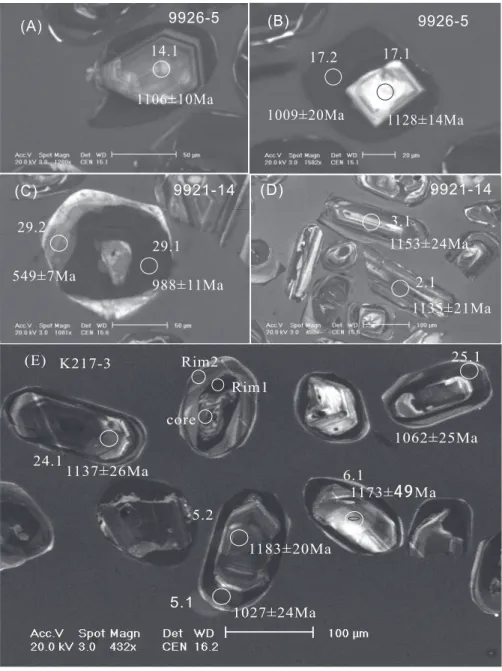
contains small (60⫺ 120 m), yellowish, irregularly shaped, and mostly rounded to stubby zircons with distinct core-rim structures. CL images show that most zircons have complex internal structures (figs. 3A and 3B). The cores show magmatic growth zoning with highly variable U concentrations from 185 to 2,462 ppm and Th/U ratios from 0.20 to 1.25. Some zircons have two generations of overgrowth as manifested by (1) an inner rim that has high U concentrations of 1,161 to 2,183 ppm and Th/U ratios⬍ 0.39, and (2) an outer rim that has lower U concentrations (678–1,012 ppm) and Th/U ratios (⬍ 0.17).
Twenty-three spots on 18 zircons were analyzed (table 1). Eight core analyses are concordant (fig. 4A) and yielded a weighted mean207Pb/206Pb age of 1119⫾ 13 Ma (MSWD⫽ 2.4). Slightly discordant cores suggest isotopic disturbance. The above age is interpreted to date crystallization of the gneiss protolith. Three analyses of the inner rims (rim 1) are also concordant (fig. 4A) and yielded a weighted mean207Pb/206Pb age of 997⫾ 13 Ma (MSWD⫽ 0.80). Four spots were measured on the outer rims (rim 2). Three spots (10.1, 10.2, 10.3) are structureless in their CL images and gave variable
206
Pb/238U ages of 671⫾ 11 Ma (1, U⫽ 905 ppm, Th/U⫽ 0.06), 579 ⫾ 2 Ma (1, U⫽
921 ppm, Th/U⫽ 0.14) and 546 ⫾ 7 Ma (1, U⫽ 1012 ppm, Th/U⫽ 0.17),
respectively, whereas the fourth spot (analysis 4.2) gave a206Pb/238U age of 667⫾ 13 Ma (1, U⫽ 678 ppm, Th/U⫽ 0.11). Some outer rims (for example, grain 14, fig. 3A) were too narrow for SHRIMP analysis. On figure 4A there is a large spread from 1140 to ca. 980 Ma, and the selected inner rims (rim 1) also spread either side of 1000 Ma, suggesting profound disturbance at 530 Ma.
In summary, these data indicate a complex history for felsic gneiss sample 9926-5 whose zircons show evidence of magmatism at 1119 ⫾ 13 Ma, suggesting primary crystallization of the gneiss protolith from an igneous melt. The rock was subsequently overprinted during two phases of high-grade metamorphism with zircon growth at
ca. 1000 Ma and ca. 546 Ma. The oldest metamorphic rim at ca. 1000 Ma is probably related to metamorphism associated with the older D1deformation (Fitzsimons and
Harley, 1991), whereas the outer rim dated at ca. 546 Ma is likely to be related to late
Fig. 3. CL images of dominant zircon morphologies from felsic gneiss samples. Numbered ellipsoids indicate SHRIMP spots. (A) and (B) Images of inherited magmatic cores with a small-volume isometric high-U zircon overgrowth. (C) Grain 29 shows a core and a complex overgrowth yielding rim1 (ca. 1.0 Ga) and rim2 (0.55 Ga) ages. (D) Grain 3 shows interior oscillatory growth banding of a euhedral igneous crystal formed at about 1.15 Ga, truncated by a curved resorption surface, upon which texturally homogeneous metamorphic overgrowth possibly formed at ca. 1.0 Ga. (E) Cathodoluminescence images of sample K217-3. Highly luminescent zircon cores are of magmatic origin. Cores are overgrown by two generations of zircon rims. The first rim has an age of ca. 1.0 Ga and is thought to reflect Grenville-age metamorphism, the second rim probably reflects 0.5 Ga high-grade reworking of the area.
Table 1 Summary of SHRIMP U-Pb zircon results for sample 9926-5, Felsic gneiss, Penguin Island, near Steinnes Peninsula R ad ioge n ic r ati os Age (Ma ) Gra in. spot U(ppm ) T h (ppm ) T h /U 206 Pb c (% ) 206 Pb * (ppm ) 207 Pb * 206 Pb * ±% 207 Pb * 235 U ±% 206 Pb * 238 U ±% 206 Pb 238 U Age ± 207 Pb 206 Pb Age ± Di sc (% ) 1. 1 c 495 239 0. 50 0. 06 65. 7 0. 07341 0. 86 1. 562 1. 4 0. 1543 1. 1 925 9 1, 026 17 10 2. 1 c 509 438 0. 89 0. 10 75. 5 0. 07555 1. 1 1. 799 1. 3 0. 1727 0. 58 1027 6 1, 084 22 5 3. 1 c 424 327 0. 80 0. 02 69. 6 0. 07803 0. 65 2. 052 1. 1 0. 1907 0. 84 1125 9 1, 148 13 2 4. 1 c 315 204 0. 67 0. 18 44. 2 0. 07505 0. 99 1. 690 1. 1 0. 16322 0. 51 978 5 1, 071 20 9 4. 2 r2 678 70 0. 11 0. 22 63. 7 0. 06227 1. 5 0. 937 2. 5 0. 1090 2. 0 667 13 685 32 3 5. 1 r1 2183 28 0. 01 0. 04 318 0. 07253 0. 42 1. 696 0. 69 0. 16954 0. 55 1010 5 1, 001 8 -1 6. 1 c 185 117 0. 65 0. 26 29. 1 0. 07627 1. 3 1. 918 1. 4 0. 1823 0. 61 1080 6 1, 103 26 2 7. 1 c 315 225 0. 74 0. 26 45. 9 0. 07458 1. 2 1. 742 1. 6 0. 1693 1. 1 1, 008 10 1, 059 23 5 8. 1 c 253 174 0. 71 0. 15 40. 1 0. 07548 0. 97 1. 917 1. 1 0. 1842 0. 57 1, 090 6 1, 082 19 -1 9. 1 c 517 258 0. 52 0. 08 76. 3 0. 07549 0. 71 1. 788 1. 0 0. 1718 0. 74 1, 022 7 1, 082 14 6 10. 1 s 905 57 0. 06 0. 10 85. 4 0. 06275 1. 1 0. 950 2. 1 0. 1097 1. 8 671 11 700 23 4 10. 2 s 921 123 0. 14 0. 12 74. 5 0. 0632 3. 7 0. 820 3. 7 0. 09405 0. 30 579 2 717 79 19 10. 3 s 1012 162 0. 17 0. 05 76. 8 0. 06043 1. 1 0. 736 1. 7 0. 0883 1. 3 546 7 619 23 12 11. 1 c 1542 1296 0. 87 0. 01 252 0. 07705 0. 34 2. 0206 0. 44 0. 19019 0. 28 1, 122 3 1, 122 7 0 12. 1 c 1489 1246 0. 86 0. 01 241 0. 07652 0. 34 1. 984 0. 61 0. 18803 0. 51 1, 111 5 1, 109 7 0 13. 1 c 1367 1560 1. 18 0. 10 207 0. 07677 0. 40 1. 864 0. 63 0. 17608 0. 50 1, 046 5 1, 116 8 6 13. 2 r1 1161 433 0. 39 0. 14 161 0. 07193 0. 58 1. 602 1. 5 0. 1615 1. 4 965 12 985 12 2 14. 1 c 814 630 0. 80 0. 10 131 0. 07642 0. 49 1. 973 0. 68 0. 18727 0. 46 1, 107 5 1, 106 10 0 15. 1 c 763 920 1. 25 0. 09 126 0. 07868 0. 87 2. 088 0. 97 0. 19240 0. 43 1, 134 5 1, 165 17 3 16. 1 c 901 278 0. 32 -0. 02 145 0. 07486 0. 67 1. 937 0. 94 0. 1877 0. 66 1, 109 7 1, 065 14 -4 17. 1 c 807 329 0. 42 -0. 03 138 0. 07727 0. 72 2. 123 0. 80 0. 19925 0. 37 1, 171 4 1, 128 14 -4 17. 2 r1 1507 222 0. 15 -0. 02 223 0. 07283 0. 99 1. 726 1. 3 0. 1719 0. 84 1, 023 8 1, 009 20 -1 18. 1c 2462 477 0. 20 0. 09 374 0. 07547 0. 58 1. 840 1. 1 0. 1768 0. 90 1, 049 9 1, 082 12 3 Errors are 1-sigma; Pbc and Pb* indicate the common and radiogenic portions, respectively. Common Pb corrected using measured 204 Pb. For disc(%), 0% denotes a concordant analysis. Abbreviation: c, core; r1, rim 1; rim2; s, structless.
deformation (Fitzsimons and Harley, 1991; Dirks and others, 1993; Carson and others, 1995; Dirks and Hand, 1995).
1.2. Sample 9921-14 (quartz-plagioclase gneiss, Steinnes Peninsula).—Zircons from this
felsic gneiss are dominated by clear to brownish grains, ranging in size between 60 and
9926-5 Cores: 1119±13Ma MSWD=2.4 (8 analyses) Rims1, 997±13Ma MSWD=0.80 (3 analyses) Spot4.2: 667±13Ma Spot10.3: 546±7Ma (A) 207Pb/235U K217-3 Cores:1124±24Ma MSWD=2.1(12 analyses) Rims: 1031±29Ma MSWD=1.05(5 analyses) (C) 207Pb/235U 206Pb/ 238U 9921-14 Cores, 1133±12Ma MSWD=1.9 (12 analyses) Rims1, 981±13Ma MSWD=0.28, (3 analyses) Rims2, 529±8Ma MSWD=0.13, (2 analyses) (B) 207Pb/235U 206Pb/ 238U 206 Pb/ 238U
Fig. 4. A-C Concordia diagrams of SHRIMP-dated zircons. (A) Felsic gneiss 9926-5 from small Island north of Steinnes Peninsula; (B) Felsic gneiss 9921-14 from Steinnes Peninsula; (C) Felsic gneiss K217-3 from Kolloy Island. Error ellipses are 1.
250m. The zircons population consist of grains with different morphologies, showing a complete range from prismatic to spherical. Prismatic grains generally have rounded terminations, suggesting zircon dissolution during high-grade metamorphism. Vari-able degrees of rounding produced spherical grains that occur in addition to multifac-eted zircons that grew during granulite-facies metamorphism.
Cathodoluminescence (CL) images exhibit two types of internal patterns. Type 1 occurs in well rounded and multifaceted grains and is characterized by the presence of patchy zonation within inherited cores (see for example fig. 3C), surrounded by wide high-U overgrowth; small and discontinuous rims are common for this type. The grains are not homogeneous but exhibit core-mantle-rim textures with different CL intensi-ties (for example, fig. 3C). Type 2 (prismatic zircon) consists of inherited cores with oscillatory zoning surrounded by thin rims (for example, fig. 3D).
We focus on the⬃1133 Ma, ⬃981 Ma and ⬃529 Ma age groups (fig. 4B). Zircons of these age groups are distinguished by their CL images (figs. 3C and 3D). Nineteen core areas of magmatic zircons were analyzed in this study (table 2). These all have Th/U ratios in the range of 0.3 to 1.0, similar to those determined for late Mesoprotero-zoic magmatic zircons from sample 9926-5. Twelve analyses provide a weighted mean
207
Pb/206Pb age of 1133 ⫾ 12 Ma (MSWD⫽1.9). Three weakly luminescent mantle areas (rim1) yielded a weighted mean206Pb/238U age of 981⫾ 13 Ma (MSWD⫽0.28). We interpret ⬃1000 Ma as the best estimate for the age of late Mesoproterozoic metamorphism in this sample. We explain the zircon domains as the result of metamorphic recrystallization because of a lack of igneous growth features, low Th/U ratios, and general concordance at an age that cannot be produced by simple isotopic disequilibrium between the⬃1133 Ma and ⬃530 Ma events. Therefore, the ⬃1000 Ma zircon domains in this gneiss, like those in sample 9926-5, may reflect high-temperature metamorphism that was contemporaneous with spatially associated mag-matic events. Two analyses of zircon rims yielded early Paleozoic ages with a mean of 529 ⫾ 8 Ma (MSWD⫽0.13), Analysis 1.2 is very discordant, and is not further considered here.
Zircons in this gneiss reveal a multi-stage history beginning with ⬃1133 Ma magmatism, followed by⬃1000 Ma high-grade metamorphism and ⬃530 Ma metamor-phism and partial melting. The age distribution and isotopic behavior of the total zircon population resemble that of sample 9926-5 with multiple age components analyzed from discrete domains. We argue that initial⬃1133 Ma magmatism and first metamorphism may reflect the late Mesoproterozoic event at⬃1000 Ma whereas the second metamorphism may reflect the early Paleozoic event at⬃530 Ma.
1.3 Sample K217-3 (orthopyroxene-bearing felsic gneiss, Kolloy Island).—The sample
contains round and elongate, clear to honey-yellowish zircons between 100 and 200 m in length. CL imaging shows cores with magmatic zonation; these cores are surrounded, entirely or in part, by a structureless, weakly luminescent mantle (rim1) which reflects an early period of zircon growth. All grains have an outermost thin overgrowth (rim2), attributed to late resorption (fig. 3E). The magmatic cores have medium U-concentrations (264-772 ppm), whereas the metamorphic rims1 and resorbed areas are high in U. Twenty nine areas have been analyzed, with both magmatic cores and metamorphic mantles (rim1) targeted (fig. 4C and table 3). Twelve core analyses give a weighted mean 207Pb/206Pb age of 1124⫾24 Ma (MSWD⫽2.1) which is interpreted to date zircon crystallization close to the time of emplacement of the orthogneiss precursor. Five analyses of rim1 give a weighted mean
207
Pb/206Pb age of 1031 ⫾ 29 Ma (MSWD⫽1.05). One analysis from grain 5 with a metamorphic mantle yielded a concordant 207Pb/206Pb age of 1027 ⫾ 24 Ma. This metamorphic age is identical to that in samples 9926-5 and 9921-14, within error, and indicates igneous crystallization at ca. 1100 Ma, followed by resorption and new
Table 2 Summary of SHRIMP U-Pb zircon results for sample 9921-14, felsic gneiss, Steinnes Peninsula R ad ioge nic r ati os Age (Ma ) Gra in spot U(ppm ) T h (ppm ) T h /U 206 Pb c (% ) 206 Pb * (ppm ) 207 Pb * 206 Pb * ±% 207 Pb * 235 U ±% 207 Pb * 235 U ±% 206 Pb 238 U Age ± 207 Pb 206 Pb Age ± Di sc (% ) 1. 1 r 2 17 0 18 1 1. 10 0. 00 12 0. 05 92 2. 4 0. 69 6 2. 7 0. 08 53 1. 3 52 7. 7 6. 4 575 52 8 2. 1 c 28 8 25 2 0. 90 47 0. 07 75 5 1. 0 2. 04 8 1. 5 0. 19 15 1. 1 1, 13 0 11 1, 13 5 21 1 3. 1 c 15 7 12 1 0. 80 26 0. 07 82 4 1. 2 2. 05 4 1. 7 0. 19 04 1. 2 1, 12 4 12 1, 15 3 24 3 4. 1 r 1 45 4 14 0 0. 32 62 0. 07 04 3 1. 4 1. 54 1 1. 7 0. 15 87 1. 1 949. 6 9. 6 941 28 -1 5. 1 c 84 2 28 1 0. 34 0. 03 11 9 0. 07 35 3 0. 60 1. 66 0 1. 4 0. 16 37 1. 3 977 12 1, 02 9 12 5 6. 1 r 1 46 4 19 0 0. 42 0. 03 62 0. 07 17 7 0. 88 1. 54 2 1. 6 0. 15 58 1. 3 933 11 980 18 5 7. 1 c 35 5 10 5 0. 31 0. 01 53 0. 07 47 8 1. 0 1. 79 8 1. 7 0. 17 44 1. 4 1, 03 7 13 1, 06 2 21 2 8. 1 c 45 7 43 1 0. 98 0. 04 76 0. 07 71 9 0. 73 2. 06 6 1. 4 0. 19 41 1. 2 1, 14 4 12 1, 12 6 15 -2 9. 1 r 1 79 7 96 0. 12 0. 02 11 2 0. 07 14 1 0. 75 1. 61 3 1. 6 0. 16 38 1. 4 978 12 969 15 -1 10. 1 c 16 0 94 0. 60 0. 07 26 0. 07 52 1. 4 1. 97 7 2. 0 0. 19 08 1. 4 1, 12 6 14 1, 07 3 29 -5 11. 1 r 1 42 0 10 7 0. 26 --58 0. 06 94 0 1. 3 1. 53 0 1. 7 0. 15 99 1. 1 95 6. 5 9. 7 911 26 -5 12. 1 c 13 35 62 1 0. 48 --22 4 0. 07 68 2 0. 42 2. 07 0 1. 3 0. 19 54 1. 2 1, 15 1 13 1, 11 6. 5 8. 3 -3 13. 1 c 10 41 77 9 0. 77 0. 03 17 9 0. 07 84 4 0. 51 2. 15 7 1. 2 0. 19 94 1. 1 1, 17 2 12 1, 15 8 10 -1 13. 2 r 2 38 8 12 7 0. 34 0. 24 29 0. 06 01 1. 8 0. 71 1 2. 1 0. 08 58 3 1. 1 53 0. 8 5. 7 606 39 12 14. 1 r 2 47 3 13 4 0. 29 0. 06 40 0. 06 17 1 1. 5 0. 83 7 1. 9 0. 09 84 1. 1 60 4. 9 6. 3 664 33 9 14. 2 m 68 8 76 0. 11 74 0. 06 61 6 0. 96 1. 14 3 1. 5 0. 12 52 1. 2 76 0. 7 8. 3 812 20 6 15. 1 c 23 7 11 1 0. 48 0. 06 40 0. 07 59 2 1. 1 2. 04 0 1. 8 0. 19 49 1. 4 1, 14 8 14 1, 09 3 22 -5 16. 1 m 53 8 71 0. 14 0. 09 49 0. 06 22 4 1. 2 0. 90 7 1. 6 0. 10 56 1. 1 64 7. 3 6. 7 683 26 5 17. 1 r 1 58 9 11 1 0. 19 --80 0. 07 04 1 0. 95 1. 53 1 1. 7 0. 15 77 1. 4 944 12 940 19 0 18. 1 c 85 9 55 0 0. 66 --14 1 0. 07 70 4 0. 58 2. 02 7 1. 2 0. 19 09 1. 1 1, 12 6 11 1, 12 2 11 0 19. 1 c 10 23 31 4 0. 32 0. 05 16 5 0. 07 51 2 0. 61 1. 93 8 1. 3 0. 18 71 1. 1 1, 10 6 12 1, 07 2 12 -3 20. 1 r 1 50 8 11 0 0. 22 --69 0. 07 03 8 0. 94 1. 52 9 1. 5 0. 15 76 1. 1 94 3. 3 9. 7 94 0 19 0 21. 1 c 20 1 14 4 0. 74 0. 08 34 0. 07 76 2 1. 2 2. 08 7 1. 8 0. 19 50 1. 3 1, 14 9 14 1, 13 7 24 -1 22. 1 c 43 7 24 4 0. 58 0. 03 68 0. 07 38 2 0. 95 1. 84 4 1. 5 0. 18 11 1. 2 1, 07 3 12 1, 03 7 19 -4 23. 1 c 73 5 51 1 1. 00 --87 0. 07 81 7 0. 71 2. 13 9 1. 3 0. 19 84 1. 1 1, 16 7 11 1, 15 1 14 -1 24. 1 c 48 6 12 9 0. 60 0. 25 21 0. 07 40 2. 6 1. 88 4 2. 9 0. 18 46 1. 2 1, 09 2 12 1, 04 2 53 -5 25. 1 c 42 0 25 6 0. 81 --45 0. 07 73 2 0. 97 2. 16 6 1. 7 0. 20 31 1. 4 1, 19 2 15 1, 12 9 19 -6 26. 1 c 17 9 51 6 0. 55 0. 05 86 0. 07 57 4 0. 71 2. 01 3 1. 3 0. 19 28 1. 1 1, 13 6 11 1, 08 8 14 -4 27. 1 c 73 5 40 2 0. 57 0. 20 11 8 0. 07 69 4 0. 90 1. 98 2 1. 4 0. 18 68 1. 1 1, 10 4 11 1, 12 0 18 1 28. 1 c 48 6 24 8 0. 53 0. 02 87 0. 07 86 7 0. 90 2. 25 2 1. 5 0. 20 76 1. 2 1, 21 6 14 1, 16 4 18 -4 29. 1 r 1 13 00 12 2 0. 10 0. 02 18 5 0. 07 15 9 0. 73 1. 63 5 1. 4 0. 16 56 1. 2 988 11 974 15 -1 29. 2 r 2 17 9 98 0. 56 0. 64 14 0. 05 83 4. 4 0. 71 5 4. 6 0. 08 89 1. 3 54 9. 3 6. 9 541 96 -1 Errors are 1-sigma; Pbc and Pb* indicate the common and radiogenic portions, respectively. Common Pb corrected using measured 204 Pb. For disc(%), 0% denotes a concordant analysis. Abbreviation: c, core; r1, rim1 ; r2, rim2 ; m , mixed.
Table 3 Summary of SHRIMP U-Pb zircon results for sample k217-3, felsic gneiss, Kolloy Island R ad ioge nic r ati os Age (Ma ) Gra in spot U(ppm ) T h (ppm ) T h /U 206 Pb c (% ) 206 Pb * (ppm ) 207 Pb * 206 Pb * ±% 207 Pb * 235 U ±% 207 Pb * 235 U ±% 206 Pb 238 U Age ± 207 Pb 206 Pb Age ± Di sc (% ) 1. 1 c 82 8 77 6 0. 97 0. 16 13 1 0. 07 60 3. 7 1. 92 9 4. 3 0. 18 40 2. 2 1, 08 8 24 1, 09 6 75 1 2. 1 c 11 03 36 6 0. 34 0. 57 17 4 0. 07 67 1. 4 1. 93 7 2. 7 0. 18 32 2. 2 1, 08 3 23 1, 11 4 29 3 3. 1 r 78 1 66 0. 09 0. 15 93. 0 0. 06 62 5 1. 4 1. 26 5 2. 7 0. 13 85 2. 3 837 18 814 29 -3 4. 1 r 79 5 70 0. 09 0. 36 86. 5 0. 06 66 1. 7 1. 15 8 2. 8 0. 12 61 2. 2 764 17 825 35 7 5. 1 r 77 2 48 0. 06 0. 26 11 5 0. 07 34 8 1. 2 1. 75 6. 0 0. 17 3 5. 9 1, 02 8 58 1, 02 7 24 0 5. 2 c 10 46 10 91 1. 08 0. 10 18 0 0. 07 94 4 10 2. 19 1 2. 4 0. 20 00 2. 2 1, 17 5 25 1, 18 3 20 1 6. 1c 26 4 21 8 0. 86 0. 47 41. 8 0. 07 90 2. 5 2. 00 1 3. 4 0. 18 36 2. 4 1, 08 2 25 1, 17 3 49 7 7. 1 r 79 9 55 0. 07 0. 08 11 3 0. 07 23 2. 1 1. 63 7 3. 1 0. 16 42 2. 3 980 22 994 42 1 8. 1 r 84 6 10 6 0. 13 0. 07 96. 1 0. 06 85 9 1. 2 1. 25 0 2. 6 0. 13 21 2. 3 797 18 887 25 10 9. 1r 10 48 69 0. 07 0. 06 11 0 0. 06 28 1. 7 1. 05 3 2. 9 0. 12 16 2. 3 741 16 701 37 -6 10. 1 c 36 1 19 0 0. 54 0. 43 58. 3 0. 07 80 2. 0 2. 01 5 3. 3 0. 18 73 2. 6 1, 10 4 27 1, 14 8 40 4 11. 1 c 12 21 66 7 0. 56 0. 11 18 6 0. 07 58 6 0. 79 1. 85 4 2. 4 0. 17 73 2. 2 1, 05 0 23 1, 09 1 16 4 12. 1 r 70 2 67 0. 10 0. 12 74. 6 0. 06 57 5 1. 4 1. 12 0 2. 6 0. 12 36 2. 2 750 16 798 29 6 13. 1 r 81 3 76 0. 10 0. 09 91. 4 0. 06 90 2. 1 1. 24 3 3. 1 0. 13 07 2. 3 788 17 898 43 12 14. 1 r 61 1 84 0. 14 0. 16 62. 3 0. 06 51 1. 7 1. 06 2 2. 9 0. 11 84 2. 3 720 16 777 36 7 15. 1 r 81 2 97 0. 12 0. 12 90. 5 0. 06 81 2. 0 1. 21 6 3. 1 0. 12 96 2. 3 783 17 871 42 10 16. 1 r 96 5 73 0. 08 0. 08 11 3 0. 06 65 2. 0 1. 25 1 3. 0 0. 13 64 2. 3 825 18 822 42 0 17. 1 c 37 3 35 3 0. 98 0. 10 62. 5 0. 07 90 1. 5 2. 12 3 2. 8 0. 19 50 2. 3 1, 14 7 26 1, 17 1 30 2 18. 1 r 10 00 69 0. 07 0. 09 10 4 0. 06 39 0 1. 2 1. 06 6 2. 7 0. 12 10 2. 4 736 17 738 25 0 19. 1 r 37 0 10 1 0. 28 0. 13 46. 6 0. 07 11 2. 5 1. 43 8 3. 5 0. 14 66 2. 3 879 20 961 52 8 20. 1 c 76 3 35 8 0. 48 0. 04 10 7 0. 07 64 2. 6 1. 71 1 5. 6 0. 16 25 4. 9 965 46 1, 10 5 52 12 21. 1 c 32 2 26 4 0. 85 0. 18 50. 8 0. 07 74 1. 8 1. 95 9 3. 2 0. 18 35 2. 6 1, 08 4 27 1, 13 2 37 4 22. 1 c 67 1 14 3 0. 22 0. 02 10 0. 0 0. 07 52 3 1. 1 1. 80 1 2. 5 0. 17 36 2. 2 1, 03 0 22 1, 07 5 21 4 23. 1 c 15 41 21 0. 01 0. 23 24 8 0. 07 70 6 1. 1 1. 98 9 2. 5 0. 18 72 2. 2 1, 10 5 24 1, 12 3 21 1 23. 2 r 10 12 66 0. 07 0. 09 11 9 0. 06 67 7 1. 1 1. 25 8 2. 5 0. 13 66 2. 2 826 18 831 23 1 24. 1 c 47 5 31 5 0. 69 0. 12 81. 0 0. 07 76 1. 3 2. 12 6. 0 0. 19 8 5. 9 1, 16 8 66 1, 13 7 26 -3 25. 1 r 10 19 11 0 0. 11 0. 39 14 8 0. 07 47 7 1. 3 1. 74 0 2. 6 0. 16 88 2. 3 1, 00 3 22 1, 06 2 25 5 26. 1 r 14 52 12 6 0. 09 0. 81 21 5 0. 07 41 3. 4 1. 74 8 4. 0 0. 17 10 2. 2 1, 01 6 22 1, 04 5 68 3 Errors are 1-sigma; Pbc and Pb* indicate the common and radiogenic portions, respectively. Common Pb corrected using measured 204 Pb. For disc(%), 0% denotes a concordant analysis. Abbreviation: c, core; r, rim.
metamorphic growth at ca. 1000 Ma. The other mantle (rim1) ages of 736 to 837 Ma probably reflect isotopic mixtures without geological relevance, because the evolution of the felsic gneiss involved polyphase reworking of diverse late Mesoproterozoic crustal precursors during a ca. 1.0 Ga granulite-facies event, and a superimposed granulite-facies episode at ca. 0.53 Ga in high strain zones. CL images show that substantial new zircon growths (1.0 Ga and 0.53 Ga) around pre-existing magmatic zircon core grains occurred twice. Recrystallization in some zircon grains may have been incomplete, leaving a “memory” of the previous isotopic event. Isotopic analysis of such an area will yield an age older than the event inducing late recrystallization and younger than the early recrystallized zircon (Hoskin and Black, 2000). The data points plot along the concordia curve between 1.0 Ga and 0.5 Ga, and the intermediate ages are geologically meaningless and probably represent mixtures.
Alternatively, it is possible that the 736 to 837 Ma ages reflect distinct phase in the P-T evolution. In this context, it is interesting to note that a Sm-Nd mineral isochron age of 809 to 825 Ma was reported for garnet-bearing assemblages in basement gneisses of the northern Prince Charles Mountains, East Antarctica (Hensen and Zhou, 1997). Nichols and Fahey (1996) also reported a Th-Pb monazite age of ca. 800 Ma from a mylonite located at Wall Peak, suggesting mylonite development at this time, and the existence of a high-grade event in the western Prince Charles Mountains. The similar ages obtained on zircons may be interpreted as supporting evidence that a distinct geological process affected the study area at that time. Some concordant zircons that spread along Concordia are most likely a result of multistage growth. We therefore prefer to explain these data as mixed ages. The analytical spots reflect complex zircon structures. Additionally, highly luminescent rims, although too narrow to be analyzed, probably represent a reaction zone that formed during the late Pan-African thermal event.
2. mafic gneiss
2.1. Sample 93122-15 (mafic granulite, Fold Island).—Zircons from sample 93122-15
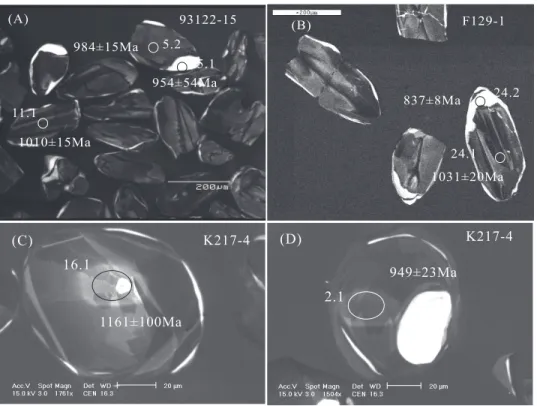
consist predominantly of a 200m size fraction. The grains are clear, but some are pale yellow. CL images revealed sector zoning, but occasionally fractured and surrounded by a thin high-luminescent rim. The zircons are anhedral with variable shapes from rounded with broad sector zoning to more elongate with parallel zoning. No cores were identified. Representative CL images are presented in figure 5.
Twenty-nine spots were analyzed on 27 grains, and the data are reported in table 4 and are shown on a conventional Concordia diagram (fig. 6A). The concordant to near-concordant data at ca. 1.0 Ga form a statistically coherent population at 978⫾ 7 Ma (MSWD⫽2.2; n⫽24) (fig. 6A). Most grains show no major age difference except for spots 6.1 and 21.1. Three analyses of the bright rims are near concordant (fig. 5A), the bright rim spots (5.1 and 27.2) yielded ages near 959 Ma, the bright rim spot 12.1 produced a near-concordant age of 878 Ma. The internal structures (fig. 5A) consist of broad parallel zoning common to many diorites and gabbros. The mean age of 978⫾ 7 Ma is interpreted to reflect the timing of mafic magmatism, and furthermore there are bright rims that appear to be slightly younger (see fig. 5A) and may indicate the timing of metamorphism. No zircon recrystallization or new growth occurred during the 530 Ma event.
2.2 Sample F129-1 (mafic granulite, Steinnes Peninsula).—The sample contains
light-brown, round to short prismatic, partly irregular zircons, some with crevasses, and are predominantly of a 200 to 300m size fraction. Most zircons show a distinctly striped character under CL (fig. 5B), whereas some have an outer zone of high luminescence, indicative of low-U-concentration, which may indicate a reaction zone.
Thirty spots on 28 zircons were analyzed (fig. 5B, table 5), and the analyses cluster around the concordia curve, yielding a weighted mean207Pb/206Pb age of 1007⫾ 10
Ma (MSWD⫽0.91; n⫽14), which resembles that of sample 93122-15. This age is favored to reflect the timing of mafic magmatism. Minor early Paleozoic Pb-loss caused some data points to plot below the Concordia curve, but there is no indication of a strong ca. 530 Ma event.
2.3 Sample K217-4 (mafic gneiss, Kolloy Island).—This sample contains clear to
light-brown, isometric and round zircons consisting predominantly of a 80 m size fraction. Many zircons show highly luminescent cores under CL. Zircon overgrowth in the sample is stubby with internal fir-tree zoning (figs. 5C and 5D), these zircons often have wide high-U rims (U content from 200 to 1558 ppm), and a few zircons show typical narrow, highly luminescent low-U rims, too thin to be analyzed on SHRIMP.
Seventeen areas on 16 grains were analyzed (table 6; fig. 6C). The discordant core ages are Mesoproterozoic (207Pb/206Pb minimum ages range from 1090 to 1221 Ma), whereas the overgrowth analyses yielded a spread in ages from 867 to 1000 Ma along concordia, although there is some scatter along the concordia line. Two spots from typical grains 2.1 and 3.1 with metamorphic rims yielded 96 percent and 99 percent concordant 207Pb/206Pb ages of 949⫾ 37 Ma and 906 ⫾ 64 Ma respectively. Some analyses plot on or slightly below Concordia, but a few plot above Concordia, probably due to gain of radiogenic Pb during metamorphic disturbance (for example, Williams and others, 1984). The data cluster mainly around ages of 850 to 1000 Ma (fig. 6C). The highly luminescent rims probably indicate resorption or dissolution/reprecipita-tion during the early Paleozoic. Therefore, we argue that metamorphic zircon growth occured at⬃900 to 950 Ma.
Fig. 5. Characteristic CL images of analyzed zircons from mafic gneiss samples. Numbered ellipsoids indicate SHRIMP analyses. (A) Image of zircon from mafic gneiss sample 93122-15. (B) Image of zircons from mafic gneiss sample F129-1. (C) and (D) Metamorphic zircon overgrowth at ca. 950 Ma indicates timing of Grenville-age metamorphism (K217-4). High-CL reveals inherited low U cores.
Table 4 Summary of SHRIMP U-Pb zircon results for sample 93122-15, mafic gneiss, Fold Island R ad ioge nic r ati os Age (Ma ) Gra in spot U(ppm ) T h (ppm ) T h /U 206 Pb c (% ) 206 Pb * (ppm ) 207 Pb * 206 Pb * ±% 207 Pb * 235 U ±% 207 Pb * 235 U ±% 206 Pb 238 U Age ± 207 Pb 206 Pb Age ± Di sc (% ) 1. 1 c 28 9 24 3 0. 87 0. 14 41. 7 0. 07 22 0 0. 87 1. 66 8 1. 3 0. 16 76 0. 94 998. 8 8. 7 992 18 -1 2. 1 c 40 3 33 8 0. 87 0. 04 50. 7 0. 07 28 1 1. 1 1. 47 0 1. 2 0. 14 64 3 0. 55 880. 9 4. 6 1, 00 9 22 13 3. 1 c 12 57 62 0. 05 0. 02 17 6 0. 07 15 1. 7 1. 60 4 1. 9 0. 16 27 0. 82 971. 9 7. 4 972 34 0 4. 1 c 37 7 48 0. 13 0. 04 52. 2 0. 07 16 9 0. 83 1. 59 2 1. 7 0. 16 11 1. 5 963 14 977 17 1 5. 1 r 66 8 0. 13 0. 39 8. 84 0. 07 09 2. 7 1. 52 4 3. 0 0. 15 60 1. 4 934 12 954 54 2 5. 2 c 33 2 12 9 0. 40 45. 8 0. 07 19 4 0. 73 1. 59 2 1. 1 0. 16 05 0. 82 959. 4 7. 3 984 15 3 6. 1 c 35 3 0. 08 1. 19 4. 67 0. 06 48 5. 2 1. 37 5 5. 7 0. 15 38 2. 2 922 19 769 11 0 -20 7. 1 c 65 9 73 8 1. 16 0. 14 84. 5 0. 07 00 3 0. 64 1. 43 9 0. 71 0. 14 90 0 0. 30 895. 3 2. 5 929 13 4 8. 1 c 40 2 12 8 0. 33 0. 04 57. 7 0. 07 07 1 1. 1 1. 62 9 1. 2 0. 16 70 3 0. 36 995. 7 3. 3 949 23 -5 9. 1 c 44 6 11 1 0. 26 0. 11 62. 1 0. 07 15 0 0. 98 1. 59 4 1. 2 0. 16 17 0. 65 966. 2 5. 8 972 20 1 10. 1 c 74 4 79 9 1. 11 0. 03 10 4 0. 07 14 1 0. 54 1. 59 79 0. 61 0. 16 23 0 0. 28 969. 5 2. 6 969 11 0 11. 1 c 47 2 44 2 0. 97 0. 11 68. 5 0. 07 28 6 0. 73 1. 69 5 0. 86 0. 16 87 2 0. 46 1, 00 5. 1 4. 2 1, 01 0 15 0 12. 1 r 13 5 4 0. 03 0. 17 17. 0 0. 06 80 1. 7 1. 36 8 1. 8 0. 14 59 0 0. 59 877. 9 4. 9 869 36 -1 12. 2 c 53 3 12 7 0. 25 0. 09 73. 9 0. 07 03 9 0. 99 1. 56 4 1. 4 0. 16 11 1. 0 96 3 9. 0 940 20 -2 13. 1 c 46 8 20 3 0. 45 0. 00 68. 1 0. 07 30 4 0. 64 1. 70 6 1. 1 0. 16 94 0. 92 1, 00 8. 7 8. 6 1, 01 5 13 1 14. 1 c 67 7 81 0. 12 0. 03 96. 2 0. 07 20 2 0. 88 1. 64 3 1. 3 0. 16 54 10 986. 9 9. 1 986 18 0 15. 1 c 54 7 81 0. 15 0. 05 77. 2 0. 07 24 9 0. 81 1. 64 1 1. 2 0. 16 42 0. 91 979. 8 8. 3 1, 00 0 16 2 16. 1 c 62 2 95 0. 16 0. 02 85. 9 0. 07 28 7 0. 56 1. 61 5 0. 89 0. 16 07 0. 69 960. 8 6. 2 1, 01 0 11 5 17. 1 c 44 3 45 7 1. 07 0. 13 64. 0 0. 07 15 0 0. 85 1. 65 8 1. 2 0. 16 82 0. 89 1, 00 2. 2 8. 3 972 17 -3 18. 1 c 46 7 12 5 0. 28 0. 02 65. 6 0. 07 10 1. 7 1. 60 1 2. 8 0. 16 35 2. 2 976 20 958 35 -2 19. 1 c 50 9 89 0. 18 0. 06 73. 3 0. 07 14 9 1. 0 1. 65 4 1. 1 0. 16 78 0 0. 43 1, 00 0. 0 4. 0 971 21 -3 20. 1 c 37 5 11 5 0. 32 0. 05 53. 9 0. 07 08 9 0. 72 1. 63 7 1. 3 0. 16 75 1. 0 998. 3 9. 6 954 15 -5 21. 1 c 13 3 8 0. 06 0. 31 15. 8 0. 06 85 3. 2 1. 30 4 4. 1 0. 13 81 2. 6 834 20 883 66 6 22. 1 c 60 9 67 0. 11 0. 02 86. 2 0. 07 07 5 0. 60 1. 60 6 1. 1 0. 16 46 0. 96 982. 3 8. 7 950 12 -3 23. 1 c 51 8 75 0. 15 0. 06 66. 1 0. 07 00 3 0. 70 1. 43 3 1. 3 0. 14 85 1. 1 892. 3 9. 4 929 14 4 24. 1 c 36 7 22 2 0. 63 0. 04 51. 1 0. 07 24 1 0. 84 1. 61 7 0. 91 0. 16 19 3 0. 34 967. 5 3. 1 998 17 3 25. 1 c 61 3 40 3 0. 68 0. 11 85. 0 0. 07 06 4 0. 55 1. 57 1 0. 98 0. 16 13 0. 80 963. 7 7. 2 947 11 -2 26. 1 c 39 1 11 6 0. 31 0. 05 57. 9 0. 07 15 6 1. 3 1. 69 8 2. 2 0. 17 21 1. 8 1, 02 4 17 973 26 -5 27. 2 r 47 2 11 4 0. 25 0. 05 64. 6 0. 07 10 4 1. 1 1. 55 9 1. 5 0. 15 92 0. 98 952. 2 8. 7 959 23 1 Errors are 1-sigma; Pbc and Pb* indicate the common and radiogenic portions, respectively. Common Pb corrected using measured 204 Pb. For disc(%), 0% denotes a concordant analysis. Abbreviation: c, core; r, rim.
2.4 Sample V218-5 (mafic granulite, V¨ogoy Island).—Zircons are brown and 100 to
280m long, with rounded metamorphic overgrowth. CL images show that many grains contain zoned magmatic cores, overgrown by metamorphic zircon (fig. 7). These CL images are strikingly different from samples 93122-15, F129-2 and K217-4 and imply that the mafic gneiss is possibly derived from a gabbroic protolith. We analyzed 28 spots on 22 grains (fig. 6D, table 7). For the zoned magmatic components, some areas are discordant and have lost radiogenic Pb. Six analyses are near-concordant and produced a weighted mean 207Pb/206Pb age of 1126 ⫾ 20 Ma (MSWD⫽0.78). This age provides the best estimate for the time of emplacement of the mafic precursor.
Some analyses of the metamorphic overgrowths are characterized by slight discordancy and lost radiogenic Pb. Two spots from typical grains 4 and 19 with metamorphic rims have 95 percent concordant207Pb/206Pb ages of 990⫾ 48 Ma and 938 ⫾ 49 Ma (fig. 6D). The data indicate igneous crystallization at ca. 1100 Ma, followed by resorption and new metamorphic growth at ca. 940 to 990 Ma. The rim ages are interpreted to represent a metamorphic overprint, and twelve zircon over-growth analyses constitute a concordant population with a mean 206Pb/238U age of 854 ⫾ 13 Ma (MSWD⫽1.7). This, however, is interpreted to represent a mixed age. From CL images we conclude that substantial new zircon growth must have occurred twice (at 1.0 Ga and⬃0.53 Ga) around pre-existing grains. Progressive recrystallization in some zircon grains may be partial, leaving a “memory” of the previous isotopic composition (figs. 7A and 7B). Isotopic analysis of such an area will yield an age older
Fig. 6. Concordia diagrams for four zircon samples of the mafic gneiss, indicating Grenville-age metamorphism at ca.1.0 Ga and a Pan-African overprint at ca. 0.53 Ga. Error ellipses are 1.
Table 5 Summary of SHRIMP U-Pb zircon results for sample F129-1, mafic gneiss, Steinnes Peninsula 1. 1c 31 3 15 6 0. 52 0. 23 41. 1 0. 07 13 1. 5 1. 50 2 2. 0 0. 15 27 1. 4 916 12 967 30 5 2. 1c 42 8 56 0. 14 0. 11 55. 0 0. 07 08 8 0. 92 1. 46 2 1. 3 0. 14 96 0. 95 898. 5 8. 0 954 19 6 3. 1c 52 4 11 6 0. 23 0. 11 69. 6 0. 07 40 8 0. 77 1. 57 8 1. 2 0. 15 45 0. 94 925. 9 8. 1 1, 04 4 16 11 4. 1c 60 7 97 0. 17 0. 06 71. 1 0. 07 07 8 0. 77 1. 33 0 1. 2 0. 13 62 0. 92 823. 4 7. 1 951 16 13 5. 1c 13 87 12 82 0. 96 0. 13 15 1 0. 07 23 1. 5 1. 26 0 1. 9 0. 12 65 1. 2 767. 6 8. 5 993 30 23 6. 1r 11 4 10 0. 09 0. 61 13. 3 0. 08 00 2. 9 1. 48 2 3. 3 0. 13 44 1. 5 813 12 1, 19 7 58 32 6. 2c 54 6 99 0. 19 0. 09 81. 3 0. 07 23 0 0. 75 1. 72 8 1. 2 0. 17 33 0. 96 1, 03 0. 2 9. 2 994 15 -4 7. 1c 37 0 12 8 0. 36 0. 17 50. 3 0. 07 09 3 0. 82 1. 54 3 1. 3 0. 15 78 0. 96 944. 6 8. 4 956 17 1 8. 1c 50 6 12 5 0. 26 0. 13 71. 8 0. 07 29 4 0. 95 1. 65 8 1. 4 0. 16 48 1. 0 983. 6 9. 3 1, 01 2 19 3 9. 1c 36 8 12 0 0. 34 0. 35 45. 8 0. 07 05 1. 7 1. 40 3 2. 0 0. 14 42 1. 0 868. 5 8. 2 944 34 8 10. 1 c 52 5 82 0. 16 0. 11 68. 9 0. 07 41 5 1. 1 1. 56 0 1. 5 0. 15 26 0. 97 915. 6 8. 2 1, 04 6 22 12 11. 1 c 36 4 11 7 0. 33 0. 15 51. 6 0. 07 47 9 1. 3 1. 69 6 1. 7 0. 16 44 1. 1 981 10 1, 06 3 25 8 12. 1 c 67 1 92 0. 14 0. 12 95. 8 0. 07 07 5 0. 88 1. 61 9 1. 3 0. 16 60 0. 94 990. 0 8. 6 950 18 -4 13. 1 c 38 8 22 8 0. 61 0. 13 57. 6 0. 07 28 1 0. 95 1. 73 2 1. 5 0. 17 25 1. 1 1, 02 6 10 1, 00 9 19 -2 14. 1 c 38 8 12 3 0. 33 0. 12 53. 7 0. 07 21 9 0. 90 1. 59 9 1. 4 0. 16 07 1. 1 960. 5 10 991 18 3 15. 1 c 40 3 10 0 0. 26 0. 21 59. 0 0. 07 59 9 0. 90 1. 78 3 1. 3 0. 17 01 0. 95 1, 01 2. 8 8. 9 1, 09 5 18 7 16. 1 c 35 2 27 1 0. 80 0. 27 46. 2 0. 07 16 7 1. 1 1. 50 8 1. 5 0. 15 26 1. 1 915. 3 9. 1 977 22 6 17. 1 c 57 5 78 0. 14 0. 11 83. 7 0. 07 35 0 0. 79 1. 71 6 1. 3 0. 16 93 10 1, 00 8. 2 9. 3 1, 02 8 16 2 18. 1 c 44 2 32 5 0. 76 0. 10 56. 5 0. 07 12 8 0. 92 1. 46 1 1. 3 0. 14 87 0. 97 893. 4 8. 1 965 19 7 19. 1 c 40 2 40 5 1. 04 0. 06 55. 6 0. 07 18 4 0. 95 1. 59 4 1. 3 0. 16 10 0. 96 962. 2 8. 5 981 19 2 20. 1 c 57 7 11 3 0. 20 0. 10 84. 0 0. 07 33 6 0. 79 1. 71 3 1. 2 0. 16 94 0. 93 1, 00 8. 6 8. 7 1, 02 4 16 2 21. 1 c 34 3 11 7 0. 35 0. 11 47. 3 0. 07 22 3 1. 1 1. 59 6 1. 5 0. 16 02 0. 99 958. 1 8. 8 992 23 3 22. 1 c 38 3 11 8 0. 32 0. 20 52. 2 0. 07 32 3 1. 0 1. 59 8 1. 5 0. 15 82 1. 0 947. 0 9. 1 1, 02 0 21 7 23. 1 c 41 6 10 3 0. 25 0. 08 55. 3 0. 07 21 6 0. 93 1. 53 8 1. 3 0. 15 46 0. 96 926. 6 8. 3 990 19 6 24. 1 c 39 3 96 0. 25 0. 11 53. 2 0. 07 36 2 0. 99 1. 59 9 1. 4 0. 15 75 1. 0 943. 1 9. 0 1, 03 1 20 9 24. 2 r 48 4 59 0. 12 0. 20 57. 8 0. 06 73 7 1. 2 1. 28 7 1. 5 0. 13 86 0. 98 836. 5 7. 7 849 24 2 25. 1 c 11 4 13 0. 12 0. 41 12. 6 0. 06 57 2. 4 1. 15 6 2. 9 0. 12 75 1. 5 774 11 798 51 3 26. 1 r 11 8 18 0. 16 0. 98 12. 8 0. 06 37 4. 9 1. 09 8 5. 1 0. 12 51 1. 3 759. 7 9. 4 731 10 0 -4 27. 1 r 10 1 5 0. 05 1. 20 12. 8 0. 06 57 4. 1 1. 32 3 4. 4 0. 14 60 1. 6 879 13 798 86 -10 28. 1 c 41 8 21 5 0. 53 0. 17 53. 6 0. 07 32 5 0. 86 1. 50 4 1. 3 0. 14 90 0. 97 895. 1 8. 1 1, 02 1 17 12 Errors are sigma; Pbc and Pb* indicate the common and radiogenic portions, respectively. Common Pb corrected using measured 204 Pb. For disc(%), 0% denotes a concordant analysis. Abbreviation: c, core; r, rim.
Table 6 Summary of SHRIMP U-Pb zircon results for sample k217-4, mafic gneiss, Kolloy Island R ad ioge n ic r ati os Age (Ma ) Gra in. spot U(ppm ) T h (ppm ) T h /U 206 Pb c (% ) 206 Pb * (ppm ) 207 Pb * 206 Pb * ±% 207 Pb * 235 U ±% 206 Pb * 238 U ±% 206 Pb 238 U Age ± 207 Pb 206 Pb Age ± Di sc (% ) 1. 1r 568 105 0. 19 0. 20 67. 9 0. 0683 1. 8 1. 309 3. 7 0. 1390 3. 2 839 26 878 36 5 1. 2c 26 9 0. 37 1. 31 3. 18 0. 0794 11 1. 54 12 0. 1402 5. 7 846 45 1, 183 210 40 2. 1r 733 234 0. 33 0. 02 95. 7 0. 0707 1. 8 1. 483 2. 9 0. 1520 2. 3 912 20 949 37 4 3. 1r 799 229 0. 30 0. 03 103 0. 0692 3. 1 1. 427 3. 7 0. 1495 2. 0 898 16 906 64 1 4. 1r 1011 160 0. 16 0. 06 110 0. 06334 1. 3 1. 106 2. 3 0. 1266 2. 0 769 14 720 27 -6 5. 1r 1558 221 0. 15 0. 03 204 0. 06720 0. 74 1. 413 2. 3 0. 1525 2. 1 915 18 844 15 -8 6. 1r 200 104 0. 54 0. 46 28. 7 0. 0748 6. 8 1. 72 7. 2 0. 1664 2. 2 992 20 1, 063 140 7 7. 1r 1129 178 0. 16 0. 00 140 0. 06757 1. 4 1. 340 3. 2 0. 1439 2. 9 867 24 855 29 -1 8. 1c 507 106 0. 22 0. 00 80. 0 0. 0803 2. 6 2. 035 3. 3 0. 1838 2. 0 1, 088 20 1, 204 51 11 9. 1r 615 133 0. 22 0. 06 83. 3 0. 0725 3. 3 1. 576 4. 1 0. 1576 2. 4 944 21 1, 000 67 6 10. 1c 436 110 0. 26 0. 07 57. 7 0. 0758 3. 0 1. 609 4. 1 0. 1540 2. 8 923 24 1, 090 61 18 11. 1r 596 127 0. 22 0. 25 85. 4 0. 0674 1. 6 1. 546 2. 6 0. 1664 2. 1 992 19 849 33 -14 12. 1r 863 136 0. 16 0. 14 112 0. 06724 1. 1 1. 400 2. 2 0. 1510 2. 0 907 17 845 22 -7 13. 1r 752 148 0. 20 0. 12 85. 2 0. 06730 1. 5 1. 221 2. 7 0. 1316 2. 3 797 17 847 30 6 14. 1r 602 137 0. 23 0. 10 75. 1 0. 06596 1. 5 1. 319 2. 5 0. 1450 2. 0 873 16 805 31 -8 15. 1r 923 170 0. 19 0. 18 95. 3 0. 0619 1. 8 1. 024 2. 7 0. 1199 2. 0 730 14 672 38 -8 16. 1c 173 83 0. 49 0. 49 23. 5 0. 0810 2. 4 1. 755 3. 3 0. 1572 2. 2 941 19 1, 221 48 30 Errors are 1-sigma; Pbc and Pb* indicate the common and radiogenic portions, respectively. Common Pb corrected using measured 204 Pb. For disc(%), 0% denotes a concordant analysis. Abbreviation: c, core; r, rim.
than the event inducing late recrystallization and younger than the early magmatic zircon (Hoskin and Black, 2000). The data points plot along the concordia line between 1.0 and 0.5 Ga, and the ages are therefore considered geologically mean-ingless.
Alternatively, it is possible that the ca. 854 Ma date marks the time of a distinct phase in the P-T evolution. The explanation is the same as for mafic gneiss sample K217-3, but different from samples 93122-15 and F129-2. This suggests that these rocks have different protoliths. Sample V218-5 probably originated from a gabbroic intrusive rock, whereas the occurrence and mineral assemblages suggest that samples 93122-15 and F129-2 were probably derived from dismembered mafic dikes (Dirks and others, 1993; Wang and others, 1994). In fact, the presence of a tight cluster of ages at 854 Ma is hard to explain merely as a result of two-stage overprinting – one would expect more of a smear given that ca. 990 Ma rims also occur. This “age” is intriguing and requires further testing.
Fig. 7. Cathodoluminescence images of typical zircons from mafic gneiss sample V218-5, displaying inherited cores and broad rims.
Table 7 Summary of SHRIMP U-Pb zircon results for sample V218-5, mafic gneiss, Vogoy Island R ad ioge nic r ati os Age (Ma ) Gra in spot U(ppm ) T h (ppm ) T h /U 206 Pb c (% ) 206 Pb * (ppm ) 207 Pb * 206 Pb * ±% 207 Pb * 235 U ±% 207 Pb * 235 U ±% 206 Pb 238 U Age ± 207 Pb 206 Pb Age ± Di sc (% ) 1. 1r 48 5 16 0 0. 34 0. 10 59. 4 0. 06 66 4. 2 1. 30 7 4. 8 0. 14 24 2. 3 858 18 825 88 -4 2. 1r 20 5 13 0 0. 65 0. 13 25. 3 0. 06 81 2. 2 1. 34 7 3. 3 0. 14 35 2. 4 864 19 871 45 1 3. 1c 99 7 49 4 0. 51 0. 01 16 1 0. 07 50 6 0. 79 1. 94 3 2. 4 0. 18 77 2. 2 1, 10 9 23 1, 07 0 16 -4 4. 1r 32 5 22 4 0. 71 0. 00 37. 3 0. 07 09 1. 7 1. 30 7 2. 9 0. 13 37 2. 3 809 18 955 34 15 4. 2r 29 3 14 0 0. 49 0. 00 39. 7 0. 07 22 2. 3 1. 56 5 3. 4 0. 15 73 2. 4 942 21 990 48 5 5. 1r 32 6 23 6 0. 75 0. 13 43. 5 0. 06 83 1. 9 1. 46 0 3. 0 0. 15 51 2. 3 929 20 877 39 -6 6. 1r 16 9 11 5 0. 71 0. 20 22. 9 0. 06 98 2. 5 1. 51 7 3. 4 0. 15 75 2. 4 943 21 924 51 -2 6. 2c 32 9 30 8 0. 97 0. 00 48. 1 0. 07 89 1. 5 1. 85 2 2. 7 0. 17 02 2. 3 1, 01 3 21 1, 17 0 29 13 7. 1m 16 4 14 7 0. 93 0. 29 19. 0 0. 06 86 3. 1 1. 27 1 5. 2 0. 13 44 4. 2 813 32 887 63 8 7. 2r 16 2 11 1 0. 71 0. 29 13. 4 0. 06 59 5. 7 0. 87 7 6. 3 0. 09 66 2. 6 594 15 802 12 0 26 8. 1r 14 8 15 2 1. 06 0. 00 18. 9 0. 06 52 2. 5 1. 34 2 3. 5 0. 14 93 2. 4 897 20 780 53 -15 9. 1r 19 0 13 8 0. 75 0. 00 22. 8 0. 07 10 3. 2 1. 36 4 4. 0 0. 13 94 2. 4 841 19 957 66 12 10. 1 c 36 3 36 4 1. 04 0. 00 58. 6 0. 08 03 1. 3 2. 08 2 2. 6 0. 18 80 2. 3 1, 11 0 24 1, 20 6 25 8 10. 2 r 22 7 22 9 1. 04 0. 00 29. 4 0. 07 41 2. 0 1. 54 3 4. 6 0. 15 09 4. 1 906 35 1, 04 5 40 13 11. 1 c 32 9 38 1 1. 20 0. 00 56. 1 0. 07 97 1. 4 2. 18 5 2. 7 0. 19 88 2. 4 1, 16 9 25 1, 19 1 27 2 12. 1 r 30 7 37 6 1. 26 0. 00 33. 3 0. 07 09 1. 8 1. 23 3 2. 9 0. 12 61 2. 3 765 17 955 36 20 13. 1 r 33 4 21 8 0. 68 0. 00 38. 0 0. 06 82 1. 8 1. 24 6 2. 9 0. 13 25 2. 3 802 18 875 37 8 13. 2 c 27 0 18 2 0. 70 0. 26 31. 8 0. 07 09 2. 2 1. 33 7 3. 5 0. 13 68 2. 8 826 21 955 45 13 14. 1 r 38 1 22 9 0. 62 0. 00 43. 5 0. 06 74 1. 8 1. 23 5 5. 6 0. 13 29 5. 3 804 40 850 37 5 15. 1 c 59 2 59 3 1. 03 0. 04 97. 3 0. 07 74 6 1. 1 2. 04 4 2. 5 0. 19 14 2. 3 1, 12 9 23 1, 13 3 22 0 16. 1 c 35 6 20 8 0. 61 0. 05 58. 1 0. 07 87 1. 9 2. 06 1 3. 5 0. 18 99 2. 9 1, 12 1 30 1, 16 5 37 4 17. 1 c 62 9 23 8 0. 39 0. 04 62. 2 0. 06 66 9 1. 4 1. 05 7 2. 7 0. 11 50 2. 3 702 15 828 30 15 18. 1 r 69 1 29 1 0. 43 0. 07 80. 4 0. 06 89 1. 5 1. 28 6 2. 7 0. 13 53 2. 3 818 18 896 30 9 19. 1 r 15 1 13 8 0. 95 0. 00 20. 1 0. 07 03 2. 4 1. 50 6 3. 5 0. 15 53 2. 6 931 22 938 49 1 20. 1 r 21 7 23 0 1. 10 0. 35 27. 1 0. 06 56 3. 2 1. 31 2 4. 0 0. 14 50 2. 5 873 20 795 66 -10 21. 1 r 40 0 26 3 0. 68 0. 10 49. 1 0. 06 70 1. 7 1. 31 8 5. 0 0. 14 25 4. 7 859 38 839 36 -2 22. 1 r 30 0 15 1 0. 52 0. 18 38. 1 0. 06 73 2. 5 1. 37 2 4. 0 0. 14 79 3. 1 889 26 846 53 -5 22. 1 c 55 6 50 4 0. 94 0. 17 90. 9 0. 07 81 9 1. 2 2. 04 9 2. 8 0. 19 00 2. 5 1, 12 2 26 1, 15 2 24 3 Errors are 1-sigma; Pbc and Pb* indicate the common and radiogenic portions, respectively. Common Pb corrected using measured 204 Pb. For conc.(%), 0% denotes a concordant analysis. Abbreviation: c, core; r1, rim1; r2, rim2; M, mixed.
3.paragneiss
3.1 Sample 981227-1 (metapelite, Seal Cove of the Mirror Peninsula).—All zircon grains
are relatively large, 200 to 250m in length, and have the rounded forms common to zircons from high-grade rocks, and many grains are ellipsoidal to spherical. CL imaging shows that most grains contain inherited cores with oscillatory zoning, characteristically surrounded, in whole or in part, by a thin, structureless, weakly luminescent overgrowth (rim1) (figs. 8A, 8B, 8C and 8D). Each zircon also exhibits a thin outer rim (rim2) with relatively bright luminescence in CL images.
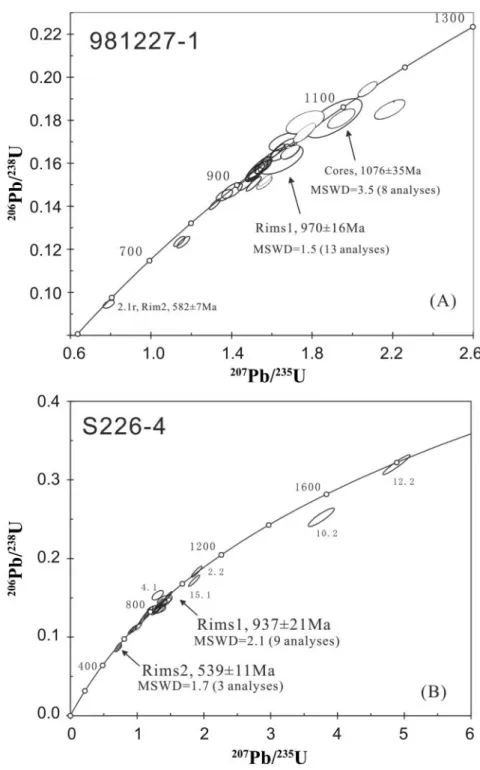
U-Th-Pb analyses of the zircons are listed in table 8 and plotted on the Concordia diagram of figure 9A. The cores with magmatic growth zoning are a little heteroge-neous in composition, both chemically and isotopically. U-contents range from 245 to 677 ppm, and Th/U range from 0.07 to 0.42. Twelve of the analyzed grains consist of oscillatory-zoned cores that give207Pb/206Pb ages ranging from 1034 to 1769 Ma, with a main age peak at ca. 1.1 Ga. This confirms that the zircon cores are detrital in origin from a late Paleoproterozoic to Mesoproterozoic provenance. No Archean grains were detected. The issue for this sample is whether the range in ages reflects erosion from a wide range of sources (that is, a paragneiss), or whether the age range was produced through variable Pb-loss from an igneous protolith (that is, an orthogneiss). Given the zircon ages alone the paragenesis of this sample (that is, sedimentary vs. magmatic origin) is difficult to establish. The presence of a Paleoproterozoic age is indicative of sedimentary input (though it represents a very small fraction of the material analyzed) and an apparent age peak at 1.1 Ga. However, this peak is similar to that of the felsic gneiss samples, which are interpreted as orthogneisses. Because of the extensive production of metamorphic rims in this rock, it is likely that at least some disturbance in the U-Pb system has occurred. The age data imply that the source of the paragneiss sequence is possibly a felsic to intermediate igneous rock.
The overgrowths (rim 1) have a wide range in U (368⫺1765ppm) and low Th/U (mostly 0.02⫺0.07). Such extreme Th/U values are a feature of zircons crystallizing at high metamorphic grade (Williams and others, 1996). The overgrowth analyses (that
(A) (B) (C) (D) 1147±32Ma 953±50Ma 940±24Ma 111 0±69Ma 1132±18Ma 989±12Ma 1769±28Ma 582±7Ma 981227-1 981227-1 981227-1 981227-1 1.1 4.2 1.2 4.1 10.2 10.1 2.2 2.1 rim1 Rim2 100µm 1814±10Ma 908±21Ma (E) S226-4 (F) S226-4 12.2 12.1 15.2 15.1 1155±14Ma 980±31Ma
Fig. 8. Detrital zircon grains with metamorphic overgrowths of varying width from metasedimentary samples. A, B, C and D from Seal Cove; CL image of inherited magmatic core with a small-volume isometric high-U zircon rim; typical zircons have a very thin, highly luminescent rim that is probably indicative of metamorphic resorption of Pan-African age. Scale bars are 100m. Grain identification numbers include SHRIMP spot number and ages; E and F from south of Nella Fjord.
Table 8 Summary of SHRIMP U-Pb zircon results for sample 981227-1, paragneiss, Seal Cove R ad ioge nic r ati os Age (Ma ) Gra in spot U(ppm ) T h (ppm ) T h /U 206 Pb c (% ) 206 Pb * (ppm ) 207 Pb * 206 Pb * ±% 207 Pb * 235 U ±% 207 Pb * 235 U ±% 206 Pb 238 U Age ± 207 Pb 206 Pb Age ± Di sc (% ) 1. 1c 28 5 50 0. 18 0. 11 44. 3 0. 07 80 1. 6 1. 94 4 2. 3 0. 18 08 1. 6 1, 07 1 16 1, 14 7 32 7 1. 2r 1 90 1 64 0. 07 13 2 0. 07 08 2. 4 1. 66 0 2. 9 0. 17 00 1. 6 1, 01 2 15 953 50 -6 2. 1r 2 71 9 39 0. 06 0. 63 58. 7 0. 06 07 1. 9 0. 79 0 2. 3 0. 09 45 1. 3 581. 9 7. 2 628 41 7 2. 2c 31 1 12 6 0. 42 0. 08 84. 5 0. 10 82 1. 5 4. 72 2. 6 0. 31 63 2. 1 1, 77 2 32 1, 76 9 28 0 3. 1c 60 1 52 0. 09 0. 18 78. 1 0. 07 51 6 0. 97 1. 56 3 1. 6 0. 15 08 1. 3 906 11 1, 07 3 19 16 4. 1c 23 9 53 0. 23 37. 1 0. 07 66 3. 4 1. 91 0 4. 8 0. 18 09 3. 3 1, 07 2 33 1, 11 0 69 3 4. 2r 1 17 65 29 0. 02 0. 20 23 9 0. 07 04 1 1. 2 1. 52 9 2. 6 0. 15 75 2. 4 943 21 940 24 0 5. 1r 1 85 3 39 0. 05 0. 00 12 2 0. 07 23 1. 8 1. 65 8 2. 7 0. 16 63 2. 1 992 19 995 36 0 6. 1c 28 9 10 4 0. 37 0. 77 46. 3 0. 08 57 1. 6 2. 18 4 2. 3 0. 18 49 1. 6 1, 09 4 16 1, 33 1 32 18 7. 1r 1 11 22 20 0. 02 0. 11 14 5 0. 07 28 3 0. 72 1. 51 0 1. 7 0. 15 04 1. 5 903 12 1, 00 9 15 11 8. 1c 27 7 48 0. 18 0. 11 42. 6 0. 07 16 2. 9 1. 76 5 3. 5 0. 17 89 2. 0 1, 06 1 19 974 60 -9 9. 1r 1 71 3 47 0. 07 0. 01 97. 0 0. 07 12 5 1. 2 1. 55 5 1. 8 0. 15 83 1. 3 947 11 965 25 2 10. 1 c 50 4 15 9 0. 33 0. 01 84. 1 0. 07 74 1 0. 92 2. 07 5 1. 5 0. 19 44 1. 2 1, 14 5 12 1, 13 2 18 -1 10. 2 r1 13 19 27 0. 02 0. 05 18 8 0. 07 12 0 0. 59 1. 62 8 1. 4 0. 16 59 1. 3 989 12 963 12 -3 11. 1 m 76 0 47 0. 06 92. 0 0. 06 77 9 0. 73 1. 31 7 1. 4 0. 14 09 1. 2 850. 0 9. 3 862 15 1 12. 1 c 35 6 69 0. 20 37. 7 0. 06 83 0 1. 1 1. 16 1 1. 8 0. 12 33 1. 4 750 10 878 23 15 13. 1 r1 30 6 67 0. 23 41. 1 0. 07 04 7 1. 2 1. 52 1 1. 9 0. 15 65 1. 5 937 13 942 25 0 14. 1 c 24 5 58 0. 25 0. 27 34. 2 0. 07 38 3. 5 1. 64 3 4. 5 0. 16 16 2. 7 966 24 1, 03 5 71 7 15. 1 r1 30 6 70 0. 24 45. 7 0. 07 34 1 1. 2 1. 76 1 2. 0 0. 17 40 1. 6 1, 03 4 16 1, 02 5 24 -1 16. 1 r1 32 1 35 0. 11 0. 35 43. 2 0. 07 07 6 1. 4 1. 52 4 2. 4 0. 15 62 2. 0 936 17 950 29 2 17. 1 r1 10 89 19 0. 02 0. 00 13 8 0. 06 90 1. 8 1. 40 3 2. 4 0. 14 73 1. 6 886 13 900 37 2 18. 1 r1 46 6 73 0. 16 0. 08 61. 9 0. 07 09 0 1. 2 1. 51 2 1. 9 0. 15 47 1. 4 927 12 955 25 3 19. 1 m 14 43 37 0. 03 0. 09 18 0 0. 06 82 1. 6 1. 36 5 2. 0 0. 14 51 1. 2 873. 5 9. 9 875 32 0 20. 1 c 29 4 54 0. 19 0. 10 41. 8 0. 07 45 0 1. 1 1. 69 5 1. 7 0. 16 50 1. 3 985 12 1, 05 5 23 7 21. 1 r1 44 7 67 0. 16 57. 7 0. 07 08 4 1. 0 1. 46 6 1. 6 0. 15 01 1. 2 902 10 953 21 5 22. 1 r1 36 8 48 0. 13 39. 1 0. 06 69 0 1. 0 1. 14 1 1. 6 0. 12 37 1. 3 751. 8 8. 9 835 22 10 23. 1 r1 38 0 71 0. 19 0. 09 51. 8 0. 07 13 4 0. 98 1. 56 0 1. 8 0. 15 86 1. 5 949 13 967 20 2 24. 1 r1 37 3 45 0. 12 0. 05 50. 5 0. 07 08 9 1. 1 1. 54 1 2. 5 0. 15 77 2. 3 944 20 954 22 1 26. 1 c 39 9 68 0. 18 0. 02 56. 7 0. 07 37 2 0. 91 1. 68 2 1. 5 0. 16 54 1. 2 987 11 1, 03 4 18 5 25. 1 c 67 7 11 9 0. 18 88. 3 0. 07 47 1 0. 68 1. 56 6 1. 4 0. 15 20 1. 2 912. 2 10. 0 1, 06 1 14 14 Errors are 1-sigma; Pbc and Pb* indicate the common and radiogenic portions, respectively. Common Pb corrected using measured 204 Pb. For conc.(%), 0% denotes a concordant analysis. Abbreviation: c, core; r1, rim1. r2, rim2. M, mixed.
Fig. 9. Concordia diagram for two metasedimentary zircon samples from Seal Cove and south of Nella Fjord, Mirror Peninsula. Error ellipses are 1.
is, spots 4.2, 5.1, 13.1, 15.1, 24.1) cluster near Concordia at ca. 1.0 Ga (fig. 9A). Thirteen analyses give a weighted mean207Pb/206Pb age of 970⫾ 16 Ma (MSWD⫽1.5; fig. 9A). It is possible that the paragneisses were deposited ⬍ 1000 Ma but contain polyphase detrital zircons that record pre-depositional ages of 1130 Ma and/or 1000 Ma. The exceptions are the spots with mixed analyses. The outer rim 2 was analyzed in one zircon and yielded a206Pb/238U age of 582⫾ 7 Ma.
3.2. Sample S226-4 (paragneiss, Seal Cove of the Mirror Peninsula).—The zircons are
round and stubby, elongate, have round to subrounded terminations, with three textural types (core, rim 1, and rim 2) distinguished (figs. 8E and 8F). They consist predominantly of a 60 to 80m size fraction. The cores have a moderate CL response and show oscillatory zoning (that is, spot 12.2). They are surrounded by multiple overgrowths. The first (innermost) overgrowth (rim 1) is usually high in U (⬃1000 ppm), and is only developed around a few cores. Rim1 has a low CL response and commonly is more homogeneous, it also occurs as wide overgrowth on Mesoprotero-zoic cores (fig. 8E, spot 12.1). Rim1 shows an absence of oscillatory zoning, consistent with metamorphic growth. The outer rim 2 is composed of a medium-U generation.
Twenty-four analyses were performed on sixteen grains (table 9 and fig. 9B). Four analyses of oscillatory-zoned cores (10.2, 12.2, 2.2, 15.1) give Paleoproterozoic to Mesoproterozoic207Pb/206Pb ages of 1765⫾ 17, 1814 ⫾ 10, 1065 ⫾ 14, 1155 ⫾ 14 Ma respectively. Uranium concentrations range from 221 to 921 ppm, Th from 152 to 337 ppm, and Th/U ratios from 0.35 to 0.97. The systematics of S226-4 are therefore similar to 981227-1 of Seal Cove. The zircon cores are interpreted as detrital grains and yielded diverse ages. The discordant nature of some core analyses probably reflects Pb-loss during metamorphism, the207Pb/206Pb ages generally range from 1.8 to 1.1Ga (fig. 9B), also consistent with the detrital signature from sample 981227-1.
Nine analyses were made of type 1 rims, which have U contents between 498 and 1440 ppm and Th/U ratios between 0.02 and 0.08. These rims yielded207Pb/206Pb ages ranging from 916⫾ 57 to 997 ⫾ 22 Ma. The discordant ages probably indicate Pb-loss during the second period of zircon overgrowth, mixtures of metamorphic overgrowths and older core material, and/or multiple periods of metamorphic growth. Rim 2 was analyzed in four zircons, one older outlier was rejected (9.1), and a weighted mean of the remaining206Pb/238U ages is 539⫾ 11 Ma (MSWD⫽1.7, 3 analyses).
3.3. Sample V218-4 (paragneiss, V¨ogoy Island).—Zircon fluoresces yellow in
transmit-ted light. Grains are typically rounded, with aspect ratios of 1:1 to 1:2, and range from 100 to 150m in length. Transmitted light and CL imaging shows oscillatory-zoned cores with wide, homogeneous overgrowths up to 50m wide (fig. 10). The cores have relatively high Th/U ratios (from 0.17⫺2.49), indicating a magmatic origin, whereas the wide rims have low Th/U ratios (0.02-0.09), typical of metamorphic overgrowth. In many cases, for example grain 11 (fig. 10), the rims have an outer zone of relatively bright luminescence, indicative of medium U-concentration, which may indicate a reaction zone.
Eighteen spots from cores and rims were analyzed in 14 zircons (table 10, fig. 11). Eleven analyses of oscillatory-zoned grains give207Pb/206Pb ages ranging from Paleo-proterozoic (2173⫾ 8 Ma) to Mesoproterozoic (1110 ⫾ 55 Ma) and with significant peaks at ca. 1.1 to 1.2 Ga. The implication is that the depositional age of the protolith is⬍ 1110 Ma. Seven analyses of the metamorphic rims provide an early Neoprotero-zoic age record; three zircon rims (14.1, 15.1, 17.2) confirm a late Grenvillian-age event with207Pb/206Pb ages of 901⫾ 78 Ma, 948 ⫾ 33 Ma, 945 ⫾ 98 Ma, respectively (table 10 and fig. 11). A typical metamorphic rim analysis of spot 11.2 yielded a
207
Pb/206Pb age of 1111⫾ 19 Ma, whereas the core analysis of spot 11.1 is 1655 Ma (fig. 10). The early Neoproterozoic new zircon growth suggests that a metamorphic episode occurred at ca. 1 Ga. These rims have an outer zone, although too thin (⬍ 10 m) to
Table 9 Summary of SHRIMP U-Pb zircon results for sample s226-4, paragneiss, Seal Cove R ad ioge nic r ati os Age (Ma ) Gra in spot U(ppm ) T h (ppm ) T h /U 206 Pb c (% ) 206 Pb * (ppm ) 207 Pb * 206 Pb * ±% 207 Pb * 235 U ±% 207 Pb * 235 U ±% 206 Pb 238 U Age ± 207 Pb 206 Pb Age ± Di sc (% ) 1. 1-1r 2 357 45 0. 13 0. 05 26. 4 0. 0602 2. 0 0. 715 3. 0 0. 0861 2. 3 532 12 611 43 15 1. 2r 1 1058 19 0. 02 0. 08 124 0. 0724 0 1. 1 1. 361 2. 1 0. 1364 1. 8 824 14 997 22 21 1. 1-2r 2 332 41 0. 13 0. 03 25. 4 0. 0589 9 1. 2 0. 726 2. 0 0. 0892 1. 6 551. 1 8. 6 567 27 3 2. 1r 1 1028 83 0. 08 0. 02 134 0. 0697 8 0. 58 1. 463 1. 7 0. 1520 1. 6 912 14 922 12 1 3. 1m 925 25 0. 03 0. 04 114 0. 0676 1 0. 64 1. 336 1. 7 0. 1433 1. 6 863 13 857 13 -1 2. 2c 674 228 0. 35 0. 02 106 0. 0748 5 0. 68 1. 891 1. 7 0. 1833 1. 6 1, 085 16 1, 065 14 -2 4. 1r 1 1004 60 0. 06 0. 04 132 0. 0619 2. 1 1. 308 2. 7 0. 1532 1. 6 919 14 671 45 -27 5. 1r 1 697 35 0. 05 0. 03 82. 3 0. 0697 6 0. 65 1. 321 1. 7 0. 1373 1. 6 829 12 921 13 11 6. 1r 2 184 21 0. 12 0. 16 13. 6 0. 0602 1. 9 0. 712 2. 6 0. 0857 1. 7 530. 2 8. 7 612 42 15 6. 2m 786 30 0. 04 0. 03 86. 2 0. 0643 2 1. 0 1. 132 3. 9 0. 1277 3. 8 775 27 752 22 -3 7. 1r 1 498 26 0. 05 0. 09 57. 6 0. 0702 8 0. 85 1. 303 1. 8 0. 1345 1. 6 813 12 937 17 15 8. 1m 980 40 0. 04 0. 05 93. 0 0. 0623 1 1. 4 0. 948 2. 1 0. 1104 1. 6 675 10 685 29 1 9. 1r 2 690 20 0. 03 0. 02 63. 9 0. 0610 6 1. 0 0. 907 1. 9 0. 1078 1. 6 659. 9 9. 9 641 22 -3 10. 1 m 373 13 0. 04 0. 12 36. 5 0. 0648 8 1. 2 1. 019 2. 1 0. 1139 1. 6 695 11 770 26 11 10. 2 c 221 152 0. 71 0. 04 48. 0 0. 1080 0. 95 3. 757 2. 1 0. 2524 1. 9 1, 451 25 1, 765 17 22 11. 1 r1 826 33 0. 04 0. 03 96. 0 0. 0692 4. 0 1. 291 4. 3 0. 1354 1. 6 818 12 904 83 10 12. 1 r1 1436 46 0. 03 0. 03 178 0. 0718 1. 5 1. 431 2. 2 0. 1446 1. 6 871 13 980 31 13 12. 2 c 261 245 0. 97 0. 03 71. 7 0. 1108 9 0. 53 4. 882 1. 7 0. 3193 1. 6 1, 786 25 1, 814. 0 9. 6 2 13. 1 m 878 36 0. 04 0. 01 97. 1 0. 0651 5 0. 91 1. 157 2. 0 0. 1288 1. 8 781 13 779 19 0 14. 1 r1 935 37 0. 04 0. 01 113 0. 0711 7 0. 79 1. 385 2. 0 0. 1411 1. 8 851 14 962 16 13 15. 1 c 921 337 0. 38 0. 01 136 0. 0783 1 0. 70 1. 855 1. 8 0. 1718 1. 7 1, 022 16 1, 155 14 13 15. 1 r1 1440 19 0. 01 0. 01 166 0. 0693 2 1. 0 1. 278 2. 0 0. 1337 1. 7 809 13 908 21 12 4. 2m 766 121 0. 16 0. 01 89. 3 0. 0693 7 1. 0 1. 298 1. 9 0. 1357 1. 6 820 12 910 21 11 16. 1 r1 1112 30 0. 03 0. 02 141 0. 0696 2. 8 1. 415 3. 2 0. 1475 1. 6 887 13 916 57 3 Errors are 1-sigma; Pbc and Pb* indicate the common and radiogenic portions, respectively. Common Pb corrected using measured 204 Pb. For conc.(%), 0% denotes a concordant analysis. Abbreviation: c, core; r1, rim1. r2, rim2. M, mixed.