行政院國家科學委員會專題研究計畫 成果報告
再生能源民營電廠之競爭行為的賽局論分析
研究成果報告(精簡版)
計 畫 類 別 : 個別型 計 畫 編 號 : NSC 99-2410-H-009-063- 執 行 期 間 : 99 年 08 月 01 日至 100 年 07 月 31 日 執 行 單 位 : 國立交通大學經營管理研究所 計 畫 主 持 人 : 胡均立 計畫參與人員: 碩士班研究生-兼任助理人員:林芳麗 碩士班研究生-兼任助理人員:王怡婷 碩士班研究生-兼任助理人員:劉育呈 碩士班研究生-兼任助理人員:陳柏廷 碩士班研究生-兼任助理人員:盧煒婷 碩士班研究生-兼任助理人員:張嘉文 碩士班研究生-兼任助理人員:簡瑞祥 博士班研究生-兼任助理人員:張子浦 博士班研究生-兼任助理人員:潘京蒂 報 告 附 件 : 國外研究心得報告 處 理 方 式 : 本計畫可公開查詢中 華 民 國 100 年 09 月 01 日
再生能源民營電廠之競爭行為的賽局論分析
An Analysis on the System of Guaranteed Purchasing Price in
Taiwan Electricity Market
計畫編號:NSC 99-2410-H-009-063
計畫報告
執行期限:民國 99 年 8 月 1 日至 100 年 7 月 31 日
主持人:胡均立 國立交通大學經營管理研究所
兼任研究助理:張子溥、潘京蒂、林芳麗、王怡婷、劉育呈、
陳柏廷、盧煒婷、張嘉文、簡瑞祥
電子信箱(E-mail)位址:[email protected]
2
目錄
中文摘要 ... 3
Abstract ... 4
1 Introduction ... 5
2 Literature review ... 6
3 The model setup ... 7
4 Analytical Results ... 9
4.1 Benchmark model ... 9
4.2 A guaranteed power price scenario ... 9
4.3 Some discussions ... 13
5 Conclusion ... 14
References ... 16
3
再生能源民營電廠之競爭行為的賽局論分析
中文摘要
為了地球的永續發展,使用再生能源的發電比例應該要提高,而傳統石化 燃料發電的比例必須降低。在台灣,許多使用再生能源發電的小型電廠銷售電 力給傳統石化燃料發電的大型電廠。在這篇文章中,我們使用 Stackelberg 模型 去分析保證收購價格的制度對社會福利的影響。研究發現,保證收購價格制度 有可能使社會福利降低。 關鍵辭:發電廠、再生資源、Stackelberg 模型4
The Competition between Big Public and Small Private Power Plants
Jin-Li Hu,a, Ming-Chung Chang,b Tsung-Fu Hanc
a
Institute of Business and Management, National Chiao Tung University, Taiwan
b
Department of Finance, Kainan University, Taiwan
c
Department of Industrial Engineering and Management, Tungnan University, Taiwan
Abstract
For earth sustainable development, the proportion of power generated by renewable resources has been increasing while the proportion of power generated by fossil fuel has been decreasing. Many small size power plants which generate power by renewable resources sell power to large size traditional power plants which generate power by fossil fuel. In this study, we employ Stackelberg framework to analyze the system of guaranteed purchasing price in which a traditional power plant purchases power from a small size green power plant. We conclude that the system of guaranteed purchasing price may cause the social welfare to decrease.
Keywords: Power plant; Renewable resources; Stackelberg game
Corresponding author. Institute of Business and Management, National Chiao Tung University, 118, Chung-Hsiao W. Rd., Sec. 1, Taipei City 100, Taiwan. TEL: +886-2-2381-2386 ext 57641; FAX: +886-2-2349-4922; URL: http://jinlihu.tripod.com. Financial support from Taiwan’s National Science Council (NSC 99-2410-H-009-063) is gratefully acknowledged.
5
1 Introduction
The economy growth brings the electricity consumption to increase rapidly. However, traditional fossil fuel power plants emit a lot of greenhouse gas which causes the global warming and the climate change. For the earth sustainable development, many countries’ governments actively develop green power generated by renewable resources. The generation expansion planning (GEP) determines which kind of the power plants should be constructed and when they should start to operate [1]. In many countries, the electricity power industry is seriously controlled by governments before. In recent years, because of the energy shortage, many countries’ governments encourage the private enterprises to build independent power plants [2]. Since the electricity power market exists the independent power producers (IPPs), the traditional power plant can purchase green power from IPPs to substitute traditional power generated by using fossil fuel. On other hand, IPPs may create profit by using their excess generation capacity [3].
Traditional power plant uses fossil fuel to generate power, but the process of generating power makes a lot of greenhouse gas which causes the global warming and the climate change. Kyoto Protocol has asked the member states to decrease the greenhouse gas emissions for the earth sustainable development. Hence, the traditional generation method by using fossil fuel has been viewed an environmental unfriendly way. Recently, green power generated by using renewable resources such as solar and wind has been viewed as an environmental friendly energy. Ameli et al. [4] study in the optimal proportion of green power in overall electricity consumption, and the economic advantage of green power. Many countries have started to emphasize the generation of green power such as that the target of United Kingdom (UK) is the proportion of green power in overall electricity consumption to be 15% in 2015, and go to 20% in 2020 [5]. European Union also sets the target of green power
6
supply to go to 12% in 2010 [6]. Some studies also discuss the operational risk of power generation by using renewable energy [7].
There are two kinds of power plants in real life, one is the traditional power plant which uses fossil fuel to generate power, and the other power plant uses the renewable energy to generate power. In the future, the conventional large size, and state-own power plant may be substituted by the small size, and private power plant which generate power by using renewable resources. In this study, we use the Stackelberg framework to analyze the system of guaranteed purchasing price in which the traditional power plant purchase green power from the power plant which generates power by using the renewable resources. Traditional power plant is a Stackelberg follower since it must purchase all power generated by green power plant. We are interested that the effect of system of guaranteed purchasing price on social welfare.
2 Literature review
Electricity has the nature that it cannot be stored, hence the power company must reserve some capacity to deal with the market demand fluctuation. The infrastructure of the present transmission and distribution networks is developed to support the traditional large size power plant. Since the green power plant which generates power by using renewable resources emerges in the electricity industry, the traditional monopoly electricity market structure has changed.
Ackermann [8] defines the distributed generation as that an electric power source directly connects to the distribution network or on the customer side of the meter. The author analyzes the effect of distributed generation on market power by applying the cases of combined heat & power (CHP) and wind power in western Denmark. He concludes that distributed generation can reduce the power plant’s market power.
Lopes et al. [6] mention that the integration force of distributed generation includes environment, regulatory and commerce. They also conclude that distributed
7
generation will be benefit to the power plant which locates in large industrial area and residential area since the power plant does not invest too much in infrastructures.
The concept of distributed generation is not to replace the current power system, but to integrate into the system operation. Strbac et al. [5] assess the costs and benefits of wind generation in the UK electricity system. They conclude that the system will be able to accommodate significant increase in wind power generation with relatively small increases in overall costs of supply. Akhmatov and Knudsen [9] point out that large penetration of distributed generation in Danish power system, the central large size power plants still control the voltage and frequency of the grid. However, the trend is changing and large wind farms are playing the important role in supporting the services.
Some distributed generation business models have been discussed by Gordijn and Akkermans [10]. They survey some cases in various countries including Spain, Norway, UK, Netherlands and some novel ideas are highlighted. For example, the small size local producer business model for renewable distributed generation is profitable. Besides, in many countries the reserve power generation capacity is decreasing for the sake of deregulation, it creates new opportunities for distributed generation.
3 The model setup
Since electricity market is typical oligopoly competition market, the game theory is widely applied to the research, especially in auctions for electricity purchase and sale [11-15]. Some studies about the electricity market have focused on generation expansion planning [16], transmission constrained network [17], the power plant behavior in short term [18]. Stackelberg model applied in our study assumes that at least one of the players in the market is able to pre-commit itself to a particular level of supply before other players have fixed their level of supply. The other firms
8
observe the leader’s supply decision and the respond with their output decision. The players able to initially pre-commit their level of output are called the market leaders and the other players are the followers [19]. The basic setting in this study is based on two power plants, one is the public power plant which generates power by using traditional fossil fuel, and the other one is a private power plant which generates power by using renewable resources. The power market demand is a linear form as below:
p = a bQ, (1)
where a > 0, b > 0 and Q = x + y. And x is power outputs of public power plant by using traditional resources; y is a power output of private power plant by using renewable resources, where x R+, y [0, y ], and y is called as capacity constraints of private power plant. p is the market price of power. The marginal costs of outputs x, and y are cx, and cy, respectively. In generally speaking, the marginal
cost of renewable power is higher than that of conventional power, thus it is reasonable to assume that cy > cx > 0. The profit functions of both power plants are:
1 = (p cx)x + (p w)y,
2 = (w cy)y, (2)
where w is a guaranteed price that the public power plant purchases power from the private power plant. In short, the public power plant is only one power supplier by generating power x, and purchasing power y from private power plant.
The social welfare function is composed by consumer surplus and producer surplus (1 + 2). Under the assumption of linear demand function, the consumer
surplus can be reduced to (b/2)Q2. The social welfare function is described as follows:
W = (b/2)Q2 + (1 + 2). (3)
This is a three-stage game. At stage 1, the social planner chooses the optimal power price p* to maximize the social welfare, respectively. At stage 2, the public power
9
plant decides the guaranteed purchasing power w*. At stage 3, two power plants choose the optimal outputs x*, and y*. Since the public power plant must purchase all renewable power generated by private power plant, we assume that the public power plant is a Stackelberg follower, and the private power plant is a Stackelberg leader. We try to examine a question that would the guaranteed price policy and that the private power plant is a stackelberg leader would cause a low social welfare?
4 Analytical Results
In this section, we try to compare the social welfare under a guaranteed power price scenario and that in the benchmark model.
4.1 Benchmark model
In benchmark model, we assume that the public power plant is a monopolist for supplying the power, i.e., Qm = x, where the superscript m represents the monopoly case. The social welfare function in this case is composed by the consumer surplus, i.e., (b/2)Qm2, and the producer surplus, i.e., m = (p cx)Qm. The social planner sets
the optimal power price to maximize the social welfare function, i.e., pm = cx. We
find that the rule of marginal cost pricing will cause the highest social welfare. Given
pm = cx, the consumer surplus is
b c a x 2 ) ( 2
, the producer surplus is 0, and the maximized social welfare is
b c a x 2 ) ( 2 .
4.2 A guaranteed power price scenario
In this subsection, we assume that the public power plant is a monopoly to sell the power in the market, and it not only generates the power by itself but it also purchases power form the private power plant by a guaranteed purchasing price. We employ the backward induction to obtain the optimal solution in this scenario.
10
The decision making for the private power plant, i.e., Stackelberg leader, at stage 3 as follows: y = . if , 0 , if , y y c w c w y (4)
Equation (4) means that if the guaranteed price makes the profit of the private power plant is positive (negative), i.e., w cy (<) 0, then the private power will (not) sell
all (any) power to the public power plant. According to Equation (2), the public power plant chooses the output to maximize the profit as follows:
x = b c a x 2 y. (5) At stage 2, the public power plant decides the guaranteed purchasing price. By the profit function of the public power plant, we find 1/w < 0. This result tells us
the optimal guaranteed purchasing power for the public power plant is
w = cy. (6)
Refer back to Equation (4) and we realize that the private power plant will sell all power i.e., y = y to the public power plant under the scenario of guaranteed purchasing price.
At stage 1, the social planner decides the optimal power price to maximize the social welfare. Because of w = cy, the social welfare function in Equation (3) can be
reduced as follows:
W = (b/2)Q2 + 1, (7)
where Q = x + y. By the first order condition of social welfare function, we obtain the optimal quantity of power production for the public power plant is
x = b
c a x
y. (8) The optimal market total output, the power price, and the social welfare are
11 Q* = b c a x , p* = c , x W* = b c a x 2 ) ( 2 (cy cx)y, (9)
where “*” represents the case of cy > cx. From Equation (9), we find the social
planner still adopts the rule of marginal cost pricing to maximize the social planner.
4.2.2 The case of cy < cx
Following the same step in the case of cy > cx, we can obtain the optimal solution
of this scenario as follows:
Q** = b c a x , p** = c , x W** = b c a x 2 ) ( 2 + (cx cy)y, (10)
where “**” represents the case of cy < cx. We arrange the optimal solution in various
12
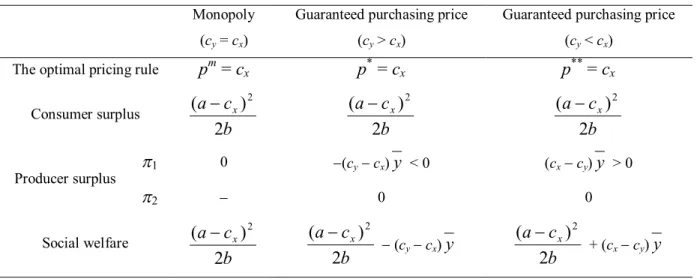
Table 1. The optimal solution in various scenarios
Monopoly (cy = cx)
Guaranteed purchasing price (cy > cx)
Guaranteed purchasing price (cy < cx)
The optimal pricing rule pm = cx p* = cx p** = cx
Consumer surplus b c a x 2 ) ( 2 b c a x 2 ) ( 2 b c a x 2 ) ( 2 Producer surplus 1 0 (cy cx)y < 0 (cx cy)y > 0 2 0 0 Social welfare b c a x 2 ) ( 2 b c a x 2 ) ( 2 (cy cx)y b c a x 2 ) ( 2 + (cx cy)y
Table 1 shows that it causes a maximized social welfare if the social planner adopts the rule of marginal cost pricing on matter in the monopoly case or in the case of guaranteed purchasing price with cy > cx or cy < cx. Hence, we have the proposition 1
as follows:
Proposition 1 No matter what the market structure is, the rule of marginal cost pricing always maximizes the social welfare.
We also find that the system of guaranteed purchasing price does not change the consumer surplus. The reason is that the public power plant still is a monopoly to sell the power under the system of guaranteed purchasing price. The rule of marginal cost pricing makes the profit of public power plant in the case of monopoly be zero. But in the system of guaranteed purchasing price, the profit of public power plant is likely to be negative (positive) if the guaranteed purchasing price is higher (lower) than its own electricity generation cost. And the public power plant must use the marginal cost of private power plant as a guaranteed purchasing price in order to maximize its own profit. As a result, the profit of private power plant is always zero. Hence, the
13
size of social welfare depends on the size of public power plant. We conclude some important findings in the proposition 2 as follows:
Proposition 2 Under the rule of marginal cost pricing
(i) No matter what the market structure is, the sizes of consumer surplus are the same; (ii) The guaranteed purchasing price set by public power plant is just as the marginal
cost of private power plant;
(iii)The system of guaranteed purchasing price is likely to cause a positive or negative profit for public power plant;
(iv) The system of guaranteed purchasing price is likely to cause a low social welfare if this system causes a profit loss for public power plant.
4.3 Some discussions
It is obviously that a decrease in the marginal cost of public power plant will cause an increase in consumer surplus no matter in which kind of the market structure. This result is that the public power plant is a monopoly in selling power market.
We next concern the effect of change in marginal costs of private power plant and public power plant on the social welfare. For getting the answer, we show some comparative statistic results as follows:
y c W * = y c W ** = y < 0, (11) x c W * = x c W ** = b c a x) ( + y > 0 if y > b c a x) ( . (12) From Equation (11) we find that a decrease in marginal cost of private power plant will cause the social welfare to increase. This result comes from that the profit of public power plant increases if cy < cx, or the loss of public power plant decreases if cy
14
decrease in the marginal cost of public power plant may cause the social welfare to decrease when the purchased amount of power by the public power plant is too much, i.e., y > (a cx)/b. Although a decrease in marginal cost of public power plant is
advantage to consumer surplus, the public power plant purchases too much power that price is fixed on cy is disadvantage to producer surplus. Given any purchased amount
of power y, if an increase size of consumer surplus can’t cover a decrease size of producer surplus, then it will cause the social welfare to decrease. This result is concluded in proposition 3 as follows:
Proposition 3 Under the system of guaranteed purchasing price, the marginal cost of public power plant decreases, and the public power plant purchases power too much, it will cause the social welfare to decrease.
5 Conclusion
In the past, humankind over depend on fossil fuel to generate power. However, the process of generating power by fossil fuel has made a large amount of greenhouse gas emission, and then cause the global warming and the climate change which has threaten the humankind existence. In order to retarding the global warming and keeping the sustainable development of earth, it has become an important mission for the worldwide governments to generate the power by renewable resources.
Generally speaking, the power plant of using renewable resources is private, small size, and makes a small environmental damage. On the other hand, the traditional power plant of using fossil fuel is public, large size, and makes a large environmental influence. The power market in Taiwan includes a public power plant which uses the fossil fuel to generate the power and many private power plants which use the renewable resources to generate the power. In order to increasing the proportion of
15
green-power, Taiwan government regulates the system of guaranteed purchasing price in which the public power plant must purchase all power generated by the private power plant under a guaranteed price.
This study uses the Stackelberg game to analyze the effect of guaranteed purchasing price system on social welfare. In our model, the private power plant is a Stackelberg leader and the public power plant is a Stackelberg follower since the public power plant must purchase all power generated by private power plant. We consider two scenarios in which the marginal cost of power generated by traditional fossil fuel is larger or lower than the marginal cost of power generated by renewable resources. The main findings in this study are as follows. (i) In our model framework, the rule of marginal cost pricing always causes a maximized social welfare. (ii) Under the system of guaranteed purchasing price, no matter what the guaranteed purchasing price is, the consumer surplus in various models are the same. (iii) A surprised finding is that the system of guaranteed purchasing price may cause the social welfare to decrease.
16
References
[1] J. Zhu, M. Y. Chow, A review of emerging techniques on generation expansion planning, IEEE Trans. Power Syst. 12 (1997) 1722-1728.
[2] W. Xing, F. F. Wu, A game-theoretical model of private power production, Electrical Power & Energy Systems. 23 (2001) 213-218.
[3] N. X. Jia, R. Yokoyama, Profit allocation of independent power producers based on cooperative game theory, Electrical Power & Energy Systems. 25 (2003) 633-641.
[4] M. T. Ameli, S. Moslehpour, M. Shamlo, Economical load distribution in power networks that include hybrid solar power plants, Electric Power Systems Research. 78 (2008) 1147-1152.
[5] G. Strbac, A. Shakoor, M. Black, D. Pudjianto, T. Bopp, Impact of wind generation on the operation and development of the UK electricity systems, Electric Power Systems Research. 77 (2007) 1214-1227.
[6] J. A. Peças Lopes, N. Hatziargyriou, J. Mutale, P. Djapic, N. Jenkins, Integrating distributed generation into electric power system: a review of drivers, challenges and opportunities, Electric Power Systems Research. 77 (2007) 1189-1203.
[7] E. M. Gouveia, M. A. Matos, Evaluating operational risk in a power system with a large amount of wind power, Electric Power Systems Research. 79 (2009) 734-739.
[8] T. Ackermann, Distributed resource and re-regulated electricity markets, Electric Power Systems Research. 77 (2007) 1148-1159.
[9] V. Akhmatov, H. Knudsen, Large penetration of wind and dispersed generation into Danish power grid, Electric Power Systems Research. 77 (2007) 1228-1238.
17
[10] J. Gordijn, H. Akkermans, Business models for distributed generation in a liberalized market environment, Electric Power Systems Research. 77 (2007) 1178-1188.
[11] D. Gan, J. Wang, D. V. Bourcier, An auction game model for pool-based electricity markets, Electrical Power & Energy Systems. 27 (2005) 480-487. [12] E. M. Azevedo, P. B. Correia, Bidding strategies in Brazilian electricity auctions,
Electrical Power & Energy Systems. 28 (2006) 309-314.
[13] L. Geerli, L. Chen, R. Yokoyama, Pricing and operation in deregulated electricity market by noncooperative game, Electric Power Systems Research. 57 (2001) 133-139.
[14] D. Moitre, Nash equilibria in competitive electric energy markets, Electric Power Systems Research. 60 (2002) 153-160.
[15] G. Gutiérrez-Alcaraz, G. B. Sheblé, Electricity market dynamics: Oligopolistic competition, Electric Power Systems Research. 76 (2006) 695-700.
[16] A. S. Chuang, F. Wu, P. Varaiya, A game-theoretic model for generation expansion planning: problem formation and numerical comparisons, IEEE Trans. Power Syst. 16 (2001) 885-891.
[17] L. B. Cunningham, R. Baldick, M. L. Baughman, An empirical study of applied game theory: transmission constrained Cournot behavior, IEEE Trans. Power Syst. 17 (2002) 166-172.
[18] C. Ruiz, A. J. Conejo, R. García-Bertrand, Some analytical results pertaining to Cournot models for short term electricity markets, Electric Power Systems Research. 78 (2008) 1672-1678.
[19] G. Romp, Game Theory: Introduction and Application, Oxford University Press, New York, 1997.
18
國科會補助專題研究計畫成果報告自評表
請就研究內容與原計畫相符程度、達成預期目標情況、研究成果之學術或應用
價值(簡要敘述成果所代表之意義、價值、影響或進一步發展之可能性)、是
否適合在學術期刊發表或申請專利、主要發現或其他有關價值等,作一綜合評
估。
1. 請就研究內容與原計畫相符程度、達成預期目標情況作一綜合評估
達成目標
□ 未達成目標(請說明,以 100 字為限)
□ 實驗失敗
□ 因故實驗中斷
□ 其他原因
說明:
如報告書中所示,已完成賽局模型設定,進行推導,並得到 Nash 均衡結
果,整理成命題。將繼續衍伸及改寫,以挑戰優良類國際期刊為目標。
2. 研究成果在學術期刊發表或申請專利等情形:
論文:已發表 □未發表之文稿□撰寫中 □無
專利:□已獲得 □申請中 無
技轉:□已技轉 □洽談中 無
其他:(以 100 字為限)
除了結案報告所附英文初稿之外,計畫執行期間已有運用賽局論方法於環
境與資源或產業經濟相關議題的學術期刊陸續發表,並有進行中論文:
1.
Chang, Ming-Chung and Jin-Li Hu (2011), "Inconsistent Preferences in Environmental Protection Investment and the Central Government's Optimal Policy," Applied Economics (SSCI), 43(6), 767-772.2.
Lin, Yan-Shu, Jin-Li Hu and Peng-Chiao Xia (Forthcoming), "Location Choice and Patent Licensing," Manchester School (SSCI).3.
Chang, Ming-Chung, Jin-Li Hu and Mei-Yu Lee (Forthcoming), "Economic and Environmental Effects of Refill Packs," Bulletin of Economic Research (SSCI). Advance on line: http://onlinelibrary.wiley.com/doi/10.1111/j.1467-8586.2010.00384.x/abstract4. Ya-Po Yang and Jin-Li Hu, “The Gresham’s Law in Environmental Protection,” under 2nd Revision for Environmental Economics and Policy Studies (EconLit).
5. Chung, Hui-Ling, Yan-Shu Lin and Jin-Li Hu, “Bundling Strategy and Product Differentiation,” under 2nd Revision for Journal of Economics (SSCI).
6.
Sheu, Jiuh-Biing and Jin-Li Hu, “The Competition between Green and Traditional Transportations,” Working Paper.19
3. 請依學術成就、技術創新、社會影響等方面,評估研究成果之學術或應用價
值(簡要敘述成果所代表之意義、價值、影響或進一步發展之可能性)(以
500 字為限)
主持人近年已於優良類能源經濟與政策期刊發表許多論文,包含:
Energy Policy (已有 7 篇 以上)、Applied Energy (已有 2 篇以 上)、
Energy Economics (已有 1 篇以上) 等,並獲得國際學術界之高度引述。但
是這些文章幾乎都是能源效率或生產力指標的自行發展建構及實證應用。本
計畫利用賽局模型,將有助於自行推導理論命題,以供未來實證研究者進行
檢定與討論。畢竟,理論與實證都不應偏廢。
1
類
別:國際學術會議
題目: The 1
stCongress of East Asian Association of
Environmental and Resource Economics (EAAERE)
服務機關:國立交通大學經營管理研究所
姓名職稱:胡均立 教授兼所長
前往國家:日本北海道
出國期間:自 99 年 8 月 16 日至 99 年 8 月 21 日
報告日期:99 年 9 月 15 日
一、參加經過 敝人長期研究資源與環境管理議題。東亞環境與資源經濟的學者過去在東亞地區輪流 主辦學術會議。敝人 2006 年 11 月曾經參加過在韓國首爾舉行的 The 2nd East Asian Symposium on Environmental and Natural Resources Economics,2008 年 2 月出席在日本東 京的 The 3rdEast Asian Symposium on Environmental and Natural Resources,2009 年 3 月聯 合主辦並出席了 The 4th
2
過 多 年 的 密 切 往 來 與 互 動 , 東 亞 地 區 的 環 境 與 資 源 經 濟 學 者 決 定 成 立 East Asian Association of Environmental and Resource Economics (EAAERE),並於今年 8 月在北海道大 學舉行成立大會及第一次年會。 敝人是在 8 月 16 日上午跟隨中華經濟研究院蕭代基院長及開南大學觀光運輸學院黃宗 煌院長領導的台灣教授及專家團體,從桃園機場飛到新千歲機場,並於 8 月 21 日上午由 新千歲機場飛回桃園機場。會議地點在北海道大學,會議期間為 8 月 17 日至 8 月 19 日。 8 月 17 日下午是日本、英國、德國、台灣、中國大陸、韓國的貴賓演講,主題為各地區的 綠色租稅改革。分組論文發表則安排於 8 月 18、19 兩日。由於蕭代基院長於出發前在桃 園機場就特別提醒,敝人於 8 月 17 日至 8 月 19 日三天內全程參與,並踴躍發言。 二、心得
敝人係於 8 月 19 日上午發表「Gresham’s Law in Environmental Protection」一文,與高雄 大學經營管理研究所楊雅博教授合著。這篇論文係利用賽局理論模型推導命題。其研究動機 是見到中國大陸因為環境執法寬鬆,使得無效率的高污染廠商有機會藉由逃避環境保護成本 來壓低產品售價,不利於合法負擔環境保護及污染防治成本的廠商,因而造成「劣幣驅逐良 幣」的現象。我們利用賽局理論推導證明,在不完全環境執法下,高成本廠商得以藉由策略 性地違反環保法規,來阻卻守法的低成本廠商進入市場。僅是訂定更嚴格的環境保護標準, 但未同時提高執法機率及提高罰金,有助於違法廠商將守法廠商趕出市場。本理論模型得以 用來解釋何以高污染與低生產效率經常並存於開發中經濟體。 本篇文章的評論人為東京大學國際協力學 Tetsuya Tsurumi 教授,但是他表示主要進行實 證研究,鮮少做經濟理論的推導。與會者普遍認為這篇研究的方法學嚴謹且結論大致合理, 但是理論文章所能處理的變數有限,且並無出人意表之外的新穎發現,僅是從經濟理論來解 釋已經可觀察到的現象何以長期存在。 敝人同時擔任政治大學經濟系李慧琳教授的評論人。她發表的題目為「Economic Impact of the Public Expenditure on Building On-Site Wastewater Treatment Facilities in the Taipei Metropolitan Area: An Application of the Regional Input-Output Model」,模擬計算台北都會區地 方政府廢水處理工程支出的投入產出分析。其中包含 55 個部門、19 個台北縣市的鄉鎮市。 結果發現廢水處理工程支出對帶動地方產業發展及就業具有顯著正向影響,其中又以台北縣
3
板橋市的支出所帶的乘數效果最大。由於從事中國大陸研究,敝人特別積極參加了中國大陸 研究相關的場次。例如:8 月 19 日下午的非再生能源場次中,京都大學 Vivian Leung 博士生 報告了「Limited Diffusion of LPG-powered Vehicles in China」,一橋大學博士生 Fu Zhe 報告了 「Motorization and Air Pollution in Shanghai」,日本國立環境研究所 Azusa Okagawa 博士報告 了「Promotion of Energy Supply from West to East in China」。敝人都舉手發問,並提供論文修 改建議。 三、考察參觀活動 日本山口大學陳禮俊教授,是知名的台灣旅日學者。他目前在中國大陸雲南等地區進行 田野調查,並且在台灣推廣山坡地生態工法。敝人多次與他交談,也了解了一些日本學界與 東亞學術界在永續發展上的合作項目。 韓國釜山國立大學 Sang-Mok Kang,曾多次在不同的國際會議中與敝人相遇,他曾於 2009 年來台參加亞洲生產力會議。他經常使用資料包絡分析法進行產業綠色效率計算,進行南韓 及中國大陸廠商綠色效率及生產力的比較研究。他最近從事共同邊界法的應用。敝人建議進 行第二階段的迴歸分析,以估計環境變數對綠色效率及生產力的影響,而非僅就效率值的計 算結果進行主觀猜測。 敝人與去年曾蒞臨本所演講的日本慶應大學 Eiji Hosoda 教授,就環境管制理論可能的發 展進行討論。此次的大會的主題之一是綠色租稅,不同租稅工具的組合或選擇將是有趣的環 境管制議題之一。Hosoda 教授是國際期刊 Environmental Economics and Policy Studies (EEPS) 的主編,敝人曾經在該期刊發表過學術論文,東亞環境與資源經濟學會計畫將 EEPS 變成該 學會的主要出版期刊,並於成立大會上正式宣布。 京都大學 Akihisa Mori 教授,一向對於促進東亞環境與資源學術交流不遺餘力。他提及 除了學術研究以外,藉由環境學術交流活動,落實綠色租稅改革理論於東南亞等開發中國家 的可能性。 此外,許多同行的台灣學者表示未來合作發表論文的意願。畢竟在台灣進行跨校研究合 作,具有可以經常見面討論的優點,也對增加台灣在國際發表上的量能,有所助益。
4 四、建議 藉由這次赴北海道大學參加國際會議,敝人除了宣讀論文外,並與海外學者面對面討論 未來的研究議題趨勢。畢竟,平時電子郵件的密集往返討論不如面對面的討論。未來可以主 動建議海外友人參加同一個國際研討會,藉由與會期間當面討論並介紹彼此的學術界朋友。 台灣是東亞環境與資源經濟學會的正式發起團體,我方宜積極參與,鞏固會籍,並藉此 與東亞環境與資源經濟學者密切交流,落實國際合作項目。 五、攜回資料名稱及內容 會議手冊、會議論文光碟、各國學者名片等。 六、其他 無。
國科會補助計畫衍生研發成果推廣資料表
日期:2011/09/01國科會補助計畫
計畫名稱: 再生能源民營電廠之競爭行為的賽局論分析 計畫主持人: 胡均立 計畫編號: 99-2410-H-009-063- 學門領域: 環境與資源管理無研發成果推廣資料
99 年度專題研究計畫研究成果彙整表
計畫主持人:胡均立 計畫編號:99-2410-H-009-063- 計畫名稱:再生能源民營電廠之競爭行為的賽局論分析 量化 成果項目 實際已達成 數(被接受 或已發表) 預期總達成 數(含實際已 達成數) 本計畫實 際貢獻百 分比 單位 備 註 ( 質 化 說 明:如 數 個 計 畫 共 同 成 果、成 果 列 為 該 期 刊 之 封 面 故 事 ... 等) 期刊論文 0 0 100% 研究報告/技術報告 1 1 100% 研討會論文 0 0 100% 篇 論文著作 專書 0 0 100% 申請中件數 0 0 100% 專利 已獲得件數 0 0 100% 件 件數 0 0 100% 件 技術移轉 權利金 0 0 100% 千元 碩士生 7 2 350% 博士生 2 2 100% 博士後研究員 0 0 100% 國內 參與計畫人力 (本國籍) 專任助理 0 0 100% 人次 期刊論文 3 2 150% 研究報告/技術報告 0 0 100% 研討會論文 1 1 100% 篇 論文著作 專書 0 0 100% 章/本 申請中件數 0 0 100% 專利 已獲得件數 0 0 100% 件 件數 0 0 100% 件 技術移轉 權利金 0 0 100% 千元 碩士生 0 0 100% 博士生 0 0 100% 博士後研究員 0 0 100% 國外 參與計畫人力 (外國籍) 專任助理 0 0 100% 人次其他成果