行政院國家科學委員會專題研究計畫 成果報告
奈米白金及含羧酸基聚電解質摻雜聚苯胺之複合材料應用
於直接甲醇燃料電池之研究
研究成果報告(精簡版)
計 畫 類 別 : 個別型 計 畫 編 號 : NSC 99-2218-E-151-003- 執 行 期 間 : 99 年 08 月 01 日至 101 年 07 月 31 日 執 行 單 位 : 國立高雄應用科技大學化學工程與材料工程系 計 畫 主 持 人 : 郭仲文 計畫參與人員: 碩士班研究生-兼任助理人員:楊長乾 碩士班研究生-兼任助理人員:黃昭文 碩士班研究生-兼任助理人員:郭正彥 碩士班研究生-兼任助理人員:曾宇璽 公 開 資 訊 : 本計畫可公開查詢中 華 民 國 101 年 10 月 28 日
中 文 摘 要 : 奈米材料是近幾年備受關注的材料之一。本篇文章利用聚苯 胺(PANI)經由「同步摻雜-沉積」的方法摻雜聚丙烯酸(PAA) 及鹽酸(HCl),再將奈米白金(Pt)粒子沉積於此載體形成 PANI-(PAA+HCl)-Pt 複合電極。首先,藉由電化學定電位方 式沉積 PANI 薄膜,將 PANI 薄膜浸泡於氨水(NH4OH)溶液呈去 摻雜態,再浸置於混合均勻的 PAA、HCl 和六氯鉑酸前驅物 (H2PtCl6.6H2O)溶液中進行同步摻雜。之後,利用電化學定 電位法沉積奈米 Pt 於 (PAA+HCl)內製備成 PANI-(PAA+HCl)-Pt 的複合電極。為了易於比較,在相同沉積條件 下,將 Pt 於直接沉積於摻雜 HCl 之 PANI 形成 PANI-HCl-Pt 電極。使用化學分析電子光譜儀(XPS)測試,證明 PANI-(PAA+HCl)比 PANI-HCl 具有較高正電荷氮原子。以掃描式電 子顯微鏡(SEM)發現 PANI-(PAA+HCl)具有三維多孔網狀結構 之奈米絲。經由穿透式電子顯微鏡(TEM)及歐傑電子光譜圖 (AES)深度分析證實,白金粒子均勻分散在三維網狀 PANI-(PAA+HCl)結構內。利用循環伏安法測試複合電極的催化能 力,結果顯示 PANI-(PAA+HCl)-Pt 電極對甲醇氧化電流密度 為 PANI-HCl-Pt 電極的 2 倍。以計時安培分析法測試對甲醇 催化穩定性,結果顯示 PANI-(PAA+HCl)-Pt 電極具有較佳的 穩定性。此奈米複合電極具有更優越的性質以應用於直接甲 醇燃料電池。 中文關鍵詞: 聚苯胺、聚丙烯酸、奈米纖維
英 文 摘 要 : This work demonstrates a novel and simple route for preparing a composite that comprises platinum (Pt) nanoparticles and polyaniline (PANI) doped with poly(acrylic acid) (PAA) and hydrochloric acid (HCl) via 'simultaneous doping- deposition' to obtain (PAA+HCl)-Pt composite electrodes.
PANI-(PAA+HCl) is characterized using X-ray photoelectron spectroscopy (XPS) and scanning electron microscopy (SEM). XPS results indicate that PANI-(PAA+HCl) has more positively charged nitrogen atoms compared to PANI doped with HCl (PANI-HCl). SEM images reveal that PANI-(PAA+HCl) is composed of highly porous nanowires. The morphology and structure of the PANI-(PAA+HCl)-Pt composite are further characterized by transmission electron microscopy (TEM) and Auger electron spectroscopy (AES). TEM images and AES results indicate that Pt particles are dispersed uniformly into the spatial regions of PANI-(PAA+HCl).
Cyclic voltammetry results and chronoamperometric response measurements show that PANI-(PAA+HCl)-Pt electrodes have good electrocatalytic activity of methanol oxidation with low CO poisoning.
英文關鍵詞: Polyaniline, poly(acrylic acid), nanowires, cyclic voltammetry, TEM, methanol oxidation
行政院國家科學委員會補助專題研究計畫
■ 成 果 報 告
□期中進度報告
奈米白金及含羧酸基聚電解質摻雜聚苯胺之複合材料應用於直接甲醇燃料電池之研究
計畫類別:■個別型計畫 □整合型計畫
計畫編號:NSC 99-2218-E-151-003
-
執行期間: 2010 年 8 月 1 日至 2012 年 7 月 31 日
執行機構及系所:國立高雄應用科技大學化學工程與材料工程系
計畫主持人: 郭仲文
共同主持人:
計畫參與人員:楊長乾、曾宇璽、郭正彥、黃昭文
成果報告類型(依經費核定清單規定繳交):■精簡報告 □完整報告
本計畫除繳交成果報告外,另須繳交以下出國心得報告:
□赴國外出差或研習心得報告
□赴大陸地區出差或研習心得報告
□出席國際學術會議心得報告
□國際合作研究計畫國外研究報告
處理方式:
除列管計畫及下列情形者外,得立即公開查詢
□涉及專利或其他智慧財產權,■一年□二年後可公開查詢
Composites of nano- Pt particles and polyaniline doped
with polyelectrolytes containing carboxylic acid for
direct methanol fuel cells
1. INTRODUCTION
Direct methanol fuel cells (DMFC) are highly attractive power sources for a variety of applications due to their high energy efficiency, low emissions, low noise, and environmental friendliness [1-8]. DMFCs are based on methanol electro-oxidation at the anode. Among the numerous materials used for the anode of DMFCs, Pt has been established as a powerful electrocatalyst for the oxidation of methanol [9,10]. However, the use of Pt in the form of smooth foils for the direct electro-oxidation of methanol has been found to be inefficient due to (i) high cost and (ii) the formation of strongly adsorbed intermediates such as CO (referred to as COads) as a result of the dissociative adsorption of methanol [11].
In order to mitigate COads-like poisoning, various strategies have been developed to improve the electrocatalytic activity for methanol electro-oxidation and oxygen reduction reactions, including the addition or incorporation of a second element into Pt electrocatalysts, such as catalyst supporters [12,13]. It has been shown that the use of conducting polymers (CPs) as a catalyst supporter is a simple and useful way of reducing catalyst poisoning. CPs in their various oxidation states interconvert each other, which allows a redox cycle to form for catalytic reactions. Thus, the electrochemical deposition of metals on electrodes modified with CP films is a convenient and inexpensive route for developing anode materials. Studies on CPs as host materials for Pt nanoparticles have focused on polyaniline (PANI) [14,15], polypyrrole (PPy) [16,17], and polythiophene (PT) [18]for methanol oxidation. The advantage of using CPs over other materials is that they are permeable to electroactive species, sufficiently conductive for current flow between the solution and substrate, easily modified using various techniques, and easy to coat onto various substrates. CPs also act as electrocatalyst and current collectors.
Poly(styrenesulfonic acid) (PSS), a polymer acid, has been shown to be easily incorporated in a CP matrix as a dopant as a support for Pt particles. Huang et al. [19] reported that PANI-PSS acts as a matrix that leads to the uniform distribution of Pt particles. As a result, the electrocatalytic activity for methanol oxidation of PANI-PSS-Pt is much higher than that of PANI-Pt. Kuo et al. [20] reported that highly dispersed Pt particles became homogeneously distributed in a poly(3,4-ethylenedioxythiophene)-poly(styrene sulfonic acid) (PEDOT-PSS) matrix. However, these investigations mainly focused on the manufacture of PSS as a dopant in a CP matrix; less attention has been given to the processing of a CP modified with a polymer acid containing carboxylic acid groups for use as a supporting material in DMFCs.
In the present study, a simple simultaneous doping-deposition method is used to introduce -CO2H groups (poly(acrylic acid), PAA) and HCl with Pt4+ ions into a PANI matrix. PANI doped simultaneously with PAA and HCl forms a spatial network structure, which behaves as a 3D-random matrix for the deposition of Pt particles. We believe that PANI-(PAA+HCl) may act as a stabilizer for Pt particles, preventing their aggregation. The PANI-(PAA+HCl)-Pt composite is expected to enhance electroactivity for methanol oxidation.
2. EXPERIMENTAL
2.1. Preparation of PANI-(PAA+HCl)
A mixture solution of 50 mM ANI (Merck) and 0.5 M H2SO4 (Merck) aqueous solution was prepared. Electrochemical polymerization of the solution was carried out using a potentiostatic method with stainless steel 316 (SS) as the working electrode for a total charge of 0.1 C cm-2, details of the procedure are described elsewhere [21]. Before each experiment, SS was cleaned in an ultrasonic bath using detergent, deionized water, and isopropanol, and then dried with a dry nitrogen flow. The electrochemically deposited PANI film was rinsed with double distilled water for 5 min and then dried at 120 °Cfor 3 min. The Emeraldine base form (EB) of PANI was obtained by treating the PANI film in 0.1 M ammonium hydroxide (Aldrich) for 3 min. The EB film was then simultaneously redoped with poly(acrylic acid) (PAA) (Mw = 450,000, Aldrich) and HCl in 0.01 M PAA +0.01 M HCl solution containing 5 mM H2PtCl6⋅6H2O. EB film redoped with PAA and HCl is denoted as PANI-(PAA+HCl). For comparison, EB film was redoped with HCl in 0.01 M HCl solution containing 5 mM H2PtCl6⋅6H2O (denoted as PANI-HCl).
2.2. Deposition of Pt into PANI-(PAA+HCl) matrix
Pt particles were incorporated into PANI-(PAA+HCl) film via electrochemical deposition from 0.01 M PAA + 0.01 M HCl + 0.1 M KCl solution containing 5 mM H2PtCl6.6H2O (PANI-(PAA+HCl)-Pt) with a constant deposition charge of 0.15 C at a constant potential of -0.2 V (vs. Ag/AgCl). For comparison, Pt particles were also deposited into a PANI-HCl matrix (PANI-HCl-Pt) under deposition conditions similar to those used for PANI-(PAA+HCl). After Pt particle incorporation, the electrodes were rinsed with double distilled water for 5 min and then dried at 120 °C for 3 min. The amount of Pt loaded into PANI-(PAA+HCl) or deposited onto PANI-HCl was calculated using:
where M is the atomic weight of Pt, F is the Faradic constant, and Z is the number of electrons transferred (taken as four for the formation of Pt). The amount (m) was calculated using the charge (Qdep)
utilized for the deposition of Pt particles.
2.3. Characterization of PANI-(PAA+HCl)-Pt composite electrode
A X-ray photoelectron spectroscopy (XPS) study was performed using an ESCA 210 spectrometer with Mg Kα(hν= 1253.6 eV) irradiation as the photon source. The primary tension was 12 kV and the pressure during the scans was approximately 10-10 mbar. The surface morphologies of PANI-(PAA+HCl)-Pt and PANI-HCl-Pt films were compared using a scanning electron microscope (SEM) (JEOL JSM-6700F) equipped with an energy dispersive spectroscopy (EDS). The morphology was characterized by Transmission electron microscopy (TEM, JEOL 1200 EX) at a 100 kV accelerating voltage. Specimens for TEM were prepared by spreading a small drop of one of the sample solutions onto a 400-mesh copper grid. The drop was dried in air at room temperature for nearly 4 days. Auger electron spectroscopy (AES) depth profiles were obtained with a Microlab 310 D (VG Scientific Ltd.) spectrometer at emission currents of 0.1 and 8 mA with gun tensions of 10 (electron) and 3 kV (ion), respectively.
Qdep ⋅ M
m =
Electrochemical characterizations of PANI-(PAA+HCl)-Pt and PANI-HCl-Pt composite electrodes were carried out using an CHI627D electrochemical analyzer (U.S.A.). All experiments were performed in a three-component cell. An Ag/AgCl electrode (in 3 M KCl), Pt wire, and SS (1-cm2 area) were used as the reference, counter, and working electrodes, respectively. A Luggin capillary, whose tip was set at a distance of 1-2 mm from the surface of the working electrode, was used to minimize errors due to iR drop in the electrolytes.
2.4. Methanol Electro-oxidation and Stability of PANI-(PAA+HCl)-Pt composite electrode
The catalytic activities of PANI-(PAA+HCl)-Pt and PANI-HCl-Pt composite electrodes were examined by cyclic voltammetry (CV) at 10 mV sec-1 ranging from -0.2 to 1.0 V. Chronoamperometric response curves were obtained at 0.6 V in 0.1 M CH3OH + 0.5 M H2SO4 solution. All the electrochemical experiments were carried out at room temperature.
3. RESULTS AND DISCUSSION
3.1. Characterizations of PANI-(PAA+HCl)
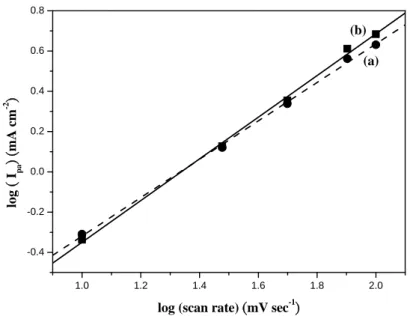
An investigation was made into the charge transport mechanism in the PANI-(PAA+HCl)-Pt and PANI-HCl-Pt composite electrodes at various scan rates (v) by linear sweep voltammograms (LSVs). The double logarithmic plots of peak current versus v (Fig. 1) for the two types of electrode are linear with nearly identical slopes. It is known that the linearity of a plot of peak current versus v corresponds to the surface-bound transport process and a different type of linear for the plot of peak current versus v1/2
signifies a diffusion control process [22]. The slope values of the double logarithmic plots are 0.95 and 1.03 for PANI-HCl and PANI-(PAA+HCl), respectively. Thus, the PANI-HCl and PANI-(PAA+HCl) composite electrodes have surface-bound transport processes.
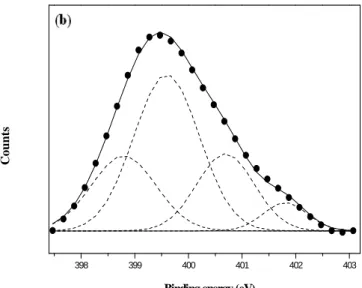
XPS analyses of the surfaces of PANI-HCl and PANI-(PAA+HCl) were conducted to investigate variations at nitrogen binding sites. Fig. 2 shows the XPS spectra of core-level N1s for PANI-HCl and PANI-(PAA+HCl). The signals of N1s were fitted with peaks at 398.8, 399.6, 400.7, and 401.8 eV, which correspond to quinonoid imine (=N-), benzenoid amine (-NH-), protonated amine (-N+), and protonated imine (=N+), respectively [23]. Kumar et al. [24,25] attributed the last two peaks to the presence of polarons (radical cations) and bipolarons (dications). The ratio of these two N1s components at 400.7 and 401.8 eV (positively charged nitrogen atoms) can be considered as a direct estimation of the doping level of PANI [26]. The area ratios of the four nitrogen constituents in PANI were calculated; their results are listed in Table 1. The doping level for PANI-(PAA+HCl) (27 %) is higher than that observed for PANI-HCl (23 %) due to the existence of PAA.
1.0 1.2 1.4 1.6 1.8 2.0 -0.4 -0.2 0.0 0.2 0.4 0.6 0.8 log ( I pa ) ( mA c m -2 )
log (scan rate) (mV sec-1)
(a) (b) 398 399 400 401 402 403 Co unt s
Binding energy (eV)
Figure 1. Dependence of the peak current on the scan rate by linear sweep voltammograms (LSVs): (a)
PANI-HCl and (b) PANI-(PAA+HCl).
Table 1. XPS results of PANI-HCl and PANI-(PAA+HCl)
Electrode =N-(%) -NH-(%) -N+(%) =N+(%) [-N+ + =N+/N] (%) PANI-HCl 19 58 19 4 23 PANI-(PAA+HCl) 23 50 21 6 27
398 399 400 401 402 403
Co
u
n
ts
Binding energy (eV)
Figure 2. N1s XPS core level spectra of (a) PANI-HCl and (b) PANI-(PAA+HCl) composite films.
3.2. Electrodeposition of Pt into PANI-(PAA+HCl)
Pt particles were incorporated into PANI-HCl and PANI-(PAA+HCl) films by electrochemical deposition at a constant potential of -0.2 V (vs. Ag/AgCl) with a charge of 0.15 C. Fig. 3a shows SEM micrographs of the surface morphology of PANI-HCl, PANI-(PAA+HCl), PANI-HCl-Pt, and PANI-(PAA+HCl)-Pt electrodes. The nanowire morphology for PANI-HCl and PANI-(PAA+HCl) films is clearly evident in Fig. 3a(I-II). The PANI-HCl nanowires have an average diameter of 30-60 nm. PANI-(PAA+HCl) nanowires have a larger diameter (50-80 nm) with a smooth surface due to the influence of PAA molecules on PANI. It is to be noted that the incorporation of PAA into PANI did not change the nanowire morphology. The nanowire morphology of PANI-(PAA+HCl) provides a large surface area for the subsequent deposition of Pt particles. We believe that Pt particles are incorporated into PANI-HCl and PANI-(PAA+HCl) nanowire network structures. Pt particleswith a size of about 100 nm can be seen in the PANI-HCl-Pt composite electrode (Fig. 3a(III)), whereas no Pt particles are visible in the PANI-(PAA+HCl)-Pt electrode, possibly due to their small size (Fig. 3a(IV)). Even though the loading of Pt particles was low (76 μg), Pt particles can be clearly seen on the PANI-HCl nanowires. Pt mapping analysis for PANI-HCl-Pt and PANI-(PAA+HCl)-Pt electrodes indicates the existence of Pt (Fig. 3a inset). Fig. 3b(I-II) show a TEM micrograph of Pt particles embedded into PANI-HCl and PANI-(PAA+HCl) nanowires, respectively. The black spots indicate of Pt in PANI-HCl and PANI-(PAA+HCl). The aggregation of Pt particles can be clearly seen on PANI-HCl-Pt electrodes. The particle size of Pt (20-90 nm) for the PANI-(PAA+HCl)-Pt electrode is smaller than that for the PANI-HCl-Pt electrode, which gives the former electrode a higher active surface area. The CO2- groups of PAA uptake Pt4+ ions and HCl into the PANI matrix and PANI-(PAA+HCl) matrix, which prevents the aggregation of Pt nanoparticles after Pt formation.
(a)
(b)
Figure 3. (a) SEM images of (I) PANI-HCl, (II) PANI-(PAA+HCl), (III) PANI-HCl-Pt, and (IV)
PANI-(PAA+HCl)-Pt. Insets in (III) and (IV) show X-ray maps (bright spots indicate Pt). (b) TEM images of (I) PANI-HCl-Pt and (II) PANI-(PAA+HCl)-Pt.
0 5 10 15 20 In te ns it y (c ount s) Time/min (a) (b)
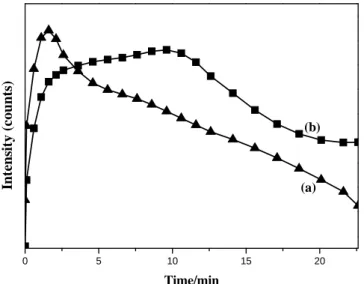
The incorporation of Pt into PANI-HCl and PANI-(PAA+HCl) films was examined using depth profiles of Pt particles obtained with AES (Fig. 4). There is a definite difference in the distribution of particles in PANI-HCl-Pt and PANI-(PAA+HCl)-Pt electrodes. The depth profile of Pt in the PANI-HCl matrix (curve a) increases in intensity of Pt, reaching a maximum at 2 min. The intensity then decreases rapidly after about 23 min. In contrast to the PANI-HCl-Pt electrode, Pt in the PANI-(PAA+HCl) matrix (curve b) quickly increases in intensity up to a shoulder at 2 min and then increases to a maximum at about 10 min. The intensity then decreases slowly after about 23 min. Consequently, Pt particles in the PANI-(PAA+HCl) matrix are more uniformly dispersed than those in PANI-HCl. This may be due to the CO2- groups of PAA uptake Pt4+ ions, and PANI doped with PAA and HCl form a spatial network structure that acts as a 3D-random matrix and a protective layer which prevents the aggregation of Pt particles after Pt formation. The homogenous distribution of Pt in the PANI-(PAA+HCl) spatial network structure may increase the utilization of Pt for methanol oxidation.
Figure 4. AES depth profiles for platinum within (a) PANI-HCl-Pt and (b) PANI-(PAA+HCl)-Pt.
3.3. Scheme of the formation of PANI-(PAA+HCl)-Pt
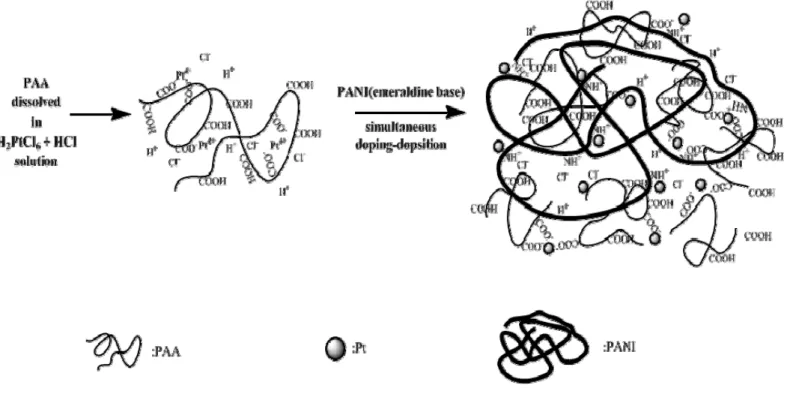
Based on the observed synthesis of the composite electrodes, the proposed scheme of the “simultaneous doping-deposition” of Pt in the PANI-(PAA+HCl) matrix is shown in Fig. 5. When H2PtCl6, HCl, and PAA are mixed well, mobile Pt4+ ions couple with CO2- groups on PAA to form a complex. During the dipping of the PANI matrix in a H2PtCl6, HCl, and PAA solution, PANI emeraldine base is simultaneously doped with excess CO2- anions on the PAA and Cl- anions of HCl to maintain charge neutrality within the PANI phase. The formed complex (Pt4+ with Cl- and CO2-) may become trapped in the PANI matrix. Since Pt is deposited via a potentiostatic process, PANI-(PAA+HCl) provides an environment for the dispersion of individual Pt particles and keeps the active surface area large. We anticipate that this morphology is suitable for DMFC applications. Pt particles dispersed on a carbon black support that are used as a catalyst in DMFCs do not provide optimal interparticle spacing for rapid methanol diffusion below the top surface layers, limiting the effectiveness of expensive catalysts. Pt particles dispersed in PANI-(PAA+HCl) may be better suited for
DMFC applications.
Figure 5. Schematic illustration for the formation of PANI-(PAA+HCl)-Pt.
3.4. Electrocatalytic activity and stability of PANI-(PAA+HCl)-Pt for methanol oxidation
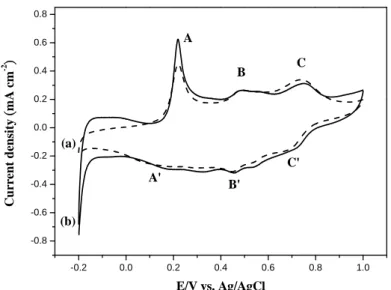
Cyclic voltammograms of PANI-HCl-Pt and PANI-(PAA+HCl)-Pt electrodes collected at a scan rate of 10 mV sec-1 in 0.5 M H2SO4, are shown in Fig. 6a-b, respectively. Three well-defined redox pairs can be seen due to the conversion of leucoemeraldine to emeraldine (0.2 V, A/A’ peaks), emeraldine to pernigraniline (0.7 V, C/C’ peaks), and hydroquinone to quinone (0.4 V, B/B’ peaks), respectively [27]. The PANI-HCl-Pt and PANI-(PAA+HCl)-Pt electrodes have a clear texture of hydrogen adsorption/desorption with no sharp peaks in the potential range of -0.2 and +0.0 V vs. Ag/AgCl [28]. There is a difference in the current density of hydrogen absorption and desorption between PANI-HCl-Pt and PANI-(PAA+HCl)-Pt electrodes. It is known that the integral of the intensity of hydrogen absorption and desorption represents the number of sites of Pt available for hydrogen adsorption and desorption, respectively [29,30]. The charge for hydrogen absorption and desorption on the PANI-(PAA+HCl)-Pt surface is 5.44 mC cm-2, which is 2.0 times larger than that on the PANI-HCl-Pt surface (2.76 mC cm-2). This implies that PANI-(PAA+HCl)-Pt has a higher surface area for Pt than that of PANI-HCl-Pt, which is attributable to the homogeneous dispersion of Pt in the PANI-(PAA+HCl) spatial network structure.
CV and chronoamperometry are convenient and useful tools for investigating the electrocatalytic activity and stability of electrodes for methanol oxidation, respectively. The methanol oxidation at PANI-HCl-Pt and PANI-(PAA+HCl)-Pt electrodes was characterized by CV in 0.5 M H2SO4 solution containing 0.1 M methanol at a scan rate of 10 mV sec-1. The resulting cyclic voltammograms are shown in Fig. 7. Methanol oxidation commenced at about 0.4 V, with a peak at about 0.6 V. For the reverse scan, an oxidation peak occurred at about 0.55 V, and no reduction peak was observed. The onset potentials for methanol oxidation were 0.42 and 0.40 V for PANI-HCl-Pt and PANI-(PAA+HCl)-Pt, respectively. The lower onset potential of PANI-(PAA+HCl)-Pt is attributed to the -COH groups in PANI-(PAA+HCl) that can shuttle
-0.2 0.0 0.2 0.4 0.6 0.8 1.0 -1.0 -0.5 0.0 0.5 1.0 1.5 2.0 (b) C u rren t d ensi ty ( mA c m -2 ) E/V vs. Ag/AgCl (a) -0.2 0.0 0.2 0.4 0.6 0.8 1.0 -0.8 -0.6 -0.4 -0.2 0.0 0.2 0.4 0.6 0.8 C' B' C u rr ent density ( mA c m -2 ) E/V vs. Ag/AgCl (b) (a) A B C A'
electrons easily (high positive charge nitrogen content) toward methanol oxidation.
Figure 6. Cyclic voltammograms of (a) PANI-HCl-Pt and (b) PANI-(PAA+HCl)-Pt in 0.5 M H2SO4 solution with a scanning rate of 10 mV sec-1.
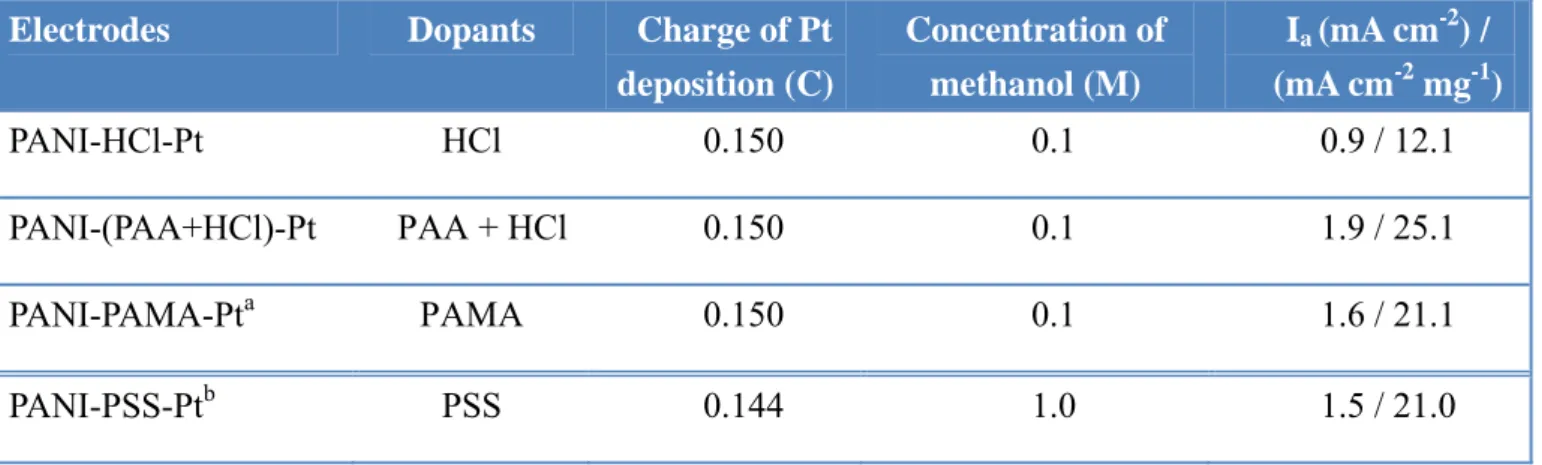
A comparison of cyclic voltammograms for the oxidation of methanol on PANI-(PAA+HCl)-Pt and PANI-HCl-Pt electrodes indicates that the oxidation current at the PANI-(PAA+HCl)-Pt electrode is higher (curve b) than that at the PANI-HCl-Pt (curve a) electrode. For instance, the maximum anodic peak current density (Ia in Table 2) of 25.1 mA cm-2 mg-1 observed for PANI-(PAA+HCl)-Pt electrode at about 0.60 V is higher than that for observed for PANI-HCl-Pt (12.1 mA cm-2 mg-1). The better performance of the PANI-(PAA+HCl)-Pt electrode toward methanol oxidation may be attributed to the following reasons. Firstly, a high surface area for Pt particles is anticipated due to the uniform distribution of Pt particles into PANI doped with PAA and HCl, which can twist to form a spatial 3D matrix. Secondly, we anticipate that the -CO2H groups in PANI-(PAA+HCl) may act as a stabilizer for Pt particles and prevent the aggregation of Pt particles. The PANI-(PAA+HCl) matrix acts as a good medium for the deposition of Pt particles, and increases the density of active sites on the electrode surface.
Figure 7. Cyclic voltammograms of (a) PANI-HCl-Pt and (b) PANI-(PAA+HCl)-Pt in 0.1 M CH3OH + 0.5 M H SO solution, scan rate = 10 mV sec-1.
Table 2. Components and characterizations for electrodes in the same deposition charge (0.1 C) of PANI as
matrix.
a Reference [31]. b Reference [19].
The maximum anodic peak current density (Ia in Table 2) of 25.1 mA cm-2 mg-1 observed for PANI-(PAA+HCl)-Pt electrode for the oxidation of methanol is higher than the 21.1 mA cm-2 mg-1 obtained for Pt in a polyaniline-poly(acrylic acid-co-maleic acid) (PANI-PAMA-Pt) electrode [31] for the same deposition charge of PANI and Pt. The higher current density for the PANI-(PAA+HCl)-Pt electrode may be due to the CO2- groups of PAA helping the uptake of Pt4+ ions by the PAA, HCl, and H2PtCl6 solution. A uniform distribution of reduced Pt particles into PANI-(PAA+HCl) can twist to form a spatial 3D matrix. The oxidation current density (25.1 mA cm-2 mg-1) for 0.1 M methanol oxidation observed for PANI-(PAA+HCl)-Pt is higher than that (21.0 mA cm-2 mg-1) observed for PANI-PSS-Pt [19] for the oxidation of 1.0 M methanol (Table 2). Golabi and Nozad [32] reported that anodic current increases with increasing methanol concentration and levels off at concentrations higher than 0.7 M. This might be attributed to the weak interaction between PANI and the -CO2H groups of the weak acid PAA, which provides more network pore space with Pt4+ existence for facile preparing Pt nanoparticles. Hence, the proposed methods highly favor the formation of Pt nanoparticles in the PANI-(PAA+HCl) matrix via the “simultaneous doping-deposition” process.
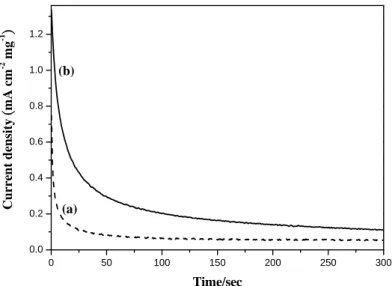
Chronoamperometric responses at PANI-HCl-Pt and PANI-(PAA+HCl)-Pt electrodes for a solution of 0.1 M CH3OH in 0.5 M H2SO4 were recorded at 0.6 V (Fig. 8) and compared to evaluate the catalyst poisoning effect [33,34]. PANI-(PAA+HCl)-Pt has better catalytic properties toward methanol oxidation compared to those of PANI-HCl-Pt. For example, the current at 150 s is 0.16 mA cm-2 mg-1 for PANI-(PAA+HCl)-Pt (curve b) and 0.06 mA cm-2 mg-1 for PANI-HCl-Pt (curve a).
Furthermore, the methanol oxidation current decays at a lower rate for PANI-(PAA+HCl)-Pt than for PANI-HCl-Pt. This demonstrates that Pt particles embedded in PANI-(PAA+HCl) are more electroactive and stable compared to those in PANI-HCl. The incorporation of PAA into PANI may influence the formation of strongly absorbed poisonous species on the surface of Pt particles. Thus, the PANI-(PAA+HCl)-Pt electrode exhibited low catalyst poisoning.
Electrodes Dopants Charge of Pt deposition (C) Concentration of methanol (M) Ia (mA cm-2) / (mA cm-2 mg-1) PANI-HCl-Pt HCl 0.150 0.1 0.9 / 12.1 PANI-(PAA+HCl)-Pt PAA + HCl 0.150 0.1 1.9 / 25.1 PANI-PAMA-Pta PAMA 0.150 0.1 1.6 / 21.1 PANI-PSS-Ptb PSS 0.144 1.0 1.5 / 21.0
0 50 100 150 200 250 300 0.0 0.2 0.4 0.6 0.8 1.0 1.2 C u rr ent de n si ty ( mA c m -2 mg -1 ) Time/sec (a) (b)
Figure 8. Chronoamperometric response of (a) PANI-HCl-Pt and (b) PANI-(PAA+HCl)-Pt at 0.6
V (vs. Ag/AgCl) in 0.1 M CH3OH + 0.5 M H2SO4 solution.
4. CONCLUSIONS
PANI-(PAA+HCl) porous nanowires were synthesized by simultaneously doping PANI with PAA and HCl. The deposited Pt nanoparticles were incorporated into the PANI-(PAA+HCl) nanowire network structure to form the PANI-(PAA+HCl)-Pt composite electrode. The -CO2H groups in the PANI-(PAA+HCl) spatial structure improve the stability of Pt4+ ions in the polymer matrix, resulting in a homogenous distribution of Pt in PANI-(PAA+HCl). The PANI-(PAA+HCl)-Pt electrode exhibits a higher current density and lower onset potential toward methanol oxidation than PANI-HCl-Pt. The PANI-(PAA+HCl)-Pt composite electrode is a promising material for catalysts for methanol oxidation. The enhanced electrocatalytic activity of Pt in PANI-(PAA+HCl) opens up the possibility to using smaller amounts of Pt in DMFC applications.
ACKNOWLEDGEMENTS
The financial support of this work by the National Science Council of Taiwan under NSC 99-2218-E-151-003 is gratefully acknowledged.
References
1. B.D. McNicol, D.A.J. Rand, K.R. Williams, J. Power Sources, 83 (1999) 15.
2. M. Brandalise, M.M. Tusi, R.M.S. Rodrigues, E.V. Spinace, A.O. Neto, Int. J. Electrochem. Sci., 5 (2010) 1879.
3. Y.I. Kim, D. Soundararajan, C.W. Park, S.H. Kim, J.H. Park, J.M. Ko, Int. J. Electrochem. Sci., 4 (2009) 1548.
4. C.M. Bautista-Rodriguez, A. Rosas-Paleta, J.A. Rivera-Marquez, O. Solorza-Feria, Int. J. Electrochem. Sci., 4 (2009) 60.
5. A.O. Neto, R.W.R. Verjulio-Silva, M. Linardi, E.V. Spinace, Int. J. Electrochem. Sci., 4 (2009) 954. 6. J. Parrondo, R. Santhanam, F. Mijangos, B. Rambabu, Int. J. Electrochem. Sci., 5 (2010) 1342.
7. B. Krishnamurthy, S. Deepalochani, Int. J. Electrochem. Sci., 4 (2009) 386.
8. M. Brandalise, M.M. Tusi, R.M. Piasentin, M. Linardi, E.V. Spinace, A.O. Neto, Int. J. Electrochem. Sci., 5 (2010) 39.
9. B. Pierozynski, D. Zielinska, Int. J. Electrochem. Sci., 5 (2010) 1507. 10. M.S. El-Deab, Int. J. Electrochem. Sci., 4 (2009) 1329.
11. B. Beden, F. Hahn, S. Juanto, C. Lamy, J.M. Leger, J. Electroanal. Chem., 225 (1987) 215. 12. A.A. Hathoot, M. Abdel-Kader, M. Abdel-Azzem, Int. J. Electrochem. Sci., 4 (2009) 208.
13. R.F.B. De Souza, M.M. Tusi, M. Brandalise, R.R. Dias, M. Linardi, E.V. Spinace, M.C. dos Santos, A.O. Neto, Int. J. Electrochem. Sci., 5 (2010) 895.
14. J. Yano, H. Hirayama, Y. Harima, A. Kitani, J. Electrochem. Soc., 157 (2010) B506. 15. F.J. Liu, L.M. Huang, T.C. Wen, A. Gopalan, Synth. Met., 157 (2007) 651.
16. Y.C. Zhao, L. Zhan, J.N. Tian, S.L. Nie, Z. Ning, Electrochim. Acta, 56 (2011) 1967. 17. J. Li, X.Q. Lin, J. Electrochem. Soc., 154 (2007) B1074.
18. V. Selvaraj, M. Alagar, I. Hamerton, Appl. Catal., B Environ., 73 (2007) 172. 19. L.M. Huang, W.R. Tang, T.C. Wen, J. Power Sources, 164 (2007) 519.
20. C.W. Kuo, L.M. Huang, T.C. Wen, A. Gopalan, J. Power Sources, 160 (2006) 65. 21. F.J. Liu, Polymer Composites, 30 (2009) 1473.
22. T.C. Wen, L.M. Huang, A. Gopalan, J. Electrochem. Soc., 148 (2001) D9.
23. Y.K. Zhou, B.L. He, W.J. Zhou, H.L. Li, J. Electrochem. Soc., 151 (2004) A1052. 24. S.N. Kumar, G. Bouyssoux, F. Gaillard, Surf. Interface Anal., 15 (1990) 531. 25. S.N. Kumar, F. Gaillard, G. Bouyssoux, A. Sartre, Synth. Met., 36 (1990) 111. 26. L.D.D. Pra, S. Demoustier-Champagne, Thin Soild Films, 479 (2005) 321. 27. S.S. Chen, T.C. Wen, A. Gopalan, Synth. Met., 132 (2003) 133.
28. C. Sivakumar, Electrochim. Acta, 52 (2007) 4182.
29. T.J. Schmidt, H.A. Gasteiger, G.D. Stab, P.M. Urban, D.M. Kolb, R.J. Behm, J. Electrochem. Soc., 145 (1998) 2354.
30. A.Chen, D.J.L. Russa, B. Miller, Langmuir, 20 (2004) 9695.
31. C.C. Yang, T.Y. Wu, H.R. Chen, T.H. Hsieh, K.S. Ho, C.W. Kuo, Int. J. Electrochem. Sci., 6 (2011) 1642. 32. S.M. Golabi, A. Nozad, J. Electroanal. Chem., 521 (2002) 161.
33. X.J. Feng , Y.L. Shi, Z.A. Hu,Int. J. Electrochem. Sci., 5 (2010) 489.
34. F.J. Liu, L.M. Huang, T.C. Wen, C.F. Li, S.L. Huang, A. Gopalan, Synth. Met., 158 (2008) 603.
5. Relation publish papers (Chung-Wen Kuo)
2012 (SCI 論文之IF 及 ranking 以 2011 年 ISI 資料庫為依據)
1. Chung-Wen Kuo, Bor-Kuan Chen, Yu-Hsi Tseng, Tar-Hwa Hsieh, Ko-Shan Ho,Tzi-Yi Wu*, Ho-Rei Chen,” A comparative study of poly(acrylic acid) and poly(styrenesulfonic acid) doped into polyaniline as platinum catalyst support for methanol electro-oxidation” , Journal of the Taiwan Institute of Chemical Engineers, 43(2012)798. (SCI, IF=2.110, ranking: 29/133 in engineering chemical), (NSC 99-2218-E-151-003)
2. Tzi-Yi Wu, Zheng-Yan Kuo, Jiin-Jiang Jow, Chung-Wen Kuo*, Cheng-Jang Tsai, Pin-Rong Chen, Ho-Rei Chen,”Co-electrodeposition of platinum and rhodium in poly(3,4-ethylenedioxythiophene)-poly(styrene sulfonic acid) as electrocatalyst for methanol oxidation”, International Journal of Electrochemical Science, 7(2012)8076 (SCI, IF=3.729, ranking: 9/27 in Electrochemistry ) (NSC 99-2218-E-151-003)
3. Chung-Wen Kuo, Zheng-Yan Kuo, Jiin-Jiang Jow, Tzi-Yi Wu*, Jing-Yuan Chen, Xian-Xun Zhu,”Enhanced Electrocatalytic Performance for Methanol Oxidation via Insertion of Ruthenium Oxide Particles into Pt and Polyaniline-Poly(Acrylic Acid-co-Maleic Acid) Composite Electrode”, International Journal of Electrochemical Science, 7(2012)4974. (SCI,
IF=3.729, ranking: 9/27 in Electrochemistry ), (NSC 99-2218-E-151-003)
4. Tzi-Yi Wu, Lin Hao, Chung-Wen Kuo, Yuan-Chung Lin, Shyh-Gang Su, Ping-Lin Kuo, I-Wen Sun*, ”Ionic Conductivity and Diffusion in Lithium Tetrafluoroborate-Doped 1-Methyl-3-Pentylimidazolium Tetrafluoroborate Ionic Liquid”, International Journal of Electrochemical Science, 7(2012)2047. (SCI, IF=3.729)
5. Tzi-Yi Wu, Bor-Kuan Chen*, Lin Hao, Chung-Wen Kuo, I-Wen Sun*,” Thermophysical properties of binary mixtures {1-methyl-3-pentylimidazolium tetrafluoroborate + polyethylene glycol methyl ether}”, Journal of the Taiwan Institute of Chemical Engineers, 43 (2012) 313. (SCI, IF=2.110)
6. Chung-Wen Kuo, Ping-Lin Kuo, Ko-Shan Ho, Tar-Hwa Hsieh, Sin-Jhih Chen, Tzi-Yi Wu*, Yu-Chang Huang, ” Polyaniline doped with various inorganic acids and polymeric acids as platinum catalyst support for methanol electro-oxidation”, Journal of the Chinese Chemical Society, 59(2012)1294. (SCI, IF=0.678, ranking: 113/152 in Chemistry, multidisciplinary),
special issue. (NSC 99-2218-E-151-003)
7. Tzi-Yi Wu, I.-Wen Sun, Ming-Wei Lin, Bor-Kuan Chen, Chung-Wen Kuo, H. Paul Wang, Yu-Yuan Chen , Shyh-Gang Su*,” Thermophysical properties of room temperature ionic liquids with oligomeric formate and hydrogen sulfate” , Journal of the Taiwan Institute of Chemical Engineers, 43(2012)58. (SCI, IF=2.110)
8. Liang Chao, Ko-Shan Ho*, Sheng-Yen Shen, Hsin-Yu Pu, Tar-Hwa Hsieh, Chung-Wen Kuo, Bo-Hao Tseng, ”Short polyaniline nanorod prepared in the presence of para-phenylenediamine”, 2012 , Journal of applied polymer science(SCI, IF=1.289), in press.
9. I-Wen Sun, Yuan-Chung Lin, Bor-Kuan Chen, Chung-Wen Kuo, Chi-Chang Chen, Shyh-Gang Su, Pin-Rong Chen, Tzi-Yi Wu*,”Electrochemical and physicochemical characterizations of butylsulfate-based ionic liquids”, International Journal of Electrochemical Science 7(2012)7206, (SCI, IF= 3.729)
10. Tzi-Yi Wu, Bor-Kuan Chen*, Chung-Wen Kuo, Lin Hao, Yu-Chun Peng, I-Wen Sun,” Standard entropy, surface excess entropy, surface enthalpy, molar enthalpy of vaporization, and critical temperature of bis(trifluoromethanesulfonyl)imide-based ionic liquids”, Journal of the Taiwan Institute of Chemical Engineers, 2012, in press. (SCI, IF =2.110).
11. Cheng-Jang Tsai*, Tzi-Yi Wu, Yun Chen, Chung-Wen Kuo,” Electrochemical and
Optoelectronic Characterization of Novel Poly[2,5-Dialkoxy-p-Phenyleneethynylene-2,7-(9,9-Fluorene)]s with 7-Oxy-4-Methylcoumarin
Side Groups”, International Journal of Eelctrochemical Science 7(2012)8637, (SCI, IF= 3.729) 12. Tzi-Yi Wu, Hao-Cheng Wang, Shyh-Gang Su*, Yuan-Chung Lin, Chung-Wen Kuo, I-Wen
Sun,”Aggregation of polyethyleneglycol oligomer with imidazolium-based ionic liquids”, Journal of Rare Earths (2012), (SCI, IF= 0.901), in press
Pin-Rong Chen, Tzi-Yi Wu*” Cyclic Ammonium-Based Ionic Liquids as Potential Electrolytes for Dye-Sensitized Solar Cells”, International Journal of Eelctrochemical Science 7(2012)9748. (SCI, IF= 3.729)
14. Chung-Wen Kuo, Sin-Jhih Chen, Pin-Rong Chen, Wen-Ta Tsai, Tzi-Yi Wu*,” Doping process effect of polyaniline doped with poly(styrenesulfonic acid) supported platinum for methanol oxidation” , Journal of the Taiwan Institute of Chemical Engineers, (2012). submitted. (NSC 99-2218-E-151-003)
2011
1. Chung-Wen Kuo*, Chang-Cian Yang, Tzi-yi Wu*,” Facile Synthesis of Composite Electrodes Containing Platinum Particles Distributed in Nanowires of Polyaniline-Poly(Acrylic Acid) for Methanol Oxidation” International Journal of Electrochemical Science, 6 (2011) 3196. (SCI,
IF=3.729, ranking: 9/27 in Electrochemistry, Cited number: 5 ) (NSC
99-2218-E-151-003)
2. Chang-Cian Yang, Tzi-yi Wu, Ho-Rei Chen, Tar-Hwa Hsieh, Ko-Shan Ho, Chung-Wen Kuo*,” Platinum particles embedded into nanowires of polyaniline doped with poly(acrylic acid-co-maleic acid) as electrocatalyst for methanol oxidation” International Journal of Electrochemical Science, 6 (2011) 1642. (SCI, IF=3.729, ranking: 9/27 in Electrochemistry, Cited number: 9 ) (NSC 99-2218-E-151-003)
3. Tzi-Yi Wu, Bor-Kuan Chen, Lin Hao, Yuan-Chung Lin, H. Paul Wang, Chung-Wen Kuo, I-Wen Sun *,” Physicochemical Properties of Glycine-based Ionic Liquid [QuatGly-OEt][EtOSO3] (2-Ethoxy-1-ethyl-1,1-dimethyl-2- oxoethanaminium ethyl sulfate) and its Binary Mixtures with Poly(ethylene glycol)(Mw = 200) at Various Temperatures” , International Journal of Molecular Sciences, 12 (2011) 8750. (SCI, IF=2.598)
中 華 民 國 2012 年 10 月 31 日
國科會補助專題研究計畫成果報告自評表
請就研究內容與原計畫相符程度、達成預期目標情況、研究成果之學術或應用價
值(簡要敘述成果所代表之意義、價值、影響或進一步發展之可能性)
、是否適
合在學術期刊發表或申請專利、主要發現或其他有關價值等,作一綜合評估。
1. 請就研究內容與原計畫相符程度、達成預期目標情況作一綜合評估
■ 達成目標
□ 未達成目標(請說明,以 100 字為限)
□ 實驗失敗
□ 因故實驗中斷
□ 其他原因
說明:
2. 研究成果在學術期刊發表或申請專利等情形:
論文:■已發表 □未發表之文稿 □撰寫中 □無
專利:□已獲得 ■申請中 □無
技轉:□已技轉 □洽談中 □無
其他:
共發表 14 篇 SCI 期刊,其中,本人擔任第一作者或通訊作者計 6 篇。質、量
均有不錯之表現。
3. 請依學術成就、技術創新、社會影響等方面,評估研究成果之學術或應用價
值(簡要敘述成果所代表之意義、價值、影響或進一步發展之可能性)(以
500 字為限)
人類所需要的能源大多依靠燃燒方式獲得,各國為了維持經濟發展,必需
迅速發展工業,燃燒大量的石化原料;各種交通工具數量激增,因此需要更大量
能源之消耗。由於快速的消耗石化燃料能源,而引起研究燃料電池的動機。直接
甲醇燃料電池中的觸媒電極是決定燃料電池優劣的關鍵技術之一,無論是間接甲
醇料電池所需要的一氧化碳容忍性觸媒,或是直接甲醇燃料電池所需要高活性電
催化觸媒,都是維繫電池效率與壽命的重要關鍵。本人用聚苯胺引入含羧酸基團
之聚電解質作為白金的載體影響白金的分散性。以聚苯胺引入含羧酸基團聚電解
質作為白金的載體,此複合材料研究結果對甲醇具有極佳電催化能力及穩定性並
可能應用於直接甲醇燃料電池。
此外,白金毒化也會降低甲醇燃料電池效率,為了解決這一方面的問題,
我們嘗試白金/釕與白金/銠粒子分別電沉積於導電性高分子並對甲醇催化研
究,這些複合材料研究結果對甲醇具有極佳催化能力、穩定性及抗毒化能力並可
能應用於直接甲醇燃料電池。
國科會補助計畫衍生研發成果推廣資料表
日期: 2012 年 10 月 31 日國科會補助計畫
計畫名稱:奈米白金及含羧酸基聚電解質摻雜聚苯胺之複
合材料應用於直接甲醇燃料電池之研究
計畫主持人:郭仲文
計畫編號:NSC 99-2218-E-151-003
-
領域:電化學 (中文)奈米白金及含羧酸基聚電解質摻雜聚苯胺之複合
電極製備
研發成果名稱
(英文)Synthesis of Composite Electrodes Containing PlatinumParticles Distributed in Nanowires of Polyaniline-Poly(Acrylic Acid)
成果歸屬機構
國科會
發明人
(創作人)
郭仲文
(中文)奈米材料是近幾年備受關注的材料之一。本技術利用聚 苯胺(PANI)經由「同步摻雜-沉積」的方法摻雜聚丙烯酸(PAA)及 鹽酸(HCl),再將奈米白金(Pt)粒子沉積於此載體形成 PANI-(PAA+HCl)-Pt 複合電極。 (200-500 字)技術說明
(英文)This work demonstrates a novel and simple route for preparing a composite that comprises platinum (Pt) nanoparticles and polyaniline (PANI) doped with poly(acrylic acid) (PAA) and
hydrochloric acid (HCl) via “simultaneous doping- deposition” to obtain PANI-(PAA+HCl)-Pt composite electrodes.
產業別
能源技術
技術/產品應用範圍
技術移轉可行性及預期
效益
國科會補助計畫衍生研發成果推廣資料表
日期:2012/10/21國科會補助計畫
計畫名稱: 奈米白金及含羧酸基聚電解質摻雜聚苯胺之複合材料應用於直接甲醇燃料電 池之研究 計畫主持人: 郭仲文 計畫編號: 99-2218-E-151-003- 學門領域: 電化學無研發成果推廣資料
99 年度專題研究計畫研究成果彙整表
計畫主持人:郭仲文 計畫編號:99-2218-E-151-003-計畫名稱:奈米白金及含羧酸基聚電解質摻雜聚苯胺之複合材料應用於直接甲醇燃料電池之研究 量化 成果項目 實際已達成 數(被接受 或已發表) 預期總達成 數(含實際已 達成數) 本計畫實 際貢獻百 分比 單位 備 註 ( 質 化 說 明:如 數 個 計 畫 共 同 成 果、成 果 列 為 該 期 刊 之 封 面 故 事 ... 等) 期刊論文 2 2 100% 研究報告/技術報告 0 0 0% 研討會論文 12 14 60% 篇 論文著作 專書 0 0 0% 申請中件數 0 0 0% 專利 已獲得件數 0 0 0% 件 件數 0 0 0% 件 技術移轉 權利金 0 0 0% 千元 碩士生 6 6 100% 博士生 0 0 0% 博士後研究員 0 0 0% 國內 參與計畫人力 (本國籍) 專任助理 0 0 0% 人次 期刊論文 12 14 60% 研究報告/技術報告 0 0 0% 研討會論文 0 0 0% 篇 論文著作 專書 0 0 0% 章/本 申請中件數 0 0 0% 專利 已獲得件數 0 0 0% 件 件數 0 0 0% 件 技術移轉 權利金 0 0 0% 千元 碩士生 6 7 70% 博士生 0 0 0% 博士後研究員 0 0 0% 國外 參與計畫人力 (外國籍) 專任助理 0 0 0% 人次其他成果