Feng-Min Wei & Deng-Yau Shy Research on PETE in the TATE 119
Journal of Research in Education Sciences 2016, 61(2), 119-151
doi:10.6209/JORIES.2016.61(2).05
Locating Research on Physical Education
Teacher Education in the Teaching and
Teacher Education From 2001 to 2010
Feng-Min Wei
Deng-Yau Shy
Department of Physical Education, National Taiwan Normal University
Department of Physical Education, National Taiwan Normal University
Abstract
Teacher education has been considered multidisciplinary since it first became a field of inquiry in the 1990s. However, the relationship between physical education teacher education (PETE) and the larger field of teacher education remains undefined. To determine this relationship, this study aimed to understand the status quo of research on PETE (R-PETE) and its relationship with and trends within the broader knowledge base of teacher education during one decade. A total of 853 studies published in Teaching and Teacher Education from 2001 to 2010 were collected then, applying the method of quantitative content analysis, categorized by publication year, teacher’s stages of life career, research issues, and research methodologies. The results confirmed that R-PETE was considered as having a legitimate but peripheral relationship with the larger teacher education field during the study period. This paper discusses the implications of this relationship found and provides recommendations for future research on PETE.
Keywords: content analysis, impact factor, physical education pedagogy, research trends, teacher education
Corresponding Author: Deng-Yau Shy, E-mail: [email protected]
120 Research on PETE in the TATE Feng-Min Wei & Deng-Yau Shy
Introduction
The Intrinsic Logic of Academic Activities
Academic activities are all about the creation, accumulation, and verification of knowledge. For the purpose of acquiring and facilitating advanced, in-depth knowledge of any discipline or field of inquiry, scholars inevitably have to collect, analyze and synthesize present research results of the issues or topics which they are interested in so that they can understand more about what have been known and what might be essential to know. Only after the time when scholars bring up a critical argument or important but omitted questions deserving to study with strong and reasonable supports derived from previous research literature, they start to open a new promising space untouched and unknown for understanding and explaining specific phenomena belonging to specific discipline or field and the retrospective process is broadly recognized as “literature review” by scholars in different academic communities.
The intrinsic logic of literature review is to base knowledge development and breakthrough on the preceding efforts and experiences and on the idea of continually systematic procedure. For example, since pedagogical content knowledge (PCK) as one of the most crucial conceptions in education field was first declared to educational researchers by Shulman (1986b), it kept being worthy and highly potential topic in teaching and teacher education. What needs to be highlighted is that it should be attributed to an extensive review process of past research on teaching (Shulman, 1986a) through which Shulman could find out subject matter content was “a missing program” in understanding teachers’ ability and teaching quality. In addition, if any scholars who sought to investigate issues about teacher knowledge, especially pertaining to their content knowledge, after 1986 (e.g., Blömeke, Suhl, & Kaiser, 2011; Gess-Newsome, 1999; Grossman & Richert, 1988), they would not be allowed to skip over the original as well as the follow-up intelligent outcomes made by Shulman. Furthermore, one study which intended to dealing with the relationships between teachers’ knowledge and practice should take the relationship represented by PCK and its implicit practice into consideration as well (Cochran-Smith & Lytle, 1999). Apparently, this process of literature review for strengthening scholarship of certain discipline or field is constantly operated and faithfully valued by researchers up to the present.
Indeed, another two inspiring studies in sport pedagogy can sustain the important role literature review plays and be the proof of its functions on knowing the development and restrictions of research in physical education. The first one is Locke’s (1984) thoughtful review study of physical
Feng-Min Wei & Deng-Yau Shy Research on PETE in the TATE 121
educators’ teaching and learning. In order to introduce a yet unaware field of inquiry, keep sight of its boundary, and comment on its origins, present composition and future prospects, Locke conducted a long-term, comprehensive review of research on teacher education in physical education (RTE-PE) from 1960 to 1984. He found that the accumulating knowledge base about RTE-PE at the time was asymmetrical because “we know vastly more about what physical education teacher need to learn, than we do about how to help them learn” (Locke, 1984, p. 6). More seriously, he found out educational professionals were unable to distinguish the differences between research on teacher education (RTE) and research on teaching (RT), not to mention illustrating the specific research interests and issues in each them. What result in this confusion were that first RTE was not been regarded as a particular field which was different from RT, and second the territory of questions which characterize RTE also was not anchored by scholars. Thus, those reasons were the constraints on further improvement of RTE-PE which was part of RTE, and on raising as yet unapproachable “good questions” into the continuing dialogue of scholars in the academic field.
The second study is provided by Metzler’s (1991) reflective article which also represented the importance of looking back on the past. Metzler used Locke’s (1977) inclusive/exclusive criteria for research on teaching to investigate the data-based reports published in Journal of Teaching in Physical Education (JTPE) and also abstracts accepted for a major symposium from 1981 to 1989. The result showed that the researchers in sport pedagogy changed their interests of research, and there seemed to be little smooth declination of attention given to research on teaching. With the spirit of “returning the teaching act to the main focus of sport pedagogy” (Metzler, 1991, p. 159) in mind, Metzler not only requested scholars in sport pedagogy community to work hard on “teaching when dependent and independent variables have a clear relationship to how and what teachers instruct and how and what students learn” (Metzler, 1991, p. 151) but also continued to think of our academic enterprise so as to “ask reflective questions about our field, retrace where we have been, appraise where we are now, and project where we might be going” (Metzler, 1991, p. 150).
Applying Content Analysis to Understanding Research Trends in
Physical Education Pedagogy
Obviously, no matter what kinds of methods were used, it is the reflective process of reviewing previous knowledge base and trends, and pointing out what questions have been solved and what have not and how research methodologies have been utilized over times that should actually enlighten us researchers on future directions of inquiry. There were still many studies in sport pedagogy that explored the development of any discipline or research trends in the certain field of
122 Research on PETE in the TATE Feng-Min Wei & Deng-Yau Shy
inquiry with this critical thinking logic but utilizing much more systematical and replicable methods such like, for the most part, content analysis. For instance, Silverman (1987) analyzed 120 doctoral dissertations with a focus on teaching in physical education from 1975 to 1984. The result indicated that doctoral dissertation literature on teaching in physical education have showed a slight but noticeable decrease which was probably caused by the increasing numbers of research on teacher education proved by Locke (1984). Another obvious trend was a majority of studies (55) were classified into the category of methods comparison with no systematic observation, and the following foci were the descriptive study (22), instrument development (16), student comparison (15), and so on. After that, it was until 2003 there showed another study concerning about the investigation trend of doctoral dissertations with a teaching focus conducted by Silverman and Manson (2003). They reported that most of teaching dissertations completed between 1985 and 1999 concentrated on teaching effectiveness (n=180, 92.5%) and paid close attention to motor skill acquisition (n=86, 42.8%). Moreover, qualitative methods (n=35, 17.4%) have received more acceptances and used to answer research questions in sport pedagogy than earlier studies, from 2.5% in Silverman’s study to 17.4% in the recent study.
In addition, another avenue for understanding the development and scholarship of one specific area is to analyze its published research either in educational journals (Elmore & Woehlke, 1988; Murray, Nuttall, & Mitchell, 2008; Tseng & Lin, 2011; White, 1997) or in physical education pedagogy journals (Byra & Karp, 2000; Hemphill, Richards, Templin, & Blankenship, 2012; Kulinna, Scrabis-Fletcher, Kodish, Phillips, & Silverman, 2009; Silverman & Skonie, 1997; Ward & Ko, 2006). For instance, the study conducted by Silverman and Skonie examined 179 research published in journals and in conference proceedings from January 1980 to June 1994. Similar to Silverman and Manson’s (2003) result, they found that most of the RT-PE studies were categorized as effective studies (152, 85.5%) and highlighted the research focus on motor skill (89, 49.7%) with an extensive 10 (5.6%) motor skill and other variables (i.e., knowledge or attitude). At the same time, the result showed that over half of the studies (90, 50.3%) didn’t measure any student variables. Most studies (155, 87.1%) recruited school-aged children to be participants, especially in elementary schools (76, 42.7%). About two third of the studies (113, 64.9%) used the in-service teachers as subjects, and nearly all (162, 90.5%) of the published studies utilized quantitative research methods. What so interesting was that when investigating the publication outlet of RT-PE, Silverman and Skonie found the number of RT-PE published in education journals was slightly increasing if we compared the first time period (1980-1986, n=5) with the second (1987-1994, n=14). It means that RT-PE studies have surely become more visible and gain greater legitimacy in the educational
Feng-Min Wei & Deng-Yau Shy Research on PETE in the TATE 123
research communities.
In another study, Ward and Ko (2006) examined over two decades of studies in the JTPE placing emphasis on the sex and country in terms of affiliation of editors, the affiliation of editorial board members, the affiliation of first authors, and also types and foci of manuscripts. From the result, we can perceive an obvious increasing numbers in aspects of editors, board membership, authors, research methods, and research types especially after 1990, and the imbalance which both implied the different number of male and female scholars and the female number of who submit their papers to journals in the field and who own the rights to decide which papers would be accepted during 1980 had been terminated. Furthermore, Kulinna et al. (2009) provided a completed review of research literature in physical education pedagogy (R-PEP) for one decade (1995-2004) in 94 journals. Findings showed that there were 1819 physical education pedagogy research papers published in all four journal types: (a) physical education journals (n=1026, 56.40%); (b) kinesiology journals (n=546, 30.02%); (c) education and social science journals (n=170, 9.35); and (d) health education/medical journals (n=77, 4.23%). Journal of Teaching in Physical Education (262, 14.38%) and Physical Educator (164, 9.00%) were the two primary publication outlets of R-PEP. The major focus area of research papers was teaching (1188, 65.31%) followed by curriculum (350, 19.24%) and teacher education (281, 15.45%).
Obstacles in R-PEP Deserving to be Overcome
A detailed analysis of published research literature, undoubtedly, did provide us with valuable insights to understand the development process, status quo, and probable trends of scholarship in physical education pedagogy, and further, to help us identify the needs and directions of expanding the future investigation. Just as the studies we have mentioned, they all achieved to put research in the specific area or journals including research on teaching, physical education pedagogy and JTPE into categories (i.e. research types, research focus, general methodologies, and so on). However, after reviewing and reflecting on the previous research thinking and result, Kulinna et al. (2009) did not satisfy with the results of previous studies and advocated that the importance of “global examination” for research on physical education pedagogy. Kulinna et al. (2009, p. 119) have ever stated that
Silverman and his colleagues (Silverman, 1987; Silverman & Manson, 2003; Silverman & Skonie, 1997) have provided the initial efforts to identify, categorize, and analyze the published papers as well as dissertations pertaining to research on teaching in physical education (RT-PE), and, even though these have provided some insight, Kulinna et al. (2009, p. 119) were narrowly focused and there is a need for more current data.
124 Research on PETE in the TATE Feng-Min Wei & Deng-Yau Shy
That means some scholars argued those studies were too narrow and old-fashioned. Following this point of view, we started to deliberate upon and tried to figure out to what extent and by which ways the previous research have represented and fulfilled in the field of physical education pedagogy. By doing this work, we come up with some critical thoughts, and we will elaborate them in a proper order in the following sections.
First, we need to point out that there is no study of trend analysis conducted after Kulinna et al. (2009) and Ward and Ko (2006) finished their fruitful work in physical education pedagogy (PEP), because Kulinna et al. finished their data collection at the year 2004 and Ward and Ko stopped collecting data of their study at the year 2005. Since analyzing research is a continuing process, if we do not persist in tracing and well knowing the research trends of PEP, then it would be hard for us to understand what’s going on in the field of PEP after 2006 until now and where we should go in the future.
Second, the analysis of research has been identified as one specific research approach to investigate certain issues in many fields. It may not only be used to categorize research results of qualitative research or data collection techniques employed in specific journals (Byra & Karp, 2000; Hemphill et al., 2012), but also be utilized to synthesize research trends of physical education teaching (Metzler, 1991; Silverman, 1987; Silverman & Manson, 2003; Silverman & Skonie, 1997). As Silverman and Ennis (1996, p. 4) declared, “We can think of the field of physical education pedagogy as having three subareas: teacher education, curriculum, and teaching.” Particular overview of studies on the teacher education and curriculum in PEP is scarce; therefore, collecting more information about the research trends of these two subareas and promoting their development by valuable perspectives are important for future research.
Third, from the times of late 1980s to the early 1990s, scholars advocated teacher education as a field of inquiry (Houston, Haberman, & Sikula, 1990; Lanier & Little, 1986; Locke, 1984), and tried to describe the extent of teacher education to the preparation and development of pre-service and in-service teachers (Silverman, 1991) or to organize the scope of teacher education for investigation into topics like “selection of trainees, placement of graduates, qualification of teacher educators, organization of training programs, supervision of field experiences, development activities for practitioners in the field, and use of technology to help teachers refine complex instructional behaviors” (Locke, 1984, p. 14). Actually, this kind of description of extent and topic scope of teacher education was not monopolized by teacher education in PEP if we check the topics of research categorized by Murray et al. (2008) coming from the generic education journal. In addition, most of studies in PEP have published in education and social science journals (Kulinna et al., 2009;
Feng-Min Wei & Deng-Yau Shy Research on PETE in the TATE 125
Silverman & Skonie, 1997), and addressed an essential notion, which shedding light on the trends or fashions in PEP, and was not isolated by itself but affected by educational research as “prevailing winds” (Collier, 2003; Locke, 1984; Metzler, 1991; Rovegno, 2003; Silverman, 1991). This means that educational research has been leading the research and its trends in PEP, and at the same time, research in PEP have been starting to provide with some useful insights into educational research community reciprocally. In this regard, analysis of research on teacher education should not be limited to certain subject matters or journals that published articles from the same fields, but break through the boundaries of specific contents to a more extensive and accurate perspective of knowledge development and trend, especially for teacher education whose nature is multidisciplinary.
Research Purpose and Questions
So far, we have presented and discussed lots of the past research findings in PEP, and even summarized a few obstacles deserving to be noticed and overcome. Built upon these valuable efforts, further studies ought to catch up on the missing matters especially in terms of research on teacher education and curriculum in PEP, and to insert questions in which scholars in PEP feel interested in the continuing dialogue of all the fields of educational research community so as to expand the stable limited horizons of research in PEP for greater visibility in general and on our own campuses. The purpose of the present study, therefore, was to understand the research on teacher education in PEP and its location and trends within the broader knowledge base of teacher education in one decade. The term physical education teacher education (PETE) showing at the title of this study was borrowed from Bain (1990) to label research studies exploring specific questions about physical educators’ teacher preparation and professional development. Three questions of this study were provided: What’s the status quo of research on teacher education and research on PETE? At which position should R-PETE be placed in R-TE? What might be the trends and what will probably be the future research directions for R-PETE? For accomplishing this purpose, we chose studies published in Teaching and Teacher Education which accepted study articles in a range of fields between 2001 and 2010 as our database, and then carefully analyzed and aptly categorized each article into four aspects, including publication year, teacher’s stages of life career, research issues, and research methodologies employed. Through our extensive and refined examination, it would be possible for researchers those who are interested in teacher education or physical education teacher education to simultaneously comprehend the trend of research on teacher education, the status quo of research on physical education teacher education, the differences between these two categories of teacher education research, and even to figure out what may be the missing parts of current research on teacher education.
126 Research on PETE in the TATE Feng-Min Wei & Deng-Yau Shy
Method
At present, a variety of analysis methods and techniques have been developed and utilized to help researchers understand the research trends of specific research fields, such as content mining techniques (Tseng & Lin, 2011). Content analysis as one of most used methods to analyze research literature has showed in many fields including public administration, education, rural education, special education, science education, and recreation, parks, and leisure (Cleary, 1992, 2000; Elmore & Woehlke, 1988; Harmon, Howley, & Sanders, 1996; Swanson, 1993; Valerius & Mackay, 1993; White, 1997), and physical education pedagogy is no exception. As defined by Krippendorff (2013, p. 24), “Content analysis is a research technique for making replicable and valid inferences from texts (or other meaningful matters) to their contexts of their use.” That is, through suggested procedures of this technique containing design, utilizing, sampling, coding, drawing inferences and validation, researchers are expected to be able to objectively and systematically draw out and understand words, images or other forms of messages inserted in texts and meanwhile, “to establish their own context for inquiry, thus opening the door to a rich repertoire of social-scientific constructs by which texts may become meaningful in ways that a culture may not be aware of ” (Krippendorff, 1989, p. 404). In this study, we used content analysis to decode a decade of research products published in Teaching and Teacher Education from 2001 to 2010. The succeeding sections would present the selection of journal/articles, the coding of selected articles, and data analysis which were the core procedures for using content analysis as a research technique to categorize different dimensions of studies. For the purpose of this study, we tended not only to categorize overall frequencies and percentages of each dimension analyzed but also to find out studies whose subjects were pre-service and/or in-service teachers involving in the physical education teacher education program and/or majored in physical education. The entire data collection and analysis duration took over 400 hours.
Selection of Journal/Articles
Kulinna et al.’s (2009) study has revealed that there were 170 research articles in PEP published in education and social science journals during the period of 1995 to 2004 and Teaching and Teacher Education was one of the prominent publication pool for R-PEP rated on the third order which was merely under than the numbers of Journal of Applied Behavior Analysis and Journal of Applied Social Psychology in the same type of journal. Even though articles in other journals could also be recognized as research outcomes in broader teacher education field, this study, considering its
Feng-Min Wei & Deng-Yau Shy Research on PETE in the TATE 127
primary purpose to highlight R-PETE’s position in general teacher education, only chose articles published in Teaching and Teacher Education from 2001 to 2010 as the analyzed subjects of this investigation because, on one hand, this certain journal did accept and publish research articles contributed by PEP scholars, which is of evidence in Kulinna et al.’s early analysis, and on the other hand, after comparing with another selectable, distinguished journal, Journal of Teacher Education, which also invest a variety of its emphases and voices in teacher education scholarship and related decision-making, scholars in PEP seemingly tend to take Teaching and Teacher Education as target journal in publishing their research outcomes. Through our quick search of both optional journals’ databases using “physical education” as keyword, the latest articles from PEP scholars in the Journal of Teacher Education are published in 1980s and there are two obvious number drops during the 1960s to 1970s and after 1990s, while in Teaching and Teacher Education scholars continue to give off their sounds especially after later 1980s to present.
Moreover, we chose Teaching and Teacher Education because of its high quality and publication number in recent decades. Teaching and Teacher Education is an international and multidisciplinary journal concerned primarily with teachers, teaching, and teacher education, and it is also one of the prestigious journal selected for inclusion in Social Science Citation Indexes by Thomson Reuters. It publishes 8 volumes every year after 1996, and the average number of published articles from 2001 to 2010 is 85.3; this yearly amount is tremendously higher than the Journal of Teacher Education. The superior quality of articles was confirmed by scholars so that numbers of studies examined topics related to teacher education with no choice but to follow perspective and cite good ideas descending from it. Table 1 presented yearly information about impact factor, journal ranking in the category, and quartile in the category of Teaching and Teacher Education from 2001 to 2011. We could found from the yearly impact factor and quartile in the category that journal quality is continuing to improve to the top first quartile in the education and educational research category in the year 2011.
All 944 articles consisting of 943 original and 1 review articles were reviewed. Except 91 articles which were excluded because any one of the four dimensions could not be ensured or because of the unrelated monograph issue such as medical education, the last 853 articles were carefully analyzed and identified into four different coding dimensions.
Coding Dimensions of Selected Articles
A systematic framework, built by referring to prior studies, for coding articles was designed at first. Then, each study was coded for publication year, teacher’s stages of life career, research issues
128 Research on PETE in the TATE Feng-Min Wei & Deng-Yau Shy
Table 1
Yearly JCRJournal Information of Teaching and Teacher Education
Year Impact factor Journal ranking in the category Quartile in the category
2001 0.400 - - 2002 0.368 61/N/A N/A 2003 0.565 33/92 Q2 2004 0.348 59/91 Q3 2005 0.462 47/98 Q2 2006 0.496 50/100 Q3 2007 0.589 45/105 Q3 2008 0.769 49/113 Q2 2009 0.977 44/139 Q2 2010 1.124 49/184 Q2 2011 1.322 37/206 Q1
Note. Information was retrieved from the ISI Web of Knowledgesm website: http://admin-apps.webof knowledge.com/JCR/JCR?PointOfEntry=Home&SID=W2nrTq5eyWErhGsphtH
which were induced from the Handbook of Research on Teacher Education (1st and 2nd edition), and research methodologies grounded on each article. The following sections would individually go into particulars about each one of coded categories and subcategories.
Publication Year
This study examined overall articles published between 2001 and 2010 in Teaching and Teacher Education. Articles were first received a specific number to be the identifying number. If an article was published in volume 25, issue 4, and put at the second order, it would get a number 25-4-2. By doing this, we could fast and easily determine the publication year of each article. For example, if the identifying number of an article was as the upper one, then it must be published in the year 2009 and coded 2009.
Teacher’s Stages of Life Career
In terms of this category, we modified teacher education continuum used by Locke (1984). Locke simply divided teacher’s life career into three stages including preservice training, induction, and in-service. But, if we take the role condition (graduate or not) of preservice teacher and responsibility level for teaching into consideration, the three-stage teacher education continuum might seem a little implicit, so we added an extra stage named practicum between the previous preservice and induction stages. When the participants of one study are student teachers who have
Feng-Min Wei & Deng-Yau Shy Research on PETE in the TATE 129
graduated from university or college and participated in a teacher education program no matter in the period of student teaching or practicum as described by the authors, it may be coded to be in the practicum period. Therefore, the following categories were used: (1) pre-service stage; (2) practicum stage; (3) induction stage; (4) in-service stage. In addition, for some studies, cross-stages and longitudinal research might also be conducted. Studies under these circumstances would be coded covering two, three, or four stages. For instance, if one study examined the process of preservice teachers’ knowledge construction during the time period when they were pre-service teachers until the end of student teaching as student teachers, then it would be coded as from preservice to practicum stage.
Research Issues
The categories and subcategories of research issues were developed by coding and mixing all the sections and chapters into one reasonable framework. We first used the thorough listing of sections and chapters in the second edition Handbook of Research on Teacher Education of as the core axis, and then put addition meaning chapter title in the first edition Handbook in the suitable place of the main listing so as to form a systematic framework of research issues on teacher education. The final framework included the following categories: (1) recruitment, selection, and initial preparation; (2) contexts influences on teacher education; (3) teacher education curriculum; (4) continuing professional growth, development, and assessment; (5) diversity and equity issues; (6) emerging directions in teacher education, and under these categories 66 subcategories could be split. All the categories and subcategories of research issues were available in Appendix A. Only the primary research issue of each study was coded with the secondary or other research issues excluded.
Research Methodologies
Three categories of research methodologies were used: (1) quantitative methods; (2) qualitative methods; (3) mixed method. Except for the three categories of methodology, each study was coded into one suitable subcategory which totally grounded on the method used in each of the articles. The categories and subcategories of research methodologies were showed in the following Appendix B.
Data Analysis
Descriptive statistics were used to calculate the frequencies and percentages for each category. Results of frequencies and percentages for each category were presented through appropriate figure and/or two-way tables. For example, the publication year and the teacher’s stages of life career.
130 Research on PETE in the TATE Feng-Min Wei & Deng-Yau Shy
Moreover, at times, we divided frequencies and percentages into two lesser numbers as the prior and the later one for presenting much more information about the progress for the category. When feasible and suitable, one-sample Kolmogorov-Smirnov test was adopted to examine the percentages of each displayed scope (R-TE or R-PETE) for verifying whether the distributions were consistent with the uniform condition or not. This test of nonparametric statistics could provide more information about analyzed results that will make our interpretations of status quo of R-TE and R-PETE more precisely.
Results
In this section, we demonstrated analyzing outcomes of the four categories examined. All the results of this investigation were presented in four parts: yearly publication numbers of R-TE and R-PETE, teacher’s stages of life career of R-TE and R-PETE, research issues of R-TE and R-PETE, and research methodologies of R-TE and R-PETE with the consistent form of comparing research on teacher education and physical education teacher education.
Yearly Publication Numbers of R-TE and R-PETE
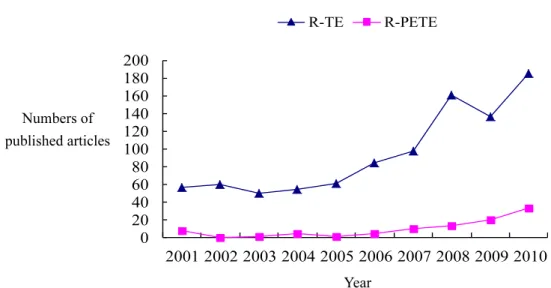
Using the last 853 articles (90.36%) as the entire body of publications analyzed, we could find the yearly publication numbers of research both in R-TE and in R-PETE increased continuously (see Figure 1). Moreover, Table 2 showed that, at the year of 2008, the publication number in R-TE rapidly expanded reaching almost two times to the number of 2007. Publication number of R-PETE was only 14 (1.64%) in the article pool. The year of 2008 possessed of the most research on PETE published. It was also showed in Table 2 the yearly publication frequencies in R-PETE. As we could find, there was the highest frequency of studies in R-PETE at 2008 during the decade, which was congruent with the trend of R-TE. Unfortunately, we didn’t find any research articles of R-PETE published at 2005 and 2006.
Teacher’s Stages of Life Career in R-TE and R-PETE
In the left side of Table 3 were the different focuses of teacher’s life career stages in the research on teacher education. Over half of the studies in R-TE (n=466, 54.63%) purely placed emphasis on in-service stage, and another 277 studies (32.47%) focused on the preservice stage. By using one-sample Kolmogorov-Smirnov test to examine the uniform distribution of research focuses in R-TE (ks=2.258, p= .000), the result indicated the percentages between different focuses in R-TE were significant difference statistically. On the other side, R-PETE presented on the right side
Feng-Min Wei & Deng-Yau Shy Research on PETE in the TATE 131 0 20 40 60 80 100 120 140 160 180 200 2001 2002 2003 2004 2005 2006 2007 2008 2009 2010 R-TE R-PETE
Figure 1. Publication Numbers in R-TE and R-PETE From 2001 to 2010
Table 2
Yearly Publication Numbers of R-TE and Frequencies in R-PETE Year Publication numbers Frequencies excluded Frequencies included Frequencies in PETE 2001 56 7 49 1 2002 60 0 60 1 2003 50 1 49 2 2004 54 4 50 1 2005 61 1 60 0 2006 84 4 80 0 2007 97 9 88 1 2008 161 13 148 4 2009 136 19 117 2 2010 185 33 152 2 Total 944 91 853 14 Percentages of total 100% 9.64% 90.36% 1.64%
of Table 3 also pointed out two of the same prevailing stages of teachers’ life career ─ pre-service stage and in-service stage, but the publication number of R-PETE in preservice stage (0.94%) was two times to the number of in-service stage (0.47%) reversely. Statistical result of distribution
Numbers of published articles
132 Research on PETE in the TATE Feng-Min Wei & Deng-Yau Shy
Feng-Min Wei & Deng-Yau Shy Research on PETE in the TATE 133
condition in R-PETE also showed significant difference (ks=2.126, p= .000). By the way, R-PETE did not show any longitudinal and cross-stages articles.
Research Issues in R-TE and R-PETE
Over seventy percentages (n=617, 72.33%) of R-TE focused on issue 1 and 4 which were issues about recruitment, selection, and initial preparation (n=248, 29.07%) and continuing professional growth, development, and assessment (n=369, 43.26%), and the following issues in order were diversity and equity issues (n=90, 10.55%), emerging directions in teacher education (n=88, 10.32%), contexts influences on teacher education (n=42, 4.92%), and the last teacher education curriculum (n=16, 1.88%). Table 4 on page 18 presented the publication numbers and percentages of research issues in R-TE by year. What is worthy of noting was the examination of the distribution of research issues in R-TE showed an insignificant difference (ks=1.120, p= .163). When narrowing the scope to R-PETE, we could easily recognize in the right side of Table 4 that the issue 1 (n=9, 1.06%) was the most interesting issue in physical education, and there were 3 articles (0.35%) paying attention to issue 6. However, statistically, there was still no difference within research issues in R-PETE (ks=1.356, p= .051). For detailed information about research issues in R-PETE, please refer to the empirical statistics of Table 4.
Research Methodologies in R-TE and R-PETE
Yearly frequencies and percentages of three categories of research methodologies in R-TE and R-PETE summarize in Table 5. Studies in R-TE were coded into three categories: quantitative method (n=184, 21.57%), qualitative method (n=568, 66.59%), and mixed method (n=101, 11.84%); studies in R-PETE were also coded by the same framework and showed: quantitative method (n=5, 0.59%) and qualitative method (n=9, 1.06%). No matter in R-TE or in R-PETE qualitative method was utilized by studies most frequently, but no significant differences could be affirmed statistically within the distributions of these two coded scopes (ks=0.847, p= .470 in R-TE; ks=0.577, p= .893 in R-PETE). In addition, as the mixed method was used in R-TE studies, it has not appeared as a methodological approach in any R-PETE between 2001 and 2010.
Discussion
Scholars majored in many disciplines all place emphasis on the research field of teacher education for personnel training of future experts or professionals and continuous development of
134 Research on PETE in the TATE Feng-Min Wei & Deng-Yau Shy
Feng-Min Wei & Deng-Yau Shy Research on PETE in the TATE 135
136 Research on PETE in the TATE Feng-Min Wei & Deng-Yau Shy
the discipline, especially those subjects in school curriculum such as mathematics, science, music, social studies, physical education, and so on. This means teacher education is not an isolated but multidiscipline field of inquiry. With this insight in mind, and building upon the previous studies of Kulinna et al. (2009) and Murray et al. (2008) which were not only limited in specific disciplines, we conducted a study to examine research on teacher education in Teaching and Teacher Education during a decade, and meanwhile drew out the small number of articles being clarified into research on teacher education in physical education from the overall article pool of R-TE for ensuring the scope and limitations of recent investigation and further figuring out future directions of inquiry. Although some trends of research might be caught by presenting the frequencies and percentages of R-TE and R-PETE or simply comparing the tabulation results between the two different-size scopes of research, it is much meaningful for us to look and interpret the research results both in groups and between subgroups in R-TE and R-PETE. The following section will discuss some trends presented in this study with prior literature and look into the future of research on teacher education and physical education teacher education.
R-PETE did Make Its Voice in TE Research Community
R-PETE did publish in education journals as mentioned by the Kulinna et al.’s (2009) and Silverman and Skonie’s (1997) studies, but through the analysis of the recent study, only 14 (1.64%) of publications could be coded to suit to R-PETE. The reason why the result of publication number of this study was different with previous studies whose percentage rates of articles published in education journals were 10.6% (Silverman & Skonie, 1997) and 9.11% (Kulinna et al., 2009) might come from: 1. the percentages of previous studies were not only coded research on teacher education but included research on teaching and curriculum and 2. research on teacher education had always been recognized with the lowest category among the three. However, Ward and Ko (2006) conducted an analysis to code publications in JTPE from 1981 to 2005. They found articles emphasizing on the focus of teacher education account for 20% which was just lower than research on pedagogy. It probably means that from 1994 the end year of Silverman and Skonie’s paper to 2005 the end year of Ward and Ko’s paper, research on teacher education in JTPE have increased rapidly and even caught up to the number of pedagogy (21%). In a word, studies have showed the different percentages of R-PETE in specific journals in publication articles of physical education pedagogy (Kulinna et al., 2009; Silverman & Skonie, 1997; Ward & Ko, 2006), but the exact percentages numbers were divided because of the scope of research analyzed. On balance, R-PETE has published in the international journals and owned the legitimate but peripheral position in the research field of
Feng-Min Wei & Deng-Yau Shy Research on PETE in the TATE 137
teacher education. What we need to do nowadays is to insert our thinking and perspectives into continuous discourse of research community in order to make it visible and important to the development of the scholarship, the professional, and even the society.
R-TE and R-PETE Focused on Distinct Teacher’s Stages of Life
Career
Two obvious publication trends showed in the dimension of teacher’s career life stages. First, under the situation when total percentages of adding preservice stage and in-service stage were approximately the same in R-TE (87.10%) and R-PETE (85.7%), R-TE showed the ratio of preservice stage to in-service stage was 32:55, while R-PETE showed the ratio of preservice stage to in-service stage was 57:29. And second, longitudinal and cross-stages studies were not be done in R-PETE, while in R-TE scholars conducted 30 (3.52%) studies pertaining to these kinds. Information could be provided through a comparison between R-TE and R-PETE: 1. the research trends of this two scope of articles were not correspondent with each other, and 2. long-term and cross-stages studies would not be conducted even if Turner (as cited in Locke, 1984) have established a relationships among four categories (selection, training, placement, and work success) of information about teacher education which including 7 kinds of progress. Assumed reason for these results might be that “there has been no rational system for directing inquiry at either institutional or governmental levels” (Locke, 1984, p. 19). For continuing and improving knowledge base of R-PETE, researchers in physical education pedagogy must start to conduct studies with substantial theoretical foundation and empirical evidence; besides, researchers within the same community should endeavor to ascertain their joint issues or questions deserving of quest, then we will not only take possession of the prolonged but systematical achievements which will stand for our design of quality teacher preparation programs and daily teaching practice as well.
Topics Concentrated in R-PETE Were Not Congenial to Those in R-TE
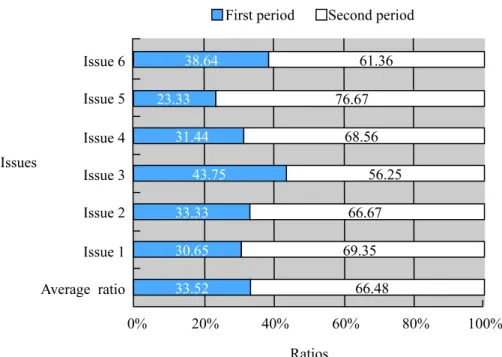
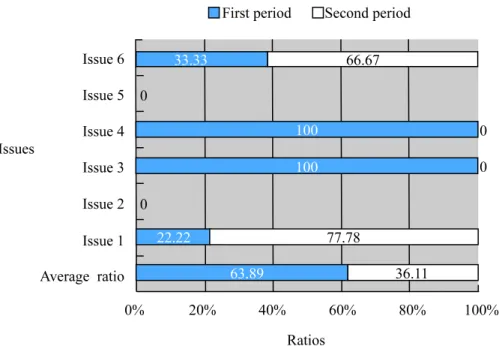
In terms of the dimension of research issues, the subcategory of recruitment, selection, and initial preparation was the predominant one both in R-TE and R-PETE while considering the final number of publications. But, if we took the tendencies of distinct alterations of each subcategory between the first (2001-2005) and second (2006-2010) time period into account, more valuable information would be gained. To be precise, in the situation of first to second time period ratio of publication number in R-TE which is about 34:66, we could find in Figure 2 that the percentages of publication number of issue 3, 5, and 6 in R-TE within the two time periods changed swiftly over at least five percentage points of the average number; issues 3 and 6 declined slowly, and issue 5
138 Research on PETE in the TATE Feng-Min Wei & Deng-Yau Shy
Figure 2. Publication Ratios of Issues Within Two Time Periods in R-TE
increased. Moreover, in the R-PETE, the ratio of first to the second period was approximately 64 to 36. Obvious representation of declination showed at issue 3 and 4, and a quick increase presented at issue 1 and 6 (for a schematic image, please refer to Figure 3). Thus, we discovered that the research trends in R-TE and in R-PETE were not congenial to each other’s because while the percentages of issue 3 and 6 declined in R-TE, the percentages of issue 1 and 6 in R-PETE were increasing. Also, while the issue of Diversity and Equity were the only subcategory increased among the others in R-TE, this same issue has been left aside in R-PETE just like issue 2 (Contextual Influences on Teacher Education).
These findings are harmful for the development of the entire research community of teacher education and might relatively decrease the possible contributions that research on teacher education could provide to the professionals and policy makers who will apply the found knowledge to enhance the practices of teacher preparation programs or related decisions of policy legislation and implementation, and to the schools that are guaranteed to enroll teachers with higher teaching quality and commitments so that students’ opportunities and rights to learn in a safety and supported environment will not be sacrificed. Even though our study did not deal with what specific research questions were addressed and answered both in R-TE and in R-PETE, from a perspective of resources integration we could still highlight, in part, the discordant problem of research trends in
Ratios 38.64 Issues 61.36 23.33 76.67 31.44 68.56 43.75 56.25 33.33 66.67 30.65 69.35 33.52 66.48 0% 20% 40% 60% 80% 100% Issue 6 Issue 5 Issue 4 Issue 3 Issue 2 Issue 1 Average ratio
Feng-Min Wei & Deng-Yau Shy Research on PETE in the TATE 139
Figure 3. Publication Ratios of Issues Within Two Time Periods in R-PETE
teacher education. In her profound convincing commentary article, Grossman (2008) indicated, after reviewing few reports synthesizing the results of and the ways through which academic knowledge produced in teacher education and carefully reflecting her personal research lines and progress as teacher educator, the shortages of well-design and well-executed programmatic research could not effectively influence both the provider and receiver populations of any circumstance in teacher education, such as teacher educators and prospective teachers or in-service teachers and their students, and the field of teacher education should deeply rethink a range of methodological issues such as adopting larger scale research approach, developing alternative ways to conceptualize programs, employing other measures and tools to collect data about program features, teacher performances, or student outcomes, and so on, and meanwhile, bravely change the yet embraced and limited module of producing knowledge in teacher education and try to cooperate with scholars from different disciplines, such like sociology and economic, in enriching the multiplicity of research methods. Furthermore, in their research, Schalock, Schalock, and Ayres (2006, p. 114) stated that “both intrainstitutional and interinstitutional changes of unprecedented magnitude will be needed for teacher education and teacher education research to rise to the challenges faced in the context of today’s emerging standards-based, evidence-driven approach to education.” Their words led us to notice that not only would a clear delineation of intra-structural rationale for an interesting issue within specific research line or lesser field contribute to knowledge acquisition and evolution, but an
33.33 66.67 Ratios Issues 0% 20% 40% 60% 80% 100% Issue 6 Issue 5 Issue 4 Issue 3 Issue 2 Issue 1 Average ratio 0 0 0 0 First period Second period
100
100
77.78
63.89 36.11
140 Research on PETE in the TATE Feng-Min Wei & Deng-Yau Shy
inter-structural cooperation or partnership of subjects or among different contexts in the same field should also be considered as certainly important task for researchers to accomplish the purpose of scaling up the theory development needed for research in teacher education. The idea of facilitating closer collaborative relationships, no matter between disciplines or within contexts, has progressively centered on teacher educators’ suggested strategic proposal for better effecting the theory building and practice process of teacher education. Accordingly, it is becoming more necessary for scholars in R-TE as well as in R-PETE to regularly communicate and interact with each other, and even to understand and learn from their colleagues either in different disciplines and research traditions or in practical fields, in collecting then integrating all the efforts and wisdoms from every possible contributors to solve problems in the field of teacher education step by step.
Both R-TE and R-PETE Inclined to Qualitative Approach
Methodologies utilized by research on teacher education within one decade changed in turn while comparing to the average percentages of each subcategory. Sometimes the percentages of the quantitative method were utilized increasingly or decreasingly during ten years, but sometimes the same situation might be experienced by the qualitative research or the mixed-method research. Clear to say, the qualitative method was the most used methodological approach both in R-TE and R-PETE, and the quantitative method was always at the second order utilized by studies. This condition was very different with studies conducted by scholars (Silverman, 1987; Ward & Ko, 2006) in physical education pedagogy which indicated that the mainly adopted methodology was quantitative approach to solving research questions in the field. It is thus evident that an appeal to use alternative perspectives (e.g. qualitative methods) for avoiding the limited assumptions underlying one mode of inquiry (Schempp, 1987) has come true recently if we took the development of methodological approaches followed in R-TE and R-PETE into consideration. However, Grossman (2008) reminded us that teacher education research “may have swung too far toward the search for particularities” (p. 20) so that it may be the time when scholars shall endeavor to reconsider the balance between in-depth qualitative studies and larger scale research in the field of teacher education once again.
Conclusion
To sum up, by doing this examination of previous research in teacher education/physical education teacher education, we have known that R-PETE has grown over the past one decade in the general education journals; however, a few research trends in R-PETE were not consistent with
Feng-Min Wei & Deng-Yau Shy Research on PETE in the TATE 141
R-TE. If some ending remarks need to be given for answering the core question of this study, we firmly believed that R-PETE is now locating at the legitimate but peripheral position in the research field of teacher education because of the evidence presented in this study. It represents that R-PETE as an actor has played a formal role in the drama named teacher education, but the methods of acting and talking seem to be played or expressed in our own way which might be helpful to show our opinions about and influences on the phenomena of teacher preparation and teachers’ professional development and practice, especially from a domain-specific perspective. In addition, even if R-PETE is still marginal in number, we thought that the questions were not primarily about the percentages of R-PETE in the scope of R-TE or about whether the R-PETE follows the trends of R-TE; the crucial question is about what kind of and how many contributions the R-PETE will provide for the whole field of teacher education for not only gradually understanding which avenues we should devote in the future to extending theoretical knowledge base underlying teacher preparation and learning to teach as well as to enhancing professionals’ expertise and status in society, but also realizing what “important and good questions” (Locke, 1984) and problematization process should be raised up to the existing knowledge base and practical operation in the changing field of teacher education toward the changing era.
Limitations did appear in this study because of the journal chose and the analyzing method used. Some might critically argue that few of R-PETE were published in the Teaching and Teacher Education so that the numbers showed in the tables and figures of present study might not correctly reflect contemporary knowledge base of the field; meanwhile, the content analysis utilized in our study would not reveal the questions which have not been solved and the questions which should be explored deeply into the unapproachable area, for now, in our field. Therefore, to make sure more detailed information on scope and trends of R-TE as well as R-PETE can be clarified, future studies should take one step forward to further examine the research published in journals which were generally acknowledged to be the main publication outlets of physical education pedagogy research literatures, such as the Journal of Teaching in Physical Education, Research Quarterly for Exercise and Sport, Quest, and so on. Simultaneously, endeavors to design a thorough framework for categorizing questions investigated in the previous R-TE and R-PETE should be built from a bird’s eye view to depict the holistic blueprint of what we have known and unknown about questions in R-TE within multiple disciplines including physical education pedagogy.
142 Research on PETE in the TATE Feng-Min Wei & Deng-Yau Shy
Acknowledgements
As to the appearance of this paper, we would like to express our special thanks to Dr. Raymond Kim-Wai Sum, who is with the Department of Sports Science and Physical Education, The Chinese University of Hong Kong, for his commentary on our early draft. We also gratefully acknowledge all the individual reviewers of this study for their questions, suggestions, and critiques that directly contributed to the improvement of this paper. Nevertheless, two authors of this paper still take all the responsibilities for the opinions and possible mistakes presented in this article.
Feng-Min Wei & Deng-Yau Shy Research on PETE in the TATE 143
References
Bain, L. L. (1990). Physical education teacher education. In W. R. Houston, M. Haberman, & J. Sikula (Eds.), Handbook of research on teacher education (pp. 758-781). New York, NY: Macmillan.
Blömeke, S., Suhl, U., & Kaiser, G. (2011). Teacher education effectiveness: Quality and equity of future primary teachers’ mathematics and mathematics pedagogical content knowledge. Journal of Teacher Education, 62(2), 154-171. doi:10.1177/0022487110386798
Byra, M., & Karp, G. G. (2000). Data collection techniques employed in qualitative research in physical education teacher education. Journal of Teaching in Physical Education, 19(2), 246-266. Cleary, R. E. (1992). Revisiting the doctoral dissertation in public administration: An examination of
the dissertations of 1990. Public Administration Review, 52(1), 55-61. doi:10.2307/976546 Cleary, R. E. (2000). The public administration doctoral dissertation reexamined: An evaluation of
the dissertations of 1998. Public Administration Review, 60(5), 446-455. doi:10.1111/0033- 3352.00107
Cochran-Smith, M., & Lytle, S. L. (1999). Relationships of knowledge and practice: Teacher learning in communities. Review of Research in Education, 24(1), 249-305. doi:10.3102/ 0091732X024001249
Collier, C. (2003). Models and curricula of physical education teacher education. In D. Kirk, D. MacDonald, & M. O’Sullivan (Eds.), The handbook of physical education (pp. 386-406). Champaign, IL: Human Kinetics.
Elmore, P. B., & Woehlke, P. L. (1988). Statistical methods employed in American Educational Research Journal, Educational Researcher, and Review of Educational Research from 1978-1987. Educational Research, 17(9), 19-20. doi:10.3102/0013189X017009019
Gess-Newsome, J. (1999). Pedagogical content knowledge: An introduction and orientation. In J. Gess-Newsome & N. G. Lederman (Eds.), Examining pedagogical content knowledge: The construct and its implications for science education (pp. 3-17). Dordrecht, the Netherlands: Kluwer.
Grossman, P. (2008). Responding to our critics: From crisis to opportunity in research on teacher education. Journal of Teacher Education, 59(1), 10-23. doi:10.1177/0022487107310748
Grossman, P. L., & Richert, A. E. (1988). Unacknowledged knowledge growth: A re-examination of the effects of teacher education. Teaching and Teacher Education, 4(1), 53-62. doi:10.1016/
144 Research on PETE in the TATE Feng-Min Wei & Deng-Yau Shy
0742-051X(88)90024-8
Harmon, H. L., Howley, C. B., & Sanders, J. P. (1996). Doctoral research in rural education and the rural R & D menu. Journal of Research in Rural Education, 12(2), 68-75.
Hemphill, M. A., Richards, K. A. R., Templin, T. J., & Blankenship, B. T. (2012). A content analysis of qualitative research in the Journal of Teaching in Physical Education from 1998 to 2008. Journal of Teaching in Physical Education, 31(3), 279-287.
Houston, W. R., Haberman, M., & Sikula, J. (1990). Handbook of research on teacher education: A project of the association of teacher educators. New York, NY: Macmillan.
Krippendorff, K. (1989). Content analysis. In E. Barnouw, G. Gerbner, W. Schramm, T. L. Worth, & L. Gross (Eds.), International encyclopedia of communication (Vol. 1, pp. 403-407). New York, NY: Oxford University Press.
Krippendorff, K. (2013). Content analysis: An introduction to its methodology (3rd ed.). Thousand Oaks, CA: Sage.
Kulinna, P. H., Scrabis-Fletcher, K., Kodish, S., Phillips, S., & Silverman, S. (2009). A decade of research literature in physical education pedagogy. Journal of Teaching in Physical Education, 28(2), 119-140.
Lanier, J. E., & Little, J. W. (1986). Research on teacher education. In M. C. Wittrock (Ed.), Handbook of research on teaching (3rd ed., pp. 527-569). New York, NY: Macmillan.
Locke, L. F. (1977). Research on teaching physical education: New hope for a dismal science. Quest, 28(1), 2-16. doi:10.1080/00336297.1977.10519895
Locke, L. F. (1984). Research on teaching teachers: Where are we now? [Monograph]. Journal of Teaching in Physical Education, 3(Suppl. 2).
Metzler, M. W. (1991). Bring the teaching act back into sport pedagogy. Journal of Teaching in Physical Education, 11(2), 150-160.
Murray, S., Nuttall, J., & Mitchell, J. (2008). Research into initial teacher education in Australia: A survey of the literature 1995-2004. Teaching and Teacher Education, 24(1), 225-239. doi:10. 1016/j.tate.2007.01.013
Rovegno, I. (2003). Teacher’s knowledge construction. In S. J. Silverman & C. D. Ennis (Eds.), Student learning in physical education (pp. 295-310). Champaign, IL: Human Kinetics.
Schalock, H. D., Schalock, M. D., & Ayres, R. (2006). Scaling up research in teacher education: New demands on theory, measurement, and design. Journal of Teacher Education, 57(2), 102- 119. doi:10.1177/0022487105285615
Feng-Min Wei & Deng-Yau Shy Research on PETE in the TATE 145
science. Journal of Teaching in Physical Education, 6(2), 111-121.
Shulman, L. S. (1986a). Paradigms and research programs in the study of teaching: A contemporary perspective. In M. C. Wittrock (Ed.), Handbook of research on teaching (3rd ed., pp. 3-36). New York, NY: Macmillan.
Shulman, L. S. (1986b). Those who understand: Knowledge growth in teaching. Educational Researcher, 15(2), 4-14. doi:10.3102/0013189X015002004
Silverman, S. (1987). Trends and analysis of research on teaching in doctoral programs. Journal of Teaching in Physical Education, 7(1), 61-70.
Silverman, S. (1991). Research on teaching in physical education. Research Quarterly for Exercise and Sport, 62(4), 352-364. doi:10.1080/02701367.1991.10607533
Silverman, S. J., & Ennis, C. D. (1996). Enhancing learning: An introduction. In S. J. Silverman & C. D. Ennis (Eds.), Student learning in physical education: Applying research to enhance instruction (pp. 3-7). Champaign, IL: Human Kinetics.
Silverman, S., & Manson, M. (2003). Research on teaching in physical education doctoral dissertation: A detailed investigation of focus, method, and analysis. Journal of Teaching in Physical Education, 22(3), 280-297.
Silverman, S., & Skonie, R. (1997). Research on teaching in physical education: An analysis of published research. Journal of Teaching in Physical Education, 16(3), 300-311.
Swanson, H. L. (1993). Selecting a research program in special education: Some advice and generalizations from published research. Remedial and Special Education, 14(3), 7-20. doi:10. 1177/074193259301400304
Tseng, Y.-S., & Lin, Y.-I. (2011). The application of content mining techniques to the analysis of educational evaluation research trends. Journal of Research in Education Sciences, 56(1), 129- 166. doi:10.3966/2073753X2011035601005
Valerius, L., & Mackay, K. (1993). A decade of doctoral dissertations in recreation, parks, and leisure studies departments: 1980-1990. Schole: A Journal of Leisure Studies and Recreation Education, 8, 61-68.
Ward, P., & Ko, B. (2006). Publication trends in the Journal of Teaching in Physical Education from 1981 to 2005. Journal of Teaching in Physical Education, 25(3), 266-280.
White, R. (1997). Trends in research in science education. Research in Science Education, 27(2), 215-221. doi:10.1007/BF02461317
146 Research on PETE in the TATE Feng-Min Wei & Deng-Yau Shy
Appendix A
Coding Categories and Subcategories of Research Issues Research issues 1. Recruitment, selection, and initial preparation
1.1 Who teaches and why: dilemmas of building a profession for twenty-first-century schools (selection issues)
1.2 The role of attitudes and beliefs in learning to teach 1.3 Personal narrative and life history in learning to teach 1.4 Designing coherent and effective teacher education programs 1.5 Field and laboratory experiences
1.6 Professional development schools 1.7 Teacher knowledge and learn to teach 1.8 Student teaching and school experience 1.9 The subject-matter preparation of teachers 1.10 Professional identity
1.11 Others (ex. (future time) perspective, conception about the assessment of science teaching, thoughts of social justice, metaphorical conceptualizations of learner/learning, motivation, self-efficacy, perception, adolescent development, teaching commitment, reflective thinking/reflection, goal-orientation/orientation, use of reading strategies, think/understanding)
1.12 Training within teacher education
1.13 Evaluation of preservice teacher education programs 2. Contextual influences on teacher education
2.1 Changing teacher education and professional development 2.2 Financing teacher education and professional development 2.3 Standards for certification, licensure, and accreditation 2.4 Professors, teachers, and leaders in SCDEs
2.5 Federal policy and teacher education 2.6 Federal funding and teacher education 3. Teacher education curriculum
3.1 Early childhood education 3.2 Elementary education 3.3 Middle-level education
Feng-Min Wei & Deng-Yau Shy Research on PETE in the TATE 147
Coding Categories and Subcategories of Research Issues (continued) Research issues
3.4 Secondary education
3.5 Teacher education research in English language arts and reading 3.6 Mathematics teacher education
3.7 Science education 3.8 Reading teacher education
3.9 English language arts teacher education 3.10 Business teacher education
3.11 Vocational teacher education 3.12 Physical education teacher education 3.13 Teacher education for the visual arts 3.14 Music teacher education
3.15 The professional development of social studies education 3.16 Classroom management
3.17 The hidden curriculum of preservice teacher education
4. Continuing professional growth, development, and assessment 4.1 Teacher socialization (for cultural diversity)
4.2 Beginning teacher support: attrition, mentoring, and induction 4.3 Teacher empowerment and site-based management
4.4 Teaching effects and teacher evaluation 4.5 Teacher professional development 4.6 Authentic assessment
4.7 Cases and case methods in teacher education 4.8 Supervision
4.9 Assessment of teaching 4.10 Teacher knowledge
4.10.1 practical knowledge
4.10.2 pedagogical content knowledge 4.10.3 teacher knowledge
4.10.4 meta-cognitive knowledge 4.10.5 professional knowledge 4.10.6 mentoring knowledge
4.10.7 teachers’ knowledge in relation to child abuse and neglect 4.10.8 emotional knowledge
4.10.9 subject matter knowledge
148 Research on PETE in the TATE Feng-Min Wei & Deng-Yau Shy
Coding Categories and Subcategories of Research Issues (continued) Research issues
4.11 Teachers and teaching: signs of a changing profession 4.12 Teachers’ attitudes and beliefs
4.13 Teacher’s emotions and perception 5. Diversity and equity issues
5.1 Selecting and Preparing culturally competent teachers (for urban) 5.2 Multicultural education: landscape for reform in the twenty-first century
5.3 The crisis in teacher education in America/England/Canada: issues of recruitment and retention of culturally different (minority) teachers
5.4 Teacher preparation programs at historically black colleges and universities
5.5 Preparing instructional professionals for linguistically and culturally diverse students 5.6 Family, community, and school collaboration
5.7 Special education and inclusion 5.8 Equity challenges
6. Emerging directions in teacher education 6.1 The moral responsibilities of educators
6.2 Creating collaborative, child- and family- centered education, health, and human service systems 6.3 Alternatives to public schooling
6.4 Alternative teacher certification 6.5 Improving rural teacher education
6.6 Information technology and teacher education 6.7 Needed research in teacher education
6.8 Teacher education research in international settings
Feng-Min Wei & Deng-Yau Shy Research on PETE in the TATE 149
Appendix B
Coding Categories and Subcategories of Research Methodologies Research methodologies 1. Quantitative method 1.1 Survey 1.2 Meta-analysis 1.3 Experimental/quasi-experimental design 1.4 Cause-effect study
1.5 Direct observational study 1.6 Factor analysis 1.7 Quantitative study 1.8 SEM/SLM 1.9 Path analysis 2. Qualitative method 2.1 Qualitative study 2.2 Case study 2.3 Action research 2.4 Policy analysis 2.5 Phenomenological study 2.6 Narrative inquiry
2.7 Literature review/literature analysis 2.8 Ethnographical study 2.9 Biographical study 2.10 Grounded theory 2.11 Self-study 2.12 Content analysis 2.13 Anthropological study 2.14 Interaction analysis 2.15 Hermeneutics study 2.16 Critical inquiry 2.17 Philosophical inquiry 2.18 Feminist study (continued)
150 Research on PETE in the TATE Feng-Min Wei & Deng-Yau Shy
Coding Categories and Subcategories of Research Methodologies (continued) Research methodologies
2.19 Symbolic interactionism 2.20 Conceptual analysis 2.21 Reflective inquiry 2.22 Comparative study 2.23 Popper’s science method 2.24 Word association approach 2.25 Life history
2.26 Group memory-work 2.27 Document analysis
2.28 Membership categorization analysis 2.29 Discourse analysis
2.30 Semiotics analysis 2.31 Delphi technique 2.32 Development research 3. Mixed method
Feng-Min Wei & Deng-Yau Shy Research on PETE in the TATE 151 教育科學研究期刊 第六十一卷第二期 2016年,61(2),119-151 doi:10.6209/JORIES.2016.61(2).05