
公益平面廣告研究於動物保護:女性模特兒反對殘酷時尚 - 政大學術集成
120
0
0
全文
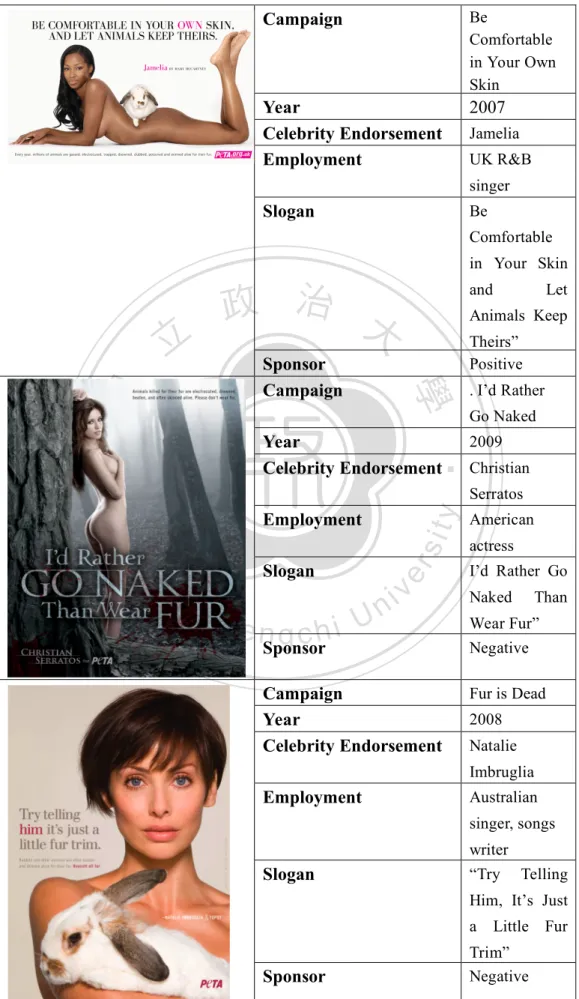
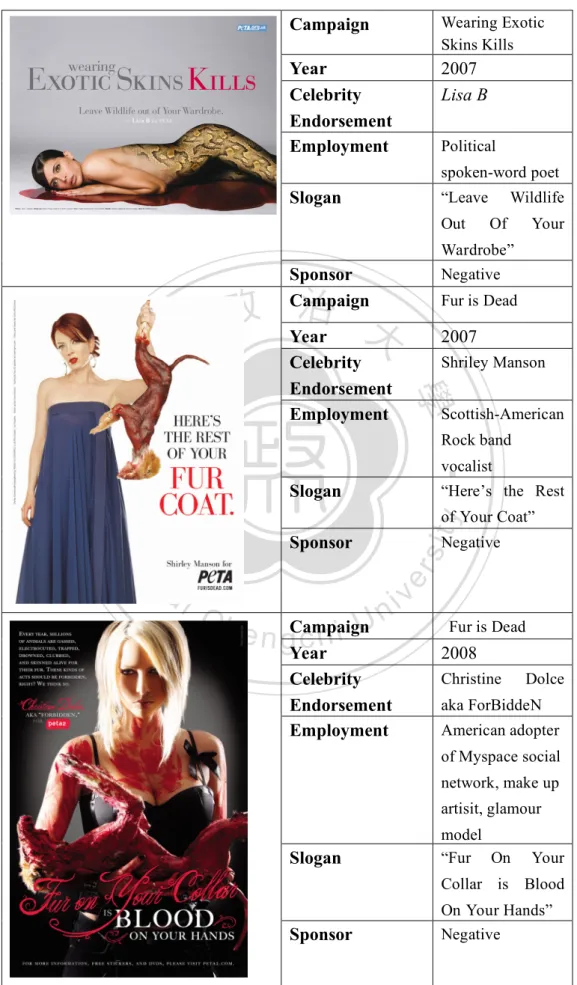
(2) A Study on the Animal Protection Public Service Print Advertising: Female Models against cruel Fashion. Table of Content. Abstract………………………………………………………………………..……6 Chapter I. Introduction….………...…………………………………………..…8. 1.1 Research background.…….…………………………………………..…..8 1.2 Case Study Brief………………….………..………………………..…...11 1.3. Cultural Study: PSA..……………………………………………..……..13 1.3.1 Western nudity and Asian censorship……………………………….15 1.3.2 Animal Rights Protection: West and Asia (Taiwan)……..…..….…..16. 治 政 大 Research Questions………………............................................................21 立 Research Procedure……………………………………………..……….24. 1.4 Research Purpose.…………………………...……………………...……21. 1.6. 學. Chapter II. ‧ 國. 1.5. Literature Review…………………………………………..……….25. 2.1 Previous Studies on Animals Issue in Advertising…………….….…….25. ‧. 2.2 Persuasion Process in Advertising ……………….………….…....…….27. y. sit. Celebrity Endorsement….…………………….……………….….…… .35. io. er. 2.4. Nat. 2.3 Nonverbal Communication…………………….………………….….....30. 2.5 Advertising Appeal………………………………………………..…….36. n. al. Ch. i n U. v. 2.5.1 Sexual Advertising Appeal………………...……………….….........37. engchi. 2.5.2 Humor Advertising Appeal…….….………………………….…......39 2.5.3 Fear Advertising Appeal……..…………………………...…..……..41 2.6. Literature Review Conclusions…………………………………..….…..42. Chapter III. Methodology…..…………………………………………….……...46. 3.1 Qualitative Method.……………..…………..............……………...…...46 3.2 Research Design……...……………………………………………..…..47 3.2.1 Research Framework………….………………………..……..…….48 3.3 Participants Sampling Procedure……………….….…….…….………..50 3.4 PETA Print Advertisements Sampling…………….….………….….….50 3.4.1 Coding Scheme……..…………………..……….…………..……....51. 2.
(3) A Study on the Animal Protection Public Service Print Advertising: Female Models against cruel Fashion. 3.4.2 Coding Reliability…………..…………………………...……....…...57 3.4.3 Representative Sample…………..…….…….…………………...…..57 Chapter IV. Data Analysis…………………………………………………...….61. 4.1 Data Review and Observations…………...…………………………...…61 4.2. Reliability and Validity of Audience response………………………..…62. 4.3. Data Management: Generating Categories, Themes and Patterns…….....64. 4.4. Results Report………...…………………………………….….……...…74. 4.5 Answering Research Questions……………..…….……….......................80 4.6. Results Discussion………………………………………………….….....86. Chapter V. Findings and Conclusions.…………………….….…………..……87. 政 治 大. 5.1. Findings…………………………………………………………..….…...87. 5.2. Conclusions…….…..……………………...…………...….……….....….90. 5.3. Recommendations…………………………………………………..……91. 5.4. Study Limitations and Alternative Findings…….…………….….….…..91. 立. ‧ 國. 學. PETA Historic Brief and Success Stories..…………….…..….100. Appendix 3. Sampling Categories and Items……………….…….……...…..106. Appendix 4. Categorical Scale..………………………………………...…....111. y. Appendix 2. Nat. Appendix 1. ‧. References………………………………………………………….………..…......93. n. al. er. io. sit. Participants Sample Chart……………...…………..….….....…105. Ch. engchi. i n U. v. 3.
(4) A Study on the Animal Protection Public Service Print Advertising: Female Models against cruel Fashion. 摘要 殘酷時尚議題已成為當代的芒刺,對動物保護團體及人權組織形成挑戰。善待動 物組織(People for the Ethical Treatment of Animals:PETA)是目前規模最大、發展最完 善的動物權利組織,其廣告往往能在人們心中喚醒善待動物的意識。PETA首次在 時尚雜誌上發起的反對毛皮廣告活動,即獲得「非營利組織最佳廣告獎(Best Ads Produced by a Nonprofit)」。. 政 治 大 研究列舉PETA的PSA廣告範例如下:「我寧願裸體」(“I’d rather go naked”, 1992 立. 本研究的宗旨為,展示公益內容廣告運動可在任何市場導向的經濟體中運作。本. ‧ 國. 學. 年) 、「毛皮代表死亡」(“Fur is dead”, 2001年)、「對皮膚感到自在」(“Be comfortable in your own skin”, 2003年)、 「拯救海豹」(“Save the seals”, 2009年)。 「毛皮」(“Skins”). Nat. y. ‧. 主題上述廣告皆由知名女性代言。. er. io. sit. 本研究為質量研究,採用射影技術(projective technique)及深入訪談,調查結合訊息 與圖像的PSA廣告在傳達動物權力相關議題時的效果。本研究將指出這些廣告可如. al. n. v i n Ch 何透過1.有創意、逼真的圖像、2.說服力的寓意訊息及3.知名代言人,加強傳遞人 engchi U 與自然關係的概念。. 本研究發現,具說服力的訊息必須擁有逼真、富含寓意、簡潔、清楚等特性,且 僅有在搭配適當的圖像時,才能發揮效力。此類圖像必須擁有不含混、非情色誘 因、有創意、外來風或暗中使用性訴求等特性。廣告必須同時訴諸感性訴求及現 實主義,並由知名、受人敬重的代言人出演。當公益廣告意圖以幽默感營造有利 的風趣情境時,就不應使用嚴肅形象,或要求觀眾訴諸行動。至於訴諸恐懼類的. 4.
(5) A Study on the Animal Protection Public Service Print Advertising: Female Models against cruel Fashion. 公益廣告,則結合令人反感的圖像特徵及寓意訊息,仍可營造有利觀眾回應的情 境,然而太過強烈的反感特徵有時會造成觀眾無法掌握寓意,導致觀眾無法回應。 訴諸恐懼類平面廣告所引起的觀眾回應差異,以及本研究的局限性,可歸因於應 答者的文化差異。. 本研究做出結論為,擁有優良公眾形象及正面背景的知名代言人,可成功向大眾 傳遞寓意訊息。再者,有創意、逼真,但不過度暴力、過度情色的圖像可吸引觀. 政 治 大. 眾目光,促使大眾意識並做出反應。. 立. ‧. ‧ 國. 學. 關鍵字:公益廣告、動物保護、廣告訴求、廣告效果、代言人. n. er. io. sit. y. Nat. al. Ch. engchi. i n U. v. 5.
(6) A Study on the Animal Protection Public Service Print Advertising: Female Models against cruel Fashion. Abstract. In the Modern Age the problem of killing fashion has become a thorny issue for the fashion industry, animal rights protection organizations, animal world and humanity. In this respect, People for the Ethical Treatment of Animals (PETA) performs as the largest and most highly developed animal rights institution in modern countries. PETA’s advertising has made a revolution in people’s minds concerning the ethical treatment of animals and already the first advertising campaign by PETA received the “Best Ads Produced by a Nonprofit” Award for its anti-fur advertising campaign in. 政 治 大 The purpose of the study is to show how such social content advertising 立. fashion magazines.. ‧ 國. 學. campaigns can work in all countries that are learning to live under market-driven. economies. This research concerns properly selected print PSA samples of “I’d rather. ‧. go naked” (launched in 1992), “Fur is dead” (launched in 2001), “Be comfortable in your own skin” (launched in 2003), and “Save the seals” (launched in 2009) campaigns. Nat. sit. al. er. io. advertisements.. y. presented by a number of celebrity spokeswomen posing for PETA’s “Skins” print. v i n interviews, the study investigates C thehimpact of a combination e n g c h i U of PSA specific messages n. Based on qualitative research with the use of projective techniques and in-depth. and image characteristics concerning animal rights using Public Service Print Advertising. The research will show how these ads hopefully can improve their effectiveness in order to achieve more respect for the human-nature relationship by using 1) Creative, realistic images, 2) A powerful educational message, and 3) A highly respected and appreciated celebrity spokesperson. The study found that a strong persuasive message is defined as realistic, educational, laconic, clear and the advertisement is ultimately effective only when used with proper image characteristics. Such image characteristics are non-vulgar, non-sexually distracting, but creative, exotic, or latent in sexual appeal. An advertisement should use emotional appeal and realism, presented by a celebrity. 6.
(7) A Study on the Animal Protection Public Service Print Advertising: Female Models against cruel Fashion. spokesperson with a respected personal background. While PSA uses a high degree of humor to produce favorable and amused attitude, they do not present a serious image or promote a call to action. Regarding using fear appeal, strongly unpleasant image characteristics combined with educational messages still may produce a favorable and responsible attitude. However, it was found that unfavorable perceptions caused by strongly unpleasant images sometimes distracted viewers from the educational message or failed to produce a responsible reaction. The striking differences among public responses regarding fear appeal in print ads and study limitations can be attributed to cultural differences within respondents. The study has concluded that strong educational messages spoken by highly. 政 治 大. trustworthy celebrities with positive background activity makes the public listen.. 立. Furthermore, creative, realistic, but not overly-violent or overly-sexual images catch the. ‧ 國. ‧. Key words:. 學. viewer’s attention, makes the public more aware and encourages responsible thinking.. y. Nat. Public Service Advertising, animal protection, advertising appeal, advertising. n. er. io. al. sit. effectiveness, celebrity endorsement.. Ch. engchi. i n U. v. 7.
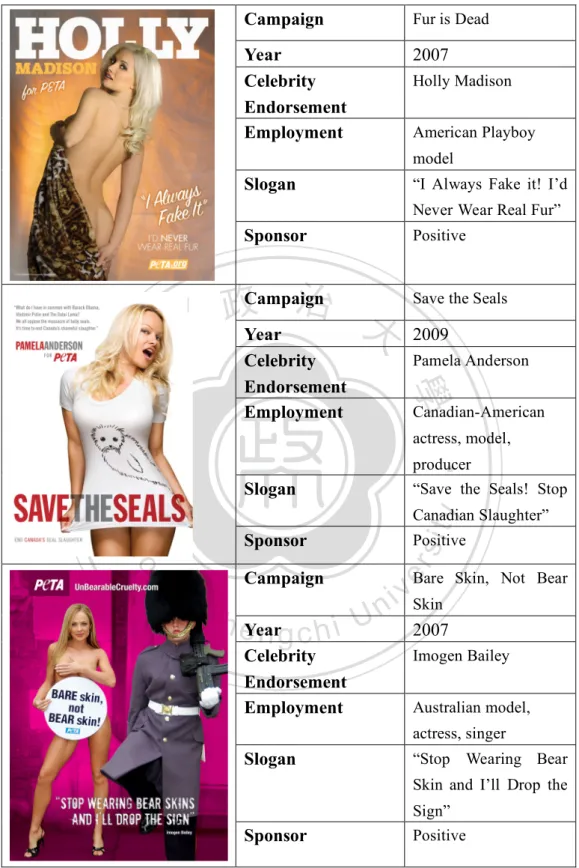
(8) A Study on the Animal Protection Public Service Print Advertising: Female Models against cruel Fashion. Chapter I Introduction. 1.1 Research Background. Everybody is entitled to his or her own opinion, but freedom of thought is not the same thing as freedom of action. You are free to believe whatever you want as long as you don’t hurt others. You may believe that animals should be killed, that black people should be enslaved, or that women should be beaten, but you don’t always have the. 政 治 大. right to put your beliefs into practice. The very nature of reform movements is to tell. 立. others what to do – don’t use humans as slaves, don’t sexually harass women, etc. – and. ‧ 國. 學. all movements initially encounter opposition from people who want to continue to take part in the criticized behavior.. ‧. Even with the improved standard of living we enjoy today, concurrently our. y. Nat. society still faces challenges such as sickness, death, human cruelty, ecological crisis. sit. and other negative results of progress in the modern world. To fight those difficulties is. n. al. er. io. a global task. Social marketers try to solve social problems by changing long-held,. i n U. v. deep-seated beliefs and associated behaviors that have a detrimental effect on human. Ch. engchi. well-being (Kotler and Andreasen, 1996).. While other commercials promote brands to address the requirements of a customer, public service advertising (PSA) tries to get the attention from the whole of free society using all creative ways at its disposal. PSA uses the same complex of techniques as general commercials do. The main difference is that the task of PSA is to educate – to make the public think about the problem and call for action. The target audience is also different, for commercial advertising it includes only a thin marketing group, for PSA it includes the entire global society. Although PSA subjects have a bigger importance in our society than consumer needs, animal protection advertising (as an example of PSA) has never had such wide publicity as market-oriented advertising campaigns,.. 8.
(9) A Study on the Animal Protection Public Service Print Advertising: Female Models against cruel Fashion. Specifically in contemporary times, animal cruelty in the fashion industry, has become a big problem and thorny question for the fashion industry, animal protection organizations, the animal world and humanity. Serious problems in the world deserve our attention, and cruelty to animals is one of them. We must alleviate suffering wherever we can. Helping animals is not any more or less important than helping human beings—they are both important. Animal suffering and human suffering are interconnected. Animal rights organizations such as People for the Ethical Treatment of Animals (PETA) have become a big social institution in all developed countries. These organizations also raise a substantial amount of money. PETA focuses its attention on. 政 治 大. four areas in which the largest numbers of animals suffer the most intensely for the. 立. longest periods of time: factory farms, laboratories, the clothing trade, and the. ‧ 國. 學. entertainment industry. It works through public education, cruelty investigations, research, animal rescue, legislation, special events, celebrity involvement, and protest. ‧. campaigns. PETA advertisements were broadly targeted to reinforce the idea that. y. sit. of society.. Nat. killing animals by the fashion industry is everybody’s problem, not just certain sections. n. al. er. io. PETA, with more than 2.0 million members and supporters, is the largest animal. i n U. v. rights organization in the world and has the largest animal advertising campaign in. Ch. engchi. history. Most of nonprofit organizations survive mainly on donations and volunteering work, and consequently depend on quality advertising. (http://www.peta.org). In contemporary times animal rights protection advertising as a part of public service advertising is a substantial and consequential field for investigation. Animal rights protection advertising itself includes different categories such as: General Animal Rights Animal Rights in the Entertainment Industry Animal Rights in the Academia and Scientific Enterprises Animal Rights in the Food Industry Animal Rights in the Apparel Industry The present study concerns specifically the “Skins” PSA campaign which. 9.
(10) A Study on the Animal Protection Public Service Print Advertising: Female Models against cruel Fashion. introduces animal rights protection to the fashion and clothing industry, and addresses the use of animals in the fur and leather industry. There are many ways to spread the message of compassion. PETA’s Advertising made a revolution in people’s mind. The first of PETA’s animal rights protection advertising campaigns, its anti-fur Advertising campaign in national fashion magazines, received. the. “Best. Ads. Produced. by. a. Nonprofit”. Award”. (http://www.furisdead.org.uk/history.asp). The purpose of the study is to show how such social content advertising campaigns could work in all countries that are now learning to live under market-driven economies.. 立. 政 治 大. ‧. ‧ 國. 學. n. er. io. sit. y. Nat. al. Ch. engchi. i n U. v. 10.
(11) A Study on the Animal Protection Public Service Print Advertising: Female Models against cruel Fashion. 1.2 Case study brief. The study concerns PETA’s first, biggest and longest running campaign – the anti-cruel fashion print advertisement campaign named “Skins” – which was followed by “Vegetarianism”, “Animal Experiments”, “Animals in Entertainment”, “Companion Animals”, and “Wildlife”. “Skins” includes following themes: “I’d rather go naked” (spokespersons chose to be nude rather than wear fur), “Be comfortable in your own skin” (spokespersons exhibit her own beautiful skin instead of wearing fur and leather), “Fur is dead” (spokespersons present realistic pictures of dead animals killed for their fur), “If you wouldn’t wear your dog” (spokesperson equates wearing fur of any animal. 政 治 大. with wearing the fur of pets), “Ink – not Mink” (spokespersons highlight the beauty of. 立. tattooed skin versus the unpleasantness of fur), “Bare Skin, Not Bear Skin”. ‧ 國. 學. (spokeswomen exhibits her bare skin instead of using bear skin), and finally “Save the Seals” (spokespersons wear white T-shirts with the campaign slogan in order to stop the. ‧. hunting of seals).. y. Nat. An investigation of the Skins case study is interesting for three reasons. First of all,. sit. compared to campaigns addressing vegetarianism, animal experimentation, and animals. n. al. er. io. in entertainment, anti-fur and anti-leather campaigns are presented by a greater number. i n U. v. of spokeswomen celebrities. Secondly, using celebrities which are actually fashion. Ch. engchi. workers to stand up against cruel fashion is extraordinary and quite impressive. These campaigns involve incredible numbers of female celebrity models, such as Eva Mendes, Pamela Anderson, Anna Nicole Smith, Shirley Manson, Christina Applegate, Peaches, Hugo Boss models, Charlize Theron, Yana Booth, Aimee Teagarden, Joanna Crupa, Amanda Beard, Roselyn Sanchez, Jenna Jameson, Holly Madison, Gena Lee Nolin, Des’ree, Ellen Degeneres, Fernanda Tavares, Jenna Morasca, Persia White, Melissa Rivers, Kathy Najimy, Christy Turlington, Vanessa Olivarez, Jennifer Lopez, Imogen Bailey, Surya Bonaly, Dominique Swain, Sophie Ellis Bextor, Charlotte Rose, Michelle Manhart and other Playboy models (http://www.peta.org/mediacenter/default.aspx). Finally, these campaigns have enjoyed widespread and manifest success (see Appendix 1).. 11.
(12) A Study on the Animal Protection Public Service Print Advertising: Female Models against cruel Fashion. People for the Ethical Treatment of Animals use persuasive and creative ways to awaken publicity and argue that with so many great alternatives to fur, leather, and wool available, there’s no reason to wear the skin, fleece, or fur of any animal. There are many plant-based, sustainable, and renewable fabrics available, including hemp, cotton, bamboo, linen, and more. World famous designers such as Polo Ralph Lauren, Calvin Klein, Kenneth Cole, Tommy Hilfiger, and Stella McCartney don’t use fur in their collections, and stores such as J.Crew, The Gap, Express, and Ann Taylor do not sell fur items. There are many alternatives to leather, including cotton, linen, rubber, ramie, canvas, and synthetics. Chlorenol (called “Hydrolite” by Avia and “Durabuck” by Nike) is perforated for breathe ability and is used in athletic and hiking shoes. It. 政 治 大. stretches around the foot with the same “give” as leather, gives good support, and is. 立. machine-washable. Designers such as Liz Claiborne, Capezio, Sam & Libby, Steve. ‧ 國. 學. Madden, and Nike offer an array of non-leather handbags, wallets, and shoes. At the present moment, the year of 2010, PETA has become the biggest animal. ‧. rights protection organization, which continues to fight against cruelty in the fashion. y. sit. Nat. industry, and involves about one hundred celebrities who agreed to model against. the. PETA campaign a l latest v i n (http://www.peta.org/mediacenter/default.aspx). Ch engchi U. n. is. io. hunting. er. killing in the name of fashion. Boycotting Vancouver Olympics 2010 to protest seal fur in. 2010. 12.
(13) A Study on the Animal Protection Public Service Print Advertising: Female Models against cruel Fashion. 1.3 Cultural Study: PSA. Advertising is a product of modernity and mass media. Since its appearance during the Preindustrialization Era (pre-1800) advertising was always a part of social life. In the 17th century, the first American printed advertisements appeared in the “Boston News Letter” newspaper, the message was printed under the heading “Advertising” and offered rewards for the return of merchandise stolen from apparel shop (O’Guinn, Allen and Semenik, 2009) More than two hundred years passed (during which the Industrialization Era, the American Civil War, the First World War and the Great Depression all transpired) then. 政 治 大. in 1942 the first Advertising Council as a non-commercial organization was founded in. 立. the United States. From the 1950’s to 1960’s there was a huge spreading of activity,. ‧ 國. 學. and the appearance of the first PSA billboards on roads. For example, the Crying Indian and Smokey the Bear are both ad campaigns to prevent forest fires.. ‧. The decade of the 1970’s is known as a time of peace, love, and creative revolution.. y. Nat. It affected just about everything including advertising. This was also a time of. sit. cooperation between public service advertising and political organizations, which. n. al. er. io. included evident correlations between social, political and commercial advertising (O’Guinn, Allen and Semenik).. Ch. engchi. i n U. v. From 1980 to 1990 the PSA field progressed with huge development.. The biggest commercial organizations independently started public advertising campaigns. For example, the world famous Avon Cosmetics launched their campaign about the prevention of breast cancer (http://www.ca.avon.com/PRSuite/crusade.page). America became the first country that cared for the whole society, while at the same time caring about about one lifestyle and one kind of existence. Founded in 1980, the People for the Ethical Treatment of Animals is an organization dedicated to establishing and defending the rights of all animals. PETA operates under the simple principle that animals are not ours to eat, wear, experiment on, or use for entertainment. PETA educates policymakers and the public about animal abuse and promotes kind treatment of animals. PETA’s animal protection work brings. 13.
(14) A Study on the Animal Protection Public Service Print Advertising: Female Models against cruel Fashion. together members of the scientific, judicial, and legislative communities to stop abusive practices. Aided by thorough investigative work, congressional involvement, consumer boycotts, and international media coverage, PETA achieves long-term changes that improve the quality of life for, and prevent the deaths of, countless animals. People for the Ethical Treatment of Animals is an international nonprofit charitable organization based in Norfolk, Virginia, with affiliates in the United Kingdom, Germany, the Netherlands, India, and the Asia-Pacific Region (www.peta.org). Next, cultural differences between Western and Asian regions in the the wide area of public service advertising activities are considered briefly. First, the First World War. 政 治 大 PSA to educate the public, and call them to action on the country-wide problems such 立 as war and massive death. In Asia, PSA appeared in Japan during an international fair and the start of the Great Depression in 1914 was an impulse for governments to use. ‧ 國. 學. as a call for the public to learn more about foreign habits and etiquette, which is definitely incomparable to the forces that necessitated American PSA to appear. The. ‧. difference in importance of PSA between Western and Asian regions is also evidenced. sit. y. Nat. by the following statistics. In the USA, PSA has addressed 40 issues a year and. io. er. advertisements went to media on free of charge terms, while in Japan only 6 themes were launched a year and advertisements were all paid for. American organizations. al. n. v i n spend 15.5 millions USD a year on Japanese organizations spend less than 1.5 C PSA h ebut i U h n c g million, which is a difference of more than a factor of 10. According to China Times Advertising Awards, there was no difference between PSA and common commercial Ads in Taiwan (Republic of China) until the year of 1990 (孫秀蕙,1993). To understand some cultural differences and its influence on PETA’s print characteristic effectiveness and perception by the public in different cultural regions, such as Asia and Western countries, cultural views on the female image and animal care in different modern societies, will be discussed.. 14.
(15) A Study on the Animal Protection Public Service Print Advertising: Female Models against cruel Fashion. 1.3.1 Western nudity and Asian censorship PETA’s PSA is designed in United States with the participation of a great number of western spokespeople. However are models perceived in Asia as they are in the West? To answer this question the history of the Asian relationship to the west needs to be examined. China has been victimized repeatedly by outsiders throughout modern history. Perhaps that explains in part the attitudes that the Chinese bring to present day business and political negotiations with the West. From the beginning of the Opium War until the end of World War II, China was a subject of foreign powers rather than a sovereign. 政 治 大. nation. The Chinese people have a strong sense of history. Even as late as the outbreak. 立. of World War II, there were signs on buildings in Shanghai’s quarter that read:. ‧ 國. 學. “Chinamen and Dogs Not Permitted to Enter”. Decades later, these humiliations are still fresh in the Chinese mind. Since Marco Polo visited China during the Ming Dynasty,. ‧. China has received foreign guests with courtesy. But the events of this last century have created an understandable distrust of foreigners (Chin Ning Chu, 1991).. sit. y. Nat. io. er. Chin Ning Chu in his book “The Asian Mind Game” (1991, p.171) reports the interviews that he conducted with nearly two hundred immigrants from Japan, Korea,. n. al. Ch. i n U. v. China, Hong Kong, and Taiwan in the United States. Most expressed that in their. engchi. dealing with Westerners, Westerners are an open, friendly, big-hearted idealistic people. Asians admire these qualities, which could be a big plus for an ad spokesperson working in an Eastern context. On the other hand, those interviewed also called American people superficial, arrogant, impatient, child-like and often do not take them seriously. When discussing female spokesperson appearance, cultural differences become a big issue. Asia is a part of the world that still stays quite traditional and conservative. Only a few advertisements use the nude female body to sell a product.. Television is. censored and strict on erotic content. Until even recently Chinese authorities have conducted a long lasting fight with erotic content throughout the media, that “spread. 15.
(16) A Study on the Animal Protection Public Service Print Advertising: Female Models against cruel Fashion. pornography or vulgar content, and threaten the morals of young people” (Human Rights. Watch,. 2009).. According. to. the. Xinhua. News. Agency. (http://www.xinhuanet.com 2009), six central agencies, led by the Ministry of Public Security and Ministry of Industry and Information Technology, conducted an intensified month-long campaign to clean up the media of unhealthy, vulgar and pornographic material. Such reports suggest there may be a barrier to the effectiveness of PETA’s ads on catching the viewers’ attention, if the dominant sexual appeal is perceived as morally offensive in the Asian mind. On the other hand, regardless of whether the viewer is Asian or Western, attention. 政 治 大 Exotic sexuality that is coming from a foreign woman has a powerful attraction to any 立 viewer, whether he or she is sexually attracted or just interested to see “something. is focused on foreigners, especially on a female model from the category of “the others”.. ‧ 國. 學. different” and not so common.. ‧. When the viewer sees the image, he creates a story about it. Stories tend to have a moral quality – they are about right and wrong that contain “do’s” and “don’ts”.. y. Nat. sit. Considering cultural differences between Asia and West, the appearing of gorgeous. n. al. er. io. nude blonde or black female model in Advertising can have a very different impact on. i n U. v. Asian people’s mind. This could be positive or negative, which also may affect the study results.. Ch. engchi. 1.3.2 Animal Rights Protection: West and Asia (Taiwan) Animal Rights Protection has a long history in Western countries. Even as early as the year of 1641, we can trace the roots for the idea of animal rights. The great influence of the century was the French philosopher, René Descartes (1596–1650), whose “Meditations” was published that year, and whose ideas about animals informed attitudes well into the 21st century. Writing during the scientific revolution—a revolution of which he was one of the chief architects—Descartes proposed a mechanistic theory of the universe, His mechanistic approach was extended to the issue of animal consciousness. The first laws protecting animals were enacted in 1635,1641. 16.
(17) A Study on the Animal Protection Public Service Print Advertising: Female Models against cruel Fashion. and 1654. Richard Ryder writes that the first known legislation against animal cruelty in the English-speaking world was passed in Ireland in 1635. It prohibited pulling wool off sheep, and the attaching of ploughs to horses’ tails. The British philosopher John Locke (1632–1704) argued, in “Some Thoughts Concerning Education” in 1693, that animals do have feelings, and that unnecessary cruelty toward them is morally wrong. Jean-Jacques Rousseau (1712–1778) argued in Discourse on Inequality in 1754 that animals should be part of natural law, not because they are rational, but because they are sentient. In 1785, The German philosopher Immanuel Kant (1724–1804), following Locke, opposed the idea that humans have duties toward non-humans. For Kant, cruelty to animals was wrong solely on the grounds that it was bad for humankind. The 19th. 政 治 大. century saw an explosion of interest in animal protection and the enactment of animal. 立. protection legislation, particularly in England: the Cruel Treatment of Cattle Act was. ‧ 國. 學. enacted in 1822, the Cruelty to Animals Act in 1835, Acts in 1849 and 1876. Martin’s Act, as it became known, was the world’s first major piece of animal protection. ‧. legislation in 1822. It was given royal assent on June 22 of that year as an act to prevent. y. Nat. the cruel and improper Treatment of Cattle, and made it an offence punishable by fines. sit. up to five pounds or two months imprisonment. In 1824, several members of parliament. n. al. er. io. decided to form a society to bring prosecutions under the Act – the Royal Society for. i n U. v. the Prevention of Cruelty to Animals (http://cfawr.org/current-legislation.php).. Ch. engchi. The first animal protection group in the United States, the American Society for the Prevention of Cruelty to Animals (ASPCA) founded by Henry Bergh in April 1866, still exists. He created a “Declaration of the Rights of Animals,” and in 1866 persuaded the New York state legislature to pass anti-cruelty legislation and to grant the ASPCA the authority to enforce it. The 20th century saw society increase animal use but also saw the creation of many animal protection groups, and animal rights movements. By the 21st century, first rights were proposed for animals and the number of large organizations. fighting. for. animal. rights. has. increased. to. 30. (http://advocacy.britannica.com/blog/advocacy/2006/11/the-aspca-pioneers-in-animalwelfare/). As it has been shown, the western mind has been concerned about the. 17.
(18) A Study on the Animal Protection Public Service Print Advertising: Female Models against cruel Fashion. relationship between humans and animals for centuries. In Asia, the development of animal rights protection organizations hasn’t been as successful. According. to. the. China. Post. updated. on. April. 26. 2010. (http://www.chinapost.com.tw/editorial/taiwan-issues/2010/04/26/253933/Animal-prote ction.htm), a series of incidents regarding issues of animal abuse, protection and welfare were reported over the few weeks prior to the report, making it a problem that deserves attention. First, a National Taiwan University (NTU) graduate student was sentenced to an 18-month prison sentence by the Taipei District Court on March 30, 2010 for torturing three cats to death. This was the first time a court in Taiwan has found a. 政 治 大 was sentenced, beat and then skinned the cats in October and Novembers of 2008, the 立 court said, which violated the Animal Protection Act. defendant guilty of animal abuse. Li Nian Long, the marine engineering student that. ‧ 國. 學. Just two days after the sentencing, an American animal rights activist held a press. ‧. conference in Taipei City on April 1 calling for better enforcement of the ban on animal. y. Nat. traps after she and five of the 18 stray dogs that she cares for in Taipei’s Yangmingshan. sit. area were injured by traps originally set up to catch wild boars. Two of her dogs. n. al. er. io. required having their legs amputated according to Faye Angevine, the 35-year Taiwan resident who owns the dogs.. Ch. engchi. i n U. v. Illegal traps are more common than one might expect. Between July 2008 and July 2009, there were 141 reported encounters with illegal animal traps in Taipei alone, 98 of which involved animals that required amputations, as reported by Animals Taiwan, a group. devoted. to. caring. for. injured. stray. dogs. and. cats. (http://www.chinapost.com.tw/editorial/taiwan-issues/2010/04/26/253933/Animal-prote ction.htm). If Taiwan prides itself in becoming a developed nation, the electorate should call on its representatives to spend less time engaging in a WWE-like brawl (some good punches, a few real injuries, all show) and devote more effort to encouraging the humane treatment of animals. The judge’s decision to impose a heavy sentence on the. 18.
(19) A Study on the Animal Protection Public Service Print Advertising: Female Models against cruel Fashion. NTU student is laudable, a deliberate first step in raising the public’s attention to animal abuse issues. It is also good news that the Taipei City Government will soon likely amend the law to ban the selling of animal traps. Recently, however, Taiwan has done important steps to improve its standing in international community. The Taiwan Society for the Prevention of Cruelty to Animals (Taiwan. SPCA). was. founded. by. British. expat. Sean. McCormack. and. Canadian–Taiwanese sisters Connie and Annie Chiang in July of 2009. It is currently registering for national non-profit status. The Taiwan SPCA is already active in animal rescue, campaigning, and investigating reports of animal abuse. The Taiwan SPCA. 政 治 大 of “Educating, Campaigning,. relies on public support, receiving no financial assistance as yet from government or. 立. other agencies.. With the goal. Prosecuting, and. Protecting”, the Taiwan SPCA aims to enhance the welfare of all animals within. ‧ 國. 學. Taiwan (www.spca.org.tw). The objectives of the association are to promote kindness. ‧. towards, prevent cruelty to, and alleviate suffering of animals in Taiwan by all legal means. The Taiwan SPCA believes that an advanced society upholds the most humane. Nat. sit. y. treatment of animals within its guardianship: “We believe that, by being dedicated to. al. n. community” (http://taiwanspca.com/aboutus.html).. Ch. engchi. er. io. the welfare of nonhuman animals, a nation enhances its standing in the international. i n U. v. It is significant to note that the Taiwanese SPCA during its short history has garnered a number of great supporters, such as COSTCO, HTC, United International Business Consultants, ICRT FM 100, Taipei Language Institute, True Yoga True Dance True Fitness and also a number of Chinese and Western restaurants, plus a great celebrity support, such as Mavis and the 100% music band, Manchucker the rap artist, Cool Silly the music band, Xiao S, Mc Hotdog, A-Lin, Machi, Wang Shao Wei, Ting Chu, ICRT Dj Eric Tu, ICRT Dj Terry Engel, Nese, Jacky Zhu, VJ Rong Jia, and VJ Henry (http://www.spca.org.tw/tspca-in-the-news-26032328622257723566.html). The Taiwan SPCA works hard to make Taiwan a global leader in animal welfare, with effective animal-protection laws, a respected animal inspectorate, model shelters, a. 19.
(20) A Study on the Animal Protection Public Service Print Advertising: Female Models against cruel Fashion. public educated in the responsible care of animals, and the utmost humane treatment of all animals within every sector of Taiwan society.. 立. 政 治 大. ‧. ‧ 國. 學. n. er. io. sit. y. Nat. al. Ch. engchi. i n U. v. 20.
(21) A Study on the Animal Protection Public Service Print Advertising: Female Models against cruel Fashion. 1.4 Reasearch Purpose. The purpose of the study is to examine the effectiveness of combining a PSA specific message and image characteristics in the different appeals of animal rights protection public service print advertising. The study seeks following goals: 1) Defining the most persuasive message and image characteristics in animal rights protection public service print advertising; 2) Defining the most effective advertising appeal in animal rights protection public service print advertising;. 1.5. Research Questions. 立. 政 治 大. ‧ 國. 學. The study suggests following Research questions:. RQ1: What are the most persuasive message characteristics in PETA’s print PSA. ‧. that can influence responsible attitude?. y. Nat. RQ2: What are the most persuasive image characteristics in PETA’s print PSA that. sit. can influence favorable attitude?. n. al. er. io. RQ3: May a high degree of humor appeal in combination with sexual appeal in. i n U. v. PETA’s print PSA produce favorable feeling while simultaneously engendering an effective call to action?. Ch. engchi. RQ4: May a high degree of Fear appeal (“hard selling”) in combination with sexual appeal in PETA’s print PSA produce unpleasant and unfavorable feeling and while simultaneously containing an educational function?. 21.
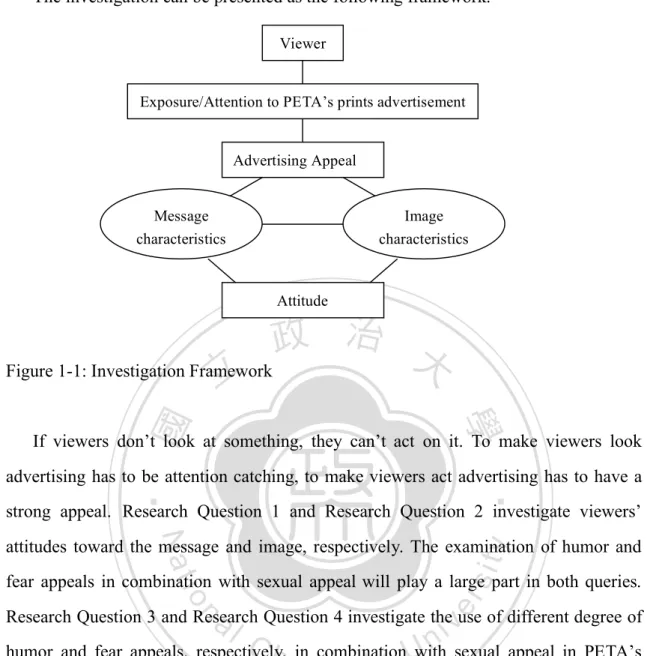
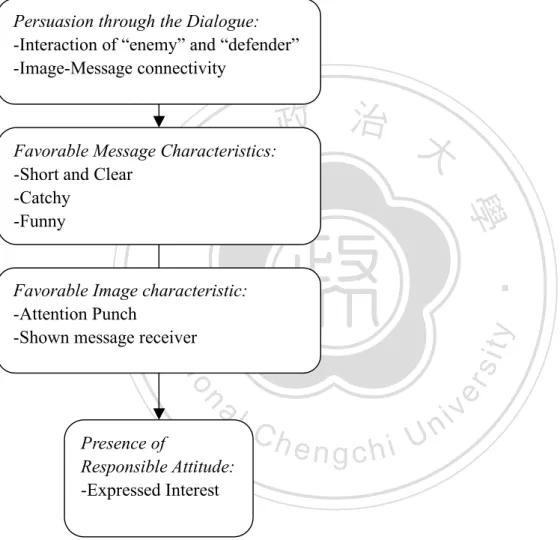
(22) A Study on the Animal Protection Public Service Print Advertising: Female Models against cruel Fashion. The investigation can be presented as the following framework. Viewer. Exposure/Attention to PETA’s prints advertisement. Advertising Appeal Message characteristics. Image characteristics. Attitude. 政 治 大 Figure 1-1: Investigation Framework 立. ‧ 國. 學. If viewers don’t look at something, they can’t act on it. To make viewers look. ‧. advertising has to be attention catching, to make viewers act advertising has to have a strong appeal. Research Question 1 and Research Question 2 investigate viewers’. Nat. sit. y. attitudes toward the message and image, respectively. The examination of humor and. al. er. io. fear appeals in combination with sexual appeal will play a large part in both queries.. v i n C h in combinationUwith sexual appeal in PETA’s humor and fear appeals, respectively, engchi n. Research Question 3 and Research Question 4 investigate the use of different degree of. print PSA and what impact these appeals could have on viewers’ attitude.. Sometimes the advertising strategy in PSA is to scare consumers into acting. Fear appeals (or “hard sells”) are typically designed to illicit a specific feeling. Fear is an extraordinarily powerful emotion and may be used to get consumers to take or consider taking some very important action (responsible thinking). This fear must be coupled with some degree of thought in order for it to work. A high risk of harm or other negative consequences of not taking some recommended actions is presented in these ads, which may result in a negative attitude toward the advertising theme and absence of responsible thinking if advertisers are not careful about presenting them. The fear appeal is usually combination of a rational component and an emotional component.. 22.
(23) A Study on the Animal Protection Public Service Print Advertising: Female Models against cruel Fashion. The intuitive belief about fear appeal as a message tactic is that fear will motivate and persuade the receiver to think responsibly, and to take an action or consider taking an action that will reduce or eliminate the portrayed threat. On the other hand, so-called “humor ads” (or “soft sells”) have a positive attitude towards the persuasive effect of advertising. Humor appeals can increase popularity and attraction, especially with the use of a beautiful female spokesperson. However. is it. enough to increase the effectiveness or persuasive impact, and make the public take action? If the receiver remembers a gag, but cannot remember what the advertisement was about, this ad cannot be called effective. Even so, a humor strategy in public service advertising is a big and risky step that cannot be neglected by research attention.. 政 治 大. As the message is presented in images, this study concerns the involvement of. 立. celebrity spokeswomen in both humor and fear appeal animal protection print ads. ‧. ‧ 國. io. sit. y. Nat. n. al. er. print PSA.. 學. which results in a combination of sexual-humor and sexual-fear appeals in PETA’s. Ch. engchi. i n U. v. 23.
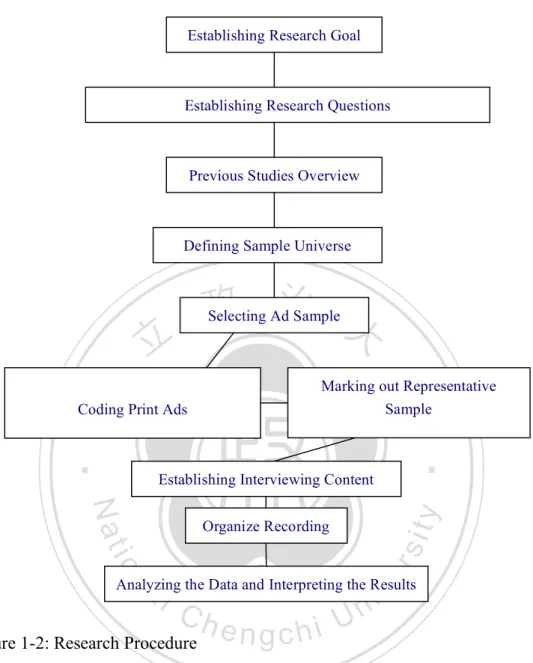
(24) A Study on the Animal Protection Public Service Print Advertising: Female Models against cruel Fashion. 1.6. Research Procedure. Establishing Research Goal. Establishing Research Questions. Previous Studies Overview. Defining Sample Universe. 治 政 Selecting Ad Sample 大 Marking out Representative Sample. 學. Coding Print Ads. ‧. ‧ 國. 立. Nat. y. Establishing Interviewing Content. er. io. al. sit. Organize Recording. v. n. Analyzing the Data and Interpreting the Results. Ch. Figure 1-2: Research Procedure. engchi. i n U. Establishing research goal and questions as the first steps of research procedure has been stated in Chapter I. Chapter II consists of previous studies overview and possibility of its application to the current study. Chapter III decides the research method, the author defines the universe of public sample, selects the advertising campaign and marking out reliable representative ads' sample. When the interviewing content is decided, recoded interviewing proceudres are conducted. In Chapter IV, the data is analyzed, and the results are discussed. Chapter V provides findings, conclusion, academic and practical suggestions, as well as points out the study limitations.. 24.
(25) A Study on the Animal Protection Public Service Print Advertising: Female Models against cruel Fashion. Chapter II Literature Review. 2.1 Previous Study on Animals Issue in Advertising. Amazingly, previous studies have not examined the animal rights issue in advertising in depth and only a few research papers have examined the use of animals in print ads. Nancy Spears and Richard Germain in the research paper “A Note on Green. 政 治 大. Sentiments and the Human-Animal Relationship in Print Advertising During the 20th. 立. Century” (2007) used a content analysis of print advertisements with animals spanning. ‧ 國. 學. the 20th century to investigate green sentiments. The provided framework integrates green advertisers’ depictions of animals and values. Thus, the present study seeks to. ‧. contribute to the understanding of green sentiments in print ads having animals. The. y. Nat. central purpose of the study was guided by three objectives:. n. al. er. io. To study changing social values;. sit. To suggest how animals in Advertising can be used to reassure consumers;. i n U. v. To conduct a longitudinal examination of print ads.. Ch. engchi. To accomplish these objectives, the study proposes a theoretical model based on positionality. The concept of positionality refers to the culturally understood position that humans hold in relation to animals and how this position adapts to ever changing societal demands. Hypotheses were developed from the model to address artistic renditions of animals as well as the depicted self-focused versus society-focused values in print advertisements in different time periods. A content analysis of 1,223 magazine advertisements from the 20th century in the United States was conducted to test the hypotheses. Findings of this study suggest the manner in which animals and depicted values in ads containing animals can be effectively used to stimulate the consumer to consider green value in advertised products.. 25.
(26) A Study on the Animal Protection Public Service Print Advertising: Female Models against cruel Fashion. Advertisers frequently use animals in ads, another little academic research Lancendorfer, Atkin, and Reece (2008) focuses on consumer reactions to their use. This study uses the heuristic–systematic model (HSM) to examine consumer response to animal companions in advertisements. Specifically, HSM serves as the theoretical foundation for testing the effects of animal heuristic cues on the formation of attitude toward the ad, attitude toward the brand, and purchase intention. In the current study, the presence of the dog increases heuristic processing, concurrent processing, and ultimately attitude toward the ad.. 立. 政 治 大. ‧. ‧ 國. 學. n. er. io. sit. y. Nat. al. Ch. engchi. i n U. v. 26.
(27) A Study on the Animal Protection Public Service Print Advertising: Female Models against cruel Fashion. 2.2. Persuasion process in Advertising. The study of persuasion in Advertising has a rich tradition. Most advertisement effectiveness content models are based on a well-known advertising theory presented by Lavidge and Steiner (1961) – the hierarchy of effects model (A Model for Predictive Measurements of Advertising Effectiveness, Journal of Marketing, October 1961): Awareness -> Knowledge -> Liking -> Preference -> Conviction -> Purchase Later on, many researchers developed similar models based on this theory. John D. Leckenby and Nugent Wedding (1982) suggested three dimensions of impact in the. 治 政 大 dimension includes attitude,. persuasion process: Cognitive – Affective – Conative. The cognitive (knowing). 立. exposure, awareness,. recognition, comprehension, and recall.. ‧ 國. 學. The affective (feeling) dimension includes attitude change, liking/disliking, and involvement.. ‧. The conative (taking an action) dimension includes advertised intention and. sit. y. Nat. behavior.. io. er. Although these models provide useful insights into the possible sequence of audience responses to advertisements in general, they are a bit simplified for empirical. n. al. Ch. i n U. v. research in advertising effects, because the human mind is much more complex than the three- or six-step procedures.. engchi. An early research in cognitive response theory is in attitude change research (Timothy C. Brock, 1967; Anthony G. Greenwald, 1968). This approach has become an increasingly viable explanation for a variety of empirical findings and theoretical perspectives. The cognitive response approach to persuasion emphasizes the thoughts that people have while exposed to persuasive messages. Advertising persuasion research has identified numerous ways in which advertising can influence public opinion. In the viewpoint of William E. Baker and Richard. J. Lutz (1988), using a general situational contingency approach, the Relevance-Accessibility Model (RAM) can explain when different advertising effects will be most effective and persuasive (and most ineffective) in influencing public. 27.
(28) A Study on the Animal Protection Public Service Print Advertising: Female Models against cruel Fashion. behavior. The RAM represents an assimilation of recent research in cognitive and social psychology, behavioral learning theory, and advertising theory, including research on how consumers process Advertising information, how information is stored in and accessed from memory, and how people use information to facilitate judgments. The RAM is based on the view that the primary goal of Advertising is not to change an attitude at the moment of exposure to the advertisement, but rather to influence choice by communicating relevant information that is easily retrieved, that is, accessible, and used at the response occasion to discriminate among other alternatives. According to the RAM, breakdowns in advertising effectiveness occur for two general reasons: when advertising information is not accessed at the response occasion or when. 政 治 大. the accessed advertising information is perceived as irrelevant to the choice process. To. 立. be optimally effective advertising messages must contain the type of information that. ‧ 國. 學. public are most likely to use to discriminate at the response occasion and maximize the accessibility of that information at the response occasion. A central proposition of the. ‧. RAM is that perceived information relevance is a function of public decision-making. y. Nat. involvement at the response occasion.. sit. Application of the Elaboration Likelihood Model of persuasion, or ELM (Petty and. n. al. er. io. Cacioppo, 1986), and Heuristic-Systematic Model of Information Processing, or HSM. i n U. v. (Chaiken, 1980), suggests a model of source effects. Depending on the level of. Ch. engchi. involvement, persuasion may occur through either an effortful, systematic, elaboration‐based central route or an effortless association, or heuristic‐based peripheral route. The multiple‐roles postulate of the ELM (Petty and Wegener, 1998 and 1999) suggests that source effects may occur via either the peripheral route, if source serves as a peripheral cue, or the central route, if source serves as a product‐advocacy argument. Hence, the multiple‐roles postulate, with source effects a result of consumers processing source information (e.g., thoughts and feelings evoked by the source), upholds multiple source‐effect hypotheses and may resolve the discrepancies between the source‐effect models described. When cognitive resources are constrained (due to low motivation and/or low ability), consumers spend fewer resources processing information, by definition (i.e.,. 28.
(29) A Study on the Animal Protection Public Service Print Advertising: Female Models against cruel Fashion. low‐resource processing). Source perceptions may influence product attitudes in multiple ways, such as category‐based responses (Fiske and Neuberg, 1990), well‐learned heuristics (Chaiken, 1980), cognitive balance (Heider, 1958), or associations (Petty and Cacioppo, 1986). Thus, if source features are affectively positive (e.g., attractive) or consistent with well‐practiced, positive judgment heuristics (e.g., “experts are believable”), positive source effects will likely result. Since low‐resource/low‐involvement consumers are unlikely to process source information further, resulting source effects are unlikely to depend on the product category.. 立. 政 治 大. ‧. ‧ 國. 學. n. er. io. sit. y. Nat. al. Ch. engchi. i n U. v. 29.
(30) A Study on the Animal Protection Public Service Print Advertising: Female Models against cruel Fashion. 2.3 Nonverbal Communication An important shift in advertising research occurred in the decade of the 1980s. The dominance of verbal measures of advertising response has given a way to a more balanced perspective that includes a concern for affective and behavioral responses to advertising stimuli, as well as verbal or cognitive responses. The use of imagery, visual associations, drawings and paintings, and models are pervasive in advertising. The importance of nonverbal communication is obvious. Among the elements that belong to nonverbal communication are pictures and illustrations, symbols, gestures and other “affective” stimuli. Nonverbal communication is difficult to define. Researchers have. 治 政 identified classes are: paralinguistic phenomena (how 大 is something said or shown), 立 facial expression, body movements (kinesics), gestures, spacing or proxemics, eye attempted to develop various classification systems for this. Among the more frequently. ‧ 國. 學. movements, touch, pictures (pictics or vidistics), and symbolic artifacts. The study of nonverbal communication has a rich tradition in the social sciences.. ‧. The design Advertising research without consideration of nonverbal variables risks. sit. y. Nat. confounding and loss of internal validity. Advertising creative designers grapple with. io. er. the problem of making the best use of nonverbal communication.. Julie Edell in “Nonverbal Effects in Ads: Review and Synthesis” (1988) provides a. n. al. Ch. i n U. v. useful and quite comprehensive overview of the area. She provides four theoretical. engchi. mechanisms for explaining the impact of nonverbal communication in advertising: information processing, classical conditioning, distraction, and mood induction. Numerousinformation processing research papers show that a picture is more likely to be remembered than words The explanation of this phenomena is that pictures can often show the relationship between the objects. Thus, the association between these objects is more meaningfully and effortlessly made, resulting in a stronger and more memorable message. Under the classical conditioning mechanism, nonverbal elements of advertising have an effect by transferring the affect generated in response to the nonverbal elements to the advertised theme. The distraction explanation has often been found to be most consistent with the data, especially when stimuli used in the study closely resembled. 30.
(31) A Study on the Animal Protection Public Service Print Advertising: Female Models against cruel Fashion. typical advertisements. In 1983, Johnson and Tversky conducted four experiments investigating the effects of mood states on people’s perception of risk. They found that a negative event (for example, street crime, chronic depression, stroke) regardless of how similar the mood-induction story was to the type of event effeted estimated of the frequency of a similar event occurring Both a depressing story and a crime story had the same effect on estimates of the frequency of all types of negative events occurring. The positive story decreased the estimate of twenty of twenty-one different types of negative events occurring. Johnson and Tversky concluded that the mood induced by these brief stories had large and pervasive impacts not only on similar events, but on wide range of unrelated events as well.. 政 治 大. If nonverbal elements are successful in creating an affective reaction, mood, or. 立. feeling state, then this mood could influence other evaluations, including the evaluation. ‧ 國. 學. of information, the Ad, and the advertised theme.. In studies of visual-verbal integration, one of the earliest investigations of visual. ‧. stimuli in impression formation was reported by Lampel and Anderson (1968). Female. y. Nat. college students evaluated the datability of males described by a photograph and two. sit. personality-trait adjectives. The result showed that the importance of verbal trait. n. al. er. io. information increased as the visual attractiveness increased. But when visual. i n U. v. information was presented in a verbal list, it was unimportant. That is, inherently visual. Ch. engchi. information, such as physical appearance, is apparently discounted when it is described verbally. The visual material, when available, is processed first, and this sets the stage for later processing of verbal information. This means that visual information dominates initial impressions. This does not imply that the final impression is similarly dominated by pictures. Since additional information may be incorporated into the impressions, the final impact of picture depends on how much more besides the picture is processed. There are three sources of evidence to support the assumption of visual priority. First, analyses of eye movements indicate what people respond to first when viewing an ad. Second, Edell and Staelin proposed a processing model for advertising in which the first step is to “look at layout of ad” (1983, p.48). Using print ads, they employed a variety of responses, including process-tracing techniques, to measure the subject’s. 31.
(32) A Study on the Animal Protection Public Service Print Advertising: Female Models against cruel Fashion. reaction. They found that different processing strategies were used depending on the relation between picture and text. All processing, however, began with the analysis of pictorial information. The Consumer Integration Theory (CIT) presented by James Shanteau (1988) describes how visual and verbal information is combined to form of an impression. This theory is based on the two assumptions of visual primacy and serial averaging, which is substantial and direct. These assumptions lead to a five-step model: (1) the first reactions to visual stimuli, (2) the first reactions to verbal stimuli, (3) initial impressions based on combination of visual and verbal first reactions, (4) further processing to extract attribute values, and (5) updating of impressions as additional attributes are extracted.. 立. 政 治 大. This approach leads to several implications about the effects of visual information. ‧ 國. 學. in advertising. First, CIT is predicated on pictorial materials having a primary role in the initial impressions to ads. The visual information may dominate the final impression. ‧. or provide a starting point that is eclipsed by later text information.. y. Nat. Second, CIT implies that the relative importance of visual and verbal information in. sit. an Ad is a function of extent or subsequent processing.. n. al. er. io. Third, involvement with an ad is likely to play a major role in determining whether. i n U. v. visual or verbal material is most influential. Under low involvement, visual information. Ch. engchi. is more important than under high involvement, because it is processed first and there is a little subsequent processing of verbal information. Finally, the experience of consumers should also influence the relative impact of visual and verbal information. Andrew A. Mitchell’s research concerns a number of issues examining the effects of feeling states in advertising (1985). The first issue is whether the effects of feeling states induced prior to the exposure to an advertisement are different from those induced by the advertisement itself. The second issue concerns the explanation of these effects by difference in the information encoded during exposure to the advertisement. The third issue is whether the effects of these feeling states are similar to those induced by placing a positively or negatively evaluated photograph in an advertisement. The results of this study found that mood had a strong effect on the formation of. 32.
(33) A Study on the Animal Protection Public Service Print Advertising: Female Models against cruel Fashion. attitudes towards an advertised object, but no effect on the number of support or counterarguments generated and no effect on attitude toward the advertisement. There seemed to be little relationship between the valence of the information recalled from memory and the attitudes that were formed under the positive mood condition. Finally, the images characteristics of nonverbal communication in advertisement are an important part of the impulse for optimal processing of information in advertisements. Lynn R. Kahle and Pamela M. Homer consider surrealism as nonverbal communication in advertising (1986). According to present research, there is an immense use of surrealistic techniques in public service advertising. Surrealism, as a phenomenon of an early twentieth-century artistic movement, is often evident in. 政 治 大. cotemporary advertisements. The magnificent importance of this research is to consider. 立. the amount of creativity of surrealism in advertising that is needed in order to. ‧ 國. 學. understand whether and how these techniques influence consumers.. Surrealism is a form of art that represents the unexpected combinations of vision. ‧. suddenly free of the stereotyped mental habits. It seeks dialectically to deny opposites,. y. Nat. such as seriousness and humor, or good and bad. Surrealists achieve maximum impact. sit. of an object through a variety of nonverbal communication techniques such as:. n. al. er. io. isolation – the object once situated outside its own field is freed of its expected role;. i n U. v. modification – the artist changes some aspect of the object so that a property that is not. Ch. engchi. normally associated with the object is a associated with it; incongruity – a change in scale, position or substance; paradox – intellectual antitheses; conceptual bipolarity – interpenetrating images in which two situations observed from a single point of view; provocation of accidental encounters and double images. Social adaptation theory (Kahle and Homer) has been developed primarily to account for attitude change and advertising effectiveness. At the heart of any theory of consumer behavior is the central mechanism through which change occurs. The two building elements of change in social adaptation theory are assimilation and accommodation. When someone receives new information that information can be assimilated into existing mental schema, it can lead to accommodation (revision) of such a schema. Assimilation is the fusion of a new object to an already established. 33.
(34) A Study on the Animal Protection Public Service Print Advertising: Female Models against cruel Fashion. schema. Accommodation is the most direct sense in which the environment acts on the individual’s cognitive structure. An unexpected or surreal stimulus will likely foster adaptation because it will not fit into any established schema. A complementary function to adaptation is organization. It is the tendency to systematize process into coordinated, coherent systems. It is the mechanism through which internal representations of the external environment are related to one another. Social adaptation theory predicts that employing surrealistic techniques should draw attention to the inadequacy of existing schemas, because the information will be perceived as novel and unexpected, which are the most important elements in a creativity theory of advertising.. 立. 政 治 大. ‧. ‧ 國. 學. n. er. io. sit. y. Nat. al. Ch. engchi. i n U. v. 34.
(35) A Study on the Animal Protection Public Service Print Advertising: Female Models against cruel Fashion. 2.4. Celebrity Endorsement. McCracken proposed a meaning transfer model for celebrity endorsement (1989). According to the model, a celebrity’s effectiveness as an endorser stems from the cultural meanings with which the celebrity is endowed. The model shows how the meanings pass from the celebrity to the product and from the product to the consumer. Meaning begins as something resident in the physical and social world constituted by the principles of the prevailing culture. Meaning then moves to consumer goods and to the consumer’s life. The movement of meanings from the culturally constituted world to consumer goods is achieved by advertising and the fashion system. The movement from. 政 治 大 Celebrity endorsement plays a crucial role in this transfer. The meaning first resides in 立 consumer goods to the individual consumer is achieved by the efforts of the consumer.. ‧ 國. 學. the celebrities themselves, is then transferred when the celebrity enters an advertisement with a product, and finally is carried from the product to the consumer.. ‧. A previous research paper is quite useful for the present study (based on analyzing the effectiveness of print advertisements with participating famous models standing up. Nat. sit. y. for animals rights). Kahle and Homer (1985) examined how people respond to. al. er. io. magazine advertising by manipulating the physical attractiveness of celebrity sources,. v. n. and the likeability of celebrity sources. The study focused on how they participate in product involvement. i n C in simulated h print advertisements e n g c h i U for. Edge disposable razors.. Celebrities with extreme ratings on physical attractiveness and likeability were selected for inclusion in the simulated advertisements, based on a preliminary survey of respondents from the same subject population as the participants in the actual experiment. Kahle and Homer reasoned that for products such as disposable razor, for which consumer interest is relatively low, subjects would not examine information from an advertisement very long. The same is true for PSA, public interest for animal protection actions is as that high as it could be for the any market product. Any information conveyed in the advertisement would probably be observed within the first second or two of observing the advertisement. Thus, the adapted significance of the celebrity’s image relative to the function of the advertised object would be crucial in. 35.
(36) A Study on the Animal Protection Public Service Print Advertising: Female Models against cruel Fashion. determining the effectiveness of the advertisement. The results of this study were consistent with the prediction. Only advertisements that included attractive celebrities were associated with optimal levels of favorable attitudes toward the product. 2.5 Advertising Appeal Advertising uses appeals as a way of persuading the public. There are two basic appeals – emotional and rational. An emotional appeal is related to an individual’s psychological and social needs for purchasing certain products and services. Many consumers are emotionally motivated (or driven to make a purchase) and when. 政 治 大 and values as belief systems and social constructions, guide the audience, play role in 立 evaluating a certain persuader’s message are influenced by the affects. Emotions, needs. ‧ 國. (Averill, 1986; Borchers, 2001).. 學. identifying persuader’s ideas and motivate the audience to act on persuader’s message. ‧. Rational appeals (as the name suggests) focus on the individual’s functional, utilitarian or practical needs for particular products and services. Such appeals. Nat. sit. y. emphasize the characteristics and features of the product and the service. Print media is. al. er. io. particularly well suited for rational appeals and is often used with good success. As. v i n Traditionally, reasoning has beenCexamined a formal argumentation perspective. h e n gfrom chi U n. emotional appeal is drawn on motivations, rational appeal is about reasoning.. Reasoning is concerned with making claims, which are the statements that. communicate a persuader’s message to an audience. Michael G. Cruz (1988) found that when persuaders state their claims explicitly, audience members better comprehend their message. When they understand the message, the audience believes the persuader holds a more knowledgeable position on the subject, which Cruz argues, leads to greater attitude change. However, there must be some data, premises, evidences, or examples involved in reasoning process. Next, the literature review highlights the different types of emotional appeal thatare widely used in PETA’s print PSA.. 36.
(37) A Study on the Animal Protection Public Service Print Advertising: Female Models against cruel Fashion. 2.5.1. Sexual Advertising Appeal. “Publicity is about social relations, not objects. Its promise is not of pleasure, but of happiness as judged from outside by others. The happiness of being envied is glamour” (Berger, 1972, p.132). “The women in advertising is meant to imagine herself transformed into an object of envy for others, an envy which will then justify her loving herself” (Berger, p.134). Sex and nudity have always sold well. Sexuality, sexual explicitness, overt sexuality, or sensuality raises the curiosity of the audience and can result in strong feelings about the advertisement. It can also result in the product appearing interesting.. 治 政 大 2006). Seminal studies scholars, activists, and the public (Reichert and Lambiase, 立 analyzed the effects of nudity in print advertisements: who among viewers responded to Since the late 1960s, the use of sex in advertising has been widely discussed by. ‧ 國. 學. the sexual appeal and how the appeal affected brand recall and viewer attitudes toward the brand (Alexander and Judd, 1978; Steadman, 1969). In comparative analyses of. ‧. sexual portrayals in magazine advertisements in 1964 and 1984, Soley and Kurzbard. sit. y. Nat. found that while the percentage of sexual appeals did not increase, the types of sexual. io. er. portrayals did, with the sexual appeal becoming more overt (Reichert and Lambiase). Concerning model gender and product interactions, Thomas W. Whipple and Alice. n. al. Ch. i n U. v. E. Courtney (1983) believe that although there is considerable evidence that advertising. engchi. presents a traditionally stereotyped portrayal of women, and that demography and attitudes among women have changed dramatically over the past decade, there is a little agreement about what steps an advertiser can effectively take to respond to these challenges. Among some advertisers, there is concern that traditional stereotypes may be declining in the effectiveness. For some special cases and for some target audiences, who public service advertisers normally deal with, there are strong indications that progressive portrayals of women are more effective. There is also evidence that replacing traditional images with more modern or “liberated” ones may create new effectiveness. Becoming an object of desire supposedly makes a woman more valuable in the eyes of others, and hence more valuable to herself. Aside from simply containing sexual content, sexual information in ads can be. 37.
數據

+7
相關文件
The Task Force fully recognises students’ diverse learning and development needs across different key stages and domains, and hence the recommendations need to be considered in
2.8 The principles for short-term change are building on the strengths of teachers and schools to develop incremental change, and enhancing interactive collaboration to
- Informants: Principal, Vice-principals, curriculum leaders, English teachers, content subject teachers, students, parents.. - 12 cases could be categorised into 3 types, based
Students are asked to collect information (including materials from books, pamphlet from Environmental Protection Department...etc.) of the possible effects of pollution on our
The existence of cosmic-ray particles having such a great energy is of importance to astrophys- ics because such particles (believed to be atomic nuclei) have very great
–保護兒童特別調查隊 (Child Protection Special Investigation Team/ CPSIT).
–保護兒童特別調查隊 (Child Protection Special Investigation Team/ CPSIT).
Twilight of the Gods: The Beatles in Retrospect (London 1973).. The Complete Beatles Recording Sessions
