High quality factor microcavity lasers realized by circular photonic crystal with
isotropic photonic band gap effect
Po-Tsung Lee, Tsan-Wen Lu, Jyun-Hao Fan, and Feng-Mao Tsai
Citation: Applied Physics Letters 90, 151125 (2007); doi: 10.1063/1.2724899
View online: http://dx.doi.org/10.1063/1.2724899
View Table of Contents: http://scitation.aip.org/content/aip/journal/apl/90/15?ver=pdfcov Published by the AIP Publishing
Articles you may be interested in
Photonic crystal heteroslab-edge microcavity with high quality factor surface mode for index sensing Appl. Phys. Lett. 94, 141110 (2009); 10.1063/1.3117225
Investigation of whispering gallery mode dependence on cavity geometry of quasiperiodic photonic crystal microcavity lasers
Appl. Phys. Lett. 89, 231111 (2006); 10.1063/1.2402894 High-quality-factor photonic crystal heterostructure laser Appl. Phys. Lett. 89, 101104 (2006); 10.1063/1.2345912 Quasiperiodic photonic crystal microcavity lasers
Appl. Phys. Lett. 84, 4875 (2004); 10.1063/1.1762705
Experimental demonstration of a high quality factor photonic crystal microcavity Appl. Phys. Lett. 83, 1915 (2003); 10.1063/1.1606866
This article is copyrighted as indicated in the article. Reuse of AIP content is subject to the terms at: http://scitation.aip.org/termsconditions. Downloaded to IP: 140.113.38.11 On: Thu, 01 May 2014 00:34:45
High quality factor microcavity lasers realized by circular photonic crystal
with isotropic photonic band gap effect
Po-Tsung Lee, Tsan-Wen Lu,a兲 Jyun-Hao Fan, and Feng-Mao Tsai
Department of Photonics and Institute of Electro-Optical Engineering, National Chiao Tung University, Rm. 415, CPT Building, 1001 Ta-Hsueh Road, Hsinchu, 300 Taiwan, Republic of China
共Received 12 February 2007; accepted 15 March 2007; published online 13 April 2007兲
The photonic band gap 共PBG兲 effect and its isotropy of sunflower-type circular photonic crystal 共CPC兲 are obtained and investigated from the transmission spectra performed by finite-difference time-domain 共FDTD兲 method. The PBG directional width variation is found to be only 6.7%. A well-confined whispering gallery mode共WGM兲 with azimuthal number of 6 is obtained by FDTD simulation from the CPC microcavity formed by seven missing air holes共C2兲. Ascribed to the deep and isotropic PBG confinement, the WGM lasing with very-low threshold 共⬃0.13 mW兲 and very-high-quality 共Q兲 factor 共⬎10 000兲 is obtained from well-fabricated CPC C2 microcavity lasers. © 2007 American Institute of Physics. 关DOI:10.1063/1.2724899兴
In advanced optical communication systems, circular resonator plays a key role in numerous applications includ-ing filters, add/drop channel devices, optical buffer compo-nents, and so on. In most circular resonators with large di-mension, they usually exhibit excellent characteristics of low loss, good confinement, high quality factor, etc. Unfortu-nately, when the size of resonator is reduced for condensed system requirement, the bend loss of total internal reflection arisen from decreased local radius of resonator increases dra-matically. To solve this problem, a resonator design named annular circular resonator共ACR兲 is proposed by Scheue and Yariv.1,2 In ACR, the confinement is provided by Bragg re-flection of the surrounded annular Bragg reflector formed by concentric periodic circular trenches instead of total internal reflection effect. However, there are two problems in ACR. First, the widely used membrane structure cannot be applied in ACR due to the annular Bragg reflector. Second, the cur-rent injection structure cannot be achieved due to its discon-tinuous structure. Very recently, one promising solution called circular photonic crystal 共CPC兲 microcavity is pro-posed by several groups.3–6In CPC microcavity, the circular trenches共annular Bragg reflector兲 are replaced by CPC lat-tices consisting of air holes fabricated on dielectric materials, as illustrated in Fig.1共a兲, and the confinement is provided by the photonic band gap共PBG兲 effect of CPC lattice which is found very recently.7,8 In general, the CPC lattices are ar-ranged to be concentric circles in different formations includ-ing square, triangular, and sunflower type.5There are several advantages of using CPC microcavity. First, the isotropic PBG can be obtained from this kind of nonperiodic lattice structure due to its high symmetry in the wave vector 共k兲 space. This implies that the CPC microcavity could provide more uniform confinement in different directions and lead to better lasing properties. Second, by proper design, the highly confined whispering galley mode共WGM兲, which is a highly potential mode in photonic integrated circuits共PIC兲, can be sustained in the CPC microcavity. Third, due to the lattice geometry, the CPC microcavity fused with CPC waveguide7,9,10 also shows large flexibility in PIC design.
Although few theoretical results of modal characteristics of large microcavities共⬎2 m in diameter兲 formed by CPCs have been reported,3–5the characteristics of CPC microcavity with small cavity size 共⬍2m in diameter兲 have not been studied yet. In this report, at first, we investigate the isotropy of the PBG of sunflower-type CPC by finite-difference time-domain共FDTD兲 simulations. Then we design a microcavity formed by seven missing air holes, called CPC C2 microcav-ity共⬍2 m in diameter兲. Its modal characteristics performed by FDTD simulations indicate that the WGM can be sus-tained in this microcavity. From the well-fabricated devices, the WGM single-mode lasing action with ultralow threshold
a兲Electronic mail: [email protected]
FIG. 1.共Color online兲 共a兲 Scheme of sunflower-type CPC lattice structure and the calculation setup of transmission spectrum.共b兲 Calculated transmis-sion spectra of CPC lattice structure共red curve兲 and that with C2 microcav-ity共purple curve兲. The spectrum indicates the PBG region for normalized frequency from 0.29 to 0.354.共c兲 By rotating the whole CPC lattice, the variations of PBG width and upper and lower gap boundaries are calculated, which are 6.7%, 7.9%, and 4.5%, respectively, compared to PBG width at 0°.
APPLIED PHYSICS LETTERS 90, 151125共2007兲
0003-6951/2007/90共15兲/151125/3/$23.00 90, 151125-1 © 2007 American Institute of Physics This article is copyrighted as indicated in the article. Reuse of AIP content is subject to the terms at: http://scitation.aip.org/termsconditions. Downloaded to IP:
and estimated measured high quality共Q兲 factor is obtained. The scheme of a sunflower-type CPC lattice is shown in Fig.1共a兲, and the spatial lattice positions on the x-y plane are given by
x = aN cos
冉
2n6N
冊
, y = aN sin冉
2n6N
冊
, n = 1⬃ 6N, where a and N denote the lattice constant and number of the concentric lattice periods, which are also defined in Fig.1共a兲. To investigate its PBG effect, we calculate its transmission spectrum using FDTD method with effective index approxi-mation. A Gaussian dipole source with 0.366 central normal-ized frequency is put on one side of the CPC lattice formed by 127 air holes. Then, the transmitted electromagnetic wave is detected by a detector on the opposite side. The calculated transmission spectrum of CPC with 500 nm lattice constant 共a兲 and 0.42a air-hole radius 共r兲 is shown as red curve in Fig.1共b兲. In this figure, a significant PBG region lower than −15 dB transmission for normalized frequency from 0.29 to 0.354 is observed. To investigate the PBG isotropy, we rotate the CPC lattice by an anglewith 3° increment, as shown in Fig.1共a兲. In the simulation, we only deal with the case of
= 0 ° – 30° due to the 12-fold-like rotational symmetry of CPC lattice. The normalized frequency of upper and lower gap boundaries as a function ofis shown in Fig.1共c兲. The variations of PBG width and upper and lower boundaries compared to the PBG width 共defined at 0°兲 are only 6.7%, 7.9%, and 4.5%, respectively, which shows the isotropic PBG of CPC.共This result is quite similar with the CPC PBG isotropy using metallic rods reported by Horiuchi et al.8兲 We also numerically study the PBG directional variation of tri-angular photonic crystal 共PC兲 for comparison by the same simulation setup. Its PBG width variation is found to be 10.1%, which is larger than that of CPC. Besides, the trans-mission depth 共low transmission region兲 variation of PC PBG is about 15 dB, which is also much larger than 5 dB of CPC PBG. Thus, the above numerical results clearly indicate the isotopic PBG of CPC. In chasing for thresholdless micro-and nanoscale laser sources, the reduction of unnecessary spontaneous emission by the PBG effect becomes a key issue.11To suppress the spontaneous emission efficiently, the directional difference of PBG has to be relatively small com-pared to the width of PBG itself,8 i.e., the PBG must be isotropic. As a result, the CPC with isotropic PBG can be considered as a potential candidate of lattice structure to re-alize thresholdless laser sources.
The modal characteristics of CPC C2 microcavity are also performed by FDTD method with an effective index of 2.7, which is obtained with the dielectric slab thickness of 220 nm. In searching for defect modes in PC microcavity, FDTD method with effective index has been reported as a fast and reliable approach.12 The normalized frequencies of calculated defect modes versus r / a ratio of CPC C2 micro-cavity are shown in Fig.2. Lots of defect modes exist within the PBG region and their mode profiles are also shown in Fig. 2, including zero- 共K=4,5,6兲, first- 共K=2,3兲, and second-order 共K=0,1兲 radial modes, where K denotes the rotational Bloch number. It is worthy to notice that one of them presents zero-order radial WGM profile with azimuthal number of 6共K=6兲. The transmission spectrum of CPC C2 microcavity is also shown as purple curve in Fig.1共b兲. For the researches in past decades, WGM is a very important
mode in the applications of quantum information process and coupled active devices with logical operation. But, in most photonic crystal microcavities, WGM is rarely well sustained in the cavity or takes the lead during mode competition. Thus, we will focus on this WGM in our following experi-ments and discussions.
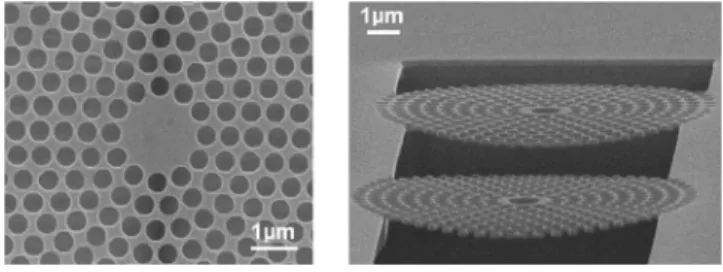
In fabrication, the CPC C2 microcavity is fabricated on the epitaxial structure consisting of four 10 nm compres-sively strained InGaAsP multi-quantum-wells共MQWs兲 with 1550 nm peak wavelength and around 200 nm broad spec-trum width from 1380 to 1580 nm under photolumines-cence. The CPC patterns are defined by electron-beam li-thography and transferred into MQWs by a series of inductively coupled plasma/reactive ion etching process. The membrane structure is formed by HCl selective wet etching. The details of the fabrication procedure can be found in our previous reports.13,14 The top-view and tilted-view scanning electron microscope共SEM兲 pictures of fabricated devices are shown in Fig.3.
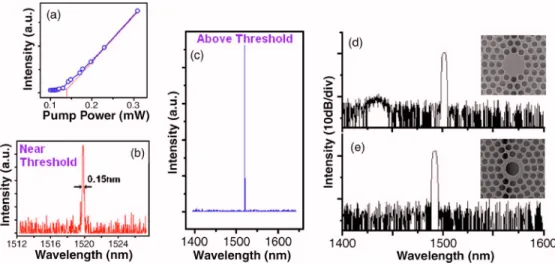
In characterization, the microcavity is optically pumped at room temperature by 845 nm laser pulse with 0.5% duty cycle. The measured lasing actions with different lattice pa-rameters are denoted by open circles in Fig. 2, and they clearly indicate the lasing mode is WGM compared with the simulation results. The small difference between simulated and measured results is arisen from the index approximation used in FDTD simulations. The typical light-in–light-out 共L-L兲 curve is shown in Fig.4共a兲, and the threshold can be estimated as low as 0.13 mW from the curve. The spectra of near and above threshold at lasing wavelength of 1519.8 nm are shown in Figs.4共b兲 and4共c兲. The measured Q factor is larger than 10 000 estimated from measured linewidth
FIG. 2.共Color online兲 Defect modes in normalized frequency with different r / a ratios of CPC C2 microcavity are calculated by FDTD simulations. The defect mode profiles including zero- 共K=4,5,6兲, first- 共K=2,3兲, and second-order共K=0,1兲 radial modes are shown in the inset. The measured results denoted by open circles indicate that the lasing mode is WGM共K = 6兲.
FIG. 3. Top-view共left兲 and tilted-view 共right兲 SEM pictures of fabricated sunflower-type CPC C2 microcavities.
151125-2 Lee et al. Appl. Phys. Lett. 90, 151125共2007兲
This article is copyrighted as indicated in the article. Reuse of AIP content is subject to the terms at: http://scitation.aip.org/termsconditions. Downloaded to IP: 140.113.38.11 On: Thu, 01 May 2014 00:34:45
共⌬FWHM兲 near the transparency pump level by Q=/⌬FWHM.
This estimated Q factor value is limited to the resolution of our spectrum analyzer, and the details of this experimental estimated method can be found in report by Srinivasan et
al.15Comparing with the lasing characteristics of dodecago-nal quasi-PC共DQPC兲 D2 microcavity we reported before,14 the estimated Q factor and the threshold of CPC C2 micro-cavity are both better than those of DQPC D2 micromicro-cavity. Actually, for these two microcavities, the cavity modal boundaries are almost the same. As a result, this indicates the more isotropic PBG confinement of CPCs than DQPCs. Be-sides, to further prove that the lasing mode is WGM, a direct approach is applying a perturbation in the microcavity, for example, fabricating a central air hole in the microcavity region.13 The typical lasing spectra in decibel scale are shown in Figs.4共d兲and4共e兲. A significant side mode which is identified as dipole共K=1兲 mode can be observed in Fig.
4共d兲. After inserting the central air hole shown in the inset SEM picture, the side mode is greatly reduced without af-fecting the WGM lasing and the side-mode suppression ratio 共SMSR兲 is increased up to 25 dB, as shown in Fig. 4共e兲. Besides, although the effective index of the microcavity is greatly reduced by this inserted central air hole, there is only small wavelength shifting under large cavity index variance, as shown in Figs. 4共d兲 and 4共e兲. This strongly implies the small influence caused by the central air hole on effective modal index of WGM, which provides direct evidence of WGM lasing.
Although above results in simulations and experiments show isotropic PBG of CPC and excellent performances of CPC C2 microcavity, small anisotropy still exists in the sunflower-type CPC due to its 12-fold-like symmetry in its Brillioun zone. In our undergoing work, to overcome this small anisotropy and realize real circular Brillioun zone, the CPC lattice structure needs to be modified. The approach is properly rotating the lattice structure period by period,4,8and the further improved lasing properties of higher Q factor and lower threshold can be expected.
In summary, we have investigated the PBG isotropy of sunflower-type CPC lattice by FDTD simulated transmission spectra. The variations of PBG width and upper and lower
boundaries compared to PBG width at 0° are only 6.7%, 7.9%, and 4.5%, respectively, which indicate the isotropic PBG of CPC. The WGM共K=6兲 and other defect modes of CPC C2 microcavity are also calculated by FDTD method. From well-fabricated devices, we obtained the lasing action of WGM with high estimated Q factor of over 10 000 and ultralow threshold of 0.13 mW, which are ascribed to the isotropic CPC PBG effect. By adding extra perturbation 共central air hole兲, we further confirm that the lasing mode is WGM and the SMSR is increased up to 25 dB due to the side-mode reduction.
This work is supported by Taiwan’s National Science Council 共NSC兲 under Contract Nos. NSC-95-2221-E-009-234 and NSC-95-2221-E-009-056 and Promoting Academic Excellence of Universities under Contract No. NSC-94-2752-E-009-007-PAE. The authors would like to thank the help from Tien-Chang Lu, Hao-Chung Kuo, and Center for Nano Science and Technology of National Chiao Tung Uni-versity, Taiwan, R.O.C.
1J. Scheuer and A. Yariv, J. Opt. Soc. Am. B 20, 2285共2003兲. 2J. Scheuer and A. Yariv, IEEE J. Quantum Electron. 39, 1555共2003兲. 3J. Scheuer and A. Yariv, Phys. Rev. E 70, 036603共2004兲.
4J. Chaloupka, J. Zarbakhsh, and K. Hingerl, Phys. Rev. B 72, 085122
共2005兲.
5D. Chang, J. Scheuer, and A. Yariv, Opt. Express 13, 9272共2005兲. 6S. S. Xiao and M. Qiu, Photonics Nanostruct. Fundam. Appl. 3, 134
共2005兲.
7J. Zarbakhsh, F. Hagmann, S. F. Mingaleev, K. Busch, and K. Hingerl,
Appl. Phys. Lett. 84, 4687共2004兲.
8N. Horiuchi, Y. Segawa, T. Nozokido, K. Mizuno, and H. Miyazaki, Opt.
Lett. 29, 1084共2004兲.
9N. Horiuchi, Y. Segawa, T. Nozokido, K. Mizuno, and H. Miyazaki, Opt.
Lett. 30, 973共2005兲.
10S. S. Xiao and M. Qiu, Phys. Lett. A 340, 474共2005兲.
11M. Fujita, S. Takahashi, Y. Tanaka, T. Asano, and S. Noda, Science 308,
1296共2005兲.
12Z. Qiang and W. Zhou, IEEE Photonics Technol. Lett. 18, 1940共2006兲. 13P. T. Lee, T. W. Lu, F. M. Tsai, T. C. Lu, and H. C. Kuo, Appl. Phys. Lett.
88, 201104共2006兲.
14P. T. Lee, T. W. Lu, F. M. Tsai, and T. C. Lu, Appl. Phys. Lett. 89, 231111
共2006兲.
15K. Srinivasan, P. E. Barclay, O. Painter, J. Chen, A. Y. Cho, and C.
Gmachl, Appl. Phys. Lett. 83, 1915共2003兲.
FIG. 4.共a兲 L-L curve and spectra of 共b兲 near and 共c兲 above threshold of WGM lasing action at 1519.8 nm for a typical CPC C2 microcavity. Its threshold and Q factor are estimated as 0.13 mW and over 10 000 from the L-L curve and the spectrum near threshold. Comparing the spectra of共d兲 before and 共e兲 after adding a perturbation共central air hole兲 in CPC microcavity, the side mode is significantly reduced and the SMSR is increased up to 25 dB.
151125-3 Lee et al. Appl. Phys. Lett. 90, 151125共2007兲
This article is copyrighted as indicated in the article. Reuse of AIP content is subject to the terms at: http://scitation.aip.org/termsconditions. Downloaded to IP: 140.113.38.11 On: Thu, 01 May 2014 00:34:45