
漢語(不)方便/便利框架語意的凸顯類型研究 - 政大學術集成
115
0
0
全文
(2) 立. 政 治 大. ‧. ‧ 國. 學. n. er. io. sit. y. Nat. al. Ch. engchi. i n U. v.
(3) PATTERNS OF PROFILING OF THE (IN)CONVENIENCE FRAME IN MANDARIN CHINESE. 立. BY 政 治 大 Po-chung Lin. ‧. ‧ 國. 學. n. al. er. io. sit. y. Nat A Thesis Submitted to the Graduate Institute of Linguistics. i n C In Partial Fulfillment of theU he ngchi. Requirements for the Degree of Master of Arts. July 2010. v.
(4) 立. 政 治 大. ‧. ‧ 國. 學. n. er. io. sit. y. Nat. al. Ch. engchi. i n U. v.
(5) 立. 政 治 大. ‧. ‧ 國. 學. n. er. io. sit. y. Nat. al. Ch. engchi. Copyright © 2010 Po-chung Lin All Rights Reserved. i n U. v.
(6) 立. 政 治 大. ‧. ‧ 國. 學. n. er. io. sit. y. Nat. al. Ch. engchi. i n U. v.
(7) ACKNOWLEDGEMENTS 終於到了尾聲。四年的旅程,有那麼多的學習、歡笑、淚水竟在這一刻都成 了回憶的片段。感謝我的指導教授張郇慧老師,對我相當地信任與包容,讓我自 由發揮撰寫論文,老師的指導,除了讓我在專業上精進,也讓我學習到了許多做 人處事的態度。感謝論文口試委員賴惠玲老師與連金發老師,賴老師仔細地針對 論文多處提出建議,使論證更加嚴謹、完整,連老師見樹又見林,讓我得以思考 論文的本質為何以及繼續發展的方向與可能性。也要感謝所有教導過我的老師 們,何萬順老師,蕭宇超老師,黃瓊之老師,萬依萍老師,徐嘉慧老師,詹惠珍. 政 治 大 助,也要感謝黃老師幫我撰寫國科會推薦函以及在許多方面的幫助,感謝老師們 立. 老師,林伯英老師,特別要感謝何老師在我論文遇到困難時給予一切可能的幫. ‧ 國. 學. 的帶領,讓我對語言各個不同的面向有了更深入的了解。感謝助教曾惠玲學姐, 助教在論文的完成上給了我許多幫助與鼓勵,也要感謝所上同學們的陪伴,特別. ‧. 是育彬學長、菘霖學長、婉婷學姐與光中,在我論文遇到困難時給了我許多建議。. sit. y. Nat. 另外要感謝亦師亦友的炳勻與展嘉,研究所的一路上,你們的陪伴給予我很. al. er. io. 大支持的力量,謝謝炳勻與我討論許多論文架構與內容的問題,我總是在你身上. v. n. 學習到各式各樣的事物,謝謝展嘉給了我許多建議並幫忙修改論文的文字,你總. Ch. engchi. i n U. 是我學習自我管理的好榜樣,我們三人行一起經歷闖蕩了許多關卡,得到了很多 寶藏,我知道前方還有更值得期待的等著我們。感謝玉樵,十多年來的情誼點滴 在心頭,所謂酒逢知己千杯少,我們難得碰頭,每次相聚總覺得聊不夠,時間像 是永遠也不夠似的。 更加要感謝我的爸媽與三個哥哥,雖然已經是成年人了,但家人總是對身為 老么的我特別愛護,家人的支持,給了我力量克服種種的困難,完成論文的喜悅 要跟最愛我的家人分享。 最後,這本論文的完成,最重要的是對自己有了交代。 末路上的終點線,也將是另一段路程的序曲。. i.
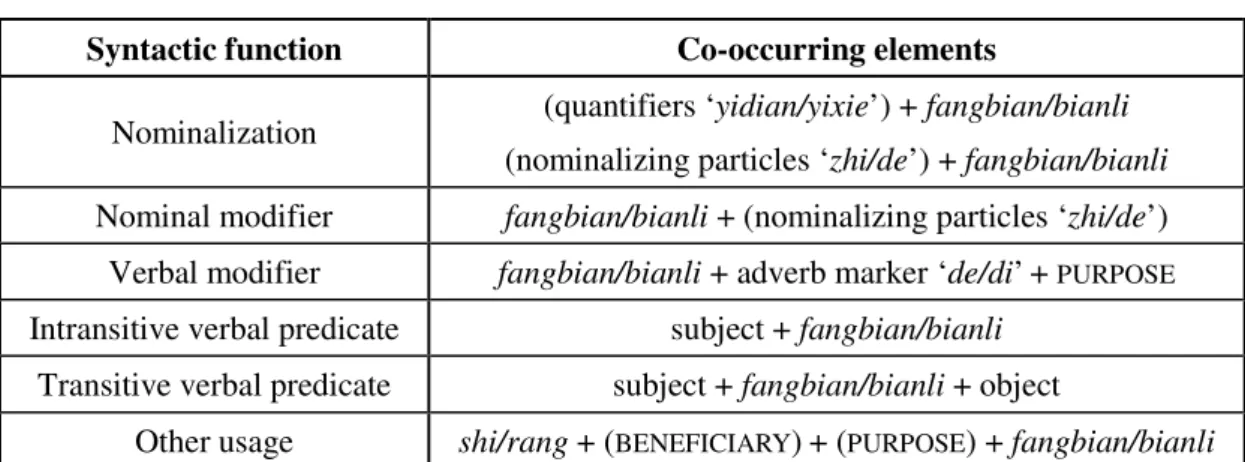
(8) TABLE OF CONTENTS Acknowledgements. i. Table of Contents. ii. List of Tables. iv. Chinese Abstract. v. English Abstract. vii. 1 Introduction. 1. 1.1 Studies on near-synonyms. 1. 1.2 The dictionary view of fangbian and bianli. 2. 1.3 Research questions. 5. 政 治 大. 立. 1.4 The data of this study. 7. ‧ 國. 學. 2 Literature Review. 8. Nat. 17. er. io. 3.1 The CONVENIENCE frame and fangbian/bianli. al. 14. sit. 3 The Conceptual Structures of Fangbian and Bianli. ‧. 2.2 The theoretical framework of Frame Semantics. y. 2.1 Chief et al. (2000) on fangbian and bianli. v ni. n. 3.1.1 The frame elements of the CONVENIENCE frame. Ch. U i e h n c g 3.1.3 Response to Chief et al. (2000) 3.1.2 One frame, two perspectives. 8. 3.2 The INCONVENIENCE frame and fangbian/bianli. 17 17 23 31 39. 3.2.1 The frame elements of the INCONVENIENCE frame. 39. 3.2.2 Why the INCONVENIENCE frame. 44. 3.3 Recapitulations. 49. 4 The Syntactic Functions of Fangbian and Bianli 4.1 The syntactic behaviors of fangbian and bianli. 51 51. 4.1.1 Nominalization. 52. 4.1.2 Nominal modifier. 61. 4.1.3 Verbal modifier. 65. ii.
(9) 4.1.4 Intransitive verbal predicate. 70. 4.1.5 Transitive verbal predicate. 79. 4.1.6 Other usage. 85. 4.2 The distribution of syntactic functions of fangbian and bianli. 90. 4.3 Recapitulations. 92. 5 Conclusion. 94. 5.1 Summary of the findings. 94. 5.2 Implications for future research. 97. References. 立. 99. 政 治 大. ‧. ‧ 國. 學. n. er. io. sit. y. Nat. al. Ch. engchi. iii. i n U. v.
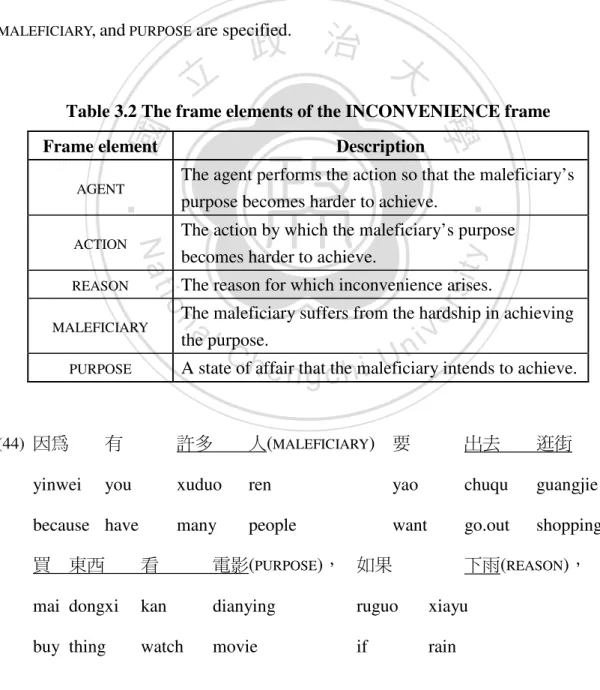
(10) LIST OF TABLES Table 2.1. Distributional differences in terms of syntactic function (Chief et al. 2000). 8. Table 3.1. The frame elements of the CONVENIENCE frame. 18. Table 3.2. The frame elements of the INCONVENIENCE frame. 40. Table 3.3. The corresponding frame elements between the frames of CONVENIENCE and INCONVENIENCE. 45. Table 4.1. The syntactic functions of fangbian and bianli. 52. Table 4.2. Participant roles profiled with the function of nominalization in the CONVENIENCE frame. io. al. v i n Participant roles C profiled with the function of intransitive verbal hengchi U predicate in the CONVENIENCE frame n. Table 4.10. y. Nat. Table 4.9. 65. Participant roles profiled with the function of verbal modifier in the INCONVENIENCE frame. Table 4.8. 64. Participant roles profiled with the function of verbal modifier in the CONVENIENCE frame. Table 4.7. 62. ‧. in the INCONVENIENCE frame Table 4.6. 59. Participant roles profiled with the function of nominal modifier. sit. Table 4.5. 學. in the CONVENIENCE frame. er. Table 4.4. 政 治 大 in the INCONVENIENCE frame 立 Participant roles profiled with the function of nominal modifier. Participant roles profiled with the function of nominalization. ‧ 國. Table 4.3. 55. 66. 71. Participant roles profiled with the function of intransitive verbal predicate in the INCONVENIENCE frame. 77. The distribution of the syntactic functions of fangbian and bianli. 90. iv.
(11) 國 立 政 治 大 學 研 究 所 碩 士 論 文 摘 要 研究所別: 語言學研究所 論文名稱: 漢語(不)方便/便利框架語意的凸顯類型研究 指導教授: 張郇慧 研究生: 林柏仲 論文提要內容: 共一冊,分五章. 本論文旨在探討近義詞的相關議題,特別是要檢視其背後的概念結構與表層. 政 治 大 異做深入並有系統地分析,並期以此解釋他們在語法層次上不同的表現。 立. 的語法功能。透過「方便」與「便利」的研究,本文就這對近義詞在語意上的差. ‧ 國. 學. 以框架語意學(Frame Semantics)為理論架構,本研究發現近義詞「方便」與 「便利」會引導出「方便框架」(CONVENIENCE frame)與「不方便框架」. ‧. (INCONVENIENCE frame),而這兩個語意框架雖有相對應的框架成分(frame. sit. y. Nat. element),實質上卻是引發出不同的概念型態。近一步說明這對近義詞在語意上. al. er. io. 的差別, 「方便」與「便利」對於他們所涉入的複雜事件(complex event)持不同的. v. n. 觀點: 「方便」主要是專注在結果次事件(result-subevent)並採受恩者(BENEFICIARY). Ch. engchi. i n U. 的觀點;而「便利」則較專注在原因次事件(cause-subevent)並採動作者/施恩者 (AGENT/BENEFACTOR)的觀點。此外,由於「方便」與「便利」具備了正面、值得 嚮往的特質,這也解釋了何以「方便框架」比「不方便框架」有更高程度的目的 性(intentionality)。 為檢視近義詞在概念上的差異是否會反映於在他們的語法表現上,本研究闡 明了「方便」與「便利」的語法功能及其使用分布的情況、以及參與角色(participant role)的凸顯類型(profiling pattern)。結果顯示「方便」與「便利」主要有五種語法 功能,即名詞化、修飾名詞、修飾動詞、不及物動詞謂語、及物動詞謂語,最常 使用的語法功能為名詞化與動詞謂語(包含及物與不及物)。此五種語法功能皆會. v.
(12) 突顯某些參與角色,但主要都是突顯了「目的」(PURPOSE)與「手段」(MEANS); 而其他參與角色也會在不同語法功能的使用中被突顯,並且這些突顯類型皆可由 「方便」與「便利」在概念上的差異來做解釋。 總結來說,本論文闡釋了近義詞「方便」與「便利」在概念上不同的偏好會 導致他們在語法上有不同的表現;此外, 「方便」與「便利」在參與角色的凸顯 類型上亦不相同,這說明了, 「方便」與「便利」是屬於不同的構式(construction)。 最後,本論文也再次確認了詞彙背後的語意概念會決定其語法的表現。. 立. 政 治 大. ‧. ‧ 國. 學. n. er. io. sit. y. Nat. al. Ch. engchi. vi. i n U. v.
(13) ABSTRACT. The purpose of this thesis is to approach the issue of near-synonyms via the examination of their respective underlying conceptual structures and surface syntactic functions. Specifically, the present study aims to furnish a fine-grained and systematic analysis of the semantic differences between the near-synonymous pair fangbian and bianli that shall better explain their differential syntactic behaviors. Based on the theoretical framework of Frame Semantics, this study found that the conceptual structures of fangbian and bianli are associated with the frames of. 政 治 大. CONVENIENCE and INCONVENIENCE. While pertaining to a corresponding set of. 立. frame elements, the two frames actually prompt distinct conceptualizations. Precisely,. ‧ 國. 學. fangbian and bianli differ in their perspectivization of the complex event involved: fangbian focuses on the result-subevent and takes the BENEFICIARY’s perspective. ‧. whereas bianli on the cause-subevent and takes the AGENT/BENEFACTOR’s perspective.. y. Nat. sit. In addition, the fact that convenience is desirable and thus typically intended also. n. al. er. io. explains the stronger intentionality involved in the CONVENIENCE frame than in the INCONVENIENCE frame.. Ch. engchi. i n U. v. To investigate whether conceptual differences between the near-synonyms would be manifested in their syntactic behaviors, this thesis further elucidated the syntactic functions and their distribution of fangbian and bianli as well as the profiling of the participant roles in each syntactic function. In particular, five main syntactic functions of fangbian and bianli were identified: nominalization, nominal modifier, verbal modifier, intransitive verbal predicate and transitive verbal predicate; each serves to profile distinct participant roles, mostly PURPOSE or MEANS. Moreover, the profiling of other participant roles can be accounted for by the perspectival distinction between the near-synonymous pair. Finally, the distribution of syntactic functions of vii.
(14) fangbian and bianli demonstrated that the usage of the near-synonyms as verbal predicate and nominalization is the most dominant categories. To conclude, this thesis has shown that the conceptual preferences of fangbian and bianli in terms of their perspectivization lead to their different syntactic behaviors. Moreover, the near-synonymous pair also differs in their profiling of the participant roles; in other words, they display distinct profiling patterns and therefore pertain to different constructions. Finally, it still holds for the present study that the semantics of a word drives its syntactic behaviors.. 立. 政 治 大. ‧. ‧ 國. 學. n. er. io. sit. y. Nat. al. Ch. engchi. viii. i n U. v.
(15) Chapter 1 Introduction. This chapter first provides the background information concerning the study on the issue of near-synonyms. Then the traditional view on the near-synonymous pair of fangbian and bianli is examined to see how lexicographers describe the lexical relationship between fangbian and bianli in the dictionary. Following are the research questions mainly concerning the similarities and differences in terms of the semantics. 政 治 大. and syntax of the near-synonyms. Lastly, it is addressed how the data are collected.. 立. 1.1 Studies on near-synonyms. ‧ 國. 學. Much of the study on near-synonyms (Chang et al. 2000; Liu 1997; Tsai et al.. ‧. 1998, 1999) has been concerned about the distinct semantic features that would tell. sit. y. Nat. them apart and predict syntactic behaviors. For instance, in the discussion of gaoxing. io. er. (高興) ‘happy’ and kuaile (快樂) ‘glad’ (Tsai et al. 1998), two distinct semantic features [effect] and [control] are proposed. The feature [effect] tells why gaoxing can. al. n. v i n sentential-final kuaile cannot. The other C hparticle le (了) while engchi U. co-occur with the. feature [control] accounts for the propositional object of gaoxing that kuaile prohibits. As cited in Liu (2002) discussing the verbs of doubt huaiyi and cai, “… the behavior of a verb, particularly with respect to the expression and interpretation of its arguments, is to a large extent determined by its meaning” (Levin, 1993:1). While this perspective has served as a rationale in many studies of near-synonyms, the so-called distinct features do not always hold in real usage. In their discussion of tall, Dirven and Taylor (1988:393) assigned the adjective tall the semantic feature [+human] and stated that humans are “obligatorily described as tall, never as high.” Nevertheless, in Taylor’s (2002) revisiting analysis of high and tall, it is reported that in the LOB 1.
(16) corpus (the Lancaster-Oslo-Bergen Corpus), two examples of high are applied to humans. Moreover, Taylor proposed that “the distribution of the English adjectives can be insightfully analyzed in terms of the co-extension relation, with high designating the dominant vantage, tall the recessive vantage (ibid., p.263).” This passage could be paraphrased as high being a common term and tall a peripheral one with both of them indicating roughly the same situations. High describes a wider range of entities than tall since high is much more an objective and dominant term while tall is more subjective and highly correlated with human beings. In other words,. 政 治 大 perspectives, or vantages as termed by Taylor. This distinction in perspectivization for 立. high and tall differ not in their argument types (human or non-human) but in their. high vs. tall provides another theoretical dimension in dealing the issues of the. ‧ 國. 學. near-synonyms. The insight of perspectivization will be further illuminated under the. ‧. framework of Frame Semantics as will be introduced in Chapter 2.. er. io. sit. y. Nat. 1.2 The dictionary view of fangbian and bianli. Traditional dictionaries also record the meanings of fangbian and bianli. In the. al. n. v i n Dictionary C h ( 重 編 國 語 辭 典U) (1982) engchi. Recompiled Mandarin. by the Ministry of. Education in Taiwan, the definitions of fangbian and bianli are as follows.. 便利 1. 順適,方便,如「手足便利,耳目聰明。」 (史記.范雎傳) 2. (佛學)佛家稱大小便為便利。. Bianli 1. Easy, fangbian ‘convenient’. Used as in “hands and feet are bianli (functioning well); ears and eyes are smart and bright”. 2. (Buddhism) The Buddhist calls the excrement and urine bianli ‘excrement and urine’. 2.
(17) 方便 1. 便利,如「馬路開通之後,行車方便多了。」 2. 便利於人的事,如「請您行個方便,幫幫忙吧!」. Fangbian 1. Bianli ‘convenient’. Used as in “as the road is open for use, traveling by car is much more fangbian ‘easy’”. 2. Things that are bianli ‘convenient’ for people. Used as in “please, would you give fangbian ‘benefit’ and do a favor.”. 治 政 They occur in each other’s entry as the defining key大 words. As for dictionaries on 立 near-synonyms, fangbian and bianli are also identified as a pair in the Synonym. It is noticeable that fangbian and bianli are defining each other in a circular manner.. ‧ 國. 學. Dictionary (近義詞應用詞典) (1997), their semantic differences are described as. ‧. follows.. y. Nat. sit. 辨析:“方便”著重於指沒有阻攔,沒有困難,如交通方便,手頭不方便,. n. al. er. io. 它的運用範圍比“便利”廣;它還指“適宜”,如在辦公地方說[話]不方便。. v. “便利”著重於不費勁,使人不感到困難,如交通便利,附近有學校,上. Ch. 學便利,增添公共汽車,便利群眾。. engchi. i n U. Differentiation between the near-synonyms: Fangbian focuses on the lack of barriers or difficulties such as in “transportation is fangbian ‘easy’; finance is not fangbian ‘functioning well’”. Fangbian applies to a wider scope of linguistic environments than bianli. Fangbian also means ‘proper’. For example, it is not fangbian ‘suitable’ to talk in the office. Bianli puts the emphasis on the property ‘effortless’ that people do not feel the hardships such as in “transportation is bianli ‘easy’; there is a school nearby, attending school is bianli ‘easy’; more buses will bianli ‘benefit’ the public.”. 3.
(18) As a matter of fact, the semantic differences given above between fangbian and bianli are still confusing that both lexical units mainly connote the lack of difficulties; the descriptions of the distinction between the near-synonyms do not really help distinguish fangbian and bianli but only add the extra meaning ‘appropriate’ of fangbian. In contrast, other dictionaries on the near-synonyms attempt to approach fangbian and bianli via describing the differences at the level of language use. Although the semantic differences are not articulated, the differences in usage for fangbian and bianli are specified, as in The Commercial Press Guide to Chinese. 政 治 大. Synonyms (商務館學漢語近義詞詞典) (2009).. 立. 同:都表示做事情或行動很順利,不麻煩。作謂語和賓語時,經常可以. ‧ 國. 學. 互換,“便利”多用於書面語,“方便”用於書面語、口語…. ‧. Similarities: Both words mean that things or actions are going smoothly without troubles. When they serve as predicates or objects, fangbian and. y. Nat. al. er. io. while fangbian in both written and spoken contexts….. sit. bianli are often interchangeable. Bianli is more often used in written contexts. n. v i n Ch 異:“便利”一般只用於因為某些情況或機構的出現或變化(如商場新開 engchi U. 張、銀行延長服務時間等),而使做某件事情(如購物、辦理各種銀行業務 等)變得容易了;“方便”表示使人不感到麻煩、費勁,使用範圍要比“便利”. 廣…. Differences: Bianli in general only applies to situations where a change occurs in some conditions or institutions (such as a market zone opening, the bank delaying the closing time and etc) so that doing something gets easier (such as shopping, doing the bank-relevant affairs and etc). Fangbian means that people do feel untroubled or effortless and it can be used in a wider range of contexts than bianli….. 4.
(19) In brief, these dictionary descriptions provide preliminary observations with regard to the similarities and differences between fangbian and bianli; moreover, they serve as evidence that fangbian and bianli are truly treated as a pair of near-synonyms in the traditional view of the lexicographers.. 1.3 Research questions The purpose of this thesis is to approach the issue of near-synonyms via the examination of the conceptual structure and language use. Based on the previous. 政 治 大 near-synonyms should arise from the conceptual differences of fangbian and bianli. 立 study by Chief et al. (2000), the observation of different syntactic behaviors of the. While it has been assumed that the semantics of a word drives its syntactic behaviors,. ‧ 國. 學. the profiling account proposed by Chief et al. (ibid.) does not explain well some. ‧. syntactic patterns of fangbian and bianli as will be elucidated in Chapter 2. As a. sit. y. Nat. consequence, the present study aims to furnish a fine-grained and systematic analysis. io. er. of the conceptual structure of fangbian and bianli that shall better explain their various syntactic behaviors.. al. n. v i n C h structure of fangbian The analysis of the conceptual and bianli is based on the engchi U. theoretical framework of Frame Semantics. A frame is a conceptual system that. provides the knowledge schema against which the pertinent lexemes are understood. In other words, to know the meaning of a lexical item is to have an access to the frame that it evokes. In the words of Frame Semantics, the purpose of the conceptual analysis of the near-synonyms is to scrutinize the frames and frame elements that fangbian and bianli possess. Moreover, given the frames and frame elements, fangbian and bianli may focus on different portions of the knowledge schema. In the present study, the reason why we deal with the conceptual structure of fangbian and bianli prior to their syntactic behaviors is two-fold. On the one hand, it is assumed as 5.
(20) in the previous literature (Chang et al. 2000; Liu 1997; Tsai et al. 1998, 1999) as well as the present study that semantics drives syntax. On the other hand, the clarification of the conceptual structure actually facilitates the analysis and description of the syntactic behaviors of fangbian and bianli. Accordingly, the questions to be addressed in the present study are presented as in the following.. 1. What are the frames that fangbian and bianli evoke? What are the frame elements involved in these frames?. 政 治 大 intentionality? How do they differ in their conceptual preferences toward the 立. 2. What are the conceptual differences between fangbian and bianli in terms of. events involved?. ‧ 國. 學. 3. What are the syntactic functions of fangbian and bianli and their distributions in. ‧. the corpus data?. sit. y. Nat. 4. What are the differences between fangbian and bianli in terms of the profiling of. io. er. the participant roles for each syntactic function?. al. n. v i n Questions 1-2 are mainlyCrelated to the semantic h e n g c h i U similarities and differences. between fangbian and bianli under the framework of Frame Semantics, which will be dealt with in Chapter 3. The conceptual analysis will not only further justify the lexical status of fangbian and bianli as a pair of near-synonyms but also spells out the subtle differences only unconsciously understood by language users. The conceptual analysis also lays the foundation for further exploration on the syntactic functions and behaviors of fangbian and bianli as questions 3-4 emphasize. The similarities and differences in language use of fangbian and bianli will be discussed in Chapter 4. The similarities and differences in syntactic behaviors are expected to correspond to the conceptual similarities and difference of fangbian and bianli. 6.
(21) 1.4 The data of this study To address the questions afore-mentioned, the data from the Academia Sinica Balanced Corpus of Modern Chinese (Sinica Corpus) (Version 4.0) are gathered, which contains about five million words.1 Sinica Corpus provides a general overview of the Chinese language in contemporary use as the variety of sources of the data may suggest. The key words fangbian and bianli are searched under default conditions without any imposed restrictions. With the repeated tokens excluded, there are 590 tokens for fangbian and 171 tokens for bianli in total. Note that exemplars drawn. 政 治 大 the complement to the Sinica Corpus in addressing the points in question. Their 立. from other sources (such as from the United Daily News or the Liberty Times) serve as. sources will be presented with the data.. ‧. ‧ 國. 學. n. er. io. sit. y. Nat. al. 1. Ch. engchi. i n U. v. The Sinica Corpus can be accessed at: http://dbo.sinica.edu.tw/SinicaCorpus/. 7.
(22) Chapter 2 Literature Review. In this chapter, we are going to review Chief et al. (2000) in section 2.1, an article specifically deals with the near-synonyms fangbian and bianli. It is argued by Chief et al. (ibid.) that the distinctive semantic features account for the distributional differences between fangbian and bianli. However, as will be shown, the proposed account by Chief et al. (ibid.) is faced with problems in argumentation as well as. 政 治 大 the theoretical framework of Frame Semantics is reviewed. It is adopted in this study 立 explaining the distributional differences between fangbian and bianli. In section 2.2,. to give a fine-grained analysis of the conceptual structures of fangbian and bianli.. ‧. ‧ 國. 學. 2.1 Chief et al. (2000) on fangbian and bianli. sit. y. Nat. In their study of the near-synonymous pair fangbian and bianli, Chief et al. (ibid.). io. er. utilize a usage-based approach in an attempt to extract the distinct semantic features that would determine the relevant syntactic behaviors. The Sinica Corpus (version 2.0). al. n. v i n is adopted and generates 445 C tokens for fangbian and h e n g c h i U 125 tokens for bianli.. 2. The. syntactic functions identified by Chief et al. (ibid.) are as illustrated in Table 2.1.. Table 2.1 Distributional differences in terms of syntactic function (Chief et al. 2000). 2. Syntactic function. Fangbian (445). Bianli (125). Verbal predicate. 77%. 44%. Nominal modifier. 7%. 34%. Verbal modifier. 5%. 0%. Nominalization. 10%. 22%. Total. 100%. 100%. The 2.0 version of the Sinica Corpus contains around 3.5 million Chinese words. The latest 4.0 version contains about 5 million words. 8.
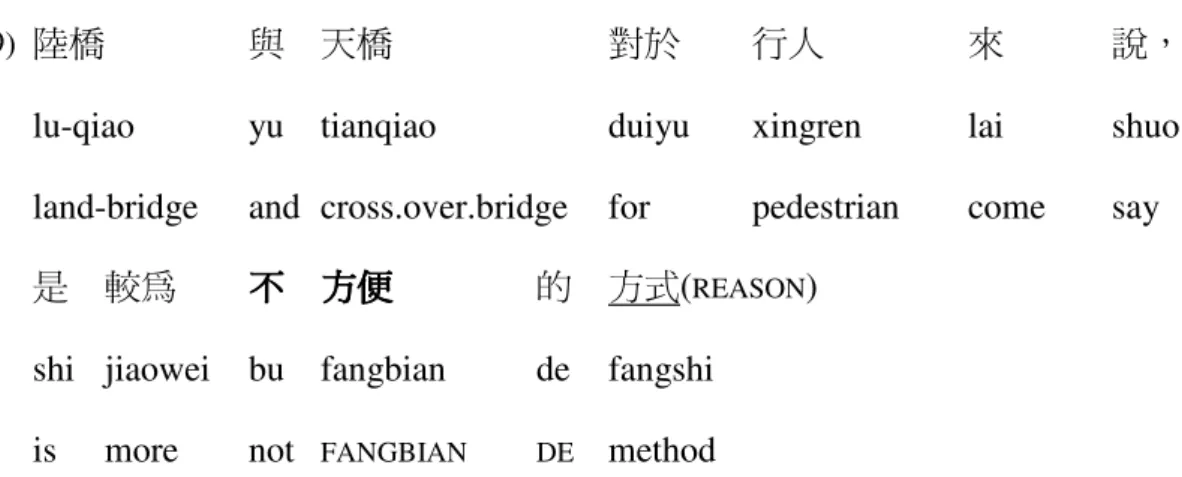
(23) The following examples (1) and (2) exemplify the syntactic function of the intransitive verb predicate for fangbian and bianli, (3) and (4) the syntactic function of transitive verbal predicate, (5) and (6) the syntactic function of nominal modifier, and (7) and (8) the syntactic function of nominalization. The syntactic function of verbal modifier is exclusive to fangbian as in (9).. (1) 停車. tingche. 方便 fangbian. 政 治 大 ‘Parking (here) is convenient.’ 立. (2) 交通. convenient. 便利. 學. jiaotong. bianli. traffic. convenient. ‧. ‧ 國. parking. io. banshichu. establish. office. y 出國. 觀光. a l fangbian minzhong i chuguo v n Ch convenient people go-abroad engchi U. n. shezhi. 民眾. 方便. sit. 辦事處. er. (3) 設置. Nat. ‘Transportation is convenient.’. guanguang visit. ‘Establishing an office makes it convenient for people to travel abroad.’ (4) 修改. 許多. 法規. 便利. 山民. 墾殖. xiugai. xuduo. fagui. bianli. shan-min. kenzhi. modify. many. rule. convenient. mountain-people. cultivate. ‘Modifying many rules makes it convenient for the aborigines to cultivate (land).’ (5) 方便. 的 資訊. fangbian. de. zixun. convenient. DE. information. ‘easily-accessible information’ 9.
(24) 的 方式. (6) 便利. bianli. de. fangshi. convenient. DE. way. ‘convenient way’ (7) 聯繫. 上. 的 方便. lianxi. shang. de. fangbian. communicate. in. DE. convenience. ‘convenience in communicating’ (8) 生活. 政 治 大. 的 便利. shenghuo de. bianli. living. convenience. 立. 學. ‧ 國. DE. ‘convenience in living’ 方便. 的 處理. 事情. keyi. geng. fangbian. de. chuli. shiqing. can. more. convenient. DE. handle. y. n. al. Ch. engchi. sit. io. ‘Users can manage things more conveniently.’. things. er. user. 更. Nat. shiyongzhe. 可以. ‧. (9) 使用者. i n U. v. As shown in Table 2.1, there are no tokens used as a verbal modifier for bianli. The usage of verbal modifier is exclusive to fangbian as in (9). In addition to bianli’s lack of the syntactic function of verbal modifier, there are two more distributional differences between fangbian and bianli as observed by Chief et al. (ibid.). One concerns the transitive-intransitive alternation of the verbal predicate — fangbian prefers the intransitive form while bianli shows no such preferences. Moreover, bianli does not allow the transitive-intransitive alternation while fangbian does, as will be delineated later. The other difference lies in negation — there are no tokens of bianli co-occurring with the negator bu in the negative context while around 10% of the 10.
(25) tokens for fangbian does. To account for these differences, Chief et al. (ibid.) proposed that fangbian profiles the whole event whereas bianli profiles the beneficial role of the event. Accordingly, the argument structure of fangbian is demonstrated as in (10) and that of bianli in (11).. GOAL (Proposition)]. (10) fangbian [AGENT. <SUBJ. XCOMP>. 政 治 大. BEN GOAL (Proposition)]. (11) bianli [AGENT. OBJ. 立XCOMP>. 學. Chief et al. (2000). ‧. ‧ 國. <SUBJ. As (10) and (11) demonstrate, fangbian has only two arguments AGENT and GOAL. y. Nat. sit. while bianli has three arguments AGENT, BEN (the beneficial role), and GOAL. The. n. al. er. io. shadowed bold text indicates the scope of the profile. This profiling account put. i n U. v. forward by Chief et al. (ibid.) attempts to account for the distributional differences. Ch. engchi. between fangbian and bianli. First, fangbian can be used as a verbal modifier whereas bianli cannot since the verb modified usually represents a proposition and only fangbian profiles this. Second, only fangbian can occur in negative contexts since fangbian profiles the proposition and its event can be negated like any proposition. Moreover, it is further claimed by Chief et al. (ibid.) the positive meaning denoted by the beneficial role of bianli also excludes negation. Moreover, that fangbian profiles the whole event whereas bianli profiles the beneficial role of the event also explains the issue of transitive-intransitive alternation of the verbal predicate for fangbian and bianli. Consider the following examples. 11.
(26) (12) 設置辦. shezhi. 事處. 方便. 民眾. 出國. 觀光. banshichu. fangbian. minzhong. chuguo. guanguang. convenient. people. go-abroad. visit. establish office. ‘Establishing an office makes it convenient for people to travel abroad.’ (13) 設置. shezhi. 辦事處,. 民眾. 出國. 觀光. 方便. banshichu. minzhong. chuguo. guanguang. fangbian. people. go-abroad. visit. convenient. establish office. ‘Establishing an office makes it convenient for people to travel abroad.’. xiugai modify. 便利 山民 政 治 大 xuduo fagui bianli shan-min 立. 許多. many. 法規. rule. convenient. mountain-people. 墾殖 kenzhi cultivate. 學. ‧ 國. (14) 修改. ‘Modifying many rules makes it convenient for the aborigines to cultivate. ‧. (land).’. 法規, 山民. 墾殖. xiugai. xuduo. fagui. shan-min. kenzhi. modify. many. mountain-people. cultivate. 便利. n. al. Ch. er. io. rule. sit. y. Nat. 許多. (15) *修改. n U engchi. iv. bianli convenient. In (12), fangbian profiles the event ‘people go abroad and visit’ and this post-verbal proposition can be inverted to the pre-verbal position as in (13). By contrast, bianli in (14) could not allow such an inversion of (15) since it profiles only the beneficial role ‘the aboriginal people’ of the event. Nonetheless, the profiling account that fangbian profiles the whole event whereas bianli profiles the beneficial role of the event is problematic in argumentation as well as dealing with the distributional differences. Regarding the argument structures of fangbian and bianli, as mentioned, fangbian holds only two arguments, i.e. AGENT and GOAL whereas bianli holds three arguments, i.e. AGENT, the 12.
(27) beneficial role, and GOAL. It is unjustified to claim there is no beneficial role in the argument structure of fangbian simply because fangbian profiles the event. As can be seen in the tokens of fangbian such as in (12), people who are traveling abroad indeed benefit from the establishment of the office and can be considered the argument of the beneficial role. Moreover, if it is true that fangbian lacks the beneficial role whereas bianli profiles the beneficial role, the example (16) stands as a counter example and poses a serious challenge.. (16) 反正. 見 隙. fanzheng jian xi. 違規. jiu. wei-gui. 立. then go-through. care. whether violate-rule. 學. 自己. 方便/?便利 方便 便利. 就. tingche. zhiyao. ziji. fangbian/bianli. jiu. parking only-if. self. convenient. then. 好 hao. fine. sit. y. Nat. 停車, 只要. ‧. ‧ 國. anyway see crack. 管他 是否 政 治 大 zuan guan ta shifou. 就 鑽,. io. violations as long as he himself feels convenient.’. n. al. Ch. engchi. er. ‘(He) forces through whatever narrow passages and does not care about. i n U. v. In (16), fangbian instead of bianli can be predicated upon the beneficial role ziji ‘self’, which is against the profiling account proposed by Chief et al. (ibid). Moreover, the profiling account does not explain all the distributional differences in a solid manner. First, concerning the syntactic function of verbal modifier where there is no token of bianli, bianli’s profiling of the beneficial role does not necessarily exclude the GOAL as a target for modification. Second, it is not explicitly explained or inferable from the argumentation how come fangbian’s profiling the whole event gives rise to its preferences for the intransitive form of the verbal predicate. Third, bianli’s profiling the beneficial role does not necessarily exclude negation; its lack of tokens in negative 13.
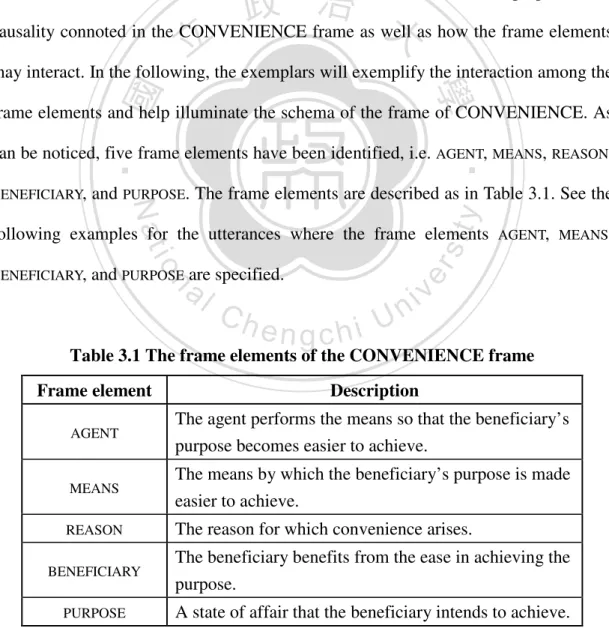
(28) utterances may arise from other causes. The profiling account proposed by Chief et al. (2000) is faced with problems discussed so far. To find out what really distinguishes the near-synonymous pair of fangbian and bianli, a fine-grained analysis of the conceptual structures of words is required. Frame semantics, as will be introduced in the following section, provides the framework of such analyses.. 2.2 The theoretical framework of Frame Semantics The analysis of the conceptual structures of fangbian and bianli in this study is. 政 治 大 1977, 1982, 1985, 1992). As Fillmore, Ruppenhofer & Baker (2004:26) put, frames 立. based on the theoretical framework of Frame Semantics proposed by Fillmore (1976,. are “schematic representations of the conceptual structures and patterns of beliefs,. ‧ 國. 學. practices, institutions, images, etc. that provide a foundation for meaning interaction. ‧. in a given speech community”. Put simply, a frame is the schematization of human. EVENT frame (Fillmore and Atkins 1992:79), the. BUYER. buys. GOODS. from the. er. io. sit. y. Nat. experiences where concepts are interrelated. For instance, as in the COMMERICAL. for an amount of. n. , or the SELLER sells GOODS to the BUYER for an aMONEY v i l n C h pays MONEY to theUSELLER for GOODS. The verbal amount of MONEY, or still the BUYER engchi. SELLER. lexemes buy, sell, and pay pertinent to the COMMERICAL EVENT frame encode the. interaction and relation among the arguments or participant roles of SELLER,. and. MONEY.. BUYER, GOODS,. In other words, frames not only give the concepts involved but. tell the story, i.e. the interaction and relation among the concepts. It is against the knowledge of frames that the relevant lexemes are understood (Croft & Cruse 2004; Petruck 1996) and this knowledge of frames serves as the “prerequisite to our ability to understand the meanings of associated words” (Fillmore 1985). The other way around is also true that the lexemes evoke frames, i.e. relevant lexemes serve as the access point to “a presupposed structure of relationships” (Fillmore 1985:224). 14.
(29) As lexemes evoke frames, they simultaneously “instantiate particular elements of such frames” (Lowe et al. 1997). For example, in evoking the COMMERCIAL EVENT frame, it is conceptually inevitable to identify the frame elements such as BUYER, GOODS, SELLER,. and. MONEY,. categories “that are needed for describing the. lexical meanings” (Fillmore and Atkins 1992:78). These categories identified “in a frame are not independent slots but are often related correlationally and conceptually… a frame’s core attributes correlate highly, often appearing together across contexts” (Barsalou 1992a:35). In other words, frame elements are the , , , and 政 治 大 will probably hold in different contexts and cases of the COMMERCIAL 立. invariant categories of a frame, i.e. the concepts of MONEY. BUYER GOODS SELLER. EVENT frame. Notice that both participant roles and frame elements refer to the. ‧ 國. 學. categories that constitute a frame. However, the term participant role suggests an. ‧. overtone of language use whereas the term frame element focuses on the concept that. sit. y. Nat. these categories pertain to.. io. er. Frame analysis is indeed useful in describing lexical meanings. For a pair of words that share the same reference, their distinction can be articulated via the. al. n. v i n C h For instance, fleshUand meat appear to denote the clarification of the pertinent frames. engchi same substance while flesh is used in the BODY frame and meat in the FOOD frame. (Croft 2009). Actually, it seems that the concepts BODY and FOOD imply different perspectives taken towards the substance referred to — flesh suggests a living creature’s viewpoint while meat suggests an eater’s perspective. This distinction in perspectivization is also manifested in other lexemes such as chicken. In the ANIMAL frame, a chicken is a living creature whereas in the FOOD frame, chicken is meat for consumption. Another example illustrated by Fillmore (1982) concerns the differences between coast and shore. While both coast and shore refer to a strip of land adjacent to the sea, they evoke different semantic frames — coast involves the LAND 15.
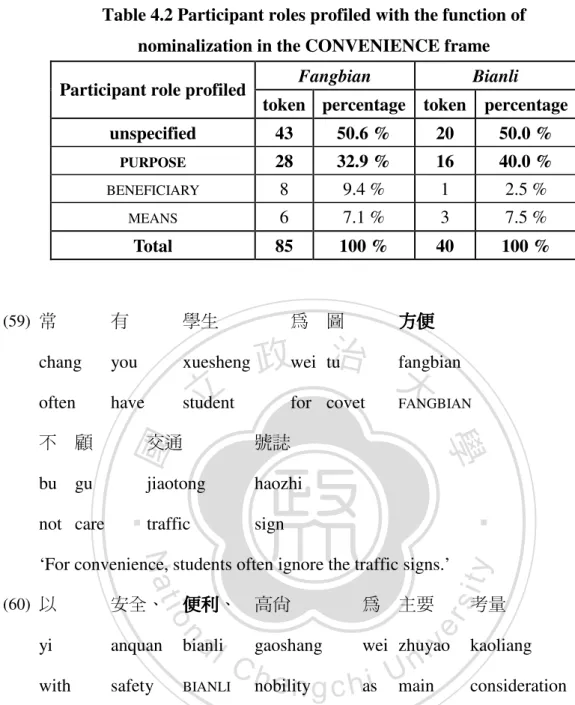
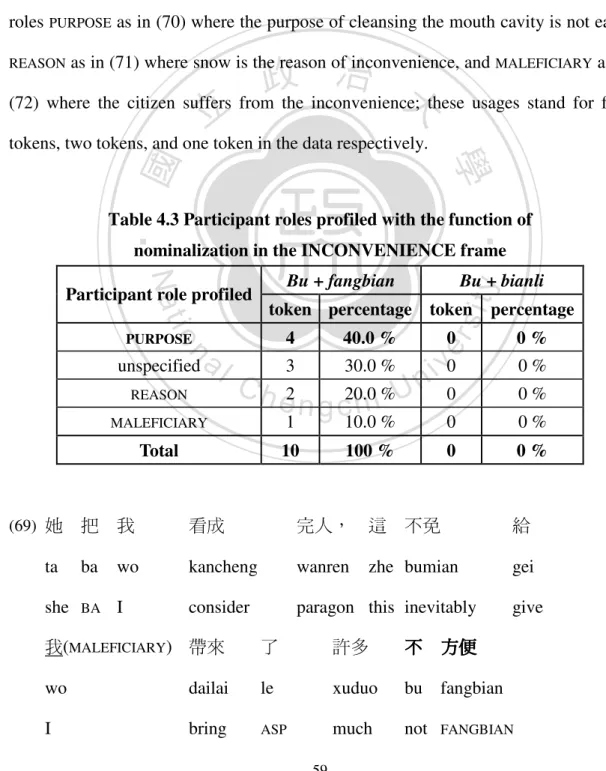
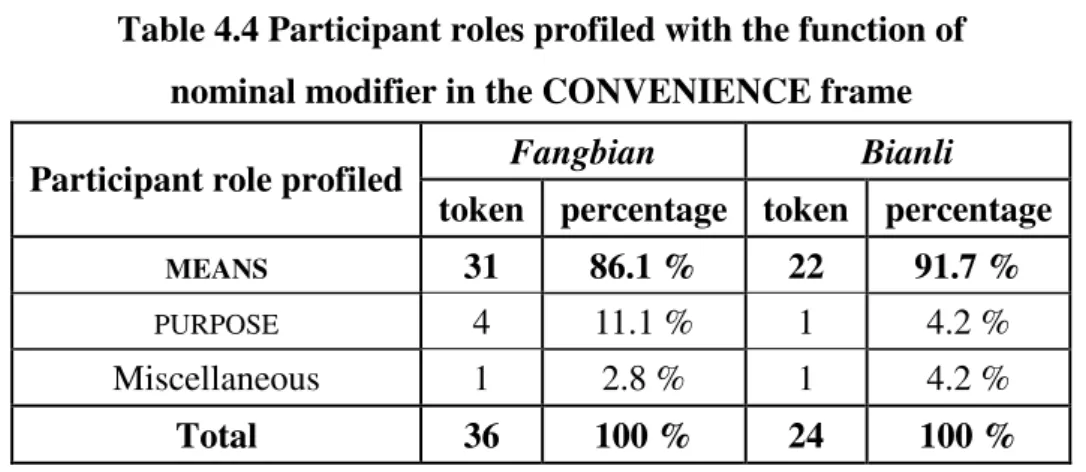
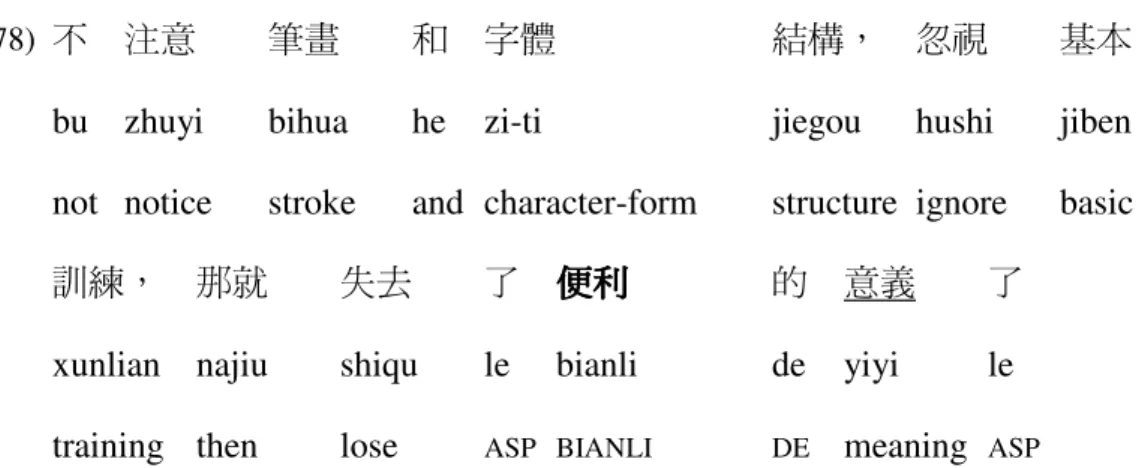
(30) DWELLING frame while shore the SEAFARING frame. To be specific, coast encodes the perspective of a person on land whereas shore encodes the perspective of a person out at sea. Therefore, a trip from coast to coast requires an over-land journey while a trip from shore to shore is taken at sea. So far, the inter-frame distinction in perspectivization has been identified in cases such as flesh vs. meat and coast vs. shore; the present study aims to investigate whether intra-frame differences in perspectivization are encoded by the near-synonymous pair of fangbian and bianli.. 立. 政 治 大. ‧. ‧ 國. 學. n. er. io. sit. y. Nat. al. Ch. engchi. 16. i n U. v.
(31) Chapter 3 The Conceptual Structures of Fangbian and Bianli. In this chapter, the conceptual structures of fangbian and bianli, i.e. the frames of CONVENIENCE and INCONVENIENCE, will be elucidated based on the framework of Frame Semantics.3 While sharing the same frames, fangbian and bianli take distinct perspectives on the events involved. This perspectival difference not only accounts for their distinct syntactic behaviors in both frames of CONVENIENCE and. 政 治 大 explanation for the linguistic phenomena discussed in Chief et al. (2000). 立. 學. 3.1 The CONVENIENCE frame and fangbian/bianli 3.1.1 The frame elements of the CONVENIENCE frame. ‧. ‧ 國. INCONVENIENCE, but also provides a more systematic and cognitively motivated. sit. y. Nat. The near-synonymous pair under investigation, fangbian and bianli, literally. io. er. ‘convenient’, is pertinent to the frame of CONVENIENCE, which, in essence, involves the idea of a condition conducive to a purpose. This condition may be. al. n. v i n C hsomeone’s act. TheUframe of CONVENIENCE can conducive in nature or result from engchi be defined as follows.. The frame of CONVENIENCE refers to a scene where a condition is conducive to the achievement of a PURPOSE. This condition may be brought about by some MEANS or be inherently conducive as a REASON. The MEANS is typically employed by an BENEFICIARY to. AGENT. to cause the least difficulty for a. achieve the PURPOSE. In other scenarios, the REASON simply. states the inherent condition where it is easier for the. BENEFICIARY. to. achieve the PURPOSE. 3. In the present study, both “CONVENIENCE” and “INCONVENIENCE” refer to the relevant world knowledge, not individual lexical items. 17.
(32) Based on the above description, the frame of CONVENIENCE can be envisaged as a complex event composed of two subevents, i.e. the cause-subevent and the result-subevent. The cause-subevent includes two scenarios — the. AGENT’s. employing the MEANS or the REASON alone can both serve as the cause of convenience. Nonetheless, as the analysis unfolds, the the. REASON. and hence the. MEANS. MEANS. connotes stronger intentionality than. entails stronger causation than the. REASON.. other side, the result-subevent is composed of the scenario where the. On the. PURPOSE. gets. easier to achieve for the BENEFICIARY.. 政 治 大 causality connoted in the CONVENIENCE frame as well as how the frame elements 立. The identification of the cause-subevent and result-subevent pinpoints the. may interact. In the following, the exemplars will exemplify the interaction among the. ‧ 國. 學. frame elements and help illuminate the schema of the frame of CONVENIENCE. As. and PURPOSE. The frame elements are described as in Table 3.1. See the. sit. y. Nat. BENEFICIARY,. ‧. can be noticed, five frame elements have been identified, i.e. AGENT, MEANS, REASON,. io. and PURPOSE are specified.. al. n. BENEFICIARY,. Ch. AGENT, MEANS,. er. following examples for the utterances where the frame elements. engchi. i n U. v. Table 3.1 The frame elements of the CONVENIENCE frame Frame element. Description. AGENT. The agent performs the means so that the beneficiary’s purpose becomes easier to achieve.. MEANS. The means by which the beneficiary’s purpose is made easier to achieve.. REASON. The reason for which convenience arises.. BENEFICIARY. The beneficiary benefits from the ease in achieving the purpose.. PURPOSE. A state of affair that the beneficiary intends to achieve.. 18.
(33) (17) 媽媽(AGENT) 在. 學校. 附近. 租 了 房子(MEANS). mama. zai xuexiao fujin. zu. le. fangzi. mother. at. rent. ASP. house. 方便4. 他(BENEFICIARY). 上學(PURPOSE). fangbian. ta. shangxue. FANGBIAN. he. go.to.shcool. school. nearby. ‘His mother rented a house near the school to make it convenient for him to go to school.’ (18) 該. 圖書室(AGENT). gai tushushi. 資料庫,. yi. ziliaoku. 立. also plan. establish one investigation database. 學. ‧ 國. the library. 建立 一 調查 政 治 大 ni jianli yi diaocha. 亦 擬. 調查. 研究. 之 原始. souji. suoyou. diaocha. yanjiu. zhi yuanshi ziliao. gather. all. investigation research. or. result. y. original data. huo jieguo. 相關. sit. 各. yi. ge xiangguan a l bianli v i n Ch to BIANLI each relevant engchi U. n. report. 以 便利. io. baogao. DE. 或 結果. er. 報告(MEANS),. 資料. ‧. 所有. Nat. 蒐集. 研究者(BENEFICIARY). 參考、. 使用(PURPOSE). yanjiuzhe. cankao. shiyong. researcher. reference. use. ‘The library is also planning to establish a research database to gather all the first-hand data or reports of the results of the research so that it is convenient for the researchers to refer to and use.’. 4. To avoid confusion regarding the interpretation of fangbian and bianli as they may serve different. syntactic functions in different contexts, FANGBIAN and BIANLI are used as the glossing in all the examples in this thesis. 19.
(34) In (17), the mother, the. AGENT,. rented a house near the school, which is the. MEANS. that creates the condition where the purpose of going to school requires less effort for the son, the BENEFICIARY. Generally, the AGENT is a person, but it is not necessarily so. An institutional entity can also metonymically represent the agents who work in such institution and thus exercise volitional power. In (18), the library, an institutional AGENT,. manages to make it easier for the researchers, the BENEFICIARY, to reach the. PURPOSE. of accessing first-hand data by means of establishing a database. The above. illustrates how the. PURPOSE. becomes easier for the. under a condition. BENEFICIARY. 政 治 大 In contrast, the less common frame element 立. brought about by a given MEANS employed by an AGENT.. describes the condition. REASON. where achieving the. requires fewer efforts from the. PURPOSE. BENEFICIARY.. This. ‧ 國. 學. inherent condition is conducive to the PURPOSE without any extra intentional endeavor.. three. CL. y. fandian. al. n. jia. Ch. restaurant. 都. 正好/*有意. dou. zhenghao/youyi. sit. io. san. 飯店. er. 家. Nat. (19) 三. ‧. Here are two examples.. n U engchi all. iv. wei. just.right/intentionally. 在 王子. 街. 上(REASON),. 不論. 購物、. zai wangzi. jie. shang. bulun. gouwu. in. street. up. no.matter. shopping. prince. 位. locate. 觀光、. 休閒(PURPOSE). 都. 挺. 方便. 的. guanguang. xiuxian. dou. ting. fangbian. de. sightseeing. leisure. all. quite. FANGBIAN. DE. ‘All three restaurants are right located on the prince street, and it is quite easy for shopping, sightseeing, and leisure.’. [constructed example]. 20.
(35) 鎮. 位居. 全. 縣. 地理. madou. zhen. weiju. quan. xian. dili. Madou. town. locate. whole. county. geography. 中心(REASON),. 有. 交通(PURPOSE). 便利. Zhongxin. you. jiaotong. bianli. center. have. transportation. BIANLI. (20) 麻豆. 等. 先天. 優勢. deng. xiantian. youshi. [UDN 2008]5. 政 治 大 ‘The town Madou is located in the geographical center of the whole county and 立 so.on. inherent. advantage. inherently possesses the advantage of convenient transportation and so on.’. ‧ 國. 學 ‧. In (19), as the restaurants are right located in some sort of a landmark, it is easy to go. sit. y. Nat. shopping and sightseeing as well as enjoy the leisure time. Note that the adverb. io. er. zhenghao ‘just right’ pinpoints the absence of intention for the frame element REASON. This is further supported by the implausible reading rendered by another verb youyi. al. n. v i n ‘intentionally’ in the context. C In (20), the town is endowed with the advantage of hengchi U. convenient transportation for the simple reason that it is situated in the geographical center of the county. These examples demonstrate that the frame element. REASON. features an inherently favorable condition without any volitional strength involved. From the above examples, it can be noticed that the. MEANS. connotes stronger intentionality than the. which features the absence of. REASON,. employed by the. intention. Accordingly, serving as the cause of convenience, the. MEANS. AGENT. entails. stronger causation than the REASON. While five frame elements have been identified in the CONVENIENCE frame, 5. The examples of the United Daily News (UDN) are drawn from the database at http://udndata.com/. 21.
(36) conceptually, they are not equally salient to language users. On the one hand, the AGENT. alone does not make the. PURPOSE. easier to achieve. Rather, it is the. MEANS. employed by the AGENT that leads to a desirable condition. Likewise, the BENEFICIARY does not benefit straight from the AGENT, MEANS, or REASON, but from the desired and easier-to-achieve. PURPOSE.. Therefore,. MEANS, REASON,. and. PURPOSE. are regarded as. core frame elements since they are more directly connected to the CONVENIENCE frame, while. AGENT. and. BENEFICIARY. level, the frame elements. are non-core frame elements. At the discourse. MEANS, REASON,. and. PURPOSE. are realized in language use. which are more or less identifiable in the 政 治 大 context. Consider the following examples. 立 AGENT. and. 便利. 作物. gaishan turang. tiaojian,. bianli. zuowu. improve soil. condition. BIANLI. crop. and. sit. 種植(PURPOSE). a l zhongzhi v i n Ch planting engchi U. n. cultivation. DE. er. io. yu. de. y. 與. zaipei. 的. ‧. 栽培. Nat. 條件(MEANS),. (21) 改善. 土壤. BENEFICIARY,. 學. ‧ 國. more often than. ‘The improvement of the soil condition facilitates the cultivation and planting of crops.’ 用. 電腦(MEANS). 管理(PURPOSE). tushuguan. yong. diannao. guanli. library. use. computer. manage. 真是. 太 方便. 了. zhenshi. tai. fangbian. le. indeed. too. FANGBIAN. ASP. (22) 圖書館. ‘It is so convenient to manage the library with the computer.’ 22.
(37) In (21), it can be inferred from the context that the. AGENT. should be the farmer who. wants to improve the soil so that it is easier for himself, the BENEFICIARY, to cultivate and plant the crops. In (22), the AGENTs are probably those in charge of the library affairs and themselves as well as those who use the service of the library can be the BENEFICIARY. of the efficient work rendered by the computer. In brief, the core frame. elements MEANS,. REASON,. and. PURPOSE. are key to the concept of CONVENIENCE. and the interaction between them alone is sufficient for the comprehension of the CONVENIENCE frame. By contrast, the non-core frame elements BENEFICIARY. AGENT. and. 政 治 大. are concomitant or dependent participants naturally derived from this. interaction.. 學. ‧ 國. 立. 3.1.2 One frame, two perspectives. PURPOSE. must be intended,. sit. y. Nat. since bianli permits only direct causation where the. ‧. As the analysis unfolds, bianli connotes stronger intentionality than fangbian. PURPOSE. is not. io. er. whereas fangbian allows both direct and indirect causation, i.e. the. always intended. While both fangbian and bianli evoke the CONVENIENCE frame,. al. n. v i n C hsubevents of the complex they are perspectivized on different CONVENIENCE event. engchi U To be specific, fangbian highlights the result-subevent and perceives the event of CONVENIENCE from the perspective of the attainment of the instead of the. PURPOSE;. REASON. BENEFICIARY. benefiting from the. bianli emphasizes the cause-subevent of the. MEANS. since bianli involves direct causation and connotes stronger. intentionality. As a result, bianli perceives the event of CONVENIENCE from the perspective of the. AGENT’s. employing the MEANS. Note the frame element. REASON,. featuring the lack of the involvement of intention, is more frequently profiled in the tokens of fangbian, such as in the subjects of the syntactic function of intransitive verbal predicate as will be shown in section 4.1.4. This may be explained by that 23.
(38) fangbian allows various degrees of intentionality connoted in the cause-subevent, which is to be delineated. In the CONVENIENCE frame, the convenience arises. However, the the. AGENT. MEANS. is exercised by some. the. AGENT’s. employing the. so that. of fangbian is not necessarily exercised by. MEANS. with the intention to make it easier for the. PURPOSE —. AGENT. MEANS. BENEFICIARY. to achieve its. may only accidentally lead to such a. result. Put differently, for fangbian, indirect causation is allowed and the unintended whereas brought about by the. AGENT.. PURPOSE. is. Consider the following example. 政 治 大. where fangbian expresses indirect causation.. 立. dazhuan ti-zong. ban. qi-ren-zhi. college. hold. seven-man-rule. athletic-association. 東吳(BENEFICIARY). fangbian. dongwu. io. Soochow. qiu-sai ball-game. FANGBIAN. 組隊. 參加(PURPOSE). zu-dui. canjia. recruit-team. participate. n. al. Ch. engchi. er. accidentally. sit. y. Nat. ganghao. 方便. 球賽(MEANS). ‧. ‧ 國. 七人制. 剛好. 體總(AGENT). 學. 辦. (23) 大專. i n U. v. ‘The collegiate athletic association is holding the seven-player rugby game, which happens to facilitate the team recruitment and participation in the game for Soochow University.’. In (23), the collegiate athletic association, the AGENT, happened to hold a seven-player rugby game (instead of the traditional fifteen-player one), a. MEANS. that accidentally. gives rise to the condition where fewer players than expected are required for the 24.
(39) PURPOSE. of participation in the game for Soochow University, the. this example, the. AGENT. does not bear the. BENEFICIARY.. BENEFICIARY’s PURPOSE. In. in mind; this is. evidenced by the adverb ganghao ‘accidentally’. In other words, holding a seven-player game only indirectly or inadvertently cause convenience. This example illustrates that fangbian perceives the event from the BENEFICIARY’s perspective and is more concerned about the result-subevent — the event, as in (23), is encoded by fangbian simply because the BENEFICIARY Soochow University achieves the PURPOSE of participation in the game more easily regardless of the intention of the collegiate. 政 治 大 as to what counts as a valid cause-subevent, i.e. besides being a direct cause, the 立. athletic association’s holding the game. Specifically, fangbian allows more flexibility. of fangbian can also be an indirect cause. This is also why bianli connotes. 學. ‧ 國. MEANS. stronger intentionality than fangbian since fangbian holds both direct and indirect. ‧. causation whereas bianli only direct causation, as will be exemplified later.. sit. y. Nat. As mentioned, fangbian highlights the result-subevent of the complex. io. er. CONVENIENCE event and allows more flexibility as to what counts as a valid cause-subevent; events will be encoded by fangbian as long as the result of. al. n. v i n convenience arises. As a matterC of fact, it is found that h e n g c h i Ueven an ill intention connoted. in the cause-subevent can be accommodated by fangbian. See the following examples.. (24) 所謂. suowei. 殺人. 利器(MEANS),. 會. 給 兇手(BENEFICIARY). sha-ren. liqi. hui. gei xiongshou. would. give murderer. so.called kill-man instrument 帶來. 很多. 的 方便. dai-lai. henduo. de. fangbian. bring-come. much. DE. FANGBIAN. 25.
(40) ‘The so-called man-killing instrument would bring much convenience for the murderer.’ (25) 甚至. 架空. 現有. 方便. 法律(MEANS)、. shenzhi jiakong. xianyou falu. fangbian. even. current. FANGBIAN. nullify. law. 財團(BENEFICIARY). 炒地皮(PURPOSE) [UDN 2008]. caituan. chaodepi. conglomerate. land.speculation. 政 治 大. ‘(They) even nullify the law to facilitate land-speculation for the conglomerate.’. 立. In (24), the killing instrument made it easier for the killer to fulfill the immoral. ‧ 國. 學. purpose of killing. In (25), the law is nullified to facilitate land speculation for the BENEFICIARY’s. standpoint is taken and the. ‧. conglomerate. In both cases, the. sit. y. Nat. result-subevent is the concern; the ill intention involved in bringing about. io. AGENT’s. employing the. al. MEANS. er. convenience is tolerated. In other words, for fangbian, it does not bother whether the violates the conventional norms of our society if and. n. v i n C heffortlessly and someone only if the PURPOSE is fulfilled more benefits from that. engchi U In contrast, bianli takes the. AGENT’s. perspective and holds only direct causation. where the PURPOSE must be intended. Unlike the MEANS of fangbian, which can serve as either a direct or indirect cause, the MEANS of bianli leads to convenience only in a direct manner, i.e. the PURPOSE. MEANS. of bianli is always employed for the. — the intention of the. BENEFICIARY. Consequently, BENEFACTOR,. AGENT. BENEFICIARY’s. is oriented toward the benefits of the. the AGENT of bianli is portrayed as an AGENT as well as a. which functions like the AGENT in the cause-subevent. Furthermore, the. intention or goodwill of the. AGENT/BENEFACTOR. is an important property for the. events encoded by bianli. Consider the following pair of examples. 26.
(41) 體總(AGENT). 辦. 七人制. 球賽(MEANS). dazhuan ti-zong. ban. qi-ren-zhi. qiu-sai. college. hold. seven-man-rule. ball-game. (26) ?大專. athletic-association. 剛好. 便利. 東吳(BENEFICIARY). ganghao. bianli. dongwu. accidentally. BIANLI. Soochow. 組隊. 參加(PURPOSE). zu-dui. canjia. recruit-team. participate. 政辦 治七人制 大. 體總(AGENT). 立. athletic-association. BIANLI. seven-man-rule. 東吳(BENEFICIARY). ball-game. dongwu. y. to. hold. sit. bianli. qiu-sai. Nat. yi. qi-ren-zhi. ‧. 以 便利. ban. 學. college. ‧ 國. dazhuan ti-zong. 球賽(MEANS). Soochow. io. 組隊. 參加(PURPOSE). zu-dui. canjia. recruit-team. participate. n. al. Ch. er. (27) 大專. [constructed example]. [constructed example]. engchi. i n U. v. ‘The collegiate athletic association is holding the seven-player rugby game in order to facilitate the team recruitment and participation of Soochow University.’. In (26), bianli is not appropriate since its. MEANS. tends to be exercised purposely, i.e.. the AGENT manages to hold the game for the BENEFICIARY, while the adverb ganghao defies this interpretation. On the contrary, as in (27), bianli fits with the context since the. MEANS. is indeed exercised out of the goodwill of the. examples demonstrate that bianli takes the 27. AGENT/BENEFACTOR.. BENEFACTOR’s. These. perspective and is more.
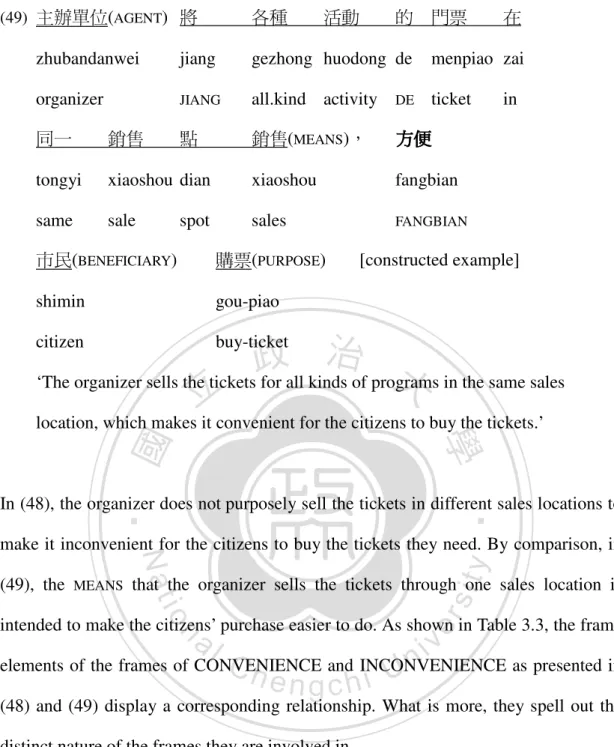
(42) concerned with the cause-subevent since the accidentally resultant convenience is not allowed by bianli but only convenience derived out of goodwill is. This demonstrates why bianli connotes stronger intentionality than fangbian since only direct causation is allowed and the PURPOSE must be intended. As such, it is not surprising that most of the authoritative AGENTs co-occur with bianli as in the following example.. (28) 屏東. 縣. 政府. 消防局(AGENT). 為 便利. pingdong. xian. zhengfu. xiaofangju. wei bianli. Pingdong. county. government. fire-bureau to 治 政 大 啟用 ) 報案( ),. 瘖啞. 人士(BENEFICIARY. yinya. renshi. mute. people. 人士. 簡訊. 報案. 系統」(MEANS). renshi. jianxun. baoan. xitong. people. short.message emergency.report. ‧ 國. PURPOSE. baoan. 「瘖啞. qiyong. yinya. 學. 立. BIANLI. mute. report.emergency put.to.use. Nat. io. er. system. sit. y. ‧. [UDN 2008]. ‘In order to make it convenient for the mute citizens to report emergency, the fire. al. n. v i n C h government startsUto operate the bureau of the Pingdong County engchi mute-citizen-emergency-reporting SMS system.’. In (28), in order to make it convenient for mute citizens to report emergency, the fire bureau sets up an SMS system for this specific purpose. The frequent co-occurrence of authoritative. AGENTs. with bianli can be attributed to the fact that the authoritative. institutions are supposed to bear the goodwill or responsibility to give benefits as well as the appropriate. MEANS. to do so. The. AGENT/BENEFACTOR. perspective taken by. bianli meets the semantic requirement of the authoritative AGENTs.. 28.
(43) To brief the discussion so far, it has been shown that fangbian allows both direct and indirect causation and bianli permits only direct causation. Therefore, bianli connotes stronger intentionality than fangbian. Moreover, in the frame of CONVENIENCE, fangbian is perspectivized on the result-subevent of the complex CONVENIENCE event and takes the perspectivized. on. the. AGENT/BENEFACTOR’s. BENEFICIARY’s. cause-subevent viewpoint.. BENEFACTOR-BENEFICIARY. In. of. viewpoint. In contrast, bianli is. the. the. MEANS. following. and. takes. examples,. the the. perspectival distinction proposed in this study also. 政 治 大. accounts for the distributional differences between fangbian and bianli in other usages.. ‧ 國. 對 我們. 學. 方便/?便利 方便 便利. zhe dui women. shuang-fang. dou. fangbian/bianli. this for us. both-side. both. FANGBIAN/BIANLI. io. y 管他 是否 a l 就 鑽, v i n jiuC zuan ta shifou h e n g c hguan i U. n. 見 隙. er. ‘This is convenient for both of us.’ (30) 反正. fanzheng jian xi anyway see crack. ‧. 都. Nat. 雙方(BENEFICIARY). sit. (29) 這. 立. then go.through. care. 違規 wei-gui. whether violate-rule. 停車(MEANS),. 只要. 自己(BENEFICIARY). 方便/?便利 方便 便利. tingche. zhiyao. ziji. fangbian/bianli. parking. only.if. self. FANGBIAN/BIANLI. 就. 好. jiu. hao. then. fine. ‘(He) forces through whatever narrow passages and does not care about violations as long as he himself feels convenient.’ 29.
(44) (31) 女生. 宿舍. 的 刷卡. 方式(MEANS) 也 在 測試. nüsheng sushi. de. shua-ka. fangshi. ye. girl. DE. swipe-card. method. also in. dormitory. zai ceshi test. 階段, 讓. 我們(BENEFICIARY). 非常. jieduan. rang. women. feichang de. fangbian/bianli. stage. make. us. very. FANGBIAN/BIANLI. 的 方便/?便利 方便 便利. DE. ‘The card-reading method for the girl dormitory is also under test, which makes it very convenient for us (to get in and out).’. In (29), bianli sounds less. 立. 政 治 大 natural than fangbian in this. near-synonyms co-occur with the. BENEFICIARY women. utterance where the. ‘us’. In (30), fangbian but not. ‧ 國. 學. bianli can be predicated upon the BENEFICIARY ziji ‘self’. These are attributable to the perspective assumed by bianli and the BENEFICIARY’s one by fangbian.. ‧. BENEFACTOR’s. sit. y. Nat. In (31), the verb rang ‘make’ takes the BENEFICIARY women ‘us’ as the object and. io. er. only fangbian can be the complement in this syntactic pattern, which literally means ‘make us convenient.’ It is noteworthy the English counterpart of fangbian and bianli. n. al. convenient does not occur. v i n inCthe ‘make somebody h e n g c h i U convenient’. fangbian shows an affinity with the compound nouns with the. MEANS. BENEFICIARY. and. PURPOSE,. that is made or arranged by the. following example for lexical compounding.. (32) 便利/?方便 便利 方便. 商店/貼/袋(MEANS). bianli/fangbian. shangdian/tie/dai. FANGBIAN/BIANLI. store/sticker/bag. [UDN 2008]. ‘convenience store/ convenience sticker/ convenience bag’. 30. pattern. While bianli forms. AGENT.. See the.
(45) In (32), the store, sticker, and bag are all. MEANS. created by some. AGENT.. The. convenience store is opened by the entrepreneur for the purpose of effortless shopping, the convenience sticker is produced for easy note-taking, and the convenience bag is designed for the efficient shipping of items. These. MEANS. shangdian ‘store’, tie. ‘sticker’, and dai ‘bag’ form compounds with bianli since it bears the connotation of goodwill and permits only direct causation — a good quality of goods or service is therefore implied.. 政 治 大 Via the re-examination of two distributional differences between fangbian and 立. 3.1.3 Response to Chief et al. (2000). bianli discussed in Chief et al. (2000), the present study will demonstrate that the. ‧ 國. 學. perspectival preference provides a more systematic and consistent analysis that. ‧. unveils the underlying conceptual difference between fangbian and bianli. For the. sit. y. Nat. purpose of clear argument, the terminology needs clarification. In Chief et al. (ibid.),. io. er. it is proposed that there are two arguments for fangbian, i.e. agent and goal; three for bianli, i.e. agent, the beneficial role and goal. These arguments, i.e. agent, the. al. n. v i n C h and roughly equalUto the frame elements AGENT, beneficial role and goal, are parallel engchi BENEFICIARY, and PURPOSE. respectively in this study.. The first issue, as discussed in Chief et al. (ibid.), is that bianli does not allow the transitive-intransitive alternation since, as argued by them, it profiles the BENEFICIARY instead of the whole event consisting of the. BENEFICIARY. Consider the following pair of examples.. (33) 備有. 各種. 產品(MEANS). beiyou. gezhong chanpin. prepare. all.kind product. 便利 bianli BIANLI. 31. together with the. PURPOSE..
(46) 消費者(BENEFICIARY). 選購(PURPOSE). xiaofeizhe. xuangou. consumer. choose.and.buy. [Chief et al. 2000]. ‘With all kinds of products, it is convenient of the consumers to shop around and make their purchase.’ 產品(MEANS),. 各種. (34) ?備有. beiyou. gezhong chanpin. have. all.kind product 便利 [Chief et al. 2000] 政 治 大 bianli xuangou 立. 消費者(BENEFICIARY) xiaofeizhe consumer. 選購(PURPOSE). choose.and.buy. BIANLI. ‧ 國. 學 ‧. As in (33), the event ‘consumers shop around and make their purchase’ consists. sit. y. Nat. of the BENEFICIARY and the PURPOSE and functions as the object of bianli. As claimed by Chief et al. (ibid.), this event cannot be inverted into the subject position as in (34). er. io. this proposed a l BENEFICIARY of the event. Nevertheless, v i distribution. Accordingly, n C hthe following syntactic account by them does not explain engchi U. n. since bianli profiles only the. only the. BENEFICIARY. can be inverted into the subject position in the usage of bianli. instead of fangbian since it is profiled by bianli instead of fangbian. Nonetheless, this is not true as in the following example.. (35) 備有. 各種. 產品(MEANS),. 消費者(BENEFICIARY). beiyou. gezhong chanpin. xiaofeizhe. have. all.kind product. consumer. 32.
(47) 方便/?便利 方便 便利. 選購(PURPOSE). fangbian/bianli. xuangou. FANGBIAN/BIANLI. choose.and.buy. [constructed example]. ‘With all kinds of products, it is convenient of the consumers to shop around and make their purchase.’. In (35), the BENEFICIARY can be inverted and stand alone in the subject position only in the usage of fangbian while bianli is not natural in the syntactic pattern. This is. 政 治 大 On the other hand, fangbian is claimed to lack the argument 立. totally against Chief et al.’s (ibid.) proposal that BENEFICIARY is profiled by bianli. BENEFICIARY. and. profile the whole event. Therefore, fangbian allows the transitive-intransitive. ‧ 國. 學. alternation. See the following pair of examples presented by Chief et al. (ibid.).. 民眾(BENEFICIARY). banshichu. fangbian. minzhong. FANGBIAN. people. sit. y. al. er. office. n. 出國. 方便. io. establish. ‧. shezhi. 辦事處(MEANS). Nat. (36) 設置. 觀光(PURPOSE C )h [Chief et al.] U n i engchi. chuguo. guanguang. go.abroad. visit. v. ‘Establishing an office makes it convenient for people to travel abroad.’ (37) 設置. 辦事處(MEANS), 民眾(BENEFICIARY). shezhi. banshichu. minzhong. establish. office. people. 出國. 觀光(PURPOSE). 方便. chuguo. guanguang. fangbian. go.abroad. visit. FANGBIAN. 33. [Chief et al. 2000].
(48) ‘Establishing an office makes it convenient for people to travel abroad.’. In (36), the event ‘people travel abroad’ can be inverted into the subject position as in (37). Nonetheless, Chief et al.’s (ibid.) discussion of fangbian does not seem justified that fangbian profiles the whole event and lacks the argument. BENEFICIARY. simply. because fangbian allows the movement of the whole event into the subject position. It should be also taken into account that fangbian allows the movement of the BENEFICIARY. into the subject position as in (35).. 政 治 大 and that fangbian profiles only the event have encountered the counter 立. So far, the analyses provided by Chief et al. (ibid.) that bianli profiles the BENEFICIARY. evidence from the example (35). In the following, it is to be demonstrated that the. ‧ 國. 學. BENEFACTOR-BENEFICIARY. account of the present study provides a more consistent. ‧. explanation. Recall that for bianli, the event cannot be inverted into the subject. io. event for bianli in Chief et al. (ibid.).. n. al. (38) ?備有. 各種. Ch. engchi. gezhong chanpin. have. all.kind product. i n U. 消費者(BENEFICIARY). 選購(PURPOSE). 便利. xiaofeizhe. xuangou. bianli. consumer. choose.and.buy. BIANLI. 各種. instead of the. v. 產品(MEANS),. beiyou. (39) 備有. BENEFICIARY. er. example serves as the evidence of the profiling of the. sit. y. Nat. position of the intransitive usage as in the example (34), repeated as (38) here. This. 產品(MEANS),. beiyou. gezhong chanpin. have. all.kind product 34. [Chief et al. 2000].
(49) 選購(PURPOSE). 便利. xuangou. bianli. choose.and.buy. BIANLI. [constructed example]. ‘With all kinds of products, it is convenient of the consumers to shop around and make their purchase.’. In (38), it seems that bianli cannot be predicated upon the event consisting of the and the PURPOSE. Nevertheless, as in (39), bianli can indeed function as. BENEFICIARY. the predicate of the element. 政 治 大 is responsible for the failure of predication in (38). It is to be 立. PURPOSE.. BENEFICIARY. To bring the pieces together, it turns out the frame. predicated upon the event that accommodates the. as in (38) for bianli. perspective while being predicated only upon the. for bianli as in (39) does not really conflict with the. BENEFACTOR’s. insight. sit. y. Nat. PURPOSE. BENEFACTOR’s. BENEFICIARY. ‧. goes against the. 學. ‧ 國. clarified further why the example (38) is not natural but the example (39) is – being. io. data from the Sinica Corpus –. al. BENEFICIARY. er. since BENEFACTOR entails the idea of PURPOSE. As a matter of fact, this is true for the does not occur in the subject position in. n. v i n the intransitive usage of bianli.C To be specific, bianliU h e n g c h i is never found to be predicated upon BENEFICIARY.. For fangbian, the event can be inverted into the subject position of the intransitive usage as in the example (37), repeated as (40) here. This example serves as the evidence for the profiling of the event and the lack of the argument BENEFICIARY. for fangbian in Chief et al. (ibid.).. (40) 設置. 辦事處(MEANS), 民眾(BENEFICIARY). shezhi. banshichu. minzhong. establish. office. people 35.
(50) 出國. 觀光(PURPOSE). 方便. chuguo. guanguang. fangbian. go.abroad. visit. FANGBIAN. [Chief et al. 2000]. ‘Establishing an office makes it convenient for people to travel abroad.’. In (40), given the. BENEFICIARY’s. viewpoint assumed by fangbian, as proposed in the. present study, it is reasonable that fangbian gets predicated upon the event containing the. BENEFICIARY. as well as the. PURPOSE.. The data from the Sinica Corpus also. 政 治 大. support this; there are cases of the intransitive usage where the realized in the subject position.. 立. BENEFACTOR-BENEFICIARY. account also holds for the counter. example as in (35), repeated here as (41).. ‧. 產品(MEANS),. 消費者(BENEFICIARY). y. gezhong chanpin. xiaofeizhe. have. all.kind product. io. consumer. fangbian/bianli FANGBIAN/BIANLI. n. 方便/?便利 方便 便利. al. sit. beiyou. er. 各種. Nat. (41) 備有. alone is. 學. ‧ 國. Moreover, the. BENEFICIARY. v i n 選購( example] C hPURPOSE) [constructed engchi U xuangou. choose.and.buy. In (41), fangbian can be predicated upon the BENEFICIARY whereas bianli cannot; this is attributable to the explanation that fangbian takes the viewpoint of the BENEFICIARY while bianli takes that of the. BENEFACTOR.. To sum up the first issue, the profiling. account by Chief et al. (ibid.) that bianli profiles only BENEFICIARY and fangbian the event is challenged since the argument. BENEFICIARY. can indeed stand alone in the. subject position and get predicated upon by fangbian instead of bianli, as displayed in 36.
(51) the counter example (35). Also, the. BENEFACTOR-BENEFICIARY. account also explains. the counter example and proves more systematic and consistent in addressing the transitive-intransitive alternation for fangbian and bianli. The other issue is concerned with bianli/fangbian used as a verbal modifier. From the data of Chief et al. (ibid.), there is no token used as a verbal modifier for bianli. It is claimed that bianli does not modify a verb since it does not profile the event, which contains the verbal phrase. In contrast, 5% of the tokens for fangbian function as a verbal modifier since it profiles the event. However, from our data to be. 政 治 大 modifier as opposed to 7.3% for fangbian. See the following examples. 立 人文. 資訊. 網(MEANS), 使得. jianli. renwen. zixun. wang. shide. build. human.arts. information. net. enable. io. 的. 方便. a l geng fangbian de i v C h FANGBIAN UDEn more engchi. n. minzhong. 更. er. 民眾(BENEFICIARY). citizen. sit. y. Nat. together. 建立. ‧. gongtong. 學. (42) 共同. ‧ 國. presented in Table 4.5 in section 4.2, 2.3% of the tokens for bianli function as a verbal. 享受. 人文. xiangshou. renwen. fuwu. enjoy. human.arts. service. 服務(PURPOSE). ‘Building together the information net of liberal arts would enable the citizens to enjoy the service more easily.’ (43) 這. 市民(BENEFICIARY). 可 從. 市內. 的. zhe shi. shimin. ke. shinei. de. this makes. citizen. can from. within.city. DE. 使. 37. cong.
(52) 八. 個. 區域. 非常. 便利. 的. ba. ge. quyu. fei1chang. bianli. de. eight. CL. area. very. BIANLI. DE. 到達. 市中心(PURPOSE). daoda. shizhongxin. arrive. downtown. ‘This enables the citizens to arrive downtown from the eight areas within the city very conveniently.’. 政 治 大 The token of bianli used as a verbal modifier as in (43) defies the claim by Chief et al. 立. 學. ‧ 國. (ibid.) that bianli does not profile the event. However, it is true that fangbian occurs. more frequently than bianli in the usage of verbal modifier. In (42) and (43), it is. PURPOSE.. As a result, the reason why fangbian seems to be a better. sit. y. Nat. modify the. ‧. found that the verbal modifier is used for the resultant situation given its function to. io. er. candidate than bianli in the usage of verbal modifier lies in fangbian’s preference for the result of the event whereas bianli’s for the cause.. al. n. v i n To summarize section 3.1,C to grasp the frame of U h e n g c h i CONVENIENCE is to grasp its. core frame elements – the. MEANS,. employed by the. bring about a favorable condition for the. AGENT,. BENEFICIARY. as well as the. to achieve the. Furthermore, with the CONVENIENCE frame envisaged as an event, the employing the BENEFICIARY. MEANS. REASON. PURPOSE. AGENT’s. can be construed as the cause of the event while that the. benefits from the easier-to-achieve. PURPOSE. can be construed as the. result of the event. Under the same frame, bianli displays only direct causation and is more concerned with the cause of the event with the AGENT/BENEFACTOR’s perspective. In contrast, fangbian accommodates both direct and indirect causation and is more concerned with the result of the event with the 38. BENEFICIARY’s. perspective. The.
數據
+7

相關文件
語文運用 留意錯別字 辨識近義詞及詞語 的感情色彩 認識成語
巴斯德研究院(法語:Institut Pasteur)總部位於巴黎,是法國的一個私立的非營利研究 中心,致力於生物學、微生物學、疾病和疫苗的相關研究,其創建者巴斯德於
In summary, the main contribution of this paper is to propose a new family of smoothing functions and correct a flaw in an algorithm studied in [13], which is used to guarantee
加強「漢語拼音」教學,使學生掌握
使用人工智慧框架基礎(Frame-based)的架構,這些努力的結果即為後來發展的 DAML+OIL。DAML+OIL 是 Web Resource 中可以用來描述語意的 Ontology 標 記語言,它是以 W3C
探究式學習 教學類型 (四種類型).. 探究式學習教學 常見模式及實施 Stripling Model of Inquiry.. Connect, wonder, investigate, express
•三個月大的嬰兒在聆聽母語時,大腦激發 的區域和成人聆聽語言時被激發的區域一
在 在 運用新修訂自評框架後 運用新修訂自評框架後 的意見
