* 通訊作者。E-mail: [email protected]
藿香薊不同密度對玉米生育及產量之影響
侯金日
1* 郭華仁
2 1國立嘉義大學農藝學系
2國立台灣大學農藝學系
摘要
本研究主要目的為探討紫、白花藿香薊不同密度下對玉米生育及產量之影
響,試驗結果顯示藿香薊對春、秋作玉米生育及產量影響,均隨藿香薊植株密度
增加而使玉米地上部與根乾重皆顯著減少。對秋作玉米產量而言,當紫花藿香薊
密度為每平方公尺
10 株時玉米種子產量減少 6%,但密度增加為每平方公尺 40 株
時則玉米產量減少達
25%;而秋作白花藿香薊密度每平方公尺 10 株對玉米種子產
量減少
10%,但當增加為每平方公尺 40 株則使玉米產量減少達 29%。對春作玉米
產量而言,當紫花藿香薊密度為每平方公尺
10 株時玉米種子產量減少 2%,但當
密度增加為每平方公尺
40 株時則使玉米產量減少達 16%;而春作白花藿香薊密度
為每平方公尺
10 株時玉米種子產量減少 7%,但當密度增加為每平方公尺 40 株時
則使玉米產量減少達
20%。
關鍵詞:紫花藿香薊、白花藿香薊、玉米、生長、競爭、產量
Effect of different densities of two Ageratum spp. on the
growth and yield of corn
Chen-Jin Hou
1*, Warren H. J. Kuo
21. Department of Agronomy, National Chiayi University
2. Department of Agronomy, National Taiwan University
Abstract
The main purpose of this study is to evaluate the influence of Ageratum spp.
Results of corn growth as affected by two Agercitum spp. in spring and fall
experiments showed that the higher densities of Ageratum resulted in the reductions of
shoot dry weight, root dry weight, leaf area and branch number of corn plants. In fall, 10
plants/m
2of A. houstonianum Mill. decreased the yield of corn by 6% and 40 plants/m
2of A. houstonianum Mill. decreased the yield of corn by 25%. Two densities of A.
conyzoides L., similar to A. houstonianum Mill., resulted in 10% and 29% reductions of
corn yield, respectively. However, the effect of these two Ageratum spp. on corn yield
was diminished in the spring experiment.
Key words: Ageratum houstonianum Mill., Ageratum conyzoides L., corn, growth, yield
前
言
台灣自
40 年代首在屏東地區推廣不整地栽培法以來,包括水稻、玉米、大豆、
紅豆等作物的省工栽培法均曾進行試驗研究(曾等,1984;陳和李,1984;郭等,
1984;連,1985;彭等,1985;許和朱,1991)。
不整地栽培制度或低整地之栽培制度下,雜草之危害經常是作物栽培成敗之
重點。因雜草適應力強,與栽培作物競爭養分及空間,造成作物產量之減少,而
雜草在未防除或管理下,極易擴張到造成作物經濟損失之程度(Buhler et al. 1997,
O’Donovan, 1996)。因此適當之雜草管理,對農民與生產者而言為一項重要之課題。
有關雜草與作物之競爭國內學者研究報告較少,僅
Yang (1995, 1996), Yang
and Chang (1996a)有關稗草之研究,國外則有較多之研究如 Nordby and Hartzler
(2004)、Tollenaar et al.(1994)研究禾本科玉米;Hoffman and Buhler (2002)研究高
粱;Bensch et al, (2003)、Mendalled et al. (2004)、Hartzler and Battles (2004)研究豆
科作物大豆;Aguyoh and Masiunas (2003)研究菜豆;Scott and Wilcut (2001)研究落
花生;Norris et al. (2001a, 2001b)研究蕃茄;Xue and Stougaard (2002, 2004)研究春
小麥;Grundy et al. (2004)研究洋蔥與甘藍等,這些研究指出作物與雜草之競爭導
致作物生長衰退、產量降低。
玉米為台灣重要雜糧、飼料及食用作物,目前在飼料價格高漲、全球能源短
缺下,玉米在台灣之栽培前景看好。據
2007 年台灣農業年報統計玉米栽培面積約
20,000 公頃(飼料玉米 7,361 公頃、食用玉米 12,316 公頃),未來玉米之栽培面積將
持續增加。玉米生育期間雜草之危害主要在生育初期,而紫、白花藿香薊於玉米
生育初期亦為田區重要之雜草,而至生育中、後期玉米藉由植株高度之優勢,雜
草之危害相對較少。
因此了解農田中紫、白花藿香薊不同之植株密度,對玉米生育及產量之影響,
實為推廣玉米栽培管理中低整地栽培、或一般慣行栽培時藿香薊是否防除或作為
覆蓋作物之參考依據。本研究擬以紫、白花藿香薊為材料,於玉米田區依不同密
度播種,探討兩種雜草於秋作與春作之玉米田中,對玉米生育及產量之影響,以
了解紫、白花藿香薊對玉米在不同期作間之競爭關係。
材料與方法
一、供試材料:
紫、白花藿香薊種子;玉米(台農一號)種子材料購自台中縣新社鄉農委會種苗
繁殖改良場。
二、試驗方法:
於
2005 年秋作及 2006 年春作於嘉義縣鹿草鄉農家農田,以條播方式播種玉
米,行株距為
60X30 cm,小區面積 2X5 m,除對照組外於每小區分別撒播紫花與
白花藿香薊種子,播種量每平方公尺
100 粒,計春、秋作各 30 個小區。待播種後
15 天,間苗小區之藿香薊植株為每平方公尺 10、20、30 及 40 株,各小區留苗之
植株株距依植株數而有不同之差異,對照組保持田間無草之狀態。分別以每平方
公尺
0(對照組)、10、20、30 及 40 株處理,並於生育 30、60 及 90 天取紫、白花
藿香薊及玉米植株每小區
5 株,調查藿香薊與玉米之地上部乾重、根乾重、株高;
以及藿香薊之葉面積、分株數、及玉米之穗重。待玉米植株成熟後每小區取
5 株,
調查玉米之農藝性狀,包括株高、穗位高、莖桿直徑、穗長、穗徑、穗重、每穗
種子數目、每穗種子重、脫粒率、百粒重、小區種子產量、並評估在不同之藿香
薊密度間種子產量損失之百分率。
試驗採裂區設計,以不同藿香薊(紫花與白花)為主區,不同之藿香薊密度(0(對
照無藿香薊)、10、20 及 40 株)為副區,三重複。
三、統計分析方法:
所得資料以電腦套裝軟體
SAS 進行變方分析及進行最小顯著差異測驗法(least
significant difference test),以比較處理平均值間之差異。
結果
一、紫、白花藿香薊不同種植密度對玉米與藿香薊生長之影響
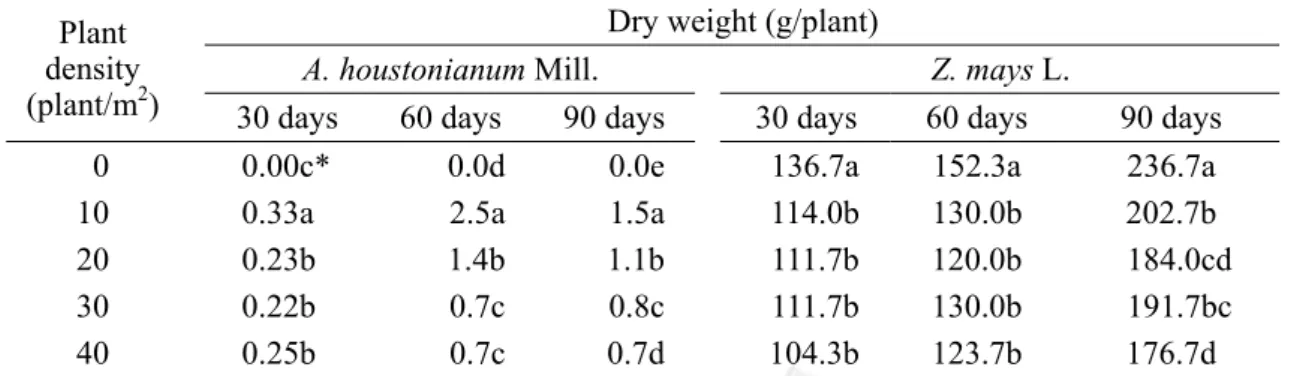
調查紫花藿香薊不同種植密度於玉米不同生育期間(30、60 及 90 天),對玉米與
紫花藿香薊地上部乾重、根部乾重、株高之影響(2005 秋作)(表 1)顯示,就地上部乾
重(表 1a)而言,對照組無紫花藿香薊存在時,玉米生育 30、60 及 90 天皆有最高之
地上部乾重,隨著紫花藿香薊密度增加玉米地上部乾重顯著減少,每平方公尺
40
株之紫花藿香薊時,玉米地上部乾重在不同生育期間
30、60、90 天皆顯著下降。而
紫花藿香薊在每平方公尺
10 株至 40 株間則無顯著差異。紫花藿香薊單株地上部乾
重也會隨植株密度增加而降低,生育初期(30 天)表現較不明顯,生育中期則差異較
大。就根部乾重(表 1b)而言,對照組無紫花藿香薊存在時,玉米生育 30、60 及 90
天皆有最高之根部乾重,隨紫花藿香薊密度增加玉米根部乾重顯著減少,每平方公
尺
30 及 40 株之紫花藿香薊時,根部乾重皆減少。而紫花藿香薊在每平方公尺 20
株至
40 株間則無顯著差異。紫花藿香薊單株根部乾重也隨植株密度增加而降低,生
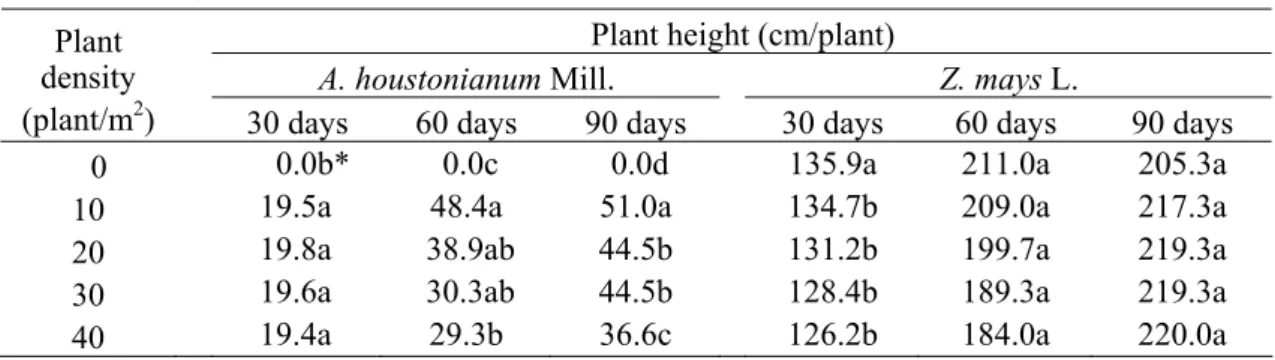
育初期(30 天)表現較不明顯,生育中期(60 及 90 天)則差異較大。就株高(表 1c)而言,
玉米於不同生育期間(30、60 及 90 天),顯示藿香薊密度增加對玉米植株高度並無影
響。
於玉米不同生育期間(30、60、90 天)白花藿香薊不同種植密度對玉米與白花藿
香薊地上部與根部乾重、葉面積、分枝數、株高之影響(2005 秋作)(表 2)顯示,玉
米生育
30、60 及 90 天之地上部乾重,均隨白花藿香薊密度增加而顯著減少,尤
其每平方公尺
40 株之白花藿香薊密度使玉米地上部乾重大量減少。而白花藿香薊
表1a. 紫花藿香薊不同種植密度對玉米與紫花藿香薊地上部乾重之影響(2005 秋作)Table 1a. Effects of different plant densities of A. houstonianum Mill. on dry matter production of corn and A. houstonianum Mill..(Fall crop, 2005)
Dry weight (g/plant)
A. houstonianum Mill. Z. mays L.
Plant density (plant/m2
) 30 days 60 days 90 days 30 days 60 days 90 days
0 0.00c* 0.0d 0.0e 136.7a 152.3a 236.7a
10 0.33a 2.5a 1.5a 114.0b 130.0b 202.7b
20 0.23b 1.4b 1.1b 111.7b 120.0b 184.0cd
30 0.22b 0.7c 0.8c 111.7b 130.0b 191.7bc
40 0.25b 0.7c 0.7d 104.3b 123.7b 176.7d
表1b. 紫花藿香薊不同種植密度對玉米與紫花藿香薊根部乾重之影響(2005 秋作)
Table 1b. Effects of different plant densities of A. houstonianum Mill. on root dry weight of corn and A. houstonianum Mill. (Fall crop, 2005)
Root dry weight (g/plant) Plant
density A. houstonianum Mill. Z. mays L.
(plant/m2) 30 days 60 days 90 days 30 days 60 days 90 days
0 0.00c* 0.00c 0.00c 14.3a 34.0a 57.3a
10 0.08a 0.48a 0.84a 12.2b 23.3b 53.3a
20 0.06b 0.26b 0.44b 9.9c 20.3b 45.0b
30 0.07ab 0.20b 0.33b 8.4c 17.0bc 41.7bc
40 0.06b 0.18b 0.33b 9.3c 15.7c 36.7c
*Means with the same letter in the same column are not significantly different at 5% level.
表
1c. 紫花霍香薊不同種植密度於玉米生育期間(30、60、90 天)對玉米與紫花霍香
薊株高之影響(2005 秋作)
Table 1c. Effects of different plant densities of A. houstonianum Mill. at growing stage(30, 60, 90 days) of corn on both plant height of corn and A. houstonianum Mill. (Fall crop, 2005)
Plant height (cm/plant)
Plant
density A. houstonianum Mill. Z. mays L.
(plant/m2)
30 days 60 days 90 days 30 days 60 days 90 days
0 0.0b* 0.0c 0.0d 135.9a 211.0a 205.3a
10 19.5a 48.4a 51.0a 134.7b 209.0a 217.3a
20 19.8a 38.9ab 44.5b 131.2b 199.7a 219.3a
30 19.6a 30.3ab 44.5b 128.4b 189.3a 219.3a
40 19.4a 29.3b 36.6c 126.2b 184.0a 220.0a
*Means with the same letter in the same column are not significantly different at 5% level.
在每平方公尺
30 株至 40 株間,玉米地上部乾重則無顯著差異。此外,白花藿香
薊單株地上部乾重也隨本身植株密度增加而降低,生育初期(30 天)表現較不明顯,
生育中期則差異較大。就根部乾重(表 2b)而言,玉米生育 30 天則除每平方公尺 40
株之密度與對照組呈顯著外其餘均呈無顯著差異,生育
60 天、90 天時則隨白花藿
香薊密度增加而顯著減少,至每平方公尺
40 株白花藿香薊時,根部乾重在不同生
育期間
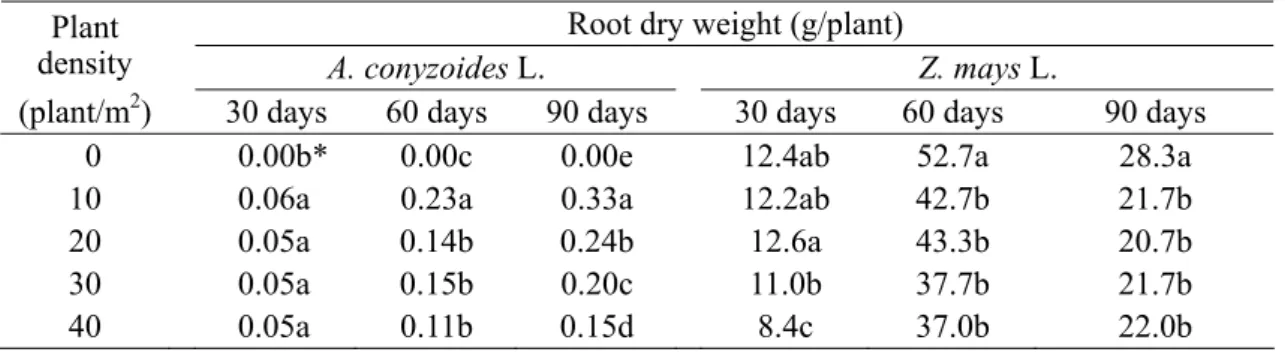
30、60、90 天皆為最少。白花藿香薊單株根部乾重則於生育 90 天處理間
差異較大,生育初期(30 天)表現較不明顯。就株高(表 2c)而言,顯示藿香薊密度增
加對玉米株高並無影響。
表2a. 白花藿香薊不同種植密度對玉米與白花藿香薊地上部乾重之影響(2005 秋作)
Table 2a. Effects of different plant densities of A. conyzoides L. on dry matter production of corn and A. conyzoides L. (Fall crop, 2005)
Dry weight (g/plant) Plant
density A. conyzoides L. Z. mays L.
(plant/m2) 30 days 60 days 90 days 30 days 60 days 90 days
0 0.00c* 0.0d 0.0e 95.7a 241.0d 148.3a
10 0.15a 1.4a 1.2a 86.7b 229.3a 125.0b
20 0.12ab 0.8b 0.8b 83.3b 214.3b 110.3b
30 0.10b 0.6bc 0.7c 72.0c 171.7bc 107.7b
40 0.10b 0.5c 0.5d 72.7c 148.3c 109.0b
*Means with the same letter in the same column are not significantly different at 5% level.
表2b. 白花藿香薊不同種植密度對玉米與白花藿香薊根部乾重之影響(2005 秋作)
Table 2b. Effects of different plant densities of A. conyzoides L. on root dry weight of corn and
A. conyzoides L. (Fall crop, 2005)
Root dry weight (g/plant) Plant
density A. conyzoides L. Z. mays L.
(plant/m2) 30 days 60 days 90 days 30 days 60 days 90 days
0 0.00b* 0.00c 0.00e 12.4ab 52.7a 28.3a
10 0.06a 0.23a 0.33a 12.2ab 42.7b 21.7b
20 0.05a 0.14b 0.24b 12.6a 43.3b 20.7b
30 0.05a 0.15b 0.20c 11.0b 37.7b 21.7b
40 0.05a 0.11b 0.15d 8.4c 37.0b 22.0b
*Means with the same letter in the same column are not significantly different at 5% level.
表2c. 白花藿香薊不同種植密度對玉米與白花藿香薊株高之影響(2005 秋作)
Table 2c. Effects of different plant densities of A. conyzoides L. on plant height of corn and A.
conyzoides L. (Fall crop, 2005)
Plant height (cm/plant) Plant
density A. conyzoides L. Z. mays L.
(plant/m2) 30 days 60 days 90 days 30 days 60 days 90 days
0 0.0d* 0.0d 0.0c 143.6a 207.0a 226.0a
10 9.7a 41.2a 36.2a 135.0a 197.0a 213.7a
20 8.2b 29.4b 30.6b 136.3a 193.3a 215.0a
30 5.2c 26.8c 29.3b 133.2a 189.3a 222.3a
40 4.5c 25.9c 27.1b 136.8a 190.0a 239.7a
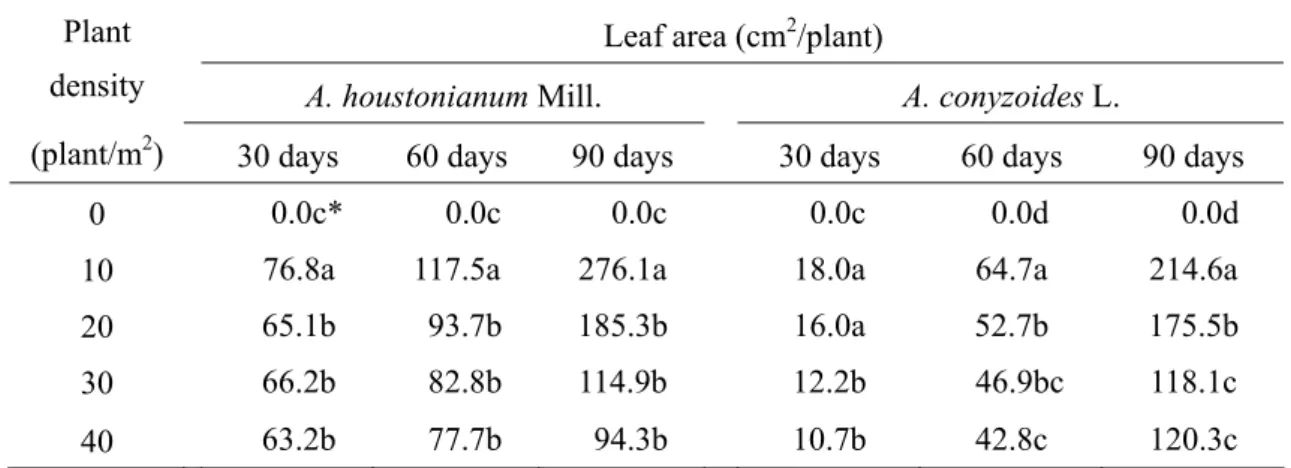
紫花與白花藿香薊不同種植密度對藿香薊葉面積之影響(2005 秋作)(表 3a)顯
示,無論是生育
30 天或生育 90 天,隨種植密度增加,單株葉面積在不同生育天
數間有減少之現象。而紫花與白花藿香薊不同種植密度對藿香薊分枝數影響(2005
秋作)(表 3b)顯示,無論是生育 30 天、60 天或 90 天,分枝數隨種植密度之增加而
減少,而生育
30 天不同紫、白花藿香薊種植密度間差異不大。
表3a. 紫花與白花藿香不同種植密度對藿香薊葉面積之影響(2005 秋作)Table 3a. Effects of different plant densities of A. Houstonian Mill. and A. conyzoides L. on the leaf area of two Ageratum spp. (Fall crop, 2005)
Leaf area (cm2/plant) Plant
density A. houstonianum Mill. A. conyzoides L.
(plant/m2) 30 days 60 days 90 days 30 days 60 days 90 days
0 0.0c* 0.0c 0.0c 0.0c 0.0d 0.0d
10 76.8a 117.5a 276.1a 18.0a 64.7a 214.6a
20 65.1b 93.7b 185.3b 16.0a 52.7b 175.5b
30 66.2b 82.8b 114.9b 12.2b 46.9bc 118.1c
40 63.2b 77.7b 94.3b 10.7b 42.8c 120.3c
*Means with the same letter in the same column are not significantly different at 5% level.
表3b. 紫花與白花藿香薊不同種植密度對藿香薊分枝數之影響(2005 秋作)
Table 3b. Effects of different plant densities of A. houstonianum Mill. and A. conyzoides L. on the branches number of two Ageratum spp. (Fall crop, 2005)
Branches (no./plant)
Plant
density A. houstonianum Mill. A. conyzoides L.
(plant/m2) 30 days 60 days 90 days 30 days 60 days 90 days
0 0.0b* 0.0c 0.0c 0.0b 0.0c 0.0c
10 7.3a 12.3a 7.7a 6.3a 10.3a 8.7a
20 6.0a 9.0b 9.0a 6.7a 7.0b 8.3a
30 6.0a 8.3b 5.0b 6.0a 7.3b 6.3b
40 5.0a 8.7b 4.0b 5.0a 7.0b 6.0b
於玉米生育期間(60 及 90 天),紫花與白花藿香薊不同種植密度對玉米果穗重
之影響(表 4)顯示,在不同種植密度之紫、白花藿香薊之競爭下,無論是生育 60
天或生育
90 天,玉米穗重皆以對照組為最多,於玉米生育 60 天紫、白花藿香薊
每平方公尺
10 株之密度並無顯著影響,而生育 90 天,兩種藿香薊於每平方公尺
種植
0-40 株間則有顯著之差異存在。
表4. 紫花與白花藿香薊不同種植密度對玉米穗重之影響(2005 秋作)Table 4. Effects of different plant densities of A. houstonianum Mill. and A. conyzoides L. on the ear weight of corn. (Fall crop, 2005)
Ear weight (g/plant) Plant
density A. houstonianum Mill. A. conyzoides L.
(plant/m2) 60 days 90 days 60 days 90 days
0 182.7a* 276.7a 202.7a 308.3a
10 149.3a 233.3b 192.0a 277.0b
20 98.3b 202.3c 166.7ab 255.0c
30 91.7b 186.0cd 125.0b 249.7c
40 80.0b 168.3d 126.7b 225.0d
*Means with the same letter in the same column are not significantly different at 5% level.
調查紫花藿香薊不同種植密度於玉米不同生育期間(30、60、90 天),對玉米
與紫花藿香薊地上部乾重、根部乾重、株高之影響(2006 春作)(表 5)顯示,就地上
部乾重(表 5a)而言,對照組無紫花藿香薊存在時,玉米生育 30、60、90 天皆有最
高之地上部乾重,隨紫花藿香薊密度增加玉米地上部乾重顯著減少,每平方公尺
40 株之紫花藿香薊時,玉米地上部乾重在不同生育期間 30、60、90 天皆顯著下降。
而紫花藿香薊在每平方公尺
20 株至 40 株間則無顯著差異。紫花藿香薊單株地上
部乾重也隨植株密度增加而降低,生育初期(30 天)表現較不明顯,生育中期則差異
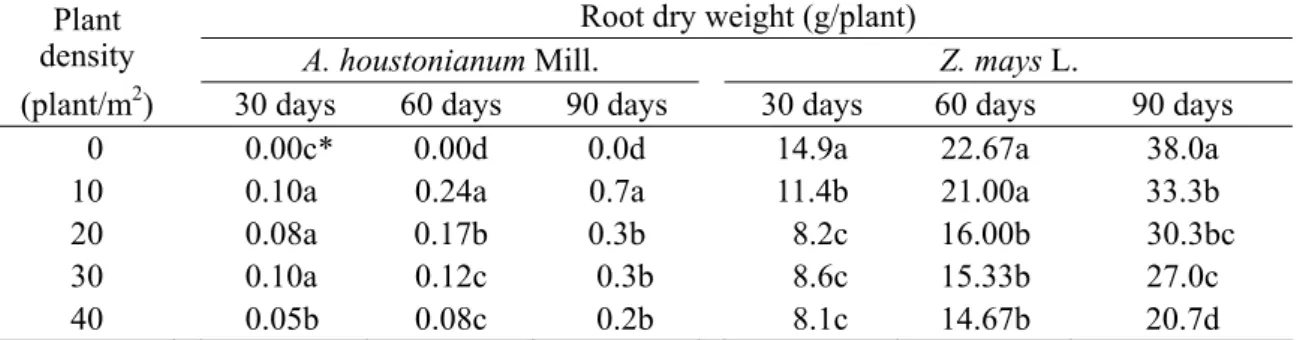
較大。就根部乾重(表 5b)而言,對照組無紫花藿香薊存在時,玉米生育 30、60、
90 天皆有最高之根部乾重,隨紫花藿香薊密度增加玉米根部乾重顯著減少,至每
平方公尺
30、40 株之紫花藿香薊時,根部乾重皆減少。而紫花藿香薊在每平方公
尺
20 株至 40 株間則無顯著之差異。紫花藿香薊單株根部乾重也隨植株密度增加
而降低,生育初期(30 天)表現較不明顯,生育中期(60、90 天)則差異較大。就株高
(表 5c)而言,玉米於生育期間 30 天對株高無顯著影響,而生育 60、90 天玉米株高
隨藿香薊植株密度增加而降低。
表5a.紫花藿香薊不同種植密度對玉米與紫花藿香薊地上部乾重之影響(2006 春作)
Table 5a. Effects of different plant densities of A. houstonianum Mill. on dry matter production of corn and A. houstonianum Mill. (Spring crop, 2006)
Dry weight (g/plant) Plant
density A. houstonianum Mill. Z. mays L.
(plant/m2) 30 days 60 days 90 days 30 days 60 days 90 days
0 0.0c* 0.0c 0.0d 88.3a 140.0a 250.7a
10 0.8a 1.1a 1.4a 69.0b 134.3a 210.3b
20 0.6b 1.0a 1.2b 66.3b 123.7b 160.0b
30 0.5b 0.8b 1.0c 56.7b 124.7b 167.7b
40 0.5b 0.7b 0.9c 51.0c 118.0b 138.7c
*Means with the same letter in the same column are not significantly different at 5% level.
表5b.紫花藿香薊不同種植密度對玉米與紫花藿香薊根部乾重之影響(2006 春作)
Table 5b. Effects of different plant densities of A. houstonianum Mill. on root dry weight of corn and A. houstonianum Mill. ( Spring crop, 2006)
Root dry weight (g/plant) Plant
density A. houstonianum Mill. Z. mays L.
(plant/m2) 30 days 60 days 90 days 30 days 60 days 90 days
0 0.00c* 0.00d 0.0d 14.9a 22.67a 38.0a
10 0.10a 0.24a 0.7a 11.4b 21.00a 33.3b
20 0.08a 0.17b 0.3b 8.2c 16.00b 30.3bc
30 0.10a 0.12c 0.3b 8.6c 15.33b 27.0c
40 0.05b 0.08c 0.2b 8.1c 14.67b 20.7d
*Means with the same letter in the same column are not significantly different at 5% level.
表5c.紫花藿香薊不同種植密度對玉米與紫花藿香薊株高之影響(2006 春作)
Table 5c. Effects of different plant densities of A. houstonianum Mill. on plant height of corn and A. houstonianum Mill. ( Spring crop, 2006)
Plant height (cm/plant) Plant
density A. houstonianum Mill. Z. mays L.
(plant/m2) 30 days 60 days 90 days 30 days 60 days 90 days
0 0.0b* 0.0d 0.0d 154.5a 262.3a 219.7a
10 23.5a 57.2a 84.3a 156.2b 257.7a 217.0a
20 21.4a 54.3ab 64.0ab 156.3b 236.7b 214.3a
30 19.2a 49.7b 55.0b 154.9b 227.3b 202.7b
40 18.4a 41.9c 50.5c 152.7b 208.7c 207.7b
於玉米不同生育期間(30、60、90 天) 白花藿香薊不同種植密度對玉米與白花
藿香薊地上部乾重、根部乾重、葉面積、分枝數、株高之影響(2006 春作)(表 6)顯
示,就地上部乾重(表 6a)而言,對照組無白花藿香薊存在時,玉米生育 30、60、
90 天皆有最高之地上部乾重,生育 30 天、60 天及 90 天隨白花藿香薊密度增加顯
著減少,至每平方公尺
40 株之白花藿香薊時,玉米地上部乾重大量減少。而白花
藿香薊在每平方公尺
30 株至 40 株間玉米地上部乾重則無顯著差異。白花藿香薊
單株地上部乾重也隨植株密度增加而降低,生育初期(30 天)表現較不明顯,生育中
期則差異較大。就根部乾重(表 6b)而言,對照組無白花藿香薊存在時,玉米生育
30、60、90 天皆有最高根部乾重。單株白花藿香薊根部乾重則於生育 60 天與 90
天處理差異較大。就株高(表 6c)而言,玉米於不同生育期間(30、60、90 天),顯
示藿香薊密度增加對玉米株高並無影響。
表6a.白花藿香薊不同種植密度對玉米與白花藿香薊地上部乾重之影響(2006 春作)Table 6a. Effects of different plant densities of A. conyzoides L. on dry matter production of corn and A. conyzoides L. (Spring crop, 2006)
Dry weight (g/plant) Plant
density A. conyzoides L. Z. mays L.
(plant/m2) 30 days 60 days 90 days 30 days 60 days 90 days
0 0.0c 0.0d 0.0d 81.7a 135.0a 243.7a
10 0.3a 1.1a 1.9a 73.7a 128.7a 230.7a
20 0.2b 1.1a 1.7b 79.3a 106.3b 228.0a
30 0.1b 0.7b 1.6b 67.7b 99.7b 185.0b
40 0.1b 0.4c 0.9c 60.0b 94.0b 167.3b
*Means with the same letter in the same column are not significantly different at 5% level.
表6b. 白花藿香薊不同種植密度對玉米與白花藿香薊根部乾重之影響(2006 春作)
Table 6b. Effects of different plant densities of A. conyzoides L. on root dry weight of corn and
A. conyzoides L. (Spring crop, 2006)
Root dry weight (g/plant) Plant
density A. conyzoides L. Z. mays L.
(plant/m2) 30 days 60 days 90 days 30 days 60 days 90 days
0 0.00b* 0.00e 0.0e 14.60a 21.0a 46.0a
10 0.02a 0.64a 0.8a 11.94b 20.3a 38.0b
20 0.01a 0.32b 0.4b 9.27bc 16.7b 30.0c
30 0.01a 0.17c 0.4c 8.49c 19.7ab 28.7cd
40 0.01a 0.08d 0.2d 8.72c 15.0b 24.3d
表6c. 白花藿香薊不同種植密度對玉米與白花藿香薊株高之影響(2006 春作)
Table 6c. Effects of different plant densities of A. conyzoides L. on plant height of corn and A.
conyzoides L. (Spring crop, 2006)
Plant height (cm/plant) Plant
density A. conyzoides L. Z. mays L.
(plant/m2) 30 days 60 days 90 days 30 days 60 days 90 days
0 0.0c* 0.0d 0.0c 159.7a 224.3a 262.0a
10 11.0a 43.5a 61.5a 153.0a 219.0a 247.3a
20 9.3b 39.9b 55.0a 150.9a 227.0a 225.3a
30 9.3b 30.4c 43.3a 151.0a 219.0a 241.0a
40 9.9ab 29.5c 41.7b 145.5a 210.7a 234.7a
*Means with the same letter in the same column are not significantly different at 5% level.
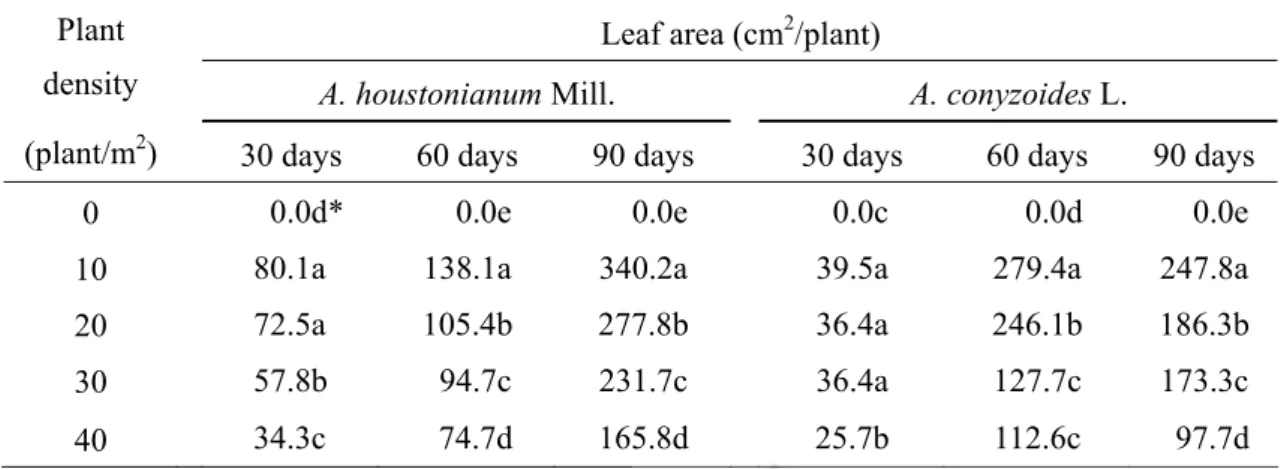
紫花與白花藿香薊不同種植密度對藿香薊葉面積之影響(2006 春作)(表 7a)顯
示,玉米在不同種植密度之紫、白花藿香薊之競爭下,無論是生育
30 天、60 天或
90 天,葉面積隨種植密度之增加而有減少之趨勢,每平方公尺種植 10 株與其他各
處理間皆有顯著差異。而紫花與白花藿香薊不同種植密度於玉米生育期間(30、60、
90 天)對藿香薊分枝數影響(表 7b)顯示,玉米在不同種植密度之紫、白花藿香薊之
競爭下,分枝數隨種植密度之增加而減少。
表7a.紫花與白花藿香薊不同種植密度對藿香薊葉面積之影響(2006 春作)Table 7a. Effects of different plant densities of A. houstonianum Mill. and A. conyzoides L. on the leaf area of two Ageratum spp. (Spring crop, 2006)
Leaf area (cm2/plant) Plant
density A. houstonianum Mill. A. conyzoides L.
(plant/m2) 30 days 60 days 90 days 30 days 60 days 90 days
0 0.0d* 0.0e 0.0e 0.0c 0.0d 0.0e
10 80.1a 138.1a 340.2a 39.5a 279.4a 247.8a
20 72.5a 105.4b 277.8b 36.4a 246.1b 186.3b
30 57.8b 94.7c 231.7c 36.4a 127.7c 173.3c
40 34.3c 74.7d 165.8d 25.7b 112.6c 97.7d
表7b.紫花與白花藿香不同種植密度對藿香薊分枝數之影響(2006 春作)
Table 7b. Effects of different plant densities of A. houstonianum Mill.and A. conyzoides L. on the branches number of two Ageratum spp. (Spring crop, 2006)
Branches (no./plant)
Plant
density A. houstonianum Mill. A. conyzoides L.
(plant/m2) 30 days 60 days 90 days 30 days 60 days 90 days
0 0.0b* 0.0c 0.0d 0.0c 0.0d 0.0d
10 8.0a 10.0a 12.3a 4.3a 11.0a 14.0a
20 8.0a 8.7a 11.7ab 4.0a 10.7a 13.0b
30 7.0a 7.7b 11.0b 3.7a 8.0b 12.7c
40 6.6a 6.0b 8.8c 3.3a 6.0c 9.0c
*Means with the same letter in the same column are not significantly different at 5% level.
紫花與白花藿香薊不同種植密度對玉米穗重之影響(2006 春作)(表 8)顯示,玉
米在不同種植密度之紫、白花藿香薊之競爭下,無論是生育
60 天或生育 90 天,
穗重皆以對照組最重。
表8. 紫花與白花藿香不同種植密度對玉米穗重之影響(2006 春作)
Table 8. Effects of different plant densities of A. houstonianum Mill.and A. conyzoides L. on the ear weight of corn. (Spring crop, 2006)
Ear weight (g/plant) Plant
density A. houstonianum Mill. A. conyzoides L.
(plant/m2) 60 days 90 days 60 days 90 days
0 134.0a* 164.7a 135.0a 188.7a
10 103.3b 143.3b 93.7b 148.3b
20 78.3c 128.3c 84.3b 135.3bc
30 69.7d 121.0cd 84.3b 120.0c
40 65.3d 115.3d 60.0c 124.7c
二、紫、白花藿香薊不同種植密度對玉米農藝性狀及產量之影響
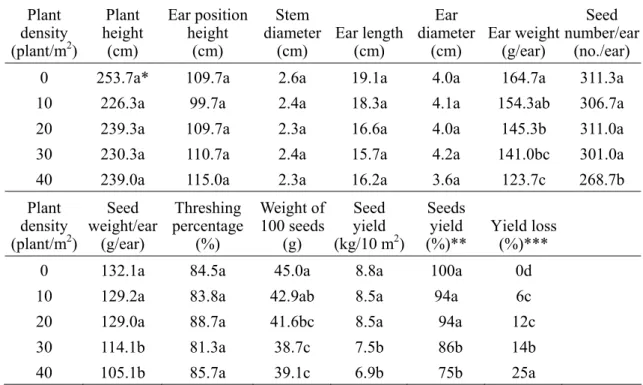
調查
2005 秋作紫花藿香薊不同種植密度對玉米農藝性狀及產量之影響(表
9),結果顯示除株高、穗位高、莖徑、穗長、穗徑、脫粒率呈不顯著差異外,其餘
穗重、穗種子數目、穗種子重、百粒重、小區種子產量、種子產量之百分率與種
子產量之損失率皆呈顯著差異。各性狀間表現最佳者為對照組,其次為每平方公
尺
10 株、20 株之紫花藿香薊處理,其表現與對照組不相上下。而在每平方公尺
40 株之紫花藿香薊競爭下,玉米各性狀之表現為最差,尤其是小區種子產量,差
異較為明顯。以對照組種子產量為
100%計算,其在每平方公尺 10 株及 20 株之紫
花藿香薊密度競爭下,種子產量略降為
94%,而當紫花藿香薊密度增加為每平方
公尺
40 株之競爭下,種子產量降為 75%。就種子產量因紫花藿香薊密度增加損失
率而言,紫花藿香薊每平方公尺
40 株之競爭下,則玉米種子產量損失率為 25%。
表9. 紫花藿香薊不同種植密度對玉米農藝性狀及產量之影響(2005 秋作)Table 9. Effects of different plant densities of A. houstonianum Mill. on agronomic characters and yield of corn. (Fall crop, 2005)
Plant density (plant/m2) Plant height (cm) Ear position height (cm) Stem diameter (cm) Ear length(cm) Ear diameter
(cm) Ear weight (g/ear)
Seed number/ear
(no./ear)
0 253.7a* 109.7a 2.6a 19.1a 4.0a 164.7a 311.3a
10 226.3a 99.7a 2.4a 18.3a 4.1a 154.3ab 306.7a
20 239.3a 109.7a 2.3a 16.6a 4.0a 145.3b 311.0a
30 230.3a 110.7a 2.4a 15.7a 4.2a 141.0bc 301.0a
40 239.0a 115.0a 2.3a 16.2a 3.6a 123.7c 268.7b
Plant density (plant/m2) Seed weight/ear (g/ear) Threshing percentage (%) Weight of 100 seeds (g) Seed yield (kg/10 m2) Seeds yield (%)** Yield loss (%)***
0 132.1a 84.5a 45.0a 8.8a 100a 0d 10 129.2a 83.8a 42.9ab 8.5a 94a 6c
20 129.0a 88.7a 41.6bc 8.5a 94a 12c 30 114.1b 81.3a 38.7c 7.5b 86b 14b 40 105.1b 85.7a 39.1c 6.9b 75b 25a
* Means with the same letter in the same column are not significantly different at 5% level. ** Percentages denote the relative yield (%) to control.
分析
2005 秋作白花藿香薊不同種植密度對玉米農藝性狀及產量之影響(表
10),結果顯示除穗位高、莖徑、穗長、穗徑、脫粒率、百粒重呈不顯著差異外,
其餘株高、穗重、穗種子數目、穗種子重、小區種子產量、種子產量之百分率與
種子產量之損失率皆呈顯著性差異。而各性狀間表現最佳者為對照組,其次為每
平方公尺
10 株、20 株之白花藿香薊處理。而每平方公尺 40 株白花藿香薊競爭下,
玉米各性狀之表現為最差,尤其是小區種子產量,差異較為明顯,以對照組種子
產量為
100%計算,其在每平方公尺 10 株及 20 株之白花藿香薊競爭下,種子產量
略降為
90%與 80%,而當白花藿香薊每平方公尺 30 株之競爭下,種子產量降為
73%,當每平方公尺 40 株之競爭下,則種子產量更降為 71%。就種子產量因白花
藿香薊密度增加損失率而言,白花藿香薊每平方公尺
40 株之競爭下,則玉米種子
產量損失率為
29%。
表10. 白花藿香薊不同種植密度對玉米農藝性狀及產量之影響(2005 秋作)Table 10. Effects of different plant densities of A. conyzoides L. on agronomic characters and yield of corn. (Fall crop, 2005)
Plant density (plant/m2) Plant height (cm) Ear position height (cm) Stem diameter (cm) Ear length(cm) Ear diameter
(cm) Ear weight (g/ear)
Seed number/ear
(no./ear)
0 245.3a* 113.0a 2.7a 19.2a 3.9a 168.7a 358.3a
10 244.7a 111.0a 2.6a 17.4a 4.1a 151.7ab 327.7b
20 231.3ab 99.0a 2.2a 16.5a 4.1a 134.3bc 336.7b
30 223.0b 98.0a 2.2a 16.2a 3.9a 122.3c 296.0c
40 220.3b 99.0a 1.9a 15.8a 3.9a 120.3c 298.3c
Plant density (plant/m2) Seed weight/ear (g/ear) Threshing percentage (%) Weight of 100 seeds (g) Seed yield (kg/10 m2) Seeds yield (%)** Yield loss (%)***
0 149.3a 88.7a 42.1a 9.8a 100a 0c
10 133.5b 90.0a 41.8a 8.9ab 90ab 10bc
20 120.9bc 90.0a 37.7a 8.0bc 80bc 20ab
30 108.5c 91.2a 38.5a 7.2c 73c 27a
40 112.8c 88.8a 36.7a 7.4c 71c 29a
* Means with the same letter in the same column are not significantly different at 5% level. ** Percentages denote the relative yield (%) to control.
調查
2006 春作紫花藿香薊不同種植密度對玉米農藝性狀及產量影響(表 11),
結果顯示除穗位高、莖徑、穗長、穗徑、脫粒率呈不顯著差異外,其餘株高、穗
重、穗種子數目、穗種子重、百粒重、小區種子產量、種子產量之百分率與種子
產量之損失率皆呈顯著性差異。而各性狀間表現最佳者為對照組,其次為每平方
公尺
10 株、20 株及 30 株之紫花藿香薊其表現與對照組不相上下。而每平方公尺
40 株之紫花藿香薊競爭下,玉米性狀之表現在小區種子產量,差異較為明顯,以
對照組種子產量為
100%計算,其在每平方公尺 10 株、20 株及 30 株紫花藿香薊競
爭下,種子產量略降為
98%、93%及 91%,而當紫花藿香薊每平方公尺 40 株之競
爭下,則種子產量降為
84%。種子產量因紫花藿香薊密度增加之損失率當紫花藿
香薊每平方公尺
40 株之競爭下,則玉米種子之損失率為 16%。
表11. 紫花藿香薊不同種植密度對玉米農藝性狀及產量之影響 (2006 春作)Table 11. Effects of different plant densities of A. houstonianum Mill. on agronomic characters and yield of corn. (Spring crop, 2006)
Plant density (plant/m2) Plant height (cm) Ear position height (cm) Stem diameter (cm) Ear length (cm) Ear diameter (cm) Ear weight (g/ear) Seed number/ear (no./ear)
0 299.7a* 144.7a 3.4a 18.7a 4.3a 142.7a 360.7a
10 288.0b 144.3a 3.1a 18.3a 4.3a 140.3a 355.3a
20 275.3c 134.0a 2.8a 17.3a 4.0a 133.3b 347.0b
30 270.0c 130.0a 2.6a 16.7a 3.8a 129.3b 336.0c
40 266.0c 130.7a 2.3a 17.0a 3.8a 120.0c 316.0d
Plant density (plant/m2) Seed weight/ear (g/ear) Threshing percentage (%) Weight of 100 seeds (g) Seed yield (kg/10 m2) Seeds yield (%)** Yield loss (%)***
0 134.3a 91.2a 36.2a 8.8a 100a 0c
10 128.0a 91.2a 36.0a 8.4a 98a 2c
20 114.7b 89.7a 35.0a 7.6b 93b 7b
30 114.0b 88.2a 34.9a 7.5b 91b 9b
40 105.3c 88.7a 34.4a 6.9c 84c 16a * Mean with the same letter in the same column are not significantly different at 5% level. ** Percentages denote the relative yield (%) to control.
分析
2006 春作白花藿香薊不同種植密度對玉米農藝性狀及產量影響(表 12),
結果顯示除穗位高、莖徑、穗長、穗徑、脫粒率、百粒重呈不顯著差異外,其餘
株高、穗重、穗種子數目、穗種子重、小區種子產量、種子產量之百分率與種子
產量之損失率皆呈顯著性之差異。而各性狀間表現最佳者為對照組,其次為每平
方公尺
10 株、20 株之白花藿香薊其表現與對照組不相上下。而每平方公尺 40 株
之白花藿香薊競爭下,玉米性狀之表現在小區種子產量,差異較為明顯,以對照
組種子產量為
100%計算,其在每平方公尺 10 株、20 株之白花藿香薊競爭下,種
子產量略降為
93%與 91%,而當白花藿香薊每平方公尺 40 株之競爭下,則種子產
量降為
80%。就種子產量因白花藿香薊密度增加之損失率,白花藿香薊每平方公
尺
40 株競爭下,玉米種子之產量損失率為 20%。
表12. 白花藿香薊不同種植密度對玉米農藝性狀及產量之影響 (2006 春作)Table 12. Effects of different plant densities of A. conyzoides L. on agronomic characters and yield of corn. (spring crop, 2006)
Plant density (plant/m2) Plant height (cm) Ear position height (cm) Stem diameter (cm) Ear length (cm) Ear diameter (cm) Ear weight (g/ear) Seed number/ear (no./ear)
0 286.0a* 137.3a 3.2a 18.8a 4.4a 153.7a 338.7a
10 285.7a 137.0a 3.4a 18.5a 4.2a 142.3b 336.7a
20 280.0a 130.0a 3.0a 17.7a 4.2a 139.3b 331.3a
30 274.7b 129.3a 2.9a 16.5a 3.8a 130.7c 326.7a
40 270.0b 127.7a 2.8a 15.4a 3.8a 122.7c 311.3b
Plant density (plant/m2) Seed weight/ear (g/ear) Threshing percentage (%) Weight of 100 seeds (g) Seed yield (kg/10 m2) Seeds yield (%)** Yield loss (%)***
0 131.3a 86.2a 37.3a 8.7a 100a 0c
10 128.0a 86.3a 37.4a 8.2b 93b 7b
20 114.7b 83.5a 34.6a 7.6c 91b 9b
30 113.3b 83.5a 34.7a 7.5c 85c 15a
40 109.0b 83.7a 34.9a 7.2c 80c 20a
* Means with the same letter in the same column are not significantly different at 5% level. ** Percentages denote the relative yield (%) to control.