科技部補助專題研究計畫成果報告
期末報告
基於合作式數位閱讀標註知識典藏與分享之雲端高互動閱
讀學習社群平台建置與研究(第 3 年)
計 畫 類 別 : 個別型計畫 計 畫 編 號 : NSC 100-2628-S-004-001-MY3 執 行 期 間 : 102 年 08 月 01 日至 103 年 07 月 31 日 執 行 單 位 : 國立政治大學圖書資訊與檔案學研究所 計 畫 主 持 人 : 陳志銘 計畫參與人員: 碩士級-專任助理人員:范維媛 碩士班研究生-兼任助理人員:陳冠雯 碩士班研究生-兼任助理人員:黃泓彬 碩士班研究生-兼任助理人員:王逸翔 碩士班研究生-兼任助理人員:呂婷芸 碩士班研究生-兼任助理人員:林宓 報 告 附 件 : 出席國際會議研究心得報告及發表論文 處 理 方 式 : 1.公開資訊:本計畫可公開查詢 2.「本研究」是否已有嚴重損及公共利益之發現:否 3.「本報告」是否建議提供政府單位施政參考:否中 華 民 國 103 年 09 月 17 日
中 文 摘 要 : 隨著數位資訊取得的普及,兒童使用數位文本進行閱讀的時 間亦逐漸增加,如何在數位時代培養孩童建立良好的數位閱 讀能力,以及促進兒童的數位閱讀理解力也日趨重要。過去 許多研究指出透過螢幕進行的數位閱讀行為將導致淺層閱 讀、降低持續注意力及閱讀理解。為提高數位閱讀的成效, 本計畫提出一具閱讀標註鷹架與互動討論鷹架輔助之合作式 閱讀標註系統 (collaborative reading annotation system with reading annotation and interactive discussion scaffolding, 簡稱 CRAS-RAIDS),希望促進兒童透過有效的 合作數位閱讀提升其閱讀理解成效。本計畫基於準實驗研究 法,以臺灣桃園縣一所國小兩個五年級班級的 53 名學生為研 究對象,隨機分配其中一班為實驗組,透過 CRAS-RAIDS 系統 進行合作閱讀及互動討論之閱讀學習活動;而另一班則分派 為控制組,透過傳統紙本閱讀標註及現場面對面討論進行合 作閱讀活動。本計畫探討兩組在閱讀態度、閱讀理解及閱讀 策略表現上的差異。結果顯示實驗組學習者在直接理解、推 論理解及閱讀策略使用上均顯著優於控制組學習者。此外, 研究結果也顯示採用 CRAS-RAIDS 系統進行輔助閱讀的實驗組 學習者,在閱讀態度中的行為、情感和整體維度上均具有顯 著提升,而控制組則否;但是兩組學習者在閱讀態度表現上 並不具有顯著差異。此外,透過 CRAS-RAIDS 支援進行合作閱 讀活動的實驗組學習者,高度肯定此一系統對於支援數位閱 讀的成效。 中文關鍵詞: 合作式閱讀標註系統、數位閱讀、閱讀標註鷹架、互動討論 鷹架、閱讀理解
英 文 摘 要 : With the growing amount of digital information
available and the increasing amount of time children spend on reading electronic media, cultivating
children with good digital reading abilities and promoting digital reading comprehension are becoming more and more important in the digital age. However, a number of studies argued that the arrival of
screen-based digital reading leads to shallow
reading, short sustained attention, and low reading comprehension. To enhance digital reading
performance, this work presents a collaborative
reading annotation system with reading annotation and interactive discussion scaffolding (CRAS-RAIDS) to facilitate reading performance in collaborative digital reading environments. Based on
quasi-experimental design, this work recruits 53 Grade 5 students in two classes at an elementary school in Taoyuan County, Taiwan. One of the two classes is randomly assigned as the experimental group that performs collaborative reading with the proposed CRAS-RAIDS support and the remaining class is
randomly assigned to the control group that performs collaborative reading with traditional paper-based reading annotation and face-to-face discussion. This work examines the differences between both groups with different treatments for collaborative reading in reading attitude, reading comprehension, and
reading strategy use in an active reading context, in which participants perform autonomous learning.
Analytical results show that the experimental group presents significant superiority on direct and explicit comprehension performance, inferential comprehension performance, and reading strategy use as compared to the control group. Moreover,
analytical results show that the promotion of reading attitude in experimental group was significant in terms of the behavioral, affective sub-dimensions, and the total dimension, but not in the control group. However, both groups do not appear
statistically significant difference in reading attitude. Additionally, the experimental group performing collaborative reading with the proposed CRAS-RAIDS support has revealed positive interests and high affirmation on learning satisfaction. 英文關鍵詞: Collaborative reading annotation system, digital
reading, reading annotation scaffolding, interactive discussion scaffolding, reading comprehension
1
行政院科技部專題研究計畫成果報告
基於合作式數位閱讀標註知識典藏與分享之雲端高互動閱讀
學習社群平台建置與研究(3/3)
計畫主持人:陳志銘 教授 計畫執行單位:國立政治大學圖書資訊與檔案學研究所 計畫編號:100-2628-S-004-001-MY3 計畫執行期間:100年8月1日~103年7月31日中文摘要
隨著數位資訊取得的普及,兒童使用數位文本進行閱讀的時間亦逐漸增加,如何在數位 時代培養孩童建立良好的數位閱讀能力,以及促進兒童的數位閱讀理解力也日趨重要。過去 許多研究指出透過螢幕進行的數位閱讀行為將導致淺層閱讀、降低持續注意力及閱讀理解。 為提高數位閱讀的成效,本計畫提出一具閱讀標註鷹架與互動討論鷹架輔助之合作式閱讀標 註系統 (collaborative reading annotation system with reading annotation and interactive discussion scaffolding, 簡稱CRAS-RAIDS),希望 促進兒童透過有效的合作數位閱讀提升其閱讀理解成效。 本計畫基於準實驗研究法,以臺灣桃園縣一所國小兩個五年級班級的53名學生為研究對象, 隨機分配其中一班為實驗組,透過CRAS-RAIDS系統進行合作閱讀及互動討論之閱讀學習活 動;而另一班則分派為控制組,透過傳統紙本閱讀標註及現場面對面討論進行合作閱讀活動。 本計畫探討兩組在閱讀態度、閱讀理解及閱讀策略表現上的差異。結果顯示實驗組學習者在 直接理解、推論理解及閱讀策略使用上均顯著優於控制組學習者。此外,研究結果也顯示採 用CRAS-RAIDS系統進行輔助閱讀的實驗組學習者,在閱讀態度中的行為、情感和整體維度 上均具有顯著提升,而控制組則否;但是兩組學習者在閱讀態度表現上並不具有顯著差異。 此外,透過CRAS-RAIDS支援進行合作閱讀活動的實驗組學習者,高度肯定此一系統對於支援 數位閱讀的成效。 關鍵字: 合作式閱讀標註系統、數位閱讀、閱讀標註鷹架、互動討論鷹架、閱讀理解Abstract
With the growing amount of digital information available and the increasing amount of time children spend on reading electronic media, cultivating children with good digital reading abilities and promoting digital reading comprehension are becoming more and more important in the digital age. However, a number of studies argued that the arrival of screen-based digital reading leads to shallow reading, short sustained attention, and low reading comprehension. To enhance digital reading performance, this work presents a collaborative reading annotation system with reading annotation and interactive discussion scaffolding (CRAS-RAIDS) to facilitate reading performance in collaborative digital reading environments. Based on quasi-experimental design, this work
2
recruits 53 Grade 5 students in two classes at an elementary school in Taoyuan County, Taiwan. One of the two classes is randomly assigned as the experimental group that performs collaborative reading with the proposed CRAS-RAIDS support and the remaining class is randomly assigned to the control group that performs collaborative reading with traditional paper-based reading annotation and face-to-face discussion. This work examines the differences between both groups with different treatments for collaborative reading in reading attitude, reading comprehension, and reading strategy use in an active reading context, in which participants perform autonomous learning. Analytical results show that the experimental group presents significant superiority on direct and explicit comprehension performance, inferential comprehension performance, and reading strategy use as compared to the control group. Moreover, analytical results show that the promotion of reading attitude in experimental group was significant in terms of the behavioral, affective sub-dimensions, and the total dimension, but not in the control group. However, both groups do not appear statistically significant difference in reading attitude. Additionally, the experimental group performing collaborative reading with the proposed CRAS-RAIDS support has revealed positive interests and high affirmation on learning satisfaction.
Keywords: Collaborative reading annotation system, digital reading, reading annotation scaffolding,
interactive discussion scaffolding, reading comprehension
1. Introduction
With the rapid development of digital publication, Amazon now sells more copies of e-books than paper books (Bounie, Eang, Sirbu, & Waelbroeck, 2012) as well as electronic resources at libraries are increasingly popular in recent years (Liu, 2012). A recent survey by Gartner Inc. (2013) shows that the time people spend reading on a screen is now almost equal to the time spent reading from print. With the growing amount of digital information available and the increasing amount of time people spend on reading electronic media, the digital environment has brought about significant changes in reading practice and behavior as people spend more time reading online (Liu, 2012). Eden and Eshet-Akkalai (2013) indicated that today’s young readers are proficient in digital reading as they read from print, because digital reading has become an everyday practice among them. Digital reading provides a number of powerful advantages that are traditionally absent in the print environment, such as interactivity, nonlinearity, immediacy of accessing information, and the convergence of text, images, audio, and video. However, Carr (2010) argued that the arrival of screen-based digital reading together with the fragmentary nature of hypertext is threatening sustained reading and leads to shallow reading. Liu (2005) also indicated the screen-based digital reading behavior is characterized by more time spent on browsing and scanning, keyword spotting, one-time reading, non-linear reading, and reading more selectively, but less time is spent on in-depth reading, and concentrated reading. Wolf (2009) also emphasized the importance of encouraging explicit instruction of deeper comprehension processes and studying the formation of the deep-reading processes in online reading. Early research found that comprehension levels were
3
lower on screen-based reading, however in more recent years the comprehension gap between reading on a screen versus on paper has been decreasing (Cull, 2011). Particularly, Eden and Eshet-Akkalai’s study (2013) confirmed that no significant differences were found between the performances of 93 university students in print and digital reading under active reading conditions on the topic of environmental awareness. Their study supported the notion that digital reading has become an everyday practice among users, who have gained digital reading proficiency in the digital age. Undoubtedly, the contents with digital format are becoming widespread which raises the importance of studying the impact of reading screen-based digital contents.
Due to the characteristics of digital reading in terms of non-linear reading, texts with hyperlinking, and shallow reading, the process of reading on screen tends to be cognitively different from the process of reading on printed paper, in terms of brain activation, the contextual environment, cognitive focus, comprehension, and reading speed (Cull, 2011; Coiro & Dobler, 2007). Digital texts that incorporate hyperlinks and hypermedia introduce some complications in defining comprehension because they require skills and abilities beyond those required for the comprehension of conventional, linear print (RAND Reading Study Group, 2002). However, many studies argued that the younger generation growing up in the digital environment lacks the ability to read deeply and to sustain a prolonged engagement in online reading (Birkerts, 1994; Carr, 2010; Liu, 2005; Wolf, 2009). Fuchs et al. (2001) indicated that students with poor reading skills have lower self-esteem, pose greater discipline problems and are less likely to complete school than more skillful readers. Therefore, developing reading assisted tools or strategies to promote the online reading skills and performance is urgently needed in digital reading environments.
Annotating digital texts collaboratively can effectively accumulate and share the knowledge of readers who participate in reading learning processes. Annotations typically facilitate reviewing a text that has already been read. Most importantly, annotated content can help new readers understand articles and help readers obtain a deeper and broader understanding than when reading digital content without annotations (Porter-O’Donnell, 2004). Many studies (Ovsiannikov, Arbib, & McNeill, 1999; Petri, Miikka, Jaakko, Patrik, & Henry, 2005; Rau, Chen, & Chin, 2004) have demonstrated that collaborative reading annotation tools can promote reading performance and provide benefits in terms of collaborative reading. However, current collaborative reading annotation systems developed for promoting reading comprehension have not yet received attention on providing reading annotation and interactive discussion scaffolding that can direct readers to annotate digital texts and perform discussion to annotated digital texts effectively. Bull et al. (1999) indicated that scaffolding is an interactive process in which a teacher or facilitator assists such a learner to build a “structure” to contain and frame the new information as well as scaffolding can be provided by teachers, peers, or computers, and may include the use of tutoring, performance systems, and reciprocal teaching. Providing scaffolding has been an effective strategy in assisting students doing higher-order cognitive activities, particularly for reading (Clark & Graves, 2005; Chen, Teng, Lee, & Kinshuk, 2011). Additionally, various forms of collaborative reading have
4
often been included in discussion-based teaching methods (Kiili, Laurinen, Marttunen, & Leu, 2012). Particularly, educators are increasingly using online asynchronous discussion tools for learning and instruction because these tools include fewer time and space restrictions compared to traditional face-to-face discussion (Chen & Chiu, 2008). Also, online asynchronous discussion allow more opportunities for learners to prepare, reflect, think, and search for extra information before participating in the discussion (Chen & Chiu, 2008). Particularly, Wolf’s study (2008) indicated that recent research on annotation interfaces provides provocative evidence that anchored, annotation-based discussion environments may lead to better conversations about a text. Thus, performing online asynchronous discussion to debate and reflect digital texts with annotations can further help readers to deeply understand reading texts.
To enhance collaborative reading annotation applications in digital reading environments, this work thus presents a collaborative reading annotation system with reading annotation and interactive discussion scaffolding (CRAS-RAIDS) to promote reading performance of learners via improving learners’ reading annotation strategy use and interactive discussion in collaborative digital reading environments. This study focused on directing students to annotate digital texts effectively and directing students to perform structured discussions based on annotated digital texts because open-ended discussions are often ineffective and confusing to students (Michaels & Bruce, 1991). In short, the research questions of this study include to examine whether the differences between the collaborative reading with the proposed CRAS-RAIDS support and collaborative reading with traditional paper-based reading annotation and face-to-face discussion in reading attitude, reading comprehension, and reading strategy use exist in active reading context, and whether the elementary school students performing collaborative reading with the proposed CRAS-RAIDS support revealed positive interests and high affirmation on web-based learning willingness and learning satisfaction.
2. Literature Review
2.1 Digital reading supported by web-based reading annotation system
Reading is not a single activity because it involves different purposes and requires different skills in handling reading materials. Reading is actually a complex and variable behavior (Liu, 2005). In recent years, the advent of digital media and the growing collection of digital documents have had a profound impact on reading (Liu, 2005). Particularly, the development of information and computer technology (ICT) has offered various alternatives to support reading activities and to anticipate change of reading behavior. Traditionally, annotating printed books by pencil or pen is the most common method of recording book-related knowledge, but has disadvantages when compared with knowledge storage in computers, knowledge dissemination, and knowledge sharing via the Internet. Using a digital annotation tool to annotate digital texts can overcome these shortcomings. Thus, in recent years, many computer-assisted collaborative reading annotation systems have been developed to assist learners in learning by reading digital texts and the positive
5
effects of computer-assisted collaborative reading annotation on promoting reading performance have been confirmed (Su, Yang, Hwang, & Zhang, 2010; Mendenhall & Johnson, 2011; Chen, Chen, Hong, Liao, & Huang, 2012).
Among the proposed computer-assisted collaborative reading annotation systems, Su et al. (2010) proposed a personalized annotation management system (PAMS), which can manage, share, and reuse individual and collaborative annotations as well as provide a shared mechanism for discussion about shared annotations among multiple users, for collaborative learning groups. Analytical results show that the use of PAMS can increase learning achievements in collaborative learning environments and the influence of annotation on learning achievements becomes stronger with the use of the sharing mechanism. Moreover, Steimle, Brdiczka, and Muhlhauser (2009) developed the CoScribe system for collaborative reading annotation of lecture slides on digital paper, using a digital pen to make collaborative handwritten annotations on printed lecture slides. Their study demonstrated that combining paper with a digital pen is helpful in supporting reading annotation and collaboration. Chen, Wang and Chen (2013) proposed a self-regulated learning (SRL) mechanism combined with a digital reading annotation system (DRAS) to enhance Grade 7 students to generate collaboratively rich and high-quality annotations for promoting English-language reading performance. Compared with the group learners who used the proposed DRAS without the support of SLR mechanisms for performing English-language reading, their study demonstrated that the reading comprehension and reading annotation abilities of the group learners who used the proposed DRAS with the support of SLR mechanisms were significantly improved. Additionally, Mendenhall and Johnson (2011) applied an online annotation system HyLighter that can facilitate shared annotations to foster the development of critical thinking skills and reading comprehension of university undergraduates. Their study also indicated that HyLighter may help students in enhancing reading comprehension, critical thinking and meta-cognition skills. Also, Chen et al. (2012) developed a web-based collaborative reading annotation system to enable knowledge sharing and discussion among learners to improve reading performance in a digital library environment. Their study found that annotated digital material provides useful knowledge to readers. Additionally, the effect on digital libraries is that digital library content grows dynamically as readers contribute knowledge.
However, to the best of our knowledge and literature review, no studies focused on developing collaborative reading annotation systems with reading annotation and interactive discussion scaffolding that can direct readers to annotate digital texts effectively and can help readers perform effective discussion to annotated digital texts. Thus, developing reading annotation and interactive discussion scaffolding in collaborative reading annotation systems to facilitate high-level reading comprehension and reading strategy use is considered in this study.
2.2 Collaborative reading, reading scaffolding, and
computer-mediated discussion for promoting reading performance
6
Kiili, Laurinen, Marttunen and Leu (2012) claimed that analogous with collaborative learning, collaborative reading is a socially contextualized form of reading, it takes place with at least one other person, and it includes a process in which meaning and knowledge are jointly constructed through text-based discussion. Their study explored collaborative reading as an activity with the potential for the co-construction of both meaning and knowledge. Huang (2012) also indicated that collaborative reading makes students be aware that reading is not a matter of oneself but a matter of each group member. Through working together and communicating with each other, new ideas can be tried out, one’s reading skills can be improved, and tension and anxiety can be reduced. Unlike individual reading, people engaged in collaborative reading can capitalize on one another’s resources and share reading outcomes to each other. Two of the most widely used collaborative learning methods in the area of traditional reading instruction are Cooperative Integrated Reading and Composition and Reciprocal Teaching (Fuchs et al., 2001). However, traditional collaborative reading instructions are bounded by time and space and have limitations in interaction, communication, coordination, negotiation, sharing, and interactivity within a learning group. In recent years, many computer-supported collaborative learning (CSCL) systems that can explore the social nature of learning focusing exclusively on enhancing mediated collaboration among multiple learners, learners and computer systems were developed to facilitate reading instruction, particularly in developing collaborative reading annotation systems to promote reading performance in digital reading environments (Su, Yang, Hwang, & Zhang, 2010; Chen, Chen, Hong, Liao, & Huang, 2012; Yang, Zhang, Su, & Tsai, 2011). In general, reading annotations may help learners in four significant aspects: attention, organization, indexing, and discussion (Yang, Zhang, Su, & Tsai, 2011). Moreover, collaborative strategic reading (CSR) is also frequently used for collaborative reading. CSR emphasizes that students can apply specific strategies, which include brainstorming and predicting (preview), monitoring understanding (click and clunk), finding the main idea (get the
gist), and generating questions and reviewing key ideas (wrap up), to enhance their reading
comprehension based on small cooperative groups in which each student plays a critical role associated with the effective functioning of the group and the implementation of strategies (Klingner et al., 2004).
Moreover, Yelland and Masters (2007) identified that there are three different types of scaffolding which we refer to as cognitive, technical and affective can be conceptualized to enhance learning performance. Cognitive scaffolding denotes those activities which pertain to the development of conceptual and procedural understandings which involve either techniques or devices to assist the learner. Technical scaffolding related to the fact that learners were working with computers. Affective scaffolding denotes the mechanisms that can help learners keep on task and encourage them to higher levels of thinking and operating when engaged with a variety of learning activities. Among previous studies associated with reading practices with reading scaffolding support, Chen, Teng, Lee and Kinshuk (2011) adopted QR codes in association with mobile technology to deliver supplementary materials and scaffolded questions to support students’
7
paper-based reading. Their results suggested that direct access to supplementary materials using QR codes does not significantly influence students’ reading comprehension; however, the reading strategy of scaffolded questioning significantly improves students’ understanding about the text. Moreover, Li, Chen and Yang (2013) proposed the visual cue map, which presents pages and within-page spatial cues in an interactive toolbar, and reflects the physical structure of the e-book and the relative relationship between cues and pages, to improve e-book reading and navigation. Their results showed that participants who used the system with the visual cue map spent significantly less time to complete 10 navigational tasks and gained a higher reviewing score. Moreover, Jin (2013) developed visual structure design guidelines of presenting screenshots for enhancing text structure comprehension and selective attention design guidelines of presenting key phrases for maintaining the learners’ attention on the essential contents based on the psychological and instructional, technological foundations that can affect the visual design of digital text. The results of the study show both the visual structure and selective-attention design guidelines had a positive influence on text structure understanding, essential contents comprehension and usability of digital text. Actually, no matter in e-book or digital text with the visual cue map or visual structure design guideline can be regarded as a kind of reading scaffoldings for supporting reading practices.
Moreover, various forms of collaborative reading have often been included in discussion-based teaching methods because discussions associated with interpretations, higher-order questions, and explorations and argumentation are particularly beneficial for promoting reading performance (Kiili, Laurinen, Marttunen, & Leu, 2012). Generally, discussion can be performed by face-to-face conversations (Chiu, 2008) or computer-mediated discussions (discussion board, online forums, chat rooms, etc.) (Chen & Chiu, 2008). Despite the importance often assigned to participation in face-to-face classroom discussions, many studies found that most students never, rarely, or only occasionally asked or responded to a question in the classroom (Crombie, Pyke, Silverthorn, Jones, & Piccinin, 2003; Caspi, Chajut, Saporta, & Beyth-Marom, 2006). Compared with face-to-face classroom discussion, Guiller, Durndell and Ross (2008) indicated that the potential advantages of computer-mediated discussion is that it gives rise to an increase in the use of formal, research-based evidence and the quality of critical thinking because its asynchronous nature, allowing more time for reflection before responding as well as the process of expressing ideas into words may be beneficial for students in terms of clarification of argument and writing skills. Also, computer-mediated discussion has fewer time and space restrictions and allows more opportunities for learners to prepare, reflect, think, and search for extra information before participating in the discussion (Chen & Chiu, 2008). More importantly, disagreements occur more often during computer-mediated discussions than face-to-face discussions because computer-mediated discussions tend to be less personalized and concerned about other’s feelings, thus more likely to express their disagreements (Chen, 2004), whereas new ideas are often met with disagreement (Chiu & Khoo, 2003). In contrast, agreement messages that support the previous message need not add much content, thereby providing less added information for others to reference. Based on the
8
positive effects of collaborative reading, reading scaffolding, and interactive discussion in reading practices, this work thus proposed CRAS-RAIDS to support digital reading and explored its potential in promoting reading attitude, reading strategy use, and reading comprehension.
2.3 Effects of reading attitude, reading strategy use on reading
comprehension
With advances in information and communication technology (ICT), paper books are giving way to digital media as more print documents now appear in an electronic format. This growth is regarded to bring about significant changes in the reading practices. RAND Reading Study Group (2002) defined reading as “the process of simultaneously extracting and constructing meaning through interaction and involvement with written language”. National Institute of Child Health and Human Development (2000) defined comprehension as the process which happens “when readers actively relate the ideas represented in print to their own knowledge and experiences and construct mental representations in memory.” Reading for understanding is a non-trivial task, particularly when the reader is unfamiliar with the material being read. Compared to a printed text, many studies indicated that reading a digital text leads to lower comprehension (Morineau, Blanche, Tobin, & Guéguen, 2005; Carr, 2010; Liu, 2005). Carr’s study (2010) found that comprehension declined as the number of links increased when readers were asked to read an electronic text containing hyperlinks (Carr, 2010). However, based on a study of 66 college students in the US, Moyer (2011) found that no statistically significant differences exist in comprehension across print, ebook, and audio book modalities. Similarly, Eden and Eshet-Akkalai’s study (2013) also confirmed that no significant differences were found between the performances of 93 university students in print and digital reading under active reading conditions on the topic of environmental awareness. Obviously, the comprehension gap between reading on a screen versus on paper is gradually decreasing because digital reading has become an everyday practice among users, who have gained digital reading proficiency in the digital age.
Moreover, many studies indicated that reading attitude and reading strategy use are two relatively important factors affecting reading comprehension performance (Petscher, 2010; Brown, Campione, & Day, 1981; Coiro & Dobler, 2007; Kidwai, 2009). Petscher (2010) indicated that reading attitudes have long been regarded as an important psychological construct as they play an important role in moderating one’s level of motivation and intention to read, as well as mediating the relationship between an individual’s beliefs and reading activities. Alexander and Cobb (1992) emphasized that good reading attitudes are a prerequisite for reading and the relationship between reading attitude and reading comprehension is strong. Most teachers widely believed that the students’ reading attitude towards reading significantly impacts students’ reading achievement (Russ, 1989). Particularly, Petscher’s study (2010) reported that the mean strength of the relationship between reading attitudes and achievement is moderate (Zr=0.32) based on the meta-analysis for a total of 32 studies associated with reading attitudes and achievement. Since
9
positive attitudes towards reading tend to gain higher reading achievements, exploring whether digital reading with the proposed CRAS-RSSIDM support affect reading attitude is considered in this study.
Moreover, Brown, Campione, and Day (1981) suggested that inadequate background knowledge and improper reading strategies are two general types of difficulties that hinder effective reading. To help readers comprehend the text efficiently, relevant background knowledge essential to understand the text and reading strategies for facilitating the reading process should be made available in real time for students. Generally, expert readers use a range of strategic processes such as previewing the text, setting goals, making predictions, monitoring understanding, asking questions, and interpreting text when comprehending printed text (Coiro & Dobler, 2007). Kidwai (2009) proposed five reading strategies that contain text-macrostructure or chunking strategy, summarization strategy, imagery strategy, reading self-assessment or comfort-meter strategy, and note-taking strategy to support effective reading in a Web-based learning environment. Among the five reading strategies, summarization strategy emphasizes that readers can write a summary for each section that they create, whereas note-taking strategy emphasizes that readers can take notes on an element-by-element basis—these notes are attached to the elements that make up the instructional unit. Also, skilled readers frequently employ a range of integrative processes to aid their comprehension of text. Pugh (1978) proposed that scanning, search reading, skimming, receptive reading, and responsive reading are five reading techniques that students frequently use when they read texts as well as each technique requires a different level of intellectual engagement with the content. Students often engage in responsive reading, as when they annotate parts of a text. Moreover, proficient readers are better able to apply sophisticated reading strategies and analyze textual organization, and they possess more metacognitive skills than less proficient readers (Yau, 2005). Since reading strategy use is a relatively important factor affecting reading comprehension performance, this study thus examines whether performing the collaborative reading with the proposed CRAS-RAIDS support provides benefits in terms of promoting reading strategy use.
3. Research Methodology
3.1 Research variables
This work aims to examine the differences between collaborative reading with the proposed CRAS-RAIDS support and collaborative reading with traditional paper-based reading annotation and face-to-face discussion in reading attitude, reading comprehension, and reading strategy use in an active reading context. Therefore, the independent variable is collaborative reading with CRAS-RAIDS support or collaborative reading with traditional paper-based reading annotation and face-to-face discussion for two selected PRILS (Progress in International Reading Literacy Study) reading articles. Dependent variables include reading attitude, reading comprehension, and reading strategy use of the two different treatments during collaborative reading processes. Reading attitude is assess based on three components—cognition, affection, and behavior of people; the pretest and
10
posttest scores of PRILS reading comprehension test reveal the performance of reading comprehension; reading strategy use is assessed based on Retrieving and Straightforward Inferencing and Interpreting, Integrating, and Evaluating in PRILS; and control variables are the two different treatments using the same PRILS reading articles and the same experimental period.
3.2 Experimental design
This study applies the quasi-experiment nonequivalent control group design, as randomly selecting participants as a research target is a difficult task in actual teaching scenarios. The participants of the study were randomly recruited from Grade 5 students in two classes at an elementary school in Taoyuan County, Taiwan. According to the nonequivalent control group design in quasi-experimental research, participants were randomly assigned to the experimental group and control group. The experimental group was randomly assigned from one of the two classes. The remaining class was assigned to the control group. The experimental group students performed their collaborative reading with the proposed CRAS-RAIDS support for two selected PRILS reading articles, while the control group students performed collaborative reading with traditional paper-based reading annotation and face-to-face discussion for two selected PRILS reading articles. The learners in the experimental group can set their reading annotations as either individual annotations for only displaying their reading annotations on individual’s annotation webpage or public annotations for sharing their reading annotations with other peers, but they were encouraged to share their reading annotations with other peers. Moreover, the learners in the experimental group can select any length of digital texts to write reading annotations as well as these reading annotations can be determined an appropriate type of reading annotation tag based on seven different types of reading annotation scaffolding provided in the collaborative reading annotation system while performing digital reading activity. Additionally, the learners in the experimental group can also browse other peers’ reading annotations and respond other peers’ reading annotations based on seven types of interactive discussion scaffolding provided in the collaborative reading annotation system. However, the learners in the control group were asked to write and share their reading annotations on the printed paper, and perform face-to-face discussion to respond other peers’ reading annotations. In the control group, the subjects and the number of participants for face-to-face discussion have not been limited, but the control group learners were asked to record their discussion contents, including participator name and the corresponding discussion contents, in detail.
3.3 Experimental procedures
First, a reading comprehension pretest of the first selected PRILS reading article and a reading attitude scale were applied to assess the prior knowledge and original reading attitude of the two groups before performing collaborative reading activity. Additionally, before performing the reading activities, both group students respectively received a 1-hour training session in how to perform
11
traditional paper-based reading annotation and face-to-face discussion and how to operate the proposed CRAS-RAIDS for the designed reading activities. Learners in both groups then started to perform collaborative reading activity for the first selected PRILS reading article. The performing collaborative reading activities include to autonomously write reading annotations based on the points of view of individuals and to participate in interactive discussion according to reading annotations. The difference between the control group and experimental group is that the control group adopted traditional paper-based reading annotation and face-to-face discussion to perform collaborative reading, whereas the experimental group applied the proposed CRAS-RAIDS to support collaborative reading and discussion. After performing 3 times of collaborative reading activities within a week for the first selected PRILS article, both group students were given the reading comprehension posttest of the first selected PRILS article. After that, learners in both groups started to perform collaborative reading activity for the second selected PRILS article. However, to consider that performing the pretest of the selected second article might lead to that the experimental participants found out the answer sets of the pretest sheet from textbooks or the Internet, thus affecting the assessment of reading comprehension performance. This work has thus not performed the pretest of the selected second article in this stage. Similarly, after performing 3 times of collaborative reading activities within a week for the second selected PRILS article, both group students were given the reading comprehension posttest of the second selected PRILS article and the posttest of reading attitude. The collaborative reading activity at each time lasted 30 minutes. All learners in both groups had not been directed by teacher during the collaborative reading activity. That is, all learners in both groups performed autonomous learning in an active learning context. After finishing all the designed collaborative reading activities, this study assessed whether reading attitude, reading comprehension, and reading strategy use in the experimental group was superior to that of the control group.
3.4 Research participants
In total, 53 Grade 5 students in two classes at an elementary school in Taoyuan County, Taiwan were randomly selected as experimental participants, and their ages are between ten to eleven years old. One class was randomly selected as the experimental group, while the remaining one class was the control group. The experimental group has 28 students, 13 males and 15 females. The control group has 25 students, 14 males and 11 females.
3.5 Research instruments
3.5.1 The developed collaborative reading annotation system with reading
annotation and interactive discussion scaffolding (CRAS-RAIDS)
This work develops a collaborative reading annotation system with reading annotation and interactive discussion scaffolding that has a user-friendly interface for readers to annotate digital texts and discuss digital texts with annotated contents. The main functionalities of the system for
12
creating reading annotations and facilitating interactive discussion for the annotated texts are detailed as follows.
A. Reading annotation scaffolding for the annotated digital texts
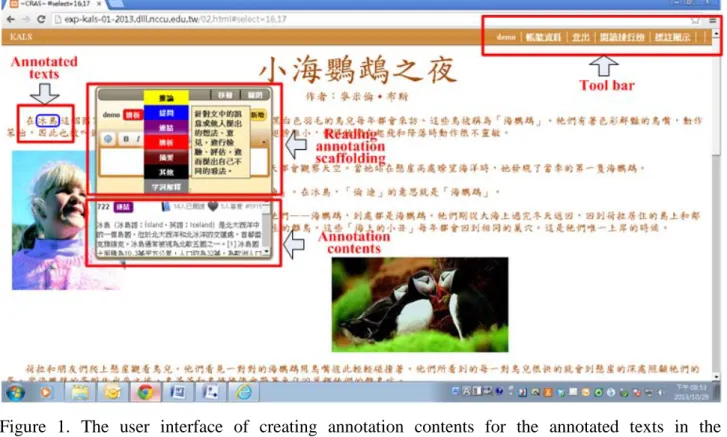
The proposed collaborative reading annotation system provides functionalities to create, modify, and delete reading annotations for digital texts. Figure 1 shows the user interface of creating the annotation contents for the annotated texts in the collaborative reading annotation system. Users can set their reading annotations as either individual annotations or public annotations. If an annotation is a public annotation, it shared with other readers. Conversely, if an annotation is an individual annotation, its content will only be displayed on individual’s annotation webpage. Moreover, to help user create reading annotations with appropriate semantic tag for promoting reading comprehension, the proposed collaborative reading annotation system provides seven different types of reading annotation scaffolding, including reasoning, discrimination, linking, summary, quizzing, explanation, and other (Figure 1) to support users to determine appropriately reading annotation types. The meaning of each type of reading annotation scaffolding for the annotated digital texts is detailed as follows:
(1) Reasoning type: Allowing readers to integrate and interpret the emphasis of the annotated digital texts.
(2) Discrimination type: Allowing readers to propose distinct viewpoints based on evaluating and examining the conveying meaning of the annotated reading texts.
(3) Linking type: Allowing readers to connect their prior knowledge, life experiences, or reading articles associated with the annotated digital texts.
(4) Summary type: Allowing readers to give a short summary description that can represent the meaning of the annotated digital texts based on extracting key information or concepts in the annotated digital texts.
(5) Quizzing type: Allowing readers to propose their doubts and thoughts for the annotated digital texts.
(6) Explanation type: Allowing readers to provide supplementary explanations or instances for the annotated reading texts.
(7) Other type: Allowing readers to determine freely the type of the annotated digital texts when the annotated digital texts cannot be determined as the predefined type of reading annotation scaffolding.
13
Figure 1. The user interface of creating annotation contents for the annotated texts in the collaborative reading annotation system
B. Interactive discussion scaffolding for the annotated digital texts
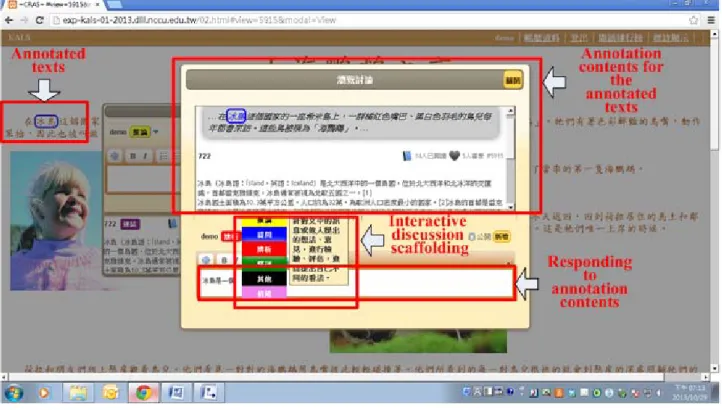
Figure 2 shows the user interface of the interactive discussion scaffolding for responding the texts with annotation contents in the collaborative reading annotation system. The functionalities of the interactive discussion scaffolding provide readers with a space to discuss the contents of reading annotations with other readers. Through the interactive discussion, readers can respond, clarify, and debate the reading annotations contributed by other readers. To help reader create structured and meaning interactive discussion for promoting reading comprehension, the proposed collaborative reading annotation system provides six different types of interactive discussion scaffolding, including reasoning, discrimination, quizzing, clarification, debugging, and other, to support users to determine appropriately discussion types of reading annotations. The meaning of each type of interactive discussion scaffolding for responding, clarifying, and debating the digital texts with reading annotations contributed by other readers is detailed as follows:
(1) Reasoning type: Allowing readers to respond the digital texts annotated with the reasoning type of reading annotation.
(2) Discrimination type: Allowing readers to respond the digital texts annotated with the discrimination type of reading annotation.
(3) Quizzing type: Allowing readers to respond the digital texts annotated with the quizzing type of reading annotation.
(4) Clarification type: Allowing readers to clarify opinions or thoughts for the annotated digital texts.
14
(5) Debugging type: Allowing readers to revise incorrect concepts, opinions or thoughts for the annotated digital texts.
(6) Other type: Allowing readers to determine freely the type of interactive discussion when their responding opinions or thoughts cannot be determined as the predefined types of interactive discussion scaffolding.
Figure 2. The user interface of the interactive discussion scaffolding for responding the texts with annotation contents in the collaborative reading annotation system
D. Favorite annotation
In the proposed cooperative reading annotation system, the function of favorite annotation allows readers to mark their favorite annotations by clicking the love icon. The favorite annotations are very helpful in reviewing the interested reading annotations of individual readers.
3.5.2 Traditional paper-based reading annotations
Traditionally, annotating printed books by pencil or pen is the most common method of recording book-related knowledge. Generally, hand-written annotations, which may include highlights or underlining, comments, footnotes, tags, and links, are made in the margins of books or manuscripts. Among hand-written reading annotations, readers frequently highlight or underline words as attentional landmarks, write short comments within the margins or between lines of texts as interpretation cues, or use longer notes in blank spaces or near figures to elaborate with complementary information. Figure 3 shows an illustration of traditional hand-written paper-based reading annotations of the control group.
15
Figure 3. An illustration of traditional hand-written paper-based reading annotations of the control group students
3.5.3 The reading comprehension assessment
This study adopted the corresponding PIRLS test sheets and scoring guidance for the two selected PIRLS articles to assess the reading comprehension. The two selected PIRLS articles in this study are “An unbelievable night” and “Puffings”, respectively. To assess reading comprehension, PIRLS measures a range of reading comprehension on two parts: retrieving and straightforward inferencing; and interpreting, integrating, and evaluating. The retrieving and straightforward inferencing was termed as direct and explicit comprehension as well as the interpreting, integrating, and evaluating was termed as inferential comprehension in this study. Each of the two parts includes about half of the assessment items. The direct and explicit comprehension assessment includes items assessing the retrieval process and those assessing straightforward inferencing. In contrast, the inferential assessment combines the interpreting and integrating process items with the examining and evaluating process items.
3.5.4 The reading attitude assessment
A reading attitude scale with 13 items was designed as a Chinese version for elementary school students based on related reading attitude scale, which is consisted of three dimensions—cognition,
16
affection, and behavior of people (Anderson, 1988). The cognitive dimension is the beliefs or
thoughts of the person towards different situations and events. The affective dimension is the feeling about the situation or events. And behavioral dimension is associated with the behavioral intension under particular context. Responses were on a four-point Likert-type scale, ranging from 1 for “disagree to 4 for “strongly agree.” Scale reliability was examined by the 97 other students. The Cronbach’s alpha values of the three subscales respectively are 0.805, 0.692, and 0.820, and the Cronbach’s alpha value of the total scale is 0.845, implying that the scale has a high reliability and sensitivity to reading attitude.
3.5.5 The learning satisfaction assessment
Additionally, a learner satisfaction questionnaire composed of four dimensions that include learning activity, interactive behavior, learning environment, and learning system was designed to assess the learning satisfaction degree of the experimental learner groups. Responses were on a six-point Likert-type scale, ranging from 1 for “strongly disagree” to 6 for “strongly agree.”
4. Experimental Results
4.1 Analysis of different types of discussion posting for both groups
To analyze whether or not the discussion behaviors between both groups have significant difference, this work invited two elementary school teachers who have over ten-year reading instruction experiences to identify the type of each discussion posting based on the defined interactive discussion scaffolding. Intercoder reliability that identified the type of each discussion posting based on Cohen’s kappa is as high as 0.95. Table 1 shows the percentage of the considered different types of discussion posting for both groups. This work found that the number of discussion posting in the experimental group for the second reading article is almost two times higher than the number of discussion posting in the first reading article, but the number of discussion posting in the control group for the second reading articles is almost equivalent to the first reading article. Obviously, the experimental group has gradually become strong willingness to participant in discussion posting over time, but not in the control group. Interestingly, the discussion posting of the control group mainly focused on the types of quizzing, clarification, and other. That is, the processes of face-to-face discussion are bounded in the cycle of proposing quizzing and clarifying the quizzing and are easy to digress from the subject. In contrast, in addition to having the types of quizzing and clarification, the discussion posting of the experimental group also focused on the types of discrimination and reasoning as well as the type of other is significantly lower than the control group did. Based on content analysis (Stemler, 2001), discrimination and reasoning are regarded as high-level cognitive ability in reading. In other words, using the proposed CRAS-RAIDS to support collaborative reading activities can facilitate high-level thinking and interactive discussion as well as avoids students falling into irrelevant discussion subjects.
17
Moreover, this work also assessed whether the number of discussion posting between both groups has significant difference based on independent-sample t-test results. Table 2 shows the analytical results. The results show that the number of discussion posting of the experimental group is significantly higher than that of the control group, regardless of the first or second selected PIRLS articles (t=2.077, p<.05; t=4.124, p<.05). Clearly, the experimental group who performed collaborative reading with the proposed CRAS-RAIDS support has higher willingness and more active to participate in interactive discussion than the control group who performed collaborative reading with traditional paper-based reading annotation and face-to-face discussion.
Table 1. The percentage of the considered different types of discussion posting for both groups The Type of
Discussion Posting
The first selected PIRLS article The second selected PIRLS article The Control Group The Experimental
Group The Control Group
The Experimental Group Reasoning 11.8 29.3 3.5 15.2 Discrimination 0.7 18.1 0.7 11.1 Debugging 0 0.5 0.7 0.9 Clarification 26.5 11.2 32.2 33.3 Quizzing 31.5 30.8 34.1 30.2 Other 29.4 10.2 28.8 9.3 Total Number of Discussion Posting 140 321 166 582
Table 2. The independent-sample t-test results of the number of discussion posting for both groups The Selected PIRLS Article Leaning Group Number of Students Number of Discussion Posting
Mean Std. t Sig. (two
tailed) The first article The Control Group 25 140 5.60 4.983 2.077* .045 The Experimental Group 28 321 11.46 13.975 The second article The Control Group 25 166 6.64 3.695 4.124*** .000 The Experimental Group 28 582 20.79 17.725 * indicates p<.05; *** indicates p<.001
4.2 Analysis of reading comprehension performance for both groups
To assess the reading comprehension performance of both groups, paired-sample and independent-sample t-tests were applied. Pretest scores of both groups in the first selected PIRLS article represent student prior knowledge. Posttest scores of both groups in the first and second selected PIRLS articles represent the reading comprehension performance of students after reading activities. The reading comprehension performance of both groups in terms of the direct and explicit comprehension and inferential comprehension were assessed and compared based on PIRLS measure, respectively.
18
4.2.1 Analysis of the performance of direct and explicit comprehension for both
groups
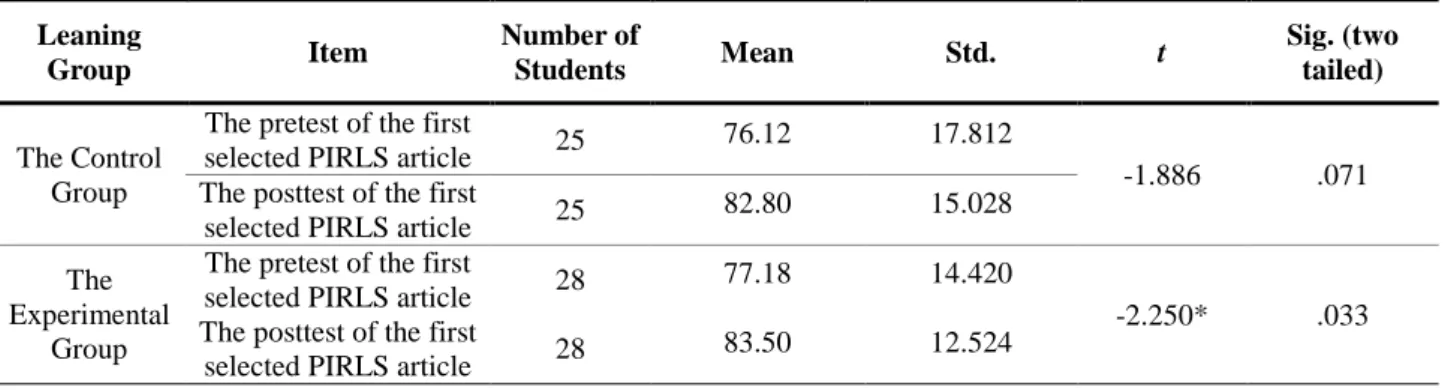
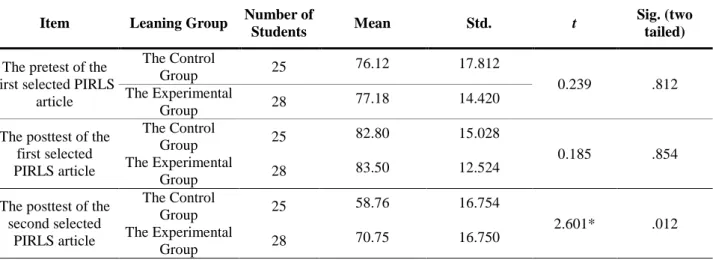
First, the paired-sample t-test was employed to confirm whether the performance of direct and explicit comprehension in both groups is significant based on the pretest and posttest scores of the first selected PIRLS article. Table 3 shows the results. Analytical results show that the performance of direct and explicit comprehension in the experimental group has statistically significant difference (t=-2.250, p<.05), while the control group has not statistically significant difference (t=-1.886, p>.05). In other words, the experimental group students who used CRAS-RAIDS to perform collaborative reading activity generated good performance in direct and explicit comprehension, but the control group students who used traditional paper-based reading annotation and face-to-face discussion to perform collaborative reading activity has not generated good performance in direct and explicit comprehension. Additionally, this work also examined whether the performance of direct and explicit comprehension in the experimental group is superior to that of the control group based on independent-sample t-test results. Table 4 shows the results. First, this work assesses whether prior knowledge (i.e., pretest score) of both groups differed significantly based on the pretest of the first selected PIRLS article. Comparison results show that prior knowledge of both groups in the first selected PIRLS article did not differ significantly. Moreover, this work assessed whether the difference in the posttest scores for both groups was significant based on independent-sample t-test results. Analytical results reveal that the posttest scores of the first selected PIRLS article for both groups did not differ significantly; that is, analytical results confirm that both learning modes generate equivalent performance in direct and explicit comprehension in the first selected PIRLS article. However, this work found that the posttest scores of the second selected PIRLS article for both groups differ significantly; that is, analytical results confirm that the performance of direct and explicit comprehension in the experimental group is superior to that of the control group in the second selected PIRLS article.
Table 3. The paired-sample t-test results of the performance of direct and explicit comprehension for both groups
Leaning Group Item Number of Students Mean Std. t Sig. (two tailed) The Control Group
The pretest of the first
selected PIRLS article 25 76.12 17.812
-1.886 .071
The posttest of the first
selected PIRLS article 25 82.80 15.028
The Experimental
Group
The pretest of the first
selected PIRLS article 28 77.18 14.420
-2.250* .033
The posttest of the first
selected PIRLS article 28 83.50 12.524
19
Table 4. The independent-sample t-test results of the performance of direct and explicit comprehension for both groups
Item Leaning Group Number of
Students Mean Std. t
Sig. (two tailed)
The pretest of the first selected PIRLS
article The Control Group 25 76.12 17.812 0.239 .812 The Experimental Group 28 77.18 14.420
The posttest of the first selected PIRLS article The Control Group 25 82.80 15.028 0.185 .854 The Experimental Group 28 83.50 12.524
The posttest of the second selected PIRLS article The Control Group 25 58.76 16.754 2.601* .012 The Experimental Group 28 70.75 16.750 * indicates p<.05
4.2.2 Analysis of the performance of inferential comprehension for both groups
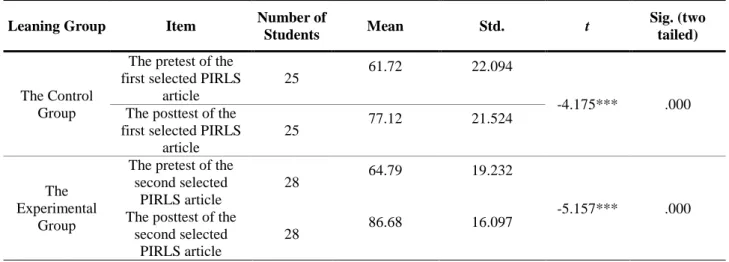
Similarly, the paired-sample t-test was employed to confirm whether the performance of inferential comprehension in both groups is significant based on the pretest and posttest scores of the first selected PIRLS article. Table 5 shows the results. Analytical results show that the performance of inferential comprehension in both groups was significant (t=-4.175, p<.05; t=-5.157, p<.05). In other words, the experimental and control group students who respectively used CRAS-RAIDS and traditional paper-based reading annotation and face-to-face discussion to perform collaborative reading activity all generated good performance in terms of inferential comprehension. Additionally, this work also examined whether the performance of inferential comprehension in the experimental group is superior to that of the control group based on independent-sample t-test results. Table 6 shows the results. First, this work assessed whether prior knowledge (i.e., pretest score) of both groups differed significantly based on assessing the pretest of the first selected PIRLS article. Comparison results show that prior knowledge of both groups in the first selected PIRLS article did not differ significantly (t=0.358, p>.05). Next, this work assessed whether the difference in the posttest scores for both groups was significant based on independent-sample t-test results. Analytical results reveal that the posttest scores of the first selected PIRLS article for both groups did not differ significantly (t=1.843, p>.05); that is, analytical results confirm that both groups generate equivalent performance in inferential comprehension in the first selected PIRLS article. However, this work found that the posttest scores of the second selected PIRLS article for both groups differ significantly; that is, analytical results confirm that the performance of inferential comprehension in the experimental group is superior to that of the control group in the second selected PIRLS article.20
Table 5. The paired-sample t-test results of the performance of inferential comprehension for both groups
Leaning Group Item Number of
Students Mean Std. t
Sig. (two tailed)
The Control Group
The pretest of the first selected PIRLS
article
25 61.72 22.094
-4.175*** .000 The posttest of the
first selected PIRLS article
25 77.12 21.524
The Experimental
Group
The pretest of the second selected
PIRLS article
28 64.79 19.232
-5.157*** .000 The posttest of the
second selected PIRLS article
28 86.68 16.097
*** indicates p<.001
Table 6. The independent-sample t-test results of the performance of inferential comprehension for both groups
Item Leaning Group Number of
Students Mean Std. t
Sig. (two tailed)
The pretest of the first selected PIRLS
article The Control Group 25 61.72 22.094 0.358 .721 The Experimental Group 28 64.79 19.232
The posttest of the first selected PIRLS article The Control Group 25 77.12 21.524 1.843 .071 The Experimental Group 28 86.68 16.097
The posttest of the second selected PIRLS article The Control Group 25 70.36 27.983 3.343** .002 The Experimental Group 28 90.89 16.551 * * indicates p<.01
4.3 Analysis of reading strategy use for both groups
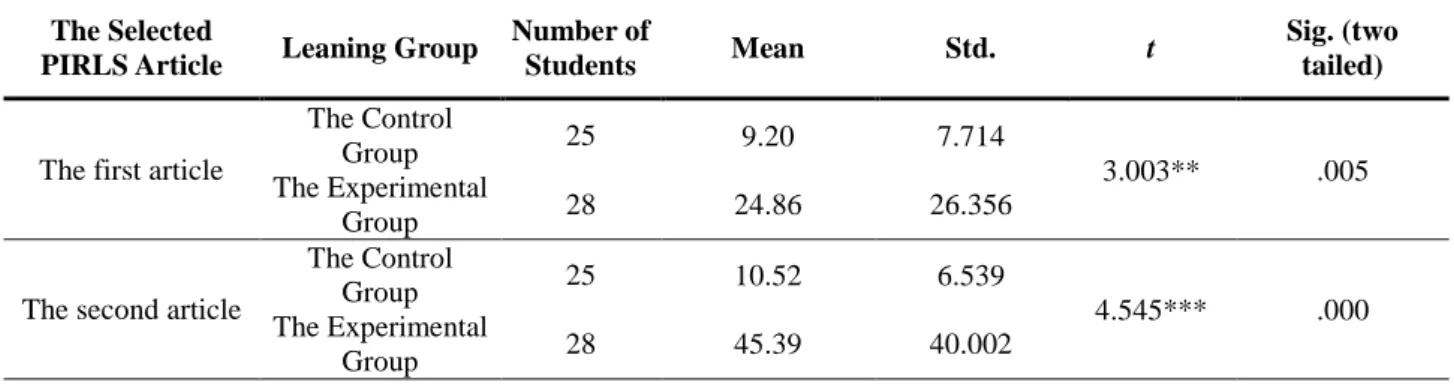
Next, the independent-sample t-test was employed to confirm whether the reading strategy use between both groups has significant difference based on the score of reading strategy use assessed by an elementary school teacher who has over ten-year reading instruction experiences. Table 7 shows the results. Analytical results show that the reading strategy use of both groups has significant difference as well as the experimental group is superior to that of the control group, regardless of the first or second selected PIRSE article (t=3.003, p<.05; t=4.545, p<.05).
21
Table 7. The independent-sample t-test results of reading strategy use for both groups The Selected
PIRLS Article Leaning Group
Number of
Students Mean Std. t
Sig. (two tailed)
The first article
The Control
Group 25 9.20 7.714
3.003** .005
The Experimental
Group 28 24.86 26.356
The second article
The Control Group 25 10.52 6.539 4.545*** .000 The Experimental Group 28 45.39 40.002 ** indicates p<.01; *** indicates p<.001
4.4 Analysis of reading attitude for both groups
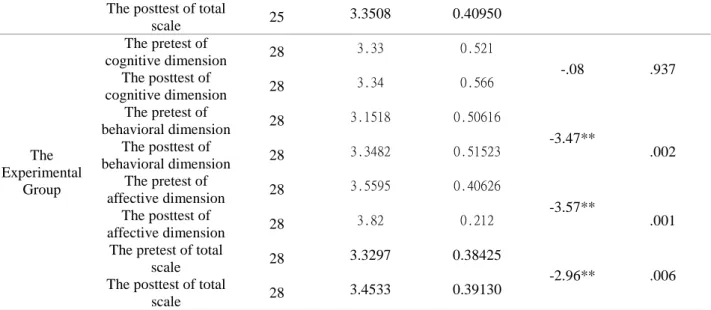
In addition to assessing the performance in terms of reading strategy use and reading comprehension for both groups, this work also analyzed the difference between both groups in reading attitude. The reading attitude scale was used to measure reading attitude after both students groups experienced different learning treatments. First, the paired-sample t-test was employed to confirm whether the promotion of reading attitude in both groups is significant based on the pretest and posttest scores of reading attitude. Table 8 shows the results. Analytical results show that the promotion of reading attitude in experimental group was significant in terms of the behavioral, affective dimensions, and the total scale (t=-3.47, p<.05; t=-3.57, p<.05; t=-2.96, p<.05), while the promotion of reading attitude in the control group was not significant in terms of three considered attitude dimensions and the total scale. Moreover, this work also analyzed whether the reading attitude of both groups differed significantly based on independent-samples t-test results. Table 9 shows the analytical results. The results confirmed that reading attitude between both groups has no significant difference in the three evaluation dimensions and total scale, regardless of reading attitude before learning or after learning. Restated, the original reading attitude and final reading attitude of both groups was equivalent.
Table 8. The paired-sample t-test results of the reading attitude for both groups
Leaning Group Item Number of
Students Mean Std. t Sig. (two tailed) The Control Group The pretest of cognitive dimension 25 3.21 0.636 -1.095 .284 The posttest of cognitive dimension 25 3.31 0.543 The pretest of behavioral dimension 25 3.1100 0.56862 -1.095 .284 The posttest of behavioral dimension 25 3.1000 0.62082 The pretest of affective dimension 25 3.5867 0.53817 .092 .927 The posttest of affective dimension 25 3.76 0.297
The pretest of total
22 The posttest of total
scale 25 3.3508 0.40950 The Experimental Group The pretest of cognitive dimension 28 3.33 0.521 -.08 .937 The posttest of cognitive dimension 28 3.34 0.566 The pretest of behavioral dimension 28 3.1518 0.50616 -3.47** .002 The posttest of behavioral dimension 28 3.3482 0.51523 The pretest of affective dimension 28 3.5595 0.40626 -3.57** .001 The posttest of affective dimension 28 3.82 0.212
The pretest of total
scale 28 3.3297 0.38425
-2.96** .006
The posttest of total
scale 28 3.4533 0.39130
** indicates p<.01
Table 9. The independent-sample t- test results of reading attitude for both groups
Item Leaning Group Number of
Students Mean Std. t Sig. (two tailed) The pretest of cognitive dimension The Control Group 25 3.21 0.636 0.755 .454 The Experimental Group 28 3.33 0.521 The posttest of cognitive dimension The Control Group 25 3.31 0.543 0.170 .866 The Experimental Group 28 3.34 0.566 The pretest of behavioral dimension The Control Group 25 3.1100 0.56862 0.283 .778 The Experimental Group 28 3.1518 0.50616 The posttest of behavioral dimension The Control Group 25 3.1000 0.62082 1.590 .118 The Experimental Group 28 3.3482 0.51523 The pretest of affective dimension The Control Group 25 3.5867 0.53817 -0.209 .836 The Experimental Group 28 3.5595 0.40626 The posttest of affective dimension The Control Group 25 3.76 0.297 0.857 .396 The Experimental Group 28 3.82 0.212 The pretest of total scale The Control Group 25 3.2677 0.45946 0.535 .595 The Experimental Group 28 3.3297 0.38425 The posttest of total scale The Control Group 25 3.3508 0.40950 0.932 .356 The Experimental Group 28 3.4533 0.39130 ** indicates p<.01; *** indicates p<.001
23
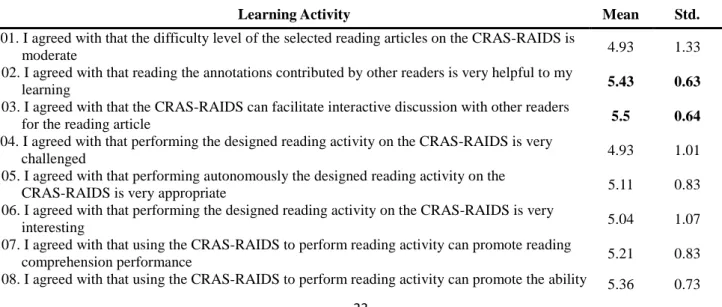
Next, this work assesses the learning satisfaction degree of the experimental group students based on the satisfaction questionnaire with six-point Likert-type scale, ranging from 1 for “strongly disagree” to 6 for “strongly agree.” Table 10 shows the analytical results. The results shows that the average learning satisfaction degree in terms of the four evaluation dimensions including the learning activity, interactive behavior, learning environment, and learning system are 5.21, 5.28, 5.23, and 5.43, respectively. Restated, most of the experimental group students agreed or strongly agreed that using the proposed CRAS-RAIDS to support online collaborative reading activities has positive effects on the four considered evaluation dimensions. Particularly, the average satisfaction degree of the question “I agreed with that reading the annotations contributed by other readers is very helpful to my learning” is as high as 5.43 and the standard deviation is 0.63; the average satisfaction degree of the question “I agreed with that the CRAS-RAIDS can facilitate interactive discussion with other readers for the reading article” is as high as 5.5 and the standard deviation is 0.64; the average satisfaction degree of the question “I will read the reading annotations that other readers shared on the collaborative digital reading annotation system” is as high as 5.64 and the standard deviation is 0.55; the average satisfaction degree of the question “I agreed with that the functionalities in the CRAS-RAIDS for responding discussion issues is very easy to use” is as high as 5.71 and the standard deviation is 0.53; the average satisfaction degree of the question “I agreed with that browsing other readers’ reading annotations in the CRAS-RAIDS is very easy” is as high as 5.61 and the standard deviation is 0.79. The high learning satisfaction degree and low standard deviation show that most of the experimental group students satisfied using the proposed CRAS-RAIDS to support online collaborative reading activities as well as their opinions are relatively consistent. More importantly, the average satisfaction degree of the question “I will keep on using the CRAS-RAIDS to perform reading activity in the future” is up to 5.5. The results are very encouraging and demonstrate that the proposed CRAS-RAIDS is a well-designed reading assisted tool and indeed offers significant benefits in terms of promoting digital reading performance.
Table 10. The assessment results of learner satisfaction in the experimental group students
Learning Activity Mean Std.
01. I agreed with that the difficulty level of the selected reading articles on the CRAS-RAIDS is
moderate 4.93 1.33
02. I agreed with that reading the annotations contributed by other readers is very helpful to my
learning 5.43 0.63
03. I agreed with that the CRAS-RAIDS can facilitate interactive discussion with other readers
for the reading article 5.5 0.64
04. I agreed with that performing the designed reading activity on the CRAS-RAIDS is very
challenged 4.93 1.01
05. I agreed with that performing autonomously the designed reading activity on the
CRAS-RAIDS is very appropriate 5.11 0.83
06. I agreed with that performing the designed reading activity on the CRAS-RAIDS is very
interesting 5.04 1.07
07. I agreed with that using the CRAS-RAIDS to perform reading activity can promote reading
comprehension performance 5.21 0.83