國
立
交
通
大
學
資訊科學與工程研究所
碩
士
論
文
以群組認證金鑰支援跨網域漫遊的認證與
金鑰分配機制
Group Authentication Key-based Authentication and Key
Agreement for Inter-network Roaming
研 究 生:陳鈺玟
指導教授:曾建超 教授
以群組認證金鑰支援跨網域漫遊的認證與金鑰分配機制
Group Authentication Key-based Authentication and Key Agreement for
Inter-network Roaming
研 究 生:陳鈺玟 Student:Yu-Wen Chen
指導教授:曾建超 Advisor:Chien-Chao Tseng
國 立 交 通 大 學
資 訊 科 學 與 工 程 研 究 所
碩 士 論 文
A ThesisSubmitted to Institute of Computer Science and Engineering College of Computer Science
National Chiao Tung University in partial Fulfillment of the Requirements
for the Degree of Master
in
Computer Science
July 2007
Hsinchu, Taiwan, Republic of China
以群組認證金鑰支援跨網域漫遊的認證與金鑰分配機制
研究生: 陳鈺玟 指導教授: 曾建超 教授
國立交通大學資訊學院資訊科學與工程研究所
摘 要
本論文提出一個群組認證與金鑰分配機制,這個機制可以減少行動台(mobile station; MS)的服務網路(Serving Network; SN)與家網路(Home Network; HN)之 間的認證訊息流量。在傳統的無線網路認證與會議金鑰產生機制中,SN 對於每一 個來訪的 MS 都會發出認證需求,要求 MS 的 HN 進行 MS 的認證並回傳 MS 的認證資 料,因此當有多個 MSs 漫遊至同一 SN 時,這些 MS 的認證需求會產生 SN 與 HN 之 間的訊息流量以及網路延遲,影響即時通訊系統的服務品質。因此本篇論文以群 組認證的概念,利用群組成員經常一起漫遊或漫遊於相同路線的特性,讓第一個 執行認證程序的 MS 在認證同時,順便幫同群組的其他 MS 取得可共享的群組認證 資料。若群組成員想在同一個 SN 上認證,則 SN 上的認證者(Authenticator)可直 接利用先前取得的群組認證金鑰來與 MS 進行近端認證(Local Authentication), 不用再向 MS 的 HN 發送認證的訊息。因此可以減少 SN 與 HN 之間的訊息流量與認 證延遲,大幅改善 MS 於無線網路漫遊時的認證速度與效能,更提昇了即時通訊的 服務品質。 關鍵詞:群組,認證,認證與金鑰分配機制,群組金鑰,漫遊,網路。
Group Authentication Key-based Authentication and Key
Agreement for Inter-network Roaming
Student: Yu-Wen Chen Advisor: Dr. Chien-Chao Tseng
Institute of Computer Science and Engineering College of Computer Science
National Chiao Tung University
ABSTRACT
This thesis presents a Group Key-based Authentication and Key Agreement (GK-AKA) mechanism to reduce the number of authentication messages exchanged between a serving network (SN) and the home network (HN) of a mobile station (MS). Current Authentication and Key Agreement (AKA) protocols are designed for an SN to authen-ticate each individual MS in wireless environments. Therefore, when multiple MSs from the same network visit an SN, the SN needs to ask the HN of the MSs to authenti-cate each MS and return the MS’s authentication data individually. Each of these au-thentications will cause a number of authentication messages exchanged between the SN and HN of the MSs, and lengthen the handover latency, which may degrade the quality of real-time services.
In this thesis, we propose a GK-AKA mechanism that adopts the concept of group authentication to eliminate the number authentications between the SN and HN of the MSs. In many circumstances, a group of MSs may roam together or along the same path, or visit the same SN. In GK-AKA, when the first MS of an MS group visits an SN, the SN will perform a “full” authentication with the MS’s HN, and obtain the authentication
data not only for the first MS but also for the rest of the MSs of the same group. Later on, when an MS of the same group visit the SN, the SN can authenticate the MS locally, without sending authentication request to the MS’s HN. Performance analysis shows that GK-AKA can reduce the authentication signal overhead between SN and HN sig-nificantly.
Index Terms—security, group key, AKA (Authentication and Key Agreement), roaming,
誌 謝
首先,我要感謝我的指導教授-曾建超老師兩年來的悉心指導。兩年前剛考上 交大資工所,去敲老師的門、表達加入意願時,老師還希望我能多考慮其他領域 的教授。最後是我三顧茅廬,厚著臉皮硬『盧』很久,老師才願意將我收入門下。 拜在曾老師門下的這兩年來,我除了學習到許多專業知識外,也深刻體認到做學 問的第一步就是要積極奮發、主動出擊。 同時要感謝曹孝櫟教授、紀光輝教授與蘇坤良教授於百忙之中撥冗審閱我的 碩士論文並擔任口試委員,老師們所提供的寶貴建議本篇論文更為完善,也感謝 老師們的指導於鼓勵,讓我在學術的路上能獲得更多經驗。另外也要特別感謝曹 孝櫟教授提供我聯發科技的工讀機會,以及指導我如何進行工研院的專利攻防口 試。 本篇論文的原始構想源自王瑞堂(以下簡稱 RT)學長。當老師在國外參訪時, 因為有了 RT 的指導與從旁協助,讓我能早早立定研究方向,多方蒐集資料。而與 RT 討論時,也學習到從不同的角度衡量問題解法的可能性。與 RT 合作最大的樂趣 就是互相攻擊對方的安全機制是否真的安全,在腦力激盪的同時,往往可以順道 改進自身方法的缺點。感謝 RT 給予我的一切協助,祝 RT 能早日畢業,順利拿到 博士學位。此外,我要感謝前瞻資料庫實驗室(Advanced Database System Lab)的博士 班洪智傑學長,他在資料分析方面給予我相當大的協助,除了教導我如何將繪圖 軟體與文書處理軟體運用得淋漓盡致之外,同時也在我求學的路上不斷地鼓勵 我。沒有他的陪伴,我無法平安順利地渡過兩年的研究所生涯。祝智傑學長也能 早日畢業,拿到博士學位。 朋友們,感謝你們在我生活中所給予的幫助與精神上的鼓勵,讓我沉重的壓 力能得到舒緩。而交大的學長、同學、學弟們,感謝你們豐富我的校園生活。
感謝外婆時常燉雞湯幫我補身子,感謝九十高齡的奶奶頂著大太陽來參加我 的畢業典禮。最後,要感謝我的家人們全力支持我追尋自己的夢想,對於我任性 辭去工作的決定,毫無怨言。
Contents
Abstract in Chinese ...i
Abstract in English...ii
Acknowledgement ...iv
Table of Contents ...vi
List of Figures ...viii
List of Tables... x
Chapter 1 Introduction ... 1
1.1 Motivation ... 1
1.2 Objective ... 3
1.3 Synopsis ... 4
Chapter 2 Background and Related Work... 5
2.1 UMTS AKA ... 5
2.2 UMTS X-AKA... 8
Chapter 3 Group Authentication Key-based AKA... 11
3.1 Architecture... 12
3.2 Setup Procedure ... 12
3.2.1 Group Authentication Key (GAK) ... 13
3.2.2 Index Table... 15
3.2.3 Message Authentication Code (MAC) Algorithms ... 15
3.3 Authentication Data Distribution Procedure... 16
3.4 Mutual Authentication and Key Agreement Procedure ... 19
Chapter 4 Security Considerations... 25
4.2 Performance Analysis ... 26
4.3 Efficiency Evaluation... 27
Chapter 5 Conclusion and Future Work ... 31
List of Figures
Figure 1-1 Signaling overhead between SN and HN while Authentication... 2
Figure 1-2 Reduce the signaling overhead between SN and HN... 3
Figure 2-1 An overview of UMTS AKA mechanism... 5
Figure 2-2 Operation in HN in UMTS AKA ...7
Figure 2-3 Operation in MS in UMTS AKA mechanism ... 8
Figure 2-4 An overview of UMTS X-AKA mechanism ... 9
Figure 3-1 System Architecture for roaming MS group ... 12
Figure 3-2 Group Authentication Key ... 13
Figure 3-3 One MS belongs to multiple MS groups ... 14
Figure 3-4 Distribution of Authentication Data in the proposed AKA mechanism ... 16
Figure 3-5 Generation of MACM1-1 in MS in the proposed GAK-AKA mechanism ... 17
Figure 3-6 The Operation in HN when SN sends the authenticate request of MSM1-1... 18
Figure 3-7 Mutual Authentication and Key Agreement in the proposed mechanism ... 19
Figure 3-8 The operation in SN while authenticating MSM1-1... 20
Figure 3-9 The operation in MSM1-1 in Mutual Authentication and Key Agreement procedure ... 20
Figure 3-10 Authentication and Key Agreement for MSM1-2... 22
Figure 3-11 The operation in SN while SN authenticating MSM1-2... 22
Figure 3-12 The operation in MS while SN authenticating MSM1-2... 23
List of Tables
Table I. Index Table... 15 Table II QUALITATIVE ANALYSIS OF THREE KINDS OF AKA
Chapter 1
Introduction
1.1
Motivation
With the tremendous growth of mobile services and applications, wireless network brings up a whole new experience to people’s daily life. The wireless networks can be simply divided into two major categories: Data Networks and Cellular Networks. Dif-ferent infrastructures provide distinct uses. One of the most prevalent data networks is WLAN [17] which is operated by IEEE 802.11 standard. WLAN can be easily built up and is popular with the low cost and high bandwidth. Cellular networks including GSM [16], GPRS [16], TETRA [20], and UMTS [15], provide wider communication range than general data networks. The cost to construct the whole network system is ex-tremely high and the bandwidth of communication is relatively low. With the amazing rangy distance, cellular networks still reverse the way how people communicate.
Data in wireless networks are transmitted over the air that makes the wireless commu-nications vulnerable. In order to secure wireless commucommu-nications, many researches have proposed numerous schemes to provide different security level. Extensible Authentica-tion Protocol (EAP) [1] provides multiple authenticaAuthentica-tion methods. EAP-AuthenticaAuthentica-tion and Key Agreement (EAP-AKA) [3] developed by 3rd Generation Partnership Project (3GPP) based on both challenge-response mechanisms and symmetric secret keys is now commonly used in wireless networks and provides compatibility to WLAN, GSM network, and UMTS network. The conventional AKA protocols for wireless network consist of 3 main components: the roaming MS group who send out authentication re-quests, the SN who provide access to internet for roaming MSs and stands for the
au-thenticator, the HN who manages the MS profile and plays as the authentication server (AS). Majority of the AKA protocols are designed for individual mobile station (MS) while the group communication become one of the most desired real-time applications.
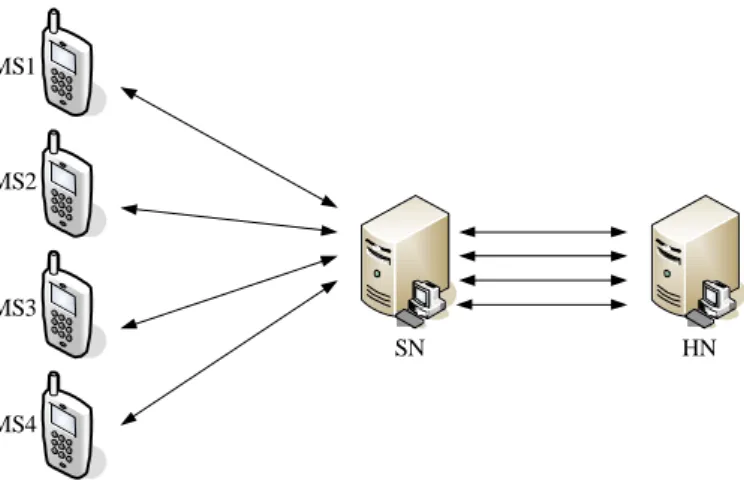
Group communications over wireless network such as video conference, chatting programs, and games, have some special properties: 1. MSs often communicating to each other usually belong to the same Home Network (HN), 2. MSs in the same group tend to migrate to the same Serving Network (SN). For example, some employees in the same company on their way to a meeting place hold a conference call; a public transport company whose buses are all equipped with mobile routers (MR) so that the passengers can access internet via the MR on bus, and buses on the same route are requested to be authenticated by the same SN around the route; firemen with TETRA handsets on the move to the places on fire. Those group communications rely on real-time services and are sensitive to the latency caused by handoff. However, the security protocols which aim to provide secure communications increase the handoff delay. Moreover, the con-ventional AKA mechanisms designed for individual MS may produce multiple Authen-tication Data Request messages for each roaming MS sent from the same SN to the same HN since the MSs in the same group usually belong to the same HN. Hence, when the roaming MS group send authentication request to the SN may cause the signaling overhead between SN and HN as shown in Figure 1-1.
SN HN
MS1
MS2
MS3
MS4
For example, when some Taiwanese with CHT mobile phones tour round Hong Kong, the CHT company will be charged the registration commission from the tele-comm operator in Hong Kong on handling roaming CHT mobile phones.
1.2
Objective
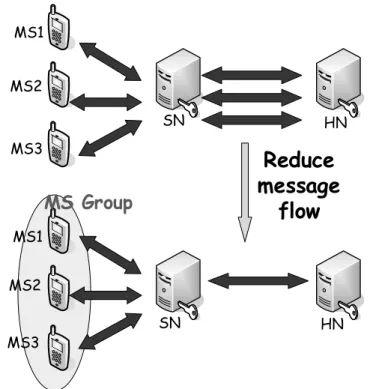
Since the mobile stations belonging to the same HN are apt to handoff together to the same SN, the MSs group could share a group secret and reversely take the advantage of sharing group secret as a trick to reduce the original repeating traffic between SN and HN. MS1 MS2 MS3 MS1 MS2 MS3 MS Group SN SN HN HN
Reduce
message
flow
Figure 1-2 Reduce the signaling overhead between SN and HN
Let the MSs in the same group share a group secret for group authentication that every member in group can use the group secret to authenticate itself while roaming to a foreign network. The first member initiates the authentication procedure sends an au-thentication request message to SN with his individual identity (MS ID), group identity (GID) and other necessary information. Based on the GID, SN can obtain authentication data for group from HN instead of for individual MS. As show in Figure 1-2, the group
authentication data stored in SN can be re-used for the rest member in group without extra messages exchanged between SN and HN. Thus the signaling overhead can be reduced. Furthermore, with the existing group authentication data in SN, full authenti-cation backward to the HN is not required and local authentiauthenti-cation takes place instead.
The objective of this research is to reduce the signaling overhead between SN and HN. This is achieved by providing group authentication data for SN when the first member in roaming MS group request for authentication so that authentication data are pre-distributed for the rest members in group. The proposed AKA mechanism should be able to fulfill following requirements:
1. Perform on the premise that the network has property of group. 2. Reduce the signaling overhead between SN and HN.
3. Provide an end-to-end security channel between the MS and SN.
1.3
Synopsis
The remainder of this thesis is organized as follows. Chapter 2 briefly introduces back-ground technologies and related work. Chapter 3 presents the proposed mechanism, in-cluding the system architecture and message flows. We analyze the security and signal-ing overhead of the proposed mechanism in chapter 4. In the end, we conclude the the-sis and introduce our future works in chapter 5.
Chapter 2
Background and Related Work
This chapter presents some popular AKA mechanisms for the fabulous 3G networks. After a brief introduction to the basic system architecture, both the pro and con are ana-lyzed and discussed as the related work.
2.1
UMTS AKA
MS SN HN
2. ID Response 3. Auth. Data Request
5. User Auth. Request (Rand(i)||AUTN(i))
6. User Auth. Response (RES(i)) 7. Auth. result
Generate Authentication Vectors AV(1...n)
Store AV & select AV(i)
Verify AUTN(i) Compute RES(i)
Compare RES(i) & XRES(i) Compute CK(i) and IK(i) Select CK(i) and IK(i)
4. Auth. Data Response(AV)
User Authentication and Key Agreement 1. ID request
Auth Data Distribution
Figure 2-1 An overview of UMTS AKA mechanism
The AKA procedure are extensively applied into widely divergent formats in multifari-ous networks for its facility and brief principle. Take UMTS AKA [14] for example. The
MS SN HN 2. ID Response 3. Auth. Data Request
5. User Auth. Request (Rand(i)||AUTN(i))
6. User Auth. Response (RES(i)) 7. Auth. result
Generate Authentication Vectors AV(1...n)
Store AV & select AV(i)
Verify AUTN(i) Compute RES(i)
Compare RES(i) & XRES(i) Compute CK(i) and IK(i) Select CK(i) and IK(i)
4. Auth. Data Response(AV)
User Authentication and Key Agreement 1. ID request
Auth Data Distribution
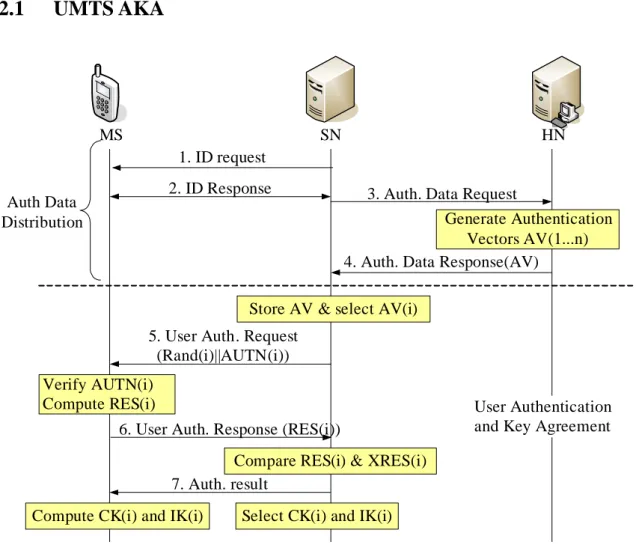
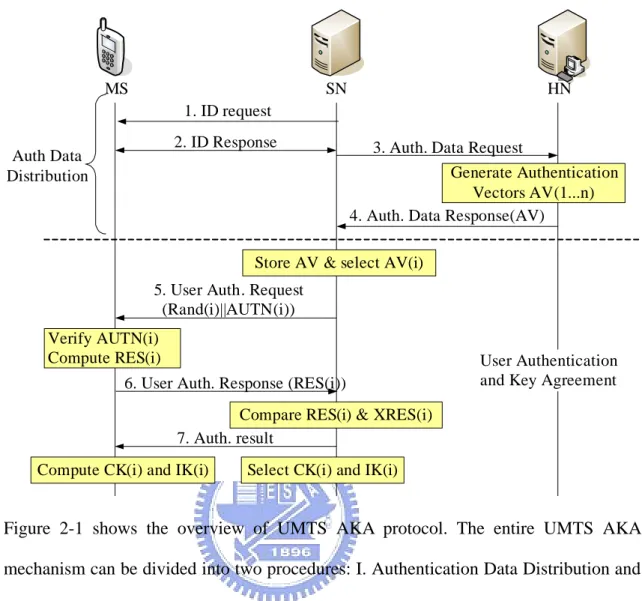
Figure 2-1 shows the overview of UMTS AKA protocol. The entire UMTS AKA mechanism can be divided into two procedures: I. Authentication Data Distribution and II. User Authentication and Key Agreement. The first procedure is for HN to distribute the request authentication data for proper SN which provides access to Internet for the roaming MS. The second procedure is to establish a new pair of reliable session key between MS and SN. This process is illustrated in 7 major steps below:
1: ID Request: Upon MS proposing an access request, Serving Network (SN) initiates
the authentication procedure by sending requests to MS and asking for MS’s identity.
2: ID Response: The International Mobile Subscriber Identity (IMSI) of MS is sent
from MS to SN so that SN can identify MS and transfer the authentication request backward to the HN of MS.
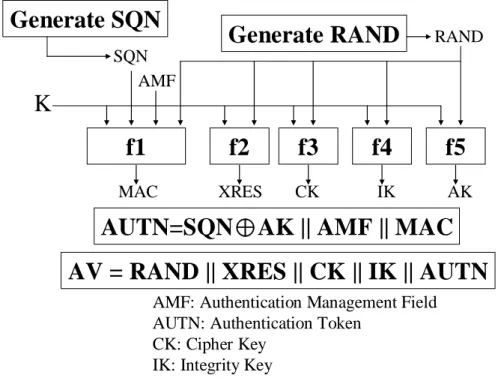
Generate SQN
Generate RAND
AUTN=SQN♁AK || AMF || MAC
AV = RAND || XRES || CK || IK || AUTN
f1
f2
f3
f4
f5
MAC XRES CK IK AK AMFK
RAND SQNAMF: Authentication Management Field AUTN: Authentication Token
CK: Cipher Key IK: Integrity Key
Figure 2-2 Operation in HN in UMTS AKA
3: Authentication Data Request: The purpose of this step is for SN to request
Authenti-cation Vectors (AV(i…n)) from the Home Network (HN). The ordered list on “n” au-thentication vectors based on sequence number (SQN) may be computed or pre-computed on demand and sent from HN to SN. The operation of generating each attributes in AV is shown in Figure 2-2. A cipher key K for MS, a random number RAND are the common parameters used as input in addition to Authentication Man-agement Field (AMF) and Sequence Number (SQN) to generate AV(i) comprising MAC (Message Authentication Code), XRES (eXpected Response), CK, IK, AK (Anonymity Key) and AUTN (Network Authentication Token).
4: Authentication Data Response: After generating the AV for specific MS, HN sends it
to SN so that SN is authorized to authenticate MS with the temporary authentication data.
5: User Auth. Request: After generating the AV for specific MS, HN sends it to SN so
that SN is authorized to authenticate MS with the temporary authentication data. Up re-ceiving the message from HN, SN selects the next unused Authentication Vector from
the ordered array and then sends both the RAND(i) and AUTN(i) of the ith selected vector to MS so that MS can verify the correctness of SQN and computes the propor-tional response RES(i).
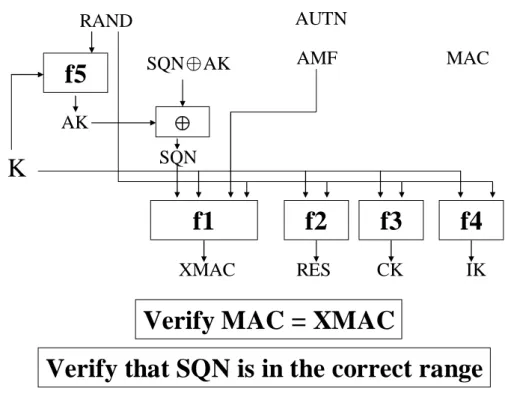
Verify MAC = XMAC
Verify that SQN is in the correct range
f1
f2
f3
f4
f5
XMAC RES CK IK AKK
RAND AUTN MAC AMF SQN♁AK ♁ SQNFigure 2-3 Operation in MS in UMTS AKA mechanism
6: User Auth. Response: MS verifies the correctness of SQN first by computing a
XMAC and comparing it with the MAC in AUTN(i). If the SQN is correct, MS then computes the proportional response RES(i) and sent it back to SN in the response mes-sage. The operation in MS is illustrated in Figure 2-3.
7: Auth. Result: Once the RES(i) is sent to SN and verified correct, the SN chooses the
corresponding CK/IK as the session key for the following connection. While waiting for the authentication result, MS computes the CK/IK in advance for usage until new au-thentication procedure is requested or Disconnection.
2.2
UMTS X-AKA
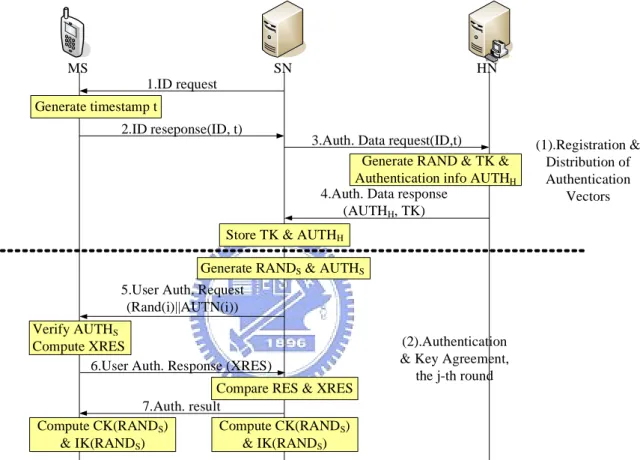
pro-posed another AKA protocol called UMTS X-AKA [4]. The Figure 1-1 illustrates the detail steps of X-AKA. The concept of UMTS X-AKA is to realize local authentication by means of a transient key TK generated by HN and stored in SN. The UMTS X-AKA can be decomposed into two major procedures: (1) Registration & Distribution of Au-thentication Vectors, (2) AuAu-thentication & Key Agreement (for the j-th round)
MS SN HN
1.ID request
2.ID reseponse(ID, t)
3.Auth. Data request(ID,t)
4.Auth. Data response (AUTHH, TK)
5.User Auth. Request (Rand(i)||AUTN(i))
6.User Auth. Response (XRES) 7.Auth. result
Generate RANDS & AUTHS
Verify AUTHS
Compute XRES
Compare RES & XRES Compute CK(RANDS)
& IK(RANDS)
Generate timestamp t
Generate RAND & TK & Authentication info AUTHH
Compute CK(RANDS)
& IK(RANDS)
Store TK & AUTHH
(1).Registration & Distribution of Authentication
Vectors
(2).Authentication & Key Agreement,
the j-th round
Figure 2-4 An overview of UMTS X-AKA mechanism
The UMTS AKA provides mutual authentication and the freshness assurance of the agreed session key. Compared with GSM AKA, the UMTS AKA is proven to be rela-tively secure [12] not only in reply attack caused by limited authentication data but also in false base station attack caused by unidirectional authentication. However, the UMTS AKA has three known flaws in (1) bandwidth consumption between HN and SN, (2) storage space of SN for spare authentication vector, and (3) sequence number synchro-nization. (1) and (2) are solve in UMTS X-AKA. However, the synchronization still cost for extra messages in UMTS X-AKA
However, most of the conventional AKA mechanisms are for single Mobile Station. When multiple MSs communicate and move as a group in Wireless Network, the cur-rent AKA mechanisms are suffered from the same issue: SN has to transfer multiple messages with Authentication Data Request for different MSs to the same HN and re-ceive response messages with Authentication Data since the MSs in the same group be-long to the same HN. Based on the group concept, we propose a sharing group authen-tication key-based Authenauthen-tication and Key Agreement mechanism to reduce the signal-ing overhead between SN and HN. With this group authentication procedure, not only the bandwidth between SN and HN is saved but also the key pre-distributed is achieved for group members.
Chapter 3
Group Authentication Key-based AKA
The aforementioned authentication and key agreement protocols are widely imple-mented, however, the complexity and costs are relatively high when bursts of authenti-cation messages pump for group communiauthenti-cations. In this paper, we propose an adaptive authentication protocol based on group authentication key to lessen the complexity and latency caused by group authentication. The idea of grouping mobile stations is based on clustering; people living in the same community, working in the same company, studying in the same campus, or even casually being on the same bus, tend to move from one place to another together. When a group of mobile users migrates simultane-ously, the first member who hands off may provide not only a personal identity but also sometimes a group identity to serving network. In our approach, however, mobile sta-tion provides only individual identity. The serving network may first check if this MS belongs to any active group which any members has already finished his authentication procedure and made the group authentication data available in database of serving net-work for the rest members in the same group. Assume that MS1 is the first member who performs authentication procedure when handoff, SN may obtain some authentication data for both MS and his group from their home network. Instead of generating and dis-tributing individual authentication data for each mobile station respectively, our scheme produce authentication data for groups of users so that mobile stations in the same group share the same batch of authentication data including group transient authentica-tion key and informaauthentica-tion in group list. By reducing the redundant messages, such as
Authentication Data Request sent out by different MS in the same group to the same
between serving network and home network.
The proposed protocol can be divided into three main procedures: 1.Setup proce-dure, 2. Authentication Data Distribution, 3. Mutual Authentication and Key Agreement. We will describe the details of each step from section 3.2.
3.1
Architecture
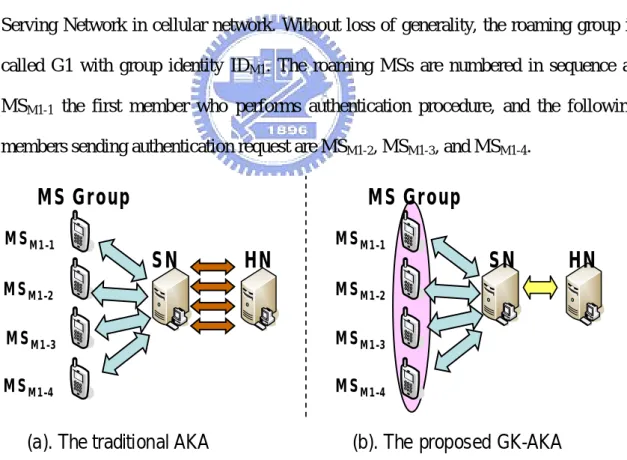
The basic architecture is shown in Figure 3-1 where Figure 3-1(a) shows how the tradi-tional AKA protocols work with roaming MS group and Fig.(b) the proposed GK-AKA. The HN represents the Authentication Server (AS) or the Authentication Center (AuC) which controls and manages all the authentication data for MS. The SN represents the authenticator in various wireless networks, such as Access Point in 802.11 network, or Serving Network in cellular network. Without loss of generality, the roaming group is called G1 with group identity IDM1. The roaming MSs are numbered in sequence as
MSM1-1 the first member who performs authentication procedure, and the following
members sending authentication request are MSM1-2, MSM1-3, and MSM1-4.
MS Group
SN
HN
MS Group
SN
HN
MSM1-1 MSM1-2 MSM1-4 MSM1-3 MSM1-1 MSM1-2 MSM1-4 MSM1-3(a). The traditional AKA (b). The proposed GK-AKA
Figure 3-1 System Architecture for roaming MS group
3.2
Setup Procedure
indi-vidual MS, our proposed mechanism provides group authentication data for a set of mobile stations. Thus before the AKA mechanism starts, the HN generates the group authentication data and distributes the necessary part to mobile stations in the same group. Group authentication data includes 1). Group Information and 2). Message
Au-thentication Code (MAC) Algorithms. The Group Information consists of the Group
Authentication Key (GAK) shared by HN and group members and the Index Table stored in only HN shown in Table. 1. After this step, HN holds the GAK and the Index Table while each MS holds the GAK, Group ID, its individual member ID and Initial Value, and is unaware of other MSs’ personal information.
3.2.1 Group Authentication Key (GAK)
GAK
HN MSM1-2 MSM1-1 MSM1-4 MSM1-3Figure 3-2 Group Authentication Key
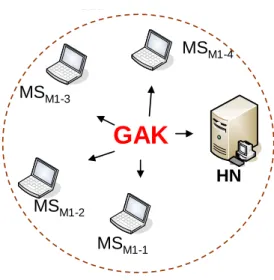
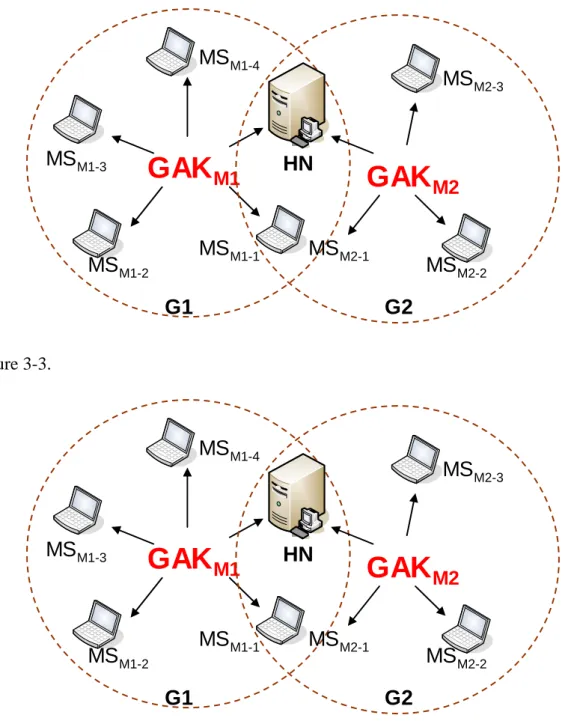
For the most part of networks, Group Key is introduced for encryption. Each member in the trust-group owns an individual key for end-to-end communication and shares a common group key for group communications. Here we define an entirely difference group key called Group Authentication Key (GAK) which is still shared by all members in the same group as shown in Figure 3-2 and used in not encryption but authentication.
GAK
M1HN
MS
M1-2MS
M1-1MS
M1-4MS
M1-3GAK
M2MS
M2-1MS
M2-2MS
M2-3G1
G2
Figure 3-3.GAK
M1HN
MS
M1-2MS
M1-1MS
M1-4MS
M1-3GAK
M2MS
M2-1MS
M2-2MS
M2-3G1
G2
Figure 3-3 One MS belongs to multiple MS groups
The GAK, as well as the individual authentication key for each MS, may be pre-defined or computed on demand. The generation and distribution of GAK with the members joining or leaving are managed by the Authentication Center (AuC) in users’ home network, and the details will not be discussed in this paper and can be referred to [10].
3.2.2 Index Table
Table I. Index Table
The major attributes comprise Group Identity (GID), Group Authentication Key (GAK), Member Identities (MS ID), Initial Value (IVi) for each member, and other information.
In this proposed protocol, the digits of initial value IVi are so large that each value is
unique and distinct from one another and no members can spy on others’ initial values. With the peculiarity of practically unlimited, the initial value of members can also be different and unique from group to group. Besides the facility for distinguishing from members, the initial value IVi also behaves as the sequence number in UMTS AKA
where SQN is responsible for the synchronization between MS and SN in User Authen-tication Procedure in UMTS AKA.
3.2.3 Message Authentication Code (MAC) Algorithms
The cryptographic MAC algorithms are short pieces of information used to authenticate a message. The inputs for MAC algorithms consist of a secret key and some information and outputs generated by MAC algorithms are usually not reversible. The MAC algo-rithms used in the proposed approach are:
f0: generating MAC for HN to authenticate MS. f1: generating MAC for MS to authenticate SN. f2: generating MAC for SN to authenticate MS. f3: key generation.
Group Group ID Member ID Initial Value Other Info
IDM1-1 IVM1-1 …
IDM1-2 IVM1-2 …
IDM1-3 IVM1-3 …
G1 IDM1
3.3
Authentication Data Distribution Procedure
The idea of the proposed protocol relies on the premise that members in the same group tend to migrate continuously and the latency arises from handoff procedure is propor-tional to the number of drifters. For n mobile stations, convenpropor-tionally, SN has to send n
Authentication Data Request message separately. However we now reduce the
redun-dant messages to the same destination arisen from different members in the same trust group by providing the group authentication data-Group Transient Key (GTK)-substi-tuting for the original GAK so that the primitive authentication key will not be revealed and the computed transient key can be periodically updated based on the random num-ber provided by SN and MS to ensure the freshness of authentication material.
MSM1-1 SN HN
Pre-Shared Key KM1-1, GAK Pre-Shared Key KM1-1, GAK
Generate AUTHM1
1.ID req.
2.ID res.(AUTHM1)
3. Auth. Data req.(AUTHM1)
Verify AUTHM1, Generate AUTHH
4.Auth. Data res.(AUTHH) Store AUTHH
Figure 3-4 Distribution of Authentication Data in the proposed AKA mechanism
Let the first member who performs authentication procedure be MSM1-1. Figure 3-4
il-lustrates the operation of GAK. The detail steps are as follows:
1. ID Req.: SN tries to get MSM1-1’s identity.
2. ID Res.(AUTHM1): Upon receiving the ID Req. message, MSM1-1 generates
AUTHM1 = (IDM1||IDM1-1||RNM1-1||MACM1-1)
f0(KM1-1, RNM1-1) for HN to authenticate MS before distributing group authentication
data to SN. The detail operation is presented in Figure 3-5.
f
0
MAC
M1-1K
M1-1RNM1-1
AUTH
AUTHM 1M1=(IDM1||IDM1-1||RNM1-1||MACM1-1)
Figure 3-5 Generation of MACM1-1 in MS in the proposed GAK-AKA mechanism
3. Auth. Data Req.(AUTHM1): Since MSM1-1 is the first MS in group, SN has no data to
authenticate MSM1-1. SN then transfers the message to HN and requests for data to
au-thenticate the roaming group G1 which MSM1-1 belongs to.
4. Auth. Data Res.(AUTHH): HN first verifies the MACM1-1 in AUTHM1 with KM1-1 the
pre-share key of MSM1-1. If MSM1-1 is confirmed legit, HN retrieves the corresponding
GAK of MS group G1 to generate a Group Transient Key (GTK)
GTKM1 = f3(RNM1-1||RNH||AMF||GAK)
. The group authentication data sent to SN is AUTHH = (RNH||AMF||RNM1-1||GTKM1)
where RNH is the random number generated by HN, AMF the Authentication
Manage-ment Field, RNM1-1 the random number used as one of the input of GTKM1, and the
GTKM1 of course. The Index Table for G1 is also sent to SN in this step. Figure 3-6
il-lustrates the operation in HN while HN receives the authentication request of MSM1-1
Generate
RN
RN
HHAUTH
H=
RN
RN
HH|| AMF || RN
M1-1|| GTK
M1f
0f
3 Yes/No GTKM1AMF
RN
H GAK RNM1-1 MACM1-1 AUTHM1 KM1-1=
MS Authentication3.4
Mutual Authentication and Key Agreement Procedure
This procedure focuses on the mutual authentication between MS and SN, and is de-signed to generate the session key between MS and SN so that a secure channel is es-tablished between MS and SN. Figure 3-7 presents the message flows.
MSM1-1 SN HN
Pre-Shared Key KM1-1, GAK Pre-Shared Key KM1-1, GAK
Generate AUTHSM1-1 5.Auth. req.(AUTHSM1-1) Verify AUTHSM1-1 6.Auth. res.(MACM1) Compute MACM1,MK Verify MACM1 Compute MK
7.Auth. Result (Success/Fail)
GTKM1
Figure 3-7 Mutual Authentication and Key Agreement in the proposed mechanism 5. Auth. Req.(AUTHSM1-1): After obtaining the group authentication data AUTHH for MS
group G1, SN initiates the i-th run of mutual authentication procedure between SN and MSM1-1 by generating AUTHSM1-1 = (AMF||RNH||RNM1-1||MACS||RNSM1-1) where the
first three parameters are necessary for mobile station to generate GTKM1, MACS =
f1(GTKM1||RNM1-1||IVM1-1+i), and a random number RNSM1-1 generated by SN and
used to challenge MSM1-1 later. While waiting for the response from MSM1-1, SN can
compute the Master Key MK = f3(GTKM1||RNM1-1||RNSM1-1) for the subsequent sessions
AUTH
SM1-1= AMF || RN
H||
RN
M1-1|| MAC
S|| RN
SM1-1f
1=
MACS Yes/No RNM1-1f
3 × i + MK SN Initialization Authenticate MS × GTKM MACM1 IVM1-1Generate RN
SM1-1 AUTHHf
2 RNSM1-1Figure 3-8 The operation in SN while authenticating MSM1-1
f
0f
1 MACM1-1 Yes/Nof
2f
3 MACM1MS Initialization Authenticate SN and HN
f
3 MK KM1-1 GAK × + RNH AMF MACS RNSM1-1 RNM1-1 i IVM1-1 AUTHAUTHM1M1=(IDM1||IDM1-1||RNM1-1||MACM1-1)
AUTHSM1-1
GTKM1
=
×
RNM1-1
6. Auth. Res.(MACM1): First of all, MSM1-1 computes the GTKM1 with the first three
ar-guments in AUTHSM1-1 and the GAK stored in each mobile station in the same group.
MSM1-1 then authenticates SN by computing and comparing a corresponding result of
MACS. After successfully authenticating SN, besides generating the Master Key MK
between SN and MSM1-1, MSM1-1 also generates the response message MACM1 =
f2(GTKM1||RNSM1-1||IVM1-1+i). Figure 3-9 shows the detail computation in MSM1-1.
7. Auth. Result (Success/Fail): SN authenticates MSM1-1 by verifying whether MSM1-1
generates the correct response or not in Figure 3-8. The message sent to MSM1-1
indi-cates the result of mutual authentication procedure.
After the full authentication process, the MK generated separately after step 5 in both MSM1-1 and SN can be used as the material for various keys.
When the second member MSM1-2 in roaming MS group requests for authentication,
SN initiates the mutual authentication procedure with the existing GTKM1 so that the
original step 3 and 4 are skipped and the signals between SN and HN are eliminated. The procedure of authenticating MSM1-2 is shown in Figure 3-10.However, the random
numbers used to compute the challenge messages, such as RNM1-2 for MACS and
RNSM1-2 for MACM1, are entirely different from those used in authentication of MSM1-1.
Figure 3-11 illustrates the operation of MAC algorithms in SN when authenticating MSM1-2 and Figure 3-12 presents the operation in MSM1-2.
MSM1-2 SN HN
Pre-Shared Key KM1-2, GAK Pre-Shared Key KM1-2, GAK
Generate AUTHM1 1.ID req. 2.ID res.(AUTHM1) Store AUTHH Generate AUTHSM1-2 5.Auth. req.(AUTHSM1-2) Verify AUTHSM1-2 6.Auth. res.(MACM1) Compute MACM1,MK Verify MACM1 Compute MK
7.Auth. Result (Success/Fail)
GTKM1
Figure 3-10 Authentication and Key Agreement for MSM1-2
AUTH
SM1-2= AMF || RN
H||
RN
M1-1|| MAC
S|| RN
SM1-2f
1=
MACS Yes/No RNM1-2f
3 × i + MK SN Initialization Authenticate MS × GTKM1 MACM1 IVM1-2Generate RN
SM1-2 AUTHHf
2 RNSM1-2f
0 f1 MACM1-2 Yes/No f2f
3 MACM1 MS Initialization Authenticate HN and SNf
3 MK KM1-2 GAK × + RNH AMF MACS RNSM1-2 RNM1-2 i IVM1-2 AUTHAUTHM1M1=(IDM1||IDM1-2||RNM1-2||MACM1-2)
AUTHSM1-2
GTKM1
=
×
RNM1-1
Chapter 4
Security Considerations
In this section, we discuss some performance analysis and efficiency evaluations of the aforementioned protocols in related work and our proposed GAK protocol based on the shared group authentication key. Here we consider 1.the storages cost in SN, 2.the sig-nals transferred between SN, and HN
4.1
Security Analysis
First of all, our proposed protocol satisfies the following concepts of secure wireless network user authentication:
1. Mutual Authentication: In this GAK protocol, mutual authentication of MS and HN is done by producing the same GTK, and mutual authentication of MS and SN is done by generating and comparing the challenge messages RESS and RESM. In particular, even though all members share the same GTK,
when one adversarial member, MS1 for example, tries to personate another member, MS2 for example, by eavesdropping and collecting the traffic be-tween MS2 and SN, MS1 fails to generate the correct RESM which must be
calculated by GTK, RNS2, and most important of all the initial value j2 of MS2.
In other words, the SN can easily distinguish one member from another even though all members have the same GTK and in case some of them may inter-cept other members’ challenge messages.
2. Reply Attack Resistance: When an attacker attempts to intercept an authen-tication packet and later transmit it to the expected destination, the receipt of duplicated packet may cause some undesired consequence. In our proposed
scheme, whenever a user authentication is requested, new random numbers RNMi and RNS from MS and SN respectively are both produced to provide
temporally use of generating challenge messages. Besides, the initial value ji
in both MS and Group List stored in SN brings about the synchronization be-tween MS and SN since they are requested to keep the same value so that SN can identify MS successfully. Therefore, the proposed protocol is able to pro-vide reply attack resistance.
3. Secure Key Derivation: The session key shared between MS and SN is gen-erated respectively by each side without any extra messages exchange in this proposed protocol. Therefore we can keep the session key from being attacked or intercepted by adversaries.
4. Scalability: Since the proposed protocol is based on the concept of group au-thentication, the number of messages is less than most of the prevalent AKA protocols when multiple users request for authentication simultaneously. The conventional AKA protocols generate different authentication data for indi-vidual mobile station while our GAK protocol uses the same GTK and Group List to authentication a party of users. Because parts of the redundant mes-sages are reduced by using the GTK directly, our proposed method is able to process multiple authentication requests if the scale of users grows.
4.2 Performance Analysis
Our proposed mechanism takes the GTK as a substitute for the original GAK so that the primary GAK can be protected whereas the SN can be fully authorized to authenticate the roaming MS group with exactly one key instead of several distinct authentication data for individual MSs. For HN, the signaling overhead between SN is reduced. For SN, not only the communication bandwidth between HN is saved but also the storage
cost for user database is diminished. As for MS, except the first member in group, au-thentication key is pre-distributed without extra message exchange. Furthermore, one MS can belong to more than one group and hold multiple GAKs. Thus the MS is able to decide different group identity for group authentication when roaming to different SNs. One of the most important performance evaluations of AKA protocols are the secure level. In our proposed mechanism, HN authenticates the legitimacy of MS before pro-viding the group authentication data to SN so that SN cannot obtain MS’s authentication data without a request message from MS. The freshness of messages for mutual authen-tication between SN and MS can be assured by the random number generated by both side. If a malicious MS tries to impersonate other members in the same group with the identical GAK, SN is able to identify the vicious member by comparing the IV in Index Table provided by HN. With the unique MKs for different pairs of MS and SN, the secure channel between MS and SN is established.
4.3 Efficiency Evaluation
We evaluate the storage cost by the authentication data in database of SN and approxi-mately measure the quantities of the signals transferred between MS, SN and HN in mathematical way. The cost of storage and signals compared with UMTS AKA[15] and UMTS X-AKA[4] is tabulated in Table II ,where n is the number of mobile stations, g is the number of roaming groups, and m represents the times of authentication requests from each MS if every mobile station is assumed to send more than just one authentica-tion request. By observing the effect caused by argument m, we can scrutinize the dif-ference in number of signals between our proposed method and the aforementioned AKA protocols.
Table II QUALITATIVE ANALYSIS OF THREE KINDS OF AKA PROTOCOLS
The proposed AKA mechanism only needs g authentication data in an SN whereas the other approaches require n different authentication data. Since only the very first mem-ber of each group perform full authentication, the signaling overhead in our proposed scheme is obviously n/g times less than that in [15] and [4]. Generally speaking, the number of groups g and is much smaller than the number of MSs n. Figure 4-1 shows the number of signals between SN and HN in the three AKA mechanisms, in which each MS transfers three authentication requests. Notice that the number of signals in GK-AKA is related to the number of groups, g, whereas factors in UMTS AKA are the number of MSs n, and the number of authentication requests transferred by each MS and that in UMTS X-AKA is n as well.
Signals between HN and SN
0 50 100 150 200 250 300 350 5 10 15 20 25 30 35 40 45 50
Number of MRS
N
um
ber
o
f
si
gnal
s
UMTS AKA UMTS X-AKA G-AKAFigure 4-1 The signaling overhead between HN and SN with g = 1 and m = 3.
Signals between HN and SN mechanism
STORAGE IN SN One
MS n MSs
UMTS AKA n*AV(s) 2 2n
UMTS X-AKA n*(TK+AUTH) 2 2n
Chapter 5
Conclusion and Future Work
We proposed an authentication and key agreement scheme based on Group Key that allows mobile stations to share a group secret including group key and identity for authentication. With the shared group authentication data, not only the signaling over-head between HN and SN is considerably reduced, but also the storage cost in SN is appreciably diminished. Thus our proposed mechanism is able to fasten the handoff procedure and provide better services for real-time applications. The proposed scheme fits all networks with group character, such as TETRA network [20], 802.16 WiMAX networks [18][19], and also the security system in company. We can extend the group concept to the serving network side when one SN cooperates with another one. By sharing the group secret, SN may be able to pre-authenticate the coming MS if the MS hands over from a member SN.
Reference
[1] B. Aboba, et al., “Extensible Authentication Protocol (EAP)”, RFC 3748, June 2004.
[2] B. Aboba, et al., “PPP EAPTLS Authentication Protocol”, RFC 2716 IETF, Octo-ber 1999.
[3] J. Arkko, et al., “Extensible Authentication Protocol Method for 3rd Generation Authentication and Key Agreement (EAP-AKA)”, RFC 4187, January 2006.
[4] C.-M Huang, et al., “Authentication and Key Agreement Protocol for UMTS with Low Bandwidth Consumption”, Advanced Information Networking and Applica-tions, 2005. AINA 2005. 19th International Conference, 28-30 March 2005, pp.392 - 397 vol.1.
[5] H. Haverinen, et al., “Extensible Authentication Protocol Method for Global Sys-tem for Mobile Communication (GSM) Subscriber Identity Modules (EAP-SIM) ”, RFC 4186 IETF, January 2006.
[6] R. Housley, et al., “Internet X.509 Public Key Infrastructure Certificate and Cer-tificate Revocation List (CRL) Profile”, RFC 3280 IETF, April 2002.
[7] V. C. Joseph, et al., “Verifiable AKA for Beyond 3G Wireless Packet Services”, Wireless and Optical Communications Networks, 2006 IFIP International Confer-ence, 11-13 April 2006.
[8] W. Liang, et al., “A Local Authentication Control Scheme Based on AAA Archi-tecture in Wireless Networks”, Vehicular Technology Conference, 2004, VTC2004-Fall, IEEE 60th. Vol. 7, 26-29 September 2004, pp5276-5280.
[9] W. Simpson, et al., “PPP Challenge Handshake Authentication Protocol (CHAP)”, RFC 1994 IETF, August 1996.
[10] D. Wallner, et al., “Key Management for Multicast: Issues and Architectures ”, RFC 2627 IETF, June 1999.
[11] C.-K Wong, Mohamed Gouda, and Simon S. Lam, “Secure Group Communications Using Key Graph”, IEEE/ACM Trans. Netw, Vol. 8, No. 1, February 2000, pp.78-85
[12] M. Zhang, et al., “Security analysis and enhancements of 3GPP authentication and key agreement protocol”, Wireless Communications, IEEE Transactions on Volume 4, Issue 2, March 2005 pp.734 - 742.
[13] 3rd Generation Partnership Project (3GPP) [Online] Available: http://www.3gpp.org/
[14] 3rd Generation Partnership Project; Technical Specification Group SA; 3G Security, “Security Threats and Requirements”, 3GPP, TR 21.133, 1999.
[15] 3rd Generation Partnership Project; Technical Specification Group SA; 3G Security, “Report on the evaluation of 3GPP standard confidentiality and integrity algorithms, version 1.0.0, 2000-12”, 3GPP, TR 33.908, 1999.
[16] European Telecommunications Standards Institute (EISI), GSM 02.09 Security Aspects, June 1993.
[17] IEEE Std IEEE 802.11TM-
[18] IEEE Std IEEE 802.16™-2004, “IEEE Standard for Local and Metropolitan Area Networks Part 16: Air Interface for Fixed Broadband Wireless Access Systems”, Oct. 2004.
[19] IEEE Std IEEE 802.16e™-2005, “IEEE Standard for Local and Metropolitan Aarea Networks Part 16: Air Interface for Fixed Broadband Wireless Access Systems”, Dec. 2005http://shop.ieee.org/ieeestore/Product.aspx?product_no=SS95394.