行政院國家科學委員會專題研究計畫 成果報告
自有住宅對台灣地區家庭生育決策之影響
研究成果報告(精簡版)
計 畫 類 別 : 個別型 計 畫 編 號 : NSC 96-2415-H-004-010- 執 行 期 間 : 96 年 08 月 01 日至 97 年 07 月 31 日 執 行 單 位 : 國立政治大學財政系 計 畫 主 持 人 : 羅光達 計畫參與人員: -99:羅光達 碩士班研究生-兼任助理人員:莊靖怡 碩士班研究生-兼任助理人員:魏郁倫 報 告 附 件 : 出席國際會議研究心得報告及發表論文 處 理 方 式 : 本計畫涉及專利或其他智慧財產權,1 年後可公開查詢中 華 民 國 97 年 11 月 05 日
The Influence of Homeownership on Fertility in Taiwan
Kuang-Ta Lo
Assistant Professor National Chengchi University
Abstract
Mulder (2006) argues that the homeownership and the quality of housing have the effects on the fertility behavior of a family. However, the literatures have concluded different
findings regarding whether or not the homeownership promotes or delays a family’s reproduction decision.
In this study, we construct the regional-based panel data comprising 23 counties and cities from 1994 to 2005 in Taiwan to estimate the effects of homeownership on fertility behavior. Our empirical results show that the private homeownership rate is negatively related to the birthrate in Taiwan. With limited resources available in each household, homeownership and reproduction decision seems to compete and crowd out each other. However, from the lagged models, the crowd out effect diminishes as time goes by. In addition, we also found that the cultural lunar year effect significantly affects a family’s fertility decision in Taiwan.
Key words: Homeownership, Fertility, Panel data, Taiwan
Introduction
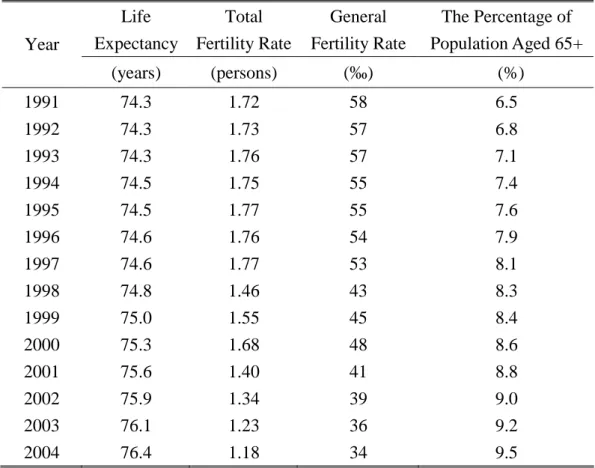
Over the past two decades, the population structure in Taiwan has undergone significant changes. These changes can be observed by the vital statistics in Table 1. First, the life expectancy has increased from 74.3 years in 1991 to 76.4 years in 2004. Second, the total fertility rate dropped from 1.72 persons to 1.18 persons. Third, during the same period, the general fertility rate also decreased from 58‰ to 34‰. Fourth, the population aged 65 and above in the total population increased from 6.5% to 9.5%. These changes in figures show that Taiwan is undergoing the so-called “demographic transition”. In other words, it is apparent that the demographic structure of Taiwan is headed toward the
“high-senescence-and-low-birthrate”trend.
The phenomenon of low birthrates not only affects demographic structure developments, it also causes social and economic problems; therefore, different countries have proposed policies to improve the low birthrate problem. For instance, Japan implemented baby bonus and nursery funds to encourage births. The government in Germany plans to set aside 4.6 billion Euro to subsidize families to raise children and compensate for women who are unable to work during birth giving and child upbringing as well as high tuitions for kindergarten. In France, a mother is entitled to a 4-month paid maternal leave whether she delivers a baby herself or adopts one. In Singapore, the government not only issues cash bonuses and savings as incentives, women with bearing the third baby are entitled to extra bonuses while they are on maternal leave. Also, the family with three children is prioritized in renting the public housing. In Taiwan, Hsinchu City government encourages birth giving by implementing the maternity allowance to encourage women to have babies1.
The above fertility policies implemented in different counties mostly focus on childbirth subsidies or parental leave provisions; few include discussions on the environment for the baby care and child upbringing. Narrowly speaking, the baby care and child upbringing environment refers to the environment conditions suitable for nursery; however, in the broad sense, it refers to the long-term living environment conditions. In literature, the effects of living conditions on the reproduction decision are discussed from social and economic aspects. The public generally believes that a stable space to live and grow up is beneficial for character building of children. Therefore, many sociology studies show that the homeownership has certain effects on family formation and reproduction decision. For example, Ineichen (1981) pointed out that the young men and women in the United Kingdom postpone the time of marriage and having children because they cannot have homeownership. In Taiwan, the first and foremost important motive for people to buy a house is to improve the living conditions
1
The childbirth subsidies in Hsinchu are: first born (NT$15,000); second born (NT$20,000); third born (NT$25,000); twins (NT$50,000); triplet and more (NT$100,000)
and for environmental protection, followed by the reasons of marriage and having children2. Therefore, homeownership indeed affects a family’s reproduction decision. Mulder (2006) argues that there are two possible relationships between homeownership and fertility behaviors. First, homeownership ensures a stable family environment; thus, it increases the birthrate. Second, with the family budget constraints and limited resources, once a large of budget is spent to purchase a house, the fertility behavior may either crowd out or be
postponed. Therefore, the relationship between homeownership and fertility behavior shows no clear direction of influence.
Table 1: Vital Statistics in Taiwan
Life Expectancy Total Fertility Rate General Fertility Rate The Percentage of Population Aged 65+ Year (years) (persons) (‰) (%) 1991 74.3 1.72 58 6.5 1992 74.3 1.73 57 6.8 1993 74.3 1.76 57 7.1 1994 74.5 1.75 55 7.4 1995 74.5 1.77 55 7.6 1996 74.6 1.76 54 7.9 1997 74.6 1.77 53 8.1 1998 74.8 1.46 43 8.3 1999 75.0 1.55 45 8.4 2000 75.3 1.68 48 8.6 2001 75.6 1.40 41 8.8 2002 75.9 1.34 39 9.0 2003 76.1 1.23 36 9.2 2004 76.4 1.18 34 9.5
Source: Ministry of the Interior, Department of Health.
2
Source: Housing Demand Survey of the Second Season 2006, Council for Economic Planning and Development, Taiwan.
Literature Review
The literatures state that the homeownership will affect a family’s reproduction decision indirectly and directly. The indirect factors originate from the effects of homeownership on the formation of a family. Mulder (2006) points out that since it is rather difficult for young people in Europe to buy houses, they leave home to live independently at a later age. This in turn delays the formation of families and indirectly reduces the birthrate. On the other hand, it is asserted that the homeownership has a direct effect on birth giving. The main reason for this is that parents hope to provide their children with more stable and high quality living and growing environments. Therefore, we can observe that a family’s fertility behavior often occurs after having a house. For example, Feijten and Mulder(2002) discovers that birth giving to the first child often takes place after a family has found a permanent place to stay in Netherlands. Mulder and Wagner(2001) also find the similar fertility behavior pattern in
Germany. Krishnan and Krotki (1993) show that during the period in which women give birth, women are more likely to become home owners than in other periods. However, for women without kids, there is no significant difference between the ratios of home owners and renters in any periods.
Some researchers however believe that homeownership and birth giving are long-term and high-cost behaviors for households. Therefore, under the family budget constraints, the crowd out effect is possible. Courgeau and Lelièvre (1992) show that having a house may lead to a delayed reproduction decision3. Murphy and Sullivan (1985) demonstrate that homeownership is an important variable in analyzing the birth giving behavior in the U.K., and they are negatively related. In other words, the birthrate and the number of children are lower in the families owning homes, as compared to the families that rent homes.
Castigliono and Zuanna (1994) believe that couples usually find a suitable place to live before having children because a self-owned home is the fundamentals to raise children; thus, house purchasing will postpone the fertility behavior. Based on the descriptions above, it is found that no consensus has been reached among literatures regarding whether or not homeownership increases the birthrate or produces negative effects on the reproduction decision.
Empirical Model and Data Description
In order to investigate the relationship between homeownership and fertility, we establish the regional-based panel data comprising 23 counties and cities from 1994 to 2005
3
Courgeau and Lelièvre (1992) show that the house purchase will crowd out other family resources, but the extentofsuch effectsvary asthehead ofahousehold’sjobsdiffer.
in Taiwan. We focus only on the regional-specific effects, thus, the fixed-effects model can be written as follow: it kit k it it i it X X X Y 1 1 2 2 ... (1)
In this study, we collect data of 23 counties and cities in Taiwan from 1994-2005 (12 years). Thus, in Equation (1), i23,t12, and the number of observations is 276. The general fertility rate (GFR)4 of childbearing age women is adopted as the dependent variable in this study. The independent variables include the private homeownership rate (PHR), the household income (INC), the unemployment rate (UR), the infant mortality rate (IMR), the women education (WEDU), and the dummies of the lunar dragon/tiger year. The definitions of all variables and their descriptive statistics are listed in Table 2. Since there is a 10-month period between the time of conception and birth giving, the application of the lagged form in the empirical model is a more suitable approach. As Huang (2002) mentioned, because the correct lag structure is difficult to identify, one-year lag and two-year lag specifications are estimated for comparisons. Besides, we use the log-log form to estimate the elasticities. Based on the descriptions above, the fertility equations estimated in this study are as follows.
Model 1: t i t i t i t i t i t i k t i WEDU IMR UR INC PHR GFR , , 5 , 4 , 3 , 2 , 1 0 , ) ln( ) ln( ) ln( ) ln( ) ln( ) ln( (2) Model 2: t i t i t i t i t i t i t i k t i WEDU IMR FUR MUR INC PHR GFR , , 6 , 5 , 4 , 3 , 2 , 1 0 , ) ln( ) ln( ) ln( ) ln( ) ln( ) ln( ) ln( (3) Model 3: t i k t k t t i t i t i t i t i k t i T D WEDU IMR UR INC PHR GFR , 7 6 , 5 , 4 , 3 , 2 , 1 0 , ) ln( ) ln( ) ln( ) ln( ) ln( ) ln( (4) Model 4: t i k i k i t i t i t i t i t i t i k t i T D WEDU IMR FUR MUR INC PHR GFR , 8 7 , 6 , 5 , 4 , 3 , 2 , 1 0 , ) ln( ) ln( ) ln( ) ln( ) ln( ) ln( ) ln( (5) 4
The general fertility rate is the number of live births per 1,000 females of childbearing age between the ages of 15-49 years in a given year.
Table 2: Descriptions and Statistics of the Variables
Variables Descriptions Mean Standard Deviation Minimum Maximum Expected Sign
GFR Generalfertility rate(‰):regionallivebirthsper1,000
women aged 15-49. 47.52 10.96 26 77
PHR Private homeownership rate (%): regional ratio of
owner-occupied houses to total residential houses. 86.57 5.25 71.7 95.94 ?
INC Household income (NTD): regional average household
income, deflated to the year of 2001. 809,874 148,357 509,071 1,238,340 +
UR Unemployment rate (%): regional annual unemployment
rate. 3.37 1.28 0.9 5.51 -
MUR Male unemployment rate (%): regional male
unemployment rate. 3.68 1.51 0.5 6.8 -
FUR Female unemployment rate (%): regional female
unemployment rate. 2.93 1.04 0.9 5.1 -
IMR Infantmortality rate(‰):regionalratio ofinfantdeaths
aged below 1 year old to live births. 6.11 1.51 2.34 12.97 ?
WEDU Women education level (%): regional ratio of women
graduated from college or higher to total female population. 6.25 4.39 0.39 24.01 -
D D=1, if year=2000; D=0, others. 0.08 0.28 0 1 +
Empirical Results
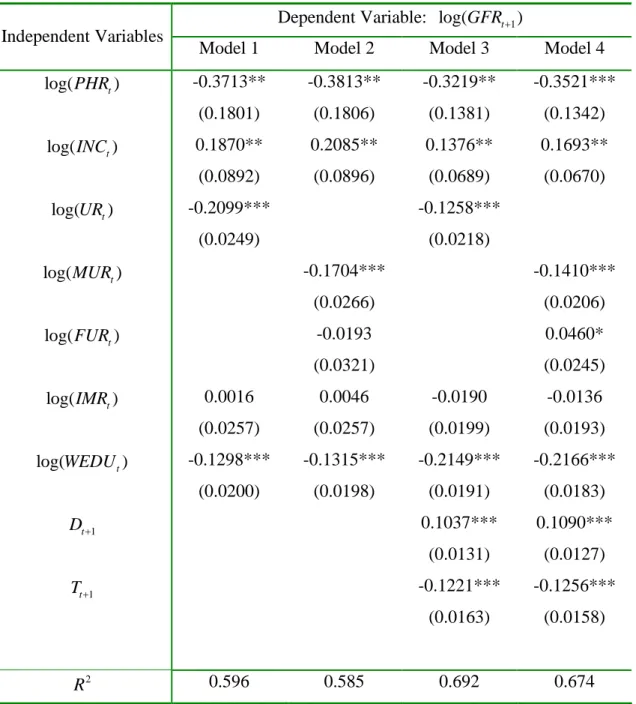
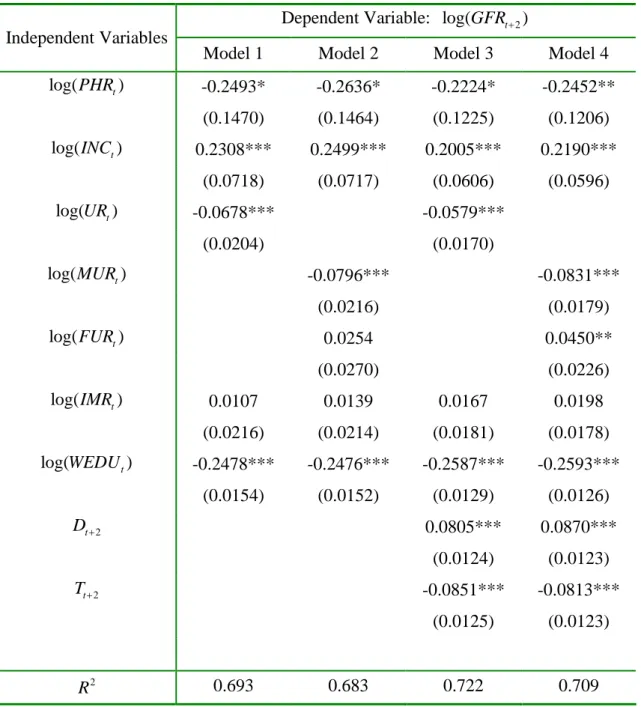
Table 3 and Table 4 represent our empirical results. In the one-year lag form (Table 3), the coefficients of PHR in our four models are -0.37,-0.38,-0.32 and -0.35, respectively. This result shows that the private homeownership rate and the birthrate are negatively related. Namely, when the PHR is increased by 1%, there is a 32%-38% drop in birthrate. In the two-year lag form (Table 4), the 1% increase in the PHR will result to a drop of 22%-26% in the fertility rate. This result shows that an increase in the PHR will result to a decrease in the birthrate; however, as time goes by, the negative effect will become smaller. Therefore, our results support Courgeau and Lelièvre (1992) and Murphy and Sullivan (1985), under the limited household budget constraints, the homeownership produces a resource crowd–out effectoradelay effecton afamily’sfertility decision.We further show that this negative effect will become smaller as time passes.
As for the household income, the empirical results are the same as expected in the birth-giving model. When children are considered as a normal good, an increase in income will bring to an increase demand for children. Therefore, income and birthrate are positively related. In addition, Model 1 and Model 3 also show that the unemployment rate is
significantly negative to the birthrate. This coincides with the results of Mocan (1990) and Huang et al. (2006) that the fertility behavior is procyclical. In other words, as the
unemployment rate drops, there are prosperous economic developments, and people become more hopeful in their ability to have children and raise them. The birthrate will therefore increase. Moreover, in Model 2 and Model 4, we find that the male unemployment rate is significantly negative; however, the coefficient of the female unemployment rate could be positive and negative. The positive coefficient could be explained that when women are unemployed, their time spent at home increases; thus, the reproduction decision is more likely to be made. This will in turn aid in increasing the birthrate. However, the estimation is not significant.
In terms of the infant mortality rate, the results obtained from different models show no significant differences. Most coefficients are positive. It signifies that in Taiwan, the
replacement effect caused by the baby deaths is greater than the cost effect as proposed by Whittington et al.(1990); however, it is not statistically significant. As for the women’s education level, the estimated coefficients are negative values. It shows that the areas with higher women education level have lower birthrates. This result coincides with the theory that women with high education level will increase the opportunity cost of raising children. It thus will have a negative effect on the reproduction decision. The special lunar year effect also coincided with expected results. Taiwanese are more likely to give births in the lunar dragon year but not in the lunar tiger year.
Conclusions
Mulder (2006) argues that the homeownership provides households a stable living environment, and a more favorable environment to raise the young. Therefore, the
homeownership also increases a family’s willingness to have children. However, under the household’sbudget constraints, once a family spends a large resource to purchase a house, the crowd-out effect may take place or the fertility behavior may be postponed in the short-run. Therefore, the relationship between the two remains to be determined. In this study, the panel data comprising of 23 counties and cities in Taiwan are used together with the fixed-effect model to discuss the effects of homeownership on the fertility behavior in Taiwan. According to our empirical results, the private homeownership rate and the birth rate in Taiwan are negatively related. In other words, with other conditions being constant, areas with high private homeownership rates tend to have lower birthrates. This result seems to support the finding of Courgeau and Lelièvre (1992). Under the limited household resources, the
homeownership and reproduction decision will compete and crowd out each other. However, from our lagged models, it is found that the crowding out effect diminishes as time goes by.
In this study, we also show that when the household income increases the birthrate will increaseaswell,implying children arenormalgoods.Besides,when women’seducation level increases, the higher shadow price of their wages will be; therefore, the cost of raising
children will also increase. It further will inhibit the increase in fertility. The unemployment rate is negatively related to the birthrates. Besides, the traditional lunar year culture does affectTaiwanesefamily’sfertility decision.
The limitation of this study is that the data and variables obtained from the cities and counties are the average values of all households instead of each individual household data. As a result, some variables affecting afamily’sreproduction decision such as the age of household’shead,the family structure cannot be controlled. In addition, the reasons for the different homeownership rates in the different cities and counties such as the housing price is not taken into consideration or explained. It is recommended that these limitations be included in future studies.
Table 3: Empirical Results –One-Year Lag
Dependent Variable: log(GFRt1) Independent Variables
Model 1 Model 2 Model 3 Model 4
-0.3713** -0.3813** -0.3219** -0.3521*** log(PHRt) (0.1801) (0.1806) (0.1381) (0.1342) 0.1870** 0.2085** 0.1376** 0.1693** log(INCt) (0.0892) (0.0896) (0.0689) (0.0670) -0.2099*** -0.1258*** log(URt) (0.0249) (0.0218) -0.1704*** -0.1410*** log(MURt) (0.0266) (0.0206) -0.0193 0.0460* log(FURt) (0.0321) (0.0245) 0.0016 0.0046 -0.0190 -0.0136 log(IMRt) (0.0257) (0.0257) (0.0199) (0.0193) -0.1298*** -0.1315*** -0.2149*** -0.2166*** log(WEDUt) (0.0200) (0.0198) (0.0191) (0.0183) 0.1037*** 0.1090*** 1 t D (0.0131) (0.0127) -0.1221*** -0.1256*** 1 t T (0.0163) (0.0158) 2 R 0.596 0.585 0.692 0.674
Note: 1. The standard errors are in parentheses.
Table 4: Empirical Results –Two-Year Lag
Dependent Variable: log(GFRt2) Independent Variables
Model 1 Model 2 Model 3 Model 4
-0.2493* -0.2636* -0.2224* -0.2452** log(PHRt) (0.1470) (0.1464) (0.1225) (0.1206) 0.2308*** 0.2499*** 0.2005*** 0.2190*** log(INCt) (0.0718) (0.0717) (0.0606) (0.0596) -0.0678*** -0.0579*** log(URt) (0.0204) (0.0170) -0.0796*** -0.0831*** log(MURt) (0.0216) (0.0179) 0.0254 0.0450** log(FURt) (0.0270) (0.0226) 0.0107 0.0139 0.0167 0.0198 log(IMRt) (0.0216) (0.0214) (0.0181) (0.0178) -0.2478*** -0.2476*** -0.2587*** -0.2593*** log(WEDUt) (0.0154) (0.0152) (0.0129) (0.0126) 0.0805*** 0.0870*** 2 t D (0.0124) (0.0123) -0.0851*** -0.0813*** 2 t T (0.0125) (0.0123) 2 R 0.693 0.683 0.722 0.709
Note: 1. The standard errors are in parentheses.
References
Courgeau, Daniel and Eva Lelièvre(1992),“Interrelations Between First
Home-ownership, Constitution of the Family, and Professional Occupation in France.”Demographic Applications of Event History Analysis, edited by J.
Trussell, R. Hankinson, and J. Tilton. Oxford: Clarendon Press, 120-140.
Feijten, Peteke andClara H.Mulder(2002),“TheTiming of Household Events and Housing Events in the Netherlands: A Longitudinal Perspective.”Housing Studies,
17, 773-792.
Huang, Jr-Tsung (2002),“PersonalTax Exemption:TheEffecton Fertility in Taiwan.”The Developing Economies, 40(1), 32-38.
Huang, Jr-Tsung, An-Pang Kao, and Wen-Chuan Hung (2006),“TheInfluenceof College Tuition and Fees on Fertility Ratein Taiwan.”Journal of Family and Economic Issues, 27(4), 626-642.
Ineichen, Bernard (1981),“TheHousing Decision ofYoung People”,British Journal of Sociology, 32, 252-258.
Krishnan, Vijaya. and Karol. J. Krotki (1993),“Life Cycle Effects on Homeownership in Canada”,Housing Studies , 8, 120-127.
Mocan,NaciH.(1990),“BusinessCycles and Fertility Dynamics in the United States: A Vector Autoregressive Model.”Journal of Population Economics, 3, 125-146.
Mulder, Clara H. and MichaelWagner(2001),“TheConnections Between Family Formation and First-time Homeownership in the Context of West Germany and theNetherlands.”European Journal of Population, 17, 137-164.
Murphy, M. J. andO.Sullivan (1985),“Housing Tenure and Family Formation in Contemporary Britain.”European Sociological Review, 1, 230-243.
Mulder, Clara H. (2006),“Population and Housing: A Two-sided Relationship.”
Demographic Research, 15, 401-412.
Whittington,LeslieA.,JamesAlm and H.Elizabeth Peters(1990),“Fertility and the Personal Exemption: Implicit Pronatalist Policy in theUnited States.”American Economic Review, 80, 545-556.
出席國際學術會議心得報告
計畫編號
96-2415-H-004-010-計畫名稱 自有住宅對台灣地區家庭生育決策之影響
出國人員姓名 服務機關及職稱
Kuang-Ta Lo, Assistant Professor, National Chengchi University, Department of Public Finance
會議時間地點 June 29 –July 3, 2008, Hawaii
會議名稱 The 83
rd
Annual Conference of the Western Economic Association International (WEAI)
發表論文題目 The Influence of Homeownership on Fertility in Taiwan –Evidence from Regional-Based Panel Data
一、參加會議經過
本人於 2008 年 6 月 29 日搭乘華航班機前往美國夏威夷參加此次國際會議,於當日早上 抵達飯店略為休息後,即赴美國西方經濟學會辦理註冊報到,並與與會的學者交換學術研究 心得。6 月 30 日下午,本人在研討主題為“EconomicsoftheFamily”的場次中發表“The Influence of Homeownership on Fertility in Taiwan –Evidence from Regional-Based Panel Data”論文一 篇;並評論“Child-rearing, the Tax System, and Retirement Saving”一文(該文作者為 Professor Stuart J. Wilson, University of Regina, Department of Economics)。晚上,本人與參與此次會議 之多位經濟學者一起用餐並交換研究心得。會議期間,本人亦參加了 2 場與本人研究興趣有 關之 seminar,收益良多。會議結束後本人則進行兩天的私人參訪行程,並於 7 月 5 日搭機返 回台灣。
二、與會心得
此次會議的參與者,包含許多國際上經濟研究領域中相當傑出的學者。例如:Professor Jack W. Hou (California State University), Professor Davina C. Ling (California State University), Professor Been-Lon Chen (Academia Sinica)等等。在會議進行的期間,本人除了在所參與的場 次之中發表與評論論文之外,並利用機會與上述學者加強意見交換,促進學術交流。另外, 本人也與 Professor Wilson (University of Regina)討論未來合作的可能議題方向。除了與國外學 者的討論之外,本人也與多位國內知名學者進行交流,例如中研院經濟所楊建成教授,陳明 郎教授,台北大學經濟系徐美教授,陳俊志教授等等。而在本人所發表的論文場次中,與會 的學者則對本人的論文表示相當的研究興趣,並且在計量模型上給予相當具有建設性的建 議。本人針對與會學者所提出的問題與意見,已對此論文進行修正,並預計投稿至 Housing Studies 期刊(SSCI)。 總之參加此次研討會,由於在會中與多位國內外傑出學者認識與交流,對本人在目前研 究的議題上有直接的幫助,並且對本人在未來研究的方向規劃上亦有相當的助益。