Materials Science and Engineering B 113 (2004) 42–45
Photocatalytic TiO
2
thin films prepared via a high-pressure
crystallization process
Chung-Hsin Lu
∗, Wei-Hong Wu
Department of Chemical Engineering, National Taiwan University, Taipei, Taiwan, ROC Received 31 May 2004; accepted 23 June 2004
Abstract
Titania thin films with high photocatalytic activity are successfully synthesized by combining the metalorganic deposition method (MOD) and the high-pressure crystallization (HPC) process. The crystallization temperature of anatase-type TiO2films is significantly reduced to as
low as 150◦C. TiO2thin films with crack-free surface and uniform morphology are obtained. The diffusion of silicon species from substrates
into TiO2films is effectively suppressed. The HPC-derived TiO2thin films are demonstrated to have higher photocatalytic activity than those
prepared via the conventional annealing process. © 2004 Elsevier B.V. All rights reserved.
Keywords: Photocatalytic; Titanium dioxide; Anatase; Thin films
1. Introduction
In recent years, titanium dioxide (TiO2) has been
exten-sively applied in various fields such as dielectric materials, gas sensors, dye-sensitized solar cells, pigments, and pho-tocatalysts[1–5]. Ever since Fujishima[6] discovered that TiO2can split water under UV light illumination, the
photo-catalytic activity of TiO2has attracted great attention and has
been widely investigated[7,8]. There are various methods to synthesize TiO2thin films, such as the sol–gel method, the
sputtering method, and the chemical vapor deposition (CVD) method. The most commonly adopted method for preparing photocatalytic TiO2thin films is the sol–gel method because
of the advantages of simplified processes and low cost of materials. M. J. Alam et al. deposited TiO2 thin films on
silicon and glass substrates via the sol–gel process using ti-tanium iso-propoxide[9], and reported that the crystallized TiO2 with an anatase structure is obtained after annealing
at above 400◦C. Yu et al.[10] stated that the diffusion of sodium and calcium ions from the soda-lime glass into the TiO2films is detrimental to the photocatalytic activity of the ∗Corresponding author. Tel.: +886 2 23651428; fax: +886 2 23623040. E-mail address: [email protected] (C.-H. Lu).
obtained TiO2films. Since high-temperature heating will
fa-cilitate the interdiffusion of TiO2 and other substances in
the substrates, the photocatalytic activity of TiO2 will be
diminished.
In order to lower the crystallization temperature of ceramic thin films, a high-pressure crystallization (HPC) process was recently developed by our group to prepare crystallized ceramic thin films at low temperatures[11–13]. Dielectric Ta2O5 and ferroelectric Pb(Zr,Ti)O3 (PZT) thin films are
both successfully crystallized via the HPC process at a tem-perature as low as 350◦C, which is significantly lower than the crystallization temperatures in the conventional annealing process under atmospheric pressure. In this study, the HPC process is employed to lower the crystallization temperature of TiO2thin films. The phase formation and photocatalytic
activity of the films obtained via the HPC process are investigated.
2. Experimental
The precursor films of titanium dioxide were prepared via the metalorganic deposition method (MOD). Titanium tetraisopropoxide and 2-methoxylethanol were used as the
0921-5107/$ – see front matter © 2004 Elsevier B.V. All rights reserved. doi:10.1016/j.mseb.2004.06.013
C.-H. Lu, W.-H. Wu / Materials Science and Engineering B 113 (2004) 42–45 43
source metalorganic solution and solvent, respectively. N-type silicon wafers were utilized as the substrates. The met-alorganic solution was spin-coated onto the cleaned silicon substrates. The coated substrates were dried on the hot plate at 150◦C for 10 min to remove the organic solvent. The dried thin films on substrates were further pyrolyzed at 325◦C for 30 min to evaporate the residual organics. The above pro-cess was repeated for three times to obtain the desired film thickness (around 0.4m).
The as-pyrolyzed films were annealed via two different crystallization processes. The first one was annealing in a furnace under atmospheric pressure (14.7 psi) at various tem-peratures ranging from 325 to 600◦C for 2 h, and the other
one was to anneal via the HPC process at 125–250◦C for
2 h. During the HPC process, the as-pyrolyzed films were annealed in a sealed stainless-steel bomb containing distilled water to form a high-pressure environment. The as-pyrolyzed films were placed above the water surface to avoid contact with water. In order to verify the crystal structure of TiO2
thin films, X-ray source with stronger intensity and a specific wavelength of 1.32679 ˚A was dispersed from continuous syn-chrotron radiation, and the phases existent in the films were analyzed. The surface morphologies of the thin films were ex-amined via a scanning electron microscope (SEM). The depth profiles of the annealed films were analyzed via secondary ion mass spectroscopy (SIMS). The photocatalytic activity of the TiO2thin films was determined based on the
degrada-tion of methylene blue. UV–vis spectroscopy was utilized to detect the absorbance of the degraded methylene blue. The il-luminance of UV light source used during the photocatalysis
process was about 1.2 mW/cm2.
3. Results and discussion
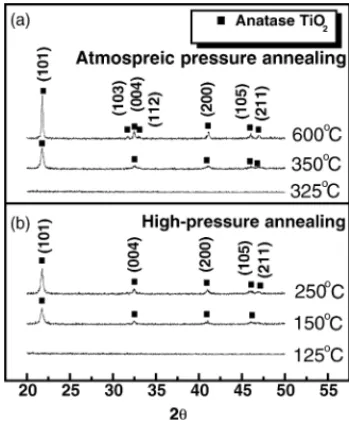
Fig. 1(a) illustrates the X-ray diffraction (XRD) patterns of the as-pyrolyzed films annealed under atmospheric pressure (14.7 psi). In this figure, the films annealed at 325oC show no diffraction peaks, indicating that the films remain at their amorphous state. After annealing at 350◦C, crystalline TiO2
with an anatase structure is formed. When annealing temper-ature reaches 600◦C, the crystallinity of TiO2thin film is
en-hanced. The XRD patterns of the as-pyrolyzed films annealed via the HPC process are illustrated inFig. 1(b). After 125◦C annealing under 30 psi via the HPC process, only amorphous films are obtained. However, once the as-pyrolyzed films are
annealed at 150◦C under 70 psi, the amorphous films are
converted to crystallized TiO2films. In comparison with the
conventional annealing process under atmospheric pressure, the HPC process significantly reduces the crystallization tem-perature from 350 to 150◦C. When the as-pyrolyzed films are further annealed at 250◦C under 588 psi, the crystallinity of TiO2is greatly improved. The HPC process might lead to a
reduction in the critical free energy required for the forma-tion of stable nuclei, and facilitates the nucleaforma-tion process at low temperatures[14,15]. The other possible mechanism
Fig. 1. X-ray diffraction patterns of TiO2 thin films annealed under: (a)
atmospheric pressure; and (b) high pressure.
is that the high vapor-pressure developed during the process probably forms a water coating on the film surface, thereby resulting in a dissolution–precipitation process to produce the crystallized nuclei at low temperatures.
The surface morphologies of TiO2 thin films were
analyzed by SEM, and the obtained scanning electron micro-graphs are shown inFig. 2. As demonstrated inFig. 2(a), after 150◦C annealing under 30 psi in the HPC process, uniform TiO2thin films without cracks are formed, and the particle
size of the obtained thin films is around 30 nm. After TiO2
thin films are annealed at 250◦C under 588 psi in the HPC process, the particle size of the thin films slightly enlarges to 50 nm as shown in Fig. 2(b). Contrarily, it is shown in
Fig. 2(c) that with 600◦C annealing under atmospheric pres-sure, cracks are formed randomly on the film surface and the microstructure of the thin films appears porous. The cracking is considered to be owning to the stress caused by uneven ther-mal expansion, and the interfacial roughening as well as voids
formed during high-temperature annealing [16]. The above
results indicate that the formation of undesired cracks on the surface of TiO2thin films is effectively avoided via the HPC
process.
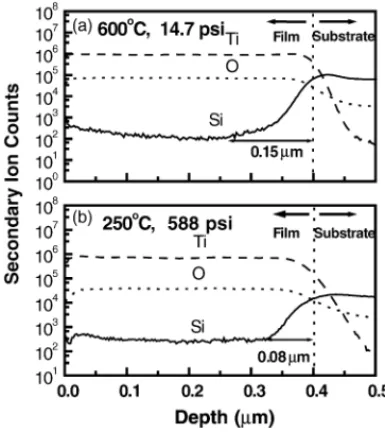
Fig. 3illustrates the depth profiles of TiO2thin films
an-nealed at 600◦C under atmospheric pressure (14.7 psi) and at 250◦C under 588 psi. After 600◦C annealing under at-mospheric pressure, silicon species diffuse from substrates into TiO2 films, and the diffusion distance of Si species is
0.15m as depicted in Fig. 3(a). On the other hand, af-ter 250◦C annealing under 588 psi in the HPC process, the diffusion distance of Si species from substrates into TiO2
thin films is merely 0.08m (Fig. 3(b)). Since the anneal-ing temperature in the HPC process is much lower than that of the conventional method, the diffusion rate and mobility of Si species are considerably reduced in the HPC process. It is demonstrated that the interdiffusion between TiO2thin
44 C.-H. Lu, W.-H. Wu / Materials Science and Engineering B 113 (2004) 42–45
Fig. 2. Scanning electron micrographs of TiO2 thin films prepared at: (a)
150◦C under 63 psi (HPC process); (b) 250◦C under 588 psi (HPC process); and (c) 600◦C under 14.7 psi (atmospheric pressure annealing).
films and substrates is effectively suppressed by the HPC process.
The absorbance changes of methylene blue solution de-graded by the TiO2 thin films are illustrated inFig. 4. It
Fig. 3. Secondary ion mass spectroscopic profiles of TiO2 thin films
an-nealed at: (a) 600◦C under 14.7 psi (atmospheric pressure annealing); and (b) 250◦C under 588 psi (HPC process).
is found that the photocatalytic activity of the amorphous films is low since the absorbance of methylene blue solu-tion changes very little (curve a). When TiO2thin films are
annealed at 350◦C under atmospheric pressure, the photo-catalytic activity is improved; however methylene blue is only partially degraded (curve b). The thin films annealed at 150◦C via the HPC process have greater photocatalytic activ-ity than those annealed at 350◦C under atmospheric pressure (curve c). Methylene blue is completely decomposed after 5 h-illumination for the films annealed at 600◦C under atmo-spheric pressure and those annealed at 250◦C under 588 psi (curves d and e). However, the degradation rate of TiO2thin
films annealed at 250◦C via the HPC process is faster than
Fig. 4. Degradation of methylene blue for (a) amorphous TiO2films and
TiO2 thin films annealed at: (b) 350◦C under 14.7 psi; (c) 150◦C under
C.-H. Lu, W.-H. Wu / Materials Science and Engineering B 113 (2004) 42–45 45
that of films annealed at 600◦C under atmospheric pressure. It is revealed that TiO2thin films prepared via the HPC
pro-cess have greater photocatalytic activity than those derived from the conventional annealing process. It is reported that the diffusion of substrate species is detrimental to the photo-catalytic activity of TiO2thin films[17,18]. Substrate species
will not only decrease the photocatalytic activity of TiO2, but
also produce surface and bulk recombination centers of pho-togenerated electron–hole pairs. The diffusion of Si species into TiO2films will reduce the photocatalytic activity of TiO2
films when they are annealed at high temperatures. For TiO2
films, it is confirmed that the HPC process can effectively reduce their crystallization temperature and significantly im-prove their photocatalytic activity.
4. Conclusions
Titania thin films with a monophasic anatase structure are synthesized in this study. The crystallization temperature of TiO2films is significantly reduced to as low as 150◦C via the
newly developed HPC process. TiO2thin films with
crack-free surface are successfully obtained via this process. The diffusion of silicon species from substrates is effectively sup-pressed because of the lowered annealing temperatures. It is demonstrated in this study that TiO2films prepared via the
HPC process exhibit enhanced photocatalytic activity in com-parison with those derived from the conventional annealing process. The developed process provides a novel route to synthesize TiO2thin films with high photocatalytic activity
at low temperatures.
Acknowledgement
The financial support for this study from Ministry of Eco-nomic Affair, Taiwan, the Republic of China through Grant 92-EC-17-A-09-S1-019 is gratefully acknowledged.
References
[1] G.K. Dalapati, S. Chattejee, S.K. Samanta, C.K. Maiti, Electron. Lett. 39 (2003) 323.
[2] A. Ruiz, A. Cornet, G. Sakai, K. Shimanoe, J.R. Morante, N. Ya-mazoe, Chem. Lett. 9 (2002) 892.
[3] K. Hara, Y. Tachibana, Y. Ohga, A. Shinpo, S. Suga, K. Sayama, H. Sugihara, H. Arakawa, Sol. Energy Mater. Sol. C 77 (2003) 89. [4] P. Gross, J. Schmelzer, Macromol. Symp. 187 (2002) 641. [5] L. Zhang, Y.F. Zhu, Y. He, W. Li, H.B. Sun, Appl. Catal. B Environ.
40 (2003) 287.
[6] A. Fujishima, K. Honda, Nature 238 (1972) 37.
[7] D. Robert, B. Dongui, J.V. Weber, J. Photochem. Photobiol. A 156 (2003) 195.
[8] P.A. Christensen, T.P. Curtis, T.A. Egerton, S.A.M. Kosa, J.R. Tinlin, Appl. Catal. B Environ. 41 (2003) 371.
[9] M.J. Alam, D.C. Cameron, J. Sol–Gel Sci. Technol. 25 (2002) 137. [10] J. Yu, X. Zhao, Mater. Res. Bull. 35 (2000) 1293.
[11] C.H. Lu, US Patent No. 6,143,366 (2000).
[12] C.H. Lu, Y.C. Chen, Y.C. Sun, J. Mater. Chem. 12 (2002) 1628. [13] C.H. Lu, W.J. Hwang, Y.C. Sun, Jpn. J. Appl. Phys. 41 (2002) 6674. [14] S.C. Liao, W.E. Mayo, K.D. Pae, Acta Mater. 45 (1997) 4027. [15] K.W. Seo, J.K. Oh, J. Ceram. Soc. Jpn. 108 (2000) 691.
[16] J. Lee, S.H. Oh, J. Lee, E. Lee, I. Lim, W.K. Park, G. Kim, Thin Solid Films 370 (2000) 307.
[17] Y. Paz, A. Heller, J. Mater. Res. 12 (1997) 2759.
[18] Y. Paz, Z. Luo, L. Rabenberg, A. Heller, J. Mater. Res. 10 (1995) 2842.