
Changing the game: how environmental international non-governmental organisations empower the state by mobilising society in china
89
0
0
全文
(2) Changing the Game: How Environmental International Non-Governmental Organisations Empower the State by Mobilising Society in China. 研究生:Frank LaMacchia 指導教授:湯京平 國立政治大學. 政 治 大 亞太研究英語碩士學位學程 立 ‧. ‧ 國. 學. 碩士論文. Nat. er. io. sit. y. A Thesis. Submitted to International Master‟s Program in Asia-Pacific Studies. n. al. i n U. C. v. h eChengchi National n g c h i University. In partial fulfilment of the Requirement For the degree of Master in China Studies. 中華民國 99 年 6 月 June 2010. 2.
(3) Abstract. International NGOs have grown in stature and influence in China, and are widely seen as important contributors to the development of a more dynamic Chinese society. This paper contributes to theoretical frameworks regarding how to understand the way in which INGOs are able to influence certain political outcomes in China; arguing that in both the short and long-term, INGOs have worked to mobilise society in active support of environmental protection in different parts of China. The ability to change the social structure has been important in empowering relevant institutions within the state, such as the Ministry of Environmental Protection, to respond to environmental. 政 治 大. protection issues. A greater role for such ministries represents a change in political structures around environmental protection. In doing so, this paper provides a. 立. thorough analysis of China‟s society‟s response to environmental protection and the. ‧ 國. 學. political decision making processes at play when environmental issues are involved. Two case studies collected from field work, of International Rivers contribution to the. ‧. anti-dam movement in the campaign against the Nujiang Dam; and Pacific Environment‟s support for a local NGO opposing river pollution in Anhui province,. sit. y. Nat. will be utilised to support the argument that INGOs‟ mobilisation of society is an. io. er. important means of „empowering‟ the state to respond positively to environmental protection issues. Such developments are taken as signs of growing social. al. n pluralisation.. Ch. engchi. 3. i n U. v.
(4) Contents. 1. Introduction. 6. 2. Environmental INGOs in China: A Theoretical and Practical Overview. 10. 2.1. Changing State Society Relations. 10. 2.1.1. Corporatist and Civil Society Frameworks. 12. 2.2. INGOs in the Authoritarian Context. 18. 2.3. Methodology. 25. 3. Domestic Structures Around Environmental Protection in China. 政 治 大. 3.1. Social Structures Around Environmental Protection. 立. 27 27 28. 3.1.2. ENGOs Links with Society. 31. ‧ 國. 學. 3.1.1. Capacity of ENGOs. 3.1.3. Media. ‧. 3.2. Political Structures Around Environmental Protection. io. 4. Changing the Game- A Study of Two INGOs. n. al. Ch. 4.1. International Rivers. engchi. er. 3.2.2. Fragmentation at the Provincial Level. sit. y. Nat. 3.2.1. Fragmentation at the National Level. i n U. v. 37 39 40 43 47 48. 4.1.1. National Social and Political Structures Around Large Dam Construction Prior to the Nujiang Campaign. 54. 4.1.2. National Domestic Structures Around Large Dam Construction Province During and After the Nujiang Campaign. 4.2. Pacific Environment. 57. 62. 4.2.1. Green Anhui. 64. 4.2.2. Domestic Structures Around Water Pollution Issues in Bengbu Prior to Green Anhui's Campaign 4.2.2.1.Political Structures. 66 66. 4.
(5) 4.2.2.2. Social Structures. 70. 4.2.3. Domestic Structures Around Water Pollution Issues in Bengbu During and After Green Anhui's Campaign 4.2.4. Pacific Environment's Role. 71 74. 5. Conclusions. 77. 5.1. Review of Research. 77. 5.2. Research Implications. 80. 5.3. Limitations of Research. 81. 6. References. 83. 立. 政 治 大. ‧. ‧ 國. 學. n. er. io. sit. y. Nat. al. Ch. engchi. 5. i n U. v.
(6) 1. Introduction The economic reforms first embarked upon in the late 1970s are important symbols of China's transition from a totalitarian command economy to the thriving economy and considerably more open society that exists today. Although the reforms that began in this period are sometimes viewed as the first steps of a precise strategy, a social, economic and political transition with a clear beginning, middle and end; in most ways such notions are false assumptions. Rather than viewing the reforms as part of Deng Xiaoping's (or the post-Mao political elite's) great vision for a new China, a distilled narrative that is often perpetuated for the sake of simplicity, a better way to frame the reforms are as a series of tentative experiments, many of which started only. 政 治 大. very modestly but transformed into more sweeping reforms after success at the local. 立. level (Shirk, 1993; 30).. ‧ 國. 學. In fact, the very incremental nature of China's economic reforms have been part of the great fascination scholars and other 'China watchers' have held, and have. ‧. led to a contradiction between a sense of progress or development in some areas. y. Nat. alongside lag or dogged conservatism in others. These contradictions have fascinated. sit. and confused the ongoing attempts to locate and identify China conducted by different. er. io. stakeholders at an international and domestic level- governments; business; the media;. al. n. v i n to find China, to identify itCand context is perhaps really h eputninganc hunderstandable i U. academia; political activists; and non-governmental organisations (NGOs). The search. more of a series of attempts to answer the question: what is really possible in the new, emerging China? From the international perspective, this question can be rephrased as: what can foreign governments, businesses and NGOs achieve in China? While there is a certain amount of clarity about what is possible in terms of economic relations with China, an understanding of interactions between international actors and the Chinese polity and society are more obscured.. In the social realm, various scholars have addressed the role international nongovernmental organisations (INGOs) have played in China's social development. 1 These works have gone a considerable way to clarifying INGOs role in China, 1 See for instance, (Chen 2006, 2010; Morton 2005, 2008; Wu, 2005; Wang, 2006; Young, 2005).. 6.
(7) highlighting that INGOs have functioned most effectively in areas where they provide a social service and do not serve as a direct challenge to the central government's legitimacy, such as environmental protection, health and rural education; yet have made little inroad in areas such as human rights that directly call into question the central government's actions and treatment of opposition. In particular, scholars have focussed on environmental INGOs‟ dynamic contribution to Chinese society, noting the presence of more than fifty INGOs working in this area (Wu, 2005; 145), and identifying how INGOs have fostered the growth of many local environmental NGOs (Chen, 2010).. However, despite the contributions of INGOs such as those working in the. 治 政 measure INGOs' contribution to Chinese society. 大 Are they helping to create a more 立 open society, much like foreign direct investment and other financial instruments have field of environmental protection, there still exists a lack of clarity regarding how to. ‧ 國. 學. helped to liberalise China's economy? Or does the work they carry out fail to leave a lasting impact on China's social and political milieu? If the work they are involved in. ‧. does have an influence on the state, how best to conceptualise the way in which it. Nat. y. occurs? Thus, this thesis is involved in trying to find ways of assessing the. al. er. io. sit. contribution of environmental INGOs to Chinese society.. n. In the following chapter, I will chart the emerging role of environmental. Ch. i n U. v. INGOs in China amidst changing state-society relations brought about by the. engchi. economic reforms in order to provide some contextual background to the topic. Following this, I will consider various theories regarding how INGOs seek to influence the state in authoritarian contexts, agreeing with Wu and Wang's proposition that environmental NGOs working in China attempt empower the state in a nonconfrontational fashion while mobilising society around environmental issues (Wu, 2005; Wang, 2006).. Extending this idea, I will elaborate on the 'empowerment through mobilisation' thesis that is central to this paper: which suggests that while the relationship between INGOs and the state is non-confrontational, the ability to empower the state to respond in a way that changes the status quo very much hinges on INGOs capacity to work with domestic NGOs to mobilise the media and society, 7.
(8) changing society's awareness and involvement in environmental protection issues, and elevating the status of environmental protection arguments. This social mobilisation empowers ministries involved in environmental protection at the national and local level (basing my work mainly on the Ministry of Environmental Protection (MEP) and local Environmental Protection Bureaus (EPBs) ) in various ways, a process referred to as a change in the domestic political structures around environmental protection throughout. The capacity to change political structures following the mobilisation of society around environmental issues will serve as a positive indicator of INGOs ability to influence the Chinese social and political landscape, and more broadly, of a growing pluralisation in China's political process.. 治 政 大 in China. In doing so, I will political structures surrounding environmental protection 立 expound upon the developments and limitations within China's social structure around. In the third chapter, I will provide greater detail of the underlying social and. ‧ 國. 學. environmental protection, exploring areas such as environmental NGOs (ENGOs) ability to work with local communities and the media. In regards to political structures. ‧. existing around environmental protection, I will highlight the key structural deficiencies that account for the marginalisation of ministries holding progressive. y. Nat. sit. norms (such as the MEP and EPBs) within the domestic political structure, while. n. al. er. io. locating evidence that this marginalisation can be overcome.. Ch. i n U. v. The fourth chapter will progress to identify the two case studies under. engchi. investigation in this thesis: the involvement of a US based NGO, International Rivers, in supporting domestic NGOs such as Green Watershed and Green Earth Volunteers in the well-known campaign to oppose the construction of the Nujiang Dam in Yunnan province. I will identify the normative and practical contributions International Rivers made to the campaign, arguing that they supported China's social elite in the national campaign opposing the Nujiang dam. In doing so, I will test the effects of social mobilisation on the capacity to empower the MEP to prevent the development of large dams. The second case study also involves an INGO based in the US, Pacific Environment, which has played an important role in supporting local and poorly funded grassroots ENGOs. In this case study, I will examine how long term support Pacific Environment assisted Green Anhui‟s successful campaign against three chemical companies pollution of the Huai River, a major river that runs through parts 8.
(9) of eastern and central China. From this perspective, I will be well equipped to see the impact of a mobilised ENGO, the media, and public opinion in Bengbu city on a largely inert city Environmental Protection Bureau, and assess whether it changed the role and status of the EPB within the local political context. These two case studies will provide a useful framework for considering what contributions INGOs are really able to make to aspects of state-society relations particular to environmental protection issues.. 立. 政 治 大. ‧. ‧ 國. 學. n. er. io. sit. y. Nat. al. Ch. engchi. 9. i n U. v.
(10) 2. Environmental INGOs in China: A Theoretical and Practical Overview In this chapter, I explore how changes in China's economic structure since the late 1970s have stimulated social changes and allowed for a role for INGOs in China's environmental protection. Discussing environmental INGOs role in society and whether they should be viewed within a corporatist or civil society framework, I argue that INGOs have developed ways to circumvent laws that try to keep INGOs within the scope of state control and have participated in China's civil society, providing a brief historical account of INGOs work in China. This validates the assumption that INGOs are capable of mobilising social structures in China. Following this, I consider. 政 治 大 theoretical viewpoints relevant to environmental INGOs working in China.I seek to 立. arguments regarding how INGOs work in authoritarian contexts, considering different. overcome the lack of clarity in understanding the exact contribution of INGOs work,. ‧ 國. 學. and whether they contribute to only superficial change in environmental protection or something more substantial. This is achieved by introducing Wang's argument,. ‧. heavily influenced by Risse-Kappen‟s theoretical model, which states that INGOs. y. Nat. capacity to influence the norms and practices of the state can be assessed by whether. sit. or not they are able to change the domestic political and social structures that exist. er. io. around environmental protection (Wang, 2006). From this position, I explain my. al. n. v i n in the mobilisation of socialC structures to political empowerment of state bodies h e n gleads chi U. 'empowerment through mobilisation' thesis, which provides that INGOs involvement. invested in environmental protection.. 2.1. Changing State Society Relations Although what can be thought of as INGOs have existed in China since before the 1919 May Fourth Movement (Zhang, 2003; 5), INGOs as understood in the contemporary context have a relatively short history in China. The reasons for this are easily guessed for China watchers. Time virtually stood still during Mao's reign in terms of Chinese society's relations with the outside world, and so the story essentially begins (like so many related to new phenomena in China) in the period marking the establishment of Deng Xiaoping's economic reforms. While commentators often highlight the crucial difference between Deng and his 10.
(11) contemporary socialist 'reformer' Mikhail Gorbachev as lying in the absence of glasnost, or political reforms (Morton, 2005; 520), it is commonly argued that economic reform, perhaps by necessity, has decisively loosened the state's grip on society (Zhang, 2003; 9). Acting in the interests of economic efficiency, the retreat of previously critical party-controlled institutions such as the work unit (danwei) and village collectives, along with a substantial amount of government decentralisation has weakened the state's capacity to control Chinese society. Further, the processes of reform irretrievably changed the underpinnings of the Chinese state, and weakened Communism as the state's binding ideological basis of legitimacy. For tens of millions of people, the state is an inadequate provider of public. 政 治 大. goods like health care, employment opportunities and environmental protection, and as Minxin Pei noted in 2005, but was beginning to unravel in the early 1980s, the. 立. Chinese state is faced with the interlinking crisis of being unable to provide public. ‧ 國. 學. goods and at the same time lacking "pressure valves" to settle disputes and relieve tension (Pei, 2005;103). Worryingly for the Chinese state, this new socio-political. ‧. reality has also resulted in the rapid rise of public protest, or 'mass incidents' as they are formally known, as a means of challenging the status quo. In the social realm, the. sit. y. Nat. lack of adequate bona fide 'pressure valves' has meant a dramatic increase in the number of protests, with more than 30,000 protests occurring in the first nine months. io. n. al. er. of 2000 alone (Morton, 2005; 527). While I am by no means painting the pre-reform. i n U. v. Maoist era as a golden era for environmental protection, and certainly not one for. Ch. engchi. citizen recourse to official complaint, the partial unlinking of China's economic and political spheres has resulted in a confluence of problems related to the state's capacity to manage socio-political problems and the discontent they generate. Further, the explosion of private enterprise has meant that many of the negative externalities of economic growth have been left unchecked by various organs of the state, through both a lack of capacity and willingness. The problems that began to manifest in the early 1980s have spiralled to the extent that the year 2005 alone saw around 51,000 pollution incidents, and required a cleanup of the Songshan oil spill that cost 3 billion US dollars (Chan, 2004; 74). In rural areas, water scarcity and pollution contribution contribute to crop lost of approximately $US 24 billion annually (Economy, 2003), as well as causing many more unnecessary costs due to. 11.
(12) health and productivity losses (Chan, 2004; 80). It is clear to many, including China's political leadership, that a declining environment is a threat to the future of China's economic growth. It was with a gradual awareness of the severity of such problems that the Chinese state tentatively began to enlist the support of INGOs in the early 1980s as a cost-effective means of addressing various public policy problems. The environmental realm was among the first recipients of this outreach, and large environmental INGOs worked with the state to find solutions for issues like habitat degradation and species loss. WWF for instance, was specifically contacted by the Chinese government in the early 1980s to commence a program of panda habitat protection in Sichuan (Wu,. 政 治 大. 2005; 154). Additionally, in accordance with the decentralisation that was occurring in the economic realm, the state also began to encourage social organisations such as the. 立. Ford Foundation sponsored Chinese Academy of Social Sciences to develop ways to. ‧ 國. 學. tackle environmental and other social problems. During the 15th Party Congress in 1997, the five yearly event being one of the most reliable means of assessing the pulse. ‧. and direction of the Chinese state, then supreme leader Jiang Zemin stressed the need to "cultivate and develop...social intermediary organisations" (Saich, 2000; 128).. sit. y. Nat. Given these developments, some pondered whether the decentralisation at the economic level was slowly being replicated at the social level and creating an. io. er. autonomous 'civil society' in which INGOs could work within.. n. al. i n C 2.1.1. Corporatist and CivilhSociety Frameworks engchi U. v. Starting with Oi in 1992, scholars primarily pointed to a corporatist model or 'statist' perspective to explain how "downsizing the government apparatus" (Ma 2005; 66) in the economic realm had led to an intertwined relationship between private business and the state as a result of economic reforms. At the same time, scholars were noting that the state were 'downsizing government apparatus' in other areas, highlighting new 'corporatist' relationships between the state and 'social organisations', which were gaining relevance in poverty, labour, gender, rural and environmental issues among others 2 . Quashing popular speculation raised in the Western media at the time that China's economic reforms 2 See for instance: (Whiting, 1991), (White, 1993) , (Pearson, 1994) and (Unger and Chan, 1995). 12.
(13) would eventually and inevitably lead to social and political change as had occurred in the Soviet Union, corporatist scholars instead argued that the growth of social organisations was merely reflective of the state's developing capacity to efficiently maintain its penetration of social life in changing economic circumstances: The state determines which organisations will be recognised as legitimate and forms an unequal partnership of sorts with such organisations (Unger and Chan, 1995; 30).. Corporatist scholars did loosely acknowledge the Western concept of civil society, which depicts an "independent sphere of social interaction between economy and state” (Cohen and Arato, 1992; ix), but were determined not to overplay the. 政 治 大. extent to which it existed. Cautious terms such as “embryonic” (White 1993, 86) were. 立. used in reference to civil society, but the corporatist perspective was framed as the. ‧ 國. 學. primary lens of analysis and civil society was only ever considered as a tiny peephole providing only the narrowest view of state-society relations. The effort to. ‧. acknowledge the civil society discourse in China, while remaining overwhelmingly rooted to corporatist perspectives can be seen in Frolic's analysis of the growth of. sit. y. Nat. NGOs in China as part of “state-led civil society” (Frolic, 1997), whereby the state's utilisation of hundreds of thousands of social organisations and quasi-administrative. io. n. al. er. units to help it manage a rapidly expanding economy and changing society, was. i n U. v. depicted as the mark of a delicate and fragile pluralisation.. Ch. engchi. Leading the list of concerns for those that identified a corporatist state-society relationship in China was the proliferation of government organised NGOs (GONGOs) which are administratively and financially tied to the state apparatus; as well as the enactment of the 1998 Regulation for Registration and Management of Social Organisations (Hsia and White, 2002; 337-338), which tightened the conditions governing the formation and activity of NGOs.. Looking at Chinese legislation governing NGO and INGO activities in China that were codified in the late 1990s, and even at the slightly relaxed laws that were updated in 2004, (Regulations on the Management of Foundations) the legal relationship between the state and social organisations is decidedly corporatist. From. 13.
(14) the outset, the state places rigorous restricts on the establishment and registration of social organisations not initiated by the state itself (all social organisations beside GONGOs), which is at once a barrier and disincentive for the domestic growth of domestic organisations and for international NGOs seeking to work in China. According to the 1998 regulations, social organisations must fulfil the following criteria to officially register as a national organisation: “be corporate entities; have over 50 members' and at least 100,000 RM (approximately $US 15, 000) in operating funds (Ma, 2006; 66). Such financial restrictions deter the growth of low budget grassroots organisations.. However, the most problematic features of these laws are how they legally. 治 政 the 1950s (Ashley and He, 2008; 55). Within this大 system, NGOs must register first 立 with a professional supervisory agency or mother-in-law , and only then become. enshrine the dual registration system, an oppressive instrument that can be traced to 3. ‧ 國. 學. eligible to apply for registration with the Ministry of Civil Affairs (and meet a new set of bureaucratic requirements). These regulations also provide that there is also only. ‧. supposed to be one NGO working in each issue area and technically forbid NGOs from developing branch organisations in other cities or provinces (Ma, 2006). This. y. Nat. sit. ensures a substantial degree of control over registered social organisations, as mother-. al. er. io. in-laws are fearful of the ramifications if social organisations they sponsor are. n. perceived to be creating trouble for important individuals or state institutions. Thus,. Ch. i n U. v. the dual registration and its implications discourage and stifle potential mother-in-. engchi. laws from sponsoring candidate social organisations.. The principal practical outcomes of the dual registration system for those social organisations that do manage to get sponsored is that state officials often embed themselves in such organisations through being members of the board, and/or giving 'recommendations' on how the social organisations should conduct itself. Although no formal law existed governing INGOs until 2004, since then INGOs have also been required to fulfil the dual registration in order to register a representative office (Ma 2005, 65). The dual registration is in some ways an even greater challenge for INGOs, as potential mother-in-laws are generally disinclined to sponsor international 3 Referred to in Chinese as the “mother-in-law” (popo). These agencies are almost always a government institution. 14.
(15) organisations as they are often assumed to be interferers or troublemakers.. Evidence of the corporatist mode of control employed in China, and the tenuous position that some INGOs that do get registered have found themselves in can be found in the example of the Naumann Foundation. A foundation that promotes liberal politics, it was sponsored by China‟s State Statistical Bureau and Ministry of Agriculture in the mid 1990‟s to work on capacity building projects (White et. al, 1996; 6). However, they found their Beijing offices closed down by the Chinese government for sponsoring an international conference on Tibetan independence in Germany in 1996, evidence of the constraints the state imposes on the freedom of expression (domestically and internationally) of INGOs working in China, and. 政 治 大. strengthening the corporatist argument that INGOs in China work within narrow confines dictated by the state.. 立. ‧ 國. 學. Further, the 1992 establishment of a bureaucratic channel for INGOs to work in China, the China Association for Non-Governmental Organisations (CANGO),. ‧. under the auspices of the Ministry of Trade and Economic Cooperation (MOFTEC), was roundly derided as a move with the cynical function of merely "sell(ing) projects. sit. y. Nat. to international NGOs" (Zweig, 2002; 252). Rather than INGOs having the capacity. io. requires them to work closely with the state.. al. er. to work with society in developing solutions to environmental problems, CANGO. n. v i n C ofh hindsight, this corporatist Even with the benefit perspective does seem in engchi U. many ways to aptly characterise the context (especially the legal context) international. and domestic NGOs alike existed in for much of the 1990s, irrespective of the field they were working in. However, too great an emphasis on the legal context is misleading, and even anachronistic when dealing with a state as complex and contradictory as the Chinese one. Although it remains incredibly difficult for both NGOs and INGOs to register nationally with the Ministry of Civil Affairs (MOCA), or with provincial Bureau‟s of Civil Affairs (BOCA), this is often by no means an insurmountable obstacle. INGOs are often informally allowed to operate without MOCA/BOCA registration as long as they have a mother in law sponsor. This has become increasingly common since more and more government departments in all areas of the Chinese bureaucracy, especially outside of the sensitive political. 15.
(16) environment of Beijing, have come to realise that in many cases the advantages that INGOs bring outweigh the risk. Ma explains the mutual benefits of such an arrangement: Official approval and institutional support help INGOs carry out. their. projects. smoothly,. while. government. or. governmental organizations receive overhead fees for their sponsorship and access to technological and monetary resources. (Ma 2005, 177) In addition to such an arrangement, INGOs have developed other tactful ways of circumventing the letter of the law to work in China, some of which require clear. 政 治 大 don‟t directly challenge the state. The various options open to INGOs to work in 立. state cooperation, while others are tacitly approved or unregulated so long as they China can be presented as follows4 :. ‧ 國. 學. Channels for INGO Presence in China. ‧. Clear Government Cooperation. y. Nat. Obtaining an International Expert‟s Service Certificate from the State Bureau. sit. . i n U. v. Signing an Agreement Memorandum with government bodies.. Tacit Cooperation . al. n. . er. io. of Foreign Experts. Ch. engchi. Operating cooperative programs with Chinese NGOs or governmental agencies, thereby avoiding registration.. Unregulated . Establishing Hong Kong or Macao-based headquarters or branches through which their programs are run in the mainland.. . Opening program offices, which are not required to register with the government.. 4 This figure is developed based on (Ma, 2006) and my own observations of INGO activity. 16.
(17) . Registering as a commercial entity. . Remaining based overseas and working remotely through email and informal visits to local organisations.. Undoubtedly, working within a legal context where they are strictly regulated is not an ideal situation for international or domestic NGOs, and a signal that they must tread carefully in China, but it is evident that an informal flexibility exists that provides INGOs the capacity to work outside the corporatist control of the state. The fact that INGOs have many methods of working in China besides registration has given them the capacity to work outside of the state's purview. Thus, it can be argued that a key deficiency of the corporatist perspective is its overstated emphasis on legal. 政 治 大. requirements in China, and perhaps an undue negligence of the situation on the ground.. 立. ‧ 國. 學. Corporatist scholars cautious of adopting a civil society perspective were also very cynical about viewing INGOs as part of an 'independent sphere of social. ‧. interaction between economy and state' because of the difficulties involved in connecting INGOs with society. Such a view emphasises that although large. Nat. sit. y. international NGOs such as WWF and the Ford Foundation were making. io. er. contributions to the way in which the state handled the environment in the 1990s, and even began to work with local populations in dynamic ways like establishing micro-. n. al. i n U. v. credit programs aimed at ending environmentally unsound practices in the Caohai. Ch. engchi. region (Wu 2005, 376), they were typically bereft of autonomous NGO partners. More recent advocates of the corporatist lens have also placed doubts on the independence and vitality of INGO work in China, describing it as “minimal” (Hsia and White, 2002; 347) as a result of a perceived lack of a grassroots movement in China. However, the 1990s was a period of social transition, and in fact, a period of time where domestic and international NGOs grew in size, capacity and function in China, that went beyond the embryonic. While corporatist relations between the state and a great number of social organisations remained, the rise of independently formed NGOs in China in the earlyto-mid 1990s was a catalyst for significant change in Chinese state-society relations,. 17.
(18) enabling an expanded and more grassroots role for international NGOs. In 1994, Liang Conjie established one of China's first NGOs, Friends of Nature, a seminal moment that was followed by the founding of several other NGOs later that year, which were able to work independent of the state. Impressed by Friends of Nature's involvement in environmental education and lobbying, including a successful campaign drawing attention to illegal logging in Yunnan province that was responsible for the destruction of the golden snub nosed monkey's habitat, Tony Saich identified Friends of Nature as a leading example of a small community of NGOs that were finding ways to "negotiate the state" (Saich, 2000) Marshalling other examples from China's NGO community, he argued:. 政 治 大. "broadly speaking, education and environment groups have negotiated relatively free space" to pursue their agendas (Saich, 2000; 137) While acknowledging that China. 立. was far from developing a "civil society as conventionally defined" (Saich 2000;. ‧ 國. 學. 139), by drawing attention to NGOs like Friends of Nature, Saich spearheaded a worthy critique of the "oversimplification" purported by corporatist models of China's. ‧. state-society relations, which had failed to recognise the significance of pockets of autonomy within an increasingly amorphous state-society relationship. Saich's claims. sit. y. Nat. were bolstered by later assertions that:. er. io. ...even when working in cooperation with local and national. al. n. v i n NGOs... find a C niche work in China through their h eforntheir gchi U bureaucracy or government, in reality, most international. own connections, working directly with grassroots groups. (Wu, 2005; 390). It is evident that despite the Chinese state's attempts to regulate INGOs, they have developed the capacity to work independently with local groups and emerging grassroots NGOs. Such a collaboration is indicative of an emerging 'independent sphere of social interaction between economy and state', or nascent civil society.. 2.2. INGOs in the Authoritarian Context Despite INGOs participation in China's nascent civil society, it is still not clear what the implications of such participation are. Do INGOs in China have the capacity to. 18.
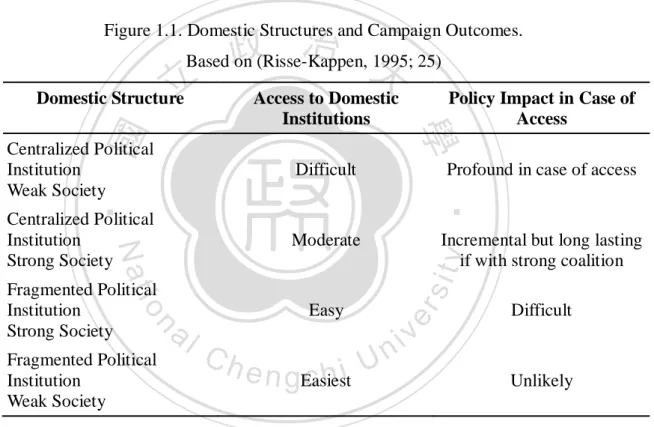
(19) promote ideas and international norms as part of a 'transnational civil society' and change the environmental protection policies and practices of the state and society (Florini, 2000; 10-11)? Or are they limited to only a superficial or fringe input? The possibility that INGOs work can be considered to be part of a 'transnational civil society' is thought to have especially significant implications in authoritarian contexts like China. Risse, Ropp and Sikkink‟s spiral model depicts INGOS as capable of forming „transnational advocacy networks‟ with domestic partners, engaging states in a game of political cat and mouse, gradually and methodically redefining the status quo (Risse et. al. Sikkink, 1999). According to this model, INGOs are able to perform this process of norm socialisation through a five-. 政 治 大. phase process; whereby INGOs act as moral entrepreneurs to entice states to gradually internalise progressive norms. The first two phases involve "repression" and violation. 立. of international norms, and then "denial "of INGOs criticisms. The next phase is. ‧ 國. 學. critical, involving INGOs pressuring the state to make "tactical concessions", which create a windows of opportunity to get the state to rhetorically accept the norms it is. ‧. violating. Once this occurs the state begins to gradually accept its responsibility in. sit. Nat. through "rule consistent behaviour" (Risse. et. al 1999, 22).. y. upholding the norms, which reach "prescriptive status", and finally uphold the norms. er. io. In his work on transnational dam campaigns, Khagram challenges the idea that. al. n. v i n C „domestic model, arguing that China's h e n g cstructures‟ i U are resistant to such processes h (Khagram, 2004). By domestic structures, Khagram refers to Risse- Kappen's norms flow from INGOs and transnational civil society to states through a spiral. description of: the organisational apparatus of political and societal institutions, their routines, the decision-making rules and procedures incorporated in law and custom, as well the values and norms embedded in the political culture. (RisseKappen, 1995; 19) Khagram's conclusion is informed by Risse-Kappen's domestic structures methodology, which asserts that domestic structures determine the likelihood of INGO's accessing political systems, linking up with domestic actors, and influencing. 19.
(20) the policies and attitudes of the state. Although the impact might be profound if INGOs gain access to a highly centralised state, this is unlikely if the society is weak, especially if the INGOs actions challenges the status quo. For this reason, RisseKappen argues that INGOs are most likely to exert influence in contexts where the political structure is fragmented and a plural social structure exists (Risse-Kappen, 1995). Based on these assumptions, Khagram posits China's lack of democracy, dogged efforts to control society through censorship of the media and restriction on the development of NGOs (described above) as reflective of a centralised political structure, and a weak society; and argues that INGOs do not perform significant roles in China.. 政 治 大. Figure 1.1. Domestic Structures and Campaign Outcomes. Based on (Risse-Kappen, 1995; 25). 立. Difficult. Centralized Political Institution Strong Society. Moderate. Fragmented Political Institution Strong Society. Easy. Incremental but long lasting if with strong coalition. n. al. Ch. e n gEasiest chi. er. io. sit. y. Nat. Fragmented Political Institution Weak Society. Profound in case of access. ‧. Centralized Political Institution Weak Society. Policy Impact in Case of Access. 學. Access to Domestic Institutions. ‧ 國. Domestic Structure. i n U. v. Difficult. Unlikely. Khagram's position is challenged by two perspectives- Keck and Sikkink's boomerang model (Keck and Sikkink, 1998) and the double mobilisation thesis offered by Wu (Wu, 2005). According to Keck and Sikkink's boomerang model, local groups operating in authoritarian regimes that seek to change the status quo around an issue like human rights or environment, seek out the assistance of INGOs. INGOs then develop international advocacy campaigns aiming to pressure and shame the offending government‟s failure to uphold international norms in three ways: direct criticism of the state's activity; lobbying other states to place pressure on offending. 20.
(21) governments; or lobbying intergovernmental organisations (IGOs) such as the World Bank to place pressure on offending governments (Keck and Sikkink, 1998; 17). The boomerang model is hence the description of the process where local NGOs, due to oppressive local conditions, 'throw out' information exposing the state‟s violation of international norms in the direction of INGOs, which through a carefully crafted international campaign is then directed to 'come back' in the form of pressure to act at the state. This pressure is expected to challenge the state's moral legitimacy to govern, and thus pressure the state to change it's policies or approaches. Clearly, the main problem with utilising Keck and Sikkink's model when discussing transnational advocacy networks and INGOs in China is that it fails to. 政 治 大. adequately take into consideration the options available to advocacy networks when the target state is not particularly susceptible to international pressure. Unlike the. 立. military dictatorships in Latin American countries that Keck and Sikkink's thesis. ‧ 國. 學. chiefly emphasises, China is at once a great power (even an emerging superpower) and an authoritarian regime. The ruling regime is extremely resistant to contentious. ‧. forms of pressure that are suggested in the boomerang model- patently demonstrated by the unsuccessfulness and limited duration of sanctions imposed by the Clinton. io. er. in the June 4th Tiananmen Square incident.. sit. y. Nat. administration upon China in the early 1990s, following human rights abuses evident. al. n. v i n C h to INGO influence? that the Chinese state is resistant e n g c h i U Not according to Wu, who. Does the inapplicability of the boomerang model prove Khagram's assertion. negates both Khagram's arguments and the boomerang model proposed by Keck and. Sikkink (Wu, 2005). She indicates that the boomerang model, as well as Khagram's argument that INGOs are unable to influence society, reflect a "theoretical bias in the transnational civil society literature towards contentious relations between state and society" (Wu, 2005; 44). These perspectives controversially suggest that INGOs must confront the state to force a political outcome (boomerang model) and that 'the state' is uniformly opposed to civil society. While it is true that the Chinese state seeks to regulate civil society, as identified above, this is only one element of the state's attitude. Recognising this, Wu ascribes a cooperative and non-confrontational triangular relationship between INGOs, the state and society, a „double mobilisation‟; whereby the INGO community attaches importance to establishing constructive. 21.
(22) relationships with state institutions like the Ministry of Environmental Protection and the Ministry of Forestry, as well as local communities and NGOs (Wu, 2005). Using a Tang dynasty poem's metaphor of 'spring rain', Wu describes the gradual spread and penetrative, sustainable effects of INGOs 'double mobilisation' in China. She argues that this model is of greater utility because it demonstrates how working with local communities and domestic INGOs, as well as engaging in constructive dialogue with the state has yielded constructive results in policy development (especially in the environmental area) and has had a flow-on effect of widening the space for civil society actors in China. The double-mobilisation thesis is important because instead of looking at. 政 治 大 attempts, it considers China's domestic political and social structures at the micro立. macro-level variables such as democracy and social pluralisation broadly as Khagram. level. This identifies the fact that while certain issue areas such as security and foreign. ‧ 國. 學. policy are heavily centralised within China's political structure; and that a distinct lack of plurality exists in certain social issues like human rights; political and social. ‧. structures should not be portrayed as centralised and completely penetrated by state. y. Nat. power respectively (Wu, 2005; 93). Instead, at the micro level of environmental. sit. protection issues, the Chinese state is increasingly fragmented, and there is an. n. al. er. io. emerging green social structure consisting of INGOs, NGOs and the media.. Ch. i n U. v. Like Wu, Wang‟s detailed study of Greenpeace campaigns in China is also. engchi. theoretically indebted to Risse-Kappen, but attempts to use micro-level structures as evidence of INGOs policy impact. (Wang, 2006) While the scope of Wu's work is in defining a theoretical framework for understanding how INGOs campaign in different issue areas in China, Wang attempts the more ambitious task of holding micro-level structures up as metrics to assess the contribution INGOs make to state-society relations in China (Wang 2005). In doing this, he suggests that: The success of INGO campaigns depends on whether INGOs can create a favourable political and social structure around the campaign issue. (Wang 2006, 95) Wang states that favourable structures are produced by empowering the state. 22.
(23) with "information, knowledge and moral persuasions", while simultaneously mobilising society with "ideas and capacity-building measures to exert social pressure on the campaign targets" (Wang, 2006). However, while Wang identifies clearly that the creation of a strong society is necessary for campaign success, he is ambiguous as to what the required political structure is for campaign success. I feel this ambiguity is in part produced by confusion over the terms: centralisation; decentralisation; fragmentation; centre and local, which I will now make an effort to clarify. The Chinese state can be described as centralised on the macro-level in the sense that the central political leadership (by which I refer primarily to those political leaders in the Standing Committee of the Politburo). 政 治 大. exercise a great deal of authority in determining China's political agenda through pronouncements like Five Year plans. On the micro-level, the state is also centralised. 立. when it comes to how the political leadership exercise a great deal of control over. ‧ 國. 學. important state issues like foreign policy and security, and carefully restrict the expression of alternative views.. ‧. However, on the micro-level, the state is also fragmented when it comes to. y. Nat. environmental issues, in that the rigorous restriction of alternative views does not. sit. occur. This does not mean that the central government can be confrontationally. er. io. criticised about its environmental record as occurs in Western countries, but that the. al. n. v i n security issues, Tibet's statusCashan inalienable partUof China is a non-negotiable issue; engchi state does not have a hegemony on the production of knowledge. For instance in. in the environmental protection area in China by contrast, there exists the potential for differing voices in society about contentious issues like dam construction.. The state is also fragmented or decentralized in the area of environmental protection in the sense that a lack of uniformity of views exists over less sensitive issues, and that a number of state actors, such as various ministries, provincial governments, local governments, are involved in decision-making, and often have different decision-making priorities. When attempting to distinguish between these interests, terms such as centre and local are often used, with the centre denoting ministries within the State Council, a central government institution, and the the local referring to territorial governments at the provincial level or lower.. 23.
(24) Returning to Wang's argument that success for INGO campaigns depends on whether or not they are able to create a favourable political and social structure, I argue that success depends on creating a more centralised political structure, by which I mean a political structure where State Council ministries sympathetic to INGOs ideas and position, are able to assert themselves in issues where environmental protection is important, and not have their authority challenged by other state actors with conflicting interests. For the sake of clarity, I will largely eschew terms such as centralised and fragmented, and instead refer to the empowerment of ministries and bureaus sympathetic to environmental protection issues within domestic political structures, primarily focussing on the national Ministry of Environmental Protection (MEP) and local environmental protection bureaus (EPBs) ). 立. 政 治 大. As well as clarifying Wang's theoretical position to identify exactly what. ‧ 國. 學. political structures are favourable, this thesis deviates slightly from Wang's empowerment and mobilisation model. In this model, Wang argues that empowering. ‧. the state and mobilising society around environmental protection issues are key goals for INGOs and vital to campaign success, a proposition that I agree with.. sit. y. Nat. Additionally, it is my central contention that that one of the key ways in which the MEP and EPBs are empowered to act is through the presence of a society mobilised. io. n. al. er. behind environmental protection goals, for example opposing pollution or the. i n U. v. construction of large dams. This theoretical framework will be referred to as the. Ch. engchi. 'empowerment through mobilisation' model throughout. It is important to note that mobilisation can occur at the national, provincial and local levels of society, and is evident by the presence of a pluralised society that can be mobilised for political causes (Risse-Kappen 1995, 17). Such mobilisation does not necessarily apply to a broad social mobilisation, where environmental protection becomes a permanent and central concern for the whole of Chinese society, but on instances where groups of people at different levels of society rally behind certain or specific environmental issues. Likewise, empowerment of the state to adequately support environmental protection norms occurs at different levels of government, and is not a uniform empowerment throughout the entire Chinese political system.. 2.3. Methodology 24.
(25) As is evident above, the empowerment through mobilisation framework that this thesis will advance is heavily indebted to the theoretical review of Wu Fengshi and Wang Liang, who have developed comprehensive theories in order to understand INGOs relationship with the state and society, particularly those working in the environmental field. This element of their work is derived from that of Risse-Kappen, who originally developed the domestic political structures framework. In many ways, this thesis is a dialogue and extension of these works.. The many articles and books that deal with international NGOs working in China, transnational civil society and environmental governance are also used throughout this. 治 政 important contextual information about social 大 and political structures around 立 environmental protection. Also of critical importance are the annual publications work, both in the development of the theoretical framework, as well as in providing. ‧ 國. 學. produced by the Wilson Centre‟s China Environment Forum, the China Environment Series, which provides a great deal of up-to-date information about the work. ‧. international and environmental ENGOs carry out. These resources are utilised as secondary evidence of INGOs capacity to mobilise society and empower the state. al. er. io. sit. y. Nat. throughout.. n. A field trip visit to China in September/October of 2010 was extremely helpful in. Ch. i n U. v. developing a first-hand understanding of the work INGOs carry out, as well as in. engchi. developing an understanding of the social context they work within. In this trip, I was able to interview Wen Bo, Global Fund's China Advisory Board Coordinator and Pacific Environment‟s China Program Co-director; Erika Helms, Roots and Shoots Beijing Director; Ms Zhang, Wetlands International‟s China Coordinator; and Gladys Wang, Global Environment Institute‟s Communication Officer. During this period of time, I also conducted telephone interviews with Nicole Brewer, International Rivers‟ China Global Progam Associate, and Christine Tsang, Program Associate at the Blue Moon Fund. All of these interviews were useful for the development of this research, however, it is the interviews conducted with Wen Bo and Nicole Brewer that are applied most directly, as the experiences of International Rivers and Pacific Environment form the basis of the case studies conducted in Chapter Four. Through these interviews, I sought to explore in detail how International Rivers and Pacific 25.
(26) Environment work with civil society partners, and on the capacity of a „green civil society‟ to influence political outcomes. Including case studies of campaigns that occurred at both the national level and local level, implicating the national level Ministry of Environmental Protection and local level Environmental Protection Bureaus, I seek to demonstrate that change to micro-level structures is possible at the various levels of environmental governance. This is an important distinction, and one that is omitted in Wang‟s analysis of changes in domestic structures around environmental protection.. Another important distinction pertains to the size and nature of the INGOs included in the case study. Wang Liang‟s case study focuses on the work of Greenpeace, a large,. 治 政 INGOs with smaller budgets and different scopes. 大 This is important in demonstrating 立 that smaller NGOs are also able to contribute to change in micro-level political and. internationally renowned environmental NGO; however, this case study focuses on. ‧ 國. 學. social structures in China. Beyond this, based on comments from field research and the empirical evidence included in Wang Liang‟s thesis, it seems that Greenpeace. ‧. takes a more unilateral approach to their advocacy work, which does not encourage an active role for local NGO participants or civil society. Focussing on NGOs with close. y. Nat. sit. connections to the grassroots, particularly Pacific Environment, will allow for a more. al. er. io. explicit demonstration of the capacity for INGOs to mobilise the social structure and. n. thereby stimulate change in political structures around environmental protection.. Ch. engchi. 26. i n U. v.
(27) 3. Domestic Structures Around Environmental Protection in China This chapter will attempt to characterise the social and political structures that exist around environmental protection in China, charting the roles and character of important actors such as INGOs, domestic environmental NGOs (ENGOs), local communities, the Chinese media and various organs within the complex Chinese domestic structure. It will introduce examples from academic and other sources to identify examples of mobilised social structures and empowered political structures around environmental protection in China. A broad understanding of the existing. 治 政 advance the theoretical framework developed in the大 first chapter and explored through 立 case studies in Chapter Three- that INGOs are more easily able to empower the state political and social structures around environmental protection is necessary in order to. ‧ 國. 學. by mobilising society.. ‧. 3.1. Social Structures Around Environmental Protection. y. Nat. sit. Based upon the definitions of social structures provided by Risse-Kappen in the first. er. io. chapter, a strong society consists of “politicized civil societies which can be easily. al. v i n comprehensive analysis of C Chinese society suggests that is not politicised or easily hengchi U mobilised for political causes, as identified in the first chapter, there are indications of n. mobilized for political causes" (Risse-Kappen 1995, 17). While it is clear that a. the vestiges of a strong society existing at micro-level areas such as environmental protection, at both the national and local levels.. Wang suggests that a strong society at the micro-level or issue-area level can be defined by the number of organised social groups like NGOs involved in the issue. This thesis expands Wang's conception and provides a wider view of social structures by considering social structure around environmental protection issues as consisting of three components: the size and organisational capacity of the environmental NGO (ENGO) community and the organisations themselves; the ties ENGOs have developed with society in order to address environmental protection; and the media's. 27.
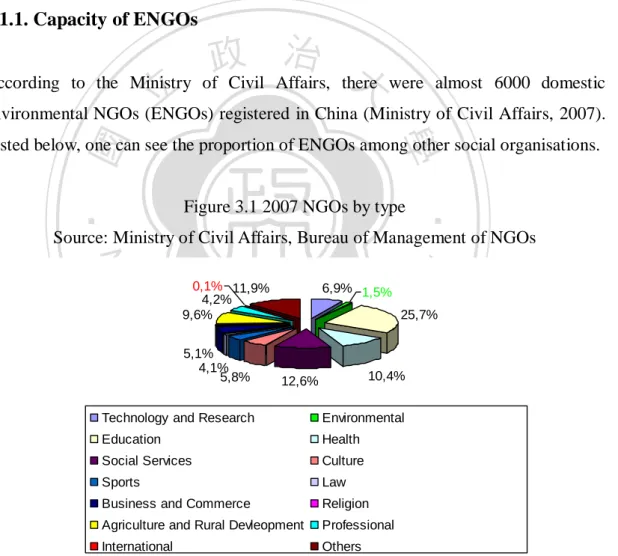
(28) coverage of environmental issues. Using this framework, I argue that although not occurring consistently or evenly, the social structure around environmental protection is increasingly porous and consists of discrete areas of dynamism.. Some studies focus on ENGO cooperation with the state, and while this is important, it is beyond the scope of this research, given that the theoretical focus of this paper lies with examining the influence of a mobilised society upon attempts to empower the state. For this reason, direct ENGO and INGO cooperation with the state will be excluded from an analysis of China's social structures.. 3.1.1. Capacity of ENGOs. 政 治 大 According to the Ministry of Civil Affairs, there were almost 6000 domestic 立 environmental NGOs (ENGOs) registered in China (Ministry of Civil Affairs, 2007).. ‧ 國. 學. Listed below, one can see the proportion of ENGOs among other social organisations.. ‧. Figure 3.1 2007 NGOs by type. Source: Ministry of Civil Affairs, Bureau of Management of NGOs 6,9% 1,5%. 25,7%. n. er. io. Ch. sit. y. Nat. al. 0,1% 11,9% 4,2% 9,6% 5,1% 4,1% 5,8%. e n g12,6% chi. iv n U 10,4%. Technology and Research. Environmental. Education. Health. Social Services. Culture. Sports. Law. Business and Commerce. Religion. Agriculture and Rural Devleopment. Professional. International. Others. At first glance, the number of registered ENGOs seems small, especially next to the almost 100, 000 educational institutes, however, these state authorised statistics fail to demarcate grassroots organisations and government organised NGOs (GONGOs). While environmental GONGOs have played an important role in. 28.
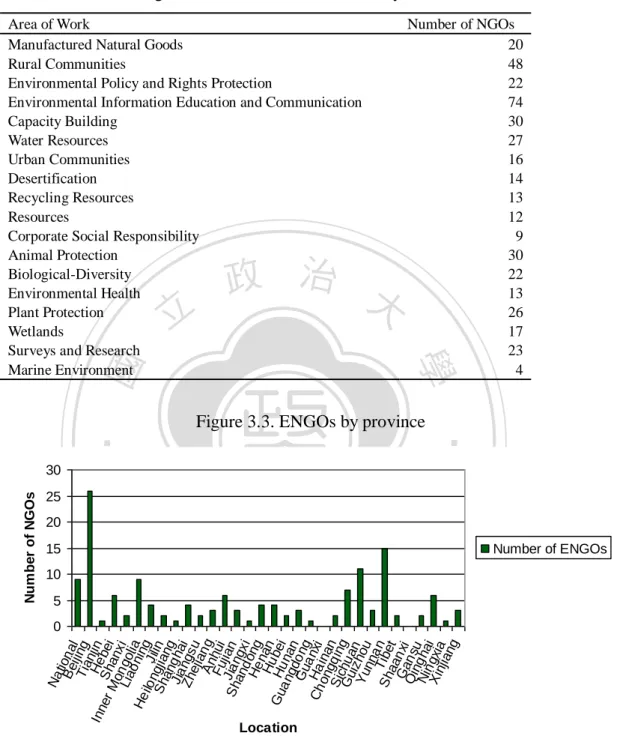
(29) advancing environmental protection norms (Wu, 2003), it is my contention that a greater indicator of a strong society is the extent and capacity of bottom-up civil society orgaisations. This is not suggesting that GONGOs don't make a contribution to civil society, but is an argument that the size and capacity of grassroots organisations provide a more reliable picture of the size and capacity of the ENGO community. These groups are better indicators of the social structure because they reveal the extent to which ideals of protecting the environment have inspired individuals and groups to initiate organisations.. A clearer picture of the growth of grassroots ENGOs relative to NGOs in other sectors is underscored by the indication that there is also substantial growth in. 治 政 大 more internet, student and number existed as for profit business entities and thousands 立 volunteer groups as well as nature clubs and those that were not registered at all unregistered ENGOs- to the extent that for every registered ENGO in China, the same. ‧ 國. 學. (Economy, 2005). Also indicative of the number of active grassroots environmental NGOs is how many are recognised by leaders in the ENGO community. For the NGO. ‧. Forum of the Global Environmental Facility's biannual conference in 2003, Friends of Nature, probably the most domestically and internationally well-respected grassroots. y. Nat. sit. NGO in China identified and invited over 60 grassroots environmental NGOs (Wu,. al. er. io. 2005; 134).In the seven years since that event took place, an up to date database of. n. grassroots environmental NGO's estimates there to be 421 'green' NGOs (Chinese. Ch. i n U. v. Environmental NGOs Online, 2010) 5 . It is the significant number of grassroots. engchi. organisations that have meant ENGOs are recognised as being at the vanguard of Chinese civil society, and have thus been conceived of as forming a „green civil society‟ by various scholars (Chen, 2010; Busgen, 2005).. It is evident that domestic environmental NGOs work on a range of issues and have penetrated most provinces in China, although with a far greater presence in Beijing, Yunnan and Sichuan (Chinese Environmental NGOs Online, 2010). There is also a greater concentration of INGOs working in these provinces (Morton 2008, 200). This data is presented below: 5. The above listed statistics do not include the thousands of unregistered student groups all around the country, who are active in environmental education and also campaign work, and have also fomented environmental NGOs like Green Stone (Lu, 2003; 62). 29.
(30) Figure 3.2. Environmental NGOs by issue area. Area of Work Manufactured Natural Goods Rural Communities Environmental Policy and Rights Protection Environmental Information Education and Communication Capacity Building Water Resources Urban Communities Desertification Recycling Resources Resources Corporate Social Responsibility Animal Protection Biological-Diversity Environmental Health Plant Protection Wetlands Surveys and Research Marine Environment. 5. y. sit. Ch. n U engchi. iv. Number of ENGOs. Na Bteion al Tiaijing H njin Inn er She bei Mo an Lian golx i o n ia He ilo n Jiing Sh gjialin a n J i ng h g Zha ngsai eji u Anan g Fu hui Sh J ia njian and gx i He ong n a H n Gu Huu bei a n na g n Gudo ng H Ch aa nxi on ina Sicgq inng Gu hu a Yuiz honu nna Sh Tiben a t G an x Qinan sui Ni g ha Xinn gxiai jian g. 0. er. Number of NGOs. 10. al. n. 15. io. 20. ‧. 25. Figure 3.3. ENGOs by province. Nat. 30. 學. ‧ 國. 立. 政 治 大. Number of NGOs 20 48 22 74 30 27 16 14 13 12 9 30 22 13 26 17 23 4. Location. There exists a great deal of diversity within this ENGO community. Some NGOs such as Friends of Nature are well funded and work at high capacity, while others exist on shoestring budgets and struggle to channel their energies creatively. For instance, Friends of Nature has an annual expenditure of approximately USD$300,000 (Friends of Nature, 2006), 700 due paying members, connections with student groups and local communities all around the country, possess educated,. 30.
(31) trained and motivated staff, and are therefore capable of working in many provinces on a multitude of environmental protection issues (Johnson 2009, 68). By contrast, smaller NGOS, such as those that INGOs Pacific Environment and Global Green Grants attempted to establish working relationships with, often consist of only a few volunteers and lack even the technical skills to use a computer (Interview Wen Bo, 2009).. In fact, most grassroots groups exist on what by a Western perspective is considered basic funding, but have been nonetheless able to achieve impressive outcomes. One such example is the Institute of Public and Environmental Affairs (IPE) started by Ma Jun, a small NGO based in Beijing with only a handful of staff. 治 政 大identifying precise areas of water ENGOs to create an impressive water pollution map 立 pollution throughout the country (China Environment Series, 2006).. that has used basic government data along with information provided by other. ‧ 國. 學. Importantly, local NGOs such as the IPE receive considerable financial and. ‧. technical support from INGOs, with Ma Jun's IPE funded by the National Resources Defence Council (NRDC) to develop a similar air pollution map, also using NRDC as. y. Nat. sit. a consultant to help them better implement reliable ways of measuring air pollution. al. er. io. (China Environment Series, 2006). Overall, INGOS have worked hard to establish. n. relationships with grassroots NGOs, with 71 percent of 126 surveyed NGOs reporting. Ch. i n U. v. contact with INGOs (Yang 2004), while INGOs such as the Ford Foundation provide. engchi. up to 95 percent funding for dynamic local NGOs like the Centre for Biodiversity and Indigenous Knowledge (Chen 2010, 510). In sum, the number, extensive dispersion and capacity of ENGOs demonstrates an increasing non-state role in environmental protection, which INGOs play a vital role in supporting.. 3.1.2. ENGOs Links with Society International and domestic NGOs have been able to work with society and particularly local communities through establishing participatory programmes where local communities become a direct part of the solution in addressing environmental protection; setting up environmental education centres; and also assisting local. 31.
(32) communities in locating channels to raise grievances.. Participatory programs have sought to help communities play a role in environmental governance, to protect local resources or species that are at damaged or at risk, as well as developing sustainable methods of income generation at the local (mostly rural) level. One of the most difficult aspects of campaigns that promote environmental protection is that they often interfere with the short-term economic goals of local communities, who often have so few economic opportunities that they have no choice but to abuse the scarce natural resources upon which they depend so heavily (Herrold, 1999; 445). The International Crane Foundation was a pioneer in developing participatory governance, via its campaign to organise and empower. 治 政 (Chen, 2010; 510). From 1993,“with a relatively大 modest budget and well-trained 立 Chinese experts instead of expensive foreign consultants” (Herrold-Menzies, 2006; villagers to conserve black necked cranes in the Caohai nature reserve in Guizhou. ‧ 國. 學. 383) ICF began working closely with Guizhou villagers to understand the ways in which activities they had been engaged in for a long time (and had now become. ‧. illegal under the regulations of the Caohai nature reserve regulations) were endangering the cranes existence, such as fishing during spawning season, hunting. y. Nat. sit. waterfowl, draining wetlands, and clearing wooded hillsides. At first this was strongly. al. er. io. resisted and the new regulations resulted in physical confrontations between villagers. n. and nature reserve staff (Herrold 1999; 445) However, the new regulations became. Ch. i n U. v. largely respected, in large part because of the establishment of a successful micro-. engchi. credit grants program to help farmers set up businesses- producing handicrafts, raising vegetables and livestock and establishing inter-village trade (Herrold, 1999; 444-5). Further, beyond merely abiding by the regulations and recognising the importance of protecting the black crane, local villagers in the Caohai nature reserve region became actively involved in eco-management activities such as volunteering in lake restoration activities (Herrold Menzies. 2006; 394). This prominent example highlights the ways in which ENGOs can work in close contact with local communities to achieve the dual goals of environmental protection and development.. Another example of ENGOs working directly with local communities was derived from an interview conducted with Gladys Wang of Global Environment. 32.
(33) Institute (GEI)6, a domestic NGO based in Beijing, who described the ways in which GEI used market based mechanisms to help villagers in Yunnan, Guilin, Tibet, and even Sri Lanka to invest in biogas tanks, which use yak and cow manure to produce cheap and green energy. Funded heavily by the Blue Moon Fund, these initiatives fulfilled many development and environmental objectives simultaneously- alleviating the high gas prices for villagers, replacing firewood for fuel and providing fertiliser for organic vegetable crops that GEI encouraged villagers to grow (Interview Wang 2009).. ICF and GEI's programs demonstrated the capacity for ENGOs in China to successfully cooperate (and develop programs) with local communities that promote. 治 政 大 reflect how the Chinese social structure around environmental protection is capable of 立 spreading environmental protection norms and practices to local communities. Of environmental protection and the sustainable use of resources. Both these examples. ‧ 國. 學. course, in a broader sense, local awareness and involvement in environmental protection is weak. With only a few hundred ENGOs in a country of more than a. ‧. billion people, there are many local communities for whom the terms environmental protection is completely irrelevant. Despite these challenges, ENGOs like ICF have. y. Nat. sit. demonstrated an increasing awareness to locate local communities that are most. al. er. io. vulnerable to environmental degradation and unsustainable development. For. n. instance, Yunnan province has developed as a locus for ENGOs due to the threats (and. Ch. i n U. v. actualization of such threats) that development poses to its unique biodiversity.. engchi. Other limitations to ENGOs capacity to connect with local communities is that programs often take many years to develop successfully, as a high level of trust and understanding needs to be built up between ENGOS and the local community. As Wen Bo of Pacific Environment and Global Green Grants Fund suggested in a personal interview, sometimes these type of programs collapse after a few years because they are too difficult to administer (Interview Wen Bo, 2009). However, it is difficult to find information about such unsuccessful programs, as ENGOs are often reluctant to share their failures. Although more extensive field work on this issue is required, including perhaps personal involvement in working on such a program, the previous. 6 For more information on GEI, see Buckley (2006). 33.
(34) examples represent a social structure around environmental protection that has demonstrated the capacity to mobilise local communities in support of environmental development programs.. Another dimension of ENGOs mobilisation of local communities is the work they play in education. Education has been the traditional preserve of ENGOs in China, to the point where Jin Jiaman, director of GEI and formally of the Chinese Environmental Research Institute (a GONGO), encouraged Chinese ENGOS to branch out beyond education into other spheres of work (Turner, 2001). Nonetheless, environment education is important in imbuing future generations with a value for environmental protection, as well as empowering other NGOs and the state with. 治 政 大the country. Organisations such around the issue of grassland conservation throughout 立 Friends of Nature and Han Hai Sha work at the apex of grassland conservation relevant information. For instance, ENGOs have utilised education at different levels. ‧ 國. 學. education, providing magazine articles, lectures and seminars on healthy agriculture in vulnerable grassland for activists and researchers in the field (China Environment. ‧. Series 2003). Han Hai Sha has also worked to link together urban scientists who work on desertification with communities struggling with the problem. Owing to. y. Nat. sit. relationships between ENGOs and a growing sense of an ENGO community,. al. er. io. technical and scientific information developed about grassland desertification in. n. China is able to freely dispersed and used where it is needed. For instance,. Ch. i n U. v. information produced by Friends of Nature has been used by Green Camel Bell in. engchi. Gansu province, which works with the local education authority to edit school textbooks so that they accurately identify desertification problems (China Environment Series, 2003).. Roots and Shoots, the environmental education arm of the Jane Goodall Institute, is one of the major contributors to environmental education in urban communities in China, working with an estimate of 500 groups in Beijing, Shanghai, Chongqing and Nanchang. Unlike the way in which formal education works in most parts of China and at most education levels, Roots and Shoots actively discourages the traditional model, whereby a large group of students sit and listen attentively to a single teacher, who is assumed to have all the answers (Interview Erika Helms, 2009). Rather, Roots and Shoots serves as a mechanism to support and encourage groups of 34.
(35) young people to learn more about environmental issues, participate in lengthy group discussions, and develop ways they can learn more about environmental issues within the local community. Roots and Shoots groups exist as after school clubs, university student groups, as well as various elementary, high school and even kindergarten classes7, who connect with student groups around the country and also with Roots and Shoots groups throughout the world. As well as generally working to encourage students to develop independent thinking skills and spread public awareness about environmental issues, Roots and Shoots have also encouraged its student groups to go out into the local community and apply their knowledge. For instance, a university Roots and Shoots group in Shanghai has developed the skills and knowledge to conduct basic 'green audits' of office buildings, helping to reduce unnecessary energy. 治 政 rooftops. Like other areas of the social structure,大 this form of education exists in 立 pockets and reflects a dynamic fringe area rather than the mainstream. However, the and water consumption, and integrate organic gardening into office balconies and. ‧ 國. 學. work of Roots and Shoots in promoting general environmental education and of a network of NGOs in advocating grassland education, both highlight how ENGOs are. ‧. able to mobilise local communities.. y. Nat. sit. In recent years, ENGOs have also developed the capacity to assist local. al. er. io. communities in airing grievances. One of the most controversial and substantial ways. n. in which they have done this is in recent times is by assisting citizens in raising legal. Ch. i n U. v. cases to defend their rights against companies that damage the environment. At the. engchi. local level, the most prominent and active NGO involved in such work is the Beijing Centre for Legal Assistance to Pollution Victims (CLAPV), who are supported with financial and informational resources by the US based INGO- National Resources Defence Council (NRDC). CLAPV and NRCD have worked on a number of cases and also have connections to the China University of Political Science and Law. The most famous case CLAPV was involved in occurred in Jiangsu province, where the centre raised an action on behalf of 100 peasant families against a paper factory that was dumping toxic chemicals into the Shiliang River in eastern Jiangsu Province. After proving that the paper factory's water pollution contravened water pollution laws, a local court ruled against the factory and awarded compensation of 5.6 million 7 The affiliation with Chinese schools is informal, and Roots and Shoots have not been unable to establish a program to work in the public education system. 35.
(36) yuan to the families affected (Chan 2004; 78). This was believed to be the first time that environmental laws had been used to protect citizens in China, and was thus hailed as landmark case, and a tentative sign of growing recognition of citizens‟ rights. It is important to stress that such legal action is a very recent development and that there often exists significant barriers, including violent harassment from business and political opponents to legal action. By no means should it be assumed that NGOs are working all across the country to launch legal actin against businesses that pollute the environment. Additionally, CLAPV must use their relationship with the China University of Political Science and Law, a state institution, to carefully choose their cases so as not to implicate political figures directly.. 治 政 大 when CLAPV won a case, In fact, the Jiangsu case was the only instance 立 however it also reached financial settlements in two other cases (Shigetomi and ‧ 國. 學. Makino, 2009; 92). CLAPV also played an important role in working with other smaller NGOs like Pingnan Green Association (PGA). Moreover, the experience of. ‧. PGA is useful because it demonstrates both the improvements in the social structure around green issues but also the overwhelming obstacles that must be overcome. In. Nat. sit. y. March 2006, an Intermediate People‟s Court in Fujian Province found in favour of. al. er. io. PGA and the people of Xiping in an action against the Fujian based Rongping. n. Chemical Affiliated company, China's largest chlorate manufacturer (Pitkin, 2006;. Ch. i n U. v. 142). Rongping was ordered to pay the people of Xiping nearly $85000 for health and. engchi. environmental damages caused, which at first was taken as a great victory. However, more than a year after the case the local people had not received the money, and PGA's leader Dr. Zhang Changjian was the target of police harassment, which ultimately led to the closure of his medical practice clinic. Despite extensive research on my part, this case has not been referred to in any publications since 2007 and the PGA website is currently unavailable in either Chinese or English. This leads one to believe that even if the money awarded to the people of Xiping was received, PGA is no longer able to function as an NGO that articulates local grievances.. Despite the limitations of PGA and CLAPV and other similar organisations, the involvement of ENGO in producing such a drastic breakthrough in elevating and recognising the legal rights of the citizens is evident that social structures surrounding 36.
數據
Outline
Capacity of ENGOs
ENGOs Links with Society
Fragmentation at the National Level
Fragmentation at the Provincial Level
National Social and Political Structures Around Large Dam Construction Prior to the Nujiang Campaign
National Domestic Structures Around Large Dam Construction Province During and After the Nujiang Campaign
Domestic Structures Around Water Pollution Issues in Bengbu Prior to Green Anhui's Campaign
Domestic Structures Around Water Pollution Issues in Bengbu During and After Green Anhui's Campaign
Pacific Environment's Role
Limitations of Research
相關文件
Now, nearly all of the current flows through wire S since it has a much lower resistance than the light bulb. The light bulb does not glow because the current flowing through it
Our environmental policy is to promote environmental education in schools, to maintain a management system to improve the environmental quality of our activities, to adopt
Students are asked to collect information (including materials from books, pamphlet from Environmental Protection Department...etc.) of the possible effects of pollution on our
Our environmental policy is to promote environmental education in schools, to enhance our staff’s environmental awareness by encouraging them to participate in
Our environmental policy is to promote environmental education in schools, to enhance our staff’s environmental awareness by encouraging them to participate in environmental
Our environmental policy is to promote environmental education in schools, to enhance our staff’s environmental awareness by encouraging them to participate in environmental
• Thresholded image gradients are sampled over 16x16 array of locations in scale space. • Create array of
Through the study found that religious orientation, vegetarian attitude, health knowledge Orientation, animal protection Orientation, Environmental Protection orientation
