國
立
交
通
大
學
資訊科學系
碩
士
論
文
以 綜 觀 概 念 圖 輔 助 概 念 結 構 的 自 我 覺 察
Using Integrated Concept Map to Help Self-awareness
in Conceptual Structure
研 究 生:陳冠傑
指導教授:孫春在 教授
以 綜 觀 概 念 圖 輔 助 概 念 結 構 的 自 我 覺 察
Using Integrated Concept map to Help Self-awareness
in Conceptual Structure
研 究 生:陳冠傑 Student:Kuan-Chieh Chen
指導教授:孫春在 Advisor:Chuen-Tsai Sun
國 立 交 通 大 學
資 訊 科 學系
碩 士 論 文
A ThesisSubmitted to Institute of Computer and Information Science College of Electrical Engineering and Computer Science
National Chiao Tung University in partial Fulfillment of the Requirements
for the Degree of Master
in
Computer and Information Science
June 2005
Hsinchu, Taiwan, Republic of China
以綜觀概念圖輔助概念結構的自我覺察
學生:陳冠傑 指導教授:孫春在 教授
國立交通大學資訊科學研究所
摘 要
本研究提出一種綜觀概念圖系統來輔助提升學生在概念架構的自我覺察 程度。在綜觀概念圖中,相同或是相似的概念詞以及命題會被綜合在一起。在 此系統中,團體中每位成員皆須建構自己的概念圖,系統輔助數個概念圖的綜 合,讓團體中每位成員在自己概念圖中的想法會在綜觀概念圖中被保留住,不 會因為團體的討論而忽略掉一些成員好的想法。學生可以使用綜觀概念圖當成 一種後設認知的工具來自我反省自己的概念圖,並且觀察他人的概念圖;除此 之外,綜觀概念圖亦可以幫助學生進行數個概念圖的比較。本研究希望藉由綜 觀概念圖,讓學生利用反省與和他人比較概念架構的方式來自我覺察知識架構 的不足,進而增進其自我覺察的程度。在本研究中,32 個台灣大學生在觀看過 綜觀概念圖之後,他們的自我覺察程度有所提升。在這個研究過程中,學生觀 看完綜觀概念圖之後,也對他們的先前的概念圖做了一些改進和概念的改變。 本研究發現概念架構的自我覺察程度與學生概念圖改進的程度呈現顯著的正 相關,但為低度相關。學生們對於本系統都有不錯的評價,而且學生們認為可 以藉由此系統讓他們更容易發現到他們概念圖的不足與和他人概念圖的差異。 關鍵詞: 概念圖、綜觀概念圖、後設認知、自我覺察、概念架構、概念改變
Using Integrated Concept Map to Help Self-awareness in
Conceptual Structure
Student: Kuan-chieh Chen Advisor: Chuen-Tsai Sun
Institute of Computer and Information Science National Chiao Tung University
ABSTRACT
This study presents an integrated concept mapping system to aid students in promoting their self-awareness in conceptual structure. The same or similar
concepts and propositions are accommodated in the integrated concept map. Group members’ thoughts in concept maps can be retained with the representation of integrated concept map, which may be viewed as a group product. Students can use integrated concept map as a meta-cognitive tool for introspecting students’ own and observing others’ concept maps; besides, integrated concept map can also facilitate the comparisons between concept maps. By using integrated concept mapping system, students can self-examine their own concept maps and compare with others’ concept maps in order to self-aware their insufficiencies in knowledge structures, and further this activity can promote their level of self-awareness. The level of self-awareness of thirty-two Taiwanese college students was found promoted after they viewed integrated concept maps. Students made some conceptual changes and improvements in concept maps during the experiment. Significant but low positive correlation between the level of self-awareness in conceptual structure and the improvements on concept map structure was found. Students’ perceptions about using this system were positive, and they felt that the differences or insufficiencies of their concept maps are easily found by means of this system.
Keywords: Concept map; Integrated concept map; Meta-cognitive; Self-awareness; Conceptual structure; Conceptual change
誌 謝
研究所兩年的學習中,在孫春在教授的指導下,真的學到很多東西也培養了 做研究的方法眼光與方法,感激老師不僅僅是在研究上的指導,也教導很多我們 做人處世上的不足之處。另外還要感激同組的實驗室夥伴:鄭喬文的互相砥礪與 幫助,讓我能夠順利做完論文的實驗與分析,還有其他實驗室同學對我的關心與 照顧,並且還要特別感激實驗室宜敏學姊一直以來給我的指導,讓我能在研究過 程中將研究想的更清楚與明確,以及岱伊、佩嵐學姊在 meeting 上的指正與意見。 同時,要特別感謝系上曾憲雄老師、教育所林姍如老師、台科大王淑玲老師 在口試時提供的意見,使我的論文更加完善與豐富,讓我能以不同的角度來看自 己的研究。最後,我要感激的是我的家人,感謝他們的一路支持,培養與鼓勵我 念到碩士班,並且在我研究時給與我信心,讓我能專心完成我的論文。在此,謹 將此份榮耀與感激獻給所有關心我的朋友與家人,謝謝大家!目錄
中文摘要 --- i 英文摘要 --- ii 誌謝 --- iii 目錄 --- iv 表目錄 --- vi 圖目錄 --- vii Chapter1. 論文主體 1. Introduction --- 1 2. Theoretical perspectives --- 3 3. Research Questions --- 7 4. Research Frameworks --- 7 5. Methodology --- 105.1 Subjects and tasks --- 10
5.2 Experimental design and procedures --- 10
5.3 Integrated concept mapping system --- 11
6. Measurements --- 15
6.1 Scoring of concept maps --- 15
6.2 Level of self-awareness in conceptual structure --- 15
6.3 Questionnaire for the integrated concept mapping system --- 16
7. Results and discussions --- 16
8. Conclusions --- 23
9. Limitations and suggestions --- 26
10. References --- 27 Chapter2. 附錄
Appendix A (文獻探討)--- 30 Appendix B (概念圖自我評量表)--- 35 Appendix C (概念圖系統問卷)--- 38 Appendix D (概念圖問卷分析資料) --- 41 Appendix E (概念圖系統介面) --- 45 Chapter3.參考文獻 --- 47
表 目 錄
表1. The advantages and disadvantages of the methods used in concept mapping system in CSCL --- 4 表2. The schedule of this experiment ---11
表3. The analysis table of Kendall’s coefficient for the experts’ assessments of first and revised concept map --- 16 表4. The descriptive statistics table of self-awareness score in pre-test and post-test --- 17 表5. Pair-samples t-test for the improvement in the score of self-awareness between pre-test and post-test --- 17 表6. Pair-samples T-test for the improvement in the score of self-awareness between pre-test and post-test (in four components) --- 18 表7 The improvements in experts’ assessment between students’ first and revised concept maps --- 19 表8. Independent-samples t-test for the score of self-awareness between pre-test and post-test (divided into 2 groups according to number of viewing times)
--- 20 表9. The correlation table between the level of self-awareness and improvement in concept maps --- 22
圖 目 錄
圖1. The main framework of this research --- 8
圖2. Student A’s concept map (whose topic is about the basic infrastructure of
computer hardware) --- 13 圖3. Student B’s concept map (whose topic is about the basic infrastructure of
computer hardware) --- 13 圖4. Student C’s concept map (whose topic is about the basic infrastructure of
computer hardware) --- 14 圖5. The integrated concept map of the above three students: A, B, and C
Introduction
Concept mapping (Novak & Gowin, 1984) has been introduced as a technique for externalizing learners’ knowledge structures. The process of concept mapping also helps learners to develop reflective thinking because it enables learners to reconstruct their concepts in their minds and to think how to represent their conceptual structure in concept maps. In addition, Malone & Dekkers (1984) indicated concept mapping as “window to the mind”, because it can be used to look into ourselves, observe others and proceed with self-reflection. Therefore, concept mapping can be viewed as a strategy of metacognition and help students to observe the knowledge structures. Several studies showed thatself-awareness is beneficial for learners to promote the efficiency and increase the motivation of learning. According to assimilation theory of cognitive learning (Ausubel, 1968), the most important factor of learning is considered to be the prior knowledge of learners. Meaningful learning occurs when students add new knowledge to their prior knowledge structure. Therefore, how to increase the self-awareness of learners in their knowledge structures is an essential issue. It is beneficial for learners to know what lacks or faults in their original knowledge structure.
Duval & Wicklund (1972) defined self-awareness as a condition that we
experience concentration to ourselves. As stated earlier, concept mapping can be used as a meta-cognitive tool. Consequently, concept mapping technique is employed and combined with the theory of self-awareness to help increase learners’ self-awareness in conceptual structure. Integrated concept map is proposed to help learners to introspect their insufficiencies, differences and boundaries of their knowledge structures by means of the comparison with others’ concept maps.
The benefits of concept mapping, especially in the collaborative learning environment, have been proved in several studies. (Okebukola, 1989; Roth &
Roychoudhury, 1992) In addition, computer -assisted concept mapping system has also been proved to overcome limitations of concept mapping by pen and pencil (Chiu et al., 2000); for example, students need to spend more time, efforts revising and maintaining concept maps, and consequently they may not concentrate on the body of knowledge. Therefore, concept mapping system in computer supported collaborative learning (CSCL) environment has been the major focus of several studies. (Chung et al., 1997; Chiu et al., 2000) Due to some drawbacks of methods used in concept mapping system in CSCL, integrated concept mapping system is proposed to produce an integrated concept map as another type of group concept map. The same or similar concepts or propositions are integrated together in the integrated concept map. This system helps the learners in the same group (which discusses the same topic) integrate their concept maps, and learners can select which concept maps they want theirs to accommodate with. The integrated concept map can facilitate learners to figure out the differences between their own and others’ concept maps. It provides convenience for learners to make the comparison between concept maps, and students don’t need to view others’ concept maps individually.
In summary, this study has the following objectives: 1.utilizing integrated concept mapping system to promote students’ self-awareness in their own conceptual structures 2.to provide another form of computer-assisted concept-mapping system in CSCL 3. to promote the self-awareness and improvements in four components of conceptual structures: relationships, hierarchies, cross-links, and examples (Novak, 1984) after viewing integrated concept maps 4.to find the correlation between the self-awareness and the improvements in conceptual structure.
Theoretical perspectives
a. Concept mapping, meaningful learning, and the criteria for assessing concept
maps (The details of theory can be seen in Appendix A.)
Concept mapping is based on the principle: meaningful learning occurs when learners construct their knowledge hierarchically and explore the possible linkages between concepts (Novak & Gowin, 1984). In the process of constructing concept maps, learners have the opportunity to think their concepts reflectively; at the same time when they rearrange the concepts, they would introspect the conceptual structure and check whether it is correct and appropriate. Therefore, concept mapping can be viewed as a meta-cognitive learning strategy and help learners to observe their knowledge structures.
Ausubel’s theory (1968) suggested that whether learners can actively link new knowledge to the previously constructed concepts and propositions is a vital factor of meaningful learning. The integrated concept map is just like the union of concept maps; some concepts or propositions could be joined together between the concept maps. Therefore, the system provides a convenient interface for learners to observe others’ concepts or propositions linking to their own knowledge structures.
Stuart (1985) proposed that concept mapping is equal to the process of thinking. Concept maps can be measured in some way to detect the differences of learning achievements among different students; they can also be measured in pre-test/post-test to detect the variation of learning achievements in one student. Wallace (1990) have utilized concept mapping as a measurement for assessing knowledge structure and its variation at different time. In this study, some measurement, based on Novak & Gowin’s (1984) suggestion of scoring concept map, is used to measure students’ conceptual structure in pre-test and post-test. The measurement includes four components in conceptual structure: relationships, hierarchies, cross-links, and
examples.
b. Computer-assisted concept mapping system
Chang et al. (2001) and Chiu et al. (2000) identified some weaknesses of constructing concept maps by pen and pencil; for example it’s inconvenient for interactions and feedback between learners and instructors, and it’s hard to proceed with revision and maintenance. Okebukola’s study (1989) showed that meaningful learning was promoted more in the collaborative learning environment. Thus, computer-assisted concept mapping systems, such as KSI Mapper and CMapTools, have been proposed in the CSCL environment. Most computer-assisted concept mapping systems in CSCL focus on how to get the authority to construct the concept map because it is impossible for all group members to construct or revise the concept map at the same time. By means of these concept mapping systems, group members can collaborate and accomplish a group concept map.
Some methods, such as rotating, transferring, assigning, open and selection, used in concept mapping system in CSCL (Chung et al.,1997; Chiu et al., 1999) are described in the Appendix A. There are some advantages and disadvantages of these methods which are listed in the following Table 1.
Table1. The advantages and disadvantages of the methods used in concept mapping system in CSCL:
Method Advantages Disadvantages Rotating It won’t cause the conflict of
constructing concept map. Transferring It won’t cause the conflict of
constructing concept map.
The sharing and distribution of time period is quite complicated.
It’s easy that only the minority of group members have the authority to construct the concept map.
Assigning
Open
Selection
The authority is centralized on a group member.
Everyone has the opportunity to construct concept map and express his own ideas.
Everyone has to complete his own concept map and can express his won ideas.
Choosing the assigned group member is complex, and the assigned member would easily construct at his will.
There may be “free rider effect” in this kind of system.
Because only one concept map would be chosen, several good ideas would be ignored.
Among these methods, K-E Chang (2003) suggested selecting one concept map by group members as the group concept map. However, he found that students tend to select a complete concept map (maybe the content is not the best); some good
relationships and concepts would be neglected. Therefore, he suggested that it’s worthwhile to search for a better method of creating a group’s product and preserving the uniqueness of each member’s products. In this way, some good ideas or
viewpoints won’t be neglected due to the group discussion. The system proposed in this study can solve this problem. However, there are also some limitations of this method which would be discussed later.
c. Meta-cognition
Flavell (1976) thought that meta-cognition is the inspective knowledge of one’s own cognitive system. In this study, the integrated concept mapping system is
considered as a meta-cognitive mechanism to inspect learners’ knowledge structures. Students can utilize the system to inspect several learners’ and their knowledge
structures at the same time.
Fry & Lupart (1987) proposed a method called “confidence rating method” to measure the level of meta-cognition; the method is to anticipate the performance of self. After finishing an exam, students are asked to predict their performances or scores of the exam before they know the correct answers.The more similar student’s prediction is to the real score, the more ability of cognition and monitoring the student has. As a result, this method is used to measure the level of self-awareness in the study. If the difference between students’ assessment and the real assessment is smaller, the students have better self-awareness; vice versa.
d. Self-awareness (The detail of theories can be seen in Appendix A)
Duval & Wicklund (1972) defined that self-awareness occurs whenever one's attention is directed toward oneself. Chen (1997) pointed out that self-awareness is a condition that we understand and introspect our own thoughts. Generally speaking, self-awareness, a process in meta-cognition, is considered to be conscious of our present states. In social psychological views, introspection can be used to understand ourselves and build up self-concepts. Therefore, if one focuses his attention to his mind and inspects all the thoughts and consciousness, self-awareness is promoted. However, Richard Nisbett and Timothy Wilson (1977) found that if we only focus the attention on ourselves, the observation would not be so precise because we are
inclined to find some reason (which may not be true) to persuade ourselves. Consequently, in addition to introspection, social comparison is combined to assist self-awareness in this study. A learner can utilize the integrated concept map to proceed with the comparison between his and others’ concept maps.
In this study, learners’ knowledge structures are represented in concept maps. When a learner views the integrated concept map, it can not only help the learner to view others’ concept maps but also direct his attention to his own concept map. The
integrated concept map assists the learner in the introspection of his own knowledge structure. Furthermore, through the integration of concept maps, learners can easily make comparison between concept maps. By utilizing the system, the concept conflicts between learners’ and others’ concept maps can also be discovered. The concept conflicts can help learners to promote their self-awareness in conceptual structure.
Research Questions
This study attempts to answer the following research questions.
‧Whether the self-awareness in learners’ conceptual structure can be promoted by means of using the integrated concept mapping system?
‧After using the system, whether it can help learners easily find out the insufficiencies and the boundaries, even the faults in their concept maps? Do the students make some improvements in their previous concept maps?
‧Does the frequency of viewing integrated concept maps influence the improvements in the level of self-awareness?
‧Does the level of self-awareness in conceptual structure correlate with the level of improvements in concept maps?
Research Framework
Figure 1 shows the main research framework and some analyses of this study. In this experiment, there are three significant steps: the first constructed concept map, viewing integrated concept maps, and the revised concept map.
Figure1. The main framework of this research
tudents can revise their previous concept maps according to what they observe from
ent and S
the integrated concept map. Self-assessments and expert assessments (includes three experts) are included in both the previous and revised concept map. According to the confidence rating method, the difference between students’ assessment and experts’ assessment can be considered as an indicator of the ability of monitoring and comprehension. Hence, in the experiment, the difference between self-assessm expert-assessment is defined as the level of self-awareness in conceptual structure. If
Time axis Self-assessment
First concept map
View integrated concept maps Expert-assessment
Records every student’s frequency of viewing integrated concept maps
Revised concept map
Self-assessment Expert-assessment Analysis 2 Analysis 3 Analysis 4 Analysis 1
the self-assessment is close to the expert-assessment, it is thought to be at high self-awareness in conceptual structure.
There are several analyses in the framework (Figure 1.) which can be explained in the
1: The improvement of self-awareness in conceptual structure is
ther
(2) ments in previous and revised concept map are the
the
(3) is about finding out whether the number of times of
heir
(4) self-awareness in conceptual s following:
(1) Analysis
discussed. After viewing the integrated concept map which is integrated by viewer’s own and others’ concept maps, the hypothetical assumption is that students should become more aware of their own knowledge structures. Whe the self-awareness in the revised concept map is promoted is the main issue in this analysis. Furthermore, the improvements of self-awareness in four components (which are relationships, hierarchies, cross-links, and examples) in conceptual structure is discussed.
Analysis 2: The improve
considered. Is the structure of concept map improved after students view integrated concept map? The analysis is to observe whether students find out insufficiency and boundary of their previous concept map and construct some extensions after viewing the integrated concept maps. Which of the four components in conceptual structure is improved most significantly in this experiment is discussed.
Analysis 3: This analysis
viewing integrated concept map would influence the improvements in self-awareness. The subjects are divided into two groups according to t frequency of viewing integrated concept maps.
Analysis 4: The correlation between the level of
structure and the level of improvement in concept maps is the main issue in thi analysis. When a student is with high level of self-awareness in conceptual
structure, does the student improve more in his revised concept map? Or doe student improve little because he is at low level of self-awareness?
s a
ethodology asks
nformation management majors at a Taiwanese institute of
s of
ter
e experiment was designed to last 5 t a ght r e M Subjects and t The subjects are 32 i
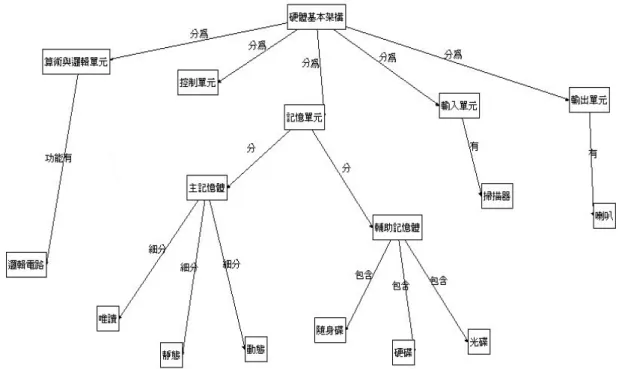
technology. They are freshmen students and enrolled in the ‘computer hardware’ course. All of the subjects are randomly divided into three groups, with two group eleven students and one group of ten. The material about hardware is from the textbook, and it’s also divided into three parts: the basic infrastructure of compu hardware, the composition of personal computer, and the storage equipment. Each group is assigned a unique topic. Every learner in a group is responsible for constructing concept maps about one of the above topic.
Experimental design and procedures According to the research framework, th
continuous weeks. At the first week, the students were taught how to construc concept map and the judgment of what a good concept map is. Then, the material about computer hardware which includes the above-mentioned three topics was tau at the second week. Considering that the subjects were not familiar with the system, the time for system tutorial and explanation must be incorporated into the design of the experiment. Students could utilize a week to familiarize the system and draw thei own concept maps. After constructing the concept maps, students were asked to self-assess their concept maps. Afterwards, students were given a week to view th integrated concept maps. Students could revise their previously constructed concept map according to the observation from the integrated concept maps. After revision, students were requested to self-assess their revised concept maps. At last, students
should fill in the questionnaire of the integrated concept mapping system. Table2. The schedule of this experiment
Time Experiment Procedure
1st week &
The instruction of concept mapping, the material about hardware, and the system 2nd week tutorial
3rd week Personal concept map construction and self-assessment
4th week The view of integrated concept maps 5th week The revision of previous concept maps
and self assessment
tegrated Concept Mapping System
apping system has been described in the
f
cept words are listed in the system according to each topic about the
ts
. In
The purpose of integrated concept m
previous section. In the section, the functions and limitations of integrated concept mapping systems are briefly illustrated. There are several functions and limitations o this system:
(1) Some con
hardware, so students can select concepts from the listed concept words when constructing concept maps. It is for the convenience of integrating their concep together. Besides, students can also generate their concepts which come into their mind. The purpose is to avoid limiting students’ space of thinking in concept words (2) What we integrate in the system is the same or similar concepts and propositions. Because there are some concepts constructed by students, the comparison of synonym is taken into account. Harry Kornilakis (2004) suggests using an electronic lexical
database, Wordnet, to support the comparison of concept words between students’ and experts’ concept maps. However, Wordnet is an English lexical database, and such database in Chinese is not so mature, especially in technological lexicon. Therefore, lexical database about the material (computer hardware) is generated advance to assist the integration of concept maps. Besides, the linking labels are retained to show the uniqueness among selected concept maps.
(3) In order to promote self-awareness, we direct students’ insigh
in
t to their own map,
of the system; such as the hierarchical problem in
d
e examples of students’ concept maps in the following (Figure 2, 3, 4): concept maps. Every integrated concept map is based on viewer’s own concept and then integrated with others’. Consequently, students can easily discover what their own concept maps lack and fault.
(4) There are also some limitations
the integrated concept map. In concept mapping, the more general concepts should be placed in the topper place of the concept map, and the specific concepts and example should be placed in the bottom. The system would place these concepts according to their original place in the original concept map. Students can adjust the hierarchy at their will. Hence, if the hierarchy of the students’ concept maps varies greatly, the hierarchy would become a main problem of the system. In this study, well-structure knowledge is taken to let students construct concept maps to prevent this hierarchical problem. In addition, resembling the group discussion, if there are too many opinions in the discussion, group opinions can’t be easily summarized. Therefore, if students integrate too many concept maps, the structure of integrated concept map is also complicated.
Figure 2. Student A’s concept map (whose topic is about the basic infrastructure of computer hardware)
Figure 3. Student B’s concept map (whose topic is about the basic infrastructure of computer hardware)
Figure 4. Student C’s concept map (whose topic is about the basic infrastructure of computer hardware)
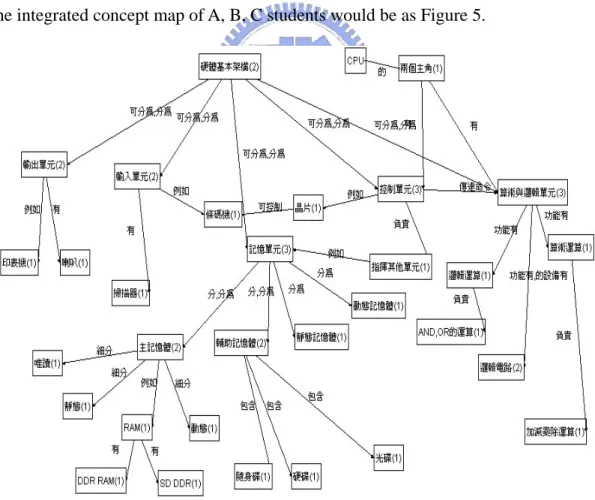
The integrated concept map of A, B, C students would be as Figure 5.
Some features of integrated concept maps are introduced:
(1) The number within the parentheses behind the concept words is how many times the concepts are mentioned in the selected concept maps. For example, the
concept “input unit” is mentioned in two concept maps (Student A and C), and the concept “scanner” is mentioned in only one concept map (Student A).
(2) The linking labels are not integrated together due to the preservation of
uniqueness in each student’s propositions. Hence, the same or similar proposition is integrated in this system, but the linking labels are listed beside the linking line. The first original and revised concept maps are stored for experts to discover the improvements in students’ concept maps. Besides, the number of times each student views the integrated concept maps and whose concept maps are selected are recorded in this system. These records will be analyzed in the experiment.
Measurements
Scoring of concept maps
As stated before, the concept maps in this experiment are scored according to four components in conceptual structure. A 12-item 5-point Likert scale (refers to appendix B) was constructed to assess the concept maps in this study. Three graduate students who major in computer science and information management took charge of assessing the students’ concept maps as the expert-assessment.
Level of self-awareness in conceptual structure
The level of self-awareness in conceptual structure, represented in quantitative way, is defined as the difference between self-assessment and expert-assessment. If the difference between the expert’s score and student’s score of concept map is small, it means that student’s awareness of their concept map is close to the expert’s
it means the self-awareness is quite high. In this experiment, there are twice
self-assessments and expert- assessments; one is towards the first constructed concept map and the other is towards the revised concept map. The agreement of three
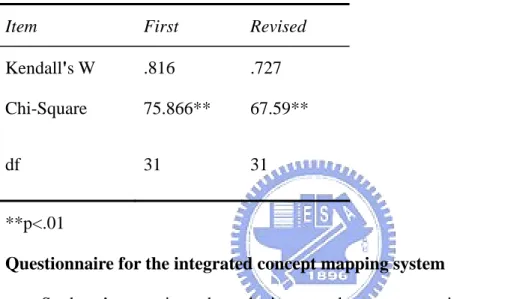
experts’ assessments of concept maps was checked by Kendall’s coefficient. The Kendall’s coefficient of the three experts’ assessment is listed in Table3.
Table 3. Summary table of Kendall’s coefficient for the experts’ assessments of first and revised concept map
Item First Revised
Kendall's W .816 .727 Chi-Square 75.866** 67.59**
df 31 31
**p<.01
Questionnaire for the integrated concept mapping system
Students’ perceptions about the integrated concept mapping system were
gathered from a questionnaire.(Refers to Appendix C) The questionnaire employed a 5-point Likert scale, and includes some questions about the system, such as the satisfaction, and the functionality of the system. The questionnaire also includes the information about what the students observe from the integrated concept map system. All students were asked to fill in this questionnaire, and some open-ended questions are also included. Some qualitative comments are also analyzed by the experts. The analysis would be listed in Appendix D.
Results and discussions
Research question 1: Whether the self-awareness in learners’ conceptual structure can
be promoted by means of using integrated concept mapping system?
learners’ assessments and the experts’ assessments are calculated in both constructed concept map. Whether students become more aware of their concept maps by
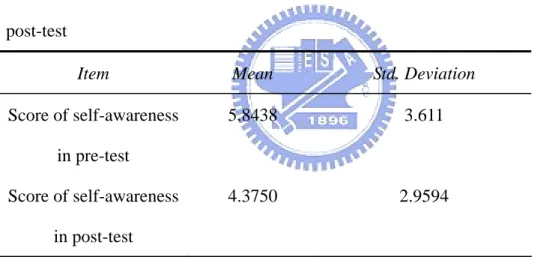
introspecting and comparison is examined. The difference between learners’ assessments and experts’ assessments is defined as “the score of self-awareness” in conceptual structure. If the difference (the score of self-awareness) is small, it means that the level of self-awareness is high; vice versa. Table 4 shows the scores of self-awareness in pre-test and post-test. Pre-test is the score in first constructed concept map, and post-test is the score in revised concept map. Table 5 shows the advancement of the score of self-awareness between pre-test and post-test.
Table 4. The descriptive statistics table of self-awareness score in pre-test and post-test
Item Mean Std. Deviation
Score of self-awareness in pre-test 5.8438 3.611 Score of self-awareness in post-test 4.3750 2.9594
Table 5. Paired t-test for the improvement in the score of self-awareness between pre-test and post-test
Mean Std. Deviation t-value Significance
Pre-test — Post-test 1.46875 3.60094 2.307 .027* *p<.05
According to the analysis of Table 4 and Table 5, the improvement in the score of self-awareness is discovered. The score in post-test is significantly different from the
score in pre-test. From the mean of the samples, it reveals that the score in post-test is lower than the score in pre-test. Therefore, the level of self-awareness is significantly promoted after students view the integrated concept maps. It means that students could adjust their ability of awareness and monitoring in the revised concept maps. After viewing the integrated concept maps, they wouldn’t excessively overestimate or underestimate their concept maps comparatively.
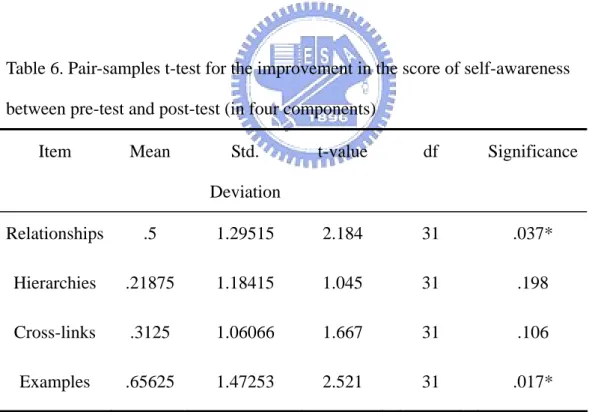
To analyze the scores of self-awareness in pre-test and post-test in detail, the improvement of self-awareness in which one component is significantly higher? The result is shown in Table 6, and the table is the t-test for the improvement in the score of self-awareness between pre-test and post-test which is divided into four
components.
Table 6. Pair-samples t-test for the improvement in the score of self-awareness between pre-test and post-test (in four components)
Item Mean Std. Deviation t-value df Significance Relationships .5 1.29515 2.184 31 .037* Hierarchies .21875 1.18415 1.045 31 .198 Cross-links .3125 1.06066 1.667 31 .106 Examples .65625 1.47253 2.521 31 .017* *p<.05
It is obvious that the level of self-awareness in the two components of conceptual structure: relationships and examples is significantly promoted. However, the level of self-awareness in hierarchies and cross-link is not significantly promoted. The result is probably because students can easily find out the existence of examples and
relationships and understand them. Therefore, the improvement of self-awareness in the two components is apparent. As regards the improvement in hierarchies, since the hierarchy of integrated concept map is a possible problem, when students view integrated concept maps, they will not easily observe the difference in the hierarchy between several concept maps. As a result, it’s not so easy for students to promote self-awareness in the hierarchy. According to Novak’s thoughts, cross-link can be viewed as an indicator of creative activity, so special care should be given to
identifying. Students usually spend more efforts constructing cross-links, and even it’s hard for students to understand the real meaning of cross-links. Consequently, the improvement of self-awareness in cross-links is also not significant.
Research question 2: After using the system, whether it can help learners easily find
out the insufficiencies and the boundaries, even the faults of their own concept map? Do the students make some improvements in their previous concept maps?
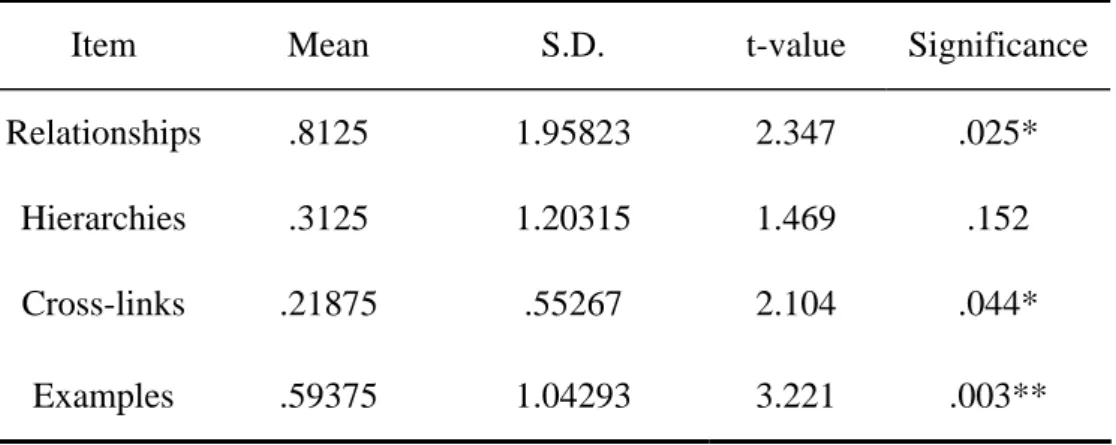
Table 7. The improvements in experts’ assessment between students’ first and revised concept maps
Item Mean S.D. t-value Significance Relationships .8125 1.95823 2.347 .025*
Hierarchies .3125 1.20315 1.469 .152 Cross-links .21875 .55267 2.104 .044* Examples .59375 1.04293 3.221 .003** *p<.05; **p<.01
From the analysis of Table 7, students get greater improvements between previous and revised concept map in relationships, cross-links, and examples significantly, especially in examples. It means that students can easily add some more examples
into their previous concept maps after viewing several integrated concept maps. Some cross-links and relationships are also added or improved in the revised concept maps. In this experiment, students’ conceptual change can be discovered by the comparison between previous and revised concept map. Carey (1987) characterized conceptual change to be either weak, if new concepts are incorporated into the current knowledge structure, or strong, if new superordinate concepts are used to restructure the current knowledge structure, but most learning takes place in the weak form. Such situation is also discovered in this experiment. Most students tended not to adjust their previous conceptual structure a lot, and they just incorporated some concepts or propositions into their concept maps. However, strong conceptual change occurred when a student found that there was a big mistake in his concept map or there’s an irreconcilable conflict between his and others’ concept maps. According to experts’ qualitative analysis, some classification and conceptual branches are also added in the students’ concept maps in this experiment. Some students even made an enormous change in conceptual structure. It shows that conceptual change in hierarchy is also discovered, but the quantity is far less than conceptual change in examples and relationships.
To sum up, students are usually inclined to keeping his previous conceptual structure in hierarchy. Providing that they find some meaningful propositions or new concepts, they will only assimilate into their original conceptual structure, and add them to their previous hierarchical structure.
Research question 3: Does the frequency of viewing integrated concept map influence
improvement in the level of self-awareness in this experiment?
The relationship between times of viewing integrated concept maps and the improvement in the level of self-awareness is examined. The students are divided into two groups (Group1, 2) according to their number of times of viewing integrated
concept maps. The mean of viewing times is taken as the criterion to divide the two groups. Students in group1 are high-viewers (who view integrated concept maps more times); students in group2 are low-viewers.
Table 8. Independent-samples t-test for the score of self-awareness between pre-test and post-test (divided into 2 groups according to number of viewing times)
Item Group Mean t-value 1 5.3125 Pre-test 2 6.375 -.828 1 3.125 Post-test 2 5.625 -2.524* *p<.05
From Table 8, group1 has higher level of self-awareness than group2. However, in the pre-test, there is no significant difference in the level of self-awareness between these two groups. Passing through the experience of viewing integrated concept maps, the analysis reveals that the two groups have significant difference in the post-test, and students in group1 still have higher level of self-awareness than group2. Consequently, when students view integrated concept maps more times, the more level of self-awareness is promoted.
Research question 4: Does the level of self-awareness correlate with the level of
improvement in concept map?
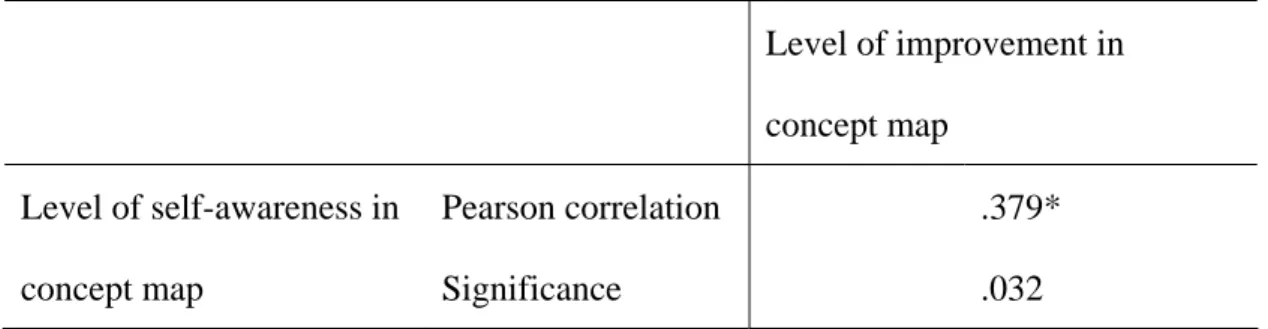
The level of self-awareness in revised concept maps is taken as the variable to check the correlation with the level of improvement between the previous and revised
concept maps. Table 9 shows the Pearson’s coefficient of correlation between these two continuous variables.
Table 9. The correlation table between the level of self-awareness and improvement in concept maps Level of improvement in concept map Level of self-awareness in concept map Pearson correlation Significance .379* .032 *. Correlation is significant at the 0.05 level.
From Pearson’s r, the correlation between the two variables is .379 and reaches the significance level of .032. It shows that there is a significant positive correlation between two variables, but the correlation is low. After analyzing the result, the reason is discussed in the following:
(1) According to the definition of self-awareness in this research, two kinds of
students at high level of self-awareness are included. One kind of students is that they can construct excellent concept maps, and they are aware that their conceptual
structure is good. The other kind students is that their concept maps aren’t good enough, and they are also aware that their conceptual structure is poor.
(2) The motivation for revising concept maps of the second kind students’ would be strong. Because they observe that their concept maps is not good enough and find something to be improved, they would tend to make more improvements in the revised concept maps.
(3) However, the motivation for revising concept maps of first kind of students’ would not be strong enough. They observe that their concept maps are good enough, so they
tend not to do many improvements in their revised concept maps; even don’t make any changes.
Other analysis from the questionnaire: (Refers to Appendix D)
a. 94% of the subjects revised their previous concept maps after viewing integrated concept maps. What encourages students to proceed with the revision is: (1) They found that there are some more extensions which could be added in their previous concept maps. (2) They wanted their concept maps to be more complete. (3) They found something unknown before viewing integrated concept maps. (4) They found that their concept maps are inferior to others’.
b. The descriptive statistics of students’ perceptions in the integrated concept mapping system is analyzed. 84% of the subjects thought that the system can help them make the comparison between their and others’ concept maps; 90% of the subjects thought that the system can help them make extensions in previous concept maps, however; 50% of the subjects thought that they’re not sure whether the system can help them find the faults in their previous concept maps; 91% of the subjects found that it’s convenient and quick for them to observe all others’ (in the same group) concept maps.
Conclusions
The main contributions of this research are that:
(1) Integrated concept mapping system is introduced to provide an interface for a learner to observe his and others’ concept maps. Learners can view several concept maps at the same time and found the relationships quickly between them because the system would assist in the integration among these concept maps. Most students felt that it’s convenient to find the differences among concept maps
and new propositions by using the system. However, students were not sure whether there are some faults in their previous concept maps. Maybe some expert concept maps should be added. The integrated concept map can also be viewed as a whole picture of students’ knowledge structures in the subject.
(2) The introspection and comparison of concept maps is used to aids the promotion of the level of self-awareness in conceptual structure. The level of self-awareness is measured by the difference between self-assessment and expert-assessment in concept maps. Students discovered the insufficiencies in their concept maps by viewing the integrated concept maps. After self-examination, students would adjust their awareness and assessments in the concept maps. The level of
self-awareness in conceptual structure, especially in relationships and examples, is proved to be significantly improved in the experiment.
(3) It is found that students make some conceptual changes and add some more concepts and propositions to prior knowledge structures after viewing the integrated concept maps. Rumelhart and Norman (1978) proposed that learning takes place in three modes: accretion (new knowledge is added to an already existing knowledge structure), tuning (constraints are placed to increase the accuracy and applicability of the current knowledge structure), and restructuring (new knowledge structures are created from the current ones). In this experiment, experts found that students promote their previous concept maps most
significantly in examples; the number of branches (relationships) and cross-links also increase significantly in the revised concept map. Students tend not to adjust their previous conceptual structure in hierarchy too much.
(4) The process of viewing integrated concept maps and the level of self-awareness is discussed. There is significant difference in the level of self-awareness between high-viewers and low-viewers after viewing integrated concept maps. From the
viewing process, experts found that students tend to select concept maps which are complete and with lots of examples. The reason is probably because students think they can make more extensions and revisions by viewing these concept maps.
(5) The correlation between the level of self-awareness in conceptual structure and the level of improvements in concept maps is discussed. These two variables are significantly and positively correlated with each other, but in low correlation. In this study, students who get higher self-awareness do not necessarily make better improvements in their concept maps.
According to the theory of self-regulated learning and meta-cognition, self-awareness is considered to be an important step in the learning process. The motivation of learning can be promoted, if students become spontaneously aware of themselves. In this study, the comparison between the viewer’s and others’ concept maps, accompanied with the insight towards the viewer’s own concept map aids the self-awareness in conceptual structure. The faults and defects of concept maps are no longer discovered by the teachers. Students can proceed with self-awareness in their knowledge structures by means of the integrated concept mapping system. They find the shortcomings by themselves and make some revisions in their knowledge structures. Moreover, spontaneous findings from integrated concept maps can urge students to assimilate more new knowledge. The improvements between first and revised concept maps can demonstrate the
assimilation of knowledge in this experiment.
In conclusion, the integrated concept map can be viewed as a mechanism to promote the self-awareness in conceptual structure. Besides, it can also assist the comparison between several concept maps, so as to lower the cognitive load of learners. Learners don’t have to view others’ concept maps individually, and
memorize every difference in each comparison. By this system, they can make an overall comparison between few concept maps and easily find the new
propositions which they can assimilate to their knowledge structures.
Limitations and suggestions
There are also some limitations in integrated concept maps, such as hierarchical limitations. Materials about well-structured knowledge are suggested being used in the integrated concept mapping system; such that the difference in hierarchy wouldn’t be too huge between subjects’ concept maps. According to subjects’ perceptions, the most appropriate number of concept maps to be integrated together is 3 to 4.
The main purpose of this study is to provide students with a convenient interface to observe others’ concepts and propositions and proceed with the comparison. Therefore, the hierarchical problem is not so vital. If the integrated concept map is taken a group concept map, the hierarchical problem is a worthwhile issue. Maybe some appropriate discussions could be added to make integrated concept map more complete and plentiful when it’s taken as the group concept map.
References
Acton, William H.; Johnson, Peder J.; Goldsmith, Timothy E.(1994). Structural Knowledge Assessment: Comparison of Referent Structures. Journal of Educational
Psychology, 86, 303-311.
Ausubel, D. P.(1968). Educational psychology: A cognitive view. New York: Holt, Rinehart & Winston.
Carey, S. (1987). Conceptual change in childhood. Cambridge, MA: MIT Press. C.C. Tsai, S.S.J. Lin & S.M. Yuan(2001) Students’ use of web-based concept map testing and strategies for learning. Journal of Computer Assisted Learning, 17, 72-84 Chang, K.E., Chen, S-F. & Sung, T.C. (2001) Concept mapping system with
scaffolding and guided learning. Journal of Computer Assisted Learning, 17, 1, 21-33. Chiu, C.H., Huang, C.C. & Chang, W.T. (2000) The evaluation and influence of interaction in network supported collaborative concept mapping. Computers &.
Education, 34, 1, 17–25.
Chung, W. K., O’Neil, F., Herl, E., & Dennis, A. (1997). Use of the networked collaborative concept mapping to measure team processes and team outcomes. Paper presented at the annual meeting of the American Educational Research Association, Chicago, IL.
Deikhoff, G. M., & Deikhoff, K. B.(1982). Cognitive maps as a tool in communicating structural knowledge. Educational Technology, 22(4), 28-30
Duval, S. & Wicklund, R.A. (1972). A theory of objective self-awareness. New York: Academic Press.
Elliot Aronson, Timothy D. Wilson, Robin M. AKERT.(1994). Social Psychology. HarpeerCillins College Publishers.
Flavell, J.H.(1976). Metacognition aspects of problem-solving. In L.B.Resnick(Eds), The nature of intelligence. Hillsdale, NJ : LawrenceErlbaum, pp231-235
Gaines, B.R. & Shaw, M. L. G. (1995). WebMap: Concept mapping on the web. Knowledge Science Institute University of Calgary Alberta, Canada. Internet. Harry Kornilakis, Maria Grigoriadou, Kyparisia A.Papanikolaou, Evangelia Gouli (2004). Using WordNet to Support Interactive Concept Map Construction.
Proceedings of the IEEE International Conference on Advanced Learning Technologies.
K-E. Chang et al. (2003). Web-based collaborative inquiry learning. Journal of
Computer Assisted Learning, 19, 56-69
Malone, J., & Dekkers, J. (1984) The concept map as an aid to information in science and mathematics. School Science and Mathematics, 84. 220-231
Novak, J.D. & Gowin, D.B. (1984). Learning How to Learn. Cambridge University Press. Cambridge
Novak, J.D. (1990a) Concept maps and vee diagrams: Two metacognitive tools to facilitate meaningful learning. Instructional Science, 19, 1, 29–52.
Okebukola, P. A., & Jegede, O. J. (1989). Cognitive preference and learning model as determinates of meaningful learning through concept mapping. Science Education, 71, 232-241
Roth W. M. & Roychoudhury, A. (1992). The social construction of scientific concepts or the concept map as conscription device and tool for social thinking in high school science. Science Education, 76, 531-557
Rumelhart, D. ,&Norman, D. (1978). Accretion, tuning and restructuring: Three modes of learning. In J. Cotton, & R. Klateky (Eds.), Semantic factors in cognition (pp. 37–53). Hillsdale, NJ: Erlbaum.
Stuart, H. A. (1985). Should concept maps be scored numerically? European Journal
of Science Education, 7, 3-8
conceptual change in biology. Journal of Research in Science Teaching, 27, 1033-1052
Yue Yin (2004) Comparison of Two Concept-Mapping Techniques: Implications for Scoring, Interpretation, and Use. Journal of Research in Science Teaching, 42,2, pp.166-184
[附錄A]
概念構圖、有意義的學習
「概念構圖」是根據心理學家 Ausubel(1968)提出的認知同化論,並由 Novak(1985)所研究出來的一套方便可行的學習方法。Ausubel 提出教師應該選擇 最基本且重要的概念來教學,並且幫助學生將這些概念與其已知道的概念作有效 聯結。 Ausubel 曾經說過:”如果我必須把所有的教育心理學理論化約成一個原 則,我寧願這麼說:影響學習的一個最重要的因素即是學習者已知道的事(what the learner already knows),只要確信”它”是什麼,並且以此作為教學的依據即可", 因而促進所謂的有意義的學習(meaningful learning)。Novak 在 1984 年提出概念構圖的方法,是一種使用命題形式的概念圖,表 徵學生所欲學習的概念與概念間的聯結關係,並以此概念圖作為評量與研究學習 者概念的依據(Novak,& Gowin,1984; Novak & Musonda, 1991)。Novak 認為所有 概念意義的學習都是經由命題形式學習來的,這種方式將會使學習者察覺到除了 這個概念的意義外,尚包括許多與這概念相關聯的衍生意義以及用法。除了著重” 概念”的學習外,還延伸至概念在語義脈絡中的意義。概念構圖可以當成一種學 習策略、用以表徵知識的工具、有效的評量工具;Heinze-Fry & Novak(1990)更認 為概念圖可以增進學生的統合能力,增長知識的保留時間,讓學生成為主動的學 習者。 根據 Novak(1984)的觀點,概念圖有四項評量的原則: (1)關係:即是指將兩個概念連結成一道命題的連結關係;其中連結線與連結語 必須表達出此兩概念間的連結關係是有意義且有效的。 (2)階層:即是指概念圖中,所呈現的階層個數,每一個附屬概念應該比其上階 層概念更具特殊性、更不一般化。 (3)交叉連結:即是指概念圖中某概念階層的一部份與另一概念階層的部份相連 結,也此連結為有意義、重要且有效的。交叉連結是指兩個經過統整的概念階層
間有效關係的連結,因此更能作為學生是否有達到有意義的學習的指標。 (4)舉例:即是指學習者能根據自己的理解,舉出特殊且具代表性的例子。 Stuart(1985)認為概念圖之所以能被計分,已作為一種教學與學習工具使用, 其最主要的原因是概念構圖具有下列幾項使用的基本假設: 1. 概念圖相當於思考的過程—不論是整個過程或局部過程。 2. 概念圖可以某種方式來加以計分,以便用來偵測不同學生間的學習成就 差異,或以前後測方式偵測同一學生在不同學習時間內的成就差異。 3. 所使用的分數彼此之間是獨立的。 4. 畫出概念圖有助於學習者的理解和回憶。 5. 教師可以使用概念圖來診斷學生在某個主題上的表現好壞。 Stuart 認為以數量方式來計算概念圖的內容,似乎不能夠完全表徵出學生學 習成效間的差異所在,某些重要的學習訊息似乎無法利用概念圖顯現出來;因此 一種強調整體性、內容品質的計分方式仍有待其他學者提出。
電腦化概念構圖系統(在合作學習環境下)
下列歸納幾種在合作環境下電腦化構圖產生團體概念圖的方式,大部份的系 統都是著重在哪位使用者才有權力建構概念圖:(1) 輪流式(Rotating): (舉例來說:Chung et al. , 1997)
將概念圖構圖權力賦予一人,但在構圖過程中輪流將構圖權力賦予給小組 其他人,每位成員均擁有相同的操作時間;當前一位構圖時間用完了,即交給下 一位,每位團體成員均有機會直接操作概念圖。在合作過程中,小組可以透過溝 通機制互相溝通、討論。 (2) 傳遞式(Transferring): 類似於輪流式,但是擁有權力建構概念圖的人是由前一位構圖者決定;其 他團體成員可以要求想要建構概念圖的權力,但是決定權是在於前一位構圖者。 (3)指定式(Assign): (舉例來說: Chiu et al. , 1999)
此模式將概念圖構圖的權力集中於一人,系統指定一個成員來進行概念圖的 操作。小組透過溝通機制給予具有構圖權力者意見,使其執行概念構圖的動作。 (4)開放式(Open): (舉例來說: CMapTools)
此模式將建構概念圖的權力開放給每一個小組成員,每一成員因此可以操作 概念圖。小組成員再透過溝通機制來協調。
(5)選擇式(Selection): (舉例來說: K-E. Chang, 2003)
團體內每一位成員均需要建構自己的概念圖,然後團體內根據討論再選出其 中一個成員的概念圖當作團體的代表。
自我覺察
自我覺察有很多種不同的定義,Duval & Wicklund(1972)定義自我覺察是一 種體驗到注意力指向自我的狀態。根據 Polster & Polster(1973)的說法,覺察是一 種相當主觀的經驗,主要有以下四個層面:(一)對知覺、動作的覺察(二)對感受 的覺察(三)對需求的覺察(四)對價值觀與評量系統的覺察。Goleman(1995)以「自 我覺察」表示個人對內心狀態持續的關注。陳金燕(1996)將自我覺察定義為知道、 了解、反省、思考自己的情緒、行為、想法、人我關係等等發生的原因。 下表為摘錄自研究者范淑儀(1997)整理出的自我覺察高與低者之差異(僅摘錄部 份): 高自我覺察者 低自我覺察者 較高的自我了解 較能自我接納 較具自主性 能自我管理 較能客觀看事物 對自己反省力較高 缺乏自我了解 較封閉 不開放 對自我與周遭敏感度不夠 較主觀看事物 缺乏成長改變的動力
在人際互動上通常較開放 自我探索與開放的觀感均具深度與廣 度 人際關係不合常起衝突 自我探索程度淺顯 在社會心理學的領域中,對人們的「自我了解」提供了完整的理論與豐富的 研究成果,認為人們可以經由「內省」、「觀察外在行為與情境」、「自我基模」以 及「社會比較」等方式來了解自己、建立自我概念。 (一)透過內省來了解自己 「內省」(introspection)就是將注意力集中在自己的內心深處,檢視所有跟想 法、感受及動機有關的訊息。Csikszenmihalyi 及 Figurski(1982)研究結果指出,人 不常將注意力集中在自己身上。然而,環境中發生的事件能激發我們的自我覺 察,例如:知道別人正在注視我們、看著鏡中的自己等等。根據自我覺察理論 (self-awareness theory),當我們處在自我覺察狀態時,我們會依自己內在的標準與 價值觀來評鑑自己現在的行為,看看自己的言行舉止是否如我們認為的那麼正 當。(Carver & Scheier,1981; Duval & Wicklund,1972; Wicklund, 1975)
Shelley Duval 及 Robert Wicklund(1972)認為,如果覺察到自己的行為與內在標 準或期望之間的差距,有兩種情況可能發生,一是改變自己的行為去符合內心的 標準,另一種可能是覺得自己無法改變自己,處於自我覺察的情況下面臨自責的 衝擊,而快速的結束自我覺察。然而,在 Richard Nisbett 和 Timothy Wilson 的研 究(1977)中發現,自我省察過去的行為與想法,並不一定能得到為何自己感受如 此,人們可能會傾向以某種理由說服自己相信自己提供的原因。 (二)觀察外在行為與情境來了解自己 自我知覺理論(self-perception theory) 根據 Darl Bem(1972)的自我知覺理論,我們經常會期待了解自己是何種人? 對事情的態度為何?這些都是經由觀察自己或他人的行為來推論的,由於自我省 察是不清晰的,因此自我觀察往往是自我認識的重要來源。這個理論建立在一個
假定之上:當內在的線索薄弱,不清楚或是無法解釋時,他們才必須依賴外來的 線索去推論個人的內在狀態。我們學習認識自己的方法之一就是觀察並試著去解 釋自己的行為。 (三)經由自我基模認識自己 認知心理學說明人會對於世界的資訊整理後歸入基模架構中,並依靠著這些 基模來解釋與詮釋新的經驗,同樣有關自我的認識也會彙整成知識結構,稱之為 自我基模(self-schema)。自我基模是根據過去經驗,將和自我觀點有關想法和觀 點整理成前後連貫的基模,並以此基模去解釋有關自我的訊息。因此同一件事 情,對不同的人有不同的意義,因為他們的自我基模特性不同。 (四)經由社會互動來認識自己 我們從別人身上可以得到許多對於自己的認識,Cooley(1902)提出鏡中的自 我(looking-glass self)表示我們對自己的定義會依據他人的回饋和評價而形成,當 我們接受他人對我們的看法,鏡中的自我就會形成(Mead,1934)。在團體諮商中, 也常利用周哈理窗(The Johari window)的活動,從別人的回饋中認識自己。因此, 社會互動對自我的認識一直扮演著重要的角色。
此外,我們也會利用與他人作比較來了解自己(Brown, 1990; Wood, 1989)。Leo Festinger 假設人們都想對自己有正確的認識,如果情況可能的話,人們會依循著 客觀的準則來判斷自己,當你在沒有客觀準則可依循時,或是在某些領域中對自 己感到不確定時,就會用到社會比較理論(Suls & Fletcher, 1983)。社會比較理論認 為當你不確定你能做的多好,或你真正的感覺是什麼時,你會觀察別人然後做比 較;當我們要認識自我的能力和看法時,我們會與重要特徵或背景與自己相近的 人做比較(Goethals & Darley, 1977; Miller, 1982)當人們對自己的特質或能力不是很 了解、或是需要客觀的標準診斷自己時,根據 Festinger 的說法,人們會透過「社 會比較」(social comparison)的方式來增進對自己特質或能力上的認識。
當我們將注意力專注在自己身上時,雖然有些省察有時會有錯誤,但是作為 增進自我認識卻是最直接,也最有效的方式;如果我們深入地探討自己,便可以
[附錄B]
概念圖自我評量表
以下為一個簡單的概念圖範例:
項目說明 : 1.關係(概念與連結語):每個概念詞是否分類清楚與具代表性,概念詞之間的連 結語是否有效且有意義,例如上圖的"外部"包括"輸出單元"、輸入單元",是正確且 具有意義的 2.階層性:指概念圖的架構上層概念較抽象、一般化,下層概念較具體,例如上圖 的"外部"是較抽象的概念,"輸出輸入單元"則是較具體、細項的概念 3.交叉連結:指不同群集、分支的連結,例如上圖的"晶片"可控制"條碼機",晶片屬 於控制單元,條碼機屬於輸入單元,兩者為不同分支 4.舉例:舉的例子詳細與正確與否,例如控制單元的例子有"晶片"等;所舉例子是 否夠豐富姓名: 班級: 請同學依照自己的感覺並根據你個人做的單元概念圖 , 幫自己的概念圖做個評 鑑 這個評分絕對不會影響概念圖成績高低 1. 我覺得在我的概念圖中,所有的概念詞都是正確且具代表性的 非常不同意 不同意 無法判斷 同意 非常同意 2. 我覺得在我的概念圖中,任兩個概念透過連結語連結後都能產生正確且有意 義的關係 非常不同意 不同意 無法判斷 同意 非常同意 3. 我覺得在我的概念圖中,我所建立的概念詞與連結語夠詳細與豐富 非常不同意 不同意 無法判斷 同意 非常同意 4. 我覺得在我的概念圖中,有顯示階層的特性(上層概念較抽象且較一般化, 下層概念較詳細、具體) 非常不同意 不同意 無法判斷 同意 非常同意 5. 我覺得在我的概念圖中,我所建立的階層與分支夠詳細與豐富 非常不同意 不同意 無法判斷 同意 非常同意 6. 我覺得在我的概念圖中,有建立一些有意義的橫向連結,將屬於兩組不同分 支的概念相連結 非常不同意 不同意 無法判斷 同意 非常同意
7. 我覺得在我的概念圖中,有建立詳細且夠豐富的例子
非常不同意 不同意 無法判斷 同意 非常同意
8. 我覺得在我的概念圖中,有舉出特殊且具代表性的例子(不同於課本的例子)
[附錄 C]
概念圖系統問卷 請依你自己的想法與感覺來勾選下列的題目 概念圖系統部份 1. 我覺得概念圖系統中的個人建立概念圖的介面容易操作 非常不同意 不同意 不知道 同意 非常同意 2. 我覺得概念圖系統的功能很齊全,方便我做修改與調整 非常不同意 不同意 不知道 同意 非常同意 3. 我覺得概念圖系統內,綜觀概念圖的介面容易操作 非常不同意 不同意 不知道 同意 非常同意 4. 我覺得以後還會想要使用類似的概念圖系統來做學習 非常不同意 不同意 不知道 同意 非常同意 5. 我覺得概念圖系統可以幫助我更容易建構概念圖(跟用紙筆來比較) 非常不同意 不同意 不知道 同意 非常同意 綜觀概念圖部份 1. 我覺得使用綜觀概念圖的功能,可以幫助我快速的發現大多數人所持有的概 念 非常不同意 不同意 不知道 同意 非常同意2. 我覺得藉由綜觀概念圖的使用,可以幫助我快速的了解多數人的概念圖 非常不同意 不同意 不知道 同意 非常同意 3. 利用綜觀概念圖,我有發現到自己概念圖的不足 (覺得自己的概念圖還有什麼 部份可以增加的) 非常不同意 不同意 不知道 同意 非常同意 4. 利用綜觀概念圖,我有發現到自己先前概念圖的錯誤 非常不同意 不同意 不知道 同意 非常同意 5. 我覺得觀看綜觀概念圖可以幫助我更容易對之前所建立的概念圖再作延伸與 修改的動作 非常不同意 不同意 不知道 同意 非常同意 6. 我覺得觀看綜觀概念圖能幫助我增進對於本學科單元的了解 非常不同意 不同意 不知道 同意 非常同意 7. 我覺得綜觀概念圖可以當作團體合作的作品 非常不同意 不同意 不知道 同意 非常同意 8. 我覺得綜觀概念圖可以協助將我的概念圖跟他人的做比較 非常不同意 不同意 不知道 同意 非常同意 9. a. 觀看完綜觀概念圖之後,你發現有哪些關係(概念與連結語)是 你沒建立 而別人有建立的 ?請詳細說明哪一部分的概念圖是你沒想到的。
b. 你覺得為什麼你建立時沒想到?請寫出詳細的理由(是因為沒想到有這方面 的概念?或是覺得自己的概念圖已經夠完整了?或是你覺得那是不重要的?或 是不知道這方面的概念?或是其他理由等等)。 10. a. 觀看完綜觀概念圖之後,你發現有哪些關係 (概念與連結語)是 你有建 立而別人沒有建立的 ?請詳細說明哪一部分的概念圖是你想到而很少人想到 的。 b. 你覺得為什麼他們沒想到?(也就是為什麼你會想要建立)請寫出詳細的理 由(別人都不知道這樣的概念,而你知道?或是你想的概念比較完整?或是你覺 得這一部分很重要?或是你想的可能是錯的?或是其他理由等等) 11. 我有想過自己是如何選擇綜觀概念圖來看的步驟 有 沒有 不知道 12. 我覺得我是採用何種方式觀看綜觀概念圖 先綜合少數幾個人(5 人以下)的再綜合多數人的 先綜合多數人的再綜合 少數幾個人的 其他 13. 我覺得大約多少人數以內的綜觀概念圖最容易了解? 人 14. 你看完綜觀後有修改你之前的概念圖嗎?為什麼要修改(或是不修改)