
詞彙歧義解困的次要語義偏向效應再視:中文多義詞的眼動研究證據 - 政大學術集成
117
0
0
全文
(2) REVISITING THE SUBORDINATE BIAS EFFECT OF LEXICAL AMBIGUITY RESOLUTION: EVIDENCE FROM EYE MOVEMENTS IN READING CHINESE. 立. 政 治 大. ‧ 國. 學. BY I-Hsuan Lu. ‧. n. er. io. sit. y. Nat. al. Ch. i n U. A Thesis Submitted to the. engchi. v. Graduate Institute of Linguistics in Partial Fulfillment of the Requirements for the Degree of Master of Arts. July 2012. . ii .
(3) 立. 政 治 大. ‧. ‧ 國. 學. n. er. io. sit. y. Nat. al. Ch. engchi. i n U. v.
(4) 立. 政 治 大. ‧. ‧ 國. 學. n. er. io. sit. y. Nat. al. Ch. engchi. i n U. Copyright © 2012 I-Hsuan Lu All Rights Reserved. . iii . v.
(5) Acknowledgements. 論文是經歷了不斷修改的過程,只有自己才能體會箇中滋味,看到這本論文 的完成,心中充滿了感動和感謝,雖然起步的較晚,但自己終究還是一步步的 堅持到最後,雖然在這條研究與學習的路上也會有未知的恐懼與挫折感,但身 邊的老師及朋友總會點著光引領著我讓我不至於迷失了方向、鼓勵我讓身心疲. 治 政 從高中開始,我對於語言就充滿了興趣,上了大學,第一次接觸張芳琪老師 大 立 的語言學概論,帶我進入了語言學的領域,從語音學到句法學,每一個主題環 累的我隔天再充滿力量繼續往前邁進。. ‧ 國. 學. 環相扣,於是,這棵小小的語言學種子在我心中就開始萌芽;感謝施雪清老師 指導我們完成畢業專題,自己嘗試著設計問卷來回答研究問題,最後有了發表. ‧. 的機會,這也讓我開始懂得該如何進行一個研究。. 考進了政大語言所,一頭栽進了語言學的世界,原本視為自然發生的語言一. Nat. sit. y. 瞬間轉為循著一定規則運作的符號。感謝一路傳授語言學知識給我的老師們,. io. er. 感謝黃瓊之老師教導的論文寫作,老師不疾不徐地教我們細心檢視每個章節需 要注意的地方,建立出完整的論文架構,這對我日後撰寫論文有很大的幫助,. n. al. Ch. i n U. v. 同時也特別感謝黃老師擔任我論文計畫書口試時的口試委員並提出寶貴的建議. engchi. 讓我在論文考試時更加順利;感謝蕭宇超老師風趣幽默的音韻學課程,讓我對 音韻有更多的認識;感謝何萬順老師精采的句法學課程,擅用活潑的譬喻讓語 法運作的規則在眼前活靈活現;感謝萬依萍教導的心理語言學,修完這門課讓 我更加堅定想透過實驗的方式來完成論文;感謝徐嘉慧所長教導的語義學課程, 講授語義的概念條理分明,也讓我對於語義研究的相關議題有所了解,也感謝 所長在所談時的關懷與鼓勵。待在語言所四年的日子,特別要感謝助教,惠鈴 學姊,不管是在課程或是論文,所上大大小小的事情時常都需要學姊提點,也 感謝學姊給我的鼓勵。 回想兩年前,望著心腦學中心,心想若能在裡面作研究應該不錯,但這是自 己過去未曾接觸過的領域,會需要接觸到統計相關的概念,對於社會組的我心 裡總是有些不安,後來有機會進到我的指導教授—蔡介立老師的眼動與閱讀實. iv.
(6) 驗室,跟著老師上了眼動方法的課程,紮實的課程與眼動儀操作訓練讓我對於 利用眼動儀這個研究工具來回答語義的議題更加篤定。我真的很感謝蔡老師在 這些日子給予我的指導與鼓勵,這讓我成長不少,藉由每次與老師的討論過程 中理出研究的邏輯與方向,逐漸也能試著自己摸索出解決問題的方法,蔡老師 對於作研究嚴謹的態度與精神是我更加敬佩的,在修改論文時更是字斟句酌, 不放過任何一個小細節,才能造就這篇論文,也感謝老師包容我不足的地方, 遇到挫折有時在老師面前落淚,讓老師還得準備面紙進行諮商輔導,這些點點 滴滴我都感謝在心。我還要感謝論文考試的兩位口試委員:李佳穎老師與林祐. 政 治 大. 瑜老師。感謝佳穎老師給我的鼓勵,讓我在口試前更有信心,也感謝兩位老師. 立. 細心審閱並提出寶貴的建議,這都使我的論文架構及內容更佳完備與清楚。. ‧ 國. 學. 感謝 EMR lab 所有的夥伴們,因為有大家的幫忙與支持,我也才能一步步地 從懵懂無知到獨立完成實驗。感謝妙璇學姊對於我眼動及閱讀相關知識的建立, 感謝家興學長提供統計上的協助並解決我的疑難雜症,感謝翠屏、婉雲以及熊. ‧. 給予我在實驗上的建議與協助,也感謝一路上伴隨我成長的實驗室夥伴們,宛. sit. y. Nat. 柔、媛媜、瑪莉、雅嵐、致潔、育稜、雅婷,謝謝你們不斷給我鼓勵,在此特 別感謝美聲錄音員 瑪莉,謝謝你花了不少時間幫我錄音,你甜美的聲音讓受試. io. n. al. er. 者都乖乖地做完實驗。感謝在進行實驗前幫忙我處理實驗材料的學弟妹,灝婷、. i n U. v. 柏亨、家萱、明哲,謝謝你們熱心的幫忙。另外,我要特別感謝我的好姊妹佩. Ch. engchi. 如,很高興在研究所遇到你,你是我們的開心果,也總是抱持著積極正面的態 度帶我面對挫折,在我心情低落的時候給我鼓勵,帶給我很大的力量和無比的 溫暖,謝謝。在這裡,有與你們大家談天說笑的畫面、也有共闖實驗難關的畫 面,我不會忘記在這裡所有的回憶。 感謝語言所的同學們給我的支持,感謝采君、孟英、裕台、易儒、宏瑋,在 我需要你們幫忙做實驗前測時,你們總是義不容辭。還有,我要特別感謝我的 室友們,惠云、孟英、小羊,感謝惠云的陪伴,帶我進入桌遊和美食的世界, 特別感謝孟英在我心情起伏最大的時期無條件的給予我溫暖的支持,謝謝你! 最後,我要感謝我的家人,我的父親盧漢耀先生,母親張桂珠女士,謝謝你 們無條件的支持我,讓我無後顧之憂朝自己的夢想前進,感謝你們成就今日的 我。感謝宏嘉總在身邊支持我、鼓勵我,給了我最大的勇氣和信心一起面對困 難,走出低潮與不安,謝謝! v.
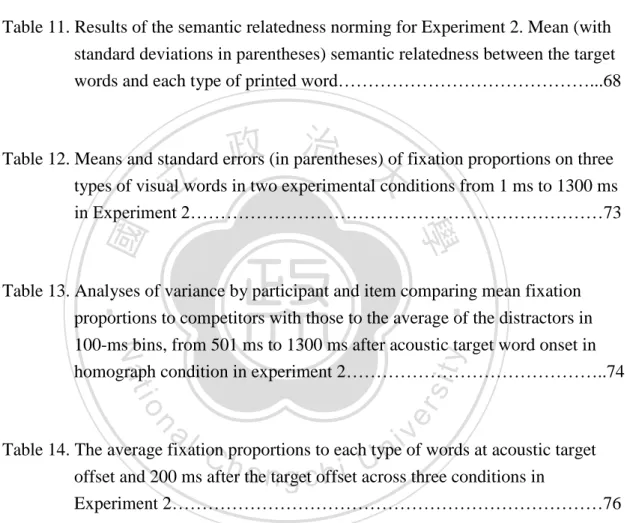
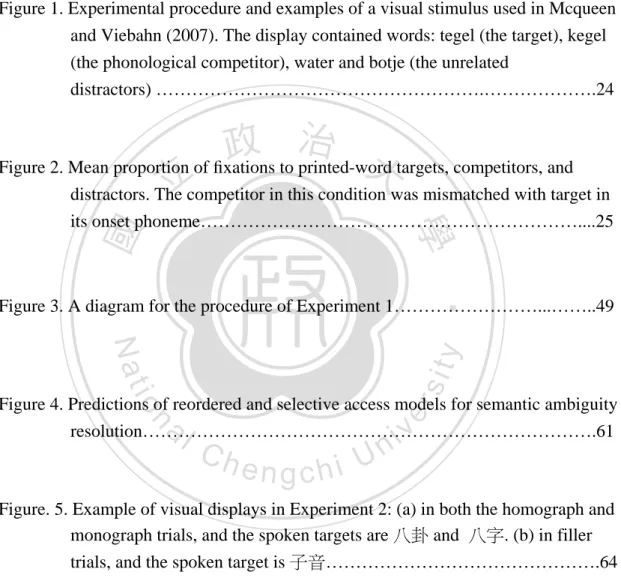
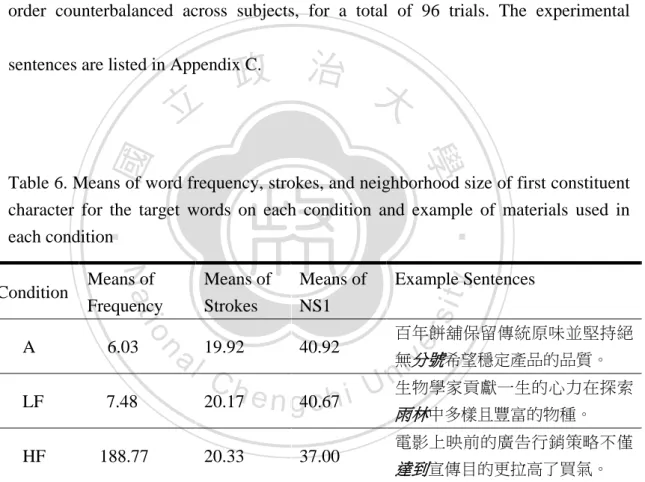
(7) T AB L E. O F C O N T EN T S. Acknowledgements ................................................................................................................. iv List of Tables ........................................................................................................................... ix List of Figures.......................................................................................................................... xi Chinese Abstract ................................................................................................................... xiii. 政 治 大 Chapter 1 Introduction.......................................................................................................... 1 立 English Abstract ..................................................................................................................... xv. ‧ 國. 學. General background ......................................................................................... 1. 1.1. Research questions ........................................................................................... 6. 1.2. ‧. Chapter 2 Literature Review ............................................................................................... 8. y. sit. io. 2.1.2. Processing models of lexical ambiguity resolution........................................ 8 Empirical evidence for lexical ambiguity resolution ................................... 13. er. 2.1.1. Nat. Issues of lexical ambiguity resolution.............................................................. 8. 2.1. al. n. v i n Eye-tracking lexical ambiguity resolution .... 13 C h paradigm and engchi U Subordinate Bias Effect (SBE) revisited........................................................ 16. 2.1.2.1 2.2 2.2.1. Reordered versus selective access model .................................................... 17. 2.2.2. The fate of unselected meaning ................................................................... 22. 2.2.3. Visual world paradigm................................................................................. 23. 2.3. Chinese lexical ambiguity resolution ............................................................. 27. 2.3.1. The linguistic characteristics of Chinese word ............................................ 27. 2.3.2. Studies of lexical ambiguity resolution in Chinese...................................... 29. Chapter 3 Norming Studies of Word Semantic and Contextual Constraint .......... 33 3.1. Norming study one: Interpretation Preference Task ...................................... 33. vi.
(8) 3.1.1. Participants .................................................................................................. 34. 3.1.2. Materials ...................................................................................................... 34. 3.1.3. Procedure ..................................................................................................... 34. 3.1.4. Results.......................................................................................................... 35. 3.2. Norming study two : Meaning Relatedness Task .......................................... 36. 3.2.1. Participants .................................................................................................. 36. 3.2.2. Materials ...................................................................................................... 36. 3.2.3. Procedure ..................................................................................................... 36. 3.2.4. Results.......................................................................................................... 37. 3.3. 政 治 大. Norming study three : Cloze Task ................................................................. 37. 立. Participants .................................................................................................. 38. 3.3.2. Materials ...................................................................................................... 38. 3.4.4. y. sit. al. Materials ...................................................................................................... 40. v i n Ch Procedure ..................................................................................................... 40 engchi U n. 3.4.3. Participants .................................................................................................. 40. io. 3.4.2. Norming study four : Contextual Bias Task .................................................. 40. er. 3.4.1. Results.......................................................................................................... 39. Nat. 3.4. Procedure ..................................................................................................... 38. ‧. 3.3.4. ‧ 國. 3.3.3. 學. 3.3.1. Results.......................................................................................................... 41. Chapter 4 Experiment One: The interaction between meaning dominance and linguistic context ..................................................................................................................................... 43 4.1. Method ........................................................................................................... 44. 4.1.1. Participants .................................................................................................. 44. 4.1.2. Materials and design .................................................................................... 44. 4.1.3. Apparatus ..................................................................................................... 46. 4.1.4. Procedure ..................................................................................................... 47. 4.2. Data analysis .................................................................................................. 49. vii.
(9) 4.3. Results............................................................................................................ 52. 4.3.1. Target word region....................................................................................... 52. 4.3.2. Pre-target and post-target region.................................................................. 53. 4.4. Discussion ...................................................................................................... 56. Chapter 5 Experiment Two: The time course of lexical ambiguity resolution................. 59 5.1. Method ........................................................................................................... 61. 5.1.1. Participants .................................................................................................. 61. 5.1.2. Materials and design .................................................................................... 61. 5.1.3. Norming studies ........................................................................................... 65. 5.1.3.1. Norming study one: Cloze Task .................................................................. 65. 5.1.3.2. Norming study two: Plausibility Rating ...................................................... 65. 5.1.3.3. Norming study three: Semantic Relatedness Rating .................................... 66. ‧ 國. Results............................................................................................................ 70 Discussion ...................................................................................................... 75. sit. y. Nat. 5.3. Procedure ..................................................................................................... 68. ‧. 5.2. 學. 5.1.4. 立. 政 治 大. 6.3 6.4. al. Dynamic processing of context influence and meaning dominance .............. 79. v i n C account The competition bias effect ...................................... 82 U h e nofgsubordinate i h c n. 6.2. io. 6.1. er. Chapter 6 General Discussion............................................................................................ 79. Time course of activation of ‘unselected’ semantic representation ............... 83 Future research............................................................................................... 86. Reference ................................................................................................................................ 89 Appendixes ............................................................................................................................. 95 A. Examples of questionnaire in Norming study two: Meaning Relatedness Task (Experiment 1)........................................................................................................................ 95 B. Norming study four: Contextual Bias Task (Experiment 1) ...................................... 96 C. Experiment materials of Experiment 1 ........................................................................ 97 D. Experiment materials of Experiment 2 ...................................................................... 100. viii.
(10) List of Tables. Table 1. Different types of models of lexical ambiguity resolution …………………12. Table 2. The materials and results summarized from Duffy, Morris, and Rayner (1988) ………………………………………………………………………15. 立. 政 治 大. ‧. ‧ 國. 學. Table 3. The comparison of results in Sereno et al. (1992) and Sereno et al. (2006)……………………………………………………………………….21. Table 4. Chinese studies of lexical ambiguity resolution…………………………... 31. er. io. sit. y. Nat. Table 5. The norming data summarized from four norming studies………………...42. n. al. Ch. engchi. i n U. v. Table 6. Means of word frequency, strokes, and neighborhood size of first constituent character for the target words on each condition and example of materials used in each condition………………………………………………………46. Table 7. Means and standard errors (in parentheses) of fixation durations and probability measures on three types of target words in Experiment 1……...53. Table 8. Means and standard errors (in parentheses) of fixation durations and probability measures on three types of pre-target words in Experiment 1.....54. . ix .
(11) Table 9. Means and standard errors (in parentheses) of fixation durations and probability measures on the post-target words in Experiment 1…………... 55. Table 10. Means of word frequency, strokes, and neighborhood size of first constituent character for the spoken target words in each experimental condition and example of materials used in each condition………………64. Table 11. Results of the semantic relatedness norming for Experiment 2. Mean (with standard deviations in parentheses) semantic relatedness between the target words and each type of printed word……………………………………...68. 政 治 大. Table 12. Means and standard errors (in parentheses) of fixation proportions on three types of visual words in two experimental conditions from 1 ms to 1300 ms in Experiment 2……………………………………………………………73. 立. ‧ 國. 學 ‧. Table 13. Analyses of variance by participant and item comparing mean fixation proportions to competitors with those to the average of the distractors in 100-ms bins, from 501 ms to 1300 ms after acoustic target word onset in homograph condition in experiment 2……………………………………..74. n. er. io. sit. y. Nat. al. Ch. i n U. v. Table 14. The average fixation proportions to each type of words at acoustic target offset and 200 ms after the target offset across three conditions in Experiment 2………………………………………………………………76. engchi. x.
(12) List of Figures. Figure 1. Experimental procedure and examples of a visual stimulus used in Mcqueen and Viebahn (2007). The display contained words: tegel (the target), kegel (the phonological competitor), water and botje (the unrelated distractors) ……………………………………………….……………….24. 治 政 大 targets, competitors, and Figure 2. Mean proportion of fixations to printed-word 立competitor in this condition was mismatched with target in distractors. The ‧. ‧ 國. 學. its onset phoneme………………………………………………………....25. Figure 3. A diagram for the procedure of Experiment 1……………………...……..49. io. sit. y. Nat. n. al. er. Figure 4. Predictions of reordered and selective access models for semantic ambiguity resolution………………………………………………………………….61. Ch. engchi. i n U. v. Figure. 5. Example of visual displays in Experiment 2: (a) in both the homograph and monograph trials, and the spoken targets are 八卦 and 八字. (b) in filler trials, and the spoken target is 子音……………………………………….64. Figure 6. Experimental procedure of Experiment 2………………………………….69. Figure 7. Fixation proportions to all types of printed words across two experimental conditions and one target (filler) condition in experiment 2. The x-axis shows time in milliseconds from the display onset, for 4000 ms………....72 . xi .
(13) Figure 8. Time course of fixation proportions on different word types in two experimental conditions from 1 ms to 1300 ms…………………………...74. 立. 政 治 大. ‧. ‧ 國. 學. n. er. io. sit. y. Nat. al. Ch. engchi. . xii . i n U. v.
(14) 國. 立. 政. 治. 大. 學. 研. 究. 所. 碩. 士. 論. 文. 提. 要. 研究所別:語言學研究所 論文名稱:詞彙歧義解困的次要語義偏向效應再視;中文多義詞的眼動研究證 據 指導教授:蔡介立 研究生:盧怡璇. 立. 政 治 大. ‧ 國. 學. 論文提要內容:(共一冊,21,216 字,分 6 章 20 節,並扼要說明內容) 過 去 二 十 多 年 來 , 心 理 語 言 學 研 究 關 注 詞 彙 歧 義 解 困 (lexical ambiguity. ‧. resolution)歷程發生時,語義脈絡與多義詞的語義頻率之間的交互作用。許多研. Nat. sit. y. 究發現,當語境支持非均勢同形異義詞 (unbalanced homograph) 的次要語義時,. n. al. er. io. 同 形 異 義 詞 的 凝 視 時 間 長 於 與 其 有 相 同 字 形 頻 率 的 單 義 詞 (unambiguous. i n U. v. control),此為次要語義偏向效應 (subordinate bias effect)。根據再排序觸接模. Ch. engchi. 型 (reordered-access model),次要語義偏向效應來自於主要語義與次要語義的競 爭;相對地,選擇觸接模型 (selective access model)則認為只有與語境相關的語 義被激發,因此,次要語義偏向效應是因為提取到一個使用頻率較低的語義。 本論文進行兩個眼動實驗。實驗一檢視中文多義詞的次要語義偏向效應以區辨 兩種詞彙歧義解困模型分別提出的解釋。本實驗的材料使用了低頻同形異義詞、 低頻單義詞、以及高頻單義詞。結果顯示,當使用的單義詞與多義詞字形頻率 相同時,在目標詞及後目標詞上(目標詞後一個詞)皆發生了次要語義偏向效應。 實驗二利用口語理解─視覺典範中透過受試者理解語音訊息時同步記錄眼動的 作業方式來探究次要語義偏向效應是否來自於主要語義的激發。當口語句子中 xiii.
(15) 的目標詞被唸出後,會計算出隨著時間增加眼睛落在四個雙字詞的凝視比例。結 果發現次要語義因為語境的選擇在聽到目標詞後大約 500 毫秒時就可被激發,主 要語義則在一聽完多義詞後被激發。因此,多義詞的兩個語義在聽到目標詞後大 約 900 至 1300 毫秒時(相當於在後目標詞時)發生競爭。整體而言,本研究顯示 即使語境支持多義詞的次要語義,主要語義依然會被激發。因此,次要語義偏向 效應是由兩個語義競爭後所造成的結果,符合再排序觸接模型的解釋。. 立. 政 治 大. ‧. ‧ 國. 學. n. er. io. sit. y. Nat. al. Ch. engchi. . xiv . i n U. v.
(16) Abstract Research in psycholinguistics throughout the last two decades has focused on. the interaction between linguistic context and meaning dominance during lexical ambiguity resolution. Many studies demonstrated the subordinate bias effect when. 政 治 大. the preceding context biased for the subordinate meaning (i.e. infrequent meaning). 立. of an unbalanced homograph. According to the reordered access model, the SBE is. ‧ 國. 學. due to competition between the dominant and subordinate meanings. On the contrary,. ‧. Nat. io. sit. and the SBE is a result of access to a low frequent meaning.. y. the selective access model assumes only the context-relevant meaning is activated. er. Two eye tracking experiments of sentence reading and sentence listening were. al. n. v i n C h the SBE of Chinese conducted. Experiment 1 examined e n g c h i U homographs to differentiate. the two accounts. We utilized low frequency homographs along with their matched low and high-frequency unambiguous words. The results showed the SBE emerging in fixation durations of the target region and post-target region (i.e. next two words of the target), when unambiguous controls were matched to the word-form frequency of ambiguous words.. . xv .
(17) Experiment 2 used visual world paradigm to explore temporal dynamics of dominant meaning activation responsible for the SBE in an instructional eyetracking-during-listening task. Fixation probabilities on four disyllabic printed words were analyzed during a time period after a target word was uttered in a spoken. 政 治 大. sentence. The results supported the reordered access model. The subordinate. 立. meaning was activated by contextual information at about 500 ms after the onset of. ‧ 國. 學. acoustic homograph at the time when context penetrated to make its favored. ‧. meaning available. Soon after the offset of homograph, the dominant meaning. Nat. io. sit. y. became active. Both meanings associated with the homograph were activated during. er. the time windows of 901 ms to 1300 ms, which approximately corresponding to the. al. n. v i n C hIn sum, our studies acoustic onset of post target. e n g c h i U demonstrate that the dominant. meaning is activated even when the contextual information biases to the subordinate meaning of a homograph. The subordinate bias effect is the result of competition from two meanings, conforming to the reordered access model.. . xvi .
(18) Chapter 1 Introduction. “If I accomplish nothing else in this story, I hope I will persuade you that human language is so vague and ambiguous that only a very clever brain could possibly understand it.” (Miller 2001). 1.1. General background. 治 政 Based on the theoretical linguistics, homonym大 and polysemy are two main types 立 ‧ 國. 學. of ambiguous words (Cruse, 1986; Lyons, 1977). Homonym is the word which contains two or more etymologically and semantically unrelated meanings sharing the. ‧. same orthographic form and phonology. For example, the word ring can refer to. sit. y. Nat. io. n. al. er. either “jewelry” or “sounds”. On the contrary, polysemy is the word that contains two. i n U. v. or more etymologically and semantically related senses. For example, the word lamb. Ch. engchi. can refer to either “an animal” or “meat”. Both homonym and polysemy have been studied in much psycholinguistic research and they have been demonstrated to be psychologically distinct based on empirical evidence. (Beretta, Fiorentino, & Poeppel, 2005; Frazier & Rayner, 1990; Rodd, Gaskell, & Marslen-Wilson, 2002). In the present study, we mainly focus on the one type of homonym which specifies words that have the same orthographic form and sound but differ in meaning. They are known as homophonic homographs. 1.
(19) 2 . Reading comprehension involves the processes from the building blocks of word meanings to the integrated semantic representation. Closely related to the nature of mental lexicon, generally, a word-form carries single phonological and semantic information. However, there is a group of words with mapping single word form to two or more meanings. The ambiguous words provide unique opportunities to examine how different meanings are activated and interacting with the contextual. 政 治 大. information. It is uncontroversial that context can facilitate meaning access in reading. 立. (Rayner, 1998). However, the temporal locus of contextual influence in lexical. ‧ 國. 學. ambiguity resolution remains unresolved. Thus, the research casting questions of. ‧. lexical ambiguity resolution serve as crucial evidence to understand the nature of the. Nat. io. sit. y. language-processing system. The modular and the interactive access hypothesis have. n. al. er. been tested on the concept of exhaustive access, tying to the notion of whether this. i n C access process was impervious h to contextual influences. engchi U. v. The proponents of modular access hypothesis (Fodor, 1983) maintains that the contextual information does not influence lexical access at the early stage. A number of early studies have provided evidence that all meanings of an ambiguous word would be activated in initial lexical access, and context affects the post-lexical integration stage (Onifer & Swinney, 1981; Swinney, 1979; Tanenhaus, Leiman, & Seidenberg, 1979). Thus, based on this result, multiple or exhaustive access model.
(20) 3 . (Onifer & Swinney, 1981; Swinney, 1979; Tanenhaus et al., 1979) was proposed. It views that all meanings of an ambiguous word are accessed autonomously and the contextual information can select an appropriate meaning at post-lexical stage. In contrast, the interactive access hypothesis (Marslen-Wilson & Tyler, 1980; McClelland & Elman, 1986) assumed that the information in lexical module can interact with discourse at the early stage. Thus, selective access model (G.B. Simpson,. 政 治 大. 1981; Tabossi, Colombo, & Job, 1987; Tabossi & Zardon, 1993) suggested that. 立. contextual information plays a very pronounced role in lexical access, and as a result,. ‧ 國. 學. only contextually appropriate meaning of ambiguous words is accessed. In sum, these. ‧. Nat. io. sit. could possibly influence lexical access.. y. opposing findings have led to a question on the timing of contextual information. al. er. However, the relative frequency of the various meanings is also important to. n. v i n C h access. In the U determine the timing of lexical e n g c h i present study, we utilize the term meaning dominance to indicate the extent to which one meaning is more likely to occur than another. Meaning dominance effects observed in cross-modal priming studies show that two meanings of a balanced ambiguous word are activated approximately at the same time. However, the dominant meaning of an unbalanced ambiguous word becomes available prior to the subordinate meaning, suggesting that access is frequency ordered. Eye movement studies have also shown the evidence.
(21) 4 . of contextual and meaning dominance effects. For example, when the preceding context supported the subordinate (infrequent) meaning, fixation durations. were. longer on biased homographs (i.e. one meaning is much more frequent than the other) as compared with its unambiguous control words which were matched in word-form frequency (Duffy, Morris, & Rayner, 1988). This has been termed as the subordinate bias effect (SBE; Pacht & Rayner, 1993; Rayner, Pacht, & Duffy, 1994).. Two. 政 治 大. hybrid models based on the interactive view manifested in eye-movement evidence. 立. were proposed to account for rapid activation of multiple meanings and early. ‧ 國. 學. influence of the sentential context. The reordered access model embraces the account. ‧. that the existence of SBE is two meanings of an ambiguous word compete for. Nat. io. sit. y. selection at the same time, and thus, it takes longer times to process. The results seem. al. er. to indicate that the dominant meaning of an ambiguous word has been activated even. n. v i n Csubordinate when the context supports its h e n g cmeaning. h i UHowever, alternative explanations. of the SBE have been proposed by proponents of selective access model, which assumes only the contextually-appropriate meaning was activated given sufficiently constraining context. Sereno, Pacht, & Rayner (1992) and Sereno, O'Donnell, & Rayner (2006) examined the SBE from this perspective and argued that the SBE may be the consequence of taking the subordinate meaning of homographs as a low frequency word, rather than the competition of the dominate meaning to the.
(22) 5 . subordinate meaning. Therefore, there are two possible accounts, competition or low frequency account for the established subordinate bias effect. The research of lexical ambiguity resolution in Chinese is relatively few and most of which have utilized a cross-modal priming paradigm to differentiate between modular and interactive hypothesis (Ahrens, 2001; Ahrens, Chang, Chen, & Huang, 1998; Li, Shu, Yip, Zhang, & Tang, 2002; Li & Yip, 1996, 1998). Chinese is. 政 治 大. considered to be a context-prominent language because of two linguistic properties,. 立. that is, the flexibility to omit the pronoun (i.e. Pro-drop) and topic-prominent, both of. ‧ 國. 學. which require the contextual information to comprehend a sentence. Therefore,. ‧. Ahrens et al. (1998) proposed language-driven hypothesis and maintained that. Nat. sit. interpretation. Indo-European. n. al. than. Ch. engchi. incorporated Chinese ambiguous word such. languages.. er. io. propositional. y. language like Chinese relies more heavily on contextual information for semantic and. iv n as U “ 背 書 ”,. Ahrens. (2001). which either means. “memorize” or “endorsement” in the preceding subordinate-biased contexts and conducted a cross-modal lexical decision task. The evidence demonstrated that both meanings were accessed at the onset of ambiguous words even when the context was biased toward the subordinate meaning. Therefore, the author contended that the data supported modular access hypothesis, which implied the contextual influence at the post-lexical stage. Nevertheless, Li et al. (2002) used cross-modal paradigm to.
(23) 6 . explore the processing of biased homophones in Chinese. The results indicated that both frequency and context were critical at an early time. Thus, it was compatible with interactive access hypothesis. In sum, it is uncontroversial that the context plays an important role in arriving at the appropriate meaning; however, whether contextual effect is acting early or late in the time course of ambiguity resolution remains unclear in Chinese.. 立. 政 治 大. ‧ 國. 學. 1.2 Research questions. ‧. The present study conducts two eye movement experiments to reveal the. Nat. io. sit. y. continuous and incremental processing of semantic ambiguity resolution. Experiment. er. 1 manipulates three types of Chinese two-character words in sentence reading task:. al. n. v i n C h (A), low frequentUunambiguous word (LF), and high low frequent biased homographs engchi. frequent unambiguous word (HF) and these words are all embedded in sentential contexts. More specifically, the biased homographs are incorporated in the subordinate-biased context. Experiment 2 uses visual world paradigm to probe the time. course. of. lexical. ambiguity. resolution. in. an. instructional. eyetracking-during-listening task. The spoken sentences are similar to those in.
(24) 7 . Experiment 1 and the visual stimuli are four disyllabic printed words containing dominant and subordinate semantic associates and two other unrelated distractors. Specific research questions to be addressed are as follows:. (1) Does the subordinate bias effect exist in lexical ambiguity resolution of reading Chinese homographs? And if the SBE was established, when does the contextual. 政 治 大. influence occur in Chinese lexical ambiguity resolution (early or late)?. 立. (2) We attempt to differentiate between the reordered and selective access model in. ‧ 國. 學. lexical ambiguity resolution. The reordered access model proposes the competition. ‧. account of the SBE; however, the selective access model posits that the SBE is in. y. Nat. al. n. account) could be supported from the present data?. Ch. engchi. .. er. io. sit. essence a word frequency effect. Which account (i.e. competition or frequency. i n U. v. (3) What is the fate of the unselected meaning? The reordered access model assumes that the activations of the unselected meaning passively decay. In contrast, the selective access model assumes that the unselected meaning was not accessed at all..
(25) Chapter 2 Literature Review. 2.1. Issues of lexical ambiguity resolution Modular and interactive access hypotheses made different assumptions about the. 政 治 大. timing of contextual influence. Over the past few decades, researchers have used. 立. various approaches to investigate lexical ambiguity resolution. For example,. ‧ 國. 學. cross-modal priming and eye-tracking methods have provided a substantial body of. ‧. empirical evidence on theoretical accounts of how ambiguous words are processed. In. Nat. io. sit. y. particular, the subordinate bias effect has been found in eye movement studies when. er. the preceding context supported the infrequent meaning of biased homographs. The. al. n. v i n C hthat both linguisticUcontext and relative frequency of existence of the SBE suggests engchi the alternative meanings play an important role in lexical ambiguity resolution.. 2.1.1. Processing models of lexical ambiguity resolution. A central issue in psycholinguistics is whether the successful and rapid meaning access is modular or interactive processing in nature. Although all models of lexical ambiguity resolution agree that context allows readers to determine the relevant . 8 .
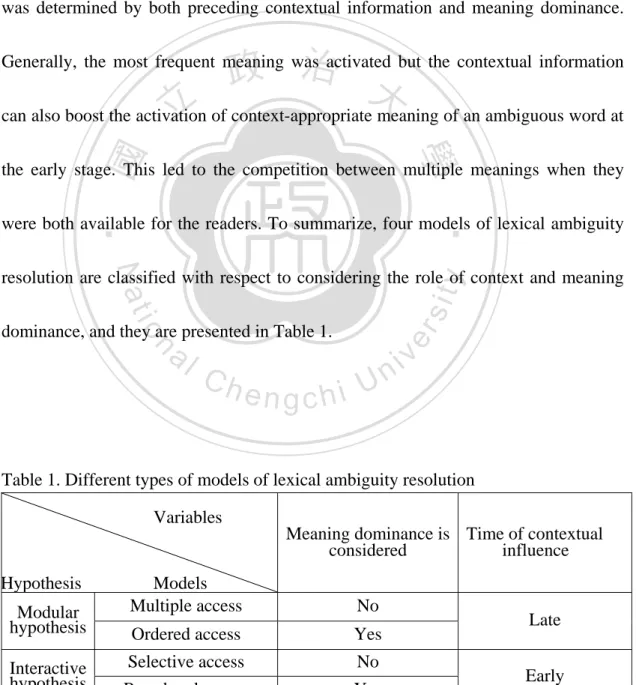
(26) 9 . meaning of a homograph, the perspectives on the time locus of contextual influence are diverse. Modular access hypothesis (Fodor, 1983) proposed the autonomous bottom-up processing in which lower levels of information (lexical module) were not directly influenced by the higher levels of information (discourse module). That is, the contextual information does not penetrate lexical access at the early stage. A contrasting hypothesis, interactive access hypothesis (Marslen-Wilson & Tyler, 1980;. 政 治 大. McClelland & Elman, 1986) contended that the simultaneous bottom-up and. 立. top-down processing was operated interactively. Higher and lower levels of. ‧ 國. 學. information can interact with each other at the early stage; therefore, contextual. ‧. information can influence the activation of lexical meaning in early time. Models. Nat. io. sit. y. associated with the modular and interactive view were generated with their empirical. n. al. er. evidence. Under the modular view, multiple and order access models were formed.. Ch. engchi. According to the interactive view, reordered. iv n and U selective. access models were. proposed. Four models of lexical ambiguity resolution are reviewed in the subsequent part in the order of considering the role of context and then meaning dominance in lexical ambiguity resolution. First of all, according to multiple or exhaustive access model (Onifer & Swinney, 1981; Swinney, 1979; Tanenhaus et al., 1979), all of the meanings of an ambiguous word were accessed temporarily and the contextual information can only help to.
(27) 10 . select an appropriate meaning at post-lexical stage. The most compelling evidence of exhaustive access came from cross-modal priming studies. Participants were instructed to respond to the visual probes either by making a lexical decision or naming it after hearing the spoken sentences containing an ambiguous word. There were a related probe for each meaning and an unrelated probe. Participants saw one of the three possible probes. The reaction time of semantically related target to either. 政 治 大. meaning of ambiguous words was compared with that of semantically unrelated. 立. controls. For example, Onifer and Swinney (1981) presented sentences either biased. ‧ 國. 學. for the dominant or for the subordinate meaning of an ambiguous word. Participants. ‧. made lexical decision for the visual probe which may occur immediate at the auditory. Nat. io. sit. y. offset of the ambiguous words or 1.5 seconds delay. In the immediate condition,. n. al. unrelated probe, thus,. er. participants responded faster to either of the meaning-related probes than to an. v i n C h occurred forUboth dominant facilitation engchi. and subordinate. meaning irrespective of context. In the delayed condition, facilitation was limited to one contextual-relevant probe as the time was lengthened between the occurrence of the ambiguous words and the probe. This implies that context only operates at post-lexical stage to select a single meaning after all meanings have been initially accessed. However, some researchers noted that the lexical decision or naming task is sensitive to backward priming or susceptible to guessing strategies, respectively, and.
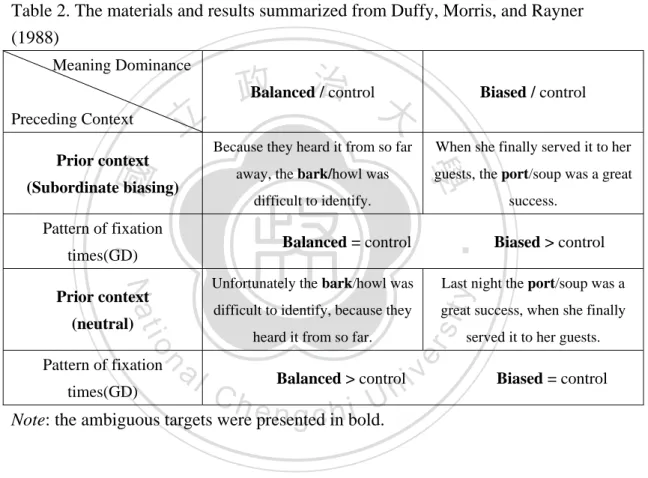
(28) 11 . thus the results may reflect post-lexical integration instead of lexical access (Balota & Chumbley, 1984). The selective access model (G.B. Simpson, 1981; Tabossi et al., 1987; Tabossi & Zardon, 1993) was developed to capture the results in the cross-modal priming studies. When the appropriate context conditions were given, participants were faster to respond to a probe related to the contextually-appropriate meaning of an ambiguous. 政 治 大. word than to a probe related to contextually-inappropriate meaning. This is consistent. 立. with the notion that the access may be limited to the information derived from the. ‧ 國. 學. context. To summarize, the discrepancy between multiple and selective access models. ‧. lies in the locus (early versus late) of contextual information affecting meaning. Nat. io. sit. y. activation of ambiguous words. However, neither of them considered the meaning. n. al. er. dominance of ambiguous words, which is an important factor in lexical ambiguity resolution.. Ch. engchi. i n U. v. Two competing models were proposed with the consideration for meaning dominance. The ordered access model is proposed by Hogaboam and Perfetti (1975) and G.B. Simpson and Burgess (1985). They maintained that, like the exhaustive model, the preceding context cannot influence on lexical access until the post-lexical stage of selecting appropriate meaning. However, the meaning was not parallel activated but the order of the activation was determined by the relative frequencies of.
(29) 12 . alternative meanings of the ambiguous words, with the most frequent meaning being retrieved first (e.g., Hogaboam & Perfetti, 1975; Onifer & Swinney, 1981; Schvaneveldt & Meyer, 1976; G.B. Simpson & Krueger, 1991). On the contrary, Duffy et al. (1988) proposed the reordered access model to account for their eye-movement results. The lexical access was exhaustive but the meaning activation was determined by both preceding contextual information and meaning dominance.. 政 治 大. Generally, the most frequent meaning was activated but the contextual information. 立. can also boost the activation of context-appropriate meaning of an ambiguous word at. ‧ 國. 學. the early stage. This led to the competition between multiple meanings when they. ‧. were both available for the readers. To summarize, four models of lexical ambiguity. Nat. io. sit. y. resolution are classified with respect to considering the role of context and meaning. n. al. Ch. engchi. er. dominance, and they are presented in Table 1.. i n U. v. Table 1. Different types of models of lexical ambiguity resolution Variables Meaning dominance is Time of contextual considered influence Hypothesis Modular hypothesis Interactive hypothesis. Models Multiple access. No. Ordered access. Yes. Selective access. No. Reordered access. Yes. Late Early.
(30) 13 . 2.1.2. 2.1.2.1. Empirical evidence for lexical ambiguity resolution. Eye-tracking paradigm and lexical ambiguity resolution. Readers move their eyes through lines in order to acquire information. Readers recognize words, access meaning and in the end integrate all the information in the course of understanding a text. In eye-tracking experiment, reader’s eye movements. 政 治 大. were monitored and recorded when the eyes proceed with a series of jumps (saccades). 立. and stops (fixations). When readers recognize words and further integrate the obtained. ‧ 國. 學. meanings into the constructed context for comprehension, the characteristics of words. ‧. affect two types of decisions, where and when to move the eyes (Tsai & McConkie,. Nat. io. sit. y. 2003).There are some advantages of the eye-tracking paradigm comparing to. n. al. of reading sentences or. er. cross-modal paradigm. First, the whole experiment is under the natural circumstance. v i n C h Second, unlike U texts. e n g c h i cross-modal. paradigm, it is more. sensitive to the on-line linguistic processing with readers’ eye fixation duration and fixation probability being measured. A large number of eye movement studies have investigated lexical ambiguity resolution (K. S. Binder, 2003; Dopkins, Morris, & Rayner, 1992; Duffy et al., 1988; Kambe, Rayner, & Duffy, 2001; Pacht & Rayner, 1993; Rayner, Cook, Juhasz, & Frazier, 2006; Rayner & Duffy, 1986; Rayner et al., 1994; S. C. Sereno, 1995; S. C..
(31) 14 . Sereno et al., 2006; S. C. Sereno, J. M. Pacht, & K Rayner, 1992; Sheridan, Reingold, & Daneman, 2009; Wiley & Rayner, 2000) Most of the studies focus on two variables: (1) the meaning dominance1, and (2) the instantiated meaning of supporting context. Meaning dominance concerns the relative frequency of alternative meaning of ambiguous words, thus, two types of homographs were differentiated. Balanced homographs have two fairly equally frequent meaning, and the biased homographs. 政 治 大. have one highly frequent meaning (dominant meaning) and one or more less frequent. 立. meanings (subordinate meaning). For example, a balanced homograph such as case,. ‧ 國. 學. with one meaning related to legal proceeding, the other related to containers and both. ‧. of which are equally common in the language. In contrast, a biased homograph, like. Nat. subordinate meaning, “a type of wine”.. n. al. Duffy et al. (1988). er. io. sit. y. port, the dominant meaning “harbor” is more prevalent in the language than its. v i n C embedded h e n gthec hbiased i U and. balanced homographs in. disambiguating information which either preceded or followed the two types of homographs, thus creating four conditions. Each type of homograph had an unambiguous control word matched with same word frequency and length. In general, when preceding contexts instantiated the subordinate meaning of biased homographs, reading times were longer on biased homographs compared with those of balanced 1 Meaning dominance could be operationally defined as the probability that a particular meaning associated with the homograph itself is given as the first response in word-association norming tasks..
(32) 15 . homographs or control words. On the contrary, in the neutral contexts, readers fixate longer on balanced homographs than on biased homographs or unambiguous control words. The example sentences and findings are summarized in Table 2.. Table 2. The materials and results summarized from Duffy, Morris, and Rayner (1988) Meaning Dominance. Balanced治 / control 政 大. 立 Because they heard it from so far difficult to identify.. Pattern of fixation. Balanced = control. times(GD). (neutral). Biased > control. Last night the port/soup was a. difficult to identify, because they. great success, when she finally. io. n. Ch. i n U. Balanced > control. engchi. y. Unfortunately the bark/howl was. heard it from so far.. al. success.. sit. Nat. Prior context. Pattern of fixation. guests, the port/soup was a great. away, the bark/howl was. ‧. ‧ 國. (Subordinate biasing). When she finally served it to her. 學. Prior context. er. Preceding Context. times(GD). Biased / control. v. served it to her guests.. Biased = control. Note: the ambiguous targets were presented in bold.. The results demonstrated that processing difficulty resulted from certain combination of contextual information and meaning dominance, such as, when the preceding context biased for the subordinate meaning, gaze duration was longer on biased homographs than on its unambiguous control words. The SBE reveals that longer processing time is needed when the preceding contexts support infrequent.
(33) 16 . meaning of the biased homographs (e.g. with the infrequent meaning generated less than 8% of the time). However, the SBE is not consistently observed under certain conditions 2 . For example, Wiley and Rayner (2000) found no SBE when the ambiguous words were not strongly biased for frequent meaning (e.g. with the probabilities of infrequent meaning generated between 8% and 30% of the time) and the titles of the context passages were given to disambiguate the vague passage. It. 政 治 大. seems that SBE is consistently established only when the subordinate meaning is very. 立. infrequent but not moderately infrequent (see discussion in Duffy, Kambe, & Rayner,. ‧ 國. 學. 2001, p. 36).. ‧. n. er. io. sit. y. Nat. al. Ch. 2.2 Subordinate Bias Effect (SBE) revisited. engchi. i n U. v. The existence of SBE implied that the language processing was likely to be interactive since the prior context influenced ambiguous word processing in an early time. Two models based on interactive hypothesis were thus proposed. The reordered 2 In a number of experiments, Kellas and colleagues (Martin, Vu, Kellas, & Metcalf, 1999; Hoang Vu, Kellas, Metcalf, & Herman, 2000; H. Vu, Kellas, & Paul, 1998) have reported effective elimination of SBE through strong contextual manipulations. On the contrary, numerous others failed to eliminate the SBE from eye movement monitoring of skilled readers by manipulating characteristics of context, such as, contextual constraint, topic and conceptual repetition (Dopkins et al., 1992; Kambe et al., 2001; Morris & Binder, 2002; Rayner et al., 1994). .
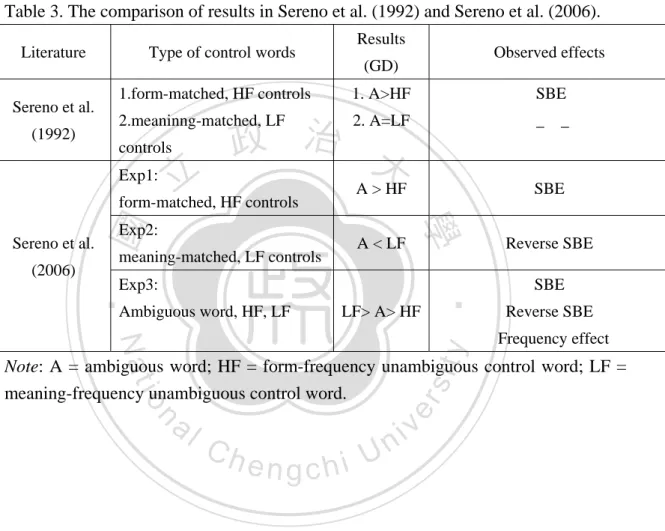
(34) 17. access model assumed that both meaning frequency and prior contextual information can influence ambiguous word processing, on the contrary, selective access model proposed that prior context determined and selected the appropriate meaning immediately regardless of the meaning dominance. Therefore, the reordered and selective access models accounted for the established SBE by proposing competition and frequency account respectively. The former assumed that the dominant meaning. 政 治 大. was activated, while, the latter was not. Sereno,et al. (1992) and Sereno,et al. (2006). 立. have tested these two accounts. They argued that the appropriate control words should. ‧ 國. 學. correspond to the frequency of component meaning since the overall word-form. ‧. frequency was much higher than the subordinate meaning frequency. If only the. Nat. io. sit. y. context-appropriate meaning was activated, it was comparably fair to compare the. al. er. fixation times between the homograph and its meaning frequency matched controls.. n. v i n C hwe focus on the two In the following subsections, e n g c h i U accounts for SBE based on the reordered access and selective access model and their explanations of the fate of the dominant meaning.. 2.2.1. Reordered versus selective access model Duffy et al. (1988) proposed the reordered access model for lexical ambiguity. resolution. The model makes four basic assumptions: first, lexical access is exhaustive.
(35) 18 . and all possible meanings are accessed when the word form is activated. Second, meaning dominance determines the relative activation of multiple meanings. Third, lexical access is an interactive process, in which the preceding context participates in the initial access of word meaning and increase the contextually-appropriate interpretation of an ambiguous word. Fourth, the activation level of the contextually-inappropriate meaning is unaffected. The SBE has served as a test. 政 治 大. ground for investigating the assumption that access is exhaustive. The most accepted. 立. account of SBE is proposed by reordered access model which maintains that the. ‧ 國. 學. dominant meaning is activated due to its relative frequent meaning and the. ‧. subordinate meaning is boosted by context. Both meanings compete for selection,. Nat. io. sit. y. thus resulting in the longer gazes on ambiguous words. The competition was. n. al. fixation durations and. er. apparently manifested in eye movement behaviors. Reading was disrupted with longer. v i n C h words received ambiguous e n g c h i U more. regressions when they. followed subordinate-instantiated context (Duffy et al., 2001; Kambe et al., 2001). Duffy et al. (2001) pointed out that although context supported the less likely meaning, the dominant meaning was not eliminated in the process. Rayner et al. (2006) suggested that the subordinate bias effect resulted from the automatic processing of the dominant meaning. Contextual information does not override the access of dominant meaning..
(36) 19 . According to the selective access model, the SBE was a word frequency effect. In other words, a single meaning was activated without retrieving the other meanings associated with that form. It takes longer processing time to access to the infrequent meaning (Kellas & Vu, 1999; S. C. Sereno et al., 1992; G. B. Simpson & Kreuger, 1991). Sereno, et al. (1992) used two control conditions to examine the selective account of SBE as only the frequency effect instead of the meaning dominance which. 政 治 大. should determine processing time. One control was matched to the form frequency of. 立. an ambiguous word, namely HF control. Another LF control word was matched with. ‧ 國. 學. the frequency of subordinate interpretation, which was estimated as the proportion of. ‧. form frequency. That is, an interpretation with a meaning bias of .15 was estimated to. Nat. io. sit. y. have a meaning frequency that was 15% of the form frequency of ambiguous words.. al. er. They obtained the typical SBE when the form frequency control was used to compare. n. v i n Ch with biased homographs. Additionally, reported longer fixations in post-target e n gthey chi U. (fixation time on the next two words of target), which indicated that ambiguity continued to next region. On the contrary, when the meaning frequency control was the comparison condition, they found SBE in total viewing time and post-target duration but not in target GD. Sereno, et al. (2006) used similar control words to investigate the SBE. They hypothesized that the use of stronger contexts would decrease the SBE related to the word-form (HF) controls and eliminate the SBE.
(37) 20 . related to the word-meaning (LF) controls, as in Sereno, et al.(1992). They reported the SBE with respect to HF words in target measures, but not in spillover measures. In contrast, reverse SBE was found with respect to LF words in target measures, namely shorter fixation times for biased homographs compared with that for LF words. They claimed that the biased homograph represented a special case in which the word form was a high-frequency word, but the context it occurred intended a low-frequency. 政 治 大. meaning. Therefore, an ambiguous word’s fixation-time can be determined by the. 立. contribution of its form and meaning during lexical access process. In terms of word. ‧ 國. 學. form, the homograph should be processed no faster than an HF control but faster than. ‧. an LF control (e.g., gaze durations: LF>A≧HF). In terms of word meaning, the. Nat. io. sit. y. homograph should be processed much slower than an HF control but no slower than. al. er. an LF control (e.g., gaze durations: LF≧A>>HF). This finding indicated that only the. n. v i n subordinate meaning of theC homograph accessed. The comparison of results in h e n gwas chi U Sereno,et al.(1992) and Sereno,et al. (2006) are summarized in Table 3. To summarize, the studies of Sereno et al. (1992) and Sereno et al. (2006) addressed important claims regarding whether the SBE is due to the different manipulations of the control words. This raised the concern that the SBE, instead of reflecting the competition between two meanings, but the increased time may result from effort to access and integrate a lower frequency word. This provided another.
(38) 21 . theoretical explanation of the subordinate bias effect without retaining the activation of the dominant meaning (see also in Reichle et al. (2007)).. Table 3. The comparison of results in Sereno et al. (1992) and Sereno et al. (2006). Literature. Results. Type of control words. Sereno et al. (1992). 1. A>HF. 1.form-matched, HF controls. Exp1:. 2. A=LF 治 政 大. 立. _. A > HF. Exp2:. A < LF. meaning-matched, LF controls. LF> A> HF. Nat. y. ‧. Exp3: Ambiguous word, HF, LF. _. SBE. 學. ‧ 國. form-matched, HF controls. (2006). SBE. 2.meaninng-matched, LF controls. Sereno et al.. Observed effects. (GD). Reverse SBE SBE Reverse SBE Frequency effect. sit. n. al. er. io. Note: A = ambiguous word; HF = form-frequency unambiguous control word; LF = meaning-frequency unambiguous control word.. Ch. engchi. i n U. v. Although the finding of Sereno et al. (1992) suggested that readers’ access to the subordinate meaning of the homograph in essence was like a low-frequency word, the empirical data showed effects of meaning dominance beyond that observed in the low-frequency unambiguous behavior. Sereno et al. (2003) and Morris (2006) contended that the SBE was found in the post-target region (in both conditions) and total viewing time provided evidence of additional processing load, which was.
(39) 22 . different from the situation of only low-frequency meaning activation, suggesting that other factor, such as, the activation of the dominant meaning could be the result of the SBE. In addition, the reason of the reverse SBE (A < LF) found in Sereno et al. (2006) remained unclear. But, it was likely that the reverse SBE was influenced by word frequency effect because the form frequency of ambiguous words is higher than that of LF unambiguous words.. 立. The fate of unselected meaning. 學. ‧ 國. 2.2.2. 政 治 大. A substantial body of research has been done to account for the subordinate bias. ‧. effect. However, there is no general consensus on whether the dominant meaning is. Nat. io. sit. y. activated or not, which plays a key role to resolve the dispute in two possible accounts. al. er. of the SBE. Reordered and selective access models have dealt with the change in the. n. v i n C hdifferently. According state of the unselected meanings e n g c h i U to the reordered access model, the activations of unselected meanings are both unaffected by the context and passively decay since multiple meanings associated with a single form are activated independently. (Rayner, Binder, & Duffy, 1999). Thus, in subordinate-biased context, the subordinate meaning was facilitated, while the dominant meaning was unaffected by contextual influence. On the other hand, based on the selective access model, subordinate-biased context would serve to facilitate activation of the subordinate.
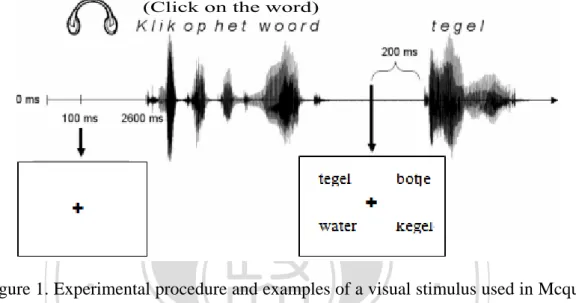
(40) 23 . meaning without accessing the dominant meaning. To observe the dynamic changes of meaning activation, an on-line task with visual world paradigm can provide the temporal information during the comprehension of the auditory sentential contexts.. 2.2.3. Visual world paradigm Recently, eye tracking has been used in a visual world paradigm, which allows. 政 治 大. continuous sampling of visual fixations and provided specific time course of spoken. 立. word recognition. The most important assumption of the visual world paradigm. ‧ 國. 學. involves the nature of the linking hypothesis, which specifies the connection between. ‧. language comprehension and visual processing. The processing of different levels of. Nat. io. sit. y. linguistic representations (i.e. phonological and semantic representation) has been. al. er. examined with a looking-during-listening task in the visual-world paradigm. A visual. n. v i n C h or printed words, display consisted of four objects e n g c h i U typically containing a target, a. competitor (i.e. linguistically-related to the target word) and two unrelated distractors. As participants listened to continuous speech, the visual display was shown on the screen. Participants were instructed to click on a named object or a named word. The experimental procedure and the visual displays from Mcqueen and Viebahn (2007) are shown in Figure 1. Figure 2 presents the time-course graph that illustrated the fixation proportions. The y-axis represents the fixation proportion of each word types.
(41) 24 . in a given time window. And the x-axis showed time in milliseconds from the acoustic target-word onset, for 1 second period. The result showed that there were more looks to phonological competitors than to distractors starting in 600-700.. 立. 政 治 大. ‧. ‧ 國. 學. n. al. er. io. sit. y. Nat. Figure 1. Experimental procedure and examples of a visual stimulus used in Mcqueen and Viebahn (2007). The display contained words: tegel (the target), kegel (the phonological competitor), water and botje (the unrelated distractors).. Ch. engchi. i n U. v.
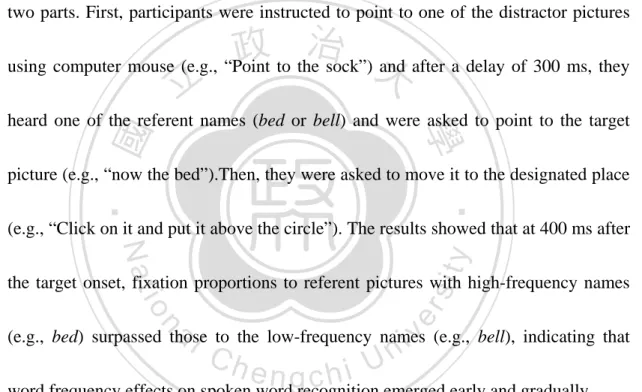
(42) 25 . Figure 2. Mean proportion of fixations to printed-word targets, competitors, and distractors. The competitor in this condition was mismatched with target in its onset phoneme.. Dahan, Magnuson, and Tanenhaus (2001) presented a referent picture of either low-frequency or high-frequency name (e.g., bed or bell) along with three phonologically unrelated pictures on a computer monitor. The instruction contained two parts. First, participants were instructed to point to one of the distractor pictures. 治 政 using computer mouse (e.g., “Point to the sock”) 大 and after a delay of 300 ms, they 立 ‧ 國. 學. heard one of the referent names (bed or bell) and were asked to point to the target picture (e.g., “now the bed”).Then, they were asked to move it to the designated place. ‧. (e.g., “Click on it and put it above the circle”). The results showed that at 400 ms after. sit. y. Nat. io. n. al. er. the target onset, fixation proportions to referent pictures with high-frequency names. i n U. v. (e.g., bed) surpassed those to the low-frequency names (e.g., bell), indicating that. Ch. engchi. word frequency effects on spoken word recognition emerged early and gradually. Falk Huettig and McQueen (2007) examined the time course of retrieval of linguistic and perceptual knowledge by using both picture and printed words. Participants were told that as they listened to the sentences, they could look freely at the visual stimuli presented on the display, which contained phonological, semantic, and shape competitors. When the visual display was picture, fixation to phonological competitor preceded those to semantic, and shape competitors. Nevertheless, only.
(43) 26 . phonological competitors were fixated preferentially as displays contained the printed words. It indicates that pictures are more sensitive to semantic activation than printed words. However, F. Huettig and McQueen (2011) showed that participants did retrieve semantic information quickly in the mapping process and shifted overt attention to semantic competitors when there was no phonologically-matched printed word in the visual display. Therefore, they concluded that language-mediated. 政 治 大. eye-movement was determined partly by the nature of information in the visual. 立. display.. ‧ 國. 學. The issues of lexical ambiguity resolution have been conducted with visual. ‧. Nat. y. world paradigm to explore the time course of semantic ambiguity resolution (L. Chen. er. io. sit. & Boland, 2008; F. Huettig & Altmann, 2004, 2007). In most of the studies, were. n. an array of pictures containing one apresented iv l C n h eone dominant-meaning-related picture, picture, and two n gsubordinate-meaning-related chi U participants. unrelated pictures as controls. The dependent variable was the fixation probability on a given picture. For example, F. Huettig and Altmann (2007) manipulated the context (neutral or subordinate-biased) preceding the ambiguous words (e.g., in subordinate-biased context: “First, the welder locked up carefully, but then he checked the pen and suspected that it was damaged.”). Participants viewed a visual array with four pictures of objects: the dominant referent (e.g., a writing pen), the.
(44) 27 . subordinate referent (e.g., an animal enclosure), and two unrelated distractors. The visual display was presented 1 second before the onset of the spoken sentence. The results showed that at the onset of the target word, there was a statistical difference in looks toward subordinate referent compared those toward the distracters. While, at the offset of the target word, there were more looks toward dominant referents relative to the unrelated distracters in the biasing condition. The effect of context was thus. 政 治 大. established when the subordinate pictures attracted more looks than the distractors.. 立. The results also implied that dominant referent eventually increased even the. ‧ 國. 學. sentential context biased the subordinate meaning.. ‧. n. al. 2.3.1. Ch. engchi. er. io. sit. y. Nat 2.3 Chinese lexical ambiguity resolution. i n U. v. The linguistic characteristics of Chinese word From the perspective of cross-linguistics, Chinese differs significantly from most. Indo-European languages in its phonological, lexical, and syntactic structures. In particular, the unique property of Chinese lexicons provides key information for lexical and sentence processing. There are three types of homonymy, homophonic homographs (e.g. bank in English; 過節 in Chinese), heterophonic homographs (e.g..
(45) 28 . tear in English; 倒數 in Chinese), and homophones (e.g. Beach-Beech in English;. 電源-店員 in Chinese). By definition, homophonic homographs are words with the same form and sound but differ in meanings. Heterophonic homographs are words with the same form but have different sounds (tone) and meanings. Homophones are words that sound the same while differ in forms and meanings. In Chinese, homophones (both monosyllabic and disyllabic ones) are the most frequent type.. 政 治 大. From the Modern Chinese Dictionary (Institute of Linguistics, 1985), 80 percent of. 立. the monosyllables in Chinese correspond to more than one meaning, and 55 percent. ‧ 國. 學. correspond to five or more homophones(see Zhang, Wu, & Yip, 2006 for a review).. ‧. The ambiguity resolution of homophones may differ from the homophonic. Nat. io. sit. y. homographs at the several level of linguistic processing. From the perspective of. al. er. spoken word recognition, multiple meanings of homophones tend to be ambiguous at. n. v i n C horthographic information phonological level and require to settle on form-meaning engchi U mapping. On the contrary, in the visual word recognition, homophonic homographs are ambiguous at the semantic level which depends heavily on the contextual information to resolve the ambiguity. Hue, Chen, Chang, and Sung (1996) reported that the proportion of homographs in Chinese was about 11%. They also found that most homographs contained one basic compositional meaning, and extended the other idiomatic meaning. Both meanings were essentially unrelated, such as “黃牛” which.
(46) 29. the compositional meaning was a kind of bull, while its idiomatic meaning was a person who scalps. The present study focused on Chinese homophonic homographs.. 2.3.2. Studies of lexical ambiguity resolution in Chinese Both homophones and homographs have been investigated by studies using. cross-modal priming. Li et al. (2002) investigated Chinese biased homophones. 政 治 大. following by two different contexts which were biased for either dominant or. 立. subordinate meaning. They found only the dominant meaning of homophone elicited. ‧ 國. 學. priming effects when the dominant-related visual probe occurred 150 ms before the. ‧. acoustic offset, but both meanings elicited priming effects when the visual probe. Nat. io. sit. y. occurred at the acoustic offset. The findings is compatible with the reordered access. al. er. model, indicating that dominant meaning is activated early, and context takes. n. v i n precedence over frequencyC at hthe later stage. Moreover, Ahrens (2001) embedded engchi U. balanced ambiguous verbs in subordinate biased contexts and the data showed that there was a significant priming for the primary- and secondary-related probes compared to their respective controls at the acoustic onset of ambiguous words. And both experimental groups were facilitated (reaction times: related probes < control probes). The author concluded that both meanings are activated even when the context biased for secondary meaning. Therefore, it supported modular access.
(47) 30 . hypothesis. However, the relative meaning dominance was not supposed to have any effect since the balanced ambiguous words were used. One possibility is that the experimental materials intermixed homonymy with polysemy. The related senses contributed to the facilitation of the contextually inappropriate meaning. Chen (2009) discriminated the biased monosyllabic homonymy and polysemy and incorporated both in the context that biased for the dominant meaning. The results indicated that. 政 治 大. only the dominant meaning of a homonymous word was activated, instead, both. 立. meanings of a polysemous word were activated. The author argued that the processing. ‧ 國. 學. of homonymy was compatible with selective access model; in contrast, the processing. ‧. of polysemy was compatible with modular access model. It seems that meaning. Nat. io. sit. y. dominance may not influence the processing of related senses. However, the. er. subordinate-biased contexts are crucial to differentiate the two processing models.. al. n. v i n Previous studies of Chinese C lexical h eambiguity i U are summarized in Table 4. n g c hresolution Table 4. Chinese studies of lexical ambiguity resolution Factors Ambiguity type Studies Ahrens. Disyllabic homograph. (2001). and polysemy. Li et al.. Disyllabic. (2002). homophone. Chen (2009). Meaning. Experimental. dominance. paradigm. Balanced Biased. Monosyllabic Homonymy and polysemy. Biased. Cross-modal priming. Supporting models. Modular. Cross-modal. Interactive. priming. (reordered model). Cross-modal. Homonymy-selective. priming. Polysemy-modular.
(48) 31 . Researchers have investigated lexical ambiguity resolution of Chinese in cross-modal priming experiments. However, the studies of lexical ambiguity resolution showed inconsistent results and different theoretical hypotheses were supported. It is obvious that context has an influence on word processing, however, we are still far from reaching consensus on the processing mechanisms. Furthermore,. 政 治 大. a comprehensive understanding of lexical ambiguity resolution in Chinese is not yet. 立. available in the natural situation of sentence reading. The goal of the present study is. ‧ 國. 學. to examine the role of contextual information in the processing of Chinese. ‧. two-character homographs and to explore the dynamics of semantic activation and. y. Nat. al. er. io. sit. integration. Experiment 1 is analogous to that in Sereno, et al. (2006), manipulating. n. three word types, low-frequency ambiguous word(A), low-frequency unambiguous. Ch. engchi. i n U. v. word (LF), and high-frequency unambiguous word (HF). .LF unambiguous controls are matched to the form frequency of the homographs. Chinese homographs are inherently low-frequency words, therefore, the frequency was close in terms of word form and meaning, Experiment 1 aims to revisit the subordinate bias effect and to test which theoretical account that is more consistent with the empirical data in the course of reading for comprehension. Experiment 2 is designed with the purpose to obtain a clear time course of contextual influence and the activation of word meanings, in.
(49) 32 . particular, to examine the status of the dominant meaning that underlies the SBE when the subordinate-biased context is given.. 立. 政 治 大. ‧. ‧ 國. 學. n. er. io. sit. y. Nat. al. Ch. engchi. i n U. v.
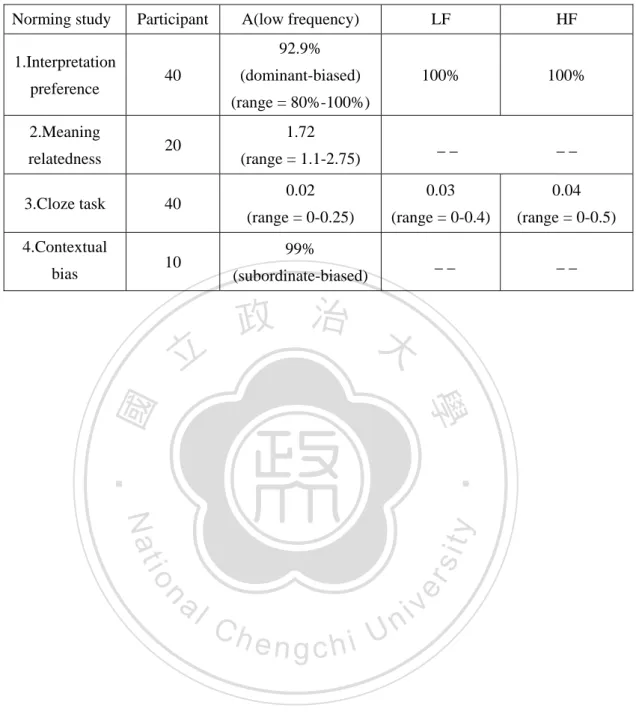
(50) Chapter 3 Norming studies of word semantic and contextual constraint. Prior to the eye-tracking experiments, the biased homographs, unambiguous words, and these words’ contextual constraints were determined by several norming studies. Four norming tasks of subjective rating were conducted to measure word’s meaning preference, meaning relativeness, contextual predictability, and context. 治 政 biasing. First, in the interpretation preference task, 大word's meaning dominance was 立 ‧ 國. 學. determined by the proportion of the participants’ first interpretation response. The results were used to select the biased homograph and unambiguous control words for. ‧. experiments. Second, a meaning relatedness task was conducted to make sure that the. sit. y. Nat. io. n. al. er. selected ambiguous words were homographs with two unrelated meanings. Third, a. i n U. v. cloze task was conducted to ensure the targets’ predictability values from the leading. Ch. engchi. context were below .5. The last norming task was to determine that the context before target was biased for the subordinate meaning.. 3.1. Norming study one: Interpretation Preference Task This task was designed to determine the dominant and subordinate meanings of. Chinese biased homographs.. . 33 .
數據
+7

相關文件
發表好歌詞定義 2.教師引導學生 小組討論曲調旋 律與歌詞的對應
A5: 本課有許多引號,除了對話 之外,是標示需要特別解釋,或
根據 Buur博士的定義(周瑞仁,2003):Mechatronics is a technology which combines mechanics with electronics and information technology to form both functional interaction
語文運用 留意錯別字 辨識近義詞及詞語 的感情色彩 認識成語
詞語 詞性 詞解 練習 主題. 人來人往 (短語) 來往的人很多
An information literate person is able to recognise that information processing skills and freedom of information access are pivotal to sustaining the development of a
In addition, to incorporate the prior knowledge into design process, we generalise the Q(Γ (k) ) criterion and propose a new criterion exploiting prior information about
(2007) demonstrated that the minimum β-aberration design tends to be Q B -optimal if there is more weight on linear effects and the prior information leads to a model of small size;
