Exploring key factors in online shopping
with a hybrid model
Hsiao‑Ming Chen
2†, Chia‑Huei Wu
3†, Sang‑Bing Tsai
1,4,5,6*†, Jian Yu
7*, Jiangtao Wang
4and Yuxiang Zheng
1*Introduction
As the significant share of the population goes online, the web increasingly influences retail sales. E-commerce revenues continue to climb up around the globe and the con-sumers are changing their consuming behaviors at the same time. According to For-rester Research, an independent technology and market research company, online retail sales in US reach $334 billion in 2015, approximately 10% of all sales in the US. E-com-merce will experience a strong compound annual growth rate (CAGR) of 10% over the next 5 years, translating to $480 billion in online sales by 2019. In UK, the online sales are projected at a compound annual growth rate of 11%, from £30.1 billion in 2011 to £51.0 billion in 2016, and the proportion of online shoppers will increase from 75% of the population in 2011 to 85% in 2016. Similarly, the proportion of online shoppers in
Abstract
Introduction: Nowadays, the web increasingly influences retail sales. An in‑depth analysis of consumer decision‑making in the context of e‑business has become an important issue for internet vendors. However, factors affecting e‑business are compli‑ cated and intertwined.
Case description: To stimulate online sales, understanding key influential factors and causal relationships among the factors is important. To gain more insights into this issue, this paper introduces a hybrid method, which combines the Decision Making Trial and Evaluation Laboratory (DEMATEL) with the analytic network process, called DANP method, to find out the driving factors that influence the online business mostly. Discussion and Evaluation: By DEMATEL approach the causal graph showed that “online service” dimension has the highest degree of direct impact on other dimen‑ sions; thus, the internet vendor is suggested to made strong efforts on service quality throughout the online shopping process.
Conclusions: In addition, the study adopted DANP to measure the importance of key factors, among which “transaction security” proves to be the most important criterion. Hence, transaction security should be treated with top priority to boost the online businesses. From our study with DANP approach, the comprehensive information can be visually detected so that the decision makers can spotlight on the root causes to develop effectual actions.
Keywords: Analytic network process (ANP), DEMATEL‑based ANP (DANP), E‑business, Online shopping, Service quality, Management
Open Access
© The Author(s) 2016. This article is distributed under the terms of the Creative Commons Attribution 4.0 International License (http://creativecommons.org/licenses/by/4.0/), which permits unrestricted use, distribution, and reproduction in any medium, provided you give appropriate credit to the original author(s) and the source, provide a link to the Creative Commons license, and indicate if changes were made.
CASE STUDY
*Correspondence: sangbing@hotmail. com; [email protected]; [email protected]
†Hsiao‑Ming Chen, Chia‑Huei Wu and Sang‑Bing Tsai contributed equally to this work. They are the first co‑ authors
1 School of Economics and Management, Shanghai Maritime University, Shanghai 201306, China 7 Business School, Nankai University, Tianjin 300071, China
Full list of author information is available at the end of the article
Sweden will increase from 72% of the population in 2011 to 86% in 2016 (Rigby 2012). Asia Pacific (China, Japan, South Korea, India, and Australia) contains both the larg-est and the fastlarg-est growing e-commerce markets, and total online retail revenues will nearly double from $733 billion in 2015 to $1.4 trillion in 2020; China, especially, is the biggest market and accounts for 80% of Asia Pacific online retail sales; it is expected to become the first market to reach $1 trillion in online retail sales in 2019, according to Forrester Research. As the competition among internet marketers increases, it is becom-ing increasbecom-ingly important for online sellers to understand the factors that affect the atti-tudes of individual customers toward online purchase.
Past researches focused on understanding the consumer’s purchase behaviors via the
internet (Akhter 2012; Chiou and Ting 2011; Chiu et al. 2013; Kim et al. 2012a; Overby
and Lee 2006; Teo and Yu 2005). Several studies identified the key factors leading to a
success of e-business (Kim et al. 2012b); many others explored the influences on online
shoppers’ evaluations regarding repurchase from an e-store (Chiu et al. 2009; Gupta and
Kim 2007; Kim et al. 2012b), customer satisfaction (Dong 2012) and intentions linked
to complaints (Hong and Kim 2012; Wu 2012). Another part of researchers consider
e-service quality and online services in general are recognized to be a crucial
determi-nant in building competitive advantage (Chiou et al. 2011; Cebi 2013; Tontini 2016; Kim
and Lee 2004; Lin 2011; Santos 2003) and relates to measures customer intention to
buy (Bai et al. 2008). In addition, the technique of multiple regression was commonly
used to show the effects of interaction between online shopping motivation and
prod-uct type (Chiou and Ting 2011); structural equation modeling (SEM) approach was also
frequently used to test the hypothetical relations between independent and dependent
variables (Hong and Kim 2012; Kim et al. 2012b; Wu 2012); the importance performance
analysis (IPA) attempted to identify what should be improved or offered on websites and
in online services (Dong 2012; Oh and Zhang 2010), and many studies on the
accept-ance of online shopping have been done under the logic of the attitudinal model,
par-ticularly TRA and its two extensions TPB and TAM (Ajzen 1991; Davis 1989; Fishbein
and Ajzen 1975). These studies have made important contribution to the understanding
of dynamics of e-business. However, consumers need consideration of multiple criteria, but few of previous researches discussed on the intertwined interactions and causal rela-tionships, even in lack of the interdependence and feedback among the criteria during the evaluation process, and do not focus on different weights of criteria; even the online
consumers’ perception study (Kim et al. 2011) from top journals, the weight of criteria
in MDS has remained equal, but the equal-weighting in calculating is not that reason-able in the real world situations. Therefore, this paper proposes an approach that com-bines the Decision Making Trial and Evaluation Laboratory (DEMATEL) method with the analytic network process (ANP) method, called DANP, to address the problems of
interdependence and feedback and weighting measure (Liu et al. 2012). Thus, the DANP
method can provide valuable information and some worthwhile recommendations for achieving a competitive advantage.
The rest of this paper is organized as follows. The second section is the literature review. In third section, the DANP method is described. In fourth section, an empiri-cal study is to demonstrate usefulness of the proposed method. Finally, conclusions and suggestions for future studies are addressed.
Literature review
For ordinary buyers, the internet serves as a convenient shopping medium that can offer such benefits as saving time and effort, less transportation and search costs, no wait-ing lines, improved shoppwait-ing enjoyment, precise price comparison, collection of data, and location of information, convenient information acquiring, and subsequent ability to search more frequently and intensely, and the chance for buyers to design products and
services according to their own needs and preferences (Chiou and Ting 2011; Fred and
Thatcher 2010; Forsythe and Shi 2003; Ha and Stoel 2009; Kim et al. 2012a, 2009; Lee
et al. 2011; Liao et al. 2009; Rozenn and Thierry 2013; Zwass 1991). In general, it gives
consumers the ability to shop from their home for a variety of products or services any-time from all over the world. Most of these factors have positive effects towards online shopping intention and behavior.
In practice, however, many consumers still hesitate to shop online mainly due to some risks, as well as information privacy, security issues and credit-card concerns. Risks may arise because online shoppers do not have the opportunity to interact with sellers directly and to examine the products before making a payment. They would perceive a higher risk for shopping online along with their purchase intention that has conse-quently been influenced. Thus, a number of studies have pointed out that the negative factors in the purchase process can be basically characterized as twofold: perceived
risk and uncertainty (Crespo and del Bosque 2010; Forsythe and Shi 2003; Ha and Stoel
2009; Kim et al. 2012a). Past researches observed that perceived risk plays an important
role in online shopping behavior. Perceived risk occurs in an online transaction when the consumer is required to provide personal and credit card information before they
buy anything (Akhter 2012). Concerns over privacy and credit card security problems
may emerge in the course of internet transactions. Concerns about privacy are, in fact, a major factor that negatively affects purchasing behavior, and it can play a critical role in consumer decision-making. In addition, uncertainty has been shown to exert a heavy
influence on the purchase decision (Forsythe and Shi 2003). Having concerns over
possi-ble unforeseen purchasing results, the consumer worries that products may fail to satisfy consumers’ expectation, fail to provide the desired benefits, or may even not function
properly (Chang and Tseng 2013; Hong and Kim 2012). We suggest that perceived risk of
online purchase should be explicitly examined in research of online shopping behavior. Moreover, trust often plays a key role in consumer adoption of online shopping (Kim
et al. 2010; Cho 2010) and lack of trust in e-retails has been identified as one of the
great-est barriers inhibiting internet transactions—a major reason that many people have not
yet made the decision to shop online (Ha and Stoel 2009; Kim et al. 2012a). Indeed, trust
is an essential factor in the transactional relationship, and e-environmental
uncertain-ties between internet vendors and consumers are of primary concern (Chang et al. 2005;
Chiu et al. 2006; Seyed-Hosseini et al. 2006; Shahraki and Paghaleh 2011).
Methods
This paper introduces a hybrid method that combines the DEMATEL with the ANP to confirm the effects of intertwined criteria and to measure their importance. The DEMA-TEL method and the ANP method are briefly introduced, and the detailed DANP
DEMATEL
Developed by the Geneva Research Centre of the Battelle Memorial Institute, the DEMA-TEL technique is a mathematical procedure to obtain the direct and indirect causation as well as the influential strength across quality features by applying the matrix computation to complex systems and comparing the interrelations across quality features (Gabus and
Fontela 1973; Fontela and Gabus 1976; Tsai 2016; Tsai et al. 2016b; Zhou et al. 2016). The
DEMATEL technique converts complex systems to a clear causal structure that simpli-fies the interrelationship across quality features of complex systems into cause group and effect group; therefore, it helps locate the causal factors and improvement of complex
sys-tems via the degree of interrelations across quantified quality features (Tzeng et al. 2007;
Wu and Lee 2007; Sun 2013; Ting et al. 2013; Wang and Dong 2015). In particular, the
visually structural matrix and causal figures expressing the causation and affecting lev-els across quality features of complex systems have been proven of great use for decision
making (Tsai and Xue 2013; Lee et al. 2014a, b; Guo and Tsai 2015; Guo et al. 2015).
In recent years, DEMATEL has been widely applied to various fields. For example, in
causal analytic method for group decision making (Lin and Wu 2008; Tsai et al. 2014;
Qu et al. 2015; Tsai et al. 2015, 2016a), safety management system for airlines (Liou et al.
2007), selecting management systems of SMEs (Tsai and Chou 2009), evaluating users’
DEMATEL method to clarify interrelations of dimensions/criteria
Using ANP procedures as follows烉 An unweighted supermatrix is defined by means by pairwise comparisons.
ɧ
The weighted superrmatrix is obtained by the total-influence matrix, which is derived according to DEMATEL method.
ɧ
The weighted supermatrix is raised to the consecutive powers to obtain a long-term stable limiting supermatrix
behavioral intention to use a new etching plasma technology (Lee et al. 2010), evaluat-ing performance criteria of employment service outreach program personnel (Wu et al.
2010), and exploring the core competences and causal effect of the IC design service
company (Lin et al. 2011b), etc. In addition, it has been integrated with the other
meth-ods, such as analytic network process (ANP) while selecting knowledge management
strategies (Wu 2008); a back-propagation artificial neural network while conducting
importance-performance analysis (Hu et al. 2009); ANP, and zero–one goal
program-ming (Tsai and Chou 2009); and ANP to form an integrated MCDM technique to weight
attribute clusters (Yang and Tzeng 2011). The method can be summarized as follows.
Step 1 Generating the direct-relation matrix X
Measuring the relationship between criteria requires that the comparison scale is designed with a number of levels. We have decided to use five to use in this case: from 0 (no influence), 1 (very low influence), 2 (low influence), 3 (high influence) to 4 (very high influence). Assuming that there are n criteria that influence a complex system, the n criteria can be extended as an n × n direct-relation matrix (X) based on mutual influ-ence relationships and levels of influinflu-ence and using the expert opinion method. In the
direct relationship matrix X, Xij is denoted as to the degree which the criterion i affects
the criterion j.
Step 2 Normalizing the direct-relation matrix N
Then, the normalization of direct-relation matrix X should be taken into account.
Regarding the calculation of the normalized direct-relation matrix (N), Kim (2006), Lin
and Wu (2008) and Lee et al. (2010) utilized the maximum sum of the row vector as the
normalization baseline.
Subsequently, X was multiplied by λ, and N was acquired.
Step 3 Attaining the total-relation matrix T
Once the normalized direct-relation matrix N is obtained, the total relation matrix T can
be acquired by the means of Eq. (4), in which the I is denoted as the identity matrix.
The sum of rows and the sum of columns are contained in vector D and vector R,
respectively. Components of both vectors are obtained by means of Eqs. (5) and (6).
(1) X = 0 x12 · · · x1n x21 0 · · · x2n . . . ... . .. ... xn1 xn2 · · · 0 (2) Definition: = 1 Max 1 ≤ i ≤ n n j=1xij (3) N = X (4) T = lim k→∞ N + N2+ · · · +Nk =N (I − N )−1
Then, the horizontal axis vector (D + R) named “Prominence” is made by adding R to
D, which reveals how much importance the criterion has. Similarly, the vertical axis (D
− R) named “Relation” is made by subtracting R from D, which may divide criteria into a cause group and an effect group. Generally, when (D − R) is positive, the criterion belongs to the cause group; when the (D − R) is negative, the criterion belongs to the effect group. Therefore, the causal diagram can be acquired by mapping the dataset of both indices, which will provide valuable insight for making decisions.
Step 4 Building a causal map
To express a complex problem by a simplified visual map, locate the figures of coordi-nates (D + R, D − R) by employing the prominence (D + R) as a horizontal axis and the relation (D − R) as a vertical axis. As such, a two-dimensional causal map can be built in four quadrants. The items located in quadrant I (large prominence, positive relation) represent the causal urgent items, which require improvement in a “direct” manner with top priority as they serve as the driving factors. The items located in quadrant IV (large prominence, negative relation) represent the effect urgent items, which also require improvement but in an “indirect” manner with high priority as they are affected by oth-ers. In contrast, the items located in quadrant II (small prominence, positive relation) are not the major items, yet one may carry out a “direct” improvement if the resources are sufficiently available. Finally, the items located in quadrant III (small prominence, negative relation) are not the major items. They are affected by others, thus calling for an “indirect” improvement with the lowest priority.
ANP
The analytic hierarchy process (AHP) has been widely used for analyzing complex deci-sion problems since it was developed by Thomas L. Saaty in the 1970s. Each element in the AHP hierarchy is assumed to be independent of one another. In many real world decision situations, however, the elements are most likely intertwined and
interdepend-ent; thus the AHP is not appropriate (Lan et al. 2013). To transcend the limits of the
AHP, the ANP is developed. It utilizes the super-matrix approach. The first difference is that the AHP is a special case of the ANP, because the ANP handles dependence within a cluster (inner dependence) and among different clusters (outer dependence). Secondly, the ANP utilizes a nonlinear structure, while the AHP applies a hierarchical and lin-ear structure with a goal at the top level and the alternatives in the bottom level (Saaty
1996). The ANP provides a way to input judgments and measurements to derive ratio
scale priorities for the distribution of influence among the criteria and groups of criteria
in the decision making process (Chen et al. 2011). The method has been applied
success-fully while solving many practical decision-making problems, such as project selection, (5) Di = n j=1 tij (i = 1, 2, . . . , n) (6) Rj= n i=1 tij j = 1, 2, . . . , n
product planning, green supply chain management and optimal scheduling problem
(Meade and Presley 2002; Lee and Kim 2000; Karsak et al. 2002; Sarkis 2003; Momoh
and Zhu 2003). Thus the ANP method has partially resolved the issues of dependence
among dimensions and the self-feedback effect within a dimension. However, there are two limitations remaining: (1) the plausible interrelationship between any two criteria that belong to different dimensions and (2) the weighted supermatrix is calculated by assuming the equal weight in all dimensions so that each column sums to unity (Hsu
et al. 2012).
Procedures for the DANP method
When dealing with ANP, our use of the normalization method implies that each clus-ter has the same weight. However, there are different degrees of influence among the clusters of factors/criteria in the world. Thus, the assumption of equal weights of each cluster to obtain the weighted super-matrix is unrealistic and needs to be improved. Therefore, this paper combines the DEMATEL with the ANP, called DEMATEL-based ANP method, or DANP proposed to avoid the shortcomings mentioned in the ANP. The DANP method inherits the advantage from DEMATEL by allowing the interrelation-ships among all criteria; in addition, the dimensional weights obtained by DEMATEL can relax the equal-weight assumption in ANP; the weighted super-matrix can thus be adjusted (by DEMATEL) to have the final DANP influential weights for all criteria (Ou
Yang et al. 2013). We expect not only to deal with the problem of interdependence and
feedback but also improve the normalized super-matrix to derive the relative influential weights in dimensions/criteria. The DANP can reflect real world situations more
accu-rately (Ou Yang et al. 2008) and can provide valuable information for decision making. It
has been successfully applied to solve a variety of MCDM problems, such as improving
marketing (Chiu et al. 2013), tourism policy (Liu et al. 2012), airline partner selection
(Liou et al. 2011), information security risk (Ou Yang et al. 2013; Lo and Chen 2012),
environment watershed plans (Chen et al. 2010).
DANP is therefore more suitable in the real world. The procedure of our proposed
method is mainly divided into four steps (Fig. 1) and can be explained briefly by Hsu
et al. (2012) and Ou Yang et al. (2008).
Step 1 The total relation matrix T will be obtained from DEMATEL. Each column of
the matrix sums up to unity. The matarix is shown in Eq. (7):
Step 2 Next, normalize Tc with the total degree of influence and obtain Tcα, as shown in
Eq. (8).
Then, normalize Tα11
c via Eq. (9), and repeat to obtain Tcαnn. Let us take matrix Tcα11 as an
example. It is normalized in a way which is presented in Eq. (9); all other matrices follow
a similar normalization scheme.
The total effect matrix is normalized into the super-matrix according to the depend-ence relationships in the group. This allows us to obtain the unweighted super-matrix, as
shown in Eq. (10).
Step 3 Obtain the weighted super-matrix by deriving the matrix of the total effect of
dimensions TD. Then, TD can be normalized to become TD by Eq. (α 11):
(8) (9) Tα11 c = tc11/d111 · · · t 11 c1j/d 11 1 . . . t 11 c1m1/d 11 1 . . . ... ... t11 ci1/d 11 i . . . t 11 cij/d 11 i · · · t 11 cim1/d 11 i . . . ... ... t11 cm11/d 11 m1 · · · t11 cm j 1 /dm111 · · · tc11m1m1/dn = tα11 c11 · · · tcα111j · · · tcα111m1 . . . ... ... tα11 ci1 · · · tcα11ij · · · tcα11im1 . . . ... ... tα11 cm11 · · · tα11 cm j 1 · · · tcα11m1m1 (10) (11) Tα D= tD11/d1 · · · tD1j/d1 · · · tD1n/d1 . . . ... ... tDi1/d2 · · · tDij/d2 · · · tDin/d2 . . . ... ... tDn1/dn · · · tDnj/dn · · · tDnn/dn = tDα11 · · · tDα1j · · · tDα1n . . . ... ...
tDαi1 · · · tDαij · · · tDαin
. . . ... ... tDαn1 · · · tDαnj · · · tDαnn
Then, the normalized TD is transformed into the unweighted super-matrix W to obtain α
the weighted super-matrix W∗
c, as shown in Eq. (12):
Step 4 Obtain the limiting supermatrix. According to the weighted supermatrix Wα, it multiplies by itself multiple times to obtain a limiting supermatrix. Then, the influential
weights of each criterion can be obtained from limz→∞(Wα)z, where z represents any
num-ber for power.
Example
An empirical example for exposing the driving factors affecting online business is illus-trated to demonstrate the purpose method to be more rational and suitable in this section, which is divided into three subsections: (1) identification of criteria and dimen-sions, (2) calculating the weights of criteria, (3) discussion.
Identification of criteria and dimensions
First, we designed a questionnaire to gather information from experts with professional knowledge and experience. Furthermore, the background of experts is described as fol-lows: three scholars of marketing specialize in the management of marketing and teach-ing marketteach-ing course in a university; ten made regular purchases from internet shop at least 30 times per year and whose names had been registered in the customer database; seven had been involved in managing e-shopping stores operations on the Yahoo web-site over 5 years. This web-site has been the most popular webweb-site for more than 3 years (Chiu
et al. 2013); it offers a wide range of products, including bags, clothing, fashion,
cosmet-ics, sporting goods and many other items. The demographic distribution was as follows: 13 females and 7 males; 100% bachelor’s degree; age around 40 years old (30% less than 40, and 70% 40 or more). Each interview with an expert took approximately 30–40 min to finish the questionnaire.
By referring to the factors affecting e-business from relevant literatures as aforemen-tioned, then after several group meetings, those who were interviewed decided to refer
to some researchers (e.g., Akhter 2012; Cebi 2013; Kim et al. 2012a) by selecting the
per-ceived benefits (acting as motivators): online service (responsiveness, communication and interaction and reliability) and conveniences (provides better prices, time saving and wider selections). Moreover, they also chose perceived risks (acting as barriers) from
a recent work (e.g., Akhter 2012; Cebi 2013; Dickinger and Stangl 2013; Hong and Yi
2012), which included trust and risk (trust, privacy risk and transactions security), and
uncertainty (performance risk, product risk and quality of product) over purchasing
out-comes. The 12 criteria and their meaning are depicted in Table 1.
(12) Wα = TαDW = tDα11× W11 tDα21× W21 · · · tDαn1× Wn1 tDα12× W12 tDα22× W22 . . . ... . . . · · · tDαij× Wij · · · tDαnj× Wnj . . . ... ... tDα1n× W1n tDα2n× W2n · · · tDαnn× Wnn
Calculating the weights of criteria
For the measurement of relationship, the experts were asked to determine the influential
importance among the 12 criteria with a scale ranging suggested by Wu et al. (2011)
and consisting of five respective levels from 0 (no influence), 1 (very low influence), 2 (low influence), 3 (high influence) to 4 (very high influence). In addition, the measure-ment scale is also divided into 0, 1, 2, 3, 4, and 5 level, which respectively represent “no impact”, “very low impact” “low impact”, “medium impact” “high impact” and “great
impact” (Kim 2006), and Huang et al. (2007), adopted 11 levels, 0, 1,…, 10, from “no
impact” to “great impact”. As viewed, the decision of measurement scale imposes not any
special constraint or regulation (Hu et al. 2009).
Then the average initial direct-relation matrix X can be obtained by pairwise com-parison in terms of influences direction and intensity. The questionnaire results are
pre-sented in Table 2.
Table 1 The influence dimensions and criteria on e-businesses used in the case study Dimensions Criteria Meanings for the criteria References A Online
service a1 Responsiveness Speed and accuracy of response Cebi (Stangl (20132013), Dickinger and ) a2 Communication and
interaction Possibility of communica‑tion between customers Cebi (Stangl (20132013), Dickinger and )
a3 Reliability Supplying as promised;
correct technical func‑ tioning of the site
Cebi (2013), Dong (2012) B Convenience b1 Provides better prices Obtaining more informa‑
tion about price and comparing for the best price through the Website
Kim et al. (2012a), Chang and Tseng (2013), Lin et al. (2011a), Close and Kinney (2010)
b2 Time saving Time and effort savings;
products available all the time
Kim et al. (2012b), Hernández et al. (2010)
b3 Wider selections Offering more useful information about the choices available through internet
Wong et al. (2012), Chiou and Ting (2011)
C Trust and Risk c1 Trust A set of beliefs about the
trustworthiness of an internet vendor, like dependability of online stores and privacy policy
Cebi (2013), Choi et al. (2013), Kim et al. (2012a)
c2 Privacy risk A concern when providing
and sending personal or financial information
Lian and Lin (2008), Akhter (2012)
c3 Transaction security Providing credit card information; safety of use of credit cards
Hong and Yi (2012), Lee (2009)
D Uncertainty d1 Performance risk Product may not perform
as expected Hong and Yi ((2012) 2012), Wu
d2 Product risk Risk of non‑delivery of
goods after payment Hong and Yi ((2011a) 2012), Lin et al. d3 Quality of product Lack of any guarantee of
The normalized direct-relation matrix can be obtained through the formulae (2) and
(3); then the total-relation matrix can be acquired by the formula (4). The total-relation
matrix is presented in Table 3.
The (D + R) and (D − R) values can be calculated from the total relation matrix
(Table 3), and the (D + R) value indicates how important a criterion is, and it provides
an index of the strength of influences given and received. The (D − R) value, on the other hand, indicates the size of the direct impact of this criterion on other criteria.
According to Table 4, when the relation of a criterion is D − R > 0, it means that it has a
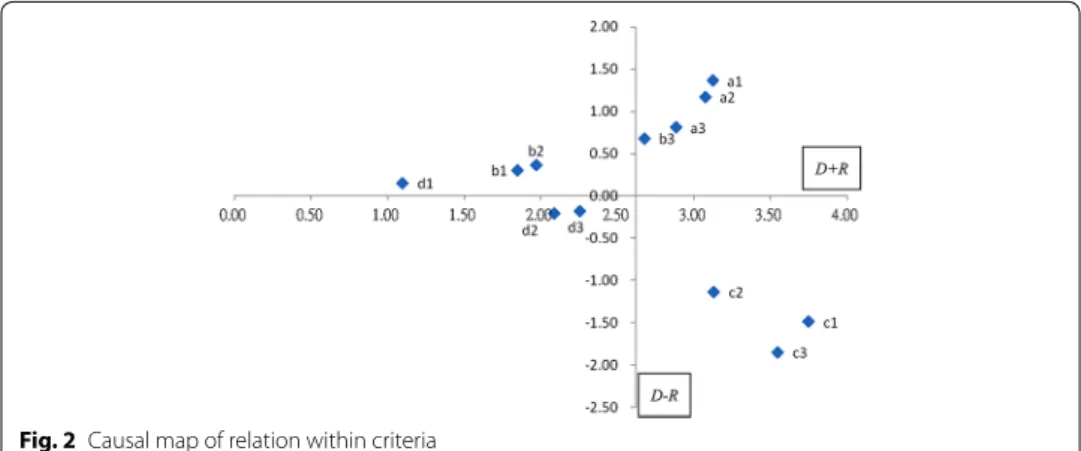
higher impact. Higher impact represents higher importance and should thus be consid-ered first. If the relation of a criterion is D − R < 0, it means that it is influenced by other criteria. Here, the positive and negative key determinants are respectively displayed. We can thus clearly see that the cause (influencing) criteria consist of a1 (Responsiveness), a2 (Communication and interaction), a3 (Reliability), b3 (Wider selections). It is thus clear that strong efforts should be made to eliminate the influence of these criteria throughout the online shopping process. Take the impact of above-mentioned causal relationship on the influence of improvement decision making, the importance of these criteria can Table 2 The initial direct-relation matrix X
Criteria a1 a2 a3 b1 b2 b3 c1 c2 c3 d1 d2 d3 a1 4.0 3.2 0.4 3.0 1.2 1.8 0.2 0.6 1.0 1.6 1.4 4.2 a2 4.0 3.4 0.4 1.8 1.2 3.0 1.0 0.2 2.0 1.8 1.8 3.5 a3 3.0 3.6 0.2 2.2 1.4 3.2 3.8 3.8 2.4 2.4 1.6 1.2 b1 0.4 0.6 1.0 1.8 2.6 0.4 0.2 0.8 1.6 1.0 1.2 0.0 b2 3.0 1.0 1.0 0.8 1.6 0.4 0.4 0.4 1.2 0.8 0.8 0.0 b3 0.8 1.0 1.2 3.2 2.6 0.4 0.0 0.0 0.6 0.6 0.8 3.2 c1 1.8 2.8 2.8 0.4 1.4 0.8 2.6 2.4 2.8 2.4 2.6 1.3 c2 1.0 1.2 3.2 0.0 0.0 0.0 3.6 3.0 0.4 0.2 0.2 1.4 c3 0.4 0.0 2.6 0.0 0.8 0.0 3.6 3.6 1.0 0.2 0.2 0.0 d1 1.0 0.8 1.8 0.6 0.2 0.8 2.4 1.2 1.0 1.6 2.4 0.0 d2 0.8 1.0 2.4 0.6 0.0 0.0 2.8 1.2 1.8 2.4 1.8 3.5 d3 1.2 1.8 3.2 1.2 0.4 0.6 3.8 0.6 0.6 2.4 1.8 0.0
Table 3 The total-relation criteria matrix Tc
Criteria a1 a2 a3 b1 b2 b3 c1 c2 c3 d1 d2 d3 a1 0.28 0.25 0.13 0.21 0.13 0.14 0.15 0.11 0.13 0.17 0.16 0.27 a2 0.29 0.27 0.14 0.18 0.13 0.19 0.19 0.11 0.18 0.19 0.18 0.26 a3 0.28 0.30 0.17 0.20 0.15 0.21 0.32 0.27 0.22 0.22 0.19 0.20 b1 0.08 0.08 0.09 0.10 0.13 0.05 0.08 0.08 0.11 0.08 0.09 0.05 b2 0.18 0.11 0.09 0.08 0.10 0.06 0.08 0.07 0.09 0.08 0.08 0.07 b3 0.11 0.11 0.11 0.17 0.14 0.06 0.09 0.06 0.08 0.09 0.09 0.17 c1 0.22 0.25 0.24 0.12 0.13 0.12 0.28 0.22 0.22 0.21 0.21 0.18 c2 0.14 0.15 0.21 0.07 0.05 0.06 0.25 0.20 0.10 0.09 0.09 0.14 c3 0.10 0.09 0.17 0.05 0.07 0.05 0.24 0.22 0.10 0.07 0.07 0.07 d1 0.12 0.12 0.15 0.08 0.06 0.08 0.19 0.12 0.11 0.13 0.16 0.08 d2 0.14 0.16 0.20 0.10 0.06 0.07 0.25 0.15 0.16 0.19 0.16 0.22 d3 0.16 0.19 0.22 0.12 0.08 0.09 0.27 0.13 0.12 0.19 0.16 0.10
be prioritized as c1(Trust) > c3(Transaction security) > a1(Responsiveness) > c2(Privacy risk) > a2(Communication and interaction) > a3(Reliability) > b3(Wider selections) based on (D + R) values. The value of c1(Trust) is the greatest of all values, indicating that is viewed by the experts as the foremost driving factor, and thus is identified as the target for prioritized treatment in order to boost the online business.
The cause group comprises the influencing criteria, whereas the effect group con-tains the influenced factors that are recipients of various influences. From the results, it appears that a successful e-retailer requires a high level of focus on the cause group (a1,
a2, a3, b3, b2, b1, d1) rather than the effect group (c1, c3, c2, d3, d2) (Fig. 2).
Furthermore, the unweighted super-matrix is presented in Table 5, and the weighted
super-matrix is presented in Table 6. Finally, the limiting supermartix is derived.
Obtained final weights for the criteria are presented in Table 7.
As seen in the Table 7, results showed that experts were most concerned with
transac-tion security (0.1699), trust (0.1587) and privacy risk (0.1414), which should be given priority to be improved in this empirical case. The “Trust and security” dimension plays an important role in e-business-one. It may heavily influence online consumers’ purchasing decisions. In contrast, the lowest priority is performance risk (0.0361). This
Fig. 2 Causal map of relation within criteria
Table 4 The total influence given and received by criteria
Criteria D R D + R D − R
a1 Responsiveness 2.244 0.880 3.124 1.363
a2 Communication and interaction 2.123 0.950 3.074 1.173
a3 Reliability 1.846 1.036 2.883 0.810
b1 Provides better prices 1.076 0.774 1.850 0.302
b2 Time saving 1.168 0.802 1.970 0.366 b3 Wider selections 1.679 0.996 2.676 0.683 c1 Trust 1.132 2.618 3.750 −1.486 c2 Privacy risk 0.999 2.131 3.131 −1.132 c3 Transaction security 0.848 2.700 3.548 −1.851 d1 Performance risk 0.626 0.471 1.097 0.155 d2 Product risk 0.941 1.148 2.089 −0.206 d3 Quality of product 1.041 1.217 2.258 −0.176
finding indicates that managers may pay less attention to this factor, compared to the other criteria analyzed, when making efforts to promote e-business.
Discussion
With an ever-increasing popularity of online shopping nowadays, an in-depth analysis of consumer decision-making in the context of e-business has become an important
issue for internet vendors (Lee and Wu 2014). This study is intended to provide an
in-depth understanding of the factors involved in satisfying customers’ needs, and thus to help managers initiate more effective marketing strategies to promote the growth of e-business.
Based on the results, some implications are discussed. Referring to Fig. 1, the
horizon-tal axis (D + R), named “Prominence”, reveals how much importance the factor has; the vertical axis (D − R), named “Relation”, divides factors into a cause group and an effect group. The factor belonging to “cause group” if (D − R) is positive, whereas it belongs to “effect group” if (D − R) is negative. Therefore, we can determine the “Responsive-ness” should be first to get improved. Second is “Communication and Interaction”. This is because they both influence other factors most. Therefore, if the internet vendors pay more attention and make the online service strategies well. The improvement in both criteria will lead to the improvement in other criteria as well. Thus, we suggest inter-net vendors benefit from interactive websites that provide online customer service and enhance the efficiency of data collection by effectively managing the information cus-tomers require, therefore ensuring the quality of information cuscus-tomers receive. With a detailed understanding of customers’ needs, employees can provide customers with the products and services they require most. This is the most important task in the e-busi-ness and it must be therefore prioritized for improvement. In addition, vendors can communicate product knowledge and proclaim their business philosophies to custom-ers, enabling customers to gain a clear understanding of vendors and subsequently rein-forcing trust in vendors. More importantly, they help customers resolve complaints by sufficient job training and actively establish forum platforms for customers to exchange Table 5 The unweighted super-matrix Wc
Unweighted a1 a2 a3 b1 b2 b3 c1 c2 c3 d1 d2 d3 a1 0.032 0.066 0.061 0.043 0.051 0.051 0.069 0.060 0.071 0.058 0.058 0.072 a2 0.073 0.037 0.066 0.035 0.040 0.055 0.063 0.081 0.064 0.039 0.084 0.086 a3 0.064 0.067 0.043 0.099 0.086 0.071 0.062 0.053 0.060 0.108 0.064 0.048 b1 0.047 0.058 0.062 0.028 0.027 0.037 0.057 0.050 0.049 0.091 0.034 0.035 b2 0.062 0.051 0.073 0.067 0.028 0.053 0.054 0.046 0.041 0.020 0.034 0.036 b3 0.078 0.078 0.052 0.035 0.076 0.041 0.061 0.077 0.083 0.035 0.078 0.075 c1 0.161 0.161 0.156 0.189 0.192 0.197 0.104 0.160 0.160 0.183 0.160 0.177 c2 0.127 0.117 0.118 0.143 0.158 0.159 0.153 0.081 0.196 0.107 0.141 0.152 c3 0.146 0.157 0.160 0.207 0.189 0.183 0.193 0.210 0.094 0.207 0.195 0.167 d1 0.026 0.025 0.035 0.044 0.032 0.022 0.042 0.040 0.055 0.034 0.013 0.023 d2 0.086 0.094 0.105 0.057 0.061 0.062 0.060 0.064 0.080 0.061 0.030 0.071 d3 0.096 0.089 0.068 0.052 0.060 0.069 0.081 0.079 0.048 0.056 0.108 0.057
Table 6 T he w eigh ted sup er-ma trix W α W eigh ted a1 a2 a3 b1 b2 b3 c1 c2 c3 d1 d2 d3 a1 0.0609 0.0609 0.0609 0.0609 0.0609 0.0609 0.0609 0.0609 0.0609 0.0609 0.0609 0.0609 a2 0.0642 0.0642 0.0642 0.0642 0.0642 0.0642 0.0642 0.0642 0.0642 0.0642 0.0642 0.0642 a3 0.0639 0.0639 0.0639 0.0639 0.0639 0.0639 0.0639 0.0639 0.0639 0.0639 0.0639 0.0639 b1 0.0483 0.0483 0.0483 0.0483 0.0483 0.0483 0.0483 0.0483 0.0483 0.0483 0.0483 0.0483 b2 0.0477 0.0477 0.0477 0.0477 0.0477 0.0477 0.0477 0.0477 0.0477 0.0477 0.0477 0.0477 b3 0.0678 0.0678 0.0678 0.0678 0.0678 0.0678 0.0678 0.0678 0.0678 0.0678 0.0678 0.0678 c1 0.1587 0.1587 0.1587 0.1587 0.1587 0.1587 0.1587 0.1587 0.1587 0.1587 0.1587 0.1587 c2 0.1414 0.1414 0.1414 0.1414 0.1414 0.1414 0.1414 0.1414 0.1414 0.1414 0.1414 0.1414 c3 0.1699 0.1699 0.1699 0.1699 0.1699 0.1699 0.1699 0.1699 0.1699 0.1699 0.1699 0.1699 d1 0.0361 0.0361 0.0361 0.0361 0.0361 0.0361 0.0361 0.0361 0.0361 0.0361 0.0361 0.0361 d2 0.0692 0.0692 0.0692 0.0692 0.0692 0.0692 0.0692 0.0692 0.0692 0.0692 0.0692 0.0692 d3 0.0719 0.0719 0.0719 0.0719 0.0719 0.0719 0.0719 0.0719 0.0719 0.0719 0.0719 0.0719
their product reviews and experiences, thereby reducing the likelihood of customers becoming victims of fraud.
We know from Table 7 that criteria weights differ. By combining DEMATEL and
ANP method, we found “Transaction security” which is weighted 0.1699 is the main force impacting consumers who are wondering whether to shop on the internet. When consumers purchase online they sometimes also take the “Trust” (0.1587) and “Privacy risk” (0.1414) into consideration. Our results show that online shopping security is the greatest concern for customers; this is in agreement with the results of previous studies. Indeed, certain risks, though seemingly minor, have, in reality, a much greater impact on customers’ purchase attitude. Naturally, online shoppers may hesitate about making pur-chases through the internet if they doubt about the security when providing and sending their personal or financial information on the public networks.
In any circumstances, the e-retailers must provide an absolute safe and secure means for transactions of personal and financial information through the internet. No deceitful sales or false transactions should be allowed. Therefore, we suggest the e-retailers should enhance online shopping websites, provide clear explanations regarding the sharing of personal information and strictly comply with the provisions to protect personal infor-mation. Furthermore, the protection of credit card information is a significant responsi-bility that should be prioritized for all online shopping website providers; any negative events involving the leak of credit card information will lead to immediate legal disputes. Customers will instantly stop using the website and issue serious complaints. In sum, customers hope to receive a rapid and reliable service when problems are encountered. The improvement of the service quality regarding privacy is a pressing issue, and compa-nies who can make immediate resource investments in this regard will attract customers and increase their satisfaction.
Conclusion
In an ever-increasingly competitive market, it is important to understand how consum-ers make a series of decisions regarding information search and data transmission in a Web-base. Although many excellent studies have been devoted to online shopping, Table 7 The limiting DANP supermatrix
Criteria DANP weights Rank
a1 Responsiveness 0.0609 9
a2 Communication and interaction 0.0642 7
a3 Reliability 0.0639 8
b1 Provides better prices 0.0483 10
b2 Time saving 0.0477 11 b3 Wider selections 0.0678 6 c1 Trust 0.1587 2 c2 Privacy risk 0.1414 3 c3 Transaction security 0.1699 1 d1 Performance risk 0.0361 12 d2 Product risk 0.0692 5 d3 Quality of product 0.0719 4
none, so far, is able to explain the simultaneous interactions between the various factors, and effectively analyze the real influential weights of all the criteria. The DANP method demonstrated a useful decision making model, which helps to clarify the complicated problems and rank the priority in this study. The three major contributions of this study are summarized as follows: (1) Identify the influential dimensions and criteria through a lot of literature reviews and experts’ opinions, provided by the experienced regular pur-chases and e-shopping stores operations. This not only produced useful results, but also can act as a reference in this industry. (2) According to the results, DEMATEL analysis can separate complex factors and display them in a causal diagraph, which manifestly provides decision makers with perceivable and comprehensive information to focus easily and thus develop a strategy as reference for the industry. In our study, “Respon-siveness” and “Communication and Interaction” are the major issues requiring urgent attention. Since they are causal items, they should be improved directly. From the sur-vey, internet vendor can gain a better understanding of key factors that influence their e-business. (3) This study illustrates the proposed approach combining DEMATEL with ANP to deal with the complexity caused by this interdependence and priority of dimen-sions and criteria obtained by applying the DANP method in the field of online shopping behavior. Top 3 in the sequence of improvement priorities were as follow: transaction security, trust and privacy risk. Using the ranked lists resulting from the DANP weight-ing, managers can most effectively compare marketing strategies in order to promote internet sales. In sum, the case study has shown that the DANP method can cor-rectly indicate the effects of internet vendor criteria and identify those that need to be improved with priority. The DANP method can not only detect the dependent relation-ships and feedback in real complex systems, but also identify a priority sequence among the dimensions and criteria. It may be valuable to both practitioners and research-ers as well as for internet vendors that are attempting to expand the management of e-commerce.
Of course, no single method is perfect, and none is reliably able to outperform all other methods in handling all kinds of problems. Nonetheless, the DANP method seems to be useful and effective analyzing complex problem clusters. The DANP method should also provide a paradigm for other industries and stimulate further future research in the area of systematically examining complex decision-making issues with interdependent crite-ria. The present study inevitably has some limitations calling for further research. First, only small expert samples were surveyed in the case study, and the results drawn from their views may not be fully reflecting the general users’. Second, 12 criteria were consid-ered in this study. It is believed that different industry may be associated with different criteria and the consumers may have different decision-making processes. It is worth-while to perform cases study for different industry in order to uncover new criteria and to attempt other promising decision-making processes. Third, other new
DEMATEL-based hybrid methods (e.g., Tsai and Chou 2009; Hu et al. 2009; Yang and Tzeng 2011)
have been found in literature. Developing a hybrid DEMATEL-based framework incor-porated with other proper methods can be another avenue for future study.
Authors’ contributions
Writing: C‑HW, H‑MC, S‑BT; Providing case and idea: C‑HW, S‑BT, H‑MC; Providing revised advice: JY, JW, YZ. All authors read and approved the final manuscript.
Author details
1 School of Economics and Management, Shanghai Maritime University, Shanghai 201306, China. 2 Department of Indus‑ trial Education, National Taiwan Normal University, Taipei 106, Taiwan. 3 Institute of Service Industries and Management, Minghsin University of Science Technology, Hsinchu 304, Taiwan. 4 Zhongshan Institute, University of Electronic Science and Technology of China, Zhongshan, Guangdong 528402, China. 5 Law School, Nankai University, Tianjin 300071, China. 6 School of Business, Dalian University of Technology, Panjin 124221, China. 7 Business School, Nankai University, Tianjin 300071, China.
Acknowledgements
We would like to thank National Science Council of Taiwan for financially supporting this research under Grant NSC 102‑2410‑H‑216‑005 and Grant NSC 9‑2632‑H‑216‑001‑MY2. This work was supported by National Social Science Fund of China (No. 12BYJ125), Provincial Nature Science Foundation of Guangdong (Nos. 2015A030310271 and 2015A030313679), Academic Scientific Research Foundation for High‑level Researcher, University of Electronic Science Technology of China, Zhongshan Institute (No. 415YKQ08), Tianjin philosophy and social science planning project (No. TJGL‑028), The Fundamental Research Funds for the Central Universities (No. ZXH2012N002).
Competing interests
The authors declare that they have no competing interests. Received: 12 November 2015 Accepted: 25 November 2016
References
Ajzen I (1991) The theory of planned behavior: some unsolved issues. Organ Behav Hum Decis Process 50:179–211 Akhter SH (2012) Who spends more online? The influence of time, usage variety, and privacy concern on online spend‑
ing. J Retail Consum Serv 19(1):109–115
Bai B, Law R, Wen I (2008) The impact of website quality on customer satisfaction and purchase intentions: evidence from Chinese online visitors. Int J Hosp Manag 27(3):391–402
Cebi S (2013) A quality evaluation model for the design quality of online shopping websites. Electron Commer Res Appl 12(2):124–135
Chang EC, Tseng YF (2013) Research note: e‑store image, perceived value and perceived risk. J Bus Res 66(7):864–870 Chang MK, Cheung W, Lai VS (2005) Literature derived reference models for the adoption of online shopping. Inf Manag
42(4):543–559
Chen YC, Lien HP, Tzeng GH (2010) Measures and evaluation for environment watershed plans using a novel hybrid MCDM model. Expert Syst Appl 37(2):926–938
Chen FH, Hsu TS, Tzeng GH (2011) A balanced scorecard approach to establish a performance evaluation and relation‑ ship model for hot spring hotels based on a hybrid MCDM model combining DEMATEL and ANP. Int J Hosp Manag 30(4):908–932
Chiou JS, Ting CC (2011) Will you spend more money and time on internet shopping when the product and situation are right? Comput Hum Behav 27(1):203–208
Chiou WC, Lin CC, Perng C (2011) A strategic website evaluation of online travel agencies. Tour Manag 32(6):1463–1473 Chiu YJ, Chen HC, Tzeng GH, Shyu JZ (2006) Marketing strategy based on customer behaviour for the LCD‑TV. Int J Manag
Decis Mak 7(2–3):143–165
Chiu CM, Chang CC, Cheng HL, Fang YH (2009) Determinants of customer repurchase intention in online shopping. Online Inf Rev 33(4):761–784
Chiu WY, Tzeng GH, Li HL (2013) A new hybrid MCDM model combining DANP with VIKOR to improve e‑store business. Knowledge‑Based Syst 37(1):48–61
Cho SE (2010) Perceived risks and customer needs of geographical accessibility in electronic commerce. Electron Com‑ mer Res Appl 9(6):495–506
Choi YK, Yoon S, Lacey HP (2013) Online game characters’ influence on brand trust: self‑disclosure, group membership, and product type. J Bus Res 66(8):996–1003
Close AG, Kinney MK (2010) Beyond buying: motivations behind consumers’ online shopping cart use. J Bus Res 63:986–992
Crespo AH, del Bosque IR (2010) The influence of the commercial features of the internet on the adoption of e‑com‑ merce by consumers. Electron Commer Res Appl 9(6):562–575
Davis FD (1989) Perceived usefulness, perceived ease of use, and user acceptance of information technology. MIS Q 13(3):319–339
Dickinger A, Stangl B (2013) Website performance and behavioral consequences: a formative measurement approach. J Bus Res 66:771–777
Dong X‑M (2012) Index system and evaluation model of e‑commerce customer satisfaction. In: International symposium on robotics and applications (ISRA). Montreal, Canada. pp 439–422
Fishbein M, Ajzen I (1975) Belief, attitude, intention and behavior: an introduction to theory and research. Addison‑Wes‑ ley Publishing Company Inc, Menlo Park
Fontela E, Gabus A (1976) The DEMATEL observer, DEMATEL 1976 Report. Battelle Geneva Research Center, Geneva Forsythe SM, Shi B (2003) Consumer patronage and risk perceptions in Internet shopping. J Bus Res 56(11):867–875 Fred N, Thatcher J (2010) Trends in organizational computing and electronic commerce professionals. J Organ Comput
Gabus A, Fontela E (1973) Perceptions of the world problematique: communication procedure, communicating with those bearing collective responsibility. DEMATEL Report No. 1. Battelle Geneva Research Center, Geneva, Switzerland
Guo JJ, Tsai SB (2015) Discussing and evaluating green supply chain suppliers: a case study of the printed circuit board industry in China. S Afr J Ind Eng 26(2):56–67
Guo WF, Zhou J, Yu CL, Tsai SB et al (2015) Evaluating the green corporate social responsibility of manufacturing corpora‑ tions from a green industry law perspective. Int J Prod Res 53(2):665–674
Gupta S, Kim HW (2007) The moderating effect of transaction experience on the decision calculus in online repurchase. Int J Electron Commer 12(1):127–158
Ha S, Stoel L (2009) Consumer e‑shopping acceptance: antecedents in a technology acceptance model. J Bus Res 62(5):565–571
Hernández B, Jiménez M, Martín MJ (2010) Customer behavior in electronic commerce: the moderating effect of e‑purchasing experience. J Bus Res 63(9–10):964–971
Hong T, Kim E (2012) Segmenting customers in online stores based on factors that affect the customer’s intention to purchase. Expert Syst Appl 39(2):2127–2131
Hong Z, Yi L (2012) Research on the influence of perceived risk in consumer online purchasing decision. Phys Proc 24:1304–1310
Hsu CH, Wang FK, Tzeng GH (2012) The best vendor selection for conducting the recycled material based on a hybrid MCDM model combining DANP with VIKOR. Resour Conserv Recycl 66(9):95–111
Hu HY, Lee YC, Yen TM, Tsai CH (2009) Using BPNN and DEMATEL to modify importance–performance analysis model: a study of the computer industry. Expert Syst Appl 36(4):9969–9979
Huang CY, Shyu JZ, Tzeng GH (2007) Reconfiguring the innovation policy portfolios for Taiwan’s SIP mall industry. Techno‑ vation 27(12):744–765
Karsak EE, Sozer S, Alptekin SE (2002) Product planning in quality function deployment using a combined analytic net‑ work process and goal programming approach. Comput Ind Eng 44(1):171–190
Kim YH (2006) Study on impact mechanism for beef cattle farming and importance of evaluating agricultural information in Korea using DEMATEL, PCA and AHP. Agric Inf Res 15:267–280
Kim W, Lee HY (2004) Comparison of web service quality between online travel agencies and online travel suppliers. J Travel Tour Mark 17(2/3):105–116
Kim YH, Kim DJ, Hwang YJ (2009) Exploring online transaction self‑efficacy in trust building in B2C e‑commerce. J Organ End User Comput 21(1):37–59
Kim JU, Kim WJ, Park SC (2010) Consumer perceptions on web advertisements and motivation factors to purchase in the online shopping. Comput Hum Behav 26(5):1208–1222
Kim JB, Albuquerque P, Bronnenberg BJ (2011) Mapping online consumer demand. J Mark Res 48(1):1–13
Kim HW, Xu Y, Gupta S (2012a) Which is more important in Internet shopping, perceived price or trust? Electron Commer Res Appl 11(3):241–252
Kim C, Galliers R, Shin N, Ryoo JH, Kim J (2012b) Factors influencing Internet shopping value and customer repurchase intention. Electron Commer Res Appl 11(4):374–387
Lan LW, Wu W‑W, Lee Y‑T (2013) On the decision structures and knowledge discovery for ANP modeling. Int J Intell Sci 3(1):15–23
Lee MC (2009) Factors influencing the adoption of internet banking: An integration of TAM and TPB with perceived risk and perceived benefit. Electron Commer Res Appl 8(3):130–141
Lee JW, Kim SH (2000) Using analytic network process and goal programming for interdependent information system project selection. Comput Oper Res 27(4):367–382
Lee YC, Wu CH (2014) A duo‑theme DEMATEL approach for exploring the driving factors of online luxury goods sales: e‑retailers’ perceptions. J Inf Optim Sci 35(2):177–202
Lee YC, Li ML, Yen TM, Huang TH (2010) Analysis of adopting an integrated decision making trial and evaluation labora‑ tory on a technology acceptance model. Expert Syst Appl 37(2):1745–1754
Lee SM, Huang T, Lee DH (2011) Evolution of research areas, themes, and methods in electronic commerce. J Organ Comput Electron Commer 21(3):177–201
Lee YC, Chen CY, Tsai SB, Wang CT (2014a) Discussing green environmental performance and competitive strategies. Pensee 76(7):190–198
Lee YC, Wu CH, Tsai SB (2014b) Grey system theory and fuzzy time series forecasting for the growth of green electronic materials. Int J Prod Res 299(8):1395–1406
Lian JW, Lin TM (2008) Effects of consumer characteristics on their acceptance of online shopping: comparisons among different product types. Comput Hum Behav 24(1):48–65
Liao QY, Luo X, Anil G (2009) Rebuilding post‑violation trust in B2C electronic commerce. J Organ End User Comput 21(1):60–74
Lin C‑L (2011) The improvement strategy of online shopping service based on SIA‑NRM approach. Intell Decis Technol 10:295–306
Lin CJ, Wu WW (2008) A causal analytical method for group decision making under fuzzy environment. Expert Syst Appl 34(1):205–213
Lin CC, Wu HY, Chang YF (2011a) The critical factors impact on online customer satisfaction. Proc Comput Sci 3:276–281 Lin YT, Yang YH, Kang JS, Yu HC (2011b) Using DEMATEL method to explore the core competences and causal effect of
the IC design service company: an empirical case study. Expert Syst Appl 38(5):6262–6268
Liou JH, Tzeng GH, Chang HC (2007) Airline safety measurement using a novel hybrid model. J Air Transp Manag 13(4):243–249
Liou JH, Tzeng GH, Tasi CY, Hsu CC (2011) A hybrid ANP model in fuzzy environments for strategic alliance partner selec‑ tion in the airline industry. Appl Soft Comput 11(4):3515–3525
Liu CH, Tzeng GH, Lee MH (2012) Improving tourism policy implementation: the use of hybrid MCDM models. Tour Manag 33(2):413–426
Lo CC, Chen WJ (2012) A hybrid information security risk assessment procedure considering interdependences between controls. Expert Syst Appl 39(1):247–257
Meade LM, Presley A (2002) R&D project selection using the analytic network process. IEEE Trans Eng Manag 49(1):59–66 Momoh JA, Zhu J (2003) Optimal generation‑scheduling based on AHP/ANP. IEEE Trans Syst Man Cybern Part B Cybern
33:531–535
Oh LB, Zhang Y (2010) Understanding Chinese users’ preference for domestic over foreign internet services. J Int Consum Mark 22(3):227–243
Ou Yang YP, Shieh HM, Leu JD, Tzeng GH (2008) A novel hybrid MCDM model combined with DEMATEL and ANP with applications. Int J Operat Res 5(3):1–9
Ou Yang YP, Shieh HM, Tzeng GH (2013) A VIKOR technique based on DEMATEL and ANP for information security risk control assessment. Inf Sci 232(May):482–500
Overby JW, Lee E‑J (2006) The effects of utilitarian and hedonic online shopping value on consumer preference and intentions. J Bus Res 59:1160–1166
Qu Q, Chen KY, Wei YM et al (2015) Using hybrid model to evaluate performance of innovation and technology profes‑ sionals in marine logistics industry. Math Prob Eng. doi:10.1155/2015/361275
Rigby C (2012) European online shopping to grow by 12% a year: predictions. http://internetretailing.net/2012/02/ european‑online‑shopping‑to‑grow‑by‑12‑a‑year‑predictions/
Rozenn P, Thierry P (2013) Determinants of e‑commerce strategy in franchising: a resource‑based view. Int J Electron Commer 17(3):109–120
Saaty TL (1996) Decision making with dependence and feedback: the analytic network process. RWS Publications, Pittsburgh
Santos J (2003) E‑service quality: a model of virtual service quality dimensions. Manag Serv Qual Int J 13(3):233–246 Sarkis J (2003) A strategic decision framework for green supply chain management. J Clean Prod 11(4):397–409 Seyed‑Hosseini SM, Safaei N, Asgharpour MJ (2006) Reprioritization of failures in a system failure mode and effects analy‑
sis by decision making trial and evaluation laboratory technique. Reliab Eng Syst Saf 91:872–881
Shahraki AR, Paghaleh MN (2011) Ranking the voice of customer with fuzzy DEMATEL and fuzzy AHP. Indian J Sci Technol 4(12):1763–1772
Sun CC (2013) Using Fuzzy DEMATEL method to establish the shopping websites competitive advantages. Afr J Bus Manag 7(15):1209–1217
Teo TSH, Yu Y (2005) Online buying behavior: a transaction cost economics perspective. Omega 33(5):451–465 Ting CW, Huang JW, Wang DS, Tzeng GH (2013) Combining DEMATEL with ANP to modify multidimensional scaling in
identifying the similarities of e‑shopping stores. Afr J Bus Manag 7(22):2206–2218
Tontini G (2016) Identifying opportunities for improvement in online shopping sites. J Retail Consum Serv 31:228–238 Tsai SB (2016) Using grey models for forecasting China’s growth trends in renewable energy consumption. Clean Technol
Environ Policy 18:563–571
Tsai WH, Chou WC (2009) Selecting management systems for sustainable development in SMEs: a novel hybrid model based on DEMATEL, ANP, and ZOGP. Expert Syst Appl 36(2):1444–1458
Tsai SB, Xue YZ (2013) Corporate social responsibility research among manufacturing enterprises: Taiwanese electronic material manufacturing enterprises. Appl Mech Mater 437:1012–1016
Tsai SB, Lee YC, Guo JJ (2014) Using modified grey forecasting models to forecast the growth trends of green materials. Proc Inst Mech Eng Part B J Eng Manuf 228(6):931–940
Tsai SB, Saito R, Lin YC, Chen Q et al (2015) Discussing measurement criteria and competitive strategies of green suppliers from a green law perspective. Proc Inst Mech Eng B J Eng Manuf 229(S1):135–145
Tsai SB, Huang CY, Wang CK, Chen Q et al (2016a) Using a mixed model to evaluate job satisfaction in high‑tech indus‑ tries. PLoS ONE 11(5):e0154071. doi:10.1371/journal.pone.0154071
Tsai SB, Xue Y, Zhang J, Chen Q et al (2016b) Models for forecasting growth trends in renewable energy. Renew Sustain Energy Rev. doi:10.1016/j.rser.2016.06.001
Tzeng GH, Chiang CH, Li CW (2007) Evaluating intertwined effects in e‑learning programs: a novel hybrid MCDM model based on factor analysis and DEMATEL. Expert Syst Appl 32(4):1028–1044
Wang S, Dong D (2015) A comparative study of customer value drivers between traditional channels and network chan‑ nel. Open J Social Sci 3:53–56
Wong YT, Osman S, Jamaluddin A, Yin‑Fah BC (2012) Shopping motives, store attributes and shopping enjoyment among Malaysian youth. J Retail Consum Serv 19(2):240–248
Wu WW (2008) Choosing knowledge management strategies by using a combined ANP and DEMATEL approach. Expert Syst Appl 35(3):828–835
Wu IL (2012) The antecedents of customer satisfaction and its link to complaint intentions in online shopping: an integra‑ tion of justice, technology, and trust. Int J Inf Manag 33(1):166–176
Wu WW, Lee YT (2007) Developing global managers’ competencies using the fuzzy DEMATEL method. Expert Syst Appl 32(2):499–507
Wu HH, Chen HK, Shieh JI (2010) Evaluating performance criteria of employment service outreach program personnel by DEMATEL method. Expert Syst Appl 37(7):5219–5223
Wu HY, Lin YK, Chang CH (2011) Performance evaluation of extension education centers in universities based on the bal‑ anced scorecard. J Eval Prog Plan 34(1):37–50
Yang JL, Tzeng GH (2011) An integrated MCDM technique combined with DEMATEL for a novel cluster‑weighted with ANP method. Expert Syst Appl 38(3):1417–1424
Zhou J, Wang Q, Tsai SB et al (2016) How to evaluate the job satisfaction of development personnel. IEEE Trans Syst Man Cybern Syst. doi:10.1109/TSMC.2016.2519860