
國
立
交
通
大
學
材料科學與工程學系
碩
士
論
文
研究藉由氧化鋁為閘極絕緣層來改善成長於矽
基板上之氧化鋁鎵/氮化鎵高電子遷移率電晶體
之線性度
Study of AlGaN/GaN MOS-HEMTs on Silicon Substrate with
Al
2O
3Gate Insulator for Device Linearity Improvement
研 究 生:陳玉芳
指導教授:張翼 博士
I
研究藉由氧化鋁為閘極絕緣層來改善成長於矽基板上之氧化鋁鎵/
氮化鎵高電子遷移率電晶之線性度
Study of AlGaN/GaN MOS-HEMTs on Silicon Substrate with Al2O3 Gate
Insulator for Device Linearity Improvement
研究生: 陳玉芳 指導教授: 張翼 博士 國立交通大學材料科學與工程學系 摘要 近年來,氮化鎵高電子移動率電晶體具有優越的特性使其在高功率,高溫,高崩潰 偏壓以及高頻應用有很大的潛力。然而在高功率無線通訊遇到關鍵性難題,就是以複雜 調變技術來達成高速率傳輸的目的時,此調變技術會導致動態訊號的產生,進而造成訊 號失真,因此在射頻功率放大器中,元件線性度成為無線通訊系統中一項非常重要的參 數。在本研究中,金氧半氮化鎵高電子移動率電晶體與一般傳統的蕭基閘極氮化鎵高電 子移動率電晶體相較,擁有較好的元件線性度特性與較高的通道飽和電流。本研究成功 製作出1.5 微米閘極線寬的三氧化二鋁金氧半氮化鎵高電子移動率電晶體,並且將其電 性分析與一般傳統的蕭基閘極氮化鎵高電子移動率電晶體相比,證實元件在線性度上有 顯著的改善。本論文研究顯示,三氧化二鋁金氧半氮化鎵高電子移動率電晶體能有效的 增進元件之線性度,有效地應用在無線通訊系統中的射頻功率放大器。
II
Study of AlGaN/GaN MOS-HEMTs on Silicon Substrate with
Al
2O
3Gate Insulator for Device Linearity Improvement
Student: Yu-Fang Chen Advisor: Dr. Edward Yi Chang Department of Materials Science and Engineering
National Chiao Tung University
Abstract
Superior properties of AlGaN/GaN HEMTs are promising contenders for high-power, high-temperature, high-breakdown, and high-frequency applications and have attracted much attention recently. However, one of the key issues for using AlGaN/GaN HEMTs for high-power radio-frequency (RF) applications is the quality of the transiting signals. For the modern wireless communication, here are many users, and the neighboring frequencies are usually located closely to each other. Hence, it is important to suppress the signal distortions for the device used in the communication system could not induce signal distortions. A among all intermodulation distortions, third-order intermodulation distortion (IM3) usually cannot be filtered out by the filter; therefore, IM3 dominates the linearity performance of the device and is the most important linearity criteria for wireless communication system. In this study, it’s found that MOS-HEMT exhibits better linearity and higher channel saturation current compared to the HEMTs with Schottky-gate. In this paper, we present the linearity characteristics of the Al2O3 AlGaN/GaN MOS-HEMTs on Si substrates with gate length 1.5μm,
and compare it with the regular AlGaN/GaN HEMTs devices for device linearity improvement in this study.
III
誌謝
碩士班兩年的時光,有開心瘋狂大笑,也有遇到挫折低潮到真思考休學,回頭想想,真 慶幸我熬了過來。在張翼老師的帶領下,我們猶如在業界,快速的學習與成長,學了製 程所需的所有機台,體驗到團體生活。從不熟陌生,到熟稔,這些是在別的實驗室無法 獲得與體會的。一路過來,謝謝幫助過我的人,謝謝曾經有的挫折,謝謝張翼老師努力 不懈研究爭取實驗室資源,還有耐心的幫我們即將畢業的學生一頁頁修改我們的論文。 謝謝林岳欽學長一路以來的指導與幫助,陪我們熬夜量測,事事替我們著想,還犧牲假 日來當我的口試委員。也謝謝Fiaz 的幫助讓我成功的換組,沒有你我想我應該碩班當博 班念吧…更謝謝一路一起奮鬥過來的黃大頭跟阿澤,沒有你們的陪伴與幫助,我想我做 實驗真的會很無聊跟孤單。尤其謝謝明明已經畢業的黃大頭有情有義留下來,幫我與阿 澤,幫我們改論文、量測、畫圖,還一起熬夜。我真的非常非常感謝你唷!謝謝阿澤一 路上的包容與耐心,雖然你後來見色忘友的很厲害,我還是很謝謝你唷~謝謝幫我長氧 化層的Dang,如果不是你精湛的長成技術,我是無法有如此好得數據可以畢業。也謝 謝我以前的指導教授倪澤恩老師,沒有你,我真的無法考上交大,謝謝你在我最低潮的 時候總是耐心的開導我,告訴我該如何做。謝謝王人正學長,當初大學時候研究訓練, 與高壓下的學習,總是刀子嘴豆腐心的帶領我們,真的萬般的感激你!你結婚的時候我 一定會包大包一點啦!謝謝我的正妹室友林妍君,沒有你的陪伴與貼心的關懷,我想我 真的會悶到爆炸!希望你早日找到如意郎君!謝謝我的家人一路上無條件的相挺與包容我 的壞脾氣,還讓我無後顧之憂的念書,我會趕快出去賺錢回饋你們的^^!謝謝劉臭臭一路 上包容我的壞脾氣,還耐心聽我抱怨與帶我去出飯,即使我在怎麼任性還是會願意挺我 與聽我抱怨。謝謝老皮、阿伯當初的教導,沒有你們那兩個月紮實的訓練,我無法成為 機台小天后!謝謝林芝羽總是無條件的挺我替我擔心,我真得很高興能夠遇到你這樣的 麻吉!我們再一起去土地公還願吧!以後還是可以常打給我唷!要堅強不要傻傻被欺負唷~ 謝謝阿韋賤賤的關懷與貼心叮嚀、謝謝宗運學弟的體貼與諒解,讓我無後顧之憂的專心IV 弄論文。謝謝長褲學弟的幫忙與協助,讓我跟阿澤可以專心的準備口試。謝謝一路玩耍 瘋狂的婉儀、林緯、佑誠,沒有你們,我碩一生活無法如此的精彩與快樂、謝謝哲榮一 路上的相挺與關懷,明明是學長,卻總是被我兇…謝謝已經畢業的凱麟與培維,與你們 相處的時光真的很歡樂。凱麟的包容與冷靜的解析給我意見,恭喜你交到人生第一個女 朋友!好感謝電子所 418 陪我走過來的所有人,謝謝你們總是忍受我聒噪吵鬧。謝謝張 俊彥校長,默默的縱容我與關心。謝謝張嘉華學長,總是幫忙我預約量測、沒我聊天打 屁、在我口試前一天晚上還幫忙我修改投影片與畫圖。謝謝延儀每次都在我報告的時候 幫我修改英文文法,還有忍受我三不五十的找麻煩。謝謝大家雖然總是嗆我、損我、卻 又總是在我傷心難過的時候,無條件的挺我與幫我。謝謝總是被我機車態度激到快發瘋 其實很貼心又細心的谷銘、謝謝細心與貼心總是笑笑的庭維、謝謝一臉認真講話很好笑 的智翔,謝謝看起來臉臭臭可是很讚的學弟宗運,我真的沒有覺得你很不好啦!你們真 得很乖唷!颱風天還願意來學習。以後要好好加油努力喔!謝謝我的麻吉黃老人,總是在 我低潮難過陪我聊天,還努力幫我物色好男人。謝謝太多要謝謝的人,謝謝你們!如果 沒有被我提出來,不代表我沒有謝謝你們喔!不要生氣呢!!謝謝大家~我終於終於可以下 台一鞠躬囉~喔耶喔耶!!!!
V
Contents
Abstract inChinese ... I Abstract in English ... II Acknowledgement ... III Contents ... V Table Captions ... VIII Figure Captions ... IXChapter 1 Introduction
1.1 General background and motivation ... 1
1.2 Scope and organization of thesis ... 3
Chapter 2 AlGaN/GaN Metal-Oxide-Semicomductor HEMTs 2.1 Material properties of GaN ... 5
2.2 Polarization effect of GaN ... 6
2.2.1 Crystal structure and piezoelectric polarization ... 7
2.2.2 Strain-induced piezoelectric and spontaneous polarization ... 8
VI
2.3.1 Hetero epitaxial growth of AlGaN/GaN HEMTs ... 8
2.3.2 The basic and operation of AlGaN/GaN HEMTs ... 10
2.3.3 Issues of high gate leakage current AlGaN/GaN HEMTs ... 11
2.4 AlGaN/GaN Metal-Oxide-Semiconductor HEMTs ... 12
2.4.1 Introduction ... 12
2.4.2 The requirements of high-k insulator oxide ... 13
Chapter 3 Fabrications of AlGaN/GaN MOS-HEMTs with Al2O3 High-K Gate Oxide 3.1 Ohmic Contact Formation ... 22
3.2 Mesa isolation ... 23
3.3 Atomic layer deposition (ALD) Al2O3 ... 24
3.4 Gate Formation ... 25
Chapter 4 Fundamentals of HEMT Electrical Characteristics 4.1 DC Characteristics Measurement ... 29
4.2 Transmission Line Model (TLM) ... 30
4.3 Linearity ... 31
VII
4.5 Extrinsic Transconductance (gm) ... 33
4.6Scattering Parameters ... 34
4.7 Current-Gain Cutoff Frequency (fT) and Maximum Oscillation Frequency ( fmax) ... 35
Chapter 5 Study of AlGaN/GaN MOS-HEMTs on Silicon substrate with Al2O3 Gate Insulator for Device Linearity Improvement 5.1 Introduction ... 41
5.2 Device fabrication ... 43
5.3 Results and discussion ... 44
5.4 Conclusions ... 49
Chapter 6 Conclusion Conclusions ... 63
VIII
Table Captions
Chapter 2
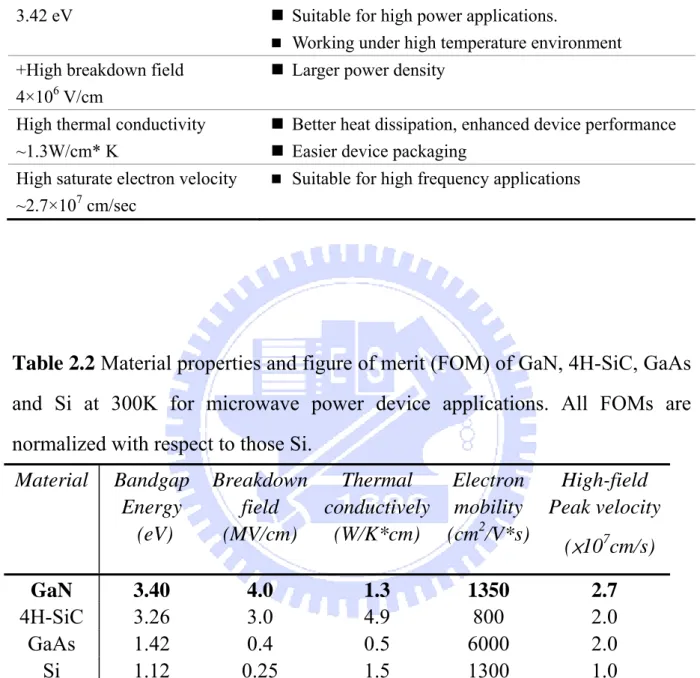
Table 2.1 Advantages of GaN material for electronic applications. ... 15 Table 2.2 Material properties and figure of merit (FOM) of GaN, 4H-SiC, GaAs
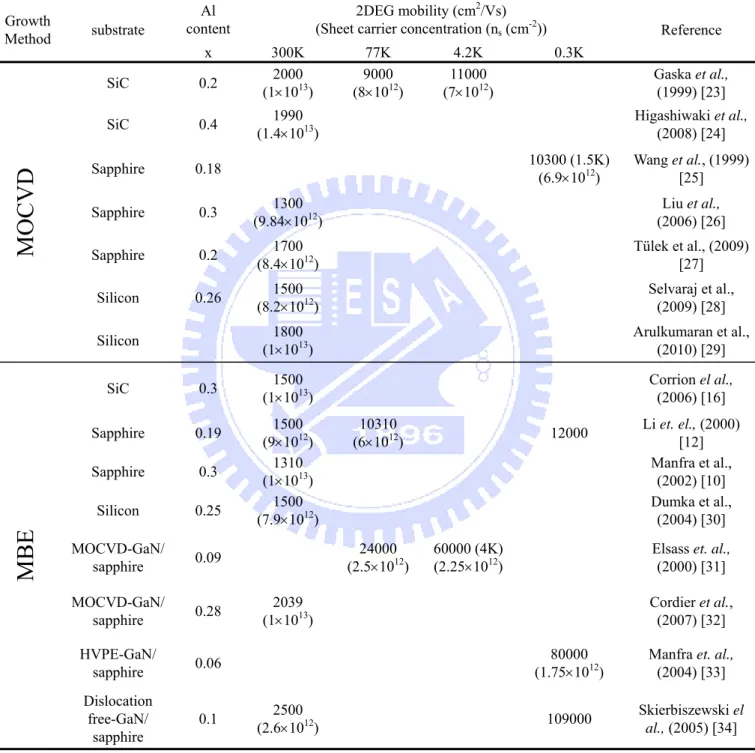
and Si at 300K for microwave power device applications. All FOMs are normalized with respect to those Si. ... 15 Table 2.3 Comparison of 2DEG mobility and sheet carrier concentration of
AlGaN/GaN structure grown by MOCVD and MBE on different
substrates. The carrier mobility and concentration are measured at 300, 77, 4.2 or 0.3 K unless specify in the bracket; x is the Al content in AlGaN layer ... 16 Table 2.4 Comparison of the proportion of different gate oxides properties ... 17
Chapter 5
Table 5.1 Comparison of the IP3 values of Al2O3 MOS-HEMT and HEMT
IX
Figures Caption
Chapter 1
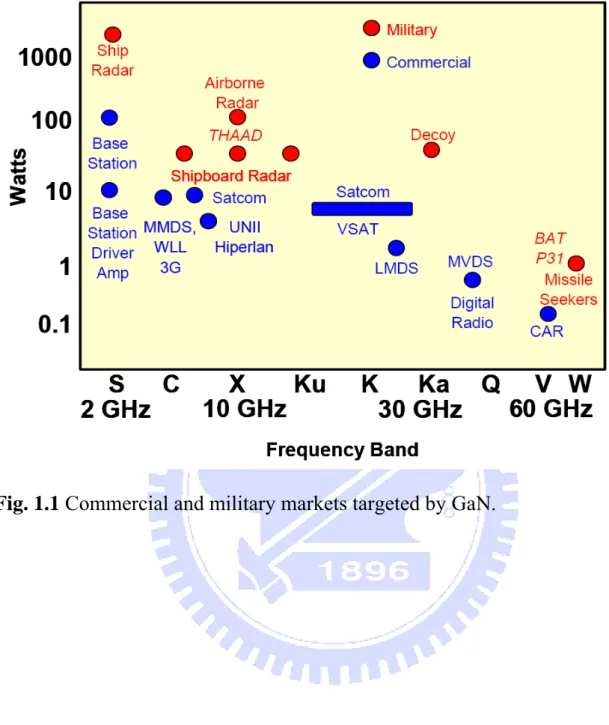
Fig. 1.1 Commercial and military markets targeted by GaN. ... 4
Chapter 2
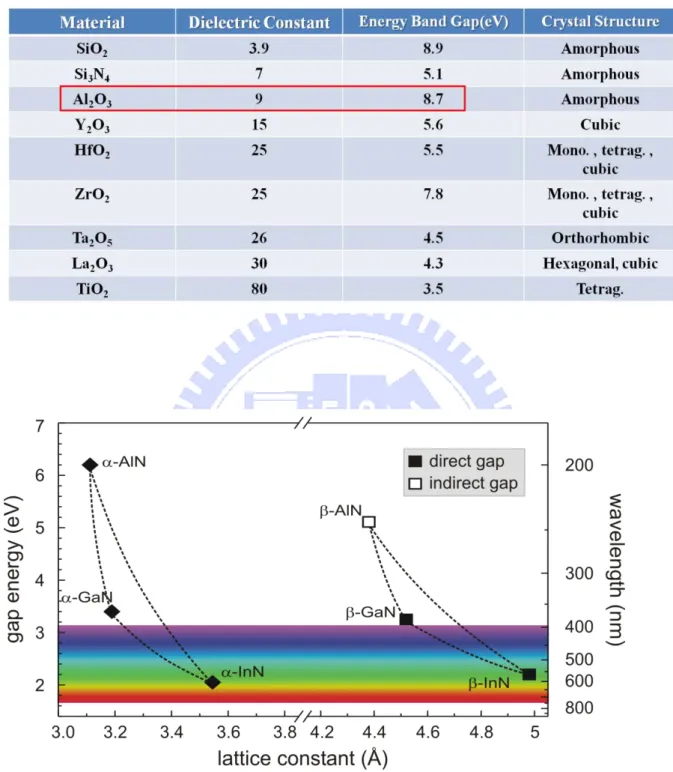
Fig. 2.1 Band gap (Eg) versus lattice constant at 300 K for wurtzite (α-phase)
and zincoblende (β-phase) GaN, InN, and AlN. The right-hand scale
gives the light wavelength, corresponding to the band gap energy ... 17 Fig. 2.2 Semiconductor materials for RF electrons applications. ... 18 Fig. 2.3 Electron drift velocity of GaN, SiC, Si and GaAs at 300 K computed
using the Monte Carlo Method. ... 18 Fig. 2.4 Schematic drawing of the structures and energy band structures of
wurtzite GaN and Zinc Blende GaN. ... 19 Fig. 2.5 Schematic of the crystal structure of wurtzite Ga-face and-face GaN.
The spontaneous polarization (Psp) direction is also shown. ... 19
Fig. 2.6 Polarization induced sheet density and directions for the spontaneous and piezoelectric polarization in Ga- and N-face AlN/GaN
heterostructures. ... 20 Fig. 2.7 Basic structure and its band diagram of AlGaN/GaN HEMT. ... 20 Fig. 2.8 Structure comparisons between AlGaN/GaN HEMT (on the left) and
Al2O3 HEMT (MOS-HEMT) (on the right). ... 21
X
Chapter 3
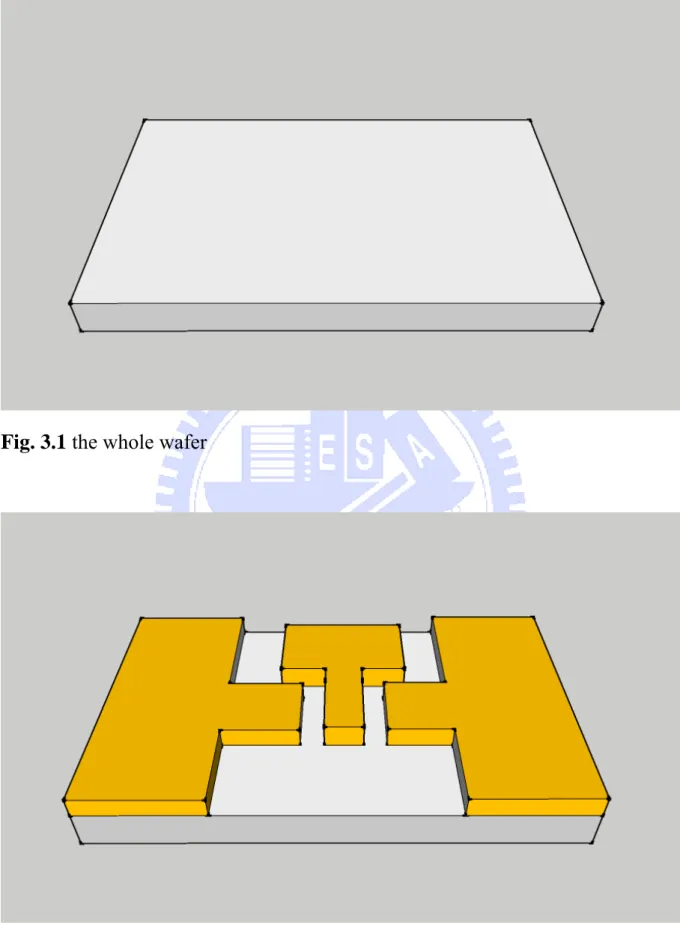
Fig. 3.1 Schematic of the whole wafer before prepare ... 26
Fig. 3.2 Schematic of the wafer after Ohmic contact formation ... 26
Fig. 3.3 Schematic of the wafer after Mesa isolation ... 27
Fig. 3.4 Schematic of the wafer after Atomic layer deposition (ALD) Al2O3 .... 27
Fig. 3.5 Schematic of the wafer after Gate formation ... 28
Chapter 4 Fig. 4.1 The Transmission Line Method (TLM ) pattern. ... 38
Fig. 4.2 The illustration of utilizing TLM to measure ohmic contact resistance 38 Fig. 4.3 Output power diagram of fundamental and third-order product signal ... 39
Fig. 4.4 Fundamental diagram of the microwave front-end device. ... 39
Fig. 4.5The equivalent two-port network schematic at high frequency... 40
Fig. 4.6 AlGaN/GaN HEMT intrinsic device model.. ... 40
Fig. 4.7 AlGaN/GaN HEMT small signal equivalent circuit. ... 40
Chapter 5 Fig. 5.1 Cross section of the (a) 1.5μm a Schottky-gate AlGaN/GaN HEMT (b) MOS-HEMT with 10nm Al2O3. ... 51
Fig. 5.2 DC ID versus VDS characteristics at VGS= 1 to -6 V of the AlGaN/GaN HEMT and Al2O3 MOS-HEMT. ... 52
XI
Fig. 5.3 IDS versus VGS curve for the AlGaN/GaN HEMT and Al2O3
MOS-HEMT at the 7 volt VDS bias ... 53
Fig. 5.4 Transconductance gm versus gate-source bias VGS at the same drain bias
Vds = 7V in the saturation region for the AlGaN/GaN HEMT and Al2O3
MOS-HEMT with gate length =1.5μm ... 54 Fig. 5.5 Gate leakage currents for the AlGaN/GaN HEMT and Al2O3
MOS-HEMT with the same device dimensions. ... 55 Fig. 5.6 Off-state drain-source breakdown characteristics of Al2O3 MOS-HEMT
and regular-HEMTs. ... 56 Fig. 5.7 IDS versus VGS curves for the AlGaN/GaN HEMT and Al2O3
MOS-HEMT at the VDS bias from 4 V to 7 V. ... 57
Fig. 5.8 Gm versus VGS curve for the AlGaN/GaN HEMT and Al2O3
MOS-HEMT at the VDS bias from 4 V to 7 V. ... 58
Fig. 5.9 IDS versus VGS curve for the Al2O3 MOS-HEMT at the VDS bias from
4 V to 10 V. ... 59 Fig. 5.10 Gm versus VGS curve for the Al2O3 MOS-HEMT at the VDS bias from
4 V to 10V ... 60 Fig. 5.11 IP3 versus IDS curve of the the AlGaN/GaN HEMT and Al2O3
1
Chapter 1
Introduction
1.1 General Background and Motivation
The wide spread communication systems such as third-generation (3G) mobile systems, wireless LAN, electronic toll collection system (ETC), and global positioning system (GPS). Recently, wide band-gap semiconductors have attracted considerable attentions as the next generation materials for RF power electronic applications such as mobile, satellites, and cable TV systems[1] for power transmitter applications. In the mobile communication applications, the next generation cell phone need, widen bandwidth and higher efficiencies; also, the development of satellites communication and TV broadcasting systems also require amplifiers which can operate at higher frequencies and higher power. Because of these demands, the outstanding properties of AlGaN/GaN HEMTs make them most promising candidate for microwave power applications in the wireless communication.Some of the commercial and military markets that are targeted by GaN devices are shown in Fig. 1.1.
However, for the microwave monolithic integrated circuits (MMICs) for power applications, a major problem is to increase the operating frequency. One of the major factors limited the performance of the GaN HEMT devices is the high gate leakage current due to the surface defects of the devices and finite barrier height of the Schottky gate. This gate leakage problem becomes more serious when dealing with high-power and high-temperature RF applications. For this reason, to improve the device high frequency performance, the lowest
2
possible gate leakage current level must be achieved. The use of high-k gate insulator for AlGaN/GaN MOS-HEMT can significantly suppress the direct-tunneling gate current.
In the past few years, many studies regarding of about the III-V/high-k interface issues have been published. It is well known that the surface pretreatment including sulfide and ammonia solution treatments could eliminate the undesired particles and native oxides. Furthermore, the surface of III-V material could be passivated by the treatment to prevent the surface exposed to air. With the progress of advanced deposition technologies, many passivation methods had been reported including Gd2O3/Ga2O3 or SiNx as gate insulators,
the Al2O3 growth by atomic layer deposition (ALD) [2-4]. Among all the
deposition technologies, the ALD shows superior characteristics for oxides deposited. ALD has several advantages over other techniques due to the actual mechanism used to deposit the films. ALD is especially advantageous when film quality or thickness is critical. ALD is also quite effective to be deposited at coating ultra high aspect ratio substrates or substrates that would be difficult to coat with other thin film techniques. It can achieve the high purity level than any other deposition technologies. In this study, the ALD system was used for the high-k oxide deposition.
The main purpose of this study is to establish the AlGaN/GaN MOS-HEMT devices technology with low leakage current for high power, high frequency applications. The technology include the applications of ALD Al2O3 with a high
insulator constant (8.6-10) and a high breakdown field (5~10 MV/cm) for the gate insulators for AlGaN/GaN MOS-HEMTs. The RF and DC performances of the AlGaN/GaN HEMTs with gate oxide in this study will be evaluated in this thesis.
3
1.2 Organization of the Thesis
This thesis is comprised of six chapters including conclusions. After background introduction, the GaN material properties and operation principle of HEMTs will be introduced in chapter 2. The AlGaN/GaN MOS-HEMTs device fabrication process is introduced in chapter 3. In Chapter 4, the electrical characterization methods for AlGaN/GaN MOS-HEMTs are described. Chapter 5 is the experiment results and discussion of the performance AlGaN/GaN MOS-HEMTs on Si substrate compared to regular HEMT. Finally, the conclusions will be given in chapter 6.
4
5
Chapter 2
AlGaN/GaN Metal-Oxide-Semiconductor HEMTs
An overview on GaN material and AlGaN/GaN HEMTs will be presented in this chapter. Material properties of GaN, especially the unique characteristics for electronic applications are introduced first. This is followed by a brief description of the polarization effect of GaN, along with AlGaN/GaN HEMTs. Thereafter, the AlGaN/GaN MOS HEMT, which is the focus of this study, is discussed. The historical approaches for the gate insulator of GaN MOS devices are reviewed and the device advantages of MOS-HEMTs over Schottky-gate HEMTs are highlighted. Finally, the basic operation and the non-ideal phenomena of MOS HEMTs are introduced.
2.1. Material properties of GaN
GaN-based materials, GaN, indium nitride (InN), and aluminum nitride (AlN), are wide bandgap semiconductors. They are the candidates for next generation high power devices. These materials have several advantages, such as high band gap, high electron velocity and high breakdown electric field. The bandgaps of GaN, InN, and AlN are respectively 3.4 eV, 1.89 eV and 6.2 eV, as shown in Fig 2.1. The figure not only shows the wide range of energies of III-V nitride materials, but also shows the wavelengths from the visible-light to the ultraviolet (UV) regions if they are used for optical devices. Thus, three-nitrides are good candidates for optoelectronic devices, such as light emission diodes (LEDs), laser diodes (LDs), detectors, and so on.
6
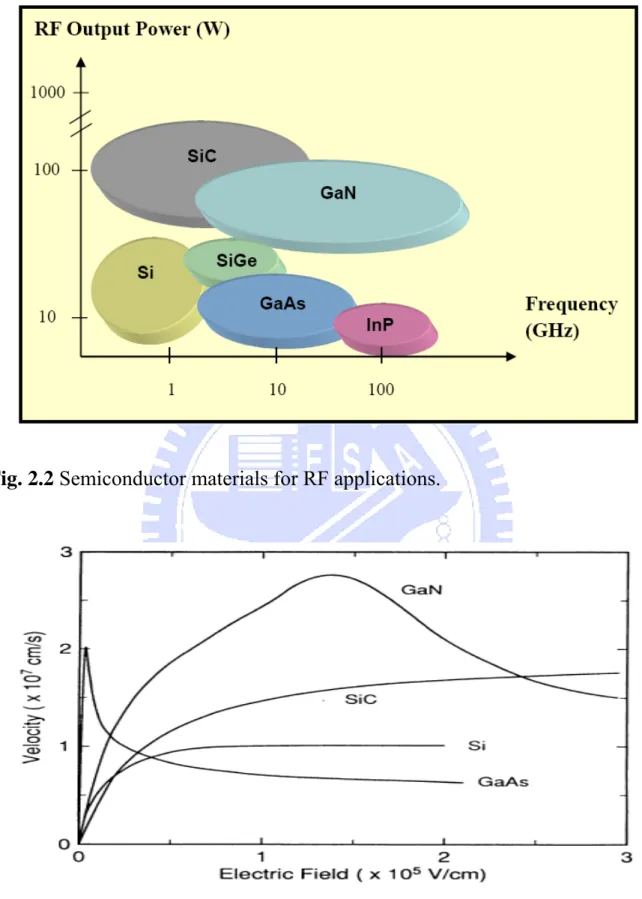
Compared with other III-V semiconductor materials, GaN gains a considerable attention for the RF power application. Fig. 2.2 compared the power vs. frequency performance of GaN in comparison with other semiconductors, and it indicates that III-V nitrides materials. GaN are promising candidates for the RF power application. Besides, due to the strong bonding energy between the Ga and N, GaN has a high breakdown field at about 3.3 MV/cm, which means the GaN devices can withstand high operating voltage. Although GaN has the lower room temperature electron mobility around 1500cm2/Vs than that of GaAs, GaN has very high electron saturation velocity about 3×107 cm2/s. This suggests the high frequency applications of the GaN-based devices. Moreover, GaN has a high thermal conductivity around 1.3 W/cmk, this makes it possible to operate at high temperatures. The benefits of GaN for electronic applications are listed in Table 2.1. Table 2.2 and Fig 2.3 show the material properties and figures of merit of GaN compared with the competing material such as 4H-SiC, GaAs and Si. According to the outstanding material properties of GaN, GaN-based devices are the good candidates in high-power, high-frequency, high speed, and high-temperature applications.
2.2 Polarization effect of GaN
The polarization effects in GaN are due to two types, one is strain-induced piezoelectric polarization, and the other is spontaneous polarization. The strain-induced piezoelectric polarization is resulted from the lattice mismatch, and the spontaneous polarization is due to the noncentrosymmetry of the wurtzite GaN and large iconicity of the covalent GaN bonds. The crystal
7
structure induced polarization of GaN, then the strain-induced piezoelectric and spontaneous polarization, will be described in next section.
2.2.1 Crystal structure and piezoelectric polarization [5]
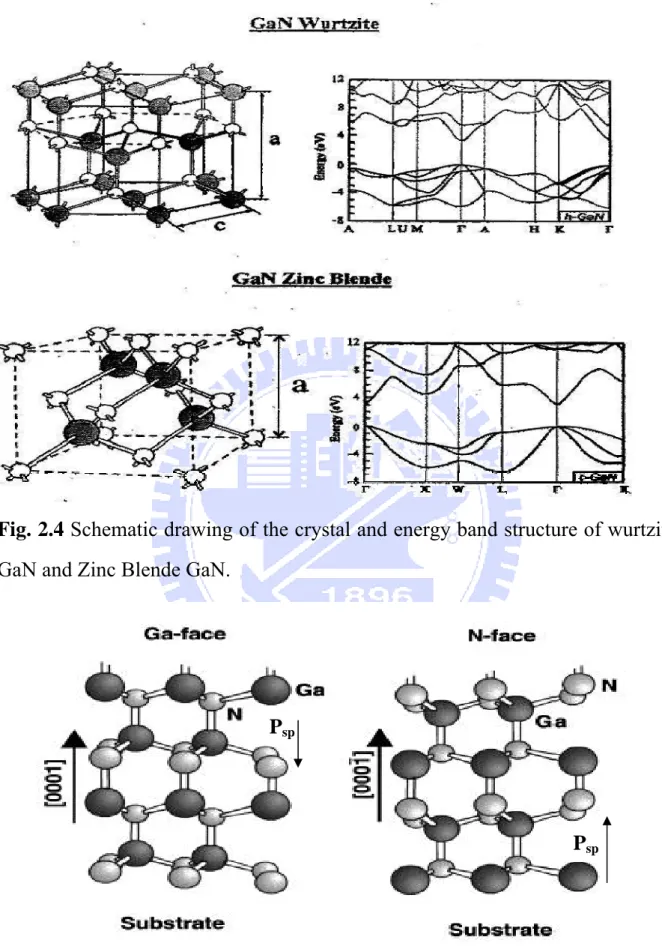
GaN-based materials have two crystal structure, hexagonal wurtzite structure and cubic zinc blends, as shown in Fig 2.4. Since there is no native GaN substrate, GaN-based materials are grown on the other substrate, such as sapphire and silicon carbide. Recently, GaN growth on Si substrate is well-explored. SiC and sapphire are hexagonal structure, and Si is diamond cubic structure. In general, if noncentrosymmetric compound crystals have two different sequences of the atomic layering in the two opposing directions parallel a certain crystallographic axes; crystallographic polarity along these axes can be observed. In early 90’s, the role of nucleation layer was discovered, and (0001) GaN was growth on (0001) sapphire. After that, hexagonal GaN-based materials are widely used in LED and HEMT structure. These are two different growth directions lead GaN to nonequivalent surfaces of Ga- or N- faced. In Ga-face, the Ga atoms are on the top position of bilayers, corresponding to the [0001] polarity. On the other hand, in N-face, the N atoms are located on the surface of {0001}, corresponding to the [0001] polarity. Fig 2.5 shows two different crystal planes of hexagonal GaN lattice structure. According to the specific crystallographic polarities, GaN exhibits different chemical and physical properties.
8
In case of Ga-face of GaN shown in Fig. 2.5, the spontaneous polarization PSP direction is downward to the substrate. In the other word, the polarization in
N-face of GaN in Fig. 2.5 is in opposite direction to Ga-face. In addition, GaN has piezoelectric spontaneous polarization PPE result from the lattice mismatch
between AlGaN and GaN. The PPE can be calculated by piezoelectric constants
e33 and e31, elastic constants c13 and c 33, and the lattice parameters a0, is given
by equation.
(2-1)
where a is the lattice constant of GaN along a-axis, and a0 is equilibrium value
of lattice constant. (a- a0)/a represents the in-plan strain along a-axis. Since
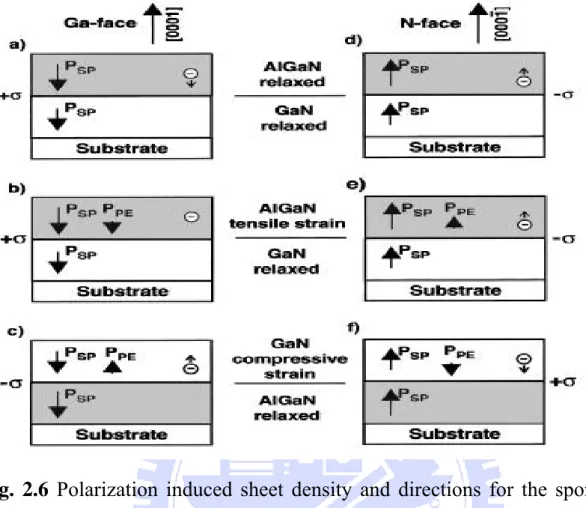
[ ] is less than zero. For AlGaN, over the whole range of compositions, piezoelectric polarization is positive for compressive and negative for tensile barriers. On the other hand, the spontaneous polarization of GaN and AlN is negative. Fig 2.6 shows the directions of the spontaneous and piezoelectric polarization in Ga- and N- face strained and relaxed AlGaN/GaN heterostrucutre.
2.3 AlGaN/GaN HEMTs
2.3.1 Hetero-epitaxial growth of AlGaN/GaN HEMTs
Due to the lack of large-size and low-cost commercial-grade substrate, GaN materials are usually grown on the foreign substrates such as sapphire, Si or SiC. Table 2.2 shows some of the material properties of these substrates as compared
9
to the GaN and AlN layers. Generally, the lattice constants and thermal expansion coefficients of these substrates differ significantly (except SiC) from that of GaN. The first successful epitaxial layer layers of GaN were grown on Sapphire. However, the very large lattice mismatch (14.8%) and the difference in the thermal expansion coefficient between GaN and sapphire substrate cause the huge challenges in the grown of nitrides. As a result of these mismatches, large amount of dislocations are generated in the GaN film. The quality of the GaN film is therefore critically dependent on the ability of the transition layer (buffer layer) used to accommodate the stress generated from these mismatches. The commonly used buffer layers include low temperature GaN [6-7], AlN [8-10] or their variations [11-13]. Dislocations generated in GaN are mainly screw, edge and mixed TDs. In addition to the buffer layers, other approaches are also used to improve the crystal quality of GaN film such as the insertion of AlN interlayers [14] or Si delta-doping layer [15].
High crystalline quality GaN materials are usually grown by metal-organic chemical vapor deposition (MOCVD) and molecular beam epitaxy (MBE) methods. MOCVD is famous for growing the LED-quality GaN and is also used to grow GaN materials for HEMT applications lately. The main advantages of MOCVD, as compared to MBE, are the high growth rate and high crystal quality even for the direct growth of GaN layers on the foreign substrates. Besides, MBE has also proven to be a promising technique to grow GaN materials for HEMT devices application [16-18]. The benefits of growing GaN by MBE include real-time monitoring of crystal growth with reflection high-energy electron deflection (RHEED), a carbon-free and hydrogen-free growth environment, a smooth surface, sharp interfaces and low point defect density. These attributes are important for achieving high quality materials for
10
HEMT devices. Table 2.3 lists some important developments on the electrical properties of AlGaN/GaN structure grown by MOCVD and MBE techniques.
Although these difficulties have been solved, the low thermal conductivity is still an unneglectable problem. Compared with sapphire, SiC has less lattice mismatch (4%) with GaN and very good thermal properties, which is nearly 10 times more than that of sapphire. Therefore, SiC is rather popular substrate. Yet, SiC is too expensive for commercialization. Recently, GaN HEMTs grown on Si substrate was been widely investigated due to lower material cost and compatible with Si technology for circuit integration.
2.3.2 The Basic Structure and Operation of AlGaN/GaN HEMTs
GaN materials for HEMT fabrication consists of a higher bandgap material, such as AlGaN [19] or AlInN [20], grown on the top of the GaN film as the
barrier layer. The discontinuity in conduction bands between the two materials forms a 2-dimentional electron gas (2DEG) channel at the hetero-interface. Basic GaN HEMT structure and band diagrams are shown in Fig. 2.7. AlGaN/GaN HEMT 2DEG formation is totally different from GaAs HEMT. In AlGaAs/GaAs HEMT, the channel electrons come from the surface states in the AlGaAs. The electrons in the AlGaAs where driven into the GaAs layer, because the hetero-junction created by different band-gap materials. The formation mechanism of GaN HEMT 2DEG is due to the strong polarization effect and large amount of surface states. High electron density (~1.5x1013 cm-2) can be induced at the 2DEG by AlGaN barrier layer with Al~25%, and high electron mobility (~2000 cm2/V*s) can be achieved on an AlGaN/GaN heterostructure. Therefore, AlGaN/GaN HEMT does not require intentional
11
doping in the barrier to provide carrier in the 2DEG channel. The 2DEG enables better electron confinement and less carrier scattering. Due to both high mobility and high carrier density, AlGaN/GaN HEMT device of high current density (>2 A/mm) has been demonstrated [21].
2.3.3 Issues of High Gate Leakage Current AlGaN/GaN HEMTs
Despite the impressive device performance, the potential of AlGaN/GaN HEMTs for commercial application have not been fully realized as yet. The RF power expected from fundamental nitride material properties significantly exceeds the experimental data. One of the key problems limiting the HEMT RF power is the high Schottky-gate leakage current, which results in the degradation of DC/RF parameters. At positive gate bias, high forward gate current can shunt the gate-channel capacitance, thus limiting the maximum drain current. At negative gate bias, high voltage drop between the gate and drain results in premature breakdown and the maximum applied drain voltage is restricted [22]. In addition, gate leakage currents increase the device sub-threshold currents, which decrease the achievable amplitude of the RF output. All these limitations become even more severe at high ambient temperatures. Mechanisms of the high gate leakage current in AlGaN/GaN HEMTs have been investigated and possible solutions to suppress the leakage have been explored in the past few years. Through numerical simulations and DC electrical measurements, Miller et al. reported, found that vertical tunneling through the gate area is the dominant mechanism for gate leakage in AlGaN-barrier HEMTs, while additional leakage current mechanisms such as lateral tunneling and defect-assisted tunneling also contributed to the total gate leakage [23]. To suppress the high gate current,
12
Miller et al. proposed an enhanced-barrier HEMT structure, in which a GaN cap layer was grown on the top of the standard AlGaN barrier. Owing to the strong polarization effects in the nitrides, the peak barrier height in the new GaN/AlGaN/GaN HEMT was increased, thus decreasing the tunneling gate leakage current. Mizuno et al. compared the gate leakage current of a GaN-based HEMT with a GaAs-based HEMT [24]. They observed both a two to three orders of magnitude larger gate leakage of the GaN-based HEMTs as compared to that of the GaAs-based HEMTs, and the temperature-independence for the gate leakage current in GaN-based HEMTs. Considering that AlGaN has a larger Schottky barrier height (1.4 eV) than GaAs HEMTs (~1.0 eV), the authors attributed tunneling to be the main leakage mechanism instead of the thermionic emission. They also found that surface treatment with CF4 plasma
prior to the gate metal deposition was able to reduce the gate leakage current by two to three orders of magnitude. A possible explanation of such leakage suppression is that the plasma treatment introduces deep acceptors to compensate the high-density positive charge on the AlGaN surface. Thus, the depletion layer thickness under the gate increases, and gate leakage current due to electron tunneling becomes small.
2.4 AlGaN/GaN MOS HEMTs
2.4.1 Introduction
As described above, device performance of conventional Schottky gate AlGaN/GaN HEMT device suffers from high gate leakage current. As a result,
13
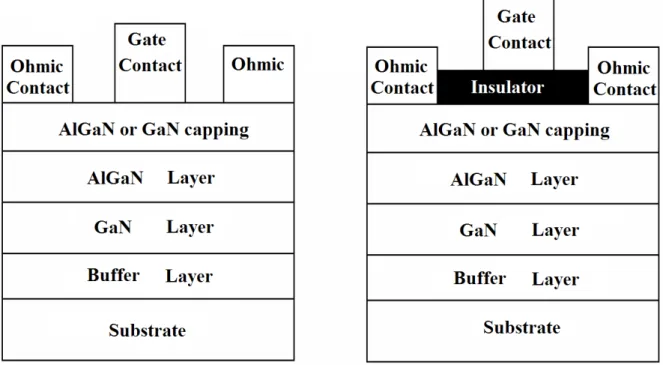
the drain current collapse when operating at high-frequency and poor long-term reliability of Schottky gate. In order to reduce the gate leakage current, a concept of high-k insulators layers between gate metal and semiconductor were investigated in the past years. A schematic comparison between HEMT and MOS-HEMTs for AlGaN/GaN is illustrated in Fig. 2.8.
2.4.2 The requirements of high-k insulators oxide
(A) Insulator constant
Insulator constant is the most important parameter for oxide material used in the MOS structure. Due to the reduction of chip’s size in the future, the horizontal electrical field is increased and the gate modulation ability is decreased. In order to solve these problems, the capacitance per unit area must be improved to decrease the effect of undesired electrical field.
(2-2)
where C is capacitance, Q is charges, and V is turned on voltage.
, ε ן C (2-3)
where ε is the insulator constant of oxide, A is cross section area, and d is the distance between the two plates. According to Eq. (2-2), the devices with larger accumulation capacitance can be turn on more easily by a smaller voltage. Using smaller operating voltage will result in higher device efficiency and cost saving. According to the Eq. (2-3), the MOS device which using oxide material with larger insulator constant as its gate insulator will have larger accumulation capacitance. So, the high-k oxide is desired for III-V MOS devices technology. The energy band gap versus insulator constants of different oxide materials is
14 plotted depicted in Fig. 2.9.
(B) Energy band gap
The energy band gap of oxide materials is an important factor which influences the leakage current of the MOS devices. The oxide with smaller energy band gap causes the carrier tunneling more easily; it will induce undesired leakage current and influence the devices performance. The oxide with larger energy band gap can prevent the carriers tunneling. But, the oxide with higher insulator constant will have the smaller energy bandgap. So, it is important to find the suitable oxide to improve the MOS devices performance. Several gate oxide candidates are listed in Table 2.4. Besides, the band offset of oxide on semiconductor material is also needed to be considered, the value must exceed 1 eV so that the oxide can serve an effective insulator [18].
ALD Al2O3 is introduced in this study due to its relatively high band gap
(about 8.7 eV) and remains amorphous under typical processing conditions. In addition, Al2O3 also possesses high breakdown electric field (5~20 MV/cm),
high thermal stability (up to 1000℃) and strong adhesion with dissimilar materials [25]. With well-controlled thickness and uniformity for the Al2O3 layer
deposited by ALD technology by the good insularity of Al2O3 layer, ALD Al2O3
15
Table 2.1 Advantages of GaN material for electronic applications.
Material property Advantages
Wide bandgap 3.42 eV
Great endurance for high device operating temperature Suitable for high power applications.
Working under high temperature environment
+High breakdown field 4×10⁶ V/cm
Larger power density
High thermal conductivity ~1.3W/cm* K
Better heat dissipation, enhanced device performance Easier device packaging
High saturate electron velocity ~2.7×107 cm/sec
Suitable for high frequency applications
Table 2.2 Material properties and figure of merit (FOM) of GaN, 4H-SiC, GaAs
and Si at 300K for microwave power device applications. All FOMs are normalized with respect to those Si.
Material Bandgap Energy (eV) Breakdown field (MV/cm) Thermal conductively (W/K*cm) Electron mobility (cm2/V*s) High-field Peak velocity (
×
107cm/s) GaN 3.40 4.0 1.3 1350 2.7 4H-SiC 3.26 3.0 4.9 800 2.0 GaAs 1.42 0.4 0.5 6000 2.0 Si 1.12 0.25 1.5 1300 1.016
Table 2.3 Comparison of 2DEG mobility and sheet carrier concentration of
AlGaN/GaN structure grown by MOCVD and MBE on different substrates. The carrier mobility and concentration are measured at 300, 77, 4.2 or 0.3 K unless specify in the bracket; x is the Al content in AlGaN layer.
Growth
Method substrate
Al content
2DEG mobility (cm2/Vs)
(Sheet carrier concentration (ns (cm-2)) Reference
x 300K 77K 4.2K 0.3K
MOCVD
SiC 0.2 (1×102000 13) (8×109000 12) (7×1011000 12) Gaska et al., (1999) [23]
SiC 0.4 (1.4×101990 13) Higashiwaki et al., (2008) [24]
Sapphire 0.18 10300 (1.5K) (6.9×10¹²) Wang et al., (1999) [25]
Sapphire 0.3 (9.84×101300 12) (2006) [26] Liu et al.,
Sapphire 0.2 (8.4×101700 12) Tülek et al., (2009) [27]
Silicon 0.26 (8.2×101500 12) Selvaraj et al., (2009) [28]
Silicon (1×101800 13) Arulkumaran et al., (2010) [29]
MBE
SiC 0.3 (1×101500 13) Corrion el al., (2006) [16]
Sapphire 0.19 (9×101500 12) (6×1010310 12) 12000 Li et. el., (2000) [12]
Sapphire 0.3 (1×101310 13) Manfra et al., (2002) [10]
Silicon 0.25 (7.9×101500 12) Dumka et al., (2004) [30]
MOCVD-GaN/
sapphire 0.09
24000
(2.5×10¹²) 60000 (4K) (2.25×10¹²) Elsass et. al., (2000) [31]
MOCVD-GaN/ sapphire 0.28 2039 (1×10¹³) Cordier et al., (2007) [32] HVPE-GaN/ sapphire 0.06 80000
(1.75×10¹²) Manfra et. al., (2004) [33]
Dislocation free-GaN/
sapphire
0.1 (2.6×102500 12) 109000 Skierbiszewski el
17
Table 2.4 Comparison of the gate oxide’s properties
Fig. 2.1 Band gap (Eg) versus lattice constant at 300 K for wurtzite (α-phase)
and zincoblende (β-phase) GaN, InN, and AlN. The right-hand scale gives the
18
Fig. 2.2 Semiconductor materials for RF applications.
Fig. 2.3 Electron drift velocity of GaN, SiC, Si and GaAs at 300 K computed
19
Fig. 2.4 Schematic drawing of the crystal and energy band structure of wurtzite
GaN and Zinc Blende GaN.
Fig. 2.5 Schematic of the crystal structure of wurtzite Ga-face and-face GaN.
The spontaneous polarization (Psp) direction is also shown.
Psp
20
Fig. 2.6 Polarization induced sheet density and directions for the spontaneous
and piezoelectric polarization in Ga- and N-face AlN/GaN heterostructures.
21
Fig. 2.8 Structure comparisons between AlGaN/GaN HEMT (on the left) and
Al2O3 HEMT (MOS-HEMT) (on the right).
22
Chapter 3
Experimental Methods of AlGaN/GaN MOS-HEMTs with
Al
2O
3High-K Gate Oxide
The fabricated AlGaN/GaN MOS-HEMT with Al2O3 high-k gate oxide in this
study brings together a novel design to enhance the electronic properties of the devices, the process flow of AlGaN/GaN MOS-HEMT with Al2O3 high-K gate
oxide fabrication in this study includes several steps as shown in Fig 3.1, and they are:
1. Ohmic contact formation
2. Active region definition (Mesa isolation) 3. Atomic layer deposition (ALD) Al2O3
4. Gate formation
3.1 Ohmic Contact Formation
An ohmic contact is a low resistance junction formed in between metal and semiconductor. The purpose of an ohmic contact on semiconductor is to allow the electrical current to flow in and out of the semiconductor. A good ohmic contact is important for a better device performance such as lower power consumption, low noise and so on. An ohmic contact should obey the ohms law; that is, it should have a linear I-V characteristic either under forward or reverse bias. Therefore, to obtain a low resistance ohmic contact, we have to create a
23
heavily doped interface between metal and semiconductor. In addition, an ohmic contact not only should be stable over time and temperature, but also should have as small resistance.
First, the negative photoresist AZ5214E and I-line aligner were used to define the ohmic metal pattern after wafer cleaning by using ACE and IPA. Unlike the Si-based devices, the lift-off process is used for III-V based device because of the lack of appropriate etching selection between ohmic metals and III-V materials. The undercut profile of the negative photoresist AZ5214E will benefit the metal lift-off process. Then, the wafers underwent O2 plasma descum to
remove residual photoresist and the dipped in HCl:H2O (1:4) solution for 15 s to
remove the native oxide on the GaN surface before Ohmic metallization. ohmic metal was composed of Ti/Al/Ni/Au from the bottom to the top, and it was deposited by e-gun beam evaporation system. Finally, tcontacts were annealed by rapid thermal annealing (RTA) at 850℃ for 30s in N2 atmosphere after metal
lift-off process as shown in Fig 3.1. The specific contact resistance was checked by the transmission line method (TLM) in the process control monitor (PCM). It containing a linear array of metal contacts with various spacings between them. The distances between TLM electrodes are 3 μm, 5 μm, 10 μm, 20 μm, and 36 μm, respectively in this study. In general, the typical measured contact resistance must be less than 1 x 10⁻⁵ Ω-㎝2.
3.2 Mesa isolation
For III-V devices, the mesa isolation is to isolated devices from each other. In these specific areas, the current flow is restricted to the desired path. In addition,
24
parasitic capacitance, parasitic resistance, and leakage current can all be reduced with effective isolation. A successful isolation provides sufficient insulating area to form passive elements such as transmission lines, capacitors, pads, etc.
First, the active areas were masked by Shipley S1818 photoresist, and then the dry etch process was conducted by inductive couple plasma (ICP) with Cl2 in Ar
ambient. After the dry etch process, the etching depth should reach the buffer layer as shown in Fig 3.3. Finally, the photoresist was striped by ACE. According to the device structure, the mesa was etched to the buffer layer to provide good device isolation. Finally, the etching depth was approximately 2500Å measured by p-10 surface profiler after the strip of photoresist, and the etching profile was carefully checked by scanning electron microscopy (SEM).
3.3 Atomic layer deposition (ALD) Al
2O
3In this study, the Al2O3 was deposited by ALD system. ALD developed in
Finland by T. Suntolan in 1974, and this method is considered as an advanced variant of the CVD technique.
Before the Al2O3 deposition, the chemical surface treatment was used to
remove the surface native oxides. Firstly, the wafers were immersed by HCl : H2O (1:4) solution to remove the native oxides, and followed by rinsing in the
water for 30 s and blowing dry by N2 gas. Then, the wafer was directly
immersed in (NH4)2S solution for 15 min at room temperate, and also rinsed for
30 s in water and blown dry by N2 gas after (NH4)2S treatment. After the
chemical surface treatments, the wafer was loaded into the ALD chamber. The Al2O3 films (TMA/N2/H2O/N2 with periods of 0.2s/5s/0.2s/5s) were deposited
25
over 50 cycles and the thickness Al2O3 was about 10 nm as shown in Fig 3.4.
Finally, the post deposition annealing (PDA) was used to improve the interface quality. The PDA was performed at 400℃ for 5 min in N2.
3.4 Gate Formation
Schottky barrier gate is one of the most important elements of the HEMTs. Both the dimension length and placement of the gate are very critical. For high speed and high frequency applications, short gate length is desired. Decreasing gate length (Lg) can increase the electronic field under the gate so as to
accelerate the transport property of channel electron.
In this study, the 1.5 μm gate length was defined by AZ 2020 photoresist, and then the remnant photoresist was removed by ICP with Ar and O2 ambient.
Beside, the wafer was dipped into the HCl:H2O (1:4) solution for 15 s to remove
the negative oxidation before the gate metal deposition. Here, the multilayer gate metals Ti/Pt/Au were deposited by the e-gum system. Finally, the wafer was immersed into the ACE for 30 min to lift –off the undesired metal, and the ICP was used to clean the wafer as shown in Fig 3.5.
26
Fig. 3.1 the whole wafer
27
Fig. 3.3 Mesa isolation
28
29
Chapter 4
Fundamentals of Electrical Characteristization
After the device fabrication, DC and RF performances of the AlGaN/GaN HEMT and MOS-HEMT were evaluated by using on-wafer measurement. For the DC measurement, the I-V characteristics were obtained by using an HP4142B Modular DC source/monitor and SUSS PA200 semi-auto probe station. The TLM method was used for determining specific contact resistance was by the 4-wires measurement. The S-parameters were measured by HP8510XF vector network analyzer using on-wafer GSG probes from Cascade MicroTech. However, evaluating the RF behaviors of a device on a wafer was a complicated process. For conventional RF measurement of a packaged device, the wafer needs to be diced and then an individual die should be mounted into a text fixture. Discriminating between the die’s and the fixture’s responses became an issue. Furthermore, fixturing die was a time-consuming process, making it impractical for high-volume screening. On-wafer RF characterization can simplify the process [26].
The method of characterization of the AlGaN/GaN HEMT and MOS-HEMT devices are stated in the following section. In this study, de-embedding which must also be performed to obtain the true RF performance of the device is also performable.
4.1 DC Characteristics Measurment [27]
30
evaluate the device characteristics, including the saturation drain current (Idss),
threshold voltage (Vth), transconductance (Gm), breakdown voltage (VBK). For
IDS-VDS curve, the drain voltage sweeps from 0 to 10V, and the gate voltage is
from 1 to pinch-off voltage with a step of -1V. For IDS-VGS curve, the gate
voltage sweeps from 6V to pinch-off voltage such as -8V for MOS-HEMT and -6 for Schottky-gate HEMT, and the drain voltage is from 4 to 15V. The measured breakdown voltage in this study is off-state breakdown voltage. The gate bias is pinch-off voltage, and the drain bias sweep from 0 to a specific value.
4.2 TLM Method
The specific contact resistance between contact metal and cap layer can be extracted by the TLM method [28]. The TLM pattern, as illustrated in Fig. 4.1, was designed in the process control monitor (PCM). In this particular approach, a linear array of contacts pad is fabricated with various spacing in between them. The distances between TLM electrodes are 3, 5, 10, 20, and 36 μm, respectively. The resistance between the two adjacent electrodes can be plotted as a function of the space between electrodes and is expressed by the following equation
R = 2Rc +Rs L/ W , (4-11)
where R is measured resistance, RC is contact resistance, RS is sheet resistance of
channel region, W is electrode width, and L is the space between electrodes. As Fig. 4.2 shows, extrapolating the data to L=0, one can calculate a value for the term RC. And the specific contact resistance ρC can be further extracted by the
following formula. S R R W C 2 2 = ρ (4-12)
31
4.3 Linearity
Linearity of amplifiers is often assessed by the third-order intercept point (IP3). If an amplifier is presented with two signals closely spaced in frequency, and a perfectly linear amplifier would simply amplify the two signals. However, the real amplifier is never with perfectly linearity, and nonlinearity will result in additional output signals. A nonlinear amplifier will have a transfer function that can be approximated as:
Po = a1Pin + a2P2in + a3P3in + … (4-13)
where Pin and Po are the input and output power, and ai are coefficients. A linear
amplifier would have ai =0 for i >1. Consider an input signal with two closely
spaced frequencies, f1 and f2:
Pin = P1sin(2πf1t) + P2sin(2πf2t) (4-14)
If Eq. (4-14) were substituted into Eq. (4-13), we can use elementary algebra and trigonometric identities to show that the output power (Po) contains
the following components: t f P a1 1sin2π1 t f P a1 2sin2π 2 (fundamentals) t f P a sin2 (2 ) 2 1 1 2 1 2 π t f P a sin2 (2 ) 2 1 2 2 2 2 π (second-order products) t f f P P a sin2 (2 ) 4 3 2 1 2 2 1 3 π ±
32 t f f P P a sin2 (2 ) 4 3 2 1 2 2 1 3 π ± (third-order products) M
Assuming P1 = P2, second-order product power is proportional to the square
of the input signal power, third-order product power is proportional to the cube of the input signal power, and so on. But only the odd and greater than third-order terms have greater attribution to the fundamental signal. So we usually consider the fundamental signal and the third-order product signal only. Fig. 4.3 is the output power diagram of the fundamental and the third-order product signals. From Fig. 4.3, we can identify the third-order intercept point (IP3). The Pin value of IP3 is also called IIP3, which is important for low noise
amplifier. From the fundamental diagram of microwave front-end device (Fig. 4.4), the low noise amplifier is used to receive signals. So a higher IIP3 value results in a higher linearity of the amplifier, and the less distortion of the input signals.
4.4 Breakdown Voltage (BV
gd)
Breakdown mechanisms and models have been discussed in many articles.
One of the models showing it is dominated by the thermionic filed emission (TFE) / tunneling current from the Schottky gate. This model predicts that the two-terminal breakdown voltage is lower at higher temperature because tunneling current increases with the temperature. Higher tunneling current occurs at higher temperature because carriers have higher energy to overcome the Schottky barrier. Other model suggests that impact-ionization determines the
33
final two-terminal breakdown voltage, because the avalanche current decreases with increasing temperature. Lower avalanche current occurs at higher temperature because phonon vibrations as well as carrier-carrier scattering increase with increasing temperature. Either model is incomplete since coupling exists between TFE and impact ionization mechanisms. In addition, different devices may suffer from different breakdown mechanisms, depending on the details of the device design (insulator thickness, recess, channel composition, and so forth). In this study, the gate-to-drain breakdown voltage BVgd is defined
as the gate-to-drain voltage when the gate current is 1mA/mm.
4.5 Extrinsic Transconductance (g
m)
The transconductance of the HEMTs indicates the ability of the gate voltage on the control of the drain current. It can be defined as:
(4-15) where the vsat is the electron velocity of the “two dimensional electron gas”
(2-DEG).
The measurement requires specification of the initial gate voltage, the gate voltage step, and the drain voltage at which the measurement is made. Because of the nonlinear behavior of source-drain current as a function of gate voltage, gm typically will become less as the bias approaches pinch-off approaches. This
also means that a smaller voltage step will yield a higher transconductance. The extrinsic transconductance is a function of the total gate width of the device, so the width must also be given. Besides, gm may also be normalized to a unit gate
sat G G D m Z v d dV dI g 2 2 ε = =
34 width, usually mS/mm.
4.6 Scattering Parameters [3-2]
Generally, the Scattering parameters, which referred to as S-parameters, are
fundamental to microwave measurement. S-parameters are a way of specifying return loss and insertion loss or insertion gain. Fig. 4.5 shows the equivalent two-port network schematic at high frequency. The relation of the microwave signals and s-parameters are defined as follows:
⎥ ⎦ ⎤ ⎢ ⎣ ⎡ ⎥ ⎦ ⎤ ⎢ ⎣ ⎡ = ⎥ ⎦ ⎤ ⎢ ⎣ ⎡ a a s s s s b b 2 1 * 22 21 12 11 2 1 (4-16)
S signals going into or coming out of the input port are labeled by a subscript 1. Signals going into or coming out of the input port are labeled by a subscript 2. The electric field of the microwave signal going into the component ports is designated a; that leaving the ports is designated b. Therefore,
a1 is the electric field of the microwave signal entering the component input.
b1 is the electric field of the microwave signal leaving the component input.
a2 is the electric field of the microwave signal entering the component output.
b2 is the electric field of the microwave signal leaving the component output.
By definition, then, 0 2 1 1 11 = = a a b s 0 2 1 2 21 = = a a b s
35 0 1 2 1 12 = = a a b s 0 1 2 2 22 = = a a b s (4-17)
Consequently, s11 is the electric field leaving the input divided by the
electric field entering the input, under the condition that no signal enters the output. Because b1 and a1 are electric fields, their ratio is a reflection coefficient.
Similarly, s21 is the electric field leaving the output divided by the electric field
entering the input, when no signal enters the output. Therefore, s21 is a
transmission coefficient and is related to the insertion loss or the gain of the device. s22 is similar to s11, but looks in the other direction into the device.
4.7 Current-Gain Cutoff Frequency (f
T) and Maximum Oscillation
Frequency ( f
max)
The intrinsic device model for the HEMT device is shown in Fig. 4.6. If we only consider the intrinsic part, the current can be expressed as:
' 2 ' 22 ' 1 ' 21 ' 2 ' 2 ' 12 ' 1 ' 11 ' 1 V y V y i V y V y i + = + = (4-18) assume (ωCgsRi)2 << 1, then we can get:
36 ) ( ) ( ) ( ) ( ) ( 2 2 ' 11 ' 21 ' 1 ' 2 ' 22 ' 21 ' 12 2 2 ' 11 gd gs i gs m i gs gd m ds gd d m gs gd m gd gd gs i gs C C j R C G R C C j G y y i i C C j G y G C C j G y C j y C C j R C y + + + − = = + + = + − = − = + + = ω ω ω ω ω ω ω ω (4-19) assume i gs gd gs m i gs gd m R C C C G R C C G 2 2 ) ( | ) ( | ω ω ω >> + + >>
fT is defined as the frequency when current gain ' 1
1 ' 2 = i i , and can be expressed as: ) ( 2 gs gd m T C C G f + ≅ π (4-20)
fmax can be obtained by using unilateral gain:
d i T d i gs m U G R f f G R C G f y y y y G U 1 4 1 1 ) 2 ( 1 4 1 ) Re( ) Re( 4 | | 2 2 2 2 ' 22 ' 11 2 ' 12 ' 21 max = = − = = π (4-21)
when U=1, fmax can be expressed as:
d i T G R f f 2 max = (4-22)
If we further consider gate resistance Rg, ohmic contact resistance Rs and Rd,
then the small signal equivalent circuit is shown as Fig. 4.7. assume ( )2 <<1
i
gsR
C
37 i gs gd gs m i gs gd m R C C C G R C C G 2 2 ) ( | ) ( | ω ω ω >> + + >> Gm >>|Gd + jω(Cgd +Cds)| then |Y' |= y11'y22' −y12'y21' ≅ jωCgdGm Transfer y parameter into Z parameter:
s d s s s g R R Y y Z R Y y Z R Y y Z R R Y y Z + + = + − = + − = + + = | | ' | | ' | | ' | | ' ' 11 22 ' 21 21 ' 12 12 ' 22 11 and |Z|=Z11Z22 −Z12Z21
{
}
{
}
{
gs gd d gd m}
s d gd gs m m gd ds gd d gd gs s d gd gs m gd ds gd d gd gs s m s d s G C j G C C j R R C C j G i i G C j C C j G C C j R R C C j G C j C C j G C C j R G Y R R y Y R y Z Z Z Z y y i i ω ω ω ω ω ω ω ω ω ω + + + + + ≅ + + + + + + + + + + + + − = + + + − = = = )] ( [ ) ( ) ( )] ( )][ ( [ ) ( ) ( )] ( )][ ( [ | | ) ( | | | | | | 1 2 11 21 22 21 11 21 1 2}
{
( )[1 ( ) ] ( ) 2 gs gd d s d gd m d s m T R R G C G R R C C G f + + + + + ≅ π (13)and we can get fmax [28]:
2 max ) 1 )( 5 . 2 1 ( 5 4 ) / 1 ( 4 m s gs gd gs gd s m g s i m m d T R G C C C C R G R R R G G G f f + + + + + + = (14)
fT and fmax are parameters often used to indicate the high frequency
38
Fig. 4.1The Transmission Line Method (TLM ) pattern.
39 -30 -25 -20 -15 -10 -5 0 5 10 15 -120 -100 -80 -60 -40 -20 0 20 40 60 3rd ORDER PRODUCTS FUNDAMENTALS
3rd ORDER INTERCEPT POINT
OP1dB OIP3 O u tp u t P o w e r (d B m ) Input Power (dBm)
Fig. 4.3 Output power diagram of fundamental andthird-order product signals.
Duplexer Antenna
fRF
fIF
fLO
LNA Filter Mixer IF amplifier
Signal process circuit Modulator PA Pre-amplifier LO
40
Fig. 4.5 The equivalent two-port network schematic at high frequency.
G '
D '
S '
S '
V
1'V
2' g s mV G d s C d G g s C g d C iR
g sV
I
2'
'
I
1Fig. 4.6 AlGaN/GaN HEMT intrinsic device model.
G D S S g R Cgd gs V 1 I 1 V i R gs C ds C d G d R 2 I gs mV G 2 V s R
41
Chapter 5
Study of AlGaN/GaN MOS-HEMTs on Silicon substrate with
Al
2O
3Gate Insulator for Device Linearity Improvement
As shown in chapter 2, device performance of conventional Schottky-gate AlGaN/GaN HEMTs suffers from high gate leakage current. Also, the drain current collapses occurs when operating at high bias voltage resulting in poor long-term reliability of the Schottky gate. To improve the leakage characteristics of the conventional Schottky-gate AlGaN/GaN HEMTs devices, the fabrication and characterization of the 1.5-μm AlGaN/GaN MOS-HEMTs with 10 nm Al2O3
high-k gate oxide grown by ALD on Si substrate was investigated. Compared to regular HEMT devices of similar geometry, little degradation of the drain current and gate control ability was observed. The result indicates that AlGaN/GaN MOS-HEMTs were the gate leakage currents several orders of magnitude lower than those of regular HEMTs, and exhibit better linearity, higher channel saturation current with improved higher power performance.
5.1 Introduction
Recently, with the rapid development of wireless communication system, the transmission speeds of next-generation wireless mobile networks, including Mobile Worldwide Interoperability for Microwave Access (WiMAX) and long term evolution (LTE) networks will be several tens of megabits per second. Higher speeds will require increased output power, leading to increased power
42
consumption by transmission amplifiers, so base stations will require significantly higher power and more physical space. Therefore, there is a need to develop compact base stations that offer easy implementation and low operation costs. To make possible a small base station with lower power consumption, high-efficiency power amplifiers are currently being developed using gallium nitride high electron mobility transistors (GaN-HEMTs). The superior properties of AlGaN/GaN HEMTs promising contenders for high-power, high-temperature, high-breakdown, and high-frequency applications.
However, one of the key problems limiting the performance and reliability of AlGaN/GaN HEMTs for high-power RF applications is the high Schottky-gate leakage current, which results in the degradation of DC/RF parameters. At positive gate bias, high forward gate current can shunt the gate-channel capacitance, thus limiting the maximum drain current. At negative gate bias, high voltage drops between the gate and drain resulting in premature breakdown and the maximum applied drain voltage is restricted. Besides, gate leakage current increase resulting in the device sub-threshold currents, which decrease the achievable amplitude of RF output. All these limitations become the most important key factors to be solved for the development of the advanced wireless communication system.
To overcome this problem, several groups have been trying to integrate the MOS structure into conventional Schottky-gate HEMT by looking for proper gate insulators for AlGaN/GaN based HEMT. Al2O3 has been used as the gate
insulator to reduce the gate leakage, which allows the application of high positive gate voltage to further increase the sheet electron density in 2D channel. It also offers additional benefits of a wide band gap (about 8.7eV), high breakdown electric field (5~20 MV/cm), high thermal stability (amorphous up to
43
at least 1000ºC) and chemical stability compared to AlGaN. With well-controlled thickness and uniform Al2O3 layer deposited by ALD technology
which employs surface saturation reaction technique, ALD Al2O3 is the leading
candidate for the gate insulators in MOS-HEMT device.
On the other hand, in the advanced wireless communication system, multichannel transmissions are extensively used to transmit signals. As transiting signals, there are many operating frequencies with the neighboring frequencies located closely to each other, so it is important to consider that the device used in the communication system would not induce signal distortions. However, among all intermodulation distortions, third-order intermodulation distortion (IM3) can’t be filtered out by the filter; therefore, IM3 dominates the linearity performance of the device and is the most important linearity criteria for wireless communication system [29]. Therefore, in this research, we study the linearity characteristics of the Al2O3 AlGaN/GaN MOS-HEMTs on Si
substrates, and compare it with the regular AlGaN/GaN HEMTs devices for device linearity improvement in this study.
5.2 Device Fabrication
The AlGaN/GaN HEMTs structure was grown on Si substrate using MOCVD technology. Electron mobility of 1600 cm2V-1s-1 and sheet carrier density of 1 1013 cm-2 were measured by hall measurement. The device processing started with ohmic contact formation. Ohmic metal Ti/Al/Ni/Au was evaporated by e-gun system, and then annealed at 800 for 1min in N℃ 2. The
44
isolation was attained through dry etch process was controlled by inductive couple plasma (ICP) with Cl2 in Ar ambient. A 10nm amorphous Al2O3 oxide
layer was deposited onto the wafer by atomic layer deposition (ALD) at 300ºC prior to the gate formation. The ALD technique allows high-quality ultra-thin material deposition with atomic layer accuracy. After gate photolithography, a Ti/Pt/Au electrode was evaporated. A schematic comparison between HEMT and MOS-HEMT are fabrication as shown in Fig. 5.1.
5.3 Results and Discussion
Ohmic contact with contact resistance of 2.8×10⁻⁶ (Ohm-cm2) was evaluated by TLM method. Fig. 5.2 shows the typical output current-voltage (I-V) characteristics of the 1.5μm gate length AlGaN/GaN HEMT and Al2O3
MOS-HEMT. The Schottky-gate device has a maximum drain current of 404 mA/mm at VGS = 0, while the MOS-HEMT devices have 544.2 mA/mm drain
currents, respectively. Besides, the HEMTs and MOS-HEMTs were completely pinch-off at a gate voltage of -5 and -6.7V, respectively. The negative shift in the Vth was attributed to the decrease gate barrier capacitance. The experimental Vth
for both HEMTs and MOS-HEMTs were in good agreement with the values obtained from Eq. (5-1), neglecting the residual doping in the AlGaN barrier layer [6]: = ⋅ b C s th en V (5-1) Where e is the electronic charge, ns is the sheet charge density and Cb is the total
unit area capacitance of the barrier layer and dielectric.
Fig. 5.3 shows the IDS versus VGS curves of HEMT and MOS-HEMT
45
HEMTs have lower IDS of 747 mA/mm at VGS = 3.6 V, but for MOS-HEMTs, its
reaches 880 mA/mm at 6 V gate bias. In this sense, the good quality of both Al2O3 insulator and Al2O3/HEMT interface has rendered a higher applicable gate
bias, which result in a higher driving current capacity of MOS-HEMTs compared to HEMTs. Moreover, the drain current at the same gate bias is also higher for MOS-HEMT. This difference arises, thereby making the MOS-HEMT channel depletion for the same gate voltage smaller than that for the HEMT. In Fig. 5.4, a slight transconductance decrease in MOS-HEMTs compared to HEMTs from 171 to 132 mS/mm was observed, which is consistent with a further separation between the control gate and the 2-DEG channel with the presence of an additional Al2O3 layer in MOS-HEMTs. However, due to the high
dielectric constant of Al2O3, the degradation in gm,max of MOS-HEMT is only
22.8% relative to that of HEMT, much better than the serve transconductance deterioration in MOS-HEMTs using low-k gate dielectrics such as SiO2 (27.2%),
Si3N4 (35.7%). This is in agreement with an estimated reduction of 20% by (5-1),
assuming drift velocity saturation (at Lg = 1.5μm) with Vsat = 5x106 cm/s. In
additional, the gate voltage swing (GVS), defined as the 10% drop from the
gm,max increase from 0.3V for HEMTs to 3.1 V for MOS-HEMTs. The larger
GVS suggests a better linear behavior for MOS-HEMTs compared to Schottky-gate HEMTs, from which a smaller intermodulation distortion, a smaller phase noise and a larger dynamic range could be expected, thus desirable for practical amplifier application.
Fig. 5.5 shows the gate leakage performance of the both HEMTs and MOS-HEMTs with the same device dimensions, from which the leakage current of MOS-HEMTs is found to be significantly lower than that of the Schottky-gate HEMTs. The gate leakage current density of MOS-HEMTs is almost 3 orders of

![HPSH [ 氧化數平衡反應式係數 ]](data:image/gif;base64,R0lGODlhAQABAIAAAP///wAAACH5BAEAAAAALAAAAAABAAEAAAICRAEAOw==)