A Three-Coordinate and Quadruply Bonded Mo
-
Mo Complex
Yi-Chou Tsai,*,†Yang-Miin Lin,†Jen-Shiang K. Yu,‡and Jenn-Kang Hwang‡Department of Chemistry, National Tsing Hua UniVersity, Hsinchu 30013, Taiwan, Republic of China, and Department of Biological Science and Technology, National Chiao Tung UniVersity,
Hsinchu 30050, Taiwan, Republic of China Received May 23, 2006; E-mail: [email protected]
Since Professor Cotton’s seminal recognition of the first dirhe-nium complex [Re2Cl8]2-featuring a quadruple bond between two
metal atoms in 1964,1 the field of metal-metal quadruple-bond
chemistry has progressed at a dramatic rate in the past decades. Thus far, the paddlewheel motif has been one of the most prevalent structural types observed.2It is worth noting that in order to preserve
theδ-interaction between two metals, the four ligands coordinating
to each metal are restricted to eitherσ-donors or weak π-donors,
such as amines, halides, phosphines, and alkoxides.2,3
In addition to the regular quadruply bonded dimetal species, coordination complexes having metal-metal multiple bonds can be stabilized by goodπ-donor ligands. For instance, Chisholm has
pioneered the use of six amide ligands to support group VI metals in discrete “ethane-like” dimeric forms, M2(NMe2)6where M )
Mo or W.4 Moreover, Power’s group recently reported the first
isolable dichromium complex with a five-fold bond between two Cr atoms, supported by only two bulky monodentate carbyl ligands.5
Low-coordinate metal complexes are highly attractive due to their unsaturated coordination spheres which can serve as an efficient platform for activating small molecules such as N2.6In this
com-munication, we report a successful synthesis of the first symmet-rically bridged7 and quadruply bonded dinuclear Mo(II) amido
complex of the type of M2X4.
Metathesis reaction between the dimeric dilithio salts of [Me2
-Si{NLi(Dipp)}2]2(Dipp ) 2,6-i-Pr2C6H3)8with 2 equiv of
mon-omeric MoCl3(THF)3in diethyl ether at room-temperature resulted
in the formation of the corresponding triply bonded dimolybdenum complex syn-1,2-Mo2Cl2[µ-η2-Me2Si(NDipp)2]21, (eq 1, Scheme
1) which was isolated by recrystallization from n-hexane in 90% yield as air- and moisture-sensitive orange crystals. The proton NMR spectrum of 1 in C6D6showed four doublet resonance signals
(δ 0.62, 1.29, 1.47 and 1.69) corresponding to the eight i-Pr groups,
and two multiplet signals aroundδ 4.27 and 4.13 ppm which were
assigned to the eight methine protons.
Crystals of 1 were analyzed by X-ray crystallography. Interest-ingly, in contrast to the reported staggered anti rotamers of 1,2-M2X2(NR2)4,2,9the structure of 1 adopted the form of the eclipsed
syn conformation, featuring two terminal chlorides and two Me2
-Si(NDipp)2 ligands spanning a metal-metal triple bond.10 The
ORTEP drawing of 1 is shown in Figure S1 (see Supporting Information). The coordination geometry of each metal center is nearly trigonal pyramidal. A striking structural feature of 1 is the large Cl-Mo-Mo-Cl torsion angle of 30.43(8)°, which is assumed as a consequence of the tetrahedral geometry around Si atoms. The Mo-N distances of 1.977(5) and 1.988(5) Å in 1 are in the range of the documented Mo-N lengths.2,4,9Interestingly, despite the
structural difference between 1 and complexes anti-1,2-MoX2
-(NMe2)4, the Mo-Mo bond length of 2.2016(10) Å for 1 is typical
for Mo-Mo triple bonds, which is even slightly shorter than that
in the corresponding anti-1,2-MoCl2(NMe2)4,9bdue to greater orbital
overlap between MX3fragments in an eclipsed ligand
conforma-tion.11Compound 1 thus provides us a good opportunity for the
preparation of an unprecedented complex of the type Mo2X4.
In pursuit of an unprecedented three-coordinate and quadruply bonded Mo2 complex, we sought to chemically reduce 1 by two
electrons. The cyclic voltammogram of a solution of 1 (THF/TBAP) shows two reversible reductions at E1/2 ) -1.83 and -2.01 V
(relative to Fc/Fc+) over the course of the cathodic sweep. Accord-ingly, reduction of an ether solution of 1 with Na/Hg gave the dia-magnetic Mo2[µ-η2-Me2Si(NDipp)2]2 2 in 43% yield as an
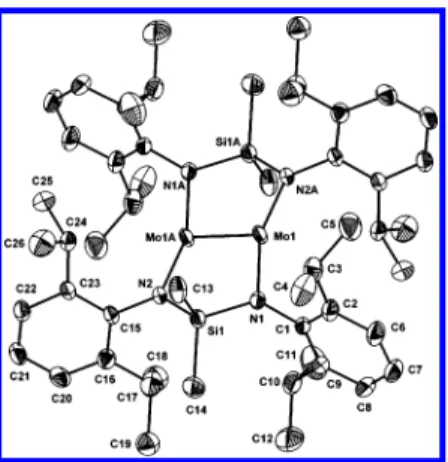
ex-tremely air- and moisture-sensitive orange solid. X-ray structure analysis confirmed the dinuclear nature of 2 and the central Mo-Mo bond. The structure revealed a disorder problem, in which two molybdenum atoms were disordered over three positions. (Sup-porting Information) One orientation of the disordered Mo2 in 2
depicted in Figure 1 shows a fused bicyclic skeleton containing a central Mo24+core spanned by two ligands, and thus exhibiting a
virtual C2hsymmetry in which the SiC2units lie in the horizontal
mirror plane. Each Mo atom is three-coordinate by two N atoms of the two amides and one adjacent Mo atom. Atoms of N(1), Mo-(1), Mo(1A), and N(1A) are coplanar, and the dihedral angle of
N-Mo-Mo-N in both the five-membered SiN2Mo2 rings are
12.08(16)°, thus providing effective steric protection for the two Mo atoms. The bond length between Mo(1) and N(1) is 1.967(4) Å and between Mo(1) and N(2A) is 1.958(4) Å which are fairly short, and the sum of the bond angles around N(1), which adopts a trigonal-planar geometry, is 359.4°and that of N(2) is 359.8°, indicating strongπ-interactions between Mo and N atoms. As is
usually the case for metal-metal dimers, the most intriguing metric is the metal-metal bond length, particularly in such a low-coordinate compound as 2. Interestingly, the bond length of Mo(1)-Mo(1A) is 2.1784(12) Å and is categorized as a long Mo-Mo quadruple bond.12
In addition to crystallographic data, electronic absorption and resonance Raman spectroscopy also provided insight into the existence of metal-metal quadruple bonds.2Most quadruply bonded
dinuclear complexes are vividly colored due to the small separations in energy between the δ and δ* orbitals. Indeed, an electronic
†National Tsing Hua University. ‡National Chiao Tung University.
Scheme 1
Published on Web 10/06/2006
absorption band of the orange-colored complex 2 was observed at about 17240 cm-1, which is assigned tentatively to an allowed transition from the molecule’sδ2(1A
g) to itsδδ* (1Bu) electronic
state, assuming idealized C2hsymmetry for the complex. A
time-dependent density functional theory (TDDFT) calculation of the electronic transition gave a value well in accord with the experi-mentally observed quantity (Table S2, Supporting Information). Furthermore, the totally symmetric metal-metal stretch,
ν(Mo-Mo), was found at the frequency of 343 cm-1 in the resonance Raman spectrum falling in the range of frequencies between 330 and 430 cm-1for the documented quadruply bonded dimolybdenum species.2
With the intent of gaining an understanding of the electronic structure and bonding of 2, we carried out electronic structure computations using density functional theory at the BLYP level. It is noteworthy that sterically encumbered ligand variants are necessary to stabilize 2. Attempts to model 2 via replacing Dipp groups with H atoms failed due to the crash of the molecular shape. Consequently, calculations on authentic formula were engaged, and the optimized geometry was constrained to C2h. The computed
Mo-Mo bond length is 2.168 Å, which agrees very well with the experimental Mo-Mo value of 2.1784(12) Å. As for the electronic structure, attention should be paid to dx2-y2and dxyorbitals13with
two Mo atoms being defined to lie on the z axis. The dx2-y2orbitals of Mo atoms in 2 are used forδ-bond formation (HOMO, Figure
2a), although half of each dx2-y2orbital is engaged in the formation of two Mo-to-Nσ-bonds, while two dxyorbitals are used to form four Mo-to-Nπ-bonds (HOMO-11, Figure 2b). This is in contrast
to the bondings between two metals in conventional paddlewheel structural motifs in which overlap of two dxyorbitals gives rise to
aδ-bond in paddlewheel structures while each metal uses dx2-y2to form metal-to-ligandσ-bonds. Moreover, not only does the contour
plot of HOMO have contribution from dx2-y2 (69.61%), it also contains 30.30% of s orbital and 0.09% of p orbital on the basis of natural bond orbital (NBO) analysis.13
The chemical property of 2 is consistent with the observation made from electrochemical measurements (i.e. the oxidative addi-tion).14For example, exposure of 2 to organic chlorides, such as
CH2Cl2or 1,2-C2H4Cl2, quickly gives 1, which can then be
con-verted once again to 2 upon reduction. The result provides us the opportunity to further explore the potentially rich chemistry of inter-conversion between M2X6triple bonds and M2X4quadruple bonds.
In summary, we have prepared an unusual triply bonded dimolyb-denum complex, syn-1,2-Mo2Cl2[µ-η2-Me2Si(NDipp)2]2, 1, from
which the first three-coordinate and quadruply bonded dimolyb-denum complex Mo2[µ-η2-Me2Si(NDipp)2]22 can be isolated upon
reduction of 1. Complex 2 exhibits an electronic structure different from that of the conventional paddlewheel structures. Reactivity studies of 2 are underway.
Acknowledgment. We are grateful to the National Science
Council of Taiwan (Grant NSC 93-2113-M-007-020) for financial support, Mr. Ting-Shen Kuo (National Taiwan Normal University), Professor Ju-Chun Wang (Soochow University, Taiwan, R.O.C.) for help with crystallographic details, and the National Center for High-performance Computing for computer time and facilities. We also thank Professors Christopher C. Cummins (MIT) and Ching-Han Hu (National Changhua University of Education, Taiwan, R.O.C.) for insightful discussions.
Supporting Information Available: Experimental details for the
synthesis of 1 and 2, cyclic voltammetry, UV-vis, X-ray crystal-lographic data, including tables and CIF files, and details of the computational study (DFT). This material is available free of charge via the Internet at http://pubs.acs.org.
References
(1) Cotton, F. A.; Curtis, N. F.; Harris, C. B.; Johnson, B. F. G.; Lippard, S. J.; Mague, J. T.; Robinson, W. R.; Wood, J. S. Science 1964, 145, 1305-1307.
(2) Cotton, F. A., Murillo, C. A., Walton, R. A., Eds. Multiple Bonds Between Metal Atoms, 3rd ed.; Springer Science and Business Media, Inc.: New York, 2005.
(3) Chisholm, M. H., Ed. Early Transition Clusters withπ-Donor Ligands;
VCH Publishers: New York, 1995; p 167.
(4) (a) Chisholm, M. H.; Reichert, W. W. J. Am. Chem. Soc. 1974, 96, 1249-1251. (b) Chisholm, M. H.; Cotton, F. A.; Frenz, B. A.; Reichert, W. W.; Shive, L. W.; Stults, B. R. J. Am. Chem. Soc. 1976, 98, 4469-4476. (5) (a) Nguyen, T.; Sutton, A. D.; Brynda, M.; Fettinger, J. C.; Long, G. J.;
Power, P. P. Science 2005, 310, 844-847. (b) Radius, U.; Breher, F. Angew. Chem., Int. Ed. 2006, 45, 3006-3010. (c) Brynda, M.; Gagliardi, L.; Widmark, P.-O.; Power, P. P.; Roos, B. O. Angew. Chem., Int. Ed.
2006, 45, 3804-3807.
(6) (a) Laplaza, C. E.; Cummins, C. C. Science 1995, 268, 861-863. (b) Laplaza, C. E.; Johnson, M. J. A.; Peters, J. C.; Odom, A. L.; Kim, E.; Cummins, C. C.; George, G. N.; Pickering, I. J. J. Am. Chem. Soc. 1996, 118, 8623-8638. (c) Yandulov, D. V.; Schrock, R. R. J. Am. Chem. Soc.
2002, 124, 6252-6253 (d) Yandulov, D. V.; Schrock, R. R. Science 2003,
301, 76-78.
(7) Similar structures have recently been reported on dinuclear Au(I) and Cu-(I) amidinato complexes. (a) Abdou, H. E.; Mohamed, A. A.; Fackler, J. P., Jr. Inorg. Chem. 2005, 44, 166-168. (b) Jiang, X.; Bollinger, J. C.; Baik, M.-H.; Lee, D. Chem. Commun. 2005, 1043-1045.
(8) Hill, M. S.; Hitchcock, P. B. Organometallics 2002, 21, 3258-3262. (9) (a) Schulz, H.; Folting, K.; Huffman, J. C.; Streib, W. E.; Chisholm, M.
H. Inorg. Chem. 1993, 32, 6056-6066. (b) Akiyama, M.; Chisholm, M. H.; Cotton, F. A.; Extine, M. W.; Murillo, C. A. Inorg. Chem. 1977, 16, 2407-2411.
(10) (a) Manke, D. R.; Loh, Z.-H.; Nocera, D. G. Inorg. Chem. 2004, 43, 3618-3624. (b) Su, K.; Tilley, T. D. Chem. Mater. 1997, 9, 588-595. (c) Blatchford, T. P.; Chisholm, M. H.; Huffman, J. C. Inorg. Chem. 1987, 26, 1920-1925. (d) Armstrong, W. H.; Bonitatebus, P. J., Jr. Z. Kristallogr. New Cryst. Struct. 1999, 214, 241-242.
(11) Albright, T. A.; Hoffmann, R. J. Am. Chem. Soc. 1978, 100, 7736-7737. (12) Cotton, F. A.; Daniels, L. M.; Hillard, E. A.; Murillo, C. A. Inorg. Chem.
2002, 41, 2466-2470.
(13) Reed, A. E.; Curtiss, L. A.; Weinhold, F. Chem. ReV. 1988, 88, 899-926 and references therein.
(14) Nocera, D. G. Acc. Chem. Res. 1995, 28, 209-217.
JA0635884
Figure 1. Molecular structure of 2 (thermal ellipsoids at the 30% probability level). Selected bond distances (Å) and angles (deg): Mo(1)-Mo(1A), 2.1784(12); Mo(1)-N(1), 1.967(4); Mo(1)-N(2A), 1.958(4); Si(1)-N(1), 1.747(4); Si(1)-N(2), 1.765(4); N(1)-Mo(1)-Mo(1A), 97.16(11); N(2)-Mo(1A)-Mo(1), 99.37(11); Mo(1)-N(2A), 159.56(16); N(1)-Si(1)-N(2), 104.31(19); Si(1)-N(2)-Mo(1), 114.5(2); Si(1)-N(1)-Mo(1), 113.2(2).
Figure 2. Contour plots of HOMO (a) and HOMO-11 (b) of 2.
C O M M U N I C A T I O N S